Leviticus 24:15

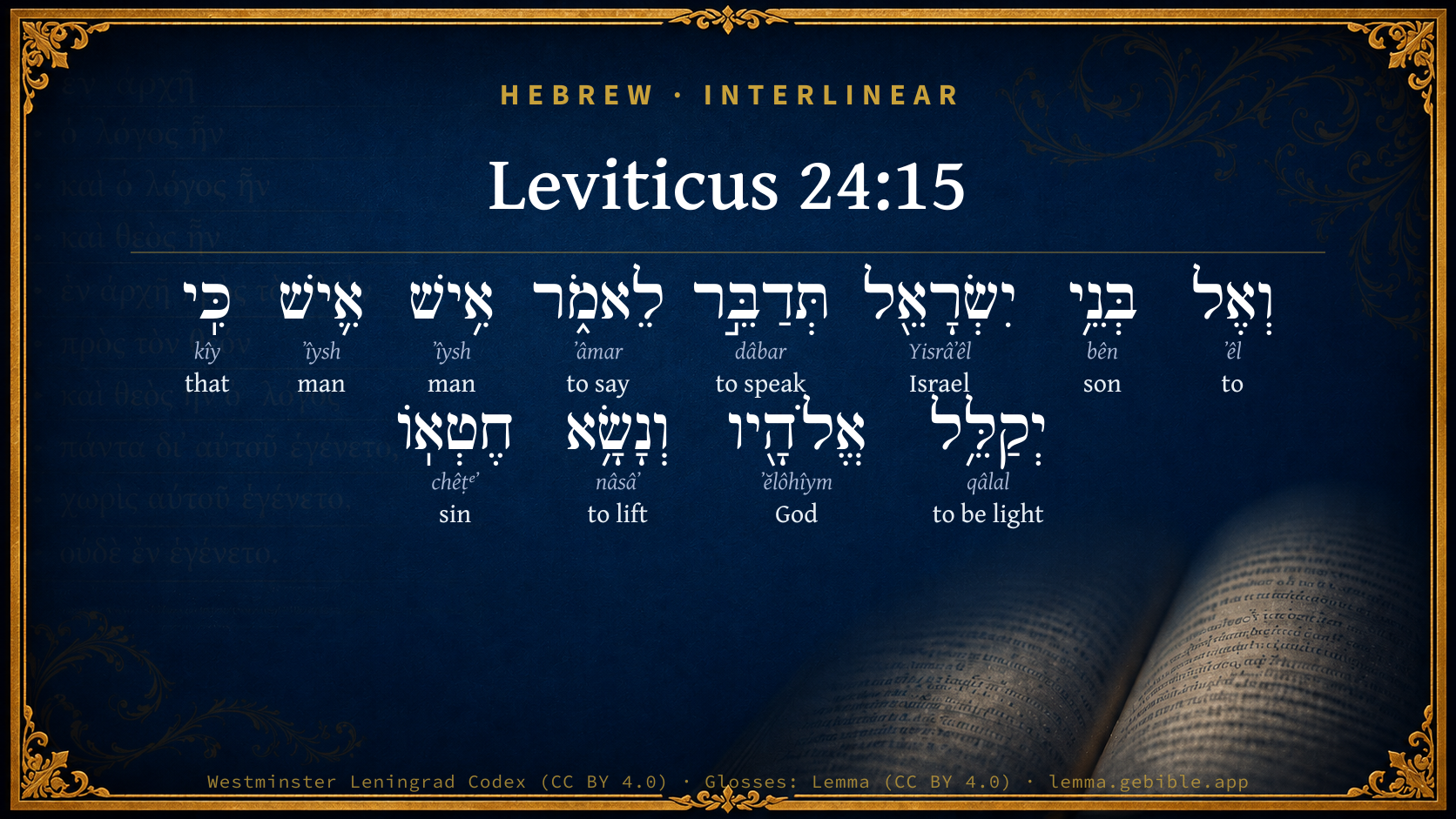
Hebrew (Westminster Leningrad Codex) Leviticus 24:15 appears in the Hebrew Old Testament. The text above is from the Westminster Leningrad Codex. Each word links to its Strong’s number, a concise gloss, and parsing drawn from the Open Scriptures Hebrew Bible morphology. Click any word for its full Brown-Driver-Briggs (BDB) entry.
Download image
Cite this verse

Leviticus 24:15 (World English Bible). Public Domain. Lemma interlinear Bible study tool, https://lemma.gebible.app/v/leviticus/24/15.

Show BibTeX & RIS
BibTeX
RIS
English Translation
You shall speak to the children of Israel, saying, 'Whoever curses his God shall bear his sin.
World English Bible · Public Domain
Download a study sheet

One document with this verse’s original text, its word-by-word gloss line, the meaning frame, cross-references with their text, attributed commentary, and full source and license credits — printable, and it pastes into notes with its structure intact.

This verse Autodidact and up

Study sheet (.html) Plain text (.txt)

A passage Seminary Student

Up to 50 verses in one chapter. A passage sheet keeps up to 6 commentary sources and 12 cross-references per verse, in the order this page ranks them, and says so on the sheet whenever that leaves anything out. Ask for a single verse and you get the Autodidact verse sheet above.

Everything on this page stays free to read, with no account — the sheet is a download of what is already on screen, not access to it.

Want to remove ads? Support Godless Engineer
Compare translations 3

The same verse in 3 English versions, stacked beneath the original-language interlinear above. Click any original word for its lexicon entry.

Each is an independent rendering of the whole verse — the interlinear is not word-aligned to these translations.

Highlighted words mark where these versions differ — a whole-verse word diff, not a word-by-word alignment.

  • World English Bible Public Domain
    You shall speak to the children of Israel, saying, 'Whoever curses his God shall bear his sin.
  • King James Version Public Domain
    And thou shalt speak unto the children of Israel, saying, Whosoever curseth his God shall bear his sin.
  • unfoldingWord Literal Text CC BY-SA 4.0
    And to the sons of Israel you shall speak, saying, ‘A man, a man if he curses his God, then he shall bear his sin.

unfoldingWord Literal Text — © unfoldingWord, licensed CC BY-SA 4.0. Word-aligned USFM3 via Door43 (git.door43.org/unfoldingWord/en_ult).

Versions to compare (up to 4)

3 of 4 selected

Show all 18 translations

Every available English version of this verse, each an independent rendering of the whole verse.

  • World English Bible Public Domain
    You shall speak to the children of Israel, saying, 'Whoever curses his God shall bear his sin.
  • Berean Standard Bible Public Domain
    And you are to tell the Israelites, ‘If anyone curses his God, he shall bear the consequences of his sin.
  • Majority Standard Bible Public Domain
    And you are to tell the Israelites, ‘If anyone curses his God, he shall bear the consequences of his sin.
  • King James Version Public Domain
    And thou shalt speak unto the children of Israel, saying, Whosoever curseth his God shall bear his sin.
  • American Standard Version (1901) Public Domain
    And thou shalt speak unto the children of Israel, saying, Whosoever curseth his God shall bear his sin.
  • Revised Version (1885) Public Domain
    And thou shalt speak unto the children of Israel, saying, Whosoever curseth his God shall bear his sin.
  • Geneva Bible (1599) Public Domain
    And thou shalt speake vnto the children of Israel, saying, Whosoeuer curseth his God, shall beare his sinne.
  • Douay-Rheims (1899) Public Domain
    And thou shalt speak to the children of Israel: the man that curseth his God, shall bear his sin:
  • Young's Literal Translation Public Domain
    `And unto the sons of Israel thou dost speak, saying, When any man revileth his God -- then he hath borne his sin;
  • Literal Standard Version CC BY-SA 4.0
    And you speak to the sons of Israel, saying, When any man reviles his God—then he has borne his sin;
  • Unlocked Literal Bible CC BY-SA 4.0
    You must explain to the people of Israel and say, 'Whoever curses his God must carry his own guilt.
  • unfoldingWord Literal Text CC BY-SA 4.0
    And to the sons of Israel you shall speak, saying, ‘A man, a man if he curses his God, then he shall bear his sin.
  • Darby Bible Public Domain
    And thou shalt speak unto the children of Israel, saying, Every one when he revileth his God shall bear his sin.
  • World Messianic Bible Public Domain
    You shall speak to the children of Israel, saying, ‘Whoever curses his God shall bear his sin.
  • Webster's Bible Public Domain
    And thou shalt speak to the children of Israel, saying, Whoever curseth his God shall bear his sin.
  • Free Bible Version CC BY-SA 4.0
    Tell the Israelites that anyone who curses their God will be punished for their sin.
  • Bible in Basic English Public Domain
    And say to the children of Israel, As for any man cursing God, his sin will be on his head.
  • JPS Tanakh (1917) Public Domain
    And thou shalt speak unto the children of Israel, saying: Whosoever curseth his God shall bear his sin.

Literal Standard Version (2020), Covenant Press — licensed CC BY-SA 4.0. Text via the HelloAO Bible API (eBible.org). Unlocked Literal Bible (unfoldingWord) — licensed CC BY-SA 4.0. Text via the HelloAO Bible API (eBible.org). unfoldingWord Literal Text — © unfoldingWord, licensed CC BY-SA 4.0. Word-aligned USFM3 via Door43 (git.door43.org/unfoldingWord/en_ult). Free Bible Version, Dr. Jonathan Gallagher — licensed CC BY-SA 4.0. Text via the HelloAO Bible API (eBible.org).

Word by word

More ways to search: Search by grammar → Find every occurrence → Compare this word →

Practice this passage: Drill this verse → Learn its vocabulary →

חֶטְאֽוֹ
chêṭᵉʼ
H2399
“sin · his”
Noun, Common, Masculine, Singular, Construct + Suffix, Personal, 3rd Person, Masculine, Singular
Part of Speech
Noun
Type
Common
Gender
Masculine
Number
Singular
State
Construct
Full BDB Definition

Origin: from H2398

TWOT: 638a

sin - sin - guilt for sin - punishment for sin
  1. וְאֶל ʼêl H413 “and · to” Conjunction + Preposition
  2. בְּנֵ֥י bên H1121 “sons of” Noun, Common, Masculine, Plural, Construct
  3. יִשְׂרָאֵ֖ל Yisrâʼêl H3478 “Israel” Noun, Proper
  4. תְּדַבֵּ֣ר dâbar H1696 “to speak” Verb, Piel, Imperfect, 2nd Person, Masculine, Singular
  5. לֵאמֹ֑ר ʼâmar H559 “to say” Preposition + Verb, Qal, Infinitive Construct
  6. אִ֥ישׁ ʼîysh H376 “man” Noun, Common, Masculine, Singular, Absolute
  7. אִ֛ישׁ ʼîysh H376 “man” Noun, Common, Masculine, Singular, Absolute
  8. כִּֽי kîy H3588 “that” Conjunction
  9. יְקַלֵּ֥ל qâlal H7043 “to be light” Verb, Piel, Imperfect, 3rd Person, Masculine, Singular
  10. אֱלֹהָ֖יו ʼĕlôhîym H430 “God(s) · his” Noun, Common, Masculine, Plural, Construct + Suffix, Personal, 3rd Person, Masculine, Singular
  11. וְנָשָׂ֥א nâsâʼ H5375 “and · to lift” Conjunction + Verb, Qal, Sequential Perfect, 3rd Person, Masculine, Singular

About this verse

These counts appear in no published source. They are computed here, from the morphology-tagged text and Lemma’s own curated glosses. What Lemma adds →

12
words
11
distinct lemmas
Pentateuch
section

Shared distinctive vocabulary

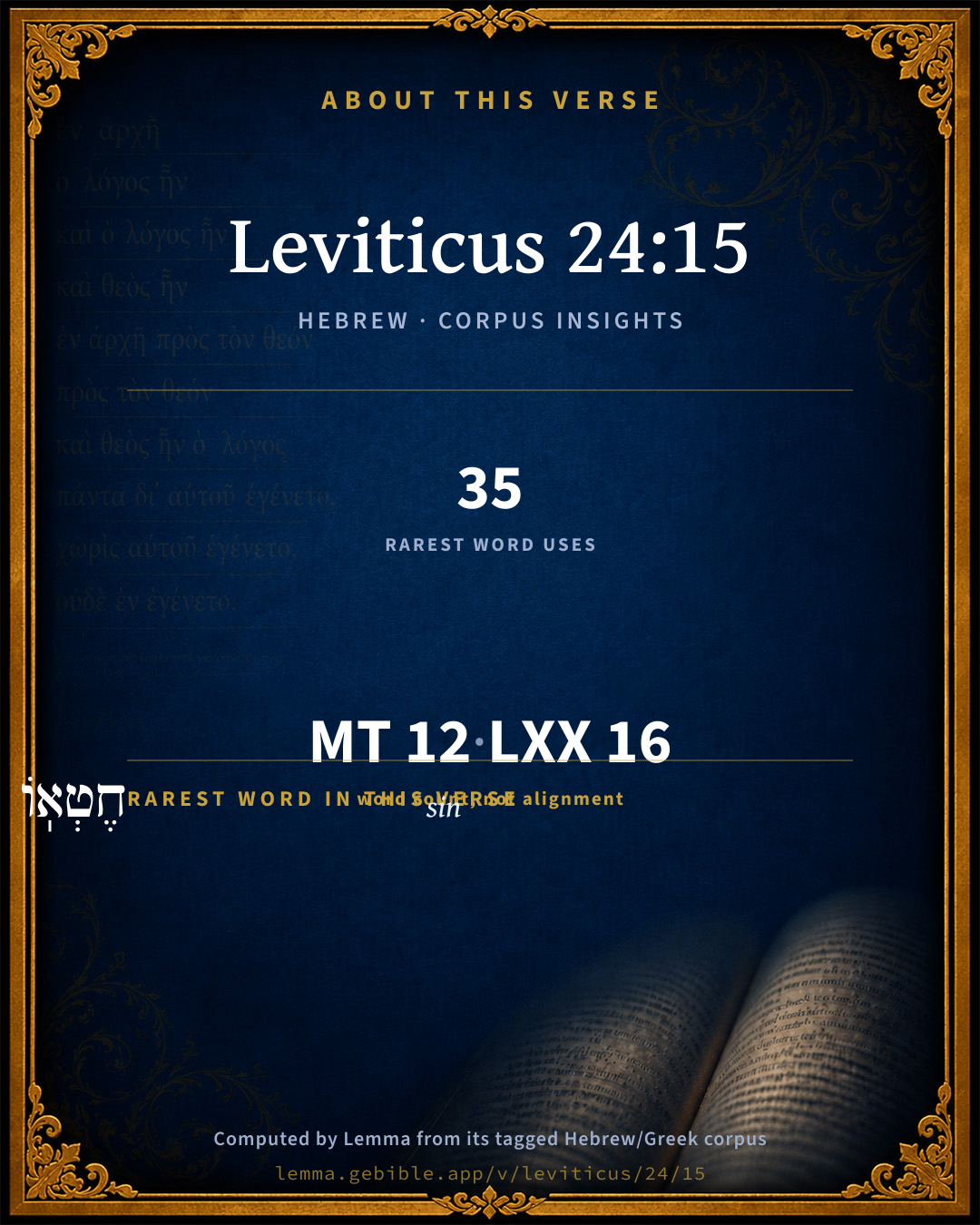
חֶטְאֽוֹ sin H2399 occurs in 34 verses of the Hebrew Bible. Also found in:

Grammatical profile

  • 4 verbs
  • 6 nouns
  • 1 preposition
  • 1 conjunction

Verb forms

  • תְּדַבֵּ֣ר Piel · Imperfect
  • לֵאמֹ֑ר Qal · Infinitive Construct
  • יְקַלֵּ֥ל Piel · Imperfect
  • וְנָשָׂ֥א Qal · Sequential Perfect

Repetition

A word recurs within this verse — often emphatic in Hebrew:

  • אִ֥ישׁ man H376 ×2

Hebrew & Septuagint length

In English translation the verse runs 17 words from the Hebrew and 21 from the Septuagint (LXX English) — closely comparable.

A rough comparison of the two English renderings, which tokenize alike — not a word-level alignment.

Word counts can differ between the Hebrew and the Greek without any difference in meaning — e.g. the Hebrew direct-object marker אֵת has no separate Greek word, and Greek often adds the article ὁ.

In the original languages it is 12 Hebrew tokens and 16 Greek tokens — but the two are counted differently (Hebrew bundles its prefixes and suffixes into one token; the Greek is in lemma form), so that isn’t a like-for-like length.

Cross-references

4

Topical passages linked to Leviticus 24:15 in the Treasury of Scripture Knowledge — connected by theme and wording, ordered by reader-vote popularity; previews shown in the World English Bible.

  • Exodus 22:28 "You shall not blaspheme God, nor curse a ruler of your people.
  • Leviticus 5:1 "'If anyone sins, in that he hears the voice of adjuration, he being a witness, whether he has seen or known, if he doesn't report it, then he shall bear his iniquity.
  • Numbers 9:13 But the man who is clean, and is not on a journey, and fails to keep the Passover, that soul shall be cut off from his people. Because he didn't offer the offering of Yahweh in its appointed season, that man shall bear his sin.
  • Leviticus 20:16–17 "'If a woman approaches any animal, and lies down with it, you shall kill the woman, and the animal: they shall surely be put to death; their blood shall be upon them.

Cross-references courtesy of OpenBible.info (CC BY 4.0).

Hebrew and Greek witnesses Masoretic Hebrew ↔ Greek Septuagint

The same verse in the two great witnesses to the Old Testament, shown verse-for-verse.

These are two independent witnesses, not word-aligned to each other, and the Septuagint is shown in lemma (dictionary) form.

Hebrew Leviticus 24:15 Masoretic · Westminster Leningrad Codex

וְאֶל בְּנֵ֥י יִשְׂרָאֵ֖ל תְּדַבֵּ֣ר לֵאמֹ֑ר אִ֥ישׁ אִ֛ישׁ כִּֽי יְקַלֵּ֥ל אֱלֹהָ֖יו וְנָשָׂ֥א חֶטְאֽוֹ

You shall speak to the children of Israel, saying, 'Whoever curses his God shall bear his sin.

World English Bible · Public Domain

Greek LXX Leviticus 24:15 Septuagint · lemma form

καί ὁ υἱός ἰσραήλ λαλέω καί εἶπον πρός αὐτός ἄνθρωπος ὅς ἐάν καταἀράομαι θεός ἁμαρτία λαμβάνω

And speak to the sons of Israel, and you shall say to them, Whosoever shall curse God shall bear his sin.

LXX2012 (modern English Septuagint) · Public Domain

Hebrew: Westminster Leningrad Codex (CC BY 4.0). Greek: Septuagint (public domain); English from LXX2012 (modern English Septuagint) (Public Domain). How the Septuagint differs from the Hebrew →

Targum (Aramaic paraphrase)

2

The Targum is the ancient Jewish Aramaic paraphrase of the Hebrew Scriptures — an interpretive translation, not the Hebrew text itself. Onkelos (literal) and Pseudo-Jonathan (expansive) render the Torah, and Jonathan the Prophets. Coverage is partial: where no permissively-licensed English translation exists for a verse, only the Aramaic is shown. This is verse-level text, not a word-by-word alignment to the Hebrew.

  1. Targum Onkelos Torah (Genesis–Deuteronomy)
    וְעִם בְּנֵי יִשְׂרָאֵל תְּמַלֵל לְמֵימָר גְבַר גְבַר דִי יַרְגֵז קֳדָם אֱלָהֵהּ וִיקַבֵּל חוֹבֵהּ

    (no public-domain English translation for this verse)

    Targum Onkelos — Aramaic: “Onkelos Genesis” (public domain); “Onkelos Exodus” (public domain); “Onkelos Leviticus” (public domain); “Onkelos Numbers” (public domain); “Onkelos Deuteronomy” (public domain). English: “Sefaria Community Translation” (CC0 1.0 (public-domain dedication)); “J.W. Etheridge. The Targums of Onkelos and Jonathan Ben Uzziel on the Pentateuch. London: Longmans, Green, 1862” (public domain). Text via Sefaria.

  2. Targum Pseudo-Jonathan Torah (Genesis–Deuteronomy)
    וְעִם בְּנֵי יִשְרָאֵל תְּמַלֵיל לְמֵימָר גְבַר טְלֵי אוֹ גְבַר סִיב דְיִרְגֵז וְיֶחֱרַף שׁוּם כִּינוּי אֱלָהֵיהּ וִיקַבֵּל חוֹבֵיהּ

    And speak thou with the sons of Israel, saying: A man young or old who shall blaspheme the known Name of his God shall bear his sin.

    Targum Pseudo-Jonathan — Aramaic: “Targum Jonathan on Genesis” (public domain); “Targum Jonathan on Exodus” (public domain); “Targum Jonathan on Leviticus” (public domain); “Targum Jonathan on Numbers” (public domain); “Targum Jonathan on Deuteronomy” (public domain). English: “The Targum of Jonathan ben Uzziel, trans. J. W. Etheridge, London, 1862” (public domain). Text via Sefaria.

Commentary

Notes on Leviticus 24:15 from classic Christian and Jewish commentators (each source and its license shown beneath its notes). The classic Christian expositions comment on the surrounding passage and are grouped to its opening verse, so a note may address several verses; the Jewish commentaries on the Tanakh (Rashi and others) are per-verse, so they appear only where the commentator wrote on this verse.

Lemma curates 59 commentaries, every one of them public domain or Creative Commons licensed, each selected and text-cleaned for this edition rather than reprinted as found. About our sources →

Trapp's Complete Commentary

John Trapp

Lev 24:15 And thou shalt speak unto the children of Israel, saying, Whosoever curseth his God shall bear his sin.

Ver. 15. Curseth his God.] This is worse than blaspheming, as implying a deep and desperate malignity. There is a negative cursing of God, concerning which see Job 1:5. {See Trap on "Job 1:5"}

John Trapp, A Commentary or Exposition upon All the Books of the Old and New Testament (1647–1656) — public domain. Text from a community e-Sword module.

Joseph Benson's Commentary

Lev 24:15-16. Whosoever curseth his God — Speaketh of him reproachfully. Shall bear his sin — That is, the punishment of it; shall not go unpunished, He that blasphemeth the name of the Lord — This is a repetition of the same sin in other words, which is common. As this law is laid down in general terms, Lev 24:15, so both the sin and the punishment are particularly expressed, Lev 24:16. All the congregation — To show their zeal for God, and to beget in them the greater dread and abhorrence of blasphemy.

Joseph Benson's Commentary on the Old and New Testaments (1811–1818) — public domain. Text from a community e-Sword module.

Geneva Bible (1599)

Geneva Bible translators

Shall be punished.

Geneva Bible (1599) marginal notes — public domain. Text via Bolls.life.

Adam Clarke's Commentary

Verse 15. Whosoever curseth his God] יקלל אלהיו yekallel Elohaiv, he who makes light of him, who does not treat him and sacred things with due reverence, shall bear his sin - shall have the guilt of this transgression imputed to him, and may expect the punishment.

Adam Clarke's Commentary on the Bible (1810–1826) — public domain. Text from a community e-Sword/MySword module.

Ellicott's Commentary for English Readers

(15) Whosoever curseth his God.—As Moses had to appeal to God for direction, the Lord has not only declared what should be done with this particular offender, but lays down a general law for the punishment of blasphemers. As the criminal who is the immediate occasion of this enactment is an Egyptian, directions are given, in the first place, about the treatment of Gentiles who temporarily sojourn among the Hebrews, and who have not as yet renounced their faith in their own God. If such a Gentile curses his own God in whom he still professes to believe, he shall bear his sin; he must suffer the punishment for his sin from the hands of his co-religionists, whose feelings he has outraged. The Israelites are not to interfere to save him from the consequence of his guilt; for a heathen who reviles the god in whom he believes is not to be trusted in other respects, and sets a bad example to others, who might be led to imitate his conduct.

A Bible Commentary for English Readers, edited by Charles John Ellicott (1878–1897) — public domain. Text from a community e-Sword module.

John Gill's Exposition

And thou shalt speak unto the children of Israel,.... On this occasion, and gave them some laws and rules concerning the above affair, and other things:

saying, whosoever curseth his God shall bear his sin; which some understand of anyone of another nation, that cursed the God he used to serve in his own country; but it can hardly be thought that a law should be made by the one only living and true God, to preserve the honour and credit of false gods, when he is so jealous of his own glory; and those are spoken of in Scripture with the greatest contempt, as dunghill deities, and are actually cursed, Jer 10:11; but they are rather to be interpreted of judges and all civil magistrates, who, as Aben Ezra observes, are sometimes called Elohim or gods, Psa 82:1; and the rather, as it is probable this man had cursed his judges, and so this is a distinct sin from what follows; and not only the manner of expressing it, but the punishment of it, seem to be different; for the phrase, "to bear his sin", is used where the punishment is not expressly declared, and is by Jarchi and others interpreted of cutting off from his people, but in what way is not certain; whereas the punishment of a blasphemer of God is before and after clearly expressed; see Lev 20:19.

John Gill's Exposition of the Whole Bible (1746–1763) — public domain (CC PDM 1.0). Text via the HelloAO Bible API.

Haydock's Catholic Bible Commentary

His God. Hebrew Elohaiv. Philo explains this of idols, as if it were unlawful to speak ill of them, lest we should proceed to do so with respect to the true God. But the prophets, and the most holy personages, had no scruple in speaking contemptuously of the pagan divinities. --- His sin, and the punishment of it. (Calmet)

George Leo Haydock (1774–1849), Haydock's Catholic Family Bible and Commentary, 1859 edition — public domain. Excludes Psalms (Douay-Rheims chapter numbering differs from Protestant) and Deuterocanonical books (Catholic canon only).

Matthew Poole's English Annotations

i. e. Speaketh of him reproachfully, and with contempt. They therefore are greatly mistaken that understand this of the heathen gods, whom their worshippers are forbidden to reproach or curse. But Moses is not here giving laws to heathens, but to the Israelites; nor would he concern himself so much to vindicate the honour of idols; nor doth this agree either with the design of the holy Scriptures, which is to beget a contempt and detestation of all idols and idolatry, or with the practice of the holy prophets, who used oft to vilify them. See 1Ki 18:27; Jer 10:11.

Shall bear his sin, i. e. the punishment of it; shall not go unpunished. Some say he was to be beaten with stripes, others say with death, which is described Lev 24:16.

Matthew Poole's English Annotations on the Holy Bible (1683–1685) — public domain. Text from a community e-Sword/MySword module.

Whedon's Commentary on the Bible

Daniel D. Whedon

15. Shall bear his sin — See Lev_10:17; Num_9:13, notes.

Daniel D. Whedon (gen. ed.), Commentary on the Old and New Testaments (1874–1909) — public domain. Text from a community e-Sword module.

The Pulpit Commentary

Vers. 15, 16. In accordance with the judicial decision on the man is framed the general law against blasphemy and its penalty. It runs as follows: Whosoever curseth his God shall bear his sin. And he that blasphemeth the name of the Lord, he shall surely be put to death, and all the congregation shall certainly stone him. It has been questioned whether two offenses or one are here contemplated, whether cursing his God is one offense, bearing his sin being its punishment, and blaspheming the Name of the Lord another and greater offense, for which the punishment is stoning; or whether the latter offense and punishment are a more specific statement of the offense and punishment which had only generally been described before. Those who take the first view point out that the present offender was an Egyptian, and urge that had he cursed his God, that is, the Egyptian god or gods, he would only have had to bear his sin; but that as he had blasphemed the Name of Israel"s God, Jehovah, he was to be stoned. The second explanation, however, is the truer one. The Scriptures recognize but one God, and he is the Lord Jehovah. Whoever curses him shall bear his sin, that is, shall be guilty in such a way that his sin must be purged either by punishment or by sacrifice, and it is then further declared that this particular sin can be purged only by the death of the offender at the hand of the congregation.

The Pulpit Commentary (1880–1919), ed. H.D.M. Spence-Jones & Joseph S. Exell — public domain. Text from a community e-Sword module.

John Wesley's Explanatory Notes

Whosoever curseth his God - Speaketh of him reproachfully. Shall bear his sin - That is, the punishment of it; shall not go unpunished.

John Wesley, Explanatory Notes Upon the Whole Bible (1754–1765) — public domain. Text via the GEBible commentary corpus.

unfoldingWord translationNotes

Door43 World Missions Community

Connecting Statement:

God continues telling Moses what they must do to the man who cursed God.

must carry his own guilt

Suffering for sin is spoken of if a person were to carry his guilt. AT: "must suffer for his sin" or "must be punished (See: Metaphor)

must surely be put to death

This can be stated in active form. AT: "the people must surely put him to death" or "the people must surely kill him" (See: Active or Passive)

translationWords

curse

guilt

name

die

assembly

alien

unfoldingWord translationNotes — © Distant Shores Media and the Door43 World Missions Community, licensed CC BY-SA 4.0. Source: git.door43.org/Door43/en_tn.

Rashi

Rabbi Shlomo Yitzchaki (Rashi)

ונשא חטאו [WHOSOEVER EXECRATETH HIS GOD] SHALL BEAR HIS SIN — i. e. shall be punished with excision if there was no legal warning preceding the offence (Sifra, Emor, Chapter 19 6; cf. Rashi on Leviticus 20:27).

Rashi on the Tanakh — English translations: “The Judaica Press complete Tanach with Rashi, translated by A. J. Rosenberg” (CC BY 4.0); “Pentateuch with Rashi's commentary by M. Rosenbaum and A.M. Silbermann, 1929-1934” (public domain); “The Metsudah Tanach series, Lakewood, N.J” (CC BY 4.0); and “The Book of Joshua, Metsudah Publications, 1997” (CC BY 4.0). Text via Sefaria.

Lesson kit

Teaching starters — assembled from the data on this page, not authored interpretation. Every prompt links to the verse data it draws on. Edit before teaching.

Leviticus, in the Pentateuch, opens this verse with 12 words (11 distinct Hebrew lemmas). Its most distinctive word is chêṭᵉʼ (“sin”). A historical commentator’s framing appears above. Read the whole chapter for the surrounding context.

Discussion questions

  1. The word chêṭᵉʼ carries the sense “sin.” How does it shape the verse?
  2. Genesis 41:9 shares the word «sin» with this verse. How do the two illuminate each other?
  3. “man” occurs 2× in this one verse. What is the effect of the repetition?
  4. These translations render this verse differently. What is at stake in choosing one wording over another?
  5. The verb «תְּדַבֵּ֣ר» is Piel Imperfect. How does its form color the action?
  6. Reading how Trapp's Complete Commentary and Joseph Benson's Commentary read this verse, where do the two commentators agree and where do they part?

Things to notice

Reading settings

Reading text

Shown beneath each verse's original-language words.

Old Testament
Old Testament edition

Read the OT as the Masoretic Hebrew (MT) or the Greek Septuagint (LXX).

English shown for the Greek Septuagint (in the Hebrew ↔ Greek comparison).

Comparing translations? Open the Compare panel on any verse page to stack up to four side by side.