
Isaiah 44:23

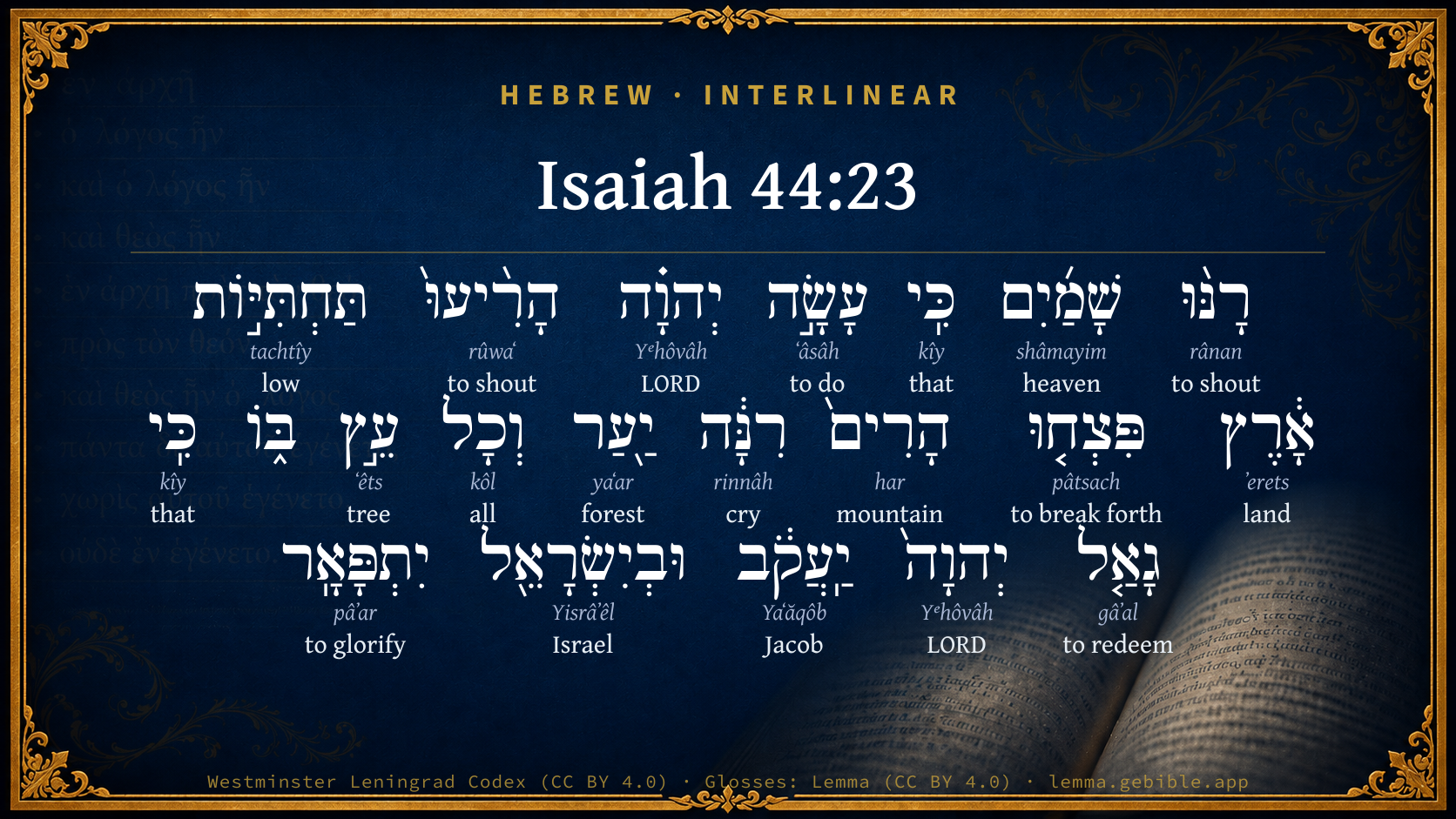
Hebrew (Westminster Leningrad Codex) Isaiah 44:23 appears in the Hebrew Old Testament. The text above is from the Westminster Leningrad Codex. Each word links to its Strong’s number, a concise gloss, and parsing drawn from the Open Scriptures Hebrew Bible morphology. Click any word for its full Brown-Driver-Briggs (BDB) entry.
Download image
Cite this verse

Isaiah 44:23 (World English Bible). Public Domain. Lemma interlinear Bible study tool, https://lemma.gebible.app/v/isaiah/44/23.

Show BibTeX & RIS
BibTeX
RIS
English Translation
Sing, you heavens, for Yahweh has done it; shout, you lower parts of the earth; break forth into singing, you mountains, O forest, and every tree therein: for Yahweh has redeemed Jacob, and will glorify himself in Israel.
World English Bible · Public Domain
Download a study sheet

One document with this verse’s original text, its word-by-word gloss line, the meaning frame, cross-references with their text, attributed commentary, and full source and license credits — printable, and it pastes into notes with its structure intact.

This verse Autodidact and up

Study sheet (.html) Plain text (.txt)

A passage Seminary Student

Up to 50 verses in one chapter. A passage sheet keeps up to 6 commentary sources and 12 cross-references per verse, in the order this page ranks them, and says so on the sheet whenever that leaves anything out. Ask for a single verse and you get the Autodidact verse sheet above.

Everything on this page stays free to read, with no account — the sheet is a download of what is already on screen, not access to it.

Want to remove ads? Support Godless Engineer
Compare translations 3

The same verse in 3 English versions, stacked beneath the original-language interlinear above. Click any original word for its lexicon entry.

Each is an independent rendering of the whole verse — the interlinear is not word-aligned to these translations.

Highlighted words mark where these versions differ — a whole-verse word diff, not a word-by-word alignment.

  • World English Bible Public Domain
    Sing, you heavens, for Yahweh has done it; shout, you lower parts of the earth; break forth into singing, you mountains, O forest, and every tree therein: for Yahweh has redeemed Jacob, and will glorify himself in Israel.
  • King James Version Public Domain
    Sing, O ye heavens; for the LORD hath done it: shout, ye lower parts of the earth: break forth into singing, ye mountains, O forest, and every tree therein: for the LORD hath redeemed Jacob, and glorified himself in Israel.
  • unfoldingWord Literal Text CC BY-SA 4.0
    Sing, heavens, for Yahweh has done; shout, depths of the earth! Break forth, mountains, a joyful shout, the forest and every tree in it! For Yahweh has redeemed Jacob, and he will glorify himself in Israel. q1

unfoldingWord Literal Text — © unfoldingWord, licensed CC BY-SA 4.0. Word-aligned USFM3 via Door43 (git.door43.org/unfoldingWord/en_ult).

Versions to compare (up to 4)

3 of 4 selected

Show all 18 translations

Every available English version of this verse, each an independent rendering of the whole verse.

  • World English Bible Public Domain
    Sing, you heavens, for Yahweh has done it; shout, you lower parts of the earth; break forth into singing, you mountains, O forest, and every tree therein: for Yahweh has redeemed Jacob, and will glorify himself in Israel.
  • Berean Standard Bible Public Domain
    Sing for joy, O heavens, for the LORD has done this; shout aloud, O depths of the earth. Break forth in song, O mountains, you forests and all your trees. For the LORD has redeemed Jacob, and revealed His glory in Israel.
  • Majority Standard Bible Public Domain
    Sing for joy, O heavens, for the LORD has done this; shout aloud, O depths of the earth. Break forth in song, O mountains, you forests and all your trees. For the LORD has redeemed Jacob, and revealed His glory in Israel.
  • King James Version Public Domain
    Sing, O ye heavens; for the LORD hath done it: shout, ye lower parts of the earth: break forth into singing, ye mountains, O forest, and every tree therein: for the LORD hath redeemed Jacob, and glorified himself in Israel.
  • American Standard Version (1901) Public Domain
    Sing, O ye heavens, for Jehovah hath done it; shout, ye lower parts of the earth; break forth into singing, ye mountains, O forest, and every tree therein: for Jehovah hath redeemed Jacob, and will glorify himself in Israel.
  • Revised Version (1885) Public Domain
    Sing, O ye heavens, for the LORD hath done it; shout, ye lower parts of the earth; break forth into singing, ye mountains, O forest, and every tree therein: for the LORD hath redeemed Jacob, and will glorify himself in Israel.
  • Geneva Bible (1599) Public Domain
    Reioyce, ye heauens: for the Lord hath done it: shoute, ye lower partes of the earth: brast foorth into prayses, ye mountaines, O forest and euery tree therein: for the Lord hath redeemed Iaakob and will be glorified in Israel.
  • Douay-Rheims (1899) Public Domain
    Give praise, O ye heavens, for the Lord hath shewn mercy: shout with joy, ye ends of the earth: ye mountains, resound with praise, thou, O forest, and every tree therein: for the Lord hath redeemed Jacob, and Israel shall be glorified.
  • Young's Literal Translation Public Domain
    Sing, O heavens, for Jehovah hath wrought, Shout, O lower parts of earth, Break forth, O mountains, with singing, Forest, and every tree in it, For Jehovah hath redeemed Jacob, And in Israel He doth beautify Himself.
  • Literal Standard Version CC BY-SA 4.0
    Sing, O heavens, for YHWH has worked, || Shout, O lower parts of earth, || Break forth, O mountains, with singing, || Forest, and every tree in it, || For YHWH has redeemed Jacob, || And He beautifies Himself in Israel.
  • Unlocked Literal Bible CC BY-SA 4.0
    Sing, you heavens, for Yahweh has done this; shout, you depths of the earth. Break out into singing, you mountains, you forest with every tree in it; for Yahweh has redeemed Jacob, and will show his glory in Israel.
  • unfoldingWord Literal Text CC BY-SA 4.0
    Sing, heavens, for Yahweh has done; shout, depths of the earth! Break forth, mountains, a joyful shout, the forest and every tree in it! For Yahweh has redeemed Jacob, and he will glorify himself in Israel. q1
  • Darby Bible Public Domain
    Sing, ye heavens; for Jehovah hath done it: shout, ye lower parts of the earth; break forth into singing, ye mountains, the forest, and every tree therein! For Jehovah hath redeemed Jacob, and glorified himself in Israel.
  • World Messianic Bible Public Domain
    Sing, you heavens, for the LORD has done it! Shout, you lower parts of the earth! Break out into singing, you mountains, O forest, all of your trees, for the LORD has redeemed Jacob, and will glorify himself in Israel.
  • Webster's Bible Public Domain
    Sing, O ye heavens; for the LORD hath done it: shout, ye lower parts of the earth: break forth into singing, ye mountains, O forest, and every tree therein: for the LORD hath redeemed Jacob, and glorified himself in Israel.
  • Free Bible Version CC BY-SA 4.0
    Sing in celebration, you heavens, for the Lord has done this; cry out loud, you depths of the earth. Shout with joy, you mountains, you forests and every tree. For the Lord has set Jacob free, and his glory is shown in Israel!
  • Bible in Basic English Public Domain
    Make a song, O heavens, for the Lord has done it: give a loud cry, you deep parts of the earth: let your voices be loud in song, you mountains, and you woods with all your trees: for the Lord has taken up the cause of Jacob, and will let his glory be seen in Israel.
  • JPS Tanakh (1917) Public Domain
    Sing, O ye heavens, for the LORD hath done it; shout, ye lowest parts of the earth; break forth into singing, ye mountains, O forest, and every tree therein; for the LORD hath redeemed Jacob, and doth glorify Himself in Israel.

Literal Standard Version (2020), Covenant Press — licensed CC BY-SA 4.0. Text via the HelloAO Bible API (eBible.org). Unlocked Literal Bible (unfoldingWord) — licensed CC BY-SA 4.0. Text via the HelloAO Bible API (eBible.org). unfoldingWord Literal Text — © unfoldingWord, licensed CC BY-SA 4.0. Word-aligned USFM3 via Door43 (git.door43.org/unfoldingWord/en_ult). Free Bible Version, Dr. Jonathan Gallagher — licensed CC BY-SA 4.0. Text via the HelloAO Bible API (eBible.org).

Word by word

More ways to search: Search by grammar → Find every occurrence → Compare this word →

Practice this passage: Drill this verse → Learn its vocabulary →

פִּצְח֤וּ
pâtsach
H6476
“break forth”
Verb, Qal, Imperative, 2nd Person, Masculine, Plural
Part of Speech
Verb
Stem
Qal
Form
Imperative
Person
2nd Person
Gender
Masculine
Number
Plural
Full BDB Definition

Origin: a primitive root

TWOT: 1796

to cause to break or burst forth, break forth with, break out - (Qal) to break out, break forth with - (Piel) to break up
  1. רָנּ֨וּ rânan H7442 “shout” Verb, Qal, Imperative, 2nd Person, Masculine, Plural
  2. שָׁמַ֜יִם shâmayim H8064 “heaven(s)” Noun, Common, Masculine, Plural, Absolute
  3. כִּֽי kîy H3588 “that” Conjunction
  4. עָשָׂ֣ה ʻâsâh H6213 “to do” Verb, Qal, Perfect, 3rd Person, Masculine, Singular
  5. יְהוָ֗ה Yᵉhôvâh H3068 “LORD” Noun, Proper
  6. הָרִ֨יעוּ֙ rûwaʻ H7321 “shout” Verb, Hiphil, Imperative, 2nd Person, Masculine, Plural
  7. תַּחְתִּיּ֣וֹת tachtîy H8482 “low of” Adjective, Adjective, Feminine, Plural, Construct
  8. אָ֔רֶץ ʼerets H776 “land” Noun, Common, Both, Singular, Absolute
  9. הָרִים֙ har H2022 “mountains” Noun, Common, Masculine, Plural, Absolute
  10. רִנָּ֔ה rinnâh H7440 “cry” Noun, Common, Feminine, Singular, Absolute
  11. יַ֖עַר yaʻar H3293 “forest” Noun, Common, Masculine, Singular, Absolute
  12. וְכָל kôl H3605 “and · all of” Conjunction + Noun, Common, Masculine, Singular, Construct
  13. עֵ֣ץ ʻêts H6086 “tree” Noun, Common, Masculine, Singular, Absolute
  14. כִּֽי kîy H3588 “that” Conjunction
  15. גָאַ֤ל gâʼal H1350 “to redeem” Verb, Qal, Perfect, 3rd Person, Masculine, Singular
  16. יְהוָה֙ Yᵉhôvâh H3068 “LORD” Noun, Proper
  17. יַֽעֲקֹ֔ב Yaʻăqôb H3290 “Jacob” Noun, Proper
  18. וּבְיִשְׂרָאֵ֖ל Yisrâʼêl H3478 “and · in/at · Israel” Conjunction + Preposition + Noun, Proper
  19. יִתְפָּאָֽר pâʼar H6286 “to glorify” Verb, Hithpael, Imperfect, 3rd Person, Masculine, Singular

About this verse

These counts appear in no published source. They are computed here, from the morphology-tagged text and Lemma’s own curated glosses. What Lemma adds →

21
words
18
distinct lemmas
Prophets
section

Notable vocabulary

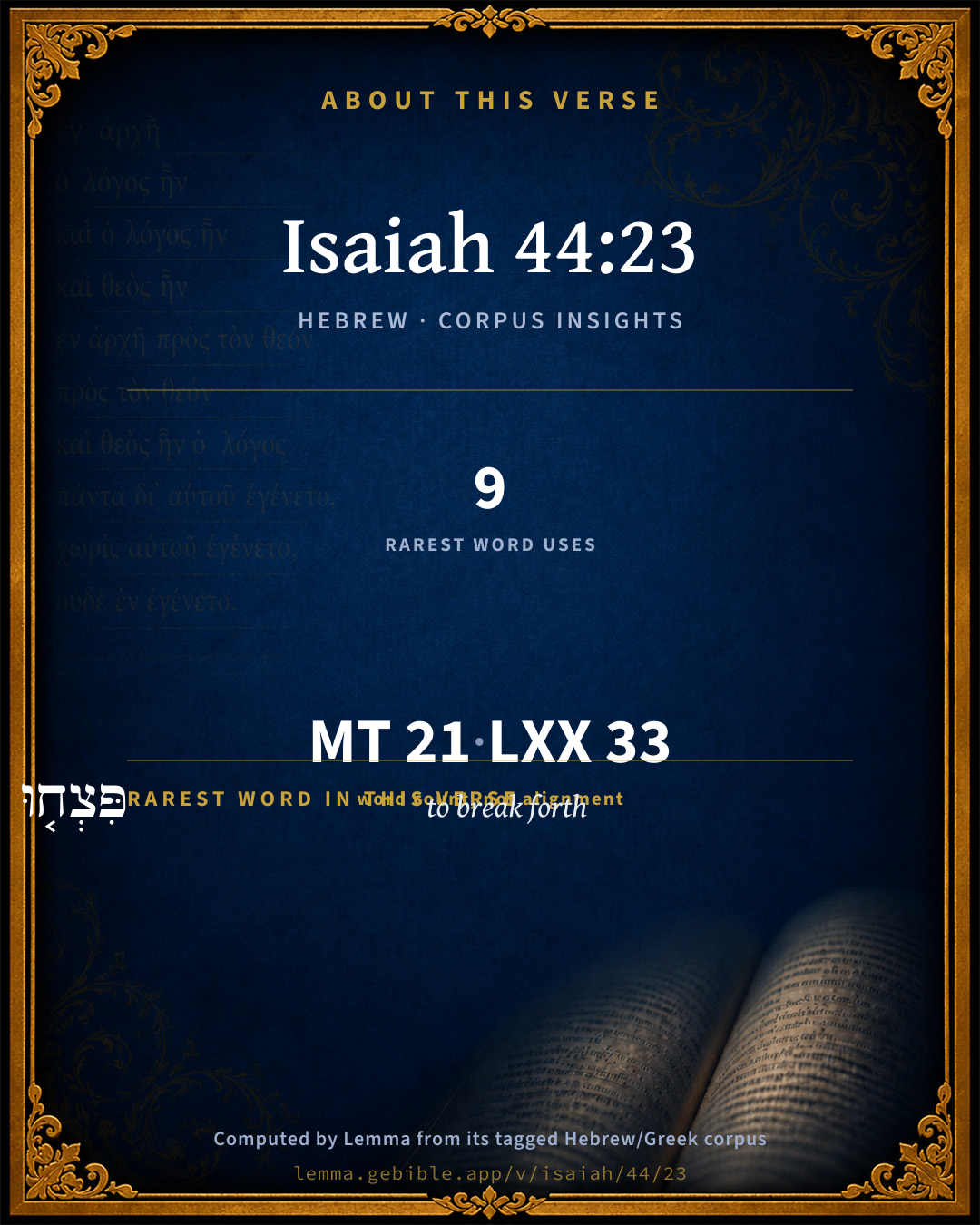
The rarest word here is פִּצְח֤וּ to break forth H6476 — appearing just 9 times in the whole Hebrew Bible.

Shared distinctive vocabulary

פִּצְח֤וּ to break forth H6476 occurs in 8 verses of the Hebrew Bible. Also found in:

Grammatical profile

  • 6 verbs
  • 11 nouns
  • 1 adjective
  • 1 preposition
  • 2 conjunctions

Verb forms

  • רָנּ֨וּ Qal · Imperative
  • עָשָׂ֣ה Qal · Perfect
  • הָרִ֨יעוּ֙ Hiphil · Imperative
  • פִּצְח֤וּ Qal · Imperative
  • גָאַ֤ל Qal · Perfect
  • יִתְפָּאָֽר Hithpael · Imperfect

Repetition

Words recur within this verse — often emphatic in Hebrew:

  • יְהוָ֗ה LORD H3068 ×2
  • כִּֽי that H3588 ×2

Hebrew & Septuagint length

In English translation the verse runs 38 words from the Hebrew and 40 from the Septuagint (LXX English) — closely comparable.

A rough comparison of the two English renderings, which tokenize alike — not a word-level alignment.

Word counts can differ between the Hebrew and the Greek without any difference in meaning — e.g. the Hebrew direct-object marker אֵת has no separate Greek word, and Greek often adds the article ὁ.

In the original languages it is 21 Hebrew tokens and 33 Greek tokens — but the two are counted differently (Hebrew bundles its prefixes and suffixes into one token; the Greek is in lemma form), so that isn’t a like-for-like length.

Cross-references

24

Topical passages linked to Isaiah 44:23 in the Treasury of Scripture Knowledge — connected by theme and wording, ordered by reader-vote popularity; previews shown in the World English Bible.

  • Ephesians 1:6–7 to the praise of the glory of his grace, by which he freely bestowed favor on us in the Beloved,
  • Revelation 5:8–14 Now when he had taken the book, the four living creatures and the twenty-four elders fell down before the Lamb, each one having a harp, and golden bowls full of incense, which are the prayers of the saints.
  • Psalms 69:34 Let heaven and earth praise him; The seas, and everything that moves therein!
  • Psalms 96:11–12 Let the heavens be glad, and let the earth rejoice. Let the sea roar, and it's fullness!
  • Psalms 98:7–8 Let the sea roar with its fullness; The world, and those who dwell therein.
  • Isaiah 49:3 and he said to me, You are my servant; Israel, in whom I will be glorified.
  • Jeremiah 51:48 Then the heavens and the earth, and all that is therein, shall sing for joy over Babylon; for the destroyers shall come to her from the north, says Yahweh.
  • Revelation 19:1–6 After these things I heard something like a loud voice of a great multitude in heaven, saying, "Hallelujah! Salvation, power, and glory belong to our God:
  • Isaiah 49:13 Sing, heavens; and be joyful, earth; and break forth into singing, mountains: for Yahweh has comforted his people, and will have compassion on his afflicted.
  • Isaiah 55:12–13 For you shall go out with joy, and be led forth with peace: the mountains and the hills shall break forth before you into singing; and all the trees of the fields shall clap their hands.
  • Psalms 148:7 Praise Yahweh from the earth, You great sea creatures, and all depths!
  • Isaiah 26:15 You have increased the nation, O Yahweh, you have increased the nation; you are glorified; you have enlarged all the borders of the land.
  • Isaiah 42:10–12 Sing to Yahweh a new song, and his praise from the end of the earth; you who go down to the sea, and all that is therein, the isles, and the inhabitants of it.
  • Isaiah 60:21 Your people also shall be all righteous; they shall inherit the land forever, the branch of my planting, the work of my hands, that I may be glorified.
  • Isaiah 61:3 to appoint to those who mourn in Zion, to give to them a garland for ashes, the oil of joy for mourning, the garment of praise for the spirit of heaviness; that they may be called trees of righteousness, the planting of Yahweh, that he may be glorified.
  • Ezekiel 36:1 You, son of man, prophesy to the mountains of Israel, and say, You mountains of Israel, hear the word of Yahweh.
  • Ezekiel 36:8 But you, mountains of Israel, you shall shoot forth your branches, and yield your fruit to my people Israel; for they are at hand to come.
  • Luke 2:10–14 The angel said to them, "Don't be afraid, for behold, I bring you good news of great joy which will be to all the people.
  • Ephesians 3:21 to him be the glory in the assembly and in Christ Jesus to all generations forever and ever. Amen.
  • 2 Thessalonians 1:10–12 when he comes to be glorified in his saints, and to be admired among all those who have believed (because our testimony to you was believed) in that day.
  • 1 Peter 4:11 If any man speaks, let it be as it were oracles of God. If any man serves, let it be as of the strength which God supplies, that in all things God may be glorified through Jesus Christ, to whom belong the glory and the dominion forever and ever. Amen.
  • Revelation 12:12 Therefore rejoice, heavens, and you who dwell in them. Woe to the earth and to the sea, because the devil has gone down to you, having great wrath, knowing that he has but a short time."
  • Revelation 18:20 Rejoice over her, O heaven, you saints, apostles, and prophets; for God has judged your judgment on her."
  • Ezekiel 39:13 Yes, all the people of the land shall bury them; and it shall be to them a renown in the day that I shall be glorified, says the Lord Yahweh.

Cross-references courtesy of OpenBible.info (CC BY 4.0).

Hebrew and Greek witnesses Masoretic Hebrew ↔ Greek Septuagint

The same verse in the two great witnesses to the Old Testament, shown verse-for-verse.

These are two independent witnesses, not word-aligned to each other, and the Septuagint is shown in lemma (dictionary) form.

Hebrew Isaiah 44:23 Masoretic · Westminster Leningrad Codex

רָנּ֨וּ שָׁמַ֜יִם כִּֽי עָשָׂ֣ה יְהוָ֗ה הָרִ֨יעוּ֙ תַּחְתִּיּ֣וֹת אָ֔רֶץ פִּצְח֤וּ הָרִים֙ רִנָּ֔ה יַ֖עַר וְכָל עֵ֣ץ בּ֑וֹ כִּֽי גָאַ֤ל יְהוָה֙ יַֽעֲקֹ֔ב וּבְיִשְׂרָאֵ֖ל יִתְפָּאָֽר

Sing, you heavens, for Yahweh has done it; shout, you lower parts of the earth; break forth into singing, you mountains, O forest, and every tree therein: for Yahweh has redeemed Jacob, and will glorify himself in Israel.

World English Bible · Public Domain

Greek LXX Isaiah 44:23 Septuagint · lemma form

εὐφραίνω οὐρανός ὅτι ἐλεέω ὁ θεός ὁ ἰσραήλ σαλπίζω θεμέλιον ὁ γῆ βοάω ὄρος εὐφροσύνη ὁ βουνός καί πᾶς ὁ ξύλον ὁ ἐν αὐτός ὅτι λυτρόω ὁ θεός ὁ ἰακώβ καί ἰσραήλ δοξάζω

Rejoice, you⌃ heavens; for God has had mercy upon Israel: sound the trumpet, you⌃ foundations of the earth: you⌃ mountains, shout with joy, you⌃ hills, and all the trees therein: for God has redeemed Jacob, and Israel shall be glorified.

LXX2012 (modern English Septuagint) · Public Domain

On this verse, John Gill's Exposition discusses the Septuagint’s reading. Read the note in Commentary ↓

Hebrew: Westminster Leningrad Codex (CC BY 4.0). Greek: Septuagint (public domain); English from LXX2012 (modern English Septuagint) (Public Domain). How the Septuagint differs from the Hebrew →

Targum (Aramaic paraphrase)

1

The Targum is the ancient Jewish Aramaic paraphrase of the Hebrew Scriptures — an interpretive translation, not the Hebrew text itself. Onkelos (literal) and Pseudo-Jonathan (expansive) render the Torah, and Jonathan the Prophets. Coverage is partial: where no permissively-licensed English translation exists for a verse, only the Aramaic is shown. This is verse-level text, not a word-by-word alignment to the Hebrew.

  1. Targum Jonathan Prophets (Joshua–Malachi)
    שַׁבַּחוּ שְׁמַיָא אֲרֵי עֲבַד יְיָ פוּרְקַן לְעַמֵהּ יַבִּיבוּ יְסוֹדֵי אַרְעָא בּוּעוּ טוּרַיָא תּוּשְׁבַּחְתָּא חוּרְשָׁא וְכָל אִילָנַיָא דְבֵהּ אֲרֵי פְרַק יְיָ יַעֲקֹב וּבְיִשְׂרָאֵל יִשְׁתַּבַּח:

    Sing, O ye heavens; for the Lord hath wrought redemption for His people: Let the foundations of the earth rejoice; rejoice, 0 mountains, in praise, O forest, and all the trees therein! for the Lord hath redeemed Jacob, and will glorify Himself in Israel.

    Targum Jonathan — Aramaic: “Mikraot Gedolot” (public domain). English: “Sefaria Community Translation” (CC0 1.0 (public-domain dedication)); “London "Chaldee Paraphrase," 1871” (public domain). Text via Sefaria.

Commentary

Notes on Isaiah 44:23 from classic Christian and Jewish commentators (each source and its license shown beneath its notes). The classic Christian expositions comment on the surrounding passage and are grouped to its opening verse, so a note may address several verses; the Jewish commentaries on the Tanakh (Rashi and others) are per-verse, so they appear only where the commentator wrote on this verse.

Lemma curates 59 commentaries, every one of them public domain or Creative Commons licensed, each selected and text-cleaned for this edition rather than reprinted as found. About our sources →

The Cambridge Bible for Schools and Colleges

gen. ed. J. J. S. Perowne

23. The prophet in a transport of joy calls on heaven and earth to celebrate the wonders of Israel’s redemption. Cf. ch. Isa_42:10-13, Isa_45:8. The poetic outburst marks the end of the section.

the Lord hath done it] The redemption is already as good as complete; see the end of the verse.

ye lower parts of the earth] or depths of the earth, the antithesis to “ye heavens.”

break forth into singing] Cf. ch. Isa_14:7.

and glorified] R.V., more correctly: and will glorify. Cf. ch. Isa_49:3, Isa_60:21, Isa_61:3.

Ch. Isa_44:24 to Isa_45:25. Jehovah’s Commission to Cyrus, His anointed, whose victories shall bring about the universal recognition of the true God

The distinctive feature of this important section of the book is the prominence given to the person and work of the Persian conqueror, Cyrus. The leading idea is no longer the relation of Israel to Jehovah, but the glorious effects that are to follow its deliverance through the agency of this divinely chosen hero. In the earlier allusions to Cyrus (ch. Isa_41:1-4; Isa_41:25-29) he is spoken of as one whose remarkable career has challenged the attention of the world and illustrated the inability of the heathen religions to deal with the great crises of history. There have been abundant intimations that he is the destined instrument of Israel’s restoration, but these have hitherto occupied a secondary place in the prophet’s thoughts. Here, however, the figure of Cyrus is brought prominently on the scene, he is addressed directly and by name, and the ultimate scope of his mission is clearly unfolded. He is to set the exiles free, to rebuild Jerusalem and the Temple; and the far-reaching moral result of his singular generosity to Israel will be the downfall of heathenism everywhere and the universal conviction that Jehovah is the only God who is a Deliverer. There are five divisions:

i. ch. Isa_44:24-28 is an introduction to the central passage, which immediately follows. Jehovah, still addressing Israel, describes Himself by a majestic series of attributes, gradually converging from the thought of His creative power to the particular point which is the subject of the present discourse, His selection of Cyrus as the instrument of His purpose.

ii. ch. Isa_45:1-8.—The Divine speaker now addresses Cyrus in person, promising to him an uninterrupted career of victory (1–3); yet it is in the interest of Israel that he, a stranger to the true God, is thus called and commissioned (4); and the final issue of his achievements will be a general recognition throughout the world of the sole Godhead of Jehovah (5–7).—The last verse (8) is a poetic interlude like ch. Isa_42:10 ff., Isa_44:23, &c.

iii. Isa_44:9-13.—Here the prophet turns aside to rebuke the murmurs of dissent which this novel announcement calls forth amongst his fellow countrymen (9–11). It would appear that there were some of the Israelites who rebelled against the thought of a foreign prince as the Anointed of Jehovah and the Saviour of Israel. The answer to these cavillers is an assertion of the absolute sovereignty of Jehovah, who reaffirms His choice of Cyrus as the instrument of Israel’s deliverance (12, 13).

iv. Isa_44:14-17.—Transporting himself to the time when the Divine purpose shall be realised, the writer depicts the procession of conquered nations who do homage to Israel as the people of the true God, and, renouncing idolatry, acknowledge the hand of Jehovah in Israel’s everlasting salvation.

v. Isa_44:18-25.—This deliverance of Israel culminates in salvation to the world at large. The passage contains some of the most striking thoughts in the whole prophecy. The character of Jehovah, His goodwill to men, is to be learned from His creation of a habitable world (18) and from the manner of His revelation to Israel (19). He has shewn Himself to be the only “righteous and saving God” (21); and the heathen are now invited to share in His salvation through faith in His sole divinity (20, 22). It is His irrevocable purpose thus to secure universal homage (23–25).

The Cambridge Bible for Schools and Colleges (gen. ed. J. J. S. Perowne; Cambridge University Press, 1878–1918) — public domain. Text from a community e-Sword module.

Trapp's Complete Commentary

John Trapp

Isa 44:23 Sing, O ye heavens; for the LORD hath done [it]: shout, ye lower parts of the earth: break forth into singing, ye mountains, O forest, and every tree therein: for the LORD hath redeemed Jacob, and glorified himself in Israel.

Ver. 23. Sing, O ye heavens; for the Lord hath done it.] It is usual both with the prophets and the apostles, when they mention the great work of man’s redemption, typified by that famous deliverance from Babylon, to break forth into praise and thanksgiving to God, the sole author thereof. See Psa 68:1; Psa 89:1; Psa 93:1; Psa 95:1; Psa 96:1; Psa 97:1; Psa 98:1; Psa 99:1; Psa 100:1; Isa 12:5-6; Rom 7:24-25; 1Co 15:56-57; 1Ti 1:17; Rev 5:11-12 Here is hinted, that so very great is the benefit of our redemption, that it might well affect heaven and earth, and all things high and low.

John Trapp, A Commentary or Exposition upon All the Books of the Old and New Testament (1647–1656) — public domain. Text from a community e-Sword module.

The Biblical Illustrator

Joseph S. Exell

Isa_44:23

Sing, O ye heavens

A song about redemption

The text is a magnificent call to heaven and earth to join in singing the glories of redemption.

I. IN WHAT PARTICULARS REDEMPTION CALLS FOR A SONG. Redemption calls for a song when we remember--

1. Its Author. The Lord hath done it. The Lord hath redeemed Jacob. Herein is indeed a marvel of grace, demanding the highest anthems ransomed lips can raise. What could man have been to Him? What shadow of an obligation was there on His part to put forth the slightest effort to save a single one? The Lord hath done it alone. With whom took He counsel in this matter? Who paid part-price with Him? Redemption is no work of the many; it is Gods own in plan and execution.

2. Its cost (1Pe_1:18-19).

3. Its completeness. Christ hath so gloriously completed the work of redemption that nothing can possibly be added to it. Unlike the atonement made by the Aaronic priesthood, it lasts for ever.

4. Its comprehensiveness. It will take eternity to reveal all. If we are Christs, then have we been redeemed from the hand of Satan. From the guilt of sin. With the guilt, away goes the power of sin. We are also redeemed from the consequences of sin. From the power of death Hos_13:14). Christ hath redeemed the bodies of His saints for the glories of the resurrection morn.

5. The chiefest cause for song is redemption being that in which God has been pleased to glorify Himself the most. The Lord hath glorified Himself in Israel. All the attributes of God are most gloriously to be seen in redemption work.

II. WHO THOSE ARE WHO SHOULD SING THE SONG.

1. Heaven! Sing, O ye heavens, and well you may, for redemption has shed a fresh lustre on your glories. The highest joy the angels can have, is that which arises from seeing their King glorified. Behold also the redeemed in heaven! Listen to their song, sweeter even than an angels, Unto Him that loved us. All heaven unites in this redemption song.

2. Let the ransomed on earth take their part. Shout, ye lower parts of the earth. Behold your serfdom gone--your bonds broken--your chains snapped--your sins forgiven--your heaven secured, and then sing.

3. Surely who that have loved ones that have been redeemed should join us in the song.

4. The trembling sinner has good cause to join his voice with ours. The Lord hath done it. If done, then there can be no necessity for any addition of thine. (A. G. Brown.)

Praise to God for redemption:

I. WHAT IS IMPORTED IN GODS REDEEMING JACOB.

1. That He pays a ransom for our souls.

2. That He rescues us from captivity.

3. That He takes vengeance on our enemies.

4. That He puts us in possession of our inheritance.

II. HOW GOD IS GLORIFIED, WHEN MAN IS REDEEMED.

1. His infinite wisdom was displayed.

2. His power was illustrated.

3. His grace was shown.

4. His truth was vindicated.

III. THE PRAISE WHICH OUGHT TO BE ASCRIBED UNTO GOD ON ACCOUNT OF REDEMPTION. The language of the text has a certain grandeur and beauty. Two things seem to be expressed in it.

1. Let every creature rejoice in the event.

2. Let all express their joy in every form.

Sing, shout, break forth into singing. Praise Him with the heart. Let all that is within you bless His holy name. Praise Him with the lips. Speak of the glory of His kingdom, and talk of His power, to make known to the sons of men His mighty acts. Praise Him with your life. Ye are bought with a price, therefore glorify God in your body and in your spirit, which are Gods Praise Him in private. Is anyone merry? Let him sing psalms. Praise Him in public. O sing unto the Lord a new song, and His praise in the congregation of the saints. (E. Brown.)

The joy of redemption

There are three redemptions which may well make all hearts rejoice.

I. REDEMPTION BY BLOOD.

II. REDEMPTION BY POWER. Conversion and regeneration. What sort of people are those whom Christ saves? Some were the very worst of the worst. Think of what these souls are saved from, and of what they are saved to. Some are saved in the teeth of ten thousand obstacles.

III. REDEMPTION IN PERFECTION. (C. H. Spurgeon.)

The song of songs:

I. LET US SURVEY THE SCENE. I have blotted out as a thick cloud thy transgressions, and as a cloud thy sins. So, going forth and returning to their God beneath that clear sky, from which the Sun of Righteousness shone down with beams of love, the forgiven people were filled with rejoicing, and by the mouth of the prophet they cried aloud, Sing, O heaven, clouds veil thee no longer; shout, ye lower parts of the earth, which have been refreshed with fertilising showers; shout, O ye forest trees, whose every bough has been hung with diamond drops; for the Lord hath redeemed Jacob, and glorified Himself in Israel. Thus the scenery of the text is helpful to the full understanding of it. Read the two verses together, and their beauty is seen. When did the joyous event take place which we are bidden to celebrate with song?

1. We may consider it as virtually accomplished in the eternal counsels of God, for our Lord is the Lamb slain from before the foundation of the world.

2. The clouds were actually removed when the atonement was presented.

3. The text also receives an actual fulfilment to each one of Gods people in the moment when the eye of faith is first turned to the crucified Saviour.

4. This also comes true not only at first, but frequently during the Christian life; for there are times when our unbelief makes new clouds, and threatens new storms.

5. The text will obtain its best fulfilment at the day of the Lords appearing,--that day around which our chief hopes must ever centre.

II. LET US CONTEMPLATE THE GLORIOUS SUBJECT FOR JOY. The great subject of joy is redemption--the redemption of Gods Israel.

1. This is a stupendous work.

2. Of redemption by price and by power we are bidden to sing, a redemption so pre-eminently desirable that we can never sufficiently value it.

3. The very centre and emphasis of the song seems to me to lie in this: The Lord hath done it. Whatever God does is the subject of joy to all pure beings.

4. It is sweet to reflect that redemption is an accomplished fact. It is not The Lord will do it, but The Lord hath done it.

5. We may lay peculiar force upon the word, the Lord hath done it, for He has finished the work.

6. A very important part of the song, however, lies in the fact that what God has done glorifies Himself.

III. LET US LISTEN TO THE SONG. The angels sing, for they have deep sympathy with the redemption of man; the redeemed in glory sing, for they have been the recipients of this mighty mercy; the material heavens themselves also ring with the sweet music, and every star takes up the refrain, and with sun and moon praise the Most High. Descending from heave, the song charms the lower earth, and the prophet calls upon materialism to share in the joy; mountains and valleys, forests and trees, are charged to join the song. Why should they not? This round earth of ours has been oershadowed by the curse through sin; she has yet to be unswathed of all the mists which iniquity has cast upon her (Rom_8:20-21).

IV. LET US JOIN IN THIS SONG. Consider how we sing this song. We sing it when by faith we see the grand truth that Jesus Christ took His peoples sin upon Him, and so redeemed them. You will be still better able to sing this if you every day realise the blessings of redemption and pardon, by drawing near to God, using the privilege of prayer, trusting the Lord for everything, enjoying sonship, and communing with your heavenly Father. (C. H.Spurgeon.)

The Biblical Illustrator, edited by Joseph S. Exell (c. 1880s–1900s) — public domain. Text from a community e-Sword module.

The Preacher's Complete Homiletical Commentary

Joseph S. Exell (gen. ed.)

A CALL FOR UNIVERSAL PRAISE

Isa_44:23. Sing, O ye heavens, for the LORD hath done it, &c.

The prophet, beholding Israel’s redemption achieved and the people restored to their land and privileges, exulted in the blessed change, and burst forth in this impassioned address to all nature above and around him, and lest it should be supposed that his transport was premature, and that he had anticipated more than could reasonably be expected, Jehovah resumes the discourse and names the man whom He had destined to be His people’s deliverer (Isa_44:28). It is natural to ask, Was the deliverance of the Jews so great, so blissful, so universally interesting as to justify the prophet’s rapturous call? In reply, we observe that the Jews exclusively were the Church of the living God, and their restoration was necessary to the accomplishment of the predictions concerning the Messiah. It was a shadow and pledge of the spiritual and eternal redemption which He was to obtain. The primary subject is the liberation of the captive Jews, but that speedily merges in a more glorious theme.

I. The work which it is here said God hath performed. This work, though then future and still only in progress, is spoken of as already effected. The purpose of God renders its completion absolutely certain.

1. The nature and extent of that deliverance with which the Israel of God are blessed. It is not only redemption from evil but redemption to God, and includes the restoration of His image to our souls. We are only yet beginning to enjoy these high privileges. Where is the man who can sufficiently appreciate the magnitude and blessedness of that change which takes place in the relations, character, and prospects of a sinner when he passes from darkness to light,—from life to death,—from bondage to freedom? Every scene around him seems now to smile upon him,—to speak to him of the goodness and greatness of his divine Benefactor, and animates his gratitude and praise. The names “Jacob” and “Israel” designate all who prove themselves Israelites indeed. What a multitude of all ages, countries, characters, and conditions this name embraces!

2. The display of the divine glory in this redemption. Who but a Being of boundless benevolence, wisdom, and power could have conceived and accomplished it? It delights Him to be known and acknowledged as its Author. How did He effect this redemption? It is the result of His Son’s sacrifice in our nature (Heb_9:11-12). “It is finished;” the work is done (Psa_22:31), and in it God “has glorified Himself” (Psa_85:10).—Consider, further, that God Himself is the source and sum of all the good which this redemption comprises. What must be the fulness of His knowledge and wisdom who irradiates so many minds; of His love who feeds this celestial flame in so many hearts; and of His blessedness who gladdens and delights so many immortal creatures?—Further, think of the means He employs for putting His people in possession of this redemption. Among these, the word and the ministry of reconciliation occupy the chief place,—means which in the estimation of the world are weak and foolish (2Co_4:7). Think, too, of the opposition offered to the execution of His gracious designs,—opposition from ignorance and depravity, from the world, and from the hosts of hell; yet it is ineffectual to frustrate the counsels of His wisdom and love.

II. This work of redemption supplies, not to the redeemed only, but to the creation of God, a fit theme of the highest exultation and praise. The prophet calls on all orders of creatures. The redeemed are not themselves addressed. Could they need any excitement to joy and praise? There are beings, indeed, who will not sing. They rather look on with malignity and “howl for vexation;” for this deliverance frustrates their designs, abolishes the evil they labour to extend, and exalts the name they dishonour (1Jn_3:8). What must be the mortification of that proud and wicked spirit! What fills others with joy will be to him a source of bitter disappointment. It does not surprise us that the fallen angels should raise no song of praise. But what shall we say when we recollect that there are human beings for whose redemption Christ died, to whom the glad news are proclaimed, but who yet reject salvation? This is impiety, folly, and madness, of which even devils cannot be accused.

With these exceptions of fallen spirits and impenitent men, the whole creation of God obeys the joyous call.

1. The holy angels delight to behold sin condemned, its works abolished, and its slaves disenthralled (Luk_2:14; Luk_15:10).

2. Even the inanimate and irrational parts of creation have an interest in Israel’s redemption. As this work advances, creation is freed from the vanity to which it is subject (Rom_8:20-21). Not only has earth, as smitten with the curse, been comparatively unfruitful, but its various productions have been desecrated to the vilest purposes,—have been compelled to minister to the sensuality, avarice, and other passions of mankind. The prevalence of purity, justice, sobriety, and mercy will deliver the inferior creatures from a load of misery, and restore all things to their right uses. No sooner is a sinner born of God than he contemplates the works of God with a new eye. He hears them proclaiming the goodness of his heavenly Father, and praising Him by fulfilling His word. Meditating on these results, it is no wonder that the prophet should represent nature in the happy coming age as inspired with new life, clothed with new beauty, and delighting to open her treasures and pour forth from them abundance of good (Psa_96:11-13; Psa_98:7-9).

If, then, we would see God’s glory, we must study His chief work. There is enough in redemption to awaken our joy.—James Stark, D.D., of Dennyloanhead: Posthumous Discourses, pp. 59–99.

This is the response of the prophet’s soul to the redemption announced in the preceding verses. His joy is as reasonable as it is excellent; the demand he makes is as just as it is poetic. There is instruction here as well as eloquence.

I. Redemption is peculiarly God’s work. “The Lord hath done it; the Lord hath redeemed Jacob.”

1. This is the teaching of Scripture throughout.

2. On enlightened and careful consideration, reason pronounces that it could have been accomplished by God only.

II. Redemption is the work in which the glory of God is most conspicuously manifested. “The Lord hath redeemed Jacob, and glorified Himself in Israel.” In His material works we see His wisdom, power, and goodness, and they should be devoutly studied by us as revelations of what He is: but in this work we have a disclosure of His patience, His forbearance, His love, His self-sacrificing pity—those moral attributes which are most worthy of our admiration.

III. The redemption that God has wrought is a work that demands universal praise. The heavens and the earth may well be called upon to unite with us in thanksgiving, for they also shall share in the blessings of this wonderful redemption (Rom_8:19-21; P. D. 975, 2465).—J. Alwin Flide.

The Preacher's Complete Homiletical Commentary (gen. ed. Joseph S. Exell; Funk & Wagnalls, c. 1892) — public domain (pre-1929). A full-Bible homiletical/sermon-outline anthology covering 65 of 66 books (2 John is absent from the source module). Text from a community e-Sword module.

Tyndale Open Study Notes

Tyndale Open Resources

44:23 All creation is called to celebrate God’s redemption of Israel (cp. 1:2).

Tyndale Open Study Notes — © Tyndale Open Resources, licensed CC BY-SA 4.0. Text via the HelloAO Bible API.

Geneva Bible (1599)

Geneva Bible translators

He showeth that the work of the Lord toward his people shall be so great, that the insensible creatures shall be moved therewith.

Geneva Bible (1599) marginal notes — public domain. Text via Bolls.life.

Jamieson, Fausset & Brown

Robert Jamieson, A. R. Fausset & David Brown

Call to inanimate nature to praise God; for it also shall share in the coming deliverance from "the bondage of corruption" (Rom 8:20-21).

done it--effected redemption for both the literal and spiritual Israel.

lower parts, &c.--antithetical to "heavens"; "mountains," "forest," and "tree," are the intermediate objects in a descending gradation (see Psa 96:11-12).

Jamieson, Fausset & Brown — Commentary Critical and Explanatory on the Whole Bible (1871) — public domain (CC PDM 1.0). Text via the HelloAO Bible API.

Ellicott's Commentary for English Readers

(23) The Lord hath done it.—The pronoun supplied in the Authorised Version refers to the redemption of Isa_44:22; but the word may be taken absolutely in the sense hath done mightily.

Ye lower parts of the earth.—These, as in Eph_4:9, are equivalent to Sheol, or Hades. Even they, commonly thought of as echoing no song of praise (Psa_6:5; Psa_88:12; Isa_38:18), are invited to join in the great doxology.

A Bible Commentary for English Readers, edited by Charles John Ellicott (1878–1897) — public domain. Text from a community e-Sword module.

John Gill's Exposition

Sing, O ye heavens, for the Lord hath done it,.... Done what he promised, the forgiveness of the sins of his people, and the redemption of them. So the Targum,

"because the Lord hath wrought redemption for his people.''

The Vulgate Latin version adds, "mercy" (o); and so the Septuagint version, "because God hath had mercy on Israel" (p); and therefore the heavens are called upon to sing on this occasion, as the angels of heaven did when the Redeemer was born, and who rejoice at the salvation of God's elect, Luk 2:13,

shout, ye lower parts of the earth; the earth, which is low in comparison of the heavens; the inhabitants of it, especially the Gentiles, which dwelt in the lower parts of the world, in comparison of Judea, which lay high:

break forth into singing, ye mountains; kings and great men of the earth, like the strong and lofty mountains:

O forest, and every tree therein; the multitude of the common people; see Isa 10:18 these are called upon to express their joy, for the following reason:

for the Lord hath redeemed Jacob, and glorified himself in Israel; which is to be understood not merely of their redemption from the Babylonish captivity, but of the redemption by Christ, which the former was a type of, and in which all God's people in all nations are concerned, and therefore have reason to rejoice; and in which all the divine perfections are glorified, not only the wisdom, power, goodness, grace, and mercy of God, but his holiness and justice; and saints not only have reason to rejoice, because they are redeemed from sin and Satan, and the law, and death and hell, and all spiritual enemies, but because the glory of God is great in their salvation.

(o) "Quia fecit misericordiam", V. L. (p) , Sept.

John Gill's Exposition of the Whole Bible (1746–1763) — public domain (CC PDM 1.0). Text via the HelloAO Bible API.

Albert Barnes' Notes on the Bible

Sing, O ye heavens - (see Isa 42:10). It is common in the sacred writings to call on the heavens, the earth, and all created things, to join in the praise of God on any great and glorious event (see Psa 96:1, Psa 96:11-12; Psa 148:1-14) The occasion of the joy here was the fact that God had redeemed his people - a fact, in the joy of which the heavens and earth were called to participate. An apostrophe such as the prophet here uses is common in all writings, where inanimate objects are addressed as having life, and as capable of sharing in the emotions of the speaker. Vitringa has endeavored to show that the various objects here enumerated are emblematic, and that by the heavens are meant the angels which are in heaven; by the lower parts of the earth, the more humble and obscure republics of the pagan; by the mountains, the greater and more mighty kingdoms; by the forest, and the trees, large and spacious cities, with their nobles. So Grotius also interprets the passage. But the passage is a highly-wrought expression of elevated feeling; the language of poetry, where the prophet calls on all objects to exult; - an apostrophe to the highest heavens and the lowest part of the earth - the mountains and the forests - the most sublime objects in nature - to exult in the fact that the Jewish people were delivered from their long and painful captivity, and restored again to their own land.

The Lord hath done it - Has delivered his people from their captivity in Babylon. There is, however, no impropriety in supposing that the eye of the prophet also rested on the glorious deliverance of his people by the Messiah; and that he regarded one event as emblematic of, and introductory to the other. The language used here will certainly appropriately express the feelings which should be manifested in view of the plan of redemption under the Messiah.

Shout, ye lower parts of the earth - The foundations of the earth; the parts remote from the high heavens. Let the highest and the lowest objects shout; the highest heavens, and the depths of the earth. The Septuagint renders it, Τὰ Θεμέλια τῆς γῆς Ta Themelia tēs gēs - ‘The foundations of the earth.’ So the Chaldee.

Ye mountains - So in Psa 148:9, Psa 148:13 : ‘Mountains and all hills; fruitful trees and all cedars - let them praise the name of the Lord.’

O forest, and every tree therein - Referring either to Lebanon, as being the most magnificent forest known to the prophet; or to any forest as a great and sublime object.

Albert Barnes' Notes on the Bible (1834–1885) — public domain. Text from a community e-Sword/MySword module.

Matthew Poole's English Annotations

By such invitations to the senseless creatures to praise God with and for his people, he signifies the transcendent greatness of this mercy and deliverance, sufficient to make even the stones, if it were possible, to break forth into God’s praises; and withal, that as the brute creatures were sufferers by man’s fall, so they should receive benefit by man’s redemption.

Matthew Poole's English Annotations on the Holy Bible (1683–1685) — public domain. Text from a community e-Sword/MySword module.

Whedon's Commentary on the Bible

Daniel D. Whedon

23. Sing… shout… the Lord hath redeemed — Gospel hope is herein so full and assured, and Messianic prospect so grandly cheering, that a chorus of rejoicing is called for from the universe, the heavens, the earth’s depths, mountains, and forests. Such signs of victory and superiority — infinitely exceptional as to devils and created beings, and nothingnesses of the idol worship — are worthy of shouts through the universe in behalf of the Lord God Almighty and the Redeemer of Israel.

Daniel D. Whedon (gen. ed.), Commentary on the Old and New Testaments (1874–1909) — public domain. Text from a community e-Sword module.

The Pulpit Commentary

Sing, O ye heavens. The sympathy of external nature with the fortunes of Israel is assumed throughout Isaiah, as it is throughout the Psalms. (see Psa_11:6 Psa_24:4-7 Psa_29:1-7 Psa_33:9 Psa_35:1, Psa_35:2, Psa_35:7, etc.) If Israel is depressed, the earth must "mourn and languish," the heavens grow dark; the mountains shrink and "be ashamed." If, on the contrary, Israel prospers, heaven and earth, mountain and forest, must alike rejoice and sing. Dr. Kay expounds the rejoicing of the heavens here, (and also in Isa_49:13) of the joy felt by the angels over the returning and pardoned sinner; but the context of both passages is in favour of the material heavens being meant. It is quite possible that there is a real and not merely a fancied sympathy between the material and the spiritual worlds. The Lord hath done it; literally, the Lord hath wrought what he has wrought is not said. Mr. Cheyne translates, "Jehovah hath done nobly. " Shout, ye lower parts of the earth. Metonymy of the part for the whole lower parts of the earth" for "the earth even to its lowest depths." There is no thought of Sheol or of its inhabitants. Break forth into singing. (Isa_14:7 Isa_35:2) As children and birds sing from the very gladness of their hearts, thereby venting the.joy that almost oppresses them, so all nature is called upon, not merely to rejoice, but to give vent to its joy, now that Israel is redeemed and God glorified.

Vers. 23-28. Joy in God"s redeeming power.

We have here

I THE REACH OF ALMIGHTY POWER. It extends:

1. Over all visible nature. (Ver. 24.) He makes "all things." The heavens and the earth are the work of his hand.

2. Over individual men. He can

(1) direct the indifferent, so that Cyrus performs his pleasure (ver. 28), although that king was living in spiritual ignorance; (Isa_45:5)

(2) confound the rebellious, so that the impostor is discredited and ashamed (ver. 25);

(3) establish the faithful, so that his servant, however he may have been disregarded, is honoured in the eyes of men (ver. 26).

1. Over men in their collective capacity. Jehovah had fashioned Israel, making her all she had become, giving her strength to do all she had accomplished; it was he that "formed" her from the beginning, that shaped her life (ver. 24). And he would yet restore the cities of Judah; they should be populous and powerful again (ver. 26).

2. Over the most formidable diacritics. Things that seem impossible of achievement are found, under his power, to be effected. At the touch of his hand the waters of the great deep disappear; at the sound of his voice the river-beds are dry (ver. 27). "With God all things are possible." Mountains of difficulty are removed, and seas of impediment are swept away. Nothing is too hard for the Lord.

II ITS BENEFICENT RESULTS. It is a question of the greatest importance What are the results of the power which is exercised by the strong.? The world has had some terrible illustrations of the miseries of malevolent force. Power seeking selfish gratification at the expense of righteousness and of human happiness is the most deplorable as it is the most damnable thing under the heavens. On the other hand, power put forth to elevate and bless is the most admirable and beneficent thing. God works toward two ends

(1) the exaltation of his own holy Name; and

(2) the redemption and restoration of mankind (ver. 23).

The two become one; for it is by bringing men back to himself and to his service that he redeems them from all that is ruinous, and that he raises them to all that is elevating and ennobling. Man finds his worst calamity in distance from his heavenly Father; he finds his highest good, his fullest blessedness, in the honour he pays, in the love he cherishes, in the obedience he renders, in the resemblance he reaches, to his Divine Saviour, his living Lord and Friend.

III UNSPEAKABLE JOY THEREIN. "Sing, O ye heavens," etc. (ver. 23). Joy at its very fullest is uncontainable, inexpressible. He wrote well who said, "I were little happy could I say how much. " There are times when we feel that we want every one and everything to be vocal with the gladness of our own soul. If the children did not shout, the very stones would have to speak the joy of that glad hour. (Luk_19:40) When the great and gracious purposes of God are accomplished in the redemption of one human soul from sin and its restoration to the love and the likeness of God, there is occasion for more joy than human songs can celebrate; how much more so when a nation is redeemed! arid how much more yet will there be when the whole race is transformed, and when the kingdoms of this world shall have become the kingdoms of our God and of his Christ! C.

The Pulpit Commentary (1880–1919), ed. H.D.M. Spence-Jones & Joseph S. Exell — public domain. Text from a community e-Sword module.

John Wesley's Explanatory Notes

Sing - By such invitations to the senseless creatures, he signifies the transcendent greatness of this mercy, sufficient to make even the stones, if it were possible, to break forth into God's praises.

John Wesley, Explanatory Notes Upon the Whole Bible (1754–1765) — public domain. Text via the GEBible commentary corpus.

Keil & Delitzsch

C. F. Keil & F. Delitzsch

There is already good ground, therefore, for exuberant rejoicing; and the reply of the church to these words of divine consolation is as follows: "Exult, O heavens; for Jehovah hath accomplished it: shout, ye depths of the earth; break out, ye mountains, into exulting; thou forest, and all the wood therein: for Jehovah hath redeemed Jacob, and He showeth Himself glorious upon Israel." All creation is to rejoice in the fact that Jehovah has completed what He purposed, that He has redeemed His people, and henceforth will show Himself glorious in them. The heavens on high are to exult; also the depths of the earth, i.e., not Hades, which would be opposed to the prevailing view of the Old Testament (Ps 66, cf., Psa 88:13), but the interior of the earth, with its caves, its pits, and its deep abysses (see Psa 139:15); and the mountains and woods which rise up from the earth towards heaven - all are to unite in the exultation of the redeemed: for the redemption that is being accomplished in man will extend its effects in all directions, even to the utmost limits of the natural world.

This exulting finale is a safe boundary-stone of this fifth prophecy. It opened with "Thus saith the Lord," and the sixth opens with the same.

Keil & Delitzsch — Biblical Commentary on the Old Testament (1861–1891) — public domain (CC PDM 1.0). Text via the HelloAO Bible API. (Old Testament only.)

J. A. Alexander on Isaiah

Joseph Addison Alexander

“Sing, oh heavens, for Jehovah hath done (it); shout, ye lower parts of the earth; break forth, ye mountains, into song, the forest and every tree in it: for Jehovah hath redeemed Jacob, and in Israel He will glorify himself.” The prediction of glorious and joyful changes, as in many other cases, is clothed in the form of an exhortation to all nature to rejoice. The thing done is what is mentioned in the last clause, (i.e., the redemption of Israel, including the deliverance from exile in Babylon, but not confined to it). The arbitrary version of the two verbs in the last clause as a preterit and present or a present and a future is in no respect to be preferred to the exact translation as a preterit and a future; expressive of what God had done and would yet do for the chosen people.

Joseph Addison Alexander, The Prophecies of Isaiah (1846–1847; New York: Scribner, 1870–1878) — public domain. Text from a community e-Sword module.

Scofield Reference Notes

C. I. Scofield

redeemed

Heb. goel, Redemp. (Kinsman type). (See Scofield "Isa 59:20")

The Scofield Reference Bible (1917 edition), notes by C. I. Scofield — public domain. Text from a community e-Sword module.

unfoldingWord translationNotes

Door43 World Missions Community

Sing, you heavens ... glory in Israel

Here Isaiah speaks various parts of creation as if they were people and commands them to praise Yawheh. (See: Apostrophe and Personification)

you depths of the earth

"you lowest parts of the earth." Possible meanings are 1) that this refers to very deep places on the earth such as caves or canyons and forms a merism with "heavens" in the previous phrase or 2) that this refers to the place of the dead. (See: Merism)

translationWords

heaven

Yahweh

redeem

Jacob

glory

unfoldingWord translationNotes — © Distant Shores Media and the Door43 World Missions Community, licensed CC BY-SA 4.0. Source: git.door43.org/Door43/en_tn.

Rashi

Rabbi Shlomo Yitzchaki (Rashi)

burst out An expression of opening the mouth.

Rashi on the Tanakh — English translations: “The Judaica Press complete Tanach with Rashi, translated by A. J. Rosenberg” (CC BY 4.0); “Pentateuch with Rashi's commentary by M. Rosenbaum and A.M. Silbermann, 1929-1934” (public domain); “The Metsudah Tanach series, Lakewood, N.J” (CC BY 4.0); and “The Book of Joshua, Metsudah Publications, 1997” (CC BY 4.0). Text via Sefaria.

Ibn Ezra

Rabbi Abraham ibn Ezra

Sing, 0 ye heavens, etc. This is a figurative expression; it means: great rejoicing will be through Israel, for through the redemption of Israel the glory of God will be revealed to the whole world.

Ibn Ezra on the Tanakh — English translations: “Sefaria Community Translation” (CC0 1.0 (public-domain dedication)); “Yalkut, Sifsei Chachomim Chumash, Metsudah Publications, 2009” (CC BY 4.0); and “Commentary of Ibn Ezra on Isaiah - trans. by M. Friedlander, 1873” (public domain). Text via Sefaria.

Lesson kit

Teaching starters — assembled from the data on this page, not authored interpretation. Every prompt links to the verse data it draws on. Edit before teaching.

Isaiah, in the Prophets, opens this verse with 21 words (18 distinct Hebrew lemmas). Its most distinctive word is pâtsach (“to break forth”). A historical commentator’s framing appears above. Read the whole chapter for the surrounding context.

Discussion questions

  1. How does “to break forth” (pâtsach) shape what this verse is saying?
  2. Psalms 98:4 shares the word «to break forth» with this verse. How do the two illuminate each other?
  3. “LORD” occurs 2× in this one verse. What is the effect of the repetition?
  4. These translations render this verse differently; the difference is in the English rendering, not the original. What questions does that raise?
  5. The verb «רָנּ֨וּ» is Qal Imperative. How does its form color the action?
  6. Reading how The Cambridge Bible for Schools and Colleges and Trapp's Complete Commentary read this verse, where do the two commentators agree and where do they part?

Things to notice

Reading settings

Reading text

Shown beneath each verse's original-language words.

Old Testament
Old Testament edition

Read the OT as the Masoretic Hebrew (MT) or the Greek Septuagint (LXX).

English shown for the Greek Septuagint (in the Hebrew ↔ Greek comparison).

Comparing translations? Open the Compare panel on any verse page to stack up to four side by side.