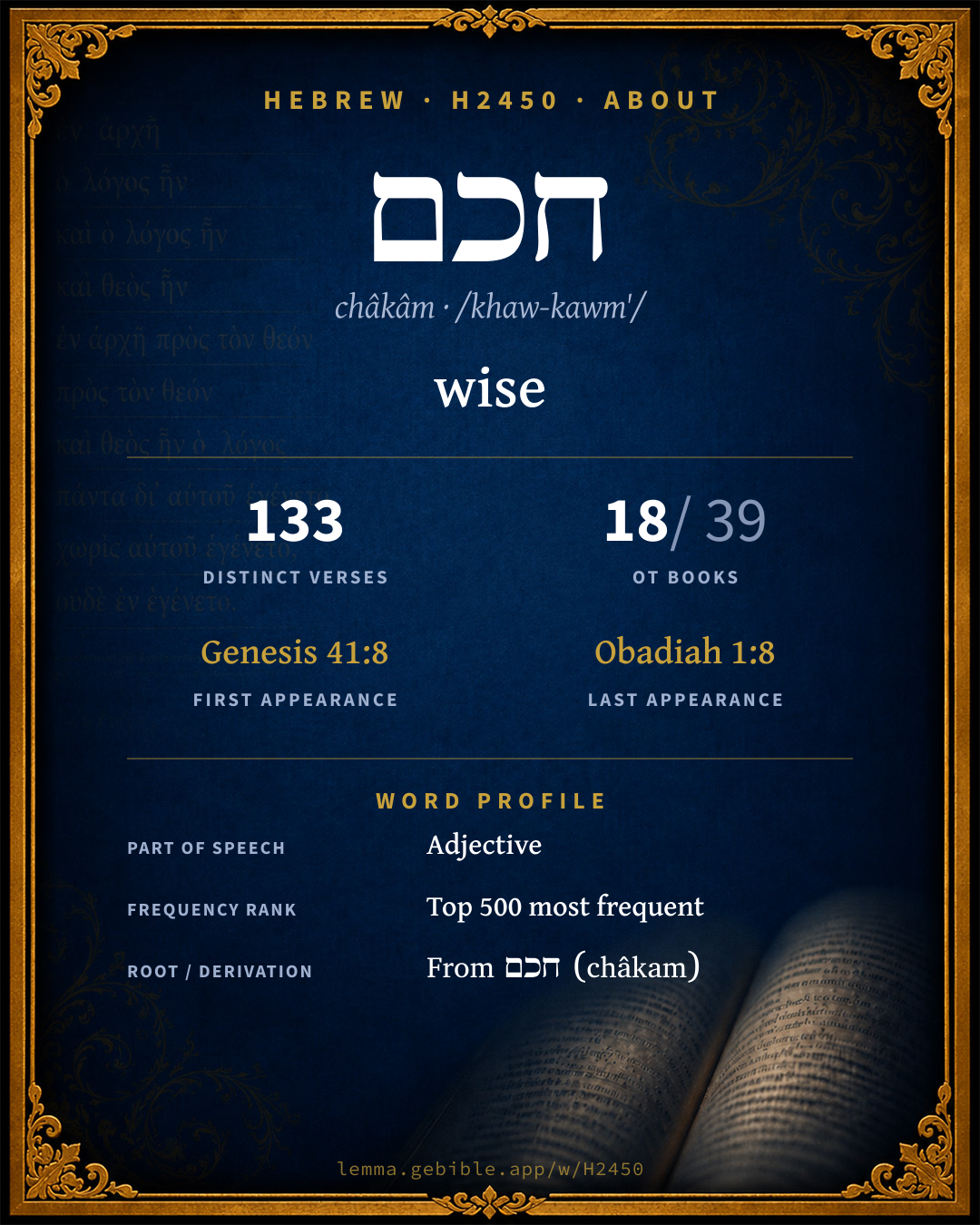
חָכָם
wise
‘wise’ is one of 7 main senses fuller range ↓
Full lexicon entry — Brown-Driver-Briggs (BDB)
From Brown-Driver-Briggs (BDB)
Where this word appears
See every Absolute-state word in the Hebrew Bible →
Grammar key — what these labels mean
Part of speech
- Adjective
- A word that describes or qualifies a noun.
- Noun
- A naming word — a person, place, thing, or idea.
Noun type
- Common
- A common noun — a general class of person, place, or thing (“king,” “city,” “water”), not a specific name.
State
- Absolute
- The independent form of a noun, not bound to a following word.
- Construct
- A noun bound to a following noun in a possessive / “of” relationship (the construct chain).
Gender
- Masculine
- Grammatically masculine.
- Feminine
- Grammatically feminine.
Number
- Singular
- One.
- Plural
- More than one (in Hebrew, generally three or more).
Grammatical forms 9 distinct
- Adjective, Adjective, Masculine, Singular, Absolute 67 times (49%)
- Adjective, Adjective, Masculine, Plural, Absolute 40 times (29%)
- Adjective, Adjective, Masculine, Plural, Construct 14 times (10%)
- Adjective, Adjective, Masculine, Singular, Construct 10 times (7%)
- Adjective, Adjective, Feminine, Singular, Absolute 2 times (1%)
- Adjective, Adjective, Feminine, Plural, Construct 1 time (1%)
- Adjective, Adjective, Feminine, Singular, Construct 1 time (1%)
- Noun, Common, Masculine, Singular, Absolute 1 time (1%)
+1 more form (1 occurrence)
Parsed forms decoded from the imported morphology (morphhb / Westminster Leningrad Codex — WLC text public domain, morphhb tagging CC BY 4.0), counted across 137 parsed occurrences — not distinct verses.
Every verse where H2450 appears — 133 distinct verses across 18 books. Click any verse to open its interlinear word-by-word view. Verse text shown in the World English Bible for context — . Each verse’s Hebrew form is shown with its reference; the English is not keyword-highlighted, since the data carries no word-level English alignment. Use “Compare translations” on any verse to read it across multiple English versions. This concordance covers the Hebrew Bible; Septuagint (Greek Old Testament) occurrences are not indexed here.
Genesis 3 verses
- Genesis 41:8 חֲכָמֶ֑י/הָ adj Adjective mp cs + sfx pers 3fs It happened in the morning that his spirit was troubled, and he sent and called for all the magicians of Egypt, and all the wise men of it. Pharaoh told them his dream, but there was no one who could interpret them to Pharaoh.
- Genesis 41:33 וְ/חָכָ֑ם conj + Adjective Adjective ms Now therefore let Pharaoh look for a discreet and wise man, and set him over the land of Egypt.
- Genesis 41:39 וְ/חָכָ֖ם conj + Adjective Adjective ms Pharaoh said to Joseph, "Because God has shown you all of this, there is none so discreet and wise as you.
Exodus 9 verses
- Exodus 7:11 לַֽ/חֲכָמִ֖ים prep det + Adjective Adjective mp Then Pharaoh also called for the wise men and the sorcerers. They also, the magicians of Egypt, did in like manner with their enchantments.
- Exodus 28:3 חַכְמֵי adj Adjective mp cs You shall speak to all who are wise-hearted, whom I have filled with the spirit of wisdom, that they make Aaron's garments to sanctify him, that he may minister to me in the priest's office.
- Exodus 31:6 חֲכַם adj Adjective ms cs I, behold, I have appointed with him Oholiab, the son of Ahisamach, of the tribe of Dan; and in the heart of all who are wise-hearted I have put wisdom, that they may make all that I have commanded you:
- Exodus 35:10 חֲכַם adj Adjective ms cs "Let every wise-hearted man among you come, and make all that Yahweh has commanded:
- Exodus 35:25 חַכְמַת adj Adjective fs cs All the women who were wise-hearted spun with their hands, and brought that which they had spun, the blue, the purple, the scarlet, and the fine linen.
- Exodus 36:1 חֲכַם adj Adjective ms cs "Bezalel and Oholiab shall work with every wise-hearted man, in whom Yahweh has put wisdom and understanding to know how to work all the work for the service of the sanctuary, according to all that Yahweh has commanded."
- Exodus 36:2 חֲכַם adj Adjective ms cs Moses called Bezalel and Oholiab, and every wise-hearted man, in whose heart Yahweh had put wisdom, even everyone whose heart stirred him up to come to the work to do it:
- Exodus 36:4 הַ֣/חֲכָמִ֔ים ptcl def.art + Adjective Adjective mp All the wise men, who performed all the work of the sanctuary, each came from his work which they did.
- Exodus 36:8 חֲכַם adj Adjective ms cs All the wise-hearted men among those who did the work made the tent with ten curtains; of fine twined linen, blue, purple, and scarlet, with cherubim, the work of the skillful workman, they made them.
Deuteronomy 5 verses
- Deuteronomy 1:13 חֲכָמִ֧ים adj Adjective mp Take wise men of understanding and well known according to your tribes, and I will make them heads over you.
- Deuteronomy 1:15 חֲכָמִים֙ adj Adjective mp So I took the heads of your tribes, wise men, and known, and made them heads over you, captains of thousands, and captains of hundreds, and captains of fifties, and captains of tens, and officers, according to your tribes.
- Deuteronomy 4:6 חָכָ֣ם adj Adjective ms Keep therefore and do them; for this is your wisdom and your understanding in the sight of the peoples, who shall hear all these statutes, and say, Surely this great nation is a wise and understanding people.
- Deuteronomy 16:19 חֲכָמִ֔ים adj Adjective mp You shall not wrest justice: you shall not respect persons; neither shall you take a bribe; for a bribe does blind the eyes of the wise, and pervert the words of the righteous.
- Deuteronomy 32:6 חָכָ֑ם adj Adjective ms Do you thus requite Yahweh, Foolish people and unwise? Isn't he your father who has bought you? He has made you, and established you.
Judges 1 verse
2 Samuel 4 verses
- 2 Samuel 13:3 חָכָ֖ם adj Adjective ms But Amnon had a friend, whose name was Jonadab, the son of Shimeah, David's brother; and Jonadab was a very subtle man.
- 2 Samuel 14:2 חֲכָמָ֑ה adj Adjective fs Joab sent to Tekoa, and fetched there a wise woman, and said to her, please act like a mourner, and put on mourning clothing, Please, and don't anoint yourself with oil, but be as a woman who has a long time mourned for the dead:
- 2 Samuel 14:20 חָכָ֗ם adj Adjective ms to change the face of the matter has your servant Joab done this thing: and my lord is wise, according to the wisdom of an angel of God, to know all things that are in the earth.
- 2 Samuel 20:16 חֲכָמָ֖ה adj Adjective fs Then cried a wise woman out of the city, "Hear, hear! Please say to Joab, 'Come near here, that I may speak with you.'"
1 Kings 3 verses
- 1 Kings 2:9 חָכָ֖ם adj Adjective ms Now therefore don't hold him guiltless, for you are a wise man; and you will know what you ought to do to him, and you shall bring his gray head down to Sheol with blood.
- 1 Kings 3:12 חָכָ֣ם adj Adjective ms behold, I have done according to your word: behold, I have given you a wise and an understanding heart; so that there has been none like you before you, neither after you shall any arise like you.
- 1 Kings 5:7 חָכָ֔ם adj Adjective ms It happened, when Hiram heard the words of Solomon, that he rejoiced greatly, and said, Blessed be Yahweh this day, who has given to David a wise son over this great people.
1 Chronicles 1 verse
2 Chronicles 4 verses
- 2 Chronicles 2:7 חָכָ֡ם הַֽ/חֲכָמִ֗ים adj Adjective ms ptcl def.art + Adjective Adjective mp Now therefore send me a man skillful to work in gold, and in silver, and in brass, and in iron, and in purple, and crimson, and blue, and who knows how to engrave [all manner of] engravings, [to be] with the skillful men who are with me in Judah and in Jerusalem, whom David my father did provide.
- 2 Chronicles 2:12 חָכָ֗ם adj Adjective ms Huram said moreover, Blessed be Yahweh, the God of Israel, that made heaven and earth, who has given to David the king a wise son, endowed with discretion and understanding, that should build a house for Yahweh, and a house for his kingdom.
- 2 Chronicles 2:13 חָכָ֛ם adj Adjective ms Now I have sent a skillful man, endowed with understanding, of Huram my father's,
- 2 Chronicles 2:14 חֲכָמֶ֔י/ךָ וְֽ/חַכְמֵ֔י adj Adjective mp cs + sfx pers 2ms conj + Adjective Adjective mp cs the son of a woman of the daughters of Dan; and his father was a man of Tyre, skillful to work in gold, and in silver, in brass, in iron, in stone, and in timber, in purple, in blue, and in fine linen, and in crimson, also to engrave any manner of engraving, and to devise any device; that there may be [a place] appointed to him with your skillful men, and with the skillful men of my lord David your father.
Esther 2 verses
- Esther 1:13 לַ/חֲכָמִ֖ים prep det + Adjective Adjective mp Then the king said to the wise men, who knew the times, (for so was the king's manner toward all who knew law and judgment;
- Esther 6:13 חֲכָמָ֜י/ו adj Adjective mp cs + sfx pers 3ms Haman recounted to Zeresh his wife and all his friends everything that had happened to him. Then his wise men and Zeresh his wife said to him, If Mordecai, before whom you have begun to fall, be of the seed of the Jews, you shall not prevail against him, but shall surely fall before him.
Job 8 verses
- Job 5:13 חֲכָמִ֣ים adj Adjective mp He takes the wise in their own craftiness; The counsel of the cunning is carried headlong.
- Job 9:4 חֲכַ֣ם adj Adjective ms cs God who is wise in heart, and mighty in strength: Who has hardened himself against him, and prospered?
- Job 15:2 הֶֽ/חָכָ֗ם ptcl inter + Adjective Adjective ms "Should a wise man answer with vain knowledge, And fill himself with the east wind?
- Job 15:18 חֲכָמִ֥ים adj Adjective mp (Which wise men have told From their fathers, and have not hidden it;
- Job 17:10 חָכָֽם adj Adjective ms But as for you all, come on now again; I shall not find a wise man among you.
- Job 34:2 חֲכָמִ֣ים adj Adjective mp "Hear my words, you wise men; Give ear to me, you who have knowledge.
- Job 34:34 חָ֝כָ֗ם adj Adjective ms Men of understanding will tell me, Yes, every wise man who hears me:
- Job 37:24 חַכְמֵי adj Adjective mp cs Therefore men revere him. He doesn't regard any who are wise of heart."
Psalms 2 verses
Proverbs 46 verses
- Proverbs 1:5 חָ֭כָם n c ms That the wise man may hear, and increase in learning; That the man of understanding may attain to sound counsel:
- Proverbs 1:6 חֲ֝כָמִ֗ים adj Adjective mp To understand a proverb, and parables, The words and riddles of the wise.
- Proverbs 3:7 חָכָ֣ם adj Adjective ms Don't be wise in your own eyes. Fear Yahweh, and depart from evil.
- Proverbs 3:35 חֲכָמִ֣ים adj Adjective mp The wise will inherit glory, But shame will be the promotion of fools.
- Proverbs 9:8 לְ֝/חָכָ֗ם prep + Adjective Adjective ms Don't reprove a scoffer, lest he hate you. Reprove a wise man, and he will love you.
- Proverbs 9:9 לְ֭/חָכָם prep + Adjective Adjective ms Instruct a wise man, and he will be still wiser. Teach a righteous man, and he will increase in learning.
- Proverbs 10:1 חָ֭כָם adj Adjective ms The proverbs of Solomon. A wise son makes a glad father; But a foolish son brings grief to his mother.
- Proverbs 10:8 חֲכַם adj Adjective ms cs The wise in heart accept commandments, But a chattering fool will fall.
- Proverbs 10:14 חֲכָמִ֥ים adj Adjective mp Wise men lay up knowledge, But the mouth of the foolish is near ruin.
- Proverbs 11:29 לַ/חֲכַם prep + Adjective Adjective ms cs He who troubles his own house shall inherit the wind. The foolish shall be servant to the wise of heart.
- Proverbs 11:30 חָכָֽם adj Adjective ms The fruit of the righteous is a tree of life. He who is wise wins souls.
- Proverbs 12:15 חָכָֽם adj Adjective ms The way of a fool is right in his own eyes, But he who is wise listens to counsel.
- Proverbs 12:18 חֲכָמִ֣ים adj Adjective mp There is one who speaks rashly like the piercing of a sword, But the tongue of the wise heals.
- Proverbs 13:1 חָ֭כָם adj Adjective ms A wise son listens to his father's instruction, But a scoffer doesn't listen to rebuke.
- Proverbs 13:14 חָ֭כָם adj Adjective ms The teaching of the wise is a spring of life, To turn from the snares of death.
- Proverbs 13:20 חֲכָמִ֣ים adj Adjective mp One who walks with wise men grows wise, But a companion of fools suffers harm.
- Proverbs 14:3 חֲ֝כָמִ֗ים adj Adjective mp The fool's talk brings a rod to his back, But the lips of the wise protect them.
- Proverbs 14:16 חָכָ֣ם adj Adjective ms A wise man fears, and shuns evil, But the fool is hotheaded and reckless.
- Proverbs 14:24 חֲכָמִ֣ים adj Adjective mp The crown of the wise is their riches, But the folly of fools crowns them with folly.
- Proverbs 15:2 חֲ֭כָמִים adj Adjective mp The tongue of the wise commends knowledge, But the mouth of fools gush out folly.
- Proverbs 15:7 חֲ֭כָמִים adj Adjective mp The lips of the wise spread knowledge; Not so with the heart of fools.
- Proverbs 15:12 חֲ֝כָמִ֗ים adj Adjective mp A scoffer doesn't love to be reproved; He will not go to the wise.
- Proverbs 15:20 חָ֭כָם adj Adjective ms A wise son makes a father glad, But a foolish man despises his mother.
- Proverbs 15:31 חֲכָמִ֣ים adj Adjective mp The ear that listens to reproof lives, And will be at home among the wise.
- Proverbs 16:14 חָכָ֣ם adj Adjective ms The king's wrath is a messenger of death, But a wise man will pacify it.
- Proverbs 16:21 לַ/חֲכַם prep + Adjective Adjective ms cs The wise in heart shall be called prudent. Pleasantness of the lips promotes instruction.
- Proverbs 16:23 חָ֭כָם adj Adjective ms The heart of the wise instructs his mouth, And adds learning to his lips.
- Proverbs 17:28 חָכָ֣ם adj Adjective ms Even a fool, when he keeps silent, is counted wise. When he shuts his lips, he is thought to be discerning.
- Proverbs 18:15 חֲ֝כָמִ֗ים adj Adjective mp The heart of the discerning gets knowledge. The ear of the wise seeks knowledge.
- Proverbs 20:26 חָכָ֑ם adj Adjective ms A wise king winnows out the wicked, And drives the threshing wheel over them.
- Proverbs 21:11 לְ֝/חָכָ֗ם prep + Adjective Adjective ms When the mocker is punished, the simple gains wisdom; When the wise is instructed, he receives knowledge.
- Proverbs 21:20 חָכָ֑ם adj Adjective ms There is precious treasure and oil in the dwelling of the wise; But a foolish man swallows it up.
- Proverbs 21:22 חָכָ֑ם adj Adjective ms A wise man scales the city of the mighty, And brings down the strength of its confidence.
- Proverbs 22:17 חֲכָמִ֑ים adj Adjective mp Turn your ear, and listen to the words of the wise. Apply your heart to my teaching.
- Proverbs 23:24 חָ֝כָ֗ם adj Adjective ms The father of the righteous has great joy. Whoever fathers a wise child delights in him.
- Proverbs 24:5 חָכָ֥ם adj Adjective ms A wise man has great power; And a knowledgeable man increases strength;
- Proverbs 24:23 לַֽ/חֲכָמִ֑ים prep + Adjective Adjective mp These also are sayings of the wise. To show partiality in judgment is not good.
- Proverbs 25:12 חָ֝כָ֗ם adj Adjective ms As an ear-ring of gold, and an ornament of fine gold, So is a wise reprover to an obedient ear.
- Proverbs 26:5 חָכָ֣ם adj Adjective ms Answer a fool according to his folly, Lest he be wise in his own eyes.
- Proverbs 26:12 חָכָ֣ם adj Adjective ms Do you see a man wise in his own eyes? There is more hope for a fool than for him.
- Proverbs 26:16 חָכָ֣ם adj Adjective ms The sluggard is wiser in his own eyes Than seven men who answer with discretion.
- Proverbs 28:11 חָכָ֣ם adj Adjective ms The rich man is wise in his own eyes; But the poor who has understanding sees through him.
- Proverbs 29:8 וַ֝/חֲכָמִ֗ים conj + Adjective Adjective mp Mockers stir up a city, But wise men turn away anger.
- Proverbs 29:9 חָכָ֗ם adj Adjective ms If a wise man goes to court with a foolish man, The fool rages or scoffs, and there is no peace.
- Proverbs 29:11 וְ֝/חָכָ֗ם conj + Adjective Adjective ms A fool vents all of his anger, But a wise man brings himself under control.
- Proverbs 30:24 חֲכָמִ֥ים adj Adjective mp "There are four things which are little on the earth, But they are exceedingly wise:
Ecclesiastes 20 verses
- Ecclesiastes 2:14 הֶֽ/חָכָם֙ ptcl def.art + Adjective Adjective ms The wise man's eyes are in his head, and the fool walks in darkness--and yet I perceived that one event happens to them all.
- Ecclesiastes 2:16 לֶ/חָכָ֛ם הֶ/חָכָ֖ם prep det + Adjective Adjective ms ptcl def.art + Adjective Adjective ms For of the wise man, even as of the fool, there is no memory for ever, seeing that in the days to come all will have been long forgotten. Indeed, the wise man must die just like the fool!
- Ecclesiastes 2:19 הֶֽ/חָכָ֤ם ptcl inter + Adjective Adjective ms Who knows whether he will be a wise man or a fool? Yet he will have rule over all of my labor in which I have labored, and in which I have shown myself wise under the sun. This also is vanity.
- Ecclesiastes 4:13 וְ/חָכָ֑ם conj + Adjective Adjective ms Better is a poor and wise youth than an old and foolish king who doesn't know how to receive admonition any more.
- Ecclesiastes 6:8 לֶ/חָכָ֖ם prep det + Adjective Adjective ms For what advantage has the wise more than the fool? What has the poor man, that knows how to walk before the living?
- Ecclesiastes 7:4 חֲכָמִים֙ adj Adjective mp The heart of the wise is in the house of mourning; but the heart of fools is in the house of mirth.
- Ecclesiastes 7:5 חָכָ֑ם adj Adjective ms It is better to hear the rebuke of the wise, than for a man to hear the song of fools.
- Ecclesiastes 7:7 חָכָ֑ם adj Adjective ms Surely extortion makes the wise man foolish; and a bribe destroys the understanding.
- Ecclesiastes 7:19 לֶ/חָכָ֑ם prep det + Adjective Adjective ms Wisdom is a strength to the wise man more than ten rulers who are in a city.
- Ecclesiastes 8:1 כְּ/הֶ֣/חָכָ֔ם prep + ptcl def.art + Adjective Adjective ms Who is like the wise man? And who knows the interpretation of a thing? A man's wisdom makes his face shine, and the hardness of his face is changed.
- Ecclesiastes 8:5 חָכָֽם adj Adjective ms Whoever keeps the commandment shall not come to harm, and his wise heart will know the time and procedure.
- Ecclesiastes 8:17 הֶֽ/חָכָם֙ ptcl def.art + Adjective Adjective ms then I saw all the work of God, that man can't find out the work that is done under the sun, because however much a man labors to seek it out, yet he won't find it. Yes even though a wise man thinks he can comprehend it, he won't be able to find it.
- Ecclesiastes 9:1 וְ/הַ/חֲכָמִ֛ים conj + ptcl def.art + Adjective Adjective mp For all this I laid to my heart, even to explore all this: that the righteous, and the wise, and their works, are in the hand of God; whether it is love or hatred, man doesn't know it; all is before them.
- Ecclesiastes 9:11 לַ/חֲכָמִ֥ים prep det + Adjective Adjective mp I returned, and saw under the sun, that the race is not to the swift, nor the battle to the strong, neither yet bread to the wise, nor yet riches to men of understanding, nor yet favor to men of skill; but time and chance happen to them all.
- Ecclesiastes 9:15 חָכָ֔ם adj Adjective ms Now a poor wise man was found in it, and he by his wisdom delivered the city; yet no man remembered that same poor man.
- Ecclesiastes 9:17 חֲכָמִ֔ים adj Adjective mp The words of the wise heard in quiet are better than the cry of him who rules among fools.
- Ecclesiastes 10:2 חָכָם֙ adj Adjective ms A wise man's heart is at his right hand, but a fool's heart at his left.
- Ecclesiastes 10:12 חָכָ֖ם adj Adjective ms The words of a wise man's mouth are gracious; but a fool is swallowed by his own lips.
- Ecclesiastes 12:9 חָכָ֑ם adj Adjective ms Further, because the Preacher was wise, he still taught the people knowledge. Yes, he pondered, sought out, and set in order many proverbs.
- Ecclesiastes 12:11 חֲכָמִים֙ adj Adjective mp The words of the wise are like goads; and like nails well fastened are words from the masters of assemblies, which are given from one shepherd.
Isaiah 8 verses
- Isaiah 3:3 וַ/חֲכַ֥ם conj + Adjective Adjective ms cs The captain of fifty, The honorable man, The counselor, The skilled craftsman, And the clever enchanter.
- Isaiah 5:21 חֲכָמִ֣ים adj Adjective mp Woe to those who are wise in their own eyes, And prudent in their own sight!
- Isaiah 19:11 חַכְמֵי֙ חֲכָמִ֥ים adj Adjective mp cs adj Adjective mp The princes of Zoan are utterly foolish; the counsel of the wisest counselors of Pharaoh is become brutish: how do you say to Pharaoh, I am the son of the wise, the son of ancient kings?
- Isaiah 19:12 חֲכָמֶ֔י/ךָ adj Adjective mp cs + sfx pers 2ms Where then are your wise men? and let them tell you now; and let them know what Yahweh of Hosts has purposed concerning Egypt.
- Isaiah 29:14 חֲכָמָ֔י/ו adj Adjective mp cs + sfx pers 3ms therefore, behold, I will proceed to do a marvelous work among this people, even a marvelous work and a wonder; and the wisdom of their wise men shall perish, and the understanding of their prudent men shall be hid.
- Isaiah 31:2 חָכָם֙ adj Adjective ms Yet he also is wise, and will bring evil, and will not call back his words, but will arise against the house of the evil-doers, and against the help of those who work iniquity.
- Isaiah 40:20 חָכָם֙ adj Adjective ms He who is too impoverished for [such] an offering chooses a tree that will not rot; he seeks to him a skillful workman to set up an engraved image, that shall not be moved.
- Isaiah 44:25 חֲכָמִ֛ים adj Adjective mp who frustrates the signs of the liars, and makes diviners mad; who turns wise men backward, and makes their knowledge foolish;
Jeremiah 11 verses
- Jeremiah 4:22 חֲכָמִ֥ים adj Adjective mp For my people are foolish, they don't know me; they are foolish children, and they have no understanding; they are wise to do evil, but to do good they have no knowledge.
- Jeremiah 8:8 חֲכָמִ֣ים adj Adjective mp How do you say, We are wise, and the law of Yahweh is with us? But, behold, the false pen of the scribes has worked falsely.
- Jeremiah 8:9 חֲכָמִ֔ים adj Adjective mp The wise men are disappointed, they are dismayed and taken: behold, they have rejected the word of Yahweh; and what manner of wisdom is in them?
- Jeremiah 9:12 הֶֽ/חָכָם֙ ptcl def.art + Adjective Adjective ms Who is the wise man, that may understand this? and [who is] he to whom the mouth of Yahweh has spoken, that he may declare it? why is the land perished and burned up like a wilderness, so that none passes through?
- Jeremiah 9:17 הַ/חֲכָמ֥וֹת ptcl def.art + Adjective Adjective fp Thus says Yahweh of Hosts, Consider you, and call for the mourning women, that they may come; and send for the skillful women, that they may come:
- Jeremiah 9:23 חָכָם֙ adj Adjective ms Thus says Yahweh, Don't let the wise man glory in his wisdom, neither let the mighty man glory in his might, don't let the rich man glory in his riches;
- Jeremiah 10:7 חַכְמֵ֧י adj Adjective mp cs Who should not fear you, King of the nations? for to you does it appertain; because among all the wise men of the nations, and in all their royal estate, there is none like you.
- Jeremiah 10:9 חֲכָמִ֖ים adj Adjective mp There is silver beaten into plates, which is brought from Tarshish, and gold from Uphaz, the work of the artificer and of the hands of the goldsmith; blue and purple for their clothing; they are all the work of skillful men.
- Jeremiah 18:18 מֵֽ/חָכָ֔ם prep + Adjective Adjective ms Then said they, Come, and let us devise devices against Jeremiah; for the law shall not perish from the priest, nor counsel from the wise, nor the word from the prophet. Come, and let us strike him with the tongue, and let us not give heed to any of his words.
- Jeremiah 50:35 חֲכָמֶֽי/הָ adj Adjective mp cs + sfx pers 3fs A sword is on the Chaldeans, says Yahweh, and on the inhabitants of Babylon, and on her princes, and on her wise men.
- Jeremiah 51:57 וַ/חֲכָמֶ֜י/הָ conj + Adjective Adjective mp cs + sfx pers 3fs I will make drunk her princes and her wise men, her governors and her deputies, and her mighty men; and they shall sleep a perpetual sleep, and not wake up, says the King, whose name is Yahweh of Hosts.
Ezekiel 3 verses
- Ezekiel 27:8 חֲכָמַ֤יִ/ךְ adj Adjective mp cs + sfx pers 2fs The inhabitants of Sidon and Arvad were your rowers: your wise men, Tyre, were in you, they were your pilots.
- Ezekiel 27:9 וַ/חֲכָמֶ֨י/הָ֙ conj + Adjective Adjective mp cs + sfx pers 3fs The old men of Gebal and the wise men of it were in you your repairers of ship seams: all the ships of the sea with their mariners were in you to deal in your merchandise.
- Ezekiel 28:3 חָכָ֛ם adj Adjective ms behold, you are wiser than Daniel; there is no secret that is hidden from you;
Hosea 2 verses
- Hosea 13:13 חָכָ֔ם adj Adjective ms The sorrows of a travailing woman will come on him. He is an unwise son; For when it is time, he doesn't come to the opening of the womb.
- Hosea 14:9 חָכָם֙ adj Adjective ms Who is wise, that he may understand these things? Who is prudent, that he may know them? For the ways of Yahweh are right, And the righteous walk in them; But the rebellious stumble in them.
Obadiah 1 verse
About this entry
At a glance — auto-summarized from this page’s data, not written by a person. Every figure links to its source below. This summary describes the numbers; it doesn’t interpret them.
חכם — transliterated châkâm — is a Hebrew adjective carrying the sense “wise.” It is not a single-sense word — see its full sense range. With 133 verses in 18 books, it is a common word in the Hebrew Bible. Its uses concentrate in Proverbs (35% of all occurrences). It first appears in Genesis 41:8. See the sense tree, 133-verse concordance, and the renderings breakdown below.
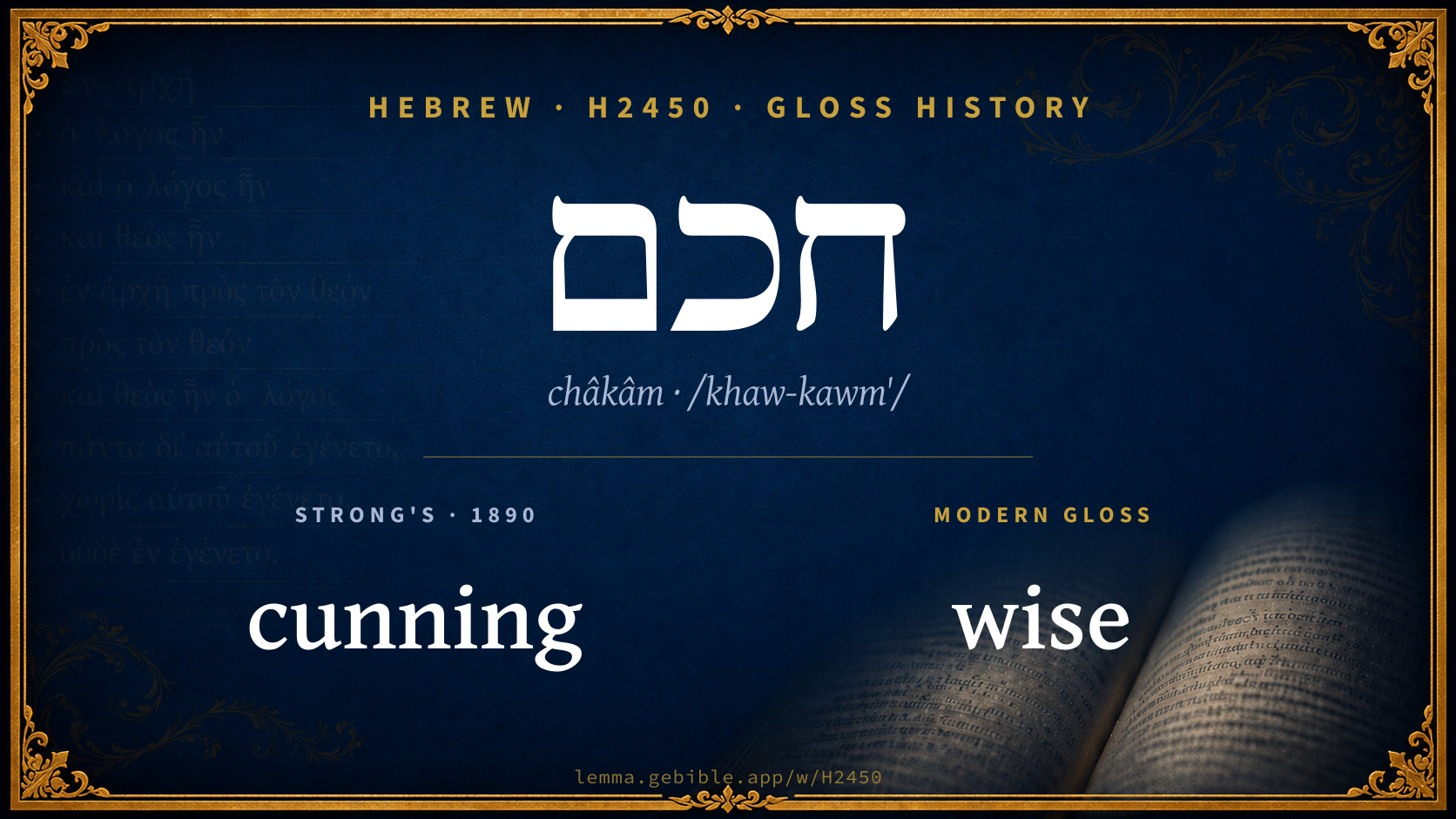
Gloss history
Strong's 1890 vs modern scholarship
About this word
Strong's H2450 catalogs a Hebrew word from the Hebrew Old Testament.
These counts are not copied from any lexicon or concordance. They are computed here, from the morphology-tagged Hebrew Old Testament. What Lemma adds →
- 133
- distinct verses
- The word appears in 133 distinct verses.
- 18 / 39
- OT books
- The word appears in 18 of 39 Old Testament books.
- #328
- by frequency
- Top 500 most frequent Hebrew words (rank 328 of 8,640 Hebrew words by occurrence).
View all 133 occurrences in the concordance →
Most concentrated in
- Proverbs 46 verses 35%
- Ecclesiastes 20 verses 15%
- Jeremiah 11 verses 8%
By section of the Old Testament
By traditional corpus
Conventional, traditional groupings — biblical authorship is debated, so this is a traditional corpus grouping, not an authorship claim. Each share is this word’s portion of its verses in that division of the Hebrew canon. Each figure is a share of the word’s 133 distinct verses.
- Writings (Ketuvim) 83 verses · 62%
- Prophets (Nevi'im) 33 verses · 25%
- Torah (Pentateuch) 17 verses · 13%
How translations render this word
Counts come from each version’s own published word-to-Strong’s tagging or interlinear alignment — an approximate guide to how each version renders this word, not a word-level alignment the data otherwise carries. Because each total is that version’s own tagged count, the per-version totals vary from one another and need not match the appearance or distinct-verse counts above. These counts may also differ from a printed concordance because Lemma counts each distinctly tagged rendering and does not collapse phrase taggings into a single head-word total. This is a fixed set of word-tagged versions (KJV, ASV, BSB, ULT) and does not change with the reading translation you choose elsewhere. Each version’s license is shown beside its name below (and on Sources).
- King James Version: Wise 68×, Cunning 6×, Is wise 5×
- American Standard Version: Wise 63×, Skilful 5×, Wise man 4×
- Berean Standard Bible: Wise 76×, Wise men 7×, Wise man 5×
- unfoldingWord Literal Text: Wise 67×, Wise ones 10×, Wise of 8×
King James Version Public Domain
Renders H2450 across 137 tagged occurrences — most commonly:
Plus 37 renderings that appear only once — usually multi-word phrases or single function words the recovered tagging swept in, not distinct renderings.
American Standard Version Public Domain
Renders H2450 across 138 tagged occurrences — most commonly:
Plus 48 renderings that appear only once — usually multi-word phrases or single function words the recovered tagging swept in, not distinct renderings.
Berean Standard Bible Public Domain
Renders H2450 across 136 tagged occurrences — most commonly:
Plus 27 renderings that appear only once — usually multi-word phrases or single function words the recovered tagging swept in, not distinct renderings. Not rendered by a distinct English word in 2 further occurrences.
unfoldingWord Literal Text CC BY-SA 4.0
Renders H2450 across 154 tagged occurrences — most commonly:
Plus other, less common renderings. Plus 22 renderings that appear only once — usually multi-word phrases or single function words the recovered tagging swept in, not distinct renderings.
8 senses and sub-senses in the full BDB
What do BDB’s symbols mean?
BDB uses these scholarly abbreviations:
| Symbol | Meaning |
|---|---|
| 𝔊 | the Septuagint (the ancient Greek translation, LXX) |
| 𝔙 | the Vulgate (the Latin translation) |
| 𝔖 | the Syriac version (the Peshitta) |
| 𝔗 | the Targum (the Aramaic translation) |
| ψ | the Psalms |
| √ | root (the underlying root or stem) |
| ‖ | parallel passage (a synonymous or contrasted parallel) |
| † | the dagger: every passage where the word occurs is cited |
The 8 senses and sub-senses the full Brown-Driver-Briggs lexicon distinguishes for this word, in lexicon order (not ranked by frequency), with BDB’s own verbatim wording and sub-sense lettering. Shown in Hebrew script with BDB’s own scholarly abbreviations. The condensed entry is in the Lexicon Entry tab. See also the Forms in the corpus table below.
- 1. skilful in technical work; artificers Is 3:3; sailors Ez 27:8, so (prob.) v 9; mourning women Je 9:16; artisans of tabern. and temple and their furniture Ex 28:3; 31:6; 35:10; 36:1, 2, 4, 8 (P), 1 Ch 22:15 2 Ch 2:6, 12, 13(×2); women in spinning Ex 35:25 (P); goldsmiths and other artisans Je 10:9; makers of idol-images Is 40:20. e.g. Isaiah 3:3
- 2. wise in the administration of affairs: Joseph in Egypt Gn 41:33, 39 (E); heads of tribes Dt 1:13, 15, judges 16:19; of David 2 S 14:20, of Solomon 1 K 2:9; 3:12; 5:21 = 2 Ch 2:11; the prince of Tyre, in satire Ez 28:3; of kings in general Pr 20:26; class of political advisers of Judah Is 29:14 Je 18:18, appar. also Is 5:21; of Egypt Is 19:11(×2), 12, Edom Ob 8, the nations Je 10:7; so of God Is 31:2. e.g. Genesis 41:33
- 3. shrewd, crafty, cunning: Jonadab 2 S 13:3; the princesses Ju 5:29; אשׁה חכמה wise woman 2 S 14:2; 20:16; gen., Je 9:22; intelligent animals Pr 30:24; לכד ח׳ בערמם taking the cunning in their craft Jb 5:13; חכם בעיני wise in one’s own eyes Pr 3:7; 26:5, 12, 16; 28:11; חכמי לב wise of mind (in their own mind) Jb 37:24. e.g. 2 Samuel 13:3
- 4. pl. class of learned and shrewd men, incl. astrologers, magicians and the like, of Egypt Gn 41:8 (E), Ex 7:11 (P; cf. Is 19:11(×2), 12); Babylon Is 44:25 Je 50:35; 51:57; Persia Est 1:13; 6:13. e.g. Genesis 41:8
- 5. prudent, towards king Pr 16:14; in controversies Pr 11:29; 29:8, 9, 11; religious affairs Ho 13:13; 14:10 Je 4:22; 8:8, 9 Dt 4:6; 32:6 ψ 107:43; אישׁ ח׳ Je 9:11. e.g. Proverbs 16:14
- 6. wise, ethically and religiously, in WisdLt:
- a. as adj., חֲכַם לֵב wise of mind Pr 10:8; 16:21; לֵב חָכָם Ec 8:5; of the son Pr 10:1 = 15:20, 13:1; 23:24; Ec 2:19; ילד ח׳ Ec 4:13 wise boy; גבר ח׳ Jb 34:34 wise man; מוכיח ח׳ wise reprover Pr 25:12. e.g. Proverbs 10:8
- b. = subst.: (1) as a wise learner in school of wisdom, he fears God and departs from evil Pr 14:16; is silent Pr 17:28; hearkens to counsel Pr 12:15; hears and increases in learning Pr 1:5; his ear seeketh knowledge Pr 18:15; he receives it Pr 21:11; and stores it up Pr 10:14; his ears hearken to the reproof which giveth life Pr 15:31; and he becomes wiser through it Pr 9:8, 9. (2) as a wise teacher, a sage, he does not answer with windy knowledge Jb 15:2; he tells the experience of the past Jb 15:18; has knowledge Jb 34:2; teaches it Ec 12:9; disperses it Pr 15:7; his tongue is health Pr 12:18; it utters knowledge aright Pr 15:2; his mind instructs his mouth and adds learning to his lips Pr 16:23; his words are gracious Ec 10:12; it is good to hear his rebuke Ec 7:5; his instruction is a fountain of life Pr 13:14; one walking with him becomes wiser Pr 13:20. The חכמים recall the Gk. σόφοι, having their schools, pupils (בֵן), discipline (מוּסָר), principles and collections of wisdom, דברי חכמים Pr 1:6; 22:17 (cf. 24:23), Ec 9:17; 12:11; God himself is חכם לבב Jb 9:4. (3) the wise are prosperous: true, in sceptical view of Ec., they have no advantage over the fool Ec 6:8; but die as the fool Ec 2:16(×2) ψ 49:11; they will not be able to find the works of God Ec 8:17; like others are in the hands of God Ec 9:1; they do not secure bread Ec 9:11; but elsewhere reverse is true: precious treasure is in his dwelling Pr 21:20; his lips preserve him Pr 14:3; they inherit glory Pr 3:35; wealth is their crown Pr 14:24; the wise man is strong Pr 24:5 Ec 7:19; his eyes are in his head Ec 2:14; his mind is at his right hand Ec 10:2; he interprets things Ec 8:1. (4) the wise man is a blessing to others: he wins men Pr 11:30; scales the city of the mighty Pr 21:22; though poor he delivers the city Ec 9:15; is a reproof to scorners Pr 15:12; his mind is in the house of mourning Ec 7:4; injustice makes him foolish Ec 7:7; Job finds no wise men among his cruel friends Jb 17:10. e.g. Proverbs 14:16
Senses from the full Brown-Driver-Briggs lexicon (Brown, Driver, Briggs; Oxford 1906 — public domain), digitized via Sefaria, supplemented by the OpenScriptures HebrewLexicon (CC BY 4.0). Full attribution on Sources.
Word origin
adj. wise, ח׳ Dt 4:6 + 67 times; cstr. חֲכַם Is 3:3 + 9 times; pl. חֲכָמִים Dt 1:13 + 39 times; cstr. חַכְמֵי Ex 28:3 + 4 times; sf. חֲכָמֶיךָ Is 19:12 etc. + 8 times; f. חֲכָמָה 2 S 14:2; 20:16; cstr. חַכְמַת Ex 35:25; pl. חֲכָמוֹת Je 9:16; cstr. חַכְמוֹת Ju 5:29 Pr 14:1 (but read חָכְמוֹת De);—
— Brown-Driver-Briggs (Oxford 1906, public domain), digitized via Sefaria, supplemented by the OpenScriptures HebrewLexicon (CC BY 4.0). See Sources.
Derived from חכם (châkam) (H2449) — to be wise.
Jastrow Dictionary
A second Hebrew/Aramaic lexicon for comparison, covering Aramaic and post-biblical (Talmudic, Targumic, Midrashic) usage that the biblical-Hebrew BDB does not. Matched by lemma rather than by Strong’s number, so a lemma may carry more than one Jastrow headword (shown separately below), and the entries cover usage well beyond the Bible.
חָכַם
- v. חָכָם)
- 1. to be wise, to know. Nidd. 70ᵇ מה יעשה אדם ויֶחְכַּם what must one do in order to be wise?
- 2. (denom. of חָכָם) to meet for deliberation. Ib. לכשיחיו נֶחְכַּם להן when they resurrect, we shall meet to discuss their case.
- 1. to grow wise, to become a scholar. B. Bath. 25ᵇ הרוצה שיַחְכִּים he who desires to become a scholar; ib. 175ᵇ (Ber. 63ᵇ שיִתְחַכֵּם). Ab. II, 5 … לא כל … מַחְכִּים not every one that has a large trade, becomes wise (experienced); a. fr.
- 2. to make wise, to stimulate a person’s mind by ingenious suggestions, questions &c. Ḥag. 14ᵃ תלמיד המַחְכִּים וכ׳ a student who enlightens his teachers. B. Mets. 107ᵇ ומַחְכִּימַת פתי and makes the simple wise.
- 3. to subtilize, philosophize. Ex. R. s. 6, beg. ה׳ על גזרתו וכ׳ philosophized on (tried to find out the reasons for) the Lord’s law. Ib. מה שהייתי מַחְכִּים וכ׳ when I philosophised … and made myself believe …, it was all vain boast &c.
- to become wise. Ber. 63ᵇ, v. supra. B. Bath. 25ᵇ מתוך שמִתְחַכֵּם מתעשר because by becoming wise, he will get rich. Pesik. R. s. 33 beg. מאליו נתח׳ became wise by his own speculation.
חֲכַם
- (adj. with verbal inflection)
- 1. to be wise, shrewd; to be learned. Targ. I Kings V, 11. Targ. O. Ex. XV, 8 חֲכִימוּ (חַכִּ׳, h. text נערמו!). Targ. Is. XXIX, 16; a. fr.—Gitt. 56ᵇ דחַכְמִיתוּ וכ׳ that you are so wise. Taan. 23ᵇ דנִיחְכִּים טובא that we may become well-learned; a. fr.
- 2. to recognize, to know, remember. Targ. Y. II, Gen. XXXVII, 33 (some ed. חַכַּם Pa.).—Targ. II Esth. II, 18; a. fr.—Lev. R. s. 30 ח׳ את וכ׳ doest thou know anything in favor of this man?—Y. M. Kat. III, 83ᵇ top, v. בְּאַר—Y. Ber. II, 4ᵈ top וחַכְמִין אינון כלום do they (the dead) know anything?—Y. Shek. VII, 50ᶜ bot. יֶחְכְּמוּן שפייא קיטריהון let the wine-dealers identify their knots (marks on the wine bottles). Y. Keth. V, 30ᵃ bot. [read:] חֲכִים אנא לחייתא דמילדא לי (or חַכִּים) I (as an infant) recognized the midwife that assisted at my birth (when she came to nurse my mother). Y. Ter. XI, end, 48ᵇ לא אנא ח׳ לאבא I never knew my father. Y. Ḥag. II, 78ᵃ top יַחְכּוּם shall select (Y. Snh. VI, 23ᵃ bot. יטול), v. זוֹגָא.—2) (euphem. = b. h. יָדַע) to sleep with. Targ. Y. Gen. IV, 1 Ar. (ed. ידע). Targ. Y. II ib. XX, 16; a. e.—Y. Maas. Sh. IV, 55ᵇ bot.; Lam. R. to I, 1 רבתי (חד כותאי 1) a.e.
- 3. to be clear, evident. Snh. 42ᵃ, v. זָקֵן I.
- 1. to make wise, teach. Targ. Y. Deut. XXXIV, 10. Targ. Job XXXV, 11; a. e.
- 2. to outwit. Targ. O. Gen. XXVII, 36 (Rashi a. l. quotes וכמני, v. כְּמַן, v. Berl. Targ. O. II, p. 10).
- 1. to become wise. Targ. Ps. CV, 22; a. e.
- 2. to be informed, aware; to learn. Ib. XXXV, 8. Targ. Y. Ex. II, 4.
- 3. to hold counsel. Targ. O. Ex. I, 10.
- 4. to be recognized. Y. Sot. IX, 23ᶜ bot.; Y. Yeb. XVI, 15ᶜ מאן דבעי דלא מִתְחַכְּמָה he who desires to disguise himself; לא מִתְחַכְּמִין they were not recognized, v. נְחִירָא.
- to teach, make wise. Targ. Ez. III, 2; a. e.—B. Bath. 158ᵇ אוירא דא"י מַהְכּים the climate of Palestine makes wise.
חָכָם
- v. Fl. to Levy Talm. Dict. II, 2042) [retentive,]
- 1. one who knows. חֲכַם הרזים He who knows the secrets (minds of men). Ber. 58ᵃ; Tosef. ib. VII (VI), 2; Num. R. s. 21, beg.
- 2. wise man, scholar; esp. Ḥakham, a scholar’s title, less than Rabbi. Ab. IV, 1 איזהו ח׳ who is a wise man? Snh. 21ᵃ (ref. to II Sam. XIII, 3) איש ח׳ לרשעה a man wise for wickedness (artful). Gitt. 67ᵃ ח׳ וסופר is a scholar and a scribe; ח׳ לכשירצה might be a scholar, if he wanted. Hor. 13ᵇ ר"מ ח׳ R. M. was the Ḥakham (counselor); a. v. fr.—Pl. חֲכָמִים, frequ. in the sense of a number of scholars, as opposed to a single authority. Ḥull. 85ᵃ ראה רבי … ושנאו בלשון ח׳ Rabbi approving of R. Meir’s opinion …, recorded it in the Mishnah as the opinion of ‘scholars’. Ber. I, 1; a. v. fr.—חַכְמֵי אומות העולם gentile scholars (philosophers), חכמי ישראל Jewish scholars. R. Hash. 12ᵃ. Pes. 94ᵇ; a. fr.—תַּלְמִיד חָכָם (= תלמיד וח׳, cmp. חָבֵר, abbr. ת"ח) title of a student, disciple, scholar. Ḥag. 15ᵇ ת"ח אע"פ שסרח וכ׳ a scholar’s learning is not to be despised, even if he has gone astray. Ḥull. 9ᵃ ת"ח צריך וכ׳ in order to be recognised as a Talmid Ḥakham, one must have learned three things &c.; a. v. fr.—Pl. תַּלְמִידֵי חֲכָמִים. Ber. 64ᵃ ת"ה מרבים וכ׳ scholars increase the peace of the world; a. v. fr. e.g. 2 Samuel 13:3
חכם
- , Y. Erub. IX, end, 25ᵈ והח׳, read והחמם, v. חֲמָם
A Dictionary of the Targumim, the Talmud Babli and Yerushalmi, and the Midrashic Literature (Marcus Jastrow; London, Luzac, 1903) — Public Domain. Digitized via Sefaria. Digitized via Sefaria. Full attribution on Sources.
Forms in the corpus
The 66 distinct written forms H2450 takes in the Hebrew Bible, most frequent first — each parse links to that state’s occurrences in the concordance. Hebrew forms include their vowel points and cantillation, so a single lemma takes many written forms.
The 60 most common forms are shown; 6 rarer forms follow in the full concordance.
Same root — word family
Other BDB entries built from the same root as H2450, grouped by Strong’s listed origin. These share a root / origin per the lexicon — not necessarily a shared meaning. Each links to that word’s own entry.
Derives from
Shares the same root
Proper names from this root
People and places named from this root — a name, not an additional meaning of the word.
Compare all same-root words → Showing 4 of 5 — not the complete family. 1 of the same-root words is a proper name (a person or place). They share a root, not necessarily a meaning.
Septuagint verse parallels
This word appears in 126 verses that also exist in the Greek Old Testament (Septuagint), out of the 133 Hebrew verses it occurs in. You can read those verses in Greek by switching the Old Testament edition to the Septuagint.
Read these verses in the Septuagint
- Genesis 41:8
- Exodus 7:11
- Deuteronomy 1:13
- Judges 5:29
- 2 Samuel 13:3
- 1 Kings 2:9
- 1 Chronicles 22:15
- 2 Chronicles 2:7
- Esther 1:13
- Job 5:13
- Psalms 49:10
- Proverbs 1:5
This is a verse-level parallel only — the same verses exist in both the Hebrew and Greek Old Testaments. No word-level Hebrew↔Greek correspondence is claimed: the data carries no such alignment, so no Greek word is shown as this Hebrew word’s translation. Coverage is not total — the Septuagint omits the deuterocanon and renumbers the Psalms, so some Hebrew verses have no direct Greek parallel.