
Proverbs 24:5

Hebrew (Westminster Leningrad Codex) Proverbs 24:5 appears in the Hebrew Old Testament. The text above is from the Westminster Leningrad Codex. Each word links to its Strong’s number, a concise gloss, and parsing drawn from the Open Scriptures Hebrew Bible morphology. Click any word for its full Brown-Driver-Briggs (BDB) entry.
Download image
Cite this verse

Proverbs 24:5 (World English Bible). Public Domain. Lemma interlinear Bible study tool, https://lemma.gebible.app/v/proverbs/24/5.

Show BibTeX & RIS
BibTeX
RIS
English Translation
A wise man has great power; And a knowledgeable man increases strength;
World English Bible · Public Domain
Download a study sheet

One document with this verse’s original text, its word-by-word gloss line, the meaning frame, cross-references with their text, attributed commentary, and full source and license credits — printable, and it pastes into notes with its structure intact.

This verse Autodidact and up

Study sheet (.html) Plain text (.txt)

A passage Seminary Student

Up to 50 verses in one chapter. A passage sheet keeps up to 6 commentary sources and 12 cross-references per verse, in the order this page ranks them, and says so on the sheet whenever that leaves anything out. Ask for a single verse and you get the Autodidact verse sheet above.

Everything on this page stays free to read, with no account — the sheet is a download of what is already on screen, not access to it.

Want to remove ads? Support Godless Engineer
Compare translations 3

The same verse in 3 English versions, stacked beneath the original-language interlinear above. Click any original word for its lexicon entry.

Each is an independent rendering of the whole verse — the interlinear is not word-aligned to these translations.

Highlighted words mark where these versions differ — a whole-verse word diff, not a word-by-word alignment.

  • World English Bible Public Domain
    A wise man has great power; And a knowledgeable man increases strength;
  • King James Version Public Domain
    A wise man is strong; yea, a man of knowledge increaseth strength.
  • unfoldingWord Literal Text CC BY-SA 4.0
    A man of wisdom with strength and a man of knowledge strengthens power.

unfoldingWord Literal Text — © unfoldingWord, licensed CC BY-SA 4.0. Word-aligned USFM3 via Door43 (git.door43.org/unfoldingWord/en_ult).

Versions to compare (up to 4)

3 of 4 selected

Show all 18 translations

Every available English version of this verse, each an independent rendering of the whole verse.

  • World English Bible Public Domain
    A wise man has great power; And a knowledgeable man increases strength;
  • Berean Standard Bible Public Domain
    A wise man is strong, and a man of knowledge enhances his strength.
  • Majority Standard Bible Public Domain
    A wise man is strong, and a man of knowledge enhances his strength.
  • King James Version Public Domain
    A wise man is strong; yea, a man of knowledge increaseth strength.
  • American Standard Version (1901) Public Domain
    A wise man is strong; Yea, a man of knowledge increaseth might,
  • Revised Version (1885) Public Domain
    A wise man is strong; yea, a man of knowledge increaseth might.
  • Geneva Bible (1599) Public Domain
    A wise man is strong: for a man of vnderstanding encreaseth his strength.
  • Douay-Rheims (1899) Public Domain
    A wise man is strong: and a knowing man, stout and valiant.
  • Young's Literal Translation Public Domain
    Mighty `is' the wise in strength, And a man of knowledge is strengthening power,
  • Literal Standard Version CC BY-SA 4.0
    The wise [is] mighty in strength, || And a man of knowledge is strengthening power,
  • Unlocked Literal Bible CC BY-SA 4.0
    A warrior of wisdom is strong, and a man of knowledge increases his strength;
  • unfoldingWord Literal Text CC BY-SA 4.0
    A man of wisdom with strength and a man of knowledge strengthens power.
  • Darby Bible Public Domain
    A wise man is strong, and a man of knowledge increaseth strength.
  • World Messianic Bible Public Domain
    A wise man has great power. A knowledgeable man increases strength,
  • Webster's Bible Public Domain
    A wise man is strong; and a man of knowledge increaseth strength.
  • Free Bible Version CC BY-SA 4.0
    If you have wisdom, you are strong; if you have knowledge, your power increases,
  • Bible in Basic English Public Domain
    A wise man is strong; and a man of knowledge makes strength greater.
  • JPS Tanakh (1917) Public Domain
    A wise man is strong; yea, a man of knowledge increaseth strength.

Literal Standard Version (2020), Covenant Press — licensed CC BY-SA 4.0. Text via the HelloAO Bible API (eBible.org). Unlocked Literal Bible (unfoldingWord) — licensed CC BY-SA 4.0. Text via the HelloAO Bible API (eBible.org). unfoldingWord Literal Text — © unfoldingWord, licensed CC BY-SA 4.0. Word-aligned USFM3 via Door43 (git.door43.org/unfoldingWord/en_ult). Free Bible Version, Dr. Jonathan Gallagher — licensed CC BY-SA 4.0. Text via the HelloAO Bible API (eBible.org).

Word by word

More ways to search: Search by grammar → Find every occurrence → Compare this word →

Practice this passage: Drill this verse → Learn its vocabulary →

מְאַמֶּץ
ʼâmats
H553
“being strong”
Verb, Piel, Participle Active, Masculine, Singular, Absolute
Part of Speech
Verb
Stem
Piel
Form
Participle Active
Gender
Masculine
Number
Singular
State
Absolute
Full BDB Definition

Origin: a primitive root

TWOT: 117

to be strong, alert, courageous, brave, stout, bold, solid, hard - (Qal) to be strong, brave, bold - (Piel) to strengthen, secure (for oneself), harden (heart), make firm, make obstinate, assure - (Hithpael) to be determined, to make oneself alert, strengthen oneself, confirm oneself, persist in, prove superior to - (Hiphil) to exhibit strength, be strong, feel strong
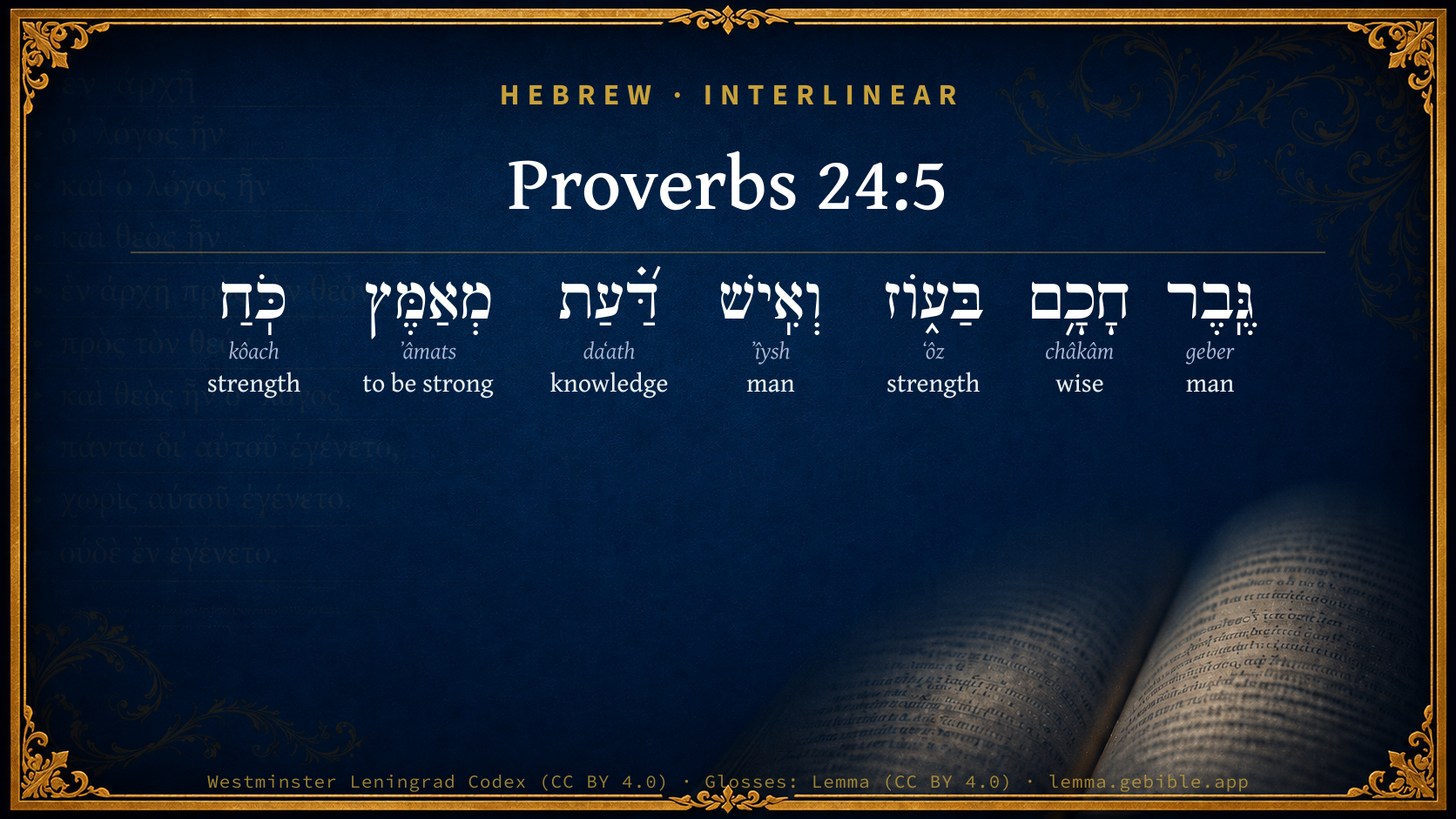
  1. גֶּֽבֶר geber H1397 “man” Noun, Common, Masculine, Singular, Absolute
  2. חָכָ֥ם châkâm H2450 “wise” Adjective, Adjective, Masculine, Singular, Absolute
  3. בַּע֑וֹז ʻôz H5797 “in/at the · strength” Preposition, Determined + Noun, Common, Masculine, Singular, Absolute
  4. וְאִֽישׁ ʼîysh H376 “and · man of” Conjunction + Noun, Common, Masculine, Singular, Construct
  5. דַּ֝֗עַת daʻath H1847 “knowledge” Noun, Common, Feminine, Singular, Absolute
  6. כֹּֽחַ kôach H3581 “strength” Noun, Common, Masculine, Singular, Absolute

About this verse

These counts appear in no published source. They are computed here, from the morphology-tagged text and Lemma’s own curated glosses. What Lemma adds →

7
words
7
distinct lemmas
Wisdom
section

Shared distinctive vocabulary

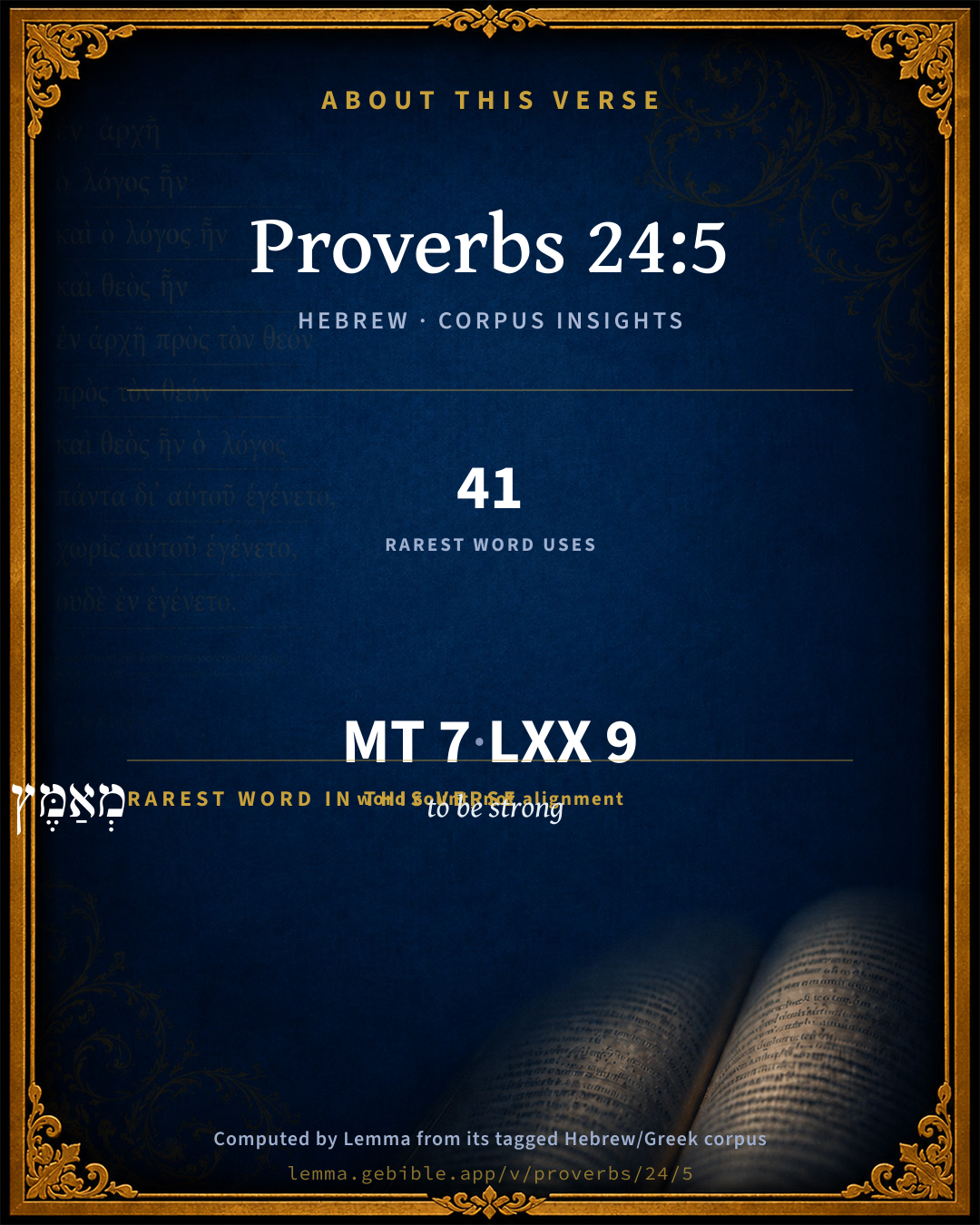
מְאַמֶּץ to be strong H553 occurs in 41 verses of the Hebrew Bible. Also found in:

Grammatical profile

  • 1 verb
  • 5 nouns
  • 1 adjective

Verb forms

  • מְאַמֶּץ Piel · Participle Active

Hebrew & Septuagint length

In English translation the verse runs 12 words from the Hebrew and 19 from the Septuagint (LXX English) — the Septuagint runs noticeably longer here. See the side-by-side →

A rough comparison of the two English renderings, which tokenize alike — not a word-level alignment.

Word counts can differ between the Hebrew and the Greek without any difference in meaning — e.g. the Hebrew direct-object marker אֵת has no separate Greek word, and Greek often adds the article ὁ.

In the original languages it is 7 Hebrew tokens and 9 Greek tokens — but the two are counted differently (Hebrew bundles its prefixes and suffixes into one token; the Greek is in lemma form), so that isn’t a like-for-like length.

Cross-references

8

Topical passages linked to Proverbs 24:5 in the Treasury of Scripture Knowledge — connected by theme and wording, ordered by reader-vote popularity; previews shown in the World English Bible.

  • Ecclesiastes 7:19 Wisdom is a strength to the wise man more than ten rulers who are in a city.
  • Colossians 1:11 strengthened with all power, according to the might of his glory, for all endurance and perseverance with joy;
  • Proverbs 21:22 A wise man scales the city of the mighty, And brings down the strength of its confidence.
  • Psalms 84:7 They go from strength to strength. Everyone of them appears before God in Zion.
  • Proverbs 8:14 Counsel and sound knowledge are mine. I have understanding and power.
  • Isaiah 40:31 but those who wait for Yahweh shall renew their strength; they shall mount up with wings as eagles; they shall run, and not be weary; they shall walk, and not faint.
  • Proverbs 10:29 The way of Yahweh is a stronghold to the upright, But it is a destruction to the workers of iniquity.
  • Ecclesiastes 9:14–18 There was a little city, and few men within it; and a great king came against it, besieged it, and built great bulwarks against it.

Cross-references courtesy of OpenBible.info (CC BY 4.0).

Hebrew and Greek witnesses Masoretic Hebrew ↔ Greek Septuagint

The same verse in the two great witnesses to the Old Testament, shown verse-for-verse.

Here the Septuagint runs noticeably longer than the Hebrew — LXX2012 (modern English Septuagint) 19 words vs World English Bible 12. A rough length comparison of the two English translations, not a word-level alignment — read both below.

These are two independent witnesses, not word-aligned to each other, and the Septuagint is shown in lemma (dictionary) form.

Hebrew Proverbs 24:5 Masoretic · Westminster Leningrad Codex

גֶּֽבֶר חָכָ֥ם בַּע֑וֹז וְאִֽישׁ דַּ֝֗עַת מְאַמֶּץ כֹּֽחַ

A wise man has great power; And a knowledgeable man increases strength;

World English Bible · Public Domain

Greek LXX Proverbs 24:5 Septuagint · lemma form

κρείσσων σοφός ἰσχυρός καί ἀνήρ φρόνησις ἔχω γεώργιον μέγας

A wise man is better than a strong man; and a man who has prudence than a large estate.

LXX2012 (modern English Septuagint) · Public Domain

On this verse, Adam Clarke's Commentary discusses the Septuagint’s reading. Read the note in Commentary ↓

Hebrew: Westminster Leningrad Codex (CC BY 4.0). Greek: Septuagint (public domain); English from LXX2012 (modern English Septuagint) (Public Domain). How the Septuagint differs from the Hebrew →

Commentary

Notes on Proverbs 24:5 from classic Christian and Jewish commentators (each source and its license shown beneath its notes). The classic Christian expositions comment on the surrounding passage and are grouped to its opening verse, so a note may address several verses; the Jewish commentaries on the Tanakh (Rashi and others) are per-verse, so they appear only where the commentator wrote on this verse.

Lemma curates 59 commentaries, every one of them public domain or Creative Commons licensed, each selected and text-cleaned for this edition rather than reprinted as found. About our sources →

Trapp's Complete Commentary

John Trapp

Pro 24:5 A wise man [is] strong; yea, a man of knowledge increaseth strength.

Ver. 5. A wise man is strong.] {See Trapp on "Pro 21:22"}

John Trapp, A Commentary or Exposition upon All the Books of the Old and New Testament (1647–1656) — public domain. Text from a community e-Sword module.

The Biblical Illustrator

Joseph S. Exell

Pro_24:5

A wise man is strong; yea, a man of knowledge increaseth strength

Wisdom the strength of the mind

The changes of life often have unhappy effects on the temper of our minds.

A defence against these evils would be very desirable. Who would not possess a constant equanimity, an uniform peace and steady resolution of soul? Solomon says this is to be gained through wisdom, or religious virtue.

I. The diseased and feeble state of mind against which wisdom is the proper remedy. It seemeth to consist in an indisposition for the due exercise of its powers. The body is then distempered and weak, and so the mind is rendered incapable of the offices which become such a being. The weakness principally appeareth in the prevalence of passions which are excited by them, and are summed up in aversion; that is, in the prevalence of fear and sorrow and anger. Reason and moral conscience is the man; in its vigour and authority over the inferior springs of action our strength lieth.

1. Fear is an infirmity natural to man, which very often hath pernicious effects, and in itself, abstracting from its effects, is very uncomfortable. Every living creature, according to its measure of perfection, hath a self-enjoyment, and findeth ease and satisfaction in its sound and healthy state. But it was wisely provided that such of them as are liable to dangers and annoyances from abroad should have a painful apprehension of them, in order to their being put upon the speediest methods for avoiding them. This is the end of fear in their constitution. Man is made with a larger comprehension, and with the privilege of foresight, by which he discovereth a variety of dangers, and seeth them at a great distance; and this certainly was not originally intended to be his torment, but, if it be so in event, it must be by way of penal infliction for his faults, or a distemper of his mind against which there is a proper remedy provided.

2. Grief. This is not equal in all men. Some spirits can sustain their infirmity better than others. But all find it requires a force above that of mere unimproved and uncultivated nature to support it. It requireth religious wisdom.

3. Anger. Felt when the disagreeable event is considered an injury, and as befalling us by the injustice or ill-will of a voluntary agent. Now consider the symptoms of this natural weakness. During the prevalence of these passions the understanding is obscured; at least, we have not the due use of it. It seems to be the natural tendency of pain to arrest the thoughts. The counsels of the mind are at such times full of perplexity, which often produce irresolution, instability, and fatal precipitation.

II. Wherein the strength of the wise man lieth. How wisdom, or religious virtue, is the cure of our weakness and its symptoms.

1. It is a defence against fear, because it represents uncomfortable events as too inconsiderable to affect our main interests. The good man is satisfied from himself; his integrity is his chief treasure. Virtue is a greater good than riches, worldly honours, and carnal pleasure.

2. The testimony of our conscience is an effectual preservative against immoderate dejecting fears, as it gives us confidence towards God and assurance of His favour.

3. The wise man is strong against fear, because his confidence is in the Divine all-sufficiency, love, and faithfulness. Chance and necessity, as the cause of events, are the refuge of ignorant minds. Faith controls the fears of a religious mind, for it represents an intelligent, powerful, and gracious Providence as superintending all affairs and directing all events irresistibly.

4. The wise man is strengthened by the Christian hope of immortality. The same principles and sentiments restrain immoderate anger. So religious wisdom delivers us from the symptoms of weakness arising from the passions; ignorance and confusion; the darkened understanding. True wisdom openeth the eyes. There is an admirable simplicity in religion. A man of knowledge increaseth strength against irresolution, unsteadiness, and precipitancy; his behaviour is consistent and uniform, because it is conducted by one invariable principle. The wise and virtuous perform their good works with vigour and alacrity. And this spiritual strength is ever increasing, and a constant source of pleasure to the man himself. Then let us examine ourselves, and try what equanimity we maintain in the changes of life. (J. Abernethy, M.A.)

Fixed religious principles

A wise man is strong. That is, a true man; one who fears God. We shall seek to show the infinite importance of fixed principles

I. In relation to the duties of life.

II. In regard to the relationships of life.

III. In relation to the trials of life.

IV. As a safeguard against the Temptations of life. (F. Wagstaff.)

The Biblical Illustrator, edited by Joseph S. Exell (c. 1880s–1900s) — public domain. Text from a community e-Sword module.

Tyndale Open Study Notes

Tyndale Open Resources

24:5-6 Saying 21: See 21:22.

Tyndale Open Study Notes — © Tyndale Open Resources, licensed CC BY-SA 4.0. Text via the HelloAO Bible API.

Jamieson, Fausset & Brown

Robert Jamieson, A. R. Fausset & David Brown

The general statement (Ecc 9:16, Ecc 9:18) is specially illustrated (compare Pro 21:22; Psa 144:1).

Jamieson, Fausset & Brown — Commentary Critical and Explanatory on the Whole Bible (1871) — public domain (CC PDM 1.0). Text via the HelloAO Bible API.

Adam Clarke's Commentary

Verse 5. A wise man is strong.] His wisdom enables him to construct a great variety of machines, by which, under his own influence, he can do the labour of a hundred or even a thousand men. But in all cases wisdom gives power and influence; and he who is wise to salvation can overcome even Satan himself. The Septuagint has: "The wise is better than the strong; and the man who has prudence, than a stout husbandman."

Adam Clarke's Commentary on the Bible (1810–1826) — public domain. Text from a community e-Sword/MySword module.

Ellicott's Commentary for English Readers

(5) A man of knowledge increaseth strength.—For the spiritual sense, comp. 2Pe_3:18.

A Bible Commentary for English Readers, edited by Charles John Ellicott (1878–1897) — public domain. Text from a community e-Sword module.

The Cambridge Bible for Schools and Colleges

gen. ed. J. J. S. Perowne

5. strong] Lit. in strength, A.V. and R.V. marg. Comp.

The voice of Jehovah is in might;

The voice of Jehovah is in majesty. Psa_29:4.

“The expression is more forcible than if adjectives denoting these qualities (‘mighty,’ ‘majestic’) had been used. Comp. ἐν ἐξουσίᾳ, Luk_4:32; ἐν ἰσχύϊ (rec.), Rev_18:2.”—Bp Perowne.

increaseth strength] Lit., as in margin A.V. and R.V., strengtheneth might.

The Cambridge Bible for Schools and Colleges (gen. ed. J. J. S. Perowne; Cambridge University Press, 1878–1918) — public domain. Text from a community e-Sword module.

John Gill's Exposition

For by wise counsel thou shall make thy war,.... Counsel, as well as strength, is necessary for war: kings and states, before they enter on a war, should not only well consider the justness of their cause, but should consult whether they have a sufficiency of men and money to carry it on; and should concert the wisest methods to attack the enemy, or defend themselves; and, above all, should ask counsel of God; see Kg2 18:20. And this is true of our spiritual warfare with sin, Satan, the world, and false teachers; which requires not only strength to wage war with them, but wise counsel, that we may be able to understand and guard against their cunning, wiles, and stratagems: and this is principally to be asked of God, who is wonderful in counsel; and of good and experienced men, skilled in those matters;

and in the multitude of counsellors there is safety; to take the advice of wise counsellors, and many of them, even among men, is safe for princes and states, in the above case and in all others; and especially to ask and take counsel of God, who gives wisdom liberally to them that ask it; and of Christ, the wonderful Counsellor; and from the Scriptures, whom David made his counsellors; and from old experienced Christians, and ministers of the word, with whom are wisdom, counsel, and understanding; See Gill on Pro 11:14.

John Gill's Exposition of the Whole Bible (1746–1763) — public domain (CC PDM 1.0). Text via the HelloAO Bible API.

Albert Barnes' Notes on the Bible

Is strong - literally, as in the margin; i. e., rooted and established in strength.

Albert Barnes' Notes on the Bible (1834–1885) — public domain. Text from a community e-Sword/MySword module.

Haydock's Catholic Bible Commentary

Valiant, as well as a good economist, ver. 4. (Calmet)

George Leo Haydock (1774–1849), Haydock's Catholic Family Bible and Commentary, 1859 edition — public domain. Excludes Psalms (Douay-Rheims chapter numbering differs from Protestant) and Deuterocanonical books (Catholic canon only).

Matthew Poole's English Annotations

Is strong; is courageous and resolute, and able by wisdom to do greater things than others can accomplish by their own strength.

Matthew Poole's English Annotations on the Holy Bible (1683–1685) — public domain. Text from a community e-Sword/MySword module.

Whedon's Commentary on the Bible

Daniel D. Whedon

5. A wise man is strong — Powerful — “Knowledge is power.” If physical strength is defective, it supplies the defects; and whatever be the strength, skill and dexterity will greatly add thereto. Machines, which are the product of knowledge, have greatly increased the power of man. Wisdom gives influence.

Increaseth strength — Makes firm, confirms. Comp. Pro_2:14; Job_19:19; Ecc_9:14; Ecc_9:16.

Daniel D. Whedon (gen. ed.), Commentary on the Old and New Testaments (1874–1909) — public domain. Text from a community e-Sword module.

The Pulpit Commentary

Vers. 5, 6. Wisdom is beneficial in peace and war.

A wise man is strong. zwb, "in strength," full of strength, because, however feeble in body, he is wise in counsel, firm in purpose, brave in conduct, thoroughly to be depended upon, and supported by his perfect trust in God. (comp. Pro_21:22) The Septuagint, with which agree the Syriac and Chaldee, reading differently, renders, "A wise man is better than a strong man a sentiment which Lesetre compares to Cicoro"s "cedant arma togae." A man of knowledge increaseth strength; literally, strengtheneth power; shows greater, superior power, as Amo_2:14. The Septuagint, from some corruption of the text, renders, "And a man having prudence (is better) than a large estate (gewrgiou megalou );" i.e. wisdom will bring a man more worldly advantages than the possession of extensive farms. The gnome is proved by what follows.

The Pulpit Commentary (1880–1919), ed. H.D.M. Spence-Jones & Joseph S. Exell — public domain. Text from a community e-Sword module.

John Wesley's Explanatory Notes

Is strong - Is courageous and resolute, and able by wisdom to do greater things than others can accomplish by strength.

John Wesley, Explanatory Notes Upon the Whole Bible (1754–1765) — public domain. Text via the GEBible commentary corpus.

Keil & Delitzsch

C. F. Keil & F. Delitzsch

The praise of wisdom is continued: it brings blessings in the time of peace, and gives the victory in war.

5 A wise man is full of strength;

And a man of understanding showeth great power.

6 For with wise counsel shalt thou carry on successful war;

And safety is where counsellors are not wanting.

The ב of בּעוז (thus with Pathach in old impressions, Cod. 1294, Cod. Jaman., and elsewhere with the Masoretic note לית ומלא) introduces, as that of בכּח, Psa 24:4, the property in which a person or thing appears; the article (cf. העזבים, Pro 2:13, Gesen, 35, 2A) is that of gender. The parallel מאמץ כח, a Greek translates by ὑπὲρ κραταιὸν ἰσχύΐ = מאמּיץ כּח (Job 9:4; Isa 40:26). But after 5a it lies nearer that the poet means to express the power which lies in wisdom itself (Ecc 7:19), and its superiority to physical force (Pro 21:22); the lxx, Syr., and Targ. also, it is true, translate 5a as if מעז (prae potente) were the words used. אמּץ כּח means to strengthen the strength, and that is (Nah 2:2) equivalent to, to collect the strength (to take courage), here and at Amo 2:14, to show strong (superior) strength. The reason is gathered from Pro 20:18 and Pro 11:14. The לך here added, Hitzig is determined to read תּעשׂה: for with prudent counsel the war shall be carried out by thee. The construction of the passive with ל of the subject is correct in Heb. (vid., at Pro 14:20) as well as in Aram.,

(Note: Vid., Nldeke's Neusyrische Gram. p. 219, Anm., and p. 416.)

and עשׂה frequently means, in a pregnant sense: to complete, to carry out, to bring to an end; but the phrase עשׂה מלחמה means always to carry on war, and nothing further. לך is the dat. commod., as in נלחם ל, to wage war (to contend) for any one, e.g., Exo 14:14. Instead of ברב, the lxx reads בלב; regarding γεωργίου μεγάλου for מאמץ כח, without doubt a corrupt reading, vid., Lagarde.

Keil & Delitzsch — Biblical Commentary on the Old Testament (1861–1891) — public domain (CC PDM 1.0). Text via the HelloAO Bible API. (Old Testament only.)

Kretzmann's Popular Commentary

Paul E. Kretzmann

v. 5. A wise man is strong, full of strength, exerting a powerful influence; yea, a man of knowledge, one making use of proper circumspection and caution, increaseth strength, develops and extends his influence, makes use of his power in the proper manner.

Paul E. Kretzmann, Popular Commentary of the Bible (1921–1924) — public domain. Text from a community e-Sword module.

unfoldingWord translationNotes

Door43 World Missions Community

General Information:

These verses continue the "thirty sayings" (Proverbs 22:20).

warrior of wisdom

The abstract noun "wisdom" can be translated as "wise." AT: "wise warrior" (See: Abstract Nouns)

a man of knowledge increases his strength

The abstract nouns "knowledge" and "strength" can be translated as the verb "know" and the adjective "strong." AT: "a man who knows many things is stronger because he knows these things" (See: Abstract Nouns)

by wise direction

The abstract noun "direction" can be translated as a verb. AT: "if you have wise people telling you what to do" (See: Abstract Nouns)

wage your war

"fight your war"

advisors

those who tell government officials what those officials should do

translationWords

know

wise

unfoldingWord translationNotes — © Distant Shores Media and the Door43 World Missions Community, licensed CC BY-SA 4.0. Source: git.door43.org/Door43/en_tn.

Rashi

Rabbi Shlomo Yitzchaki (Rashi)

A wise man is with strength A wise man is always with strength.

Rashi on the Tanakh — English translations: “The Judaica Press complete Tanach with Rashi, translated by A. J. Rosenberg” (CC BY 4.0); “Pentateuch with Rashi's commentary by M. Rosenbaum and A.M. Silbermann, 1929-1934” (public domain); “The Metsudah Tanach series, Lakewood, N.J” (CC BY 4.0); and “The Book of Joshua, Metsudah Publications, 1997” (CC BY 4.0). Text via Sefaria.

Lesson kit

Teaching starters — assembled from the data on this page, not authored interpretation. Every prompt links to the verse data it draws on. Edit before teaching.

Proverbs, in the Wisdom, opens this verse with 7 words (7 distinct Hebrew lemmas). Its most distinctive word is ʼâmats (“to be strong”). The Greek Septuagint runs longer here. A historical commentator’s framing appears above. Read the whole chapter for the surrounding context.

Discussion questions

  1. What does “to be strong” (ʼâmats) contribute to the verse as a whole?
  2. Genesis 25:23 shares the word «to be strong» with this verse. How do the two illuminate each other?
  3. Compared with the Hebrew, the Septuagint runs longer here. What questions does that raise?
  4. These translations render this verse differently; the difference is in the English rendering, not the original. What questions does that raise?
  5. The verb «מְאַמֶּץ» is Piel Participle Active. How does its form color the action?
  6. Reading how Trapp's Complete Commentary and The Biblical Illustrator read this verse, where do the two commentators agree and where do they part?

Things to notice

Reading settings

Reading text

Shown beneath each verse's original-language words.

Old Testament
Old Testament edition

Read the OT as the Masoretic Hebrew (MT) or the Greek Septuagint (LXX).

English shown for the Greek Septuagint (in the Hebrew ↔ Greek comparison).

Comparing translations? Open the Compare panel on any verse page to stack up to four side by side.