
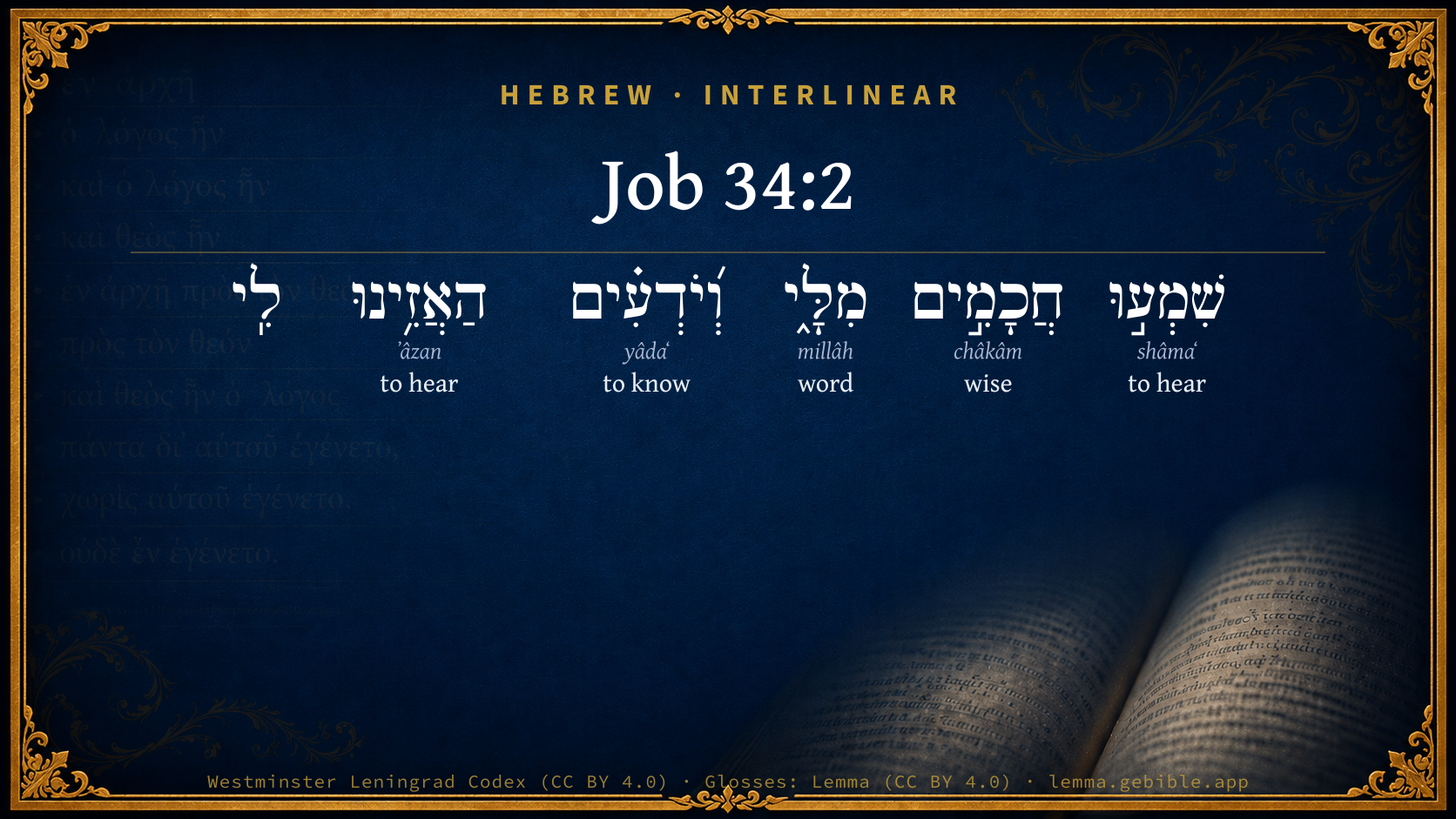
Job 34:2

Hebrew (Westminster Leningrad Codex) Job 34:2 appears in the Hebrew Old Testament. The text above is from the Westminster Leningrad Codex. Each word links to its Strong’s number, a concise gloss, and parsing drawn from the Open Scriptures Hebrew Bible morphology. Click any word for its full Brown-Driver-Briggs (BDB) entry.
Download image
Cite this verse

Job 34:2 (World English Bible). Public Domain. Lemma interlinear Bible study tool, https://lemma.gebible.app/v/job/34/2.

Show BibTeX & RIS
BibTeX
RIS
English Translation
"Hear my words, you wise men; Give ear to me, you who have knowledge.
World English Bible · Public Domain
Download a study sheet

One document with this verse’s original text, its word-by-word gloss line, the meaning frame, cross-references with their text, attributed commentary, and full source and license credits — printable, and it pastes into notes with its structure intact.

This verse Autodidact and up

Study sheet (.html) Plain text (.txt)

A passage Seminary Student

Up to 50 verses in one chapter. A passage sheet keeps up to 6 commentary sources and 12 cross-references per verse, in the order this page ranks them, and says so on the sheet whenever that leaves anything out. Ask for a single verse and you get the Autodidact verse sheet above.

Everything on this page stays free to read, with no account — the sheet is a download of what is already on screen, not access to it.

Want to remove ads? Support Godless Engineer
Compare translations 3

The same verse in 3 English versions, stacked beneath the original-language interlinear above. Click any original word for its lexicon entry.

Each is an independent rendering of the whole verse — the interlinear is not word-aligned to these translations.

Highlighted words mark where these versions differ — a whole-verse word diff, not a word-by-word alignment.

  • World English Bible Public Domain
    "Hear my words, you wise men; Give ear to me, you who have knowledge.
  • King James Version Public Domain
    Hear my words, O ye wise men; and give ear unto me, ye that have knowledge.
  • unfoldingWord Literal Text CC BY-SA 4.0
    “Hear my words, wise, and listen to me, ones knowing.

unfoldingWord Literal Text — © unfoldingWord, licensed CC BY-SA 4.0. Word-aligned USFM3 via Door43 (git.door43.org/unfoldingWord/en_ult).

Versions to compare (up to 4)

3 of 4 selected

Show all 18 translations

Every available English version of this verse, each an independent rendering of the whole verse.

  • World English Bible Public Domain
    "Hear my words, you wise men; Give ear to me, you who have knowledge.
  • Berean Standard Bible Public Domain
    “Hear my words, O wise men; give ear to me, O men of learning.
  • Majority Standard Bible Public Domain
    “Hear my words, O wise men; give ear to me, O men of learning.
  • King James Version Public Domain
    Hear my words, O ye wise men; and give ear unto me, ye that have knowledge.
  • American Standard Version (1901) Public Domain
    Hear my words, ye wise men; And give ear unto me, ye that have knowledge.
  • Revised Version (1885) Public Domain
    Hear my words, ye wise men; and give ear unto me, ye that have knowledge.
  • Geneva Bible (1599) Public Domain
    Heare my wordes, ye wise men, and hearken vnto me, ye that haue knowledge.
  • Douay-Rheims (1899) Public Domain
    Hear ye, wise men, my words, and ye learned, hearken to me:
  • Young's Literal Translation Public Domain
    Hear, O wise men, my words, And, O knowing ones, give ear to me.
  • Literal Standard Version CC BY-SA 4.0
    “Hear, O wise men, my words, || And, O knowing ones, give ear to me.
  • Unlocked Literal Bible CC BY-SA 4.0
    “Listen to my words, you wise men; hear me, you who have knowledge.
  • unfoldingWord Literal Text CC BY-SA 4.0
    “Hear my words, wise, and listen to me, ones knowing.
  • Darby Bible Public Domain
    Hear my words, ye wise [men]; and give ear unto me, ye that have knowledge.
  • World Messianic Bible Public Domain
    “Hear my words, you wise men. Give ear to me, you who have knowledge.
  • Webster's Bible Public Domain
    Hear my words, O ye wise men; and give ear to me, ye that have knowledge.
  • Free Bible Version CC BY-SA 4.0
    “Listen to my words, you men who say you are wise; pay attention to what I'm saying you who think you know.
  • Bible in Basic English Public Domain
    Give ear, you wise, to my words; and you who have knowledge, give attention to me;
  • JPS Tanakh (1917) Public Domain
    Hear my words, ye wise men; and give ear unto me, ye that have knowledge.

Literal Standard Version (2020), Covenant Press — licensed CC BY-SA 4.0. Text via the HelloAO Bible API (eBible.org). Unlocked Literal Bible (unfoldingWord) — licensed CC BY-SA 4.0. Text via the HelloAO Bible API (eBible.org). unfoldingWord Literal Text — © unfoldingWord, licensed CC BY-SA 4.0. Word-aligned USFM3 via Door43 (git.door43.org/unfoldingWord/en_ult). Free Bible Version, Dr. Jonathan Gallagher — licensed CC BY-SA 4.0. Text via the HelloAO Bible API (eBible.org).

Word by word

More ways to search: Search by grammar → Find every occurrence → Compare this word →

Practice this passage: Drill this verse → Learn its vocabulary →

About this verse

These counts appear in no published source. They are computed here, from the morphology-tagged text and Lemma’s own curated glosses. What Lemma adds →

6
words
5
distinct lemmas
Wisdom
section

Shared distinctive vocabulary

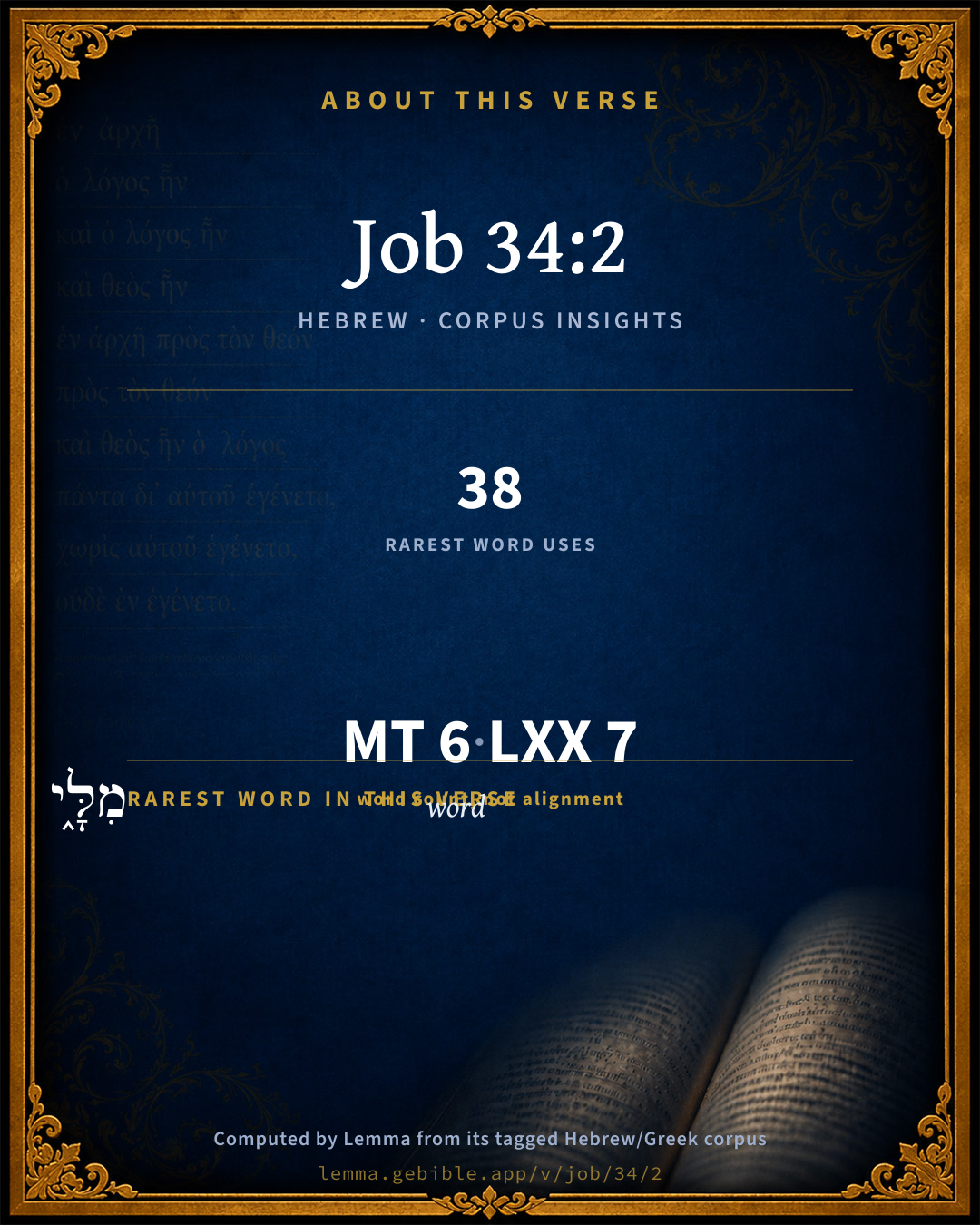
מִלָּ֑י word H4405 occurs in 38 verses of the Hebrew Bible. Also found in:

Grammatical profile

  • 3 verbs
  • 1 noun
  • 1 adjective
  • 1 preposition

Verb forms

  • שִׁמְע֣וּ Qal · Imperative
  • וְ֝יֹדְעִ֗ים Qal · Participle Active
  • הַאֲזִ֥ינוּ Hiphil · Imperative

Hebrew & Septuagint length

In English translation the verse runs 14 words from the Hebrew and 10 from the Septuagint (LXX English) — the Septuagint runs noticeably shorter here. See the side-by-side →

A rough comparison of the two English renderings, which tokenize alike — not a word-level alignment.

Word counts can differ between the Hebrew and the Greek without any difference in meaning — e.g. the Hebrew direct-object marker אֵת has no separate Greek word, and Greek often adds the article ὁ.

In the original languages it is 6 Hebrew tokens and 7 Greek tokens — but the two are counted differently (Hebrew bundles its prefixes and suffixes into one token; the Greek is in lemma form), so that isn’t a like-for-like length.

Cross-references

3

Topical passages linked to Job 34:2 in the Treasury of Scripture Knowledge — connected by theme and wording, ordered by reader-vote popularity; previews shown in the World English Bible.

  • Proverbs 1:5 That the wise man may hear, and increase in learning; That the man of understanding may attain to sound counsel:
  • 1 Corinthians 14:20 Brothers, don't be children in thoughts, yet in malice be babies, but in thoughts be mature.
  • 1 Corinthians 10:15 I speak as to wise men. Judge what I say.

Cross-references courtesy of OpenBible.info (CC BY 4.0).

Hebrew and Greek witnesses Masoretic Hebrew ↔ Greek Septuagint

The same verse in the two great witnesses to the Old Testament, shown verse-for-verse.

Here the Septuagint runs noticeably shorter than the Hebrew — LXX2012 (modern English Septuagint) 10 words vs World English Bible 14. A rough length comparison of the two English translations, not a word-level alignment — read both below.

These are two independent witnesses, not word-aligned to each other, and the Septuagint is shown in lemma (dictionary) form.

Hebrew Job 34:2 Masoretic · Westminster Leningrad Codex

שִׁמְע֣וּ חֲכָמִ֣ים מִלָּ֑י וְ֝יֹדְעִ֗ים הַאֲזִ֥ינוּ לִֽי

"Hear my words, you wise men; Give ear to me, you who have knowledge.

World English Bible · Public Domain

Greek LXX Job 34:2 Septuagint · lemma form

ἀκούω ἐγώ σοφός ἐπιἵστημι ἐνὠτίζομαι ὁ καλός

Hear me, you⌃ wise men; listen, you⌃ that have knowledge.

LXX2012 (modern English Septuagint) · Public Domain

Hebrew: Westminster Leningrad Codex (CC BY 4.0). Greek: Septuagint (public domain); English from LXX2012 (modern English Septuagint) (Public Domain). How the Septuagint differs from the Hebrew →

Commentary

Notes on Job 34:2 from classic Christian and Jewish commentators (each source and its license shown beneath its notes). The classic Christian expositions comment on the surrounding passage and are grouped to its opening verse, so a note may address several verses; the Jewish commentaries on the Tanakh (Rashi and others) are per-verse, so they appear only where the commentator wrote on this verse.

Lemma curates 59 commentaries, every one of them public domain or Creative Commons licensed, each selected and text-cleaned for this edition rather than reprinted as found. About our sources →

Trapp's Complete Commentary

John Trapp

Job 34:2 Hear my words, O ye wise [men]; and give ear unto me, ye that have knowledge.

Ver. 2. Hear my words, O ye wise men] And those are not many, Hos 14:9. He excludeth poor Job, whom yet he had promised to teach wisdom, Job 33:33. And that he spoke not to the many it is probable, for they have not those auras perpargatas, that he calleth for in the next verse. Bοιωτες fere sunt, they are heavily eared for the most part, and of dull apprehension;

Boeotum in patria, crassoque sub acre nati.

To the other three then of Job’s friends he applieth himself; whom because he had sharply reproved before, and that they may not think that he held himself the only wise man among them, he thus bespeaketh to get audience, and makes them judges of his discourse. Men may be wise in some things that have carried the matter foolishly enough in other, ουδεις ανθρωπων αυπος απαντα σοφος (Theog.).

And give ear unto me, ye that have knowledge] It is a happiness to have such hearers. "I speak as to wise men, judge ye what I say," 1Co 10:15. Jovianus the emperor was wont to wish, That he might govern wise men, and that wise men might govern him. But as it was once said, That there was never less wisdom in Greece than in the days of the seven wise men; so may we now well complain, that there is a very great want of sound and saving knowledge in this great abundance of helps thereunto; so that we may cry out, with the prophet Isaiah, Whom shall we teach knowledge, and whom shall we make to understand the hearing? Them that are weaned from the milk, and drawn from the breasts; q.d. We have to do with very babes, children in understanding, but not in malice.

John Trapp, A Commentary or Exposition upon All the Books of the Old and New Testament (1647–1656) — public domain. Text from a community e-Sword module.

Joseph Benson's Commentary

Job 34:2-4. Hear my words O ye wise men — Who are here present: do you judge whether what I have said, and have still further to say, be not reasonable and true. For the ear trieth words — Man’s mind judgeth of the truth and propriety of things spoken and heard; as the mouth tasteth meat — And distinguishes what is sweet and palatable from what is otherwise. The ear is put for the mind, to which things are conveyed by it. Let us choose to us judgment — Let us agree to examine the business, that we may be able to pronounce a righteous judgment. Let us not contend for victory, but for truth and justice. Let us know among ourselves what is good — Let us show one another who hath the best cause.

Joseph Benson's Commentary on the Old and New Testaments (1811–1818) — public domain. Text from a community e-Sword module.

Whedon's Commentary on the Bible

Daniel D. Whedon

PROOF FROM THE NATURE AND ADMINISTRATION OF GOD THAT MAN HAS NO RIGHT TO DOUBT GOD’S RIGHTEOUSNESS OR JUSTICE. Chap. 34.

EXORDIUM, Job_34:2-9. a. An appeal to the wise that they shall hearken with the ear of the understanding, and subject his argument to the ordeal of reason, Job_34:2-4.

2. O ye wise — Other listeners than Job and the three were probably present; and either to them or an imaginary audience he now makes his appeal. This circuitous mode of address helps to relieve the severity of the chastisement he is about to administer to Job.

Daniel D. Whedon (gen. ed.), Commentary on the Old and New Testaments (1874–1909) — public domain. Text from a community e-Sword module.

Geneva Bible (1599)

Geneva Bible translators

Which are esteemed wise of the world.

Geneva Bible (1599) marginal notes — public domain. Text via Bolls.life.

Jamieson, Fausset & Brown

Robert Jamieson, A. R. Fausset & David Brown

This chapter is addressed also to the "friends" as the thirty-third chapter to Job alone.

Jamieson, Fausset & Brown — Commentary Critical and Explanatory on the Whole Bible (1871) — public domain (CC PDM 1.0). Text via the HelloAO Bible API.

The Cambridge Bible for Schools and Colleges

gen. ed. J. J. S. Perowne

2. The wise men are not the three friends, but the bystanders who hear Elihu; cf. Job_34:34.

2–4. Elihu invites the wise among those who listen to him to attend to what he further says, and to unite with him in seeking to discover the right in this cause between Job and God.

The Cambridge Bible for Schools and Colleges (gen. ed. J. J. S. Perowne; Cambridge University Press, 1878–1918) — public domain. Text from a community e-Sword module.

John Gill's Exposition

For the ear trieth words,.... Not only the musical sound of them, the goodness of the language and diction, and the grammatical construction of them, but the sense of them, and whether the matter of them is good or not; that they are sound speech, which cannot be condemned, or unsound; whether they are right or wrong, agreeably to right reason, sound doctrine, and the word of God; for there are words and words, some the words of men, others the words of God. A sanctified ear tries these; but then men must have such ears to hear, and be attentive to what they hear, and retain it; hear internally as well as externally; and which a man does when his ears are opened by the Lord, from whom are the hearing ear and seeing eye; and such try what they hear, distinguish between good and bad, approve truth and receive it, and retain and hold it fast:

as the mouth tasteth meat; words and doctrines are like meat, some good and some bad; and such that have a good taste try them, either a rational or rather a spiritual discernment: some have no spiritual taste, their taste is not changed, and therefore cannot distinguish, nor make any good judgment of things; but others have, and these discern the difference, relish truth, savour the things that be of God, taste the good word of God, and esteem it more than their necessary food; and it is sweeter to them than the honey or the honeycomb. Such Elihu judged these men to be he addressed, and therefore desired their attention to what he had to say.

John Gill's Exposition of the Whole Bible (1746–1763) — public domain (CC PDM 1.0). Text via the HelloAO Bible API.

Albert Barnes' Notes on the Bible

Hear my words, O ye wise men - Addressing particularly the three friends of Job. The previous chapter had been addressed to Job himself. He had stated to him his views of the design of affliction, and he had nothing to reply. He now addresses himself to his friends, with a particular view of examining some of the sentiments which Job had advanced, and of showing where he was in error. He addresses them as “wise men,” or sages, and as endowed with “knowledge,” to conciliate their attention, and because he regarded them as qualified to understand the difficult subject which he proposed to explain.

Albert Barnes' Notes on the Bible (1834–1885) — public domain. Text from a community e-Sword/MySword module.

Matthew Poole's English Annotations

O ye wise men, who are here present, do you judge of the truth and reason of what I have said, and am further to say; for I am willing to submit all to the judgment of the truly wise.

Matthew Poole's English Annotations on the Holy Bible (1683–1685) — public domain. Text from a community e-Sword/MySword module.

John Wesley's Explanatory Notes

Ear - The ear, is put for the mind to which things are conveyed by it.

John Wesley, Explanatory Notes Upon the Whole Bible (1754–1765) — public domain. Text via the GEBible commentary corpus.

Lesson kit

Teaching starters — assembled from the data on this page, not authored interpretation. Every prompt links to the verse data it draws on. Edit before teaching.

Job, in the Wisdom, opens this verse with 6 words (5 distinct Hebrew lemmas). Its most distinctive word is millâh (“word”). The Greek Septuagint runs shorter here. A historical commentator’s framing appears above. Read the whole chapter for the surrounding context.

Discussion questions

  1. The word millâh carries the sense “word.” How does it shape the verse?
  2. 2 Samuel 23:2 shares the word «word» with this verse. How do the two illuminate each other?
  3. Compared with the Hebrew, the Septuagint runs shorter here. What questions does that raise?
  4. The translations on this page render this verse differently — a whole-verse word diff, not a word-by-word alignment. What might account for the different wordings?
  5. The verb «שִׁמְע֣וּ» is Qal Imperative. How does its form color the action?
  6. Reading how Trapp's Complete Commentary and Joseph Benson's Commentary read this verse, where do the two commentators agree and where do they part?

Things to notice

Reading settings

Reading text

Shown beneath each verse's original-language words.

Old Testament
Old Testament edition

Read the OT as the Masoretic Hebrew (MT) or the Greek Septuagint (LXX).

English shown for the Greek Septuagint (in the Hebrew ↔ Greek comparison).

Comparing translations? Open the Compare panel on any verse page to stack up to four side by side.