
Proverbs 21:22

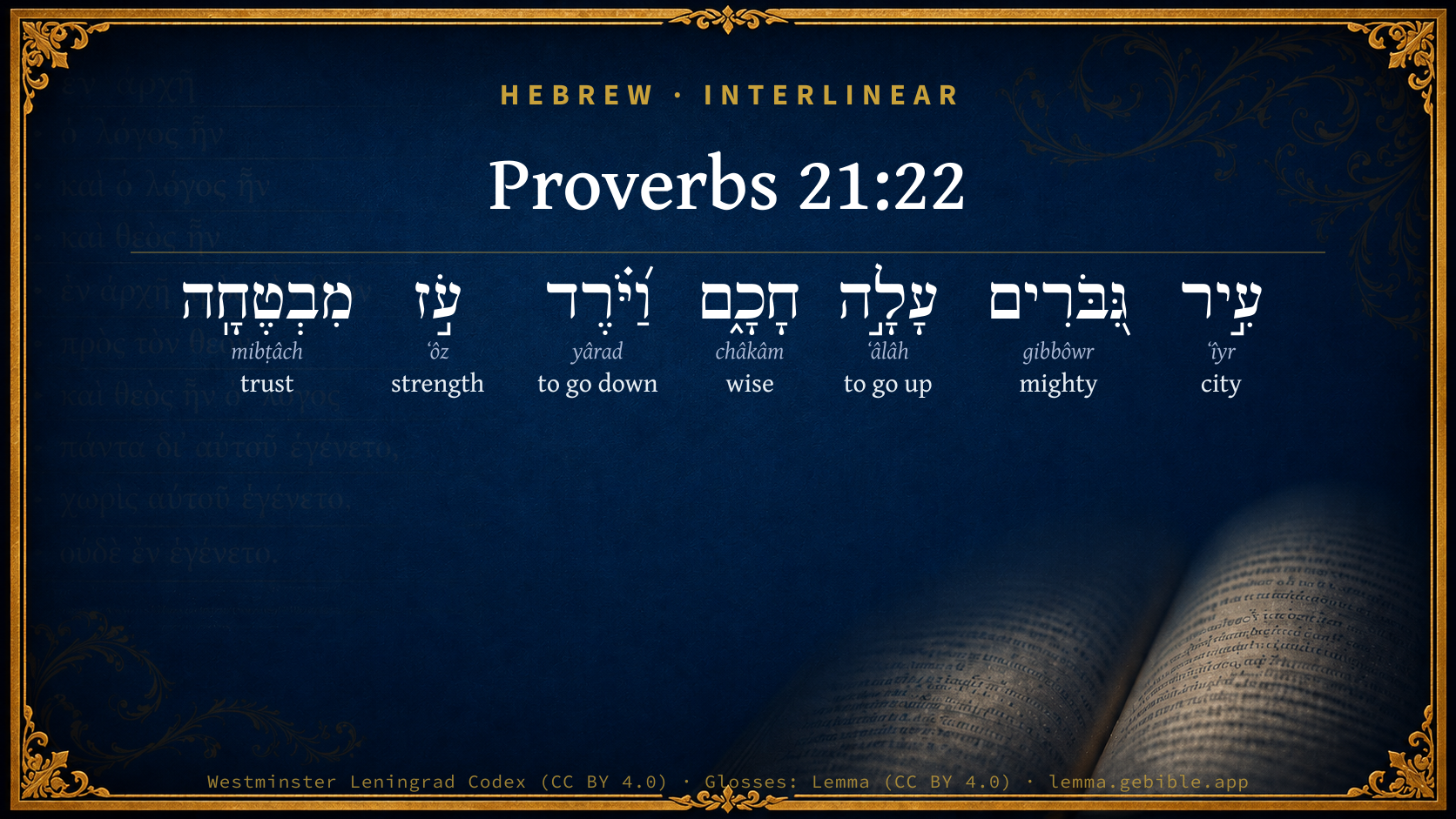
Hebrew (Westminster Leningrad Codex) Proverbs 21:22 appears in the Hebrew Old Testament. The text above is from the Westminster Leningrad Codex. Each word links to its Strong’s number, a concise gloss, and parsing drawn from the Open Scriptures Hebrew Bible morphology. Click any word for its full Brown-Driver-Briggs (BDB) entry.
Download image
Cite this verse

Proverbs 21:22 (World English Bible). Public Domain. Lemma interlinear Bible study tool, https://lemma.gebible.app/v/proverbs/21/22.

Show BibTeX & RIS
BibTeX
RIS
English Translation
A wise man scales the city of the mighty, And brings down the strength of its confidence.
World English Bible · Public Domain
Download a study sheet

One document with this verse’s original text, its word-by-word gloss line, the meaning frame, cross-references with their text, attributed commentary, and full source and license credits — printable, and it pastes into notes with its structure intact.

This verse Autodidact and up

Study sheet (.html) Plain text (.txt)

A passage Seminary Student

Up to 50 verses in one chapter. A passage sheet keeps up to 6 commentary sources and 12 cross-references per verse, in the order this page ranks them, and says so on the sheet whenever that leaves anything out. Ask for a single verse and you get the Autodidact verse sheet above.

Everything on this page stays free to read, with no account — the sheet is a download of what is already on screen, not access to it.

Want to remove ads? Support Godless Engineer
Compare translations 3

The same verse in 3 English versions, stacked beneath the original-language interlinear above. Click any original word for its lexicon entry.

Each is an independent rendering of the whole verse — the interlinear is not word-aligned to these translations.

Highlighted words mark where these versions differ — a whole-verse word diff, not a word-by-word alignment.

  • World English Bible Public Domain
    A wise man scales the city of the mighty, And brings down the strength of its confidence.
  • King James Version Public Domain
    A wise man scaleth the city of the mighty, and casteth down the strength of the confidence thereof.
  • unfoldingWord Literal Text CC BY-SA 4.0
    A wise ascends a city of mighty ones, and he brings down the strength of its confidence.

unfoldingWord Literal Text — © unfoldingWord, licensed CC BY-SA 4.0. Word-aligned USFM3 via Door43 (git.door43.org/unfoldingWord/en_ult).

Versions to compare (up to 4)

3 of 4 selected

Show all 18 translations

Every available English version of this verse, each an independent rendering of the whole verse.

  • World English Bible Public Domain
    A wise man scales the city of the mighty, And brings down the strength of its confidence.
  • Berean Standard Bible Public Domain
    A wise man scales the city of the mighty and pulls down the stronghold in which they trust.
  • Majority Standard Bible Public Domain
    A wise man scales the city of the mighty and pulls down the stronghold in which they trust.
  • King James Version Public Domain
    A wise man scaleth the city of the mighty, and casteth down the strength of the confidence thereof.
  • American Standard Version (1901) Public Domain
    A wise man scaleth the city of the mighty, And bringeth down the strength of the confidence thereof.
  • Revised Version (1885) Public Domain
    A wise man scaleth the city of the mighty, and bringeth down the strength of the confidence thereof.
  • Geneva Bible (1599) Public Domain
    A wise man goeth vp into the citie of the mightie, and casteth downe the strength of the confidence thereof.
  • Douay-Rheims (1899) Public Domain
    The wise man hath scaled the city of the strong, and hath cast down the strength of the confidence thereof.
  • Young's Literal Translation Public Domain
    A city of the mighty hath the wise gone up, And bringeth down the strength of its confidence.
  • Literal Standard Version CC BY-SA 4.0
    The wise has gone up a city of the mighty, || And brings down the strength of its confidence.
  • Unlocked Literal Bible CC BY-SA 4.0
    A wise man scales the city of the mighty ones, and he brings down the stronghold in which they trusted.
  • unfoldingWord Literal Text CC BY-SA 4.0
    A wise ascends a city of mighty ones, and he brings down the strength of its confidence.
  • Darby Bible Public Domain
    A wise [man] scaleth the city of the mighty, and casteth down the strength of the confidence thereof.
  • World Messianic Bible Public Domain
    A wise man scales the city of the mighty, and brings down the strength of its confidence.
  • Webster's Bible Public Domain
    A wise man scaleth the city of the mighty, and casteth down the strength of its confidence.
  • Free Bible Version CC BY-SA 4.0
    The wise can overcome a city belonging to strong warriors, and tear down the fortress they trusted to protect them.
  • Bible in Basic English Public Domain
    A wise man goes up into the town of the strong ones, and overcomes its strength in which they put their faith.
  • JPS Tanakh (1917) Public Domain
    A wise man scaleth the city of the mighty, and bringeth down the stronghold wherein it trusteth.

Literal Standard Version (2020), Covenant Press — licensed CC BY-SA 4.0. Text via the HelloAO Bible API (eBible.org). Unlocked Literal Bible (unfoldingWord) — licensed CC BY-SA 4.0. Text via the HelloAO Bible API (eBible.org). unfoldingWord Literal Text — © unfoldingWord, licensed CC BY-SA 4.0. Word-aligned USFM3 via Door43 (git.door43.org/unfoldingWord/en_ult). Free Bible Version, Dr. Jonathan Gallagher — licensed CC BY-SA 4.0. Text via the HelloAO Bible API (eBible.org).

Word by word

More ways to search: Search by grammar → Find every occurrence → Compare this word →

Practice this passage: Drill this verse → Learn its vocabulary →

About this verse

These counts appear in no published source. They are computed here, from the morphology-tagged text and Lemma’s own curated glosses. What Lemma adds →

7
words
7
distinct lemmas
Wisdom
section

Notable vocabulary

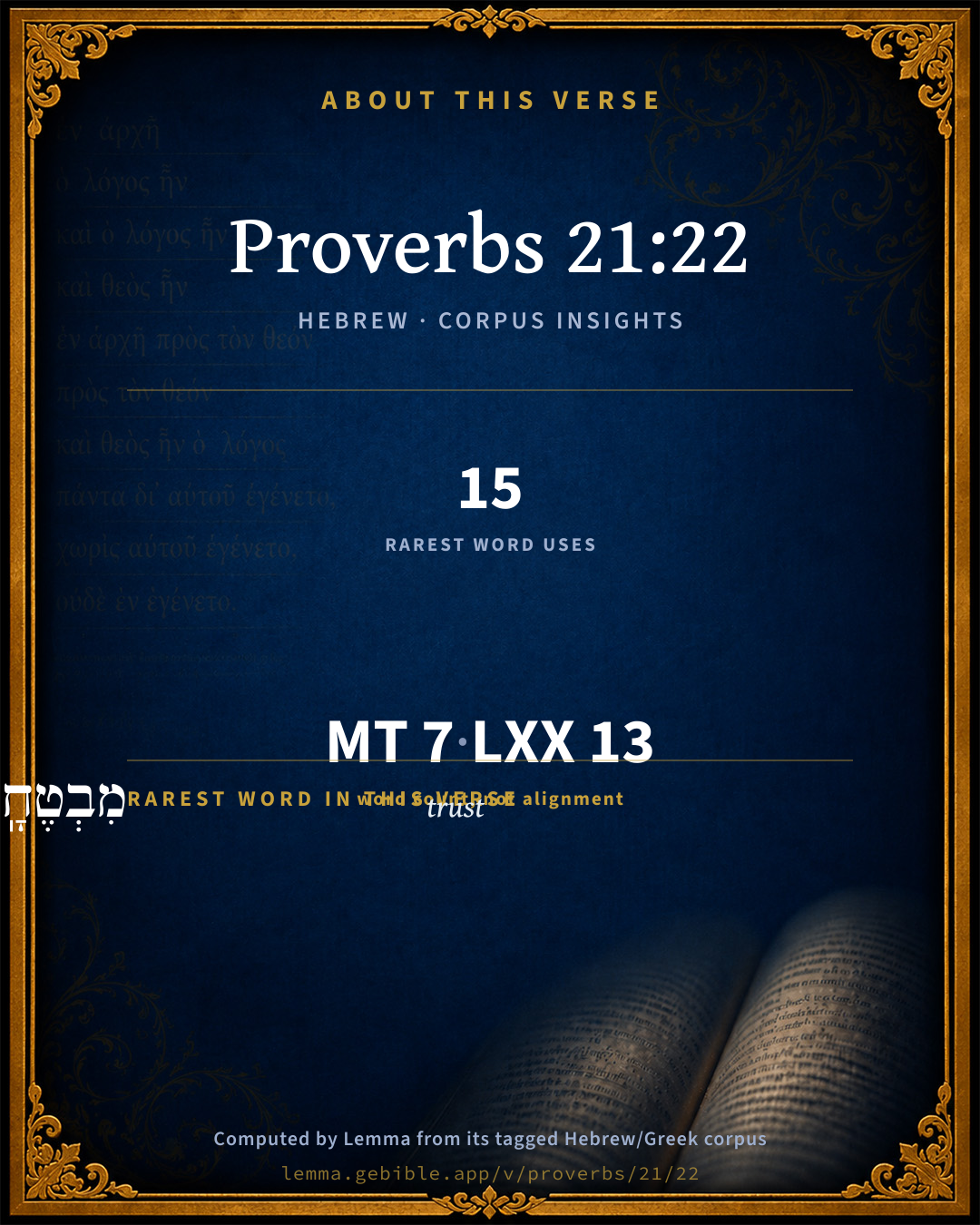
The rarest word here is מִבְטֶחָֽה trust H4009 — appearing just 15 times in the whole Hebrew Bible.

Shared distinctive vocabulary

מִבְטֶחָֽה trust H4009 occurs in 15 verses of the Hebrew Bible. Also found in:

Grammatical profile

  • 2 verbs
  • 3 nouns
  • 2 adjectives

Verb forms

  • עָלָ֣ה Qal · Perfect
  • וַ֝יֹּ֗רֶד Hiphil · Sequential Imperfect

Hebrew & Septuagint length

In English translation the verse runs 17 words from the Hebrew and 15 from the Septuagint (LXX English) — closely comparable.

A rough comparison of the two English renderings, which tokenize alike — not a word-level alignment.

Word counts can differ between the Hebrew and the Greek without any difference in meaning — e.g. the Hebrew direct-object marker אֵת has no separate Greek word, and Greek often adds the article ὁ.

In the original languages it is 7 Hebrew tokens and 13 Greek tokens — but the two are counted differently (Hebrew bundles its prefixes and suffixes into one token; the Greek is in lemma form), so that isn’t a like-for-like length.

Cross-references

5

Topical passages linked to Proverbs 21:22 in the Treasury of Scripture Knowledge — connected by theme and wording, ordered by reader-vote popularity; previews shown in the World English Bible.

  • Ecclesiastes 7:19 Wisdom is a strength to the wise man more than ten rulers who are in a city.
  • Proverbs 24:5 A wise man has great power; And a knowledgeable man increases strength;
  • Ecclesiastes 9:13–18 I have also seen wisdom under the sun in this way, and it seemed great to me.
  • 2 Samuel 5:6–9 The king and his men went to Jerusalem against the Jebusites, the inhabitants of the land, who spoke to David, saying, Except you take away the blind and the lame, you shall not come in here; thinking, David can't come in here.
  • 2 Samuel 20:16–22 Then cried a wise woman out of the city, "Hear, hear! Please say to Joab, 'Come near here, that I may speak with you.'"

Cross-references courtesy of OpenBible.info (CC BY 4.0).

Hebrew and Greek witnesses Masoretic Hebrew ↔ Greek Septuagint

The same verse in the two great witnesses to the Old Testament, shown verse-for-verse.

These are two independent witnesses, not word-aligned to each other, and the Septuagint is shown in lemma (dictionary) form.

Hebrew Proverbs 21:22 Masoretic · Westminster Leningrad Codex

עִ֣יר גִּ֭בֹּרִים עָלָ֣ה חָכָ֑ם וַ֝יֹּ֗רֶד עֹ֣ז מִבְטֶחָֽה

A wise man scales the city of the mighty, And brings down the strength of its confidence.

World English Bible · Public Domain

Greek LXX Proverbs 21:22 Septuagint · lemma form

πόλις ὀχυρός ἐπιβαίνω σοφός καί κατααἱρέω ὁ ὀχύρωμα ἐπί ὅς πείθω ὁ ἀσεβής

A wise man assaults strong cities, and demolishes the fortress in which the ungodly trusted.

LXX2012 (modern English Septuagint) · Public Domain

On this verse, The Cambridge Bible for Schools and Colleges discusses the Septuagint’s reading. Read the note in Commentary ↓

Hebrew: Westminster Leningrad Codex (CC BY 4.0). Greek: Septuagint (public domain); English from LXX2012 (modern English Septuagint) (Public Domain). How the Septuagint differs from the Hebrew →

Commentary

Notes on Proverbs 21:22 from classic Christian and Jewish commentators (each source and its license shown beneath its notes). The classic Christian expositions comment on the surrounding passage and are grouped to its opening verse, so a note may address several verses; the Jewish commentaries on the Tanakh (Rashi and others) are per-verse, so they appear only where the commentator wrote on this verse.

Lemma curates 59 commentaries, every one of them public domain or Creative Commons licensed, each selected and text-cleaned for this edition rather than reprinted as found. About our sources →

Trapp's Complete Commentary

John Trapp

Pro 21:22 A wise [man] scaleth the city of the mighty, and casteth down the strength of the confidence thereof.

Ver. 22. A wise man scaleth the city of the miyhty.] Wisdom is that το παγχρεστον, which is profitable for all things; of singular and sovereign use, as in domestic and politic, so in military affairs and businesses. Here prudence is made out to be better than puissance, and one wise man to be too hard for many mighty, though got into the strongest garrisons. In war wisdom is better than strength, saith Solomon more than once. {Ecc 9:16; Ecc 7:19} How did Archimedes hold out Syracuse against the Roman general by his singular skill and industry! And how many strong cities have been scaled and surprised by warlike wiles and stratagems! as Babylon by Cyrus first, and afterwards by Zopyrus, Jerusalem by Pompey, taking the opportunity of the seventh day, Sabbath, wherein he knew the superstitious Jews would not stir to defend themselves, and many others that might out of histories be instanced. {a}

{a} Dio.

John Trapp, A Commentary or Exposition upon All the Books of the Old and New Testament (1647–1656) — public domain. Text from a community e-Sword module.

Joseph Benson's Commentary

Pro 21:22. A wise man scaleth the city of the mighty — Wisdom and policy are ofttimes more considerable and powerful than strength; and casteth down the strength, &c. — The strongest forts, to which the citizens trust most for their defence.

Joseph Benson's Commentary on the Old and New Testaments (1811–1818) — public domain. Text from a community e-Sword module.

The Preacher's Complete Homiletical Commentary

Joseph S. Exell (gen. ed.)

MAIN HOMILETICS OF Pro_21:22

A WISE MAN AND A MIGHTY CITY

I. The city of the mighty will not easily yield to conquerors. When a fortress encloses within its walls many strong arms and stout hearts, it will not be captured by child’s play. The confidence that the defenders have, not only in the strength of their position but in their own individual power and prowess, will certainly prevent them from giving up without a struggle. Such a city must be “scaled” or captured either by stratagem or by a mightier force than that which defends it. There are various ways in which this may be done. When the height and thickness of the walls prevent their overthrow from without they may be assailed from beneath, and when brave men cannot be subdued by the sword they may be by hunger.

II. In whatever way the city is taken wisdom is the mightiest force employed. Military strength—indeed physical force of any kind—is of little or no avail without wisdom to direct it. Under the guidance of a wise commander an undisciplined and almost powerless mob becomes a powerful army, and a very small amount of mere strength can be made very effective if it is wisely directed. Belshazzar had strong walls around his city, and a mighty army within it, but Cyrus possessed the wisdom which the Babylonians lacked, and therefore the “wise man” overthrew the confidence of the mighty.

III. Wisdom is a power that is needed to take other strongholds besides those built of brick or stone. Any obstruction or difficulty which a man encounters in life may be a “city of the mighty” to overthrow which wisdom will be an indispensable ally. Poverty is such a city, and it cannot be scaled by activity and industry alone—the industrious effort must be guided by wisdom. Ignorance may be compared to such a stronghold, and wisdom is needed to guide the pursuit after knowledge. Sinful habits are walls around a man, and they are so defended and strengthened by invisible powers of evil that they cannot be cast down by strength of will alone—wisdom must be sought from above to turn the struggle into a victory. But we have not only to contend with personal evils but with relative ones, with the misery and sin around us if not within us, and here again nothing can be done without wisdom. Muscular force can do a little to put down their outward manifestations, but wisdom only can do anything towards lessening their real and terrible hold upon men. The human soul, also, is a “city” which can be “scaled” only by “the wise man.” In Eden the city of Man-soul was taken by the subtlety and craft of the devil, and a wisdom more than human is needed to regain it. The undertaking is especially difficult, because there are inhabitants within the city who are averse to a change of masters—there are evil tendencies within which make men unwilling to leave the yoke of Satan for the service of God. Our Lord Jesus Christ has, however, scaled this city of the mighty; all the wisdom of God has been brought to bear upon the work of reconciling men to Himself, and the Cross has accomplished what the physical force of Omnipotence itself could not have achieved.

What is strength without a double share

Of wisdom? Vast, unwieldy, burdensome;

Proudly secure, yet liable to fall

By weakest subtleties; strength’s not made to rule,

But to subserve where wisdom bears command.—Milton.

OUTLINES AND SUGGESTIVE COMMENTS

The Israelites never crushed the Philistines. The Jebusites long dwelt in Jerusalem’s stronghold (Jos_15:63). The sinner (at conversion) in his feeblest state enters Canaan, and “scales the city of the mighty.” But when his foot has touched that eternal tramping-ground, alas for him! there is still the citadel! “A wise man,” not only as being a wise man, but in becoming a wise man, has scaled the city of the mighty, and evermore afterwards, in becoming wiser, he is “casting down the strength of its place of confidence.” … Not to print mistake upon his emblems, Solomon qualifies the last by those that immediately follow. Conversion is not a warfare. It is not the glow of camps or the shout of armed men, but a drowsy and forlorn awakening. Arrayed against it may be the strength of the mighty, but it is a strength absurd and miserable, as against a droning and depressing inanition. “We wrestle not against flesh and blood,” and when we come to understand the venture, the climb over the gates is not a bound of strength, but a torpid crawl out of mortal infirmity of feeling. Hence the patient prosing of the Preacher, as he next approaches us (in Pro_21:23). Christian obedience is the way to triumph.—Miller.

The art of war has already shewn the pre-eminence of wisdom above strength. Prudent tactics, or a wise application of courage, triumphs over mere personal prowess. Joshua’s stratagem in taking Ai was a proof of military wisdom. Solomon seems to have known of a wise man singly delivering his city from the power of a mighty king; a proof of wisdom quite tantamount to the strength of an aggressor scaling the walls, and thus casting down its confidence. (Ecc_9:13-18). Much more therefore will spiritual wisdom, the immediate gift of God, overcome difficulties as formidable as the scaling of the city of the mighty. A wise calculation of the cost is eminently serviceable in achieving most important triumphs. (Luk_14:31-32). For does not conscious weakness lead to a single dependence upon God? And what difficulties are too great for an Almighty arm? “By thee”—said a valiant soldier in the army of faith—“I have run through a troop; and by my God have I leaped over a wall.” “Weapons of a spiritual, not of a carnal,” temper, “are mighty through God to the pulling down of strongholds” (2Co_10:4), impregnable to the power of man. All the promises are “to him that overcometh.” Let the soldier go to the conflict “strong in the Lord,” and “putting on his whole armour.” (Eph_6:10). The triumph is sure. The heavenly city will be scaled. “The kingdom of heaven suffereth violence, and the violent take it by force.” (Mat_11:12.)—Bridges.

For Homiletics of Pro_21:23 see on chap. Pro_13:3, page 294.

The Preacher's Complete Homiletical Commentary (gen. ed. Joseph S. Exell; Funk & Wagnalls, c. 1892) — public domain (pre-1929). A full-Bible homiletical/sermon-outline anthology covering 65 of 66 books (2 John is absent from the source module). Text from a community e-Sword module.

Tyndale Open Study Notes

Tyndale Open Resources

21:22 A wise military strategist can devise ways to defeat stronger forces. This makes wisdom superior to raw power (cp. Eccl 7:12; 9:13-18).

Tyndale Open Study Notes — © Tyndale Open Resources, licensed CC BY-SA 4.0. Text via the HelloAO Bible API.

Geneva Bible (1599)

Geneva Bible translators

Wisdom overcometh strength and confidence in worldly things.

Geneva Bible (1599) marginal notes — public domain. Text via Bolls.life.

Matthew Henry's Commentary

Note, 1. Those that have power are apt to promise themselves great things from their power. The city of the mighty thinks itself impregnable, and therefore its strength is the confidence thereof, what it boasts of and trust in, bidding defiance to danger. 2. Those that have wisdom, though they are so modest as not to promise much, often perform great things, even against those that are so confident of their strength, by their wisdom. Good conduct will go far even against great force; and a stratagem, well managed, may effectually scale the city of the mighty and cast down the strength it had such a confidence in. A wise man will gain upon the affections of people and conquer them by strength of reason, which is a more noble conquest than that obtained by strength of arms. Those that understand their interest will willingly submit themselves to a wise and good man, and the strongest walls shall not hold out against him.

Matthew Henry's Commentary on the Whole Bible (1708–1710) — public domain (CC PDM 1.0). Text via the HelloAO Bible API.

Jamieson, Fausset & Brown

Robert Jamieson, A. R. Fausset & David Brown

"Wisdom is better than strength" (Ecc 7:19; Ecc 9:15).

strength . . . thereof--that in which they confide.

Jamieson, Fausset & Brown — Commentary Critical and Explanatory on the Whole Bible (1871) — public domain (CC PDM 1.0). Text via the HelloAO Bible API.

Adam Clarke's Commentary

Verse 22. A wise man scaleth the city of the mighty] Wisdom is in many respects preferable to strength, even in the case of defence. See what skill does in the fortification and reduction of strong places.

Adam Clarke's Commentary on the Bible (1810–1826) — public domain. Text from a community e-Sword/MySword module.

The Cambridge Bible for Schools and Colleges

gen. ed. J. J. S. Perowne

22. While asserting the superiority of skill to force in actual warfare (comp. Jos_8:3-29; Ecc_9:13-15), the proverb admits of higher applications. Comp. 2Co_10:4, where as Dean Plumptre (Speaker’s Comm.) suggests, πρὸς καθαίρεσιν ὀχυρωμάτων, may be a reminiscence of the LXX. rendering here, καθεῖλε τὸ ὀχύρωμα.

The Cambridge Bible for Schools and Colleges (gen. ed. J. J. S. Perowne; Cambridge University Press, 1878–1918) — public domain. Text from a community e-Sword module.

John Gill's Exposition

A wise man scaleth the city of the mighty,.... Which makes good what is elsewhere said, that "wisdom is better than strength", Ecc 9:16; and sometimes more is done by prudence and wisdom, by art and cunning, by schemes and stratagems, than by power and force; especially in military affairs, and particularly in besieging and taking fortified cities; when one wise man, by his wisdom, may so order and manage things, as to be able, with a few under his command, to mount the walls of a city and take it, though defended by a mighty garrison in it. This may be applied to, our Lord Jesus Christ entering into the city of a man's heart, possessed by the strong man armed; overcoming him, taking from him his armour, and dividing his spoil, Luk 11:21; compare with this Ecc 9:14;

and casteth down the strength of the confidence thereof; the strong walls, bulwarks, and such fortifications, in which the mighty in the city placed their confidence: and the like does Christ, when he enters into the heart of a sinner by his word and spirit; he destroys all its former strong confidences, and brings it into subjection to himself, Co2 10:4.

John Gill's Exposition of the Whole Bible (1746–1763) — public domain (CC PDM 1.0). Text via the HelloAO Bible API.

Albert Barnes' Notes on the Bible

Even in war, counsel does more than brute strength. So of the warfare which is carried on in the inner battlefield of the soul. There also wisdom is mighty to the “pulling down of strongholds” (2Co 10:4, where Paul uses the very words of the Septuagint Version of this passage), and the wise man scales and keeps the city which the strong man armed has seized and made his own.

Albert Barnes' Notes on the Bible (1834–1885) — public domain. Text from a community e-Sword/MySword module.

Haydock's Catholic Bible Commentary

Thereof. Nothing can resist, Matthew xii. 29., and Ecclesiastes ix. 16. (Calmet)

George Leo Haydock (1774–1849), Haydock's Catholic Family Bible and Commentary, 1859 edition — public domain. Excludes Psalms (Douay-Rheims chapter numbering differs from Protestant) and Deuterocanonical books (Catholic canon only).

Matthew Poole's English Annotations

A wise man sealeth the city of the mighty; wisdom and policy is ofttimes more considerable and powerful than strength.

The strength of the confidence thereof; the strongest forts, to which the citizens trust most for their defence.

Matthew Poole's English Annotations on the Holy Bible (1683–1685) — public domain. Text from a community e-Sword/MySword module.

Whedon's Commentary on the Bible

Daniel D. Whedon

22. The city of the mighty — עיר, (‘hir,) גברים (gibborim.) It may mean a very strong city, or a city defended by mighty men, or both.

The strength of the confidence thereof — Or, the bulwark of its confidence — “its trusted strength.” He casts down the strong defences in which the defenders confided. The proverb means that wisdom is better than physical strength; skilful strategy more powerful than brute force: accomplishes more than force of arms. History is full of illustrations. Compare Ecc_9:14-16; Pro_24:5. In 2Co_10:4, the apostle uses the very words of the Septuagint here in respect to the “pulling down” of the spiritual strongholds. The heavenly wise men, who were “mighty” through God, overturned the strong towers of heathenism.

Daniel D. Whedon (gen. ed.), Commentary on the Old and New Testaments (1874–1909) — public domain. Text from a community e-Sword module.

The Pulpit Commentary

A wise man scaleth the city of the mighty. The courage and strength of valiant men cannot defend a city against the skilful counsel of a wise strategist. And he casteth down the strength of the confidence thereof. He lays low the strength in which the defenders trusted; he not only takes the fortress, but also demolishes it. Wisdom is stronger than bodily might. (Pro_20:18. See the apologue, Ecc_9:14, etc.) Septuagint, "A wise man cometh upon strong cities, and casteth down the stronghold (kayeile to ocurwma ) in which the ungodly trusted." Thus St. Paul, speaking of the weapons which God gives us to fight withal in the spiritual battle, says (2Co_10:4) that they are "mighty before him to the casting down of strongholds (proresin ocurwmatwn ).

See homily on vers. 29-31. C,

The Pulpit Commentary (1880–1919), ed. H.D.M. Spence-Jones & Joseph S. Exell — public domain. Text from a community e-Sword module.

John Wesley's Explanatory Notes

The strength - The strongest sorts to which the citizens trust.

John Wesley, Explanatory Notes Upon the Whole Bible (1754–1765) — public domain. Text via the GEBible commentary corpus.

Keil & Delitzsch

C. F. Keil & F. Delitzsch

22 A wise man scaleth a city of the mighty;

And casteth down the fortress in which they trusted.

Ecc 9:14. is a side-piece to this, according to which a single wise man, although poor, may become the deliverer of a city besieged by a great army, and destitute of the means of defence. עלה, seq. acc., means to climb up, Joe 2:7; here, of the scaling of a fortified town, viz., its fortress. עז is that which makes it עיר עז, Isa 26:1 : its armour of protection, which is designated by the genit. מבטחה, as the object and ground of their confidence. The vocalization מבטחה, for mibtachcha (cf. Jer 48:13 with Job 18:14), follows the rule Gesen. 27, Anm. 2b. The suff., as in לאתננּה, Isa 23:17, is lightened, because if its mappik, Michlol 30b; vid., regarding the various grounds of these formae raphatae pro mappicatis, Bttcher, 418. If a city is defended by ever so many valiant men, the wise man knows the point where it may be overcome, and knows how to organize the assault so as to destroy the proud fortress. With ויּרד, he brings to ruin, cf. עד רדתּהּ, Deu 20:20.

Keil & Delitzsch — Biblical Commentary on the Old Testament (1861–1891) — public domain (CC PDM 1.0). Text via the HelloAO Bible API. (Old Testament only.)

Bridges on Proverbs

Charles Bridges

The art of war has already shewn the pre-eminence of wisdom above strength.†1 Prudent tactics, or a wise application of courage, triumphs over mere personal prowess. Joshua’s stratagem in taking Ai was a proof of military wisdom.†2 Solomon seems to have known of a wise man singly delivering his city from the power of a mighty king; a proof of wisdom quite tantamount to the strength of an aggressor scaling the walls, and thus casting down its confidence. (Ecc 9:13-18 .) Much more therefore will spiritual wisdom, the immediate gift of God, overcome difficulties as formidable as the scaling of the city of the mighty. A wise calculation of the cost is eminently serviceable in achieving most important triumphs. (Luk 14:31-32 .) For does not conscious weakness lead to a single dependence upon God? And what difficulties are too great for an Almighty arm? "By thee" — said a valiant soldier in the army of faith — "I have run through a troop; and by my God have I leaped over a wall."†3 "Weapons of a spiritual, not a carnal," temper, "are mighty through God to the pulling down of strongholds" (2Co 10:4 ), impregnable to the power of man. All the promises are "to him that overcometh."†4 Let the soldier go to the conflict "strong in the Lord," and "putting on his whole armor." (Eph 6:10-11 .) The triumph is sure. The heavenly city will be scaled. "The kingdom of heaven suffereth violence, and the violent take it by force." (Mat 11:12 .)

Footnotes:

†1 Pro 24:5-6. Ecc 7:19 .

†2 Jos 8:3-22.

†3 Psa 18:29. Psa 144:1 .

†4 Rev 2:7, and to all the Apocalyptic churches.

Charles Bridges, An Exposition of the Book of Proverbs (1846) — public domain. Text from a community e-Sword module.

Kretzmann's Popular Commentary

Paul E. Kretzmann

v. 22. A wise man scaleth the city of the mighty, for a wise man will find and suggest ways of taking even a strong fortress, defended by numerous and strong warriors, Ecc 9:14-15, and casteth down the strength of the confidence thereof, the bulwarks upon which the defenders relied.

Paul E. Kretzmann, Popular Commentary of the Bible (1921–1924) — public domain. Text from a community e-Sword module.

Rashi

Rabbi Shlomo Yitzchaki (Rashi)

A wise man ascended to a city of mighty men This refers to Moses, our teacher, who went up among the angels, who are mighty in strength. (and brought down, etc. The Torah.)

Rashi on the Tanakh — English translations: “The Judaica Press complete Tanach with Rashi, translated by A. J. Rosenberg” (CC BY 4.0); “Pentateuch with Rashi's commentary by M. Rosenbaum and A.M. Silbermann, 1929-1934” (public domain); “The Metsudah Tanach series, Lakewood, N.J” (CC BY 4.0); and “The Book of Joshua, Metsudah Publications, 1997” (CC BY 4.0). Text via Sefaria.

Lesson kit

Teaching starters — assembled from the data on this page, not authored interpretation. Every prompt links to the verse data it draws on. Edit before teaching.

Proverbs, in the Wisdom, opens this verse with 7 words (7 distinct Hebrew lemmas). Its most distinctive word is mibṭâch (“trust”). A historical commentator’s framing appears above. Read the whole chapter for the surrounding context.

Discussion questions

  1. How does “trust” (mibṭâch) shape what this verse is saying?
  2. Job 8:14 shares the word «trust» with this verse. How do the two illuminate each other?
  3. The translations on this page render this verse differently — a whole-verse word diff, not a word-by-word alignment. What might account for the different wordings?
  4. The verb «עָלָ֣ה» is Qal Perfect. How does its form color the action?
  5. Reading how Trapp's Complete Commentary and Joseph Benson's Commentary read this verse, where do the two commentators agree and where do they part?

Things to notice

Reading settings

Reading text

Shown beneath each verse's original-language words.

Old Testament
Old Testament edition

Read the OT as the Masoretic Hebrew (MT) or the Greek Septuagint (LXX).

English shown for the Greek Septuagint (in the Hebrew ↔ Greek comparison).

Comparing translations? Open the Compare panel on any verse page to stack up to four side by side.