
Jeremiah 10:9

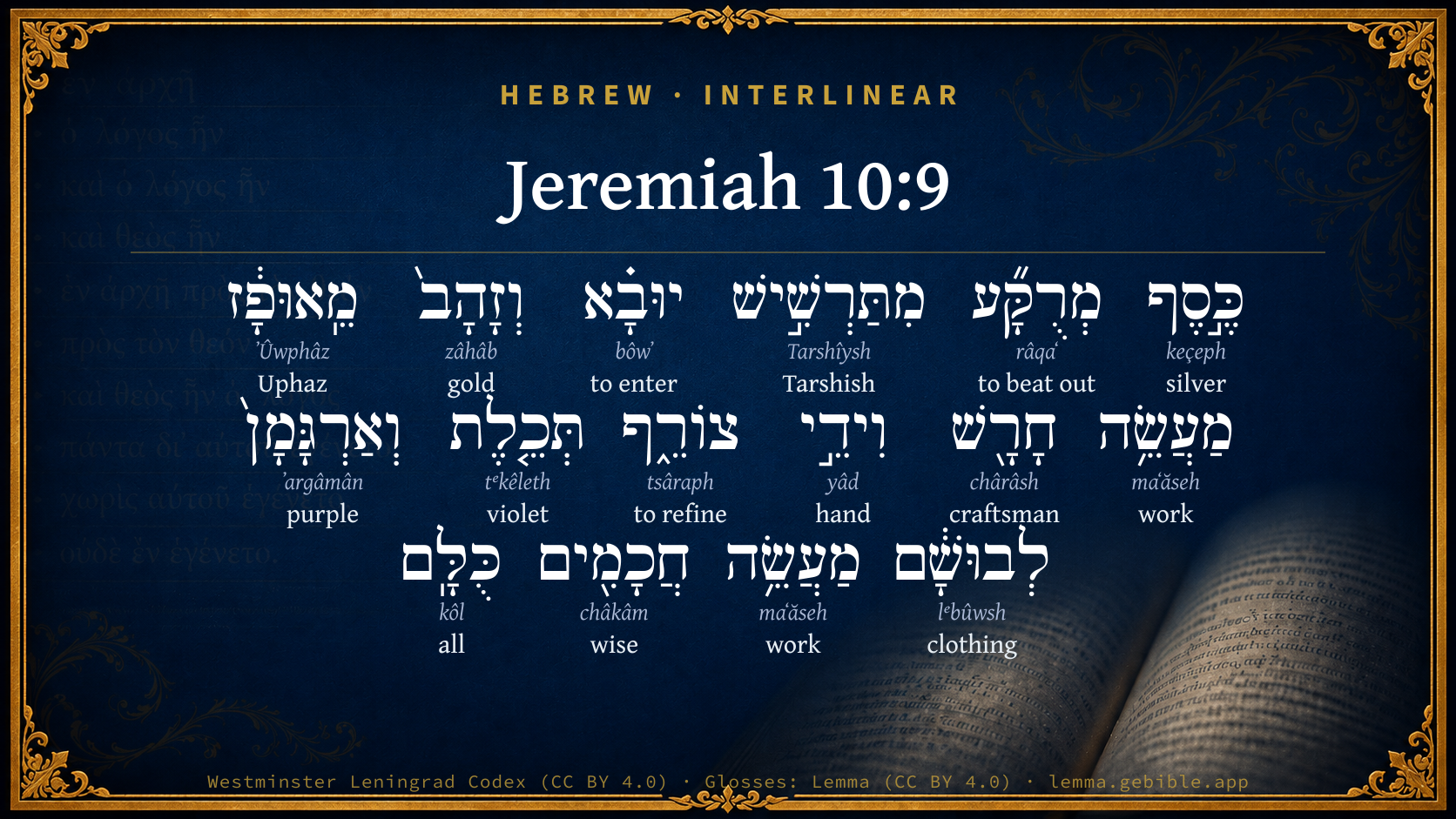
Hebrew (Westminster Leningrad Codex) Jeremiah 10:9 appears in the Hebrew Old Testament. The text above is from the Westminster Leningrad Codex. Each word links to its Strong’s number, a concise gloss, and parsing drawn from the Open Scriptures Hebrew Bible morphology. Click any word for its full Brown-Driver-Briggs (BDB) entry.
Download image
Cite this verse

Jeremiah 10:9 (World English Bible). Public Domain. Lemma interlinear Bible study tool, https://lemma.gebible.app/v/jeremiah/10/9.

Show BibTeX & RIS
BibTeX
RIS
English Translation
There is silver beaten into plates, which is brought from Tarshish, and gold from Uphaz, the work of the artificer and of the hands of the goldsmith; blue and purple for their clothing; they are all the work of skillful men.
World English Bible · Public Domain
Highlights
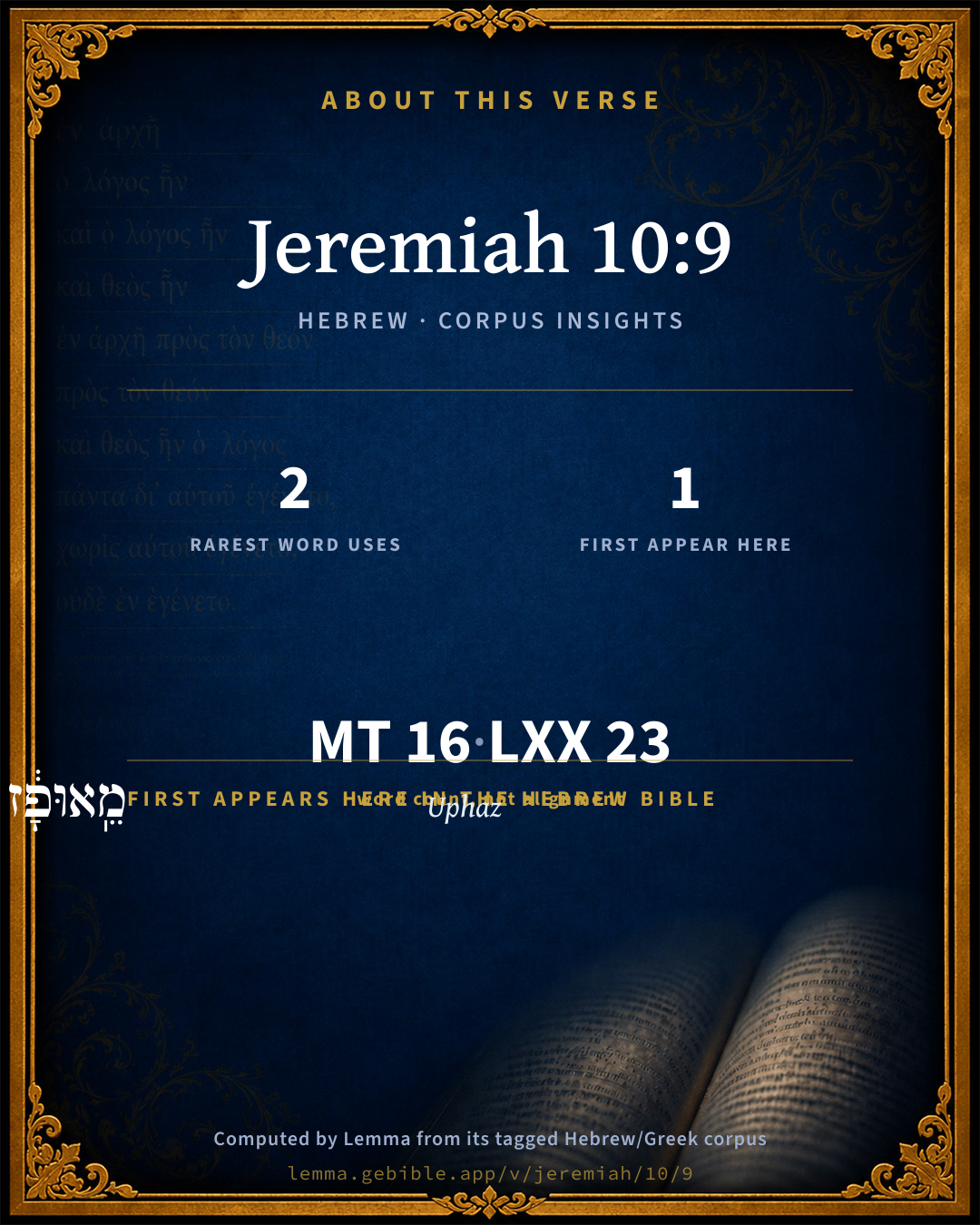
  • 1 first appearance in the Hebrew Bible
Full analysis ↓
Download a study sheet

One document with this verse’s original text, its word-by-word gloss line, the meaning frame, cross-references with their text, attributed commentary, and full source and license credits — printable, and it pastes into notes with its structure intact.

This verse Autodidact and up

Study sheet (.html) Plain text (.txt)

A passage Seminary Student

Up to 50 verses in one chapter. A passage sheet keeps up to 6 commentary sources and 12 cross-references per verse, in the order this page ranks them, and says so on the sheet whenever that leaves anything out. Ask for a single verse and you get the Autodidact verse sheet above.

Everything on this page stays free to read, with no account — the sheet is a download of what is already on screen, not access to it.

Want to remove ads? Support Godless Engineer
Compare translations 3

The same verse in 3 English versions, stacked beneath the original-language interlinear above. Click any original word for its lexicon entry.

Each is an independent rendering of the whole verse — the interlinear is not word-aligned to these translations.

Highlighted words mark where these versions differ — a whole-verse word diff, not a word-by-word alignment.

  • World English Bible Public Domain
    There is silver beaten into plates, which is brought from Tarshish, and gold from Uphaz, the work of the artificer and of the hands of the goldsmith; blue and purple for their clothing; they are all the work of skillful men.
  • King James Version Public Domain
    Silver spread into plates is brought from Tarshish, and gold from Uphaz, the work of the workman, and of the hands of the founder: blue and purple is their clothing: they are all the work of cunning men.
  • unfoldingWord Literal Text CC BY-SA 4.0
    Beaten silver is brought from Tarshish, and gold from Uphaz, the work of a craftsman, and the hands of one who refines. Their clothing violet and purple; the work of skilled ones all of them.

unfoldingWord Literal Text — © unfoldingWord, licensed CC BY-SA 4.0. Word-aligned USFM3 via Door43 (git.door43.org/unfoldingWord/en_ult).

Versions to compare (up to 4)

3 of 4 selected

Show all 18 translations

Every available English version of this verse, each an independent rendering of the whole verse.

  • World English Bible Public Domain
    There is silver beaten into plates, which is brought from Tarshish, and gold from Uphaz, the work of the artificer and of the hands of the goldsmith; blue and purple for their clothing; they are all the work of skillful men.
  • Berean Standard Bible Public Domain
    Hammered silver is brought from Tarshish, and gold from Uphaz—the work of a craftsman from the hands of a goldsmith. Their clothes are blue and purple, all fashioned by skilled workers.
  • Majority Standard Bible Public Domain
    Hammered silver is brought from Tarshish, and gold from Uphaz—the work of a craftsman from the hands of a goldsmith. Their clothes are blue and purple, all fashioned by skilled workers.
  • King James Version Public Domain
    Silver spread into plates is brought from Tarshish, and gold from Uphaz, the work of the workman, and of the hands of the founder: blue and purple is their clothing: they are all the work of cunning men.
  • American Standard Version (1901) Public Domain
    There is silver beaten into plates, which is brought from Tarshish, and gold from Uphaz, the work of the artificer and of the hands of the goldsmith; blue and purple for their clothing; they are all the work of skilful men.
  • Revised Version (1885) Public Domain
    There is silver beaten into plates which is brought from Tarshish, and gold from Uphaz, the work of the artificer and of the hands of the goldsmith; blue and purple for their clothing; they are all the work of cunning men.
  • Geneva Bible (1599) Public Domain
    Siluer plates are brought from Tarshish, and golde from Vphaz, for the worke of the workeman, and the handes of the founder: the blewe silke, and the purple is their clothing: all these things are made by cunning men.
  • Douay-Rheims (1899) Public Domain
    Silver spread into plates is brought from Tharsis, and gold from Ophaz: the work of the artificer, and of the hand of the coppersmith: violet and purple is their clothing: all these things are the work of artificers.
  • Young's Literal Translation Public Domain
    Spread-out silver from Tarshish is brought, And gold from Uphaz, Work of an artizan, and of the hands of a refiner, Blue and purple `is' their clothing, Work of the skilful -- all of them.
  • Literal Standard Version CC BY-SA 4.0
    Spread-out silver is brought from Tarshish, || And gold from Uphaz, || Work of an artisan, and of the hands of a refiner, || Their clothing [is] blue and purple, || Work of the skillful—all of them.
  • Unlocked Literal Bible CC BY-SA 4.0
    They bring hammered silver from Tarshish, and gold from Uphaz made by artificers, the hands of refiners. Their clothes are blue and purple cloth. Their skillful men made all of these things.
  • unfoldingWord Literal Text CC BY-SA 4.0
    Beaten silver is brought from Tarshish, and gold from Uphaz, the work of a craftsman, and the hands of one who refines. Their clothing violet and purple; the work of skilled ones all of them.
  • Darby Bible Public Domain
    Silver spread into plates is brought from Tarshish, and gold from Uphaz, the work of the artizan and of the hands of the founder; blue and purple is their clothing: they are all the work of skilful [men].
  • World Messianic Bible Public Domain
    There is silver beaten into plates, which is brought from Tarshish, and gold from Uphaz, the work of the engraver and of the hands of the goldsmith. Their clothing is blue and purple. They are all the work of skillful men.
  • Webster's Bible Public Domain
    Silver spread into plates is brought from Tarshish, and gold from Uphaz, the work of the workman, and of the hands of the founder: blue and purple is their clothing: they are all the work of skillful men.
  • Free Bible Version CC BY-SA 4.0
    Sheets of hammered silver are shipped in from Tarshish, and gold from Uphaz, to be used by craftsmen and metal-workers. These idols are dressed in clothes of blue and purple made by experts.
  • Bible in Basic English Public Domain
    Silver hammered into plates is sent from Tarshish, and gold from Uphaz, the work of the expert workman and of the hands of the gold-worker; blue and purple is their clothing, all the work of expert men.
  • JPS Tanakh (1917) Public Domain
    Silver beaten into plates which is brought from Tarshish, and gold from Uphaz, the work of the craftsman and of the hands of the goldsmith; blue and purple is their clothing; they are all the work of skilful men.

Literal Standard Version (2020), Covenant Press — licensed CC BY-SA 4.0. Text via the HelloAO Bible API (eBible.org). Unlocked Literal Bible (unfoldingWord) — licensed CC BY-SA 4.0. Text via the HelloAO Bible API (eBible.org). unfoldingWord Literal Text — © unfoldingWord, licensed CC BY-SA 4.0. Word-aligned USFM3 via Door43 (git.door43.org/unfoldingWord/en_ult). Free Bible Version, Dr. Jonathan Gallagher — licensed CC BY-SA 4.0. Text via the HelloAO Bible API (eBible.org).

Word by word

More ways to search: Search by grammar → Find every occurrence → Compare this word →

Practice this passage: Drill this verse → Learn its vocabulary →

מֵֽאוּפָ֔ז
ʼÛwphâz
H210
“from · Uphaz”
Preposition + Noun, Proper
Part of Speech
Preposition + Noun
Type
Proper
Full BDB Definition

Origin: perhaps a corruption of H211

TWOT: None

Uphaz = "desire of fine gold" - a place famous for its gold (site unknown)
  1. כֶּ֣סֶף keçeph H3701 “silver” Noun, Common, Masculine, Singular, Absolute
  2. מְרֻקָּ֞ע râqaʻ H7554 “beaten out” Verb, Pual, Participle Passive, Masculine, Singular, Absolute
  3. מִתַּרְשִׁ֣ישׁ Tarshîysh H8659 “from · Tarshish” Preposition + Noun, Proper
  4. יוּבָ֗א bôwʼ H935 “to enter” Verb, Hophal, Imperfect, 3rd Person, Masculine, Singular
  5. וְזָהָב֙ zâhâb H2091 “and · gold” Conjunction + Noun, Common, Masculine, Singular, Absolute
  6. מַעֲשֵׂ֥ה maʻăseh H4639 “work of” Noun, Common, Masculine, Singular, Construct
  7. חָרָ֖שׁ chârâsh H2796 “craftsman” Noun, Common, Masculine, Singular, Absolute
  8. וִידֵ֣י yâd H3027 “and · hands of” Conjunction + Noun, Common, Both, Dual, Construct
  9. צוֹרֵ֑ף tsâraph H6884 “refining” Verb, Qal, Participle Active, Masculine, Singular, Absolute
  10. תְּכֵ֤לֶת tᵉkêleth H8504 “violet of” Noun, Common, Feminine, Singular, Construct
  11. וְאַרְגָּמָן֙ ʼargâmân H713 “and · purple” Conjunction + Noun, Common, Masculine, Singular, Absolute
  12. לְבוּשָׁ֔ם lᵉbûwsh H3830 “clothing · their” Noun, Common, Masculine, Singular, Construct + Suffix, Personal, 3rd Person, Masculine, Plural
  13. מַעֲשֵׂ֥ה maʻăseh H4639 “work of” Noun, Common, Masculine, Singular, Construct
  14. חֲכָמִ֖ים châkâm H2450 “wise” Adjective, Adjective, Masculine, Plural, Absolute
  15. כֻּלָּֽם kôl H3605 “all · their” Noun, Common, Masculine, Singular, Construct + Suffix, Personal, 3rd Person, Masculine, Plural

About this verse

These counts appear in no published source. They are computed here, from the morphology-tagged text and Lemma’s own curated glosses. What Lemma adds →

16
words
15
distinct lemmas
Prophets
section

Notable vocabulary

The rarest word here is מֵֽאוּפָ֔ז Uphaz H210 — appearing just 2 times in the whole Hebrew Bible.

First appearance in Scripture

This word makes its first canonical appearance in the Hebrew Bible here:

  • מֵֽאוּפָ֔ז Uphaz H210

Shared distinctive vocabulary

מֵֽאוּפָ֔ז Uphaz H210 occurs in 2 verses of the Hebrew Bible. Also found in:

Grammatical profile

  • 3 verbs
  • 12 nouns
  • 1 adjective

Verb forms

  • מְרֻקָּ֞ע Pual · Participle Passive
  • יוּבָ֗א Hophal · Imperfect
  • צוֹרֵ֑ף Qal · Participle Active

Repetition

A word recurs within this verse — often emphatic in Hebrew:

  • מַעֲשֵׂ֥ה work H4639 ×2

Hebrew & Septuagint length

In the original languages it is 16 Hebrew tokens and 23 Greek tokens — but the two are counted differently (Hebrew bundles its prefixes and suffixes into one token; the Greek is in lemma form), so that isn’t a like-for-like length.

Cross-references

5

Topical passages linked to Jeremiah 10:9 in the Treasury of Scripture Knowledge — connected by theme and wording, ordered by reader-vote popularity; previews shown in the World English Bible.

  • Psalms 115:4 Their idols are silver and gold, The work of men's hands.
  • Daniel 10:5 I lifted up my eyes, and looked, and, behold, a man clothed in linen, whose loins were girded with pure gold of Uphaz:
  • 1 Kings 10:22 For the king had at sea a navy of Tarshish with the navy of Hiram: once every three years came the navy of Tarshish, bringing gold, and silver, ivory, and apes, and peacocks.
  • Isaiah 40:19 The image, a workman has cast [it], and the goldsmith overlays it with gold, and casts [for it] silver chains.
  • Ezekiel 27:12 Tarshish was your merchant by reason of the multitude of all kinds of riches; with silver, iron, tin, and lead, they traded for your wares.

Cross-references courtesy of OpenBible.info (CC BY 4.0).

Hebrew and Greek witnesses Masoretic Hebrew ↔ Greek Septuagint

The same verse in the two great witnesses to the Old Testament, shown verse-for-verse.

These are two independent witnesses, not word-aligned to each other, and the Septuagint is shown in lemma (dictionary) form.

Hebrew Jeremiah 10:9 Masoretic · Westminster Leningrad Codex

כֶּ֣סֶף מְרֻקָּ֞ע מִתַּרְשִׁ֣ישׁ יוּבָ֗א וְזָהָב֙ מֵֽאוּפָ֔ז מַעֲשֵׂ֥ה חָרָ֖שׁ וִידֵ֣י צוֹרֵ֑ף תְּכֵ֤לֶת וְאַרְגָּמָן֙ לְבוּשָׁ֔ם מַעֲשֵׂ֥ה חֲכָמִ֖ים כֻּלָּֽם

There is silver beaten into plates, which is brought from Tarshish, and gold from Uphaz, the work of the artificer and of the hands of the goldsmith; blue and purple for their clothing; they are all the work of skillful men.

World English Bible · Public Domain

Greek LXX Structure differs

In the Septuagint, Jeremiah is about an eighth shorter than the Hebrew and arranges its material differently — the Oracles Against the Nations (Hebrew chapters 46–51) appear in the middle of the Greek book, after 25:13. Because the chapter and verse boundaries do not line up, a verse-for-verse comparison with the Hebrew is not shown.

A verse-for-verse comparison isn’t shown here because the chapters and verses don’t line up. Switch to the LXX edition with the MT / LXX toggle above to read the Greek directly.

On this verse, Jamieson, Fausset & Brown discusses the Septuagint’s reading. Read the note in Commentary ↓

Hebrew: Westminster Leningrad Codex (CC BY 4.0). Greek: Septuagint (public domain); English from a public-domain English Septuagint. How the Septuagint differs from the Hebrew →

Targum (Aramaic paraphrase)

1

The Targum is the ancient Jewish Aramaic paraphrase of the Hebrew Scriptures — an interpretive translation, not the Hebrew text itself. Onkelos (literal) and Pseudo-Jonathan (expansive) render the Torah, and Jonathan the Prophets. Coverage is partial: where no permissively-licensed English translation exists for a verse, only the Aramaic is shown. This is verse-level text, not a word-by-word alignment to the Hebrew.

  1. Targum Jonathan Prophets (Joshua–Malachi)
    כַּסְפָּא דִמְחַפָּן מֵאַפְרִיקָא מַיְתָן וְדַהֲבָא מֵאוֹפִיר עוֹבַד נַגָר וִידֵי קִינֵי תִּכְלָא וְאַרְגְוָנָא לְבוּשְׁהוֹן עוֹבַד חֲכִּימִין כּוּלְהוֹן:

    (no public-domain English translation for this verse)

    Targum Jonathan — Aramaic: “Mikraot Gedolot” (public domain). English: “Sefaria Community Translation” (CC0 1.0 (public-domain dedication)); “London "Chaldee Paraphrase," 1871” (public domain). Text via Sefaria.

Commentary

Notes on Jeremiah 10:9 from classic Christian and Jewish commentators (each source and its license shown beneath its notes). The classic Christian expositions comment on the surrounding passage and are grouped to its opening verse, so a note may address several verses; the Jewish commentaries on the Tanakh (Rashi and others) are per-verse, so they appear only where the commentator wrote on this verse.

Lemma curates 59 commentaries, every one of them public domain or Creative Commons licensed, each selected and text-cleaned for this edition rather than reprinted as found. About our sources →

Trapp's Complete Commentary

John Trapp

Jer 10:9 Silver spread into plates is brought from Tarshish, and gold from Uphaz, the work of the workman, and of the hands of the founder: blue and purple [is] their clothing: they [are] all the work of cunning [men].

Ver. 9. Silver spread into plates.] See Isa 40:19.

Is brought from Tarshish.] From Tarsus or Tartessus; {Eze 27:12} from Africa, saith the Chaldee. Idolaters spare for no cost.

And gold from Uphaz.] The same with Phaz; {Job 28:17} or with Ophir, as some; Aurum Obzyrum.

They are all the work of cunning men.] Quaerunt suos Phidias et Praxiteles: but how could those give that deity which themselves had not?

John Trapp, A Commentary or Exposition upon All the Books of the Old and New Testament (1647–1656) — public domain. Text from a community e-Sword module.

Joseph Benson's Commentary

Jer 10:9. Silver spread into plates — To cover the images, and make them appear as if made of massy silver; is brought from Tarshish — A port of Spain, to which the merchants of Tyre and Sidon traded; of which place see note on Isa 2:16. And gold from Uphaz — The Syriac, Chaldee, and Theodotion read, from Ophir, which Bochart supposes to be here meant; namely, Ophir in India, near Zeilan, a place famous for gold. Blue and purple are their clothing — “The splendour and magnificence of dress seem, among the ancients, to have consisted very much in the richness of the colours; the art of dying which to perfection, was esteemed a matter of great skill, being known and practised by very few. The excellence of the Tyrian purple is celebrated by both sacred and profane authors. And the blue, which from many passages of Scripture we find to have been in great request, was also imported from remote countries as an article of elegant and expensive luxury.” They are all the work of cunning men — “If, in the preceding verse, the insignificance of the idols was argued from the vile and perishable matter out of which they were composed; the same is inferred in this from their being indebted to the art and labour of man for all their costly ornaments, their splendid outward show. In short, the whole of them, says the prophet, internal and external, is the work of skilful men. Upon what ground then could the thing formed pretend to a nature more excellent than its former?” — Blaney.

Joseph Benson's Commentary on the Old and New Testaments (1811–1818) — public domain. Text from a community e-Sword module.

Tyndale Open Study Notes

Tyndale Open Resources

10:9 The people who created idols had to send far away for metal. They had to purchase silver from Tarshish on the southern tip of Spain. They had to buy gold from Uphaz (or Ophir) in Arabia. The skillful craftsmen and expert tailors put their best efforts into changing an otherwise worthless piece of wood or stone into an attractive artifact (see 10:4-5).

Tyndale Open Study Notes — © Tyndale Open Resources, licensed CC BY-SA 4.0. Text via the HelloAO Bible API.

Geneva Bible (1599)

Geneva Bible translators

Whereas they found the best gold: showing, that they thought nothing too dear for their idols, some read Ophir, as 1 Kings 9:28.

Geneva Bible (1599) marginal notes — public domain. Text via Bolls.life.

Jamieson, Fausset & Brown

Robert Jamieson, A. R. Fausset & David Brown

Everything connected with idols is the result of human effort.

Silver spread--(See on Isa 30:22; Isa 40:19).

Tarshish--Tartessus, in Spain, famed for precious metals.

Uphaz-- (Dan 10:5). As the Septuagint in the Syrian Hexapla in the Margin, THEODOTUS, the Syrian and Chaldee versions have "Ophir," GESENIUS thinks "Uphaz" a colloquial corruption (one letter only being changed) for "Ophir." Ophir, in Gen 10:29, is mentioned among Arabian countries. Perhaps Malacca is the country meant, the natives of which still call their gold mines Ophirs. HEEREN thinks Ophir the general name for the rich countries of the south, on the Arabian, African, and Indian coasts; just as our term, East Indies.

cunning--skilful.

Jamieson, Fausset & Brown — Commentary Critical and Explanatory on the Whole Bible (1871) — public domain (CC PDM 1.0). Text via the HelloAO Bible API.

Adam Clarke's Commentary

Verse 9. Brought from Tarshish] Some suppose this to be Tartessus in Spain, from which the Phoenicians brought much silver. Uphaz, Calmet thinks to be the river Pison; some think Ophir is intended.

Blue and purple is their clothing] These were the most precious dyes; very rare, and of high price.

Adam Clarke's Commentary on the Bible (1810–1826) — public domain. Text from a community e-Sword/MySword module.

John Calvin's Commentaries

The Prophet, anticipating what might be said, refers to the splendor and pomp of idols, and declares that all was frivolous and extremely puerile. Whence was it that the world shewed so much honor to idols, except that their pomp dazzled the eyes of men? The devil has also by this artifice ever deluded the unbelieving; for he has exhibited in idols something that involved men’s minds in darkness.

The Prophet then assails these foolish imaginations, and says, Silver is brought from Tharsis, that is, from Cilicia; for so the Scripture designates that transmarine country, which lies opposed to Judea; and we know that Cilicia was over against Judea; for the Mediterranean Sea intervenes between Syria and Cilicia; and the sea of Tharsis is what they call that part which extended towards Cilicia and Asia Minor. The Prophet then says; that it was brought from a far country. Well, he says, the fact is so; and then it is added that gold was brought from Uphaz Some have explained this last word wrongly, by saying that it means pure or fine gold; but it appears from this place and many others, that it is the name of a country, that is, Persia, or one not far from Persia: it was at least a country eastward of Judea. He then says, gold is brought from Uphaz; and he mentions the workmanship, the work of the artificer; that is, it is not silver and gold in its rude state; but they are so elegantly wrought, that they readily attract the eyes of men. Then he adds the hands (he speaks in the plural number) of the melter; that is, the silver and gold were melted and were made to assume a certain form; and then art was employed, which gave an increased polish to these forms which came out of the furnace. He afterwards says, The hyacinth and purple are their vestments; that is, it is not enough to have the precious metal, and that cast into an elegant and lovely form, but it must be clothed in purple and hyacinth. He says in the last place, that the work was that of the wise; that is, skillful men were chosen, who could in the most perfect manner give expression to every lineament; in short, nothing was left undone.

But the Prophet, though he concedes generally to the unbelieving that they added whatever could add beauty to their idols, yet declares that they were mere trumperies: they are puppets, he says; for man, who is a mortal, cannot make a god: and then, what can art and the toil and labor of man do in this respect? can he change the nature of things? can he make a god from wood and stone? and when a vestment covers the idol of gold or of silver, can it raise it above the heavens, that it may attain a new divinity? We hence see that the Prophet mentions all that was done, that he might taunt the heathens and ridicule their fatuitous trifles; for in their idols there was nothing real, nothing that could be dependd upon. He then subjoins —

John Calvin's Commentaries (1540-1563) — public domain. Text from the Calvin Translation Society English edition (1840s-50s) via the Christian Classics Ethereal Library (ccel.org). Calvin's coverage is partial (roughly two-thirds of the Bible); uncommented books and verses are honest gaps, never fabricated. The 19th-century editor's footnotes and remarks are omitted so the notes are faithfully Calvin's own voice.

Ellicott's Commentary for English Readers

(9) Tarshish.—As elsewhere in the Old Testament, Spain, the Tartessus of the Greeks (Gen_10:4; Jon_1:3; Eze_27:12), from whence Palestine, through the Phoenicians, was chiefly supplied with silver, tin, and other metals.

Uphaz.—Possibly an error of transcription, or dialectical variation, for Ophir, giving the meaning “gold-coast.” The word is found only here and in Dan_10:5. Some interpreters, however, connect it with the name of Hyphasis, one of the tributaries of the Indus. We cannot attain to greater certainty. (See Note on 1Ki_9:28.)

Blue and purple.—Both were colours obtained from the murex, a Mediterranean shell-fish, and were used both for the curtains of the Tabernacle (Exo_25:4) and for the gorgeous apparel of the idols of the heathen. “Purple,” as elsewhere in the English of the Bible, must be understood of a deep crimson or scarlet. (Comp. Mat_27:28; Mar_15:17.)

A Bible Commentary for English Readers, edited by Charles John Ellicott (1878–1897) — public domain. Text from a community e-Sword module.

The Cambridge Bible for Schools and Colleges

gen. ed. J. J. S. Perowne

9. A description of the process of the making of idols out of silver and gold, and the robing of them in expensive garments. There is probably in both MT. and LXX corruption such as cannot now be fully disentangled. The first part of the v. is likely to be a gloss.

Tarshish] probably Tartessus in Spain, for the mineral products supplied by Tarshish to Tyre, silver, etc. (Eze_27:12), were exactly those in which Spain was rich. In Strabo’s time the port had ceased to exist; hence the confusion as to the locality.

Uphaz] unknown, read Ophir (as mg.) with some texts of LXX, Targ., Syr. Its position is disputed, but was probably in S.E. of Arabia. See HDB.

blue and purple] the richness of the idols’ clothing matches that of the materials which compose them.

cunning] See on Jer_9:17.

The Cambridge Bible for Schools and Colleges (gen. ed. J. J. S. Perowne; Cambridge University Press, 1878–1918) — public domain. Text from a community e-Sword module.

John Gill's Exposition

Silver spread into plates is brought from Tarshish,.... In Cilicia, where the Apostle Paul was born; according to Josephus, as Jerom says, it was a country in India. The Targum renders it, from Africa, and calls it silver "rolled up", or "covered"; so the Vulgate Latin; such was beaten with a hammer into plates, and might be rolled up for better convenience of shipment; and with which they covered and decked their idols, to make them look glittering and pompous, and command some awe and reverence from the common people. The Arabic version renders it, "solid silver"; it being the same word from whence the firmament of heaven has its name, or the wide expanse; hence we render it "spread", stretched, and drawn out into plates. The Syriac version is, "the best silver"; as very likely that from Tarshish was reckoned.

And gold from Uphaz; called sometimes "the gold of Uphaz"; Dan 10:5 or "Fess"; perhaps the same with the gold of Ophir, Job 28:16 and so the Targum here calls it, "gold from Ophir"; to which agrees the Syriac version; and was esteemed the best gold.

The work of workmen, and of the hands of the founder; melter or refiner, being first purified by him from dross, and then wrought into plates, and polished, and fitted for the idol; and all this being owing to the art and workmanship of men, shows the brutishness and ignorance of the people, in worshipping it as a god. Blue and purple is their clothing; not the clothing of the workmen, but of the idols; these colours seem to be chosen to dazzle the eyes of the populace, and cause them to entertain a high opinion of them; the "blue" being the colour of the heavens, and the "purple" what is wore by kings; and so both may denote their deity and dominion. But, alas!

they are all the work of cunning men: both the idols, and their clothing; especially the latter is meant, which were curiously wrought and embroidered by men skilful in that art.

John Gill's Exposition of the Whole Bible (1746–1763) — public domain (CC PDM 1.0). Text via the HelloAO Bible API.

Albert Barnes' Notes on the Bible

Or, “It is a piece of wood (Jer 10:8 note); yea, beaten silver it is, which is brought from Tarshish, and gold from Uphaz: it is the work etc.”

Tarshish ... Uphaz - See the marginal reference and Gen 10:4. Possibly Uphaz was a place in the neighborhood of the River Hyphasis.

Blue and purple - Both colors were purple, from dyes obtained from shellfish: but the former had a violet, the latter a red tinge.

Albert Barnes' Notes on the Bible (1834–1885) — public domain. Text from a community e-Sword/MySword module.

Haydock's Catholic Bible Commentary

Ophaz, or Phison, (Genesis ii. 11.; Calmet) the coast of Pegu, Faprobana, &c. (Menochius)

George Leo Haydock (1774–1849), Haydock's Catholic Family Bible and Commentary, 1859 edition — public domain. Excludes Psalms (Douay-Rheims chapter numbering differs from Protestant) and Deuterocanonical books (Catholic canon only).

Matthew Poole's English Annotations

Silver spread into plates; it was not wood washed with gold, nor massy silver or gold, but covered over with plates of silver or gold, Exo 39:3.

From Tarshish; from some remote place, probably from Spain, whence the best gold came; Tarshish is the proper name of a sea-town in Cilicia, Eze 27:12,25; Jon 1:3; and being a noted port, from whence they had passage to Africa, India, and other remote countries, it is usually put for the ocean, and may as well signify from any place beyond the sea. If you take it properly, then possibly it is noted as the best silver coming from thence, as Uphaz for the best gold; for though we read also of gold coming from thence, 1Ki 10:22; 2Ch 9:21, yet where the most proper commodities of it are mentioned we read of no gold, Eze 27:12, unless what seems rather to be brought thither, Jer 10:22.

Gold from Uphaz, i.e. probably the best gold, coming from thence in those days, as the best silver from Tarshish, and that here was the best gold is probable from Dan 10:5. There are various conjectures at what place this points at, whether the same with Phas, or Fez, by an aphaeresis, or Ophir, a place not far from Tarshish; and divers other places are conjectured; and some think it refers to no place at all, but to point at the excellency of the gold only. But it is not the design that this comment should swell with things rather conjectural than profitable, it is enough to know that this place intends the purest gold.

The work of the workman, and of the hands of the founder: thus, saith he, the artificer takes it, and each, according to his art, shapes it and adorns it; fits the silver and the gold for it.

Blue and purple is their clothing: expositors differing about the materials out of which they were dyed, do differ also in the colours, which here are called blue and purple; the dispute is not worth the while in a vulgar comment, they that will may consult the English Annotations. Either this relates to the further adorning those rich idols of silver and gold; or it implies other artists, such as shape, or sew silk or cloth, woollen or linen, made use of to make these garments for those idols of more inferior materials, as wood or stone, the other being sufficiently beautified without them.

They are all the work of cunning men, i.e. the choicest men in their respective arts were picked out for this work, that there might be nothing wanting as to exactness, richness, and curiosity; all this the prophet speaks the more to ridicule their idols, as if all this would put any thing of power, virtue, or excellency in them, still deest aliquit intus.

Matthew Poole's English Annotations on the Holy Bible (1683–1685) — public domain. Text from a community e-Sword/MySword module.

Whedon's Commentary on the Bible

Daniel D. Whedon

9. Tarshish — Generally supposed to have been located in the south of Spain. It is thought from the context to have been an opulent and cultured city.

Uphaz — Thought by Gesenius and Keil to be a dialectical variety of Ophir, and the Targum and the Syriac Version so treat it. Others, however, regard it as a distinct name. It occurs elsewhere only in Dan_10:5.

Daniel D. Whedon (gen. ed.), Commentary on the Old and New Testaments (1874–1909) — public domain. Text from a community e-Sword module.

The Pulpit Commentary

This verse apparently once followed Ver. 5. Like Vers. 7 and 8, it is omitted in the Septuagint. Silver spread into plates, etc. The silver and gold were meant for the coating of the wooden image. (comp. Isa_30:22 Isa_40:19) Tarshish; i.e. Tartessus, in south-west Spain, between the two mouths of the Baetis, or Guadal-quivir. Gold from Uphaz. A place bearing this name, or anything like it, is not known from other sources than the Old Testament writings; and hence a corruption of the text has naturally been suspected (Ophir into Uphaz). As, however, r and z are not easily confounded, either in the earlier or the later Hebrew characters, this view must be abandoned, though it has the authority of several ancient versions of this passage (including the Peshite and the Targum). The name occurs again in Dan_10:5. The Peshite, moreover, curiously enough, translates zahab mufaz in 1Ki_10:18 (Authorized Version, "the best gold") by "gold from Ophir." Blue and purple. The Hebrew has no word, strictly speaking, for either "blue" or "purple." Both these words here used probably express coloring matter rather than colors (this is certain of the latter word, which properly designates a kind of mussel, the shell of which yielded dye). The first produced a violet purple, the second a reddish purple.

The Pulpit Commentary (1880–1919), ed. H.D.M. Spence-Jones & Joseph S. Exell — public domain. Text from a community e-Sword module.

John Wesley's Explanatory Notes

Tarshish - Is the proper name of a sea-town in Cilicia, and being a noted port, it is usually put for the ocean, and may signify any place beyond the sea. Uphaz - Probably the best gold came from thence as the best silver from Tarshish.

John Wesley, Explanatory Notes Upon the Whole Bible (1754–1765) — public domain. Text via the GEBible commentary corpus.

Rashi

Rabbi Shlomo Yitzchaki (Rashi)

Silver beaten into plates Heb. מרקע.

Rashi on the Tanakh — English translations: “The Judaica Press complete Tanach with Rashi, translated by A. J. Rosenberg” (CC BY 4.0); “Pentateuch with Rashi's commentary by M. Rosenbaum and A.M. Silbermann, 1929-1934” (public domain); “The Metsudah Tanach series, Lakewood, N.J” (CC BY 4.0); and “The Book of Joshua, Metsudah Publications, 1997” (CC BY 4.0). Text via Sefaria.

Lesson kit

Teaching starters — assembled from the data on this page, not authored interpretation. Every prompt links to the verse data it draws on. Edit before teaching.

Jeremiah, in the Prophets, opens this verse with 16 words (15 distinct Hebrew lemmas). Its most distinctive word is ʼÛwphâz (“Uphaz”). A historical commentator’s framing appears above. Read the whole chapter for the surrounding context.

Discussion questions

  1. How does “Uphaz” (ʼÛwphâz) shape what this verse is saying?
  2. This is the first place “Uphaz” appears in Scripture (first appears here). What does its debut here establish?
  3. How does Daniel 10:5, which shares the word «Uphaz», read alongside this verse?
  4. What does the repetition of “work” (2× in this one verse) do in this verse?
  5. These translations render this verse differently; the difference is in the English rendering, not the original. What questions does that raise?
  6. «מְרֻקָּ֞ע» is a Pual Participle Passive verb. How does that grammatical form shape the action described?
  7. Compare how Trapp's Complete Commentary and Joseph Benson's Commentary read this verse. Where do they agree or differ?

Things to notice

Reading settings

Reading text

Shown beneath each verse's original-language words.

Old Testament
Old Testament edition

Read the OT as the Masoretic Hebrew (MT) or the Greek Septuagint (LXX).

English shown for the Greek Septuagint (in the Hebrew ↔ Greek comparison).

Comparing translations? Open the Compare panel on any verse page to stack up to four side by side.