Obadiah 1:8

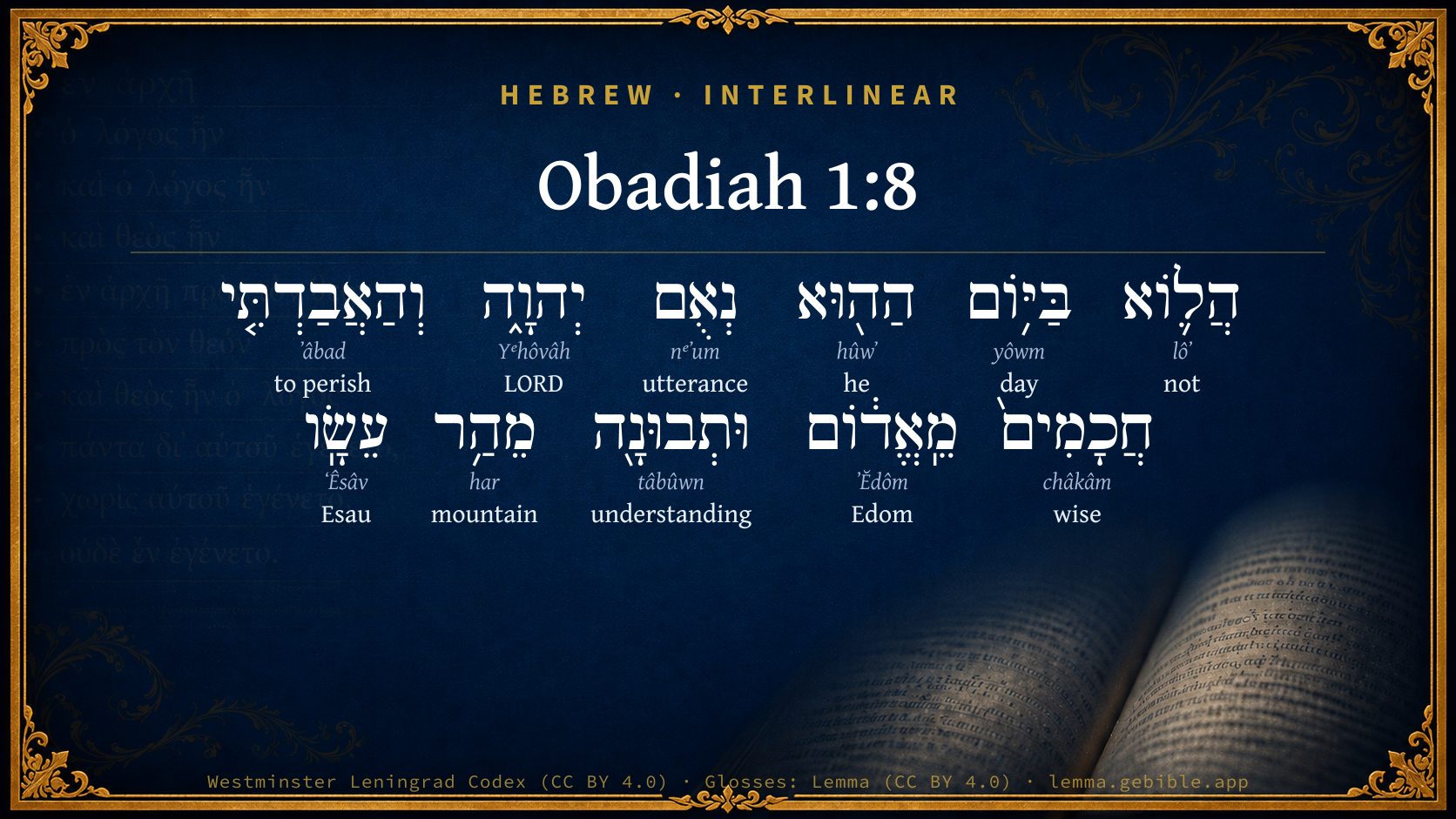
Hebrew (Westminster Leningrad Codex) Obadiah 1:8 appears in the Hebrew Old Testament. The text above is from the Westminster Leningrad Codex. Each word links to its Strong’s number, a concise gloss, and parsing drawn from the Open Scriptures Hebrew Bible morphology. Click any word for its full Brown-Driver-Briggs (BDB) entry.
Download image
Cite this verse

Obadiah 1:8 (World English Bible). Public Domain. Lemma interlinear Bible study tool, https://lemma.gebible.app/v/obadiah/1/8.

Show BibTeX & RIS
BibTeX
RIS
English Translation
"Won't I in that day," says Yahweh, "destroy the wise men out of Edom, and understanding out of the mountain of Esau?
World English Bible · Public Domain
Download a study sheet

One document with this verse’s original text, its word-by-word gloss line, the meaning frame, cross-references with their text, attributed commentary, and full source and license credits — printable, and it pastes into notes with its structure intact.

This verse Autodidact and up

Study sheet (.html) Plain text (.txt)

A passage Seminary Student

Up to 50 verses in one chapter. A passage sheet keeps up to 6 commentary sources and 12 cross-references per verse, in the order this page ranks them, and says so on the sheet whenever that leaves anything out. Ask for a single verse and you get the Autodidact verse sheet above.

Everything on this page stays free to read, with no account — the sheet is a download of what is already on screen, not access to it.

Want to remove ads? Support Godless Engineer
Compare translations 3

The same verse in 3 English versions, stacked beneath the original-language interlinear above. Click any original word for its lexicon entry.

Each is an independent rendering of the whole verse — the interlinear is not word-aligned to these translations.

Highlighted words mark where these versions differ — a whole-verse word diff, not a word-by-word alignment.

  • World English Bible Public Domain
    "Won't I in that day," says Yahweh, "destroy the wise men out of Edom, and understanding out of the mountain of Esau?
  • King James Version Public Domain
    Shall I not in that day, saith the LORD, even destroy the wise men out of Edom, and understanding out of the mount of Esau?
  • unfoldingWord Literal Text CC BY-SA 4.0
    Will I not on that day (a declaration of Yahweh) destroy wise men from Edom, and understanding from the mountain of Esau?

unfoldingWord Literal Text — © unfoldingWord, licensed CC BY-SA 4.0. Word-aligned USFM3 via Door43 (git.door43.org/unfoldingWord/en_ult).

Versions to compare (up to 4)

3 of 4 selected

Show all 18 translations

Every available English version of this verse, each an independent rendering of the whole verse.

  • World English Bible Public Domain
    "Won't I in that day," says Yahweh, "destroy the wise men out of Edom, and understanding out of the mountain of Esau?
  • Berean Standard Bible Public Domain
    In that day, declares the LORD, will I not destroy the wise men of Edom and the men of understanding in the mountains of Esau?
  • Majority Standard Bible Public Domain
    In that day, declares the LORD, will I not destroy the wise men of Edom and the men of understanding in the mountains of Esau?
  • King James Version Public Domain
    Shall I not in that day, saith the LORD, even destroy the wise men out of Edom, and understanding out of the mount of Esau?
  • American Standard Version (1901) Public Domain
    Shall I not in that day, saith Jehovah, destroy the wise men out of Edom, and understanding out of the mount of Esau?
  • Revised Version (1885) Public Domain
    Shall I not in that day, saith the LORD, destroy the wise men out of Edom, and understanding out of the mount of Esau?
  • Geneva Bible (1599) Public Domain
    Shall not I in that day, saith the Lord, euen destroy the wise men out of Edom, and vnderstanding from the mount of Esau?
  • Douay-Rheims (1899) Public Domain
    Shall not I in that day, saith the Lord, destroy the wise out of Edom, and understanding out of the mount of Esau?
  • Young's Literal Translation Public Domain
    Is it not in that day -- an affirmation of Jehovah, That I have destroyed the wise out of Edom, And understanding out of the mount of Esau?
  • Literal Standard Version CC BY-SA 4.0
    Is it not in that day,” a declaration of YHWH, || “That I have destroyed the wise out of Edom, || And understanding out of the mountain of Esau?
  • Unlocked Literal Bible CC BY-SA 4.0
    “Will I not on that day,” says Yahweh, “destroy the wise men from Edom and understanding out of the mountain of Esau?
  • unfoldingWord Literal Text CC BY-SA 4.0
    Will I not on that day (a declaration of Yahweh) destroy wise men from Edom, and understanding from the mountain of Esau?
  • Darby Bible Public Domain
    Shall I not in that day, saith Jehovah, destroy the wise men out of Edom, and understanding out of the mount of Esau?
  • World Messianic Bible Public Domain
    “Won’t I in that day”, says the LORD, “destroy the wise men out of Edom, and understanding out of the mountain of Esau?
  • Webster's Bible Public Domain
    Shall I not in that day, saith the LORD, even destroy the wise men out of Edom, and understanding out of the mount of Esau?
  • Free Bible Version CC BY-SA 4.0
    On that day, declares the Lord, I will destroy the wise men of Edom—there will be no more wisdom in the mountains of Esau.
  • Bible in Basic English Public Domain
    Will I not, in that day, says the Lord, take away the wise men out of Edom, and wisdom out of the mountain of Esau?
  • JPS Tanakh (1917) Public Domain
    Shall I not in that day, saith the LORD, destroy the wise men out of Edom, and discernment out of the mount of Esau?

Literal Standard Version (2020), Covenant Press — licensed CC BY-SA 4.0. Text via the HelloAO Bible API (eBible.org). Unlocked Literal Bible (unfoldingWord) — licensed CC BY-SA 4.0. Text via the HelloAO Bible API (eBible.org). unfoldingWord Literal Text — © unfoldingWord, licensed CC BY-SA 4.0. Word-aligned USFM3 via Door43 (git.door43.org/unfoldingWord/en_ult). Free Bible Version, Dr. Jonathan Gallagher — licensed CC BY-SA 4.0. Text via the HelloAO Bible API (eBible.org).

Word by word

More ways to search: Search by grammar → Find every occurrence → Compare this word →

Practice this passage: Drill this verse → Learn its vocabulary →

וּתְבוּנָ֖ה
tâbûwn
H8394
“and · understanding”
Conjunction + Noun, Common, Feminine, Singular, Absolute
Part of Speech
Conjunction + Noun
Type
Common
Gender
Feminine
Number
Singular
State
Absolute
Full BDB Definition

Origin: from H995

TWOT: 239c

understanding, intelligence - the act of understanding - skill - the faculty of understanding - intelligence, understanding, insight - the object of knowledge - teacher (personification)
  1. הֲל֛וֹא lôʼ H3808 “not” Particle, Interrogative + Particle, Negative
  2. בַּיּ֥וֹם yôwm H3117 “in/at the · day” Preposition, Determined + Noun, Common, Masculine, Singular, Absolute
  3. הַה֖וּא hûwʼ H1931 “the · he” Particle, Definite Article + Pronoun, Personal, 3rd Person, Masculine, Singular
  4. נְאֻם nᵉʼum H5002 “utterance of” Noun, Common, Masculine, Singular, Construct
  5. יְהוָ֑ה Yᵉhôvâh H3068 “LORD” Noun, Proper
  6. וְהַאֲבַדְתִּ֤י ʼâbad H6 “and · to perish” Conjunction + Verb, Hiphil, Sequential Perfect, 1st Person, Common, Singular
  7. חֲכָמִים֙ châkâm H2450 “wise” Adjective, Adjective, Masculine, Plural, Absolute
  8. מֵֽאֱד֔וֹם ʼĔdôm H123 “from · Edom” Preposition + Noun, Proper
  9. מֵהַ֥ר har H2022 “from · mountain of” Preposition + Noun, Common, Masculine, Singular, Construct
  10. עֵשָֽׂו ʻÊsâv H6215 “Esau” Noun, Proper

About this verse

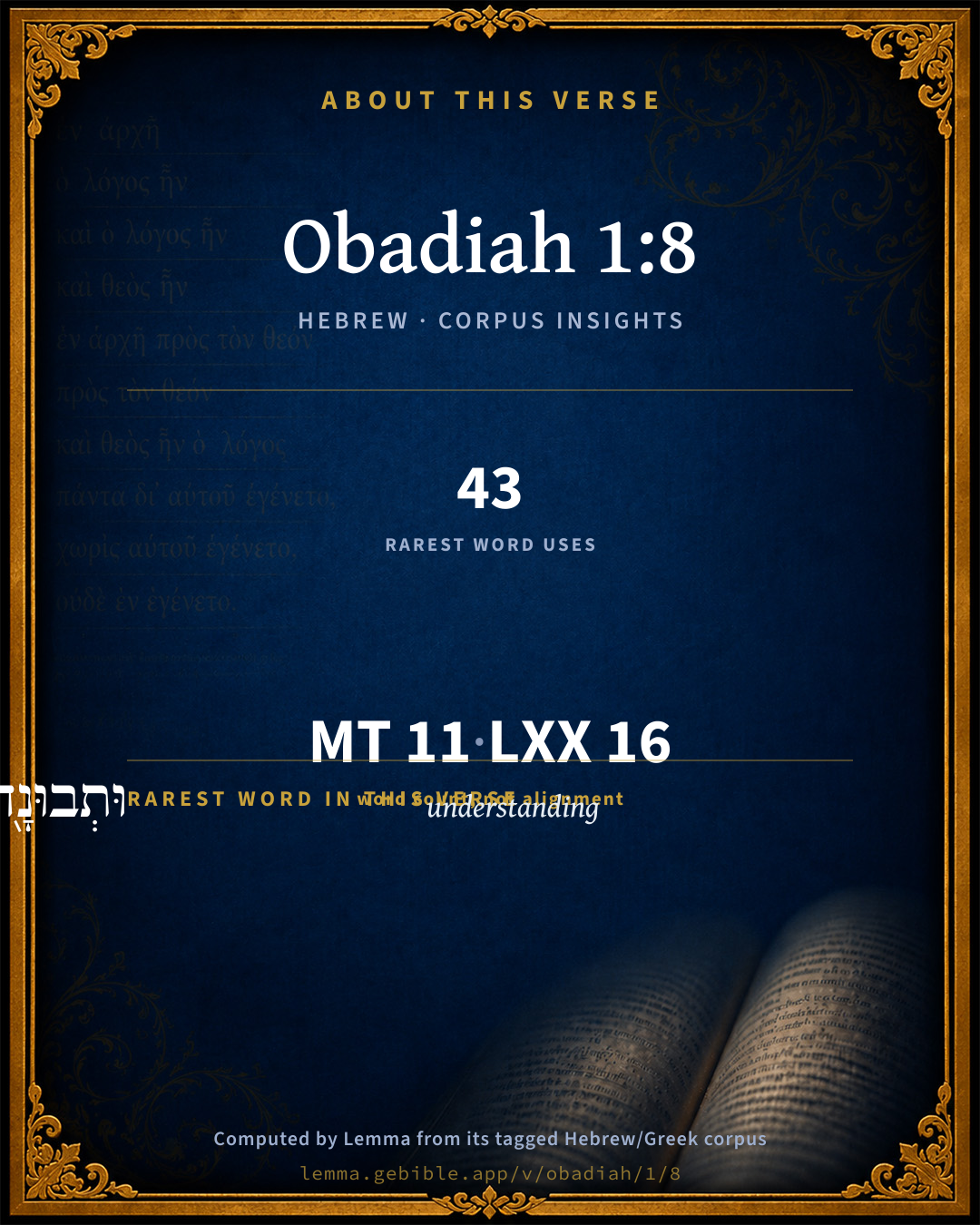
These counts appear in no published source. They are computed here, from the morphology-tagged text and Lemma’s own curated glosses. What Lemma adds →

11
words
11
distinct lemmas
Prophets
section

Shared distinctive vocabulary

וּתְבוּנָ֖ה understanding H8394 occurs in 42 verses of the Hebrew Bible. Also found in:

Grammatical profile

  • 1 verb
  • 7 nouns
  • 1 adjective
  • 1 pronoun
  • 1 particle

Verb forms

  • וְהַאֲבַדְתִּ֤י Hiphil · Sequential Perfect

Hebrew & Septuagint length

In English translation the verse runs 22 words from the Hebrew and 23 from the Septuagint (LXX English) — closely comparable.

A rough comparison of the two English renderings, which tokenize alike — not a word-level alignment.

Word counts can differ between the Hebrew and the Greek without any difference in meaning — e.g. the Hebrew direct-object marker אֵת has no separate Greek word, and Greek often adds the article ὁ.

In the original languages it is 11 Hebrew tokens and 16 Greek tokens — but the two are counted differently (Hebrew bundles its prefixes and suffixes into one token; the Greek is in lemma form), so that isn’t a like-for-like length.

Cross-references

6

Topical passages linked to Obadiah 1:8 in the Treasury of Scripture Knowledge — connected by theme and wording, ordered by reader-vote popularity; previews shown in the World English Bible.

  • Isaiah 29:14 therefore, behold, I will proceed to do a marvelous work among this people, even a marvelous work and a wonder; and the wisdom of their wise men shall perish, and the understanding of their prudent men shall be hid.
  • Job 5:12–14 He frustrates the devices of the crafty, So that their hands can't perform their enterprise.
  • Psalms 33:10 Yahweh brings the counsel of the nations to nothing. He makes the thoughts of the peoples to be of no effect.
  • Isaiah 19:3 The spirit of Egypt shall fail in the midst of it; and I will destroy the counsel of it: and they shall seek to the idols, and to the charmers, and to those who have familiar spirits, and to the wizards.
  • Isaiah 19:13–14 The princes of Zoan are become fools, the princes of Memphis are deceived; they have caused Egypt to go astray, who are the corner-stone of her tribes.
  • 1 Corinthians 3:19–20 For the wisdom of this world is foolishness with God. For it is written, "He has taken the wise in their craftiness."

Cross-references courtesy of OpenBible.info (CC BY 4.0).

Hebrew and Greek witnesses Masoretic Hebrew ↔ Greek Septuagint

The same verse in the two great witnesses to the Old Testament, shown verse-for-verse.

These are two independent witnesses, not word-aligned to each other, and the Septuagint is shown in lemma (dictionary) form.

Hebrew Obadiah 1:8 Masoretic · Westminster Leningrad Codex

הֲל֛וֹא בַּיּ֥וֹם הַה֖וּא נְאֻם יְהוָ֑ה וְהַאֲבַדְתִּ֤י חֲכָמִים֙ מֵֽאֱד֔וֹם וּתְבוּנָ֖ה מֵהַ֥ר עֵשָֽׂו

"Won't I in that day," says Yahweh, "destroy the wise men out of Edom, and understanding out of the mountain of Esau?

World English Bible · Public Domain

Greek LXX Obadiah 1:8 Septuagint · lemma form

ἐν ἐκεῖνος ὁ ἡμέρα λέγω κύριος ἀποὀλλύω σοφός ἐκ ὁ ιδουμαία καί σύνεσις ἐκ ὄρος ησαυ

In that day, says the Lord, I will destroy the wise men out of Idumea, and understanding out of the mount of Esau.

LXX2012 (modern English Septuagint) · Public Domain

On this verse, Keil & Delitzsch discusses the Septuagint’s reading. Read the note in Commentary ↓

Hebrew: Westminster Leningrad Codex (CC BY 4.0). Greek: Septuagint (public domain); English from LXX2012 (modern English Septuagint) (Public Domain). How the Septuagint differs from the Hebrew →

Targum (Aramaic paraphrase)

1

The Targum is the ancient Jewish Aramaic paraphrase of the Hebrew Scriptures — an interpretive translation, not the Hebrew text itself. Onkelos (literal) and Pseudo-Jonathan (expansive) render the Torah, and Jonathan the Prophets. Coverage is partial: where no permissively-licensed English translation exists for a verse, only the Aramaic is shown. This is verse-level text, not a word-by-word alignment to the Hebrew.

  1. Targum Jonathan Prophets (Joshua–Malachi)
    הֲלָא בְּעִדָנָא הַהִיא אֲמַר יְיָ וְאוֹבֵד חַכִּימִין מֵאֱדוֹם וְכָל גְבַר דְבֵיהּ סוּכְלְתָנוּתָא מִכְּרַכָּא דְעֵשָׂו:

    (no public-domain English translation for this verse)

    Targum Jonathan — Aramaic: “Mikraot Gedolot” (public domain). English: “Sefaria Community Translation” (CC0 1.0 (public-domain dedication)); “London "Chaldee Paraphrase," 1871” (public domain). Text via Sefaria.

Commentary

Notes on Obadiah 1:8 from classic Christian and Jewish commentators (each source and its license shown beneath its notes). The classic Christian expositions comment on the surrounding passage and are grouped to its opening verse, so a note may address several verses; the Jewish commentaries on the Tanakh (Rashi and others) are per-verse, so they appear only where the commentator wrote on this verse.

Lemma curates 59 commentaries, every one of them public domain or Creative Commons licensed, each selected and text-cleaned for this edition rather than reprinted as found. About our sources →

Trapp's Complete Commentary

John Trapp

Oba 1:8 Shall I not in that day, saith the LORD, even destroy the wise [men] out of Edom, and understanding out of the mount of Esau?

Ver. 8. Shall I not in that day, saith the Lord, &c.] Edom was famous for wisdom, as appeareth by Eliphaz the Temanite, and other of Job’s friends who were Idumeans; and Rabshakeh could say that counsel and strength are of war, Isa 36:5 What a price did Agamemnon set upon Nestor and Darius upon Zophirus? Scipio did nothing without his Polybius, and ascribed most of his victories to his advice. "Every purpose is established by counsel: and with good advice make war," saith Solomon, Pro 20:18. Romani sedendo vincunt passed for a proverb of old. The Romans conquered by sitting in council; and Cyneas got more cities by his wisdom than Pyrebus by his puissance. But "where no counsel is the people fall," Pro 11:14; and this was Edom’s case in that day, that is, at that time when their confederates betrayed them to their enemy and desolation was at next door by God destroyed their wise men; he either cut them off or infatuated them. Deus, quem destruit, demen tat. When God intends to undo a man (say the Dutch) he first puts out his eyes, and befools him. Pliny saith of the eagle that, setting upon the hart, he lights upon his horns, and there flutters up and down, filling his eyes with dust borne in her feathers; that at last he may cast himself from a rock, and become a prey. God blindeth the understanding and expectorateth the wisdom of those whom he designeth to destruction. "Surely the princes of Zoan are fools, the wise counsellors of Pharaoh are become brutish, they have also seduced Egypt. The Lord hath mingled a spirit of perversities in the midst thereof," Isa 19:11-14.

John Trapp, A Commentary or Exposition upon All the Books of the Old and New Testament (1647–1656) — public domain. Text from a community e-Sword module.

The Biblical Illustrator

Joseph S. Exell

Oba_1:8

Shall I not in that day . . . even destroy the wise men out of Edom.

Pride in our wisdom

But we are warned by these words that if we excel in understanding we are not to abuse this singular gift of God, as we see the case to be with the ungodly, who turn to cunning whatever wisdom the Lord has bestowed on them. There is hardly one in a hundred to be found who does not seek to be crafty and deceitful if he excels in understanding. This is a very wretched thing. What a great treasure is wisdom! Yet we see that the world perverts this excellent gift of God; the more reason there is for us to labour, that our wisdom should be found in true simplicity. This is one thing. Then we must also beware of trusting in our own understanding, and of despising our enemies, and of thinking that we can ward off any evil that may impend over us; but let us ever seek from the Lord, that we may be favoured at all times with the spirit of wisdom, that it may guide us to the end of life: for He can at any moment take from us whatever He has given us, and thus expose us to shame and reproach. (John Calvin.)

The Biblical Illustrator, edited by Joseph S. Exell (c. 1880s–1900s) — public domain. Text from a community e-Sword module.

Whedon's Commentary on the Bible

Daniel D. Whedon

In Oba_1:8 the prophet explains the lack of wisdom. Jehovah will cause the wise men to cease. This thought is expressed by a rhetorical question, equivalent to Surely I will destroy.

In that day — The day in which the events recorded in Oba_1:7 will take place.

Destroy the wise men — This threat is not to be understood as meaning that the wise men will suffer death, but that they will be destroyed as wise men; in other words, their wisdom and understanding will be withdrawn. As a result they will be unable to discover the schemes of “the nations,” or give counsel to their own rulers. For the sake of emphasis the same thought is repeated.

Understanding — Or, discernment; the power to see and estimate things correctly.

Mount of Esau — Mount Seir. After the occupation of the territory southeast of the Dead Sea by the descendants of Esau the two names came to be used interchangeably. Some commentators seem to think that the parallel passage in Jeremiah 49 shows no acquaintance with this verse. It is quite probable, however, that Jer_49:7, reflects the thought of this passage (compare Isa_19:3; Isa_19:11; Isa_29:14). Eliphaz, one of Job’s “wise” friends, was an Edomite (Job_2:11); and later traditions seem to imply that the Edomites boasted in the possession of special wisdom. In presenting a list of nations claiming extraordinary wisdom, Bar_3:22, says, “The Agarenes that seek wisdom upon earth, the merchants of Meran and Teman, the authors of fables and the seekers out of understanding, none of these have known the way of wisdom, or remember her paths.”

Daniel D. Whedon (gen. ed.), Commentary on the Old and New Testaments (1874–1909) — public domain. Text from a community e-Sword module.

Tyndale Open Study Notes

Tyndale Open Resources

1:8 At that time (literally in that day): The Hebrew word yom, “day,” occurs twelve times in 1:8-15, often translated “when” or “at that time.” The time referred to in 1:8 is the beginning of the end, when God steps in to reverse the fortunes of his people. • wise person . . . everyone who has understanding: Edom took pride in its wisdom tradition (cp. Jer 49:7). For example, the book of Job is set in Edomite territory.

Tyndale Open Study Notes — © Tyndale Open Resources, licensed CC BY-SA 4.0. Text via the HelloAO Bible API.

Jamieson, Fausset & Brown

Robert Jamieson, A. R. Fausset & David Brown

(; compare ; ; ).

in that day . . . even destroy--Heretofore Edom, through its intercourse with Babylon and Egypt, and from its means of information through the many caravans passing to and fro between Europe and India, has been famed for knowledge; but in that day at last ("even") I will destroy its wise men.

mount of Esau--that is, Idumea, which was a mountainous region.

Jamieson, Fausset & Brown — Commentary Critical and Explanatory on the Whole Bible (1871) — public domain (CC PDM 1.0). Text via the HelloAO Bible API.

Adam Clarke's Commentary

Verse 8. Shall I not - destroy the wise men] It appears, from Jer 49:7, that the Edomites were remarkable for wisdom, counsel, and prudence. See on the above place.

Adam Clarke's Commentary on the Bible (1810–1826) — public domain. Text from a community e-Sword/MySword module.

John Calvin's Commentaries

We must now notice what the Prophet says, Shall I not in that day destroy the wise from Edom? Though men be in many respects blind, whom God guides not by his Spirit, and on whom he shines not with his word, yet the worst blindness is, when men become inebriated with the false conceit of wisdom. When therefore any one thinks himself endued with understanding, so that he can perceive whatever is needful, and that he cannot be circumvented, his wisdom is insanity and extreme madness: it would indeed be better for us to be idiots and fools than to be thus inebriated. Since then the wise of this world are insane, the Lord declares that they will have no wisdom when the time of trial comes. God indeed permits the ungodly for a long time to felicitate themselves on account of their own acumen and counsels, as he suffered the Idumeans to go on prosperously. And there are also many at this day who felicitate themselves on their successes, and almost adore their own cunning. Who indeed can persuade the Venetians that there is anywhere consummate wisdom but among themselves, by which, forsooth, they surpass all others in deception? For no other reason do they, amidst many agitations, retain their own position, except that they seem to see farther into what is for their own advantages; nay, that kings in general stand, and continue safe amidst so many shakings, this they ascribe to their own wisdom: “Except I had looked well in this respect to my own affairs, except I had anticipated danger, and except I had foreseen it, it would have been all over as to my condition.” Thus they think within themselves: but the Lord at length infatuates them, that it may be evident, that this was not formerly said in vain to the Idumeans, Shall I not in that day, saith Jehovah, etc. and it was emphatically added, in that day: for the Prophet means, that it was no wonder that the Idumeans had been hitherto wary and adopted the best counsel; for it was not the Lord’s purpose to deprive them of wisdom; but when the suitable time of vengeance came, he instantly took away whatever prudence there was in them; for it is indeed in God’s hand to take away whatever there is either of understanding or of acuteness in men.

But we are warned by these words, that if we excel in understanding, we are not to abuse this singular gift of God, as we see the case to be with the ungodly, who turn to cunning whatever wisdom the Lord has bestowed on them. There is hardly one in a hundred to be found, who does not seek to be crafty and deceitful, if he excels in understanding. This is a very wretched thing. What a great treasure is wisdom? Yet we see that the world perverts this excellent gift of God; the more reason there is for us to labor, that our wisdom should be founded in true simplicity. This is one thing. Then we must also beware of trusting in our own understanding, and of despising our enemies, and of thinking that we can ward off any evil that may impend over us; but let us ever seek from the Lord, that we may be favored at all times with the spirit of wisdom, that it may guide us to the end of life: for he can at any moment take from us whatever he has given us, and thus expose us to shame and reproach.

When he says, from mount Esau, he means mount Seir, as I have already reminded you. But he meant to point out their whole country; for they were almost surrounded by mountains, and dwelt, as it is well known, in that Arabia which is called Patraea. It follows —

John Calvin's Commentaries (1540-1563) — public domain. Text from the Calvin Translation Society English edition (1840s-50s) via the Christian Classics Ethereal Library (ccel.org). Calvin's coverage is partial (roughly two-thirds of the Bible); uncommented books and verses are honest gaps, never fabricated. The 19th-century editor's footnotes and remarks are omitted so the notes are faithfully Calvin's own voice.

The Cambridge Bible for Schools and Colleges

gen. ed. J. J. S. Perowne

8. destroy the wise men] i.e. so deprive them of their wisdom that they shall cease to be wise men. Comp. Jer_49:7, “Concerning Edom, thus saith the Lord of hosts; Is wisdom no more in Teman? is counsel perished from the prudent? is their wisdom vanished?” There is perhaps a reference to wisdom as a special characteristic of the Edomites. “Eliphaz, the chief of Job’s friends, the representative of human wisdom, was a Temanite.” (Pusey, see Job_2:11.) In the Book of Baruch the Edomites are referred to as types of wisdom. “It hath not been heard of in Chanaan, neither hath it been seen in Theman. The Agarenes that seek wisdom upon earth, the merchants of Meran and of Theman, the authors of fables, and searchers out of understanding; none of these have known the way of wisdom, or remember her paths.” Bar_3:22-23.

8, 9. Though thus shamefully betrayed and utterly spoiled, the Edomites might yet possibly have recovered themselves, if those inherent qualities in which the strength of nations as of individuals consists, had still been left to them. But the judgment of God would deprive them of these, and so render their case hopeless. Wisdom and courage, the two great resources of a nation in adversity, would alike fail them. Comp. Jer_49:7; Jer_49:22.

The Cambridge Bible for Schools and Colleges (gen. ed. J. J. S. Perowne; Cambridge University Press, 1878–1918) — public domain. Text from a community e-Sword module.

John Gill's Exposition

Shall I not in that day, saith the Lord, even destroy the wise men out of Edom,.... When they shall be invaded by the enemy, and treacherously dealt with by their allies; so that there shall be no wise counsellors at court to give advice what proper methods should be taken at such a season; they should either be taken off by death, or their wisdom should be turned into folly, and they be rendered incapable of giving right counsel:

and understanding out of the mount of Esau? that is, men of understanding, as the Targum, should be destroyed out of Edom or Idumea, which was a mountainous country; such as were well versed in politics, or understood military affairs, and how to conduct at such a critical time; to form schemes, and concert measures, and wisely put them in execution; and to be deprived of all such must be a great loss at such a time, and add to their distress and calamity; see Jer 49:7.

John Gill's Exposition of the Whole Bible (1746–1763) — public domain (CC PDM 1.0). Text via the HelloAO Bible API.

Albert Barnes' Notes on the Bible

Shall I not in that day even destroy the wise out of Edom? - It was then no common, no recoverable, loss of wisdom, for God, the Author of wisdom, had destroyed it. The pagan had a proverb, “whom God willeth to destroy, he first dements.” So Isaiah foretells of Judah Isa 29:14, “The wisdom of their wise shall perish, and the understanding of their prudent shall be hid.” Edom was celebrated of old for its wisdom. Eliphaz, the chief of Job’s friends, the representative of human wisdom, was a Temanite Job 4:1. A vestige of the name of the Shuhites, from where came another of his friends, probably still lingers among the mountains of Edom. Edom is doubtless included among the “sons of the East” 1Ki 4:30 whose wisdom is set as a counterpart to that of Egypt, the highest human wisdom of that period, by which that of Solomon would be measured. “Solomon’s wisdom excelled the wisdom of all the children of the East country and all the wisdom of Egypt.” In Baruch, they are still mentioned among the chief types of human wisdom (Bar. 3:22, 23). “It (wisdom) hath not been heard of in Chanaan, neither hath it been seen in Theman. The Agarenes that seek wisdom upon earth, the merchants of Meran and of Theman, the authors of fables and searchers-out of understanding, none of these have known, the way of wisdom, or remember her paths.”

Whence, Jeremiah Jer 49:7, in using, these words of Obadiah, says: “Is wisdom no more in Teman? Is counsel perished from the prudent? Is their wisdom vanished?” He speaks, as though Edom were a known abode of human wisdom, so that it was strange that it was found there no more. He speaks of the Edomites “as prudent,” discriminating , full of judgment, and wonders that counsel should have “perished” from them. They had it eminently then, before it perished. They thought themselves wise; they were thought so; but God took it away at their utmost need. So He says of Egypt Isa 19:3, Isa 19:11-12. “I will destroy the counsel thereof. The counsel of the wise counselors of Pharaoh is become brutish. How say ye unto Pharaoh, I am the son of the wise, the son of ancient kings? Where are they? Who are thy wise? And let them tell thee now, and let them know, what the Lord of hosts hath purposed upon Egypt.” And of Judah Jer 19:7. “I will make void the counsel of Judah and Jerusalem in this place.”

The people of the world think that they hold their wisdom and all God’s natural gifts, independently of the Giver (God). God, by the events of His natural Providence, as here by His word, shows, through some sudden withdrawal of their wisdom, that it is His, not their’s! People wonder at the sudden failure, the flaw in the well-arranged plan, the one over-confident act which ruins the whole scheme, the over-shrewdness which betrays itself, or the unaccountable oversight. They are amazed that one so shrewd should overlook this or that, and think not that He, in whose hands are our powers of thought, supplied not just that insight, Whereon the whole depended.

Albert Barnes' Notes on the Bible (1834–1885) — public domain. Text from a community e-Sword/MySword module.

Haydock's Catholic Bible Commentary

Esau. Job and Eliphaz were both from this country.

George Leo Haydock (1774–1849), Haydock's Catholic Family Bible and Commentary, 1859 edition — public domain. Excludes Psalms (Douay-Rheims chapter numbering differs from Protestant) and Deuterocanonical books (Catholic canon only).

Matthew Poole's English Annotations

Shall I not? this interrogation is a strong assertion, I certainly will.

In that day, of war and desolation of Edom, when Nebuchadnezzar with his armies shall invade Idumea.

Destroy; either by war or sicknesses take the wise men out of Edom, they shall die; or deprive them of places of trust where they might help to save Edom; or else turn their wisdom into foolishness, as Ahithophel’s was.

The wise men; men of sound counsel and good conduct in the affairs of peace and war.

And understanding out of the mount of Esau; an elegant ingemination for illustrating and confirming the prediction. All Edom shall miserably perish, not a wise man left to foresee and prevent it.

Matthew Poole's English Annotations on the Holy Bible (1683–1685) — public domain. Text from a community e-Sword/MySword module.

The Pulpit Commentary

Vers. 8, 9. Their vaunted wisdom and their boasted courage shall fail, for God shall take them away. "Quem Deus vult perdere, prius dementat.

In that day; when Edom is abandoned by its friends. Destroy the wise men out of Edom. God shall take their wisdom from them, so that they shall be no more able to offer prudent counsel or suggest plans of safety. (Isa_19:11-16 Isa_29:14 Isa_47:12, Isa_47:13) The Edomites were celebrated for wisdom or practical philosophy. (comp. 1Ki_4:30 Jer_49:7 RAPC Bar 3:22, 23) Mount of Esau (vers. 9, 19, 21). Mount Seir a designation of Edom from the nature of the country.

Vers. 8, 9. Wisdom and power of no avail against God.

Of all their possessions men are most prone to rely upon and to boast of their physical prowess and their intellectual sagacity. It is thought that great power, directed by consummate prudence and wisdom, is of all things earthly the most trustworthy, the most unfailing. Yet warnings are in Scripture often addressed to men to dissuade them from an undue confidence even in gifts and qualities so rare and admirable as these. The sons of Esau are in this passage admonished that, if they trust to their own wisdom and their own strength for safety, protection, and deliverance, their trust shall be disappointed.

I HUMAN POWER AND WISDOM ARE ALWAYS IN THEMSELVES VERY LIMITED. What is the might of man when compared with the great forces of nature the earthquake, the tempestuous sea, etc.? And before how many speculative difficulties and practical problems does the wisdom of man confess itself utterly baffled! It is strange that whilst, looking at the general law, men are always ready to confess their physical and intellectual impotency, when they come to particular cases calling for strength and wisdom they are so ready to confide in that which they have every reason to distrust.

II HUMAN POWER AND WISDOM ARE OFTEN MISDIRECTED. Good in themselves, and admirable instances of the creative skill of God himself, these qualities are especially liable to abuse. Such is the case when power is employed in the cause of injustice and oppression, when wisdom is misused to defeat the designs of truth and charity. Often in the history of other nations than Edom has this misuse been exhibited. We are too prone to admire and extol strength and sagacity superior to our own; but it is better to ask How have these gifts been used? By what principles have they been guided?

III HUMAN POWER AND WISDOM WILL CERTAINLY BE BROUGHT TO NOTHING IF OPPOSED TO THE COUNSELS OF GOD. Man"s power may be great; God"s is irresistible. Man"s wisdom may be profound, but God"s is omniscient. Hence when that which is finite opposes itself to that which is infinite, the result can only be disastrous for man. Edom found this to be so; and the experience of Edom has been the experience of multitudes in every age.

APPLICATION. "Let not the wise man glory in his wisdom, neither let the mighty man glory in his might; ... but let him that glorieth glory in this, that he understandeth and knoweth me, that I am the Lord which exercise loving kindness, judgment, and righteousness in the earth.

Vers. 8, 9. False confidences.

"Shall I not in that day, saith the Lord, even destroy the wise men out of Edom, and understanding out of the mount of Esau? And thy mighty men, O Teman, shall be dismayed, to the end that every one of the mount of Esau may be cut off by slaughter." The wise, the mighty! who shall stand when these fall? Edom made great boast of its wise men and its mighty men, but it was a vain confidence. "Thus saith the Lord, Let not the wise man glory in his wisdom, neither let the mighty man glory in his might, let not the rich man glory in his riches: but let him that glorieth glory in this, that he understandeth and knoweth me, that I am the Lord which exercise loving kindness, judgment, and righteousness, in the earth: for in these things I delight, saith the Lord." Edom was long famous for its wisdom. Eliphaz, the principal friend of the patriarch Job, was a Temanite. This Eliphaz, in some respects, was a representative of human wisdom. He oftentimes laid down false principles, or misapplied right ones, but was always ready to boast that he knew more than others. It is great folly to be wise in one"s own conceits. God asks, "Shall I not destroy the wise men out of Edom?" In Jeremiah 8 he says, "The stork, the turtle, the crane, and the swallow observe the time of their coming, but my people know not the judgment of the Lord." How do ye say, We are wise"? The birds, when the chilly winds of autumn come, take care to migrate to a warmer clime where winter will not destroy, but ye make no preparation for the future. How do ye say, "We are wise? Would it be wise for a merchant never to look into his affairs? Would it be wise for a captain of a ship to see a great storm coming, and make no preparation? Would it be wise to proceed, on a long journey and have no provision? How do ye say, We are wise? There are multitudes to whom this question must be put. The vainly wise men of Edom still exist men who might truly learn wisdom from the little things spoken of in Proverbs 30.: "The ants are a people not strong, yet they prepare their meat in the summer; the conies are but a feeble folk, yet make they their houses in rocks they know where to hide; the locusts have no king, yet go they forth all of them by bands they know that unity is strength; the lizard taketh hold with her hands, and is in kings" palaces;" it has wisdom of patient, painstaking labour. The proud self-confidence of Edom had nothing of true wisdom about it. It was displeasing to the heart-searching God. "Shall I not even destroy the wise men out of Edom?" Then, too, we have the mighty men of Teman denounced. They were of those who gloried in their might. They trusted in nature"s strength. With Pharaoh, they were ready to ask, "Who is Jehovah?... I will pursue, I will overtake, I will divide the spoil... I will draw my sword, my hand shall destroy them." "Thou didst blow with thy wind, the sea covered them; they sank as lead in the mighty waters." With Saul, they rose, girt with strong armour and sword and spear; but the prophet comes and says, "The kingdom is given to another." With Samson, they shake themselves to put forth strength as at other times, but soon in the prison of the enemy we hear the exceeding bitter cry of the blind captive, "My weakness! my weakness!" With the Assyrian king, they exclaim, "With the multitude of my chariots I am come up to the height of the mountains, to the sides of Lebanon, and will cut down the tall cedars thereof, and the choice fir trees thereof: and I will enter into the lodgings of his borders, and into the forest of his Carmel." But God says, "I will put my hook in thy nose, and my bridle into thy lips, and I will turn thee back by the way by which thou camest." And thus we see the vanity of the mighty man glorying in his might. "Thy mighty men, O Teman, shall be dismayed." Now, it will be asked, if the wise must not glory in his wisdom, nor the mighty in his might, where shall we obtain a wisdom worth seeking? Where shall we find the secret of a God-given strength? I will now answer these inquiries.

I WHERE SHALL WISDOM BE FOUND? That of Edom will not do. The wisdom of this world is insufficient for an immortal soul We mostly need, not the wisdom of this world, nor of the princes of this world, but that wisdom of God which none of the princes of this world knew, for had they known it, they would not have crucified the Lord of glory. Where shall wisdom be found? St. Paul tells us it is a revelation of the Spirit of God. Where shall wisdom be found? The Scriptures, by the power of the Spirit, "make us wise unto salvation." Behold in Jesus the Wisdom of God. Observe, we say not See in him great wisdom, but See in him infinite wisdom; see in him the Wisdom of God. All that can come forth from God is in the blessed Jesus. He is the Wisdom of God. In his Person you have perfect God and perfect man the heavenly and the earthly, the perfect embodiment and revelation of Wisdom. In his Person, his words, his work, his life, death, and resurrection, Behold the Wisdom of God. And remember that "he of God is made unto us Wisdom." Yes; this is the wonder of wonders, this is the gracious answer to the question, "Where shall wisdom be found?" "He of God is made unto us Wisdom;" Let not the wise man glory in his wisdom, ... but let him glory in the Lord," "who is the Wisdom of God and the Power of God.

II THE POWER OF GOD. This will bring us to the reply to the second inquiry Wherein may we find power? The mighty man is not to glory in his might. The mighty men of Teman, as well as the wise of Edom, are denounced. What is the source of strength that cannot decay? St. Paul understood when he said, "I can do all things through Christ who strengtheneth me." In Christ we have righteousness and strength. When we are weak in ourselves, we are strong in him. He is not only the Wisdom of God, but the Power of God. God"s power to save, God"s power to bless, God"s power to raise, sanctify, glorify, is ChristChrist the Power of God." Is there a soul you want saved? Christ is the Power of God. Is there a tried and afflicted one you desire to be comforted? Christ is the Power of God. Is there one you want taught, guided, succoured, blest? Christ is the Power of God. Do you in your own soul want soul-weanedness, heavenly mindedness, spirituality? Christ is the Power of God. Do you want power to overcome, power to be holy, power to be faithful? Christ is the Power of God. Do you want fears banished, sorrow healed, anguish soothed, and death conquered? Christ is the Power of God. He must be mighty to save. He must be all. able to renew and bless. Christ is the Almighty.

III We may now LOOK AGAIN AT OUR SCRIPTURE. We have seen that it shows the evil of all false confidence. It declares human wisdom and human power untrustworthy. It shuts us up to Christ, the Wisdom of God and Power of God. And it presses upon our hearts this important question, "What is our hope?" It calls us to see whether we are building on the mountains of Esau or the Rock of Ages. We are warned that every one of the mount of Esau shall be cut off. All refuges of lies shall be swept away. The foundation of God only standeth sure, and none other foundation can any man lay than that which is laid, which is Jesus Christ. Oh, let us rejoice in the sure Foundation! Let us declare plainly that all our hopes are founded on Jesus Christ, that the foundation of our trust is Christ, the foundation of our happiness is Christ, the foundation of our glorious expectations is Christ. On him as our Foundation we may rest secure. The gates of hell cannot prevail against us. The Rock of Ages is immovable, the covenant is inviolable, the promises are unalterable, and the Divine love is eternal, and when the mountains of Edom and all other false confidences shall forever perish, "the righteous shall shine as the sun in the kingdom of their Father forever and ever. A.C.T.

The Pulpit Commentary (1880–1919), ed. H.D.M. Spence-Jones & Joseph S. Exell — public domain. Text from a community e-Sword module.

Keil & Delitzsch

C. F. Keil & F. Delitzsch

"Does it not come to pass in that day, is the saying of Jehovah, that I destroy the wise men out of Edom, and discernment from the mountains of Esau? Oba 1:9. And thy heroes despair, O Teman, that every one may be cut off by murder from the mountains of Esau." In order to give up the Edomites to destruction at that time, the Lord will take away discernment from their wise men, so that even they will not be able to help them. The destruction of the wise men is not to be understood as signifying that the wise men will all be slain, or slain before any others, but simply that they will be destroyed as wise men by the withdrawal or destruction of their wisdom. This meaning is sustained, not only by the fact that in the second clause tebhūnâh only is mentioned as that which is to be destroyed, but also by the parallel passages, Jer 49:7; Isa 19:11; Isa 29:14. Jeremiah mentions here the wisdom of the Temanites in particular. That they were celebrated for their wisdom, is evident not only from this passage, but also from the fact that Eliphaz, the chief opponent of Job in argument, was a Temanite (Job 2:1, etc.). With this withdrawal of wisdom and discernment, even the brave warriors lose their courage. The heroes are dismayed (chattū), or fall into despair. Tēmân, which the Chaldee has rendered incorrectly as an appellative, viz., inhabitants of the south (dârōmâ'), is a proper name of the southern district of Idumaea (see at Amo 1:12), so called from Teman, a son of Eliphaz and grandson of Esau (Gen 36:11, Gen 36:15). Gibbōrekhâ (thy heroes), with the masculine suffix, the people inhabiting the district being addressed under the name of the district itself. God inflicts this upon Edom with the intention (lema‛an, to this end) that all the Edomites should be cut off. Miqqâtel, from the murdering, by murder (compare Gen 9:11, where min occurs after yikkârēth in this sense); not "without conflict," as Ewald renders it, for qetel signifies slaying, and not conflict. The thought of connecting miqqâtel with what follows cannot for a moment be entertained (vid., lxx, Syr., Vulg.). It is opposed not only by the authority of the Masoretic punctuation, but still more decisively by the fact, that the stronger and more special word (qetel) cannot precede the weaker and more general one (châmâs), and that the murder of certain fugitives is placed first in the list of crimes committed by Edom upon the Israelites (Oba 1:10-14).

Keil & Delitzsch — Biblical Commentary on the Old Testament (1861–1891) — public domain (CC PDM 1.0). Text via the HelloAO Bible API. (Old Testament only.)

Scofield Reference Notes

C. I. Scofield

Edom

(See Scofield "Gen 36:1").

The Scofield Reference Bible (1917 edition), notes by C. I. Scofield — public domain. Text from a community e-Sword module.

Lesson kit

Teaching starters — assembled from the data on this page, not authored interpretation. Every prompt links to the verse data it draws on. Edit before teaching.

Obadiah, in the Prophets, opens this verse with 11 words (11 distinct Hebrew lemmas). Its most distinctive word is tâbûwn (“understanding”). A historical commentator’s framing appears above. Read the whole chapter for the surrounding context.

Discussion questions

  1. How does “understanding” (tâbûwn) shape what this verse is saying?
  2. How does Exodus 31:3, which shares the word «understanding», read alongside this verse?
  3. The translations on this page render this verse differently — a whole-verse word diff, not a word-by-word alignment. What might account for the different wordings?
  4. «וְהַאֲבַדְתִּ֤י» is a Hiphil Sequential Perfect verb. How does that grammatical form shape the action described?
  5. Compare how Trapp's Complete Commentary and The Biblical Illustrator read this verse. Where do they agree or differ?

Things to notice

Reading settings

Reading text

Shown beneath each verse's original-language words.

Old Testament
Old Testament edition

Read the OT as the Masoretic Hebrew (MT) or the Greek Septuagint (LXX).

English shown for the Greek Septuagint (in the Hebrew ↔ Greek comparison).

Comparing translations? Open the Compare panel on any verse page to stack up to four side by side.