
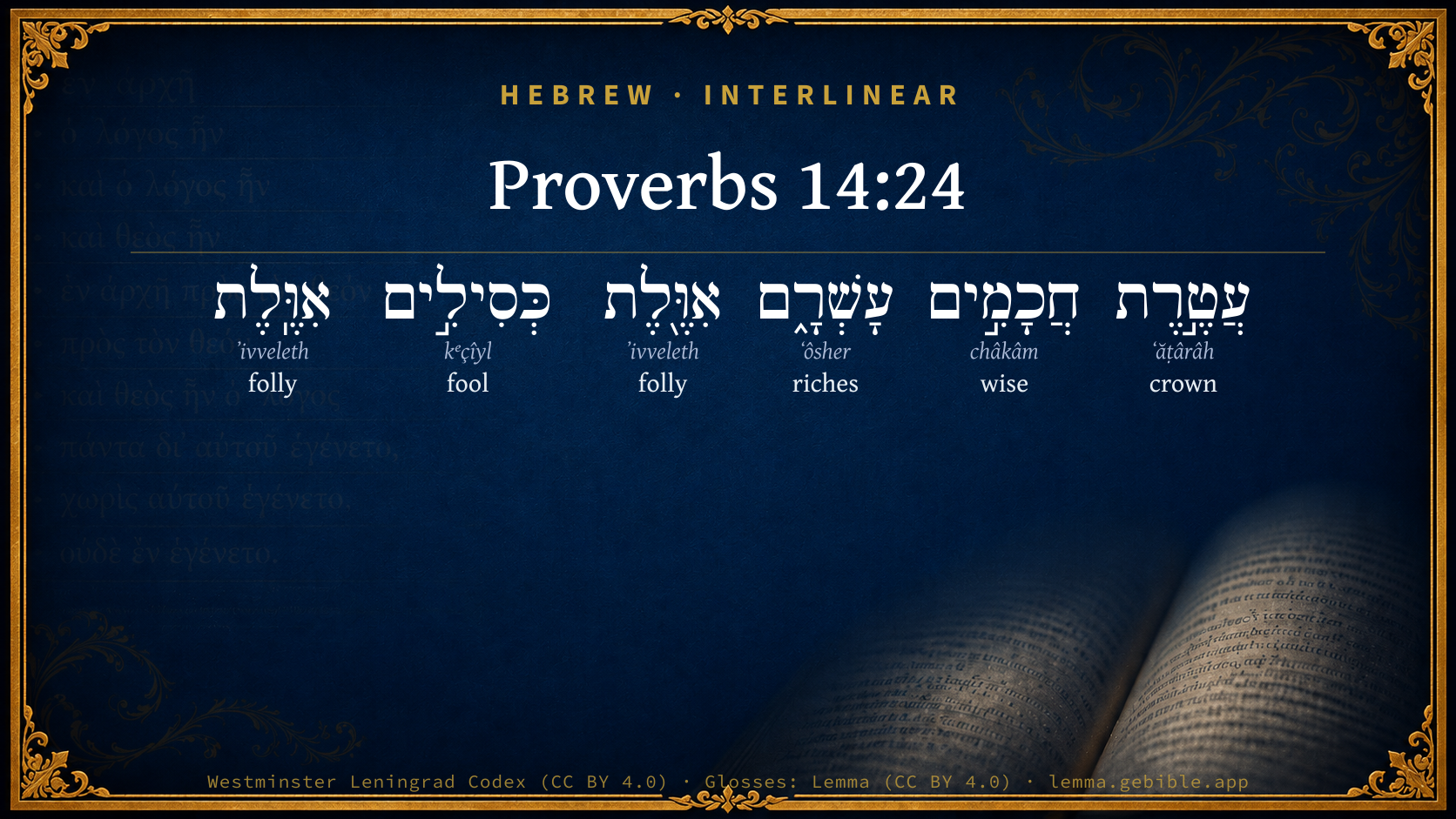
Proverbs 14:24

Hebrew (Westminster Leningrad Codex) Proverbs 14:24 appears in the Hebrew Old Testament. The text above is from the Westminster Leningrad Codex. Each word links to its Strong’s number, a concise gloss, and parsing drawn from the Open Scriptures Hebrew Bible morphology. Click any word for its full Brown-Driver-Briggs (BDB) entry.
Download image
Cite this verse

Proverbs 14:24 (World English Bible). Public Domain. Lemma interlinear Bible study tool, https://lemma.gebible.app/v/proverbs/14/24.

Show BibTeX & RIS
BibTeX
RIS
English Translation
The crown of the wise is their riches, But the folly of fools crowns them with folly.
World English Bible · Public Domain
Download a study sheet

One document with this verse’s original text, its word-by-word gloss line, the meaning frame, cross-references with their text, attributed commentary, and full source and license credits — printable, and it pastes into notes with its structure intact.

This verse Autodidact and up

Study sheet (.html) Plain text (.txt)

A passage Seminary Student

Up to 50 verses in one chapter. A passage sheet keeps up to 6 commentary sources and 12 cross-references per verse, in the order this page ranks them, and says so on the sheet whenever that leaves anything out. Ask for a single verse and you get the Autodidact verse sheet above.

Everything on this page stays free to read, with no account — the sheet is a download of what is already on screen, not access to it.

Want to remove ads? Support Godless Engineer
Compare translations 3

The same verse in 3 English versions, stacked beneath the original-language interlinear above. Click any original word for its lexicon entry.

Each is an independent rendering of the whole verse — the interlinear is not word-aligned to these translations.

Highlighted words mark where these versions differ — a whole-verse word diff, not a word-by-word alignment.

  • World English Bible Public Domain
    The crown of the wise is their riches, But the folly of fools crowns them with folly.
  • King James Version Public Domain
    The crown of the wise is their riches: but the foolishness of fools is folly.
  • unfoldingWord Literal Text CC BY-SA 4.0
    The crown of the wise ones their riches; the folly of stupid ones folly.

unfoldingWord Literal Text — © unfoldingWord, licensed CC BY-SA 4.0. Word-aligned USFM3 via Door43 (git.door43.org/unfoldingWord/en_ult).

Versions to compare (up to 4)

3 of 4 selected

Show all 18 translations

Every available English version of this verse, each an independent rendering of the whole verse.

  • World English Bible Public Domain
    The crown of the wise is their riches, But the folly of fools crowns them with folly.
  • Berean Standard Bible Public Domain
    The crown of the wise is their wealth, but the effort of fools is folly.
  • Majority Standard Bible Public Domain
    The crown of the wise is their wealth, but the effort of fools is folly.
  • King James Version Public Domain
    The crown of the wise is their riches: but the foolishness of fools is folly.
  • American Standard Version (1901) Public Domain
    The crown of the wise is their riches; `But' the folly of fools is `only' folly.
  • Revised Version (1885) Public Domain
    The crown of the wise is their riches: but the folly of fools is only folly.
  • Geneva Bible (1599) Public Domain
    The crowne of the wise is their riches, and the follie of fooles is foolishnes.
  • Douay-Rheims (1899) Public Domain
    The crown of the wise is their riches: the folly of fools, imprudence.
  • Young's Literal Translation Public Domain
    The crown of the wise is their wealth, The folly of fools `is' folly.
  • Literal Standard Version CC BY-SA 4.0
    The crown of the wise is their wealth, || The folly of fools [is] folly.
  • Unlocked Literal Bible CC BY-SA 4.0
    The crown of wise people is their wealth, but the folly of fools brings them only more folly.
  • unfoldingWord Literal Text CC BY-SA 4.0
    The crown of the wise ones their riches; the folly of stupid ones folly.
  • Darby Bible Public Domain
    The crown of the wise is their riches; the folly of the foolish is folly.
  • World Messianic Bible Public Domain
    The crown of the wise is their riches, but the folly of fools crowns them with folly.
  • Webster's Bible Public Domain
    The crown of the wise is their riches: but the foolishness of fools is folly.
  • Free Bible Version CC BY-SA 4.0
    The wise are rewarded with wealth, but stupid people are rewarded with stupidity.
  • Bible in Basic English Public Domain
    Their wisdom is a crown to the wise, but their foolish behaviour is round the head of the unwise.
  • JPS Tanakh (1917) Public Domain
    The crown of the wise is their riches; but the folly of fools remaineth folly.

Literal Standard Version (2020), Covenant Press — licensed CC BY-SA 4.0. Text via the HelloAO Bible API (eBible.org). Unlocked Literal Bible (unfoldingWord) — licensed CC BY-SA 4.0. Text via the HelloAO Bible API (eBible.org). unfoldingWord Literal Text — © unfoldingWord, licensed CC BY-SA 4.0. Word-aligned USFM3 via Door43 (git.door43.org/unfoldingWord/en_ult). Free Bible Version, Dr. Jonathan Gallagher — licensed CC BY-SA 4.0. Text via the HelloAO Bible API (eBible.org).

Word by word

More ways to search: Search by grammar → Find every occurrence → Compare this word →

Practice this passage: Drill this verse → Learn its vocabulary →

About this verse

These counts appear in no published source. They are computed here, from the morphology-tagged text and Lemma’s own curated glosses. What Lemma adds →

6
words
5
distinct lemmas
Wisdom
section

Notable vocabulary

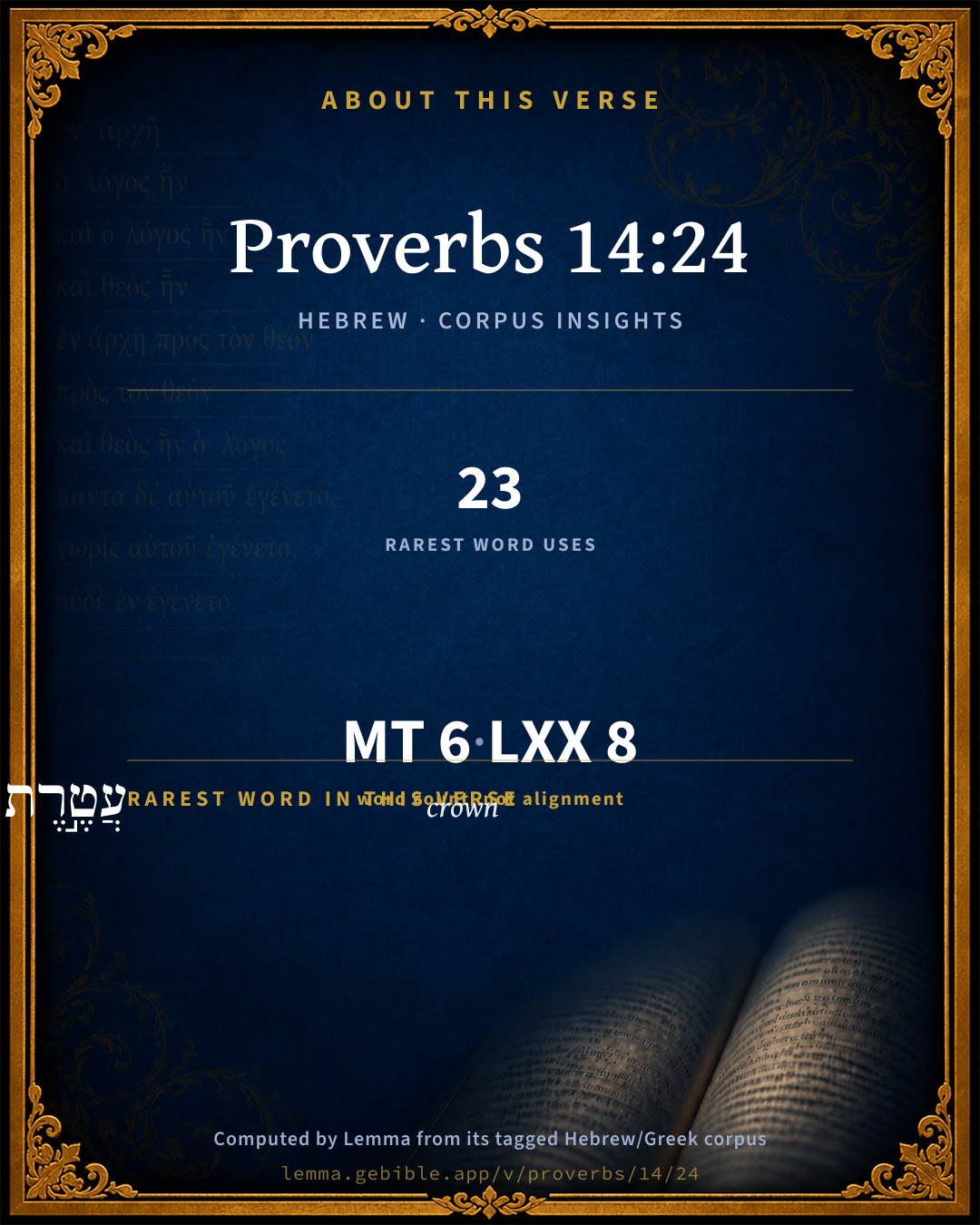
The rarest word here is עֲטֶ֣רֶת crown H5850 — appearing just 23 times in the whole Hebrew Bible.

Shared distinctive vocabulary

עֲטֶ֣רֶת crown H5850 occurs in 23 verses of the Hebrew Bible. Also found in:

Grammatical profile

  • 4 nouns
  • 2 adjectives

Repetition

A word recurs within this verse — often emphatic in Hebrew:

  • אִוֶּ֖לֶת folly H200 ×2

Hebrew & Septuagint length

In English translation the verse runs 17 words from the Hebrew and 16 from the Septuagint (LXX English) — closely comparable.

A rough comparison of the two English renderings, which tokenize alike — not a word-level alignment.

Word counts can differ between the Hebrew and the Greek without any difference in meaning — e.g. the Hebrew direct-object marker אֵת has no separate Greek word, and Greek often adds the article ὁ.

In the original languages it is 6 Hebrew tokens and 8 Greek tokens — but the two are counted differently (Hebrew bundles its prefixes and suffixes into one token; the Greek is in lemma form), so that isn’t a like-for-like length.

Cross-references

8

Topical passages linked to Proverbs 14:24 in the Treasury of Scripture Knowledge — connected by theme and wording, ordered by reader-vote popularity; previews shown in the World English Bible.

  • Ecclesiastes 7:11–12 Wisdom is as good as an inheritance. Yes, it is more excellent for those who see the sun.
  • Luke 12:19–20 I will tell my soul, "Soul, you have many goods laid up for many years. Take your ease, eat, drink, be merry."'
  • Luke 16:9 I tell you, make for yourselves friends by means of unrighteous mammon, so that when you fail, they may receive you into the eternal tents.
  • Luke 16:19–25 "Now there was a certain rich man, and he was clothed in purple and fine linen, living in luxury every day.
  • Psalms 49:10–13 For he sees that wise men die; Likewise the fool and the senseless perish, And leave their wealth to others.
  • Psalms 112:9 He has dispersed, he has given to the poor. His righteousness endures forever. His horn will be exalted with honor.
  • Proverbs 27:22 Though you grind a fool in a mortar with a pestle along with grain, Yet his foolishness will not be removed from him.
  • Isaiah 33:6 There shall be stability in your times, abundance of salvation, wisdom, and knowledge: the fear of Yahweh is your treasure.

Cross-references courtesy of OpenBible.info (CC BY 4.0).

Hebrew and Greek witnesses Masoretic Hebrew ↔ Greek Septuagint

The same verse in the two great witnesses to the Old Testament, shown verse-for-verse.

These are two independent witnesses, not word-aligned to each other, and the Septuagint is shown in lemma (dictionary) form.

Hebrew Proverbs 14:24 Masoretic · Westminster Leningrad Codex

עֲטֶ֣רֶת חֲכָמִ֣ים עָשְׁרָ֑ם אִוֶּ֖לֶת כְּסִילִ֣ים אִוֶּֽלֶת

The crown of the wise is their riches, But the folly of fools crowns them with folly.

World English Bible · Public Domain

Greek LXX Proverbs 14:24 Septuagint · lemma form

στέφανος σοφός πανοῦργος ὁ δέ διατριβή ἄφρων κακός

A prudent man is the crown of the wise: but the occupation of fools is evil.

LXX2012 (modern English Septuagint) · Public Domain

On this verse, The Pulpit Commentary discusses the Septuagint’s reading. Read the note in Commentary ↓

Hebrew: Westminster Leningrad Codex (CC BY 4.0). Greek: Septuagint (public domain); English from LXX2012 (modern English Septuagint) (Public Domain). How the Septuagint differs from the Hebrew →

Commentary

Notes on Proverbs 14:24 from classic Christian and Jewish commentators (each source and its license shown beneath its notes). The classic Christian expositions comment on the surrounding passage and are grouped to its opening verse, so a note may address several verses; the Jewish commentaries on the Tanakh (Rashi and others) are per-verse, so they appear only where the commentator wrote on this verse.

Lemma curates 59 commentaries, every one of them public domain or Creative Commons licensed, each selected and text-cleaned for this edition rather than reprinted as found. About our sources →

Trapp's Complete Commentary

John Trapp

Pro 14:24 The crown of the wise [is] their riches: [but] the foolishness of fools [is] folly.

Ver. 24. The crown of the wise is their riches.] An ornament, an encouragement in well doing, and an instrument of doing much good, if God give a heart thereto; for quid cervo ingentia cornua, cum desit animus? To what end is a treasure, if a man have lost the key that leads to it?

“Vel mihi da clavem, vel mihi tolle seram.”

But the foolishness of fools is folly.] That is, Of rich fools, such as was Pope Clemens V, of whom the historian saith, Papa hic ditior quam sapientior that he was more wealthy than wise. The crown of the wise is their riches; but yet give them to a fool, you put a sword into a madman’s hand; the folly of such fools will soon be foolishness. Why, was it not foolishness before they were rich? Yes, but now it is become egregious foolishness. Aφορητος εστι μαστιγιας ευτυχων, the earth cannot bear the insolence of such. Set a beggar on horseback, &c.

John Trapp, A Commentary or Exposition upon All the Books of the Old and New Testament (1647–1656) — public domain. Text from a community e-Sword module.

Joseph Benson's Commentary

Pro 14:24. The crown of the wise is their riches — They are a singular advantage and ornament to them, partly as they make their wisdom more regarded, while the poor man’s wisdom is despised, Ecc 9:16; and partly as they give a man great opportunity to exercise wisdom or virtue, by laying out his riches in the service of God, to the great good of mankind; which also tends to his own glory and happiness; but the foolishness of fools, &c. — But as for rich fools, their folly is not cured, but made worse and more manifest by their riches. Their riches find them fools, and leave them fools; they are not a crown, but a reproach to them, and an occasion of greater contempt.

Joseph Benson's Commentary on the Old and New Testaments (1811–1818) — public domain. Text from a community e-Sword module.

The Preacher's Complete Homiletical Commentary

Joseph S. Exell (gen. ed.)

CRITICAL NOTES.—

Pro_14:24. Or, “It is a crown to the wise when they are rich, but the folly of fools remains folly” (Delitzsch).

MAIN HOMILETICS OF Pro_14:24

WEALTH WITH AND WITHOUT WISDOM

I. Both a wise man and a fool may attain to wealth. The intellectually wise, and the man who lacks mental ability, may both possess great riches. There are many who have vast estates and no more wisdom to manage them than an infant, and there are those whose ability is equal to their wealth and position. So with moral wisdom. Abraham, the friend of God, “was very rich in cattle, in silver, and in gold” (Gen_13:2). Job, who had the Divine testimony to his “perfectness” and “uprightness,” was “the greatest of all the men of the east” (Job_1:3). But many godless men like those mentioned in our Lord’s parables (Luk_12:16; Luk_12:20; Luk_16:19-24) have “much goods laid up for many years,” and “are clothed in purple and fine linen, and fare sumptuously every day.” God is no respecter of persons in the distribution of temporal good in the shape of riches, but if there is any leaning to one class of character more than to another, He would seem rather to favour the ungodly. Because such “have their portion in this life” (Psa_17:14) and in this life only; because they have only this heaven upon earth; because they have no desire and conception of anything higher; it seems as if the Ruler of the universe often gives them the only good they are capable of appreciating. Some of the most miserable specimens of humanity that the world has ever seen have sat upon thrones, and a few of the greatest of God’s human children have likewise wielded sceptres. So with the crown of wealth; it has been and is worn by men quite irrespective of moral character, but the preponderance seems to be in favour of the moral fool. Looked at in the light of eternity there is no injustice or even mystery in this.

II. But wealth is an adornment to the wise man only. If you dress an Ethiopian in pure white linen you will not change the colour of his skin. The man is what he was though his raiment is changed, and the whiteness of his garments makes his skin look all the blacker. If a tree is barren, the most costly and perfect artificial fruit placed among its leaves will not add to its beauty. It will only produce an incongruity which will be altogether distasteful to the spectator. Its barrenness is only made the more conspicuous. So no wealth can give any dignity to a mental and moral fool. Wealth will not hide the intellectual barrenness, nor cover the black stains upon the man’s moral character. Nay, the wealth only brings them more prominently into view. However rich a fool is “the foolishness of fools is folly,” and nothing else. But a man who is wise enough to know how to use wealth—especially if he is good enough to put it to the highest and best uses—even though he be neither intellectually great or highly polished, will make his riches a crown—will so use them as to merit and receive the respect and goodwill of his fellow creatures. Wealth looks best upon the head of one who possesses both intelligence and goodness, but whenever it is studded with the gems of a wise and sympathetic liberality it is a royal diadem—it makes its wearer a king.

OUTLINES AND SUGGESTIVE COMMENTS

The Christian is rich in this world. We read in the 18th verse of the “prudent making a crown of knowledge.” Aladdin was rich when he had nothing but his lamp. If a ray of faith puts creation in bondage to a saint, then not only is his “knowledge a crown,” but “his crown is his wealth.” What needs Aladdin further than his lamp? The sovereignty of saints, even in a forlorn world, makes a perfect opulence; while “the folly of fools,” seeing that it could give place to this; seeing that he also could have the lamp; seeing that the crowned princes, the very best of them, were fools like him; and therefore, that it can only be because he is a fool that he does not throw off his folly;—all this explains the closing clause, which is terse in its very quaintness; for, for the very reason that “the crown of the wise is their wealth, the foolishness of fools is folly.”—Miller.

Though, as a fearful temptation (Mat_13:22; Mat_19:23), no wise man would desire riches; yet as the gift of God (1Ki_3:13; Psa_112:3)—the gift, indeed, of His left hand (chap. Pro_3:16)—they may become His crown. What a crown they were to David and his wise son, as the materials for building the temple (1Ch_29:1-5; 2Ch_5:1); and to Job, as employed for the good of his fellow-creatures (Job_29:6-17). So that, though wisdom under all circumstances is a blessing, it is specially pronounced to be “good with an inheritance” (Ecc_7:11-12). It is necessary to distinguish between the thing itself and the abuse of it. Wealth is in fact a blessing, when honestly acquired and conscientiously employed. And when otherwise, the man is to be blamed, and not his treasure.—Bridges.

What is the most gorgeous and dazzling earthly crown compared with a diadem of which the component parts are the blessings of the destitute relieved, the ignorant instructed, the vicious reclaimed, the afflicted comforted, the dying cheered with the hope of life, the perishing rescued from perdition and brought to God!—Wardlaw.

If good men are spoiled of their wealth, they need not lament, as if they had lost their crown. For riches are an ornament of grace to the head of wise men, even when they are lost. Job’s patience in the loss of everything, did as much honour to him as his extraordinary beneficence whilst he was the richest man in the East. We honour his memory still more, when he sewed sackcloth upon his skin, and defiled his horn in the dust, than at the time when judgment was his robe and his diadem.—Lawson.

As a horse is of no use without the bridle, so are riches without reason.—Cawdray.

Not riches but wisdom gives a crown of glory (chap. Pro_4:9). “The prudent are crowned with knowledge,” not with riches; therefore, the sense is, Wisdom (the opposite of folly), being the crown of the wise constitutes their true riches,” and results in the heavenly riches; but the foolishness of fools is not riches to them, as the wise man’s crown of wisdom is to him, but is, and continues folly, i.e., emptiness—neither an ornamental crown nor enriching wisdom.—Fausset.

The seeming tautology of the second clause is really its point. “The foolishness of fools is.…” We expect something else, but the subject is also the predicate. “The foolishness of fools is foolishness.” That is the long and the short of it. Turn it as you will, it comes to that.—Plumptre.

Wisdom in a poor man is but a petty lord. He may rule himself well, but he shall have little command or power over others. Riches make a wise man a king, and as they crown him with honour by being well used by him, so do they extend his dominion far and wide. Many are subject to the law of his discretion, and the force of his wise authority prevaileth many ways. Well, therefore, doth the crown of riches sit upon his head, whose wise head it is that makes them to be riches. But riches in a fool are his bauble, whereby he maketh himself and others sport.… The wise being crowned by them are kings over their riches. They command them to their pleasure and use them to their honour. Whereas it is the folly of fools that they are galley-slaves to their own wealth.—Jermin.

Give riches to a fool and you put a sword into a madman’s hand; the folly of such fools will soon be foolishness. Why, was it not foolishness before? Yes, but now it is become egregious foolishness. To what end is a treasure, if a man have lost the key that leads to it.—Trapp.

The Preacher's Complete Homiletical Commentary (gen. ed. Joseph S. Exell; Funk & Wagnalls, c. 1892) — public domain (pre-1929). A full-Bible homiletical/sermon-outline anthology covering 65 of 66 books (2 John is absent from the source module). Text from a community e-Sword module.

Tyndale Open Study Notes

Tyndale Open Resources

14:24 This proverb states a general principle, even though fools sometimes have wealth (10:2; 11:18), and poverty is not always the result of foolishness (cp. 13:23; 16:8).

Tyndale Open Study Notes — © Tyndale Open Resources, licensed CC BY-SA 4.0. Text via the HelloAO Bible API.

Matthew Henry's Commentary

Observe, 1. If men be wise and good, riches make them so much the more honourable and useful: The crown of the wise is their riches; their riches make them to be so much the more respected, and give them the more authority and influence upon others. Those that have wealth, and wisdom to use it, will have a great opportunity of honouring God and doing good in the world. Wisdom is good without an inheritance, but better with it. 2. If men be wicked and corrupt, their wealth will but the more expose them: The foolishness of fools, put them in what condition you will, is folly, and will show itself and shame them; if they have riches, they do mischief with them and are the more hardened in their foolish practices.

Matthew Henry's Commentary on the Whole Bible (1708–1710) — public domain (CC PDM 1.0). Text via the HelloAO Bible API.

Jamieson, Fausset & Brown

Robert Jamieson, A. R. Fausset & David Brown

(Compare Pro 3:16).

foolishness . . . folly--Folly remains, or produces folly; it has no benefit.

Jamieson, Fausset & Brown — Commentary Critical and Explanatory on the Whole Bible (1871) — public domain (CC PDM 1.0). Text via the HelloAO Bible API.

Adam Clarke's Commentary

Verse 24. But the foolishness of fools is folly.] The Targum reads, The honour of fools is folly. The fool, from his foolishness, produces acts of folly. This appears to be the meaning.

Adam Clarke's Commentary on the Bible (1810–1826) — public domain. Text from a community e-Sword/MySword module.

Ellicott's Commentary for English Readers

(24) The crown of the wise is their riches.—They adorn and set off the wisdom of the wise, and bring it more prominently into notice; but the “foolishness of fools” remains folly. The rich fool only displays his folly all the more from being set in a conspicuous position.

A Bible Commentary for English Readers, edited by Charles John Ellicott (1878–1897) — public domain. Text from a community e-Sword module.

The Cambridge Bible for Schools and Colleges

gen. ed. J. J. S. Perowne

24. The crown of the wise] i.e. the wisdom which is their crown (Pro_14:18) is (constitutes) their riches. It is at once an ornament and a thing of price; whereas the folly of fools is, and always remains (only) folly. It is possible, however, to render, with R.V. marg., Their riches is a crown unto the wise, gracing and graced by the wearer; but the folly of fools no wealth can ennoble; it is still only folly.

The Cambridge Bible for Schools and Colleges (gen. ed. J. J. S. Perowne; Cambridge University Press, 1878–1918) — public domain. Text from a community e-Sword module.

John Gill's Exposition

The crown of the wise is their riches,.... Riches being used by them to increase and improve their knowledge and wisdom, and for the good of men, are an honour to them, and give them credit and reputation among men of sense and goodness; see Ecc 7:11;

but the foolishness of fools is folly; mere folly, extreme folly, just the same as it was; riches make them never the wiser; yea, their folly is oftentimes made more manifest through the ill use they make of their riches; spending them in the gratification of their sinful lusts; and making no use of them for their own improvement in knowledge, or for the good of their fellow creatures. The Targum is,

"the glory of fools is their folly;''

and that is no other than their shame, and in which they glory; such fools are wicked men.

John Gill's Exposition of the Whole Bible (1746–1763) — public domain (CC PDM 1.0). Text via the HelloAO Bible API.

Albert Barnes' Notes on the Bible

“The crown,” i. e., the glory of the wise man constitutes his wealth. He alone is truly rich even as he alone (compare Pro 14:18 note) is truly king.

The seeming tautology of the second clause is really its point. Turn “the foolishness of fools” as you will, it comes back to “foolishness” at last.

Albert Barnes' Notes on the Bible (1834–1885) — public domain. Text from a community e-Sword/MySword module.

Haydock's Catholic Bible Commentary

CHAPTER XIV.

Imprudence. This they always betray, while the wise use their riches to assist their fellow-creatures, and receive a crown of glory. (Haydock)

George Leo Haydock (1774–1849), Haydock's Catholic Family Bible and Commentary, 1859 edition — public domain. Excludes Psalms (Douay-Rheims chapter numbering differs from Protestant) and Deuterocanonical books (Catholic canon only).

Matthew Poole's English Annotations

The crown of the wise is their riches; they are a singular advantage and ornament to them, partly as they make their wisdom more regarded, when the poor man’s wisdom is despised, Ecc 9:16; and partly as they give a man great opportunity to discover and exercise his wisdom or virtue by laying out his riches to the honour and service of God, and to the great and manifold good of the world; which also highly tends to his own glory and happiness.

But the foolishness of fools is folly; but as for rich fools, for to them the general word is to be restrained from the opposite clause, their folly is not cured, but made worse and more manifest by their riches. Their riches find them fools, and leave them fools; they are not a crown, but a reproach to them, and an occasion of their greater contempt. For the phrase, we have the like in the Hebrew text, 1Sa 1:21. The child Samuel was a child. It is an elegant figure called antanaclasis, used in all authors.

Matthew Poole's English Annotations on the Holy Bible (1683–1685) — public domain. Text from a community e-Sword/MySword module.

Whedon's Commentary on the Bible

Daniel D. Whedon

24. The crown of the wise — Namely, their “knowledge,” see Pro_14:18, is their riches; their wisdom is their wealth.

But the foolishness of fools is folly — Foolishness and nothing else. Turn it as you will, it comes to that. It is neither riches, nor honour, nor any thing else desirable. So, substantially, Speaker’s Commentary, Furst, and Conant.

Daniel D. Whedon (gen. ed.), Commentary on the Old and New Testaments (1874–1909) — public domain. Text from a community e-Sword module.

The Pulpit Commentary

The crown of the wise is their riches. This is taken by some ("Speaker"s Commentary") to mean the glory of the wise man, the fame and splendour which surround him, constitute his wealth; but it is better to interpret it thus: Riches are an ornament to a wise man; they enhance and set off his wisdom in the eyes of others, enable him to use it to advantage, and are not the snare which they might be because they are employed religiously and profitably for the good of others. Ecc_7:11, "Wisdom is good together with an inheritance, and profitable to them that see the sun." The Septuagint has, "The crown of the wise is the clever man (panourgov )," for which has been substituted by some editors, in agreement with the present Hebrew text, ploutouv autwn , "their wealth." The Greek translators, according to their reading, denote that one eminently clever man is a glory to the whole body of wise men. But the folly of fools is only folly; that is, even though it were accompanied with riches. Decorate folly as you may, trick it out in gaud and ornament, it is still nothing but folly, and is discerned as such, and that all the more for being made conspicuous. Schultens, followed by Wordsworth, finds a play of words here. The words rendered "fool" and "folly" imply "fatness," like the Greek pacuv and the Latin crassus, which have also this double meaning. So the sentence reads, "Riches are a crown to the wise; but the abundant fatness of fools is only fatness." The last clause is translated by the LXX, "But the fools" way of life (diatribh ) is evil." St. Gregory ("Moral.," 22:8) comments on this verse thus: "It was these riches of wisdom that Solomon having before his eyes, saith, "The crown of the wise is their riches." Which same person, because it is not metals of earth, but understanding, that he calls by the name of riches, thereupon adds by way of a contrary, "But the foolishness of fools is imprudence." For if he called earthly riches the crown of the wise. surely he would own the senselessness of fools to be poverty rather than imprudence. But whereas he added, "the foolishness of fools is imprudence," he made it plain that he called prudence "the riches of the wise (Oxford tran cf.).

The Pulpit Commentary (1880–1919), ed. H.D.M. Spence-Jones & Joseph S. Exell — public domain. Text from a community e-Sword module.

John Wesley's Explanatory Notes

Riches - They are a singular advantage and ornament to them. But - As for rich fools, their folly is not cured, but made worse and more manifest by their riches.

John Wesley, Explanatory Notes Upon the Whole Bible (1754–1765) — public domain. Text via the GEBible commentary corpus.

Keil & Delitzsch

C. F. Keil & F. Delitzsch

24 It is a crown to the wise when they are rich;

But the folly of fools remains folly.

From Pro 12:4, 31; Pro 17:6, we see that עטרת חכמים is the predicate. Thus it is the riches of the wise of which it is said that they are a crown or an ornament to them. More than this is said, if with Hitzig we read, after the lxx, ערמם, their prudence, instead of עשׁרם. For then the meaning would be, that the wise need no other crown than that which they have in their prudence. But yet far more appropriately "riches" are called the crown of a wise man when they come to his wisdom; for it is truly thus that riches, when they are possessed along with wisdom, contribute not a little to heighten its influence and power, and not merely because they adorn in their appearance like a crown, or, as we say, surround as with a golden frame, but because they afford a variety of means and occasions for self-manifestation which are denied to the poor. By this interpretation of 24a, 24b comes out also into the light, without our requiring to correct the first אוּלת, or to render it in an unusual sense. The lxx and Syr. translate the first אולת by διατριβή (by a circumlocution), the Targ. by gloria, fame - we know not how they reach this. Schultens in his Com. renders: crassa opulentia elumbium crassities, but in his Animadversiones he combines the first אולת with the Arab. awwale, precedence, which Gesen. approves of. But although the meaning to be thick (properly coalescere) appertains to the verbal stem אול as well as the meaning to be before (Arab. âl, âwila, wâl), yet the Hebr. אוּלת always and everywhere means only folly,

(Note: Ewald's derivation of אויל from און = אוין, null, vain, is not much better than Heidenheim's from אולי: one who says "perhaps" = a sceptic, vid., p. 59, note.)

from the fundamental idea crassities (thickness). Hitzig's אוּלת (which denotes the consequence with which the fool invests himself) we do not accept, because this word is Hitzig's own invention. Rather לוית is to be expected: the crown with which fools adorn themselves is folly. But the sentence: the folly of fools is (and remains) folly (Symmachus, Jerome, Venet., Luther), needs the emendation as little as Pro 16:22, for, interpreted in connection with 24a, it denotes that while wisdom is adorned and raised up by riches, folly on the other hand remains, even when connected with riches, always the same, without being either thereby veiled or removed - on the contrary, the fool, when he is rich, exhibits his follies always more and more. C. B. Michaelis compares Lucian's simia est simia etiamsi aurea gestet insignia.

Keil & Delitzsch — Biblical Commentary on the Old Testament (1861–1891) — public domain (CC PDM 1.0). Text via the HelloAO Bible API. (Old Testament only.)

Bridges on Proverbs

Charles Bridges

The godly first are made wise by being "crowned with knowledge." (Pro 14:18 .) Then the crown of the wise are their riches. For though, as a fearful temptation (Mat 13:22 ; Mat 19:23 ), no wise man would desire them; yet as the gift of God (1Ki 3:13 . Psa 112:3 ) (the gift indeed of his left hand) (Pro 3:16 ) they may become his crown. They enhance his reputation, and enlarge his usefulness as a consecrated talent for God. What a crown were they to David and his wise Son, as the materials for building the temple;†1 and to Job, as employed for the good of his fellow-creatures!†2 So that, though wisdom under all circumstances is a blessing, it is specially pronounced to be "good with an inheritance." (Ecc 7:11-12 .) ’It is necessary to distinguish between the thing itself, and the abuse of it. Wealth is in fact a blessing, when honestly acquired, and conscientiously employed. And when otherwise, the man is to be blamed, and not his treasure.’†3

But if riches are the crown of the wise, they cannot disguise fools. They only seem to make their folly more open. Wasted on their selfish gratifications they become, not their crown, but their foolishness.†4 The foolish son of this wise father, with all his riches, only exposed his folly more egregiously, and lost ten precious jewels from his royal crown. (1Ki 12:16 .) Whatever be our talents, let us trade with them for eternity, and they will be our everlasting crown. (Luk 19:13 ; Luk 16:9 . 1Ti 6:19 .)

Footnotes:

†1 1Ch 29:1-5 . 2Ch 5:1 .

†2 Job 29:6-17. Compare Psa 112:9 .

†3 Cowper’s Cursory Remarks on Carracioli. Southey’s Ed. viii. 273.

†4 1Sa 25:36-38 . Psa 49:10-13 . Luk 12:19-20 .

Charles Bridges, An Exposition of the Book of Proverbs (1846) — public domain. Text from a community e-Sword module.

Kretzmann's Popular Commentary

Paul E. Kretzmann

v. 24. The crown of the wise is their riches, their possessions, gained by dint of hard work, serve to honor them; but the foolishness of fools is folly, no matter how much show and pomp he makes, how anxiously be strives to offer a magnificent appearance.

Paul E. Kretzmann, Popular Commentary of the Bible (1921–1924) — public domain. Text from a community e-Sword module.

Rashi

Rabbi Shlomo Yitzchaki (Rashi)

The crown of the wise is their wealth that they are rich in Torah.

the folly of the foolish is folly The ruin of the fools is the folly that they neglected to learn wisdom.

Rashi on the Tanakh — English translations: “The Judaica Press complete Tanach with Rashi, translated by A. J. Rosenberg” (CC BY 4.0); “Pentateuch with Rashi's commentary by M. Rosenbaum and A.M. Silbermann, 1929-1934” (public domain); “The Metsudah Tanach series, Lakewood, N.J” (CC BY 4.0); and “The Book of Joshua, Metsudah Publications, 1997” (CC BY 4.0). Text via Sefaria.

Lesson kit

Teaching starters — assembled from the data on this page, not authored interpretation. Every prompt links to the verse data it draws on. Edit before teaching.

Proverbs, in the Wisdom, opens this verse with 6 words (5 distinct Hebrew lemmas). Its most distinctive word is ʻăṭârâh (“crown”). A historical commentator’s framing appears above. Read the whole chapter for the surrounding context.

Discussion questions

  1. The word ʻăṭârâh carries the sense “crown.” How does it shape the verse?
  2. 2 Samuel 12:30 shares the word «crown» with this verse. How do the two illuminate each other?
  3. “folly” occurs 2× in this one verse. What is the effect of the repetition?
  4. The translations on this page render this verse differently — a whole-verse word diff, not a word-by-word alignment. What might account for the different wordings?
  5. Reading how Trapp's Complete Commentary and Joseph Benson's Commentary read this verse, where do the two commentators agree and where do they part?

Things to notice

Reading settings

Reading text

Shown beneath each verse's original-language words.

Old Testament
Old Testament edition

Read the OT as the Masoretic Hebrew (MT) or the Greek Septuagint (LXX).

English shown for the Greek Septuagint (in the Hebrew ↔ Greek comparison).

Comparing translations? Open the Compare panel on any verse page to stack up to four side by side.