
Proverbs 26:12

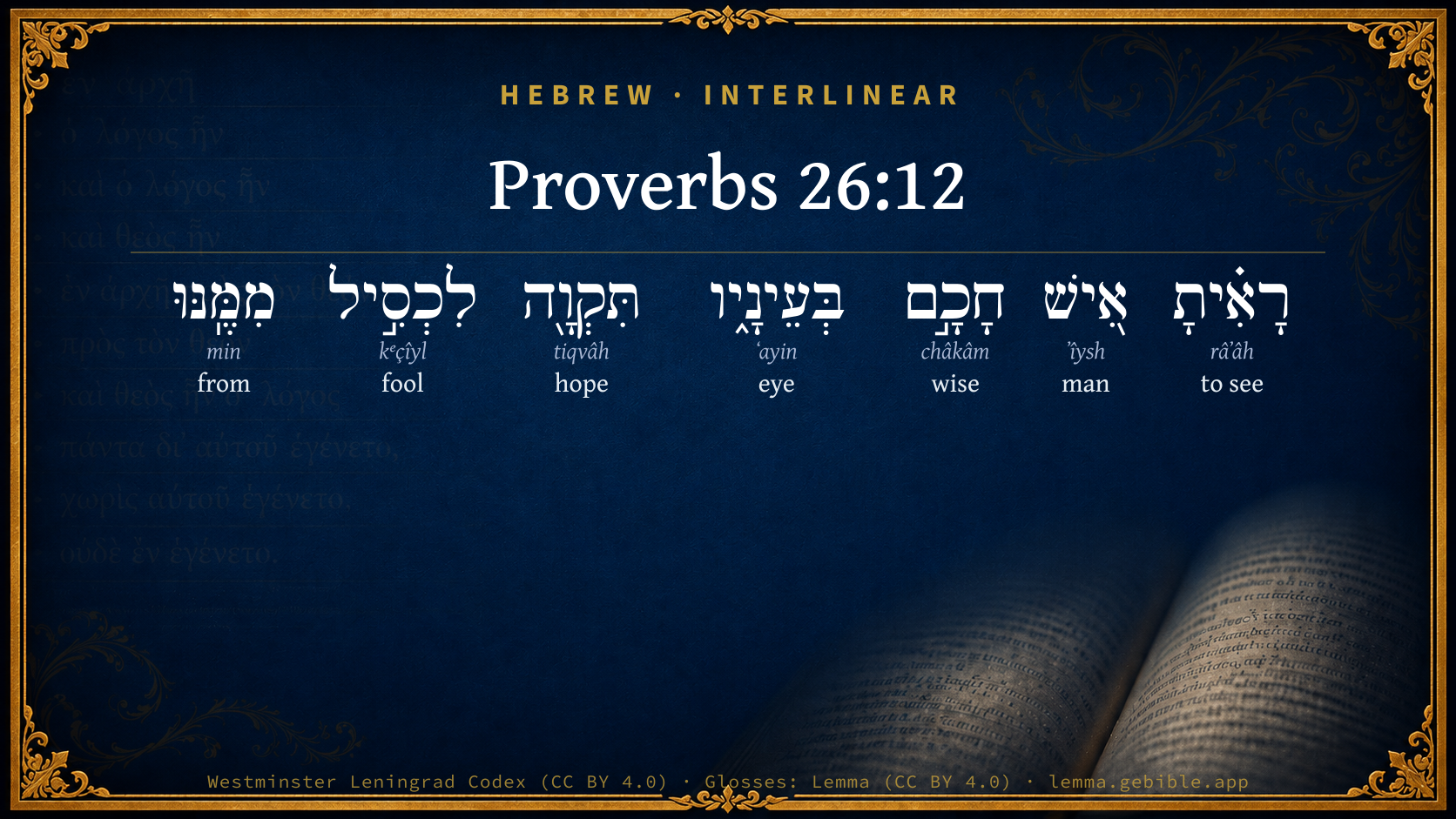
Hebrew (Westminster Leningrad Codex) Proverbs 26:12 appears in the Hebrew Old Testament. The text above is from the Westminster Leningrad Codex. Each word links to its Strong’s number, a concise gloss, and parsing drawn from the Open Scriptures Hebrew Bible morphology. Click any word for its full Brown-Driver-Briggs (BDB) entry.
Download image
Cite this verse

Proverbs 26:12 (World English Bible). Public Domain. Lemma interlinear Bible study tool, https://lemma.gebible.app/v/proverbs/26/12.

Show BibTeX & RIS
BibTeX
RIS
English Translation
Do you see a man wise in his own eyes? There is more hope for a fool than for him.
World English Bible · Public Domain
Download a study sheet

One document with this verse’s original text, its word-by-word gloss line, the meaning frame, cross-references with their text, attributed commentary, and full source and license credits — printable, and it pastes into notes with its structure intact.

This verse Autodidact and up

Study sheet (.html) Plain text (.txt)

A passage Seminary Student

Up to 50 verses in one chapter. A passage sheet keeps up to 6 commentary sources and 12 cross-references per verse, in the order this page ranks them, and says so on the sheet whenever that leaves anything out. Ask for a single verse and you get the Autodidact verse sheet above.

Everything on this page stays free to read, with no account — the sheet is a download of what is already on screen, not access to it.

Want to remove ads? Support Godless Engineer
Compare translations 3

The same verse in 3 English versions, stacked beneath the original-language interlinear above. Click any original word for its lexicon entry.

Each is an independent rendering of the whole verse — the interlinear is not word-aligned to these translations.

Highlighted words mark where these versions differ — a whole-verse word diff, not a word-by-word alignment.

  • World English Bible Public Domain
    Do you see a man wise in his own eyes? There is more hope for a fool than for him.
  • King James Version Public Domain
    Seest thou a man wise in his own conceit? there is more hope of a fool than of him.
  • unfoldingWord Literal Text CC BY-SA 4.0
    You see a man wise in his eyes. hope for a stupid than for him.

unfoldingWord Literal Text — © unfoldingWord, licensed CC BY-SA 4.0. Word-aligned USFM3 via Door43 (git.door43.org/unfoldingWord/en_ult).

Versions to compare (up to 4)

3 of 4 selected

Show all 18 translations

Every available English version of this verse, each an independent rendering of the whole verse.

  • World English Bible Public Domain
    Do you see a man wise in his own eyes? There is more hope for a fool than for him.
  • Berean Standard Bible Public Domain
    Do you see a man who is wise in his own eyes? There is more hope for a fool than for him.
  • Majority Standard Bible Public Domain
    Do you see a man who is wise in his own eyes? There is more hope for a fool than for him.
  • King James Version Public Domain
    Seest thou a man wise in his own conceit? there is more hope of a fool than of him.
  • American Standard Version (1901) Public Domain
    Seest thou a man wise in his own conceit? There is more hope of a fool than of him.
  • Revised Version (1885) Public Domain
    Seest thou a man wise in his own conceit? there is more hope of a fool than of him.
  • Geneva Bible (1599) Public Domain
    Seest thou a man wise in his owne conceite? more hope is of a foole then of him.
  • Douay-Rheims (1899) Public Domain
    Hast thou seen a man wise in his own conceit? there shall be more hope of a fool than of him.
  • Young's Literal Translation Public Domain
    Thou hast seen a man wise in his own eyes, More hope of a fool than of him!
  • Literal Standard Version CC BY-SA 4.0
    You have seen a man wise in his own eyes, || More hope of a fool than of him!
  • Unlocked Literal Bible CC BY-SA 4.0
    Do you see someone who is wise in his own eyes? There is more hope for a fool than for him.
  • unfoldingWord Literal Text CC BY-SA 4.0
    You see a man wise in his eyes. hope for a stupid than for him.
  • Darby Bible Public Domain
    Hast thou seen a man wise in his own eyes? There is more hope of a fool than of him.
  • World Messianic Bible Public Domain
    Do you see a man wise in his own eyes? There is more hope for a fool than for him.
  • Webster's Bible Public Domain
    Seest thou a man wise in his own conceit? there is more hope of a fool than of him.
  • Free Bible Version CC BY-SA 4.0
    Have you seen a man who is wise in his own eyes? There's more hope for stupid people than for him!
  • Bible in Basic English Public Domain
    Have you seen a man who seems to himself to be wise? There is more hope for the foolish than for him.
  • JPS Tanakh (1917) Public Domain
    Seest thou a man wise in his own eyes? there is more hope of a fool than of him.

Literal Standard Version (2020), Covenant Press — licensed CC BY-SA 4.0. Text via the HelloAO Bible API (eBible.org). Unlocked Literal Bible (unfoldingWord) — licensed CC BY-SA 4.0. Text via the HelloAO Bible API (eBible.org). unfoldingWord Literal Text — © unfoldingWord, licensed CC BY-SA 4.0. Word-aligned USFM3 via Door43 (git.door43.org/unfoldingWord/en_ult). Free Bible Version, Dr. Jonathan Gallagher — licensed CC BY-SA 4.0. Text via the HelloAO Bible API (eBible.org).

Word by word

More ways to search: Search by grammar → Find every occurrence → Compare this word →

Practice this passage: Drill this verse → Learn its vocabulary →

About this verse

These counts appear in no published source. They are computed here, from the morphology-tagged text and Lemma’s own curated glosses. What Lemma adds →

7
words
7
distinct lemmas
Wisdom
section

Shared distinctive vocabulary

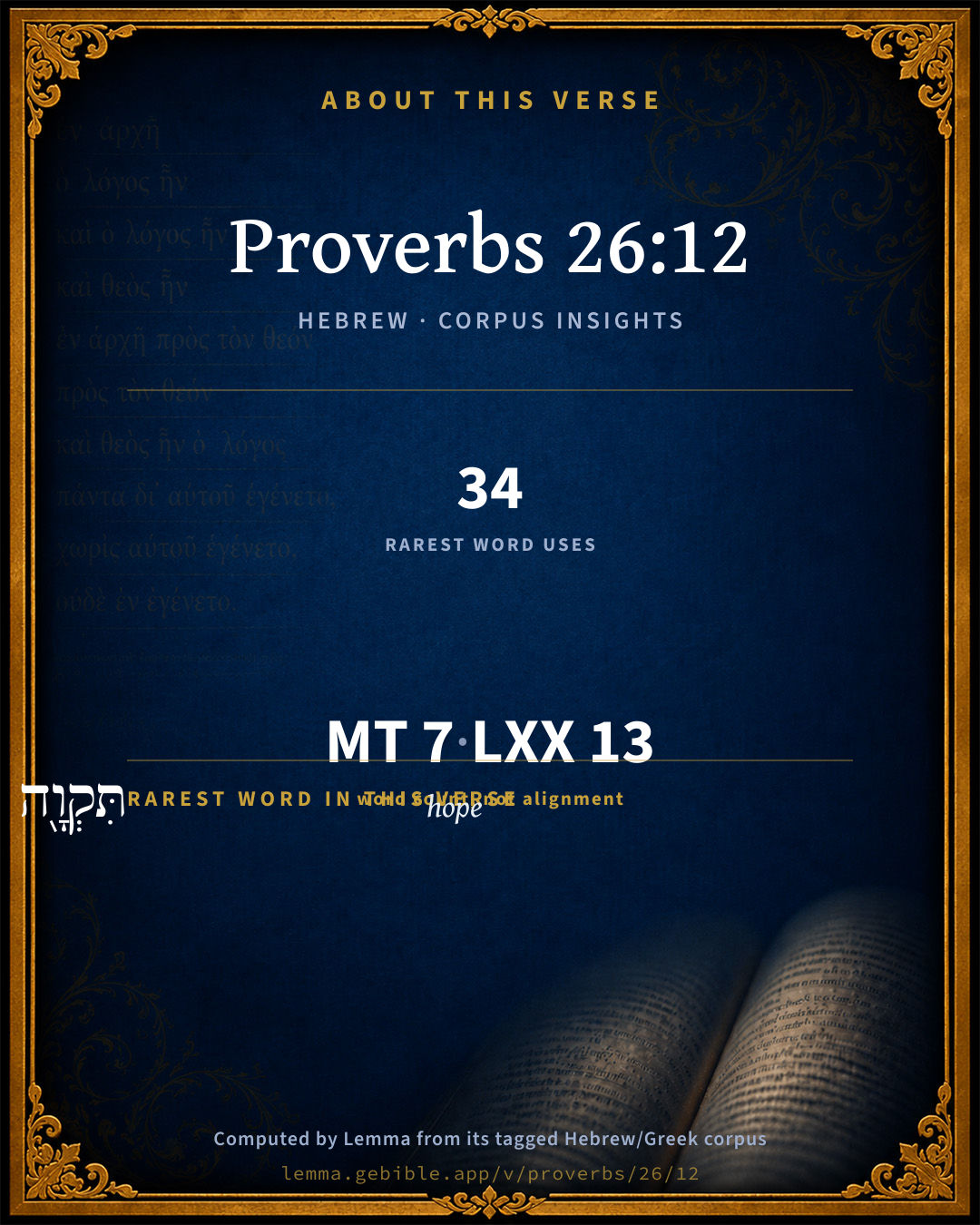
תִּקְוָ֖ה hope H8615 occurs in 33 verses of the Hebrew Bible. Also found in:

Grammatical profile

  • 1 verb
  • 3 nouns
  • 2 adjectives
  • 1 preposition

Verb forms

  • רָאִ֗יתָ Qal · Perfect

Hebrew & Septuagint length

In English translation the verse runs 20 words from the Hebrew and 20 from the Septuagint (LXX English) — the same length.

A rough comparison of the two English renderings, which tokenize alike — not a word-level alignment.

Word counts can differ between the Hebrew and the Greek without any difference in meaning — e.g. the Hebrew direct-object marker אֵת has no separate Greek word, and Greek often adds the article ὁ.

In the original languages it is 7 Hebrew tokens and 13 Greek tokens — but the two are counted differently (Hebrew bundles its prefixes and suffixes into one token; the Greek is in lemma form), so that isn’t a like-for-like length.

Cross-references

13

Topical passages linked to Proverbs 26:12 in the Treasury of Scripture Knowledge — connected by theme and wording, ordered by reader-vote popularity; previews shown in the World English Bible.

  • Proverbs 29:20 Do you see a man who is hasty in his words? There is more hope for a fool than for him.
  • 1 Corinthians 3:18–19 Let no one deceive himself. If anyone thinks that he is wise among you in this world, let him become a fool, that he may become wise.
  • Proverbs 26:5 Answer a fool according to his folly, Lest he be wise in his own eyes.
  • Proverbs 28:11 The rich man is wise in his own eyes; But the poor who has understanding sees through him.
  • Romans 12:16 Be of the same mind one toward another. Don't set your mind on high things, but associate with the humble. Don't be wise in your own conceits.
  • Revelation 3:17 Because you say, 'I am rich, and have gotten riches, and have need of nothing;' and don't know that you are the wretched one, miserable, poor, blind, and naked;
  • Proverbs 3:7 Don't be wise in your own eyes. Fear Yahweh, and depart from evil.
  • Matthew 21:31 Which of the two did the will of his father?" They said to him, "The first." Jesus said to them, "Most assuredly I tell you that the tax collectors and the prostitutes are entering into the Kingdom of God before you.
  • Luke 18:11 The Pharisee stood and prayed to himself like this: 'God, I thank you, that I am not like the rest of men, extortioners, unrighteous, adulterers, or even like this tax collector.
  • Proverbs 22:29 Do you see a man skilled in his work? He will serve kings; He won't serve obscure men.
  • Proverbs 26:16 The sluggard is wiser in his own eyes Than seven men who answer with discretion.
  • Luke 7:44 Turning to the woman, he said to Simon, "Do you see this woman? I entered into your house, and you gave me no water for my feet, but she has wet my feet with her tears, and wiped them with the hair of her head.
  • 2 Corinthians 8:1–2 Moreover, brothers, we make known to you the grace of God which has been given in the assemblies of Macedonia;

Cross-references courtesy of OpenBible.info (CC BY 4.0).

Hebrew and Greek witnesses Masoretic Hebrew ↔ Greek Septuagint

The same verse in the two great witnesses to the Old Testament, shown verse-for-verse.

These are two independent witnesses, not word-aligned to each other, and the Septuagint is shown in lemma (dictionary) form.

Hebrew Proverbs 26:12 Masoretic · Westminster Leningrad Codex

רָאִ֗יתָ אִ֭ישׁ חָכָ֣ם בְּעֵינָ֑יו תִּקְוָ֖ה לִכְסִ֣יל מִמֶּֽנּוּ

Do you see a man wise in his own eyes? There is more hope for a fool than for him.

World English Bible · Public Domain

Greek LXX Proverbs 26:12 Septuagint · lemma form

ὁράω ἀνήρ δοκέω παρά ἑαυτοῦ σοφός εἰμί ἐλπίς μέντοι ἔχω μᾶλλον ἄφρων αὐτός

I have seen a man who seemed to himself to be wise; but a fool had more hope than he.

LXX2012 (modern English Septuagint) · Public Domain

Hebrew: Westminster Leningrad Codex (CC BY 4.0). Greek: Septuagint (public domain); English from LXX2012 (modern English Septuagint) (Public Domain). How the Septuagint differs from the Hebrew →

Commentary

Notes on Proverbs 26:12 from classic Christian and Jewish commentators (each source and its license shown beneath its notes). The classic Christian expositions comment on the surrounding passage and are grouped to its opening verse, so a note may address several verses; the Jewish commentaries on the Tanakh (Rashi and others) are per-verse, so they appear only where the commentator wrote on this verse.

Lemma curates 59 commentaries, every one of them public domain or Creative Commons licensed, each selected and text-cleaned for this edition rather than reprinted as found. About our sources →

Trapp's Complete Commentary

John Trapp

Pro 26:12 Seest thou a man wise in his own conceit? [there is] more hope of a fool than of him.

Ver. 12. Seest thou a man wise in his own conceit?] This foolish wise man, or wise foolish man (for whether of the two to call him I know not, as the chronicler saith of Sir Thomas Moore), is that "dog" spoken of in verse Pro 26:11, that forethinks not the evil that followeth upon his returning to his filthy vomit, which, being made much worse by the heat of the sun and open air, maketh him much more sick than before he had been. Similarily, the witless wicked man, insensible of the evil of his way, and highly conceited thereof, goes boldly on, till there be neither hope of better nor place of worse. {See Trapp on "Pro 3:7"} See my Common Place of Arrogance.

John Trapp, A Commentary or Exposition upon All the Books of the Old and New Testament (1647–1656) — public domain. Text from a community e-Sword module.

The Biblical Illustrator

Joseph S. Exell

Pro_26:12

Seest thou a man wise in his own conceit?

there is more hope of a fool than of him

The folly of self-conceit

The Scriptures are full of denunciations against the self-sufficiency of man. The writings of Solomon are conspicuous for expressions which stigmatise the absurdity and the guilt of a self-willed, self-sufficient spirit. Here he says that when a man is wise in his own conceit, there is so little hope of his reformation that even a fool would be a more promising subject for moral and intellectual discipline. Teachable and honest mediocrity is always attended with a fair hope of improvement. But that very quality which may preserve, even to dulness itself, the chance of amelioration, is necessarily wanting to him who is wise in his own conceit, namely, a tractable and docile temper. Whenever a feeling of self-sufficiency takes possession of a mind, even of more than ordinary strength, there is danger of its shutting out all prospect of effectual improvement. What exertions will be made by one who is content with his acquisitions? To him who knows better than the rest of mankind, instruction or advice must needs appear impertinent. This guilty and miserable habit locks up from the use of all who are under its dominion those riches without which the fairest intellect must ever remain poor indeed--the wisdom of other ages, and the resources and experiences of other minds. It is dismal to reflect on the number of characters which have been ruined by this unhappy delusion. When once this fatal sorcery has suspended in the mind all aspirations after higher attainments, from that moment the movement of the character becomes infallibly retrograde. By the known constitution of things it is impossible that the intellectual or moral powers can be for a moment stationary. There is, in mans faculties, a constant tendency towards relapse and decay, which must be encountered by perpetual exertion. It is a sadder condition when the two characters in the text happen to coincide; when imbecility and arrogance go together; when the fool is wise in his own conceit. The language of the text applies to cases of great excess. But all cases have a tendency towards excess, and caution is useful in the earliest stages. The predominance of self-conceit is in most instances the result of negligent or injudicious culture. Self-will enters largely into the composition of every human character. It shows itself with the earliest dawn of the faculties. There is no instinctive impulse which prompts a child to the salutary but painful exercise of exploring his own insufficiency. The feeling of self-sufficiency is strengthened by the habit of comparing ourselves with low and imperfect characters, and by fixing ourselves in the centre of a very contracted circle. The mind should be elevated by the contemplation of the noblest forms of excellence, both intellectual and moral. Christianity is irreconcilably at war with every vice or infirmity which belongs to the family of pride. (C. W. Le Bas, M. A.)

Description and danger of religious self-conceit

Nothing renders a man so unmanageable, in the common concerns of life as self-conceit. But show the application of this passage in a spiritual sense.

I. Explain the statement of the text. Wisdom in this book is another name for religion. Foolishness is irreligion. Then the man who is wise in his own conceit is religious in his own conceits. All men are naturally subject to pride and vanity. A supposed superiority in religion will furnish ground for the exercise of this disposition as readily as any other fancied distinction. A man may be vain of his religion. Such persons very possibly have knowledge, and feeling, and what they call religious attainments. But they are destitute of self-knowledge: they have no real humiliation of heart, and they are greatly wanting in charity as to their judgment of the religious state and character of others. They have no notion of rendering to God a spiritual service. There is more hope of a fool, an irreligious person, than of such an one.

II. Show the grounds and reasons of the text. Such persons as described totally mistake the nature of true religion. To be religious is to be spiritually-minded. To advance in religion is to grow in grace. They pervert the very design and end of religion. It is designed to make men humble; it makes these persons proud. They have closed up the door to their own improvement. Use this subject for self-examination. By it try our own religion, and see what is our own spiritual state. (E. Cooper.)

The Biblical Illustrator, edited by Joseph S. Exell (c. 1880s–1900s) — public domain. Text from a community e-Sword module.

The Preacher's Complete Homiletical Commentary

Joseph S. Exell (gen. ed.)

CRITICAL NOTES.—

Pro_26:15. In his bosom. Rather, In the dish, as in chap. Pro_19:24.

MAIN HOMILETICS OF THE PARAGRAPH.—Pro_26:12-16

SELF-CONCEIT AND INDOLENCE

I. The ruinous effects of self-satisfaction.—In the preceding verses Solomon has drawn a picture of the moral fool—of the man who seems to have no moral sensibility, and who is a slave to evil habits and degrading vices. At first sight it would seem that no one could be in a more hopeless condition, but a little consideration will convince us that the wise man is right when he declares that it is easier to convince a fool of his folly, than a self-conceited man of his ignorance and weakness. For there are many men who know that they are not what they ought to be, although they have not the moral courage to quit their sinful courses; and sometimes the very depth of degradation in which such men find themselves, and the strong contrast which exists in their outward life between themselves and more respectable citizens, startle them into a vigorous and successful effort to break their chains. But a man who is wise in his own eyes is generally outwardly decorous in his behaviour—is what has been called a respectable sinner—and it is this very outward propriety which lulls his conscience to sleep. Like the Pharisee in the temple, he thanks God that he is not as other men (Luk_18:11) who are outwardly immoral, and forgets that if he is not sensual he may be devilish (Jas_3:15), may be under the dominion of the sin that made the first and greatest sinner in the universe. It was men of this class, and not the openly profane and sensual, whom Christ declared to be in danger of committing the sin which should not be forgiven (Mat_12:31), and on another occasion he shows that their hopeless condition arose from the fact that they did not realise that they were in any spiritual need. “If ye were blind ye should have no sin, but now ye say, we see; therefore your sin remaineth” (Joh_9:41). This moral blindness is so hopeless because it is self-originated and self-sustained—because the subjects of it love darkness rather than light, and even call their darkness light, and their evil, good.

II. Self-conceit is both the child and the parent of indolence. If a man feels certain that he is far in advance of his competitors for any prize or position, his efforts to gain it will be very feeble and intermittent. And on the other hand, if he is indolent he will be content with very low intellectual and spiritual attainments, and inclined to place a very high estimate upon the very little mental or moral wealth that he possesses. Being unwilling to labour after more, he makes the most of what he has, and so his sloth keeps him ignorant, and his ignorance confirms him in his slothful habits.

III. The indolent man has spasmodic and fruitless seasons of activity. He turns upon his bed of sloth as though he were going to rise, and he puts his hand in the dish (see Critical Notes) of human enterprise and activity as though he intended to take a prize, and to taste the sweets of honest and earnest toil. But his resolutions are broken almost before they are formed, and his moral courage is not strong enough to carry him through the first difficulty, or make him willing to undergo the least self-denial. And so he ever remains a stranger to the sweetness of repose honestly earned, and to the relish of good things gained by industry and perseverance. On this subject see also on chap. Pro_12:27, page 289, and on Pro_26:13. (See Homiletics on chap. Pro_22:13, page 647.)

OUTLINES AND SUGGESTIVE COMMENTS

Pro_26:12. The publicans and sinners went faster to heaven than the Pharisees; yea, there may be a greater nighness between the things when there is a greater distance between the working of them and the bringing them together. Thus, brother and sister are nigher in blood yet farther off marrying each other than two strangers; and thus two men upon the tops of two houses opposite to each other in one of your narrow streets—they are nearer each other in distance than those below are, yet in regard of coming each to other they may be said to be farther off, for the one must come down and then climb up again. Thus now a moral man, though he seems nearer to a state of grace, yet is really farther off; for he must be convinced of his false righteousness, and then climb up to the state of grace.—Goodwin.

Pro_26:16. There is no refuting a man who says nothing. Nonsense is unanswerable if there only be enough of it. Who would dispute against a pair of bagpipes, or against a company of boys that hoot at him? If you will make a match at barking or biting, a cur will be too hard for you. And if you will contend with multitudes of words, or by rage or confidence, a fool will be too hard for you.—Baxter.

The Preacher's Complete Homiletical Commentary (gen. ed. Joseph S. Exell; Funk & Wagnalls, c. 1892) — public domain (pre-1929). A full-Bible homiletical/sermon-outline anthology covering 65 of 66 books (2 John is absent from the source module). Text from a community e-Sword module.

Tyndale Open Study Notes

Tyndale Open Resources

26:12 Fools have hope because they might recognize their folly and seek advice. However, those who think they are wise will remain ignorant.

Tyndale Open Study Notes — © Tyndale Open Resources, licensed CC BY-SA 4.0. Text via the HelloAO Bible API.

Geneva Bible (1599)

Geneva Bible translators

For the fool will rather be counseled than he: also the fool sinneth of ignorance, and the other of malice.

Geneva Bible (1599) marginal notes — public domain. Text via Bolls.life.

Matthew Henry's Commentary

Here is, 1. A spiritual disease supposed, and that is self-conceit: Seest thou a man? Yes, we see many a one, wise in his own conceit, who has some little sense, but is proud of it, thinks it much more than it is, more than any of his neighbours, have, and enough, so that he needs no more, has such a conceit of his own abilities as makes him opinionative, dogmatical, and censorious; and all the use he makes of his knowledge is that it puffs him up. Or, if by a wise man we understand a religious man, it describes the character of those who, making some show of religion, conclude their spiritual state to be good when really it is very bad, like Laodicea, Rev 3:17. 2. The danger of this disease. It is in a manner desperate: There is more hope of a fool, that knows and owns himself to be such, than of such a one. Solomon was not only a wise man himself, but a teacher of wisdom; and this observation he made upon his pupils, that he found his work most difficult and least successful with those that had a good opinion of themselves and were not sensible that they needed instruction. Therefore he that seems to himself to be wise must become a fool, that he may be wise, Co1 3:18. There is more hope of a publican than of a proud Pharisee, Mat 21:32. Many are hindered from being truly wise and religious by a false and groundless conceit that they are so, Joh 9:40, Joh 9:41.

Matthew Henry's Commentary on the Whole Bible (1708–1710) — public domain (CC PDM 1.0). Text via the HelloAO Bible API.

Jamieson, Fausset & Brown

Robert Jamieson, A. R. Fausset & David Brown

The self-conceited are taught with more difficulty than the stupid.

Jamieson, Fausset & Brown — Commentary Critical and Explanatory on the Whole Bible (1871) — public domain (CC PDM 1.0). Text via the HelloAO Bible API.

Ellicott's Commentary for English Readers

(12) Seest thou a man wise in his own conceit.—Comp. the warnings of Rom_12:16, and Rev_3:17-18.

There is more hope of a fool than of him.—So the “publicans and harlots,” who had foolishly strayed from God, yet returned to Him at the preaching of the Saviour, while the Pharisees and lawyers “rejected the counsel of God against themselves” (Luk_7:30), thinking they had no need of it.

A Bible Commentary for English Readers, edited by Charles John Ellicott (1878–1897) — public domain. Text from a community e-Sword module.

John Gill's Exposition

Seest thou a man wise in his own conceit,.... Or "in his own eyes" (b); as multitudes may be seen, by looking round; man is a creature but of small knowledge in things natural, civil, mechanical, philosophical, moral, or divine; yet greatly conceited for the most part of his knowledge and wisdom. As by a "fool" in this book is generally understood a wicked profane man, so by a wise man is meant a good and righteous man, and may be so understood here; and many there are who are good and righteous only their own conceit and esteem, not truly so; they place their righteousness in outward things, in the observance of external duties; and though there may be some little imperfection in them, yet they think, as they mean well, God will accept the will for the deed: and some have imagined they have arrived to perfection; and such are generally conceited, proud, and haughty, and despise others; all which flows from ignorance; for, though they fancy themselves to be wise, they are very ignorant of themselves; of the plague of their own hearts; of the law of God, and the spirituality of it, and the extensiveness of its demands; of the strict justice and righteousness of God, which will not admit of an imperfect righteousness in the room of a perfect one; and also of the righteousness of Jesus Christ, the nature and necessity of that to justify: and this being their case, they are in very dangerous circumstances; they are building on a sand; they are liable to fall into a ditch; they cannot be justified nor saved by their own works; they oppose themselves to God's way of justifying and saving sinners; and he sets himself against them, he resisteth the proud. Wherefore

there is more hope of a fool than of him; of a profane sinner than of a self-righteous person; for Christ came to save sinners, to call them to repentance, and he receives them as such; but not self-righteous persons; and, humanly speaking, there is a greater likelihood and greater hopes of convincing sinners, and bringing them to repentance and to forsake their sins, than there is of convincing a self-righteous man of the insufficiency of his righteousness, and the folly of trusting to it, and of bringing him to repent of such a confidence, and to forsake it; for it is most natural to him; it is his own, and the effect of great labour and pains; and encourages vanity and boasting, which would be excluded should he part with it; see Mat 21:31.

(b) "in oculis suis", Pagninus, Montanus, Junius & Tremellius, &c.

John Gill's Exposition of the Whole Bible (1746–1763) — public domain (CC PDM 1.0). Text via the HelloAO Bible API.

Haydock's Catholic Bible Commentary

Fool. The ignorant may be convinced that he wants instruction. (Calmet) --- But "none are worse than the half-learned." (Quintil. i. Jo. v. 21.)

George Leo Haydock (1774–1849), Haydock's Catholic Family Bible and Commentary, 1859 edition — public domain. Excludes Psalms (Douay-Rheims chapter numbering differs from Protestant) and Deuterocanonical books (Catholic canon only).

Matthew Poole's English Annotations

A man wise in his own conceit; who, being a fool, thinks himself wise, and therefore scorneth the counsels of others.

There is more hope of a fool; of doing good to one who is a fool, and sensible of his folly, and ready to receive instruction.

Matthew Poole's English Annotations on the Holy Bible (1683–1685) — public domain. Text from a community e-Sword/MySword module.

Whedon's Commentary on the Bible

Daniel D. Whedon

12. Wise… conceit — Many hard things have been said of “the fool” in this book. One might think his case the most hopeless in the world; but the “man wise in his own conceit” — the self-conceited coxcomb — is more hopeless than a natural fool. Compare Pro_29:20.

Daniel D. Whedon (gen. ed.), Commentary on the Old and New Testaments (1874–1909) — public domain. Text from a community e-Sword module.

The Pulpit Commentary

Seest thou a man wise in his own conceit?. (Pro_3:7) Nothing so shuts the door against improvement as self-conceit. "Woe unto them," says Isaiah, (Isa_5:21) "that are wise in their own eyes, and prudent in their own sight." Such persons, professing themselves wise, become fools. (Rom_1:22 Rom_12:16 Rev_3:17, Rev_3:18) Touching conceit, Qui sibi sapit, summe desipit. The Oriental speaks of the fox finding his shadow very large, and of the wolf when alone thinking himself a lion. There is more hope of a fool than of him. (Pro_29:20) A fool who is conscious of unwisdom may be set right; but one who fancies himself perfect, and needing no improvement, is beyond cure; his case is hopeless. So the sinner who feels and acknowledges his iniquity may be converted; but the self-righteous Pharisee, who considers himself to have no need of repentance, will never be reformed. (see Luk_15:7 Luk_18:14) St. Chrysostom (Hom. in Phil.," 7), "Haughtiness is a great evil; it is better to be a fool than haughty; for in the one case the folly is only a perversion of intellect, but in the other ease it is still worse; for it is folly joined with madness. The fool is an evil to himself; but the haughty man is a plague to others too. One cannot be haughty-minded without being a fool... The soul which is puffed up has a worse disease than dropsy, while that which is under restraint is treed from all evil" (Oxford transl.).

Self-conceit.

I ITS CHARACTER. Self-conceit is just the cherishing of an undue opinion of one"s own worth, powers, character, or attainments. This is not pride, because pride need not make special pretences, so long as it asserts itself with dignity, while self-conceit is concerned with the actual contents of the mental life. This is not vanity, for it is not merely a desire to be admired; it may, arid probably will, stimulate this desire; but possibly it will be too proud to cherish it. Self-conceit is absorbed with an inordinate conception of its possessor"s own inner wealth, it makes a weak man believe that he can carry the gates of Gaza like a second Samson, and a foolish man think that he can solve the riddle of the Sphinx. It is profoundly honest in this. No Don Quixote could be more grave in the service of an illusion than the self-conceited man in pursuit of his hopeless aims.

II ITS MISCHIEF.

1. It blinds to self-knowledge. It stands between a man and a true vision of his condition and character. It substitutes its own inventions for the facts of his inner life. Instead of seeing himself as he is, the conceited man only sees himself as he is painted by his besetting weakness. He mistakes the flattering picture for a photographic likeness.

2. It shuts the door on true knowledge. The conceited man will not learn, for he will not believe in his own ignorance. He starts with a consciousness of omniscience.

3. It refuses to follow guidance. In his exalted opinion of himself the poor deluded self-worshipper declines to be guided by those who are far more capable than he is. The captain dispenses with the pilot, the patient doctors himself, the suitor conducts his own case; in religious matters the self-conceited man prefers his own notions to the teachings of prophets and apostles. His "views" outweigh Bible truths.

III ITS CAUSES.

1. It springs from self-love. Dwelling much on one"s own excellences generates an inordinate conception of them. Love is a flatterer, and self-love flatters sell

2. It is nourished in ignorance. It is usually through a lack of perception of the narrowness of the horizon that the self-conceited man believes so much in himself. His village is the world. In looking at a panorama the picture seems to retreat into a great distance, whereas it is but a few feet from the observer.

3. It is sheltered by indolence. The conceited man will not rouse himself to inquire.

IV ITS REMEDIES. These must follow the diagnosis of the disease and its causes.

1. Enlarged knowledge. As knowledge grows, the consciousness of ignorance increases.

2. Failure. Give it time, and self-conceit will work its own cure, through humiliating disasters.

3. Grace. A vision of the truth and righteousness of God and an endowment of the grace of Divine wisdom and goodness will humble a man into shame at his own previous self-conceit. So Nicodemus was humbled when Christ sent him back to his cradle.

The Pulpit Commentary (1880–1919), ed. H.D.M. Spence-Jones & Joseph S. Exell — public domain. Text from a community e-Sword module.

Keil & Delitzsch

C. F. Keil & F. Delitzsch

12 Seest thou a man who is wise in his own eyes?

The fool hath more hope than he.

Regarding the perf. hypotheticum ראית, vid., at Pro 22:29. Line second is repeated, Pro 29:20, unchanged. ממּנּוּ, prae eo, is equivalent to the Mishnic יותר ממּנּוּ, plus quam ei. As the conversion of a sinner, who does not regard himself as righteous, is more to be expected than that of a self-righteous man (Mat 9:12.), so the putting right of a fool, who is conscious that he is not wise (cf. Pro 24:7), is more likely to be effected than that of one deeming himself wise; for the greatest hindrance to any turning toward that which is better lies in the delusion that he does not need it.

(Note: The Targum has 12b after Codd. פּקח סכלא טב מגּיהּ (= Syr. pekach, expedit, convenit, melius est), it is far better circumstanced regarding the fool than regarding him. Vid., Geiger's Zeitschr. vi. (1868), p. 154.)

Thus far the group of proverbs regarding fools.

Keil & Delitzsch — Biblical Commentary on the Old Testament (1861–1891) — public domain (CC PDM 1.0). Text via the HelloAO Bible API. (Old Testament only.)

Bridges on Proverbs

Charles Bridges

Seest thou the man? God means to point at him. (Compare Pro 22:29 .) There is something to be learned from him. He castles himself up in his own conceit. He holds himself fit to be a standard: The false persuasion that he has gained wisdom, utterly precludes him from gaining it. He thinks himself wise, because he knows not what it is to be wise.†1 His wisdom is "science falsely so called."†2 For he has yet to learn the first lesson in the school — his own folly — a lesson not to be learned without severe exercise. The knowledge of the most intelligent is as nothing compared with his ignorance; and yet how strangely does the smallest quantum "puff up" (1Co 8:1 ), and fill a man full of himself! "Let no man deceive himself. If any man among you seemeth to be wise in this world, let him become a fool, that he may be wise."†3 There is more hope of the fool, who knows himself to be one. The natural fool has only one hindrance — his own ignorance. The conceited fool has two — ignorance and self-delusion. He has everything to unlearn (which is the hardest lesson in the school) before he can learn anything right. It shews some improvement, when he becomes less positive.

It was our Lord’s cutting reproof to the conceited Pharisees — "The publicans and harlots go into the kingdom of heaven before you." (Mat 21:31 .) It was his charge against the Laodicean Church — "Because thou sayest — I am rich, and increased in goods, and have need of nothing; and knowest not, that thou art wretched and miserable, and poor, and blind, and naked."†4 The prodigal fool, running into all "the excesses of riot," is more open to conviction, than the man who prides himself upon his decorous religion.†5 To the profane and ungodly we must go. But to warn him, he conceives to be knocking at the wrong door. "God! I thank thee, that I am not as other men are"†6 — is his heart’s language before God. "Stand by; I am holier than thou" (Isa 65:5 ) — is his haughty rule with his fellow-sinners. Offer him light; — He "walks in the light of his own fire." (Isa 50:11 .) Offer him life; — He is "alive" in his own eyes. (Rom 7:1-25 .) Offer him food; — His "full soul loatheth the honey-comb!" (Pro 27:7 .)

Christian Professor! Dread an ill-grounded judgment of yourself. The more confident a man is in error, the more dangerous his state. Oh! beware of holding fast a delusion, which the word of God, closely applied, would quickly dispel. Suspect your spiritual state, at least till you have given it a most probing search. Is it not possible that you may be deceived; that there may be "a lie in your right hand;" that you may have been building upon the sand; and mistaken the shadow for the substance? Consider — it is a matter of infinite and everlasting moment — in which multitudes have been mistaken — in which it is easy to be mistaken — in which our hearts are very deceitful — in which a mistake, not rectified in time, will be ruin for eternity.

Lord! preserve me from this hopeless delusion. Pull down all my pride and fancied wisdom. Take the blindness from my eyes, that I may know what I am in thy sight. "Clothe me with humility" from the sole of the foot to the head.

Footnotes:

†1 1Co 8:2 . Gal 6:3 .

†2 1Ti 6:20 .

†3 1Co 3:18 . Compare Pro 3:7 . Rom 12:3-16 .

†4 Rev 3:17. Compare Pro 30:12 .

†5 Luk 15:11-18, with Joh 9:40-41 .

†6 Luk 18:11. See Bunyan’s Picture of Ignorance.

Charles Bridges, An Exposition of the Book of Proverbs (1846) — public domain. Text from a community e-Sword module.

Lesson kit

Teaching starters — assembled from the data on this page, not authored interpretation. Every prompt links to the verse data it draws on. Edit before teaching.

Proverbs, in the Wisdom, opens this verse with 7 words (7 distinct Hebrew lemmas). Its most distinctive word is tiqvâh (“hope”). A historical commentator’s framing appears above. Read the whole chapter for the surrounding context.

Discussion questions

  1. The word tiqvâh carries the sense “hope.” How does it shape the verse?
  2. Joshua 2:18 shares the word «hope» with this verse. How do the two illuminate each other?
  3. The translations on this page render this verse differently — a whole-verse word diff, not a word-by-word alignment. What might account for the different wordings?
  4. The verb «רָאִ֗יתָ» is Qal Perfect. How does its form color the action?
  5. Reading how Trapp's Complete Commentary and The Biblical Illustrator read this verse, where do the two commentators agree and where do they part?

Things to notice

Reading settings

Reading text

Shown beneath each verse's original-language words.

Old Testament
Old Testament edition

Read the OT as the Masoretic Hebrew (MT) or the Greek Septuagint (LXX).

English shown for the Greek Septuagint (in the Hebrew ↔ Greek comparison).

Comparing translations? Open the Compare panel on any verse page to stack up to four side by side.