
Proverbs 26:16

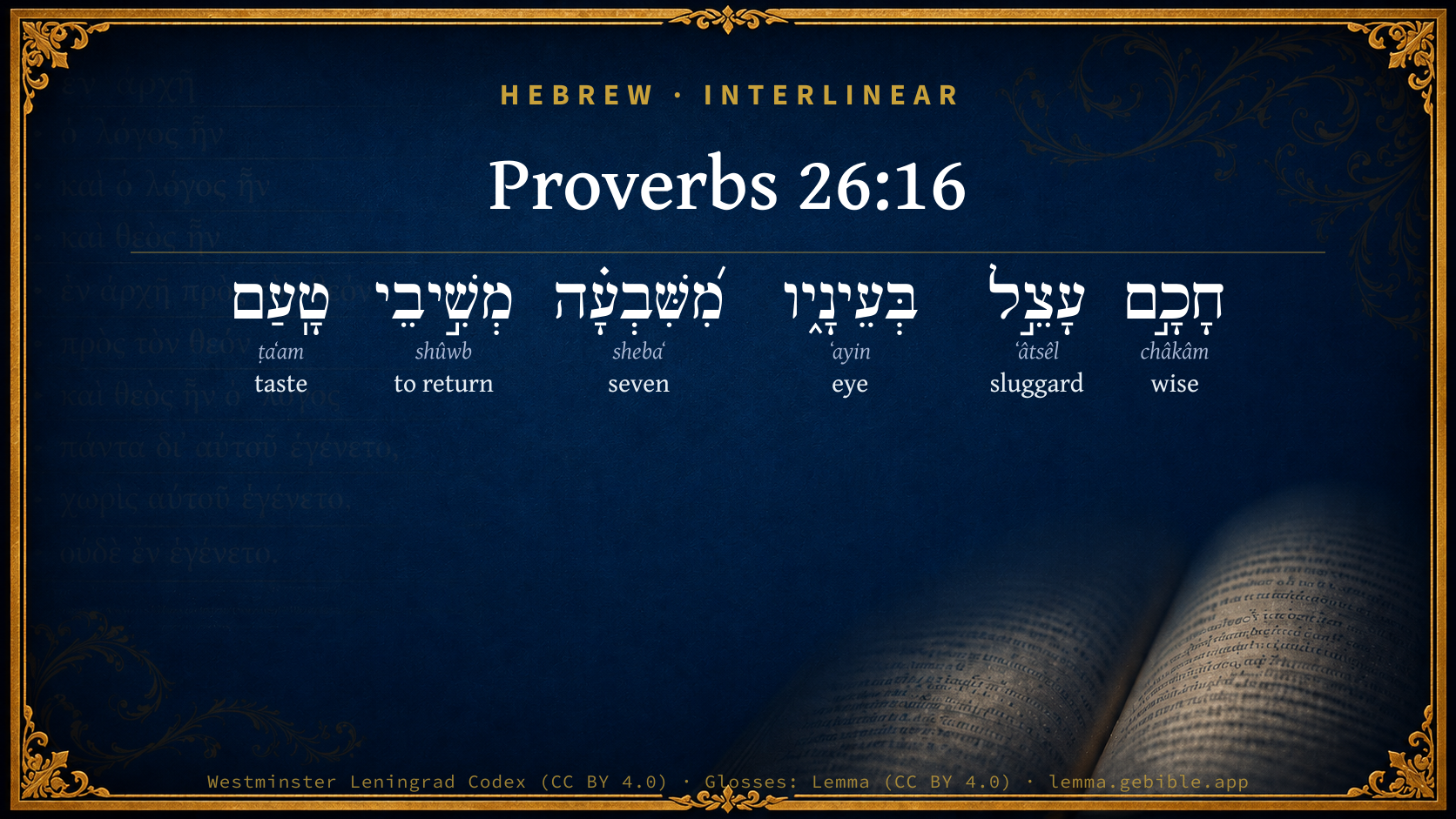
Hebrew (Westminster Leningrad Codex) Proverbs 26:16 appears in the Hebrew Old Testament. The text above is from the Westminster Leningrad Codex. Each word links to its Strong’s number, a concise gloss, and parsing drawn from the Open Scriptures Hebrew Bible morphology. Click any word for its full Brown-Driver-Briggs (BDB) entry.
Download image
Cite this verse

Proverbs 26:16 (World English Bible). Public Domain. Lemma interlinear Bible study tool, https://lemma.gebible.app/v/proverbs/26/16.

Show BibTeX & RIS
BibTeX
RIS
English Translation
The sluggard is wiser in his own eyes Than seven men who answer with discretion.
World English Bible · Public Domain
Download a study sheet

One document with this verse’s original text, its word-by-word gloss line, the meaning frame, cross-references with their text, attributed commentary, and full source and license credits — printable, and it pastes into notes with its structure intact.

This verse Autodidact and up

Study sheet (.html) Plain text (.txt)

A passage Seminary Student

Up to 50 verses in one chapter. A passage sheet keeps up to 6 commentary sources and 12 cross-references per verse, in the order this page ranks them, and says so on the sheet whenever that leaves anything out. Ask for a single verse and you get the Autodidact verse sheet above.

Everything on this page stays free to read, with no account — the sheet is a download of what is already on screen, not access to it.

Want to remove ads? Support Godless Engineer
Compare translations 3

The same verse in 3 English versions, stacked beneath the original-language interlinear above. Click any original word for its lexicon entry.

Each is an independent rendering of the whole verse — the interlinear is not word-aligned to these translations.

Highlighted words mark where these versions differ — a whole-verse word diff, not a word-by-word alignment.

  • World English Bible Public Domain
    The sluggard is wiser in his own eyes Than seven men who answer with discretion.
  • King James Version Public Domain
    The sluggard is wiser in his own conceit than seven men that can render a reason.
  • unfoldingWord Literal Text CC BY-SA 4.0
    A lazy wiser in his eyes than seven returning discernment.

unfoldingWord Literal Text — © unfoldingWord, licensed CC BY-SA 4.0. Word-aligned USFM3 via Door43 (git.door43.org/unfoldingWord/en_ult).

Versions to compare (up to 4)

3 of 4 selected

Show all 18 translations

Every available English version of this verse, each an independent rendering of the whole verse.

  • World English Bible Public Domain
    The sluggard is wiser in his own eyes Than seven men who answer with discretion.
  • Berean Standard Bible Public Domain
    The slacker is wiser in his own eyes than seven men who answer discreetly.
  • Majority Standard Bible Public Domain
    The slacker is wiser in his own eyes than seven men who answer discreetly.
  • King James Version Public Domain
    The sluggard is wiser in his own conceit than seven men that can render a reason.
  • American Standard Version (1901) Public Domain
    The sluggard is wiser in his own conceit Than seven men that can render a reason.
  • Revised Version (1885) Public Domain
    The sluggard is wiser in his own conceit than seven men that can render a reason.
  • Geneva Bible (1599) Public Domain
    The sluggard is wiser in his owne conceite, then seuen men that can render a reason.
  • Douay-Rheims (1899) Public Domain
    The sluggard is wiser in his own conceit, than seven men that speak sentences.
  • Young's Literal Translation Public Domain
    Wiser `is' the slothful in his own eyes, Than seven `men' returning a reason.
  • Literal Standard Version CC BY-SA 4.0
    Wiser [is] the slothful in his own eyes, || Than seven [men] returning a reason.
  • Unlocked Literal Bible CC BY-SA 4.0
    The lazy person is wiser in his own eyes than seven men who respond with good judgment.
  • unfoldingWord Literal Text CC BY-SA 4.0
    A lazy wiser in his eyes than seven returning discernment.
  • Darby Bible Public Domain
    A sluggard is wiser in his own eyes than seven [men] that answer discreetly.
  • World Messianic Bible Public Domain
    The sluggard is wiser in his own eyes than seven men who answer with discretion.
  • Webster's Bible Public Domain
    The sluggard is wiser in his own conceit than seven men that can render a reason.
  • Free Bible Version CC BY-SA 4.0
    In their own eyes lazy people are wiser than many sensible advisors.
  • Bible in Basic English Public Domain
    The hater of work seems to himself wiser than seven men who are able to give an answer with good sense.
  • JPS Tanakh (1917) Public Domain
    The sluggard is wiser in his own eyes than seven men that give wise answer.

Literal Standard Version (2020), Covenant Press — licensed CC BY-SA 4.0. Text via the HelloAO Bible API (eBible.org). Unlocked Literal Bible (unfoldingWord) — licensed CC BY-SA 4.0. Text via the HelloAO Bible API (eBible.org). unfoldingWord Literal Text — © unfoldingWord, licensed CC BY-SA 4.0. Word-aligned USFM3 via Door43 (git.door43.org/unfoldingWord/en_ult). Free Bible Version, Dr. Jonathan Gallagher — licensed CC BY-SA 4.0. Text via the HelloAO Bible API (eBible.org).

Word by word

More ways to search: Search by grammar → Find every occurrence → Compare this word →

Practice this passage: Drill this verse → Learn its vocabulary →

About this verse

These counts appear in no published source. They are computed here, from the morphology-tagged text and Lemma’s own curated glosses. What Lemma adds →

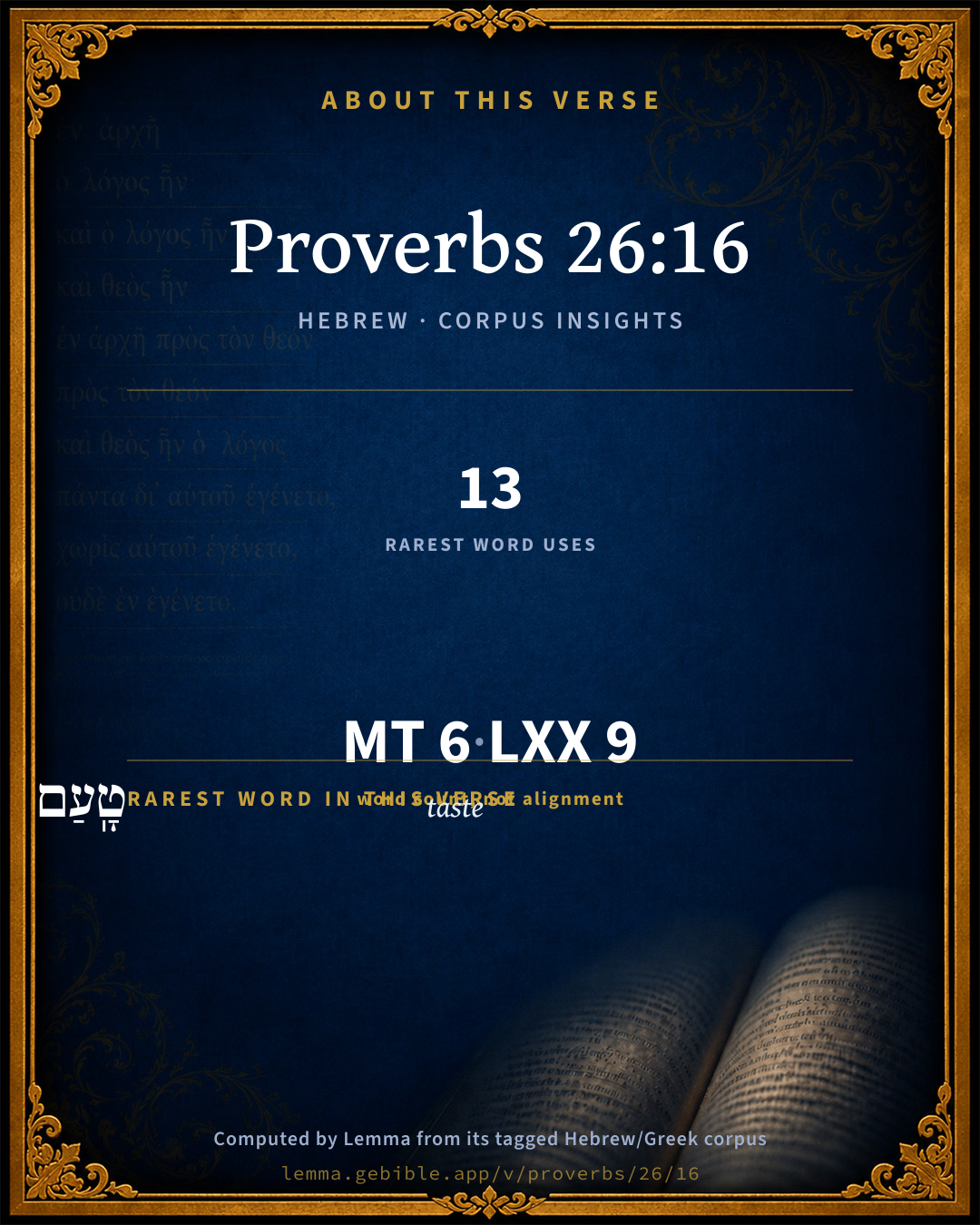
6
words
6
distinct lemmas
Wisdom
section

Notable vocabulary

The rarest word here is טָֽעַם taste H2940 — appearing just 13 times in the whole Hebrew Bible.

Shared distinctive vocabulary

טָֽעַם taste H2940 occurs in 12 verses of the Hebrew Bible. Also found in:

Grammatical profile

  • 1 verb
  • 2 nouns
  • 3 adjectives

Verb forms

  • מְשִׁ֣יבֵי Hiphil · Participle Active

Hebrew & Septuagint length

In English translation the verse runs 15 words from the Hebrew and 15 from the Septuagint (LXX English) — the same length.

A rough comparison of the two English renderings, which tokenize alike — not a word-level alignment.

Word counts can differ between the Hebrew and the Greek without any difference in meaning — e.g. the Hebrew direct-object marker אֵת has no separate Greek word, and Greek often adds the article ὁ.

In the original languages it is 6 Hebrew tokens and 9 Greek tokens — but the two are counted differently (Hebrew bundles its prefixes and suffixes into one token; the Greek is in lemma form), so that isn’t a like-for-like length.

Cross-references

3

Topical passages linked to Proverbs 26:16 in the Treasury of Scripture Knowledge — connected by theme and wording, ordered by reader-vote popularity; previews shown in the World English Bible.

  • Proverbs 26:12 Do you see a man wise in his own eyes? There is more hope for a fool than for him.
  • 1 Peter 3:15 But sanctify the Lord God in your hearts; and always be ready to give an answer to everyone who asks you a reason concerning the hope that is in you, with humility and fear:
  • Proverbs 12:15 The way of a fool is right in his own eyes, But he who is wise listens to counsel.

Cross-references courtesy of OpenBible.info (CC BY 4.0).

Hebrew and Greek witnesses Masoretic Hebrew ↔ Greek Septuagint

The same verse in the two great witnesses to the Old Testament, shown verse-for-verse.

These are two independent witnesses, not word-aligned to each other, and the Septuagint is shown in lemma (dictionary) form.

Hebrew Proverbs 26:16 Masoretic · Westminster Leningrad Codex

חָכָ֣ם עָצֵ֣ל בְּעֵינָ֑יו מִ֝שִּׁבְעָ֗ה מְשִׁ֣יבֵי טָֽעַם

The sluggard is wiser in his own eyes Than seven men who answer with discretion.

World English Bible · Public Domain

Greek LXX Proverbs 26:16 Septuagint · lemma form

σοφός ἑαυτοῦ ὀκνηρός φαίνω ὁ ἐν πλησμονή ἀποκομίζω ἀγγελία

A sluggard seems to himself wiser than one who most satisfactorily brings back a message.

LXX2012 (modern English Septuagint) · Public Domain

On this verse, The Pulpit Commentary discusses the Septuagint’s reading. Read the note in Commentary ↓

Hebrew: Westminster Leningrad Codex (CC BY 4.0). Greek: Septuagint (public domain); English from LXX2012 (modern English Septuagint) (Public Domain). How the Septuagint differs from the Hebrew →

Commentary

Notes on Proverbs 26:16 from classic Christian and Jewish commentators (each source and its license shown beneath its notes). The classic Christian expositions comment on the surrounding passage and are grouped to its opening verse, so a note may address several verses; the Jewish commentaries on the Tanakh (Rashi and others) are per-verse, so they appear only where the commentator wrote on this verse.

Lemma curates 59 commentaries, every one of them public domain or Creative Commons licensed, each selected and text-cleaned for this edition rather than reprinted as found. About our sources →

Trapp's Complete Commentary

John Trapp

Pro 26:16 The sluggard [is] wiser in his own conceit than seven men that can render a reason.

Ver. 16. Than seven men that can render a reason.] Yea, though they were the seven wise men of Greece, they were all fools to him. The proud Pharisees rejected the counsel of God, and would not be baptized of John. {Luk 7:30} Belly policy teaches the sluggard a great many excuses, which he thinks will go for wisdom, because by them he thinks to sleep in a whole skin.

John Trapp, A Commentary or Exposition upon All the Books of the Old and New Testament (1647–1656) — public domain. Text from a community e-Sword module.

Matthew Henry's Commentary

Observe, 1. The high opinion which the sluggard has of himself, notwithstanding the gross absurdity and folly of his slothfulness: He thinks himself wiser than seven men, than seven wise men, for they are such as can render a reason. It is the wisdom of a man to be able to render a reason, of a good man to be able to give a reason of the hope that is in him, Pe1 3:15. What we do we should be able to render a reason for, though perhaps we may not have wit enough to show the fallacy of every objection against it. He that takes pains in religion can render a good reason for it; he knows that he is working for a good Master and that his labour shall not be in vain. But the sluggard thinks himself wiser than seven such; for let seven such persuade him to be diligent, with all the reasons they can render for it, it is to no purpose; his own determination, he thinks, answer enough to them and all their reasons. 2. The reference that this has to his slothfulness. It is the sluggard, above all men, that is thus self-conceited; for, (1.) His good opinion of himself is the cause of his slothfulness; he will not take pains to get wisdom because he thinks he is wise enough already. A conceit of the sufficiency of our attainments is a great enemy to our improvement. (2.) His slothfulness is the cause of his good opinion of himself. If he would but take pains to examine himself, and compare himself with the laws of wisdom, he would have other thoughts of himself. Indulged slothfulness is at the bottom of prevailing self-conceitedness. Nay, (3.) So wretchedly besotted is he that he takes his slothfulness to be his wisdom; he thinks it is his wisdom to make much of himself, and take all the ease he can get, and do no more in religion than he needs must, to avoid suffering, to sit still and see what other people do, that he may have the pleasure of finding fault with them. Of such sluggards, who are proud of that which is their shame, their is little hope, Pro 26:12.

Matthew Henry's Commentary on the Whole Bible (1708–1710) — public domain (CC PDM 1.0). Text via the HelloAO Bible API.

Jamieson, Fausset & Brown

Robert Jamieson, A. R. Fausset & David Brown

The thoughtless being ignorant of their ignorance are conceited.

Jamieson, Fausset & Brown — Commentary Critical and Explanatory on the Whole Bible (1871) — public domain (CC PDM 1.0). Text via the HelloAO Bible API.

Adam Clarke's Commentary

Verse 16. Than seven men that can render a reason.] Seven here only means perfection, abundance, or multitude. He is wiser in his own eyes than a multitude of the wisest men. "Than seven men that sytt and teach." - Coverdale; i.e., than seven doctors of the law, or heads of the schools of the prophets, who always sat while they taught.

Adam Clarke's Commentary on the Bible (1810–1826) — public domain. Text from a community e-Sword/MySword module.

Ellicott's Commentary for English Readers

(16) Seven men.—A round number. (Comp. Pro_26:25; Pro_6:31; Pro_24:16.)

That can render a reason—i.e., give a sensible judgment on any matter submitted to them.

A Bible Commentary for English Readers, edited by Charles John Ellicott (1878–1897) — public domain. Text from a community e-Sword module.

The Cambridge Bible for Schools and Colleges

gen. ed. J. J. S. Perowne

16. sluggard] The A.V. after rendering the Heb. word (which is the same in all four verses), slothful, three times, here changes it to sluggard. It is better to keep one word throughout.

render a reason] Or, answer discreetly, R.V. marg.

The Cambridge Bible for Schools and Colleges (gen. ed. J. J. S. Perowne; Cambridge University Press, 1878–1918) — public domain. Text from a community e-Sword module.

John Gill's Exposition

The sluggard is wiser in his own conceit,.... It is a sort of a solecism, a kind of a contradiction in terms for a sluggard to be wise, who is so slothful as to make no use of the means of getting wisdom and knowledge. And it must be a mere conceit in him that he is wise, and especially that he is wiser

than seven men that can render a reason; not alluding to the number of a king's counsellors, who return him an answer to what he inquires of them, as Aben Ezra thinks; such as were the "seven" princes of the king of Persia, Est 1:14. Since to have such an exact number might not obtain in Solomon's time, either in Persia, or in his own court, or elsewhere: but it signifies a large number, many wise men, as Gersom observes, that render a reason to everyone that asks it of them; who, having been diligent and industrious, have got such a competency of knowledge, that they are able to give a proper reason of what they say, believe, or do: and such are they, who, by the blessing of grace in the use of means, are wise in a spiritual sense; know themselves, and Christ Jesus, and the way of salvation by him; have an understanding of the Scriptures, and of the doctrines of the Gospel; have their spiritual senses exercised, to discern between truth and error; are of established judgments, and capable of teaching others good judgment and knowledge; and of giving a reason of their faith, hope, and practice; see Pe1 3:15. Now such is the conceit of an ignorant sluggard, that he is wiser than ten thousand or ever so many of these; he thinks himself the wisest man, inasmuch as he enjoys ease and quiet in his stupid sottish way, while they are toiling and labouring, and taking a great deal of pains to get knowledge; and that he sleeps in a whole skin, and escapes the censure and reproaches of men, which they endure for being precise in religious duties, and constant in the performance of them; and fancies he can get to heaven in an easier way, without all this care and toil and trouble, only by saying, Lord, have mercy on me, at last.

John Gill's Exposition of the Whole Bible (1746–1763) — public domain (CC PDM 1.0). Text via the HelloAO Bible API.

Albert Barnes' Notes on the Bible

Seven - The definite number used for the indefinite (compare Pro 24:16).

Reason - Better, a right judgment.

Albert Barnes' Notes on the Bible (1834–1885) — public domain. Text from a community e-Sword/MySword module.

Haydock's Catholic Bible Commentary

Seven, or many wise men, who used to speak in a sententious manner. (Calmet) --- So seven is used, ver. 25.

George Leo Haydock (1774–1849), Haydock's Catholic Family Bible and Commentary, 1859 edition — public domain. Excludes Psalms (Douay-Rheims chapter numbering differs from Protestant) and Deuterocanonical books (Catholic canon only).

Matthew Poole's English Annotations

Is wiser in his own conceit, because by his idleness he avoids those troubles and dangers to which other men by their activity expose themselves, forgetting in the mean thee what reproach and loss, and how much greater mischiefs, both here and hereafter, are brought upon him by his slothfulness.

That can render a reason, to wit, a satisfactory reason, of all their actions, i.e. who are truly wise men.

Matthew Poole's English Annotations on the Holy Bible (1683–1685) — public domain. Text from a community e-Sword/MySword module.

Whedon's Commentary on the Bible

Daniel D. Whedon

16. Seven — Many. This has nothing to do with “seven” as a sacred or perfect number. It is a definite number given for an indefinite. Compare Proverbs 5:25; also Pro_6:31; Pro_24:6.

Render a reason — Can answer discreetly, give a right judgment.

Daniel D. Whedon (gen. ed.), Commentary on the Old and New Testaments (1874–1909) — public domain. Text from a community e-Sword module.

The Pulpit Commentary

The sluggard is wiser in his own conceit. The sluggard is here one who is too idle to think a matter out, and considers his own cursory view as sure to be right. He is one who deems study to be an unnecessary weariness of the flesh, (Ecc_12:12) and flatters himself that he is quite able without it to give a satisfactory account of any question presented to him. Than seven men that can render a reason. "Seven" is the number of completeness. (comp. Pro_6:31 Pro_9:1 Pro_24:16) The idle fool sets more value by his own judgment than by the sense of any number of wise men. Revised Version margin, "that can answer discreetly," is perhaps nearer the Hebrew, which implies the being able to return a wise and proper answer to anything asked of them. The LXX reading a little differently, renders, "Wiser seems a sluggard to himself than one who in satiety (en plhsmonh ) brings back a message." This is explained to mean that a sluggard thinks himself wise in not helping a neighbour with an errand or a message, though he would have probably been repaid with a good dinner for his kindness.

The Pulpit Commentary (1880–1919), ed. H.D.M. Spence-Jones & Joseph S. Exell — public domain. Text from a community e-Sword module.

John Wesley's Explanatory Notes

A reason - A satisfactory reason of ail their actions.

John Wesley, Explanatory Notes Upon the Whole Bible (1754–1765) — public domain. Text via the GEBible commentary corpus.

Keil & Delitzsch

C. F. Keil & F. Delitzsch

16 The sluggard is wise in his own eyes,

More than seven men who give an excellent answer.

Between slothfulness and conceit there exists no inward necessary mutual relation. The proverb means that the sluggard as such regards himself as wiser than seven, who all together answer well at any examination: much labour - he thinks with himself - only injures the health, blunts men for life and its joys, leads only to over-exertion; for the most prudent is, as a general rule, crack-brained. Bttcher's "maulfaule" [slow to speak] belongs to the German style of thinking; עטל לשׁנא in Syr. is not he who is slow to speak, but he who has a faltering tongue.

(Note: The Aram. עטל is the Hebr. עצל, as עטא = עצה; but in Arab. corresponds not to 'atal, but to 'azal.)

Seven is the number of manifoldness in completed unfolding (Pro 9:1). Meri thinks, after Ezr 7:14, on the council of seven of the Asiatic ruler. But seven is a round number of plurality, Pro 26:25, Pro 24:16; Pro 6:31. Regarding טעם, vid., at Pro 11:22.

Keil & Delitzsch — Biblical Commentary on the Old Testament (1861–1891) — public domain (CC PDM 1.0). Text via the HelloAO Bible API. (Old Testament only.)

Rashi

Rabbi Shlomo Yitzchaki (Rashi)

who give advice wise men.

Rashi on the Tanakh — English translations: “The Judaica Press complete Tanach with Rashi, translated by A. J. Rosenberg” (CC BY 4.0); “Pentateuch with Rashi's commentary by M. Rosenbaum and A.M. Silbermann, 1929-1934” (public domain); “The Metsudah Tanach series, Lakewood, N.J” (CC BY 4.0); and “The Book of Joshua, Metsudah Publications, 1997” (CC BY 4.0). Text via Sefaria.

Lesson kit

Teaching starters — assembled from the data on this page, not authored interpretation. Every prompt links to the verse data it draws on. Edit before teaching.

Proverbs, in the Wisdom, opens this verse with 6 words (6 distinct Hebrew lemmas). Its most distinctive word is ṭaʻam (“taste”). A historical commentator’s framing appears above. Read the whole chapter for the surrounding context.

Discussion questions

  1. How does “taste” (ṭaʻam) shape what this verse is saying?
  2. Exodus 16:31 shares the word «taste» with this verse. How do the two illuminate each other?
  3. These translations render this verse differently; the difference is in the English rendering, not the original. What questions does that raise?
  4. The verb «מְשִׁ֣יבֵי» is Hiphil Participle Active. How does its form color the action?
  5. Reading how Trapp's Complete Commentary and Matthew Henry's Commentary read this verse, where do the two commentators agree and where do they part?

Things to notice

Reading settings

Reading text

Shown beneath each verse's original-language words.

Old Testament
Old Testament edition

Read the OT as the Masoretic Hebrew (MT) or the Greek Septuagint (LXX).

English shown for the Greek Septuagint (in the Hebrew ↔ Greek comparison).

Comparing translations? Open the Compare panel on any verse page to stack up to four side by side.