
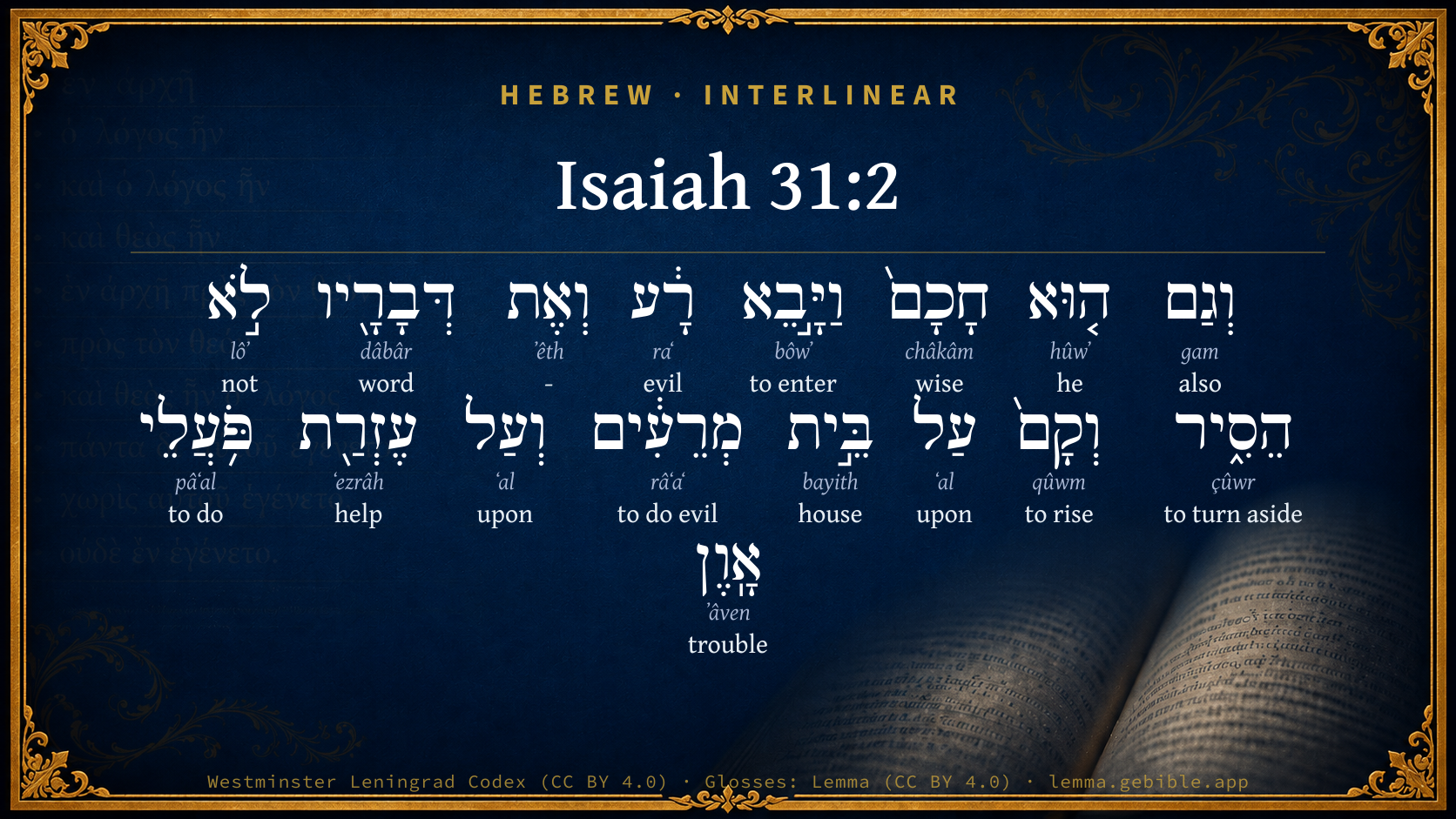
Isaiah 31:2

Hebrew (Westminster Leningrad Codex) Isaiah 31:2 appears in the Hebrew Old Testament. The text above is from the Westminster Leningrad Codex. Each word links to its Strong’s number, a concise gloss, and parsing drawn from the Open Scriptures Hebrew Bible morphology. Click any word for its full Brown-Driver-Briggs (BDB) entry.
Download image
Cite this verse

Isaiah 31:2 (World English Bible). Public Domain. Lemma interlinear Bible study tool, https://lemma.gebible.app/v/isaiah/31/2.

Show BibTeX & RIS
BibTeX
RIS
English Translation
Yet he also is wise, and will bring evil, and will not call back his words, but will arise against the house of the evil-doers, and against the help of those who work iniquity.
World English Bible · Public Domain
Download a study sheet

One document with this verse’s original text, its word-by-word gloss line, the meaning frame, cross-references with their text, attributed commentary, and full source and license credits — printable, and it pastes into notes with its structure intact.

This verse Autodidact and up

Study sheet (.html) Plain text (.txt)

A passage Seminary Student

Up to 50 verses in one chapter. A passage sheet keeps up to 6 commentary sources and 12 cross-references per verse, in the order this page ranks them, and says so on the sheet whenever that leaves anything out. Ask for a single verse and you get the Autodidact verse sheet above.

Everything on this page stays free to read, with no account — the sheet is a download of what is already on screen, not access to it.

Want to remove ads? Support Godless Engineer
Compare translations 3

The same verse in 3 English versions, stacked beneath the original-language interlinear above. Click any original word for its lexicon entry.

Each is an independent rendering of the whole verse — the interlinear is not word-aligned to these translations.

Highlighted words mark where these versions differ — a whole-verse word diff, not a word-by-word alignment.

  • World English Bible Public Domain
    Yet he also is wise, and will bring evil, and will not call back his words, but will arise against the house of the evil-doers, and against the help of those who work iniquity.
  • King James Version Public Domain
    Yet he also is wise, and will bring evil, and will not call back his words: but will arise against the house of the evildoers, and against the help of them that work iniquity.
  • unfoldingWord Literal Text CC BY-SA 4.0
    Yet he too wise, and he will bring harm, and he has not turned his words aside. And he will arise against the house of evildoers and against the help of doers of iniquity.

unfoldingWord Literal Text — © unfoldingWord, licensed CC BY-SA 4.0. Word-aligned USFM3 via Door43 (git.door43.org/unfoldingWord/en_ult).

Versions to compare (up to 4)

3 of 4 selected

Show all 18 translations

Every available English version of this verse, each an independent rendering of the whole verse.

  • World English Bible Public Domain
    Yet he also is wise, and will bring evil, and will not call back his words, but will arise against the house of the evil-doers, and against the help of those who work iniquity.
  • Berean Standard Bible Public Domain
    Yet He too is wise and brings disaster; He does not call back His words. He will rise up against the house of the wicked and against the allies of evildoers.
  • Majority Standard Bible Public Domain
    Yet He too is wise and brings disaster; He does not call back His words. He will rise up against the house of the wicked and against the allies of evildoers.
  • King James Version Public Domain
    Yet he also is wise, and will bring evil, and will not call back his words: but will arise against the house of the evildoers, and against the help of them that work iniquity.
  • American Standard Version (1901) Public Domain
    Yet he also is wise, and will bring evil, and will not call back his words, but will arise against the house of the evil-doers, and against the help of them that work iniquity.
  • Revised Version (1885) Public Domain
    Yet he also is wise, and will bring evil, and will not call back his words: but will arise against the house of the evil-doers, and against the help of them that work iniquity.
  • Geneva Bible (1599) Public Domain
    But he yet is wisest: therefore he wil bring euill, and not turne backe his worde, but he will arise against the house of the wicked, and against the helpe of them that worke vanitie.
  • Douay-Rheims (1899) Public Domain
    But he that is the wise one hath brought evil, and hath not removed his words: and he will rise up against the house of the wicked, and against the aid of them that work iniquity.
  • Young's Literal Translation Public Domain
    And He also `is' wise, and bringeth in evil, And His words He hath not turned aside, And He hath risen against a house of evil doers, And against the help of workers of iniquity.
  • Literal Standard Version CC BY-SA 4.0
    And He [is] also wise, and brings in evil, || And He has not turned aside His words, || And He has risen against a house of evildoers, || And against the help of workers of iniquity.
  • Unlocked Literal Bible CC BY-SA 4.0
    Yet he is wise, and he will bring disaster and will not retract his words. He will arise against the evil house and against the helpers of those who commit sin.
  • unfoldingWord Literal Text CC BY-SA 4.0
    Yet he too wise, and he will bring harm, and he has not turned his words aside. And he will arise against the house of evildoers and against the help of doers of iniquity.
  • Darby Bible Public Domain
    But he also is wise, and he bringeth evil, and recalleth not his words; and he will arise against the house of evildoers, and against the help of workers of iniquity.
  • World Messianic Bible Public Domain
    Yet he also is wise, and will bring disaster, and will not call back his words, but will arise against the house of the evildoers, and against the help of those who work iniquity.
  • Webster's Bible Public Domain
    Yet he also is wise, and will bring evil, and will not call back his words: but will arise against the house of the evil-doers, and against the help of them that work iniquity.
  • Free Bible Version CC BY-SA 4.0
    Yet he's also wise! He will bring disaster and won't withdraw his orders. He will take action against this wicked nation and the evil people who help them.
  • Bible in Basic English Public Domain
    Though he is wise, and able to send evil, and his purpose will not be changed; but he will go against the house of the evil-doers, and against those to whom they are looking for help.
  • JPS Tanakh (1917) Public Domain
    Yet He also is wise, and bringeth evil, and doth not call back His words; but will arise against the house of the evil-doers, and against the help of them that work iniquity.

Literal Standard Version (2020), Covenant Press — licensed CC BY-SA 4.0. Text via the HelloAO Bible API (eBible.org). Unlocked Literal Bible (unfoldingWord) — licensed CC BY-SA 4.0. Text via the HelloAO Bible API (eBible.org). unfoldingWord Literal Text — © unfoldingWord, licensed CC BY-SA 4.0. Word-aligned USFM3 via Door43 (git.door43.org/unfoldingWord/en_ult). Free Bible Version, Dr. Jonathan Gallagher — licensed CC BY-SA 4.0. Text via the HelloAO Bible API (eBible.org).

Word by word

More ways to search: Search by grammar → Find every occurrence → Compare this word →

Practice this passage: Drill this verse → Learn its vocabulary →

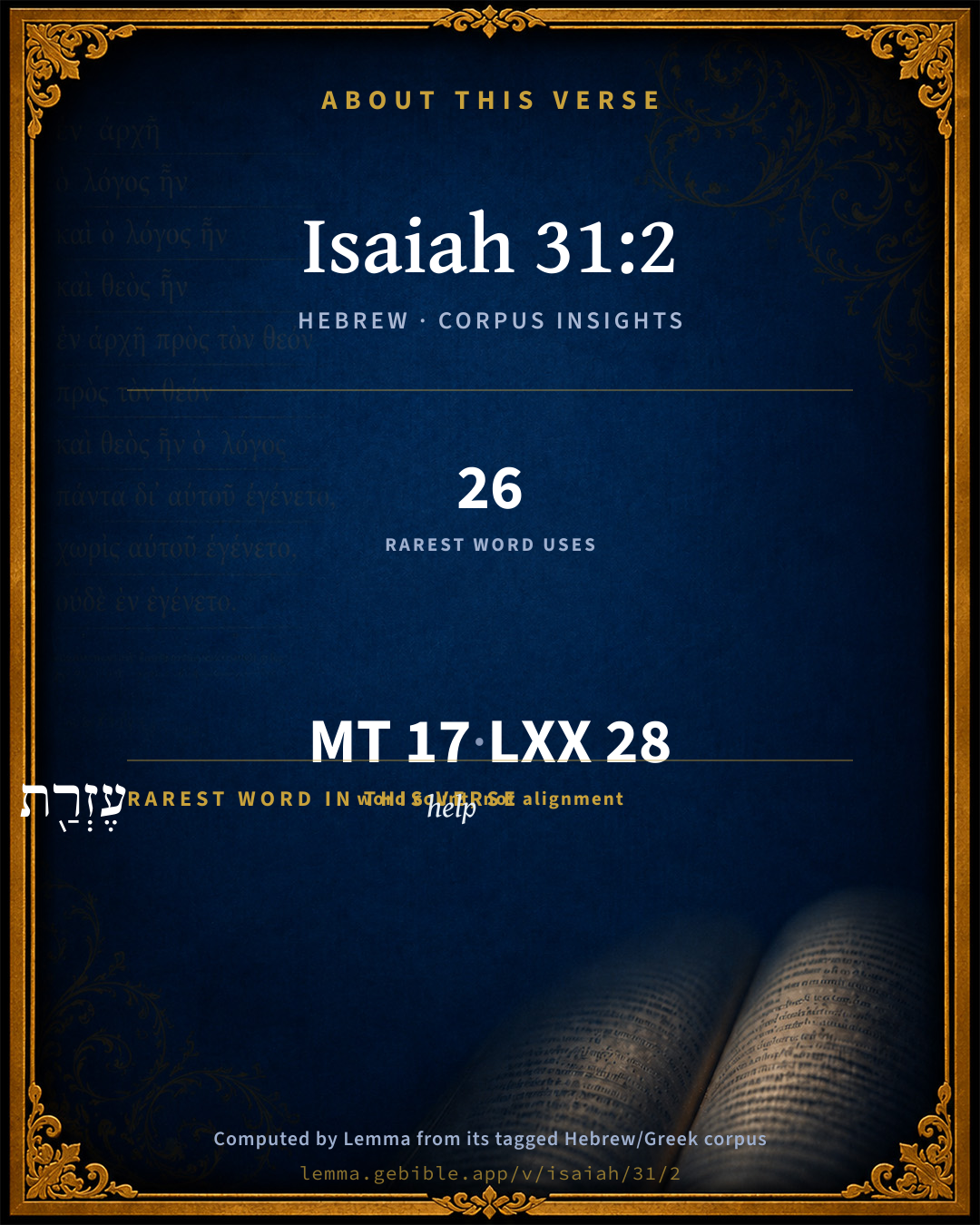
עֶזְרַ֖ת
ʻezrâh
H5833
“help of”
Noun, Common, Feminine, Singular, Construct
Part of Speech
Noun
Type
Common
Gender
Feminine
Number
Singular
State
Construct
Full BDB Definition

Origin: from H5828

TWOT: 1598b

help, succour, assistance - help, succour - one who helps
  1. וְגַם gam H1571 “and · also” Conjunction + Particle, Accusative
  2. ה֤וּא hûwʼ H1931 “he” Pronoun, Personal, 3rd Person, Masculine, Singular
  3. חָכָם֙ châkâm H2450 “wise” Adjective, Adjective, Masculine, Singular, Absolute
  4. וַיָּ֣בֵא bôwʼ H935 “and · to enter” Conjunction + Verb, Hiphil, Sequential Imperfect, 3rd Person, Masculine, Singular
  5. רָ֔ע raʻ H7451 “evil” Adjective, Adjective, Masculine, Singular, Absolute
  6. וְאֶת ʼêth H853 “and · -” Conjunction + Particle, Direct Object
  7. דְּבָרָ֖יו dâbâr H1697 “words · his” Noun, Common, Masculine, Plural, Construct + Suffix, Personal, 3rd Person, Masculine, Singular
  8. לֹ֣א lôʼ H3808 “not” Particle, Negative
  9. הֵסִ֑יר çûwr H5493 “to turn aside” Verb, Hiphil, Perfect, 3rd Person, Masculine, Singular
  10. וְקָם֙ qûwm H6965 “and · to rise” Conjunction + Verb, Qal, Sequential Perfect, 3rd Person, Masculine, Singular
  11. עַל ʻal H5921 “upon” Preposition
  12. בֵּ֣ית bayith H1004 “house of” Noun, Common, Masculine, Singular, Construct
  13. מְרֵעִ֔ים râʻaʻ H7489 “doing evil” Verb, Hiphil, Participle Active, Masculine, Plural, Absolute
  14. וְעַל ʻal H5921 “and · upon” Conjunction + Preposition
  15. פֹּ֥עֲלֵי pâʻal H6466 “doing” Verb, Qal, Participle Active, Masculine, Plural, Construct
  16. אָֽוֶן ʼâven H205 “trouble” Noun, Common, Masculine, Singular, Absolute

About this verse

These counts appear in no published source. They are computed here, from the morphology-tagged text and Lemma’s own curated glosses. What Lemma adds →

17
words
16
distinct lemmas
Prophets
section

Shared distinctive vocabulary

עֶזְרַ֖ת help H5833 occurs in 25 verses of the Hebrew Bible. Also found in:

Grammatical profile

  • 5 verbs
  • 4 nouns
  • 2 adjectives
  • 1 pronoun
  • 2 prepositions
  • 3 particles

Verb forms

  • וַיָּ֣בֵא Hiphil · Sequential Imperfect
  • הֵסִ֑יר Hiphil · Perfect
  • וְקָם֙ Qal · Sequential Perfect
  • מְרֵעִ֔ים Hiphil · Participle Active
  • פֹּ֥עֲלֵי Qal · Participle Active

Repetition

A word recurs within this verse — often emphatic in Hebrew:

Hebrew & Septuagint length

In English translation the verse runs 34 words from the Hebrew and 31 from the Septuagint (LXX English) — closely comparable.

A rough comparison of the two English renderings, which tokenize alike — not a word-level alignment.

Word counts can differ between the Hebrew and the Greek without any difference in meaning — e.g. the Hebrew direct-object marker אֵת has no separate Greek word, and Greek often adds the article ὁ.

In the original languages it is 17 Hebrew tokens and 28 Greek tokens — but the two are counted differently (Hebrew bundles its prefixes and suffixes into one token; the Greek is in lemma form), so that isn’t a like-for-like length.

Cross-references

29

Topical passages linked to Isaiah 31:2 in the Treasury of Scripture Knowledge — connected by theme and wording, ordered by reader-vote popularity; previews shown in the World English Bible.

  • Numbers 23:19 God is not a man, that he should lie, Neither the son of man, that he should repent: Has he said, and will he not do it? Or has he spoken, and will he not make it good?
  • Isaiah 45:7 I form the light, and create darkness; I make peace, and create evil. I am Yahweh, who does all these things.
  • Jeremiah 10:12 He has made the earth by his power, he has established the world by his wisdom, and by his understanding has he stretched out the heavens:
  • Amos 3:6 Does the trumpet alarm sound in a city, Without the people being afraid? Does evil happen to a city, And Yahweh hasn't done it?
  • Zephaniah 3:8 "Therefore wait for me," says Yahweh, "until the day that I rise up to the prey, for my determination is to gather the nations, that I may assemble the kingdoms, to pour on them my indignation, even all my fierce anger, for all the earth will be devoured with the fire of my jealousy.
  • Matthew 24:35 Heaven and earth will pass away, but my words will not pass away.
  • Romans 16:27
  • 1 Corinthians 1:21–29 For seeing that in the wisdom of God, the world through its wisdom didn't know God, it was God's good pleasure through the foolishness of the preaching to save those who believe.
  • Jude 1:25 to God our Savior, who alone is wise, be glory and majesty, dominion and power, both now and forever. Amen.
  • Numbers 10:35 It happened, when the ark set forward, that Moses said, Rise up, Yahweh, and let your enemies be scattered; and let those who hate you flee before you.
  • Joshua 23:15 It shall happen, that as all the good things are come on you of which Yahweh your God spoke to you, so will Yahweh bring on you all the evil things, until he have destroyed you from off this good land which Yahweh your God has given you.
  • 1 Samuel 2:3 Talk no more so exceeding proudly; Don't let arrogance come out of your mouth; For Yahweh is a God of knowledge, By him actions are weighed.
  • Psalms 12:5–6 "Because of the oppression of the weak and because of the groaning of the needy, I will now arise," says Yahweh; "I will set him in safety from those who malign him."
  • Psalms 68:1–2 Let God arise! Let his enemies be scattered! Let them who hate him also flee before him.
  • Psalms 78:65–66 Then the Lord awakened as one out of sleep, Like a mighty man who shouts by reason of wine.
  • Isaiah 20:4–6 so shall the king of Assyria lead away the captives of Egypt, and the exiles of Ethiopia, young and old, naked and barefoot, and with buttocks uncovered, to the shame of Egypt.
  • Isaiah 22:14 Yahweh of Hosts revealed himself in my ears, Surely this iniquity shall not be forgiven you until you die, says the Lord, Yahweh of Hosts.
  • Isaiah 28:21 For Yahweh will rise up as on Mount Perazim, he will be angry as in the valley of Gibeon; that he may do his work, his strange work, and bring to pass his act, his strange act.
  • Isaiah 30:3 Therefore shall the strength of Pharaoh be your shame, and the refuge in the shadow of Egypt your confusion.
  • Isaiah 30:13–14 therefore this iniquity shall be to you as a breach ready to fall, swelling out in a high wall, whose breaking comes suddenly in an instant.
  • Isaiah 31:3 Now the Egyptians are men, and not God; and their horses flesh, and not spirit: and when Yahweh shall stretch out his hand, both he who helps shall stumble, and he who is helped shall fall, and they all shall be consumed together.
  • Isaiah 32:6 For the fool will speak folly, and his heart will work iniquity, to practice profanity, and to utter error against Yahweh, to make empty the soul of the hungry, and to cause the drink of the thirsty to fail.
  • Isaiah 63:4–5 For the day of vengeance was in my heart, and the year of my redeemed is come.
  • Jeremiah 10:7 Who should not fear you, King of the nations? for to you does it appertain; because among all the wise men of the nations, and in all their royal estate, there is none like you.
  • Jeremiah 36:32 Then took Jeremiah another scroll, and gave it to Baruch the scribe, the son of Neriah, who wrote therein from the mouth of Jeremiah all the words of the book which Jehoiakim king of Judah had burned in the fire; and there were added besides to them many like words.
  • Ezekiel 29:6 All the inhabitants of Egypt shall know that I am Yahweh, because they have been a staff of reed to the house of Israel.
  • Zechariah 1:6 But my words and my decrees, which I commanded my servants the prophets, didn't they overtake your fathers? "Then they repented and said, 'Just as Yahweh of Hosts determined to do to us, according to our ways, and according to our practices, so he has dealt with us.'"
  • Job 5:13 He takes the wise in their own craftiness; The counsel of the cunning is carried headlong.
  • Jeremiah 44:29–30 This shall be the sign to you, says Yahweh, that I will punish you in this place, that you may know that my words shall surely stand against you for evil:

Cross-references courtesy of OpenBible.info (CC BY 4.0).

Hebrew and Greek witnesses Masoretic Hebrew ↔ Greek Septuagint

The same verse in the two great witnesses to the Old Testament, shown verse-for-verse.

These are two independent witnesses, not word-aligned to each other, and the Septuagint is shown in lemma (dictionary) form.

Hebrew Isaiah 31:2 Masoretic · Westminster Leningrad Codex

וְגַם ה֤וּא חָכָם֙ וַיָּ֣בֵא רָ֔ע וְאֶת דְּבָרָ֖יו לֹ֣א הֵסִ֑יר וְקָם֙ עַל בֵּ֣ית מְרֵעִ֔ים וְעַל עֶזְרַ֖ת פֹּ֥עֲלֵי אָֽוֶן

Yet he also is wise, and will bring evil, and will not call back his words, but will arise against the house of the evil-doers, and against the help of those who work iniquity.

World English Bible · Public Domain

Greek LXX Isaiah 31:2 Septuagint · lemma form

καί αὐτός σοφός ἄγω ἐπί αὐτός κακός καί ὁ λόγος αὐτός οὐ μή ἀθετέω καί ἐπι ἀναἵστημι ἐπί οἶκος ἄνθρωπος πονηρός καί ἐπί ὁ ἐλπίς αὐτός ὁ μάταιος

Therefore he has wisely brought evils upon them, and his word shall not be frustrated; and he shall rise up against the houses of wicked men, and against their vain hope,

LXX2012 (modern English Septuagint) · Public Domain

On this verse, Adam Clarke's Commentary discusses the Septuagint’s reading. Read the note in Commentary ↓

Hebrew: Westminster Leningrad Codex (CC BY 4.0). Greek: Septuagint (public domain); English from LXX2012 (modern English Septuagint) (Public Domain). How the Septuagint differs from the Hebrew →

Targum (Aramaic paraphrase)

1

The Targum is the ancient Jewish Aramaic paraphrase of the Hebrew Scriptures — an interpretive translation, not the Hebrew text itself. Onkelos (literal) and Pseudo-Jonathan (expansive) render the Torah, and Jonathan the Prophets. Coverage is partial: where no permissively-licensed English translation exists for a verse, only the Aramaic is shown. This is verse-level text, not a word-by-word alignment to the Hebrew.

  1. Targum Jonathan Prophets (Joshua–Malachi)
    וְאַף הוּא בְּחוּכְמְתֵיהּ אַיְתֵי בִישְׁתָּא עַל דְעַבְדֵהּ וְיַת פִּתְגָמוֹהִי לָא בַטֵיל וַאֲקֵים עַל בֵית מַבְאֲשִׁין וְעַל דְסָעֲדִין לֵיאוּת שְׁקָר:

    And also He in His wisdom will bring evil on account of what he is doing; and He will not make to fail His words, but He will arise against the house of evildoers; and against those who help the work of a lie.

    Targum Jonathan — Aramaic: “Mikraot Gedolot” (public domain). English: “Sefaria Community Translation” (CC0 1.0 (public-domain dedication)); “London "Chaldee Paraphrase," 1871” (public domain). Text via Sefaria.

Commentary

Notes on Isaiah 31:2 from classic Christian and Jewish commentators (each source and its license shown beneath its notes). The classic Christian expositions comment on the surrounding passage and are grouped to its opening verse, so a note may address several verses; the Jewish commentaries on the Tanakh (Rashi and others) are per-verse, so they appear only where the commentator wrote on this verse.

Lemma curates 59 commentaries, every one of them public domain or Creative Commons licensed, each selected and text-cleaned for this edition rather than reprinted as found. About our sources →

Trapp's Complete Commentary

John Trapp

Isa 31:2 Yet he also [is] wise, and will bring evil, and will not call back his words: but will arise against the house of the evildoers, and against the help of them that work iniquity.

Ver. 2. Yet he also is wise.] Yea, he is "the only wise God," whatever the world’s wizards think of him or of themselves. They counted the voyage down to Egypt the wisest way; {a} and to rest altogether upon God, to be altogether impolitic as the case now stood. Egypt also, they knew, was famous for wisdom, {Isa 19:11-12} but considered not how God had fooled them, {Exo 1:10; Exo 1:12} and taken those foxes in their own craft. {1Co 3:19}

And will bring evil.] To those evil counsellors especially,

“Hδε κακη βουλη τω βουλευσαντι κακιστη”

{a} Tacita antithesis in qua latet Antanaclasis.

John Trapp, A Commentary or Exposition upon All the Books of the Old and New Testament (1647–1656) — public domain. Text from a community e-Sword module.

The Biblical Illustrator

Joseph S. Exell

Isa_31:2

Yet He also is wise

God works in history

You have been clever and successful, but have you forgotten that God also is wise, that He too has His policy, and acts reasonably and consistently?

You think you have been making history; but God also works in history, and surely, to put it on the lowest ground, with as much cleverness and persistence as you do. (Prof. G. A. Smith, D. D.)

Forgetfulness of God

The forgetfulness, against which Isaiah directs this shaft of satire, is the besetting sin of very religious people, of very successful people, and of very clever people. (Prof. G. A. Smith, D. D.)

The religion that ignores God

It is the temptation of an ordinary Christian, churchgoing people, like ourselves, with a religion so full of marvellous mercies, and so blessed with regular opportunities of worship, to think of God only in connection with these, and practically to ignore that along the far greater stretches of life He has any interest or purpose regarding us. (Prof. G. A. Smith, D. D.)

Man no match for God

After Moscow, Napoleon is reported to have exclaimed, The Almighty is too strong for me. (Prof. G. A. Smith, D. D.)

The Biblical Illustrator, edited by Joseph S. Exell (c. 1880s–1900s) — public domain. Text from a community e-Sword module.

Geneva Bible (1599)

Geneva Bible translators

And knoweth their crafty enterprises, and will bring all to naught.

Geneva Bible (1599) marginal notes — public domain. Text via Bolls.life.

Jamieson, Fausset & Brown

Robert Jamieson, A. R. Fausset & David Brown

he also is wise--as well as the Egyptian priests, so famed for wisdom (Act 7:22), but who are "fools" before Him (Isa 19:11). He not only devises, but executes what He devises without "calling back His words" (Num 23:19).

home--the whole race.

help--the Egyptian succor sought by the Jews.

Jamieson, Fausset & Brown — Commentary Critical and Explanatory on the Whole Bible (1871) — public domain (CC PDM 1.0). Text via the HelloAO Bible API.

Adam Clarke's Commentary

Verse 2. His words - "His word"] דברו debaro, singular, without י yod, two MSS. of Dr. Kennicott's the Septuagint, and Targ. Hieros. דרכיו derachaiv, his ways, is found in one MS.

Adam Clarke's Commentary on the Bible (1810–1826) — public domain. Text from a community e-Sword/MySword module.

Ellicott's Commentary for English Readers

(2) Yet he also is wise.—The words have a ring of sarcasm in them. Isaiah admits ironically that the counsellors of Hezekiah were wise in their generation. He reminds them that there might be some little wisdom in Jehovah, and in the prophet by whom He spake.

And will not call back his words.—Such words, e.g., as those of the preceding chapter (Isa_30:12-13; Isa_30:16-17).

A Bible Commentary for English Readers, edited by Charles John Ellicott (1878–1897) — public domain. Text from a community e-Sword module.

The Cambridge Bible for Schools and Colleges

gen. ed. J. J. S. Perowne

2. Yet he also is wise] as well as the shrewd diplomatists who have negotiated this treaty! The words are ironical, yet they have a serious meaning; the prophet, alone in his view of the political situation, reassures himself by thinking of the transcendent wisdom of Jehovah and the fixity of His purpose.

and will bring evil] Rather, brings trouble (cf. Amo_3:6) in consequence of His wisdom.

and will not call back (better: and hath not recalled) his words] The “words” are such prophecies as Isa_28:16 ff., Isa_29:14 ff., Isa_30:13 f., 16 ff.

the house of [the] evildoers is Judah (ch. Isa_1:4); their help (i.e. “helpers “) is Egypt.

2, 3. A demonstration of the folly of trusting Egypt rather than Jehovah.

The Cambridge Bible for Schools and Colleges (gen. ed. J. J. S. Perowne; Cambridge University Press, 1878–1918) — public domain. Text from a community e-Sword module.

John Gill's Exposition

Yet he also is wise,.... That is, God, the Holy One of Israel, is, whom they disregarded; and wiser too than the Egyptians, to whom they sought for help, and who were thought to be a wise and political people; and wiser than themselves, who imagined they acted a prudent part, in applying to them; so wise as to know all their schemes, and able to confound them, as well as most certainly and fully to complete his own; and it would have been therefore the highest wisdom to have sought to him, and not to men:

and will bring evil; the evil of punishment or affliction on wicked men, which he has threatened, and which they could in no wise escape, by taking the methods they did:

and will not call back his words; his threatenings delivered by the prophets: these, as he does not repent of, he will not revoke or make void, but fulfil and accomplish; what he has said he will do, and what he has purposed he will bring to pass; and therefore it was a weak and an unwise part they acted, by applying to others, and slighting him:

but will arise against the house of evildoers; not the ten tribes of Israel, as Jarchi and Kimchi interpret it; but rather the people of the Jews, or some particular family among them; it may be the royal family, chiefly concerned in sending the embassy to Egypt, or in advising to it; though it may be the singular is put for the plural, as the Septuagint and Arabic versions render it "the houses"; and so may design all those great families which joined in this affair, and are therefore called "evildoers"; as all such are that put their confidence in the creature, and not in the Lord; and against such he will "arise", in a hostile manner, sooner or later, against whom there is no standing; see Job 9:4,

and against the help of them that work iniquity; that is, against the Egyptians, the helpers of the Jews, who were workers of iniquity, and therefore their help and hope in it would be in vain; or else the latter part is descriptive of the Egyptians their helpers, who were a wicked and idolatrous nation, and so not to be sought unto for help, or trusted in, since, God being against them, it would be to no purpose, as he is against all workers of iniquity.

John Gill's Exposition of the Whole Bible (1746–1763) — public domain (CC PDM 1.0). Text via the HelloAO Bible API.

Albert Barnes' Notes on the Bible

Yet he also is wise - God is wise. It is in vain to attempt to deceive him, or to accomplish such purposes without his knowledge.

And will bring evil - The punishment which is due to such want of confidence in him.

But will arise against the house of the evil-doers - This is a general proposition, and it is evidently just as true now as it was in the time of Isaiah.

Albert Barnes' Notes on the Bible (1834–1885) — public domain. Text from a community e-Sword/MySword module.

Haydock's Catholic Bible Commentary

Words. The Lord will punish the wicked Jews, (Calmet) after the Egyptians. (Josephus, [Antiquities?] x. 1.) --- The former would not believe the prophets. (Worthington)

George Leo Haydock (1774–1849), Haydock's Catholic Family Bible and Commentary, 1859 edition — public domain. Excludes Psalms (Douay-Rheims chapter numbering differs from Protestant) and Deuterocanonical books (Catholic canon only).

Matthew Poole's English Annotations

He also is wise: you think you are wise, and act wisely in engaging the Egyptians, who are a wise and warlike people, to help you; but God is not inferior to them in wisdom nor in strength, but much their superior; and therefore you have done foolishly and wickedly in preferring them before him.

Will bring evil; will execute his judgments upon you, notwithstanding all that you or your allies the Egyptians can do to hinder it.

Will not call back his words, his threatenings denounced against you, but will infallibly execute them.

Will arise; though at present he sit still, yet he will bestir himself and fight.

Against the house of evil-doers; against this wicked and rebellious people of the Jews.

The help; the helpers, as it is explained in the next verse; the abstract being put for the concrete.

Matthew Poole's English Annotations on the Holy Bible (1683–1685) — public domain. Text from a community e-Sword/MySword module.

The Pulpit Commentary

Yet he also is wise. Intense irony. "Wisdom is not wholly confined to the human counselors whose advice Judah follows. (Isa_29:14) He (Jehovah) is "wise" too, and could give prudent counsel if his advice were asked." As he is not consulted, he will bring evil upon his people, and will not call back, or retract, his words of threatening, but will give them accomplishment, by rising up against the house of the evildoers (i.e. the Jews), and their help (i.e. the Egyptians).

Vers. 2, 3. The folly of trusting in an arm of flesh.

"Put not your trust in princes, nor in any child of man," says the psalmist; (Psa_146:3) for there is no help in them." All human props are uncertain

I BECAUSE OF HUMAN CHANGEFULNESS. Men do not continue always of one mind. They make promises, and regret that they have made them, and find some way of escaping their force, or else boldly break them with a cynical disregard to what others may think or say. Their interests change, or the views that they take of them; and the wise policy of to-day seems foolishness, or even madness, tomorrow. Some men are actuated by mere caprice, and have no sooner effected a desired purpose than it loses favor in their eyes, and seems to them of little worth. They will make heavy sacrifices to obtain an alliance, and none to maintain it. They sigh always for something that they have not, and despise what they have. Human protection is always uncertain, owing to the fickleness of man, who is naturally double-minded," and "unstable in all his ways". (Jam_1:8)

II BECAUSE OF POSSIBLE INSUFFICIENCY. The human protector may, with the best intentions in the world, prove insufficient. Syria and Ammon summoned Assyria to their aid when they contended with David; (2Sa_10:6, 16 Psa_83:8) but the result was the entire defeat of the confederate army. Hannibal called on Macedonia to assist him against the Romans; but Macedonia proved too weak, and her efforts resulted in her own subjection. There must, in almost every case, be the risk that the protector, though doing all he can, may fail, and our having called him in exasperate, or even infuriate, our adversary.

III BECAUSE OF HUMAN GREED AND SELFISHNESS. The protector may become, is only too apt to become, the oppressor and the conqueror. Rome"s vast empire was built up largely by taking states under her protection, and then absorbing them. Had Egypt succeeded in defeating Assyria, and rolling back the tide of invasion that had so long been rising higher and higher, and threatening her own independence and that of her neighbors, the result would simply have been that Judaea and Samaria would have been absorbed into Egypt, or at any rate have become Egyptian dependencies. The small state that calls in one powerful kingdom to help her in her struggle against another rarely gains anything more than an exchange of masters.

IV BECAUSE THE GREATEST HUMAN STRENGTH IS POWERLESS AGAINST GOD. The Egyptians were "men, and not God; and their horses flesh, and not spirit" (ver. 8). Had all the chariots of Egypt come forth, and all their footmen and all their horsemen, they would not have saved Judah, since God had declared that here there was no work for Egypt", (Isa_19:15) and that Judah, if she trusted in Egypt, "should be ashamed of Ethiopia their expectation, and of Egypt their glory". (Isa_20:5) God can strike an army with blindness, as he did that of Benhadad (2Ki_6:18) on one occasion; or with panic fear, as he did that of the same monarch on another; (2Ki_7:6) or he can cause quarrel to break out among the constituent parts of an army, and make the soldiers slay one another; (2Ch_20:28) or he can send out a destroying angel, and kill a hundred and eighty thousand men in a night. (2Ki_19:35) Again, the God of battles determines the issue of battles. "It is nothing to him to help, whether with many or with them that have no power". (2Ch_14:11) He can cast down and bring to naught the mightiest human protector; he can save, if he wills to save, by his own angelic army, without the intervention of any human aid at all.

Divine reservation and consistency.

"Yet he... will bring evil, and will not call back his words" Doubtless God seems to call back his words. "The Lord repented of the evil which he thought to do". (Exo_32:14 2Sa_24:16 Jud_1:2:18, etc.) "He heard their cry... and repented, according to the multitude of his mercies", . (Psa_105:44, Psa_105:45) Yet, says the prophet, "he will bring evil and not call back his words." How explain this? The explanation of it is found in the fact that there is some necessary reservation understood, if not expressed, in the Divine promise and in the Divine threatening.

I HIS RESERVATION AND CONSISTENCY IN PROMISE. God promises life to the obedient and the faithful; yet there are those who believe themselves, and are believed, to be among this number, whose end is destruction. Has God called back his word? No; for his promise was contingent on their steadfastness, and they have forfeited all claim on his promised word. (Jos_24:20 Psa_85:8 Eze_33:13Jo Eze_15:6 Heb_6:4:8)

II HIS RESERVATION AND CONSISTENCY IN THREATENING. Although God may seem to call back his words of solemn threatening, yet he "will bring evil;" he is not inconsistent with himself.

1. God reveals his wrath against sin. He declares that it shall not go unpunished; that the soul that sinneth shall die; that the wages of sin is death.

2. God offers pardon. The message of the gospel of Christ is essentially and emphatically one of Divine mercy.

3. His mercy in Christ Jesus is large and free. It is not grudging, halfhearted. It is not like the forgiveness we extend to one another. (Isa_55:7-9) It means a complete restoration of the estranged but reconciled child to full parental favor. (Luk_15:22, Luk_15:23) Where, then, is the Divine consistency? It is found in the consideration that:

4. His declaration of penalty was always contingent on the attitude of the sinner. (Eze_33:14, Eze_33:15) It is not intended to be absolute and unalterable, whatever be the future career of the guilty. Like all his promises, God"s warnings are conditional. God does not call back his own words from their meaning or their fulfillment, he calls us back, through them, to our duty and to our right relation to himself. And, besides:

5. He does bring evil in some serious measure. For:

(1) Previous to our penitence sin has wrought suffering, sorrow, weakness.

(2) At the time of penitential return it works self-reproach, shame, anxiety.

(3) Reconciliation is inevitably followed by some kind and some degree of spiritual deterioration; there is a lost power, a lessened influence, a narrowed sphere the absolutely irremovable consequences of repeated wrong-doing and protracted ill-being. C.

The wisdom of God in his punishments.

"Yet he also is wise." These words seem to have been spoken as an ironical parenthesis. He also, as well as the Jewish politicians. "The words vindicate to Jehovah the skill and power adequate to inflict punishment on both the contracting parties, together with veracity in carrying his threatenings into execution." "God was as wise as the Egyptians, and ought therefore to have been consulted; he was as wise as the Jews, and could therefore thwart their boasted policy." As Isaiah leads us to consider so many phases of the subject of Divine punishment, we only suggest this topic as giving a fresh point of view. We are reminded of the wisdom, rather than the mysteriousness, severity, or love, of the Divine judgments and chastisements. In sending calamities God is wise." Covering the whole subject, the following divisions may be taken.

I God"s wisdom is seen in the threatenings, which act as warnings, and increase the guiltiness of the willful.

II God"s wisdom is seen in making his threatenings conditional, so that repentance of, and forsaking, sin may be hopeful.

III God"s wisdom is seen in fulfilling threatenings, so that no willful men may dare to presume.

IV God"s wisdom is seen in what he does for sinners themselves by his judgments.

V God"s wisdom is seen in what he does by his judgments for the spiritual training of the onlookers. "He is known by the judgments which he executeth. R.T.

HOMILIES BY E. JOHNSON Ver. 3. The help of Egypt.

A party in Judah is negotiating with Egypt; and the prophet points out the falseness of this policy.

I IT IS A RELIANCE UPON BRUTE FORCE. "Horses" are symbolic of martial strength. And Judah, being peculiarly deficient in cavalry, was tempted to trust in Egypt for chariots and horsemen". (Isa_36:8, Isa_36:9) Famed in Homer was Egyptian Thebes, with the hundred gates, and the two hundred men who issued forth from each with horses and chariots ("Iliad," 9:382). The memory of the pursuit of the Israelites at the time of the Exodus contained the picture of those chariots and horsemen. (Exo_14:6, Exo_14:9) They were in request in Solomon"s time. (1Ki_19:2-6) Egyptian cavalry, the very nerve and sinew of war; Egypt who possesses them, the most coveted ally. "On horses will we fly...on the swift will we ride," was the word of the party. Such was their "creaturely confidence." These horses were but "flesh," and "all flesh is as grass," and withers when the breath of the Eternal blows upon it. The strength of the creature is but the strength of the dependent nature; folly, then, to lean on that which is itself a leaning thing.

II IT IS A RELIANCE UPON MAN, AND NOT UPON GOD. Here man, as usual in the Hebrew prophets, is sharply opposed to God; the dependent, the frail, the mortal, to the self-dependent, the Strong, the Immortal and Eternal; the tool to the hand that holds it, the might that alone can render it effective. The axe, the saw, the staff: they are dead and helpless things, until they are brought into connection with spiritual force. So horses and chariots can avail naught, unless they be the instruments of the Lord of hosts, the engines of a spiritual and enduring policy in the earth. Man himself, without tools and weapons, is the most defenseless of animals; with them, yet still without God, he is in no better plight.

III IT IS TYPICAL OF IRRELIGIOUSNESS IN GENERAL. The folly is not so much in looking to material resources and defenses as in not looking to the Holy One of Israel in "not consulting Jehovah." All worldliness is negative, and there lies its weakness. It is a strategy of life which defeats itself; moving far from the true base of operations, and finding itself presently cut off, without the chance of return. Again, it is a departure from the Source of true wisdom. The "wisdom of the wise, and the understanding of the understanding ones this is policy, prudence. In Jehovah is a higher wisdom than that of Jewish politicians; his is wisdom united with perfect rectitude. And without reverence for him, the "fear of Jehovah," men do not partake of this higher wisdom.

IV THE END OF EGYPTIAN HELP. In the first place, the hollowness of the Jewish policy will be exposed. The word of Jehovah has gone forth, and will not come back to him void. For it is itself spiritual force, truth, mightier than any material force that is known. Put into the mouth of a prophet, (Jer_1:9) those words become mighty as fire, to devour all that stays their course as wood. (Jer_5:1-4) "All that the Lord speaketh must be done". (Num_23:26) The wall of a worldly wisdom will bulge and suddenly fall, and the "wisdom of the wise ones" be brought to naught. The words of the Eternal are backed up by the hand of the Eternal; and, when stretched out, the "helper" who has been so much looked up to will be seen to totter, and the "helped" one be buried beneath the ruins. J.

The Pulpit Commentary (1880–1919), ed. H.D.M. Spence-Jones & Joseph S. Exell — public domain. Text from a community e-Sword module.

John Wesley's Explanatory Notes

He is safe - You think you are safe, in engaging the Egyptians; but God is not inferior to them in wisdom or strength, and therefore you have done foolishly, in preferring them before him, who will execute his judgments upon you, notwithstanding all the Egyptians can do. The help - The helpers, as it is explained in the next verse.

John Wesley, Explanatory Notes Upon the Whole Bible (1754–1765) — public domain. Text via the GEBible commentary corpus.

J. A. Alexander on Isaiah

Joseph Addison Alexander

“And (yet) He too is wise, and brings evil, and His words He removes not, and He rises up against the house of evil-doers, and against the help of the workers of iniquity.” The word yet is required by our idiom in this connection. ‘Too’ implies a comparison with the Egyptians, upon whose wisdom, as well as strength, the Jews may have relied, or with the Jews themselves, who no doubt reckoned it a masterpiece of wisdom to secure such powerful assistance. The comparison may be explained as comprehending both. God was as wise as the Egyptians, and ought therefore to have been consulted; He was as wise as the Jews, and could therefore thwart their boasted policy. There is in this sentence an obvious irony. The house of evil-doers is their family or race (Isa 1:4), here applied to the unbelieving Jews. The Egyptians are called their help, and both are threatened with destruction. To rise up is to show one’s self, address one’s self to action, and implies a state of previous forbearance or neglect.

Joseph Addison Alexander, The Prophecies of Isaiah (1846–1847; New York: Scribner, 1870–1878) — public domain. Text from a community e-Sword module.

Rashi

Rabbi Shlomo Yitzchaki (Rashi)

and His words He did not retract What He said, “And the Lord shall take you back to Egypt in ships” (Deut. 28:68). This is payment in kind, for I said to you, “You shall no longer see it (ibid.),” and you went there of your own free will. Eventually, you shall go there in exile against your will.

and He rose on the ten tribes, who are a house of evildoers, and on the Egyptians who came to their aid.

Rashi on the Tanakh — English translations: “The Judaica Press complete Tanach with Rashi, translated by A. J. Rosenberg” (CC BY 4.0); “Pentateuch with Rashi's commentary by M. Rosenbaum and A.M. Silbermann, 1929-1934” (public domain); “The Metsudah Tanach series, Lakewood, N.J” (CC BY 4.0); and “The Book of Joshua, Metsudah Publications, 1997” (CC BY 4.0). Text via Sefaria.

Ibn Ezra

Rabbi Abraham ibn Ezra

Yet he also is wise, etc. God also knew their plans, and has brought evil upon them.

לא הסיר He hath not called back.

Ibn Ezra on the Tanakh — English translations: “Sefaria Community Translation” (CC0 1.0 (public-domain dedication)); “Yalkut, Sifsei Chachomim Chumash, Metsudah Publications, 2009” (CC BY 4.0); and “Commentary of Ibn Ezra on Isaiah - trans. by M. Friedlander, 1873” (public domain). Text via Sefaria.

Lesson kit

Teaching starters — assembled from the data on this page, not authored interpretation. Every prompt links to the verse data it draws on. Edit before teaching.

Isaiah, in the Prophets, opens this verse with 17 words (16 distinct Hebrew lemmas). Its most distinctive word is ʻezrâh (“help”). A historical commentator’s framing appears above. Read the whole chapter for the surrounding context.

Discussion questions

  1. How does “help” (ʻezrâh) shape what this verse is saying?
  2. How does Judges 5:23, which shares the word «help», read alongside this verse?
  3. What does the repetition of “upon” (2× in this one verse) do in this verse?
  4. These translations render this verse differently. What is at stake in choosing one wording over another?
  5. «וַיָּ֣בֵא» is a Hiphil Sequential Imperfect verb. How does that grammatical form shape the action described?
  6. Compare how Trapp's Complete Commentary and The Biblical Illustrator read this verse. Where do they agree or differ?

Things to notice

Reading settings

Reading text

Shown beneath each verse's original-language words.

Old Testament
Old Testament edition

Read the OT as the Masoretic Hebrew (MT) or the Greek Septuagint (LXX).

English shown for the Greek Septuagint (in the Hebrew ↔ Greek comparison).

Comparing translations? Open the Compare panel on any verse page to stack up to four side by side.