
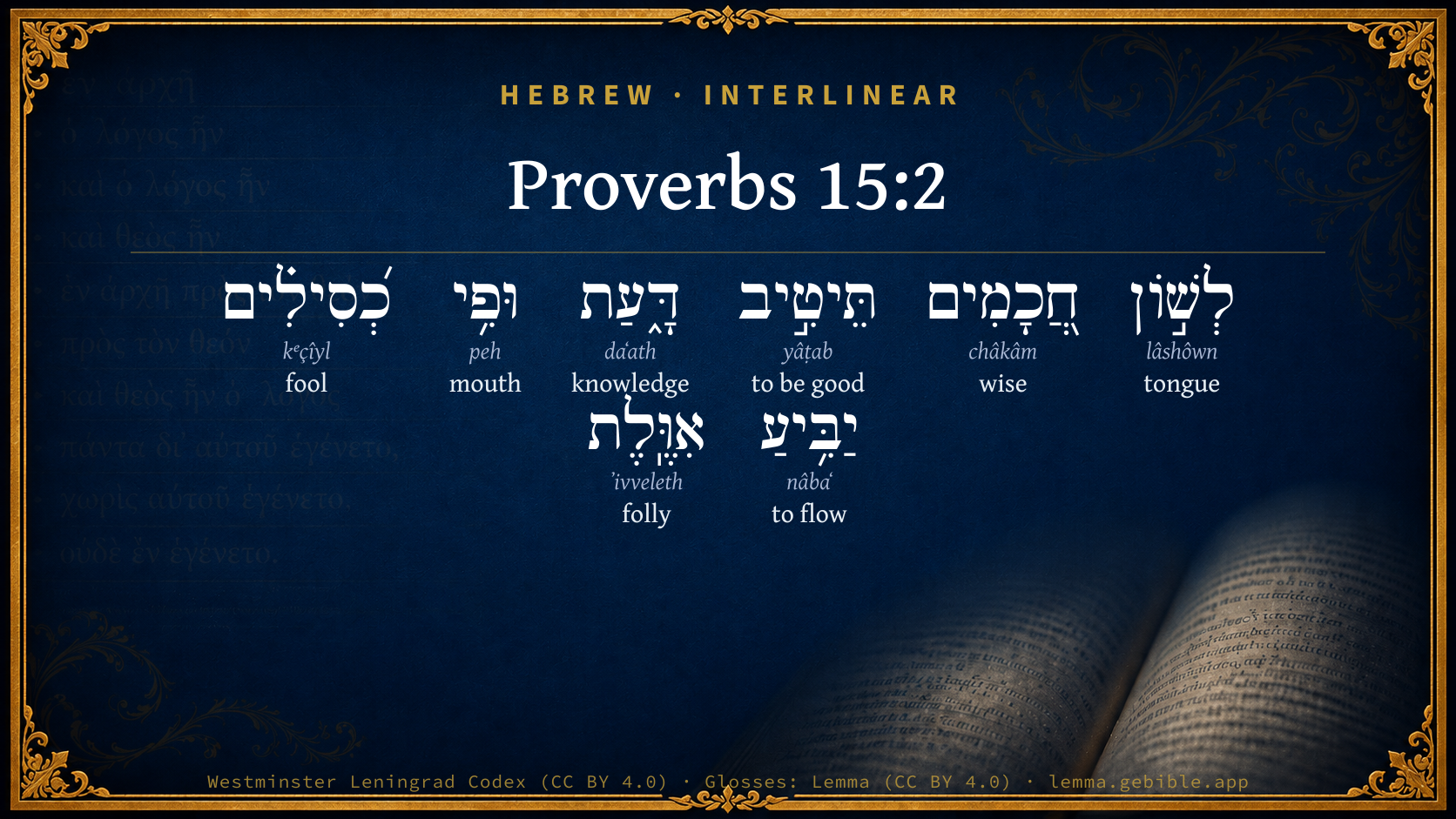
Proverbs 15:2

Hebrew (Westminster Leningrad Codex) Proverbs 15:2 appears in the Hebrew Old Testament. The text above is from the Westminster Leningrad Codex. Each word links to its Strong’s number, a concise gloss, and parsing drawn from the Open Scriptures Hebrew Bible morphology. Click any word for its full Brown-Driver-Briggs (BDB) entry.
Download image
Cite this verse

Proverbs 15:2 (World English Bible). Public Domain. Lemma interlinear Bible study tool, https://lemma.gebible.app/v/proverbs/15/2.

Show BibTeX & RIS
BibTeX
RIS
English Translation
The tongue of the wise commends knowledge, But the mouth of fools gush out folly.
World English Bible · Public Domain
Download a study sheet

One document with this verse’s original text, its word-by-word gloss line, the meaning frame, cross-references with their text, attributed commentary, and full source and license credits — printable, and it pastes into notes with its structure intact.

This verse Autodidact and up

Study sheet (.html) Plain text (.txt)

A passage Seminary Student

Up to 50 verses in one chapter. A passage sheet keeps up to 6 commentary sources and 12 cross-references per verse, in the order this page ranks them, and says so on the sheet whenever that leaves anything out. Ask for a single verse and you get the Autodidact verse sheet above.

Everything on this page stays free to read, with no account — the sheet is a download of what is already on screen, not access to it.

Want to remove ads? Support Godless Engineer
Compare translations 3

The same verse in 3 English versions, stacked beneath the original-language interlinear above. Click any original word for its lexicon entry.

Each is an independent rendering of the whole verse — the interlinear is not word-aligned to these translations.

Highlighted words mark where these versions differ — a whole-verse word diff, not a word-by-word alignment.

  • World English Bible Public Domain
    The tongue of the wise commends knowledge, But the mouth of fools gush out folly.
  • King James Version Public Domain
    The tongue of the wise useth knowledge aright: but the mouth of fools poureth out foolishness.
  • unfoldingWord Literal Text CC BY-SA 4.0
    The tongue of the wise makes knowledge good, but the mouth of the stupid gushes forth folly.

unfoldingWord Literal Text — © unfoldingWord, licensed CC BY-SA 4.0. Word-aligned USFM3 via Door43 (git.door43.org/unfoldingWord/en_ult).

Versions to compare (up to 4)

3 of 4 selected

Show all 18 translations

Every available English version of this verse, each an independent rendering of the whole verse.

  • World English Bible Public Domain
    The tongue of the wise commends knowledge, But the mouth of fools gush out folly.
  • Berean Standard Bible Public Domain
    The tongue of the wise commends knowledge, but the mouth of the fool spouts folly.
  • Majority Standard Bible Public Domain
    The tongue of the wise commends knowledge, but the mouth of the fool spouts folly.
  • King James Version Public Domain
    The tongue of the wise useth knowledge aright: but the mouth of fools poureth out foolishness.
  • American Standard Version (1901) Public Domain
    The tongue of the wise uttereth knowledge aright; But the mouth of fools poureth out folly.
  • Revised Version (1885) Public Domain
    The tongue of the wise uttereth knowledge aright: but the mouth of fools poureth out folly.
  • Geneva Bible (1599) Public Domain
    The tongue of the wise vseth knowledge aright: but the mouth of fooles babbleth out foolishnesse.
  • Douay-Rheims (1899) Public Domain
    The tongue of the wise adorneth knowledge: but the mouth of fools bubbleth out folly.
  • Young's Literal Translation Public Domain
    The tongue of the wise maketh knowledge good, And the mouth of fools uttereth folly.
  • Literal Standard Version CC BY-SA 4.0
    The tongue of the wise makes knowledge good, || And the mouth of fools utters folly.
  • Unlocked Literal Bible CC BY-SA 4.0
    The tongue of wise people compliments knowledge, but the mouth of fools pours out folly.
  • unfoldingWord Literal Text CC BY-SA 4.0
    The tongue of the wise makes knowledge good, but the mouth of the stupid gushes forth folly.
  • Darby Bible Public Domain
    The tongue of the wise useth knowledge aright; but the mouth of the foolish poureth out folly.
  • World Messianic Bible Public Domain
    The tongue of the wise commends knowledge, but the mouths of fools gush out folly.
  • Webster's Bible Public Domain
    The tongue of the wise useth knowledge aright: but the mouth of fools poureth out foolishness.
  • Free Bible Version CC BY-SA 4.0
    What wise people say makes knowledge attractive, but stupid people talk a lot of nonsense.
  • Bible in Basic English Public Domain
    Knowledge is dropping from the tongue of the wise; but from the mouth of the foolish comes a stream of foolish words.
  • JPS Tanakh (1917) Public Domain
    The tongue of the wise useth knowledge aright; but the mouth of fools poureth out foolishness.

Literal Standard Version (2020), Covenant Press — licensed CC BY-SA 4.0. Text via the HelloAO Bible API (eBible.org). Unlocked Literal Bible (unfoldingWord) — licensed CC BY-SA 4.0. Text via the HelloAO Bible API (eBible.org). unfoldingWord Literal Text — © unfoldingWord, licensed CC BY-SA 4.0. Word-aligned USFM3 via Door43 (git.door43.org/unfoldingWord/en_ult). Free Bible Version, Dr. Jonathan Gallagher — licensed CC BY-SA 4.0. Text via the HelloAO Bible API (eBible.org).

Word by word

More ways to search: Search by grammar → Find every occurrence → Compare this word →

Practice this passage: Drill this verse → Learn its vocabulary →

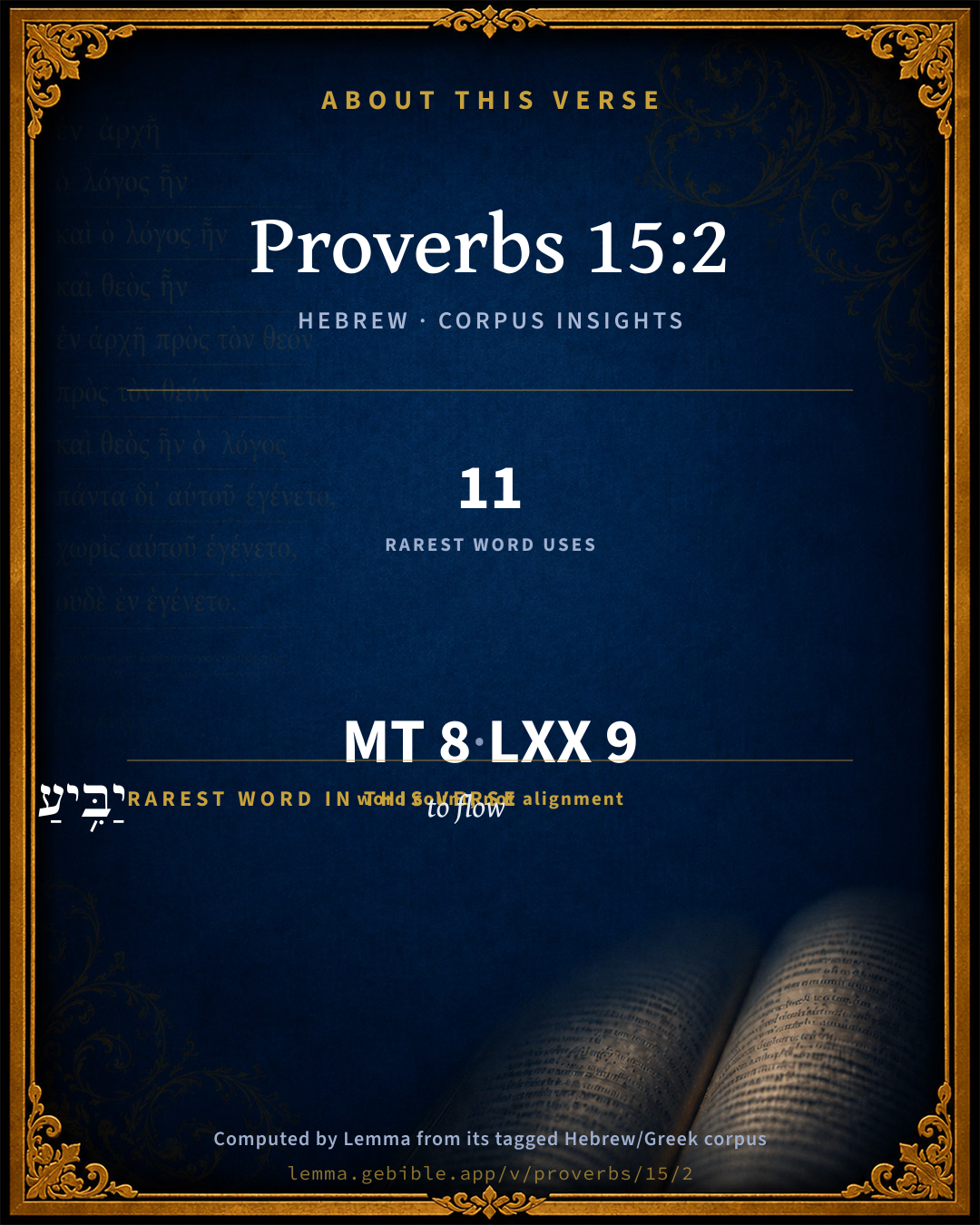
About this verse

These counts appear in no published source. They are computed here, from the morphology-tagged text and Lemma’s own curated glosses. What Lemma adds →

8
words
8
distinct lemmas
Wisdom
section

Notable vocabulary

The rarest word here is יַבִּ֥יעַ to flow H5042 — appearing just 11 times in the whole Hebrew Bible.

Shared distinctive vocabulary

יַבִּ֥יעַ to flow H5042 occurs in 11 verses of the Hebrew Bible. Also found in:

Grammatical profile

  • 2 verbs
  • 4 nouns
  • 2 adjectives

Verb forms

  • תֵּיטִ֣יב Hiphil · Imperfect
  • יַבִּ֥יעַ Hiphil · Imperfect

Hebrew & Septuagint length

In English translation the verse runs 15 words from the Hebrew and 19 from the Septuagint (LXX English) — closely comparable.

A rough comparison of the two English renderings, which tokenize alike — not a word-level alignment.

Word counts can differ between the Hebrew and the Greek without any difference in meaning — e.g. the Hebrew direct-object marker אֵת has no separate Greek word, and Greek often adds the article ὁ.

In the original languages it is 8 Hebrew tokens and 9 Greek tokens — but the two are counted differently (Hebrew bundles its prefixes and suffixes into one token; the Greek is in lemma form), so that isn’t a like-for-like length.

Cross-references

10

Topical passages linked to Proverbs 15:2 in the Treasury of Scripture Knowledge — connected by theme and wording, ordered by reader-vote popularity; previews shown in the World English Bible.

  • Proverbs 12:23 A prudent man keeps his knowledge, But the hearts of fools proclaim foolishness.
  • Proverbs 15:28 The heart of the righteous weighs answers, But the mouth of the wicked gushes out evil.
  • Proverbs 13:16 Every prudent man acts from knowledge, But a fool exposes folly.
  • Ecclesiastes 10:12–13 The words of a wise man's mouth are gracious; but a fool is swallowed by his own lips.
  • Psalms 45:1 My heart overflows with a noble theme. I recite my verses for the king. My tongue is like the pen of a skillful writer.
  • Psalms 59:7 Behold, they spew with their mouth. Swords are in their lips, "For," they say, "who hears us?"
  • Proverbs 15:23 Joy comes to a man with the reply of his mouth. How good is a word at the right time!
  • Proverbs 16:23 The heart of the wise instructs his mouth, And adds learning to his lips.
  • Proverbs 25:11–12 A word fitly spoken Is like apples of gold in settings of silver.
  • Isaiah 50:4 The Lord Yahweh has given me the tongue of those who are taught, that I may know how to sustain with words him who is weary: he wakens morning by morning, he wakens my ear to hear as those who are taught.

Cross-references courtesy of OpenBible.info (CC BY 4.0).

Hebrew and Greek witnesses Masoretic Hebrew ↔ Greek Septuagint

The same verse in the two great witnesses to the Old Testament, shown verse-for-verse.

These are two independent witnesses, not word-aligned to each other, and the Septuagint is shown in lemma (dictionary) form.

Hebrew Proverbs 15:2 Masoretic · Westminster Leningrad Codex

לְשׁ֣וֹן חֲ֭כָמִים תֵּיטִ֣יב דָּ֑עַת וּפִ֥י כְ֝סִילִ֗ים יַבִּ֥יעַ אִוֶּֽלֶת

The tongue of the wise commends knowledge, But the mouth of fools gush out folly.

World English Bible · Public Domain

Greek LXX Proverbs 15:2 Septuagint · lemma form

γλῶσσα σοφός καλός ἐπιἵσταμαι στόμα δέ ἄφρων ἀναἀγγέλλω κακός

The tongue of the wise knows what is good: but the mouth of the foolish tells out evil things.

LXX2012 (modern English Septuagint) · Public Domain

On this verse, The Pulpit Commentary discusses the Septuagint’s reading. Read the note in Commentary ↓

Hebrew: Westminster Leningrad Codex (CC BY 4.0). Greek: Septuagint (public domain); English from LXX2012 (modern English Septuagint) (Public Domain). How the Septuagint differs from the Hebrew →

Commentary

Notes on Proverbs 15:2 from classic Christian and Jewish commentators (each source and its license shown beneath its notes). The classic Christian expositions comment on the surrounding passage and are grouped to its opening verse, so a note may address several verses; the Jewish commentaries on the Tanakh (Rashi and others) are per-verse, so they appear only where the commentator wrote on this verse.

Lemma curates 59 commentaries, every one of them public domain or Creative Commons licensed, each selected and text-cleaned for this edition rather than reprinted as found. About our sources →

Trapp's Complete Commentary

John Trapp

Pro 15:2 The tongue of the wise useth knowledge aright: but the mouth of fools poureth out foolishness.

Ver. 2. The tongue of the wise useth knowledge aright.] Heb., Deals kindly with her; offers her no abuse, by venting her unseasonably, and making her overly cheap, and little set by. Eloquence wisely ordered is very commendable, and avails much: but what a poor praise was that to the Duke of Buckingham, that speaking to the Londoners in the behalf of that usurper, Richard III, he gained the commendation, that no man could deliver so much bad matter in so good words and quaint phrases. {a} Here was eloquentiae satis, sapientiae parum. The tongue was given us for better purpose; it was David’s "glory," and he used it accordingly.

But the mouth of fools poureth out foolishness.] Heb., Bubbleth it out; blurteth it out, as a fountain casteth out its waters, with a great force and swiftness: non quid, sed quantum, is all their care, being talkative above measure, and forward to utter whatsoever comes into their chaps: quicquid in buccam.

{a} Daniel’s Hist.

John Trapp, A Commentary or Exposition upon All the Books of the Old and New Testament (1647–1656) — public domain. Text from a community e-Sword module.

Joseph Benson's Commentary

Pro 15:2-4. The tongue of the wise useth knowledge aright — Expressing what he knows prudently and gracefully; taking due care both what, and when, and to whom, and in what manner he speaks; but the mouth of fools poureth out foolishness — Plentifully, continually, promiscuously, and vehemently, as a fountain doth waters, as the word יביעsignifies. A wholesome tongue — Which utters sound and useful counsels; is a tree of life — Is very useful to preserve the present life, and to promote the spiritual and eternal life, both of the speaker and the hearers; but perverseness therein — False or corrupt speeches; is a breach in the spirit — Disturbs and wounds the spirit both of the speaker and hearers.

Joseph Benson's Commentary on the Old and New Testaments (1811–1818) — public domain. Text from a community e-Sword module.

Tyndale Open Study Notes

Tyndale Open Resources

15:2 A wise teacher presents lessons in an attractive way. Crude belching describes the ugly teaching of a fool.

Tyndale Open Study Notes — © Tyndale Open Resources, licensed CC BY-SA 4.0. Text via the HelloAO Bible API.

Matthew Henry's Commentary

Note, 1. A good heart by the tongue becomes very useful. He that has knowledge is not only to enjoy it, for his own entertainment, but to use it, to use it aright, for the edification of others; and it is the tongue that must make use of it in pious profitable discourse, in giving suitable and seasonable instructions, counsels, and comforts, with all possible expressions of humility and love, and then knowledge is used aright; and to him that has, and thus uses what he has, more shall be given. 2. A wicked heart by the tongue becomes very hurtful; for the mouth of fools belches out foolishness, which is very offensive; and the corrupt communication which proceeds from an evil treasure within (the filthiness, and foolish talking, and jesting) corrupts the good manners of some and debauches them, and grieves the good hearts of others and disturbs them.

Matthew Henry's Commentary on the Whole Bible (1708–1710) — public domain (CC PDM 1.0). Text via the HelloAO Bible API.

Jamieson, Fausset & Brown

Robert Jamieson, A. R. Fausset & David Brown

useth . . . aright--commends knowledge by its proper use.

poureth out--utters abundantly (Pro 12:23), and so disgusts others.

Jamieson, Fausset & Brown — Commentary Critical and Explanatory on the Whole Bible (1871) — public domain (CC PDM 1.0). Text via the HelloAO Bible API.

Adam Clarke's Commentary

Verse 2. Useth knowledge aright] This is very difficult to know: - when to speak, and when to be silent; what to speak, and what to leave unspoken; the manner that is best and most suitable to the occasion, the subject, the circumstances, and the persons. All these are difficulties, often even to the wisest men. Even wise counsel may be foolishly given.

Adam Clarke's Commentary on the Bible (1810–1826) — public domain. Text from a community e-Sword/MySword module.

Ellicott's Commentary for English Readers

XV.

(2) Useth knowledge aright.—Brings it forth at the proper time and place.

A Bible Commentary for English Readers, edited by Charles John Ellicott (1878–1897) — public domain. Text from a community e-Sword module.

The Cambridge Bible for Schools and Colleges

gen. ed. J. J. S. Perowne

2. useth knowledge aright] Or, uttereth, &c. R.V. Lit. maketh good knowledge, i.e. turns it to good account, makes the best of it. Comp. “they make goodly (lit. as here, make good) images or pillars,” Hos_10:1.

The contrast is between the good use of knowledge which adds to its usefulness, and the reckless pouring forth of folly which increases its hurtfulness; between the pure stream flowing in useful channels, and the pestilential flood bursting forth unrestrained. Comp. Pro_13:16, and Pro_15:28 below.

The Cambridge Bible for Schools and Colleges (gen. ed. J. J. S. Perowne; Cambridge University Press, 1878–1918) — public domain. Text from a community e-Sword module.

John Gill's Exposition

The tongue of the wise useth knowledge aright,.... As the heart of a wise and good man is filled with useful knowledge, civil, moral, spiritual, and evangelical; so he takes care to communicate it, at proper times and seasons, in proper places, and to proper persons; adapting it to their case and circumstances, so as it may be for their comfort, edification, and instruction, and minister grace unto them; which is using knowledge "well", as the word (s) signifies: such an use of it recommends it, and makes it appear beautiful and lovely, decorates and adorns it. Thus every good man, out of the good treasure of knowledge in his heart, brings forth his good things seasonably, to the use of edifying; in like manner, ministers of the word, scribes well instructed in the things of God, bring forth both new and old, to the profit of those to whom they minister; so Christ, as man and Mediator, had the tongue of the learned, to speak a word in season to weary souls;

but the mouth of fools poureth out foolishness; their knowledge, as they take it to be, but it is no other than folly; this they throw out in great plenty, in a hurry, without fear or wit; they "babble" it out, as the word (t) signifies, as water out of a fountain; their hearts are full of it, and their mouths proclaim it, Pro 12:23.

(s) "utitur bene", Castalio; "pulchre", Vatablus. (t) "effutit, ebullit, fundit", Vatablus; "eructat", Junius & Tremellius, Piscator; "ebullit", V. L. Tigurine version, Schultens; "scaturire facit", Michaelis.

John Gill's Exposition of the Whole Bible (1746–1763) — public domain (CC PDM 1.0). Text via the HelloAO Bible API.

Albert Barnes' Notes on the Bible

Useth knowledge aright - Rather, makes knowledge goodly. The power of well-considered speech to commend true wisdom, is contrasted with the pouring (literally as in the margin) forth of folly.

Albert Barnes' Notes on the Bible (1834–1885) — public domain. Text from a community e-Sword/MySword module.

Haydock's Catholic Bible Commentary

Knowledge. It requires to be proposed in a proper manner.

George Leo Haydock (1774–1849), Haydock's Catholic Family Bible and Commentary, 1859 edition — public domain. Excludes Psalms (Douay-Rheims chapter numbering differs from Protestant) and Deuterocanonical books (Catholic canon only).

Matthew Poole's English Annotations

Useth knowledge aright; expressing what he knows prudently and gracefully; taking due care both what, and when, and to whom, and in what manner he speaks.

Poureth out, plentifully, continually, promiscuously, and vehemently, as a fountain doth waters, as this word signifies.

Matthew Poole's English Annotations on the Holy Bible (1683–1685) — public domain. Text from a community e-Sword/MySword module.

Whedon's Commentary on the Bible

Daniel D. Whedon

2. Useth knowledge aright — Makes it grateful, attractive, edifying. A wise man knows when to speak and when to keep silent, and how to make his words both useful and acceptable.

Foolishness — Which, as implied, can neither be profitable nor grateful to the hearers. The fools are mere babblers. Comp. Pro_12:23; Pro_13:16; Pro_15:28.

Daniel D. Whedon (gen. ed.), Commentary on the Old and New Testaments (1874–1909) — public domain. Text from a community e-Sword module.

The Pulpit Commentary

The tongue of the wise useth knowledge aright. This means either, brings it forth opportunely, it the right time and place, or illustrates it, makes it beautiful and pleasant, as ver. 13. The wise man not only has knowledge, but can give it appropriate expression. (comp. Pro_16:23) Vulgate, "The tongue of the wise adorneth wisdom." The wise man, by producing his sentiments and opinions in appropriate language and on proper occasions, commends wisdom, and renders it acceptable to his hearers. Septuagint, "The tongue of the wise knoweth what is fair (kala )." But the mouth of fools poureth out foolishness (ver. 28). A fool cannot open his mouth without exposing his folly; he speaks without due consideration or discretion; as the Vulgate terms it, ebullit, "he bubbles over," like a boiling pot, which emits its contents inopportunely and uselessly. Septuagint, "The mouth of fools proclaimeth evil."

The Pulpit Commentary (1880–1919), ed. H.D.M. Spence-Jones & Joseph S. Exell — public domain. Text from a community e-Sword module.

John Wesley's Explanatory Notes

Aright - Expressing what he knows prudently and gracefully. Poureth out - Plentifully, continually, and vehemently, as a fountain does waters.

John Wesley, Explanatory Notes Upon the Whole Bible (1754–1765) — public domain. Text via the GEBible commentary corpus.

Bridges on Proverbs

Charles Bridges

Before we had the tongue of love. Here is the tongue of wisdom. The tongue shews the man. The wise commands his tongue. The fool — his tongue commands him. He may have a mass of knowledge in possession. But from the want of the right use, it runs to waste. Wisdom is proved, not by the quantum of knowledge, but by its right application. Observe "the Spirit of knowledge resting upon our Divine Master."†1 In condescending to the ignorance of the people;†2 in commanding their respect;†3 in silencing the gainsayers;†4 in alluring sinners to himself†5 — how did his wise tongue use knowledge aright! Thus did his great Apostle give to all the same knowledge, but wisely — not the same form or gradation. (1Co 3:2 .) Instead of exasperating his Heathen congregation by an open protest, he supplied their acknowledged defect, by bringing before them the true God, "whom they were ignorantly worshipping." (Act 17:23 .) He pointed an arrow to Agrippa’s conscience, by the kindly admission of his candour and intelligence. (Act 26:27-29 .) This right use of knowledge distinguishes the "workman approved of God, and that needeth not to be ashamed." (2Ti 2:15 .) The want of it often gives out truth so loosely and unsuitably, as to open, rather than to shut, the mouth of the gainsayer; rather to bring discredit upon the truth, than conviction to the adversary. Specially will the tongue of the wise direct a right application of knowledge to those, who have newly entered the path of God. May we not sometimes in our present stature, forget our former feeble infancy? If now we "strike our roots as Lebanon," was it not once with us only "the least of all seeds"? (Hos 14:5 . Mat 13:32 .) Let our considerate instruction pluck the thorn out of their tender feet, "lest that which is lamed be turned out of the way; but rather let it be healed." (Heb 12:13 .)

But to judge of the waters flowing from a fool’s fountain; listen to Baal’s worshippers;†6 Rabshakeh’s proud boasting;†7 the fretting murmurings of the people of God†8 all pouring out foolishness. Oh! for a large infusion of sound knowledge in the treasure-house within, that the tongue may be at once disciplined and consecrated!

Footnotes:

†1 Isa 11:2.

†2 Mar 4:33.

†3 Mat 7:29. Joh 7:46 .

†4 Mat 22:15-46.

†5 Mat 11:28-30. Joh 4:1-26 .

†6 1Ki 18:26 .

†7 2Ki 18:26-29 .

†8 Num 14:2-10; Num 16:13 .

Charles Bridges, An Exposition of the Book of Proverbs (1846) — public domain. Text from a community e-Sword module.

Kretzmann's Popular Commentary

Paul E. Kretzmann

v. 2. The tongue of the wise useth knowledge aright, presenting it in well-arranged form, clothing it in an attractive manner; but the mouth of fools poureth out foolishness, in great and loathsome quantities, its utterances being noisy, confused, and without sense, nothing but folly.

Paul E. Kretzmann, Popular Commentary of the Bible (1921–1924) — public domain. Text from a community e-Sword module.

Lesson kit

Teaching starters — assembled from the data on this page, not authored interpretation. Every prompt links to the verse data it draws on. Edit before teaching.

Proverbs, in the Wisdom, opens this verse with 8 words (8 distinct Hebrew lemmas). Its most distinctive word is nâbaʻ (“to flow”). A historical commentator’s framing appears above. Read the whole chapter for the surrounding context.

Discussion questions

  1. The word nâbaʻ carries the sense “to flow.” How does it shape the verse?
  2. How does Psalms 19:2, which shares the word «to flow», read alongside this verse?
  3. The translations on this page render this verse differently — a whole-verse word diff, not a word-by-word alignment. What might account for the different wordings?
  4. «תֵּיטִ֣יב» is a Hiphil Imperfect verb. How does that grammatical form shape the action described?
  5. Compare how Trapp's Complete Commentary and Joseph Benson's Commentary read this verse. Where do they agree or differ?

Things to notice

Reading settings

Reading text

Shown beneath each verse's original-language words.

Old Testament
Old Testament edition

Read the OT as the Masoretic Hebrew (MT) or the Greek Septuagint (LXX).

English shown for the Greek Septuagint (in the Hebrew ↔ Greek comparison).

Comparing translations? Open the Compare panel on any verse page to stack up to four side by side.