
Ecclesiastes 2:19

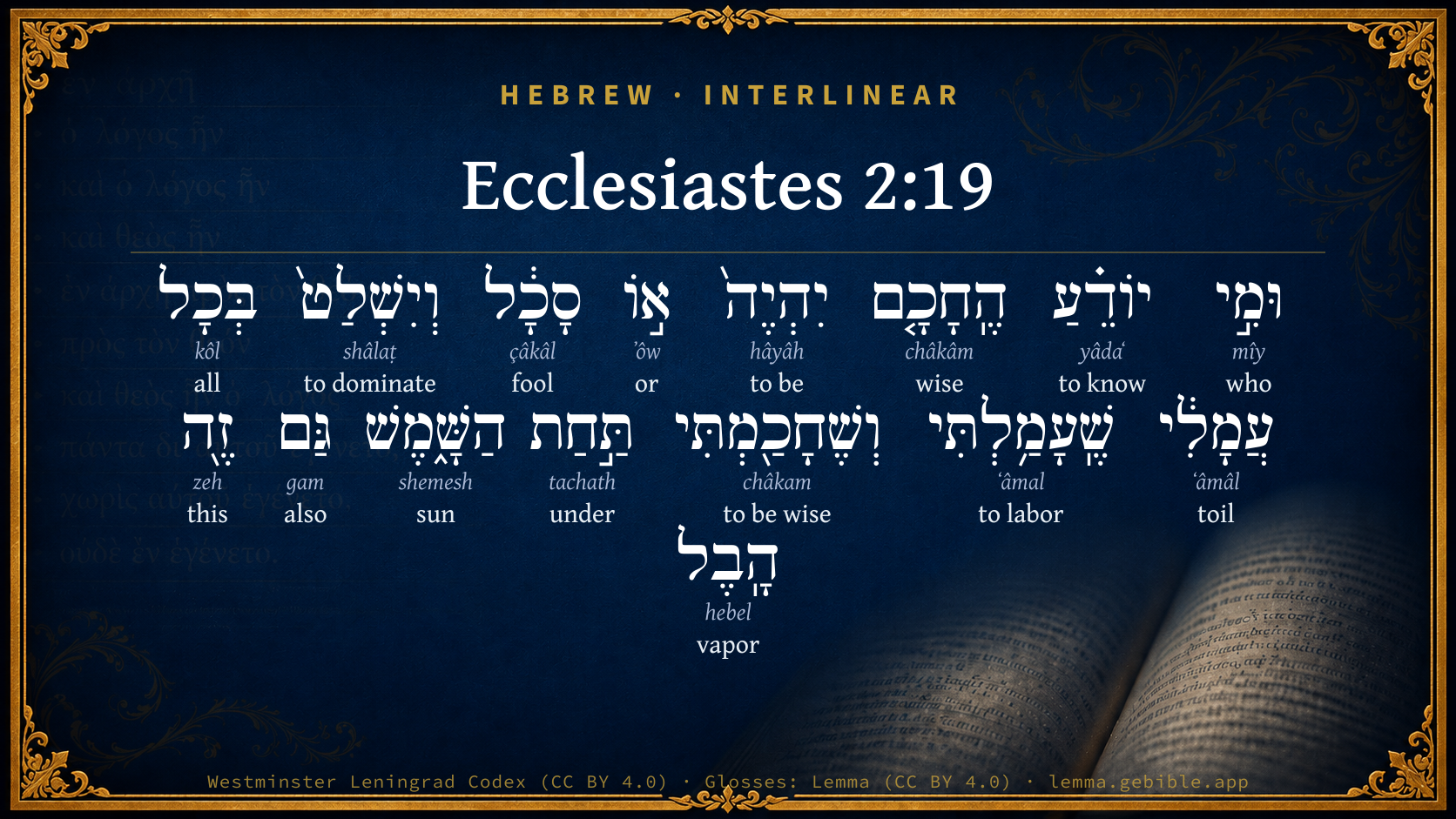
Hebrew (Westminster Leningrad Codex) Ecclesiastes 2:19 appears in the Hebrew Old Testament. The text above is from the Westminster Leningrad Codex. Each word links to its Strong’s number, a concise gloss, and parsing drawn from the Open Scriptures Hebrew Bible morphology. Click any word for its full Brown-Driver-Briggs (BDB) entry.
Download image
Cite this verse

Ecclesiastes 2:19 (World English Bible). Public Domain. Lemma interlinear Bible study tool, https://lemma.gebible.app/v/ecclesiastes/2/19.

Show BibTeX & RIS
BibTeX
RIS
English Translation
Who knows whether he will be a wise man or a fool? Yet he will have rule over all of my labor in which I have labored, and in which I have shown myself wise under the sun. This also is vanity.
World English Bible · Public Domain
Highlights
  • 1 first appearance in the Hebrew Bible
Full analysis ↓
Download a study sheet

One document with this verse’s original text, its word-by-word gloss line, the meaning frame, cross-references with their text, attributed commentary, and full source and license credits — printable, and it pastes into notes with its structure intact.

This verse Autodidact and up

Study sheet (.html) Plain text (.txt)

A passage Seminary Student

Up to 50 verses in one chapter. A passage sheet keeps up to 6 commentary sources and 12 cross-references per verse, in the order this page ranks them, and says so on the sheet whenever that leaves anything out. Ask for a single verse and you get the Autodidact verse sheet above.

Everything on this page stays free to read, with no account — the sheet is a download of what is already on screen, not access to it.

Want to remove ads? Support Godless Engineer
Compare translations 3

The same verse in 3 English versions, stacked beneath the original-language interlinear above. Click any original word for its lexicon entry.

Each is an independent rendering of the whole verse — the interlinear is not word-aligned to these translations.

Highlighted words mark where these versions differ — a whole-verse word diff, not a word-by-word alignment.

  • World English Bible Public Domain
    Who knows whether he will be a wise man or a fool? Yet he will have rule over all of my labor in which I have labored, and in which I have shown myself wise under the sun. This also is vanity.
  • King James Version Public Domain
    And who knoweth whether he shall be a wise man or a fool? yet shall he have rule over all my labour wherein I have laboured, and wherein I have shewed myself wise under the sun. This is also vanity.
  • unfoldingWord Literal Text CC BY-SA 4.0
    And who knows: Will he be wise or a fool? And he will have authority over all my toil that I toiled and which I was wise under the sun. Also, this vapor.

unfoldingWord Literal Text — © unfoldingWord, licensed CC BY-SA 4.0. Word-aligned USFM3 via Door43 (git.door43.org/unfoldingWord/en_ult).

Versions to compare (up to 4)

3 of 4 selected

Show all 18 translations

Every available English version of this verse, each an independent rendering of the whole verse.

  • World English Bible Public Domain
    Who knows whether he will be a wise man or a fool? Yet he will have rule over all of my labor in which I have labored, and in which I have shown myself wise under the sun. This also is vanity.
  • Berean Standard Bible Public Domain
    And who knows whether that man will be wise or foolish? Yet he will take over all the labor at which I have worked skillfully under the sun. This too is futile.
  • Majority Standard Bible Public Domain
    And who knows whether that man will be wise or foolish? Yet he will take over all the labor at which I have worked skillfully under the sun. This too is futile.
  • King James Version Public Domain
    And who knoweth whether he shall be a wise man or a fool? yet shall he have rule over all my labour wherein I have laboured, and wherein I have shewed myself wise under the sun. This is also vanity.
  • American Standard Version (1901) Public Domain
    And who knoweth whether he will be a wise man or a fool? yet will he have rule over all my labor wherein I have labored, and wherein I have showed myself wise under the sun. This also is vanity.
  • Revised Version (1885) Public Domain
    And who knoweth whether he shall be a wise man or a fool? yet shall he have rule over all my labour wherein I have laboured, and wherein I have shewed wisdom under the sun. This also is vanity.
  • Geneva Bible (1599) Public Domain
    And who knoweth whether he shalbe wise or foolish? yet shall hee haue rule ouer all my labour, wherein I haue trauailed, and wherein I haue shewed my selfe wise vnder the sunne. This is also vanitie.
  • Douay-Rheims (1899) Public Domain
    Whom I know not whether he will be a wise man or a fool, and he shall have rule over all my labours with which I have laboured and been solicitous: and is there any thing so vain?
  • Young's Literal Translation Public Domain
    And who knoweth whether he is wise or foolish? yet he doth rule over all my labour that I have laboured at, and that I have done wisely under the sun! this also `is' vanity.
  • Literal Standard Version CC BY-SA 4.0
    And who knows whether he is wise or foolish? Yet he rules over all my labor that I have labored at, and that I have done wisely under the sun! This [is] also vanity.
  • Unlocked Literal Bible CC BY-SA 4.0
    For who knows whether he will be a wise man or a fool? Yet he will be master over everything under the sun that my work and wisdom have built. This also is vapor.
  • unfoldingWord Literal Text CC BY-SA 4.0
    And who knows: Will he be wise or a fool? And he will have authority over all my toil that I toiled and which I was wise under the sun. Also, this vapor.
  • Darby Bible Public Domain
    And who knoweth whether he will be a wise [man] or a fool? yet shall he have rule over all my labour at which I have laboured, and wherein I have been wise under the sun. This also is vanity.
  • World Messianic Bible Public Domain
    Who knows whether he will be a wise man or a fool? Yet he will have rule over all of my labor in which I have labored, and in which I have shown myself wise under the sun. This also is vanity.
  • Webster's Bible Public Domain
    And who knoweth whether he shall be a wise man or a fool? yet shall he have rule over all my labor in which I have labored, and in which I have showed myself wise under the sun. This is also vanity.
  • Free Bible Version CC BY-SA 4.0
    And who knows whether he will be wise or foolish? Yet he will rule over everything I accomplished through my wisdom here on earth. This is just so frustrating, so hard to understand!
  • Bible in Basic English Public Domain
    And who is to say if that man will be wise or foolish? But he will have power over all my work which I have done and in which I have been wise under the sun. This again is to no purpose.
  • JPS Tanakh (1917) Public Domain
    And who knoweth whether he will be a wise man or a fool? yet will he have rule over all my labour wherein I have laboured, and wherein I have shown myself wise under the sun. This also is vanity.

Literal Standard Version (2020), Covenant Press — licensed CC BY-SA 4.0. Text via the HelloAO Bible API (eBible.org). Unlocked Literal Bible (unfoldingWord) — licensed CC BY-SA 4.0. Text via the HelloAO Bible API (eBible.org). unfoldingWord Literal Text — © unfoldingWord, licensed CC BY-SA 4.0. Word-aligned USFM3 via Door43 (git.door43.org/unfoldingWord/en_ult). Free Bible Version, Dr. Jonathan Gallagher — licensed CC BY-SA 4.0. Text via the HelloAO Bible API (eBible.org).

Word by word

More ways to search: Search by grammar → Find every occurrence → Compare this word →

Practice this passage: Drill this verse → Learn its vocabulary →

סָכָ֔ל
çâkâl
H5530
“fool”
Noun, Common, Masculine, Singular, Absolute
Part of Speech
Noun
Type
Common
Gender
Masculine
Number
Singular
State
Absolute
Full BDB Definition

Origin: from H5528

TWOT: 1493a

fool
  1. וּמִ֣י mîy H4310 “and · who” Conjunction + Particle, Interrogative
  2. יוֹדֵ֗עַ yâdaʻ H3045 “knowing” Verb, Qal, Participle Active, Masculine, Singular, Absolute
  3. הֶֽחָכָ֤ם châkâm H2450 “wise” Particle, Interrogative + Adjective, Adjective, Masculine, Singular, Absolute
  4. יִהְיֶה֙ hâyâh H1961 “to be” Verb, Qal, Imperfect, 3rd Person, Masculine, Singular
  5. א֣וֹ ʼôw H176 “or” Conjunction
  6. וְיִשְׁלַט֙ shâlaṭ H7980 “and · to dominate” Conjunction + Verb, Qal, Imperfect, 3rd Person, Masculine, Singular
  7. בְּכָל kôl H3605 “in/at · all of” Preposition + Noun, Common, Masculine, Singular, Construct
  8. עֲמָלִ֔י ʻâmâl H5999 “toil · my” Noun, Common, Both, Singular, Construct + Suffix, Personal, 1st Person, Common, Singular
  9. שֶֽׁעָמַ֥לְתִּי ʻâmal H5998 “who/which · to labor” Particle, Relative + Verb, Qal, Perfect, 1st Person, Common, Singular
  10. וְשֶׁחָכַ֖מְתִּי châkam H2449 “and · who/which · to be wise” Conjunction + Particle, Relative + Verb, Qal, Perfect, 1st Person, Common, Singular
  11. תַּ֣חַת tachath H8478 “under” Preposition
  12. הַשָּׁ֑מֶשׁ shemesh H8121 “the · sun” Particle, Definite Article + Noun, Common, Both, Singular, Absolute
  13. גַּם gam H1571 “also” Particle, Accusative
  14. זֶ֖ה zeh H2088 “this” Pronoun, Demonstrative, Masculine, Singular
  15. הָֽבֶל hebel H1892 “vapor” Noun, Common, Masculine, Singular, Absolute

About this verse

These counts appear in no published source. They are computed here, from the morphology-tagged text and Lemma’s own curated glosses. What Lemma adds →

16
words
16
distinct lemmas
Wisdom
section

Notable vocabulary

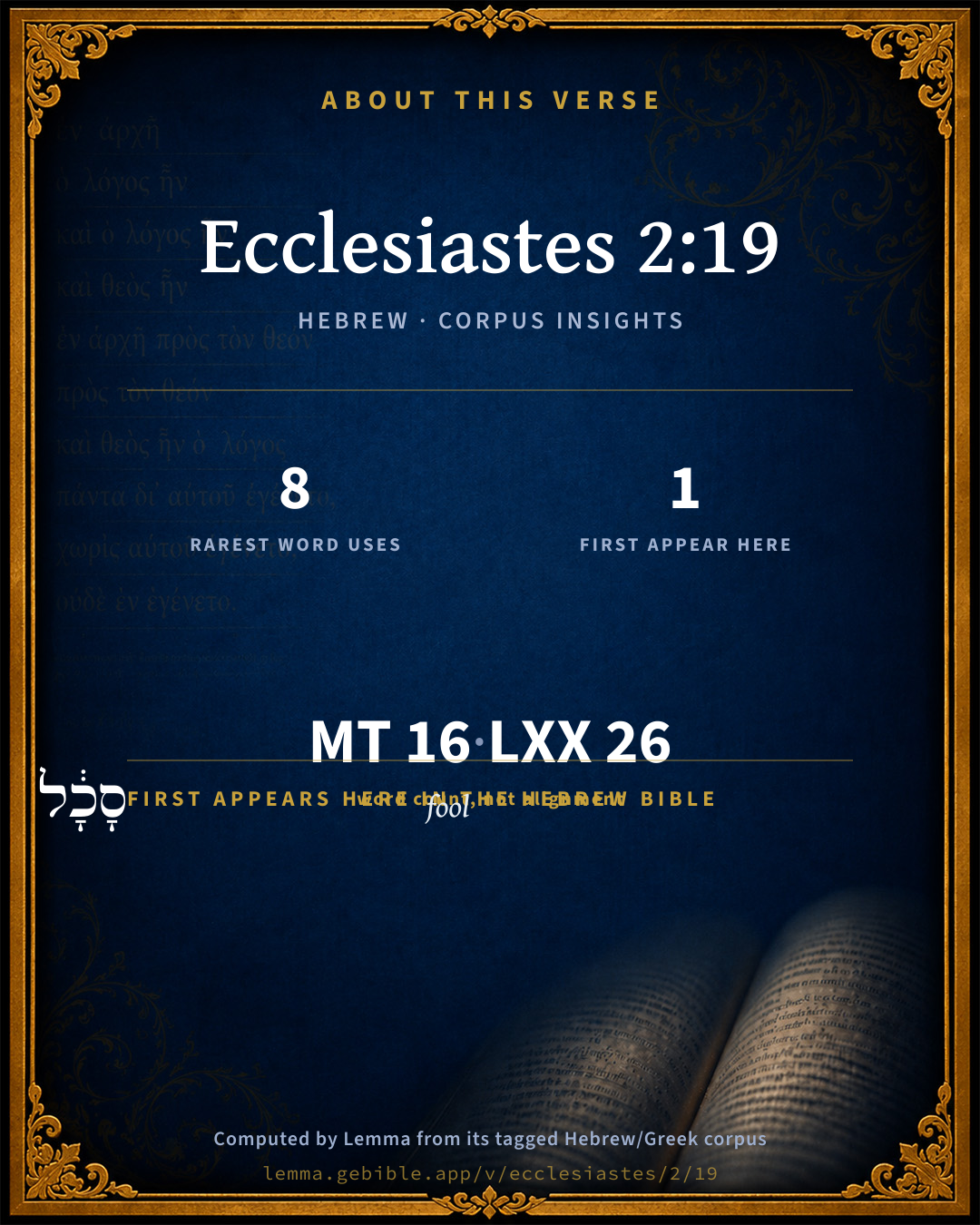
The rarest word here is סָכָ֔ל fool H5530 — appearing just 8 times in the whole Hebrew Bible.

First appearance in Scripture

This word makes its first canonical appearance in the Hebrew Bible here:

  • סָכָ֔ל fool H5530

Shared distinctive vocabulary

סָכָ֔ל fool H5530 occurs in 6 verses of the Hebrew Bible. Also found in:

Grammatical profile

  • 5 verbs
  • 5 nouns
  • 1 adjective
  • 1 pronoun
  • 1 preposition
  • 1 conjunction
  • 2 particles

Verb forms

  • יוֹדֵ֗עַ Qal · Participle Active
  • יִהְיֶה֙ Qal · Imperfect
  • וְיִשְׁלַט֙ Qal · Imperfect
  • שֶֽׁעָמַ֥לְתִּי Qal · Perfect
  • וְשֶׁחָכַ֖מְתִּי Qal · Perfect

Hebrew & Septuagint length

In English translation the verse runs 42 words from the Hebrew and 39 from the Septuagint (LXX English) — closely comparable.

A rough comparison of the two English renderings, which tokenize alike — not a word-level alignment.

Word counts can differ between the Hebrew and the Greek without any difference in meaning — e.g. the Hebrew direct-object marker אֵת has no separate Greek word, and Greek often adds the article ὁ.

In the original languages it is 16 Hebrew tokens and 26 Greek tokens — but the two are counted differently (Hebrew bundles its prefixes and suffixes into one token; the Greek is in lemma form), so that isn’t a like-for-like length.

Cross-references

9

Topical passages linked to Ecclesiastes 2:19 in the Treasury of Scripture Knowledge — connected by theme and wording, ordered by reader-vote popularity; previews shown in the World English Bible.

  • Ecclesiastes 3:22 Therefore I saw that there is nothing better, than that a man should rejoice in his works; for that is his portion: for who can bring him to see what will be after him?
  • James 3:17 But the wisdom that is from above is first pure, then peaceful, gentle, reasonable, full of mercy and good fruits, without partiality, and without hypocrisy.
  • 1 Kings 12:14–20 and spoke to them after the counsel of the young men, saying, My father made your yoke heavy, but I will add to your yoke: my father chastised you with whips, but I will chastise you with scorpions.
  • 1 Kings 14:25–28 It happened in the fifth year of king Rehoboam, that Shishak king of Egypt came up against Jerusalem;
  • 2 Chronicles 10:13–16 The king answered them roughly; and king Rehoboam forsook the counsel of the old men,
  • 2 Chronicles 12:9–10 So Shishak king of Egypt came up against Jerusalem, and took away the treasures of the house of Yahweh, and the treasures of the king's house: he took all away: he took away also the shields of gold which Solomon had made.
  • Ecclesiastes 9:13 I have also seen wisdom under the sun in this way, and it seemed great to me.
  • Luke 16:8 "His lord commended the dishonest manager because he had done wisely, for the children of this world are, in their own generation, wiser than the children of the light.
  • James 1:17 Every good gift and every perfect gift is from above, coming down from the Father of lights, with whom can be no variation, nor turning shadow.

Cross-references courtesy of OpenBible.info (CC BY 4.0).

Hebrew and Greek witnesses Masoretic Hebrew ↔ Greek Septuagint

The same verse in the two great witnesses to the Old Testament, shown verse-for-verse.

These are two independent witnesses, not word-aligned to each other, and the Septuagint is shown in lemma (dictionary) form.

Hebrew Ecclesiastes 2:19 Masoretic · Westminster Leningrad Codex

וּמִ֣י יוֹדֵ֗עַ הֶֽחָכָ֤ם יִהְיֶה֙ א֣וֹ סָכָ֔ל וְיִשְׁלַט֙ בְּכָל עֲמָלִ֔י שֶֽׁעָמַ֥לְתִּי וְשֶׁחָכַ֖מְתִּי תַּ֣חַת הַשָּׁ֑מֶשׁ גַּם זֶ֖ה הָֽבֶל

Who knows whether he will be a wise man or a fool? Yet he will have rule over all of my labor in which I have labored, and in which I have shown myself wise under the sun. This also is vanity.

World English Bible · Public Domain

Greek LXX Ecclesiastes 2:19 Septuagint · lemma form

καί τίς οἶδα εἰ σοφός εἰμί ἤ ἄφρων καί ἐξουσιάζω ἐν πᾶς μόχθος ἐγώ ὅς μοχθέω καί ὅς σοφίζω ὑπό ὁ ἥλιος καί γέ οὗτος ματαιότης

And who knows whether he will be a wise man or a fool? and whether he will have power over all my labor in which I laboured, and wherein I grew wise under the sun? this is also vanity.

LXX2012 (modern English Septuagint) · Public Domain

Hebrew: Westminster Leningrad Codex (CC BY 4.0). Greek: Septuagint (public domain); English from LXX2012 (modern English Septuagint) (Public Domain). How the Septuagint differs from the Hebrew →

Commentary

Notes on Ecclesiastes 2:19 from classic Christian and Jewish commentators (each source and its license shown beneath its notes). The classic Christian expositions comment on the surrounding passage and are grouped to its opening verse, so a note may address several verses; the Jewish commentaries on the Tanakh (Rashi and others) are per-verse, so they appear only where the commentator wrote on this verse.

Lemma curates 59 commentaries, every one of them public domain or Creative Commons licensed, each selected and text-cleaned for this edition rather than reprinted as found. About our sources →

Trapp's Complete Commentary

John Trapp

Ecc 2:19 And who knoweth whether he shall be a wise [man] or a fool? yet shall he have rule over all my labour wherein I have laboured, and wherein I have shewed myself wise under the sun. This [is] also vanity.

Ver. 19. And who knoweth whether he shall be a wise man.] A friend or an enemy, an acquaintance or a mere stranger; riches oft change masters. How many by a just hand of God die childless! or else leave what they have to spendthrifts, that will spend it as merrily as ever their parents got it miserably! scatter with a fork, as it were, what they have wretchedly raked together. Our Henry II, some few hours before he died, saw a list of their names who conspired with the King of France, and Earl Richard, his son and successor, against him; and finding therein his son John - whom he had made Earl of Cornwall, Somerset, Nottingham, Derby, and Lancaster, and given him a vast estate - to be the first, he fell into a grievous passion, both cursing his sons, and the day wherein himself was born and in that distemperature departed the world, which so often himself had distempered. {a}

{a} Daniel’s History, 112.

John Trapp, A Commentary or Exposition upon All the Books of the Old and New Testament (1647–1656) — public domain. Text from a community e-Sword module.

Tyndale Open Study Notes

Tyndale Open Resources

2:19 Foolish, destructive successors are more of a threat to wise accomplishments than wise successors, but since the Teacher couldn’t tell what kind of successors he would have, his accomplishments were meaningless to him. Solomon’s immediate successor—his son Rehoboam—turned out to be foolish (see 1 Kgs 12:1-20).

Tyndale Open Study Notes — © Tyndale Open Resources, licensed CC BY-SA 4.0. Text via the HelloAO Bible API.

Adam Clarke's Commentary

Verse 19. A wise man or a fool?] Alas! Solomon, the wisest of all men, made the worst use of his wisdom, had seven hundred wives and three hundred concubines, and yet left but one son behind him, to possess his estates and his throne, and that one was the silliest of fools!

Adam Clarke's Commentary on the Bible (1810–1826) — public domain. Text from a community e-Sword/MySword module.

Ellicott's Commentary for English Readers

(19) Have rule.—The word occurs again in Ecc_6:2; Ecc_8:9; elsewhere only in Nehemiah and Esther. and in Psa_119:133.

A Bible Commentary for English Readers, edited by Charles John Ellicott (1878–1897) — public domain. Text from a community e-Sword module.

The Cambridge Bible for Schools and Colleges

gen. ed. J. J. S. Perowne

19. who knoweth whether he shall be a wise man] We note in this rather the utterance of a generalized experience than, as some have thought, the special thought of the historical Solomon watching the growth of a character like Rehoboam. No man, whatever care he may take to entail his possessions, can secure an entail of character. And there is something irritating at times,—the writer seems to hint, almost maddening,—in the thought that whatever may be the character of the heir, he will have power to scatter in random waste what has been brought together, as with a purpose and a policy. Lands, libraries, galleries are all liable to be scattered and broken up. So in Psa_39:6 we have as the doom of the mammon-worshipper, “He heapeth up riches, and cannot tell who shall gather them.” So the sting of the message that comes to the Rich Fool of the parable is “Then whose shall those things be which thou hast provided?” Luk_12:20.

The Cambridge Bible for Schools and Colleges (gen. ed. J. J. S. Perowne; Cambridge University Press, 1878–1918) — public domain. Text from a community e-Sword module.

John Gill's Exposition

And who knoweth whether he shall be a wise man or a fool?.... The king that should be after him, as the Targum, that should be his successor and heir; and so whether he would make a good or bad use of what was left; whether he would keep and improve it, or squander it away; suggesting, that could he be sure he would be a wise man that should come into his labours, it would be some satisfaction to him that he had laboured, and such a man should have the benefit of it; but as it was a precarious thing what he would be, he could take no pleasure in reviewing his labours he was about to leave. Some think that Solomon here gives a hint of the suspicion he had, that his son Rehoboam, his successor and heir, would turn out a foolish man, as he did;

yet shall he have rule over all my labour wherein I have laboured, and wherein I have showed myself wise, under the sun; be he what he will, all will come into his hands; and he will have the power of disposing of all at his pleasure; not only of enjoying it, but of changing and altering things; and perhaps greatly for the worse, if he does not entirely destroy what has been wrought with so much care and industry, toil and labour, wisdom and prudence; the thought of all which was afflicting and distressing: and therefore he adds,

This is also vanity; and shows there is no happiness in all that a man does, has, or enjoys; and this circumstance, before related, adds to his vexation and unhappiness.

John Gill's Exposition of the Whole Bible (1746–1763) — public domain (CC PDM 1.0). Text via the HelloAO Bible API.

Haydock's Catholic Bible Commentary

Solicitous. We naturally desire to have our plans perfected. Solomon had, perhaps, a presentiment of Roboam’s misconduct, Ecclesiasticus xlvii. 27.

George Leo Haydock (1774–1849), Haydock's Catholic Family Bible and Commentary, 1859 edition — public domain. Excludes Psalms (Douay-Rheims chapter numbering differs from Protestant) and Deuterocanonical books (Catholic canon only).

Matthew Poole's English Annotations

A fool; who will undo all that I have done, and turn the effects of my wisdom into instruments of his folly, and occasions of ruin. Some think he had such an opinion of Rehoboam.

Matthew Poole's English Annotations on the Holy Bible (1683–1685) — public domain. Text from a community e-Sword/MySword module.

Whedon's Commentary on the Bible

Daniel D. Whedon

19. Who knoweth — The language of one evidently ignorant as to what the character of his heir will be — a wise man or a fool.

Yet shall he have rule — Even in States where laws of inheritance are reliable, men still contemplate with anxiety the fate of their properties in the hands of their heirs. Except in cases of entailment, grandsons are not sure of estates.

Daniel D. Whedon (gen. ed.), Commentary on the Old and New Testaments (1874–1909) — public domain. Text from a community e-Sword module.

The Pulpit Commentary

Who knoweth whether he shall be a wise man or a fool? The bitter feeling that he has to leave the fruits of his lifelong labor to another is aggravated by the thought that he knows not the character of this successor, whether he will be worthy or not. As the psalmist says, "He heapeth up riches, and knoweth not who shall gather them". (Psa_39:6) Again in the parable, "The things which thou hast prepared, whose shall they be?". (Luk_12:20; comp. Ecc 11:18, Ecc 11:19) Yet shall he have rule, etc. Whatever may be his character, he will have free use and control of all that I have gathered by my labor directed by prudence and wisdom. Vulgate, Domina-bitur in laboribus meis quibus desudavi et sollicitus fui.

The Pulpit Commentary (1880–1919), ed. H.D.M. Spence-Jones & Joseph S. Exell — public domain. Text from a community e-Sword module.

John Wesley's Explanatory Notes

Or a fool - Who will undo all that I have done, and turn the effects of my wisdom into instruments of his folly. Some think he had such an opinion of Rehoboam.

John Wesley, Explanatory Notes Upon the Whole Bible (1754–1765) — public domain. Text via the GEBible commentary corpus.

Keil & Delitzsch

C. F. Keil & F. Delitzsch

"And who knoweth whether he shall be wise or foolish? and he will have power over all my labour with which had wearied myself, and had acted wisely, under the sun: this also is vain." או...ה, instead of אם...ה, in the double question, as at Job 16:3. What kind of a man he will be no one can previously know, and yet this person will have free control (cf. שׁלט, p.641) over all the labour that the testator has wisely gained by labour - a hendiadys, for חכם with the obj. accus. is only in such a connection possible: "my labour which I, acting wisely, gained by labour."

In view of this doubtful future of that which was with pains and wisely gained by him, his spirit sank within him.

Keil & Delitzsch — Biblical Commentary on the Old Testament (1861–1891) — public domain (CC PDM 1.0). Text via the HelloAO Bible API. (Old Testament only.)

unfoldingWord translationNotes

Door43 World Missions Community

For who knows whether he will be a wise man or a fool?

The author uses this rhetorical question to emphasize that no one knows the character the man who will inherit his wealth. AT: "For no one knows whether he will be a wise man or a fool." (See: Rhetorical Question)

he will be

The word "he" refers to the author's heir.

under the sun

This refers to things that are done on earth. See how you translated this in Ecclesiastes 1:3. AT: "on the earth" (See: Idiom)

that my work and wisdom have built

Here the author's "work" and "wisdom" represent himself and the things he did in his wisdom. He probably had help with the literal buildings. AT: "that I worked very hard and wisely to build" (See: Metonymy)

vapor

The author speaks of useless and meaningless things as if they were mist. See how you translated this in Ecclesiastes 1:14. AT: "as useless as vapor" or "meaningless" (See: Metaphor)

my heart began to despair

Here the author refers to himself by his "heart" to emphasize his feelings. AT: "I began to despair" or "I began to lose all hope" (See: Synecdoche)

translationWords

know

wise

fool

lord

unfoldingWord translationNotes — © Distant Shores Media and the Door43 World Missions Community, licensed CC BY-SA 4.0. Source: git.door43.org/Door43/en_tn.

Rashi

Rabbi Shlomo Yitzchaki (Rashi)

This too is vanity This too is one of the vanities that were created in the world, that the wise man toils, and the fool inherits him.

Rashi on the Tanakh — English translations: “The Judaica Press complete Tanach with Rashi, translated by A. J. Rosenberg” (CC BY 4.0); “Pentateuch with Rashi's commentary by M. Rosenbaum and A.M. Silbermann, 1929-1934” (public domain); “The Metsudah Tanach series, Lakewood, N.J” (CC BY 4.0); and “The Book of Joshua, Metsudah Publications, 1997” (CC BY 4.0). Text via Sefaria.

Lesson kit

Teaching starters — assembled from the data on this page, not authored interpretation. Every prompt links to the verse data it draws on. Edit before teaching.

Ecclesiastes, in the Wisdom, opens this verse with 16 words (16 distinct Hebrew lemmas). Its most distinctive word is çâkâl (“fool”). A historical commentator’s framing appears above. Read the whole chapter for the surrounding context.

Discussion questions

  1. How does “fool” (çâkâl) shape what this verse is saying?
  2. The word “fool” first appears here in Scripture. What is being introduced at this debut?
  3. Ecclesiastes 7:17 shares the word «fool» with this verse. How do the two illuminate each other?
  4. These translations render this verse differently. What is at stake in choosing one wording over another?
  5. The verb «יוֹדֵ֗עַ» is Qal Participle Active. How does its form color the action?
  6. Reading how Trapp's Complete Commentary and Tyndale Open Study Notes read this verse, where do the two commentators agree and where do they part?

Things to notice

Reading settings

Reading text

Shown beneath each verse's original-language words.

Old Testament
Old Testament edition

Read the OT as the Masoretic Hebrew (MT) or the Greek Septuagint (LXX).

English shown for the Greek Septuagint (in the Hebrew ↔ Greek comparison).

Comparing translations? Open the Compare panel on any verse page to stack up to four side by side.