
Ecclesiastes 7:5

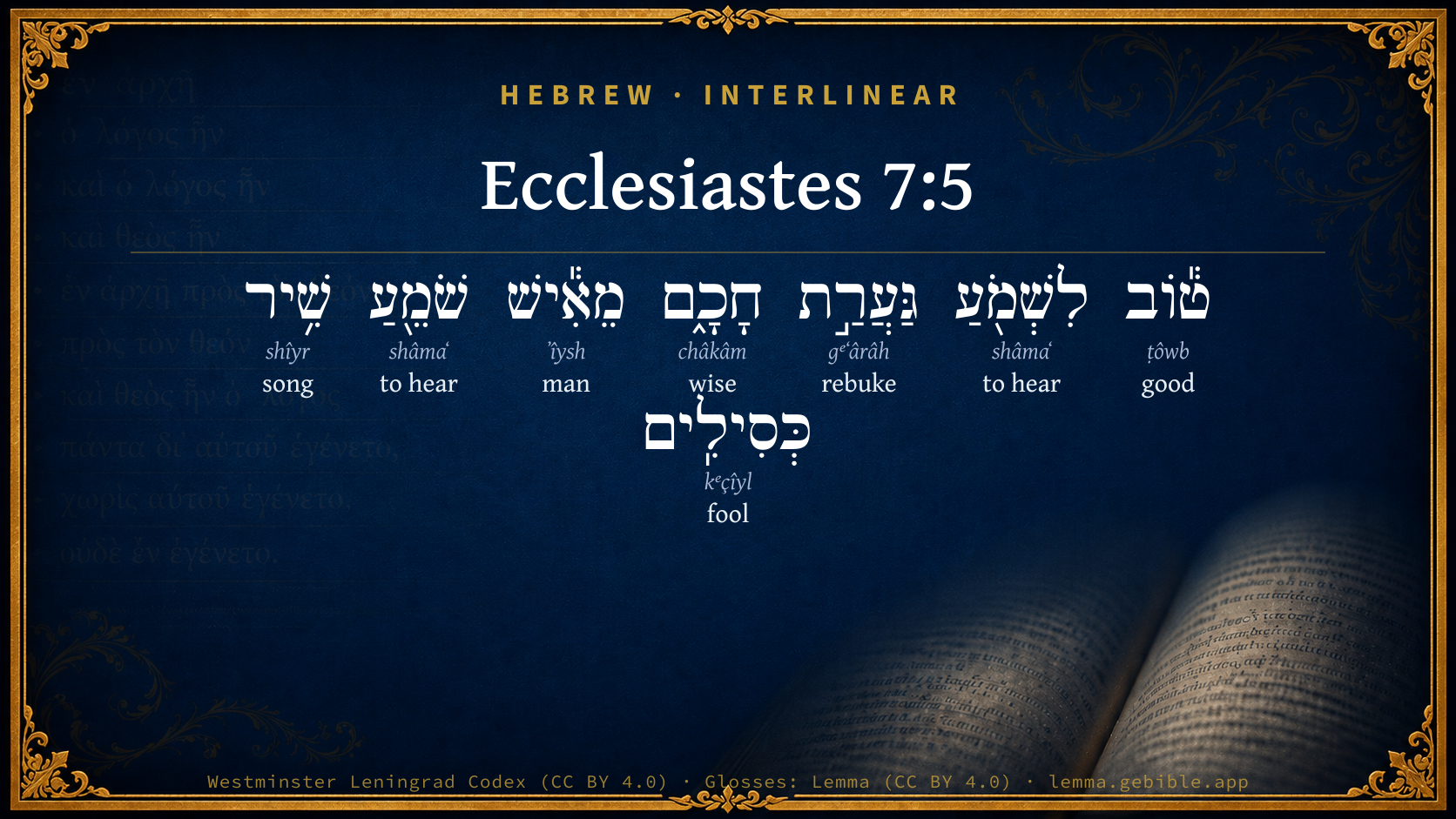
Hebrew (Westminster Leningrad Codex) Ecclesiastes 7:5 appears in the Hebrew Old Testament. The text above is from the Westminster Leningrad Codex. Each word links to its Strong’s number, a concise gloss, and parsing drawn from the Open Scriptures Hebrew Bible morphology. Click any word for its full Brown-Driver-Briggs (BDB) entry.
Download image
Cite this verse

Ecclesiastes 7:5 (World English Bible). Public Domain. Lemma interlinear Bible study tool, https://lemma.gebible.app/v/ecclesiastes/7/5.

Show BibTeX & RIS
BibTeX
RIS
English Translation
It is better to hear the rebuke of the wise, than for a man to hear the song of fools.
World English Bible · Public Domain
Download a study sheet

One document with this verse’s original text, its word-by-word gloss line, the meaning frame, cross-references with their text, attributed commentary, and full source and license credits — printable, and it pastes into notes with its structure intact.

This verse Autodidact and up

Study sheet (.html) Plain text (.txt)

A passage Seminary Student

Up to 50 verses in one chapter. A passage sheet keeps up to 6 commentary sources and 12 cross-references per verse, in the order this page ranks them, and says so on the sheet whenever that leaves anything out. Ask for a single verse and you get the Autodidact verse sheet above.

Everything on this page stays free to read, with no account — the sheet is a download of what is already on screen, not access to it.

Want to remove ads? Support Godless Engineer
Compare translations 3

The same verse in 3 English versions, stacked beneath the original-language interlinear above. Click any original word for its lexicon entry.

Each is an independent rendering of the whole verse — the interlinear is not word-aligned to these translations.

Highlighted words mark where these versions differ — a whole-verse word diff, not a word-by-word alignment.

  • World English Bible Public Domain
    It is better to hear the rebuke of the wise, than for a man to hear the song of fools.
  • King James Version Public Domain
    It is better to hear the rebuke of the wise, than for a man to hear the song of fools.
  • unfoldingWord Literal Text CC BY-SA 4.0
    Better to listen to a rebuke of wise than a person listening to a song of fools,

unfoldingWord Literal Text — © unfoldingWord, licensed CC BY-SA 4.0. Word-aligned USFM3 via Door43 (git.door43.org/unfoldingWord/en_ult).

Versions to compare (up to 4)

3 of 4 selected

Show all 18 translations

Every available English version of this verse, each an independent rendering of the whole verse.

  • World English Bible Public Domain
    It is better to hear the rebuke of the wise, than for a man to hear the song of fools.
  • Berean Standard Bible Public Domain
    It is better to heed a wise man’s rebuke than to listen to the song of fools.
  • Majority Standard Bible Public Domain
    It is better to heed a wise man’s rebuke than to listen to the song of fools.
  • King James Version Public Domain
    It is better to hear the rebuke of the wise, than for a man to hear the song of fools.
  • American Standard Version (1901) Public Domain
    It is better to hear the rebuke of the wise, than for a man to hear the song of fools.
  • Revised Version (1885) Public Domain
    It is better to hear the rebuke of the wise, than for a man to hear the song of fools.
  • Geneva Bible (1599) Public Domain
    Anger is better then laughter: for by a sad looke the heart is made better.
  • Douay-Rheims (1899) Public Domain
    The heart of the wise is where there is mourning, and the heart of fools where there is mirth.
  • Young's Literal Translation Public Domain
    Better to hear a rebuke of a wise man, Than `for' a man to hear a song of fools,
  • Literal Standard Version CC BY-SA 4.0
    Better to hear a rebuke of a wise man, || Than [for] a man to hear a song of fools,
  • Unlocked Literal Bible CC BY-SA 4.0
    It is better to listen to the rebuke of the wise than to listen to the song of fools.
  • unfoldingWord Literal Text CC BY-SA 4.0
    Better to listen to a rebuke of wise than a person listening to a song of fools,
  • Darby Bible Public Domain
    It is better for a man to hear the rebuke of the wise, than to hear the song of fools.
  • World Messianic Bible Public Domain
    It is better to hear the rebuke of the wise than for a man to hear the song of fools.
  • Webster's Bible Public Domain
    It is better to hear the rebuke of the wise, than for a man to hear the song of fools.
  • Free Bible Version CC BY-SA 4.0
    It's better to listen to criticism from a wise person than to hear the song of fools.
  • Bible in Basic English Public Domain
    It is better to take note of the protest of the wise, than for a man to give ear to the song of the foolish.
  • JPS Tanakh (1917) Public Domain
    It is better to hear the rebuke of the wise, than for a man to hear the song of fools.

Literal Standard Version (2020), Covenant Press — licensed CC BY-SA 4.0. Text via the HelloAO Bible API (eBible.org). Unlocked Literal Bible (unfoldingWord) — licensed CC BY-SA 4.0. Text via the HelloAO Bible API (eBible.org). unfoldingWord Literal Text — © unfoldingWord, licensed CC BY-SA 4.0. Word-aligned USFM3 via Door43 (git.door43.org/unfoldingWord/en_ult). Free Bible Version, Dr. Jonathan Gallagher — licensed CC BY-SA 4.0. Text via the HelloAO Bible API (eBible.org).

Word by word

More ways to search: Search by grammar → Find every occurrence → Compare this word →

Practice this passage: Drill this verse → Learn its vocabulary →

About this verse

These counts appear in no published source. They are computed here, from the morphology-tagged text and Lemma’s own curated glosses. What Lemma adds →

8
words
7
distinct lemmas
Wisdom
section

Notable vocabulary

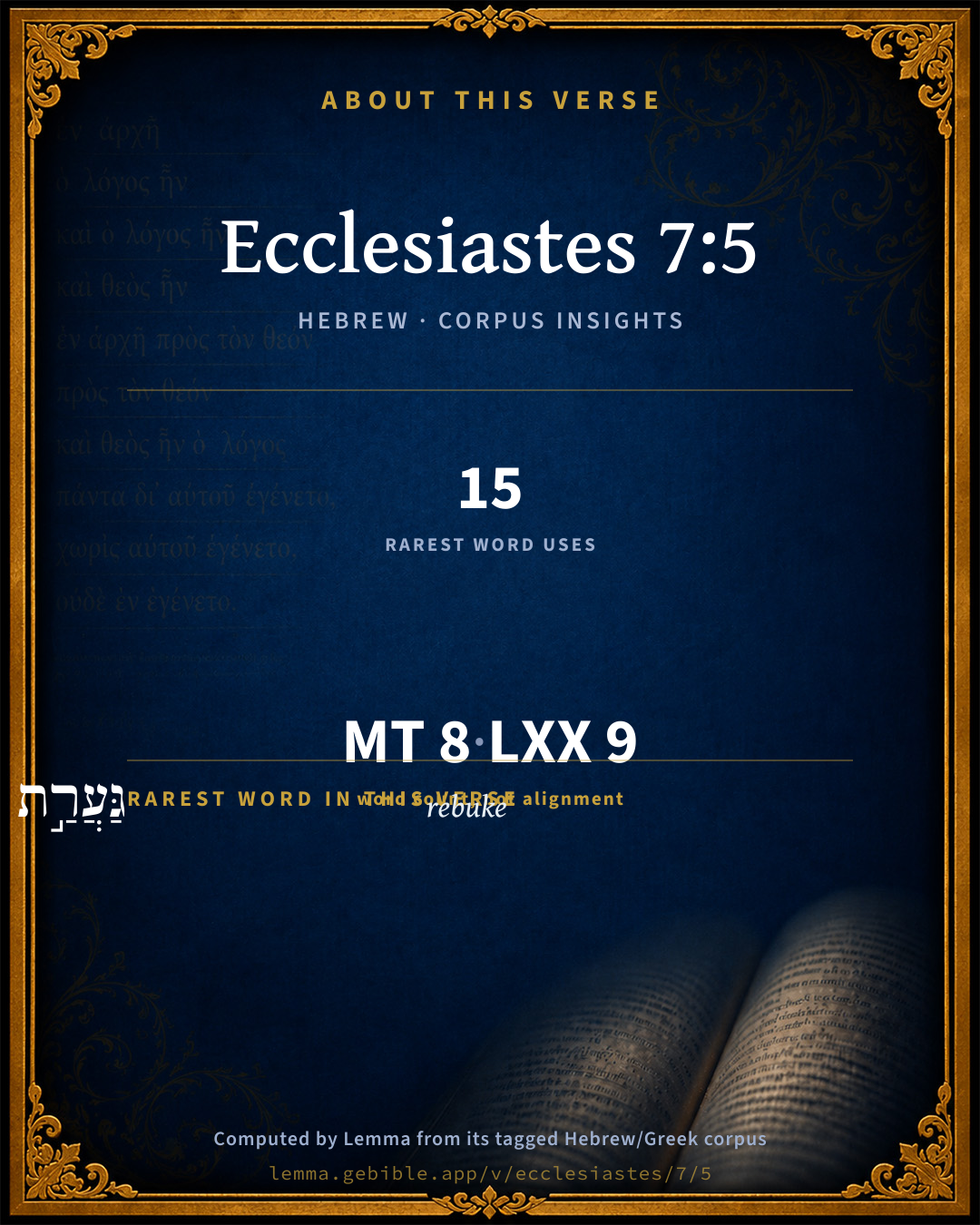
The rarest word here is גַּעֲרַ֣ת rebuke H1606 — appearing just 15 times in the whole Hebrew Bible.

Shared distinctive vocabulary

גַּעֲרַ֣ת rebuke H1606 occurs in 14 verses of the Hebrew Bible. Also found in:

Grammatical profile

  • 2 verbs
  • 3 nouns
  • 3 adjectives

Verb forms

  • לִשְׁמֹ֖עַ Qal · Infinitive Construct
  • שֹׁמֵ֖עַ Qal · Participle Active

Repetition

A word recurs within this verse — often emphatic in Hebrew:

  • לִשְׁמֹ֖עַ to hear H8085 ×2

Hebrew & Septuagint length

In English translation the verse runs 20 words from the Hebrew and 22 from the Septuagint (LXX English) — closely comparable.

A rough comparison of the two English renderings, which tokenize alike — not a word-level alignment.

Word counts can differ between the Hebrew and the Greek without any difference in meaning — e.g. the Hebrew direct-object marker אֵת has no separate Greek word, and Greek often adds the article ὁ.

In the original languages it is 8 Hebrew tokens and 9 Greek tokens — but the two are counted differently (Hebrew bundles its prefixes and suffixes into one token; the Greek is in lemma form), so that isn’t a like-for-like length.

Cross-references

9

Topical passages linked to Ecclesiastes 7:5 in the Treasury of Scripture Knowledge — connected by theme and wording, ordered by reader-vote popularity; previews shown in the World English Bible.

  • Proverbs 15:31–32 The ear that listens to reproof lives, And will be at home among the wise.
  • Psalms 141:5 Let the righteous strike me, it is kindness; Let him reprove me, it is like oil on the head; Don't let my head refuse it; Yet my prayer is always against evil deeds.
  • Revelation 3:19 As many as I love, I reprove and chasten. Be zealous therefore, and repent.
  • Proverbs 9:8 Don't reprove a scoffer, lest he hate you. Reprove a wise man, and he will love you.
  • Proverbs 13:18 Poverty and shame come to him who refuses discipline, But he who heeds correction shall be honored.
  • Proverbs 17:10 A rebuke enters deeper into one who has understanding Than a hundred lashes into a fool.
  • Psalms 69:12 Those who sit in the gate talk about me. I am the song of the drunkards.
  • Proverbs 13:13 Whoever despises instruction will pay for it, But he who respects a command will be rewarded.
  • Proverbs 27:6 Faithful are the wounds of a friend; Although the kisses of an enemy are profuse.

Cross-references courtesy of OpenBible.info (CC BY 4.0).

Hebrew and Greek witnesses Masoretic Hebrew ↔ Greek Septuagint

The same verse in the two great witnesses to the Old Testament, shown verse-for-verse.

These are two independent witnesses, not word-aligned to each other, and the Septuagint is shown in lemma (dictionary) form.

Hebrew Ecclesiastes 7:5 Masoretic · Westminster Leningrad Codex

ט֕וֹב לִשְׁמֹ֖עַ גַּעֲרַ֣ת חָכָ֑ם מֵאִ֕ישׁ שֹׁמֵ֖עַ שִׁ֥יר כְּסִילִֽים

It is better to hear the rebuke of the wise, than for a man to hear the song of fools.

World English Bible · Public Domain

Greek LXX Ecclesiastes 7:5 Septuagint · lemma form

ἀγαθός ὁ ἀκούω ἐπιτίμησις σοφός ὑπέρ ἀνήρ ἀκούω ἆ

The heart of the wise is in the house of mourning; but the heart of fools is in the house of mirth.

LXX2012 (modern English Septuagint) · Public Domain

Hebrew: Westminster Leningrad Codex (CC BY 4.0). Greek: Septuagint (public domain); English from LXX2012 (modern English Septuagint) (Public Domain). How the Septuagint differs from the Hebrew →

Commentary

Notes on Ecclesiastes 7:5 from classic Christian and Jewish commentators (each source and its license shown beneath its notes). The classic Christian expositions comment on the surrounding passage and are grouped to its opening verse, so a note may address several verses; the Jewish commentaries on the Tanakh (Rashi and others) are per-verse, so they appear only where the commentator wrote on this verse.

Lemma curates 59 commentaries, every one of them public domain or Creative Commons licensed, each selected and text-cleaned for this edition rather than reprinted as found. About our sources →

Trapp's Complete Commentary

John Trapp

Ecc 7:5 [It is] better to hear the rebuke of the wise, than for a man to hear the song of fools.

Ver. 5. It is better to hear the rebuke of the wise.] Sharp truth takes better with an honest heart than a smooth supparasitation. Seneca compares flattery to a song or symphony; but it is a syren’s song, and our ears must be stopped to it; for like the poison of asps, it casts one into a sleep, but that sleep is deadly. Those that had the sudor Anglicus, or sweating sickness, died assuredly, if allowed to sleep; those, then, were their best friends that kept them waking, though haply they had no thank for it; so are wise and merciful reprovers. "Faithful are these wounds of a friend." {Pro 27:6} {See Trapp on "Pro 27:6"} David was full glad of them; {Psa 141:5} so was Gerson, who never took anything more kindly, saith he that writes his life, than to be plainly dealt with. The bee can suck sweet honey out of bitter thyme, yea, out of poisonous hemlock. So can a wise man make benefit of his friends, nay, of his enemies. It is good to have friends (as the orator said of judges), mode audeant quae sentiunt, so they dare deal freely. This an enemy will do for spite; and malice though it be an ill judge, yet is a good informer. Augustine, in an epistle to Jerome, approves well of him that said, There is more good to be gotten by enemies railing than friends flattering. These sing Satan’s lullaby, such as casts into a dead lethargy, and should therefore be served as Alexander the Great served a certain philosopher whom he chased out of his presence, and gave this reason, Because he had lived long with him, and never reproved any vice in him; or as the same Alexander dealt by Aristobulus, the false historian, who had written a book of his noble acts, and had magnified them beyond truth, hoping thereby to ingratiate and curry favour: Alexander having read the book, cast it into the River Hydaspes, and told the author it were a good deed to throw him after, Qui solus me sic pugnantem facis. {a}

{a} Quint. Curt.

John Trapp, A Commentary or Exposition upon All the Books of the Old and New Testament (1647–1656) — public domain. Text from a community e-Sword module.

Joseph Benson's Commentary

Ecc 7:5-6. It is better to hear the rebuke of the wise — Which, though it cause some grief, yet frequently brings great benefit, even reformation, and salvation both from temporal and from eternal destruction; than the song of fools — Their flatteries, or merry discourses, which are as pleasant to corrupt nature as songs or music. For as the crackling of thorns — Which, for a time, make a great noise and blaze, but presently go out; so is the laughter of a fool — So vanishing and fruitless.

Joseph Benson's Commentary on the Old and New Testaments (1811–1818) — public domain. Text from a community e-Sword module.

Keil & Delitzsch

C. F. Keil & F. Delitzsch

A fourth proverb of that which is better (מן טוב) presents, like the third, the fools and the wise over against each other: "Better to hear the reproof of a wise man, than that one should hear the song of fools. For like the crackling of Nesseln (nettles) under the Kessel (kettle), so the laughter of the fool: also this is vain." As at Pro 13:1; Pro 17:10, גּערה is the earnest and severe words of the wise, which impressively reprove, emphatically warn, and salutarily alarm. שׁיר in itself means only song, to the exclusion, however, of the plaintive song; the song of fools is, if not immoral, yet morally and spiritually hollow, senseless, and unbridled madness. Instead of משּׁמע, the words מא שׁ are used, for the twofold act of hearing is divided between different subjects. A fire of thorn-twigs flickers up quickly and crackles merrily, but also exhausts itself quickly (Psa 118:12), without sufficiently boiling the flesh in the pot; whilst a log of wood, without making any noise, accomplishes this quietly and surely.

We agree with Knobel and Vaihinger in copying the paronomasia [Nessel-Kessel]. When, on the other hand, Zckler remarks that a fire of nettles could scarcely crackle, we advise our friend to try it for once in the end of summer with a bundle of stalks of tall dry nettles. They yield a clear blaze, a quickly expiring fire, to which here, as he well remarks, the empty laughter of foolish men is compared, who are devoid of all earnestness, and of all deep moral principles of life. This laughter is vain, like that crackling.

There is a hiatus between Ecc 7:6 and Ecc 7:7. For how Ecc 7:7 can be related to Ecc 7:6 as furnishing evidence, no interpreter has as yet been able to say. Hitzig regards Ecc 7:6 as assigning a reason for Ecc 7:5, but 6b as a reply (as Ecc 7:7 containing its motive shows) to the assertion of Ecc 7:5, - a piece of ingenious thinking which no one imitates. Elster translates: "Yet injustice befools a wise man," being prudently silent about this "yet." Zckler finds, as Knobel and Ewald do, the mediating thought in this, that the vanity of fools infects and also easily befools the wise. But the subject spoken of is not the folly of fools in general, but of their singing and laughter, to which Ecc 7:7 has not the most remote reference. Otherwise Hengst.: "In Ecc 7:7, the reason is given why the happiness of fools is so brief; first, the mens sana is lost, and then destruction follows." But in that case the words ought to have been כסיל יהולל; the remark, that חכם here denotes one who ought to be and might be such, is a pure volte. Ginsburg thinks that the two verses are co-ordinated by כי; that Ecc 7:6 gives the reason for Ecc 7:5, and Ecc 7:7 that for Ecc 7:5, since here, by way of example, one accessible to bribery is introduced, who would act prudently in letting himself therefore be directed by a wise man. But if he had wished to be thus understood, the author would have used another word instead of חכם, 7a, and not designated both him who reproves and him who merits reproof by the one word - the former directly, the latter at least indirectly. We do not further continue the account of the many vain attempts that have been made to bring Ecc 7:7 into connection with Ecc 7:6 and Ecc 7:5. Our opinion is, that Ecc 7:7 is the second half of a tetrastich, the first half of which is lost, which began, as is to be supposed, with tov. The first half was almost the same as Psa 37:16, or better still, as Pro 16:8, and the whole proverb stood thus:

טוב מעט בּחדקה

מרב תּבוּאות בּלא משׁפּט׃

[and then follows Ecc 7:7 as it lies before us in the text, formed into a distich, the first line of which terminates with חכם]. We go still further, and suppose that after the first half of the tetrastich was lost, that expression, "also this is vain," added to Ecc 7:6 by the punctuation, was inserted for the purpose of forming a connection for כי עשק: Also this is vain, that, etc. (כי, like asher, Ecc 8:14).

Keil & Delitzsch — Biblical Commentary on the Old Testament (1861–1891) — public domain (CC PDM 1.0). Text via the HelloAO Bible API. (Old Testament only.)

Tyndale Open Study Notes

Tyndale Open Resources

7:5-6 Being praised by a fool and enjoying a fool’s laughter are short-lived and worthless. Being criticized by a wise person can lead to real gain (Prov 17:10).

Tyndale Open Study Notes — © Tyndale Open Resources, licensed CC BY-SA 4.0. Text via the HelloAO Bible API.

Jamieson, Fausset & Brown

Robert Jamieson, A. R. Fausset & David Brown

(Psa 141:4-5). Godly reproof offends the flesh, but benefits the spirit. Fools' songs in the house of mirth please the flesh, but injure the soul.

Jamieson, Fausset & Brown — Commentary Critical and Explanatory on the Whole Bible (1871) — public domain (CC PDM 1.0). Text via the HelloAO Bible API.

The Cambridge Bible for Schools and Colleges

gen. ed. J. J. S. Perowne

5. It is better to hear the rebuke of the wise] The word for “rebuke” is characteristic of the sapiential books of the Old Testament (Pro_13:1; Pro_17:10). Here also the teacher finds the moral that “pain is gain.” The “rebuke” is not pleasant, but it acts with a power to heal. The “song of fools” points to the type of lyric poetry of which we have examples in Anacreon, perhaps to the more wanton and impure poems which entered so largely into Greek life, and are preserved in such abundance in the Anthologia Græca. The comic drinking songs of a people represent at all times the lowest form of its animal life, and with these also, either in his own country or in Greek-speaking lands, the writer of the book had become acquainted. Amo_6:5 indicates the existence of a like form of revelry in the older life of Israel. Such songs left a taint behind them and the man was permanently the worse for it. In Eph_5:4 we may probably trace a reference to the same form of literature.

The Cambridge Bible for Schools and Colleges (gen. ed. J. J. S. Perowne; Cambridge University Press, 1878–1918) — public domain. Text from a community e-Sword module.

John Gill's Exposition

It is better to hear the rebuke of the wise,.... To listen to it diligently, receive it cordially, and act according to it; though it may be disagreeable to the flesh, and give present pain, yet the effect and issue will be good, and show that man to be wise that hears it, as well as he that gives it; see Psa 141:1;

than for a man to hear the song of fools; the vain and impure songs that foolish men sing in the house of mirth; or the flatteries of foolish men, which tickle and please the mind, as music and songs do: or, "than a man that hears the song of fools" (i), and is pleased with it.

(i) "quam vir audiens canticum stultorum", Montanus, Mercerus; "prae viro audiente canticum stultorum", Rambachius.

John Gill's Exposition of the Whole Bible (1746–1763) — public domain (CC PDM 1.0). Text via the HelloAO Bible API.

Haydock's Catholic Bible Commentary

Mourning. They submit willingly to correction, (St. Jerome) or think seriously on the dangers of sin and God’s judgments.

George Leo Haydock (1774–1849), Haydock's Catholic Family Bible and Commentary, 1859 edition — public domain. Excludes Psalms (Douay-Rheims chapter numbering differs from Protestant) and Deuterocanonical books (Catholic canon only).

Matthew Poole's English Annotations

The rebuke of the wise, though it causeth some grief, yet frequently brings great benefit, even reformation and salvation, both from temporal and from eternal destruction, both which are the portion of impenitent sinners.

The song; the flatteries, or other merry discourses, which are as pleasant to corrupt nature, as songs or music.

Matthew Poole's English Annotations on the Holy Bible (1683–1685) — public domain. Text from a community e-Sword/MySword module.

Whedon's Commentary on the Bible

Daniel D. Whedon

5. Better… for a man — The transition is easy from the monitions of death to the counsels of the living. As the term man belongs to both clauses, it might more properly stand in the former. It is better for a man, etc. “Let the righteous smite me,” says the psalmist, “it shall be a kindness” — better than a fool’s music.

Daniel D. Whedon (gen. ed.), Commentary on the Old and New Testaments (1874–1909) — public domain. Text from a community e-Sword module.

The Pulpit Commentary

It is better to hear the rebuke of the wise. Gearah, "rebuke," is the word used in Proverbs for the grave admonition which heals and strengthens while it wounds. (see Pro_13:1 Pro_17:10) The silent lessons which a man learns from the contemplation of others" sorrow are rightly supplemented by the salutary correction of the wise man"s tongue. Than for a man to hear the song of fools. Shir, song," is a general term used of sacred or profane song; the connection here with the second clause of ver. 4, etc., leads one to think of the hoister-cue, reckless, often immodest, singing heard in the house of revelry, such as Amos (Amo_6:5) calls "idle songs to the sound of the viol" Koheleth might have heard these in his own country, without drawing his experience from the license of Greek practice or the impurity of Greek lyrics. The Vulgate renders the clause, Quum stultorum adulatione decipi, Than to be deceived by the flattery of tools." This is a paraphrase; the correctness is negatived by the explanation given in the following verse.

The Pulpit Commentary (1880–1919), ed. H.D.M. Spence-Jones & Joseph S. Exell — public domain. Text from a community e-Sword module.

unfoldingWord translationNotes

Door43 World Missions Community

to the rebuke of the wise

The word "rebuke" can be expressed as a verb. AT: "when wise people rebuke you" (See: Abstract Nouns)

to listen to the song of fools

"to listen to fools sing"

For like the crackling of thorns burning under a pot, so also is the laughter of fools

This speaks of how listening to fools talk and laugh will teach you nothing, as if their speech and laughter were the sound of burning thorns. AT: "For listening to the laughter of fools will not teach a man any more than if he were listening to the crackling of thorns burning under a pot" (See: Simile)

vapor

The author speaks of useless and meaningless things as if they were mist. See how you translated this in Ecclesiastes 1:14. AT: "as useless as vapor" or "meaningless" (See: Metaphor)

translationWords

rebuke

thorn

unfoldingWord translationNotes — © Distant Shores Media and the Door43 World Missions Community, licensed CC BY-SA 4.0. Source: git.door43.org/Door43/en_tn.

Lesson kit

Teaching starters — assembled from the data on this page, not authored interpretation. Every prompt links to the verse data it draws on. Edit before teaching.

Ecclesiastes, in the Wisdom, opens this verse with 8 words (7 distinct Hebrew lemmas). Its most distinctive word is gᵉʻârâh (“rebuke”). A historical commentator’s framing appears above. Read the whole chapter for the surrounding context.

Discussion questions

  1. How does “rebuke” (gᵉʻârâh) shape what this verse is saying?
  2. 2 Samuel 22:16 shares the word «rebuke» with this verse. How do the two illuminate each other?
  3. “to hear” occurs 2× in this one verse. What is the effect of the repetition?
  4. These translations render this verse differently. What is at stake in choosing one wording over another?
  5. The verb «לִשְׁמֹ֖עַ» is Qal Infinitive Construct. How does its form color the action?
  6. Reading how Trapp's Complete Commentary and Joseph Benson's Commentary read this verse, where do the two commentators agree and where do they part?

Things to notice

Reading settings

Reading text

Shown beneath each verse's original-language words.

Old Testament
Old Testament edition

Read the OT as the Masoretic Hebrew (MT) or the Greek Septuagint (LXX).

English shown for the Greek Septuagint (in the Hebrew ↔ Greek comparison).

Comparing translations? Open the Compare panel on any verse page to stack up to four side by side.