
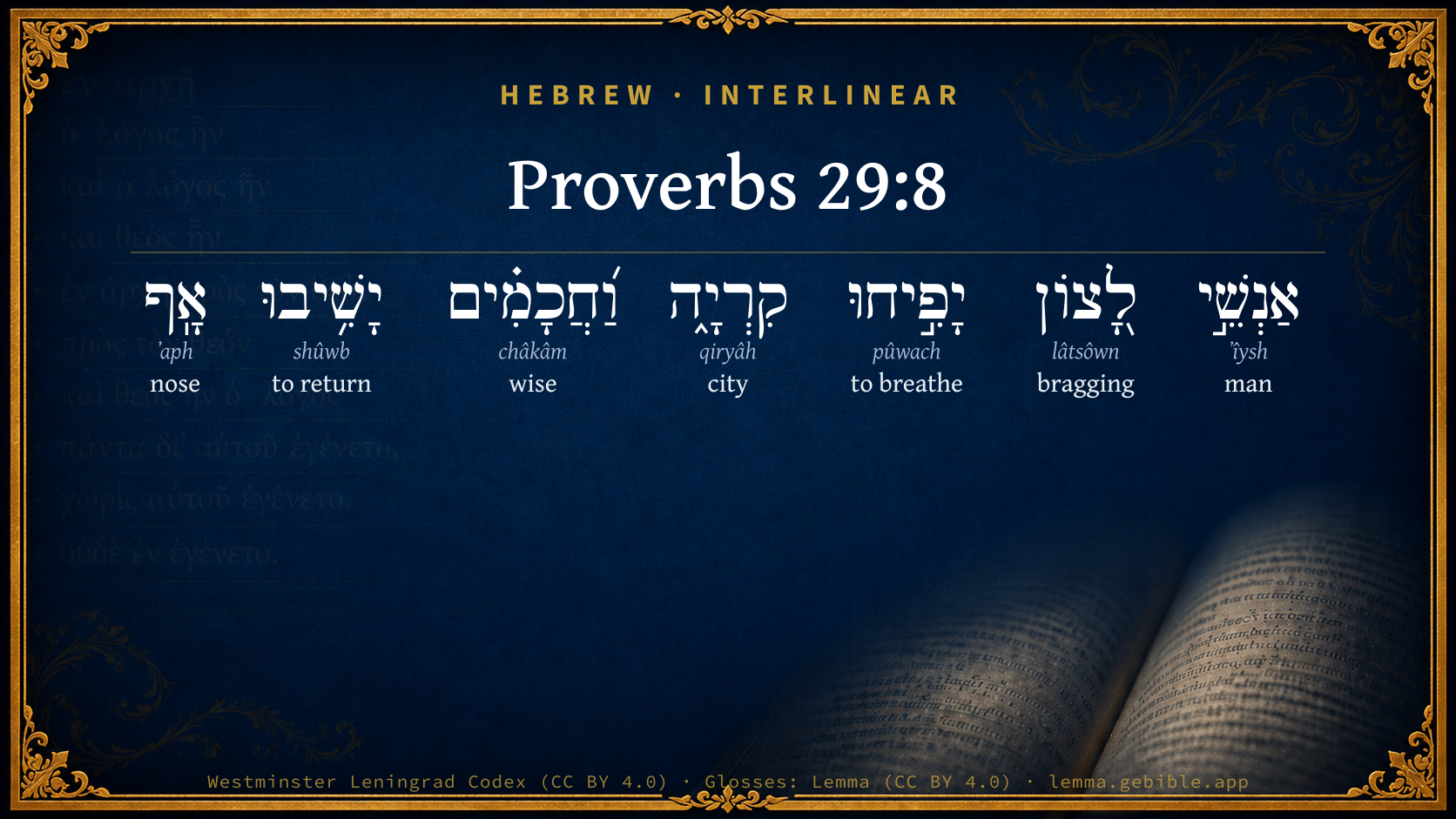
Proverbs 29:8

Hebrew (Westminster Leningrad Codex) Proverbs 29:8 appears in the Hebrew Old Testament. The text above is from the Westminster Leningrad Codex. Each word links to its Strong’s number, a concise gloss, and parsing drawn from the Open Scriptures Hebrew Bible morphology. Click any word for its full Brown-Driver-Briggs (BDB) entry.
Download image
Cite this verse

Proverbs 29:8 (World English Bible). Public Domain. Lemma interlinear Bible study tool, https://lemma.gebible.app/v/proverbs/29/8.

Show BibTeX & RIS
BibTeX
RIS
English Translation
Mockers stir up a city, But wise men turn away anger.
World English Bible · Public Domain
Download a study sheet

One document with this verse’s original text, its word-by-word gloss line, the meaning frame, cross-references with their text, attributed commentary, and full source and license credits — printable, and it pastes into notes with its structure intact.

This verse Autodidact and up

Study sheet (.html) Plain text (.txt)

A passage Seminary Student

Up to 50 verses in one chapter. A passage sheet keeps up to 6 commentary sources and 12 cross-references per verse, in the order this page ranks them, and says so on the sheet whenever that leaves anything out. Ask for a single verse and you get the Autodidact verse sheet above.

Everything on this page stays free to read, with no account — the sheet is a download of what is already on screen, not access to it.

Want to remove ads? Support Godless Engineer
Compare translations 3

The same verse in 3 English versions, stacked beneath the original-language interlinear above. Click any original word for its lexicon entry.

Each is an independent rendering of the whole verse — the interlinear is not word-aligned to these translations.

Highlighted words mark where these versions differ — a whole-verse word diff, not a word-by-word alignment.

  • World English Bible Public Domain
    Mockers stir up a city, But wise men turn away anger.
  • King James Version Public Domain
    Scornful men bring a city into a snare: but wise men turn away wrath.
  • unfoldingWord Literal Text CC BY-SA 4.0
    Men of mockery inflame a city, but the wise turn away nose.

unfoldingWord Literal Text — © unfoldingWord, licensed CC BY-SA 4.0. Word-aligned USFM3 via Door43 (git.door43.org/unfoldingWord/en_ult).

Versions to compare (up to 4)

3 of 4 selected

Show all 18 translations

Every available English version of this verse, each an independent rendering of the whole verse.

  • World English Bible Public Domain
    Mockers stir up a city, But wise men turn away anger.
  • Berean Standard Bible Public Domain
    Mockers inflame a city, but the wise turn away anger.
  • Majority Standard Bible Public Domain
    Mockers inflame a city, but the wise turn away anger.
  • King James Version Public Domain
    Scornful men bring a city into a snare: but wise men turn away wrath.
  • American Standard Version (1901) Public Domain
    Scoffers set a city in a flame; But wise men turn away wrath.
  • Revised Version (1885) Public Domain
    Scornful men set a city in a flame: but wise men turn away wrath.
  • Geneva Bible (1599) Public Domain
    Scornefull men bring a citie into a snare: but wise men turne away wrath.
  • Douay-Rheims (1899) Public Domain
    Corrupt men bring a city to ruin: but wise men turn away wrath.
  • Young's Literal Translation Public Domain
    Men of scorning ensnare a city, And the wise turn back anger.
  • Literal Standard Version CC BY-SA 4.0
    Men of scorning ensnare a city, || And the wise turn back anger.
  • Unlocked Literal Bible CC BY-SA 4.0
    Mockers set a city on fire, but those who are wise turn away wrath.
  • unfoldingWord Literal Text CC BY-SA 4.0
    Men of mockery inflame a city, but the wise turn away nose.
  • Darby Bible Public Domain
    Scornful men set the city in a flame; but the wise turn away anger.
  • World Messianic Bible Public Domain
    Mockers stir up a city, but wise men turn away anger.
  • Webster's Bible Public Domain
    Scornful men bring a city into a snare: but wise men turn away wrath.
  • Free Bible Version CC BY-SA 4.0
    Cynical people can inflame a whole city, but the wise calm angry people down.
  • Bible in Basic English Public Domain
    Men of pride are the cause of violent acts in a town, but by wise men wrath is turned away.
  • JPS Tanakh (1917) Public Domain
    Scornful men set a city in a blaze; but wise men turn away wrath.

Literal Standard Version (2020), Covenant Press — licensed CC BY-SA 4.0. Text via the HelloAO Bible API (eBible.org). Unlocked Literal Bible (unfoldingWord) — licensed CC BY-SA 4.0. Text via the HelloAO Bible API (eBible.org). unfoldingWord Literal Text — © unfoldingWord, licensed CC BY-SA 4.0. Word-aligned USFM3 via Door43 (git.door43.org/unfoldingWord/en_ult). Free Bible Version, Dr. Jonathan Gallagher — licensed CC BY-SA 4.0. Text via the HelloAO Bible API (eBible.org).

Word by word

More ways to search: Search by grammar → Find every occurrence → Compare this word →

Practice this passage: Drill this verse → Learn its vocabulary →

About this verse

These counts appear in no published source. They are computed here, from the morphology-tagged text and Lemma’s own curated glosses. What Lemma adds →

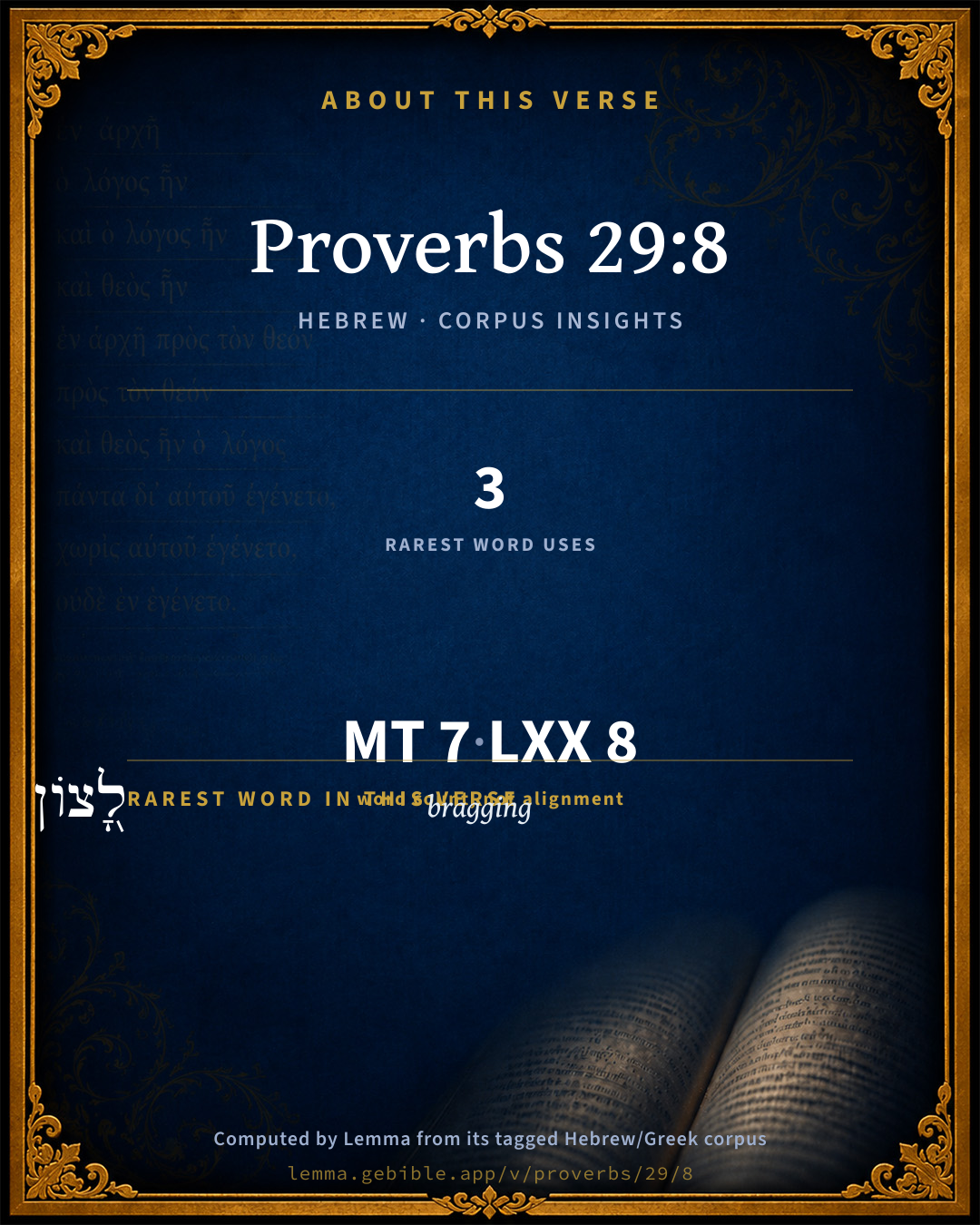
7
words
7
distinct lemmas
Wisdom
section

Notable vocabulary

The rarest word here is לָ֭צוֹן bragging H3944 — appearing just 3 times in the whole Hebrew Bible.

Shared distinctive vocabulary

לָ֭צוֹן bragging H3944 occurs in 3 verses of the Hebrew Bible. Also found in:

Grammatical profile

  • 2 verbs
  • 4 nouns
  • 1 adjective

Verb forms

  • יָפִ֣יחוּ Hiphil · Imperfect
  • יָשִׁ֥יבוּ Hiphil · Imperfect

Hebrew & Septuagint length

In English translation the verse runs 11 words from the Hebrew and 12 from the Septuagint (LXX English) — closely comparable.

A rough comparison of the two English renderings, which tokenize alike — not a word-level alignment.

Word counts can differ between the Hebrew and the Greek without any difference in meaning — e.g. the Hebrew direct-object marker אֵת has no separate Greek word, and Greek often adds the article ὁ.

In the original languages it is 7 Hebrew tokens and 8 Greek tokens — but the two are counted differently (Hebrew bundles its prefixes and suffixes into one token; the Greek is in lemma form), so that isn’t a like-for-like length.

Cross-references

17

Topical passages linked to Proverbs 29:8 in the Treasury of Scripture Knowledge — connected by theme and wording, ordered by reader-vote popularity; previews shown in the World English Bible.

  • Proverbs 11:11 By the blessing of the upright, the city is exalted, But it is overthrown by the mouth of the wicked.
  • Jeremiah 15:1 Then said Yahweh to me, Though Moses and Samuel stood before me, yet my mind would not be toward this people: cast them out of my sight, and let them go forth.
  • Proverbs 16:14 The king's wrath is a messenger of death, But a wise man will pacify it.
  • James 3:5–6 So the tongue is also a little member, and boasts great things. See how a small fire can spread to a large forest!
  • James 5:15–18 and the prayer of faith will heal him who is sick, and the Lord will raise him up. If he has committed sins, he will be forgiven.
  • Exodus 32:10–14 Now therefore leave me alone, that my wrath may burn hot against them, and that I may consume them; and I will make of you a great nation."
  • Numbers 16:48 He stood between the dead and the living; and the plague was stayed.
  • Numbers 25:11 Phinehas, the son of Eleazar, the son of Aaron the priest, has turned my wrath away from the children of Israel, in that he was jealous with my jealousy among them, so that I didn't consume the children of Israel in my jealousy.
  • Deuteronomy 9:18–20 I fell down before Yahweh, as at the first, forty days and forty nights; I did neither eat bread nor drink water; because of all your sin which you sinned, in doing that which was evil in the sight of Yahweh, to provoke him to anger.
  • 2 Samuel 24:16–17 When the angel stretched out his hand toward Jerusalem to destroy it, Yahweh repented him of the evil, and said to the angel who destroyed the people, It is enough; now stay your hand. The angel of Yahweh was by the threshing floor of Araunah the Jebusite.
  • Isaiah 28:14–22 Why hear the word of Yahweh, you scoffers, that rule this people that is in Jerusalem:
  • Ezekiel 22:30 I sought for a man among them, who should build up the wall, and stand in the gap before me for the land, that I should not destroy it; but I found none.
  • Amos 7:2–6 It happened that, when they made an end of eating the grass of the land, then I said, "Lord Yahweh, forgive, I beg you! How could Jacob stand? For he is small."
  • Matthew 27:39–43 Those who passed by blasphemed him, wagging their heads,
  • John 9:40–41 Those of the Pharisees who were with him heard these things, and said to him, "Are we also blind?"
  • John 11:47–50 The chief priests therefore and the Pharisees gathered a council, and said, "What are we doing? For this man does many signs.
  • 1 Thessalonians 2:15–16 who killed both the Lord Jesus and their own prophets, and drove us out, and didn't please God, and are contrary to all men;

Cross-references courtesy of OpenBible.info (CC BY 4.0).

Hebrew and Greek witnesses Masoretic Hebrew ↔ Greek Septuagint

The same verse in the two great witnesses to the Old Testament, shown verse-for-verse.

These are two independent witnesses, not word-aligned to each other, and the Septuagint is shown in lemma (dictionary) form.

Hebrew Proverbs 29:8 Masoretic · Westminster Leningrad Codex

אַנְשֵׁ֣י לָ֭צוֹן יָפִ֣יחוּ קִרְיָ֑ה וַ֝חֲכָמִ֗ים יָשִׁ֥יבוּ אָֽף

Mockers stir up a city, But wise men turn away anger.

World English Bible · Public Domain

Greek LXX Proverbs 29:8 Septuagint · lemma form

ἀνήρ λοιμός ἐκκαύω πόλις σοφός δέ ἀποστρέφω ὀργή

Lawless men burn down a city: but wise men turn away wrath.

LXX2012 (modern English Septuagint) · Public Domain

On this verse, The Cambridge Bible for Schools and Colleges discusses the Septuagint’s reading. Read the note in Commentary ↓

Hebrew: Westminster Leningrad Codex (CC BY 4.0). Greek: Septuagint (public domain); English from LXX2012 (modern English Septuagint) (Public Domain). How the Septuagint differs from the Hebrew →

Commentary

Notes on Proverbs 29:8 from classic Christian and Jewish commentators (each source and its license shown beneath its notes). The classic Christian expositions comment on the surrounding passage and are grouped to its opening verse, so a note may address several verses; the Jewish commentaries on the Tanakh (Rashi and others) are per-verse, so they appear only where the commentator wrote on this verse.

Lemma curates 59 commentaries, every one of them public domain or Creative Commons licensed, each selected and text-cleaned for this edition rather than reprinted as found. About our sources →

Trapp's Complete Commentary

John Trapp

Pro 29:8 Scornful men bring a city into a snare: but wise [men] turn away wrath.

Ver. 8. Scornful men bring a city into a snare.] The Vulgate render it, Pestilent persons undo a city or a state; as Nahash did the Ammonites, {1Sa 11:2; 1Sa 11:11} and as his son Hanan did much more. {2Sa 10:4; 2Sa 12:31} Mocking is catching, as the pestilence, and no less pernicious to the whole country. Geraldus Cambrensis tells of three Irish kings that, being derided for their rude habits and fashions, rebelled, and set the country in a combustion. And the young King of France, jesting at William the Conqueror’s great belly, whereof he said he lay in at Rouen, so irritated him, as he being recovered of a sickness, entered France in the chiefest time of their fruits, making spoil of all in his way, till he came even to Paris, where this scornful king then was, to show him of his visiting, and from thence marched to the city of Mants, which he utterly sacked and ransacked, razed and harassed. {a}

But wise men turn away wrath.] They stand in the gap, and divert the divine displeasure. {Psa 106:23 Eze 13:5} Their persons are in acceptation; God will look upon them, and do much for them, when he is most of all angry with the wicked. {Exo 32:10; Exo 32:14 Job 22:30 Gen 18:32} Their prayers also are prevalent. Something the Lord will yield thereunto, when most bitterly bent against a people, {Mat 24:20} and when unchangeably resolved upon their ruin, he takes course to silence such; "Pray not for this people." " Sanctum semen statumen terrae" {Isa 6:13} "The innocent shall deliver the island." {Job 22:30}

{a} Dan. Chron., 42.

John Trapp, A Commentary or Exposition upon All the Books of the Old and New Testament (1647–1656) — public domain. Text from a community e-Sword module.

The Biblical Illustrator

Joseph S. Exell

Pro_29:8

Scornful men bring a city into a snare.

The snares of the metropolis

As residents in London we ask, Is there as much wickedness here as in other great cities? Are there snares and temptations of a peculiar character, and highly dangerous to the rising youth of the age?

1. One of the snares is the spirit of the world--the spirit of competition and a low tone of moral feeling.

2. Irreligious habits.

3. Irreligious associates; such as the young man who is not conscientious in the discharge of his ordinary duties; the young man who is devoted to pleasure.

4. Late hours. This leads to neglect of prayer. And the late hour is the hour of sin.

5. Lewd women. This snare involves great moral debasement, the prostration of all intellectual power, and the annihilation of all benevolent and elevated feeling. And to this specific form other vices will adhere. (R. Ainslie.)

The Biblical Illustrator, edited by Joseph S. Exell (c. 1880s–1900s) — public domain. Text from a community e-Sword module.

Joseph Benson's Commentary

Pro 29:8. Scornful men — That mock at religion, the obligations of conscience, the fears of another world, and every thing that is sacred and serious; who when employed in the business of the state do things with precipitation, because they scorn to deliberate and take time for consultation; who do things illegal and unjustifiable, because they scorn to be bound and shackled by laws and constitutions; who provoke the people, because they scorn to please them; bring a city into a snare — Expose it to God’s wrath, and to destruction, by their self-conceit and wilfulness, by their wicked counsels and practices, whereby they seduce and infect the generality of the people; by their contempt of God, of his just laws and righteous judgments, and of the opinion and advice of wise men; but wise men — Who do not scorn, but hearken to, the counsels of God, and of prudent men; turn away wrath — The wrath of God or of men, who were enraged against it.

Joseph Benson's Commentary on the Old and New Testaments (1811–1818) — public domain. Text from a community e-Sword module.

The Preacher's Complete Homiletical Commentary

Joseph S. Exell (gen. ed.)

CRITICAL NOTES.—

Pro_29:8. Bring a city, etc., literally, “set a city on fire.”

Pro_29:9. The second clause should rather be “he rageth and laugheth (i.e., the fool), and there is no rest.”

MAIN HOMILETICS OF Pro_29:8

THE CITIZEN’S ENEMY AND THE CITIZEN’S FRIEND

I. A scornful man is a social calamity. A scorner is a man who has a great opinion of his own wisdom and ability, and a very low one of all who oppose him. From his self-constructed elevation he looks down upon those who refuse to obey him, and counts them his inferiors simply because they do so. This is a perilous course to pursue even when only individual interests are at stake, but when the scornful man holds the welfare of others in his hand, the disastrous effects of his conduct are more widely spread. When he is the only person who suffers from over-estimating himself and underrating the strength of his opponents the issue is hardly to be regretted, but Solomon here has in his mind a public man who brings ruin upon many besides himself by his proud disdain of their foes, and by his refusal to recognise a common danger. Goliath was such a man. As the representative and champion of the Philistines he over-estimated the value of his physical strength, and set too low an estimate upon the unseen power arrayed against him, and his scorn of his enemies brought a great calamity upon his nation. A scornful man brings the heaviest calamity upon a people when he scoffs at the power of God and persuades his followers to set at nought His demands and threatenings. This was the great crime of many of Solomon’s successors to the throne, and of the false prophets of Judah and Israel, and hence the sentence passed upon them and upon those who listened to them: “Wherefore hear the word of the Lord, ye scornful men, that rule this people which is in Jerusalem. Because ye have said, we have made a covenant with death, and with hell are we in agreement; when the overflowing scourge shall pass through, it shall not come unto us; for we have made lies our refuge, and under falsehood have we hid ourselves: Therefore thus saith the Lord God … Judgment also will I lay to the line, and righteousness to the plummet: and the hail shall sweep away the refuges of lies, and the waters shall overflow the hiding place,” etc. (Isa_28:14-22.)

II. A wise man is a social blessing. We have before seen (see on chap. Pro_14:16, page 364) that it is one of the characteristics of a wise man that he recognises the presence of moral danger in relation to himself, and the same may be said concerning danger of every kind, not only as regards himself, but others also. The recognition of danger is quite distinct from the fear of it; indeed those who are most quick to discern it have generally the most courage to meet it and the most wisdom to avert it. Scornful men generally have nothing but scorn wherewith to meet a foe, but the man who is truly wise can afford to acknowledge the strength of his enemies because he is fully prepared to meet them. If he seek to turn away the wrath of man by persuasion, he will be able to back his persuasion by wise reasoning, and if he strive to avert the wrath of God he will endeavour to bring those for whom he intercedes to such a state of mind as will render them fit to appreciate Divine pardon. But if he cannot do this his own character will give effect to his prayers, and as in the case of Moses and the children of Israel, God will spare many sinners for the sake of one righteous man.

OUTLINES AND SUGGESTIVE COMMENTS

Surely it was wisdom in the king and people of Nineveh, instead of bringing their city into a snare by scornful rebellion, to avert by timely humiliation the impending destruction. (Jon_3:5-10.) Let the people be gathered; let the ministers of the Lord gird themselves to their work of weeping and accepted pleaders for the land. (Joe_2:17.) Surely “except the Lord of Hosts had left us a very small remnant” of these powerful intercessors, “we should have been as Sodom, and we should have been like unto Gomorrah.” (Isa_1:9.) Praised be God! The voice is yet heard—“Destroy it not, for a blessing is in it.” (Isa_65:8.) The salt of the earth preserves it from corruption. (Mat_5:13.) Shall not we, then, honour these wise men with reverential gratitude—“My father—my father! the chariots of Israel, and the horsemen thereof?” … Moses—Exo_32:10-14; Deu_9:8-20; Psa_106:23; Aaron—Num_16:48; Phinehas Pro_25:11; Psa_106:30. Elijah—1Ki_18:42-45; Jas_5:16; Jas_5:18; Jer_18:20; Dan_9:3-20; Amo_7:1-6. The righteous remnant—Isa_1:9; Isa_6:13. Comp. Gen_18:32; Job_22:30; Jer_5:1; Eze_22:30-31. Contrast Pro_13:5.—Bridges.

For Homiletics on the subject of Pro_29:9, see on chaps. Pro_23:9, and Pro_26:3-11, pages 665 and 716.

The Preacher's Complete Homiletical Commentary (gen. ed. Joseph S. Exell; Funk & Wagnalls, c. 1892) — public domain (pre-1929). A full-Bible homiletical/sermon-outline anthology covering 65 of 66 books (2 John is absent from the source module). Text from a community e-Sword module.

Matthew Henry's Commentary

See here, 1. Who are the men that are dangerous to the public - scornful men. When such are employed in the business of the state they do things with precipitation, because they scorn to deliberate, and will not take time for consideration and consultation; they do things illegal and unjustifiable, because they scorn to be hampered by laws and constitutions; they break their faith, because they scorn to be bound by their word, and provoke the people, because they scorn to please them. Thus they bring a city into a snare by their ill conduct, or (as the margin reads it) they set a city on fire; they sow discord among the citizens and run them into confusion. Those are scornful men that mock at religion, the obligations of conscience, the fears of another world, and every thing that is sacred and serious. Such men are the plagues of their generation; they bring God's judgments upon a land, set men together by the ears, and so bring all to confusion. 2. Who are the men that are the blessings of a land - the wise men who by promoting religion, which is true wisdom, turn away the wrath of God, and who, by prudent counsels, reconcile contending parties and prevent the mischievous consequences of divisions. Proud and foolish men kindle the fires which wise and good men must extinguish.

Matthew Henry's Commentary on the Whole Bible (1708–1710) — public domain (CC PDM 1.0). Text via the HelloAO Bible API.

Jamieson, Fausset & Brown

Robert Jamieson, A. R. Fausset & David Brown

Scornful men--those who contemptuously disregard God's law.

bring--(Compare Margin), kindle strife.

turn away wrath--that is, "abate wrath."

Jamieson, Fausset & Brown — Commentary Critical and Explanatory on the Whole Bible (1871) — public domain (CC PDM 1.0). Text via the HelloAO Bible API.

Ellicott's Commentary for English Readers

(8) Scornful men.—See above on Pro_1:22.

Bring a city into a snare.—Rather, excite the passions of; literally, fan, as a flame.

Wise men turn away wrath.—By their gentle counsels.

A Bible Commentary for English Readers, edited by Charles John Ellicott (1878–1897) — public domain. Text from a community e-Sword module.

The Cambridge Bible for Schools and Colleges

gen. ed. J. J. S. Perowne

8. bring a city into a snare] Rather, set a city on fire, A. V. marg., or, in a flame, R.V.; ἐξέκαυσαν, LXX. Comp. Pro_20:10; Pro_26:21; and, for an illustration of the proverb, the story of Sheba the son of Bichri and the wise woman, 2 Samuel 20.

The Cambridge Bible for Schools and Colleges (gen. ed. J. J. S. Perowne; Cambridge University Press, 1878–1918) — public domain. Text from a community e-Sword module.

John Gill's Exposition

Scornful men bring a city into a snare,.... Such as despise dominion, speak evil of dignities; proud and haughty men, that speak Loftily, and with a contempt of their superiors; or who make a mock at religion, and scoff at all that is good and serious; these bring the inhabitants of a city into a snare, to rebel against their governors, and so into mischief and ruin: or, they "burn a city", as the Septuagint and Syriac versions (o); they inflame it, or blow it up into a flame; raise a combustion in it, and fill it with strifes and contentions; and bring down the wrath of God upon it, like fire: or, they "blow upon a city" (p); raise storms and tempests in it; turn all things upside down, and throw it into the utmost confusion, or blow it up;

but wise men turn away wrath; the wrath of men, by their wise counsels and advice, and appease tumults and seditions, and restore things to a quiet and settled state; or the wrath of God, by interposing with their prayers between him and a sinful people, as Moses did, Psa 106:23.

(o) "Inflammant urbem", Junius & Tremellius, Piscator. (p) "suffiant, vel periflant civitatem", Gejerus; "diffiant civitatem", Gussetius, p. 667. "exsuffiant civitatem", Cocceius, Schultens.

John Gill's Exposition of the Whole Bible (1746–1763) — public domain (CC PDM 1.0). Text via the HelloAO Bible API.

Albert Barnes' Notes on the Bible

Scornful men - The men who head political or religious revolutions, who inflame (literally as in the margin) the minds of the people against the powers that be.

Albert Barnes' Notes on the Bible (1834–1885) — public domain. Text from a community e-Sword/MySword module.

Haydock's Catholic Bible Commentary

Corrupt. Hebrew, "scoffers," who provoke both God and men.

George Leo Haydock (1774–1849), Haydock's Catholic Family Bible and Commentary, 1859 edition — public domain. Excludes Psalms (Douay-Rheims chapter numbering differs from Protestant) and Deuterocanonical books (Catholic canon only).

Matthew Poole's English Annotations

Bring a city into a snare; expose it to God’s wrath and to destruction by their self-conceit and wilfulness, by their wicked counsels and courses, whereby they seduce and infect the generality of the people, by their contempt of God, of his just laws and righteous judgments, and of the opinions and advice, of wise men.

Wise men, who do not scorn, but hearken to the counsels of God and of prudent men, turn away wrath; the wrath of God or of men, who were enraged against it.

Matthew Poole's English Annotations on the Holy Bible (1683–1685) — public domain. Text from a community e-Sword/MySword module.

Whedon's Commentary on the Bible

Daniel D. Whedon

8. Scornful men — Those who scoff at prudent counsels and good management.

Bring a city into a snare — The best critics prefer to render this, “inflame a city” — blow up a flame — incite the people.

Turn away wrath — Abate it, allay excitement. Comp. Eze_22:30; Exo_32:10-14; Psa_106:23.

Daniel D. Whedon (gen. ed.), Commentary on the Old and New Testaments (1874–1909) — public domain. Text from a community e-Sword module.

The Pulpit Commentary

Scornful men bring an airy into a snare. "Men of derision" (Isa_28:14) are those who despise and scoff at all things great and high, whether sacred or profane. (see on Pro_1:22) These are the persons who raise rebellion in a country and excite opposition to constituted authority. The rendering of Ytypiy, "bring into a snare," as in the Authorized Version, is supported by some of the Jewish versions and commentaries; but the more correct rendering is "blow into a blaze, inflame," as the Revised Version. (comp. Job_20:26 Eze_22:20, Eze_22:21) These scorners excite the populace to acts of fury, when all respect for piety and virtue is lost; they fan the passions of the fickle people, and lead them to civil discord and dangerous excesses. (comp. Pro_22:10) Septuagint, "Lawless men burn up a city." But wise men turn away wrath; by their prudent counsels allay the angry passions roused by those evil men. (see Ver. 11 and Pro_15:1, Pro_15:18)

Scornful men.

The evil of a contemptuous treatment of life and duty is to be seen in many relations. Let us consider some of them.

I SCORN FOR THE PEOPLE. This was the temper of the old monarchical and aristocratic systems. The mischief of it was seen in the explosion of the French Revolution. The "dim multitude" cannot be treated as so much chaff of the threshing floor. The nation is the people. The first interest of the nation is the welfare of the great bulk of the population, not the luxury of what is regarded as "the cream of society

II SCORN FOR THE POOR. This was the attitude of the wealthy Jews in ancient Israel, which called forth stern rebukes from the prophets of God; (e.g. Amo_6:3-6) and the same fault was detected in the Christian Church by St. James. (Jam_2:1-3) The indifference which too many of the prosperous feel for their hard-pressed, suffering brethren is one of the most dangerous symptoms of society. It lies at the root of socialism.

III SCORN FOR INJUSTICE. In some cases there is worse than poverty; there is Positive wrong doing. The powerful oppress the weak. Strong masters hold down miserable slaves. This evil condition was a perpetual cause of danger to Rome in its most prosperous age. It is seen in the "sweating system" in England today.

IV SCORN FOR DANGER. Misery and injustice are sources of danger. But other and direct dangers may menace a country. The scorn of pride will be no security against those dangers. We shall not be protected by staging, "Rule, Britannia," or by shouting, "Britons never shall be slaves.

V SCORN FOR WICKEDNESS. The greatest danger of the state is not in poverty at home; nor is it in war from abroad. It lies in the moral corruption of the people. Wholesale debauchery, widespread drunkenness, a perfect epidemic of gambling, profligacy, dishonesty, these are the cankers that eat out the vital strength of a nation. Indifference to such evils is contempt for moral law.

VI SCORN FOR RELIGION. In the race for wealth, in the dance of pleasure, in the mad orgy of worldly engagement, multitudes treat the claims of religion with scorn. Others, in their misery and despair, refuse to believe that any help or hope can come to them from heaven. This scornful attitude towards the first duties and the highest interests of life must be fraught with fatal consequences. Meanwhile the scornful attitude entirely excludes the beginnings of better things, Humility and repentance are impossible so long as this defiant mood is cherished.

Vers. 8-11. Dishonourable passions.

Such is the designation given by St. Paul (see Revised Version of the New Testament, Rom_1:26, etc.) to the various workings of the evil leaven in the soul. Here is a description of some of these "lusts.

I SCOFFING. (Ver. 8) Set on fire of hell, it inflames others, disturbs the peace of communities, produces failures and tumults in public life. But wisdom calms, and turns all things to the best. The scoffer, the malevolent critic of existing institutions, is a public pest; the judicious man, a public blessing. The one raises tumults, the other quells them.

II CONTENTIOUSNESS. (Ver. 9) It delights in dispute for dispute"s sake. The man of this vice does not want to elicit truth, but to find fuel for his passion. Alternating between rage and ridicule, he uses words merely as weapons of offence and defence. Egotism is at the root of all his activity.

III THE SANGUINARY TEMPER. (Ver. 10) All hatred to the truth involves hatred to the truth speaker and the truth doer. Here lies the secret of all persecution and of all judicial murders. But in ourselves, whenever we detect the rising of resentment against him who exposes our faults or fallacies, we may find something of the dark temper of him "who was of the wicked one, and slew his brother". (1Jn_3:12)

IV WANT OF SELF-CONTROL. (Ver. 11) The impetuous, unbridled temper, which explodes with wrath at the smallest provocation, or with ill-considered opinions. He is wise who knows when to hold his peace. We are not always to speak all we feel or think, but when we do speak should ever think what we say. We must remember that "there is a time to speak, and a time to keep silence. J.

Vers. 8-10. The senselessness of scorn, etc.

Here is a triplet of truths we may gather from these three texts.

I THE SENSELESSNESS OF SCORN. (Ver. 8) To be of a scornful spirit, to bestow scornful looks, to use scornful language, this is gross folly.

1. It is utterly unbecoming. Not one of us is so removed above his fellows as to be entitled to treat with entire disregard what they may have to say or what they propose to do.

2. The wisest men, and even the Wise One himself, think well to listen to what the humblest can suggest.

3. It leads to a blind opposition to true wisdom; for often wisdom is found with those in whom no one expects to discover it; even as the scornful Greek and the proud Roman found it in the despised teachers from Judaea.

4. It ends disastrously. It "brings a city into a snare," "sets a city in a flame." It refuses to consider the serious danger that is threatened, or it provokes to uncontrollable anger by its disdainfulness; and the end is discord, confusion, strife.

5. It deliberately neglects the one way of peace. A wise man who does not refuse to listen and to learn, who prefers to treat neighbours and even enemies with the respect that is their due, "turns away wrath," and saves the city from the flame. Scorn is thus a senseless thing in every light.

II THE USELESSNESS OF CONTENTION. (Ver. 9) We are not to understand that it is a vain or foolish thing to endeavour

(1) to enlighten the ignorant, or

(2) to convince the mistaken. Where there is an honest and loyal spirit, it may be of great service to do this. What is useless is

(3) to debate with the contentious. Nothing comes of it but the clatter of the tongue and the triumph of the complacent "fool." He may rage or he may laugh; he may passionately declaim or he may indulge in banter and in badinage, but he does not seek, and he will not find, the truth. He is no nearer to wisdom at the end than he was at the beginning. Time is wasted; the heart of the wise is disappointed; the way ward man is confirmed in his folly; let him alone.

III THE AIM OF THE UPRIGHT. This is twofold.

1. Peace. The wise man, who is the upright man, "turns away wrath;" and he objects to a contest with the contentious, because "there is no rest." Those in whom is the Spirit of Christ are always setting this before them as a goal to be reached; they speak and act as those that "make for peace." They feel that everything which can be should be avoided that makes for dissension and strife; they are the peacemakers, and theirs is the blessing of the children of God. (Mat_5:9)

2. Life. They (the upright) "seek the soul," or the life, of the man whom the bloodthirsty hate (Ver. 10). To "seek the soul" or the life of men is the characteristic of the good.

(1) They care, in thought and deed, for the preservation and the protection of human life; they seek the removal of all that threatens it.

(2) They care much for all that enlarges and ennobles human life education, morality, sound discipline.

(3) They care most of all for that one thing which crowns human life, and may be said to constitute it the return of the soul to God and its life in him. In this deepest and truest sense they "seek his soul;" for they are regarding and pursuing its spiritual and eternal welfare. C.

The Pulpit Commentary (1880–1919), ed. H.D.M. Spence-Jones & Joseph S. Exell — public domain. Text from a community e-Sword module.

John Wesley's Explanatory Notes

Wrath - The wrath of God or of men, who were enraged against it.

John Wesley, Explanatory Notes Upon the Whole Bible (1754–1765) — public domain. Text via the GEBible commentary corpus.

Keil & Delitzsch

C. F. Keil & F. Delitzsch

8 Men of derision set the city in an uproar,

But wise men allay anger.

Isa. 28 shows what we are to understand by אנשׁי לצון: men to whom nothing is holy, and who despise all authority. The Hiphil יפיחוּ does not signify irretiunt, from פּחח (Venet. παγιδιοῦσι, after Kimchi, Aben Ezra, and others), but sufflant, from פוח (Rashi: ילהיבו): they stir up or excite the city, i.e., its inhabitants, so that they begin to burn as with flames, i.e., by the dissolution of the bonds of mutual respect and of piety, by the letting loose of passion, they disturb the peace and excite the classes of the community and individuals against each other; but the wise bring it about that the breathings of anger that has broken forth, or is in the act of breaking forth, are allayed. The anger is not that of God, as it is rendered by Jerome and Luther, and as יפיחו freely translated might mean. The Aram. err in regard to יפיחו in passages such as Pro 6:19.

Keil & Delitzsch — Biblical Commentary on the Old Testament (1861–1891) — public domain (CC PDM 1.0). Text via the HelloAO Bible API. (Old Testament only.)

Bridges on Proverbs

Charles Bridges

The comparison is here between a "proud and haughty scorner,†1 and a wise man." The one is a public injury; the other a public blessing. The one raises a tumult; the other quells it. The man, who scorns to be bound by common restraint, will bring the city into a snare by his presumption,†2 or set it on fire ’by blowing the fire of divine wrath upon it.’†3 Happily wise men are scattered through the land: and their energy and prudence turn away wrath.†4 ’Proud and foolish men kindle the fire, which wise and good men must extinguish.’†5

Another instructive illustration of the Proverb suggests itself. Not the tyrant over his fellow-creatures, but the scorner against his God, is the public trouble. Many of the kings of Judah and Israel thus brought the city into a snare. Their provocations of divine wrath did more to further its ruin, than the most powerful foreign enemies. Their influence led the people into deeper aggravations of sin, and ripened them for judgment.†6

But wise men stand in the gap, and turn away wrath.†7 Surely it was wisdom in the king and people of Ninevah, instead of bringing their city into a snare by scornful rebellion, to avert by timely humiliation the impending destruction. (Jon 3:5-10 .) Let the people be gathered; let the Ministers of the Lord gird themselves to their work of weeping and accepted pleaders for the land. (Joe 2:17 .) Surely "except the LORD of Hosts had left us a very small remnant" of these powerful intercessors, "we should have been as Sodom, and we should have been like unto Gomorrah." (Isa 1:9 .) Praised be God! The voice is yet heard — "Destroy it not, for a blessing is in it." (Isa 65:8 .) The salt of the earth preserves it from corruption. (Mat 5:13 .) Shall not we then honor these wise men with reverential gratitude — "My father — my father! the chariots of Israel, and the horseman thereof"?†8

Footnotes:

†1 Heb. Men of scorn. Pro 21:24 .

†2 1Sa 11:2, 1Sa 11:11 . 2Sa 10:4 ; 2Sa 12:31 .

†3 LXX. Durell.

†4 2Sa 20:1, 2Sa 20:15-22 . Act 19:23-41 . Compare Virg. Æn. i. 143-153.

†5 Henry.

†6 2Ki 21:9-15 ; 2Ki 23:26-27 . Isa 28:14-22 . 2Ch 36:16-17 . Jer 36:23-32 . Mat 21:33-43 ; Mat 23:34-39 . 1Th 2:15-16 .

†7 Moses - Exo 32:10-14 . Deu 9:8-20 . Psa 106:23 . Aaron - Num 16:48 . Phinehas, Pro 25:11. Psa 106:30 . Elijah, 1Ki 18:42-45 . Jas 5:16-18 . Jer 18:20 . Dan 9:3-20 . Amo 7:1-6 . The righteous remnant - Isa 1:9 ; Isa 6:13 . Compare Gen 18:32 ; Job 22:30 ; Jer 5:1 ; Eze 22:30-31 . Eze 13:5 . ’Nothing therefore can make a man so good a patriot as religion.’ - Bp. Hall.

†8 2Ki 2:12 . This acknowledgment is sometimes forced from the consciences of the ungodly. Pro 13:10-16 .

Charles Bridges, An Exposition of the Book of Proverbs (1846) — public domain. Text from a community e-Sword module.

Rashi

Rabbi Shlomo Yitzchaki (Rashi)

inflame Heb. יפיחו, lit. they blow. They inflame it like a flame of fire that is fanned by the wind.

Rashi on the Tanakh — English translations: “The Judaica Press complete Tanach with Rashi, translated by A. J. Rosenberg” (CC BY 4.0); “Pentateuch with Rashi's commentary by M. Rosenbaum and A.M. Silbermann, 1929-1934” (public domain); “The Metsudah Tanach series, Lakewood, N.J” (CC BY 4.0); and “The Book of Joshua, Metsudah Publications, 1997” (CC BY 4.0). Text via Sefaria.

Lesson kit

Teaching starters — assembled from the data on this page, not authored interpretation. Every prompt links to the verse data it draws on. Edit before teaching.

Proverbs, in the Wisdom, opens this verse with 7 words (7 distinct Hebrew lemmas). Its most distinctive word is lâtsôwn (“bragging”). A historical commentator’s framing appears above. Read the whole chapter for the surrounding context.

Discussion questions

  1. What does “bragging” (lâtsôwn) contribute to the verse as a whole?
  2. Proverbs 1:22 shares the word «bragging» with this verse. How do the two illuminate each other?
  3. The translations on this page render this verse differently — a whole-verse word diff, not a word-by-word alignment. What might account for the different wordings?
  4. The verb «יָפִ֣יחוּ» is Hiphil Imperfect. How does its form color the action?
  5. Reading how Trapp's Complete Commentary and The Biblical Illustrator read this verse, where do the two commentators agree and where do they part?

Things to notice

Reading settings

Reading text

Shown beneath each verse's original-language words.

Old Testament
Old Testament edition

Read the OT as the Masoretic Hebrew (MT) or the Greek Septuagint (LXX).

English shown for the Greek Septuagint (in the Hebrew ↔ Greek comparison).

Comparing translations? Open the Compare panel on any verse page to stack up to four side by side.