
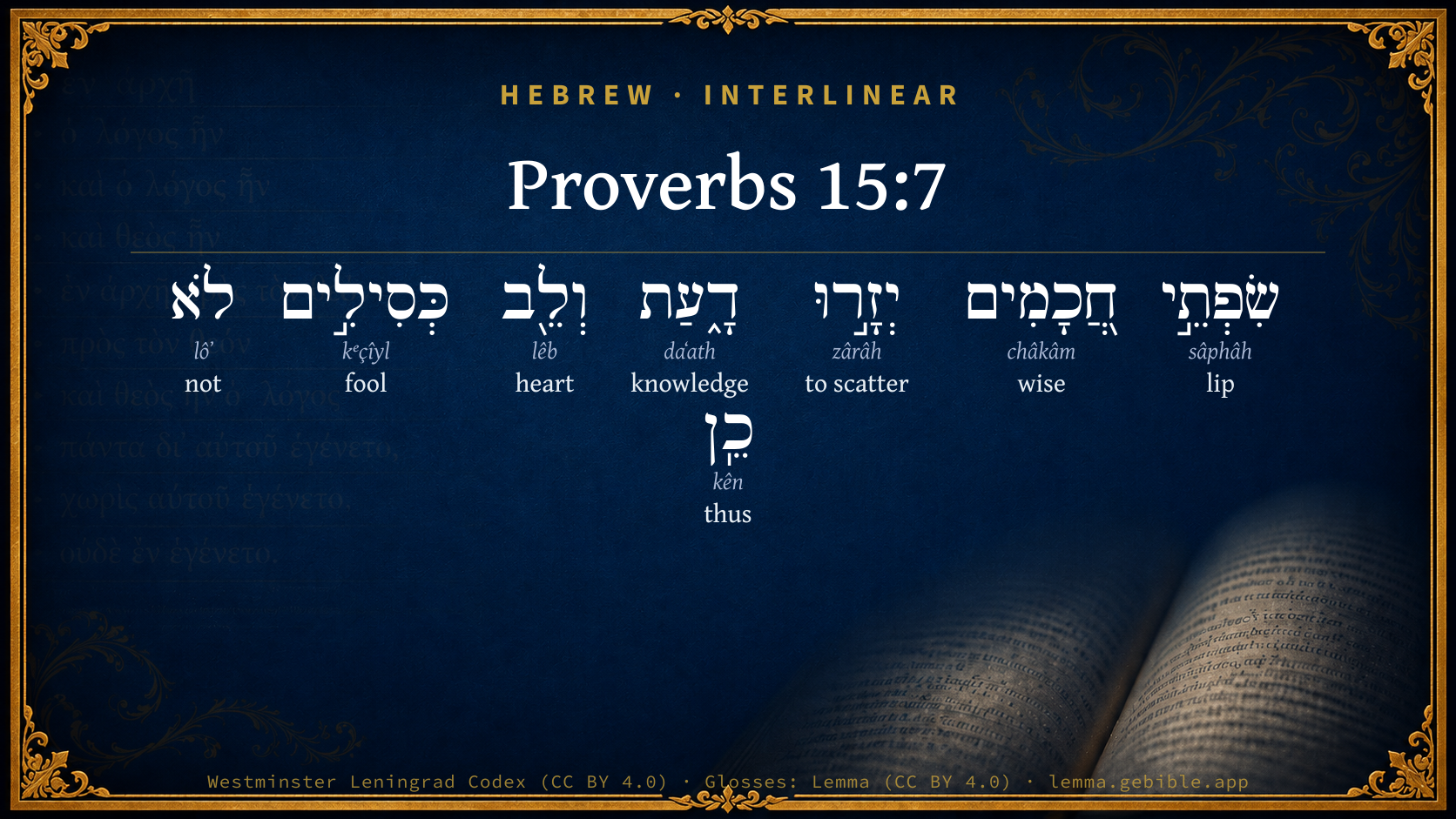
Proverbs 15:7

Hebrew (Westminster Leningrad Codex) Proverbs 15:7 appears in the Hebrew Old Testament. The text above is from the Westminster Leningrad Codex. Each word links to its Strong’s number, a concise gloss, and parsing drawn from the Open Scriptures Hebrew Bible morphology. Click any word for its full Brown-Driver-Briggs (BDB) entry.
Download image
Cite this verse

Proverbs 15:7 (World English Bible). Public Domain. Lemma interlinear Bible study tool, https://lemma.gebible.app/v/proverbs/15/7.

Show BibTeX & RIS
BibTeX
RIS
English Translation
The lips of the wise spread knowledge; Not so with the heart of fools.
World English Bible · Public Domain
Download a study sheet

One document with this verse’s original text, its word-by-word gloss line, the meaning frame, cross-references with their text, attributed commentary, and full source and license credits — printable, and it pastes into notes with its structure intact.

This verse Autodidact and up

Study sheet (.html) Plain text (.txt)

A passage Seminary Student

Up to 50 verses in one chapter. A passage sheet keeps up to 6 commentary sources and 12 cross-references per verse, in the order this page ranks them, and says so on the sheet whenever that leaves anything out. Ask for a single verse and you get the Autodidact verse sheet above.

Everything on this page stays free to read, with no account — the sheet is a download of what is already on screen, not access to it.

Want to remove ads? Support Godless Engineer
Compare translations 3

The same verse in 3 English versions, stacked beneath the original-language interlinear above. Click any original word for its lexicon entry.

Each is an independent rendering of the whole verse — the interlinear is not word-aligned to these translations.

Highlighted words mark where these versions differ — a whole-verse word diff, not a word-by-word alignment.

  • World English Bible Public Domain
    The lips of the wise spread knowledge; Not so with the heart of fools.
  • King James Version Public Domain
    The lips of the wise disperse knowledge: but the heart of the foolish doeth not so.
  • unfoldingWord Literal Text CC BY-SA 4.0
    The lips of the wise scatter knowledge, but the heart of the stupid not so.

unfoldingWord Literal Text — © unfoldingWord, licensed CC BY-SA 4.0. Word-aligned USFM3 via Door43 (git.door43.org/unfoldingWord/en_ult).

Versions to compare (up to 4)

3 of 4 selected

Show all 18 translations

Every available English version of this verse, each an independent rendering of the whole verse.

  • World English Bible Public Domain
    The lips of the wise spread knowledge; Not so with the heart of fools.
  • Berean Standard Bible Public Domain
    The lips of the wise spread knowledge, but not so the hearts of fools.
  • Majority Standard Bible Public Domain
    The lips of the wise spread knowledge, but not so the hearts of fools.
  • King James Version Public Domain
    The lips of the wise disperse knowledge: but the heart of the foolish doeth not so.
  • American Standard Version (1901) Public Domain
    The lips of the wise disperse knowledge; But the heart of the foolish `doeth' not so.
  • Revised Version (1885) Public Domain
    The lips of the wise disperse knowledge: but the heart of the foolish doeth not so.
  • Geneva Bible (1599) Public Domain
    The lippes of the wise doe spread abroade knowledge: but ye heart of the foolish doth not so.
  • Douay-Rheims (1899) Public Domain
    The lips of the wise shall disperse knowledge: the heart of fools shall be unlike.
  • Young's Literal Translation Public Domain
    The lips of the wise scatter knowledge, And the heart of fools `is' not right.
  • Literal Standard Version CC BY-SA 4.0
    The lips of the wise scatter knowledge, || And the heart of fools [is] not right.
  • Unlocked Literal Bible CC BY-SA 4.0
    The lips of wise people scatter knowledge about, but not so the hearts of fools.
  • unfoldingWord Literal Text CC BY-SA 4.0
    The lips of the wise scatter knowledge, but the heart of the stupid not so.
  • Darby Bible Public Domain
    The lips of the wise disperse knowledge, but not so the heart of the foolish.
  • World Messianic Bible Public Domain
    The lips of the wise spread knowledge; not so with the heart of fools.
  • Webster's Bible Public Domain
    The lips of the wise diffuse knowledge: but the heart of the foolish doeth not so.
  • Free Bible Version CC BY-SA 4.0
    Wise people share their knowledge, but stupid people don't think like that.
  • Bible in Basic English Public Domain
    The lips of the wise keep knowledge, but the heart of the foolish man is not right.
  • JPS Tanakh (1917) Public Domain
    The lips of the wise disperse knowledge; but the heart of the foolish is not stedfast.

Literal Standard Version (2020), Covenant Press — licensed CC BY-SA 4.0. Text via the HelloAO Bible API (eBible.org). Unlocked Literal Bible (unfoldingWord) — licensed CC BY-SA 4.0. Text via the HelloAO Bible API (eBible.org). unfoldingWord Literal Text — © unfoldingWord, licensed CC BY-SA 4.0. Word-aligned USFM3 via Door43 (git.door43.org/unfoldingWord/en_ult). Free Bible Version, Dr. Jonathan Gallagher — licensed CC BY-SA 4.0. Text via the HelloAO Bible API (eBible.org).

Word by word

More ways to search: Search by grammar → Find every occurrence → Compare this word →

Practice this passage: Drill this verse → Learn its vocabulary →

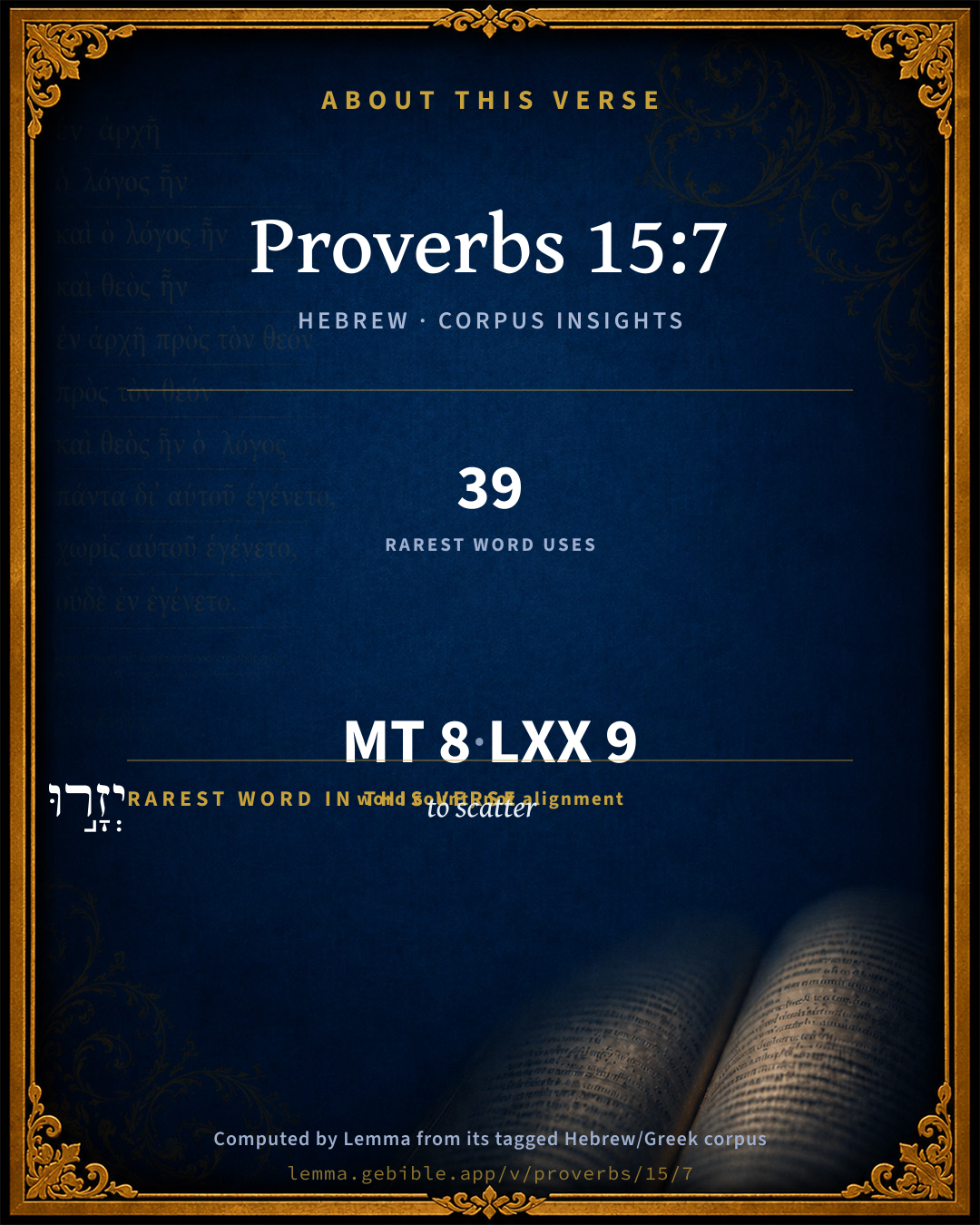
About this verse

These counts appear in no published source. They are computed here, from the morphology-tagged text and Lemma’s own curated glosses. What Lemma adds →

8
words
8
distinct lemmas
Wisdom
section

Shared distinctive vocabulary

יְזָ֣רוּ to scatter H2219 occurs in 38 verses of the Hebrew Bible. Also found in:

Grammatical profile

  • 1 verb
  • 3 nouns
  • 3 adjectives
  • 1 particle

Verb forms

  • יְזָ֣רוּ Piel · Imperfect

Hebrew & Septuagint length

In English translation the verse runs 14 words from the Hebrew and 18 from the Septuagint (LXX English) — closely comparable.

A rough comparison of the two English renderings, which tokenize alike — not a word-level alignment.

Word counts can differ between the Hebrew and the Greek without any difference in meaning — e.g. the Hebrew direct-object marker אֵת has no separate Greek word, and Greek often adds the article ὁ.

In the original languages it is 8 Hebrew tokens and 9 Greek tokens — but the two are counted differently (Hebrew bundles its prefixes and suffixes into one token; the Greek is in lemma form), so that isn’t a like-for-like length.

Cross-references

19

Topical passages linked to Proverbs 15:7 in the Treasury of Scripture Knowledge — connected by theme and wording, ordered by reader-vote popularity; previews shown in the World English Bible.

  • Matthew 12:34 You offspring of vipers, how can you, being evil, speak good things? For out of the abundance of the heart, the mouth speaks.
  • Ephesians 4:29 Let no corrupt speech proceed out of your mouth, but such as is good for building up as the need may be, that it may give grace to those who hear.
  • Proverbs 10:20–21 The tongue of the righteous is like choice silver. The heart of the wicked is of little worth.
  • James 3:6 And the tongue is a fire. The world of iniquity among our members is the tongue, which defiles the whole body, and sets on fire the course of nature, and is set on fire by Gehenna.
  • Psalms 37:30 The mouth of the righteous talks of wisdom. His tongue speaks justice.
  • Psalms 45:2 You are the most excellent of the sons of men. Grace has anointed your lips, Therefore God has blessed you forever.
  • Psalms 51:13–15 Then I will teach transgressors your ways. Sinners shall be converted to you.
  • Psalms 71:15–18 My mouth will tell about your righteousness, And of your salvation all day, Though I don't know its full measure.
  • Psalms 78:2–6 I will open my mouth in a parable. I will utter dark sayings of old,
  • Psalms 119:13 With my lips, I have declared all the ordinances of your mouth.
  • Ecclesiastes 12:9–10 Further, because the Preacher was wise, he still taught the people knowledge. Yes, he pondered, sought out, and set in order many proverbs.
  • Song of Solomon 4:11 Your lips, my bride, drip like the honeycomb. Honey and milk are under your tongue. The smell of your garments is like the smell of Lebanon.
  • Matthew 10:27 What I tell you in the darkness, speak in the light; and what you hear whispered in the ear, proclaim on the housetops.
  • Matthew 28:18–20 Jesus came to them and spoke to them, saying, "All authority has been given to me in heaven and on earth.
  • Mark 16:15 He said to them, "Go into all the world, and preach the Gospel to the whole creation.
  • Acts 18:9–10 The Lord said to Paul in the night by a vision, "Don't be afraid, but speak and don't be silent;
  • Romans 10:14–17 How then will they call on him in whom they have not believed? How will they believe in him whom they have not heard? How will they hear without a preacher?
  • Romans 15:18–21 For I will not dare to speak of any things except those which Christ worked through me, for the obedience of the Gentiles, by word and deed,
  • 2 Timothy 2:2 The things which you have heard from me among many witnesses, commit the same to faithful men, who will be able to teach others also.

Cross-references courtesy of OpenBible.info (CC BY 4.0).

Hebrew and Greek witnesses Masoretic Hebrew ↔ Greek Septuagint

The same verse in the two great witnesses to the Old Testament, shown verse-for-verse.

These are two independent witnesses, not word-aligned to each other, and the Septuagint is shown in lemma (dictionary) form.

Hebrew Proverbs 15:7 Masoretic · Westminster Leningrad Codex

שִׂפְתֵ֣י חֲ֭כָמִים יְזָ֣רוּ דָ֑עַת וְלֵ֖ב כְּסִילִ֣ים לֹא כֵֽן

The lips of the wise spread knowledge; Not so with the heart of fools.

World English Bible · Public Domain

Greek LXX Proverbs 15:7 Septuagint · lemma form

χεῖλος σοφός δέω αἴσθησις καρδία δέ ἄφρων οὐ ἀσφαλής

The lips of the wise are bound by discretion: but the hearts of the foolish are not safe.

LXX2012 (modern English Septuagint) · Public Domain

On this verse, Keil & Delitzsch discusses the Septuagint’s reading. Read the note in Commentary ↓

Hebrew: Westminster Leningrad Codex (CC BY 4.0). Greek: Septuagint (public domain); English from LXX2012 (modern English Septuagint) (Public Domain). How the Septuagint differs from the Hebrew →

Commentary

Notes on Proverbs 15:7 from classic Christian and Jewish commentators (each source and its license shown beneath its notes). The classic Christian expositions comment on the surrounding passage and are grouped to its opening verse, so a note may address several verses; the Jewish commentaries on the Tanakh (Rashi and others) are per-verse, so they appear only where the commentator wrote on this verse.

Lemma curates 59 commentaries, every one of them public domain or Creative Commons licensed, each selected and text-cleaned for this edition rather than reprinted as found. About our sources →

Trapp's Complete Commentary

John Trapp

Pro 15:7 The lips of the wise disperse knowledge: but the heart of the foolish [doeth] not so.

Ver. 7. The lips of the wise disperse knowledge.] They are the "lights of the world," φωστηρες, {Php 2:15} and they diffuse light wherever they come, shining as lamps or luminaries, and seeking to save themselves, and those that hear them. How did those learned scribes, our famous reformers, bring forth their rich treasure, and liberally disperse it? By preaching, writing, and every way trading their talents for the church’s good. Farellus, {a} with his talent, gained to the faith five cities of the Cantons, with their territories. Wycliffe, Huss, Luther, Calvin, &c., how active and fruitful were they in their generations to dispread and scatter light over the Christian world, to wise and win souls to Christ. {Pro 11:30} These surely shine as stars in heaven, {Dan 12:3} that, like stars by their light and influence, made such a scatter of riches upon earth. Every star, saith one, is like a purse of gold, out of which God throws down riches and plenty upon the sons of men. And as it is the nature of gold to be drawn forth marvellously, so that, as the learned affirm, an ounce of gold will go as far as eight pound of silver, so it is the nature of sound knowledge to be spreading and diffusive. {b}

But the heart of the foolish doth not so.] Or, Is not right. It is "little worth," {Pro 10:20} as having no true treasure in them, but froth and filth, vanity and villany: hence they do not only not disperse knowledge, which they have not, {Psa 14:4} but patronise and promote ignorance and error, sow cockle as fast as wiser men do corn, and are as busy in digging descents to hell, as others are in building staircases for heaven.

{a} " Hic est ille Farellus qui Genevenses, Novocomenses, Monipelgardenses, &c., Christo lucrifacit." - Melch. Adam in vit.

{b} Zanc., de oper. Dei, part 2, lib. iii. c. 6.

John Trapp, A Commentary or Exposition upon All the Books of the Old and New Testament (1647–1656) — public domain. Text from a community e-Sword module.

Joseph Benson's Commentary

Pro 15:7. The lips of the wise disperse knowledge — Freely communicate to others what they know, as they have opportunity; but the heart of the foolish doth not so — Either because he hath no knowledge to disperse, or because he hath not a heart to perform his duty, or to do good to others. Or, as others render the word כן, and as it is rendered Gen 42:34, is not right; that is, the heart of the foolish is not right, or disperseth (by his lips) that which is not right, namely, foolish and corrupt discourse, which is fitly opposed to knowledge.

Joseph Benson's Commentary on the Old and New Testaments (1811–1818) — public domain. Text from a community e-Sword module.

Keil & Delitzsch

C. F. Keil & F. Delitzsch

A second series which begins with a proverb of the power of human speech, and closes with proverbs of the advantages and disadvantages of wealth.

Pro 15:7

7 The lips of the wise spread knowledge;

But the direction is wanting to the heart of fools.

It is impossible that לא־כן can be a second object. accus. dependent on יזרוּ (dispergunt, not יצּרוּ, Pro 20:28; φυλάσσουσι, as Symmachus translates): but the heart of fools is unrighteous (error or falsehood) (Hitzig after Isa 16:6); for then why were the lips of the wise and the heart of the fools mentioned? לא־כן also does not mean οὐχ οὕτως (an old Greek anonymous translation, Jerome, Targ., Venet., Luther): the heart of the fool is quite different from the heart of the wise man, which spreads abroad knowledge (Zckler), for it is not heart and heart, but lip and heart, that are placed opposite to each other. Better the lxx οὐκ ἀσφαλεῖς, and yet better the Syr. lo kinı̂n (not right, sure). We have seen, at Pro 11:19, that כן as a participial adj. means standing = being, continuing, or also standing erect = right, i.e., rightly directed, or having the right direction; כּן־צדקה means there conducting oneself rightly, and thus genuine rectitude. What, after 7a, is more appropriate than to say of the heart of the fool, that it wants the receptivity for knowledge which the lips of the wise scatter abroad? The heart of the fool is not right, it has not the right direction, is crooked and perverse, has no mind for wisdom; and that which proceeds from the wise, therefore, finds with him neither estimation nor acceptance.

Pro 15:8

8 The sacrifice of the godless is an abhorrence to Jahve;

But the prayer of the upright is His delight.

Although the same is true of the prayer of the godless that is here said of their sacrifice, and of the sacrifice of the righteous that is here said of their prayer (vid., Pro 28:9, and cf. Psa 4:6 with Psa 27:6), yet it is not by accident that here (line first = Pro 21:27) the sacrifice is ascribed to the godless and the prayer to the upright. The sacrifice, as a material and legally-required performance, is much more related to dead works than prayer freely completing itself in the word, the most direct expression of the personality, which, although not commanded by the law, because natural to men, as such is yet the soul of all sacrifices; and the Chokma, like the Psalms and Prophets, in view of the ceremonial service which had become formal and dead in the opus operatum, is to such a degree penetrated by the knowledge of the incongruity of the offering up of animals and of plants, with the object in view, that a proverb like "the sacrifice of the righteous is pleasing to God" never anywhere occurs; and if it did occur without being expressly and unavoidably referred to the legal sacrifice, it would have to be understood rather after Psa 51:18. than Ps. 51:20f., rather after Sa1 15:22 than after Psa 66:13-15. זבח, which, when it is distinguished from עולה, means (cf. Pro 7:14) the sacrifice only in part coming to the altar, for the most part applied to a sacrificial feast, is here the common name for the bloody, and, per synecdochen, generally the legally-appointed sacrifice, consisting in external offering. The לרצין, Lev 1:3, used in the Tra of sacrifices, is here, as at Ps. 19:15, transferred to prayer. The fundamental idea of the proverb is, that sacrifices well-pleasing to God, prayers acceptable to God (that are heard, Pro 15:29), depend on the relations in which the heart and life of the man stand to God.

Pro 15:9

Another proverb with the key-word תועבת

An abomination to Jahve is the way of the godless;

But He loveth him who searcheth after righteousness.

The manner and rule of life is called the way. מרדּף is the heightening of רדף, Pro 21:21, and can be used independently in bonam, as well as in malam partem (Pro 11:19, cf. Pro 13:21). Regarding the form יאהב, vid., Fleischer in Deutsch. Morgenl. Zeitsch. xv. 382.

Pro 15:10

10 Sharp correction is for him who forsaketh the way;

Whoever hateth instruction shall die.

The way, thus absolute, is the God-pleasing right way (Pro 2:13), the forsaking of which is visited with the punishment of death, because it is that which leadeth unto life (Pro 10:17). And that which comes upon them who leave it is called מוּסר רע, castigatio dura, as much as to say that whoever does not welcome instruction, whoever rejects it, must at last receive it against his will in the form of peremptory punishment. The sharp correction (cf. Isa 28:28, Isa 28:19) is just the death under which he falls who accepts of no instruction (Pro 5:23), temporal death, but that as a token of wrath which it is not for the righteous (Pro 14:32).

Pro 15:11

11 The underworld [Sheol] and the abyss are before Jahve;

But how much more the hearts of the children of men!

A syllogism, a minori ad majus, with אף כּי (lxx τῶς οὐχὶ καὶ, Venet. μᾶλλον οὖν), like 12:32.

(Note: In Rabbin. this concluding form is called קל וחמר (light and heavy over against one another), and דּין (judgment, viz., from premisses, thus conclusion), κατ ̓ ἐξ. Instead of the biblical אף כי, the latter form of the language has כּל־שׁכּן (all speaks for it that it is so), על־אחת כּמּה וכמּה (so much the more), אינו דּין, or also קל וחמר (as minori ad majus = quanto magis); vid., the Hebr. Rmerbrief, p. 14.)

אבדּון has a meaning analogous to that of τάρταρος (cf. ταρταροῦν, Pe2 2:4, to throw down into the τάρταρος), which denotes the lowest region of Hades (שׁאול תּחתּית or תּחתּיּה 'שׁ), and also in general, Hades. If אבדון and מות are connected, Job 37:22, and if אבדון is the parallel word to קבר, Psa 88:12, or also to שׁאול, as in the passage similar to this proverb, Job 26:6 (cf. Job 38:17): "Shel is naked before Him, and Abaddon has no covering;" since אבדון is the general name of the underworld, including the grave, i.e., the inner place of the earth which receives the body of the dead, as the kingdom of the dead, lying deeper, does the soul. But where, as here and at Pro 27:10, שׁאול and אבדון stand together, they are related to each other, as ᾅδης and ταρταρος or ἅβυσσος, Rev 9:11 : אבדון is the lowest hell, the place of deepest descent, of uttermost destruction. The conclusion which is drawn in the proverb proceeds from the supposition that in the region of creation there is nothing more separated, and by a wide distance, from God, than the depth, and especially the undermost depth, of the realm of the dead. If now God has this region in its whole compass wide open before Him, if it is visible and thoroughly cognisable by Him (נגד, acc. adv.: in conspectu, from נגד, eminere, conspicuum esse) - for He is also present in the underworld, Psa 139:8 - then much more will the hearts of the children of men be open, the inward thoughts of men living and acting on the earth being known already from their expressions. Man sees through man, and also himself, never perfectly; but the Lord can try the heart and prove the reins, Jer 17:10. What that means this proverb gives us to understand, for it places over against the hearts of men nothing less than the depths of the underworld in eternity.

Pro 15:12

12 The scorner liketh not that one reprove him,

To wise men he will not go.

The inf. absol., abruptly denoting the action, may take the place of the object, as here (cf. Job 9:18; Isa 42:24), as well as of the subject (Pro 25:27, Job 6:25). Thus הוכיח is (Pro 9:7) construed with the dat. obj. Regarding the probable conclusion which presents itself from passages such as Pro 15:12 and Pro 13:20, as to the study of wisdom in Israel, vid., p. 39. Instead of אל, we read, Pro 13:20 (cf. Pro 22:24), את־; for לכת את־ means to have intercourse with one, to go a journey with one (Mal 2:6, cf. Gen 5:24, but not Sa2 15:22, where we are to translate with Keil), according to which the lxx has here μετὰ δὲ σοφῶν οὐχ ὁμιλήσει. The mocker of religion and of virtue shuns the circle of the wise, for he loves not to have his treatment of that which is holy reproved, nor to be convicted of his sin against truth; he prefers the society where his frivolity finds approbation and a response.

Pro 15:13

13 A joyful heart maketh the countenance cheerful;

But in sorrow of the heart the spirit is broken.

The expression of the countenance, as well as the spiritual habitus of a man, is conditioned by the state of the heart. A joyful heart maketh the countenance טוב, which means friendly, but here happy-looking = cheerful (for טוב ro is the most general designation of that which makes an impression which is pleasant to the senses or to the mind); on the contrary, with sorrow of heart (עצּבת, constr. of עצּבת, Pro 10:10, as חטאת = חטּאת, from חטּאה) there is connected a stricken, broken, downcast heart; the spiritual functions of the man are paralyzed; self-confidence, without which energetic action is impossible, is shattered; he appears discouraged, whereby רוּח is thought of as the power of self-consciousness and of self-determination, but לב, as our "Gemt" [animus], as the oneness of thinking and willing, and thus as the seat of determination, which decides the intellectual-corporeal life-expression of the man, or without being able to be wholly restrained, communicates itself to them. The ב of וּבעצּבת is, as Pro 15:16., Pro 16:8; Pro 17:1, meant in the force of being together or along with, so that רוּח נכאה do not need to be taken separate from each other as subject and predicate: the sense of the noun-clause is in the ב, as e.g., also Pro 7:23 (it is about his life, i.e., it concerns his life). Elsewhere the crushed spirit, like the broken heart, is equivalent to the heart despairing in itself and prepared for grace. The heart with a more clouded mien may be well, for sorrow has in it a healing power (Ecc 7:3). But here the matter is the general psychological truth, that the corporeal and spiritual life of man has its regulator in the heart, and that the condition of the heart leaves its stamp on the appearance and on the activity of the man. The translation of the רוח נכאה by "oppressed breath" (Umbreit, Hitzig) is impossible; the breath cannot be spoken of as broken.

Pro 15:14

14 The heart of the understanding seeketh after knowledge,

And the mouth of fools practiseth folly.

Luther interprets רעה as metaphor. for to govern, but with such ethical conceptions it is metaphor. for to be urgently circumspect about anything (vid., Pro 13:20), like Arab. ra'y and r'âyt, intentional, careful, concern about anything. No right translation can be made of the Chethib פני, which Schultens, Hitzig, Ewald, and Zckler prefer; the predicate can go before the פּני, after the Semitic rule in the fem. of the sing., Sa2 10:9, cf. Job 16:16, Chethib, but cannot follow in the masc. of the sing.; besides, the operations of his look and aspect are ascribed to his face, but not spiritual functions as here, much more to the mouth, i.e., to the spirit speaking through it. The heart is within a man, and the mouth without; and while the former gives and takes, the latter is always only giving out. In Pro 18:15, where a synonymous distich is formed from the antithetic distich, the ear, as hearing, is mentioned along with the heart as appropriating. נבון is not an adj., but is gen., like צדיק, 28a (opp. ופי). חכם, Pro 16:23. The φιλοσοφία of the understanding is placed over against the μωρολογία of the fools. The lxx translates καρδία ὀρθὴ ζητεῖ αἲσθησιν (cf. Pro 14:10, καρδία ἀδρὸς αἰσθητική); it uses this word after the Hellenistic usus loq. for דעת, of experimental knowledge.

Pro 15:15

15 All the days of the afflicted are evil;

But he who is of a joyful heart hath a perpetual feast.

Regarding עני (the afflicted), vid., 21b. They are so called on whom a misfortune, or several of them, press externally or internally. If such an one is surrounded by ever so many blessings, yet is his life day by day a sad one, because with each new day the feeling of his woe which oppresses him renews itself; whoever, on the contrary, is of joyful heart (gen. connection as Pro 11:13; Pro 12:8), such an one (his life) is always a feast, a banquet (not משׁתּה, as it may be also pointed, but משׁתּה and תּמיד thus adv., for it is never adj.; the post-bib. usage is תּמידין for עולות תּמיד). Hitzig (and also Zckler) renders 15b: And (the days) of one who is of a joyful heart are.... Others supply לו (cf. Pro 27:7), but our rendering does not need that. We have here again an example of that attribution (Arab. isnâd) in which that which is attributed (musnad) is a condition (hal) of a logical subject (the musnad ilêhi), and thus he who speaks has this, not in itself, but in the sense of the condition; the inwardly cheerful is feasts evermore, i.e., the condition of such an one is like a continual festival. The true and real happiness of a man is thus defined, not by external things, but by the state of the heart, in which, in spite of the apparently prosperous condition, a secret sorrow may gnaw, and which, in spite of an externally sorrowful state, may be at peace, and be joyfully confident in God.

Pro 15:16

16 Better is little with the fear of Jahve,

Than great store and trouble therewith.

The ב in both cases the lxx rightly renders by μετά. How מהוּמה (elsewhere of wild, confused disorder, extreme discord) is meant of store and treasure, Psa 39:7 shows: it is restless, covetous care and trouble, as the contrast of the quietness and contentment proceeding from the fear of God, the noisy, wild, stormy running and hunting about of the slave of mammon. Theodotion translates the word here, as Aquila and Symmachus elsewhere, by words which correspond (φαγέδαινα = φάγαινα or ἀχορτασία) with the Syr. יענותא, greed or insatiability.

Pro 15:17

17 Better a dish of cabbage, and love with it,

Than a fatted ox together with hatred.

With בו is here interchanged שׁם, which, used both of things and of persons, means to be there along with something. Both have the Dag. forte conj., cf. to the contrary, Deu 30:20; Mic 1:11; Deu 11:22; the punctuation varies, if the first of the two words is a n. actionis ending in ה. The dish (portion) is called ארחה, which the lxx and other Greek versions render by ξενισμός, entertainment, and thus understand it of that which is set before a guest, perhaps rightly so, for the Arab. ârrakh (to date, to determine), to which it is compared by Gesenius and Dietrich, is equivalent to warrh, a denom. of the name of the moon. Love and hatred are, according to circumstances, the disposition of the host, or of the participant, the spirit of the family:

Cum dat oluscula mensa minuscula pace quiet,

Ne pete grandia lautaque prandia lite repleta.

Keil & Delitzsch — Biblical Commentary on the Old Testament (1861–1891) — public domain (CC PDM 1.0). Text via the HelloAO Bible API. (Old Testament only.)

Matthew Henry's Commentary

This is to the same purport with Pro 15:2, and shows what a blessing a wise man is and what a burden a fool is to those about him. Only here observe further, 1. That we then use knowledge aright when we disperse it, not confine it to a few of our intimates, and grudge it to others who would make as good use of it, but give a portion of this spiritual alms to seven and also to eight, not only be communicative, but diffusive, of this good, with humility and prudence. We must take pains to spread and propagate useful knowledge, must teach some that they may teach others, and so it is dispersed. 2. That it is not only a fault to pour out foolishness, but it is a shame not to disperse knowledge, at least not to drop some wise word or other: The heart of the foolish does not so; it has nothing to disperse that is good, or, if it had, has neither skill nor will to do good with it and therefore is little worth.

Matthew Henry's Commentary on the Whole Bible (1708–1710) — public domain (CC PDM 1.0). Text via the HelloAO Bible API.

Jamieson, Fausset & Brown

Robert Jamieson, A. R. Fausset & David Brown

(Compare Pro 10:20-21).

heart . . . not so--not right, or vain.

Jamieson, Fausset & Brown — Commentary Critical and Explanatory on the Whole Bible (1871) — public domain (CC PDM 1.0). Text via the HelloAO Bible API.

Ellicott's Commentary for English Readers

(7) But the heart of the foolish doeth not so.—Or, disperseth that which is not right.

A Bible Commentary for English Readers, edited by Charles John Ellicott (1878–1897) — public domain. Text from a community e-Sword module.

The Cambridge Bible for Schools and Colleges

gen. ed. J. J. S. Perowne

7. doeth not so] So R.V. text, with the alternative in the marg. is not stedfast, or right. Maurer, however, renders (repeating disperse from the first clause) that which is not right; and compares the use of the same Heb. word, in the phrases, “thou hast well spoken,” “speak right,” “speak well:” Exo_10:29; Num_27:7; Num_36:5.

The Cambridge Bible for Schools and Colleges (gen. ed. J. J. S. Perowne; Cambridge University Press, 1878–1918) — public domain. Text from a community e-Sword module.

John Gill's Exposition

The lips of the wise disperse knowledge,.... Scatter it about for the benefit of others; they are communicative and diffusive of it unto others, that fruit may abound to their account: so the first ministers of the Gospel diffused the savour of the knowledge of Christ and his Gospel in every place; their words went into all the earth, and their sound to the end of the world; and so every Gospel minister will speak according to the oracles of God, and according to the abilities and measure of the gift which he has received; and to the utmost of his power feeds souls with knowledge and understanding;

but the heart of the foolish doth not so; does not disperse knowledge, for he has no solid substantial knowledge in him: or, "the heart of the foolish is not right" (x); it is full of folly and wickedness: or "the heart of the foolish does not disperse that which is right" (y); true and right things, and the knowledge of them; but, on the contrary, as in Pro 15:2, "pours out foolishness".

(x) "non erit rectum", Pagninus, Baynus; "non est rectum", Piscator, Mercerus. (y) "Spargit quod abest a recto", Junius & Tremellius, Amama; "eventilant non rectum", Schultens, Cocceius.

John Gill's Exposition of the Whole Bible (1746–1763) — public domain (CC PDM 1.0). Text via the HelloAO Bible API.

Albert Barnes' Notes on the Bible

Not so - The word translated “so” is taken by some in its etymological force as “strong,” “firm,” and the passage is rendered “the heart of the fool disperseth (supplied from the first clause) what is weak and unsteady,” i. e., “falsehood and unwisdom.” The Septuagint takes it as an adjective, “the heart of the fool is unstedfast.” The phrase as it stands in the King James Version is, however, of frequent occurrence Gen 48:18; Exo 10:11; Num 12:7.

Albert Barnes' Notes on the Bible (1834–1885) — public domain. Text from a community e-Sword/MySword module.

Haydock's Catholic Bible Commentary

Unlike. The wise, or themselves. Hebrew and Septuagint, "inconstant."

George Leo Haydock (1774–1849), Haydock's Catholic Family Bible and Commentary, 1859 edition — public domain. Excludes Psalms (Douay-Rheims chapter numbering differs from Protestant) and Deuterocanonical books (Catholic canon only).

Matthew Poole's English Annotations

Disperse knowledge; freely communicate to others what they know, as they have opportunity.

Doeth not so; either because he hath no knowledge to disperse, or because he hath not a heart to perform his duty, or to do good to others. Or, as others render it, and as the last Hebrew word is rendered, Gen 42:34, and elsewhere, is not right; or the place may be rendered, the heart of the foolish (understand out of the former clause, as is very usual, disperseth by his lips) that which is not right; foolish and corrupt discourse, which is fitly opposed to knowledge.

Matthew Poole's English Annotations on the Holy Bible (1683–1685) — public domain. Text from a community e-Sword/MySword module.

Whedon's Commentary on the Bible

Daniel D. Whedon

7. Disperse (or diffuse) knowledge — Communicate to others for their good the knowledge which they possess.

The… foolish doeth not so — Has no useful knowledge to impart. This is not a contradiction of Pro_14:33. That is an implied censure of an ostentatious display of knowledge; this a commendation of the benevolent diffusion of it. It should be observed, however, that the verb יזרו, (yezaru,) rendered “disperse,” also signifies to winnow, as in separating the chaff from the wheat; also, to search out, to investigate, so distinguishing between that which is valuable and that which is worthless. This meaning of the verb is preferred by some, and gives a very good sense. The lips of the wise winnow their knowledge, that is, their instructive utterances, carefully distinguishing what is useful for edification and imparting only what is valuable; but the heart of fools does not so; they do not distinguish, but give chaff and wheat together. Some render: “The heart of fools is not right.” Others: “Not stable.” Stuart: “What is not sound.” Noyes refers to the same expression in 2Ki_17:9; Isa_16:6; Jer_23:10, where it is supposed to have this meaning. The ancient versions are divided. The Chaldee and Vulgate agree with our Authorized Version. The Septuagint, however, has: “The lips of the wise are bound by discretion.”

Daniel D. Whedon (gen. ed.), Commentary on the Old and New Testaments (1874–1909) — public domain. Text from a community e-Sword module.

The Pulpit Commentary

The lips of the wise disperse knowledge. (ver. 2 Pro_10:31) The LXX takes the verb Wryi in its other signification of "binding" or "embracing," and translates, "The lips of the wise are bound ( dedetai ) with knowledge;" i.e. knowledge is always on them and controls their movements. The wise know when to speak, when to be silent, and what to say. But the heart of the foolish doeth not so; i.e. doth not disperse knowledge. Vulgate, cor stultorum dissimile erit, "will be unlike," which probably means the same as the Authorized Version. (Compare a similar use of the words lo-ken in Gen_48:18 Exo_10:11) But the contrast is stated rather weakly by this rendering, lips and heart having the same office to perform; hence it is better, with Delitzsch, Ewald, and others, to take ke (ken) as an adjective in the sense of "right" or "trustworthy," and either to supply the former verb, "disperseth that which is not right," or to render, "The heart of the foot is not directed right;" the fool goes astray, and leads himself and others into error. Septuagint, "The hearts of fools are not safe (asfaleiv )."

The Pulpit Commentary (1880–1919), ed. H.D.M. Spence-Jones & Joseph S. Exell — public domain. Text from a community e-Sword module.

John Wesley's Explanatory Notes

Disperse - Freely communicate to others what they know.

John Wesley, Explanatory Notes Upon the Whole Bible (1754–1765) — public domain. Text via the GEBible commentary corpus.

Bridges on Proverbs

Charles Bridges

The "right use of knowledge" is, first to "lay it up" in a storehouse (Pro 10:14 ); then out of the store-house to disperse it. The sower scatters the seed in the furrow, and calculates upon a proportionate harvest. (2Co 9:6 .) Thus the lips of the wise disperse the precious seed, "giving a portion to seven, and also to eight;" not discouraged by trifling difficulties, but "sowing morning and evening," and committing the result to God. (Ecc 11:2, Ecc 11:4, Ecc 11:6 .) Our Lord thus dispersed the heavenly knowledge of his gospel. (Mat 4:23 ; Mat 9:35 .) He commanded his Apostles to scatter the seed through the vast field of the world. (Mat 28:19-20 .) The persecution of the Church was overruled for this great end. (Act 8:4 .) The Reformers widely dispersed their treasures both by preaching and writing, and rich indeed was the fruit. Do we remember, that our gifts and talents are the riches of the Church (1Co 12:7 . 1Pe 4:10 ); that, like our father Abraham, we are blessed, not for our own sakes, but to "be a blessing"? (Gen 12:2 .) And does not conscience speak of the waste of many, even important, opportunities of intercourse with our fellow-sinners or fellow-Christians, when not an atom of knowledge has been dispersed? We contend for no eccentric irregularity, no passing of our proper boundary, no entrenchment upon paramount obligations. But be careful, lest in quenching unnatural fire, we inadvertently quench some genuine spark of holy flame. Be mindful of small opportunities. The careful cultivation of the smallest field ensures an abundant harvest. The acceptance is not to the number, but to the improvement of the talents; not only "where much has been given;" but where we "have been faithful in a few things." (Mat 25:21 .)

The sin of the wicked is not always, that they "pour out foolishness" (Pro 15:2 ); but that they do not so. They neglect to disperse. If they do not abuse their talent, they omit to improve it. If not blots, they are blanks in the Church. If they do no harm, they do nothing. (Mat 25:25-28 .) Indeed, they can disperse nothing from their empty storehouse. They can only trade with the trash of the world, not with the commerce of substantial knowledge — The end of both is according to their works — "Unto every one that hath (actively improves) shall be given, and he shall have abundance; but from him that hath not (uses not) shall be taken away, even that which he hath." (Mat 25:29 .)

Charles Bridges, An Exposition of the Book of Proverbs (1846) — public domain. Text from a community e-Sword module.

Kretzmann's Popular Commentary

Paul E. Kretzmann

v. 7. The lips of the wise disperse knowledge, casting it out over the country like good seed, which will return a rich harvest; but the heart of the foolish doeth not so; having no wisdom, he cannot spread any, he is not set in the right direction and is therefore utterly incompetent to teach others.

Paul E. Kretzmann, Popular Commentary of the Bible (1921–1924) — public domain. Text from a community e-Sword module.

unfoldingWord translationNotes

Door43 World Missions Community

The lips of wise people scatter knowledge about

The word "lips" represents what wise people say. The writer speaks of knowledge as if it were seeds that wise people scatter around when they speak. AT: "The speech of wise people spreads knowledge" (See: Metaphor and Metonymy)

not so the hearts of fools

Possible meanings are 1) the word "hearts" is synecdoche for the fools themselves and means that they do not scatter knowledge like wise people do. AT: "fools do not scatter knowledge about" or 2) fools do not have knowledge in their hearts, with "hearts" being a metonym for the thoughts. AT: "fools do not understand knowledge" (See: Synecdoche and Metonymy)

upright people

"people who live rightly"

is his delight

"pleases him"

translationWords

wise

know

heart

fool

Yahweh

sacrifice

evil

pray

unfoldingWord translationNotes — © Distant Shores Media and the Door43 World Missions Community, licensed CC BY-SA 4.0. Source: git.door43.org/Door43/en_tn.

Rashi

Rabbi Shlomo Yitzchaki (Rashi)

The lips of the wise crown knowledge יזרו, they crown knowledge, as in (Ex. 25: “a gold crown (זר).”

is not so It is not true gold.

Rashi on the Tanakh — English translations: “The Judaica Press complete Tanach with Rashi, translated by A. J. Rosenberg” (CC BY 4.0); “Pentateuch with Rashi's commentary by M. Rosenbaum and A.M. Silbermann, 1929-1934” (public domain); “The Metsudah Tanach series, Lakewood, N.J” (CC BY 4.0); and “The Book of Joshua, Metsudah Publications, 1997” (CC BY 4.0). Text via Sefaria.

Lesson kit

Teaching starters — assembled from the data on this page, not authored interpretation. Every prompt links to the verse data it draws on. Edit before teaching.

Proverbs, in the Wisdom, opens this verse with 8 words (8 distinct Hebrew lemmas). Its most distinctive word is zârâh (“to scatter”). A historical commentator’s framing appears above. Read the whole chapter for the surrounding context.

Discussion questions

  1. What does “to scatter” (zârâh) contribute to the verse as a whole?
  2. Exodus 32:20 shares the word «to scatter» with this verse. How do the two illuminate each other?
  3. These translations render this verse differently. What is at stake in choosing one wording over another?
  4. The verb «יְזָ֣רוּ» is Piel Imperfect. How does its form color the action?
  5. Reading how Trapp's Complete Commentary and Joseph Benson's Commentary read this verse, where do the two commentators agree and where do they part?

Things to notice

Reading settings

Reading text

Shown beneath each verse's original-language words.

Old Testament
Old Testament edition

Read the OT as the Masoretic Hebrew (MT) or the Greek Septuagint (LXX).

English shown for the Greek Septuagint (in the Hebrew ↔ Greek comparison).

Comparing translations? Open the Compare panel on any verse page to stack up to four side by side.