
Ecclesiastes 10:12

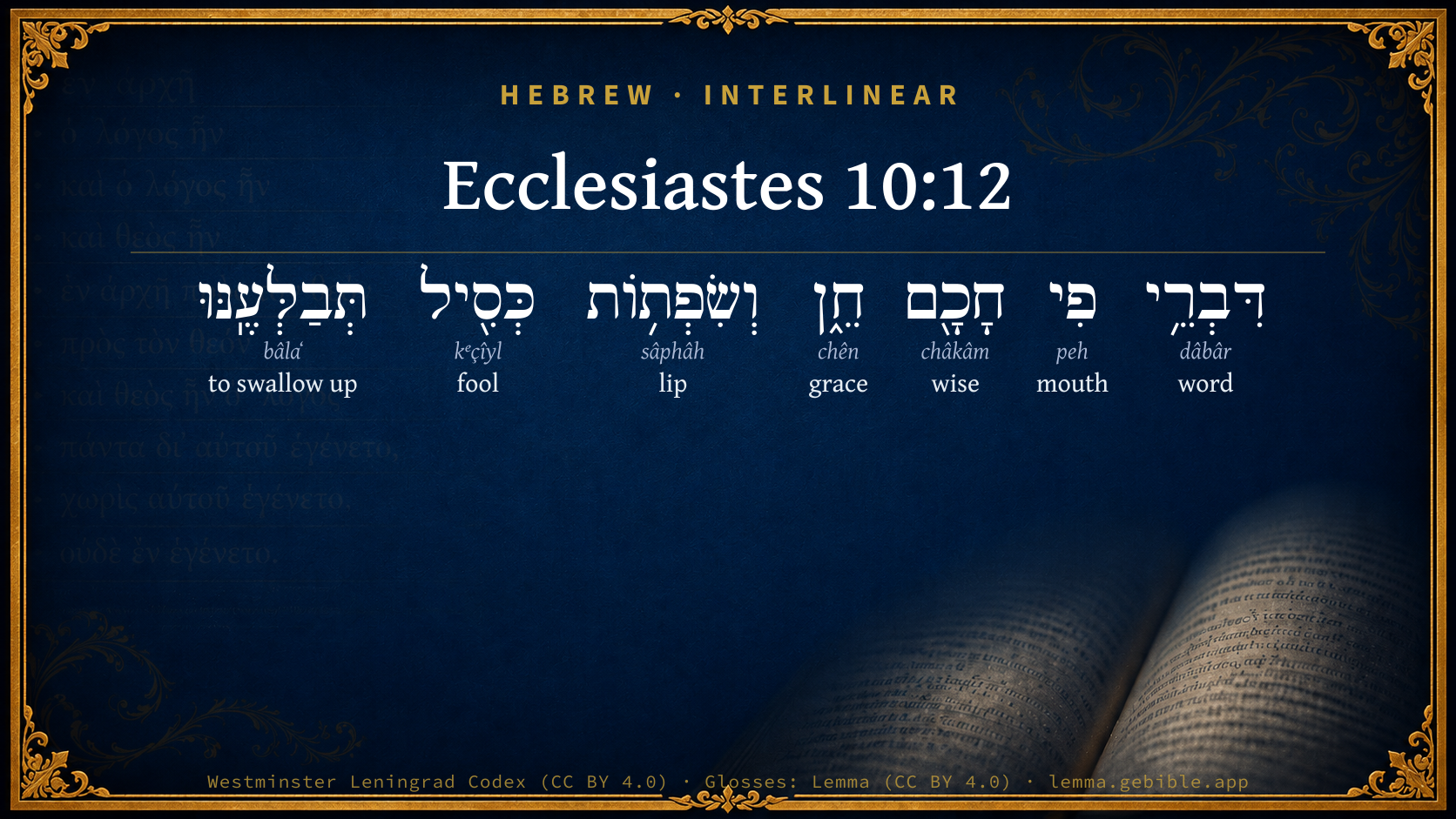
Hebrew (Westminster Leningrad Codex) Ecclesiastes 10:12 appears in the Hebrew Old Testament. The text above is from the Westminster Leningrad Codex. Each word links to its Strong’s number, a concise gloss, and parsing drawn from the Open Scriptures Hebrew Bible morphology. Click any word for its full Brown-Driver-Briggs (BDB) entry.
Download image
Cite this verse

Ecclesiastes 10:12 (World English Bible). Public Domain. Lemma interlinear Bible study tool, https://lemma.gebible.app/v/ecclesiastes/10/12.

Show BibTeX & RIS
BibTeX
RIS
English Translation
The words of a wise man's mouth are gracious; but a fool is swallowed by his own lips.
World English Bible · Public Domain
Download a study sheet

One document with this verse’s original text, its word-by-word gloss line, the meaning frame, cross-references with their text, attributed commentary, and full source and license credits — printable, and it pastes into notes with its structure intact.

This verse Autodidact and up

Study sheet (.html) Plain text (.txt)

A passage Seminary Student

Up to 50 verses in one chapter. A passage sheet keeps up to 6 commentary sources and 12 cross-references per verse, in the order this page ranks them, and says so on the sheet whenever that leaves anything out. Ask for a single verse and you get the Autodidact verse sheet above.

Everything on this page stays free to read, with no account — the sheet is a download of what is already on screen, not access to it.

Want to remove ads? Support Godless Engineer
Compare translations 3

The same verse in 3 English versions, stacked beneath the original-language interlinear above. Click any original word for its lexicon entry.

Each is an independent rendering of the whole verse — the interlinear is not word-aligned to these translations.

Highlighted words mark where these versions differ — a whole-verse word diff, not a word-by-word alignment.

  • World English Bible Public Domain
    The words of a wise man's mouth are gracious; but a fool is swallowed by his own lips.
  • King James Version Public Domain
    The words of a wise man's mouth are gracious; but the lips of a fool will swallow up himself.
  • unfoldingWord Literal Text CC BY-SA 4.0
    words of mouth of a wise favor, but lips of a fool will swallow him.

unfoldingWord Literal Text — © unfoldingWord, licensed CC BY-SA 4.0. Word-aligned USFM3 via Door43 (git.door43.org/unfoldingWord/en_ult).

Versions to compare (up to 4)

3 of 4 selected

Show all 18 translations

Every available English version of this verse, each an independent rendering of the whole verse.

  • World English Bible Public Domain
    The words of a wise man's mouth are gracious; but a fool is swallowed by his own lips.
  • Berean Standard Bible Public Domain
    The words of a wise man’s mouth are gracious, but the lips of a fool consume him.
  • Majority Standard Bible Public Domain
    The words of a wise man’s mouth are gracious, but the lips of a fool consume him.
  • King James Version Public Domain
    The words of a wise man's mouth are gracious; but the lips of a fool will swallow up himself.
  • American Standard Version (1901) Public Domain
    The words of a wise man's mouth are gracious; but the lips of a fool will swallow up himself.
  • Revised Version (1885) Public Domain
    The words of a wise man’s mouth are gracious; but the lips of a fool will swallow up himself.
  • Geneva Bible (1599) Public Domain
    The words of ye mouth of a wise man haue grace: but the lippes of a foole deuoure himselfe.
  • Douay-Rheims (1899) Public Domain
    The words of the mouth of a wise man are grace: but the lips of a fool shall throw him down headlong.
  • Young's Literal Translation Public Domain
    Words of the mouth of the wise `are' gracious, And the lips of a fool swallow him up.
  • Literal Standard Version CC BY-SA 4.0
    Words of the mouth of the wise [are] gracious, || And the lips of a fool swallow him up.
  • Unlocked Literal Bible CC BY-SA 4.0
    The words of a wise man's mouth are gracious, but the lips of a fool consume him.
  • unfoldingWord Literal Text CC BY-SA 4.0
    words of mouth of a wise favor, but lips of a fool will swallow him.
  • Darby Bible Public Domain
    The words of a wise man's mouth are gracious; but the lips of a fool swallow up himself.
  • World Messianic Bible Public Domain
    The words of a wise man’s mouth are gracious; but a fool is swallowed by his own lips.
  • Webster's Bible Public Domain
    The words of a wise man's mouth are gracious; but the lips of a fool will swallow up himself.
  • Free Bible Version CC BY-SA 4.0
    Wise words are beneficial, but fools destroy themselves by what they say.
  • Bible in Basic English Public Domain
    The words of a wise man's mouth are sweet to all, but the lips of a foolish man are his destruction.
  • JPS Tanakh (1917) Public Domain
    The words of a wise man's mouth are gracious; but the lips of a fool will swallow up himself.

Literal Standard Version (2020), Covenant Press — licensed CC BY-SA 4.0. Text via the HelloAO Bible API (eBible.org). Unlocked Literal Bible (unfoldingWord) — licensed CC BY-SA 4.0. Text via the HelloAO Bible API (eBible.org). unfoldingWord Literal Text — © unfoldingWord, licensed CC BY-SA 4.0. Word-aligned USFM3 via Door43 (git.door43.org/unfoldingWord/en_ult). Free Bible Version, Dr. Jonathan Gallagher — licensed CC BY-SA 4.0. Text via the HelloAO Bible API (eBible.org).

Word by word

More ways to search: Search by grammar → Find every occurrence → Compare this word →

Practice this passage: Drill this verse → Learn its vocabulary →

תְּבַלְּעֶֽנּוּ
bâlaʻ
H1104
“to swallow up · him”
Verb, Piel, Imperfect, 3rd Person, Feminine, Singular + Suffix, Personal, 3rd Person, Masculine, Singular
Part of Speech
Verb
Stem
Piel
Form
Imperfect
Person
3rd Person
Gender
Feminine
Number
Singular
Full BDB Definition

Origin: a primitive root

TWOT: 251

to swallow down, swallow up, engulf, eat up - (Qal) - to swallow down - to swallow up, engulf - (Niphal) to be swallowed up - (Piel) - to swallow - to swallow up, engulf - squandering (figuratively) - (Pual) to be swallowed up - (Hithpael) to be ended
  1. דִּבְרֵ֥י dâbâr H1697 “words of” Noun, Common, Masculine, Plural, Construct
  2. פִי peh H6310 “mouth of” Noun, Common, Masculine, Singular, Construct
  3. חָכָ֖ם châkâm H2450 “wise” Adjective, Adjective, Masculine, Singular, Absolute
  4. חֵ֑ן chên H2580 “grace” Noun, Common, Masculine, Singular, Absolute
  5. וְשִׂפְת֥וֹת sâphâh H8193 “and · lips of” Conjunction + Noun, Common, Feminine, Plural, Construct
  6. כְּסִ֖יל kᵉçîyl H3684 “fool” Adjective, Adjective, Masculine, Singular, Absolute

About this verse

These counts appear in no published source. They are computed here, from the morphology-tagged text and Lemma’s own curated glosses. What Lemma adds →

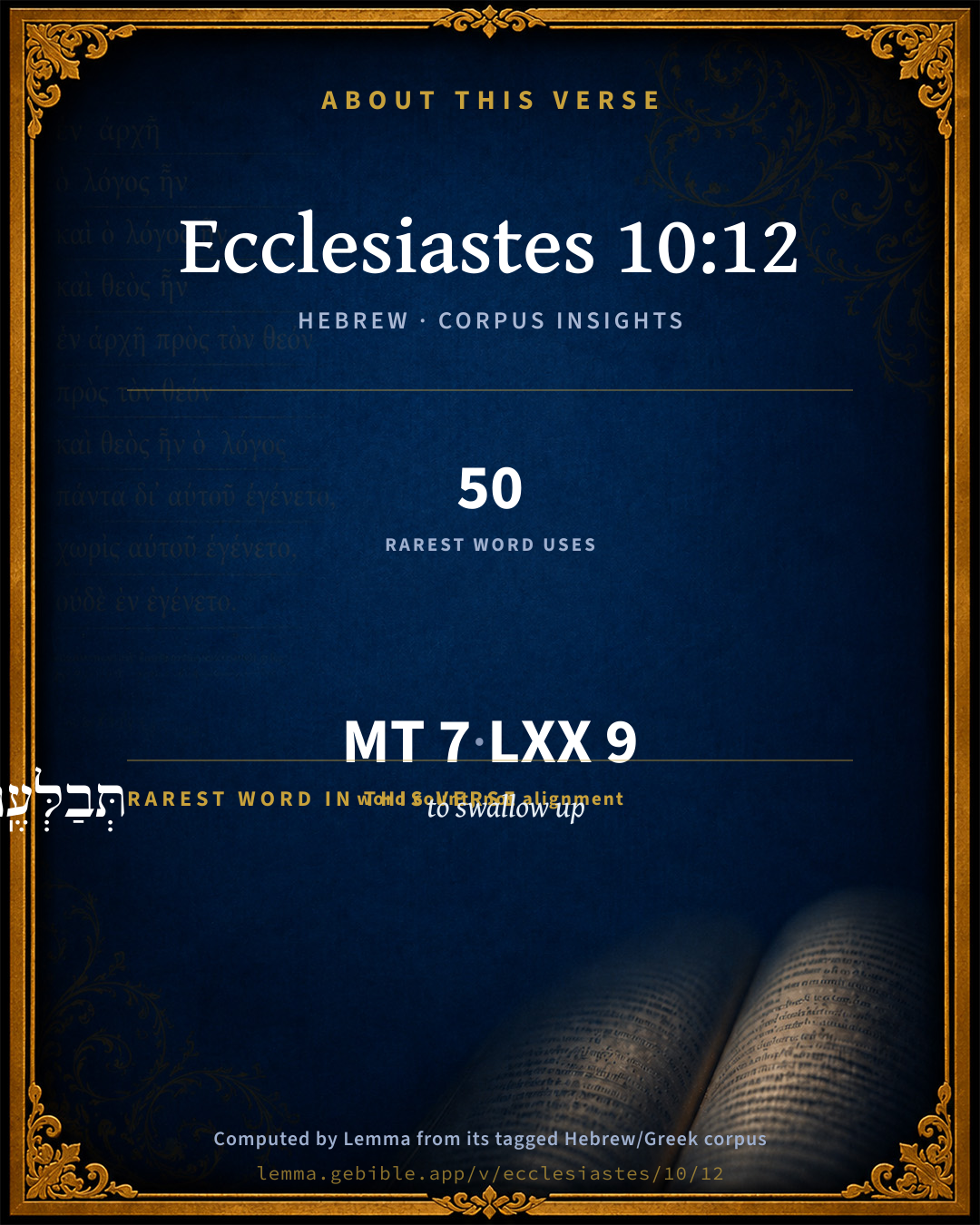
7
words
7
distinct lemmas
Wisdom
section

Shared distinctive vocabulary

תְּבַלְּעֶֽנּוּ to swallow up H1104 occurs in 48 verses of the Hebrew Bible. Also found in:

Grammatical profile

  • 1 verb
  • 4 nouns
  • 2 adjectives

Verb forms

  • תְּבַלְּעֶֽנּוּ Piel · Imperfect

Hebrew & Septuagint length

In English translation the verse runs 18 words from the Hebrew and 18 from the Septuagint (LXX English) — the same length.

A rough comparison of the two English renderings, which tokenize alike — not a word-level alignment.

Word counts can differ between the Hebrew and the Greek without any difference in meaning — e.g. the Hebrew direct-object marker אֵת has no separate Greek word, and Greek often adds the article ὁ.

In the original languages it is 7 Hebrew tokens and 9 Greek tokens — but the two are counted differently (Hebrew bundles its prefixes and suffixes into one token; the Greek is in lemma form), so that isn’t a like-for-like length.

Cross-references

31

Topical passages linked to Ecclesiastes 10:12 in the Treasury of Scripture Knowledge — connected by theme and wording, ordered by reader-vote popularity; previews shown in the World English Bible.

  • Colossians 4:6 Let your speech always be with grace, seasoned with salt, that you may know how you ought to answer each one.
  • Luke 4:22 All testified about him, and wondered at the gracious words which proceeded out of his mouth, and they said, "Isn't this Joseph's son?"
  • Proverbs 15:2 The tongue of the wise commends knowledge, But the mouth of fools gush out folly.
  • Proverbs 22:11 He who loves purity of heart and speaks gracefully Is the king's friend.
  • Ephesians 4:29 Let no corrupt speech proceed out of your mouth, but such as is good for building up as the need may be, that it may give grace to those who hear.
  • Proverbs 10:13–14 Wisdom is found on the lips of him who has discernment, But a rod is for the back of him who is void of understanding.
  • Proverbs 10:20–21 The tongue of the righteous is like choice silver. The heart of the wicked is of little worth.
  • Job 4:3–4 Behold, you have instructed many, You have strengthened the weak hands.
  • Proverbs 10:31–32 The mouth of the righteous brings forth wisdom, But the perverse tongue will be cut off.
  • Proverbs 22:17–18 Turn your ear, and listen to the words of the wise. Apply your heart to my teaching.
  • 2 Samuel 1:16 David said to him, Your blood be on your head; for your mouth has testified against you, saying, I have slain Yahweh's anointed.
  • 1 Kings 20:40–42 As your servant was busy here and there, he was gone. The king of Israel said to him, So shall your judgment be; yourself have decided it.
  • Job 16:5 But I would strengthen you with my mouth. The solace of my lips would relieve you.
  • Psalms 37:30 The mouth of the righteous talks of wisdom. His tongue speaks justice.
  • Psalms 40:9–10 I have proclaimed glad news of righteousness in the great assembly. Behold, I will not seal my lips, Yahweh, you know.
  • Psalms 64:8 Their own tongues shall ruin them. All who see them will shake their heads.
  • Psalms 71:15–18 My mouth will tell about your righteousness, And of your salvation all day, Though I don't know its full measure.
  • Psalms 140:9 As for the head of those who surround me, Let the mischief of their own lips cover them.
  • Proverbs 10:8 The wise in heart accept commandments, But a chattering fool will fall.
  • Proverbs 10:10 One winking with the eye causes sorrow, But a chattering fool will fall.
  • Proverbs 12:13–14 An evil man is trapped by sinfulness of lips, But the righteous shall come out of trouble.
  • Proverbs 12:18 There is one who speaks rashly like the piercing of a sword, But the tongue of the wise heals.
  • Proverbs 15:23 Joy comes to a man with the reply of his mouth. How good is a word at the right time!
  • Proverbs 16:21–24 The wise in heart shall be called prudent. Pleasantness of the lips promotes instruction.
  • Proverbs 18:6–8 A fool's lips come into strife, And his mouth invites beatings.
  • Proverbs 19:5 A false witness shall not be unpunished. He who pours out lies shall not go free.
  • Proverbs 25:11–12 A word fitly spoken Is like apples of gold in settings of silver.
  • Proverbs 26:9 Like a thornbush that goes into the hand of a drunkard, So is a parable in the mouth of fools.
  • Proverbs 31:26 She opens her mouth with wisdom. Faithful instruction is on her tongue.
  • Matthew 12:35 The good man out of his good treasure brings out good things, and the evil man out of his evil treasure brings out evil things.
  • Luke 19:22 "He said to him, 'Out of your own mouth will I judge you, you wicked servant! You knew that I am an exacting man, taking up that which I didn't lay down, and reaping that which I didn't sow.

Cross-references courtesy of OpenBible.info (CC BY 4.0).

Hebrew and Greek witnesses Masoretic Hebrew ↔ Greek Septuagint

The same verse in the two great witnesses to the Old Testament, shown verse-for-verse.

These are two independent witnesses, not word-aligned to each other, and the Septuagint is shown in lemma (dictionary) form.

Hebrew Ecclesiastes 10:12 Masoretic · Westminster Leningrad Codex

דִּבְרֵ֥י פִי חָכָ֖ם חֵ֑ן וְשִׂפְת֥וֹת כְּסִ֖יל תְּבַלְּעֶֽנּוּ

The words of a wise man's mouth are gracious; but a fool is swallowed by his own lips.

World English Bible · Public Domain

Greek LXX Ecclesiastes 10:12 Septuagint · lemma form

λόγος στόμα σοφός χάρις καί χεῖλος ἄφρων καταποντίζω αὐτός

The words of a wise mouth are gracious: but the lips of a fool will swallow him up.

LXX2012 (modern English Septuagint) · Public Domain

On this verse, The Pulpit Commentary discusses the Septuagint’s reading. Read the note in Commentary ↓

Hebrew: Westminster Leningrad Codex (CC BY 4.0). Greek: Septuagint (public domain); English from LXX2012 (modern English Septuagint) (Public Domain). How the Septuagint differs from the Hebrew →

Commentary

Notes on Ecclesiastes 10:12 from classic Christian and Jewish commentators (each source and its license shown beneath its notes). The classic Christian expositions comment on the surrounding passage and are grouped to its opening verse, so a note may address several verses; the Jewish commentaries on the Tanakh (Rashi and others) are per-verse, so they appear only where the commentator wrote on this verse.

Lemma curates 59 commentaries, every one of them public domain or Creative Commons licensed, each selected and text-cleaned for this edition rather than reprinted as found. About our sources →

Trapp's Complete Commentary

John Trapp

Ecc 10:12 The words of a wise man’s mouth [are] gracious; but the lips of a fool will swallow up himself.

Ver. 12. The words of a wise man’s mouth are gracious.] Heb., Are grace; they are nothing but grace, so the French translator hath it; {a} such as render him gracious with God and men, so Lyra glosseth it, as being usually "seasoned with salt, and ministering grace to the hearers." {Col 4:6}

But the lips of a fool swallow up himself.] Suddenly, utterly, unavoidably, as the whale did Jonah, as the devouring sword doth those that fall under it, as the grave doth all the living. How many of all sorts in all ages have perished by their unruly tongues, blabbing or belching out words Quae reditura per iugulum, as Pliny phraseth it that were driven down their throats again by the wronged and aggrieved parties! Take heed, saith the Arabic proverb, lest thy tongue cut thy throat; it is compared to "a sharp razor working deceitfully," {Psa 52:3} which, instead of cutting the hair, cuts the throat. {b}

{a} Ne sont que grace.

{b} Cave ne feriat lingua tua collum tuum. - Scal. Ar. Prov.

John Trapp, A Commentary or Exposition upon All the Books of the Old and New Testament (1647–1656) — public domain. Text from a community e-Sword module.

Joseph Benson's Commentary

Ecc 10:12-15. The words of a wise man are gracious — Hebrew, חן, grace: as they are profitable, so they are acceptable to others, procuring him favour with those that hear him. But the lips of a fool will swallow up himself — His discourses are ungracious and offensive to others, and therefore pernicious to himself. The beginning of his words is foolishness, &c. — All his talk, from the beginning to the end, is foolish and sinful; the more he talks the more his folly and wickedness appear; and the end is mischievous madness — He proceeds from evil to worse, and adds wilfulness to his weakness, and never desists till he hath done mischief to himself or others. A fool also is full of words — Forward to promise and boast what he will do; which is the common practice of foolish men, and running on endlessly, and never knowing when to cease; for he will have the last word, though it be but the same with that which was the first. A man cannot tell what shall be — What he will say next; his talk is so incoherent. And what shall be after him, who can tell? — That is, what mischief his foolish talk may produce. The labour of the foolish wearieth, &c. — Fools discover their folly by their wearisome and fruitless endeavours after things which are too high for them. Because he knoweth not, &c. — He is ignorant of those things which are most easy, as of the way to the great city whither he is going.

Joseph Benson's Commentary on the Old and New Testaments (1811–1818) — public domain. Text from a community e-Sword module.

Tyndale Open Study Notes

Tyndale Open Resources

10:12 Fools are destroyed by such things as foolish promises, getting caught in false testimony, and making the wrong people angry (see 5:6; Prov 17:20; 18:6-7; 19:5, 9).

Tyndale Open Study Notes — © Tyndale Open Resources, licensed CC BY-SA 4.0. Text via the HelloAO Bible API.

Matthew Henry's Commentary

Solomon, having shown the benefit of wisdom, and of what great advantage it is to us in the management of our affairs, here shows the mischief of folly and how it exposes men, which perhaps comes in as a reflection upon those rulers who set folly in great dignity.

I. Fools talk a great deal to no purpose, and they show their folly as much by the multitude, impertinence, and mischievousness of their words, as by any thing; whereas the words of a wise man's mouth are gracious, are grace, manifest grace in his heart and minister grace to the hearers, are good, and such as become him, and do good to all about him, the lips of a fool not only expose him to reproach and make him ridiculous, but will swallow up himself and bring him to ruin, by provoking the government to take cognizance of his seditious talk and call him to an account for it. Adonijah foolishly spoke against his own life, Kg1 2:23. Many a man has been sunk by having his own tongue fall upon him, Psa 64:8. See what a fool's talk is. 1. It takes rise from his own weakness and wickedness: The beginning of the words of his mouth is foolishness, the foolishness bound up in his heart, that is the corrupt spring out of which all these polluted streams flow, the evil treasure out of which evil things are brought. As soon as he begins to speak you may perceive his folly; at the very first he talks idly, and passionately, and like himself. 2. It rises up to fury, and tends to the hurt and injury of others: The end of his talk, the end it comes to, is madness. He will presently talk himself into an indecent heat, and break out into the wild extravagancies of a distracted man. The end he aims at is mischief; as, at first, he appeared to have little government of himself, so, at last, it appears he has a great deal of malice to his neighbours; that root of bitterness bears gall and wormwood. Note, It is not strange if those that begin foolishly end madly; for an ungoverned tongue, the more liberty is allowed, grows the more violent. 3. It is all the same over and over (Ecc 10:14): A fool also is full of words, a passionate fool especially, that runs on endlessly and never knows when to leave off. He will have the last word, though it be but the same with that which was the first. What is wanting in the weight and strength of his words he endeavours in vain to make up in the number of them; and they must be repeated, because otherwise there is nothing in them to make them regarded. Note, Many who are empty of sense are full of words; and the least solid are the most noisy. The following words may be taken either, (1.) As checking him for his vainglorious boasting in the multitude of his words, what he will do and what he will have, not considering that which every body knows that a man cannot tell what shall be in his own time, while he lives (Pro 27:1), much less can one tell what shall be after him, when he is dead and gone. Would we duly consider our own ignorance of, and uncertainty about, future events, it would cut off a great many of the idle words we foolishly multiply. Or, (2.) As mocking him for his tautologies. He is full of words, for if he do but speak the most trite and common thing, a man cannot tell what shall be, because he loves to hear himself talk, he will say it again, what shall be after him who can tell him? like Battus in Ovid:

- Sub illis

Montibus (inquit) erant, et erant sub montibus illis -

Under those mountains were they,

They were under those mountains, I say -

whence vain repetitions are called Battologeō, Mat 6:7.

II. Fools toil a great deal to no purpose (Ecc 10:15); The labour of the foolish, to accomplish their designs, wearies every one of them. 1. They weary themselves in that labour which is very foolish and absurd. All their labour is for the world and the body, and the meat that perishes, and in this labour they spend their strength, and exhaust their spirits, and weary themselves for very vanity, Hab 2:13; Isa 55:2. They choose that service which is perfect drudgery rather than that which is perfect liberty. 2. That labour which is necessary, and would be profitable, and might be gone through with ease, wearies them, because they go about it awkwardly and foolishly, and so make their business a toil to them, which, if they applied themselves to it prudently, would be a pleasure to them. Many complain of the labours of religion as grievous, which they would have no reason to complain of if the exercises of Christian piety were always under the direction of Christian prudence. The foolish tire themselves in endless pursuits, and never bring any thing to pass, because they know not how to go to the city, that is, because they have not capacity to apprehend the plainest thing, such as the entrance into a great city is, where one would think it were impossible for a man to miss his road. Men's imprudent management of their business robs them both of the comfort and of the benefit of it. But it is the excellency of the way to the heavenly city that it is a high-way, in which the wayfaring men, though fools, shall not err (Isa 35:8); yet sinful folly makes men miss that way.

Matthew Henry's Commentary on the Whole Bible (1708–1710) — public domain (CC PDM 1.0). Text via the HelloAO Bible API.

Jamieson, Fausset & Brown

Robert Jamieson, A. R. Fausset & David Brown

gracious--Thereby he takes precaution against sudden injury (Ecc 10:11).

swallow up himself-- (Pro 10:8, Pro 10:14, Pro 10:21, Pro 10:32; Pro 12:13; Pro 15:2; Pro 22:11).

Jamieson, Fausset & Brown — Commentary Critical and Explanatory on the Whole Bible (1871) — public domain (CC PDM 1.0). Text via the HelloAO Bible API.

Adam Clarke's Commentary

Verse 12. The words of a wise man's mouth] Every thing that proceeds from him is decent and orderly, creditable to himself, and acceptable to those who hear him. But the lips of the fool, which speak every thing at random, and have no understanding to guide them, are not only not pleasant to others, but often destructive to himself.

Adam Clarke's Commentary on the Bible (1810–1826) — public domain. Text from a community e-Sword/MySword module.

The Cambridge Bible for Schools and Colleges

gen. ed. J. J. S. Perowne

12. The words of a wise man’s mouth] The mention of the babbling eloquence of “the master of tongue” in the previous verse is naturally followed by precepts fashioned after the type of those in Pro_10:8; Pro_10:14; Pro_10:32; Pro_12:13; Pro_15:2; Pro_17:7 as to that which is of the essence of true eloquence. In “are gracious” (literally are grace itself) we find a parallel to the “gracious words” (literally words of grace) of Luk_4:22. They describe the quality in speech which wins favour, what the Greeks called the ἠθικὴ πίστις (moral suasion), which conciliates the good will of the hearers (Aristot. Rhet. i. 2, § 3).

the lips of a fool will swallow up himself] The English version rightly preserves the vivid force of the original, instead of weakly paraphrasing it by “destroy” or “consume.” Who has not heard orators who, while they thought they were demolishing their opponents, were simply demolishing themselves, swallowing up their own reputation for honesty or consistency, greeted by the ironical cheers of their opponents, while those of their own party listen in speechless dismay? Our own familiar phrase, when we speak of an imprudent orator having “to eat his own words,” expresses another aspect of the same idea.

The Cambridge Bible for Schools and Colleges (gen. ed. J. J. S. Perowne; Cambridge University Press, 1878–1918) — public domain. Text from a community e-Sword module.

John Gill's Exposition

The words of a wise man's mouth are gracious,.... Or "grace" (u). He speaks kind and good things in favour of the characters of men, and not as the babbling detractor: he speaks well of civil magistrates and rulers in the state; of the ministers of the word in the church; and of all his fellow creatures, as far as can with truth be said: and a truly good and gracious man, who is Solomon's wise man, in opposition to a fool and wicked man; his discourse will run upon the grace of God, upon the doctrines of grace, and upon the experience of the truth of grace on his heart: upon the grace of God the Father, in loving and choosing men; in contriving their salvation; in making a covenant of grace with them in Christ; in sending him to die for them, and in accepting his satisfaction and righteousness for them: and on the grace of the Son, in becoming their surety; assuming their nature, dying in their room and stead, interceding for them, taking care of them, and supplying them with grace out of his fulness: and on the grace of the Spirit, in regeneration and sanctification; working in them faith, hope, and love; applying precious promises to them, and sealing them up to the day of redemption: of these things they speak often one to another, and cannot but talk of the things they have felt and seen: and such words and discourses are gracious, graceful, and grateful to truly pious souls, and minister grace unto them; and are also well pleasing and acceptable to God and Christ, as well as gain them favour among men; see Pro 22:11;

but the lips of a fool swallow up himself; his words are not only able and displeasing to others, but bring ruin upon himself; by talking too freely of rulers and others, he brings himself into trouble, and plunges himself into difficulties, out of which he cannot easily get; yea, is swallowed up in them, and destroyed. Or, his "lips swallow up him" (w); the wise man, whose words are gracious; and, by his calumny and detraction, his deceit and lies, brings him into disgrace and danger: or, "swallows it up", or "that" (x); the grace of the wise man, or his gracious words; and hinders the edification of others by them, and the good effects of them. Though the first sense seems best.

(u) "gratia", Montanus, Mercerus, Drusius, Cocceius, Rambachius. (w) "deglutiet eum", Montanus; "absorbent eum", Piscator, Rambachius. (x) "Illam", Munster, Cocceius; "quam labia stulti velut absorbendo sufferunt", Tigurine version.

John Gill's Exposition of the Whole Bible (1746–1763) — public domain (CC PDM 1.0). Text via the HelloAO Bible API.

Haydock's Catholic Bible Commentary

Grace. Pleasing and instructive. (Calmet)

George Leo Haydock (1774–1849), Haydock's Catholic Family Bible and Commentary, 1859 edition — public domain. Excludes Psalms (Douay-Rheims chapter numbering differs from Protestant) and Deuterocanonical books (Catholic canon only).

Matthew Poole's English Annotations

Gracious, Heb. grace; as profitable, so also acceptable to others, procuring him favour with those who hear him.

Will swallow up himself; his discourses are ungracious and offensive to others, and therefore pernicious to himself.

Matthew Poole's English Annotations on the Holy Bible (1683–1685) — public domain. Text from a community e-Sword/MySword module.

Whedon's Commentary on the Bible

Daniel D. Whedon

12. Gracious — Hebrew, Conciliating. They win upon the offended ruler, and incline him to clemency, while the talk of the fool would aggravate his case into utter hopelessness.

Daniel D. Whedon (gen. ed.), Commentary on the Old and New Testaments (1874–1909) — public domain. Text from a community e-Sword module.

The Pulpit Commentary

Vers. 12-15. Section 14. The mention of "the master of the tongue" in ver. 11 leads the author to introduce some maxims concerned with the contrast between the words and acts of the wise, and the worthless prating and useless labors of the fool. The words of a wise man"s mouth are gracious; literally, are grace (cariv, Septuagint); i.e. they net only are pleasing in form and manner, but they conciliate favor, produce approbation and good will, convince and, what is more, persuade. So of our blessed Lord it was said, "All bare him witness, and wondered at the gracious words (toiv logoiv thv caritov) which proceeded out of his mouth" (Luk_4:22; cutup. Psa_45:2) In distinction from the unready man, who, like the snake-charmer in the preceding verse, suffers-by reason of his untimely silence, the wise man uses his speech opportunely and to good purpose. (A different result is given in Ecc_9:11) But the lips of a fool will swallow up himself. This is a stronger ex-prosaic, than "ruin" or "destroy." Speaking without due forethought, he compromises himself says what he has shamefully to withdraw, and brings punishment on his own head. (cutup Pro_10:8, 21 18:7)

JRhma para kairon rJifqepei bion.

Untimely speech has ruined many a life.

The Pulpit Commentary (1880–1919), ed. H.D.M. Spence-Jones & Joseph S. Exell — public domain. Text from a community e-Sword module.

John Wesley's Explanatory Notes

Gracious - Procure him favour with those who hear him.

John Wesley, Explanatory Notes Upon the Whole Bible (1754–1765) — public domain. Text via the GEBible commentary corpus.

Keil & Delitzsch

C. F. Keil & F. Delitzsch

"The words of a wise man's mouth are grace; but the lips of a fool swallow him up." The words from a wise man's mouth are חן, graciousness, i.e., gracious in their contents, their form and manner of utterance, and thus also they gain favour, affection, approbation, for culture (education) produces favour, Pro 13:15, and its lips grace (pleasantness), which has so wide an influence that he can call a king his friend, Pro 22:11, although, according to Ecc 9:11, that does not always so happen as is to be expected. The lips of a fool, on the contrary, swallow him, i.e., lead him to destruction. The Pih. בּלּע, which at Pro 19:28 means to swallow down, and at Pro 21:20 to swallow = to consume in luxury, to spend dissolutely, has here the metaphorical meaning of to destroy, to take out of the way (for that which is swallowed up disappears). שׂפתות is parallel form to שׂפתי, like the Aram. ספות. The construction is, as at Pro 14:3, "the lips of the wise תשׁם preserve them;" the idea of unity, in the conception of the lips as an instrument of speech, prevails over the idea of plurality. The words of the wise are heart-winning, and those of the fool self-destructive. This is verified in the following verse.

Keil & Delitzsch — Biblical Commentary on the Old Testament (1861–1891) — public domain (CC PDM 1.0). Text via the HelloAO Bible API. (Old Testament only.)

unfoldingWord translationNotes

Door43 World Missions Community

The words of a wise man's mouth are gracious

Here the wise man's speech is represented by his "mouth." AT: "The things that a wise man says are gracious" (See: Metonymy)

the lips of a fool consume him

Here the fool's speech is represented by his "lips." This speaks of the fool destroying himself by his speech as if it were eating him. AT: "The things that a foolish man says destroy him" (See: Metonymy and Metaphor)

translationWords

word

grace

fool

unfoldingWord translationNotes — © Distant Shores Media and the Door43 World Missions Community, licensed CC BY-SA 4.0. Source: git.door43.org/Door43/en_tn.

Rashi

Rabbi Shlomo Yitzchaki (Rashi)

The words of a wise man’s mouth find favor in the eyes of their listeners, and they listen to him, and it is good for him that he assumes greatness over them.

but a fool’s lips will destroy him This refers to someone who misleads his fellow man from the good way to the bad way; e.g., Balaam, who broke the restrictions that the nations had imposed upon themselves, that they restricted themselves from immorality from the time of the Generation of the Flood and onwards, and he advised them to offer their daughters for prostitution.

Rashi on the Tanakh — English translations: “The Judaica Press complete Tanach with Rashi, translated by A. J. Rosenberg” (CC BY 4.0); “Pentateuch with Rashi's commentary by M. Rosenbaum and A.M. Silbermann, 1929-1934” (public domain); “The Metsudah Tanach series, Lakewood, N.J” (CC BY 4.0); and “The Book of Joshua, Metsudah Publications, 1997” (CC BY 4.0). Text via Sefaria.

Lesson kit

Teaching starters — assembled from the data on this page, not authored interpretation. Every prompt links to the verse data it draws on. Edit before teaching.

Ecclesiastes, in the Wisdom, opens this verse with 7 words (7 distinct Hebrew lemmas). Its most distinctive word is bâlaʻ (“to swallow up”). A historical commentator’s framing appears above. Read the whole chapter for the surrounding context.

Discussion questions

  1. What does “to swallow up” (bâlaʻ) contribute to the verse as a whole?
  2. Genesis 41:7 shares the word «to swallow up» with this verse. How do the two illuminate each other?
  3. The translations on this page render this verse differently — a whole-verse word diff, not a word-by-word alignment. What might account for the different wordings?
  4. The verb «תְּבַלְּעֶֽנּוּ» is Piel Imperfect. How does its form color the action?
  5. Reading how Trapp's Complete Commentary and Joseph Benson's Commentary read this verse, where do the two commentators agree and where do they part?

Things to notice

Reading settings

Reading text

Shown beneath each verse's original-language words.

Old Testament
Old Testament edition

Read the OT as the Masoretic Hebrew (MT) or the Greek Septuagint (LXX).

English shown for the Greek Septuagint (in the Hebrew ↔ Greek comparison).

Comparing translations? Open the Compare panel on any verse page to stack up to four side by side.