
Proverbs 10:14

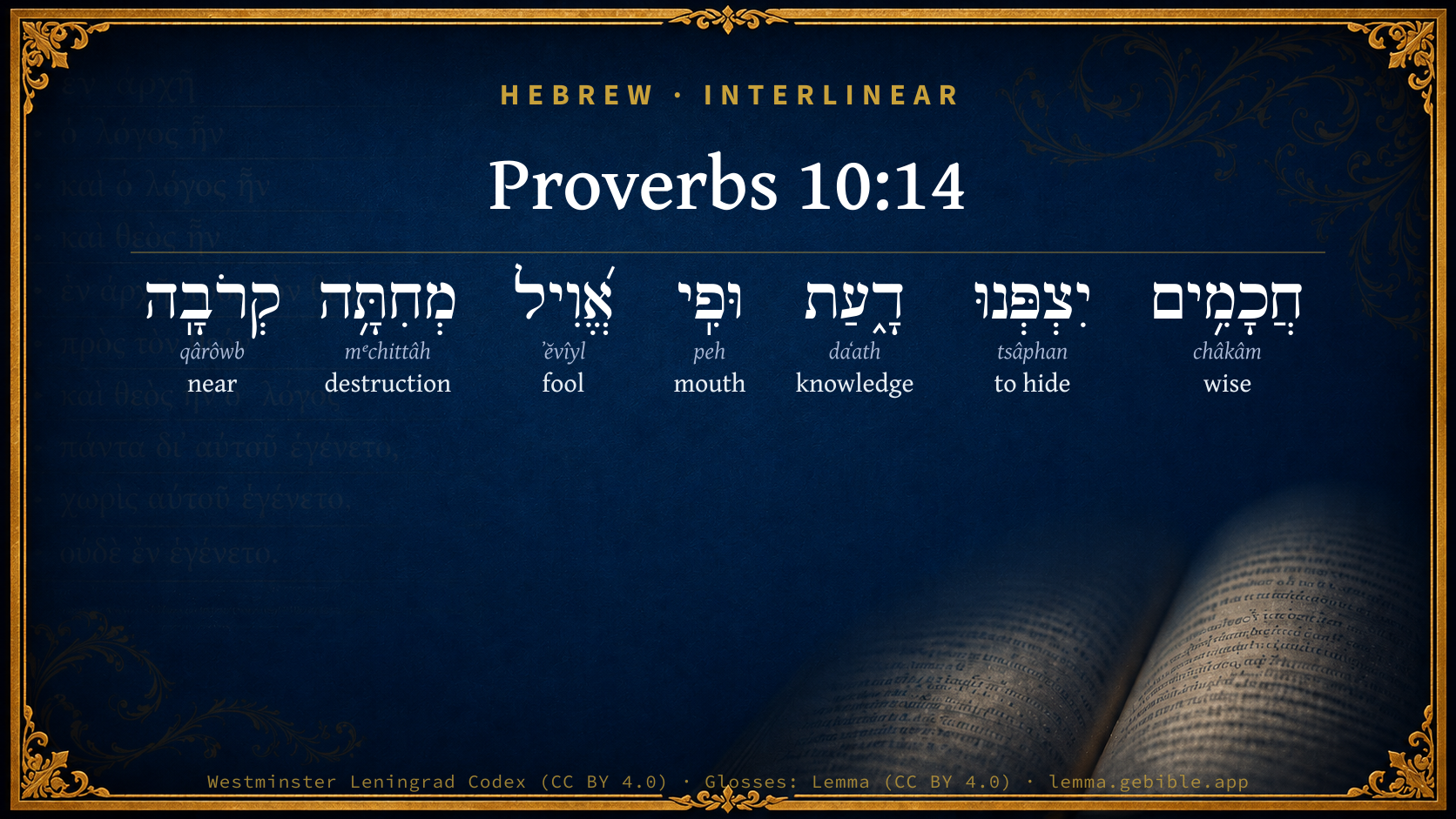
Hebrew (Westminster Leningrad Codex) Proverbs 10:14 appears in the Hebrew Old Testament. The text above is from the Westminster Leningrad Codex. Each word links to its Strong’s number, a concise gloss, and parsing drawn from the Open Scriptures Hebrew Bible morphology. Click any word for its full Brown-Driver-Briggs (BDB) entry.
Download image
Cite this verse

Proverbs 10:14 (World English Bible). Public Domain. Lemma interlinear Bible study tool, https://lemma.gebible.app/v/proverbs/10/14.

Show BibTeX & RIS
BibTeX
RIS
English Translation
Wise men lay up knowledge, But the mouth of the foolish is near ruin.
World English Bible · Public Domain
Download a study sheet

One document with this verse’s original text, its word-by-word gloss line, the meaning frame, cross-references with their text, attributed commentary, and full source and license credits — printable, and it pastes into notes with its structure intact.

This verse Autodidact and up

Study sheet (.html) Plain text (.txt)

A passage Seminary Student

Up to 50 verses in one chapter. A passage sheet keeps up to 6 commentary sources and 12 cross-references per verse, in the order this page ranks them, and says so on the sheet whenever that leaves anything out. Ask for a single verse and you get the Autodidact verse sheet above.

Everything on this page stays free to read, with no account — the sheet is a download of what is already on screen, not access to it.

Want to remove ads? Support Godless Engineer
Compare translations 3

The same verse in 3 English versions, stacked beneath the original-language interlinear above. Click any original word for its lexicon entry.

Each is an independent rendering of the whole verse — the interlinear is not word-aligned to these translations.

Highlighted words mark where these versions differ — a whole-verse word diff, not a word-by-word alignment.

  • World English Bible Public Domain
    Wise men lay up knowledge, But the mouth of the foolish is near ruin.
  • King James Version Public Domain
    Wise men lay up knowledge: but the mouth of the foolish is near destruction.
  • unfoldingWord Literal Text CC BY-SA 4.0
    Wise ones store up knowledge, but the mouth of a fool near ruin.

unfoldingWord Literal Text — © unfoldingWord, licensed CC BY-SA 4.0. Word-aligned USFM3 via Door43 (git.door43.org/unfoldingWord/en_ult).

Versions to compare (up to 4)

3 of 4 selected

Show all 18 translations

Every available English version of this verse, each an independent rendering of the whole verse.

  • World English Bible Public Domain
    Wise men lay up knowledge, But the mouth of the foolish is near ruin.
  • Berean Standard Bible Public Domain
    The wise store up knowledge, but the mouth of the fool invites destruction.
  • Majority Standard Bible Public Domain
    The wise store up knowledge, but the mouth of the fool invites destruction.
  • King James Version Public Domain
    Wise men lay up knowledge: but the mouth of the foolish is near destruction.
  • American Standard Version (1901) Public Domain
    Wise men lay up knowledge; But the mouth of the foolish is a present destruction.
  • Revised Version (1885) Public Domain
    Wise men lay up knowledge: but the mouth of the foolish is a present destruction.
  • Geneva Bible (1599) Public Domain
    Wise men lay vp knowledge: but ye mouth of the foole is a present destruction.
  • Douay-Rheims (1899) Public Domain
    Wise men lay up knowledge: but the mouth of the fool is next to confusion.
  • Young's Literal Translation Public Domain
    The wise lay up knowledge, and the mouth of a fool `is' near ruin.
  • Literal Standard Version CC BY-SA 4.0
    The wise lay up knowledge, and the mouth of a fool [is] near ruin.
  • Unlocked Literal Bible CC BY-SA 4.0
    Wise men store up knowledge, but the mouth of a fool brings destruction near.
  • unfoldingWord Literal Text CC BY-SA 4.0
    Wise ones store up knowledge, but the mouth of a fool near ruin.
  • Darby Bible Public Domain
    The wise lay up knowledge; but the mouth of the fool is near destruction.
  • World Messianic Bible Public Domain
    Wise men lay up knowledge, but the mouth of the foolish is near ruin.
  • Webster's Bible Public Domain
    Wise men lay up knowledge: but the mouth of the foolish is near destruction.
  • Free Bible Version CC BY-SA 4.0
    Wise people accumulate knowledge, but the chattering of stupid people is a prelude to disaster.
  • Bible in Basic English Public Domain
    Knowledge is stored up by the wise, but the mouth of the foolish man is a destruction which is near.
  • JPS Tanakh (1917) Public Domain
    Wise men lay up knowledge; but the mouth of the foolish is an imminent ruin.

Literal Standard Version (2020), Covenant Press — licensed CC BY-SA 4.0. Text via the HelloAO Bible API (eBible.org). Unlocked Literal Bible (unfoldingWord) — licensed CC BY-SA 4.0. Text via the HelloAO Bible API (eBible.org). unfoldingWord Literal Text — © unfoldingWord, licensed CC BY-SA 4.0. Word-aligned USFM3 via Door43 (git.door43.org/unfoldingWord/en_ult). Free Bible Version, Dr. Jonathan Gallagher — licensed CC BY-SA 4.0. Text via the HelloAO Bible API (eBible.org).

Word by word

More ways to search: Search by grammar → Find every occurrence → Compare this word →

Practice this passage: Drill this verse → Learn its vocabulary →

About this verse

These counts appear in no published source. They are computed here, from the morphology-tagged text and Lemma’s own curated glosses. What Lemma adds →

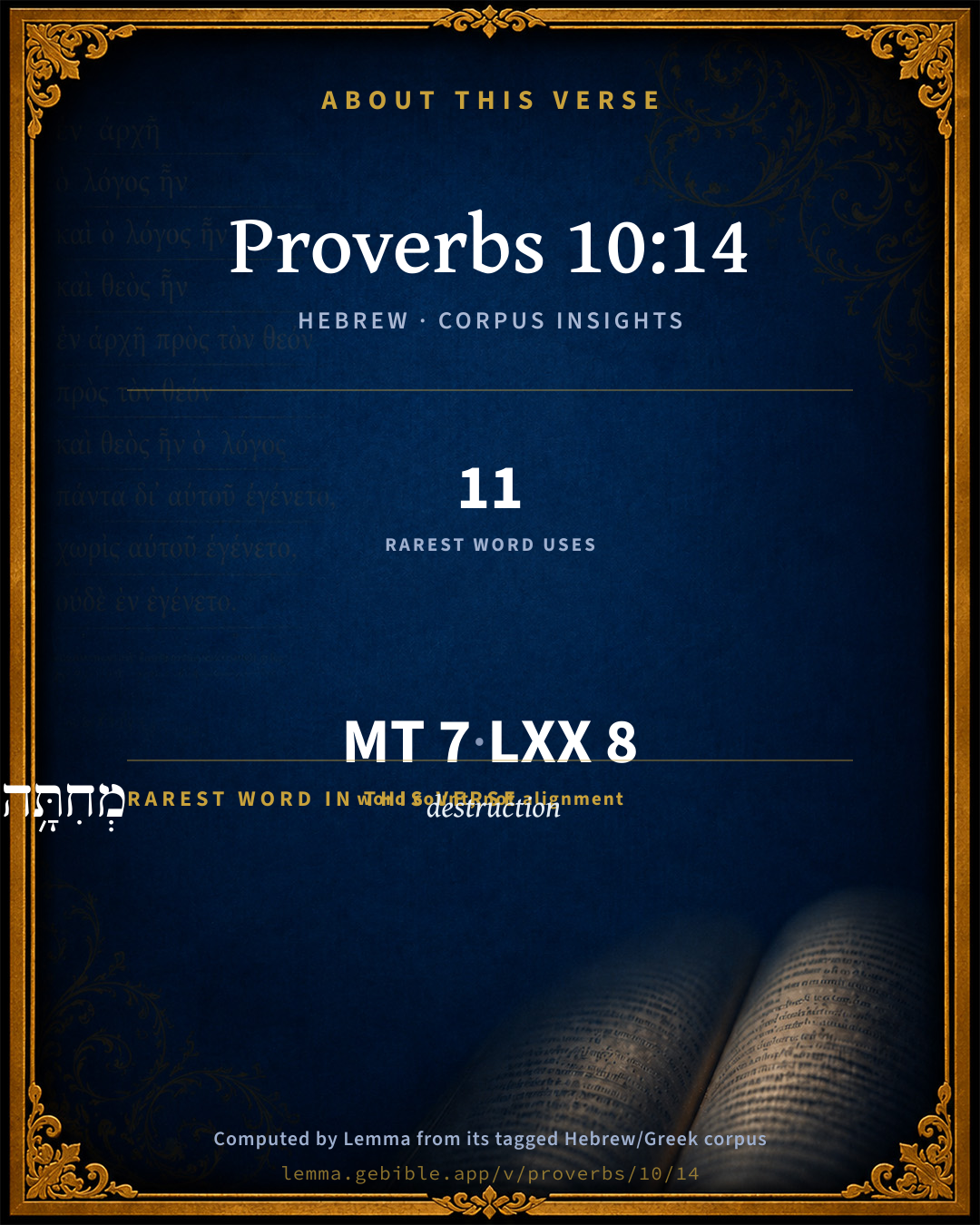
7
words
7
distinct lemmas
Wisdom
section

Notable vocabulary

The rarest word here is מְחִתָּ֥ה destruction H4288 — appearing just 11 times in the whole Hebrew Bible.

Shared distinctive vocabulary

מְחִתָּ֥ה destruction H4288 occurs in 11 verses of the Hebrew Bible. Also found in:

Grammatical profile

  • 1 verb
  • 3 nouns
  • 3 adjectives

Verb forms

  • יִצְפְּנוּ Qal · Imperfect

Hebrew & Septuagint length

In English translation the verse runs 14 words from the Hebrew and 15 from the Septuagint (LXX English) — closely comparable.

A rough comparison of the two English renderings, which tokenize alike — not a word-level alignment.

Word counts can differ between the Hebrew and the Greek without any difference in meaning — e.g. the Hebrew direct-object marker אֵת has no separate Greek word, and Greek often adds the article ὁ.

In the original languages it is 7 Hebrew tokens and 8 Greek tokens — but the two are counted differently (Hebrew bundles its prefixes and suffixes into one token; the Greek is in lemma form), so that isn’t a like-for-like length.

Cross-references

14

Topical passages linked to Proverbs 10:14 in the Treasury of Scripture Knowledge — connected by theme and wording, ordered by reader-vote popularity; previews shown in the World English Bible.

  • Proverbs 10:8 The wise in heart accept commandments, But a chattering fool will fall.
  • Proverbs 18:7 A fool's mouth is his destruction, And his lips are a snare to his soul.
  • Proverbs 13:3 He who guards his mouth guards his soul. One who opens wide his lips comes to ruin.
  • Proverbs 9:9 Instruct a wise man, and he will be still wiser. Teach a righteous man, and he will increase in learning.
  • Proverbs 10:10 One winking with the eye causes sorrow, But a chattering fool will fall.
  • Proverbs 1:5 That the wise man may hear, and increase in learning; That the man of understanding may attain to sound counsel:
  • Proverbs 18:1 An unfriendly man pursues selfishness, And defies all sound judgment.
  • Proverbs 18:15 The heart of the discerning gets knowledge. The ear of the wise seeks knowledge.
  • Proverbs 19:8 He who gets wisdom loves his own soul. He who keeps understanding shall find good.
  • Proverbs 21:23 Whoever guards his mouth and his tongue Keeps his soul from troubles.
  • Matthew 12:35 The good man out of his good treasure brings out good things, and the evil man out of his evil treasure brings out evil things.
  • Matthew 13:44 "Again, the Kingdom of Heaven is like a treasure hidden in the field, which a man found, and hid. In his joy, he goes and sells all that he has, and buys that field.
  • Matthew 13:52 He said to them, "Therefore, every scribe who has been made a disciple in the Kingdom of Heaven is like a man who is a householder, who brings out of his treasure new and old things."
  • 2 Corinthians 4:6–7 seeing it is God who said, "Light will shine out of darkness," who has shone in our hearts, to give the light of the knowledge of the glory of God in the face of Jesus Christ.

Cross-references courtesy of OpenBible.info (CC BY 4.0).

Hebrew and Greek witnesses Masoretic Hebrew ↔ Greek Septuagint

The same verse in the two great witnesses to the Old Testament, shown verse-for-verse.

These are two independent witnesses, not word-aligned to each other, and the Septuagint is shown in lemma (dictionary) form.

Hebrew Proverbs 10:14 Masoretic · Westminster Leningrad Codex

חֲכָמִ֥ים יִצְפְּנוּ דָ֑עַת וּפִֽי אֱ֝וִיל מְחִתָּ֥ה קְרֹבָֽה

Wise men lay up knowledge, But the mouth of the foolish is near ruin.

World English Bible · Public Domain

Greek LXX Proverbs 10:14 Septuagint · lemma form

σοφός κρύπτω αἴσθησις στόμα δέ προπετής ἐγγίζω συντριβή

The wise will hide discretion; but the mouth of the hasty draws near to ruin.

LXX2012 (modern English Septuagint) · Public Domain

On this verse, The Cambridge Bible for Schools and Colleges discusses the Septuagint’s reading. Read the note in Commentary ↓

Hebrew: Westminster Leningrad Codex (CC BY 4.0). Greek: Septuagint (public domain); English from LXX2012 (modern English Septuagint) (Public Domain). How the Septuagint differs from the Hebrew →

Commentary

Notes on Proverbs 10:14 from classic Christian and Jewish commentators (each source and its license shown beneath its notes). The classic Christian expositions comment on the surrounding passage and are grouped to its opening verse, so a note may address several verses; the Jewish commentaries on the Tanakh (Rashi and others) are per-verse, so they appear only where the commentator wrote on this verse.

Lemma curates 59 commentaries, every one of them public domain or Creative Commons licensed, each selected and text-cleaned for this edition rather than reprinted as found. About our sources →

Trapp's Complete Commentary

John Trapp

Pro 10:14 Wise [men] lay up knowledge: but the mouth of the foolish [is] near destruction.

Ver. 14. Wise men lay up knowledge.] To know when to speak, and when to be silent. It is a great skill to be able "to time a word," {Isa 50:4} to set it upon the wheels. {Pro 25:11} "How forcible are right words!" {Job 6:25}

But the mouth of the foolish.] An open mouth is a purgatory to the master. Nemo stultus tacere potest, saith Solon. A fool tells all, saith Solomon. {Ecc 10:12-14} And Ut quisque est dissolutissimae vitae, ita est solutissimae linguae, saith Seneca. A fool’s bolt is soon shot, and as soon retorted ofttimes upon himself.

John Trapp, A Commentary or Exposition upon All the Books of the Old and New Testament (1647–1656) — public domain. Text from a community e-Sword module.

The Biblical Illustrator

Joseph S. Exell

Pro_10:14

Wise men lay up knowledge.

Experience kept for use

Another brief definition of wisdom. Many get knowledge, and let it go as fast as they get it. They put their winnings into a bag with holes. The part of wisdom is to treasure up experience, and hold it ready for use in the time and place of need. Everything may be turned to account. Even losses may be converted into gains. Let nothing trickle out and flow away useless. None of the wisdom comes for nothing, either to old or young. Our Father in heaven gives us the best kind; and the best kind is that which is bought. The saddest thing is when people are always paying, and never possessing. The cleverest people are in many cases the least successful. A man of moderate gifts, but steadfast acquisitiveness, lays up more than a man of the brightest genius, whether the treasure sought be earthly substance or heavenly wisdom. Men, looking on the outward appearance, make great mistakes in judging of men. Those who give out little noise may have laid up much wisdom. (W. Arnot, D. D.)

Wise men lay up knowledge

In Eastern countries men lay up garments, and pride themselves in the number of their suits of apparel. In our land men lay up money. But this is not wisdom. In Egypt Joseph laid up corn for the day of famine; and in Syria men lay up water for the summer in cisterns under their houses. This is wisdom; but still it is not the wisdom of which Solomon speaks. The astronomer lays up the knowledge of the stars; and the botanist lays up the knowledge of plants and flowers. This is wisdom, but it is not that of which the text speaks. The knowledge that is best for us is the knowledge of God Himself; and though the knowledge of His works is good, the knowledge of Himself is far better. It is only this knowledge that can make you happy, or bring blessing to your soul. A poor woman, that could not read a word, once said to me, You see Im no scholar; but Im Christs scholar, and that will do. Yes, it was enough; for it made her wise unto salvation. She was one of the wise women that lay up knowledge. This is the knowledge which you must have; you will find it in the Bible; and the Holy Spirit is most willing to become your teacher. (Christian Treasury.)

The Biblical Illustrator, edited by Joseph S. Exell (c. 1880s–1900s) — public domain. Text from a community e-Sword module.

Matthew Henry's Commentary

Observe, 1. It is the wisdom of the wise that they treasure up a stock of useful knowledge, which will be their preservation: Wisdom is therefore found in their lips (Pro 10:13), because it is laid up in their hearts, out of which store, like the good householder, they bring things new and old. Whatever knowledge may be at any time useful to us we must lay it up, because we know not but some time or other we may have occasion for it. We must continue laying up as long as we live; and be sure to lay it up safely, that it may not be to seek when we want it. 2. It is the folly of fools that they lay up mischief in their hearts, which is ready to them in all they say, and works terror and destruction both to others and to themselves. They love devouring words (Psa 52:4), and these come uppermost. Their mouth is near destruction, having the sharp arrows of bitter words always at hand to throw about.

Matthew Henry's Commentary on the Whole Bible (1708–1710) — public domain (CC PDM 1.0). Text via the HelloAO Bible API.

Jamieson, Fausset & Brown

Robert Jamieson, A. R. Fausset & David Brown

lay up knowledge--that is, as treasures for good use.

mouth . . . destruction--or, "as to the mouth," &c., destruction is near; they expose themselves to evil by prating.

Jamieson, Fausset & Brown — Commentary Critical and Explanatory on the Whole Bible (1871) — public domain (CC PDM 1.0). Text via the HelloAO Bible API.

Adam Clarke's Commentary

Verse 14. Wise men lay up knowledge] They keep secret every thing that has a tendency to disturb domestic or public peace; but the foolish man blabs all out, and produces much mischief. Think much, speak little, and always think before you speak. This will promote your own peace and that of your neighbour.

Adam Clarke's Commentary on the Bible (1810–1826) — public domain. Text from a community e-Sword/MySword module.

Ellicott's Commentary for English Readers

(14) The mouth of the foolish is near destruction—i.e., is a near, ever-threatening calamity; one never knows what awkward or dangerous thing he will not say next: whereas wise men store up knowledge, and bring it forth as it is wanted (Mat_13:52).

A Bible Commentary for English Readers, edited by Charles John Ellicott (1878–1897) — public domain. Text from a community e-Sword module.

The Cambridge Bible for Schools and Colleges

gen. ed. J. J. S. Perowne

14. near destruction] Rather, is a near, or imminent (R.V. a present) destruction: “it is like a house ready to fall at any moment.” The antithesis is between wise men who treasure their wisdom to be used as occasion serves, and a fool who blurts out his folly, and may at any moment bring upon himself and others its disastrous consequences. Comp. Pro_12:23.

The A.V. follows LXX., ἐγγίζει συντριβῇ; and Vulg., confusioni proximum est.

The Cambridge Bible for Schools and Colleges (gen. ed. J. J. S. Perowne; Cambridge University Press, 1878–1918) — public domain. Text from a community e-Sword module.

John Gill's Exposition

Wise men lay up knowledge,.... Which they get by reading, prayer, meditation, hearing the word of God, and conversation with good men: this they lay up in their hearts, minds, and memories, that they may not forget it, and as a rich treasure they highly value it; that they may bring it forth at proper times, and on proper occasions, for the benefit of others; see Mat 12:35; or hide (f) it; conceal it; do not boast and brag of it, as foolish men do;

but the mouth of the foolish is near destruction: who rashly and unguardedly utters things which bring swift and sudden destruction on himself and others; or terror and consternation, as the word (g) also signifies. The Vulgate Latin version is, "but the mouth of the foolish is near to confusion"; he boasts of his knowledge, betrays his ignorance, and so brings himself to shame and confusion.

(f) "abscondent", Pagninus, Montanus; "abscondunt", V. L. "occultant", Michaelis. (g) "terrorem accersit", Tigurine version; "consternatio propinqua", Cocceius; "terror", Vatablus, Michaelis.

John Gill's Exposition of the Whole Bible (1746–1763) — public domain (CC PDM 1.0). Text via the HelloAO Bible API.

Albert Barnes' Notes on the Bible

Lay up - The point of the maxim is that the wise man reserves what he has to say for the right time, place, and persons (compare Mat 7:6), as contrasted with the foolish, ever giving immediate utterance to what destroys himself and others.

Albert Barnes' Notes on the Bible (1834–1885) — public domain. Text from a community e-Sword/MySword module.

Haydock's Catholic Bible Commentary

Confusion. He speaks inconsiderately, and involves himself in continual dangers, while the wise are cautious in their speech.

George Leo Haydock (1774–1849), Haydock's Catholic Family Bible and Commentary, 1859 edition — public domain. Excludes Psalms (Douay-Rheims chapter numbering differs from Protestant) and Deuterocanonical books (Catholic canon only).

Matthew Poole's English Annotations

Wise men lay up, to wit, in their minds and memories, to be brought forth thence upon fit occasions,

knowledge; whereby they may be enabled to speak both what and when it is seasonable, for their own or others’ good.

The mouth of the foolish is near destruction; fools are more forward to lay out than to lay up, and for want of knowledge speak much and foolishly, whereby they frequently bring destruction upon themselves

Matthew Poole's English Annotations on the Holy Bible (1683–1685) — public domain. Text from a community e-Sword/MySword module.

Whedon's Commentary on the Bible

Daniel D. Whedon

14. Lay up — Treasures up, in the memory, useful knowledge. Compare Pro_10:8. Is near destruction — Destruction is near by, imminent. The sense is, that knowledge treasured up by the wise preserves from calamity; but folly, which is pre-eminently shown by the mouth, plunges one speedily into it. Miller carries forward the verb, lay up, and renders the last clause, “but the mouth of the fool (stores up) early rain.” On first clause compare Mat_12:35; Mat_13:52; Psa_119:11.

Daniel D. Whedon (gen. ed.), Commentary on the Old and New Testaments (1874–1909) — public domain. Text from a community e-Sword module.

The Pulpit Commentary

Lay up knowledge; like a treasure, for use on proper occasions. (Pro_12:23 Pro_14:33; comp. Mat_7:6 Mat_13:52) Is near destruction. "Near" may be an adjective, equivalent to "imminent," "ever-threatening." The versions are proximum est and eggizei . The foolish are always uttering carelessly what may bring trouble on themselves and others.

The Pulpit Commentary (1880–1919), ed. H.D.M. Spence-Jones & Joseph S. Exell — public domain. Text from a community e-Sword module.

John Wesley's Explanatory Notes

Lay up - In their minds, to be brought forth upon fit occasions. Knowledge - Whereby they may be enabled to speak both what, and when it is seasonable. But - Fools are more forward to lay out than to lay up, and for want of knowledge speak much and foolishly, whereby they frequently bring destruction upon themselves.

John Wesley, Explanatory Notes Upon the Whole Bible (1754–1765) — public domain. Text via the GEBible commentary corpus.

Keil & Delitzsch

C. F. Keil & F. Delitzsch

14 Wise men store up knowledge;

But the mouth of the fool is threatening destruction.

Ewald, Bertheau, Hitzig, Oetinger: "The mouth of the fool blunders out, and is as the sudden falling in of a house which one cannot escape from." But since מחתּה is a favourite Mishle-word to denote the effect and issue of that which is dangerous and destructive, so the sense is perhaps further to be extended: the mouth of the fool is for himself (Pro 13:3) and others a near, i.e., an always threatening and unexpectedly occurring calamity; unexpectedly, because suddenly he blunders out with his inconsiderate shame-bringing talk, so that such a fool's mouth is to every one a praesens periculum. As to יצפּנוּ, it is worthy of remark that in the Beduin, Arab. dfn, fut. i, signifies to be still, to be thoughtful, to be absorbed in oneself (vid., Wetstein on Job, p. 281). According to Codd. and editions, in this correct, וּפי־ is to be written instead of אויל uwpiy; vid., Baer's Torath Emeth, p. 40.

Keil & Delitzsch — Biblical Commentary on the Old Testament (1861–1891) — public domain (CC PDM 1.0). Text via the HelloAO Bible API. (Old Testament only.)

Bridges on Proverbs

Charles Bridges

Did not Solomon prove his title as a wise man by his diligence in laying up knowledge? (Ecc 12:9-10 .) No wonder that wisdom is found in the lips, where "out of the abundance of the good treasure of the heart the mouth speaketh."†1 It is "the householder" storing his mind not for selfish gratification, but for liberal and useful distribution. (Mat 13:52 .) If the hoarding wisdom be cultivated in youth (Pro 6:6 ; Pro 18:1, Pro 18:15 ), what a store of valuable treasure would be laid up! yet all little enough to meet the coming trial. Let every day add something to the stock. So inexhaustible is the treasure, that no doubt, difficulty, temptation, or duty, will be found unprovided for!

Wise men lay up knowledge, for their own use — Fools lay it out. For want of sound wisdom, they only open their mouths for their own mischief, in profane rebellion (Exo 5:2 . Psa 12:3-5 ; Psa 52:1-5 ); groveling selfishness (1Sa 25:10-11, 1Sa 25:38 ); ungodly worldliness (Luk 12:18-20 ); or hateful pride (Act 12:21-23 ) — near to destruction. (Pro 12:13 ; Pro 13:3 ; Pro 18:7 . Ecc 10:12-13 .) How near — who can say? — But if they be not "taken away with a stroke" without remedy (Job 36:18 ); they only stand out as monuments of the "much long-suffering of God, enduring the vessels of wrath fitted to destruction." (Rom 9:22 .)

Footnotes:

†1 Mat 12:34. Jerome mentions of his friend Nepotian, that, ’by daily reading and meditating in the sacred volume, he had made his soul a library of Christ.’ — Letter to Nepotian.

Charles Bridges, An Exposition of the Book of Proverbs (1846) — public domain. Text from a community e-Sword module.

Kretzmann's Popular Commentary

Paul E. Kretzmann

v. 14. Wise men lay up knowledge, like treasures which are to be put to a good use; but the mouth of the foolish is near destruction, because his foolish suggestions are always breaking forth and bringing misfortune to himself and others, like the sudden collapse of a house.

Paul E. Kretzmann, Popular Commentary of the Bible (1921–1924) — public domain. Text from a community e-Sword module.

unfoldingWord translationNotes

Door43 World Missions Community

the mouth of a fool

"Mouth" represents what a person says. AT: "the words from a foolish person" (See: Metonymy)

his fortified city

This represents wealth as a safe place. AT: "his safety" (See: Metaphor)

translationWords

wise

know

fool

unfoldingWord translationNotes — © Distant Shores Media and the Door43 World Missions Community, licensed CC BY-SA 4.0. Source: git.door43.org/Door43/en_tn.

Rashi

Rabbi Shlomo Yitzchaki (Rashi)

Wise men store up knowledge They guard it in their heart so that they do not forget it.

Rashi on the Tanakh — English translations: “The Judaica Press complete Tanach with Rashi, translated by A. J. Rosenberg” (CC BY 4.0); “Pentateuch with Rashi's commentary by M. Rosenbaum and A.M. Silbermann, 1929-1934” (public domain); “The Metsudah Tanach series, Lakewood, N.J” (CC BY 4.0); and “The Book of Joshua, Metsudah Publications, 1997” (CC BY 4.0). Text via Sefaria.

Lesson kit

Teaching starters — assembled from the data on this page, not authored interpretation. Every prompt links to the verse data it draws on. Edit before teaching.

Proverbs, in the Wisdom, opens this verse with 7 words (7 distinct Hebrew lemmas). Its most distinctive word is mᵉchittâh (“destruction”). A historical commentator’s framing appears above. Read the whole chapter for the surrounding context.

Discussion questions

  1. What does “destruction” (mᵉchittâh) contribute to the verse as a whole?
  2. How does Psalms 89:40, which shares the word «destruction», read alongside this verse?
  3. These translations render this verse differently. What is at stake in choosing one wording over another?
  4. «יִצְפְּנוּ» is a Qal Imperfect verb. How does that grammatical form shape the action described?
  5. Compare how Trapp's Complete Commentary and The Biblical Illustrator read this verse. Where do they agree or differ?

Things to notice

Reading settings

Reading text

Shown beneath each verse's original-language words.

Old Testament
Old Testament edition

Read the OT as the Masoretic Hebrew (MT) or the Greek Septuagint (LXX).

English shown for the Greek Septuagint (in the Hebrew ↔ Greek comparison).

Comparing translations? Open the Compare panel on any verse page to stack up to four side by side.