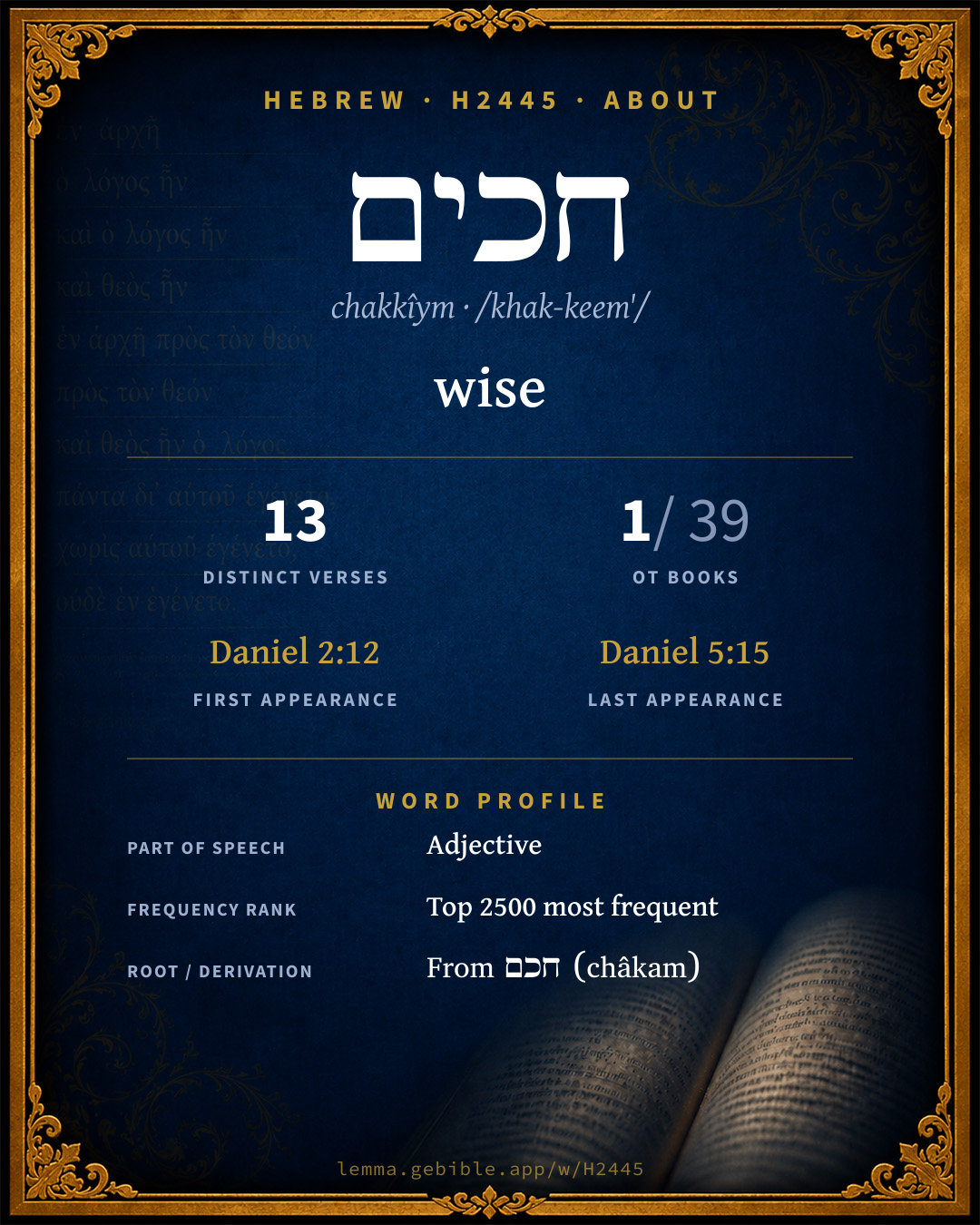
חַכִּים
wise
Full lexicon entry — Brown-Driver-Briggs (BDB)
From Brown-Driver-Briggs (BDB)
Where this word appears
See every Construct-state word in the Hebrew Bible →
Grammar key — what these labels mean
Part of speech
- Noun
- A naming word — a person, place, thing, or idea.
Noun type
- Common
- A common noun — a general class of person, place, or thing (“king,” “city,” “water”), not a specific name.
State
- Construct
- A noun bound to a following noun in a possessive / “of” relationship (the construct chain).
- Absolute
- The independent form of a noun, not bound to a following word.
Gender
- Masculine
- Grammatically masculine.
Number
- Plural
- More than one (in Hebrew, generally three or more).
Grammatical forms
- Noun, Common, Masculine, Plural, Construct 10 times (71%)
- Particle, Definite Article 2 times (14%)
- Noun, Common, Masculine, Plural, Absolute 2 times (14%)
Parsed forms decoded from the imported morphology (morphhb / Westminster Leningrad Codex — WLC text public domain, morphhb tagging CC BY 4.0), counted across 14 parsed occurrences — not distinct verses.
Every verse where H2445 appears — 13 distinct verses across 1 book. Click any verse to open its interlinear word-by-word view. Verse text shown in the World English Bible for context — . Each verse’s Hebrew form is shown with its reference; the English is not keyword-highlighted, since the data carries no word-level English alignment. Use “Compare translations” on any verse to read it across multiple English versions. This concordance covers the Hebrew Bible; Septuagint (Greek Old Testament) occurrences are not indexed here.
Daniel 13 verses
- Daniel 2:12 חַכִּימֵ֥י n c mp cs For this cause the king was angry and very furious, and commanded to destroy all the wise men of Babylon.
- Daniel 2:13 וְ/חַכִּֽימַיָּ֖/א conj + n c mp det + ptcl def.art So the decree went forth, and the wise men were to be slain; and they sought Daniel and his companions to be slain.
- Daniel 2:14 לְ/חַכִּימֵ֖י ptcl do + n c mp cs Then Daniel returned answer with counsel and prudence to Arioch the captain of the king's guard, who was gone forth to kill the wise men of Babylon;
- Daniel 2:18 חַכִּימֵ֥י n c mp cs that they would desire mercies of the God of heaven concerning this secret; that Daniel and his companions should nor perish with the rest of the wise men of Babylon.
- Daniel 2:21 לְ/חַכִּימִ֔ין prep + n c mp He changes the times and the seasons; he removes kings, and sets up kings; he gives wisdom to the wise, and knowledge to those who have understanding;
- Daniel 2:24 לְ/חַכִּימֵ֣י לְ/חַכִּימֵ֤י ptcl do + n c mp cs ptcl do + n c mp cs Therefore Daniel went in to Arioch, whom the king had appointed to destroy the wise men of Babylon; he went and said thus to him: Don't destroy the wise men of Babylon; bring me in before the king, and I will show to the king the interpretation.
- Daniel 2:27 חַכִּימִ֣ין n c mp Daniel answered before the king, and said, The secret which the king has demanded can neither wise men, enchanters, magicians, nor soothsayers, show to the king;
- Daniel 2:48 חַכִּימֵ֥י n c mp cs Then the king made Daniel great, and gave him many great gifts, and made him to rule over the whole province of Babylon, and to be chief governor over all the wise men of Babylon.
- Daniel 4:6 חַכִּימֵ֣י n c mp cs Therefore made I a decree to bring in all the wise men of Babylon before me, that they might make known to me the interpretation of the dream.
- Daniel 4:18 חַכִּימֵ֣י n c mp cs This dream I, king Nebuchadnezzar, have seen; and you, Belteshazzar, declare the interpretation, because all the wise men of my kingdom are not able to make known to me the interpretation; but you are able; for the spirit of the holy gods is in you.
- Daniel 5:7 לְ/חַכִּימֵ֣י prep + n c mp cs The king cried aloud to bring in the enchanters, the Chaldeans, and the soothsayers. The king spoke and said to the wise men of Babylon, Whoever shall read this writing, and show me the interpretation of it, shall be clothed with purple, and have a chain of gold about his neck, and shall be the third ruler in the kingdom.
- Daniel 5:8 חַכִּימֵ֣י n c mp cs Then came in all the king's wise men; but they could not read the writing, nor make known to the king the interpretation.
- Daniel 5:15 חַכִּֽימַיָּ/א֙ n c mp det + ptcl def.art Now the wise men, the enchanters, have been brought in before me, that they should read this writing, and make known to me the interpretation of it; but they could not show the interpretation of the thing.
About this entry
At a glance — auto-summarized from this page’s data, not written by a person. Every figure links to its source below. This summary describes the numbers; it doesn’t interpret them.
“wise” is the headline sense of the Hebrew adjective חכים (chakkîym). It clusters heavily in Daniel, which alone accounts for 100% of its uses. It turns up in 13 verses across 1 book, an uncommon footprint. First canonically at Daniel 2:12, it enters the text early. Translators differ — “wise” in the King James Version, then “wise men” (Berean Standard Bible) and “wise men of” (unfoldingWord Literal Text), as the renderings breakdown shows. The sections below give every sense, occurrence, and version rendering.
Gloss history
Strong's 1890 vs modern scholarship
About this word
Strong's H2445 catalogs a Hebrew word from the Hebrew Old Testament.
These counts are not copied from any lexicon or concordance. They are computed here, from the morphology-tagged Hebrew Old Testament. What Lemma adds →
- 13
- distinct verses
- The word appears in 13 distinct verses.
- 1 / 39
- OT books
- The word appears in 1 of 39 Old Testament books.
- #1,910
- by frequency
- Top 2500 most frequent Hebrew words (rank 1,910 of 8,640 Hebrew words by occurrence).
View all 13 occurrences in the concordance →
Most concentrated in
- Daniel 13 verses 100%
By section of the Old Testament
By traditional corpus
Conventional, traditional groupings — biblical authorship is debated, so this is a traditional corpus grouping, not an authorship claim. Each share is this word’s portion of its verses in that division of the Hebrew canon. Each figure is a share of the word’s 13 distinct verses.
- Writings (Ketuvim) 13 verses · 100%
How translations render this word
Counts come from each version’s own published word-to-Strong’s tagging or interlinear alignment — an approximate guide to how each version renders this word, not a word-level alignment the data otherwise carries. Because each total is that version’s own tagged count, the per-version totals vary from one another and need not match the appearance or distinct-verse counts above. These counts may also differ from a printed concordance because Lemma counts each distinctly tagged rendering and does not collapse phrase taggings into a single head-word total. This is a fixed set of word-tagged versions (KJV, ASV, BSB, ULT) and does not change with the reading translation you choose elsewhere. Each version’s license is shown beside its name below (and on Sources).
- King James Version: Wise 14×
- American Standard Version: Wise 13×
- Berean Standard Bible: Wise men 11×, Wise 2×
- unfoldingWord Literal Text: Wise men of 10×, Wise men 3×
King James Version Public Domain
Renders H2445 across 14 tagged occurrences — most commonly:
American Standard Version Public Domain
Renders H2445 across 14 tagged occurrences — most commonly:
Plus 1 rendering that appears only once — usually multi-word phrases or single function words the recovered tagging swept in, not distinct renderings.
Berean Standard Bible Public Domain
Renders H2445 across 14 tagged occurrences — most commonly:
Plus 1 rendering that appears only once — usually multi-word phrases or single function words the recovered tagging swept in, not distinct renderings.
unfoldingWord Literal Text CC BY-SA 4.0
Renders H2445 across 14 tagged occurrences — most commonly:
Plus 1 rendering that appears only once — usually multi-word phrases or single function words the recovered tagging swept in, not distinct renderings.
Senses in BDB
The 1 sense BDB distinguishes for this word, in lexicon order (not ranked by frequency or importance). The full entry — with sub-senses — is in the Lexicon Entry tab.
- wise man, wise
Word origin
[ חַכִּים ] 14 n.m. wise man
— Brown-Driver-Briggs (Oxford 1906, public domain), digitized via Sefaria, supplemented by the OpenScriptures HebrewLexicon (CC BY 4.0). See Sources.
Derived from חכם (châkam) (H2449) — to be wise.
Jastrow Dictionary
A second Hebrew/Aramaic lexicon for comparison, covering Aramaic and post-biblical (Talmudic, Targumic, Midrashic) usage that the biblical-Hebrew BDB does not. Matched by lemma rather than by Strong’s number, so a lemma may carry more than one Jastrow headword (shown separately below), and the entries cover usage well beyond the Bible.
חַכִּים I
- , v. חֲכַם
חַכִּים II
- , wise; sage, scholar. Targ. I Kings III, 12. Targ. Y. Lev. XIX, 32; a. fr.—Ab. Zar. 76ᵇ מאן ח׳ למיעבד וכ׳ who but R. … is wise enough to do that?; Pes. 76ᵃ.—Tam. 32ᵃ אידן מתקרי ח׳ who is to be called a wise man?; a. fr.—Esp. Ḥakham, a scholar’s title, inferior to Rabbi. B. Mets. 86ᵃ top ח׳ יתקרי וכ׳ shall be called a Ḥakham, but not a Rabbi. Y. Taan. IV, 68ᵃ דמנייתך ח׳ that I have appointed thee a Ḥ. (intimating that he would never be a Rabbi); a. e.—Pl. חַכִּימִין, חַכִּימַיָּא, הַכִּימֵי. Targ. Deut. I, 13. Targ. Job XL, 30 (h. text חַבָּרִים, cmp. חָבֵר); a. fr.—Nidd. 20ᵇ כמה ח׳ יהודאי how wise the Jews are. Sot. IX, 15 (49ᵃ) שרו ח׳ וכ׳ the Ḥăkhamimmim began to be (in scholarship) like common school teachers. Succ. 38ᵇ; a. fr.—Fem. חַכִּימָא, חַכִּימְתָּא. Targ. II Sam. XX, 16; a. e.—Pl. חַכִּימָתָא. Targ. Jer. IX, 16. Targ. Jud. V, 29 חַכִּימַת (constr. pl.).
חֲכַם
- (adj. with verbal inflection)
- 1. to be wise, shrewd; to be learned. Targ. I Kings V, 11. Targ. O. Ex. XV, 8 חֲכִימוּ (חַכִּ׳, h. text נערמו!). Targ. Is. XXIX, 16; a. fr.—Gitt. 56ᵇ דחַכְמִיתוּ וכ׳ that you are so wise. Taan. 23ᵇ דנִיחְכִּים טובא that we may become well-learned; a. fr.
- 2. to recognize, to know, remember. Targ. Y. II, Gen. XXXVII, 33 (some ed. חַכַּם Pa.).—Targ. II Esth. II, 18; a. fr.—Lev. R. s. 30 ח׳ את וכ׳ doest thou know anything in favor of this man?—Y. M. Kat. III, 83ᵇ top, v. בְּאַר—Y. Ber. II, 4ᵈ top וחַכְמִין אינון כלום do they (the dead) know anything?—Y. Shek. VII, 50ᶜ bot. יֶחְכְּמוּן שפייא קיטריהון let the wine-dealers identify their knots (marks on the wine bottles). Y. Keth. V, 30ᵃ bot. [read:] חֲכִים אנא לחייתא דמילדא לי (or חַכִּים) I (as an infant) recognized the midwife that assisted at my birth (when she came to nurse my mother). Y. Ter. XI, end, 48ᵇ לא אנא ח׳ לאבא I never knew my father. Y. Ḥag. II, 78ᵃ top יַחְכּוּם shall select (Y. Snh. VI, 23ᵃ bot. יטול), v. זוֹגָא.—2) (euphem. = b. h. יָדַע) to sleep with. Targ. Y. Gen. IV, 1 Ar. (ed. ידע). Targ. Y. II ib. XX, 16; a. e.—Y. Maas. Sh. IV, 55ᵇ bot.; Lam. R. to I, 1 רבתי (חד כותאי 1) a.e.
- 3. to be clear, evident. Snh. 42ᵃ, v. זָקֵן I.
- 1. to make wise, teach. Targ. Y. Deut. XXXIV, 10. Targ. Job XXXV, 11; a. e.
- 2. to outwit. Targ. O. Gen. XXVII, 36 (Rashi a. l. quotes וכמני, v. כְּמַן, v. Berl. Targ. O. II, p. 10).
- 1. to become wise. Targ. Ps. CV, 22; a. e.
- 2. to be informed, aware; to learn. Ib. XXXV, 8. Targ. Y. Ex. II, 4.
- 3. to hold counsel. Targ. O. Ex. I, 10.
- 4. to be recognized. Y. Sot. IX, 23ᶜ bot.; Y. Yeb. XVI, 15ᶜ מאן דבעי דלא מִתְחַכְּמָה he who desires to disguise himself; לא מִתְחַכְּמִין they were not recognized, v. נְחִירָא.
- to teach, make wise. Targ. Ez. III, 2; a. e.—B. Bath. 158ᵇ אוירא דא"י מַהְכּים the climate of Palestine makes wise.
A Dictionary of the Targumim, the Talmud Babli and Yerushalmi, and the Midrashic Literature (Marcus Jastrow; London, Luzac, 1903) — Public Domain. Digitized via Sefaria. Digitized via Sefaria. Full attribution on Sources.
Forms in the corpus
The 9 distinct written forms H2445 takes in the Hebrew Bible, most frequent first — each parse links to that state’s occurrences in the concordance. Hebrew forms include their vowel points and cantillation, so a single lemma takes many written forms.
| Form | Parsing | Example | Uses |
|---|---|---|---|
| חַכִּימֵ֣י | Noun, Common, Masculine, Plural, Construct | Daniel 4:6 | 3 |
| חַכִּימֵ֥י | Noun, Common, Masculine, Plural, Construct | Daniel 2:12 | 3 |
| לְ/חַכִּימֵ֣י | Noun, Common, Masculine, Plural, Construct | Daniel 5:7 | 2 |
| וְ/חַכִּֽימַיָּ֖/א | Particle, Definite Article | Daniel 2:13 | 1 |
| חַכִּֽימַיָּ/א֙ | Particle, Definite Article | Daniel 5:15 | 1 |
| חַכִּימִ֣ין | Noun, Common, Masculine, Plural, Absolute | Daniel 2:27 | 1 |
| לְ/חַכִּימִ֔ין | Noun, Common, Masculine, Plural, Absolute | Daniel 2:21 | 1 |
| לְ/חַכִּימֵ֖י | Noun, Common, Masculine, Plural, Construct | Daniel 2:14 | 1 |
| לְ/חַכִּימֵ֤י | Noun, Common, Masculine, Plural, Construct | Daniel 2:24 | 1 |
Same root — word family
Other BDB entries built from the same root as H2445, grouped by Strong’s listed origin. These share a root / origin per the lexicon — not necessarily a shared meaning. Each links to that word’s own entry.
Derives from
Shares the same root
Proper names from this root
People and places named from this root — a name, not an additional meaning of the word.
Compare all same-root words → Showing 4 of 5 — not the complete family. 1 of the same-root words is a proper name (a person or place). They share a root, not necessarily a meaning.
Septuagint verse parallels
This word appears in 13 verses that also exist in the Greek Old Testament (Septuagint), out of the 13 Hebrew verses it occurs in. You can read those verses in Greek by switching the Old Testament edition to the Septuagint.
Read these verses in the Septuagint
This is a verse-level parallel only — the same verses exist in both the Hebrew and Greek Old Testaments. No word-level Hebrew↔Greek correspondence is claimed: the data carries no such alignment, so no Greek word is shown as this Hebrew word’s translation. Coverage is not total — the Septuagint omits the deuterocanon and renumbers the Psalms, so some Hebrew verses have no direct Greek parallel.