
Proverbs 14:3

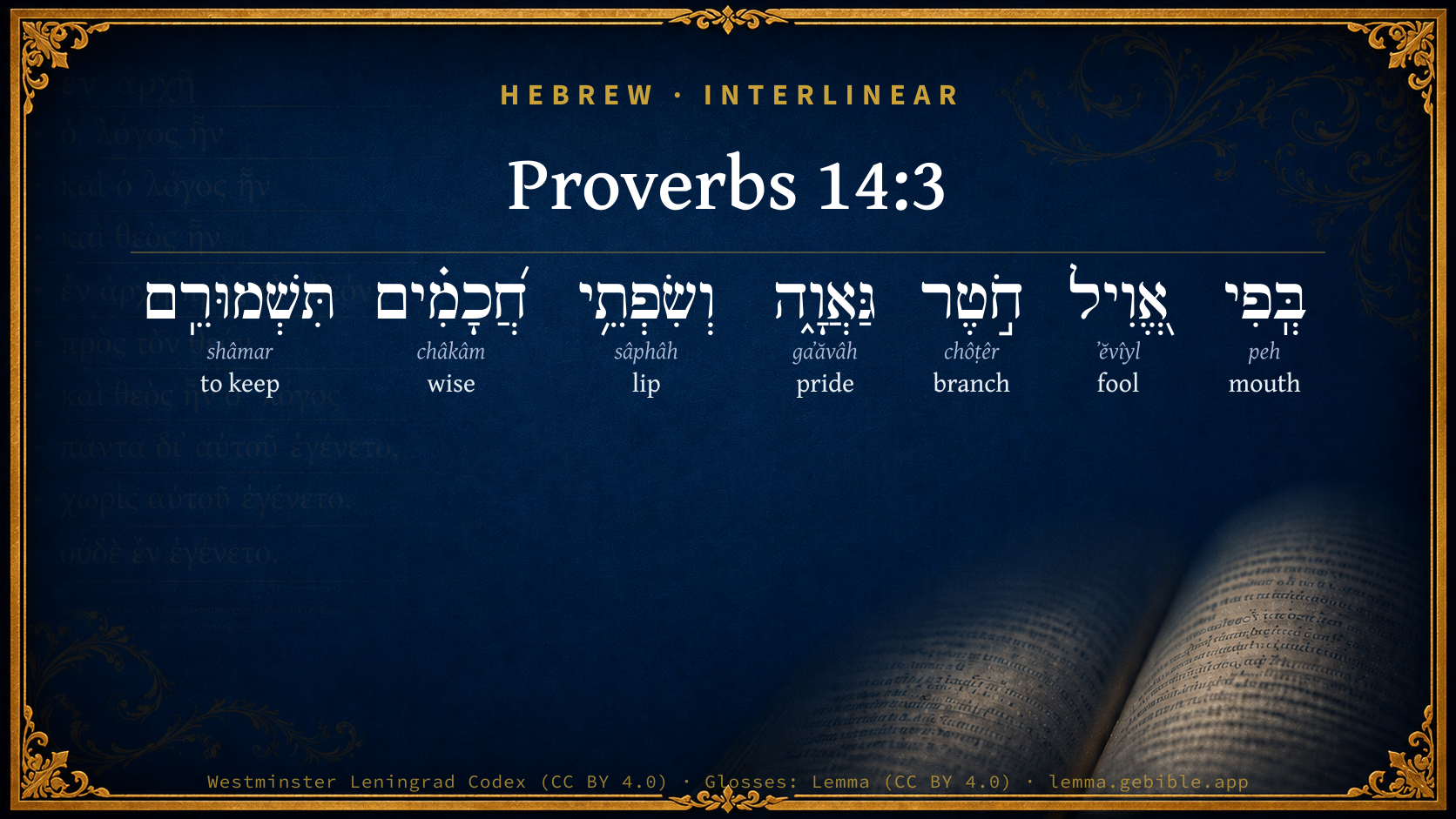
Hebrew (Westminster Leningrad Codex) Proverbs 14:3 appears in the Hebrew Old Testament. The text above is from the Westminster Leningrad Codex. Each word links to its Strong’s number, a concise gloss, and parsing drawn from the Open Scriptures Hebrew Bible morphology. Click any word for its full Brown-Driver-Briggs (BDB) entry.
Download image
Cite this verse

Proverbs 14:3 (World English Bible). Public Domain. Lemma interlinear Bible study tool, https://lemma.gebible.app/v/proverbs/14/3.

Show BibTeX & RIS
BibTeX
RIS
English Translation
The fool's talk brings a rod to his back, But the lips of the wise protect them.
World English Bible · Public Domain
Highlights
  • 1 first appearance in the Hebrew Bible
Full analysis ↓
Download a study sheet

One document with this verse’s original text, its word-by-word gloss line, the meaning frame, cross-references with their text, attributed commentary, and full source and license credits — printable, and it pastes into notes with its structure intact.

This verse Autodidact and up

Study sheet (.html) Plain text (.txt)

A passage Seminary Student

Up to 50 verses in one chapter. A passage sheet keeps up to 6 commentary sources and 12 cross-references per verse, in the order this page ranks them, and says so on the sheet whenever that leaves anything out. Ask for a single verse and you get the Autodidact verse sheet above.

Everything on this page stays free to read, with no account — the sheet is a download of what is already on screen, not access to it.

Want to remove ads? Support Godless Engineer
Compare translations 3

The same verse in 3 English versions, stacked beneath the original-language interlinear above. Click any original word for its lexicon entry.

Each is an independent rendering of the whole verse — the interlinear is not word-aligned to these translations.

Highlighted words mark where these versions differ — a whole-verse word diff, not a word-by-word alignment.

  • World English Bible Public Domain
    The fool's talk brings a rod to his back, But the lips of the wise protect them.
  • King James Version Public Domain
    In the mouth of the foolish is a rod of pride: but the lips of the wise shall preserve them.
  • unfoldingWord Literal Text CC BY-SA 4.0
    In the mouth of a fool a rod of pride, but the lips of the wise ones will preserve them.

unfoldingWord Literal Text — © unfoldingWord, licensed CC BY-SA 4.0. Word-aligned USFM3 via Door43 (git.door43.org/unfoldingWord/en_ult).

Versions to compare (up to 4)

3 of 4 selected

Show all 18 translations

Every available English version of this verse, each an independent rendering of the whole verse.

  • World English Bible Public Domain
    The fool's talk brings a rod to his back, But the lips of the wise protect them.
  • Berean Standard Bible Public Domain
    The proud speech of a fool brings a rod to his back, but the lips of the wise protect them.
  • Majority Standard Bible Public Domain
    The proud speech of a fool brings a rod to his back, but the lips of the wise protect them.
  • King James Version Public Domain
    In the mouth of the foolish is a rod of pride: but the lips of the wise shall preserve them.
  • American Standard Version (1901) Public Domain
    In the mouth of the foolish is a rod for `his' pride; But the lips of the wise shall preserve them.
  • Revised Version (1885) Public Domain
    In the mouth of the foolish is a rod of pride: but the lips of the wise shall preserve them.
  • Geneva Bible (1599) Public Domain
    In the mouth of the foolish is the rod of pride: but the lippes of the wise preserue them.
  • Douay-Rheims (1899) Public Domain
    In the mouth of a fool is the rod of pride: but the lips of the wise preserve them.
  • Young's Literal Translation Public Domain
    In the mouth of a fool `is' a rod of pride, And the lips of the wise preserve them.
  • Literal Standard Version CC BY-SA 4.0
    A rod of pride [is] in the mouth of a fool, || And the lips of the wise preserve them.
  • Unlocked Literal Bible CC BY-SA 4.0
    From the mouth of a fool comes an offshoot of his pride, but the lips of the wise will preserve them.
  • unfoldingWord Literal Text CC BY-SA 4.0
    In the mouth of a fool a rod of pride, but the lips of the wise ones will preserve them.
  • Darby Bible Public Domain
    In the fool's mouth is a rod of pride; but the lips of the wise shall preserve them.
  • World Messianic Bible Public Domain
    The fool’s talk brings a rod to his back, but the lips of the wise protect them.
  • Webster's Bible Public Domain
    In the mouth of the foolish is a rod of pride: but the lips of the wise shall preserve them.
  • Free Bible Version CC BY-SA 4.0
    What stupid people say punishes their pride, but what wise people say will protect them.
  • Bible in Basic English Public Domain
    In the mouth of the foolish man is a rod for his back, but the lips of the wise will keep them safe.
  • JPS Tanakh (1917) Public Domain
    In the mouth of the foolish is a rod of pride; but the lips of the wise shall preserve them.

Literal Standard Version (2020), Covenant Press — licensed CC BY-SA 4.0. Text via the HelloAO Bible API (eBible.org). Unlocked Literal Bible (unfoldingWord) — licensed CC BY-SA 4.0. Text via the HelloAO Bible API (eBible.org). unfoldingWord Literal Text — © unfoldingWord, licensed CC BY-SA 4.0. Word-aligned USFM3 via Door43 (git.door43.org/unfoldingWord/en_ult). Free Bible Version, Dr. Jonathan Gallagher — licensed CC BY-SA 4.0. Text via the HelloAO Bible API (eBible.org).

Word by word

More ways to search: Search by grammar → Find every occurrence → Compare this word →

Practice this passage: Drill this verse → Learn its vocabulary →

About this verse

These counts appear in no published source. They are computed here, from the morphology-tagged text and Lemma’s own curated glosses. What Lemma adds →

7
words
7
distinct lemmas
Wisdom
section

Notable vocabulary

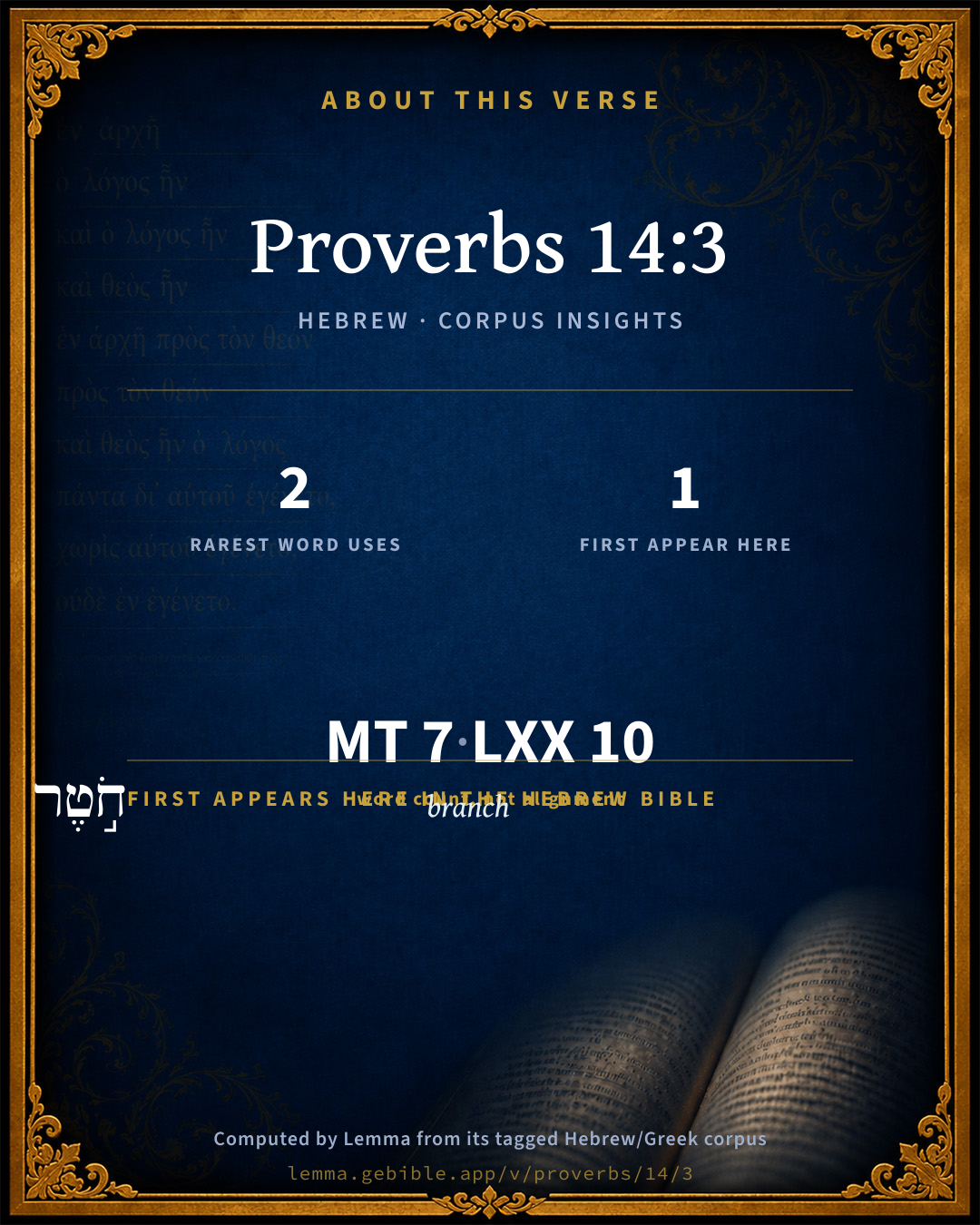
The rarest word here is חֹ֣טֶר branch H2415 — appearing just 2 times in the whole Hebrew Bible.

First appearance in Scripture

This word makes its first canonical appearance in the Hebrew Bible here:

  • חֹ֣טֶר branch H2415

Shared distinctive vocabulary

חֹ֣טֶר branch H2415 occurs in 2 verses of the Hebrew Bible. Also found in:

Grammatical profile

  • 1 verb
  • 4 nouns
  • 2 adjectives

Verb forms

  • תִּשְׁמוּרֵֽם Qal · Imperfect

Hebrew & Septuagint length

In English translation the verse runs 17 words from the Hebrew and 19 from the Septuagint (LXX English) — closely comparable.

A rough comparison of the two English renderings, which tokenize alike — not a word-level alignment.

Word counts can differ between the Hebrew and the Greek without any difference in meaning — e.g. the Hebrew direct-object marker אֵת has no separate Greek word, and Greek often adds the article ὁ.

In the original languages it is 7 Hebrew tokens and 10 Greek tokens — but the two are counted differently (Hebrew bundles its prefixes and suffixes into one token; the Greek is in lemma form), so that isn’t a like-for-like length.

Cross-references

18

Topical passages linked to Proverbs 14:3 in the Treasury of Scripture Knowledge — connected by theme and wording, ordered by reader-vote popularity; previews shown in the World English Bible.

  • Proverbs 12:6 The words of the wicked are about lying in wait for blood, But the speech of the upright rescues them.
  • James 3:5–6 So the tongue is also a little member, and boasts great things. See how a small fire can spread to a large forest!
  • Revelation 12:11 They overcame him because of the Lamb's blood, and because of the word of their testimony. They didn't love their life, even to death.
  • Romans 10:9–10 that if you will confess with your mouth the Lord Jesus, and believe in your heart that God raised him from the dead, you will be saved.
  • Revelation 3:10 Because you kept my command to endure, I also will keep you from the hour of testing, which is to come on the whole world, to test those who dwell on the earth.
  • 1 Samuel 2:3 Talk no more so exceeding proudly; Don't let arrogance come out of your mouth; For Yahweh is a God of knowledge, By him actions are weighed.
  • Job 5:21 You shall be hidden from the scourge of the tongue, Neither shall you be afraid of destruction when it comes.
  • Psalms 12:3 May Yahweh cut off all flattering lips, And the tongue that boasts,
  • Psalms 52:1–2 Why do you boast of mischief, mighty man? God's loving kindness endures continually.
  • Psalms 57:4 My soul is among lions. I lie among those who are set on fire, Even the sons of men, whose teeth are spears and arrows, And their tongue a sharp sword.
  • Proverbs 18:6 A fool's lips come into strife, And his mouth invites beatings.
  • Proverbs 21:24 The proud and haughty man, "scoffer" is his name; He works in the arrogance of pride.
  • Proverbs 22:8 He who sows wickedness reaps trouble, And the rod of his fury will be destroyed.
  • Proverbs 28:25 One who is greedy stirs up strife; But one who trusts in Yahweh will prosper.
  • Daniel 7:20 and concerning the ten horns that were on its head, and the other [horn] which came up, and before which three fell, even that horn that had eyes, and a mouth that spoke great things, whose look was more stout than its fellows.
  • 2 Peter 2:18 For, uttering great swelling words of emptiness, they entice in the lusts of the flesh, by licentiousness, those who are indeed escaping from those who live in error;
  • Psalms 31:18 Let the lying lips be mute, Which speak against the righteous insolently, with pride and contempt.
  • Revelation 15:5–6 After these things I looked, and the temple of the tabernacle of the testimony in heaven was opened.

Cross-references courtesy of OpenBible.info (CC BY 4.0).

Hebrew and Greek witnesses Masoretic Hebrew ↔ Greek Septuagint

The same verse in the two great witnesses to the Old Testament, shown verse-for-verse.

These are two independent witnesses, not word-aligned to each other, and the Septuagint is shown in lemma (dictionary) form.

Hebrew Proverbs 14:3 Masoretic · Westminster Leningrad Codex

בְּֽפִי אֱ֭וִיל חֹ֣טֶר גַּאֲוָ֑ה וְשִׂפְתֵ֥י חֲ֝כָמִ֗ים תִּשְׁמוּרֵֽם

The fool's talk brings a rod to his back, But the lips of the wise protect them.

World English Bible · Public Domain

Greek LXX Proverbs 14:3 Septuagint · lemma form

ἐκ στόμα ἄφρων βακτηρία ὕβρις χεῖλος δέ σοφός φυλάσσω αὐτός

Out of the mouth of fools comes a rod of pride; but the lips of the wise preserve them.

LXX2012 (modern English Septuagint) · Public Domain

On this verse, The Pulpit Commentary discusses the Septuagint’s reading. Read the note in Commentary ↓

Hebrew: Westminster Leningrad Codex (CC BY 4.0). Greek: Septuagint (public domain); English from LXX2012 (modern English Septuagint) (Public Domain). How the Septuagint differs from the Hebrew →

Commentary

Notes on Proverbs 14:3 from classic Christian and Jewish commentators (each source and its license shown beneath its notes). The classic Christian expositions comment on the surrounding passage and are grouped to its opening verse, so a note may address several verses; the Jewish commentaries on the Tanakh (Rashi and others) are per-verse, so they appear only where the commentator wrote on this verse.

Lemma curates 59 commentaries, every one of them public domain or Creative Commons licensed, each selected and text-cleaned for this edition rather than reprinted as found. About our sources →

Trapp's Complete Commentary

John Trapp

Pro 14:3 In the mouth of the foolish [is] a rod of pride: but the lips of the wise shall preserve them.

Ver. 3. In the mouth of the foolish is a rod of pride.] Wherewith he beats others, and lays about him like a madman, or rather like a mad dog he bites all he meets, and barks against God himself; till he procure the hate of God and men, and smart for his petulance, being beaten at length with his own rod, as the lion beats himself with his own tail.

But the lips of the wise shall preserve them.] From the aspersion of false and foolish tongues. Their good names are oiled, so that evil reports will not stick to them. Dirt will stick upon a mud wall, not so upon marble. Or if they lie under some undeserved reproach for a season, either by a real or verbal apology they wade out of it, as the eclipsed moon by keeping her motion wades out of the shadow and recovers her splendour. {Isa 54:17}

John Trapp, A Commentary or Exposition upon All the Books of the Old and New Testament (1647–1656) — public domain. Text from a community e-Sword module.

Joseph Benson's Commentary

Pro 14:3. In the mouth of the foolish is a rod of pride — “Fools often bring upon themselves, by their ungoverned tongues, the correction due to their crimes,” and especially to their pride and arrogance; but the lips of the wise shall preserve them — From that rod. Wise men are careful of their words, that they may not offend, much more that they may not abuse, the meanest person, and hereby they remain in safety.

Joseph Benson's Commentary on the Old and New Testaments (1811–1818) — public domain. Text from a community e-Sword module.

The Preacher's Complete Homiletical Commentary

Joseph S. Exell (gen. ed.)

CRITICAL NOTES.—

Pro_14:3. Rod, or “sceptre.” Zöckler reads, “In the mouth of a fool is a rod for his pride.” Stuart, “Haughtiness is a rod,” etc.

Pro_14:5. Miller here translates, “He who witnesses things correctly, does not lie; but of a deceived witness the very breath is lies” (See his comments on the verse).

Pro_14:6. Rather, “The scorner has sought wisdom,” etc.

Pro_14:7. Stuart translates the latter clause, “for thou hast not discerned,” etc.; Miller, “and thou shalt not know,” etc.

MAIN HOMILETICS OF Pro_14:3

SPEECH A ROD

I. Speech is a rod because it is emblematic of power. A rod is an emblem of position and authority. It represents more than it is. Speech is a sign of man’s superiority to the animal creation. Words in themselves are not much, but they are mighty because of what they represent, viz., the soul of man. The sceptre of a king may not in itself be of much value, but it is of worth because of what it signifies.

II. Speech will be a man’s destruction or salvation according to his character. The mouth of the fool represents the soul of the fool. We have before noted the unwisdom and danger of him who is too proud to receive instruction (see chap. Pro_11:1, page 192; Pro_13:18, etc.) His proud boasting speech will by-and-by become the cause of his chastisement—a rod for his own back. And the godly wise speech of the wise will be the means of his preservation and honour (See on chap. Pro_12:5-8, page 255, Pro_14:17-19, page 274).

OUTLINES AND SUGGESTIVE COMMENTS

The fool’s rod of pride is his tongue, wherewith he assails and strikes others. But it recoils on himself. The instrument of punishment is called a rod, not a sword, to denote the contumely with which the proud shall be visited.—Fausset.

The rod in the mouth is often sharper than the rod in the hand (Jer_18:18). Sometimes it strikes against God (Exo_5:2; Psa_12:3-4; 2Ki_19:10); sometimes it is “the rod of His anger against His people” (Isa_10:5) permitted (Rev_13:5) yet restrained (Psa_125:3). Always in the end it is the rod for the fool himself (Psa_64:8).—Bridges.

The “mouth” is the great word in the Proverbs for our whole earthly agency. The word translated “rod” is the favourite emblem of sovereignty. A fool’s life-work or energy is his sovereignty, by which he would carve his way. But it is a “sceptre of pride.” His kingship is a notion of pride. But the “lips of the wise” do really win, and do really govern. They have a true sceptre which shall really guard them.—Miller.

The lips of the wise preserve them.

1. From doing wrong to others, in their loving mildness.

2. From suffering wrong from others, by a wary heedfulness.

3. From the rod of God’s anger, in a humble craving pardon for their errors. The former part of this verse St. Gregory applieth unto arrogant preachers, who desire more sharply to reprove their afflicted hearers, than sweetly to comfort them, for they study more how they may condemn evil things by blaming of them, than how they may commend good things by praising them. They always desire those things which, by fierce chiding, they may beat upon.—Jermin.

The Preacher's Complete Homiletical Commentary (gen. ed. Joseph S. Exell; Funk & Wagnalls, c. 1892) — public domain (pre-1929). A full-Bible homiletical/sermon-outline anthology covering 65 of 66 books (2 John is absent from the source module). Text from a community e-Sword module.

Tyndale Open Study Notes

Tyndale Open Resources

14:3 A fool’s word can be used against him.

Tyndale Open Study Notes — © Tyndale Open Resources, licensed CC BY-SA 4.0. Text via the HelloAO Bible API.

Geneva Bible (1599)

Geneva Bible translators

His proud tongue shall cause him to be punished.

Geneva Bible (1599) marginal notes — public domain. Text via Bolls.life.

Matthew Henry's Commentary

See here, 1. A proud fool exposing himself. Where there is pride in the heart, and no wisdom in the head to suppress it, it commonly shows itself in the words: In the mouth there is pride, proud boasting, proud censuring, proud scorning, proud commanding and giving law; this is the rod, or branch, of pride; the word is used only here and Isa 11:1. It grows from that root of bitterness which is in the heart; it is a rod from that stem. The root must be plucked up, or we cannot conquer this branch, or it is meant of a smiting beating rod, a rod of pride which strikes others. The proud man with his tongue lays about him and deals blows at pleasure, but it will in the end be a rod to himself; the proud man shall come under an ignominious correction by the words of his own mouth, not cut as a soldier, but caned as a servant; and herein he will be beaten with his own rod, Psa 64:8. 2. A humble wise man saving himself and consulting his own good: The lips of the wise shall preserve them from doing that mischief to others which proud men do with their tongues, and from bringing that mischief on themselves which haughty scorners are often involved in.

Matthew Henry's Commentary on the Whole Bible (1708–1710) — public domain (CC PDM 1.0). Text via the HelloAO Bible API.

Jamieson, Fausset & Brown

Robert Jamieson, A. R. Fausset & David Brown

rod of pride--that is, the punishment of pride, which they evince by their words. The words of the wise procure good to them.

Jamieson, Fausset & Brown — Commentary Critical and Explanatory on the Whole Bible (1871) — public domain (CC PDM 1.0). Text via the HelloAO Bible API.

Adam Clarke's Commentary

Verse 3. The mouth of the foolish is a rod of pride] The reproofs of such a person are ill-judged and ill-timed, and generally are conveyed in such language as renders them not only ineffectual, but displeasing, and even irritating.

Adam Clarke's Commentary on the Bible (1810–1826) — public domain. Text from a community e-Sword/MySword module.

Ellicott's Commentary for English Readers

(3) In the mouth of the foolish (self-willed) is a rod of pride.—He has to smart for his ill-judged sayings; or, he punishes others with them. But this does not agree so well with what follows.

But the lips of the wise shall preserve them (the wise) from the difficulties into which the foolish come by their rash talk.

A Bible Commentary for English Readers, edited by Charles John Ellicott (1878–1897) — public domain. Text from a community e-Sword module.

The Cambridge Bible for Schools and Colleges

gen. ed. J. J. S. Perowne

3. a rod of pride] This may mean either that he smites with his proud words as with a rod (comp. Isa_11:4, where however the Heb. word is different); or (preserving better the antithesis between the two clauses of the verse) that his own mouth furnishes “a rod for his pride” (R.V. marg.); his own words cause his humiliation. Instead of “rod,” however, we may render “shoot” (R.V. marg.): proud words spring out of his mouth like a sucker or branch (comp. Isa_11:1, the only other place in which the same Heb. word occurs).

The Cambridge Bible for Schools and Colleges (gen. ed. J. J. S. Perowne; Cambridge University Press, 1878–1918) — public domain. Text from a community e-Sword module.

John Gill's Exposition

In the mouth of the foolish is a rod of pride,.... A proud tongue, or a tongue speaking proud and haughty things; with which foolish or wicked men smite others and wound and hurt their reputation and credit, and in the issue hurt themselves also; their tongue is not only a rod to others, but a scourge to themselves, or is the cause of evil coming upon them; such was the tongue of Pharaoh, as Jarchi on the place observes, Exo 5:2; and of those the psalmist speaks of, Psa 73:9; and particularly of antichrist, whose mouth is opened in blasphemies against God, and his tabernacle, and his saints, Rev 13:5;

but the lips of the wise shall preserve them; from speaking such proud and haughty things against God and men; or from being hurt by the tongues of men or their own; yea, what coaxes out of their mouth is confounding and destructive to their enemies, Rev 11:5.

John Gill's Exposition of the Whole Bible (1746–1763) — public domain (CC PDM 1.0). Text via the HelloAO Bible API.

Albert Barnes' Notes on the Bible

A rod of pride - i. e., The pride shown in his speech is as a rod with which he strikes down others and himself.

Albert Barnes' Notes on the Bible (1834–1885) — public domain. Text from a community e-Sword/MySword module.

Haydock's Catholic Bible Commentary

Pride. He chastiseth with haughtiness, and is ever quarrelling.

George Leo Haydock (1774–1849), Haydock's Catholic Family Bible and Commentary, 1859 edition — public domain. Excludes Psalms (Douay-Rheims chapter numbering differs from Protestant) and Deuterocanonical books (Catholic canon only).

Matthew Poole's English Annotations

A rod of pride: their proud and insolent speeches, as they are like a rod, offensive and injurious to others, so they make a rod for their own hacks, by provoking God and man against them; which sense seems most probable, both from the opposite clause, and by comparing this place with Pro 10:13; 26:3. For this phrase,

the rod of pride, it may be compared with other like phrases, as the foot of pride, Psa 36:11, the scourge of the tongue, Job 5:21, and the rod of the mouth, Isa 11:4.

Shall preserve them, from that rod.

Matthew Poole's English Annotations on the Holy Bible (1683–1685) — public domain. Text from a community e-Sword/MySword module.

Whedon's Commentary on the Bible

Daniel D. Whedon

3. A rod (sceptre) of pride — Haughtiness is put for a rod. It seems to be implied that the rod will eventually be used for their own punishment.

But the lips of the wise shall preserve them — They are careful of their words, not to offend, much less to abuse, others, and hence remain in safety. Compare Pro_11:6; Pro_12:6; Pro_13:14.

Daniel D. Whedon (gen. ed.), Commentary on the Old and New Testaments (1874–1909) — public domain. Text from a community e-Sword module.

The Pulpit Commentary

In the mouth of the foolish is a rod of pride. rfjo (choter), "rod," or "shoot," is found also in Isa_11:1. From the mouth of the arrogant fool proceeds a growth of vaunting and conceit, accompanied with insolence towards others, for which he is often chastised. So the tongue is compared to a sword. (e.g. Psa_57:4 Psa_64:3; Rev_1:16) St. Gregory ("Mor. in Job.," 24) applies this sentence to haughty preachers, who are anxious to appear superior to other people, and study more to chide and reprove than to encourage; "they know how to smite sharply, but not to sympathize with humility." Septuagint, "From the mouth of fools cometh a staff of insolence." The lips of the wise shall preserve them the wise. (Pro_13:3) These do not abuse speech to insult and injure others; and their words tend to conciliate others, and promote peace and good will. (comp. Pro_12:6, Pro_12:18)

The Pulpit Commentary (1880–1919), ed. H.D.M. Spence-Jones & Joseph S. Exell — public domain. Text from a community e-Sword module.

John Wesley's Explanatory Notes

A rod - His insolent speeches as they are like a rod, offensive to others, so, they make a rod for their own backs.

John Wesley, Explanatory Notes Upon the Whole Bible (1754–1765) — public domain. Text via the GEBible commentary corpus.

Keil & Delitzsch

C. F. Keil & F. Delitzsch

3 In the mouth of the fool is a switch of pride;

But the lips of the wise preserve them.

The noun חטר (Aram. חוּטרא, Arab. khiṭr), which besides here occurs only at Isa 11:1, meaning properly a brandishing (from חטר = Arab. khatr, to brandish, to move up and down or hither and thither, whence âlkhṭtâr, the brandisher, poet. the spear), concretely, the young elastic twig, the switch, i.e., the slender flexible shoot. Luther translates, "fools speak tyrannically," which is the briefer rendering of his earlier translation, "in the mouth of the fool is the sceptre of pride;" but although the Targum uses חוטרא of the king's sceptre and also of the prince's staff, yet here for this the usual Hebr. שׁבט were to be expected. In view of Isa 11:1, the nearest idea is, that pride which has its roots in the heart of the fool, grows up to his mouth. But yet it is not thus explained why the representation of this proceeding from within stops with חטר cf. Pro 11:30). The βακτηρία ὕβρεως (lxx, and similarly the other Greek versions) is either meant as the rod of correction of his own pride (as e.g., Abulwald, and, among the moderns, Bertheau and Zckler) or as chastisement for others (Syr., Targum: the staff of reviling). Hitzig is in favour of the former idea, and thinks himself warranted in translating: a rod for his back; but while גּוה is found for גּאוה, we do not (cf. under Job 41:7 : a pride are the, etc.) find גאוה for גוה, the body, or גּו, the back. But in general it is to be assumed, that if the poet had meant חטר as the means of correction, he would have written גּאותו. Rightly Fleischer: "The tongue is often compared to a staff, a sword, etc., in so far as their effects are ascribed to it; we have here the figure which in Rev 1:16 passes over into plastic reality." Self-exaltation (R. גא, to strive to be above) to the delusion of greatness is characteristic of the fool, the אויל [godless], not the כּסיל [stupid, dull] - Hitzig altogether confounds these two conceptions. With such self-exaltation, in which the mind, morally if not pathologically diseased, says, like Nineveh and Babylon in the prophets, I am alone, and there is no one with me, there is always united the scourge of pride and of disgrace; and the meaning of 3b may now be that the lips of the wise protect those who are exposed to this injury (Ewald), or that they protect the wise themselves against such assaults (thus most interpreters). But this reference of the eos to others lies much more remote than at Pro 12:6; and that the protection of the wise against injury inflicted on them by words is due to their own lips is unsatisfactory, as in this case, instead of Bewahrung [custodia], we would rather expect Vertheidigung [defensio], Dmpfung [damping, extinguishing], Niederduckung [stooping down, accommodating oneself to circumstances]. But also it cannot be meant that the lips of the wise preserve them from the pride of fools, for the thought that the mouth preserves the wise from the sins of the mouth is without meaning and truth (cf. the contrary, Pro 13:3). Therefore Arama interprets the verb as jussive: the lips = words of the wise mayest thou keep i.e., take to heart. And the Venet. translates: χείλη δὲ σοφῶν φυλάξεις αὐτά, which perhaps means: the lips of the wise mayest thou consider, and that not as a prayer, which is foreign to the gnome, but as an address to the hearer, which e.g., Pro 20:19 shows to be admissible. but although in a certain degree of similar contents, yet 3a and 3b clash. Therefore it appears to us more probable that the subject of 3b is the חכמה contained in חכמים; in Pro 6:22 wisdom is also the subject to תשׁמר עליך without its being named. Thus: while hurtful pride grows up to the throat of the fool, that, viz., wisdom, keeps the lips of the wise, so that no word of self-reflection, especially none that can wound a neighbour, escapes from them. The form תּשׁמוּרם is much more peculiar than ישׁפּוּטוּ, Exo 18:26, and תעבוּרי, Rut 2:8, for the latter are obscured forms of ישׁפּטוּ and תעברי, while on the contrary the former arises from תּשׁמרם.

(Note: Vid., regarding these forms with ǒ instead of the simple Sheva, Kimchi, Michlol 20ab. He also remarks that these three forms with û are all Milra; this is the case also in a remarkable manner with ישׁפּוּטוּ, vid., Michlol 21b; Livjath Chen ii. 9; and particularly Heidenheim, in his edition of the Pentateuch entitled Mer Enajim, under Exo 18:26.)

If, according to the usual interpretation, we make שׂפתי the subject, then the construction follows the rule, Gesen. 146, 2. The lxx transfers it into Greek: χείλη δὲ σοφῶν φυλάσσει αὐτούς. The probable conjecture, that תשׁמורם is an error in transcription for תּשׁמרוּם = תּשׁמרנה אתם (this is found also in Luzzatto's Gramm. 776; and Hitzig adduces as other examples of such transpositions of the ו Jer 2:25; Jer 17:23; Job 26:12, and Jos 2:4, ותצפנו for ותצפון), we do not acknowledge, because it makes the lips the subject with an exclusiveness the justification of which is doubtful to us.

Keil & Delitzsch — Biblical Commentary on the Old Testament (1861–1891) — public domain (CC PDM 1.0). Text via the HelloAO Bible API. (Old Testament only.)

Bridges on Proverbs

Charles Bridges

How many figures does the wise man employ to shew the destructive evils of the tongue! Here it is a rod Eze 7:10-11 ), a rod of pride. The rod in the mouth is often sharper than the rod in the hand. (Jer 18:18 .) Sometimes it strikes against God (Exo 5:2 . Psa 12:3-4 . 2Ki 19:10 ); sometimes it is "the rod of his anger" (Isa 10:5 ) against his people; permitted (Rev 13:5 ), yet restrained. (Psa 125:3 .) Always in the end is it the rod for the fool himself. (Psa 64:8 .) Yet when the heart is humbled, and filled with wisdom, the tongue becomes the preservative from imminent dangers (Pro 12:6 ), even from the threatened scourge of the rod of pride. (Job 5:21 . Psa 31:20 .)

Were this iron rod to rule the earth, who could tolerate the abodes of men? (Psa 57:4 ; Psa 120:5 .) But adored be the grace, which converts this unruly boasting member of unrighteousness, to be "an instrument of righteousness unto God!" (Rom 6:13 .)

Charles Bridges, An Exposition of the Book of Proverbs (1846) — public domain. Text from a community e-Sword module.

Kretzmann's Popular Commentary

Paul E. Kretzmann

v. 3. In the mouth of the foolish is a rod of pride, that is, he bears with himself the rod which will punish his pride, or his pride shows itself in speeches which hurt and injure others; but the lips of the wise shall preserve them, so that no word of folly is spoken by them to the injury of others, 10:13-14.

Paul E. Kretzmann, Popular Commentary of the Bible (1921–1924) — public domain. Text from a community e-Sword module.

unfoldingWord translationNotes

Door43 World Missions Community

the mouth of ... the lips of

The mouth and the lips both refer to what a person says. (See: Metonymy)

an offshoot of his pride

An offshoot is something that grows out of something else. AT: "what his pride produces" (See: Metaphor)

the wise

This word is actually a plural. "the wise men" or "wise people"

will preserve them

"will keep them from harm" or "will keep them safe"

the feeding trough

A "trough" is a container in which you put the food for animals.

an abundant crop

"a good harvest"

by the strength of an ox

"Strength" represents the strong work an ox can do. AT: "because of the work an ox does" (See: Metonymy)

translationWords

fool

proud

wise

clean

cow

unfoldingWord translationNotes — © Distant Shores Media and the Door43 World Missions Community, licensed CC BY-SA 4.0. Source: git.door43.org/Door43/en_tn.

Rashi

Rabbi Shlomo Yitzchaki (Rashi)

In a fool’s mouth is a staff of haughtiness A stick of haughtiness, like Pharaoh, who said (Ex. 5: 2): “Who is the Lord that I should hearken to His voice?”

but the lips of the wise guard them Heb. תשמורם, like תשמרם. They guard the wise.

Rashi on the Tanakh — English translations: “The Judaica Press complete Tanach with Rashi, translated by A. J. Rosenberg” (CC BY 4.0); “Pentateuch with Rashi's commentary by M. Rosenbaum and A.M. Silbermann, 1929-1934” (public domain); “The Metsudah Tanach series, Lakewood, N.J” (CC BY 4.0); and “The Book of Joshua, Metsudah Publications, 1997” (CC BY 4.0). Text via Sefaria.

Lesson kit

Teaching starters — assembled from the data on this page, not authored interpretation. Every prompt links to the verse data it draws on. Edit before teaching.

Proverbs, in the Wisdom, opens this verse with 7 words (7 distinct Hebrew lemmas). Its most distinctive word is chôṭêr (“branch”). A historical commentator’s framing appears above. Read the whole chapter for the surrounding context.

Discussion questions

  1. The word chôṭêr carries the sense “branch.” How does it shape the verse?
  2. This is the first place “branch” appears in Scripture (first appears here). What does its debut here establish?
  3. How does Isaiah 11:1, which shares the word «branch», read alongside this verse?
  4. These translations render this verse differently; the difference is in the English rendering, not the original. What questions does that raise?
  5. «תִּשְׁמוּרֵֽם» is a Qal Imperfect verb. How does that grammatical form shape the action described?
  6. Compare how Trapp's Complete Commentary and Joseph Benson's Commentary read this verse. Where do they agree or differ?

Things to notice

Reading settings

Reading text

Shown beneath each verse's original-language words.

Old Testament
Old Testament edition

Read the OT as the Masoretic Hebrew (MT) or the Greek Septuagint (LXX).

English shown for the Greek Septuagint (in the Hebrew ↔ Greek comparison).

Comparing translations? Open the Compare panel on any verse page to stack up to four side by side.