
Exodus 35:25

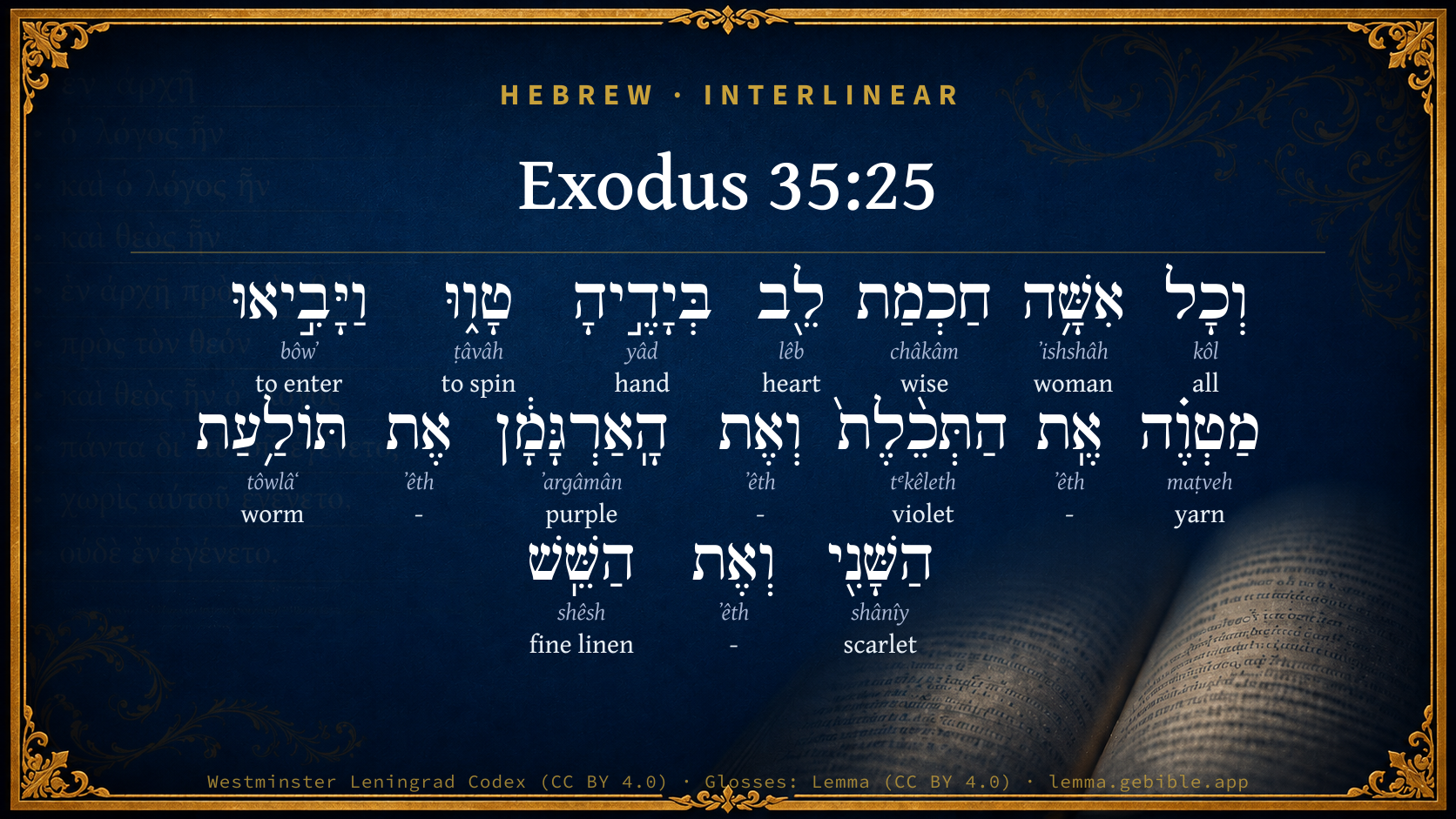
Hebrew (Westminster Leningrad Codex) Exodus 35:25 appears in the Hebrew Old Testament. The text above is from the Westminster Leningrad Codex. Each word links to its Strong’s number, a concise gloss, and parsing drawn from the Open Scriptures Hebrew Bible morphology. Click any word for its full Brown-Driver-Briggs (BDB) entry.
Download image
Cite this verse

Exodus 35:25 (World English Bible). Public Domain. Lemma interlinear Bible study tool, https://lemma.gebible.app/v/exodus/35/25.

Show BibTeX & RIS
BibTeX
RIS
English Translation
All the women who were wise-hearted spun with their hands, and brought that which they had spun, the blue, the purple, the scarlet, and the fine linen.
World English Bible · Public Domain
Highlights
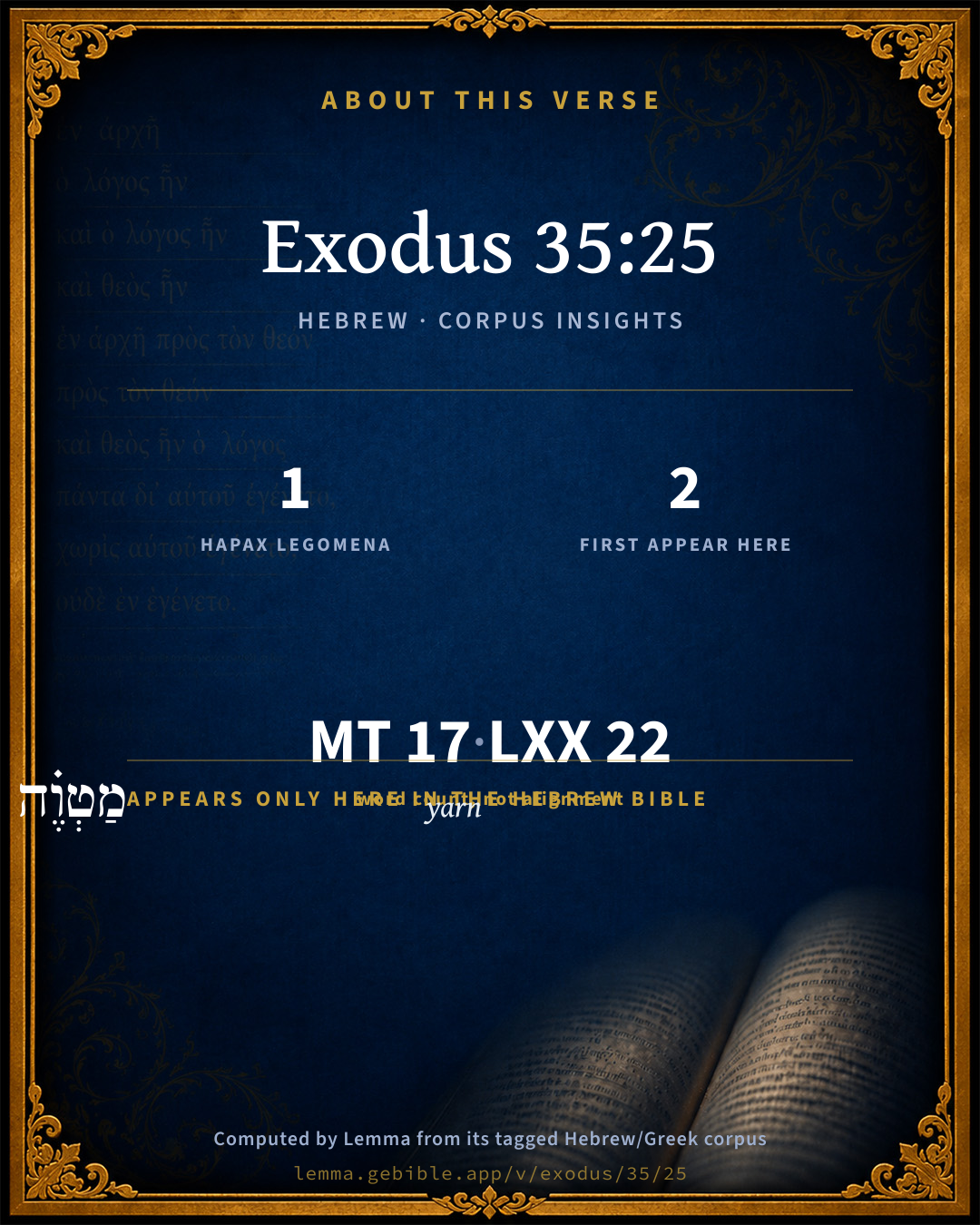
  • 1 hapax legomenon — only here in the Hebrew Bible
  • 2 first appearances in the Hebrew Bible
Full analysis ↓
Download a study sheet

One document with this verse’s original text, its word-by-word gloss line, the meaning frame, cross-references with their text, attributed commentary, and full source and license credits — printable, and it pastes into notes with its structure intact.

This verse Autodidact and up

Study sheet (.html) Plain text (.txt)

A passage Seminary Student

Up to 50 verses in one chapter. A passage sheet keeps up to 6 commentary sources and 12 cross-references per verse, in the order this page ranks them, and says so on the sheet whenever that leaves anything out. Ask for a single verse and you get the Autodidact verse sheet above.

Everything on this page stays free to read, with no account — the sheet is a download of what is already on screen, not access to it.

Want to remove ads? Support Godless Engineer
Compare translations 3

The same verse in 3 English versions, stacked beneath the original-language interlinear above. Click any original word for its lexicon entry.

Each is an independent rendering of the whole verse — the interlinear is not word-aligned to these translations.

Highlighted words mark where these versions differ — a whole-verse word diff, not a word-by-word alignment.

  • World English Bible Public Domain
    All the women who were wise-hearted spun with their hands, and brought that which they had spun, the blue, the purple, the scarlet, and the fine linen.
  • King James Version Public Domain
    And all the women that were wise hearted did spin with their hands, and brought that which they had spun, both of blue, and of purple, and of scarlet, and of fine linen.
  • unfoldingWord Literal Text CC BY-SA 4.0
    And every woman skilled of heart spun with her hands, and they brought the spun items, the blue and the purple the worm of scarlet and the fine linen.

unfoldingWord Literal Text — © unfoldingWord, licensed CC BY-SA 4.0. Word-aligned USFM3 via Door43 (git.door43.org/unfoldingWord/en_ult).

Versions to compare (up to 4)

3 of 4 selected

Show all 18 translations

Every available English version of this verse, each an independent rendering of the whole verse.

  • World English Bible Public Domain
    All the women who were wise-hearted spun with their hands, and brought that which they had spun, the blue, the purple, the scarlet, and the fine linen.
  • Berean Standard Bible Public Domain
    Every skilled woman spun with her hands and brought what she had spun: blue, purple, or scarlet yarn, or fine linen.
  • Majority Standard Bible Public Domain
    Every skilled woman spun with her hands and brought what she had spun: blue, purple, or scarlet yarn, or fine linen.
  • King James Version Public Domain
    And all the women that were wise hearted did spin with their hands, and brought that which they had spun, both of blue, and of purple, and of scarlet, and of fine linen.
  • American Standard Version (1901) Public Domain
    And all the women that were wise-hearted did spin with their hands, and brought that which they had spun, the blue, and the purple, the scarlet, and the fine linen.
  • Revised Version (1885) Public Domain
    And all the women that were wise hearted did spin with their hands, and brought that which they had spun, the blue, and the purple, the scarlet, and the fine linen.
  • Geneva Bible (1599) Public Domain
    And all the women that were wise hearted, did spin with their hands, and brought ye spun worke, euen the blewe silke, and the purple, the skarlet, and the fine linen.
  • Douay-Rheims (1899) Public Domain
    The skilful women also gave such things as they had spun, violet, purple, and scarlet, and fine linen,
  • Young's Literal Translation Public Domain
    And every wise-hearted woman hath spun with her hands, and they bring in yarn, the blue, and the purple, the scarlet, and the linen;
  • Literal Standard Version CC BY-SA 4.0
    And every wise-hearted woman has spun with her hands, and they bring in yarn—of the blue, and the purple, [and] the scarlet—and the linen;
  • Unlocked Literal Bible CC BY-SA 4.0
    Every skilled woman spun wool with her hands and brought what she had spun—blue, purple, or scarlet wool, or fine linen.
  • unfoldingWord Literal Text CC BY-SA 4.0
    And every woman skilled of heart spun with her hands, and they brought the spun items, the blue and the purple the worm of scarlet and the fine linen.
  • Darby Bible Public Domain
    And every woman that was wise-hearted spun with her hands, and brought what she had spun: the blue, and the purple, and the scarlet, and the byssus.
  • World Messianic Bible Public Domain
    All the women who were wise-hearted spun with their hands, and brought that which they had spun: the blue, the purple, the scarlet, and the fine linen.
  • Webster's Bible Public Domain
    And all the women that were wise-hearted spun with their hands, and brought that which they had spun, both of blue, and of purple, and of scarlet, and of fine linen.
  • Free Bible Version CC BY-SA 4.0
    Every woman skilled in spinning with her hands brought what she had spun: blue, purple, or crimson thread, or finely-woven linen.
  • Bible in Basic English Public Domain
    And all the women who were expert with their hands, made cloth, and gave the work of their hands, blue and purple and red and the best linen.
  • JPS Tanakh (1917) Public Domain
    And all the women that were wise-hearted did spin with their hands, and brought that which they had spun, the blue, and the purple, the scarlet, and the fine linen.

Literal Standard Version (2020), Covenant Press — licensed CC BY-SA 4.0. Text via the HelloAO Bible API (eBible.org). Unlocked Literal Bible (unfoldingWord) — licensed CC BY-SA 4.0. Text via the HelloAO Bible API (eBible.org). unfoldingWord Literal Text — © unfoldingWord, licensed CC BY-SA 4.0. Word-aligned USFM3 via Door43 (git.door43.org/unfoldingWord/en_ult). Free Bible Version, Dr. Jonathan Gallagher — licensed CC BY-SA 4.0. Text via the HelloAO Bible API (eBible.org).

Word by word

More ways to search: Search by grammar → Find every occurrence → Compare this word →

Practice this passage: Drill this verse → Learn its vocabulary →

מַטְוֶ֗ה
maṭveh
H4299
“yarn”
Noun, Common, Masculine, Singular, Absolute
Part of Speech
Noun
Type
Common
Gender
Masculine
Number
Singular
State
Absolute
Full BDB Definition

Origin: from H2901

TWOT: 794a

that which is spun, yarn
  1. וְכָל kôl H3605 “and · all of” Conjunction + Noun, Common, Masculine, Singular, Construct
  2. אִשָּׁ֥ה ʼishshâh H802 “woman” Noun, Common, Feminine, Singular, Absolute
  3. חַכְמַת châkâm H2450 “wise of” Adjective, Adjective, Feminine, Singular, Construct
  4. לֵ֖ב lêb H3820 “heart” Noun, Common, Masculine, Singular, Absolute
  5. בְּיָדֶ֣יהָ yâd H3027 “in/at · hands · her” Preposition + Noun, Common, Both, Dual, Construct + Suffix, Personal, 3rd Person, Feminine, Singular
  6. טָו֑וּ ṭâvâh H2901 “to spin” Verb, Qal, Perfect, 3rd Person, Common, Plural
  7. וַיָּבִ֣יאוּ bôwʼ H935 “and · to enter” Conjunction + Verb, Hiphil, Sequential Imperfect, 3rd Person, Masculine, Plural
  8. אֶֽת ʼêth H853 “-” Particle, Direct Object
  9. הַתְּכֵ֨לֶת֙ tᵉkêleth H8504 “the · violet” Particle, Definite Article + Noun, Common, Feminine, Singular, Absolute
  10. וְאֶת ʼêth H853 “and · -” Conjunction + Particle, Direct Object
  11. הָֽאַרְגָּמָ֔ן ʼargâmân H713 “the · purple” Particle, Definite Article + Noun, Common, Masculine, Singular, Absolute
  12. אֶת ʼêth H853 “-” Particle, Direct Object
  13. תּוֹלַ֥עַת tôwlâʻ H8438 “worm of” Noun, Common, Feminine, Singular, Construct
  14. הַשָּׁנִ֖י shânîy H8144 “the · scarlet” Particle, Definite Article + Noun, Common, Masculine, Singular, Absolute
  15. וְאֶת ʼêth H853 “and · -” Conjunction + Particle, Direct Object
  16. הַשֵּֽׁשׁ shêsh H8336 “the · fine linen” Particle, Definite Article + Noun, Common, Masculine, Singular, Absolute

About this verse

These counts appear in no published source. They are computed here, from the morphology-tagged text and Lemma’s own curated glosses. What Lemma adds →

17
words
14
distinct lemmas
Pentateuch
section

Notable vocabulary

1 hapax legomenon — a word that appears only here in the entire Hebrew Bible:

  • מַטְוֶ֗ה yarn H4299

First appearance in Scripture

These words make their first canonical appearance in the Hebrew Bible here:

  • טָו֑וּ to spin H2901
  • מַטְוֶ֗ה yarn H4299

Shared distinctive vocabulary

טָו֑וּ to spin H2901 occurs in 2 verses of the Hebrew Bible. Also found in:

Grammatical profile

  • 2 verbs
  • 10 nouns
  • 1 adjective
  • 4 particles

Verb forms

  • טָו֑וּ Qal · Perfect
  • וַיָּבִ֣יאוּ Hiphil · Sequential Imperfect

Hebrew & Septuagint length

In English translation the verse runs 27 words from the Hebrew and 24 from the Septuagint (LXX English) — closely comparable.

A rough comparison of the two English renderings, which tokenize alike — not a word-level alignment.

Word counts can differ between the Hebrew and the Greek without any difference in meaning — e.g. the Hebrew direct-object marker אֵת has no separate Greek word, and Greek often adds the article ὁ.

In the original languages it is 17 Hebrew tokens and 22 Greek tokens — but the two are counted differently (Hebrew bundles its prefixes and suffixes into one token; the Greek is in lemma form), so that isn’t a like-for-like length.

Cross-references

13

Topical passages linked to Exodus 35:25 in the Treasury of Scripture Knowledge — connected by theme and wording, ordered by reader-vote popularity; previews shown in the World English Bible.

  • Proverbs 14:1 Every wise woman builds her house, But the foolish one tears it down with her own hands.
  • Luke 8:2–3 and certain women who had been healed of evil spirits and infirmities: Mary who was called Magdalene, from whom seven demons had gone out;
  • Romans 16:12 Greet Tryphaena and Tryphosa, who labor in the Lord. Greet Persis, the beloved, who labored much in the Lord.
  • Exodus 28:3 You shall speak to all who are wise-hearted, whom I have filled with the spirit of wisdom, that they make Aaron's garments to sanctify him, that he may minister to me in the priest's office.
  • Exodus 31:6 I, behold, I have appointed with him Oholiab, the son of Ahisamach, of the tribe of Dan; and in the heart of all who are wise-hearted I have put wisdom, that they may make all that I have commanded you:
  • Exodus 36:1 "Bezalel and Oholiab shall work with every wise-hearted man, in whom Yahweh has put wisdom and understanding to know how to work all the work for the service of the sanctuary, according to all that Yahweh has commanded."
  • Proverbs 31:19–24 She lays her hands to the distaff, And her hands hold the spindle.
  • Acts 9:39 Peter got up and went with them. When he had come, they brought him into the upper chamber. All the widows stood by him weeping, and showing the coats and garments which Dorcas had made while she was with them.
  • Romans 16:1–4 I commend to you Phoebe, our sister, who is a servant of the assembly that is at Cenchreae,
  • Romans 16:6 Greet Mary, who labored much for us.
  • Galatians 3:28 There is neither Jew nor Greek, there is neither slave nor free man, there is neither male nor female; for you are all one in Christ Jesus.
  • Philippians 4:3 Yes, I beg you also, true yoke-fellow, help these women, for they labored with me in the Gospel, with Clement also, and the rest of my fellow workers, whose names are in the book of life.
  • 2 Kings 23:7 He broke down the houses of the sodomites, that were in the house of Yahweh, where the women wove hangings for the Asherah.

Cross-references courtesy of OpenBible.info (CC BY 4.0).

Hebrew and Greek witnesses Masoretic Hebrew ↔ Greek Septuagint

The same verse in the two great witnesses to the Old Testament, shown verse-for-verse.

These are two independent witnesses, not word-aligned to each other, and the Septuagint is shown in lemma (dictionary) form.

Hebrew Exodus 35:25 Masoretic · Westminster Leningrad Codex

וְכָל אִשָּׁ֥ה חַכְמַת לֵ֖ב בְּיָדֶ֣יהָ טָו֑וּ וַיָּבִ֣יאוּ מַטְוֶ֗ה אֶֽת הַתְּכֵ֨לֶת֙ וְאֶת הָֽאַרְגָּמָ֔ן אֶת תּוֹלַ֥עַת הַשָּׁנִ֖י וְאֶת הַשֵּֽׁשׁ

All the women who were wise-hearted spun with their hands, and brought that which they had spun, the blue, the purple, the scarlet, and the fine linen.

World English Bible · Public Domain

Greek LXX Exodus 35:25 Septuagint · lemma form

καί πᾶς γυνή σοφός ὁ διάνοια ὁ χείρ νήθω φέρω νήθω ὁ ὑάκινθος καί ὁ πορφύρα καί ὁ κόκκινος καί ὁ βύσσος

And every woman skilled in her heart to spin with her hands, brought spun articles, the blue, and purple, and scarlet and fine linen.

LXX2012 (modern English Septuagint) · Public Domain

Hebrew: Westminster Leningrad Codex (CC BY 4.0). Greek: Septuagint (public domain); English from LXX2012 (modern English Septuagint) (Public Domain). How the Septuagint differs from the Hebrew →

Targum (Aramaic paraphrase)

2

The Targum is the ancient Jewish Aramaic paraphrase of the Hebrew Scriptures — an interpretive translation, not the Hebrew text itself. Onkelos (literal) and Pseudo-Jonathan (expansive) render the Torah, and Jonathan the Prophets. Coverage is partial: where no permissively-licensed English translation exists for a verse, only the Aramaic is shown. This is verse-level text, not a word-by-word alignment to the Hebrew.

  1. Targum Onkelos Torah (Genesis–Deuteronomy)
    וְכָל אִתְּתָא חַכִּימַת לִבָּא בִּידָהָא מְעַזְלָא וּמַיְתַן כַּד עָזֵל יָת תִּכְלָא וְיָת אַרְגְוָנָא יָת צְבַע זְהוֹרִי וְיָת בּוּצָא:

    (no public-domain English translation for this verse)

    Targum Onkelos — Aramaic: “Onkelos Genesis” (public domain); “Onkelos Exodus” (public domain); “Onkelos Leviticus” (public domain); “Onkelos Numbers” (public domain); “Onkelos Deuteronomy” (public domain). English: “Sefaria Community Translation” (CC0 1.0 (public-domain dedication)); “J.W. Etheridge. The Targums of Onkelos and Jonathan Ben Uzziel on the Pentateuch. London: Longmans, Green, 1862” (public domain). Text via Sefaria.

  2. Targum Pseudo-Jonathan Torah (Genesis–Deuteronomy)
    וְכָל אִיתְּתָא חַכִּימַת לִבָּהָא בִידָהָא הֲוַת עַזְלָא וּמַתְיָין כַּד עָזִיל יַת תִּכְלָא וְיַת אַרְגְּוָונָא וְיַת צְבַע זְהוֹרִי וְיַת בּוּצָא

    And every woman whose heart was wise spun with her hands, and brought the spun work of hyacinth, and purple, and crimson, and fine linen.

    Targum Pseudo-Jonathan — Aramaic: “Targum Jonathan on Genesis” (public domain); “Targum Jonathan on Exodus” (public domain); “Targum Jonathan on Leviticus” (public domain); “Targum Jonathan on Numbers” (public domain); “Targum Jonathan on Deuteronomy” (public domain). English: “The Targum of Jonathan ben Uzziel, trans. J. W. Etheridge, London, 1862” (public domain). Text via Sefaria.

Commentary

Notes on Exodus 35:25 from classic Christian and Jewish commentators (each source and its license shown beneath its notes). The classic Christian expositions comment on the surrounding passage and are grouped to its opening verse, so a note may address several verses; the Jewish commentaries on the Tanakh (Rashi and others) are per-verse, so they appear only where the commentator wrote on this verse.

Lemma curates 59 commentaries, every one of them public domain or Creative Commons licensed, each selected and text-cleaned for this edition rather than reprinted as found. About our sources →

Geneva Bible (1599)

Geneva Bible translators

Which were witty and expert.

Geneva Bible (1599) marginal notes — public domain. Text via Bolls.life.

Adam Clarke's Commentary

Verse 25. All the women that were wise-hearted did spin] They had before learned this art, they were wise-hearted; and now they practise it, and God condescends to require and accept their services. In building this house of God, all were ambitious to do something by which they might testify their piety to God, and their love for his worship. The spinning practised at this time was simple, and required little apparatus. It was the plain distaff or twirling pin, which might be easily made out of any wood they met with in the wilderness.

Adam Clarke's Commentary on the Bible (1810–1826) — public domain. Text from a community e-Sword/MySword module.

Ellicott's Commentary for English Readers

(25) All the women that were wise-hearted—i.e., “all who had sufficient skill.” Spinning was probably a very general accomplishment of the Hebrew women. It was effected in early times by means of a wheel and spindle, with or without a distaff. The only materials used for the fabrics of the sanctuary appear to have been flax and goats’ hair. The flax was dyed before it was spun into thread, as sometimes by the Greeks (Horn. Od. iv. 135).

Of fine linen.—Rather, of white. Most of the Egyptian linen is of a yellowish white, being made from flax imperfectly blanched.

A Bible Commentary for English Readers, edited by Charles John Ellicott (1878–1897) — public domain. Text from a community e-Sword module.

The Cambridge Bible for Schools and Colleges

gen. ed. J. J. S. Perowne

25, 26. The special contributions of the women. The women spun yarn, both of linen (v. 25) and coarser (v. 26) materials. Spinning is still in the East the work of women: and both in the Sin. Peninsula and elsewhere women still spin camels’ and goats’ hair into the coarse yarn out of which tent-coverings are woven. ‘Wise hearted,’ and ‘wisdom,’ of technical skill; cf. v. 10, and on Exo_28:3.

The Cambridge Bible for Schools and Colleges (gen. ed. J. J. S. Perowne; Cambridge University Press, 1878–1918) — public domain. Text from a community e-Sword module.

John Gill's Exposition

And all the women whose heart stirred them up in wisdom,.... To be ingenious in their business, and to study to do it in a curious manner, and to do that which others could not:

spun goats' hair; some join the phrase, "in wisdom", in the preceding clause with this, neglecting the accent "Athnach", which divides them, thus, "in wisdom spun goats' hair"; and which, without being separated from the preceding clause, may be understood and repeated in this: for, as Aben Ezra says, to spin goats' hair was an art that required excellent wisdom; and so Jarchi: in the eastern countries there is a sort of goats' hair very bright and fine, and hangs to the ground, and the beauty of it is equal almost to that of silk, and is never sheared, but combed off, and the women of the country spin it; and at this day a great trade is driven with it at Angora and Aleppo (c).

(c) Calmet in the word "Hair".

John Gill's Exposition of the Whole Bible (1746–1763) — public domain (CC PDM 1.0). Text via the HelloAO Bible API.

Haydock's Catholic Bible Commentary

Spun. The wool, it seems, was dyed first, unless it were naturally of these colours. See Exodus xxv. 5. (Calmet)

George Leo Haydock (1774–1849), Haydock's Catholic Family Bible and Commentary, 1859 edition — public domain. Excludes Psalms (Douay-Rheims chapter numbering differs from Protestant) and Deuterocanonical books (Catholic canon only).

Whedon's Commentary on the Bible

Daniel D. Whedon

25. Women… did spin — This appears to have been the business of women among the Egyptians and other ancient nations. The fact that the wise hearted women did this work shows that it was a labour requiring skill.

Daniel D. Whedon (gen. ed.), Commentary on the Old and New Testaments (1874–1909) — public domain. Text from a community e-Sword module.

The Pulpit Commentary

All the women that were wise-heartedi.e. , "skilful." See the comment on Exo_28:3. Brought that which they had spun, both of blue, etc. The flax itself was dyed, so that the thread produced was already coloured. Of fine lineni.e. "white." All the threads were flaxen.

The Pulpit Commentary (1880–1919), ed. H.D.M. Spence-Jones & Joseph S. Exell — public domain. Text from a community e-Sword module.

Keil & Delitzsch

C. F. Keil & F. Delitzsch

All the women who understood it (were wise-hearted, as in Exo 28:3) spun with their hands, and presented what they spun, viz., the yarn required for the blue and red purple cloth, the crimson and the byssus; from which it is evident that the coloured cloths were dyed in the yarn or in the wool, as was the case in Egypt according to different specimens of old Egyptian cloths (see Hengstenberg, Egypt and the Books of Moses, p. 144). Other women spun goats' hair for the upper or outer covering of the tent (Exo 26:7.). Spinning was done by the women in very early times (Plin. hist. n. 8, 48), particularly in Egypt, where women are represented on the monuments as busily engaged with the spindle (see Wilkinson, Manners ii. p. 60; iii. p. 133, 136), and at a later period among the Hebrews (Pro 31:19). At the present day the women in the peninsula of Sinai spin the materials for their tents from camels' and goats' hair, and prepare sheep's wool for their clothing (Rppell, Nubien, p. 202); and at Neswa, in the province of Omn, the preparation of cotton yarn is the principal employment of the women (Wellstedt, i. p. 90). Weaving also was, and still is to a great extent, a woman's work (cf. Kg2 23:7); it is so among the Arab tribes in the Wady Gharandel, for example (Russegger, iii. 24), and in Nubia (Burckhardt, Nub. p. 211); but at Neswa the weaving is done by the men (Wellstedt). The woven cloths for the tabernacle were prepared by men, partly perhaps because the weaving in Egypt was mostly done by the men (Herod. 2, 35; cf. Hengstenberg, p. 143), but chiefly for this reason, that the cloths for the hangings and curtains were artistic works, which the women did not understand, but which the men had learned in Egypt, where artistic weaving was carried out to a great extent (Wilkinson, iii. pp. 113ff.).

(Note: For drawings of the Egyptian weaving-stool, see Wilkinson, iii. p. 135; also Hartmann, die Hebrerinn am Putztisch i. Taf. 1.)

Keil & Delitzsch — Biblical Commentary on the Old Testament (1861–1891) — public domain (CC PDM 1.0). Text via the HelloAO Bible API. (Old Testament only.)

unfoldingWord translationNotes

Door43 World Missions Community

blue, purple, or scarlet wool

Possible meanings are 1) "material that is dyed blue, purple, and scarlet," probably wool yarn, or 2) "blue, purple and scarlet dye" to dye the linen. See how you translated a similar phrase in Exodus 25:4.

whose hearts stirred them up

Here "hearts" refers to the women. The hearts of the women who responded to God are spoken of as if they were water stirred up by a storm. AT: "who responded to God" (See: Synecdoche and Metaphor)

translationWords

heart

unfoldingWord translationNotes — © Distant Shores Media and the Door43 World Missions Community, licensed CC BY-SA 4.0. Source: git.door43.org/Door43/en_tn.

Lesson kit

Teaching starters — assembled from the data on this page, not authored interpretation. Every prompt links to the verse data it draws on. Edit before teaching.

Exodus, in the Pentateuch, opens this verse with 17 words (14 distinct Hebrew lemmas). Its most distinctive word is maṭveh (“yarn”). A historical commentator’s framing appears above. Read the whole chapter for the surrounding context.

Discussion questions

  1. The word maṭveh carries the sense “yarn.” How does it shape the verse?
  2. 1 word here appears nowhere else in the Hebrew Bible. Why might the author reach for such rare wording?
  3. 2 words make their first appearance in Scripture here. What does this debut establish?
  4. How does Exodus 35:26, which shares the word «to spin», read alongside this verse?
  5. These translations render this verse differently; the difference is in the English rendering, not the original. What questions does that raise?
  6. «טָו֑וּ» is a Qal Perfect verb. How does that grammatical form shape the action described?
  7. Compare how Geneva Bible (1599) and Adam Clarke's Commentary read this verse. Where do they agree or differ?

Things to notice

Reading settings

Reading text

Shown beneath each verse's original-language words.

Old Testament
Old Testament edition

Read the OT as the Masoretic Hebrew (MT) or the Greek Septuagint (LXX).

English shown for the Greek Septuagint (in the Hebrew ↔ Greek comparison).

Comparing translations? Open the Compare panel on any verse page to stack up to four side by side.