Ezekiel 27:8

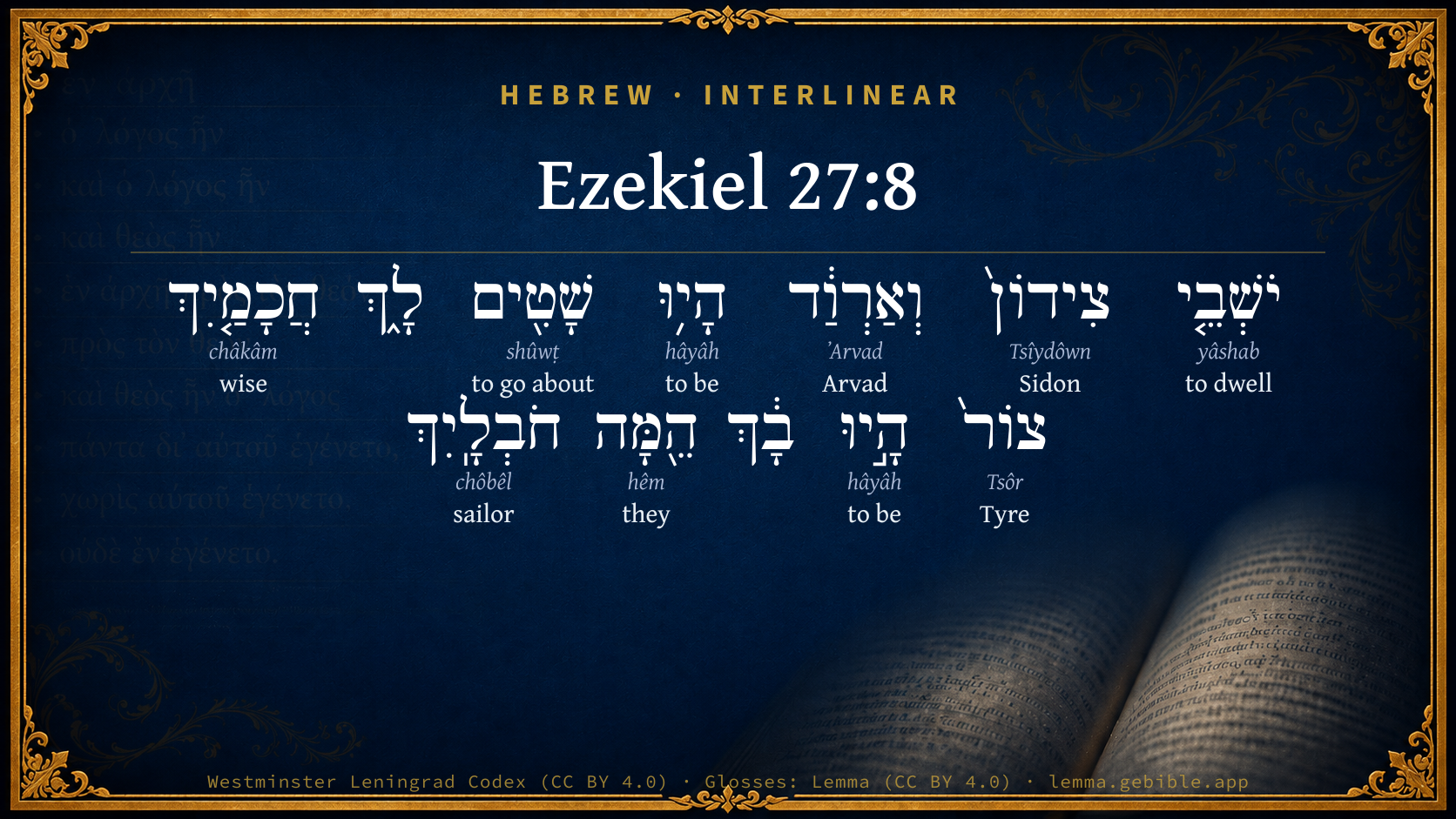
Hebrew (Westminster Leningrad Codex) Ezekiel 27:8 appears in the Hebrew Old Testament. The text above is from the Westminster Leningrad Codex. Each word links to its Strong’s number, a concise gloss, and parsing drawn from the Open Scriptures Hebrew Bible morphology. Click any word for its full Brown-Driver-Briggs (BDB) entry.
Download image
Cite this verse

Ezekiel 27:8 (World English Bible). Public Domain. Lemma interlinear Bible study tool, https://lemma.gebible.app/v/ezekiel/27/8.

Show BibTeX & RIS
BibTeX
RIS
English Translation
The inhabitants of Sidon and Arvad were your rowers: your wise men, Tyre, were in you, they were your pilots.
World English Bible · Public Domain
Highlights
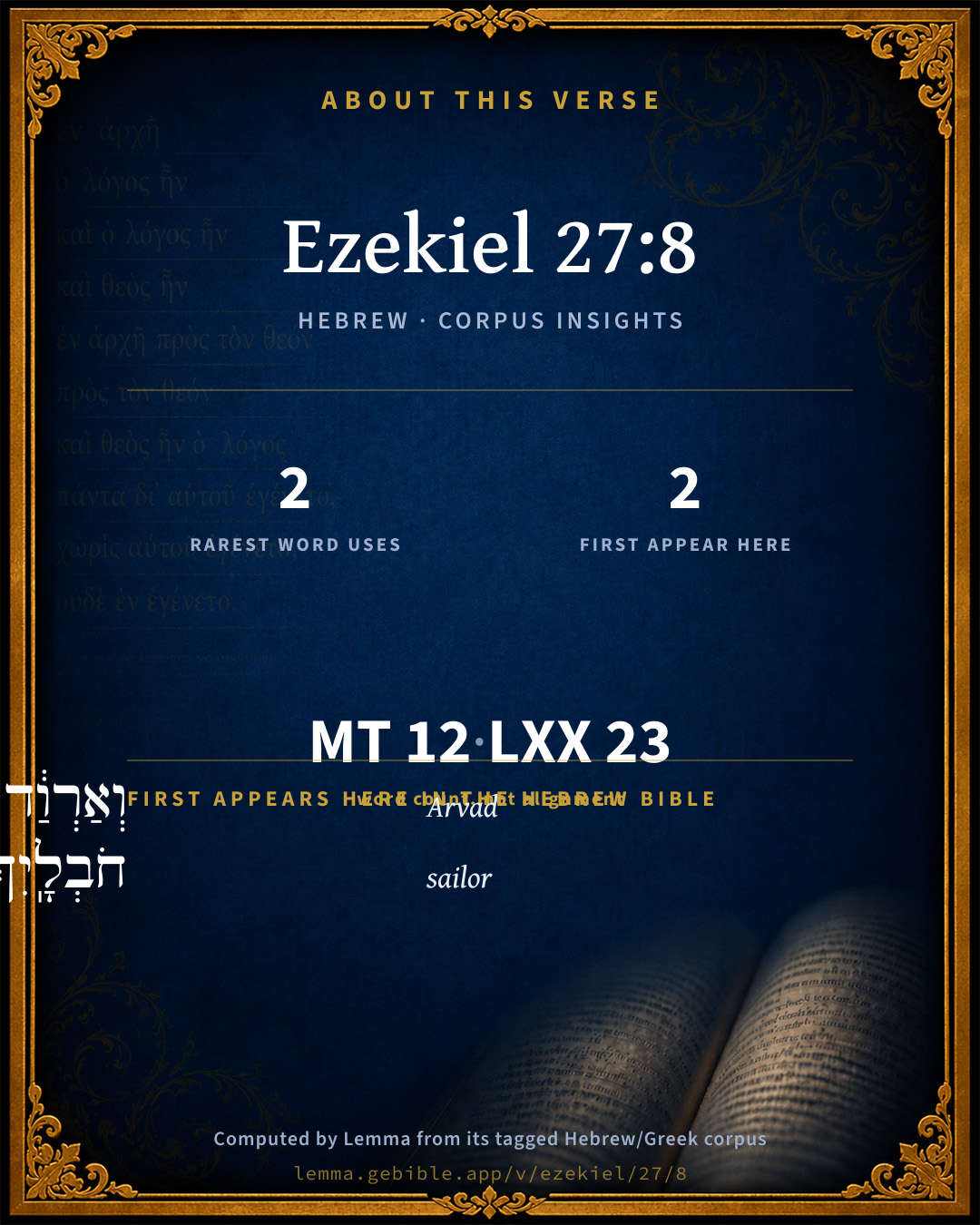
  • 2 first appearances in the Hebrew Bible
Full analysis ↓
Download a study sheet

One document with this verse’s original text, its word-by-word gloss line, the meaning frame, cross-references with their text, attributed commentary, and full source and license credits — printable, and it pastes into notes with its structure intact.

This verse Autodidact and up

Study sheet (.html) Plain text (.txt)

A passage Seminary Student

Up to 50 verses in one chapter. A passage sheet keeps up to 6 commentary sources and 12 cross-references per verse, in the order this page ranks them, and says so on the sheet whenever that leaves anything out. Ask for a single verse and you get the Autodidact verse sheet above.

Everything on this page stays free to read, with no account — the sheet is a download of what is already on screen, not access to it.

Want to remove ads? Support Godless Engineer
Compare translations 3

The same verse in 3 English versions, stacked beneath the original-language interlinear above. Click any original word for its lexicon entry.

Each is an independent rendering of the whole verse — the interlinear is not word-aligned to these translations.

Highlighted words mark where these versions differ — a whole-verse word diff, not a word-by-word alignment.

  • World English Bible Public Domain
    The inhabitants of Sidon and Arvad were your rowers: your wise men, Tyre, were in you, they were your pilots.
  • King James Version Public Domain
    The inhabitants of Zidon and Arvad were thy mariners: thy wise men, O Tyrus, that were in thee, were thy pilots.
  • unfoldingWord Literal Text CC BY-SA 4.0
    Those who were living in Sidon and Arvad were your rowers; the sages of Tyre were within you; they were your pilots.

unfoldingWord Literal Text — © unfoldingWord, licensed CC BY-SA 4.0. Word-aligned USFM3 via Door43 (git.door43.org/unfoldingWord/en_ult).

Versions to compare (up to 4)

3 of 4 selected

Show all 18 translations

Every available English version of this verse, each an independent rendering of the whole verse.

  • World English Bible Public Domain
    The inhabitants of Sidon and Arvad were your rowers: your wise men, Tyre, were in you, they were your pilots.
  • Berean Standard Bible Public Domain
    The men of Sidon and Arvad were your oarsmen. Your men of skill, O Tyre, were there as your captains.
  • Majority Standard Bible Public Domain
    The men of Sidon and Arvad were your oarsmen. Your men of skill, O Tyre, were there as your captains.
  • King James Version Public Domain
    The inhabitants of Zidon and Arvad were thy mariners: thy wise men, O Tyrus, that were in thee, were thy pilots.
  • American Standard Version (1901) Public Domain
    The inhabitants of Sidon and Arvad were thy rowers: thy wise men, O Tyre, were in thee, they were thy pilots.
  • Revised Version (1885) Public Domain
    The inhabitants of Zidon and Arvad were thy rowers: thy wise men, O Tyre, were in thee, they were thy pilots.
  • Geneva Bible (1599) Public Domain
    The inhabitants of Zidon, and Aruad were thy mariners, O Tyrus: thy wise men that were in thee, they were thy pilots.
  • Douay-Rheims (1899) Public Domain
    The inhabitants of Sidon, and the Arabians were thy rowers: thy wise men, O Tyre, were thy pilots.
  • Young's Literal Translation Public Domain
    Inhabitants of Zidon and Arvad have been rowers to thee, Thy wise men, O Tyre, have been in thee, They `are' thy pilots.
  • Literal Standard Version CC BY-SA 4.0
    Inhabitants of Sidon and Arvad have been rowers for you, || Your wise men, O Tyre, have been in you, || They [are] your pilots.
  • Unlocked Literal Bible CC BY-SA 4.0
    Those who were living in Sidon and Arvad were your rowers; the sages of Tyre were within you; they were your pilots.
  • unfoldingWord Literal Text CC BY-SA 4.0
    Those who were living in Sidon and Arvad were your rowers; the sages of Tyre were within you; they were your pilots.
  • Darby Bible Public Domain
    The inhabitants of Zidon and Arvad were thy rowers; thy wise men, O Tyre, who were in thee, were thy pilots.
  • World Messianic Bible Public Domain
    The inhabitants of Sidon and Arvad were your rowers. Your wise men, Tyre, were in you. They were your pilots.
  • Webster's Bible Public Domain
    The inhabitants of Zidon and Arvad were thy mariners: thy wise men, O Tyre, that were in thee, were thy pilots.
  • Free Bible Version CC BY-SA 4.0
    Men from Sidon and Arvad did the rowing in your ship. You had your own skilled sailors from Tyre.
  • Bible in Basic English Public Domain
    The people of Zidon and Arvad were your boatmen; the wise men of Zemer were in you; they were guiding your ships;
  • JPS Tanakh (1917) Public Domain
    The inhabitants of Sidon and Arvad were thy rowers; thy wise men, O Tyre, were in thee, they were thy pilots.

Literal Standard Version (2020), Covenant Press — licensed CC BY-SA 4.0. Text via the HelloAO Bible API (eBible.org). Unlocked Literal Bible (unfoldingWord) — licensed CC BY-SA 4.0. Text via the HelloAO Bible API (eBible.org). unfoldingWord Literal Text — © unfoldingWord, licensed CC BY-SA 4.0. Word-aligned USFM3 via Door43 (git.door43.org/unfoldingWord/en_ult). Free Bible Version, Dr. Jonathan Gallagher — licensed CC BY-SA 4.0. Text via the HelloAO Bible API (eBible.org).

Word by word

More ways to search: Search by grammar → Find every occurrence → Compare this word →

Practice this passage: Drill this verse → Learn its vocabulary →

וְאַרְוַ֔ד
ʼArvad
H719
“and · Arvad”
Conjunction + Noun, Proper
Part of Speech
Conjunction + Noun
Type
Proper
Full BDB Definition

Origin: probably from H7300

TWOT: None

Arvad = "I shall break loose" - a city-island near Sidon
  1. יֹשְׁבֵ֤י yâshab H3427 “dwelling” Verb, Qal, Participle Active, Masculine, Plural, Construct
  2. צִידוֹן֙ Tsîydôwn H6721 “Sidon” Noun, Proper
  3. הָי֥וּ hâyâh H1961 “to be” Verb, Qal, Perfect, 3rd Person, Common, Plural
  4. שָׁטִ֖ים shûwṭ H7751 “going about” Verb, Qal, Participle Active, Masculine, Plural, Absolute
  5. חֲכָמַ֤יִךְ châkâm H2450 “wise · your” Adjective, Adjective, Masculine, Plural, Construct + Suffix, Personal, 2nd Person, Feminine, Singular
  6. צוֹר֙ Tsôr H6865 “Tyre” Noun, Proper
  7. הָ֣יוּ hâyâh H1961 “to be” Verb, Qal, Perfect, 3rd Person, Common, Plural
  8. הֵ֖מָּה hêm H1992 “they” Pronoun, Personal, 3rd Person, Masculine, Plural
  9. חֹבְלָֽיִךְ chôbêl H2259 “sailors · your” Noun, Common, Masculine, Plural, Construct + Suffix, Personal, 2nd Person, Feminine, Singular

About this verse

These counts appear in no published source. They are computed here, from the morphology-tagged text and Lemma’s own curated glosses. What Lemma adds →

12
words
9
distinct lemmas
Prophets
section

Notable vocabulary

The rarest word here is וְאַרְוַ֔ד Arvad H719 — appearing just 2 times in the whole Hebrew Bible.

First appearance in Scripture

These words make their first canonical appearance in the Hebrew Bible here:

  • וְאַרְוַ֔ד Arvad H719
  • חֹבְלָֽיִךְ sailor H2259

Shared distinctive vocabulary

וְאַרְוַ֔ד Arvad H719 occurs in 2 verses of the Hebrew Bible. Also found in:

Grammatical profile

  • 4 verbs
  • 4 nouns
  • 1 adjective
  • 1 pronoun
  • 2 prepositions

Verb forms

  • יֹשְׁבֵ֤י Qal · Participle Active
  • הָי֥וּ Qal · Perfect
  • שָׁטִ֖ים Qal · Participle Active
  • הָ֣יוּ Qal · Perfect

Repetition

A word recurs within this verse — often emphatic in Hebrew:

  • הָי֥וּ to be H1961 ×2

Hebrew & Septuagint length

In English translation the verse runs 20 words from the Hebrew and 27 from the Septuagint (LXX English) — closely comparable.

A rough comparison of the two English renderings, which tokenize alike — not a word-level alignment.

Word counts can differ between the Hebrew and the Greek without any difference in meaning — e.g. the Hebrew direct-object marker אֵת has no separate Greek word, and Greek often adds the article ὁ.

In the original languages it is 12 Hebrew tokens and 23 Greek tokens — but the two are counted differently (Hebrew bundles its prefixes and suffixes into one token; the Greek is in lemma form), so that isn’t a like-for-like length.

Cross-references

11

Topical passages linked to Ezekiel 27:8 in the Treasury of Scripture Knowledge — connected by theme and wording, ordered by reader-vote popularity; previews shown in the World English Bible.

  • Genesis 10:18 the Arvadite, the Zemarite, and the Hamathite. Afterward the families of the Canaanites were spread abroad.
  • 1 Kings 9:27 Hiram sent in the navy his servants, sailors who had knowledge of the sea, with the servants of Solomon.
  • Ezekiel 27:11 The men of Arvad with your army were on your walls round about, and valorous men were in your towers; they hanged their shields on your walls round about; they have perfected your beauty.
  • Genesis 10:15 Canaan became the father of Sidon (his firstborn), Heth,
  • Genesis 49:13 "Zebulun will dwell at the haven of the sea. He will be for a haven of ships. His border will be on Sidon.
  • Joshua 11:8 Yahweh delivered them into the hand of Israel, and they struck them, and chased them to great Sidon, and to Misrephoth Maim, and to the valley of Mizpeh eastward; and they struck them, until they left them none remaining.
  • 1 Kings 5:6 Now therefore command you that they cut me cedar trees out of Lebanon; and my servants shall be with your servants; and I will give you hire for your servants according to all that you shall say: for you know that there is not among us any who knows how to cut timber like the Sidonians.
  • 2 Chronicles 2:13–14 Now I have sent a skillful man, endowed with understanding, of Huram my father's,
  • Isaiah 10:9 Isn't Calno as Carchemish? Isn't Hamath as Arpad? Isn't Samaria as Damascus?
  • Jeremiah 49:23 Of Damascus. Hamath is confounded, and Arpad; for they have heard evil news, they are melted away: there is sorrow on the sea; it can't be quiet.
  • Ezekiel 27:28 At the sound of the cry of your pilots the suburbs shall shake.

Cross-references courtesy of OpenBible.info (CC BY 4.0).

Hebrew and Greek witnesses Masoretic Hebrew ↔ Greek Septuagint

The same verse in the two great witnesses to the Old Testament, shown verse-for-verse.

These are two independent witnesses, not word-aligned to each other, and the Septuagint is shown in lemma (dictionary) form.

Hebrew Ezekiel 27:8 Masoretic · Westminster Leningrad Codex

יֹשְׁבֵ֤י צִידוֹן֙ וְאַרְוַ֔ד הָי֥וּ שָׁטִ֖ים לָ֑ךְ חֲכָמַ֤יִךְ צוֹר֙ הָ֣יוּ בָ֔ךְ הֵ֖מָּה חֹבְלָֽיִךְ

The inhabitants of Sidon and Arvad were your rowers: your wise men, Tyre, were in you, they were your pilots.

World English Bible · Public Domain

Greek LXX Ezekiel 27:8 Septuagint · lemma form

καί ὁ ἄρχων σύ ὁ καταοἰκέω σιδών καί αράδιος γίγνομαι κωπηλάτης σύ ὁ σοφός σύ σορ ὅς εἰμί ἐν σύ οὗτος κυβερνήτης σύ

And your princes were the dwellers in Sidon, and the Aradians were your rowers: your wise men, O Sor, who were in you, these were your pilots.

LXX2012 (modern English Septuagint) · Public Domain

On this verse, John Gill's Exposition discusses the Septuagint’s reading. Read the note in Commentary ↓

Hebrew: Westminster Leningrad Codex (CC BY 4.0). Greek: Septuagint (public domain); English from LXX2012 (modern English Septuagint) (Public Domain). How the Septuagint differs from the Hebrew →

Targum (Aramaic paraphrase)

1

The Targum is the ancient Jewish Aramaic paraphrase of the Hebrew Scriptures — an interpretive translation, not the Hebrew text itself. Onkelos (literal) and Pseudo-Jonathan (expansive) render the Torah, and Jonathan the Prophets. Coverage is partial: where no permissively-licensed English translation exists for a verse, only the Aramaic is shown. This is verse-level text, not a word-by-word alignment to the Hebrew.

  1. Targum Jonathan Prophets (Joshua–Malachi)
    יַתְבֵי צִידוֹן וְאַרְוַד הֲווֹ שַׁיְטִין וּמַיְתָן סְחוֹרָא לְגַוִיךְ חַכִּימַיִךְ צוֹר הֲווֹ בִיךְ אִינוּן פַּרְנָסֵיךְ:

    (no public-domain English translation for this verse)

    Targum Jonathan — Aramaic: “Mikraot Gedolot” (public domain). English: “Sefaria Community Translation” (CC0 1.0 (public-domain dedication)); “London "Chaldee Paraphrase," 1871” (public domain). Text via Sefaria.

Commentary

Notes on Ezekiel 27:8 from classic Christian and Jewish commentators (each source and its license shown beneath its notes). The classic Christian expositions comment on the surrounding passage and are grouped to its opening verse, so a note may address several verses; the Jewish commentaries on the Tanakh (Rashi and others) are per-verse, so they appear only where the commentator wrote on this verse.

Lemma curates 59 commentaries, every one of them public domain or Creative Commons licensed, each selected and text-cleaned for this edition rather than reprinted as found. About our sources →

Trapp's Complete Commentary

John Trapp

Eze 27:8 The inhabitants of Zidon and Arvad were thy mariners: thy wise [men], O Tyrus, [that] were in thee, were thy pilots.

Ver. 8. The inhabitants of Zidon.] Famous all the world over for their skill at sea and otherwise.

Thy wise men were thy pilots.] Wise they had need to be that sit at the stern of a state. Let them not therefore be ignorant, or idle, or otherwise faulty, lest they mar all: let them be active Argonauts. They have their names here in the Hebrew from the ropes of the ship, which they as pilots must skilfully order, shifting sails according to the wind. Counsel also, in that tongue, hath its name from the same root. {a}

{a} תחבולה

John Trapp, A Commentary or Exposition upon All the Books of the Old and New Testament (1647–1656) — public domain. Text from a community e-Sword module.

Joseph Benson's Commentary

Eze 27:8-11. The inhabitants of Zidon and Arvad were thy mariners — So great was the opulence and pride of the Tyrians, that they hired foreigners to do the more laborious and menial employments, and would do nothing else themselves than steer the vessels, priding themselves on being the most able pilots. Of Zidon, see note on Isa 23:4, and of Arvad, on Jer 49:23. The ancients of Gebal, &c., were thy calkers — Thou employedst the inhabitants of Gebal for calking thy ships, as being remarkably skilful in that trade. Concerning Gebal, which was a province of Phenicia, see note on Psa 83:7. All the ships of the sea were in thee — Ships from all parts came to trade with thee. They of Persia, &c., were in thine army — Thy citizens being all given to trading, thou madest use of foreign soldiers for thine army, when thy city was besieged. Bochart thinks that Lud denotes African Ethiopia; but Michaelis places this people westward in Africa. Both think Lud an Egyptian colony. The former, by Phut, understands the African Nomades: see Nah 3:9. They hanged the shield and helmet in thee — In thy garrisons, which were kept in time of peace. The men of Arvad, &c., were upon thy walls — They defended thy walls, when they were assaulted by the king of Babylon’s army. And the Gammadims were in thy towers — It is very uncertain what people are here meant by this name. Mr. Fuller and Bishop Newcome think it probable they were a people of Phenicia. The Hebrew word is derived from one which signifies to be contracted, narrowed, &c., and Parkhurst is of opinion that these people were the inhabitants of the country about Tripoli in Syria, formerly called the Αγκων, or Elbow, of Phenicia, from its being narrowed, and projecting into the sea in that form. Ludolphus conjectures they were Africans; the Chaldee paraphrase takes them to be Cappadocians. Dr. Spencer denominates them, “Parvula simulacra, plerumque cubitalia, in dominus aut turribus ethnicorum in earum tutelam, aut præsidium, collocata,” Little images, generally a cubit in length, placed upon the houses, or towers of the heathen, for their protections, or defence.

Joseph Benson's Commentary on the Old and New Testaments (1811–1818) — public domain. Text from a community e-Sword module.

Tyndale Open Study Notes

Tyndale Open Resources

27:8-11 The ship of Tyre was manned by a crew gathered from the most famously skilled men in the world. • The locations described in this account cover most of the known world at the time. Tyre’s influence was vast.

27:8-9 Sidon, Arvad, and Gebal were Mediterranean coastal towns.

Tyndale Open Study Notes — © Tyndale Open Resources, licensed CC BY-SA 4.0. Text via the HelloAO Bible API.

Geneva Bible (1599)

Geneva Bible translators

Or, shipmasters.

Geneva Bible (1599) marginal notes — public domain. Text via Bolls.life.

Jamieson, Fausset & Brown

Robert Jamieson, A. R. Fausset & David Brown

Arvad--a small island and city near Phœnicia, now Ruad: its inhabitants are still noted for seafaring habits.

thy wise men, O Tyrus . . . thy pilots--While the men of Arvad, once thy equals (Gen 10:18), and the Sidonians, once thy superiors, were employed by thee in subordinate positions as "mariners," thou madest thine own skilled men alone to be commanders and pilots. Implying the political and mercantile superiority of Tyre.

Jamieson, Fausset & Brown — Commentary Critical and Explanatory on the Whole Bible (1871) — public domain (CC PDM 1.0). Text via the HelloAO Bible API.

Adam Clarke's Commentary

Verse 8. Zidon and Arvad] Or Arad. Two powerful cities on the Phoenician coast, in the neighbourhood of Tyre, from which Tyre had her sailors; and the best instructed of her own inhabitants were her pilots or steersmen.

Adam Clarke's Commentary on the Bible (1810–1826) — public domain. Text from a community e-Sword/MySword module.

Ellicott's Commentary for English Readers

(8) Arvad.—The description now turns to the sailors. The Arvadite is mentioned among the family of Canaan in Gen_10:18, and corresponds to the Greek Aradus. There were two islands of this name: one in the Persian Gulf, the other (the one here intended) a rocky island north of the coast of Tripoli, on which a city was built like Tyre. The Phœnician cities of Zidon and Arvad furnished the oarsmen, but Tyre itself the superior captains and pilots.

A Bible Commentary for English Readers, edited by Charles John Ellicott (1878–1897) — public domain. Text from a community e-Sword module.

John Gill's Exposition

The ancients of Gebal,.... A promontory of the Phoenicians, the same with the Gabale of Pliny (n), and with the land of the Giblites, Jos 13:5. It was by the Greeks called Byblus; and so the Septuagint here render the words, the elders of Bybli or Byblus, a place once famous for the birth and temple of Adonis; it is now called Gibyle. Mr. Maundrell (o) says it is pleasantly situated by the seaside, and that at present it contains but a little extent of ground, yet more than enough for the small number of its inhabitants; it is compassed with a dry ditch, and a wall with square towers in it, at about every forty yards' distance; on its south side it has an old castle; within it is a church; besides which it has nothing remarkable; though anciently it was a place of no mean extent, as well as beauty, as may appear from the many heaps of ruins, and the fine pillars that are scattered up and down in the gardens near the town. The old experienced workmen of this place were employed by the Tyrians in mending and refitting their ships, and in the caulking of them, as follows:

the wise men thereof were in thee thy caulkers; or, "the strengtheners of thy breaches" (p), or "chinks"; the seams and commissures of the planks; which they stopped with tow, oakum, or such like stuff; at least this is what is used now, whatever might be by those wise men; and it seems by this that it was reckoned a very great art and mystery, and which only wise men were masters of, at least such the Tyrians employed. The Targum renders it,

"providing thy necessaries;''

as if they were the ships' husbands:

all the ships of the sea with their mariners were in thee to occupy thy merchandise; ships from all parts were in her harbours, which brought goods into her, and carried goods out of her, by way of merchandise. So the Targum,

"all that go down into the sea, and the ships; they were rowers, and they brought merchandise into the midst of thee;''

the goods of merchants from divers places; and carried back commodities again they traded for at Tyre; see Rev 18:19.

(n) Nat. Hist. l. 5. c. 20. (o) Journey &c. p. 33, 34. (p) "roborantes scissuram tuam", Montanus; "instaurantes fissuras tuas", Munster, Tigurine version; "rimas tuas", Vatablus; "instauratores rupturaram tuarum", Piscator.

John Gill's Exposition of the Whole Bible (1746–1763) — public domain (CC PDM 1.0). Text via the HelloAO Bible API.

Albert Barnes' Notes on the Bible

Arvad - See Gen 10:18. An island off the coast of Sidon, now called Ruad.

Albert Barnes' Notes on the Bible (1834–1885) — public domain. Text from a community e-Sword/MySword module.

Haydock's Catholic Bible Commentary

Aradians. Sidon and Arad were then subject to Tyre, and supplied rowers. --- Pilots. They studied no other science.

George Leo Haydock (1774–1849), Haydock's Catholic Family Bible and Commentary, 1859 edition — public domain. Excludes Psalms (Douay-Rheims chapter numbering differs from Protestant) and Deuterocanonical books (Catholic canon only).

Matthew Poole's English Annotations

Zidon; an ancient town and haven of Phoenicia, not far from Tyre.

Arvad; better known by its other name Aradus, an island belonging to Phoenicia, some say twenty, others say seven, furlongs from the continent. Thy mariners; rowers in thy galleys: the rich Tyrians would not employ their own in such servile works, they hired strangers. These Zidonians and Arvadeans, or Aredins, once thy equals, thou hast now outstripped, and makest thy servants, with pride enough.

Thy wise men; thy learned men; for navigation was the great study of the Tyrians, and who were best skilled in this were the learned or wise men among them, whom they had of their own, and trusted to be pilots, which employment carried honour in it to suit the proud humour of the Tyrians.

Matthew Poole's English Annotations on the Holy Bible (1683–1685) — public domain. Text from a community e-Sword/MySword module.

Whedon's Commentary on the Bible

Daniel D. Whedon

8. Zidon and Arvad — For Zidon see Eze_28:21. Arvad (Gen_10:18; 1Ch_1:16) is often mentioned in the Tel-el-Amarna tablets. It was the most northern Phoenician port, very populous, and with magnificent artificially constructed harbors and a living spring which secured the inhabitants a water supply in case of invasion or siege. The “ships of the land of Arvad” are celebrated in the Assyrian texts. It is evident that at this time both Zidon and Arvad were dependents of Tyre.

Mariners — R.V., “rowers.” For the need of wise pilots see note, Eze_26:2.

Daniel D. Whedon (gen. ed.), Commentary on the Old and New Testaments (1874–1909) — public domain. Text from a community e-Sword module.

The Pulpit Commentary

The two cities are named as tributaries of Tyro from which she drew her sailors, the Tyrians themselves acting as captains and pilots. Zidon (now Saida) is named in Gen_10:15 as the firstborn of Canaan, and was older than Tyre itself. (Isa_23:2, Isa_23:12) Arvad is identified with the Greek Aradus, the modern Ruad, an island about two miles from the coast, about two miles north of the mouth of the river Eleutheros (Nahr-el-Kebir ). It is scarcely a mile in circumference, but was prominent enough to be named here and in Gen_10:18; 1Ch_1:16. Opposite to it on the mainland was the town of Antaradus. For mariners, the Revised Version gives rowers.

The Pulpit Commentary (1880–1919), ed. H.D.M. Spence-Jones & Joseph S. Exell — public domain. Text from a community e-Sword module.

John Wesley's Explanatory Notes

Zidon - An ancient town and haven of Phoenicia, not far from Tyre. Arvad - Or Aradus, an island belonging to Phoenicia, twenty furlongs from the continent. Mariners - Rowers in thy galleys; the rich Tyrians would not employ their own in such servile works, they hired strangers. Wise men - Thy learned men: for navigation was the great study of the Tyrians.

John Wesley, Explanatory Notes Upon the Whole Bible (1754–1765) — public domain. Text via the GEBible commentary corpus.

unfoldingWord translationNotes

Door43 World Missions Community

Connecting Statement:

Yahweh continues giving Ezekiel his message to Tyre. The city of Tyre continues to be described as if it were a beautiful ship. (See: Metaphor)

General Information:

The words "you" and "your" in these verses refer to Tyre.

Arvad

This is the name of a small island off the coast of Syria. (See: How to Translate Names)

sages of Tyre

"wise men of Tyre"

pilots

A pilot is a person who controls where a ship goes by steering the ship.

Byblos

This is the name of a city on the Syrian coast. Other versions call it by the name "Gebal." (See: How to Translate Names and Textual Variants)

filled your seams

"repaired your cracks" or "repaired your leaks"

sailors

A sailor is one of the team of workers on a ship.

translationWords

Sidon

Tyre

unfoldingWord translationNotes — © Distant Shores Media and the Door43 World Missions Community, licensed CC BY-SA 4.0. Source: git.door43.org/Door43/en_tn.

Rashi

Rabbi Shlomo Yitzchaki (Rashi)

were your oarsmen [Heb. שָּׁטִים,] those who hold your oars to guide you.

your mariners those who hold the rudder to direct and straighten the ship.

Rashi on the Tanakh — English translations: “The Judaica Press complete Tanach with Rashi, translated by A. J. Rosenberg” (CC BY 4.0); “Pentateuch with Rashi's commentary by M. Rosenbaum and A.M. Silbermann, 1929-1934” (public domain); “The Metsudah Tanach series, Lakewood, N.J” (CC BY 4.0); and “The Book of Joshua, Metsudah Publications, 1997” (CC BY 4.0). Text via Sefaria.

Lesson kit

Teaching starters — assembled from the data on this page, not authored interpretation. Every prompt links to the verse data it draws on. Edit before teaching.

Ezekiel, in the Prophets, opens this verse with 12 words (9 distinct Hebrew lemmas). Its most distinctive word is ʼArvad (“Arvad”). A historical commentator’s framing appears above. Read the whole chapter for the surrounding context.

Discussion questions

  1. What does “Arvad” (ʼArvad) contribute to the verse as a whole?
  2. 2 words here appear for the first time in Scripture. What is being introduced at this debut?
  3. Ezekiel 27:11 shares the word «Arvad» with this verse. How do the two illuminate each other?
  4. “to be” occurs 2× in this one verse. What is the effect of the repetition?
  5. The translations on this page render this verse differently — a whole-verse word diff, not a word-by-word alignment. What might account for the different wordings?
  6. The verb «יֹשְׁבֵ֤י» is Qal Participle Active. How does its form color the action?
  7. Reading how Trapp's Complete Commentary and Joseph Benson's Commentary read this verse, where do the two commentators agree and where do they part?

Things to notice

Reading settings

Reading text

Shown beneath each verse's original-language words.

Old Testament
Old Testament edition

Read the OT as the Masoretic Hebrew (MT) or the Greek Septuagint (LXX).

English shown for the Greek Septuagint (in the Hebrew ↔ Greek comparison).

Comparing translations? Open the Compare panel on any verse page to stack up to four side by side.