
Proverbs 21:11

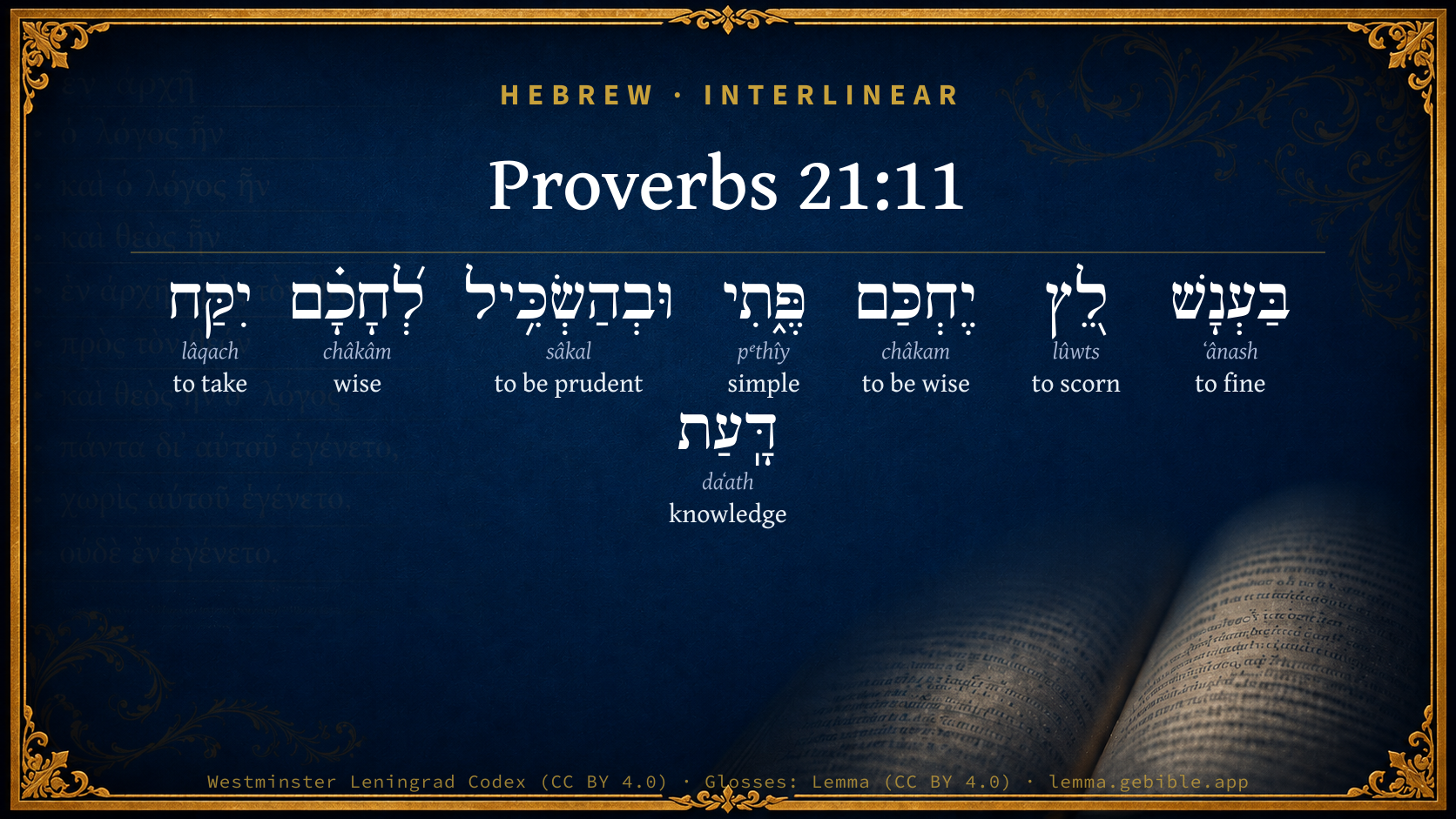
Hebrew (Westminster Leningrad Codex) Proverbs 21:11 appears in the Hebrew Old Testament. The text above is from the Westminster Leningrad Codex. Each word links to its Strong’s number, a concise gloss, and parsing drawn from the Open Scriptures Hebrew Bible morphology. Click any word for its full Brown-Driver-Briggs (BDB) entry.
Download image
Cite this verse

Proverbs 21:11 (World English Bible). Public Domain. Lemma interlinear Bible study tool, https://lemma.gebible.app/v/proverbs/21/11.

Show BibTeX & RIS
BibTeX
RIS
English Translation
When the mocker is punished, the simple gains wisdom; When the wise is instructed, he receives knowledge.
World English Bible · Public Domain
Download a study sheet

One document with this verse’s original text, its word-by-word gloss line, the meaning frame, cross-references with their text, attributed commentary, and full source and license credits — printable, and it pastes into notes with its structure intact.

This verse Autodidact and up

Study sheet (.html) Plain text (.txt)

A passage Seminary Student

Up to 50 verses in one chapter. A passage sheet keeps up to 6 commentary sources and 12 cross-references per verse, in the order this page ranks them, and says so on the sheet whenever that leaves anything out. Ask for a single verse and you get the Autodidact verse sheet above.

Everything on this page stays free to read, with no account — the sheet is a download of what is already on screen, not access to it.

Want to remove ads? Support Godless Engineer
Compare translations 3

The same verse in 3 English versions, stacked beneath the original-language interlinear above. Click any original word for its lexicon entry.

Each is an independent rendering of the whole verse — the interlinear is not word-aligned to these translations.

Highlighted words mark where these versions differ — a whole-verse word diff, not a word-by-word alignment.

  • World English Bible Public Domain
    When the mocker is punished, the simple gains wisdom; When the wise is instructed, he receives knowledge.
  • King James Version Public Domain
    When the scorner is punished, the simple is made wise: and when the wise is instructed, he receiveth knowledge.
  • unfoldingWord Literal Text CC BY-SA 4.0
    When fining a mocker, a naive one becomes wise, and when giving insight to a wise one, he receives knowledge.

unfoldingWord Literal Text — © unfoldingWord, licensed CC BY-SA 4.0. Word-aligned USFM3 via Door43 (git.door43.org/unfoldingWord/en_ult).

Versions to compare (up to 4)

3 of 4 selected

Show all 18 translations

Every available English version of this verse, each an independent rendering of the whole verse.

  • World English Bible Public Domain
    When the mocker is punished, the simple gains wisdom; When the wise is instructed, he receives knowledge.
  • Berean Standard Bible Public Domain
    When a mocker is punished, the simple gain wisdom; and when a wise man is instructed, he acquires knowledge.
  • Majority Standard Bible Public Domain
    When a mocker is punished, the simple gain wisdom; and when a wise man is instructed, he acquires knowledge.
  • King James Version Public Domain
    When the scorner is punished, the simple is made wise: and when the wise is instructed, he receiveth knowledge.
  • American Standard Version (1901) Public Domain
    When the scoffer is punished, the simple is made wise; And when the wise is instructed, he receiveth knowledge.
  • Revised Version (1885) Public Domain
    When the scorner is punished, the simple is made wise: and when the wise is instructed, he receiveth knowledge.
  • Geneva Bible (1599) Public Domain
    When the scorner is punished, the foolish is wise: and when one instructeth the wise, he wil receiue knowledge.
  • Douay-Rheims (1899) Public Domain
    When a pestilent man is punished, the little one will be wiser: and if he follow the wise, he will receive knowledge.
  • Young's Literal Translation Public Domain
    When the scorner is punished, the simple becometh wise, And in giving understanding to the wise He receiveth knowledge.
  • Literal Standard Version CC BY-SA 4.0
    When the scorner is punished, the simple becomes wise, || And in giving understanding to the wise He receives knowledge.
  • Unlocked Literal Bible CC BY-SA 4.0
    When the mocker is punished, the naive become wise, and when the wise person is instructed, he lays hold of knowledge.
  • unfoldingWord Literal Text CC BY-SA 4.0
    When fining a mocker, a naive one becomes wise, and when giving insight to a wise one, he receives knowledge.
  • Darby Bible Public Domain
    When the scorner is punished, the simple becometh wise; and when the wise is instructed, he receiveth knowledge.
  • World Messianic Bible Public Domain
    When the mocker is punished, the simple gains wisdom. When the wise is instructed, he receives knowledge.
  • Webster's Bible Public Domain
    When the scorner is punished, the simple is made wise: and when the wise is instructed, he receiveth knowledge.
  • Free Bible Version CC BY-SA 4.0
    When a mocker is punished, an immature person can learn wisdom. When the wise are educated, they gain knowledge.
  • Bible in Basic English Public Domain
    When the man of pride undergoes punishment, the simple man gets wisdom; and by watching the wise he gets knowledge.
  • JPS Tanakh (1917) Public Domain
    When the scorner is punished, the thoughtless is made wise; and when the wise is instructed, he receiveth knowledge.

Literal Standard Version (2020), Covenant Press — licensed CC BY-SA 4.0. Text via the HelloAO Bible API (eBible.org). Unlocked Literal Bible (unfoldingWord) — licensed CC BY-SA 4.0. Text via the HelloAO Bible API (eBible.org). unfoldingWord Literal Text — © unfoldingWord, licensed CC BY-SA 4.0. Word-aligned USFM3 via Door43 (git.door43.org/unfoldingWord/en_ult). Free Bible Version, Dr. Jonathan Gallagher — licensed CC BY-SA 4.0. Text via the HelloAO Bible API (eBible.org).

Word by word

More ways to search: Search by grammar → Find every occurrence → Compare this word →

Practice this passage: Drill this verse → Learn its vocabulary →

About this verse

These counts appear in no published source. They are computed here, from the morphology-tagged text and Lemma’s own curated glosses. What Lemma adds →

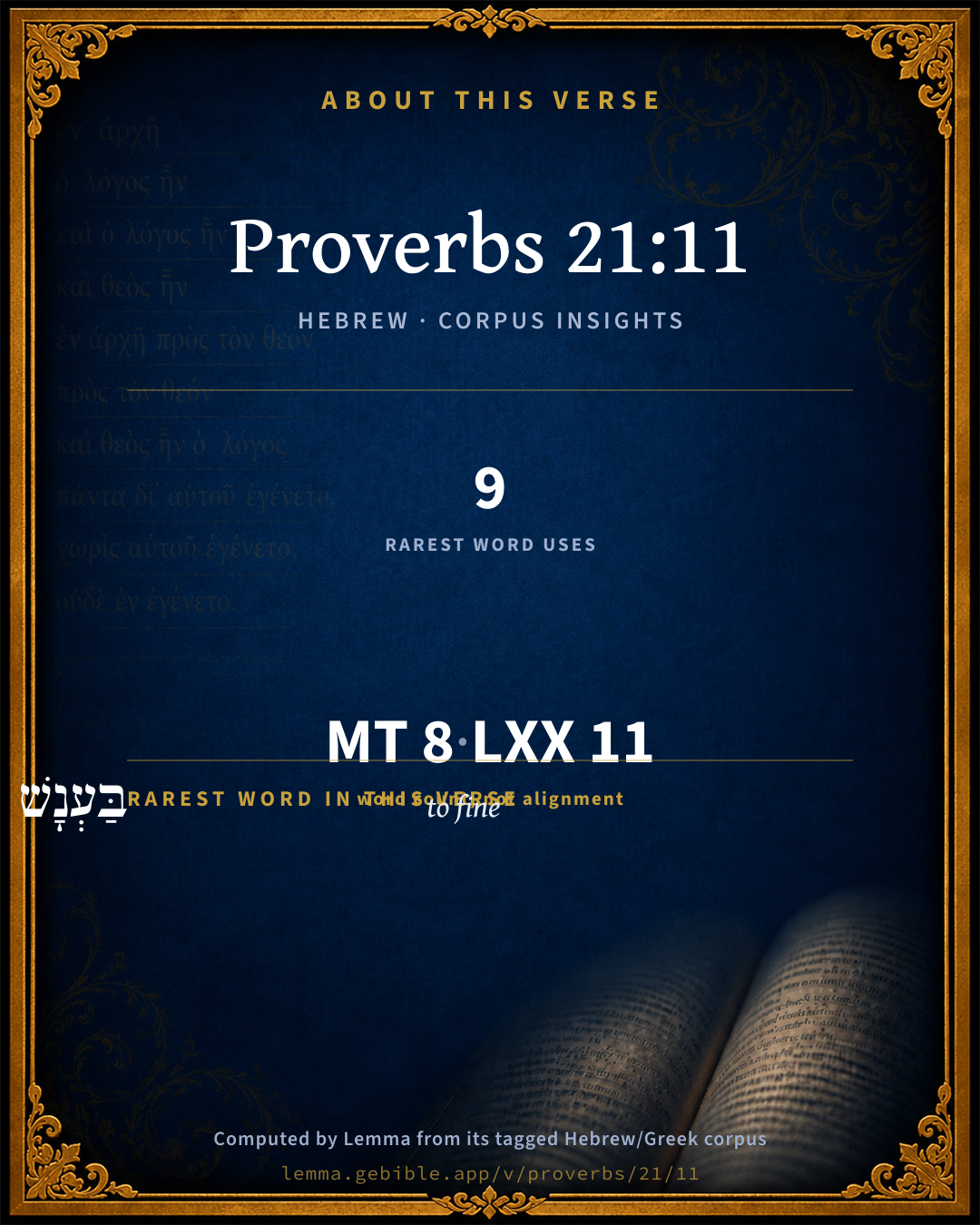
8
words
8
distinct lemmas
Wisdom
section

Notable vocabulary

The rarest word here is בַּעְנָשׁ to fine H6064 — appearing just 9 times in the whole Hebrew Bible.

Shared distinctive vocabulary

בַּעְנָשׁ to fine H6064 occurs in 8 verses of the Hebrew Bible. Also found in:

Grammatical profile

  • 4 verbs
  • 2 nouns
  • 2 adjectives

Verb forms

  • בַּעְנָשׁ Qal · Infinitive Construct
  • יֶחְכַּם Qal · Imperfect
  • וּבְהַשְׂכִּ֥יל Hiphil · Infinitive Construct
  • יִקַּח Qal · Imperfect

Hebrew & Septuagint length

In English translation the verse runs 17 words from the Hebrew and 18 from the Septuagint (LXX English) — closely comparable.

A rough comparison of the two English renderings, which tokenize alike — not a word-level alignment.

Word counts can differ between the Hebrew and the Greek without any difference in meaning — e.g. the Hebrew direct-object marker אֵת has no separate Greek word, and Greek often adds the article ὁ.

In the original languages it is 8 Hebrew tokens and 11 Greek tokens — but the two are counted differently (Hebrew bundles its prefixes and suffixes into one token; the Greek is in lemma form), so that isn’t a like-for-like length.

Cross-references

16

Topical passages linked to Proverbs 21:11 in the Treasury of Scripture Knowledge — connected by theme and wording, ordered by reader-vote popularity; previews shown in the World English Bible.

  • Proverbs 19:25 Flog a scoffer, and the simple will learn prudence; Rebuke one who has understanding, and he will gain knowledge.
  • Proverbs 18:15 The heart of the discerning gets knowledge. The ear of the wise seeks knowledge.
  • Proverbs 9:9 Instruct a wise man, and he will be still wiser. Teach a righteous man, and he will increase in learning.
  • Acts 5:5 Ananias, hearing these words, fell down and died. Great fear came on all who heard these things.
  • Deuteronomy 21:21 All the men of his city shall stone him to death with stones: so shall you put away the evil from the midst of you; and all Israel shall hear, and fear.
  • Proverbs 18:1 An unfriendly man pursues selfishness, And defies all sound judgment.
  • Numbers 16:34 All Israel that were round about them fled at the cry of them; for they said, Lest the earth swallow us up.
  • Deuteronomy 13:11 All Israel shall hear, and fear, and shall not do any more such wickedness as this is in the midst of you.
  • Psalms 64:7–9 But God will shoot at them. They will be suddenly struck down with an arrow.
  • Proverbs 1:5 That the wise man may hear, and increase in learning; That the man of understanding may attain to sound counsel:
  • 1 Corinthians 10:6–11 Now these things were our examples, to the intent we should not lust after evil things, as they also lusted.
  • Hebrews 2:1–3 Therefore we ought to pay greater attention to the things that were heard, lest perhaps we drift away.
  • Proverbs 15:14 The heart of one who has understanding seeks knowledge, But the mouths of fools feed on folly.
  • Acts 5:11–14 Great fear came on the whole assembly, and on all who heard these things.
  • Hebrews 10:28–29 A man who disregards Moses' law dies without compassion on the word of two or three witnesses.
  • Revelation 11:13 In that day there was a great earthquake, and a tenth of the city fell. Seven thousand people were killed in the earthquake, and the rest were terrified, and gave glory to the God of heaven.

Cross-references courtesy of OpenBible.info (CC BY 4.0).

Hebrew and Greek witnesses Masoretic Hebrew ↔ Greek Septuagint

The same verse in the two great witnesses to the Old Testament, shown verse-for-verse.

These are two independent witnesses, not word-aligned to each other, and the Septuagint is shown in lemma (dictionary) form.

Hebrew Proverbs 21:11 Masoretic · Westminster Leningrad Codex

בַּעְנָשׁ לֵ֭ץ יֶחְכַּם פֶּ֑תִי וּבְהַשְׂכִּ֥יל לְ֝חָכָ֗ם יִקַּח דָּֽעַת

When the mocker is punished, the simple gains wisdom; When the wise is instructed, he receives knowledge.

World English Bible · Public Domain

Greek LXX Proverbs 21:11 Septuagint · lemma form

ζημιόω ἀκόλαστος πανοῦργος γίγνομαι ὁ ἄκακος συνἵημι δέ σοφός δέχομαι γνῶσις

When an intemperate man is punished the simple becomes wiser: and a wise man understanding will receive knowledge.

LXX2012 (modern English Septuagint) · Public Domain

On this verse, The Pulpit Commentary discusses the Septuagint’s reading. Read the note in Commentary ↓

Hebrew: Westminster Leningrad Codex (CC BY 4.0). Greek: Septuagint (public domain); English from LXX2012 (modern English Septuagint) (Public Domain). How the Septuagint differs from the Hebrew →

Commentary

Notes on Proverbs 21:11 from classic Christian and Jewish commentators (each source and its license shown beneath its notes). The classic Christian expositions comment on the surrounding passage and are grouped to its opening verse, so a note may address several verses; the Jewish commentaries on the Tanakh (Rashi and others) are per-verse, so they appear only where the commentator wrote on this verse.

Lemma curates 59 commentaries, every one of them public domain or Creative Commons licensed, each selected and text-cleaned for this edition rather than reprinted as found. About our sources →

Trapp's Complete Commentary

John Trapp

Pro 21:11 When the scorner is punished, the simple is made wise: and when the wise is instructed, he receiveth knowledge.

Ver. 11. When the scorner is punished, &c.] {See Trapp on "Pro 19:25"}

And when the wise is instructed.] Or, When he accurately considers the wise, and observes both their integrity and their prosperity, by God’s blessing thereupon (for the word imports both), he resolves to play the wise man.

John Trapp, A Commentary or Exposition upon All the Books of the Old and New Testament (1647–1656) — public domain. Text from a community e-Sword module.

Joseph Benson's Commentary

Pro 21:11-12. When the scorner, &c. — Houbigant renders this verse, “When the scorner is punished, the humble is made more wise; and when the wise man prospers, the same person will acquire knowledge.” The sense evidently is, The simple learn wisdom both from the punishment of wicked men, and from the prosperity of good men. The righteous man wisely considereth, &c. — He looketh through the present power and glory of the house, or family, of the wicked, which dazzles the eye of others, unto that ruin to which it is hastening; but God, or rather: now, or that, God overthroweth, or will overthrow, the wicked for his wickedness — Namely, in due time, though for a season he bear with them.

Joseph Benson's Commentary on the Old and New Testaments (1811–1818) — public domain. Text from a community e-Sword module.

The Preacher's Complete Homiletical Commentary

Joseph S. Exell (gen. ed.)

CRITICAL NOTES.—

Pro_21:11. Instructed, Zöckler translates this “prospereth,” and understands the simple to be the subject of both clauses of the verse.

MAIN HOMILETICS OF Pro_21:11

INSTRUCTION FOR THOSE WHO NEED IT

I. An inevitable event in the history of the scorner. It is here taken for granted that he will be punished—that he who sets at nought the “counsel,” and will have none of the “reproof” of wisdom, will have his day of reckoning. The “day of his calamity” and “fear” will come (chap. Pro_1:27). Throughout this book, as throughout all the inspired writings, sin and punishment are linked as cause and effect. There is punishment in the constantly increasing dominion of evil in the soul, and there is punishment in the stings of conscience; but there is also punishment by the direct interposition of God, and it is to this that the proverb evidently points.

II. One of the fruits of wisdom. He who is wise will be instructed. Having used what he has, he will in accordance with the Divine law receive more. To “him that hath shall be given” (Mar_4:25). He who by a wise use of five talents has gained other five, shall have his store increased still more. This is likewise a foundation principle of this book, that the wise are those who are willing to be instructed, and that to those who desire instruction it will not be wanting. The special point of the verse is in the fact—

III. That the punishment of the evil man, and the soul-advancement of the good, have a work to do outside the men themselves. When the scorner receives punishment others receive instruction. This is one of its objects. A good ruler, as we have before seen (chap. Pro_20:26), is bound to distinguish between the righteous and the wicked for many reasons, and for this reason among others, that the punishment of one offender may prevent others from committing a like offence. Men often learn by example what they would not learn by precept—the inexperienced are often more deeply impressed by one instance of retributive justice than they would be by many admonitions in word. This is, as we know from God’s Word, one end of His visitations. “For this cause,” said God to Pharaoh, “have I raised thee up, for to show in thee My power, and that My name may be declared throughout all the earth” (Exo_9:16). There are vessels belonging to our navy which are past repair, and are therefore unfit for sea. Yet they are retained as light-ships along the coast, and are useful in preventing better ships from going to pieces on the rocks. Pharaoh had long scorned the commands and the judgments of Jehovah, and his own doom was fast hastening on. But he would still serve as a beacon-light to save others—by his punishment the simple would be made wise. But there is the other and brighter side of the picture. The inexperienced are allured to goodness by the advancement of the good, as well as deterred from evil by the downfall of the wicked. When the simple sees the wise man in the attitude of a learner—when he finds that the wiser he is the more he desires instruction; and when he marks the effect of his humility and earnestness in his growth in all that is calculated to win him respect and to afford him real satisfaction, he “receives knowledge” by “the instruction of the wise” as well as by the “punishment of the scorner.”

OUTLINES AND SUGGESTIVE COMMENTS

A respectful sinner; how is he a scorner? The Holy Ghost plainly intends just the shock that such words occasion. If a man hears that he should repent, and knows the reasons, and among the reasons are facts like hell, and calls like Christ’s, and scenes like death, with all the realities of an eternal judgment, is there any spoken scorn that can be thought of as more scornful than the acted scorn of not repenting? “The simple becomes wise,” i.e., the subject or the witness of the punishment, just as it may happen … Punishment never wastes. The wicked may be thrust lower by his evil (chap. Pro_14:32), but some saint receives the lesson. This principle reaches through the system. The philosophy of hell is its good-doing through all the universe.—Miller.

It is a stroke easily taken which another feels, the receiver only fears, and it is a blow haply given which, striking one, reacheth two; the scorner to his reward, the simple to his amendment … Let it therefore be a sharp punishment which is inflicted; smite a scorner, for such it is that the scorner deserveth, and it will work upon the simple, though not by the touch of the punishment yet by the virtue of it. And when wisdom hath once subdued him by fear, then will it lead him on to hear the wise, and by attention to receive knowledge.—Jermin.

The Preacher's Complete Homiletical Commentary (gen. ed. Joseph S. Exell; Funk & Wagnalls, c. 1892) — public domain (pre-1929). A full-Bible homiletical/sermon-outline anthology covering 65 of 66 books (2 John is absent from the source module). Text from a community e-Sword module.

Tyndale Open Study Notes

Tyndale Open Resources

21:11 The simpleminded learn by seeing a mocker punished (see 1:22; 19:25). The wise do not need the threat of punishment because they already desire wisdom.

Tyndale Open Study Notes — © Tyndale Open Resources, licensed CC BY-SA 4.0. Text via the HelloAO Bible API.

Geneva Bible (1599)

Geneva Bible translators

Read Prov. 19:25.

Geneva Bible (1599) marginal notes — public domain. Text via Bolls.life.

Matthew Henry's Commentary

This we had before (Pro 19:25), and it shows that there are two ways by which the simple may be made wise: - 1. By the punishments that are inflicted on those that are incorrigibly wicked. Let the law be executed upon a scorner, and even he that is simple will be awakened and alarmed by it, and will discern, more than he did, the evil of sin, and will take warning by it and take heed. 2. By the instructions that are given to those that are wise and willing to be taught: When the wise is instructed by the preaching of the word he (not only the wise himself, but the simple that stands by) receives knowledge. It is no injustice at all to take a good lesson to ourselves which was designed for another.

Matthew Henry's Commentary on the Whole Bible (1708–1710) — public domain (CC PDM 1.0). Text via the HelloAO Bible API.

Jamieson, Fausset & Brown

Robert Jamieson, A. R. Fausset & David Brown

(Compare Pro 19:25). That which the simple learn by the terrors of punishment, the wise learn by teaching.

Jamieson, Fausset & Brown — Commentary Critical and Explanatory on the Whole Bible (1871) — public domain (CC PDM 1.0). Text via the HelloAO Bible API.

Adam Clarke's Commentary

Verse 11. When the scorner is punished] When those who mock at religion, blaspheme against its Author, and endeavour to poison society, and disturb the peace of the community by their false doctrine, meet with that degree of punishment which their crimes, as far as they affect the public peace, deserve; then the simple, who were either led away, or in danger of being led away, by their pernicious doctrines, are made wise. And when those thus made wise are instructed in the important truths which have been decried by those unprincipled men, then they receive knowledge; and one such public example is made a blessing to thousands. But only blasphemy against God and the Bible should be thus punished. Private opinion the state should not meddle with.

Adam Clarke's Commentary on the Bible (1810–1826) — public domain. Text from a community e-Sword/MySword module.

Ellicott's Commentary for English Readers

(11) When the scorner is punished, the simple is made wise.—See above on Pro_19:25.

A Bible Commentary for English Readers, edited by Charles John Ellicott (1878–1897) — public domain. Text from a community e-Sword module.

The Cambridge Bible for Schools and Colleges

gen. ed. J. J. S. Perowne

11. See Pro_19:25, note.

The Cambridge Bible for Schools and Colleges (gen. ed. J. J. S. Perowne; Cambridge University Press, 1878–1918) — public domain. Text from a community e-Sword module.

John Gill's Exposition

When the scorner is punished,.... Either by the immediate hand of God, or by the civil magistrate; he who scoffs at Deity, blasphemes the most High, mocks at all religion, despises dominion, and speaks evil of dignities:

the simple is made wise; who is weak and foolish, easily persuaded and drawn into sin, yet not hardened in it, but open to reproof and conviction; he takes notice of the punishment of scorners, and takes warning from it, and behaves more wisely and cautiously for the future; see Pro 19:25;

and when the wise is instructed; by others, superior to him in wisdom; by the ministers of the Gospel, by reading and hearing the word of God, and the writings of good men; or by corrections and chastisements:

he receiveth knowledge; the wise man receives it, he attends to the instruction given him, and improves in knowledge: or rather the simple man gains knowledge by the instructions given to wise men; he learns by them, as well as by what he is taught himself. It is by some rendered, "when the wise prospers, he receiveth knowledge" (x) the simple man learns much both from the adversity and prosperity of others; and to this sense is the note of Gersom,

"when he sees how the ways of a wise man prosper, then he studies to get knowledge.''

(x) So Munster, and some in Mercer.

John Gill's Exposition of the Whole Bible (1746–1763) — public domain (CC PDM 1.0). Text via the HelloAO Bible API.

Haydock's Catholic Bible Commentary

Knowledge. These are the effects of chastisements and good company.

George Leo Haydock (1774–1849), Haydock's Catholic Family Bible and Commentary, 1859 edition — public domain. Excludes Psalms (Douay-Rheims chapter numbering differs from Protestant) and Deuterocanonical books (Catholic canon only).

Matthew Poole's English Annotations

The simple; the honest or plain-hearted man, as Pro 19:25, where this whole verse for the substance of it is contained and explained.

Instructed; or, prospers, as this word is used, Pro 17:8, and elsewhere. So the sense of the verse is, The simple learn wisdom, both from the punishment of wicked men, and from the prosperity of good men.

Matthew Poole's English Annotations on the Holy Bible (1683–1685) — public domain. Text from a community e-Sword/MySword module.

Whedon's Commentary on the Bible

Daniel D. Whedon

11. Scorner… punished — A “scorner” — a hopeless offender — is to be punished, etc., solely for the benefit of others; a man of less guilt, and recoverable, in a milder way, as discipline for himself. Stuart says: “A simpleton needs the fear of punishment; the wise, only admonition.” Miller is pungent: “Punishment is never wasted. The wicked may be thrust lower by the evil, (Pro_14:32;) but some saint receives the lesson.”

Instructed — May be rendered prospered. Some, as Zockler, understand the teaching to be, that the “simple” — uninstructed ones — learn both from the punishment of the wicked and the prosperity of the wise.

Wise… receiveth knowledge — Comp, Pro_19:25. Some understand this statement of the simple, untutored one of the first clause; others, of the wise man of the latter clause. The Speaker’s Commentary renders the proverb as treating, like Pro_19:25, of the final causes of punishment.

Daniel D. Whedon (gen. ed.), Commentary on the Old and New Testaments (1874–1909) — public domain. Text from a community e-Sword module.

The Pulpit Commentary

When the scorner is punished, the simple is made wise. We had the same thought at Pro_19:25 (where see note). The simple (parvulus, Vulgate) profit by the punishment of the incorrigibly evil But the wise need not chastisement for their improvement. When the wise is instructed, (Psa_32:6) he (the wise) receiveth knowledge. The wise man uses every opportunity, takes advantage of every circumstance and event, to increase his knowledge and experience. The Vulgate carries on the subject, "And if he (the simple) follow the wise man, he shall attain knowledge." Septuagint, "When the intemperate man is punished, the simple is made cleverer; and a wise man understanding will receive knowledge." "For it often happens," says St. Gregory ("Moral.," 18:38). "that the mind of the weak is the more unsteadied from the hearing of the truth, as it sees the despisers of the truth flourishing; but when just vengeance takes away the unjust, it keeps others away from wickedness."

The Pulpit Commentary (1880–1919), ed. H.D.M. Spence-Jones & Joseph S. Exell — public domain. Text from a community e-Sword module.

John Wesley's Explanatory Notes

The wise - The simple learn wisdom, both from the punishment of wicked men, and from the prosperity of good men.

John Wesley, Explanatory Notes Upon the Whole Bible (1754–1765) — public domain. Text via the GEBible commentary corpus.

Keil & Delitzsch

C. F. Keil & F. Delitzsch

11 When the scorner is punished, the simple is made wise;

And when insight is imparted to a wise man, he receives knowledge.

The thought is the same as at Pro 19:25. The mocker at religion and virtue is incorrigible, punishment avails him nothing, but yet it is not lost; for as a warning example it teaches the simple, who might otherwise be easily drawn into the same frivolity. On the other hand, the wise man needs no punishment, but only strengthening and furtherance: if "instruction" is imparted to him, he embraces it, makes it his own דּעת; for, being accessible to better insight, he gains more and more knowledge. De Dieu, Bertheau, and Zckler make "the simple" the subject also in 11b: and if a wise man prospers, he (the simple) gains knowledge. But השׂכּיל ל, used thus impersonally, is unheard of; wherefore Hitzig erases the ל before חכם erofeb ל eh: if a wise man has prosperity. But השׂכיל does not properly mean to have prosperity, but only mediately: to act with insight, and on that account with success. The thought that the simple, on the one side, by the merited punishment of the mocker; on the other, by the intelligent prosperous conduct of the wise, comes to reflection, to reason, may indeed be entertained, but the traditional form of the proverb does not need any correction. השׂכּיל may be used not only transitively: to gain insight, Gen 3:6; Psa 2:10, and elsewhere, but also causatively: to make intelligent, with the accus. following, Pro 16:23; Psa 32:8, or: to offer, present insight, as here with the dat.-obj. following (cf. Pro 17:26). Instead of בּענשׁ־, the Kametz of which is false, Codd. and good Edd. have, rightly, בּענשׁ־. Hitzig, making "the wise" the subject to בהשׂכיל (and accordingly "the scorner" would be the subject in 11a), as a correct consequence reads בּענשׁ = בּהענשׁ. For us, with that first correction, this second one also fails. "Both infinitivi constr.," Fleischer remarks, "are to be taken passively; for the Semitic infin., even of transitive form, as it has no designation of gender, time, and person, is an indeterminate modus, even in regard to the generis verbi (Act. and Pass.)."

(Note: The Arab. National Grammarians, it is true, view the matter otherwise. When ḳatlu zydn, the putting to death of Zeid, is used in the sense of Zeid's becoming dead, according to their view the fâ'l (the gen. subjecti) is omitted; the full expression would be ḳatlu 'amrn zaydnâ. Since now 'amrn is omitted, zaydn has in the gen. form taken the place of the fâ'l, but this gen. is the representative of the acc. objecti. Without thus going round about, we say: it is the gen. objecti.)

To this proverb with u-behaskil there is connected the one that follows, beginning with maskil.

Keil & Delitzsch — Biblical Commentary on the Old Testament (1861–1891) — public domain (CC PDM 1.0). Text via the HelloAO Bible API. (Old Testament only.)

Bridges on Proverbs

Charles Bridges

This Proverb in substance has been given before (Pro 19:25 ) as an instructive illustration of the LORD’s providential discipline. No stroke of his rod is without its effect. The blow that strikes one, reaches two — the scorner for punishment; the simple for improvement. The scorner describes a character far more common than is usually conceived. It includes much more than the gross outbreaking of the revolting heart. Under a more decent external garb, often do we see the utter want of that awful reverence for God, that humility of mind, that submission of our will, that prostration of desire, which is the glory and happiness of those above, who "cast their crowns before the throne." The very idea of the grace of God is an object of scorn and contempt. We wonder not therefore that the daring offender should be marked out for punishment. And yet, if (as is too frequently the case) the punishment be without fruit to the scorner (Isa 1:5 . Jer 5:3 ), it reads a lesson of wisdom to the simple, who had been, or were, in danger of being misled by his evil example. (Psa 64:7 .) Nay — even the man of God learns a lesson of love mingled with wholesome trembling, from this awful dispensation — "Thou puttest away all the wicked of the earth like dross; therefore I love thy testimonies. My flesh trembleth for fear of thee; and I am afraid of thy judgments."†1

The wise, though already taught of God, through his daily teaching thankfully receives increasing knowledge. (Pro 1:5 .) Among his most fruitful lessons are the instructions of the rod — instructions (mark the difference of the term) — not punishment. Often does the teaching rod seal the teaching law . And the well-disciplined child is ready with his acknowledgments — "Blessed is the man, whom thou chastenest, O LORD, and teachest him out of thy law. I will bless the LORD, who hath given me counsel; my reigns also chasten me in the night season. It is good for me that I have been afflicted, that I might learn thy statutes."†2

Footnotes:

†1 Psa 119:119-120. Compare Heb 10:26-31 .

†2 Psa 94:12; Psa 16:7 ; Psa 119:71 .

Charles Bridges, An Exposition of the Book of Proverbs (1846) — public domain. Text from a community e-Sword module.

Kretzmann's Popular Commentary

Paul E. Kretzmann

v. 11. When the scorner is punished, the simple is made wise, since he profits by the example of warning; and when the wise is instructed, he receiveth knowledge, no severe correction or punishment being necessary in his case, since he accepts teaching readily. cf Pro 19:25.

Paul E. Kretzmann, Popular Commentary of the Bible (1921–1924) — public domain. Text from a community e-Sword module.

unfoldingWord translationNotes

Door43 World Missions Community

When the mocker is punished

This can be translated in active form. AT: "When someone punishes the mocker" (See: Active or Passive)

the naive

"those who have no experience" or "those who are not mature"

the mocker

"the person who mocks others"

when the wise person is instructed

This can be translated in active form. AT: "when someone instructs the wise person" (See: Active or Passive)

lays hold of knowledge

Here knowledge is spoken of as if it were an object that someone could grasp and keep for himself. (See: Metaphor)

The righteous

Possible meanings are 1) any righteous person or 2) "Yahweh the one who is righteous."

watches the house

"pays careful attention to the house" "looks to see what happens to the house"

he brings wicked people to disaster

Here disaster is spoken of as if it were a place that someone could be brought to. AT: "he destroys them" (See: Metaphor)

translationWords

mock

punish

wise

know

house

evil

ruin

unfoldingWord translationNotes — © Distant Shores Media and the Door43 World Missions Community, licensed CC BY-SA 4.0. Source: git.door43.org/Door43/en_tn.

Rashi

Rabbi Shlomo Yitzchaki (Rashi)

When a scorner is punished, a fool gains wisdom Through the chastisements of scorners, fools gain wisdom and return [to God] in repentance.

Rashi on the Tanakh — English translations: “The Judaica Press complete Tanach with Rashi, translated by A. J. Rosenberg” (CC BY 4.0); “Pentateuch with Rashi's commentary by M. Rosenbaum and A.M. Silbermann, 1929-1934” (public domain); “The Metsudah Tanach series, Lakewood, N.J” (CC BY 4.0); and “The Book of Joshua, Metsudah Publications, 1997” (CC BY 4.0). Text via Sefaria.

Lesson kit

Teaching starters — assembled from the data on this page, not authored interpretation. Every prompt links to the verse data it draws on. Edit before teaching.

Proverbs, in the Wisdom, opens this verse with 8 words (8 distinct Hebrew lemmas). Its most distinctive word is ʻânash (“to fine”). A historical commentator’s framing appears above. Read the whole chapter for the surrounding context.

Discussion questions

  1. How does “to fine” (ʻânash) shape what this verse is saying?
  2. Exodus 21:22 shares the word «to fine» with this verse. How do the two illuminate each other?
  3. These translations render this verse differently. What is at stake in choosing one wording over another?
  4. The verb «בַּעְנָשׁ» is Qal Infinitive Construct. How does its form color the action?
  5. Reading how Trapp's Complete Commentary and Joseph Benson's Commentary read this verse, where do the two commentators agree and where do they part?

Things to notice

Reading settings

Reading text

Shown beneath each verse's original-language words.

Old Testament
Old Testament edition

Read the OT as the Masoretic Hebrew (MT) or the Greek Septuagint (LXX).

English shown for the Greek Septuagint (in the Hebrew ↔ Greek comparison).

Comparing translations? Open the Compare panel on any verse page to stack up to four side by side.