
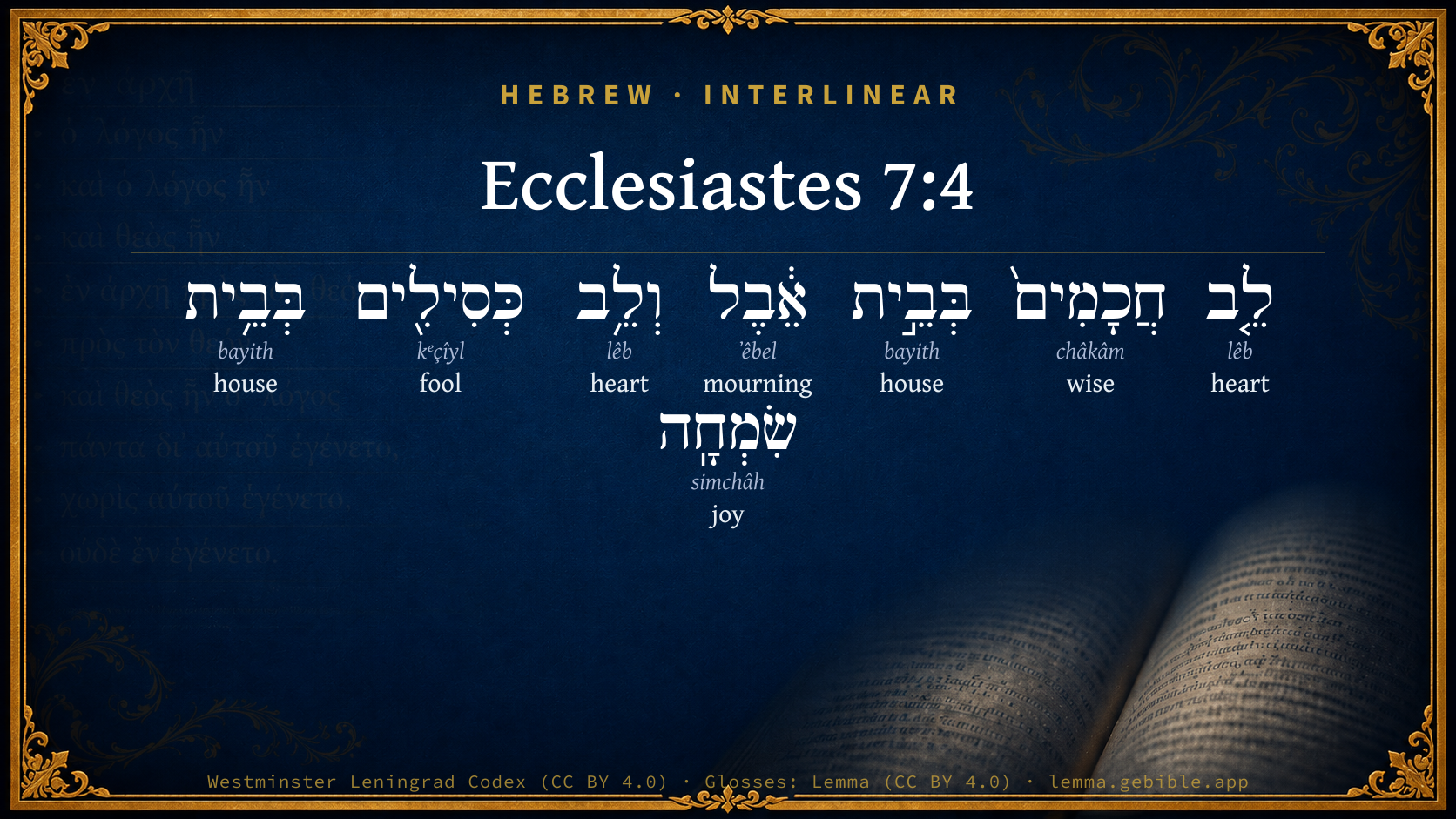
Ecclesiastes 7:4

Hebrew (Westminster Leningrad Codex) Ecclesiastes 7:4 appears in the Hebrew Old Testament. The text above is from the Westminster Leningrad Codex. Each word links to its Strong’s number, a concise gloss, and parsing drawn from the Open Scriptures Hebrew Bible morphology. Click any word for its full Brown-Driver-Briggs (BDB) entry.
Download image
Cite this verse

Ecclesiastes 7:4 (World English Bible). Public Domain. Lemma interlinear Bible study tool, https://lemma.gebible.app/v/ecclesiastes/7/4.

Show BibTeX & RIS
BibTeX
RIS
English Translation
The heart of the wise is in the house of mourning; but the heart of fools is in the house of mirth.
World English Bible · Public Domain
Download a study sheet

One document with this verse’s original text, its word-by-word gloss line, the meaning frame, cross-references with their text, attributed commentary, and full source and license credits — printable, and it pastes into notes with its structure intact.

This verse Autodidact and up

Study sheet (.html) Plain text (.txt)

A passage Seminary Student

Up to 50 verses in one chapter. A passage sheet keeps up to 6 commentary sources and 12 cross-references per verse, in the order this page ranks them, and says so on the sheet whenever that leaves anything out. Ask for a single verse and you get the Autodidact verse sheet above.

Everything on this page stays free to read, with no account — the sheet is a download of what is already on screen, not access to it.

Want to remove ads? Support Godless Engineer
Compare translations 3

The same verse in 3 English versions, stacked beneath the original-language interlinear above. Click any original word for its lexicon entry.

Each is an independent rendering of the whole verse — the interlinear is not word-aligned to these translations.

Highlighted words mark where these versions differ — a whole-verse word diff, not a word-by-word alignment.

  • World English Bible Public Domain
    The heart of the wise is in the house of mourning; but the heart of fools is in the house of mirth.
  • King James Version Public Domain
    The heart of the wise is in the house of mourning; but the heart of fools is in the house of mirth.
  • unfoldingWord Literal Text CC BY-SA 4.0
    heart of wise people in a house of mourning, but heart of fools in a house of joy.

unfoldingWord Literal Text — © unfoldingWord, licensed CC BY-SA 4.0. Word-aligned USFM3 via Door43 (git.door43.org/unfoldingWord/en_ult).

Versions to compare (up to 4)

3 of 4 selected

Show all 18 translations

Every available English version of this verse, each an independent rendering of the whole verse.

  • World English Bible Public Domain
    The heart of the wise is in the house of mourning; but the heart of fools is in the house of mirth.
  • Berean Standard Bible Public Domain
    The heart of the wise is in the house of mourning, but the heart of fools is in the house of pleasure.
  • Majority Standard Bible Public Domain
    The heart of the wise is in the house of mourning, but the heart of fools is in the house of pleasure.
  • King James Version Public Domain
    The heart of the wise is in the house of mourning; but the heart of fools is in the house of mirth.
  • American Standard Version (1901) Public Domain
    The heart of the wise is in the house of mourning; but the heart of fools is in the house of mirth.
  • Revised Version (1885) Public Domain
    The heart of the wise is in the house of mourning; but the heart of fools is in the house of mirth.
  • Geneva Bible (1599) Public Domain
    It is better to goe to the house of mourning, then to goe to the house of feasting, because this is the ende of all men: and the liuing shall lay it to his heart.
  • Douay-Rheims (1899) Public Domain
    Anger is better than laughter: because by the sadness of the countenance the mind of the offender is corrected.
  • Young's Literal Translation Public Domain
    The heart of the wise `is' in a house of mourning, And the heart of fools in a house of mirth.
  • Literal Standard Version CC BY-SA 4.0
    The heart of the wise [is] in a house of mourning, || And the heart of fools in a house of mirth.
  • Unlocked Literal Bible CC BY-SA 4.0
    The heart of the wise is in the house of mourning, but the heart of fools is in the house of feasting.
  • unfoldingWord Literal Text CC BY-SA 4.0
    heart of wise people in a house of mourning, but heart of fools in a house of joy.
  • Darby Bible Public Domain
    The heart of the wise is in the house of mourning, but the heart of fools in the house of mirth.
  • World Messianic Bible Public Domain
    The heart of the wise is in the house of mourning; but the heart of fools is in the house of mirth.
  • Webster's Bible Public Domain
    The heart of the wise is in the house of mourning; but the heart of fools is in the house of mirth.
  • Free Bible Version CC BY-SA 4.0
    Wise people think about the impact of death, while those who are fools only think about having a good time.
  • Bible in Basic English Public Domain
    The hearts of the wise are in the house of weeping; but the hearts of the foolish are in the house of joy.
  • JPS Tanakh (1917) Public Domain
    The heart of the wise is in the house of mourning; but the heart of fools is in the house of mirth.

Literal Standard Version (2020), Covenant Press — licensed CC BY-SA 4.0. Text via the HelloAO Bible API (eBible.org). Unlocked Literal Bible (unfoldingWord) — licensed CC BY-SA 4.0. Text via the HelloAO Bible API (eBible.org). unfoldingWord Literal Text — © unfoldingWord, licensed CC BY-SA 4.0. Word-aligned USFM3 via Door43 (git.door43.org/unfoldingWord/en_ult). Free Bible Version, Dr. Jonathan Gallagher — licensed CC BY-SA 4.0. Text via the HelloAO Bible API (eBible.org).

Word by word

More ways to search: Search by grammar → Find every occurrence → Compare this word →

Practice this passage: Drill this verse → Learn its vocabulary →

About this verse

These counts appear in no published source. They are computed here, from the morphology-tagged text and Lemma’s own curated glosses. What Lemma adds →

8
words
6
distinct lemmas
Wisdom
section

Notable vocabulary

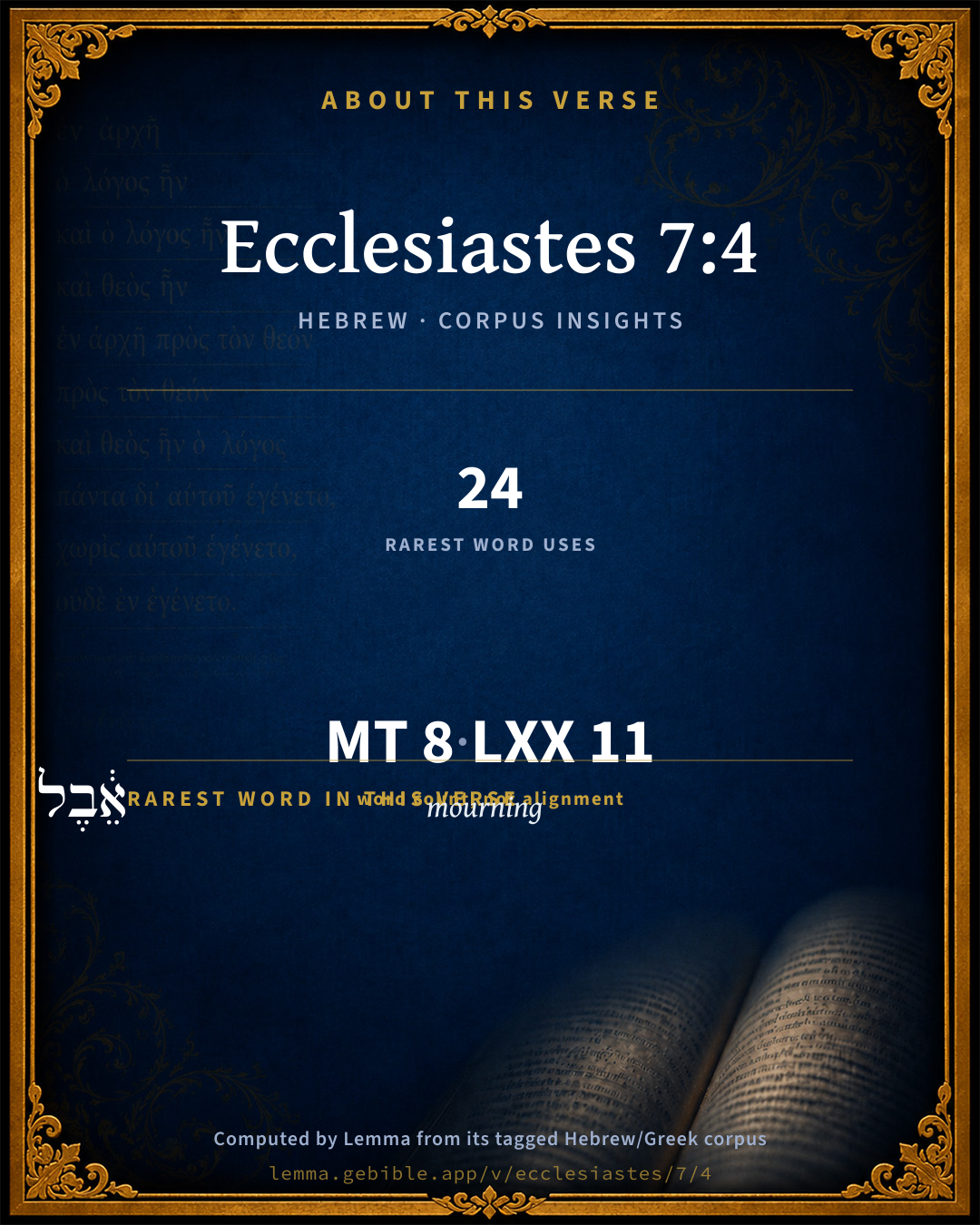
The rarest word here is אֵ֔בֶל mourning H60 — appearing just 24 times in the whole Hebrew Bible.

Shared distinctive vocabulary

אֵ֔בֶל mourning H60 occurs in 22 verses of the Hebrew Bible. Also found in:

Grammatical profile

  • 6 nouns
  • 2 adjectives

Repetition

Words recur within this verse — often emphatic in Hebrew:

  • לֵ֤ב heart H3820 ×2
  • בְּבֵ֣ית house H1004 ×2

Hebrew & Septuagint length

In English translation the verse runs 22 words from the Hebrew and 18 from the Septuagint (LXX English) — closely comparable.

A rough comparison of the two English renderings, which tokenize alike — not a word-level alignment.

Word counts can differ between the Hebrew and the Greek without any difference in meaning — e.g. the Hebrew direct-object marker אֵת has no separate Greek word, and Greek often adds the article ὁ.

In the original languages it is 8 Hebrew tokens and 11 Greek tokens — but the two are counted differently (Hebrew bundles its prefixes and suffixes into one token; the Greek is in lemma form), so that isn’t a like-for-like length.

Cross-references

18

Topical passages linked to Ecclesiastes 7:4 in the Treasury of Scripture Knowledge — connected by theme and wording, ordered by reader-vote popularity; previews shown in the World English Bible.

  • Matthew 8:14–16 When Jesus came into Peter's house, he saw his wife's mother lying sick with a fever.
  • 1 Samuel 25:36 Abigail came to Nabal; and, behold, he held a feast in his house, like the feast of a king; and Nabal's heart was merry within him, for he was very drunken: therefore she told him nothing, less or more, until the morning light.
  • Luke 7:12–13 Now when he drew near to the gate of the city, behold, one who was dead was carried out, the only son of his mother, and she was a widow. Many people of the city were with her.
  • 1 Samuel 30:16 When he had brought him down, behold, they were spread abroad over all the ground, eating and drinking, and dancing, because of all the great spoil that they had taken out of the land of the Philistines, and out of the land of Judah.
  • 1 Kings 20:16 They went out at noon. But Ben Hadad was drinking himself drunk in the pavilions, he and the kings, the thirty-two kings who helped him.
  • Nehemiah 2:2–5 The king said to me, Why is your face sad, seeing you are not sick? this is nothing else but sorrow of heart. Then I was very sore afraid.
  • Isaiah 21:4 My heart flutters, horror has frightened me; the twilight that I desired has been turned into trembling to me.
  • Isaiah 53:3–4 He was despised, and rejected by men; a man of suffering, and acquainted with disease: and as one from whom men hide their face he was despised; and we didn't respect him.
  • Jeremiah 51:39 When they are heated, I will make their feast, and I will make them drunken, that they may rejoice, and sleep a perpetual sleep, and not wake, says Yahweh.
  • Jeremiah 51:57 I will make drunk her princes and her wise men, her governors and her deputies, and her mighty men; and they shall sleep a perpetual sleep, and not wake up, says the King, whose name is Yahweh of Hosts.
  • Daniel 5:1–4 Belshazzar the king made a great feast to a thousand of his lords, and drank wine before the thousand.
  • Daniel 5:30 In that night Belshazzar the Chaldean King was slain.
  • Hosea 7:5 On the day of our king, the princes made themselves sick with the heat of wine. He joined his hand with mockers.
  • Mark 5:38–43 He came to the synagogue ruler's house, and he saw an uproar, weeping, and great wailing.
  • Mark 6:21–29 Then a convenient day came, that Herod on his birthday made a supper for his nobles, the high officers, and the chief men of Galilee.
  • John 11:31–35 Then the Jews who were with her in the house, and were consoling her, when they saw Mary, that she rose up quickly and went out, followed her, saying, "She is going to the tomb to weep there."
  • 2 Samuel 13:28 Absalom commanded his servants, saying, Mark you now, when Amnon's heart is merry with wine; and when I tell you, Smite Amnon, then kill him; don't be afraid; haven't I commanded you? be courageous, and be valiant.
  • Nahum 1:10 For entangled like thorns, and drunken as with their drink, they are consumed utterly like dry stubble.

Cross-references courtesy of OpenBible.info (CC BY 4.0).

Hebrew and Greek witnesses Masoretic Hebrew ↔ Greek Septuagint

The same verse in the two great witnesses to the Old Testament, shown verse-for-verse.

These are two independent witnesses, not word-aligned to each other, and the Septuagint is shown in lemma (dictionary) form.

Hebrew Ecclesiastes 7:4 Masoretic · Westminster Leningrad Codex

לֵ֤ב חֲכָמִים֙ בְּבֵ֣ית אֵ֔בֶל וְלֵ֥ב כְּסִילִ֖ים בְּבֵ֥ית שִׂמְחָֽה

The heart of the wise is in the house of mourning; but the heart of fools is in the house of mirth.

World English Bible · Public Domain

Greek LXX Ecclesiastes 7:4 Septuagint · lemma form

καρδία σοφός ἐν οἶκος πένθος καί καρδία ἄφρων ἐν οἶκος εὐφροσύνη

Sorrow is better than laughter: for by the sadness of the countenance the heart will be made better.

LXX2012 (modern English Septuagint) · Public Domain

Hebrew: Westminster Leningrad Codex (CC BY 4.0). Greek: Septuagint (public domain); English from LXX2012 (modern English Septuagint) (Public Domain). How the Septuagint differs from the Hebrew →

Commentary

Notes on Ecclesiastes 7:4 from classic Christian and Jewish commentators (each source and its license shown beneath its notes). The classic Christian expositions comment on the surrounding passage and are grouped to its opening verse, so a note may address several verses; the Jewish commentaries on the Tanakh (Rashi and others) are per-verse, so they appear only where the commentator wrote on this verse.

Lemma curates 59 commentaries, every one of them public domain or Creative Commons licensed, each selected and text-cleaned for this edition rather than reprinted as found. About our sources →

Trapp's Complete Commentary

John Trapp

Ecc 7:4 The heart of the wise [is] in the house of mourning; but the heart of fools [is] in the house of mirth.

Ver. 4. The heart of the wise is in the house of mourning.] He gladly makes use of all good means of minding his mortality, and holds it a high point of heavenly wisdom so to do. Hence he frequents funerals, mingles with mourners, hears etiam muta clamare cadavers, makes every tomb a teacher, every monument a monitor, {a} lays him down in his bed as in his grave, looks upon his sheets as his winding sheet. Ut somnus mortis, sic lectus imago sepulchri. If he hears but the clock strike, sees the glass run out, it is as a death’s head to preach memento mori to him; he remembers the days of darkness, as Solomon bids, {Ecc 11:8} acts death aforehand, takes up many sad and serious thoughts of it, and makes it his continual practice so to do, as Job and David did. The wiser Jews digged their graves long before, as that old prophet; {1Ki 13:30} Joseph of Arimathea had his in his garden to season his delights. John, Patriarch of Alexandria (surnamed Eleemosynarius, for his bounty to the poor), having his tomb in building, gave his people charge it should be left unfinished, and that every day one should put him in mind to perfect it, that he might remember his mortality. The Christians in some part of the primitive Church took the sacrament every day, because they looked to die every day. Augustine would not for the gain of a million of worlds be an atheist for half an hour, because he had no certainty of his life for so short a time. His mother, Monica, was heard oft to say, How is it that I am here still? {b} The women of the Isle of Man, saith Speed, {c} whensoever they go out of their doors, gird themselves about with the winding sheet that they purpose to be buried in, to show themselves mindful of their mortality. The philosopher {d} affirms that man is therefore the wisest of creatures, because he alone can number, - Bruta non numerant; this is an essential difference, - but especially in that divine arithmetic of so "numbering his days as to apply his heart to wisdom." {Psa 90:12} This speaks him wise indeed, right in his judgment, right also in his affections. This will render him right in his practice too; as it did Waldus, the merchant of Lyons, who seeing one suddenly fall down dead before him, became a new man, and chief of those old Protestants, the poor men of Lyons, {e} called also Waldenses from this Waldus.

But the heart of fools is in the house of mirth.] {See Trapp on "Ecc 7:3"} As the heart of the wicked is light and little worth, so it is their trade to hunt after lying vanities (as the child doth after butterflies), to "rejoice in a thing of nothing"; {Amo 6:13} he wiles away his time, either in "weaving spiders’ webs or hatching cockatrice’ eggs"; {Isa 59:5} froth or filth {αφροσυνη, Mar 7:22} is their recreation. Sad and serious thoughts they banish, and therefore love not to be alone. They hate to hear of that terrible word death - as Louis XI of France commanded his servants not once to mention it to him, though he lay upon his deathbed. They live and laugh as if they were out of the reach of God’s rod, or as if their lives were riveted upon eternity, They can see death in other men’s brows and visages, not feel it in their own bowels and bosoms. When they behold any laid in their graves, they can shake their heads and say, This is what we must all come to; but after a while all is forgotten, - as water stirred with a stone cast into it hath circle upon circle on the surface for present, but by and by all is smooth as before. As chickens in a storm haste to be under the hen’s wing, but when that is a little over they lie dusting themselves in the sunshine; so it is here. Good thoughts fall upon evil hearts as sparks upon wet tinder; or if they kindle there, fools bring their buckets to quench them, run into merry company to drink, or otherwise drive away those troublesome heart qualms and melancholy dumps, as they call them. This is to excel in madness, &c. {See Trapp on "Pro 10:23"}

{a} Monimenta, quasi mentem momentia.

{b} Quid hic facio. - Aug.

{c} Description of the Isle of Man, abridged.

{d} Arist.

{e} Pauperes de Lugduno.

John Trapp, A Commentary or Exposition upon All the Books of the Old and New Testament (1647–1656) — public domain. Text from a community e-Sword module.

The Biblical Illustrator

Joseph S. Exell

Ecc_7:4

The heart of the wise is in the house of mourning.

The advantages of visiting the mansions of distress

For so valuable a purpose it is well worth while to bear with all the gloominess of the house of mourning. For most useful lessons will the heart of the wise be able to learn there; and excellent rules of conduct, with respect to himself, to the memory of those who are deceased, and to such as they have left behind them.

1. With respect to himself. Death is the end of all men, and the living will lay it go his heart. It is because we do not lay it to our hearts that we most of us go on just as if we imagined there was to be no end at all; and though we do not, indeed, speculatively think so, yet we live and act upon that supposition; and our knowing it to be a false one hath no manner of influence for want of reflecting upon it as such. This could not be would we but stop a little at the house of mourning; and make the most obvious of all reflections there, from contemplating the end of others, how very quickly our own end may come, and how soon it must. Such thoughts will enliven our diligence in performing our duty here; in working, while it is day, the works of Him that sent us. And as the thoughts of death are excellently fitted to compose the vehemence of our other passions, so they are fitted particularly to check that very sinful kind of vehemence, which we are exceedingly prone to express, one against another. Another instruction, which the heart of the wise will learn in the house of mourning, is, never to flatter himself with expectations of any lasting good in a state so uncertain as this. You see, therefore, what improvement the heart of the wise may receive from a general consideration of the end of all men. But the further view of the different ends of different men is a subject of yet further advantage.

2. The heart of the wise, whilst it dwells in the house of mourning, will not only improve itself in a general sense of Christian piety, but also more especially in such precepts of it as constitute a proper behaviour with respect to the memory of those whose departure is at any time the object of our thoughts. The dead, indeed, are out of our reach: our goodness extends not to them, and our enmity can do them no harm. But for the sake of common justice and humanity, we are bound to the amiable duties of stowing candour in regard to their failings, and paying the honour which is due to their merit.

3. We may learn, from a considerate meditation on the examples of mortality, very useful instructions for our behaviour, not only with respect to the deceased, but those whom they have left behind any way peculiarly related to them. The death of a wise and good, of a near and affectionate friend, is unspeakably the greatest of all calamities. Whoever is capable of these reflections, if he allows himself time to make them, will sincerely pity all that have suffered such a loss, and equally esteem all that show they are sensible of it. (T. Secker.)

The Biblical Illustrator, edited by Joseph S. Exell (c. 1880s–1900s) — public domain. Text from a community e-Sword module.

Geneva Bible (1599)

Geneva Bible translators

Where we may see the hand of God, and learn to examine our lives.

Geneva Bible (1599) marginal notes — public domain. Text via Bolls.life.

Adam Clarke's Commentary

Verse 4. The heart of the wise is in the house of mourning] A wise man loves those occasions from which he can derive spiritual advantage; and therefore prefers visiting the sick, and sympathizing with those who have suffered privations by death. But the fool - the gay, thoughtless, and giddy - prefers places and times of diversion and amusement. Here he is prevented from seriously considering either himself or his latter end. The grand fault and misfortune of youth.

Adam Clarke's Commentary on the Bible (1810–1826) — public domain. Text from a community e-Sword/MySword module.

The Cambridge Bible for Schools and Colleges

gen. ed. J. J. S. Perowne

4. The heart of the wise] This follows as the natural sequel. Like goes to like. The impulse of the fool takes him to that which promises enjoyment; that of the wise leads him to that which has the promise of a higher wisdom and therefore of a more lasting gain.

The Cambridge Bible for Schools and Colleges (gen. ed. J. J. S. Perowne; Cambridge University Press, 1878–1918) — public domain. Text from a community e-Sword module.

John Gill's Exposition

The heart of the wise is in the house of mourning,.... When his body is not; when it does not suit him to go thither in person, his mind is there, and his thoughts are employed on the useful subjects of the frailty and mortality of human nature, of death, a future judgment, and a world to come; which shows him to be a wise man, and concerned for the best things, even for his eternal happiness in another state;

but the heart of fools is in the house of mirth; where jovial company is, merry songs are sung, and the cup or glass passes briskly round, and all is gay and brilliant: here the fool desires to be oftener than he is, and when he cannot; which shows the folly of his mind, what a vain taste he has, and how thoughtless he is of a future state, and of his eternal welfare.

John Gill's Exposition of the Whole Bible (1746–1763) — public domain (CC PDM 1.0). Text via the HelloAO Bible API.

Albert Barnes' Notes on the Bible

House of mourning ... house of mirth - These phrases acquire a forcible significance from the Eastern custom of prolonging both festive and mournful celebrations through several days. See Gen 50:10; Jdg 14:17. This verse indicates that a life of enjoyment, does not mean the abandonment of ourselves to pleasures, but the thankful and sober use of the beautiful things which God gives us.

Albert Barnes' Notes on the Bible (1834–1885) — public domain. Text from a community e-Sword/MySword module.

Haydock's Catholic Bible Commentary

Anger. That is, correction, or just wrath and zeal against evil, (Challoner) is preferable to a misguided complaisance, Proverbs xxvii. 6. (Calmet) --- Anger, when rightly used, helps us to correct our faults. (Worthington)

George Leo Haydock (1774–1849), Haydock's Catholic Family Bible and Commentary, 1859 edition — public domain. Excludes Psalms (Douay-Rheims chapter numbering differs from Protestant) and Deuterocanonical books (Catholic canon only).

Matthew Poole's English Annotations

The heart of the wise is in the house of morning, even when their bodies are absent. They are constantly, or very frequently, meditating upon sad and serious firings, such as death and judgment, the vanity of this life, and the reality and eternity of the next, because they know that these thoughts, though they be not grateful to the sensual part, yet they are absolutely necessary, and highly profitable, and most comfortable in the end, which every wise man most regards.

The heart of fools is in the house of mirth; their minds and affections are wholly set upon feasting and jollity, because, like fools and brutish creatures, they regard only their present delight, and mind not how dearly they must pay for them.

Matthew Poole's English Annotations on the Holy Bible (1683–1685) — public domain. Text from a community e-Sword/MySword module.

Whedon's Commentary on the Bible

Daniel D. Whedon

4. This verse is of the nature of an inference from the preceding. The wise do not shun the homes and scenes of sorrow, but take sincere part with them, while the fool loves only jest and mirth.

Daniel D. Whedon (gen. ed.), Commentary on the Old and New Testaments (1874–1909) — public domain. Text from a community e-Sword module.

The Pulpit Commentary

The heart of the wise is in the house of mourning. This is the natural conclusion from what was said in vers. 2, 3. The man who recognizes the serious side of life, and knows where to learn lessons of high moral meaning, will be found conversant with scenes of sorrow and suffering, and reflecting upon them. But the heart of fools is in the house of mirth. The fool, who thinks of nothing but present enjoyment, and how to make life pass pleasantly, turns away from mournful scenes, and goes only there where he may drown care and be thoughtless and merry.

The Pulpit Commentary (1880–1919), ed. H.D.M. Spence-Jones & Joseph S. Exell — public domain. Text from a community e-Sword module.

John Wesley's Explanatory Notes

The wise - Are constantly meditating upon serious things.

John Wesley, Explanatory Notes Upon the Whole Bible (1754–1765) — public domain. Text via the GEBible commentary corpus.

Rashi

Rabbi Shlomo Yitzchaki (Rashi)

The heart of the wise is in a house of mourning Their thought is about the day of death.

whereas the heart of the fools is in a house of joy They do not quake because of the day of death, and their hearts are as sound as a palace.

Rashi on the Tanakh — English translations: “The Judaica Press complete Tanach with Rashi, translated by A. J. Rosenberg” (CC BY 4.0); “Pentateuch with Rashi's commentary by M. Rosenbaum and A.M. Silbermann, 1929-1934” (public domain); “The Metsudah Tanach series, Lakewood, N.J” (CC BY 4.0); and “The Book of Joshua, Metsudah Publications, 1997” (CC BY 4.0). Text via Sefaria.

Lesson kit

Teaching starters — assembled from the data on this page, not authored interpretation. Every prompt links to the verse data it draws on. Edit before teaching.

Ecclesiastes, in the Wisdom, opens this verse with 8 words (6 distinct Hebrew lemmas). Its most distinctive word is ʼêbel (“mourning”). A historical commentator’s framing appears above. Read the whole chapter for the surrounding context.

Discussion questions

  1. What does “mourning” (ʼêbel) contribute to the verse as a whole?
  2. How does Genesis 27:41, which shares the word «mourning», read alongside this verse?
  3. What does the repetition of “heart” (2× in this one verse) do in this verse?
  4. The translations on this page render this verse differently — a whole-verse word diff, not a word-by-word alignment. What might account for the different wordings?
  5. Compare how Trapp's Complete Commentary and The Biblical Illustrator read this verse. Where do they agree or differ?

Things to notice

Reading settings

Reading text

Shown beneath each verse's original-language words.

Old Testament
Old Testament edition

Read the OT as the Masoretic Hebrew (MT) or the Greek Septuagint (LXX).

English shown for the Greek Septuagint (in the Hebrew ↔ Greek comparison).

Comparing translations? Open the Compare panel on any verse page to stack up to four side by side.