
Proverbs 12:15

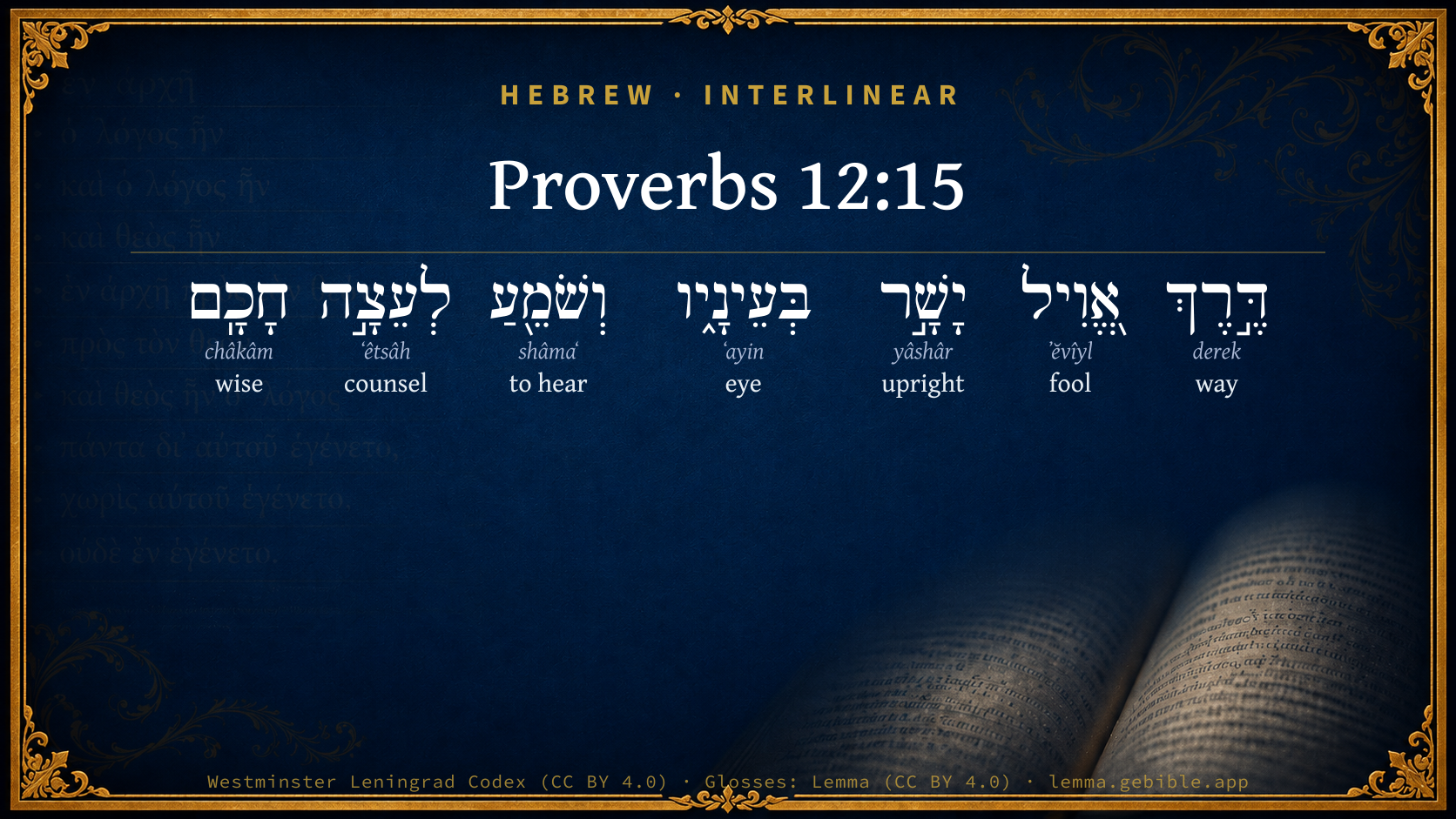
Hebrew (Westminster Leningrad Codex) Proverbs 12:15 appears in the Hebrew Old Testament. The text above is from the Westminster Leningrad Codex. Each word links to its Strong’s number, a concise gloss, and parsing drawn from the Open Scriptures Hebrew Bible morphology. Click any word for its full Brown-Driver-Briggs (BDB) entry.
Download image
Cite this verse

Proverbs 12:15 (World English Bible). Public Domain. Lemma interlinear Bible study tool, https://lemma.gebible.app/v/proverbs/12/15.

Show BibTeX & RIS
BibTeX
RIS
English Translation
The way of a fool is right in his own eyes, But he who is wise listens to counsel.
World English Bible · Public Domain
Download a study sheet

One document with this verse’s original text, its word-by-word gloss line, the meaning frame, cross-references with their text, attributed commentary, and full source and license credits — printable, and it pastes into notes with its structure intact.

This verse Autodidact and up

Study sheet (.html) Plain text (.txt)

A passage Seminary Student

Up to 50 verses in one chapter. A passage sheet keeps up to 6 commentary sources and 12 cross-references per verse, in the order this page ranks them, and says so on the sheet whenever that leaves anything out. Ask for a single verse and you get the Autodidact verse sheet above.

Everything on this page stays free to read, with no account — the sheet is a download of what is already on screen, not access to it.

Want to remove ads? Support Godless Engineer
Compare translations 3

The same verse in 3 English versions, stacked beneath the original-language interlinear above. Click any original word for its lexicon entry.

Each is an independent rendering of the whole verse — the interlinear is not word-aligned to these translations.

Highlighted words mark where these versions differ — a whole-verse word diff, not a word-by-word alignment.

  • World English Bible Public Domain
    The way of a fool is right in his own eyes, But he who is wise listens to counsel.
  • King James Version Public Domain
    The way of a fool is right in his own eyes: but he that hearkeneth unto counsel is wise.
  • unfoldingWord Literal Text CC BY-SA 4.0
    The way of a fool right in his eyes, but a wise one listens to counsel.

unfoldingWord Literal Text — © unfoldingWord, licensed CC BY-SA 4.0. Word-aligned USFM3 via Door43 (git.door43.org/unfoldingWord/en_ult).

Versions to compare (up to 4)

3 of 4 selected

Show all 18 translations

Every available English version of this verse, each an independent rendering of the whole verse.

  • World English Bible Public Domain
    The way of a fool is right in his own eyes, But he who is wise listens to counsel.
  • Berean Standard Bible Public Domain
    The way of a fool is right in his own eyes, but a wise man listens to counsel.
  • Majority Standard Bible Public Domain
    The way of a fool is right in his own eyes, but a wise man listens to counsel.
  • King James Version Public Domain
    The way of a fool is right in his own eyes: but he that hearkeneth unto counsel is wise.
  • American Standard Version (1901) Public Domain
    The way of a fool is right in his own eyes; But he that is wise hearkeneth unto counsel.
  • Revised Version (1885) Public Domain
    The way of the foolish is right in his own eyes: but he that is wise hearkeneth unto counsel.
  • Geneva Bible (1599) Public Domain
    The way of a foole is right in his owne eyes: but he that heareth counsell, is wise.
  • Douay-Rheims (1899) Public Domain
    The way of a fool is right in his own eyes: but he that is wise hearkeneth unto counsels.
  • Young's Literal Translation Public Domain
    The way of a fool `is' right in his own eyes, And whoso is hearkening to counsel `is' wise.
  • Literal Standard Version CC BY-SA 4.0
    The way of a fool [is] right in his own eyes, || And whoever is listening to counsel [is] wise.
  • Unlocked Literal Bible CC BY-SA 4.0
    The way of a fool is right in his own eyes, but a wise man listens to advice.
  • unfoldingWord Literal Text CC BY-SA 4.0
    The way of a fool right in his eyes, but a wise one listens to counsel.
  • Darby Bible Public Domain
    The way of a fool is right in his own eyes; but he that is wise hearkeneth unto counsel.
  • World Messianic Bible Public Domain
    The way of a fool is right in his own eyes, but he who is wise listens to counsel.
  • Webster's Bible Public Domain
    The way of a fool is right in his own eyes: but he that hearkeneth to counsel is wise.
  • Free Bible Version CC BY-SA 4.0
    Stupid people think they're on the right track, but if you're wise you listen to advice.
  • Bible in Basic English Public Domain
    The way of the foolish man seems right to him? but the wise man gives ear to suggestions.
  • JPS Tanakh (1917) Public Domain
    The way of a fool is straight in his own eyes; but he that is wise hearkeneth unto counsel.

Literal Standard Version (2020), Covenant Press — licensed CC BY-SA 4.0. Text via the HelloAO Bible API (eBible.org). Unlocked Literal Bible (unfoldingWord) — licensed CC BY-SA 4.0. Text via the HelloAO Bible API (eBible.org). unfoldingWord Literal Text — © unfoldingWord, licensed CC BY-SA 4.0. Word-aligned USFM3 via Door43 (git.door43.org/unfoldingWord/en_ult). Free Bible Version, Dr. Jonathan Gallagher — licensed CC BY-SA 4.0. Text via the HelloAO Bible API (eBible.org).

Word by word

More ways to search: Search by grammar → Find every occurrence → Compare this word →

Practice this passage: Drill this verse → Learn its vocabulary →

About this verse

These counts appear in no published source. They are computed here, from the morphology-tagged text and Lemma’s own curated glosses. What Lemma adds →

7
words
7
distinct lemmas
Wisdom
section

Shared distinctive vocabulary

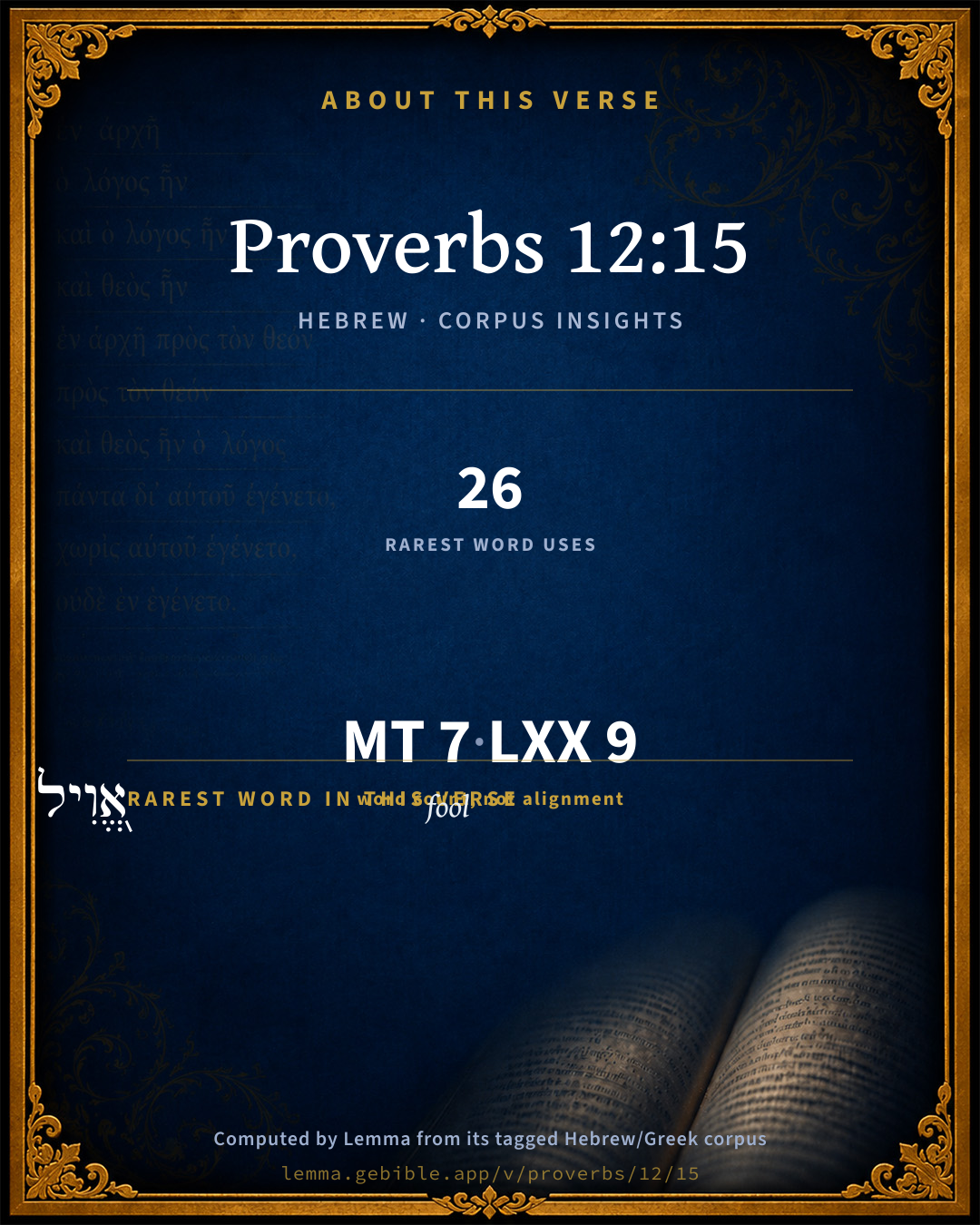
אֱ֭וִיל fool H191 occurs in 26 verses of the Hebrew Bible. Also found in:

Grammatical profile

  • 1 verb
  • 3 nouns
  • 3 adjectives

Verb forms

  • וְשֹׁמֵ֖עַ Qal · Participle Active

Hebrew & Septuagint length

In English translation the verse runs 19 words from the Hebrew and 17 from the Septuagint (LXX English) — closely comparable.

A rough comparison of the two English renderings, which tokenize alike — not a word-level alignment.

Word counts can differ between the Hebrew and the Greek without any difference in meaning — e.g. the Hebrew direct-object marker אֵת has no separate Greek word, and Greek often adds the article ὁ.

In the original languages it is 7 Hebrew tokens and 9 Greek tokens — but the two are counted differently (Hebrew bundles its prefixes and suffixes into one token; the Greek is in lemma form), so that isn’t a like-for-like length.

Cross-references

17

Topical passages linked to Proverbs 12:15 in the Treasury of Scripture Knowledge — connected by theme and wording, ordered by reader-vote popularity; previews shown in the World English Bible.

  • Proverbs 3:7 Don't be wise in your own eyes. Fear Yahweh, and depart from evil.
  • Proverbs 14:16 A wise man fears, and shuns evil, But the fool is hotheaded and reckless.
  • Proverbs 19:20 Listen to counsel and receive instruction, That you may be wise in your latter end.
  • Proverbs 26:12 Do you see a man wise in his own eyes? There is more hope for a fool than for him.
  • Proverbs 14:12 There is a way which seems right to a man, But in the end it leads to death.
  • Proverbs 16:2 All the ways of a man are clean in his own eyes; But Yahweh weighs the motives.
  • Proverbs 16:25 There is a way which seems right to a man, But in the end it leads to death.
  • Proverbs 1:5 That the wise man may hear, and increase in learning; That the man of understanding may attain to sound counsel:
  • Proverbs 9:9 Instruct a wise man, and he will be still wiser. Teach a righteous man, and he will increase in learning.
  • Galatians 6:3 For if a man thinks himself to be something when he is nothing, he deceives himself.
  • Proverbs 21:2 Every way of a man is right in his own eyes, But Yahweh weighs the hearts.
  • Proverbs 26:16 The sluggard is wiser in his own eyes Than seven men who answer with discretion.
  • Proverbs 28:11 The rich man is wise in his own eyes; But the poor who has understanding sees through him.
  • Proverbs 30:12 There is a generation that is pure in their own eyes, Yet are not washed from their filthiness.
  • Ecclesiastes 4:13 Better is a poor and wise youth than an old and foolish king who doesn't know how to receive admonition any more.
  • Jeremiah 38:15–28 Then Jeremiah said to Zedekiah, If I declare it to you, will you not surely put me to death? and if I give you counsel, you will not listen to me.
  • Luke 18:11 The Pharisee stood and prayed to himself like this: 'God, I thank you, that I am not like the rest of men, extortioners, unrighteous, adulterers, or even like this tax collector.

Cross-references courtesy of OpenBible.info (CC BY 4.0).

Hebrew and Greek witnesses Masoretic Hebrew ↔ Greek Septuagint

The same verse in the two great witnesses to the Old Testament, shown verse-for-verse.

These are two independent witnesses, not word-aligned to each other, and the Septuagint is shown in lemma (dictionary) form.

Hebrew Proverbs 12:15 Masoretic · Westminster Leningrad Codex

דֶּ֣רֶךְ אֱ֭וִיל יָשָׁ֣ר בְּעֵינָ֑יו וְשֹׁמֵ֖עַ לְעֵצָ֣ה חָכָֽם

The way of a fool is right in his own eyes, But he who is wise listens to counsel.

World English Bible · Public Domain

Greek LXX Proverbs 12:15 Septuagint · lemma form

ὁδός ἄφρων ὀρθός ἐνώπιον αὐτός εἰςἀκούω δέ συμβουλία σοφός

The ways of fools are right in their own eyes; but a wise man hearkens to counsels.

LXX2012 (modern English Septuagint) · Public Domain

On this verse, The Preacher's Complete Homiletical Commentary discusses the Septuagint’s reading. Read the note in Commentary ↓

Hebrew: Westminster Leningrad Codex (CC BY 4.0). Greek: Septuagint (public domain); English from LXX2012 (modern English Septuagint) (Public Domain). How the Septuagint differs from the Hebrew →

Commentary

Notes on Proverbs 12:15 from classic Christian and Jewish commentators (each source and its license shown beneath its notes). The classic Christian expositions comment on the surrounding passage and are grouped to its opening verse, so a note may address several verses; the Jewish commentaries on the Tanakh (Rashi and others) are per-verse, so they appear only where the commentator wrote on this verse.

Lemma curates 59 commentaries, every one of them public domain or Creative Commons licensed, each selected and text-cleaned for this edition rather than reprinted as found. About our sources →

Trapp's Complete Commentary

John Trapp

Pro 12:15 The way of a fool [is] right in his own eyes: but he that hearkeneth unto counsel [is] wise.

Ver. 15. The way of a fool is right in his own eyes.] He thinks his own wit best. Consilii satis est in me mihi; { a} he will not part with his commonwealth of baubles for the Tower of London. And such a fool is every natural man; {Job 11:12} wise enough, haply, in his generation - so is the fox too; - wise with such a wisdom as, like the ostrich’s wings, makes him outrun others upon earth, and in earthly things, but helps him never a whit towards heaven - nay, hinders him, and hangs in his light, as it fared with the Pharisees. {Mat 21:31} Of such it may be said, as Quintilian said of some conceited, presumptuous, and arrogant of themselves, that they might have proved excellent scholars if they had not been so persuaded already. So might many have been wise if they had not been conceited by their own wisdom, and saved if not too well persuaded of their good estate to Godward. They clasp and hug the barn {b} of their own brain, with the ape, till they strangle it.

“ At parit ut vivat regnetque beatus.

Cogi posse negat. ” - Hor., Eph 2:1-22.

But he that hearkeneth to counsel is wise.] He that, suspecting his own judgment, takes advice from those wiser than himself, seldom miscarries. There is that self-love in many, that they think their molehill a mountain, their kestril an eagle, their goose a swan. And, being self-conceited, they love to be flattered. Not so the wise man; he knows that humanum est errare, to error is human, and that triste mortalitatis privilegium est licere aliquando peccare. It is a sad privilege of mortals to be permitted to sin at any time. He is therefore glad of good counsel, and thankful for a seasonable reproof. "Let the righteous smite me."

{a} Arachne ap. Ovid.

{b} [Bairn, - child.]

John Trapp, A Commentary or Exposition upon All the Books of the Old and New Testament (1647–1656) — public domain. Text from a community e-Sword module.

Joseph Benson's Commentary

Pro 12:15. The way of a fool — The counsel and course which his own mind suggests to him in ordering his affairs; is right in his own eyes — Highly pleases him, so that he neglects and despises the opinions and advices of others; but he that hearkeneth, &c., is wise — That distrusts his own judgment, and seeks counsel from others.

Joseph Benson's Commentary on the Old and New Testaments (1811–1818) — public domain. Text from a community e-Sword module.

The Preacher's Complete Homiletical Commentary

Joseph S. Exell (gen. ed.)

CRITICAL NOTES.—

Pro_12:16. Presently, literally “in that very day,” i.e. “at once.” Covereth shame, or “hides his offence.”

MAIN HOMILETICS OF Pro_12:15-16

TWO EXAMPLES OF FOOLISHNESS AND WISDOM

I. The man who guides his life by his own self-conceit—rejecting the advice of others. No finite creature possesses sufficient wisdom within himself to direct his path through life. The largest and deepest rivers are dependent upon small streams to sustain their volume of water, and each little stream again must be fed from a source outside itself, and the springs which feed the streams have their origin in the ocean’s fulness. So the very greatest minds are in some things dependent upon minds which in many things are their inferior, and it is a mark of wisdom to acknowledge this, and to be willing to take advice of anyone who is able to give it upon matters in which they are better informed. Thus men are led to exercise a mutual dependence on each other, and all to depend upon Him whose wisdom is the parent of all finite counsel that is of any value.

(1) A man who will not acknowledge and act upon this principle is a fool, because he practically shuts his eyes to a self-evident fact, and denies that he is a member of a race, the members of which are evidently intended to supply each other’s lack in such a manner as to form a mutually dependent body. It is in human society as it is in the individual human body—“the eye cannot say unto the hand, I have no need of thee: nor again the head to the feet, I have no need of you” (1Co_12:21), or if they do say so they only proclaim their great want of wisdom.

(2) He is a fool because he declines to profit by the experience of men in the past. To recur to the simile of the human body, it is intended to live upon material outside itself, and a man is counted insane who refuses to take food. So we are intended to profit by the experience of men who have lived before us, and it is quite as foolish to set it aside as useless to us as it is to refuse to eat in order to live. It is indeed like expecting to keep in health and strength by consuming one’s own flesh. No man does actually and in all cases refuse to profit by the wisdom and experience of others, but he is foolish in proportion as he does so.

(3) He is a fool because he is so declared by the highest authority. God by His offers of guidance, by the very existence of the Bible, declares that men need counsel. (See upon this subject Homiletics on chap. Pro_3:7-8, page 34.) The human soul is like a blind Samson, because of the blinding nature of sin relative and sin personal, and all its endeavours to find a right way without hearkening to Divine counsel only result in stumbles and wounds, and finally, if persisted in, in moral ruin. All a man’s endeavours only increase his misery, until he take the counsel offered him by God. He is like a shipwrecked mariner suffering from raging thirst from having drunk of the briny water, every draught only increases the disease, and nothing can save him but drinking of pure water.

(4) This man is his own destroyer. It is bad to be ruined by the temptations of others, but there is this advantage, we can fall back upon the excuse of our first parents: “The woman gave me of the tree and I did eat,” or “the serpent beguiled me” (Gen_3:12-13). But when a man’s rejection of counsel ruins him, he finds himself in a “blind alley,” from which there is not even the outlet of an excuse.

II. The passionate man. This is often the companion of self-conceit and is indeed a proof of it. If a man is unable to hold a restive horse well in hand, it proves that he has not taken lessons in horsemanship. If a man cannot steer a vessel in ordinary circumstances without running her upon the rocks, it shows that he has not learned the art of navigation. A man who cannot keep his anger from over-mastering him—who cannot keep a firm hold of the rudder of his own spirit—proclaims that he has not subjected himself to moral discipline, that he has disdained to learn the art of moral rulership. Such a man is a fool, because a man in a passion is always despised by others, he often utters words which he would afterwards give much to recall, and generally ends by losing his own self-respect.

III. In contrast to this character stands the man who is in all respects the opposite—him whose character is sketched in the first clauses of these verses, who “loveth instruction” (Pro_12:1) who acknowledges that “he is a stranger in the earth and needs Divine guidance” (Psa_119:19), that “the way of man is not himself; it is not in man that walketh to direct his step” (Jer_10:23.—See Homiletics on chap. Pro_10:8, page 151). Such a man is willing to listen to the advice of any who are capable of giving it, and his prudence in this matter is generally accompanied by an ability to “cover shame”—to take a reproof or an insult in silence. He has learned to take George Herbert’s advice—

“Command thyself in chief. He life’s war knows

Whom all his passions follow as he goes.”

OUTLINES AND SUGGESTIVE COMMENTS

Pro_12:15. All through our lost nature the truth of this proverb is visible. A man may be on the road to hell, but think that he is fair for heaven. A man may build by rapine, but think that he is the pink of fair dealing. A man is not a judge about himself. A Christian, therefore, will feel this, and while the impenitent is hard as to his own right, the Christian will be humble, and will be glad, in reasonable ways, to leave his duties to be advised upon by others.—Miller.

We have one great “Counsellor” Messiah, who is made unto us “wisdom” (Isa_9:6; 1Co_1:30). Let us “hearken unto” Him (chap. Pro_1:33). Fausset.

And such a fool is every natural man (Job_11:12); wise enough, haply in his generation—so is the fox too—wise with such wisdom as, like the ostrich’s wings, makes him outrun others upon earth, but helps him never a whit towards heaven.—Trapp.

The worse any man is, or doth, the less he seeth his evil. They that commit the most sins have hope that they stand guilty of fewest; they that fall into the greatest transgressions, imagine that their faults be the smallest; they that sink into the deepest dangers do dream of greatest safety; they that have longest continued in rebellion against God, of all others, for the most part are slowest to repentance.… St. Paul testifieth that when he was in the worst case, he knew nothing but that he had been in the best.—Dod.

Every man’s way is, and must be, in some degree, acceptable to himself, otherwise he would never have chosen it. But, nevertheless, whoever is wise, will be apt to suspect and be diffident of himself. Let men’s abilities be ever so great, and their knowledge ever so extensive, still they ought not, and without great danger and inconvenience cannot, trust wholly and entirely to themselves. For those abilities and that knowledge easily may be, and often are, rendered useless by the prejudices and prepossessions of men’s own minds. Nothing is more common than for men’s appetites and affections to bribe their judgments, and seduce them into erroneous ways of thinking and acting. They are often entangled and set fast, not through the want of light and knowledge, not through any defect of their heads, but through the deceitfulness of their hearts. In many cases where they could easily direct other men, they suffer themselves to be misled, and are driven into the snare by the strength of inclination, or by the force of habit.… This acquired darkness, this voluntary incapacity, as well as the want of counsel thereby occasioned, nowhere appears more frequently, or more remarkably, than in the transaction of our spiritual concerns, and what relates to the discharge of our duty. “The way of man,” says our royal author, “is right in his own eyes,” though the end “thereof be the ways of death.” When we have wandered out of the road, and almost lost ourselves in bye-paths, we can make ourselves believe that we have continued all the while in the highway to truth and happiness.… But, however lightly we may esteem the helps and directions of men, shall we not attend to the counsels of Our Heavenly Father, and the admonitions of the Most High? Can we have more regard to what is “right in our own eyes” than to what is right in His?—Balguy.

Pro_12:16. “Covereth,” with the mantle of patience and charity, instead of exasperating himself, and losing self-control by dwelling on the indignity of the word or deed, and the worthlessness of the injurer. He does not publish the act to the discredit of the other, but consults for the reputation of the other, lest he should add sin to the injury suffered.—Fausset.

Truly is wrath called shame. For is it not a shame that unruly passions should, as it were, trample reason under foot, disfigure even the countenance, and subjugate the whole man to a temporary madness? (Dan_3:19.)—Bridges.

A fool hath no power over his passions. Like tow, he is soon kindled; like a pot, he soon boils; and like a candle whose tallow is mixed with brine, as soon as lighted he spits up and down the room. “A fool uttereth all his mind” (Chap. Pro_29:11). The Septuagint renders it “all his anger.” For, as the Hebrews well note in a proverb they have, “A man’s mind is soonest known in his purse, in his drink, and in his anger.” But “A wise man covereth shame” by concealing his wrath, or rather by suppressing it when it would break forth to his disgrace, or the just grief of another. This was Saul’s wisdom (1Sa_10:27); and Jonathan’s (1Sa_20:35); and Ahasuerus’s, when, in a rage against Haman, he walked into the garden. The philosopher wished Augustine, when angry, to say over the Greek alphabet.—Trapp.

The meaning of the Holy Ghost is not here to condemn all kinds of anger, for it is one of the powers of the soul which God created as an ornament in men, and godly anger is a part of God’s image in him, and a grace commended in Moses, Elijah, etc., and our Saviour Himself, and he that is always altogether destitute of this doth provoke God to be angry with him, for want of zeal and hatred of sin; but it is a passionate anger that is here reproved, which is not a power of the soul, but an impotency. He that conceiveth the other is an agent, and doth a service to God; but he that is moved with this is a patient, and sin hath in that case prevailed against him.—Dod.

The Preacher's Complete Homiletical Commentary (gen. ed. Joseph S. Exell; Funk & Wagnalls, c. 1892) — public domain (pre-1929). A full-Bible homiletical/sermon-outline anthology covering 65 of 66 books (2 John is absent from the source module). Text from a community e-Sword module.

Tyndale Open Study Notes

Tyndale Open Resources

12:15 Fools fail to realize what the wise know—that listening is the way to learn.

Tyndale Open Study Notes — © Tyndale Open Resources, licensed CC BY-SA 4.0. Text via the HelloAO Bible API.

Geneva Bible (1599)

Geneva Bible translators

He standeth in his own conceit, and condemneth all others in respect of himself.

Geneva Bible (1599) marginal notes — public domain. Text via Bolls.life.

Matthew Henry's Commentary

See here, 1. What it is that keeps a fool from being wise: His way is right in his own eyes; he thinks he is in the right in every thing he does, and therefore asks no advice, because he does not apprehend he needs it; he is confident he knows the way, and cannot miss it, and therefore never enquires the way. The rule he goes by is to do that which is right in his own eyes, to walk in the way of his heart. Quicquid libet, licet - He makes his will his law. He is a fool that is governed by his eye, and not by his conscience. 2. What it is that keeps a wise man from being a fool; he is willing to be advised, desires to have counsel given him, and hearkens to counsel, being diffident of his own judgment and having a value for the direction of those that are wise and good. He is wise (it is a sign he is so, and he is likely to continue so) whose ear is always open to good advice.

Matthew Henry's Commentary on the Whole Bible (1708–1710) — public domain (CC PDM 1.0). Text via the HelloAO Bible API.

Jamieson, Fausset & Brown

Robert Jamieson, A. R. Fausset & David Brown

The way . . . eyes--The fool is self-conceited (compare Pro 12:1; Pro 1:32; Pro 10:17; Jam 3:17).

Jamieson, Fausset & Brown — Commentary Critical and Explanatory on the Whole Bible (1871) — public domain (CC PDM 1.0). Text via the HelloAO Bible API.

The Cambridge Bible for Schools and Colleges

gen. ed. J. J. S. Perowne

15. he that hearkeneth … is wise] Rather, he that is wise hearkeneth unto counsel, R.V. (εἰσακούει δὲ συμβουλίας σοφός, LXX.; qui autem sapiens est audit consilia, Vulg.), in contrast to the fool, who thinks his own way must be right.

The Cambridge Bible for Schools and Colleges (gen. ed. J. J. S. Perowne; Cambridge University Press, 1878–1918) — public domain. Text from a community e-Sword module.

John Gill's Exposition

The way of a fool is right in his own eyes,.... Whether it be the way of open profaneness, or self-righteousness, it appears to him to be the right way; it seems to him a very plain one, and he finds it pleasant; and, trusting to carnal sense, corrupt reason, and a false judgment, and having a high opinion of himself and his own knowledge, never asks after the right way, nor takes the advice of others;

but he that hearkeneth unto counsel is wise; that asks advice and takes it of such who are men of age and experience, men of longer standing, and are wiser than himself; who consults the word of God about the right way of walk, worship, and salvation, and makes the testimonies of God the men of his counsel, which are able to make him wise unto salvation; who hearkens to the counsel of Gospel ministers, and obeys it; and especially to Jesus Christ the wonderful Counsellor, and to the advice he gives, Rev 3:18; and who not only hears his words, but does them; such an one is a wise man, Mat 7:24.

John Gill's Exposition of the Whole Bible (1746–1763) — public domain (CC PDM 1.0). Text via the HelloAO Bible API.

Matthew Poole's English Annotations

The way of a fool, the counsel and course which his own mind suggests to him in ordering of his affairs,

is right in his own eyes; highly pleaseth him, so that he neglects and despiseth the opinions and advices of others.

He that hearkeneth unto counsel; that distrusteth his own judgment, and seeketh counsel from others.

Matthew Poole's English Annotations on the Holy Bible (1683–1685) — public domain. Text from a community e-Sword/MySword module.

Whedon's Commentary on the Bible

Daniel D. Whedon

15. Way of a fool — A fool is so self-conceited that he takes no advice. A wise man relies not on his own judgment alone in matters of importance. Compare Pro_3:5-7; Job_32:1; Isa_5:21; Luk_18:11.

Daniel D. Whedon (gen. ed.), Commentary on the Old and New Testaments (1874–1909) — public domain. Text from a community e-Sword module.

The Pulpit Commentary

The way of a fool is right in his own eyes; i.e. in his own judgment. (Pro_3:7:16:2) The second clause is best translated, as in the Revised Version, "But he that is wise hearkeneth unto counsel," distrusting his own unaided judgment, which might lead him astray. (Pro_13:10 Pro_14:12 Pro_16:25 Pro_21:2; comp. Ecc 35:19; RAPC Tob 4:18) Theognis, 221, etc. Ov tiv toi dokeei toon idmenai oudela dhne ecein Keinov g afrwn esti noou beblammenov esylou Iswv gantev poikil epistameya . "Who thinks his neighbour nothing knows, And he alone can see, Is but a fool, for we perhaps Know even more than he.

The Pulpit Commentary (1880–1919), ed. H.D.M. Spence-Jones & Joseph S. Exell — public domain. Text from a community e-Sword module.

John Wesley's Explanatory Notes

Hearkeneth - That distrusts his own judgments, and seeks counsel from others.

John Wesley, Explanatory Notes Upon the Whole Bible (1754–1765) — public domain. Text via the GEBible commentary corpus.

Keil & Delitzsch

C. F. Keil & F. Delitzsch

15 The way of the fool is right in his own eyes,

But the wise listeneth to counsel.

Other proverbs, like Pro 16:2, say that generally the judgment of a man regarding his character does not go beyond a narrow subjectivity; but there are objective criteria according to which a man can prove whether the way in which he walks is right; but the fool knows not other standard than his own opinion, and however clearly and truly one may warn him that the way which he has chosen is the wrong way and leads to a false end, yet he obstinately persists;

(Note: Vid., kindred proverbs by Carl Schulze, Die bibl. Sprichwrter der deutschen Sprache (1860), p. 50, and M. C. Wahl's Das Sprichwort in der heb.-aram. Literatur, u.s.w. (1871), p. 31.)

while a wise man is not so wise in his own eyes (Pro 3:7) as not to be willing to listen to well-meant counsel, because, however careful he may be regarding his conduct, yet he does not regard his own judgment so unerring as not to be inclined ever anew to try it and let it stand the test. Ewald has falsely construed: yet whoever hears counsel is wise. In consequence of the contrast, אויל and חכם are the subject ideas, and with ושׁמע לעצה is brought forward that which is in contrast to the self-complacency of the fool, the conduct of the wise man.

Keil & Delitzsch — Biblical Commentary on the Old Testament (1861–1891) — public domain (CC PDM 1.0). Text via the HelloAO Bible API. (Old Testament only.)

Bridges on Proverbs

Charles Bridges

The fool’s conceit hinders his wisdom. (Job 11:12 .) A discouraging case! (Pro 26:12 .) His way is right in his own eyes. (Pro 16:2 .) He needs no direction, asks no counsel, is stubborn in his own way, because it is his own (Jdg 2:19 ), and follows it to his own ruin. His chief danger is his security. (Deu 29:19 .) There may be no flagrant sin, nothing that degrades him below the level of his respectable neighbour. He has no doubt of heaven. Instead of the way being so narrow, that few find it (Mat 7:14 ); in his view it is so easy of access, that few miss it. Thus all his religion is self-delusion. (Pro 14:12 .) O my God! save me from myself — from my own self-deceitfulness.

What a proof of wisdom is a teachable spirit! What an excellent means of increasing it! (Pro 1:5 .) Was not Moses wiser for hearkening to Jethro’s counsel (Exo 18:14-24 ); and David for listening to the restraining advice of Abigail? (1Sa 25:23-32 .) How precious then to the child of God is the office of the Divine Counsellor! (Isa 9:6 .) How wise the reverential faith, that hearkens to his counsel! Whom does he ever disappoint? Whom does he "upbraid"? (Jas 1:5 .)

Charles Bridges, An Exposition of the Book of Proverbs (1846) — public domain. Text from a community e-Sword module.

Kretzmann's Popular Commentary

Paul E. Kretzmann

v. 15. The way of a fool is right in his own eyes, in his own judgment, making it practically impossible to convince him of the contrary; but he that hearkeneth unto counsel is wise, or, "the wise listens to sound advice," it is one of his characteristics.

Paul E. Kretzmann, Popular Commentary of the Bible (1921–1924) — public domain. Text from a community e-Sword module.

unfoldingWord translationNotes

Door43 World Missions Community

in his own eyes

This phrase represents the idea he has from his own observation, imagination or memory. AT: "in his own opinion" (See: Idiom)

advice

wise suggestions

is prudent

"is wise" or "has good sense."

translationWords

fool

wise

advice

anger

unfoldingWord translationNotes — © Distant Shores Media and the Door43 World Missions Community, licensed CC BY-SA 4.0. Source: git.door43.org/Door43/en_tn.

Lesson kit

Teaching starters — assembled from the data on this page, not authored interpretation. Every prompt links to the verse data it draws on. Edit before teaching.

Proverbs, in the Wisdom, opens this verse with 7 words (7 distinct Hebrew lemmas). Its most distinctive word is ʼĕvîyl (“fool”). A historical commentator’s framing appears above. Read the whole chapter for the surrounding context.

Discussion questions

  1. How does “fool” (ʼĕvîyl) shape what this verse is saying?
  2. Job 5:2 shares the word «fool» with this verse. How do the two illuminate each other?
  3. The translations on this page render this verse differently — a whole-verse word diff, not a word-by-word alignment. What might account for the different wordings?
  4. The verb «וְשֹׁמֵ֖עַ» is Qal Participle Active. How does its form color the action?
  5. Reading how Trapp's Complete Commentary and Joseph Benson's Commentary read this verse, where do the two commentators agree and where do they part?

Things to notice

Reading settings

Reading text

Shown beneath each verse's original-language words.

Old Testament
Old Testament edition

Read the OT as the Masoretic Hebrew (MT) or the Greek Septuagint (LXX).

English shown for the Greek Septuagint (in the Hebrew ↔ Greek comparison).

Comparing translations? Open the Compare panel on any verse page to stack up to four side by side.