
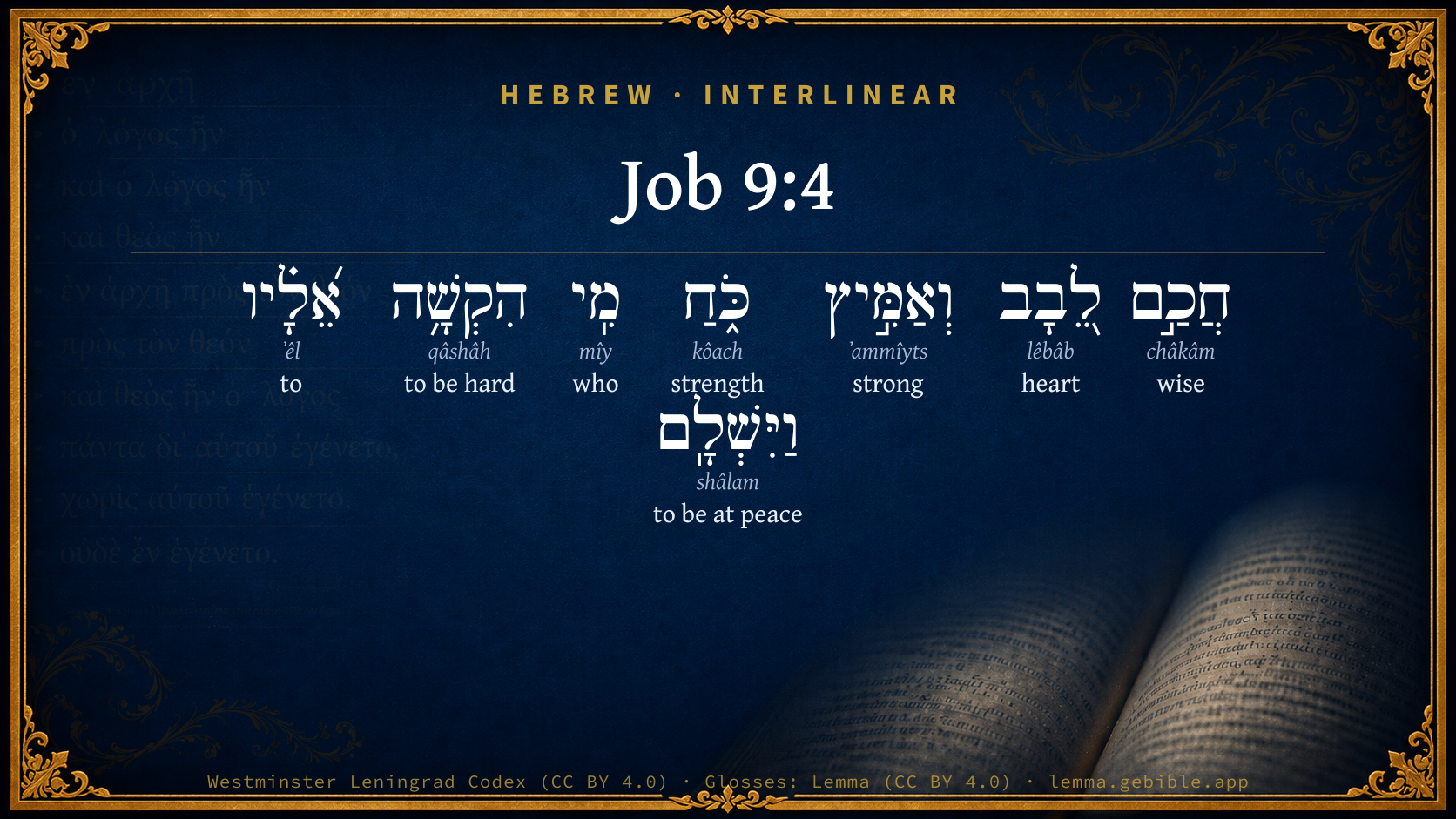
Job 9:4

Hebrew (Westminster Leningrad Codex) Job 9:4 appears in the Hebrew Old Testament. The text above is from the Westminster Leningrad Codex. Each word links to its Strong’s number, a concise gloss, and parsing drawn from the Open Scriptures Hebrew Bible morphology. Click any word for its full Brown-Driver-Briggs (BDB) entry.
Download image
Cite this verse

Job 9:4 (World English Bible). Public Domain. Lemma interlinear Bible study tool, https://lemma.gebible.app/v/job/9/4.

Show BibTeX & RIS
BibTeX
RIS
English Translation
God who is wise in heart, and mighty in strength: Who has hardened himself against him, and prospered?
World English Bible · Public Domain
Download a study sheet

One document with this verse’s original text, its word-by-word gloss line, the meaning frame, cross-references with their text, attributed commentary, and full source and license credits — printable, and it pastes into notes with its structure intact.

This verse Autodidact and up

Study sheet (.html) Plain text (.txt)

A passage Seminary Student

Up to 50 verses in one chapter. A passage sheet keeps up to 6 commentary sources and 12 cross-references per verse, in the order this page ranks them, and says so on the sheet whenever that leaves anything out. Ask for a single verse and you get the Autodidact verse sheet above.

Everything on this page stays free to read, with no account — the sheet is a download of what is already on screen, not access to it.

Want to remove ads? Support Godless Engineer
Compare translations 3

The same verse in 3 English versions, stacked beneath the original-language interlinear above. Click any original word for its lexicon entry.

Each is an independent rendering of the whole verse — the interlinear is not word-aligned to these translations.

Highlighted words mark where these versions differ — a whole-verse word diff, not a word-by-word alignment.

  • World English Bible Public Domain
    God who is wise in heart, and mighty in strength: Who has hardened himself against him, and prospered?
  • King James Version Public Domain
    He is wise in heart, and mighty in strength: who hath hardened himself against him, and hath prospered?
  • unfoldingWord Literal Text CC BY-SA 4.0
    wise in heart and mighty in strength. Who has hardened himself against him and been whole?—

unfoldingWord Literal Text — © unfoldingWord, licensed CC BY-SA 4.0. Word-aligned USFM3 via Door43 (git.door43.org/unfoldingWord/en_ult).

Versions to compare (up to 4)

3 of 4 selected

Show all 18 translations

Every available English version of this verse, each an independent rendering of the whole verse.

  • World English Bible Public Domain
    God who is wise in heart, and mighty in strength: Who has hardened himself against him, and prospered?
  • Berean Standard Bible Public Domain
    God is wise in heart and mighty in strength. Who has resisted Him and prospered?
  • Majority Standard Bible Public Domain
    God is wise in heart and mighty in strength. Who has resisted Him and prospered?
  • King James Version Public Domain
    He is wise in heart, and mighty in strength: who hath hardened himself against him, and hath prospered?
  • American Standard Version (1901) Public Domain
    `He is' wise in heart, and mighty in strength: Who hath hardened himself against him, and prospered?-
  • Revised Version (1885) Public Domain
    He is wise in heart, and mighty in strength: who hath hardened himself against him, and prospered?
  • Geneva Bible (1599) Public Domain
    He is wise in heart, and mighty in strength: who hath bene fierce against him and hath prospered?
  • Douay-Rheims (1899) Public Domain
    He is wise in heart, and mighty in strength: who hath resisted him, and hath had peace?
  • Young's Literal Translation Public Domain
    Wise in heart and strong in power -- Who hath hardened toward Him and is at peace?
  • Literal Standard Version CC BY-SA 4.0
    Wise in heart and strong in power—Who has hardened toward Him and is at peace?
  • Unlocked Literal Bible CC BY-SA 4.0
    God is wise in heart and mighty in strength; who has ever hardened himself against him and succeeded?—
  • unfoldingWord Literal Text CC BY-SA 4.0
    wise in heart and mighty in strength. Who has hardened himself against him and been whole?—
  • Darby Bible Public Domain
    He is wise in heart and mighty in strength: who hath hardened himself against him, and had peace?
  • World Messianic Bible Public Domain
    God is wise in heart, and mighty in strength. Who has hardened himself against him and prospered?
  • Webster's Bible Public Domain
    He is wise in heart, and mighty in strength: who hath hardened himself against him, and hath prospered?
  • Free Bible Version CC BY-SA 4.0
    God is so wise and so powerful that no one could challenge him and win.
  • Bible in Basic English Public Domain
    He is wise in heart and great in strength: who ever made his face hard against him, and any good came of it?
  • JPS Tanakh (1917) Public Domain
    He is wise in heart, and mighty in strength; who hath hardened himself against Him, and prospered?

Literal Standard Version (2020), Covenant Press — licensed CC BY-SA 4.0. Text via the HelloAO Bible API (eBible.org). Unlocked Literal Bible (unfoldingWord) — licensed CC BY-SA 4.0. Text via the HelloAO Bible API (eBible.org). unfoldingWord Literal Text — © unfoldingWord, licensed CC BY-SA 4.0. Word-aligned USFM3 via Door43 (git.door43.org/unfoldingWord/en_ult). Free Bible Version, Dr. Jonathan Gallagher — licensed CC BY-SA 4.0. Text via the HelloAO Bible API (eBible.org).

Word by word

More ways to search: Search by grammar → Find every occurrence → Compare this word →

Practice this passage: Drill this verse → Learn its vocabulary →

About this verse

These counts appear in no published source. They are computed here, from the morphology-tagged text and Lemma’s own curated glosses. What Lemma adds →

8
words
8
distinct lemmas
Wisdom
section

Notable vocabulary

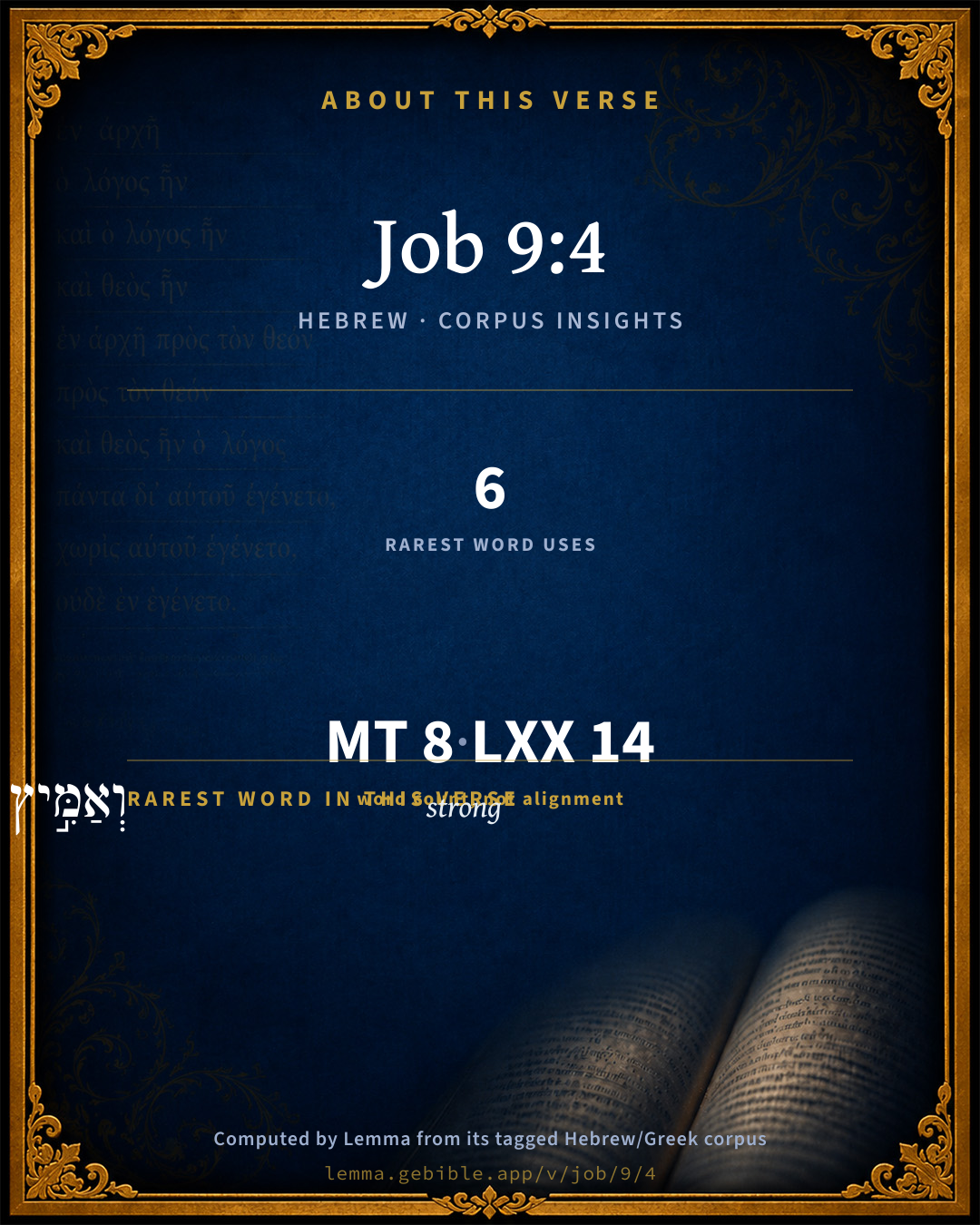
The rarest word here is וְאַמִּ֣יץ strong H533 — appearing just 6 times in the whole Hebrew Bible.

Shared distinctive vocabulary

וְאַמִּ֣יץ strong H533 occurs in 6 verses of the Hebrew Bible. Also found in:

Grammatical profile

  • 2 verbs
  • 2 nouns
  • 2 adjectives
  • 1 preposition
  • 1 particle

Verb forms

  • הִקְשָׁ֥ה Hiphil · Perfect
  • וַיִּשְׁלָֽם Qal · Sequential Imperfect

Hebrew & Septuagint length

In English translation the verse runs 18 words from the Hebrew and 18 from the Septuagint (LXX English) — the same length.

A rough comparison of the two English renderings, which tokenize alike — not a word-level alignment.

Word counts can differ between the Hebrew and the Greek without any difference in meaning — e.g. the Hebrew direct-object marker אֵת has no separate Greek word, and Greek often adds the article ὁ.

In the original languages it is 8 Hebrew tokens and 14 Greek tokens — but the two are counted differently (Hebrew bundles its prefixes and suffixes into one token; the Greek is in lemma form), so that isn’t a like-for-like length.

Cross-references

24

Topical passages linked to Job 9:4 in the Treasury of Scripture Knowledge — connected by theme and wording, ordered by reader-vote popularity; previews shown in the World English Bible.

  • Job 36:5 "Behold, God is mighty, and doesn't despise anyone. He is mighty in strength of understanding.
  • Romans 11:33 Oh the depth of the riches both of the wisdom and the knowledge of God! How unsearchable are his judgments, and his ways past tracing out!
  • Ephesians 3:20 Now to him who is able to do exceedingly abundantly above all that we ask or think, according to the power that works in us,
  • Exodus 14:17–18 I, behold, I will harden the hearts of the Egyptians, and they shall go in after them: and I will get myself honor over Pharaoh, and over all his host, over his chariots, and over his horsemen.
  • Job 9:19 If it is a matter of strength, behold, he is mighty! If of justice, 'Who,' says he, 'will summon me?'
  • Proverbs 29:1 He who is often rebuked and stiffens his neck Will be destroyed suddenly, with no remedy.
  • Ephesians 3:10 to the intent that now through the assembly the manifold wisdom of God might be made known to the principalities and the powers in the heavenly places,
  • Jude 1:24–25 Now to him who is able to keep them from stumbling, and to present you faultless before the presence of his glory in great joy,
  • Exodus 9:14–17 For this time I will send all my plagues against your heart, against your officials, and against your people; that you may know that there is none like me in all the earth.
  • 2 Chronicles 13:12 Behold, God is with us at our head, and his priests with the trumpets of alarm to sound an alarm against you. Children of Israel, don't you fight against Yahweh, the God of your fathers; for you shall not prosper.
  • Job 6:10 Be it still my consolation, Yes, let me exult in pain that doesn't spare, That I have not denied the words of the Holy One.
  • Job 11:6 That he would show you the secrets of wisdom! For true wisdom has two sides. Know therefore that God exacts of you less than your iniquity deserves.
  • Job 12:13 "With God is wisdom and might. He has counsel and understanding.
  • Job 15:23–27 He wanders abroad for bread, saying, 'Where is it?' He knows that the day of darkness is ready at his hand.
  • Job 40:9 Or have you an arm like God? Can you thunder with a voice like him?
  • Psalms 104:24 Yahweh, how many are your works! In wisdom have you made them all. The earth is full of your riches.
  • Psalms 136:5 To him who by understanding made the heavens; For his loving kindness endures forever:
  • Proverbs 28:14 Blessed is the man who always fears; But one who hardens his heart falls into trouble.
  • Daniel 2:20 Daniel answered, Blessed be the name of God forever and ever; for wisdom and might are his.
  • Daniel 4:34–37 At the end of the days I, Nebuchadnezzar, lifted up my eyes to heaven, and my understanding returned to me, and I blessed the Most High, and I praised and honored him who lives forever; for his dominion is an everlasting dominion, and his kingdom from generation to generation.
  • Daniel 5:20–30 But when his heart was lifted up, and his spirit was hardened so that he dealt proudly, he was deposed from his kingly throne, and they took his glory from him:
  • 1 Corinthians 10:22 Or do we provoke the Lord to jealousy? Are we stronger than he?
  • Ephesians 1:8 which he made to abound toward us in all wisdom and prudence,
  • Ephesians 1:19 and what is the exceeding greatness of his power toward us who believe, according to that working of the strength of his might

Cross-references courtesy of OpenBible.info (CC BY 4.0).

Hebrew and Greek witnesses Masoretic Hebrew ↔ Greek Septuagint

The same verse in the two great witnesses to the Old Testament, shown verse-for-verse.

These are two independent witnesses, not word-aligned to each other, and the Septuagint is shown in lemma (dictionary) form.

Hebrew Job 9:4 Masoretic · Westminster Leningrad Codex

חֲכַ֣ם לֵ֭בָב וְאַמִּ֣יץ כֹּ֑חַ מִֽי הִקְשָׁ֥ה אֵ֝לָ֗יו וַיִּשְׁלָֽם

God who is wise in heart, and mighty in strength: Who has hardened himself against him, and prospered?

World English Bible · Public Domain

Greek LXX Job 9:4 Septuagint · lemma form

σοφός γάρ εἰμί διάνοια κραταιός τε καί μέγας τίς σκληρός γίγνομαι ἐναντίον αὐτός ὑπομένω

For he is wise in mind, and mighty, and great: who has hardened himself against him and endured?

LXX2012 (modern English Septuagint) · Public Domain

On this verse, Haydock's Catholic Bible Commentary discusses the Septuagint’s reading. Read the note in Commentary ↓

Hebrew: Westminster Leningrad Codex (CC BY 4.0). Greek: Septuagint (public domain); English from LXX2012 (modern English Septuagint) (Public Domain). How the Septuagint differs from the Hebrew →

Commentary

Notes on Job 9:4 from classic Christian and Jewish commentators (each source and its license shown beneath its notes). The classic Christian expositions comment on the surrounding passage and are grouped to its opening verse, so a note may address several verses; the Jewish commentaries on the Tanakh (Rashi and others) are per-verse, so they appear only where the commentator wrote on this verse.

Lemma curates 59 commentaries, every one of them public domain or Creative Commons licensed, each selected and text-cleaned for this edition rather than reprinted as found. About our sources →

Trapp's Complete Commentary

John Trapp

Job 9:4 [He is] wise in heart, and mighty in strength: who hath hardened [himself] against him, and hath prospered?

Ver. 4. He is wise in heart and mighty in strength] And must therefore needs be a most just judge, since be neither wanteth wisdom to judge nor power to execute; what then should turn him out of the track of justice? Let God be just and true, but every man a liar; as it is written, That thou mightest be justified in thy sayings, and mightest overcome (or be clear) when thou judgest, or when thou art judged, Psa 51:4 Rom 3:4; for at the same time that God doth judge, or execute judgment upon any, he may also be said to be judged; whilst men pass their censures, either as applauding or disliking his judgments; and then may he be said to overcome, when judged, when men acknowledge the justice of his judgments; when they conclude him wise in heart, that is, "the only wise God," 1Ti 1:17, and mighty in strength, that is, the mighty strong God, Isa 9:6; who doth whatsoever he will in heaven and earth, Psa 118:1-29 In speaking of these and others of his most glorious attributes, we speak non quantum debemus, sed quantum possumus, not so much as we ought, but so much as we are able. As for the wisdom of God, Nemo sapientiam Dei immensam in omnem aeternitatem exhauriet (saith Gratian, the emperor, in an epistle to Ambrose), no man shall ever be able to fathom or find it out. And as for his power, so infinite is the distance between God and the greatest noble, that it is an honour that they may be suffered to live in his sight, Exo 24:10-11. And it is all one with God whether against a man or a nation, Job 34:29.

Who hath hardened himself against him, and hath prospered?] Instance but any one, whether tongue or hand smiter, that could ever boast of the last blow, or could cry, Victoria. Quis dura locutus est el? so some render it. Who ever uttered hard speeches, Jdg 1:15, stout words, Mal 3:13, against God, and prospered, seaped scot free, as we say, and had not his full payment? Blasphemers set their mouths against heaven, witness Pharaoh, Sennacherib, Julian, &c., dealing with Almighty God, as if Augustus Caesar were dealing with some god Neptune; Caligula with his Jupiter, whom he dared to a duel, η μ αναειρ η εγω σε; or the three sons trying their archery at their father’s heart, to see who can shoot nighest. But shall they thus escape by iniquity? No: "In thine anger cast down the people, O God," Psa 56:7. The wall of Aphek did execution upon the blasphemous Syrians; the angel of God upon the Assyrians; his visible vengeance fell upon Julian, Arius, and Olympius, an Arian bishop, who denying the Trinity, was struck with three thunderbolts, and killed in a bath. Others understand here the word Libbo, and read it thus, Who hath hardened his heart against him? &c. Surely if men harden their hearts, God will harden his hand, and hasten their destruction. See Pro 29:1 Isa 6:10-11 Rom 2:5, and get thy flinty heart made fleshy, since a hard heart is in some respect worse than hell (which is the just hire of it), since one of the greatest sins is far greater in evil than any of the greatest punishments.

John Trapp, A Commentary or Exposition upon All the Books of the Old and New Testament (1647–1656) — public domain. Text from a community e-Sword module.

The Biblical Illustrator

Joseph S. Exell

Job_9:4

Who hath hardened himself against God, and prospered?

Hardened against God

This passage intimates--

I. That appeals are addressed by God to men in order to bring them into allegiance to Him. The conduct which is imputed to men is susceptible of explanation only as the existence of such appeals is assumed.

1. God has appealed to us by the instrumentality of conscience. Conscience is the testimony of secret judgment in the mind of a man as to the moral quality of his own thoughts and actions. The true dictates of conscience are conformable to the extensive principle of the Divine law; and the judgments of the one are substantially the judgments of the other.

2. By the instrumentality of providence, The events which happen under the superintendence of God in the temporal sphere, and affect the temporal interests of man, are intended always to speak powerfully on his behalf. This fact was recognised by Job, when he uttered the language before us.

3. By the instrumentality of revealed truth. All Scripture is profitable for doctrine, for reproof, for correction, for instruction, and for what belongs to righteousness.

II. Men treat the appeals of God with obdurate resistance. The text takes the case of men who harden themselves against God, indicating a habit which is heinous in its nature, and which is progressive in its influence. It is emphatically resistance, the surrender of the heart and life to objects against which God has pleaded, and the retention of the heart and life amidst indulgences which God has protested against, and which He has condemned. This resistance is introduced as voluntary. It is also introduced as continued. That continuance augments the guilt. Such resistance becomes more heinous and aggravated in proportion as the calls addressed by God are solemn and weighty. Resistance is also progressive in its influence. In proportion as it is continued in the indulgence, it exercises increasing power and authority over the soul. It becomes more steady, more settled, more confirmed--this being in accordance with what we know of the tendencies of all habits to strengthen and establish themselves.

III. Obdurate resistance to the appeals made by God exposes to fearful and fatal consequences. No human being placing himself in voluntary and continued opposition against God can escape final punishment and ruin. God will inflict upon those who harden themselves against Him temporal sorrow; and if their resistance be continued till the last, the irremediable loss of their souls. There will be a proportion between punishment and guilt. (James Parsons.)

Fatal issue of final impenitence

These words imply that there is such a thing as for a man so to harden himself as to contend with God.

I. Inquire wherein this hardness of heart consists.

1. The word signifies a spirit that is obstinate and incorrigible.

2. It is descriptive of a rebellious spirit, which discovers itself under the various dispensations of God, both in a way of mercy and judgment.

3. There is also a judicial hardness to which sinners are liable, in a way of righteous judgment for their iniquities. This is not owing to any defect in the Gospel, or in the dispensations of God towards us; but to the depravity of the human heart, which perverts the means of salvation into those of destruction.

II. Notice some of the instances in which this sin is still committed.

1. It appears in indulging hard thoughts of God, of His government and of His holy law; in esteeming Him as a hard master, and in considering sinful propensities as an excuse for sinful actions, though no one thinks of excusing the offence of others against himself on the ground of such a plea. The indulgence of such thoughts lead on to final impenitence.

2. It manifests itself in a rejection or dislike of Gods way of salvation.

3. Persisting in an evil course, amidst many convictions and fears, is another instance of this sort of depravity. Pharaoh knew that he was wrong, and yet he dared to persist.

4. This hardness of heart appears in the resistance that is offered to the hand of God in providence instead of being humbled under it.

5. Presumptuously tempting God, amidst the most affecting means of salvation, is another instance of this hardness of heart. It was thus with Israel in the wilderness.

III. The fatal issue of final impenitence. Who hath hardened himself against Him, and prospered?

1. The longer you continue in this state, the more hardened you will become, till at last you will be past feeling (Eph_4:19).

2. This also is the way in which God punishes men for their impenitence (Isa_6:8).

3. The end of this impenitence and hardness of heart is fearfully described by an apostle, and should warn us of our danger (Rom_2:5-9). (T. Hannam.)

Man hardening himself against God

Every act of sin hardens the heart of man, but the heat of blasphemy at once shows and puts it into the extremity of hardness. Man hardens himself against God four ways especially.

1. Upon presumption of mercy. Many do evil because they hear God is good. They turn His grace into wantonness, and are without all fear of the Lord, because there is mercy so much with the Lord.

2. The patience of God, or His delays of judgment, harden others. Because God is slow to strike, they are swift to sin.

3. Gross ignorance hardens many.

(1) Ignorance of themselves.

(2) Ignorance of God.

He that knows not what he ought to do, cares not much what he doth. None are so venturous as they who know not their danger.

4. Hardness of heart in sinning is contracted from the multitude of those who sin. They think none shall suffer for that which so many do. Man doth not grow hard at once, much less hardest; but when once he begins to harden himself, where he shall make an end he knows not. The first step is, the taking time and leave to meditate upon sin, and roll it up and down in the thoughts. A hard heart lets vain thoughts dwell in it. A holy heart would not let them lodge with it. A second step is, some tastes of pleasure and delight in sin. It proves a sweet morsel under his tongue. The third step is, custom in sinning. It argues great boldness to venture often. By the fourth step of hardness he comes to defend and maintain his sin.

5. The hard heart grows angry and passionate with those who give advice against sin; he is resolved; and a man that is resolved in his way is angry if he be desired to remove out of his way. He that is resolved to sleep, loves not to be awakened.

6. Hard hearts grow too hard for the Word. They are sermon proof; they can sit under the preacher, and hear from day to day, but nothing touches them.

7. The heart is so hard that the sword of affliction doth not pierce it; the man is judgment proof. Let God strike him in his person or estate, let God set the world afire about his ears, yet on he goes. He is like the man of whom Solomon speaks (Pro_23:34), who lies sleeping in a storm upon the top of the mast.

8. The hard heart sits down in the chair of the scorner. He derides the Word, and mocks at the judgments of God. (J. Caryl.)

Contenders with God

A gentleman came to me in the streets of Liverpool a few years ago, and told me of an incident in my fathers ministry, of which he was an eyewitness, many years before. Your father, he said, was preaching on a then vacant spot of ground near where St. Georges Hall now stands. Directly opposite the place where he was standing, an ungodly publican, finding his business interfered with, came out and endeavoured to interrupt the proceedings, mimicking the preachers manner and gestures, and using very horrible language. I remember, said the gentleman, how solemnly your father turned round upon him, and said, Take care, my friend, it is not me, but my Master that you are mocking, and remember you cannot mock God with impunity; take care lest you draw down upon your head His just vengeance. He afterwards announced that he would preach in the same spot the next Sunday afternoon, which he did; and as he gave out his text, you may imagine the feeling of awe that settled down upon the crowd as they saw a hearse draw up to the door of the public house, to carry away the corpse of that very man who one short week before had been defying God, and insulting His messenger. (W. Hay M. H. Aitken, M. A.)

The Biblical Illustrator, edited by Joseph S. Exell (c. 1880s–1900s) — public domain. Text from a community e-Sword module.

Joseph Benson's Commentary

Job 9:4. He is wise in heart — He is infinitely wise, and searcheth all men’s hearts and ways, and discovers a multitude of sins, which men’s short-sighted eyes cannot see; and therefore can charge them with innumerable evils, of which they thought themselves innocent, and sees far more malignity than men can discern in their sins. Mighty in strength — So that, whether men contend with God by wisdom or by strength, God will be conqueror. Who hath hardened himself, &c. — Obstinately contended with him. The devil promised himself that Job, in the day of his affliction, would curse and speak ill of God. But, instead of that, he sets himself to honour God and speak highly of him. As ill pained as he is, and as much as he is taken up with his own miseries, when he has occasion to mention the wisdom and power of God, he forgets his complaints, and expatiates, with a flood of eloquence, on that glorious subject.

Joseph Benson's Commentary on the Old and New Testaments (1811–1818) — public domain. Text from a community e-Sword module.

Jamieson, Fausset & Brown

Robert Jamieson, A. R. Fausset & David Brown

wise in heart--in understanding!--and mighty in power! God confounds the ablest arguer by His wisdom, and the mightiest by His power.

hardened himself--or his neck (Pro 29:1); that is, defied God. To prosper, one must fall in with God's arrangements of providence and grace.

Jamieson, Fausset & Brown — Commentary Critical and Explanatory on the Whole Bible (1871) — public domain (CC PDM 1.0). Text via the HelloAO Bible API.

Adam Clarke's Commentary

Verse 4. He is wise in heart, and mighty in strength] By his infinite knowledge he searches out and sees all things, and by his almighty power he can punish all delinquencies. He that rebels against him must be destroyed.

Adam Clarke's Commentary on the Bible (1810–1826) — public domain. Text from a community e-Sword/MySword module.

The Cambridge Bible for Schools and Colleges

gen. ed. J. J. S. Perowne

4. wise in heart] i. e. in mind, corresponding to “mighty in power.”

hardened himself] Probably hardened his neck, i. e. braved him, Pro_29:1.

hath prospered] lit. been safe, or as we say, “with impunity.”

The Cambridge Bible for Schools and Colleges (gen. ed. J. J. S. Perowne; Cambridge University Press, 1878–1918) — public domain. Text from a community e-Sword module.

John Gill's Exposition

Which removeth the mountains,.... This and what follow are instances of the power of God, and are full proofs of his being mighty in strength; and may be understood, either literally, not only of what God is able to do if he will, but of what he has done; and history (y) furnishes us with instances of mountains being removed from one place to another; and Scheuchzer (z) makes mention of a village in Helvetia, called Plurium, which, in 1618, was covered with the sudden fall of a mountain, and swallowed up in the earth, with 1800 inhabitants, and not the least trace of it to be seen any more; and in the sacred Scriptures is a prediction of the mount of Olives being removed from its place, one half to the north and the other to the south, Zac 14:4; and Josephus (a) gives a relation much like it, as in fact; besides, Job may have respect to what had been done in his times, or before them, and particularly at the universal deluge, which covered the tops of the highest mountains and hills, and very probably washed away some from their places: or else it may be understood proverbially, of the Lord's doing things marvellous and surprising, and which are impossible and impracticable with men; see Mat 17:20; or rather figuratively, of kingdoms and mighty kings, as the Targum, comparable to mountains for their height and strength, who yet are removed by God at his pleasure; see Zac 4:7,

and they know not; when they are removed, and how it is done; it is imperceptible; either the mountains are not sensible of it, or the inhabitants of the mountains, as Bar Tzemach; or men, the common sort of men, the multitude, as Gersom: R. Saadiah Gaon interprets it of removing the men of the mountains, and they know it not:

which overturneth them in his anger; for the sins or men, which was the case of the old world: Mr. Broughton renders it, "that men cannot mark how he hath removed them out of their place in his anger".

(y) Plin. Nat. Hist. l. 2. c. 83. Wernerus, Palmerius, Theophanes "a aurus", in Bolduc. in loc. (z) Physic. Sacr. vol. 4. p. 673. (a) Antiqu. l. 9. c. 10. sect. 4.

John Gill's Exposition of the Whole Bible (1746–1763) — public domain (CC PDM 1.0). Text via the HelloAO Bible API.

Albert Barnes' Notes on the Bible

He is wise in heart - Herder renders this,

Even the wise and the powerful,

Who hath withstood him and prospered?

But the more common interpretation is to refer it to God. The meaning of Job appears to be, that God was a sagacious adversary; that he was able to manage his cause; that he could meet and refute all objections which could be urged; and that it would be in vain to engage in a litigation before him. He so well understood the whole ground of debate, and was so entirely skilled in the merits of the controversy, and could so successfully meet all that could be alleged, that it was useless to attempt to hold an argument with him.

And mighty in strength - He is able to execute all his designs, and to carry all his purposes into effect. Man is weak and feeble, and it is hopeless for him to attempt to contend with the Almighty.

Who hath hardened himself against him, and hath prospered? - To harden oneself, here means to resist or withstand him. It refers to the firmness or resolution which one is obliged to adopt who opposes another. Here it means the opposition which man makes to the law and government of the Most High; and the affirmation is, that no one can make such opposition who will not be ultimately overcome. God is so great, so powerful, and so just, that a successful resistance cannot be made. The arrangements of God will take their course, and man must yield to his claims and his government, or be prostrated. None can successfully resist God; and the true policy of man, as well as his duty, is to yield to him, and be at peace with him.

And hath prospered - Or been successful. He has failed in his opposition, and been obliged to yield. Prosperity is not found in opposing God. It is only by falling in with his arrangements and following his designs. A prosperous voyage is made by falling in with winds and currents, and not in opposing them; prosperous agriculture is carried on by coinciding with the favorable seasons of the year, and taking advantage of the dews, and rains, and sunbeams that God sends, and not in opposing them; prosperity in regard to health is found in taking advantage of the means which God gives to secure it, and not in opposing them. And the sinner in his course has no more chance of success and prosperity, than a man would have who should make it a point or principle of life always to sail against tides, and currents, and head winds; or he who should set at defiance all the laws of husbandry, and plant on a rock, or in the dead of winter; or he who should feed himself on poison rather than on nutritious food, and cultivate the nightshade rather that wheat. The great principle is, that if a man desires prosperity, he must fall in with the arrangements of God in his providence and grace; and wisdom is seen in studying these arrangements, and in yielding to them.

Albert Barnes' Notes on the Bible (1834–1885) — public domain. Text from a community e-Sword/MySword module.

Haydock's Catholic Bible Commentary

Resisted. Hebrew and Septuagint, "hardened himself against him."

George Leo Haydock (1774–1849), Haydock's Catholic Family Bible and Commentary, 1859 edition — public domain. Excludes Psalms (Douay-Rheims chapter numbering differs from Protestant) and Deuterocanonical books (Catholic canon only).

Matthew Poole's English Annotations

Wise in heart; either,

1. Really and profoundly wise; or,

2. Wise in his mind or understanding, which in Hebrew is oft called the heart, as Pro 2:10; 6:32; Hos 4:11, because the Hebrews make the heart the seat of the understanding, or of the reasonable soul. The sense is, He is infinitely wise, and so knows all things, and searcheth all men’s hearts and ways, and discovers a multitude of sins which men’s short-sighted eyes cannot see; and therefore can charge them with innumerable evils where they thought themselves innocent, and sees far more malignity than men could discern in their sins: and men cannot conceal any of their sins from him, nor cheat him, as they may other men, with crafty devices and evasions; so that there is no contending with him.

Mighty in strength, i.e. omnipotent; and therefore if men contumaciously persist in contending with him after they are convicted and condemned, he can easily crush them. So that whether men contend with God by wisdom or by strength, (which are the two ways of one man’s contending with another,) God will be conqueror.

Who hath hardened himself against him, i.e. obstinately contended with him? Or, spoken hard things towards him; quarrelling with him, opposing and reproaching God’s providence towards him as hard and unjust. Compare Jud 1:15.

Hath prospered, Heb. hath been at peace, i.e. hath not provoked God to his own destruction. A common figure, called meiosis, whereby more is understood than is expressed.

Matthew Poole's English Annotations on the Holy Bible (1683–1685) — public domain. Text from a community e-Sword/MySword module.

Whedon's Commentary on the Bible

Daniel D. Whedon

4. Hardened against — Bidden defiance, or braved him. Prospered — ישׁלם, remained uninjured; that is, unpunished. (Furst.) All opposition to God is not only futile, but dangerous.

Daniel D. Whedon (gen. ed.), Commentary on the Old and New Testaments (1874–1909) — public domain. Text from a community e-Sword module.

The Pulpit Commentary

He is wise in heart, and mighty in strength. The sense is strengthened if we omit "he is," and render, Wise in heart, and mighty in strength, who hath hardened"etc.? God"s combination of perfect wisdom with infinite strength renders it hopeless for any man to contend with him. Who hath hardened himself against him; and hath prospered? Job fully admits the wisdom of all that Eliphaz (Job_4:17) and Bildad (Job_8:3-6) have said, or hinted, with respect to his inability wholly to justify himself. No one has ever taken this line of absolute self-justification, and prospered.

The Pulpit Commentary (1880–1919), ed. H.D.M. Spence-Jones & Joseph S. Exell — public domain. Text from a community e-Sword module.

John Wesley's Explanatory Notes

He - He is infinitely wise, and searcheth all mens hearts and ways, and discovers a multitude of sins which mens short sighted- eyes cannot see; and therefore can charge them with innumerable evils, where they thought themselves innocent, and sees far more malignity than men could discern in their sins. Mighty - So that whether men contend with God by wisdom or by strength: God will be conqueror. Hardened himself - Obstinately contended with him. The devil promised himself that Job in the day of his affliction, would curse and speak ill of God. But instead of that, he sets himself to honour God, and speak highly of him. As ill pained as he is, and as much as he is taken up with his own miseries, when he has occasion to mention the wisdom and power of God, he forgets his complaints and expatiates with a flood of eloquence on that glorious subject.

John Wesley, Explanatory Notes Upon the Whole Bible (1754–1765) — public domain. Text via the GEBible commentary corpus.

unfoldingWord translationNotes

Door43 World Missions Community

wise in heart

Here the heart represents the inner being or thoughts. AT: "wise in what he decides" (See: Metonymy)

mighty in strength

The abstract noun "strength" can be expressed as the adjective "strong." AT: "mighty in how strong he is" (See: Abstract Nouns)

who has ever hardened himself against him and succeeded?

This is a rhetorical question that expects an answer of "No one." It can be reworded as a statement. AT: "no one has ever hardened himself against him and succeeded." (See: Rhetorical Question)

hardened himself against him

To harden oneself means to be stubborn. AT: "resisted him" or "defied him" (See: Reflexive Pronouns)

he who removes the mountains

"God removes the mountains"

in his anger

The abstract noun "anger" can be expressed as the adjective "angry." AT: "because he is angry" (See: Abstract Nouns)

he who shakes the earth

"God shakes the earth"

sets its supports trembling

"makes its foundations tremble"

translationWords

wise

heart

might

anger

earth

unfoldingWord translationNotes — © Distant Shores Media and the Door43 World Missions Community, licensed CC BY-SA 4.0. Source: git.door43.org/Door43/en_tn.

Rashi

Rabbi Shlomo Yitzchaki (Rashi)

He is wise in heart to contend.

and mighty in strength to requite.

who hardened his heart and went away whole? Pharaoh hardened [his heart] and was destroyed, and so it is with all who hardened [their hearts].

Rashi on the Tanakh — English translations: “The Judaica Press complete Tanach with Rashi, translated by A. J. Rosenberg” (CC BY 4.0); “Pentateuch with Rashi's commentary by M. Rosenbaum and A.M. Silbermann, 1929-1934” (public domain); “The Metsudah Tanach series, Lakewood, N.J” (CC BY 4.0); and “The Book of Joshua, Metsudah Publications, 1997” (CC BY 4.0). Text via Sefaria.

Lesson kit

Teaching starters — assembled from the data on this page, not authored interpretation. Every prompt links to the verse data it draws on. Edit before teaching.

Job, in the Wisdom, opens this verse with 8 words (8 distinct Hebrew lemmas). Its most distinctive word is ʼammîyts (“strong”). A historical commentator’s framing appears above. Read the whole chapter for the surrounding context.

Discussion questions

  1. What does “strong” (ʼammîyts) contribute to the verse as a whole?
  2. 2 Samuel 15:12 shares the word «strong» with this verse. How do the two illuminate each other?
  3. These translations render this verse differently. What is at stake in choosing one wording over another?
  4. The verb «הִקְשָׁ֥ה» is Hiphil Perfect. How does its form color the action?
  5. Reading how Trapp's Complete Commentary and The Biblical Illustrator read this verse, where do the two commentators agree and where do they part?

Things to notice

Reading settings

Reading text

Shown beneath each verse's original-language words.

Old Testament
Old Testament edition

Read the OT as the Masoretic Hebrew (MT) or the Greek Septuagint (LXX).

English shown for the Greek Septuagint (in the Hebrew ↔ Greek comparison).

Comparing translations? Open the Compare panel on any verse page to stack up to four side by side.