
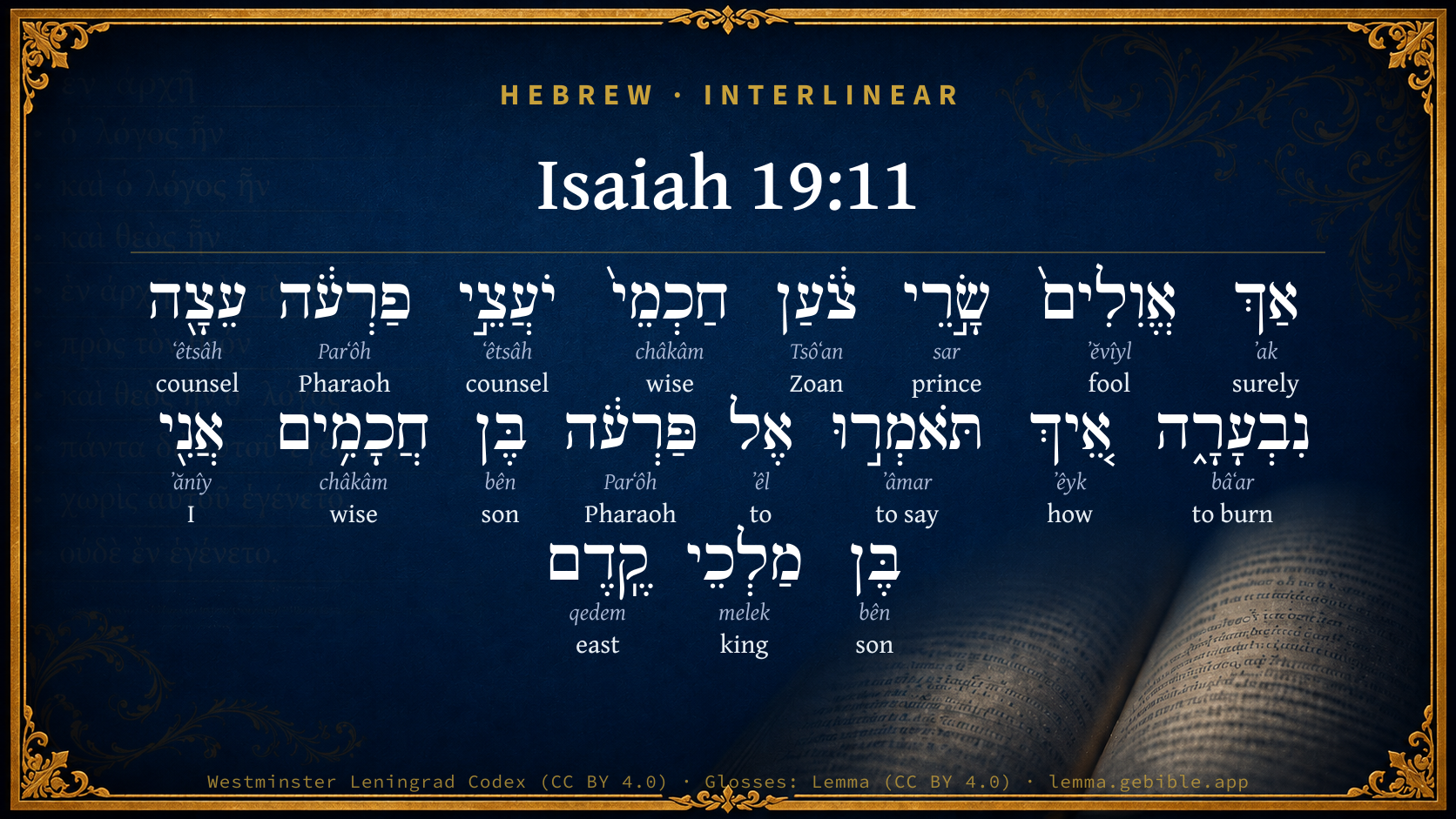
Isaiah 19:11

Hebrew (Westminster Leningrad Codex) Isaiah 19:11 appears in the Hebrew Old Testament. The text above is from the Westminster Leningrad Codex. Each word links to its Strong’s number, a concise gloss, and parsing drawn from the Open Scriptures Hebrew Bible morphology. Click any word for its full Brown-Driver-Briggs (BDB) entry.
Download image
Cite this verse

Isaiah 19:11 (World English Bible). Public Domain. Lemma interlinear Bible study tool, https://lemma.gebible.app/v/isaiah/19/11.

Show BibTeX & RIS
BibTeX
RIS
English Translation
The princes of Zoan are utterly foolish; the counsel of the wisest counselors of Pharaoh is become brutish: how do you say to Pharaoh, I am the son of the wise, the son of ancient kings?
World English Bible · Public Domain
Download a study sheet

One document with this verse’s original text, its word-by-word gloss line, the meaning frame, cross-references with their text, attributed commentary, and full source and license credits — printable, and it pastes into notes with its structure intact.

This verse Autodidact and up

Study sheet (.html) Plain text (.txt)

A passage Seminary Student

Up to 50 verses in one chapter. A passage sheet keeps up to 6 commentary sources and 12 cross-references per verse, in the order this page ranks them, and says so on the sheet whenever that leaves anything out. Ask for a single verse and you get the Autodidact verse sheet above.

Everything on this page stays free to read, with no account — the sheet is a download of what is already on screen, not access to it.

Want to remove ads? Support Godless Engineer
Compare translations 3

The same verse in 3 English versions, stacked beneath the original-language interlinear above. Click any original word for its lexicon entry.

Each is an independent rendering of the whole verse — the interlinear is not word-aligned to these translations.

Highlighted words mark where these versions differ — a whole-verse word diff, not a word-by-word alignment.

  • World English Bible Public Domain
    The princes of Zoan are utterly foolish; the counsel of the wisest counselors of Pharaoh is become brutish: how do you say to Pharaoh, I am the son of the wise, the son of ancient kings?
  • King James Version Public Domain
    Surely the princes of Zoan are fools, the counsel of the wise counsellors of Pharaoh is become brutish: how say ye unto Pharaoh, I am the son of the wise, the son of ancient kings?
  • unfoldingWord Literal Text CC BY-SA 4.0
    Surely the princes of Zoan foolish; the wisest of the counselors of Pharaoh, the counsel has consumed itself. How will you say to Pharaoh, “I a son of the wise, a son of the kings of antiquity”?

unfoldingWord Literal Text — © unfoldingWord, licensed CC BY-SA 4.0. Word-aligned USFM3 via Door43 (git.door43.org/unfoldingWord/en_ult).

Versions to compare (up to 4)

3 of 4 selected

Show all 18 translations

Every available English version of this verse, each an independent rendering of the whole verse.

  • World English Bible Public Domain
    The princes of Zoan are utterly foolish; the counsel of the wisest counselors of Pharaoh is become brutish: how do you say to Pharaoh, I am the son of the wise, the son of ancient kings?
  • Berean Standard Bible Public Domain
    The princes of Zoan are mere fools; Pharaoh’s wise counselors give senseless advice. How can you say to Pharaoh, “I am one of the wise, a son of eastern kings”?
  • Majority Standard Bible Public Domain
    The princes of Zoan are mere fools; Pharaoh’s wise counselors give senseless advice. How can you say to Pharaoh, “I am one of the wise, a son of eastern kings”?
  • King James Version Public Domain
    Surely the princes of Zoan are fools, the counsel of the wise counsellors of Pharaoh is become brutish: how say ye unto Pharaoh, I am the son of the wise, the son of ancient kings?
  • American Standard Version (1901) Public Domain
    The princes of Zoan are utterly foolish; the counsel of the wisest counsellors of Pharaoh is become brutish: how say ye unto Pharaoh, I am the son of the wise, the son of ancient kings?
  • Revised Version (1885) Public Domain
    The princes of Zoan are utterly foolish; the counsel of the wisest counsellors of Pharaoh is become brutish: how say ye unto Pharaoh, I am the son of the wise, the son of ancient kings?
  • Geneva Bible (1599) Public Domain
    Surely the princes of Zoan are fooles: the counsell of the wise counselers of Pharaoh is become foolish: how say ye vnto Pharaoh, I am the sonne of the wise? I am the sonne of the ancient Kings?
  • Douay-Rheims (1899) Public Domain
    The princes of Tanis are become fools, the wise counsellors of Pharao have given foolish counsel: how will you say to Pharao: I am the son of the wise, the son of ancient kings?
  • Young's Literal Translation Public Domain
    Only, fools `are' the princes of Zoan, The counsel of the wise ones of the counsellors of Pharaoh hath become brutish. How say ye unto Pharaoh, `A son of the wise am I, a son of kings of antiquity?'
  • Literal Standard Version CC BY-SA 4.0
    Only, the princes of Zoan [are] fools, || The counsel of the wise ones of the counselors of Pharaoh has become brutish. How do you say to Pharaoh, “I am a son of the wise, a son of kings of antiquity?”
  • Unlocked Literal Bible CC BY-SA 4.0
    The princes of Zoan are completely foolish. The advice of the wisest advisors of Pharaoh has become senseless. How can you say to Pharaoh, “I am the son of wise men, a son of ancient kings?”
  • unfoldingWord Literal Text CC BY-SA 4.0
    Surely the princes of Zoan foolish; the wisest of the counselors of Pharaoh, the counsel has consumed itself. How will you say to Pharaoh, “I a son of the wise, a son of the kings of antiquity”?
  • Darby Bible Public Domain
    They are but fools, the princes of Zoan, the wise counsellors of Pharaoh: [their] counsel is become senseless. How say ye unto Pharaoh, I am the son of the wise, the son of ancient kings?
  • World Messianic Bible Public Domain
    The princes of Zoan are utterly foolish. The counsel of the wisest counselors of Pharaoh has become stupid. How do you say to Pharaoh, “I am the son of the wise, the son of ancient kings”?
  • Webster's Bible Public Domain
    Surely the princes of Zoan are fools, the counsel of the wise counselors of Pharaoh is become brutish: how say ye to Pharaoh, I am the son of the wise, the son of ancient kings?
  • Free Bible Version CC BY-SA 4.0
    The leaders of Zoan are stupid. Pharaoh's wise counselors give advice that doesn't make sense. How can you tell Pharaoh, “I myself am a wise man, descended from ancient kings”?
  • Bible in Basic English Public Domain
    The chiefs of Zoan are completely foolish; the wisest guides of Pharaoh have become like beasts: how do you say to Pharaoh, I am the son of the wise, the offspring of early kings?
  • JPS Tanakh (1917) Public Domain
    The princes of Zoan are utter fools; the wisest counsellors of Pharaoh are a senseless counsel; how can ye say unto Pharaoh: 'I am the son of the wise, the son of ancient kings'?

Literal Standard Version (2020), Covenant Press — licensed CC BY-SA 4.0. Text via the HelloAO Bible API (eBible.org). Unlocked Literal Bible (unfoldingWord) — licensed CC BY-SA 4.0. Text via the HelloAO Bible API (eBible.org). unfoldingWord Literal Text — © unfoldingWord, licensed CC BY-SA 4.0. Word-aligned USFM3 via Door43 (git.door43.org/unfoldingWord/en_ult). Free Bible Version, Dr. Jonathan Gallagher — licensed CC BY-SA 4.0. Text via the HelloAO Bible API (eBible.org).

Word by word

More ways to search: Search by grammar → Find every occurrence → Compare this word →

Practice this passage: Drill this verse → Learn its vocabulary →

צֹ֔עַן
Tsôʻan
H6814
“Zoan”
Noun, Proper
Part of Speech
Noun
Type
Proper
Full BDB Definition

Origin: of Egyptian derivation

TWOT: None

Zoan = "place of departure" - an ancient city of lower Egypt called Tanis by the Greeks; located on the eastern bank of the Tanitic branch of the Nile; the capital of the Shepherd dynasty, built 7 years after Hebron and existing before Abraham and the dwelling place of the Pharaoh at the time of the exodus - modern 'San'
  1. אַךְ ʼak H389 “surely” Particle, Accusative
  2. אֱוִלִים֙ ʼĕvîyl H191 “fool” Adjective, Adjective, Masculine, Plural, Absolute
  3. שָׂ֣רֵי sar H8269 “princes of” Noun, Common, Masculine, Plural, Construct
  4. חַכְמֵי֙ châkâm H2450 “wise of” Adjective, Adjective, Masculine, Plural, Construct
  5. יֹעֲצֵ֣י ʻêtsâh H6098 “counsel” Verb, Qal, Participle Active, Masculine, Plural, Construct
  6. פַרְעֹ֔ה Parʻôh H6547 “Pharaoh” Noun, Proper
  7. עֵצָ֖ה ʻêtsâh H6098 “counsel” Noun, Common, Feminine, Singular, Absolute
  8. נִבְעָרָ֑ה bâʻar H1197 “burning” Verb, Niphal, Participle Active, Feminine, Singular, Absolute
  9. אֵ֚יךְ ʼêyk H349 “how” Particle, Interrogative
  10. תֹּאמְר֣וּ ʼâmar H559 “to say” Verb, Qal, Imperfect, 2nd Person, Masculine, Plural
  11. אֶל ʼêl H413 “to” Preposition
  12. פַּרְעֹ֔ה Parʻôh H6547 “Pharaoh” Noun, Proper
  13. בֶּן bên H1121 “son of” Noun, Common, Masculine, Singular, Construct
  14. חֲכָמִ֥ים châkâm H2450 “wise” Adjective, Adjective, Masculine, Plural, Absolute
  15. אֲנִ֖י ʼănîy H589 “I” Pronoun, Personal, 1st Person, Common, Singular
  16. בֶּן bên H1121 “son of” Noun, Common, Masculine, Singular, Construct
  17. מַלְכֵי melek H4428 “kings of” Noun, Common, Masculine, Plural, Construct
  18. קֶֽדֶם qedem H6924 “east” Noun, Common, Masculine, Singular, Absolute

About this verse

These counts appear in no published source. They are computed here, from the morphology-tagged text and Lemma’s own curated glosses. What Lemma adds →

19
words
15
distinct lemmas
Prophets
section

Notable vocabulary

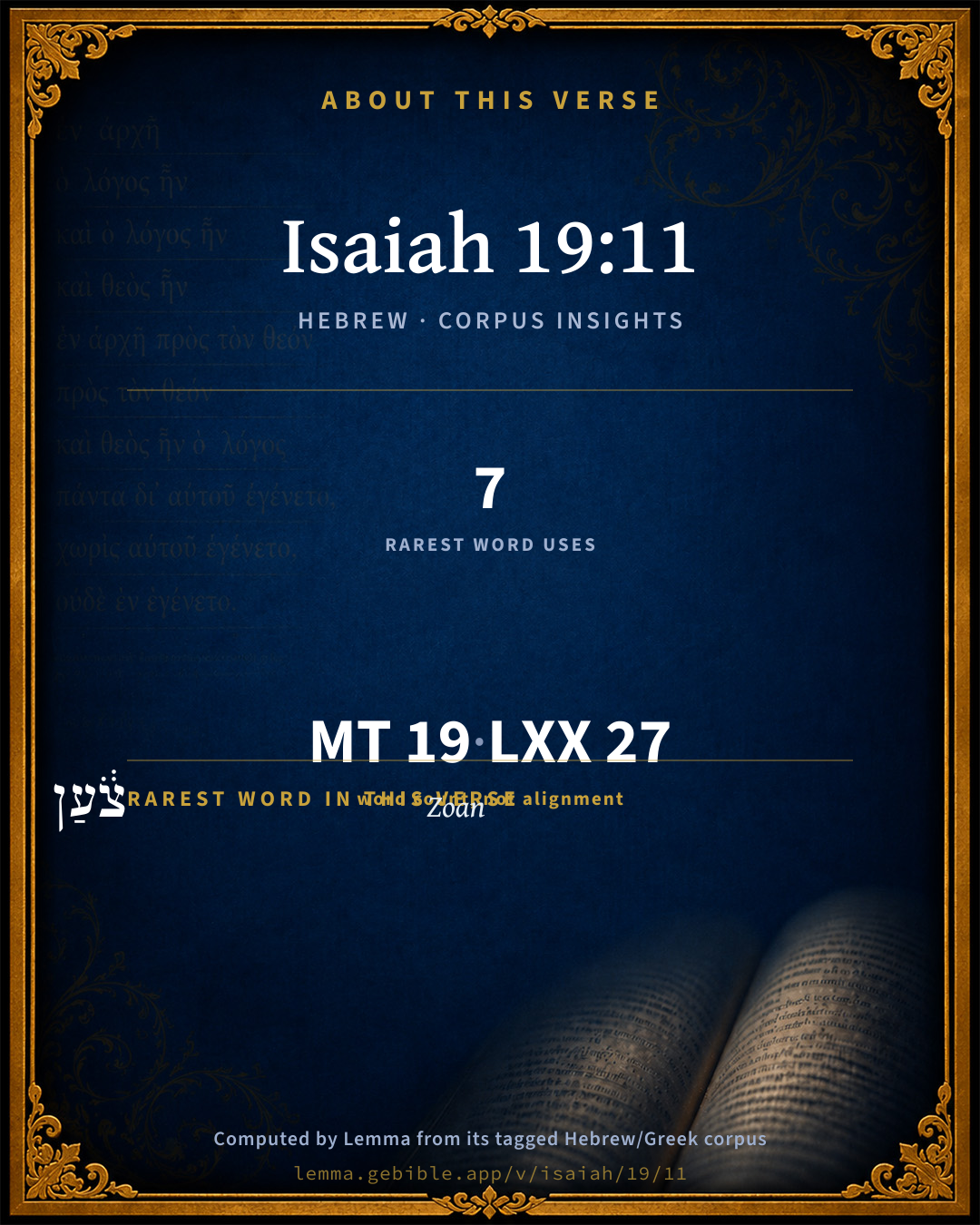
The rarest word here is צֹ֔עַן Zoan H6814 — appearing just 7 times in the whole Hebrew Bible.

Shared distinctive vocabulary

צֹ֔עַן Zoan H6814 occurs in 7 verses of the Hebrew Bible. Also found in:

Grammatical profile

  • 3 verbs
  • 9 nouns
  • 3 adjectives
  • 1 pronoun
  • 1 preposition
  • 2 particles

Verb forms

  • יֹעֲצֵ֣י Qal · Participle Active
  • נִבְעָרָ֑ה Niphal · Participle Active
  • תֹּאמְר֣וּ Qal · Imperfect

Repetition

Words recur within this verse — often emphatic in Hebrew:

  • חַכְמֵי֙ wise H2450 ×2
  • יֹעֲצֵ֣י counsel H6098 ×2
  • פַרְעֹ֔ה Pharaoh H6547 ×2
  • בֶּן son H1121 ×2

Hebrew & Septuagint length

In English translation the verse runs 36 words from the Hebrew and 38 from the Septuagint (LXX English) — closely comparable.

A rough comparison of the two English renderings, which tokenize alike — not a word-level alignment.

Word counts can differ between the Hebrew and the Greek without any difference in meaning — e.g. the Hebrew direct-object marker אֵת has no separate Greek word, and Greek often adds the article ὁ.

In the original languages it is 19 Hebrew tokens and 27 Greek tokens — but the two are counted differently (Hebrew bundles its prefixes and suffixes into one token; the Greek is in lemma form), so that isn’t a like-for-like length.

Cross-references

23

Topical passages linked to Isaiah 19:11 in the Treasury of Scripture Knowledge — connected by theme and wording, ordered by reader-vote popularity; previews shown in the World English Bible.

  • Numbers 13:22 They went up by the South, and came to Hebron; and Ahiman, Sheshai, and Talmai, the children of Anak, were there. (Now Hebron was built seven years before Zoan in Egypt.)
  • 1 Kings 4:30 Solomon's wisdom excelled the wisdom of all the children of the east, and all the wisdom of Egypt.
  • Psalms 78:43 How he set his signs in Egypt, His wonders in the field of Zoan,
  • Isaiah 30:4 For their princes are at Zoan, and their ambassadors are come to Hanes.
  • Acts 7:22 Moses was instructed in all the wisdom of the Egyptians. He was mighty in his words and works.
  • Genesis 41:38–39 Pharaoh said to his servants, "Can we find such a one as this, a man in whom is the Spirit of God?"
  • Psalms 78:12 He did marvelous things in the sight of their fathers, In the land of Egypt, in the field of Zoan.
  • Job 5:12–13 He frustrates the devices of the crafty, So that their hands can't perform their enterprise.
  • Job 12:17 He leads counselors away stripped. He makes judges fools.
  • Psalms 33:10 Yahweh brings the counsel of the nations to nothing. He makes the thoughts of the peoples to be of no effect.
  • Psalms 73:22 I was so senseless and ignorant. I was a brute beast before you.
  • Psalms 92:6 A senseless man doesn't know, Neither does a fool understand this:
  • Proverbs 30:2 "Surely I am the most ignorant man, And don't have a man's understanding.
  • Isaiah 19:3 The spirit of Egypt shall fail in the midst of it; and I will destroy the counsel of it: and they shall seek to the idols, and to the charmers, and to those who have familiar spirits, and to the wizards.
  • Isaiah 19:13 The princes of Zoan are become fools, the princes of Memphis are deceived; they have caused Egypt to go astray, who are the corner-stone of her tribes.
  • Isaiah 29:14 therefore, behold, I will proceed to do a marvelous work among this people, even a marvelous work and a wonder; and the wisdom of their wise men shall perish, and the understanding of their prudent men shall be hid.
  • Isaiah 44:25 who frustrates the signs of the liars, and makes diviners mad; who turns wise men backward, and makes their knowledge foolish;
  • Jeremiah 10:14 Every man is become brutish [and is] without knowledge; every goldsmith is disappointed by his engraved image; for his molten image is falsehood, and there is no breath in them.
  • Jeremiah 10:21 For the shepherds are become brutish, and have not inquired of Yahweh: therefore they have not prospered, and all their flocks are scattered.
  • Jeremiah 49:7 Of Edom. Thus says Yahweh of Hosts: Is wisdom no more in Teman? is counsel perished from the prudent? is their wisdom vanished?
  • Ezekiel 7:26 Mischief shall come on mischief, and rumor shall be on rumor; and they shall seek a vision of the prophet; but the law shall perish from the priest, and counsel from the elders.
  • Ezekiel 30:14 I will make Pathros desolate, and will set a fire in Zoan, and will execute judgments on No.
  • 1 Corinthians 1:19–20 For it is written, "I will destroy the wisdom of the wise, I will bring the discernment of the discerning to nothing."

Cross-references courtesy of OpenBible.info (CC BY 4.0).

Hebrew and Greek witnesses Masoretic Hebrew ↔ Greek Septuagint

The same verse in the two great witnesses to the Old Testament, shown verse-for-verse.

These are two independent witnesses, not word-aligned to each other, and the Septuagint is shown in lemma (dictionary) form.

Hebrew Isaiah 19:11 Masoretic · Westminster Leningrad Codex

אַךְ אֱוִלִים֙ שָׂ֣רֵי צֹ֔עַן חַכְמֵי֙ יֹעֲצֵ֣י פַרְעֹ֔ה עֵצָ֖ה נִבְעָרָ֑ה אֵ֚יךְ תֹּאמְר֣וּ אֶל פַּרְעֹ֔ה בֶּן חֲכָמִ֥ים אֲנִ֖י בֶּן מַלְכֵי קֶֽדֶם

The princes of Zoan are utterly foolish; the counsel of the wisest counselors of Pharaoh is become brutish: how do you say to Pharaoh, I am the son of the wise, the son of ancient kings?

World English Bible · Public Domain

Greek LXX Isaiah 19:11 Septuagint · lemma form

καί μωρός εἰμί ὁ ἄρχων τάνις ὁ σοφός σύμβουλος ὁ βασιλεύς ὁ βουλή αὐτός μωραίνω πῶς εἶπον ὁ βασιλεύς υἱός συνετός ἐγώ υἱός βασιλεύς ὁ ἐκ ἀρχή

And the princes of Tanis shall be fools: as for the king's wise counselors, their counsel shall be turned into folly: how will you⌃ say to the king, we are sons of wise men, sons of ancient kings?

LXX2012 (modern English Septuagint) · Public Domain

On this verse, Trapp's Complete Commentary discusses the Septuagint’s reading. Read the note in Commentary ↓

Hebrew: Westminster Leningrad Codex (CC BY 4.0). Greek: Septuagint (public domain); English from LXX2012 (modern English Septuagint) (Public Domain). How the Septuagint differs from the Hebrew →

Targum (Aramaic paraphrase)

1

The Targum is the ancient Jewish Aramaic paraphrase of the Hebrew Scriptures — an interpretive translation, not the Hebrew text itself. Onkelos (literal) and Pseudo-Jonathan (expansive) render the Torah, and Jonathan the Prophets. Coverage is partial: where no permissively-licensed English translation exists for a verse, only the Aramaic is shown. This is verse-level text, not a word-by-word alignment to the Hebrew.

  1. Targum Jonathan Prophets (Joshua–Malachi)
    בְּרַם אִטַפָּשׁוּ רַבְרְבַי טָאנֵס חַכִּימַיָא דְמַלְכוּהִי לְפַרְעֹה מְלַךְ דְטָעוּ אֵיכְדֵין תַּמְרוּן לְפַרְעֹה בְּנֵי חַכִּימִין אֲנַחְנָא וְאַתְּ בַּר מַלְכִין דְמִלְקַדְמִין:

    Surely the princes of Tanes have become foolish; the wise, the counsellors of Pharaoh have counselled an erroneous counsel; how will Pharaoh, We are the sons of the wise, and thou art the son of ancient kings.

    Targum Jonathan — Aramaic: “Mikraot Gedolot” (public domain). English: “Sefaria Community Translation” (CC0 1.0 (public-domain dedication)); “London "Chaldee Paraphrase," 1871” (public domain). Text via Sefaria.

Commentary

Notes on Isaiah 19:11 from classic Christian and Jewish commentators (each source and its license shown beneath its notes). The classic Christian expositions comment on the surrounding passage and are grouped to its opening verse, so a note may address several verses; the Jewish commentaries on the Tanakh (Rashi and others) are per-verse, so they appear only where the commentator wrote on this verse.

Lemma curates 59 commentaries, every one of them public domain or Creative Commons licensed, each selected and text-cleaned for this edition rather than reprinted as found. About our sources →

Trapp's Complete Commentary

John Trapp

Isa 19:11 Surely the princes of Zoan [are] fools, the counsel of the wise counsellors of Pharaoh is become brutish: how say ye unto Pharaoh, I [am] the son of the wise, the son of ancient kings?

Ver. 11. Surely the princes of Zoan are fools.] Otherwise they would never have so ill-advised their king so to drain the river, for his pleasure, to the public detriment. Zoan was an ancient city in Egypt. {Num 13:22} The Septuagint and Vulgate versions call it Tunis. Here it was that Moses did all his wonders. {Psa 78:12 Exo 7:8-9} Here Pharaoh’s princes "took counsel, but not of God; and covered with a covering, but not of his Spirit, that they might add sin to sin." {Isa 30:1}

The counsel of the wise counsellors is become brutish.] Such as was that of Machiavel, {a} the Florentine secretary, who proposeth Caesar Borgia, notwithstanding all his villanies, as the only example for a prince to imitate.

How say ye unto Pharaoh?] How can ye for shame say so of yourselves? Or quomodo dictatis Pharaoni? How can ye dictate or put such words as these into your king’s mouth? What gross flattery is this?

I am the son of the wise.] Or, A son of "wise ones; as if wisdom were proper to you, and hereditary. The Egyptians cracked much of their wisdom, yet more of their antiquity, as if they were long before other people, yea, before the moon - as the Arcadians also boasted - and that their philosophy was very ancient. {b}

{a} De Principe, p. 185.

{b} Herod. lib. ii. - προσεληναοι, Lucian. - Plato in Timaeo.

John Trapp, A Commentary or Exposition upon All the Books of the Old and New Testament (1647–1656) — public domain. Text from a community e-Sword module.

Albert Barnes' Notes on the Bible

Surely the princes - The following verses, to Isa 19:16, are designed to describe further the calamities that were coming upon Egypt by a want of wisdom in their rulers. They would be unable to devise means to meet the impending calamities, and would actually increase the national misery by their unwise counsels. The word ‘princes’ here is taken evidently for the rulers or counselors of state.

Of Zoan - The Vulgate, Septuagint, and Chaldee, render this ‘Tanis.’ Zoan was doubtless the Tans of the Greeks (Herod. ii. 166), and was a city of Lower Egypt, built, according to Moses Num 13:22, seven years after Hebron. It is mentioned in Psa 78:12; Isa 19:11, Isa 19:13; Isa 30:4; Eze 30:14. It was at the entrance of the Tanitic mouth of the Nile, and gave name to it. Its ruins still exist, and there are seen there at present numerous blocks of granite, seven obelisks of granite, and a statue of Isis. It was the capital of the dynasty of the Tanitish kings until the time of Psammetichus; it was at this place principally that the miracles done by Moses were performed. ‘Marvellous things did he in the sight of their fathers in the land of Egypt; in the field of Zoan’ Psa 78:12. Its ruins are still called “San,” a slight change of the word Zoan. The Ostium Taniticum is now the “Omm Faredje.”

Are fools - They are unable to meet by their counsels the impending calamities. Perhaps their folly was evinced by their flattering their sovereign, and by exciting him to plans that tended to the ruin, rather than the welfare of the kingdom.

The wise counselors of Pharaoh - Pharaoh was the common name of the kings of Egypt in the same way as “Caesar” became afterward the common name of the Roman emperors - and the king who is here intended by Pharaoh is probably Psammetichus (see the note at Isa 19:4).

How say ye ... - Why do you “flatter” the monarch? Why remind him of his ancestry? Why attempt to inflate him with the conception of his own wisdom? This was, and is, the common practice of courtiers; and in this way kings are often led to measures most ruinous to their subjects.

Albert Barnes' Notes on the Bible (1834–1885) — public domain. Text from a community e-Sword/MySword module.

The Biblical Illustrator

Joseph S. Exell

Isa_19:11

How say ye . . . I am the son of the wise, the son of ancient kings?

--

On the pride of birth

The charge which the prophet makes upon the Egyptian nobles may, with some justice, be extended to those in modern times who are perpetually reminding the world, directly or indirectly, of the dignity of their ancestors; and who, because they have no living merit to boast of, are ever shrining themselves in the glories of the dead.

1. Not only does the world set a high value upon illustrious birth, but it commonly obtains the preference over talents and virtues. There must be a certain rule of precedence in society, an arrangement of those pretensions we all exhibit for public notice and respect; and those causes which confer superiority must be obvious and not liable to be mistaken; not chemical distinctions, discoverable upon analysis, but natural marks, perceptible to the eye. Such, in some degree, are wealth and birth, the notoriety of which is much greater than that of talents and virtues.

2. But how comes birth to be respected at all? History teaches us to connect courage to one name, and counsel to another; to connect them even to an eye or a look; and it is difficult to behold the son or the descendant of an eminent man without deluding ourselves into an idea that some share of the virtues as well as some trait of the features has been transmitted from one to the other. A person placed in a liberal situation of life, above the necessity of increasing his fortune, is supposed to have derived from education a cultivated understanding and correct moral taste; to be careful of reputation and worthy of trust; and, when a family has been long in this situation, we associate these qualities to them much more strongly, and are apt to conceive that a certain propriety of sentiment has been transmitted, with hereditaments and lands, from one generation to another. It is therefore well to recollect that the reverence mankind pay to birth is founded upon its supposed connection with great and amiable qualities; that it is unjust to inhale the incense without possessing the attributes to which it is offered up; and that no disapprobation is so complete as that which succeeds to detected imposture and misplaced regard.

3. Pride of birth, in common with every other species of pride, is utterly incompatible with the Christian character, the very essence of which is lowliness of spirit, and, in common with every other species of pride, is marked by narrow and erroneous views of human nature. The peculiar objections to it are, that birth may frequently prove a source of the most serious misfortunes; that, at a certain period of depravity, it gives splendour to shame, and inflames the contempt of mankind; that it justifies the painful suspicion of being beloved from name, and not from nature; that, considered singly by itself, without the virtues which sometimes do, and are always expected to, accompany it, it is of all causes of self-approbation the least rational and just.

4. Though pride be the excess of self-approbation, it can only rest ultimately upon the approbation of others. It is always upon the esteem of others, present and future, or upon a title to it, conceived to be extremely strong, that pride is founded. A proud man may not possess esteem, but he must believe that he does possess it, or shall possess it, during life, or after death, or that he deserves to possess it; for, if he conceives himself justly contemptible, he must cease to be proud. Now, all pride proceeds from a wrong, notion of the method by which the approbation of others is secured; from a misappreciation of ourselves, and of the sagacity of mankind, who are so far from adopting a mans standard of himself as their own, that they commonly value a human being inversely as he values himself. It proceeds from an ignorance of that captivating modesty which lulls rivalry to sleep, and gives all the benevolent affections their free influence upon the judgment. Pride, then, is only another name for ignorance, because it takes the most shortsighted and inefficacious means to effect its object.

5. Travellers tell us that there is a tree, the roots of which afford bread or poison, according as they are managed and prepared. Such is the doubtful nature of illustrious birth: it may be a blessing or a curse, the source of virtue or the cradle of shame; eminence it must ever give, eminence of infamy or eminence of good. God forbid we should not think of ancient days, if thus doing we can add virtue or happiness; forbid us to stifle that solemn pleasure which we feel in gazing at the dead, if that solemn pleasure teach us to live aright. If you will look upon nobleness of birth as a promise to be fulfilled and a debt to be paid to society; if you will recompense mankind, by your personal merit, for their fervent love to your name and fathers, and think exalted birth a solemn pledge for exalted virtue, a covenant for honourable labour and unspotted faith, an oath taken to the shades of the dead, never to pollute their blood or sully their fame; if you hasten to fix this admiration of words and sounds upon some more solid foundation, to reflect more lustre on your race than you take from it, and to be the chief of the people in thought and action as well as by chance and law--then think forever on the greatness of your name, and the splendour of your fathers fathers; and when a prophet shall ask you, yea, when more than a prophet, when God shall ask you, How have ye said upon earth, I am the son of wise counsellors and ancient kings? ye may answer, We have so said, not ignorant that all things on earth are the shadows of a shadow, and the dust of the dust; but hoping like them to walk in the pure and perfect law of Him who made us, and to do the good and righteous things which our fathers have done of old time, that we may draw down upon us Thy blessings, and finally partake of that dear and unknown world which Thy blessed Son has promised us in Thy name. (Sydney Smith, M. A.)

The Biblical Illustrator, edited by Joseph S. Exell (c. 1880s–1900s) — public domain. Text from a community e-Sword module.

Joseph Benson's Commentary

Isa 19:11-15. Surely the princes of Zoan are fools, &c. — Zoan was the chief city, in which the king and court frequently resided. In these verses the prophet describes “the immediate causes of these evils; 1st, The folly of the princes and rulers, who valued themselves upon their Wisdom , , 2 d, The cowardice and effeminacy of the people in general. Egypt would not have become a prey to so many foreign enemies, but through the excessive weakness of the Egyptians, both in counsel and in action. They had not the courage even to defend themselves. They trusted chiefly to their Grecian and other mercenaries, who, instead of defending, were often the first to betray them.” — Bishop Newton. How say ye unto Pharaoh — Why do ye put such false and foolish words into Pharaoh’s mouth? I am the son of the wise — Wisdom is hereditary and natural to me. This vain opinion of himself they cherished by their flatteries. The son of the ancient kings — The prophet derides the vanity of the Egyptians, who used to boast of the antiquity of their nation, and especially of their kings, who, as they pretended, had reigned successively for 10,000 years. Where are thy wise men? — Who pretended, that either by their deep policy, or by their skill in astrology, or magic, they could certainly foresee things to come. The princes of Noph are deceived — Another chief city, and one of the king’s seats, called also Moph, in the Hebrew text, (Hos 9:6,) and by other and later writers, Memphis. They that are the stay — Their chief counsellors; of the tribes — Of the provinces, which he calls by a title borrowed from the Hebrews, in whose language he spake and wrote this prophecy. The Lord hath mingled — Hath poured out, or given them to drink, a perverse spirit — A spirit of error, or delusion, as the LXX. and Chaldee render it. That is, he has suffered them, in punishment of their sins, to take foolish steps, and follow pernicious counsels. They have caused Egypt to err in every work — In all their designs and undertakings. They have given such ill counsel, and pursued such wrong measures, that nothing has succeeded as it should. Neither shall there be any work which the head or tail may do — The people shall generally want employment, or, as some explain it, all orders of men, from the highest to the lowest, shall fail in the discharge of their duty, or be unsuccessful in all they undertake.

Joseph Benson's Commentary on the Old and New Testaments (1811–1818) — public domain. Text from a community e-Sword module.

Keil & Delitzsch

C. F. Keil & F. Delitzsch

The prophet now dwells upon the punishment which falls upon the pillars of the land, and describes it in Isa 19:11-13 : "The princes of Zoan become mere fools, the wise counsellors of Pharaoh; readiness in counsel is stupefied. How can ye say to Pharaoh, I am a son of wise men, a son of kings of the olden time? Where are they then, thy wise men? Let them announce to thee, and know what Jehovah of hosts hath determined concerning Egypt. The princes of Zoan have become fools, the princes of Memphis are deceived; and they have led Egypt astray who are the corner-stone of its castes." The two constructives יעצי חכמי do not stand in a subordinate relation, but in a co-ordinate one (see at Psa 78:9 and Job 20:17; compare also Kg2 17:13, Keri), viz., "the wise men, counsellors of Pharaoh,"

(Note: Pharaoh does not mean "the king" (equivalent to the Coptic π-ουρο), but according to Brugsch, "great house" (Upper Egyptian perâa, Lower Egyptian pher-âo; vid., aus dem Orient, i. 36). Lauth refers in confirmation of this to Horapollo, i. 62, ὄφις καὶ οἶκος μέγας ἐν μέσω αὐτοῦ σημαίνει βασιλέα, and explains this Coptic name for a king from that of the Οὐραῖος (βασιλίσκος) upon the head of the king, which was a specifically regal sign.)

so that the second noun is the explanatory permutative of the first. Zoan is the Tanis of primeval times (Num 13:22), which was situated on one of the arms through which the Nile flows into the sea (viz., the ostium Taniticum), and was the home from which two dynasties sprang. Noph (per aphaer. = Menoph, contracted into Moph in Hos 9:6) is Memphis, probably the seat of the Pharaohs in the time of Joseph, and raised by Psammetichus into the metropolis of the whole kingdom. The village of Mitrahenni still stands upon its ruins, with the Serapeum to the north-west.

(Note: What the lexicons say with reference to Zoan and Noph needs rectifying. Zoan (old Egyptian Zane, with the hieroglyphic of striding legs, Copt. 'Gane) points back to the radical idea of pelli or fugere; and according to the latest researches, to which the Turin papyrus No. 112 has led, it is the same as Αὔαρις (Ἄβαρις), which is said to mean the house of flight (Ha-uare), and was the seat of government under the Hykshōs. But Memphis is not equivalent to Ma-m-ptah, as Champollion assumed (although this city is unquestionably sometimes called Ha-ka-ptah, house of the essential being of Ptah); it is rather equivalent to Men-nefer (with the hieroglyphic of the pyramids), place of the good (see Brugsch, Histoire d'Egypte, i. 17). In the later language it is called pa-nuf or ma-nuf, which has the same meaning (Copt. nufi, good). Hence Moph is the contraction of the name commencing with ma, and Noph the abbreviation of the name commencing with ma or pa by the rejection of the local prefix; for we cannot for a moment think of Nup, which is the second district of Upper Egypt (Brugsch, Geogr. i. 66). Noph is undoubtedly Memphis.)

Consequently princes of Zoan and Memphis are princes of the chief cities of the land, and of the supposed primeval pedigree; probably priest-princes, since the wisdom of the Egyptian priest was of world-wide renown (Herod. ii. 77, 260), and the oldest kings of Egypt sprang from the priestly caste. Even in the time of Hezekiah, when the military caste had long become the ruling one, the priests once more succeeded in raising one of their own number, namely Sethos, to the throne of Sais. These magnates of Egypt, with their wisdom, would be turned into fools by the history of Egypt of the immediate future; and (this is the meaning of the sarcastic "how can ye say") they would no longer trust themselves to boast of their hereditary priestly wisdom, or their royal descent, when giving counsel to Pharaoh. They were the corner-stone of the shebâtim, i.e., of the castes of Egypt (not of the districts or provinces, νομοί); but instead of supporting and defending their people, it is now very evident that they only led them astray. התעוּ, as the Masora on Isa 19:15 observes, has no Vav cop.

Keil & Delitzsch — Biblical Commentary on the Old Testament (1861–1891) — public domain (CC PDM 1.0). Text via the HelloAO Bible API. (Old Testament only.)

Tyndale Open Study Notes

Tyndale Open Resources

19:11-15 The prophet taunted the leaders and wise men of Egypt, who were helpless to avert tragedy.

19:11 Zoan was the capital of Egypt, located in the Nile delta (see Num 13:22). • officials . . . best counsel: The king depended on the strategies and counsel of wise men (Isa 19:12; see Gen 41:39-40). • The officials of Zoan were known for all their wise ancestors, and Egypt liked to brag about them.

Tyndale Open Study Notes — © Tyndale Open Resources, licensed CC BY-SA 4.0. Text via the HelloAO Bible API.

Geneva Bible (1599)

Geneva Bible translators

He noteth the flatterers of Pharaoh: who persuaded the king that he was wise and noble, and that his house was most ancient, and so he flattered himself, saying, I am wise.

Called also Tanis, a famous city upon the Nile.

Geneva Bible (1599) marginal notes — public domain. Text via Bolls.life.

Jamieson, Fausset & Brown

Robert Jamieson, A. R. Fausset & David Brown

Zoan--The Greeks called it Tanis, a city of Lower Egypt, east of the Tanitic arms of the Nile, now San; it was one the Egyptian towns nearest to Palestine (Num 13:22), the scene of Moses' miracles (Psa 78:12, Psa 78:43). It, or else Memphis, was the capital under Sethos.

I am . . . son of the wise . . . kings--Ye have no advice to suggest to Pharaoh in the crisis, notwithstanding that ye boast of descent from wise and royal ancestors. The priests were the usual "counsellors" of the Egyptian king. He was generally chosen from the priestly caste, or, if from the warrior caste, he was admitted into the sacred order, and was called a priest. The priests are, therefore, meant by the expression, "son of the wise, and of ancient kings"; this was their favorite boast (HERODOTUS, 2.141; compare Amo 7:14; Act 23:6; Phi 3:5). "Pharaoh" was the common name of all the kings: Sethos, probably, is here meant.

Jamieson, Fausset & Brown — Commentary Critical and Explanatory on the Whole Bible (1871) — public domain (CC PDM 1.0). Text via the HelloAO Bible API.

Adam Clarke's Commentary

Verse 11. The counsel of the wise counsellors of Pharaoh is become brutish - "Have counselled a brutish counsel"] The sentence as it now stands in the Hebrew, is imperfect: it wants the verb. Archbishop Secker conjectures that the words יועצי פרעה yoatsey pharoh should be transposed; which would in some degree remove the difficulty. But it is to be observed, that the translator of the Vulgate seems to have found in his copy the verb יעצו yaatsu added after פרעה pharoh: Sapientes consiliarii Pharaonis dederunt consilium insipiens, "The wise counsellors of Pharaoh gave unwise counsel." This is probably the true reading: it is perfectly agreeable to the Hebrew idiom, makes the construction of the sentence clear, and renders the transposition of the words above mentioned unnecessary. - L.

Adam Clarke's Commentary on the Bible (1810–1826) — public domain. Text from a community e-Sword/MySword module.

Ellicott's Commentary for English Readers

(11) Surely the princes of Zoan are fools.—Zoan, the great city of the Delta, was known to the Greeks as Tanis, founded, as stated in Num_13:22, seven years after Hebron. Here the great Rameses II. fixed his capital, and the city thus acquired the name of Pi-Rameses.

How say ye unto Pharaoh . . .?—The princes of Zoan, probably priest-princes and priest-magicians (Exo_7:11), boasting at once of their wisdom and their ancestry, are represented as speaking to the Pharaoh of the time (probably, as in Isaiah 18, of Ethiopian origin) in something like a tone of superiority. They claim to be the only counsellors; and the prophet challenges their claim. Can they disclose, as he can, the future that impends over their country?

A Bible Commentary for English Readers, edited by Charles John Ellicott (1878–1897) — public domain. Text from a community e-Sword module.

The Cambridge Bible for Schools and Colleges

gen. ed. J. J. S. Perowne

11. Surely … fools] Mere fools are the princes of Zoan. Zoan (Tanis, between the two most easterly mouths of the Nile), an ancient city (Num_13:22), had played an important part in Egyptian history. Formerly the seat of the Hyksos kings, it had subsequently given its name to two native dynasties (21st and 23rd). Partly because of its proximity to Canaan it is frequently mentioned in the O.T. as representing Egypt. The next clause runs literally: the wisest counsellors of Pharaoh—stupid counsel (sc. is theirs)!

how say ye unto Pharaoh …] The wisdom of Egypt was the hereditary possession of the priestly caste to which the early dynasties belonged. The counsellors are here introduced boasting of the purity of their descent from these kings and sages of the olden time. Read (in both cases) a son.

11–15. The stultification of Pharaoh’s advisers.

The Cambridge Bible for Schools and Colleges (gen. ed. J. J. S. Perowne; Cambridge University Press, 1878–1918) — public domain. Text from a community e-Sword module.

John Gill's Exposition

Surely the princes of Zoan are fools,.... Zoan was a very ancient city of Egypt, it was built within seven years of Hebron in the land of Judah, Num 13:22 here it was that the Lord did those miracles, by the hands of Moses and Aaron, before Pharaoh and his people, in order to oblige him to let Israel go, Psa 78:12 by which it appears that it was then the royal city, as it seems to have been now; since mention is made of the princes of it, who usually have their residence where the court is. The Targum, Septuagint, and Vulgate Latin versions, call it Tanis, which was the metropolis of one of the nomes or provinces of Egypt, called from it the Tanitic nome (q); near it was one of the gates of the Nile, which had from it the name of the Tanitic gate (r); the princes of this place, the lords of this nome, though they had princely education, acted a foolish part, in flattering their sovereign, as afterwards mentioned, and in putting him upon doing things destructive to his kingdom and subjects:

the counsel of the wise counsellors of Pharaoh is become brutish; the men of whose privy council were esteemed very wise, and greatly boasted of, and much confided in; and yet the counsel they gave him were such as made them look more like brutes than men:

how say ye unto Pharaoh; the then reigning prince, for Pharaoh was a name common to all the kings of Egypt. Some think their king Cethon is meant, said to be a very foolish king: others Psammiticus; which seems more likely; though there is no need to apply it to any particular king, they being used to say what follows to all their kings:

I am the son of the wise; suggesting that wisdom was natural and hereditary to him; though this may not merely respect his immediate ancestors, but remote ones, as Menes or Mizraim, the first king of Egypt, to whom is attributed the invention of arts and sciences; and his son Thoth, the same with Hermes, the Mercury of the Egyptians. The Septuagint, Syriac, and Arabic versions, make these words to be spoken by the wise counsellors of themselves, "we are the sons of wise men", and so the next clause; likewise Aben Ezra and Jarchi, also the Targum:

the son of ancient kings? according to these, it is spoken to Pharaoh thus, "and thou the son of kings of old"; of Ham, Mizraim, Thoth, &c.; the Egyptians boasted much of the antiquity of their kingdom and kings; and they say, from their first king Menes, to Sethon the priest of Vulcan, who lived about the time of this prophecy, were three hundred and forty one generations or ages of men, in which were as many kings and priests; and three hundred generations are equal to ten thousand years (s); and so many years, and more, their kings had reigned down to the prophet's time; which was all vain boasting, there being no manner of foundation for it. Vitringa renders it the son of ancient counsellors; this, as the former, being spoken by the counsellors, not of Pharaoh, but themselves.

(q) Herodot. l. 2. c. 166. Plin. l. 5. c. 9. Ptolem. Geogr. l. 4. c. 5. (r) Ptolem. ib. Plin. l. 5. c. 10. (s) Herodot. l. 2. c. 142.

John Gill's Exposition of the Whole Bible (1746–1763) — public domain (CC PDM 1.0). Text via the HelloAO Bible API.

Haydock's Catholic Bible Commentary

Tanis. Or of the twelve kings, ver. 1. They are disconcerted at the approach of Psammitichus, (Calmet) or at the want of water. (Haydock)

George Leo Haydock (1774–1849), Haydock's Catholic Family Bible and Commentary, 1859 edition — public domain. Excludes Psalms (Douay-Rheims chapter numbering differs from Protestant) and Deuterocanonical books (Catholic canon only).

Matthew Poole's English Annotations

Zoan; the chief city, in which the king and court frequently resided. See Psa 78:12.

Brutish; exceeding foolish, and destructive to themselves.

How say ye unto Pharaoh? why do you put such false and foolish words into Pharaoh’s mouth?

I am the son of the wise; wisdom is hereditary and natural to me. This vain opinion of himself they cherished by their flatteries, although he undid himself and his people by his folly.

The son of ancient kings: he derides the vanity of the Egyptians, who used to make great brags of the antiquity of their nation, and especially of their kings, who, as they pretended, had reigned successively for above ten thousand years; which number of years they made up by this craft, by making those successive kings, which reigned together at the same time, in their several Nomi, or provinces.

Matthew Poole's English Annotations on the Holy Bible (1683–1685) — public domain. Text from a community e-Sword/MySword module.

Whedon's Commentary on the Bible

Daniel D. Whedon

11-13. Princes of Zoan — “Zoan,” the ancient Tanis, the present Tsan, was the capital of the northeastern kingdom, as Noph, (Isa_19:13,) or Memphis, was of Central Egypt. These are representative cities for all Egypt in this prophecy. Pharaoh was a name, not of a person but of the royal house, personified in the ruling head at the time. His princes or counsellers are a stupified cabinet in these prophetic times, though they boast royal descent and great wisdom. See Herodotus. 2:141. They were the priestly caste out of which kings were chosen.

Where are they — A sarcastic asking what they amount to as pretended wise-men.

Let them know — If they cannot tell, then let them learn from the Lord of hosts, and so obtain certain knowledge what is designed upon Egypt. In themselves the whole priestly class are very fools.

The stay of the tribes — Literally, the corner-stone of her tribes. Still the priestly class is meant. They probably assured safety as against Assyria, or as against their only dreaded foe in the far northeast.

Daniel D. Whedon (gen. ed.), Commentary on the Old and New Testaments (1874–1909) — public domain. Text from a community e-Sword module.

The Pulpit Commentary

Surely the princes of Zoan are fools. Zoan, or Tanis, which had been an insignificant city since the time of the shepherd-kings, came to the front once more at the time of the struggle between Egypt and Assyria. Esarhaddon made it the head of one of the petty kingdoms into which he divided Egypt (G. Smith, "History of Asshur-bani-pal," p. 21, 1. 2). Early in the reign of his son it revolted, in conjunction with Sais and Mendes, but was ere long reduced to subjection by the Assyrians. Its king, Petu-bastes, was taken to Nineveh, and there probably put to death. Its "princes" were, no doubt, among those who counseled resistance to Assyria. The counsel of the wise, etc.; literally, as for the wise coun-sellers of Pharaoh, their counsel is become senseless. Two classes of advisers seem to be intended nobles, supposed to be qualified by birth; and "wise men," qualified bystudy and education. Both would now be found equally incapable. Pharaoh. Probably Tirhakah is intended. It is possible that he was really suzerain of Egypt at the time of Sennacherib"s invasion, when Shabatek was nominally king. It is certain that, after the death of Shabatok (about B.C. 698), he was recognized as sovereign both of Ethiopia and of Egypt, and ruled over both countries. Esarhaddon found him still occupying this position in B.C. 673, when he made his Egyptian expedition. Tirhakah"s capital at this time was Memphis. How say ye, etc.? With what face can you boast of your descent, or of your learning, when you are unable to give any sound advice?

Vers. 11-15. The folly of statesmen..

God hath made foolish the wisdom of this world, in Egypt as in other lands. And the marks and characters of folly are everywhere the same.

I THE SPIRIT OF BOASTING. The king and his priestly counselors possess sacred books, which they consult as a college in times of emergency. The priests boast of being "sons of the wise," and sons of ancient kings. The Pharaoh himself belonged to the royal stock. Boasting is ever a sign of weakness. The strong man needs not to talk of his strength; he feels it, and others feel it. Wisdom is distinguished by the absence of self-conceit, and is impressive by its silence and modesty.

II PROOFS OF FOLLY.

1. Inability to read the signs of the times. Prediction was their favorite occupation; how is it they cannot read the thoughts of Jehovah toward the land? They resort to false methods astrology, divination, etc. Truth may not really be loved, or it may be sought by paths that can only lead away from it. It is not by mere reading, it is not by digging in quaint and curious lore, that we can arrive at sympathy with the mind of God. All the learning of the schools is folly unless we keep the light within brightly burning, the conscience clear, the mind, if not the knees, ever bent in the attitude of uplooking and prayer.

2. Bad administration. They lead the country astray. The priestly class, that is, the intellectual and educated class, looked upon as the "cornerstone of the tribes," are themselves under an illusion, and their "light and leading" is an ignis-fastus. We are too much dazzled by the acuteness, the knowledge, the abilities, the vast grasp of facts, in our great men. Often the cleverness of such overreaches itself, and great men stumble and fall, and" run into great dangers which any peasant or artisan would have foreseen." They become inebriated by their own thoughts. But it ever sobers the mind to collect itself, so to speak, in God. "This wit, this insight, is mine, peculiarly mine he who speaks with himself thus is on the brink of some fatal delusion. "It is God"s peculiar gift to me; it is a talent from him, to be used for his world this is the thought that steadies; and "if our Wisdom rest on God, he wilt truly be a steadfast Corner-stone, which no one shall shake or overthrow.

IV JUDICIAL INFATUATIONS. These delusions are traced to the judicial act of Jehovah. It is he who has put a cup of enchantment to their lips, so that the power of discernment is suspended. The image of drunkenness fitly represents their state. It is a spirit of "perverseness," or of "subversion." And the people have imbibed the same, so that they stagger about helplessly; there is no consistency, no agreement, no firm and joint action. It is an awful thing the being "given over to a reprobate mind." Nor dare we accuse the Almighty of injustice. We are ready enough to throw the blame of our own aberrations upon others, upon circumstances, or even upon him. But what "right" have we to anything, from the light of the sun to the light of reason in the soul? God gives and God deprives, for reasons inscrutable to us and no, to be questioned. But, "the heart has reasons that reason knows not of;" and the heart knows that, if its choice be true, its asking will not be refused, the needed guidance will not be denied. J.

Vers. 11-14. Leaders that mislead.

The strong, energetic language of the prophet respecting the princes and counselors of Egypt express for us the vast injury which is wrought by untrustworthy teachers in every place and time, and the duty of the people to be on their guard against such seducers (ver. 13).

I THE LEADERS THAT MISLEAD. (Vers. 10-13.) These are:

1. In the nation, leading their fellow-countrymen into a false and spurious patriotism; into vain-gloriousness; into luxury and extravagance; into the ruinous error that the fascinations of military glory are preferable to the advantages of peaceful industry, etc.

2. In the Church, leading their fellow-members into theological error; into doctrine which is not a faith but only a philosophy, or which is not a faith so much as a superstition; into indulgence in emotion without the cultivation of Christian morality; or into habits of virtue that do not rest on the basis of personal attachment to God, etc.

3. In the family, leading their children into laxity of belief; into the conviction that worldly success is of greater account than the favor of God and the possession of spiritual integrity; into the practice of dubious habits which tend to immorality or irreligion, etc.

II THEIR LAMENTABLE RELIGIOUS IGNORANCE. (Ver. 12.) The "wise men" of Egypt could not tell "what the Lord of hosts had purposed; "they did not know his mind. What availed all their other knowledge, all their political sagacity, all their pretentious skill, it they were utterly ignorant of what was in the mind of God? Our leaders of to-day, in whatever sphere they may preside, are useless and worse than useless if they cannot propose those measures, if they cannot commend those doctrines, if they cannot foster those habits and instill those principles, which are according to the mind of God, which contain the will of Jesus Christ. To advise the policy, to repeat the phrases, to build up the character which they themselves received of their fathers, may be wholly inadequate, utterly inapplicable, entirely wrong; what is wanted in our leaders is the power to perceive the mind of God, to especially understand what is "his will concerning us in Christ Jesus," to guide and teach and train so that their disciples shall live in the light of his truth and the enjoyment of his friendship.

III THE MISCHIEF WHICH THEY WORK. (Vers. 13, 14.) These men seduced Egypt from the true path, and they led her to err and stagger in false paths. The immensity of the evil which is wrought by False leaders, whether in the nation, the Church, or the home, is seen by regarding it on the negative and on the positive side.

1. They seduce from the saving truth. (1Jn_2:26) They lead men from the fear of the living God; from the faith and love of Jesus Christ; from the produce of the heavenlier graces, and therefore from living the nobler and worthier life; from the possession of a peace which no distractions can disturb, and of a treasure which no thief can steal, and of a hope which triumphs over death.

2. They lead into the saddest and even the grossest evils. Their disciples "err... as a drunken man staggereth in his vomit." A painful but graphic picture of those who are led astray into evil paths, into beliefs which are not only false but shocking, into companionships and alliances which are not only unsatisfactory but demoralizing, into habits which are not only wrong but shameful. It is the duty of the community, in view of the fact that false and foolish leaders have always abounded, and that their influence is disastrous,

(1) to be sedulously on guard lest these should be appointed;

(2) to depose those that are found unworthy of their charge,

(3) to realize that every individual man is responsible to God for the faith he holds and the life he lives, (Luk_12:57 Gal_6:4, Gal_6:5) C.

The Pulpit Commentary (1880–1919), ed. H.D.M. Spence-Jones & Joseph S. Exell — public domain. Text from a community e-Sword module.

John Wesley's Explanatory Notes

Zoan - The chief city, in which the king and court frequently resided. How - Why do you put such foolish words into Pharaoh's mouth? I am the son - Wisdom is heredity and natural to me.

John Wesley, Explanatory Notes Upon the Whole Bible (1754–1765) — public domain. Text via the GEBible commentary corpus.

J. A. Alexander on Isaiah

Joseph Addison Alexander

Only foolish (i. e. entirely foolish) are the princes of Zoan, the sages of the counsellors of Pharaoh, (their) counsel is become brutish (or irrational). How can ye say to Pharaoh, I am the son of wise (fathers), lam the son of kings of old? The reference is not merely to perplexity in actual distress, but also to an unwise policy as one of the causes of the distress itself. Zoan, the Tanis of the Greeks, was one of the most ancient cities of Lower Egypt (Num 13:22) and a royal residence. The name is of Egyptian origin and signifies a low situation. Pharaoh was a common title of the Egyptian kings. It is originally an Egyptian noun with the article prefixed. The statesmen and courtiers of ancient Egypt belonged to the sacerdotal caste, from which many of the kings were also taken. The wisdom of Egypt seems to have been proverbial in the ancient world (1Ki 4:30, Act 7:22). The last clause is addressed to the counsellors themselves. The interrogation implies the absurdity of their pretensions.

Joseph Addison Alexander, The Prophecies of Isaiah (1846–1847; New York: Scribner, 1870–1878) — public domain. Text from a community e-Sword module.

unfoldingWord translationNotes

Door43 World Missions Community

The princes of Zoan are completely foolish. The advice of the wisest advisors of Pharaoh has become senseless

These two phrases are similar in meaning. Either the princes of Zoan are also the wisest advisors or Pharaoh, or they are another group of people that also are shown to be foolish. (See: Parallelism)

Zoan

This is a city in northern Egypt. (See: How to Translate Names)

How can you say to Pharaoh ... kings?

Isaiah uses a question to mock those in Egypt who claim to be wise. AT: "You foolishly say to Pharaoh ... kings." (See: Rhetorical Question)

Where then are your wise men?

Isaiah uses a question to mock the wise men. The word "your" refers to Pharaoh. AT: "You do not have any wise men." or "Your wise men are fools." (See: Rhetorical Question)

Let them tell you and make known what Yahweh of hosts plans concerning Egypt

Isaiah is implying that wise men should be able to understand God's plans, but Isaiah does not really believe they are wise. AT: "If they were really wise, they would be able to tell you what Yahweh of hosts plans concerning Egypt" (See: Irony)

translationWords

prince

fool

advice

wise

Pharaoh

king

Yahweh of hosts

Egypt

unfoldingWord translationNotes — © Distant Shores Media and the Door43 World Missions Community, licensed CC BY-SA 4.0. Source: git.door43.org/Door43/en_tn.

Rashi

Rabbi Shlomo Yitzchaki (Rashi)

How will you say from now on to Pharaoh, each one of you about himself, I am a son of the wise? Since he will fail because of your counsel, how will you boast before him to say, We are sons of the wise, O you who are a son of the kings of old.

Rashi on the Tanakh — English translations: “The Judaica Press complete Tanach with Rashi, translated by A. J. Rosenberg” (CC BY 4.0); “Pentateuch with Rashi's commentary by M. Rosenbaum and A.M. Silbermann, 1929-1934” (public domain); “The Metsudah Tanach series, Lakewood, N.J” (CC BY 4.0); and “The Book of Joshua, Metsudah Publications, 1997” (CC BY 4.0). Text via Sefaria.

Ibn Ezra

Rabbi Abraham ibn Ezra

חכמי פרעה, יעצי פרעה ═ חכמי יועצי פרעה The wise men of Pharaoh, the counsellors of Pharaoh. This is an elliptical expression; comp. נחרי נחלי דבש Rivers, brooks of honey (Job 20:17).

נבערה Foolish. Comp. בער fool (Ps. 73:22).

I am a son of wise men. Comp. A son of free men (Koh. 10:17). Each of them will praise himself: my father was wise, my forefathers in days of old were also kings.

Ibn Ezra on the Tanakh — English translations: “Sefaria Community Translation” (CC0 1.0 (public-domain dedication)); “Yalkut, Sifsei Chachomim Chumash, Metsudah Publications, 2009” (CC BY 4.0); and “Commentary of Ibn Ezra on Isaiah - trans. by M. Friedlander, 1873” (public domain). Text via Sefaria.

Lesson kit

Teaching starters — assembled from the data on this page, not authored interpretation. Every prompt links to the verse data it draws on. Edit before teaching.

Isaiah, in the Prophets, opens this verse with 19 words (15 distinct Hebrew lemmas). Its most distinctive word is Tsôʻan (“Zoan”). A historical commentator’s framing appears above. Read the whole chapter for the surrounding context.

Discussion questions

  1. How does “Zoan” (Tsôʻan) shape what this verse is saying?
  2. How does Numbers 13:22, which shares the word «Zoan», read alongside this verse?
  3. What does the repetition of “wise” (2× in this one verse) do in this verse?
  4. The translations on this page render this verse differently — a whole-verse word diff, not a word-by-word alignment. What might account for the different wordings?
  5. «יֹעֲצֵ֣י» is a Qal Participle Active verb. How does that grammatical form shape the action described?
  6. Compare how Trapp's Complete Commentary and Albert Barnes' Notes on the Bible read this verse. Where do they agree or differ?

Things to notice

Reading settings

Reading text

Shown beneath each verse's original-language words.

Old Testament
Old Testament edition

Read the OT as the Masoretic Hebrew (MT) or the Greek Septuagint (LXX).

English shown for the Greek Septuagint (in the Hebrew ↔ Greek comparison).

Comparing translations? Open the Compare panel on any verse page to stack up to four side by side.