Jeremiah 50:35

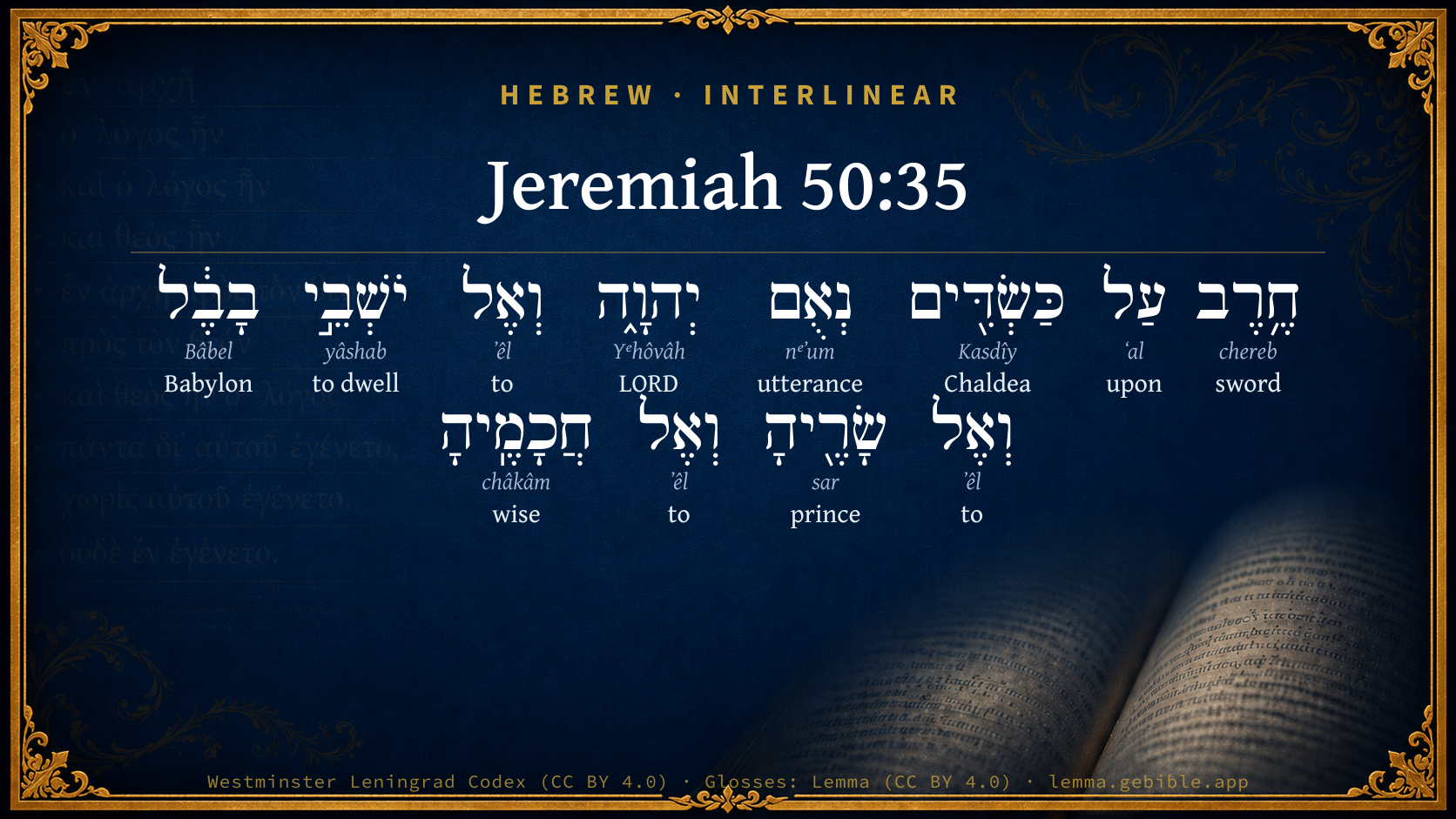
Hebrew (Westminster Leningrad Codex) Jeremiah 50:35 appears in the Hebrew Old Testament. The text above is from the Westminster Leningrad Codex. Each word links to its Strong’s number, a concise gloss, and parsing drawn from the Open Scriptures Hebrew Bible morphology. Click any word for its full Brown-Driver-Briggs (BDB) entry.
Download image
Cite this verse

Jeremiah 50:35 (World English Bible). Public Domain. Lemma interlinear Bible study tool, https://lemma.gebible.app/v/jeremiah/50/35.

Show BibTeX & RIS
BibTeX
RIS
English Translation
A sword is on the Chaldeans, says Yahweh, and on the inhabitants of Babylon, and on her princes, and on her wise men.
World English Bible · Public Domain
Download a study sheet

One document with this verse’s original text, its word-by-word gloss line, the meaning frame, cross-references with their text, attributed commentary, and full source and license credits — printable, and it pastes into notes with its structure intact.

This verse Autodidact and up

Study sheet (.html) Plain text (.txt)

A passage Seminary Student

Up to 50 verses in one chapter. A passage sheet keeps up to 6 commentary sources and 12 cross-references per verse, in the order this page ranks them, and says so on the sheet whenever that leaves anything out. Ask for a single verse and you get the Autodidact verse sheet above.

Everything on this page stays free to read, with no account — the sheet is a download of what is already on screen, not access to it.

Want to remove ads? Support Godless Engineer
Compare translations 3

The same verse in 3 English versions, stacked beneath the original-language interlinear above. Click any original word for its lexicon entry.

Each is an independent rendering of the whole verse — the interlinear is not word-aligned to these translations.

Highlighted words mark where these versions differ — a whole-verse word diff, not a word-by-word alignment.

  • World English Bible Public Domain
    A sword is on the Chaldeans, says Yahweh, and on the inhabitants of Babylon, and on her princes, and on her wise men.
  • King James Version Public Domain
    A sword is upon the Chaldeans, saith the LORD, and upon the inhabitants of Babylon, and upon her princes, and upon her wise men.
  • unfoldingWord Literal Text CC BY-SA 4.0
    A sword is against the Chaldeans—this is Yahweh’s declaration— and against the inhabitants of Babylon, her leaders, and her wise men.

unfoldingWord Literal Text — © unfoldingWord, licensed CC BY-SA 4.0. Word-aligned USFM3 via Door43 (git.door43.org/unfoldingWord/en_ult).

Versions to compare (up to 4)

3 of 4 selected

Show all 18 translations

Every available English version of this verse, each an independent rendering of the whole verse.

  • World English Bible Public Domain
    A sword is on the Chaldeans, says Yahweh, and on the inhabitants of Babylon, and on her princes, and on her wise men.
  • Berean Standard Bible Public Domain
    A sword is against the Chaldeans, declares the LORD, against those who live in Babylon, and against her officials and wise men.
  • Majority Standard Bible Public Domain
    A sword is against the Chaldeans, declares the LORD, against those who live in Babylon, and against her officials and wise men.
  • King James Version Public Domain
    A sword is upon the Chaldeans, saith the LORD, and upon the inhabitants of Babylon, and upon her princes, and upon her wise men.
  • American Standard Version (1901) Public Domain
    A sword is upon the Chaldeans, saith Jehovah, and upon the inhabitants of Babylon, and upon her princes, and upon her wise men.
  • Revised Version (1885) Public Domain
    A sword is upon the Chaldeans, saith the LORD, and upon the inhabitants of Babylon, and upon her princes, and upon her wise men.
  • Geneva Bible (1599) Public Domain
    A sworde is vpon the Caldeans, sayeth the Lord, and vpon the inhabitants of Babel, and vpon her princes, and vpon her wise men.
  • Douay-Rheims (1899) Public Domain
    A sword is upon the Chaldeans, saith the Lord, and upon the inhabitants of Babylon, and upon her princes, and upon her wise men.
  • Young's Literal Translation Public Domain
    A sword `is' for the Chaldeans, An affirmation of Jehovah, And it `is' on the inhabitants of Babylon, And on her heads, and on her wise men;
  • Literal Standard Version CC BY-SA 4.0
    A sword [is] for the Chaldeans,” || A declaration of YHWH, || “And it [is] on the inhabitants of Babylon, || And on her heads, and on her wise men;
  • Unlocked Literal Bible CC BY-SA 4.0
    A sword is against the Chaldeans—this is Yahweh's declaration— and against the inhabitants of Babylon, her leaders, and her wise men.
  • unfoldingWord Literal Text CC BY-SA 4.0
    A sword is against the Chaldeans—this is Yahweh’s declaration— and against the inhabitants of Babylon, her leaders, and her wise men.
  • Darby Bible Public Domain
    The sword is upon the Chaldeans, saith Jehovah, and upon the inhabitants of Babylon, and upon her princes, and upon her wise men;
  • World Messianic Bible Public Domain
    “A sword is on the Kasdim,” says the LORD, “and on the inhabitants of Babylon, on her princes, and on her wise men.
  • Webster's Bible Public Domain
    A sword is upon the Chaldeans, saith the LORD, and upon the inhabitants of Babylon, and upon her princes, and upon her wise men.
  • Free Bible Version CC BY-SA 4.0
    A sword is raised to attack the Babylonians, declares the Lord, ready to attack those who live in Babylon, and her officials and wise men.
  • Bible in Basic English Public Domain
    A sword is on the Chaldaeans, says the Lord, and on the people of Babylon, and on her rulers and on her wise men.
  • JPS Tanakh (1917) Public Domain
    A sword is upon the Chaldeans, saith the LORD, and upon the inhabitants of Babylon, and upon her princes, and upon her wise men.

Literal Standard Version (2020), Covenant Press — licensed CC BY-SA 4.0. Text via the HelloAO Bible API (eBible.org). Unlocked Literal Bible (unfoldingWord) — licensed CC BY-SA 4.0. Text via the HelloAO Bible API (eBible.org). unfoldingWord Literal Text — © unfoldingWord, licensed CC BY-SA 4.0. Word-aligned USFM3 via Door43 (git.door43.org/unfoldingWord/en_ult). Free Bible Version, Dr. Jonathan Gallagher — licensed CC BY-SA 4.0. Text via the HelloAO Bible API (eBible.org).

Word by word

More ways to search: Search by grammar → Find every occurrence → Compare this word →

Practice this passage: Drill this verse → Learn its vocabulary →

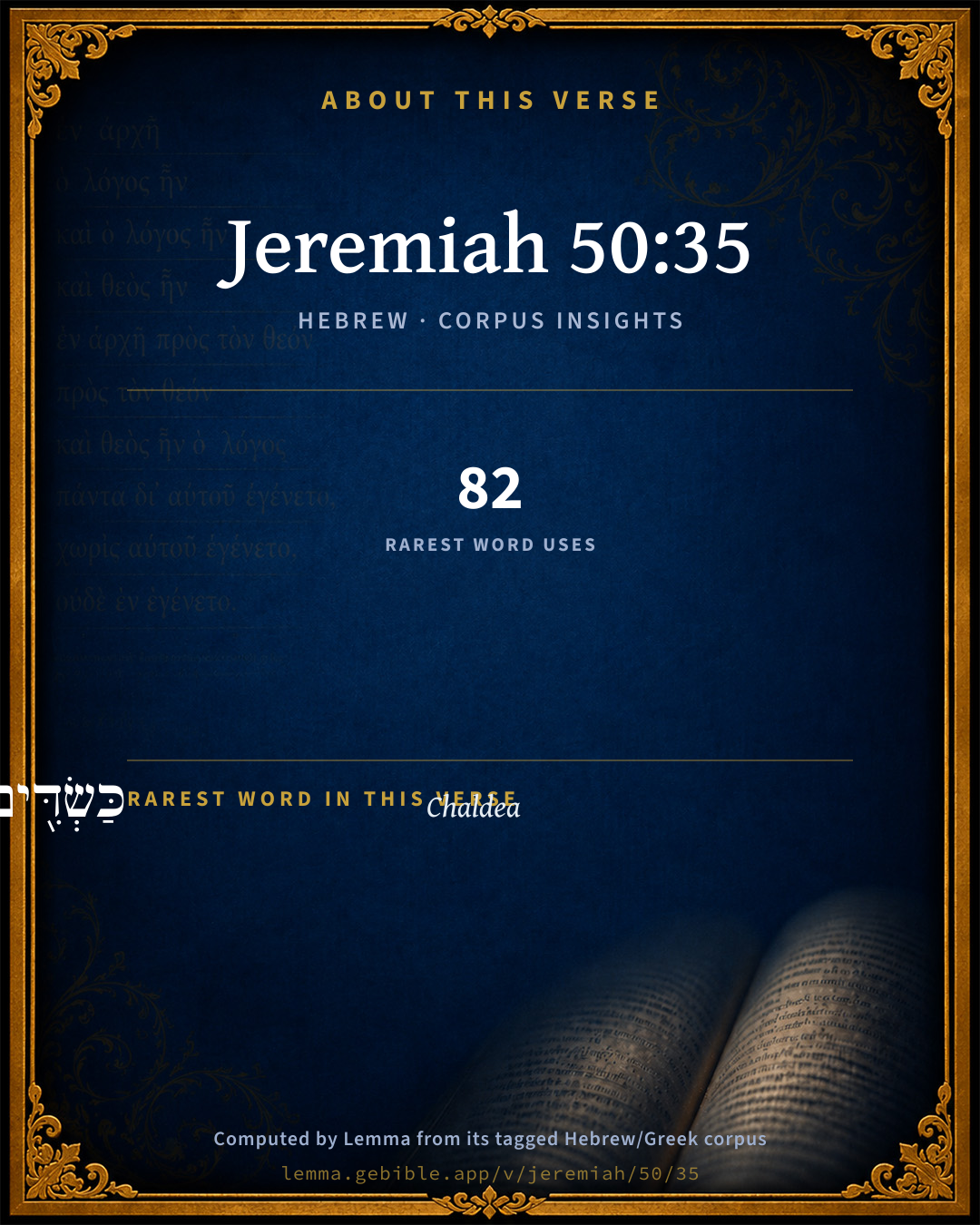
כַּשְׂדִּ֖ים
Kasdîy
H3778
“Chaldea”
Noun, Proper
Part of Speech
Noun
Type
Proper
Full BDB Definition

Origin: (occasionally with enclitic) Kasdiymah kas-dee'- maw

TWOT: None

Chaldea or Chaldeans = "clod-breakers" - a territory in lower Mesopotamia bordering on the Persian Gulf (noun proper locative) - the inhabitants of Chaldea, living on the lower Euphrates and Tigris (noun proper masculine) - those persons considered the wisest in the land (by extension) (noun proper masculine)
  1. חֶ֥רֶב chereb H2719 “sword” Noun, Common, Feminine, Singular, Absolute
  2. עַל ʻal H5921 “upon” Preposition
  3. נְאֻם nᵉʼum H5002 “utterance of” Noun, Common, Masculine, Singular, Construct
  4. יְהוָ֑ה Yᵉhôvâh H3068 “LORD” Noun, Proper
  5. וְאֶל ʼêl H413 “and · to” Conjunction + Preposition
  6. יֹשְׁבֵ֣י yâshab H3427 “dwelling” Verb, Qal, Participle Active, Masculine, Plural, Construct
  7. בָבֶ֔ל Bâbel H894 “Babylon” Noun, Proper
  8. וְאֶל ʼêl H413 “and · to” Conjunction + Preposition
  9. שָׂרֶ֖יהָ sar H8269 “princes · her” Noun, Common, Masculine, Plural, Construct + Suffix, Personal, 3rd Person, Feminine, Singular
  10. וְאֶל ʼêl H413 “and · to” Conjunction + Preposition
  11. חֲכָמֶֽיהָ châkâm H2450 “wise · her” Adjective, Adjective, Masculine, Plural, Construct + Suffix, Personal, 3rd Person, Feminine, Singular

About this verse

These counts appear in no published source. They are computed here, from the morphology-tagged text and Lemma’s own curated glosses. What Lemma adds →

12
words
10
distinct lemmas
Prophets
section

Grammatical profile

  • 1 verb
  • 6 nouns
  • 1 adjective
  • 4 prepositions

Verb forms

  • יֹשְׁבֵ֣י Qal · Participle Active

Repetition

A word recurs within this verse — often emphatic in Hebrew:

  • וְאֶל to H413 ×3

Cross-references

20

Topical passages linked to Jeremiah 50:35 in the Treasury of Scripture Knowledge — connected by theme and wording, ordered by reader-vote popularity; previews shown in the World English Bible.

  • Jeremiah 47:6 You sword of Yahweh, how long will it be before you be quiet? put up yourself into your scabbard; rest, and be still.
  • Jeremiah 51:57 I will make drunk her princes and her wise men, her governors and her deputies, and her mighty men; and they shall sleep a perpetual sleep, and not wake up, says the King, whose name is Yahweh of Hosts.
  • Daniel 5:1–2 Belshazzar the king made a great feast to a thousand of his lords, and drank wine before the thousand.
  • Daniel 5:7–8 The king cried aloud to bring in the enchanters, the Chaldeans, and the soothsayers. The king spoke and said to the wise men of Babylon, Whoever shall read this writing, and show me the interpretation of it, shall be clothed with purple, and have a chain of gold about his neck, and shall be the third ruler in the kingdom.
  • Daniel 5:30 In that night Belshazzar the Chaldean King was slain.
  • Hosea 11:6 The sword will fall on their cities, And will consume their gate bars, And will put an end to their plans.
  • Leviticus 26:25 I will bring a sword upon you, that will execute the vengeance of the covenant; and you will be gathered together within your cities: and I will send the pestilence among you; and you will be delivered into the hand of the enemy.
  • Isaiah 19:11–13 The princes of Zoan are utterly foolish; the counsel of the wisest counselors of Pharaoh is become brutish: how do you say to Pharaoh, I am the son of the wise, the son of ancient kings?
  • Isaiah 29:14 therefore, behold, I will proceed to do a marvelous work among this people, even a marvelous work and a wonder; and the wisdom of their wise men shall perish, and the understanding of their prudent men shall be hid.
  • Isaiah 41:25 I have raised up one from the north, and he has come; from the rising of the sun one who calls on my name: and he shall come on rulers as on mortar, and as the potter treads clay.
  • Isaiah 44:25 who frustrates the signs of the liars, and makes diviners mad; who turns wise men backward, and makes their knowledge foolish;
  • Isaiah 47:13–14 You are wearied in the multitude of your counsels: let now the astrologers, the star-gazers, the monthly prognosticators, stand up, and save you from the things that shall come on you.
  • Isaiah 66:16 For by fire will Yahweh execute judgment, and by his sword, on all flesh; and the slain of Yahweh shall be many.
  • Jeremiah 8:9 The wise men are disappointed, they are dismayed and taken: behold, they have rejected the word of Yahweh; and what manner of wisdom is in them?
  • Jeremiah 10:7 Who should not fear you, King of the nations? for to you does it appertain; because among all the wise men of the nations, and in all their royal estate, there is none like you.
  • Jeremiah 50:27 Kill all her bulls; let them go down to the slaughter: woe to them! for their day is come, the time of their visitation.
  • Jeremiah 50:30 Therefore shall her young men fall in her streets, and all her men of war shall be brought to silence in that day, says Yahweh.
  • Jeremiah 51:39 When they are heated, I will make their feast, and I will make them drunken, that they may rejoice, and sleep a perpetual sleep, and not wake, says Yahweh.
  • Ezekiel 14:2 The word of Yahweh came to me, saying,
  • Zechariah 11:17 Woe to the worthless shepherd who leaves the flock! The sword will be on his arm, and on his right eye. His arm will be completely withered, and his right eye will be totally blinded!"

Cross-references courtesy of OpenBible.info (CC BY 4.0).

Hebrew and Greek witnesses Masoretic Hebrew ↔ Greek Septuagint

The same verse in the two great witnesses to the Old Testament, shown verse-for-verse.

These are two independent witnesses, not word-aligned to each other, and the Septuagint is shown in lemma (dictionary) form.

Hebrew Jeremiah 50:35 Masoretic · Westminster Leningrad Codex

חֶ֥רֶב עַל כַּשְׂדִּ֖ים נְאֻם יְהוָ֑ה וְאֶל יֹשְׁבֵ֣י בָבֶ֔ל וְאֶל שָׂרֶ֖יהָ וְאֶל חֲכָמֶֽיהָ

A sword is on the Chaldeans, says Yahweh, and on the inhabitants of Babylon, and on her princes, and on her wise men.

World English Bible · Public Domain

Greek LXX Structure differs

In the Septuagint, Jeremiah is about an eighth shorter than the Hebrew and arranges its material differently — the Oracles Against the Nations (Hebrew chapters 46–51) appear in the middle of the Greek book, after 25:13. Because the chapter and verse boundaries do not line up, a verse-for-verse comparison with the Hebrew is not shown.

A verse-for-verse comparison isn’t shown here because the chapters and verses don’t line up. Switch to the LXX edition with the MT / LXX toggle above to read the Greek directly.

Hebrew: Westminster Leningrad Codex (CC BY 4.0). Greek: Septuagint (public domain); English from a public-domain English Septuagint. How the Septuagint differs from the Hebrew →

Targum (Aramaic paraphrase)

1

The Targum is the ancient Jewish Aramaic paraphrase of the Hebrew Scriptures — an interpretive translation, not the Hebrew text itself. Onkelos (literal) and Pseudo-Jonathan (expansive) render the Torah, and Jonathan the Prophets. Coverage is partial: where no permissively-licensed English translation exists for a verse, only the Aramaic is shown. This is verse-level text, not a word-by-word alignment to the Hebrew.

  1. Targum Jonathan Prophets (Joshua–Malachi)
    דְקַטְלִין בְּחַרְבָּא יֵיתוּן עַל אַרְעָא דְכַסְדָאֵי אֲמַר יְיָ וְעַל יַתְבֵי בָבֶל וְעַל רַבְרְבָהָא וְעַל חַכִּימָהָא:

    (no public-domain English translation for this verse)

    Targum Jonathan — Aramaic: “Mikraot Gedolot” (public domain). English: “Sefaria Community Translation” (CC0 1.0 (public-domain dedication)); “London "Chaldee Paraphrase," 1871” (public domain). Text via Sefaria.

Commentary

Notes on Jeremiah 50:35 from classic Christian and Jewish commentators (each source and its license shown beneath its notes). The classic Christian expositions comment on the surrounding passage and are grouped to its opening verse, so a note may address several verses; the Jewish commentaries on the Tanakh (Rashi and others) are per-verse, so they appear only where the commentator wrote on this verse.

Lemma curates 59 commentaries, every one of them public domain or Creative Commons licensed, each selected and text-cleaned for this edition rather than reprinted as found. About our sources →

Trapp's Complete Commentary

John Trapp

Jer 50:35 A sword [is] upon the Chaldeans, saith the LORD, and upon the inhabitants of Babylon, and upon her princes, and upon her wise [men].

Ver. 35. A sword is upon the Chaldeans.] Those sworn swordsmen of the devil.

John Trapp, A Commentary or Exposition upon All the Books of the Old and New Testament (1647–1656) — public domain. Text from a community e-Sword module.

Joseph Benson's Commentary

Jer 50:35-37. A sword is upon the Chaldeans — That is, there shall come a sword upon them. Upon Babylon and her princes — Who were slain together with their king, Belshazzar, at a feast, Jer 51:39; Dan 5:2-30. And upon her wise men — The Chaldeans were famous for their skill in astrology, and other arts of divination; and yet the learned in those sciences were not able to foresee or prevent the dangers coming upon themselves in the common calamity. A sword is upon the liars — Upon the diviners, or the pretenders to the knowledge of future events; and they shall dote — They shall be proved to be foolish and ignorant, by things happening directly contrary to what they had thought and said. Thus Isaiah, speaking of the same kind of men, says, He (namely, God) frustrateth the tokens of the liars, and maketh diviners mad. A sword is upon all the mingled people — Upon her auxiliaries, made up of several nations: see Eze 30:5. And they shall become as women — Fearful, and having neither courage nor any thing else manly in them. A sword is upon her treasures, &c. — “Her treasures shall be a prey to such as come with sword in hand to rifle them: as Solon said to Crœsus, who, by way of ostentation, showed him his treasures, “Sir, if any one come that has better iron than you, he will be master of all your gold.” — Lowth.

Joseph Benson's Commentary on the Old and New Testaments (1811–1818) — public domain. Text from a community e-Sword module.

Tyndale Open Study Notes

Tyndale Open Resources

50:35-38 Babylon would experience exactly the kind of violence it had meted out. The same charges were brought against Babylon as were brought against Israel, Judah, Egypt, and their neighbors. All of them worshiped idols instead of the one true God. • The sword of destruction refers to the Persian army.

Tyndale Open Study Notes — © Tyndale Open Resources, licensed CC BY-SA 4.0. Text via the HelloAO Bible API.

Jamieson, Fausset & Brown

Robert Jamieson, A. R. Fausset & David Brown

The repetition of "A sword" in the beginning of each verse, by the figure anaphora, heightens the effect; the reiterated judgment is universal; the same sad stroke of the sword is upon each and all connected with guilty Babylon.

wise men-- (Isa 47:13). Babylon boasted that it was the peculiar seat of wisdom and wise men, especially in astronomy and astrology.

Jamieson, Fausset & Brown — Commentary Critical and Explanatory on the Whole Bible (1871) — public domain (CC PDM 1.0). Text via the HelloAO Bible API.

Adam Clarke's Commentary

Verse 35. A sword] War and its calamities, or any grievous plague; and so in the following verses.

Adam Clarke's Commentary on the Bible (1810–1826) — public domain. Text from a community e-Sword/MySword module.

John Calvin's Commentaries

THE Prophet proceeds with the same subject, and employs the same manner of speaking. He denounces war on the Chaldeans as a celestial herald; and then that what he says might have more force and power, he sets the Persians and the Medes before us in the act of assailing and destroying Babylon. He therefore says now in general, A sword on the Chaldeans; and, secondly, he mentions the inhabitants of Babylon, for that city was the seat and head of the kingdom, as it is well known; but as the power of that monarchy was deemed by men unassailable, the Prophet adds, that though the chief men excelled in counsel and strength, and in the art of war, yet a sword would be upon them; and in the last place, that though Babylon had its diviners, their knowledge would yet be in vain. He, indeed, uses an honorable name, yet he no doubt refers to astrologers and soothsayers, and other kinds of prophets. For we know that the whole nation was given to many superstitions; but they boasted themselves to be the chief of all astrologers; and hence soothsayers, who practice their impostures, are called Chaldeans, and it was formerly a common designation.

Then the Prophet means, that neither power nor warlike skill, nor knowledge of any kind, would be a defense to the Chaldeans, nor the arts in which they gloried, even though they thought that they were familiarly acquainted with God; for by the stars they were wont to divine whatever was to be. It follows, —

John Calvin's Commentaries (1540-1563) — public domain. Text from the Calvin Translation Society English edition (1840s-50s) via the Christian Classics Ethereal Library (ccel.org). Calvin's coverage is partial (roughly two-thirds of the Bible); uncommented books and verses are honest gaps, never fabricated. The 19th-century editor's footnotes and remarks are omitted so the notes are faithfully Calvin's own voice.

Ellicott's Commentary for English Readers

(35) A sword is upon the Chaldeans.—Better, A sword upon the Chaldeans. Here, and in the verses that follow, the interpolated verb weakens the force of the passage. Jehovah is represented as calling the “sword” and the “drought” to do their work of destruction.

Upon her wise men.—The term points especially to the “wise men” in the technical sense of the term, the soothsayers and astrologers who were prominent among Nebuchadnezzar’s counsellors (Dan_2:2; Dan_2:13).

A Bible Commentary for English Readers, edited by Charles John Ellicott (1878–1897) — public domain. Text from a community e-Sword module.

John Gill's Exposition

A sword is upon the Chaldeans, saith the Lord,.... Or, "shall be" (k) or, "O sword, be thou on the Chaldeans" (l); that is, the sword of the Medes and Persians; those that kill with the sword, as the Targum; in the mystic sense, the Christian princes that shall draw the sword against the antichristian states:

and upon the inhabitants of Babylon; the metropolis of Chaldea; the common people in it, as distinguished from those of high rank and degree following:

and upon her princes; Belshazzar and his nobles, who were slain the night Babylon was taken:

and upon her wise men; prime ministers, politicians, and counsellors of state; neither high birth nor great wisdom can secure from the sword of the enemy, when it has a commission from God, as it had here.

(k) "Erit", Abarbinel; "irruet", Junius & Tremellius, Piscator. (l) "gladie, super Chaldaeos, scil. veni, ades", Schmidt.

John Gill's Exposition of the Whole Bible (1746–1763) — public domain (CC PDM 1.0). Text via the HelloAO Bible API.

Albert Barnes' Notes on the Bible

Omit “is.” A summons comes from Yahweh, Israel’s Goel, to the sword to fall upon all the elements of Babylon’s greatness. The princes were her rulers at home and her generals in war. The wise men were those upon whose learning she so prided herself (Dan 1:4 note).

Albert Barnes' Notes on the Bible (1834–1885) — public domain. Text from a community e-Sword/MySword module.

Haydock's Catholic Bible Commentary

Wise men. They were styled Chaldeans, and inhabited a certain part of the city, being employed in astronomical and mathematical observations. They disapproved of those who cast nativities. (Strabo xvi.)

George Leo Haydock (1774–1849), Haydock's Catholic Family Bible and Commentary, 1859 edition — public domain. Excludes Psalms (Douay-Rheims chapter numbering differs from Protestant) and Deuterocanonical books (Catholic canon only).

Matthew Poole's English Annotations

That is, there shall come a sword, the sword of the Medes, upon Babylon, and all the land of the Chaldeans, and all orders of persons in it.

Matthew Poole's English Annotations on the Holy Bible (1683–1685) — public domain. Text from a community e-Sword/MySword module.

Whedon's Commentary on the Bible

Daniel D. Whedon

35. A sword is upon the Chaldeans — The verb inserted by the translators takes away from the dramatic character of the passage. The original has the form of an exclamation, on account of the feeling which pervades it.

Princes — Rulers in peace, leaders in war.

Wise men — Magicians or savants.

Daniel D. Whedon (gen. ed.), Commentary on the Old and New Testaments (1874–1909) — public domain. Text from a community e-Sword module.

The Pulpit Commentary

Vers. 35-38. No human aid avails against so terrible a foe; therefore Jehovah calls upon his Sword (see on Jer_47:6) to avenge the cause of his people.

A sword is, etc., should rather be, Sword upon the Chaldea, it is an exclamation equivalent to "Let the Sword come upon the Chaldeans that sword which never "returns empty." The wise men are, partly the astronomers and astrologers at the various observatories in Babylonia, whose duty it was to send in monthly reports of the appearances in the sky, which were regarded as having an occult political significance. (comp. Isa_47:13) In the next verse they are called liars, or praters. In Isa_44:25 this word stands parallel to "diviners." Possibly "liars" may be a wider term than "wise men," and includes an inferior grade of pretenders to "wisdom.

Vers. 35-37. The sword everywhere.

I THE DESTROYING AGENT. Not a deluge, not fire from heaven, but an ordinary human agent, working with energy and thoroughness. The weapon which Babylon in its greed of conquest had used against Jerusalem is turned against itself. First of all, Babylon looks covetously on the land of Israel, and spoils it of its people and their possessions. And then, enriched, Babylon becomes in turn an object of desire. God has only to leave covetousness and grasping alone, whether in nations or individuals. There will generally come in some human agency to dissipate ill-gotten gains. As Babylon became richer in external goods, it became weaker in manly resources. There was more to invite attack, more need of the best defences, and yet at the same time less ability to defend. The sword stands here as the great symbol of human physical force. We must not infer that God approves it: he simply points out how it must have free scope upon the surface of things. Babylon took the sword, and she in turn must perish by the sword; and that same sword, successful against Babylon, points to the destruction of those who wielded it. Nothing abiding, nothing permanently satisfying, is to be achieved by the sword.

II THE EXTENT OF THE DESTRUCTION. Physical force can make short work of all man"s natural treasures; all that is wanted is a sufficient amount of it. Skill compensates for force only up to a certain point. Vain was it for Babylon to count up its mighty men and parade its horses and chariots. If we would arrive at right conclusions in the matter of security we must know the strength of our enemies as well as our own. As to one element in its strength in particular, Babylon would be dreadfully deceived. It could not realize how, as the agent of a punishing Jehovah, there had been more than its wonted strength bestowed on it against sinning Israel. It plumed itself too much on conquered Israel, and thought itself stronger than it really was. Y.

The Pulpit Commentary (1880–1919), ed. H.D.M. Spence-Jones & Joseph S. Exell — public domain. Text from a community e-Sword module.

unfoldingWord translationNotes

Door43 World Missions Community

A sword is against ... against ... A sword is coming against

Here "sword" represents war. AT: "War will soon happen to ... to ... War will soon happen to" (See: Metonymy)

this is Yahweh's declaration

Yahweh speaks of himself by name to express the certainty of what he is declaring. See how you translated this in Jeremiah 1:8. AT: "this is what Yahweh has declared" or "this is what I, Yahweh, have declared" (See: First, Second, or Third Person)

They will become fools

"Their actions are foolish, and everyone will see that they are fools"

They will be filled with terror

"they will be terrified"

they will become like women

The weakness of the Babylonian soldiers is spoken of as if they were women. This can be stated clearly. AT: "they will all become as weak as women" (See: Simile)

storerooms

A storeroom is a place where supplies or valuables are kept.

they will be plundered

This can be stated in active form. AT: "enemy soldiers will plunder them" (See: Active or Passive)

translationWords

sword

Chaldea

declare

wise

divination

reveal

fool

terror

horse

chariot

unfoldingWord translationNotes — © Distant Shores Media and the Door43 World Missions Community, licensed CC BY-SA 4.0. Source: git.door43.org/Door43/en_tn.

Lesson kit

Teaching starters — assembled from the data on this page, not authored interpretation. Every prompt links to the verse data it draws on. Edit before teaching.

Jeremiah, in the Prophets, opens this verse with 12 words (10 distinct Hebrew lemmas). Its most distinctive word is Kasdîy (“Chaldea”). A historical commentator’s framing appears above. Read the whole chapter for the surrounding context.

Discussion questions

  1. How does “Chaldea” (Kasdîy) shape what this verse is saying?
  2. Jeremiah 47:6 shares this passage’s theme. How do the two illuminate each other?
  3. “to” occurs 3× in this one verse. What is the effect of the repetition?
  4. The translations on this page render this verse differently — a whole-verse word diff, not a word-by-word alignment. What might account for the different wordings?
  5. The verb «יֹשְׁבֵ֣י» is Qal Participle Active. How does its form color the action?
  6. Reading how Trapp's Complete Commentary and Joseph Benson's Commentary read this verse, where do the two commentators agree and where do they part?

Things to notice

Reading settings

Reading text

Shown beneath each verse's original-language words.

Old Testament
Old Testament edition

Read the OT as the Masoretic Hebrew (MT) or the Greek Septuagint (LXX).

English shown for the Greek Septuagint (in the Hebrew ↔ Greek comparison).

Comparing translations? Open the Compare panel on any verse page to stack up to four side by side.