
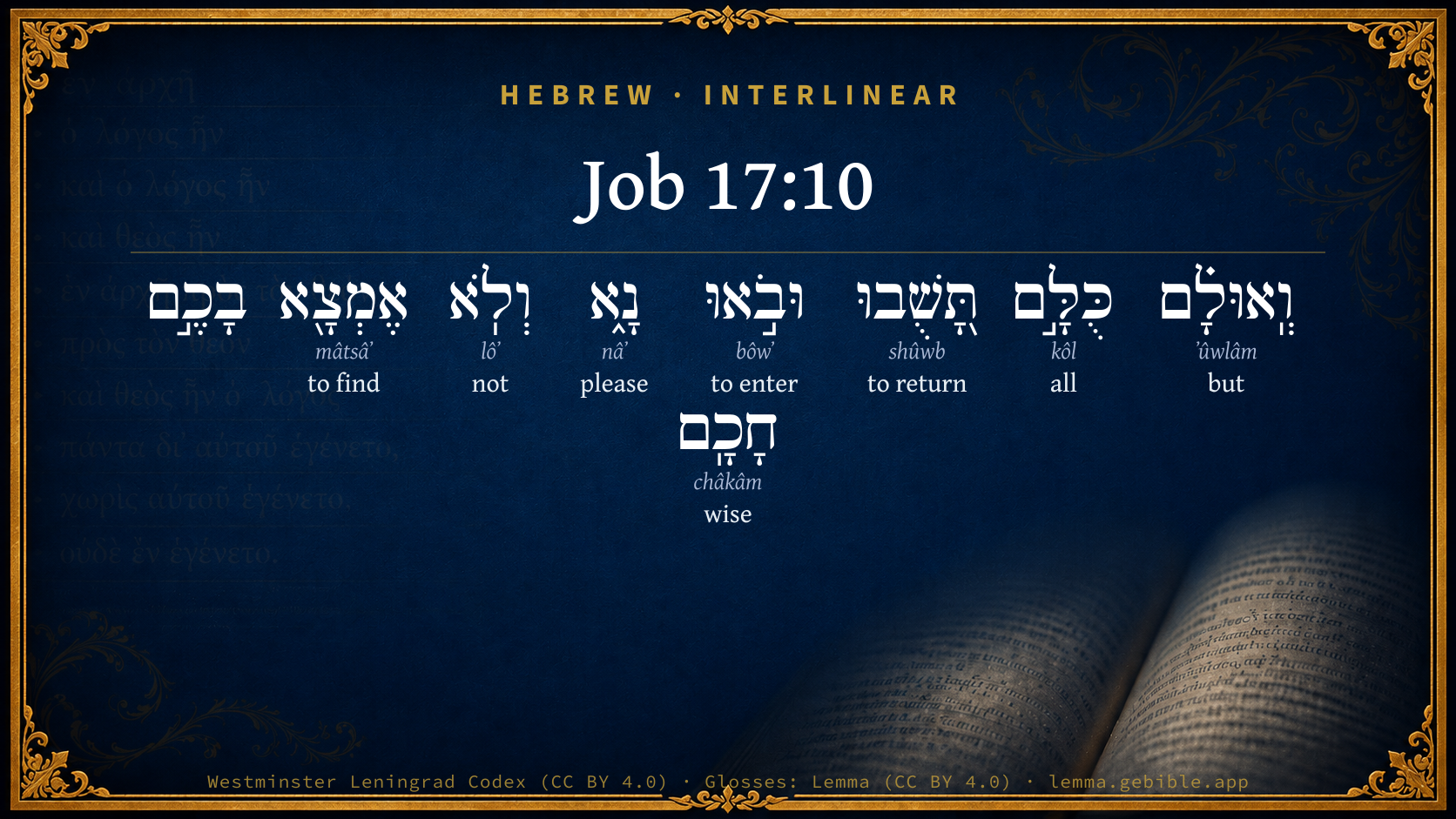
Job 17:10

Hebrew (Westminster Leningrad Codex) Job 17:10 appears in the Hebrew Old Testament. The text above is from the Westminster Leningrad Codex. Each word links to its Strong’s number, a concise gloss, and parsing drawn from the Open Scriptures Hebrew Bible morphology. Click any word for its full Brown-Driver-Briggs (BDB) entry.
Download image
Cite this verse

Job 17:10 (World English Bible). Public Domain. Lemma interlinear Bible study tool, https://lemma.gebible.app/v/job/17/10.

Show BibTeX & RIS
BibTeX
RIS
English Translation
But as for you all, come on now again; I shall not find a wise man among you.
World English Bible · Public Domain
Download a study sheet

One document with this verse’s original text, its word-by-word gloss line, the meaning frame, cross-references with their text, attributed commentary, and full source and license credits — printable, and it pastes into notes with its structure intact.

This verse Autodidact and up

Study sheet (.html) Plain text (.txt)

A passage Seminary Student

Up to 50 verses in one chapter. A passage sheet keeps up to 6 commentary sources and 12 cross-references per verse, in the order this page ranks them, and says so on the sheet whenever that leaves anything out. Ask for a single verse and you get the Autodidact verse sheet above.

Everything on this page stays free to read, with no account — the sheet is a download of what is already on screen, not access to it.

Want to remove ads? Support Godless Engineer
Compare translations 3

The same verse in 3 English versions, stacked beneath the original-language interlinear above. Click any original word for its lexicon entry.

Each is an independent rendering of the whole verse — the interlinear is not word-aligned to these translations.

Highlighted words mark where these versions differ — a whole-verse word diff, not a word-by-word alignment.

  • World English Bible Public Domain
    But as for you all, come on now again; I shall not find a wise man among you.
  • King James Version Public Domain
    But as for you all, do ye return, and come now: for I cannot find one wise man among you.
  • unfoldingWord Literal Text CC BY-SA 4.0
    But all of them, may you return, and come now, but I will not find a wise among you.

unfoldingWord Literal Text — © unfoldingWord, licensed CC BY-SA 4.0. Word-aligned USFM3 via Door43 (git.door43.org/unfoldingWord/en_ult).

Versions to compare (up to 4)

3 of 4 selected

Show all 18 translations

Every available English version of this verse, each an independent rendering of the whole verse.

  • World English Bible Public Domain
    But as for you all, come on now again; I shall not find a wise man among you.
  • Berean Standard Bible Public Domain
    But come back and try again, all of you. For I will not find a wise man among you.
  • Majority Standard Bible Public Domain
    But come back and try again, all of you. For I will not find a wise man among you.
  • King James Version Public Domain
    But as for you all, do ye return, and come now: for I cannot find one wise man among you.
  • American Standard Version (1901) Public Domain
    But as for you all, come on now again; And I shall not find a wise man among you.
  • Revised Version (1885) Public Domain
    But return ye, all of you, and come now: and I shall not find a wise man among you.
  • Geneva Bible (1599) Public Domain
    All you therefore turne you, and come nowe, and I shall not finde one wise among you.
  • Douay-Rheims (1899) Public Domain
    Wherefore be you all converted, and come, and I shall not find among you any wise man.
  • Young's Literal Translation Public Domain
    Return, and come in, I pray you, And I find not among you a wise man.
  • Literal Standard Version CC BY-SA 4.0
    But please return and come in, all of you, || And I do not find a wise man among you.
  • Unlocked Literal Bible CC BY-SA 4.0
    But as for you all, come on now; I will not find a wise man among you.
  • unfoldingWord Literal Text CC BY-SA 4.0
    But all of them, may you return, and come now, but I will not find a wise among you.
  • Darby Bible Public Domain
    But as for you all, pray come on again; and I shall not find one wise man among you.
  • World Messianic Bible Public Domain
    But as for you all, come back. I will not find a wise man among you.
  • Webster's Bible Public Domain
    But as for you all, do ye return, and come now: for I cannot find one wise man among you.
  • Free Bible Version CC BY-SA 4.0
    Why don't you come back and repeat again what you've been saying?—yet I still won't find a wise man among you!
  • Bible in Basic English Public Domain
    But come back, now, all of you, come; and I will not see a wise man among you.
  • JPS Tanakh (1917) Public Domain
    But as for you all, do ye return, and come now; and I shall not find a wise man among you.

Literal Standard Version (2020), Covenant Press — licensed CC BY-SA 4.0. Text via the HelloAO Bible API (eBible.org). Unlocked Literal Bible (unfoldingWord) — licensed CC BY-SA 4.0. Text via the HelloAO Bible API (eBible.org). unfoldingWord Literal Text — © unfoldingWord, licensed CC BY-SA 4.0. Word-aligned USFM3 via Door43 (git.door43.org/unfoldingWord/en_ult). Free Bible Version, Dr. Jonathan Gallagher — licensed CC BY-SA 4.0. Text via the HelloAO Bible API (eBible.org).

Word by word

More ways to search: Search by grammar → Find every occurrence → Compare this word →

Practice this passage: Drill this verse → Learn its vocabulary →

About this verse

These counts appear in no published source. They are computed here, from the morphology-tagged text and Lemma’s own curated glosses. What Lemma adds →

9
words
8
distinct lemmas
Wisdom
section

Notable vocabulary

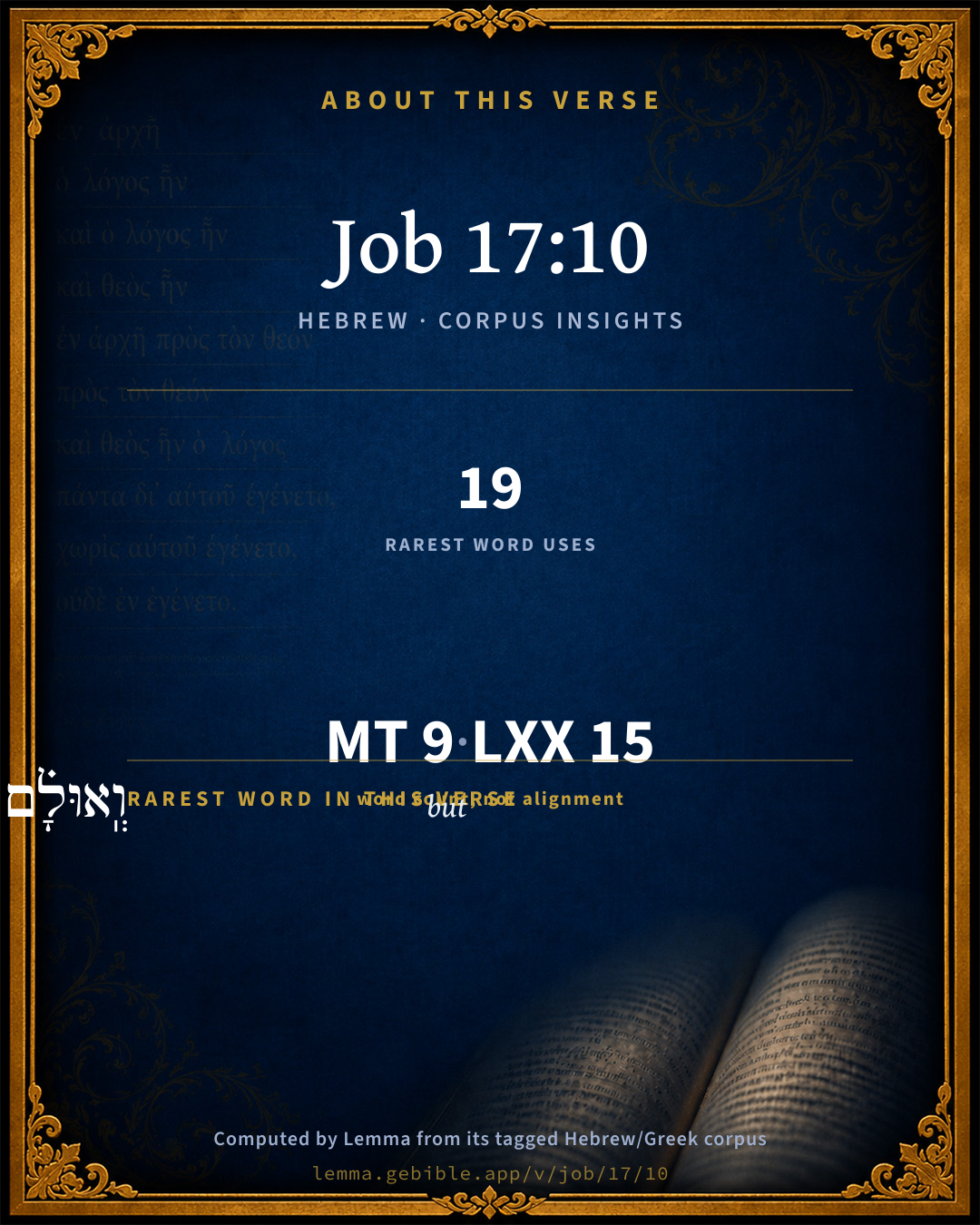
The rarest word here is וְֽאוּלָ֗ם but H199 — appearing just 19 times in the whole Hebrew Bible.

Shared distinctive vocabulary

וְֽאוּלָ֗ם but H199 occurs in 19 verses of the Hebrew Bible. Also found in:

Grammatical profile

  • 3 verbs
  • 1 noun
  • 1 adjective
  • 1 preposition
  • 1 adverb
  • 2 particles

Verb forms

  • תָּ֭שֻׁבוּ Qal · Imperfect
  • וּבֹ֣אוּ Qal · Imperative
  • אֶמְצָ֖א Qal · Imperfect

Hebrew & Septuagint length

In English translation the verse runs 18 words from the Hebrew and 17 from the Septuagint (LXX English) — closely comparable.

A rough comparison of the two English renderings, which tokenize alike — not a word-level alignment.

Word counts can differ between the Hebrew and the Greek without any difference in meaning — e.g. the Hebrew direct-object marker אֵת has no separate Greek word, and Greek often adds the article ὁ.

In the original languages it is 9 Hebrew tokens and 15 Greek tokens — but the two are counted differently (Hebrew bundles its prefixes and suffixes into one token; the Greek is in lemma form), so that isn’t a like-for-like length.

Cross-references

9

Topical passages linked to Job 17:10 in the Treasury of Scripture Knowledge — connected by theme and wording, ordered by reader-vote popularity; previews shown in the World English Bible.

  • Job 6:29 Please return. Let there be no injustice; Yes, return again, my cause is righteous.
  • Job 42:7 It was so, that after Yahweh had spoken these words to Job, Yahweh said to Eliphaz the Temanite, "My wrath is kindled against you, and against your two friends; for you have not spoken of me the thing that is right, as my servant Job has.
  • Job 12:2 "No doubt, but you are the people, And wisdom shall die with you.
  • Job 15:9 What do you know, that we don't know? What do you understand, which is not in us?
  • Job 17:4 For you have hidden their heart from understanding, Therefore shall you not exalt them.
  • Job 32:9 It is not the great who are wise, Nor the aged who understand justice.
  • Malachi 3:18 Then you shall return and discern between the righteous and the wicked, between him who serves God and him who doesn't serve him.
  • 1 Corinthians 1:20 Where is the wise? Where is the scribe? Where is the lawyer of this world? Hasn't God made foolish the wisdom of this world?
  • 1 Corinthians 6:5 I say this to move you to shame. Isn't there even one wise man among you who would be able to decide between his brothers?

Cross-references courtesy of OpenBible.info (CC BY 4.0).

Hebrew and Greek witnesses Masoretic Hebrew ↔ Greek Septuagint

The same verse in the two great witnesses to the Old Testament, shown verse-for-verse.

These are two independent witnesses, not word-aligned to each other, and the Septuagint is shown in lemma (dictionary) form.

Hebrew Job 17:10 Masoretic · Westminster Leningrad Codex

וְֽאוּלָ֗ם כֻּלָּ֣ם תָּ֭שֻׁבוּ וּבֹ֣אוּ נָ֑א וְלֹֽא אֶמְצָ֖א בָכֶ֣ם חָכָֽם

But as for you all, come on now again; I shall not find a wise man among you.

World English Bible · Public Domain

Greek LXX Job 17:10 Septuagint · lemma form

οὐ μήν δέ ἀλλά πᾶς ἐρείδω καί δεῦτε δή οὐ γάρ εὑρίσκω ἐν σύ ἀληθής

Howbeit, do you⌃ all strengthen yourselves and come now, for I do not find truth in you.

LXX2012 (modern English Septuagint) · Public Domain

On this verse, Keil & Delitzsch discusses the Septuagint’s reading. Read the note in Commentary ↓

Hebrew: Westminster Leningrad Codex (CC BY 4.0). Greek: Septuagint (public domain); English from LXX2012 (modern English Septuagint) (Public Domain). How the Septuagint differs from the Hebrew →

Commentary

Notes on Job 17:10 from classic Christian and Jewish commentators (each source and its license shown beneath its notes). The classic Christian expositions comment on the surrounding passage and are grouped to its opening verse, so a note may address several verses; the Jewish commentaries on the Tanakh (Rashi and others) are per-verse, so they appear only where the commentator wrote on this verse.

Lemma curates 59 commentaries, every one of them public domain or Creative Commons licensed, each selected and text-cleaned for this edition rather than reprinted as found. About our sources →

Matthew Henry's Commentary

Job's friends had pretended to comfort him with the hopes of his return to a prosperous estate again; now he here shows,

I. That it was their folly to talk so (Job 17:10): "Return, and come now, be convinced that you are in an error, and let me persuade you to be of my mind; for I cannot find one wise man among you, that knows how to explain the difficulties of God's providence or how to apply the consolations of his promises." Those do not go wisely about the work of comforting the afflicted who fetch their comforts from the possibility of their recovery and enlargement in this world; though that is not to be despaired of, it is at the best uncertain; and if it should fail, as perhaps it may, the comfort built upon it will fail too. It is therefore our wisdom to comfort ourselves, and others, in distress, with that which will not fail, the promise of God, his love and grace, and a well-grounded hope of eternal life.

II. That it would he much more his folly to heed them; for,

1. All his measures were already broken and he was full of confusion, Job 17:11, Job 17:12. He owns he had, in his prosperity, often pleased himself both with projects of what he should do and prospects of what he should enjoy; but now he looked upon his days as past, or drawing towards a period; all those purposes were broken off and those expectations dashed. He had had thoughts about enlarging his border, increasing his stock, and settling his children, and many pious thoughts, it is likely, of promoting religion in his country, redressing grievances, reforming the profane, relieving the poor, and raising funds perhaps for charitable uses; but he concluded that all these thoughts of his heart were now at an end, and that he should never have the satisfaction of seeing his designs effected. Note, The period of our days will be the period of all our contrivances and hopes for this world; but, if with full purpose of heart we cleave to the Lord, death will not break off that purpose. Job, being thus put upon new counsels, was under a constant uneasiness (Job 17:12): The thoughts of his heart being broken, they changed the night into day and shortened the light. Some, in their vanity and riot, turn night into day and day into night; but Job did so through trouble and anguish of spirit, which were a hindrance, (1.) To the repose of the night, keeping his eyes waking, so that the night was as wearisome to him as the day, and the tossings of the night tired him as much as the toils of the day. (2.) To the entertainments of the day. "The light of the morning is welcome, but, by reason of this inward darkness, the comfort of it is soon gone, and the day is to me as dismal as the black and dark night," Deu 28:67. See what reason we have to be thankful for the health and ease which enable us to welcome both the shadows of the evening and the light of the morning.

2. All his expectations from this world would very shortly be buried in the grave with him; so that it was a jest for him to think of such mighty things as they had flattered him with the hopes of, Job 5:19; Job 8:21; Job 11:17. "Alas! you do but make a fool of me."

(1.) He saw himself just dropping into the grave. A convenient house, an easy bed, and agreeable relations, are some of those things in which we take satisfaction in this world: Job expected not any of these above ground; all he felt, and all he had in view, was unpleasing and disagreeable, but under ground he expected them. [1.] He counted upon no house but the grave (Job 17:13): "If I wait, if there be any place where I shall ever be easy again, it must be in the grave. I should deceive myself if I should count upon any out-let from my trouble but what death will give me. Nothing is so sure as that." Note, In all our prosperity it is good to keep death in prospect. Whatever we expect, let us be sure to expect that; for that may prevent other things which we expect, but nothing will prevent that. But see how he endeavours not only to reconcile himself to the grave, but to recommend it to himself: "It is my house." The grave is a house; to the wicked it is a prison-house (Job 24:19, Job 24:20); to the godly it is Bethabara, a passage-house in their way home. "It is my house, mine by descent, I am born to it; it is my father's house. It is mine by purchase. I have made myself obnoxious to it." We must everyone of us shortly remove to this house, and it is our wisdom to provide accordingly; let us think of removing, and send before to our long home. [2.] He counted upon no quiet bed but in the darkness: "There," says he, "I have made my bed. It is made, for it is ready, and I am just going to it." The grave is a bed, for we shall rest in it in the evening of our day on earth, and rise from it in the morning of our everlasting day, Isa 57:2. Let this make good people willing to die; it is but going to bed; they are weary and sleepy, and it is time that they were in their beds. Why should they not go willingly, when their father calls? "Nay, I have made my bed, by preparation for it, have endeavoured to make it easy, by keeping conscience pure, by seeing Christ lying in this bed, and so turning it into a bed of spices, and by looking beyond it to the resurrection." [3.] He counted upon no agreeable relations but what he had in the grave (Job 17:14): I have cried to corruption (that is, to the grave, where the body will corrupt), Thou art my father (for our bodies were formed out of the earth), and to the worms there, You are my mother and my sister, to whom I am allied (for man is a worm) and with whom I must be conversant, for the worms shall cover us, Job 21:26. Job complained that his kindred were estranged from him (Job 19:13, Job 19:14); therefore here he claims acquaintance with other relations that would cleave to him when those disowned him. Note, First, We are all of us near akin to corruption and the worms. Secondly, It is therefore good to make ourselves familiar with them, by conversing much with them in our thoughts and meditations, which would very much help us above the inordinate love of life and fear of death.

(2.) He saw all his hopes from this world dropping into the grave with him (Job 17:15, Job 17:16): "Seeing I must shortly leave the world, where is now my hope? How can I expect to prosper who do not expect to live?" He is not hopeless, but his hope is not where they would have it be. If in this life only he had hope, he was of all men most miserable. "No, as for my hope, that hope which I comfort and support myself with, who shall see it? It is something out of sight that I hope for, not things that are seen, that are temporal, but things not seen, that are eternal." What is his hope he will tell us (Job 19:25), Non est mortale quod opto, immortale peto - I seek not for that which perishes, but for that which abides for ever. "But, as for the hopes you would buoy me up with, they shall go down with me to the bars of the pit. You are dying men, and cannot make good your promises. I am a dying man, and cannot enjoy the good you promise. Since, therefore, our rest will be together in the dust, let us all lay aside the thoughts of this world and set our hearts upon another." We must shortly be in the dust, for dust we are, dust and ashes in the pit, under the bars of the pit, held fast there, never to loose the bands of death till the general resurrection. But we shall rest there; we shall rest together there. Job and his friends could not agree now, but they will both be quiet in the grave; the dust of that will shortly stop their mouths and put an end to the controversy. Let the foresight of this cool the heat of all contenders and moderate the disputers of this world.

Matthew Henry's Commentary on the Whole Bible (1708–1710) — public domain (CC PDM 1.0). Text via the HelloAO Bible API.

The Cambridge Bible for Schools and Colleges

gen. ed. J. J. S. Perowne

10. do ye return, and come] Job bids them renew, if they please, their attempts to solve his problem or deal with his case; as often as they did so they only revealed their incapacity and foolishness.

for I cannot find one wise man] Rather, I shall not find. Their renewed attempts would have no better success than their former ones, they would be found by Job as foolish as before.

10–16. Final repudiation by Job of the false hopes of recovery which the friends held out to him. He knows better, his hope is in the grave.

Turning with a last word to his friends Job bids them renew as often as they chose their attempts to explain his condition, they should only shew themselves ignorant and incapable (Job_17:10). The hopes they held out were vain; his days were at an end and all the enterprises and dearest purposes of his life for ever broken off (Job_17:11-12). His hope was in the grave, where alone he would find rest (Job_17:13-16).

The Cambridge Bible for Schools and Colleges (gen. ed. J. J. S. Perowne; Cambridge University Press, 1878–1918) — public domain. Text from a community e-Sword module.

Trapp's Complete Commentary

John Trapp

Job 17:10 But as for you all, do ye return, and come now: for I cannot find [one] wise [man] among you.

Ver. 10. But as for you all, do you return, &c.] Change your minds, as Mal 3:18, and close with me, lay aside your prejudiced opinions, deliver up yourselves to my discipline, who am ready to teach you things both weighty and necessary, Siquis culturae patientum accommodet aurem.

For I cannot find one wise man amongst you] Nihil hic ex odio dicit, saith an interpreter. This Job speaketh not out of hatred to their persons, but freely uttereth that which he was persuaded to be the truth, and wisheth them a better understanding of the thing controverted between himself and them at this time. Now it is no fault to speak of men as we find them. See 1Co 6:5, "I speak to your shame. Is it so, that there is not a wise man among you?" and yet, Job 10:15, "I speak as to wise men; judge ye what I say."

Oυδεις ανθρωπων αυτος απαντα σοφος (Theog.).

John Trapp, A Commentary or Exposition upon All the Books of the Old and New Testament (1647–1656) — public domain. Text from a community e-Sword module.

The Biblical Illustrator

Joseph S. Exell

Job_17:10

The wise are not always wise:--All the ways of sin and error are ways of folly.

But was not Job censorious and rigid, too bold and adventurous to speak thus concerning men of such gravity, authority, and reputation for wisdom and learning, yea for holiness too, as these three were? Job did not speak this from any ill-will to his friends.

1. It is no fault to speak of men as we find them.

2. A wise man may do or speak that which is a just forfeiture of his present reputation for wisdom.

3. Wise men are rarely to be found. There are store of subtle men, and crafty men there are too many; but the wise man is a rare jewel.

4. Wise men are apt to show themselves unwise in expounding and judging the providences and dealings of God towards men. The works of the most wise God are all right, but few men are wise enough to pick out the right meaning of them. This arises--

(1) From the seeming confusions which are in the world. God doth not keep a method, nor govern Himself by precedents. No man can tell the way He will go, by looking into the way which He hath gone.

(2) From the narrowness of mans heart, who, measuring God by his own line, and comparing what God hath done by what he would do, cannot attain unto the righteousness of God in what He doth. It is excellent wisdom to know how to interpret and improve the dealings of God with ourselves or others. The grossest misinterpretation of his dealings is, to conclude from them the guilt or innocency of men, or the love and hatred of God. (Joseph Caryl.)

The Biblical Illustrator, edited by Joseph S. Exell (c. 1880s–1900s) — public domain. Text from a community e-Sword module.

Joseph Benson's Commentary

Job 17:10. But as for you all — Who have charged me so heavily. Do you return and come now — Recollect yourselves: reflect on what I have said, and consider my cause again; peradventure your second thoughts may be wiser. For I cannot find one wise man among you — Namely, as to this matter. None of you judge truly of my case; nor speak like wise and good men; but, like rash and inconsiderate persons, you censure me as a hypocrite, judge erroneously of God’s ways, and condemn the generation of his children on false grounds and frivolous pretences.

Joseph Benson's Commentary on the Old and New Testaments (1811–1818) — public domain. Text from a community e-Sword module.

Whedon's Commentary on the Bible

Daniel D. Whedon

Third division — JOB RESUMES THE REQUIEM (Job_17:11) WHICH AT Job_17:2 WAS INTERRUPTED BY THE SUPPLICATION THAT GOD SHOULD MEDIATE WITH GOD, Job_17:10-16.

The main thought of the elegy is the destruction of all hope for this life. This, as Ewald intimates, leads Job to look for justice beyond death; to seek in another life the fruitage of faith, hope, and charity. Job evidently reasons up to an eternal and immutable justice, from the framework of his moral being, which now resounds with testimonies to the purity of his conscience, inspiring him with the conviction that God would be his surety. This enables Job to triumph over sheol.

10. Return… now — “The friends of Job, irritated by his vehement words, threaten to retire.” — Renan. He challenges his retreating friends to continue the argument, at least to hear what he has to say, in the meantime reminding them of the little understanding they have thus far displayed. (Job_17:4.)

For — Nevertheless.

Daniel D. Whedon (gen. ed.), Commentary on the Old and New Testaments (1874–1909) — public domain. Text from a community e-Sword module.

Tyndale Open Study Notes

Tyndale Open Resources

17:10-16 Job gave up on his comforters (6:15-21; 13:4-5; 16:2-3; cp. 12:2) and believed he would die a hopeless death.

Tyndale Open Study Notes — © Tyndale Open Resources, licensed CC BY-SA 4.0. Text via the HelloAO Bible API.

Geneva Bible (1599)

Geneva Bible translators

Job speaketh to them three that came to comfort him.

Geneva Bible (1599) marginal notes — public domain. Text via Bolls.life.

Jamieson, Fausset & Brown

Robert Jamieson, A. R. Fausset & David Brown

return--If you have anything to advance really wise, though I doubt it, recommence your speech. For as yet I cannot find one wise man among you all.

Jamieson, Fausset & Brown — Commentary Critical and Explanatory on the Whole Bible (1871) — public domain (CC PDM 1.0). Text via the HelloAO Bible API.

Adam Clarke's Commentary

Verse 10. But as for you all] Ye are too proud, and too full of self-importance, to profit by what ye see. Return - enter into yourselves, consider your ways, go again to school, get back to your own houses, and endeavour to acquire humility and knowledge; for there is not one wise man among you.

Adam Clarke's Commentary on the Bible (1810–1826) — public domain. Text from a community e-Sword/MySword module.

Ellicott's Commentary for English Readers

(10) But as for you all, do ye return.—This is probably said with irony. “Come again and renew the argument between us; but I shall not be able to find a wise man among you. I am willing to listen to your argument, but I am confident as to the result of it.”

For I cannot find.—Rather, and I shall not find: i.e., if ye renew the argument.

A Bible Commentary for English Readers, edited by Charles John Ellicott (1878–1897) — public domain. Text from a community e-Sword module.

John Gill's Exposition

But as for you all, do ye return, and come now,.... This is an address to his three friends, all and everyone of them, who he perceived were nettled with his reply, and were either departing, or preparing for a rejoinder; and being conscious of his innocence, and satisfied of the goodness of his cause, and having nothing to fear from them, boldly challenges them to go on with the dispute; for though they were three to one, he was a match for them all; or else he calls upon them to turn and repent of what they had said to him, to relinquish the bad notions and ill opinion they had of him, and to retract their hard speeches and unjust censures, and return to a friendly and amicable conversation; or however, that they would come and sit down quietly, and patiently hear what he had further to say to them for their information and instruction, which they stood in great need of:

for I cannot find one wise man among you; that took his case right, was capable of judging of it, and speaking pertinently to it, and of administering comfort to him in it; they were physicians, but not skilful ones; comforters, but miserable ones; had not the tongue of the learned, to speak a word in season; disputants, but wranglers, and knew not where the pinch of the controversy lay; and their arguments were weak and worthless, and their judgment and sense of things not deserving any regard, see Co1 6:5.

John Gill's Exposition of the Whole Bible (1746–1763) — public domain (CC PDM 1.0). Text via the HelloAO Bible API.

Albert Barnes' Notes on the Bible

But as for you all, do you return - This may mean, either, “return to the debate;” or, “return from your unjust and uncharitable opinion concerning me.” The former seems to accord best with the scope of the passage. Tindal renders it, “Get you hence.” Dr. Good, “Get ye hence, and begone, I pray.” Wemyss, “Repeat your discourses as often as you may, I do not find a wise man among you.” It is doubtful, however, whether the Hebrew will bear this construction.

For I cannot find one wise man among you - Perhaps the idea here is, “I have not yet found one wise man among you, and you are invited, therefore, to renew the argument. Hitherto you have said nothing that indicates wisdom. Try again, and see if you can say anything now that shall deserve attention.” If this is the meaning, it shows that Job was willing to hear all that they had to say, and to give them credit for wisdom, if they ever evinced any.

Albert Barnes' Notes on the Bible (1834–1885) — public domain. Text from a community e-Sword/MySword module.

Haydock's Catholic Bible Commentary

Man. He offers to dispute with them again, and convince them of folly; (Menochius) or rather he here concludes his address to them, and invites them to change their preposterous judgments.

George Leo Haydock (1774–1849), Haydock's Catholic Family Bible and Commentary, 1859 edition — public domain. Excludes Psalms (Douay-Rheims chapter numbering differs from Protestant) and Deuterocanonical books (Catholic canon only).

Matthew Poole's English Annotations

Return, and come now, i.e. come now again, (as this phrase is oft used,) and renew the debate, as I see you are prepared and resolved to do, and I am ready to receive you. Or, return into yourselves, and consider my cause again; peradventure your second thoughts may be wiser.

One wise man, to wit, in this matter. None of you speak like wise or good men, but like rash and heady persons; you censure me as a rotten hypocrite, and misjudge of God’s ways, and condemn the generation of God’s children upon frivolous grounds.

Matthew Poole's English Annotations on the Holy Bible (1683–1685) — public domain. Text from a community e-Sword/MySword module.

The Pulpit Commentary

But as for you all, do ye return, and come now. A challenge to his detractors. Return, all of you, to your old work of detraction, if you so please. I care not. Your accusations no longer vex me. For I cannot find one wise man among you. If I could the case would be different. But, as you have all shown yourselves wholly devoid of wisdom, (comp. Job_42:8) what you say has no real importance.

The Pulpit Commentary (1880–1919), ed. H.D.M. Spence-Jones & Joseph S. Exell — public domain. Text from a community e-Sword module.

John Wesley's Explanatory Notes

Come - And renew the debate, as I see you are resolved to do.

John Wesley, Explanatory Notes Upon the Whole Bible (1754–1765) — public domain. Text via the GEBible commentary corpus.

Keil & Delitzsch

C. F. Keil & F. Delitzsch

10 But only come again all of you!

I shall not find a wise man among you. -

11 My days are past, My purposes cut off,

The cherished thoughts of my heart, -

12 Ye explain night as day,

Light is near when darkness sets in.

The truly righteous man, even if in the midst of his affliction he should see destruction before him, does not however forsake God. But (nevertheless) ye - he exclaims to the friends, who promise him a long and prosperous life if he will only humble himself as a sinner who is receiving punishment - repeat again and again your hortatory words on penitence! a wise man who might be able to see into my real condition, I shall not find among you. He means that they deceive themselves concerning the actual state of the case before them; for in reality he is meeting death without being deceived, or allowing himself to be deceived, about the matter. His appeal is similar to Job 6:29. Carey translates correctly: Attack me again with another round of arguments, etc. Instead of ואוּלם, as it is written everywhere else (generally when the speech is drawing to a close), we find ואלּם (as the form of writing אלם, אלּם occurs also in the subst. אוּלם), perh. in order to harmonize with כּלּם, which is here according to rule instead of כּלּכם, which corresponds more to our form of a vocative clause, just as in Kg1 22:28; Mic 1:2 (Ewald, 327, a).

(Note: Comp. my Anekdota zur Gesch. der mittelalterlichen Scholastik unter Juden und Moslemen (1841), S. 380.)

In וּבאוּ תּשׁוּבוּ the jussive and imper. (for the Chethib יבאי, which occurs in some Codd. and editions, is meaningless) are united, the former being occasioned by the arrangement of the words, which is unfavourable to the imper. (comp. Ew. 229); moreover, the first verb gives the adverbial notion iterum, denuo to the second, according to Ges. 142, 3, a.

What follows, Job 17:11, is the confirmation of the fact that there is no wise man among them who might be able to give him efficient solace by a right estimate of the magnitude and undeservedness of his suffering. His life is indeed run out; and the most cherished plans and hopes which he had hedged in and fostered for the future in his heart, he has utterly and long since given up. The plur. (occurring only here) of זמּה, which occurs also sensu malo, signifies projects, as מזמות, Job 21:27; Job 42:2, from זמם, to tie; Aben-Ezra refers to the Arab. zamâm (a thread, band, esp. a rein). These plans which are now become useless, these cherished thoughts, he calls מורשׁי, peculia (from ירשׁ, to take possession of) of his heart. Thus, after Obad. Oba 1:17, Gecatilia (in Aben-Ezra) also explains, while, according to Ewald, Beitrge, S. 98, he understands the heart-strings, i.e., the trunks of the arteries (for thus is Arab. n't to be explained), and consequently, as Ewald himself, and even Farisol, most improbably combines מורשׁ with מותר (יתר). Similarly the lxx τὰ ἄρθρα τῆς καρδίας, as though the joints (instead of the valves) of the heart were intended; probably with Middeldorpf, after the Syriac Hexapla, ἄκρα is to be read instead of ἄρθρα; this, however, rests upon a mistaking of מורשׁי for ראשׁי. While he is now almost dead, and his life-plans of the future are torn away (נתּקוּ), the friends turn night into day (שׂים, as Isa 5:20); light is (i.e., according to their opinion) nearer than the face of darkness, i.e., than the darkness which is in reality turned to him, and which is as though it stared at him from the immediate future. Thus Nolde explains it as comparative, but connecting Job 17:12 with ישׂימו, and considering פני (which is impossible by this compar. rendering) as meaningless: lucem magis propinquam quam tenebras. It is however possible that מפני is used the same as in Job 23:17 : light is, as they think near before darkness, i.e., while darkness sets in (ingruentibus tenebris), according to which we have translated. If we understand Job 23:12 from Job's standpoint, and not from that of the friends, מן קרוב is to be explained according to the Arab. qrı̂b mn, prope abest ab, as the lxx even translatesφῶς ἐγγὺς ἀπὸ προσώπου σκότους, which Olympiodorus interprets by ου ̓ μακρὰν σκότους. But by this rendering פני makes the expression, which really needs investigation, only still lamer. Renderings, however, like Renan's Ah! votre lumire resemble aux tenbres, are removed from all criticism. The subjective rendering, by which Job 17:12 is under the government of ישׂימו, is after all the most natural. That he has darkness before him, while the friends present to him the approach of light on condition of penitence, is the thought that is developed in the next strophe.

Keil & Delitzsch — Biblical Commentary on the Old Testament (1861–1891) — public domain (CC PDM 1.0). Text via the HelloAO Bible API. (Old Testament only.)

Rashi

Rabbi Shlomo Yitzchaki (Rashi)

But all of them I say to you, “Return now and come now.”

and I will not find any wise man among you insofar as you mock my lamentation.

Rashi on the Tanakh — English translations: “The Judaica Press complete Tanach with Rashi, translated by A. J. Rosenberg” (CC BY 4.0); “Pentateuch with Rashi's commentary by M. Rosenbaum and A.M. Silbermann, 1929-1934” (public domain); “The Metsudah Tanach series, Lakewood, N.J” (CC BY 4.0); and “The Book of Joshua, Metsudah Publications, 1997” (CC BY 4.0). Text via Sefaria.

Lesson kit

Teaching starters — assembled from the data on this page, not authored interpretation. Every prompt links to the verse data it draws on. Edit before teaching.

Job, in the Wisdom, opens this verse with 9 words (8 distinct Hebrew lemmas). Its most distinctive word is ʼûwlâm (“but”). A historical commentator’s framing appears above. Read the whole chapter for the surrounding context.

Discussion questions

  1. The word ʼûwlâm carries the sense “but.” How does it shape the verse?
  2. Genesis 28:19 shares the word «but» with this verse. How do the two illuminate each other?
  3. The translations on this page render this verse differently — a whole-verse word diff, not a word-by-word alignment. What might account for the different wordings?
  4. The verb «תָּ֭שֻׁבוּ» is Qal Imperfect. How does its form color the action?
  5. Reading how Matthew Henry's Commentary and The Cambridge Bible for Schools and Colleges read this verse, where do the two commentators agree and where do they part?

Things to notice

Reading settings

Reading text

Shown beneath each verse's original-language words.

Old Testament
Old Testament edition

Read the OT as the Masoretic Hebrew (MT) or the Greek Septuagint (LXX).

English shown for the Greek Septuagint (in the Hebrew ↔ Greek comparison).

Comparing translations? Open the Compare panel on any verse page to stack up to four side by side.