

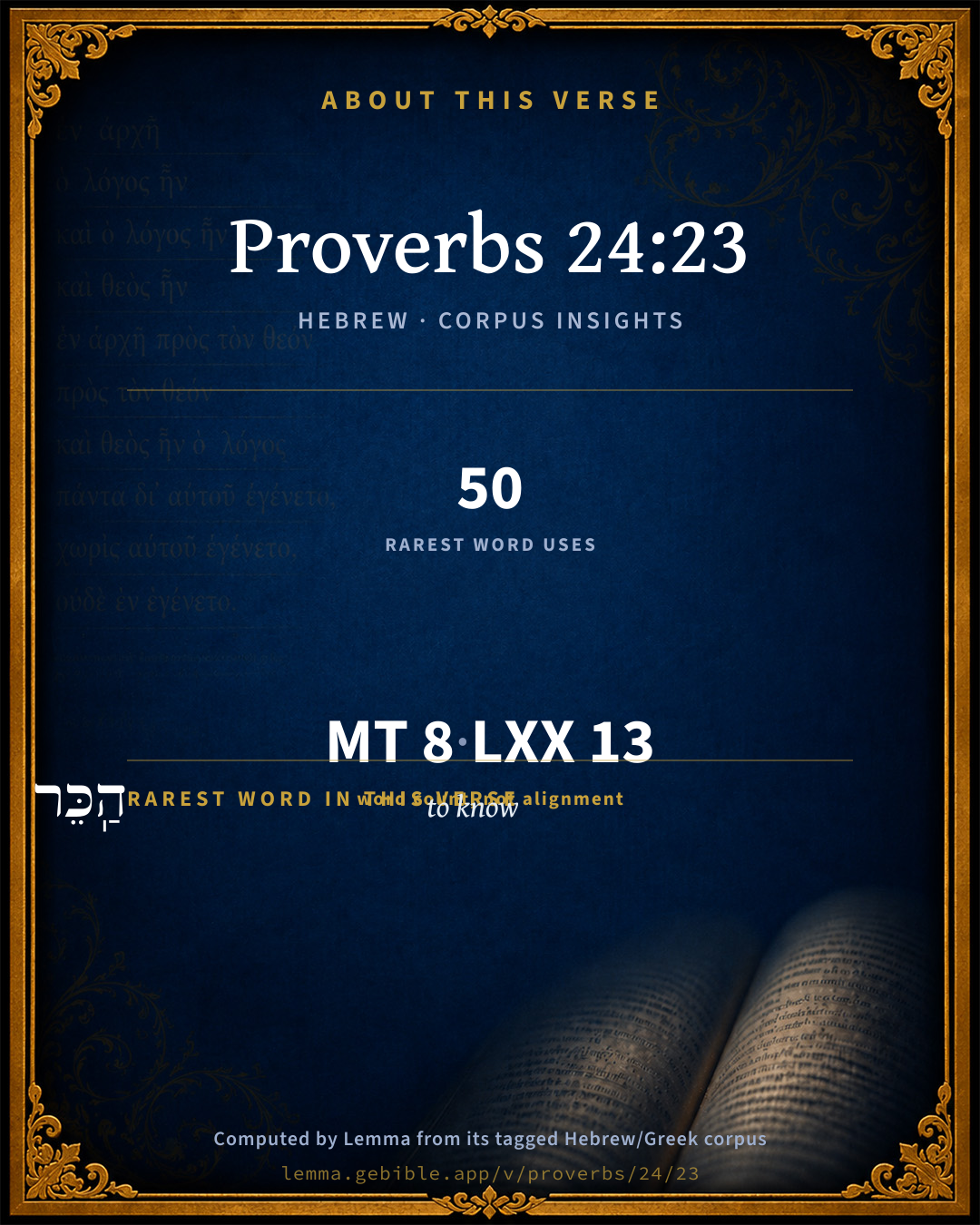
Proverbs 24:23

Hebrew (Westminster Leningrad Codex) Proverbs 24:23 appears in the Hebrew Old Testament. The text above is from the Westminster Leningrad Codex. Each word links to its Strong’s number, a concise gloss, and parsing drawn from the Open Scriptures Hebrew Bible morphology. Click any word for its full Brown-Driver-Briggs (BDB) entry.
Download image
Cite this verse

Proverbs 24:23 (World English Bible). Public Domain. Lemma interlinear Bible study tool, https://lemma.gebible.app/v/proverbs/24/23.

Show BibTeX & RIS
BibTeX
RIS
English Translation
These also are sayings of the wise. To show partiality in judgment is not good.
World English Bible · Public Domain
Download a study sheet

One document with this verse’s original text, its word-by-word gloss line, the meaning frame, cross-references with their text, attributed commentary, and full source and license credits — printable, and it pastes into notes with its structure intact.

This verse Autodidact and up

Study sheet (.html) Plain text (.txt)

A passage Seminary Student

Up to 50 verses in one chapter. A passage sheet keeps up to 6 commentary sources and 12 cross-references per verse, in the order this page ranks them, and says so on the sheet whenever that leaves anything out. Ask for a single verse and you get the Autodidact verse sheet above.

Everything on this page stays free to read, with no account — the sheet is a download of what is already on screen, not access to it.

Want to remove ads? Support Godless Engineer
Compare translations 3

The same verse in 3 English versions, stacked beneath the original-language interlinear above. Click any original word for its lexicon entry.

Each is an independent rendering of the whole verse — the interlinear is not word-aligned to these translations.

Highlighted words mark where these versions differ — a whole-verse word diff, not a word-by-word alignment.

  • World English Bible Public Domain
    These also are sayings of the wise. To show partiality in judgment is not good.
  • King James Version Public Domain
    These things also belong to the wise. It is not good to have respect of persons in judgment.
  • unfoldingWord Literal Text CC BY-SA 4.0
    These also of the wise ones: Recognizing faces in judgment not good.

unfoldingWord Literal Text — © unfoldingWord, licensed CC BY-SA 4.0. Word-aligned USFM3 via Door43 (git.door43.org/unfoldingWord/en_ult).

Versions to compare (up to 4)

3 of 4 selected

Show all 18 translations

Every available English version of this verse, each an independent rendering of the whole verse.

  • World English Bible Public Domain
    These also are sayings of the wise. To show partiality in judgment is not good.
  • Berean Standard Bible Public Domain
    These also are sayings of the wise: To show partiality in judgment is not good.
  • Majority Standard Bible Public Domain
    These also are sayings of the wise: To show partiality in judgment is not good.
  • King James Version Public Domain
    These things also belong to the wise. It is not good to have respect of persons in judgment.
  • American Standard Version (1901) Public Domain
    These also are `sayings' of the wise. To have respect of persons in judgment is not good.
  • Revised Version (1885) Public Domain
    These also are sayings of the wise. To have respect of persons in judgment is not good.
  • Geneva Bible (1599) Public Domain
    ALSO THESE THINGS PERTEINE TO THE WISE, It is not good to haue respect of any person in iudgement.
  • Douay-Rheims (1899) Public Domain
    These things also to the wise: It is not good to have respect to persons in judgment.
  • Young's Literal Translation Public Domain
    These also are for the wise: -- To discern faces in judgment is not good.
  • Literal Standard Version CC BY-SA 4.0
    These are also for the wise: [It] is not good to discern faces in judgment.
  • Unlocked Literal Bible CC BY-SA 4.0
    These also are sayings of the wise. Partiality in judging a case at law is not good.
  • unfoldingWord Literal Text CC BY-SA 4.0
    These also of the wise ones: Recognizing faces in judgment not good.
  • Darby Bible Public Domain
    These things also come from the wise. It is not good to have respect of persons in judgment.
  • World Messianic Bible Public Domain
    These also are sayings of the wise: To show partiality in judgment is not good.
  • Webster's Bible Public Domain
    These things also belong to the wise. It is not good to have respect of persons in judgment.
  • Free Bible Version CC BY-SA 4.0
    These are more sayings of the wise: Showing favoritism when passing judgment is wrong.
  • Bible in Basic English Public Domain
    These are more sayings of the wise: To have respect for a person's position when judging is not good.
  • JPS Tanakh (1917) Public Domain
    These also are sayings of the wise. To have respect of persons in judgment is not good.

Literal Standard Version (2020), Covenant Press — licensed CC BY-SA 4.0. Text via the HelloAO Bible API (eBible.org). Unlocked Literal Bible (unfoldingWord) — licensed CC BY-SA 4.0. Text via the HelloAO Bible API (eBible.org). unfoldingWord Literal Text — © unfoldingWord, licensed CC BY-SA 4.0. Word-aligned USFM3 via Door43 (git.door43.org/unfoldingWord/en_ult). Free Bible Version, Dr. Jonathan Gallagher — licensed CC BY-SA 4.0. Text via the HelloAO Bible API (eBible.org).

Word by word

More ways to search: Search by grammar → Find every occurrence → Compare this word →

Practice this passage: Drill this verse → Learn its vocabulary →

הַֽכֵּר
nâkar
H5234
“to know”
Verb, Hiphil, Infinitive Absolute
Part of Speech
Verb
Stem
Hiphil
Form
Infinitive Absolute
Full BDB Definition

Origin: a primitive root

TWOT: 1368

to recognise, acknowledge, know, respect, discern, regard - (Niphal) to be recognised - (Piel) to regard - (Hiphil) - to regard, observe, pay attention to, pay regard to, notice - to recognise (as formerly known), perceive - to be willing to recognise or acknowledge, acknowledge with honour - to be acquainted with - to distinguish, understand - (Hithpael) to make oneself known - to act or treat as foreign or strange, disguise, misconstrue - (Niphal) to disguise oneself - (Piel) - to treat as foreign (profane) - to misconstrue - (Hithpael) - to act as alien - to disguise oneself
  1. גַּם gam H1571 “also” Particle, Accusative
  2. אֵ֥לֶּה ʼêl-leh H428 “these” Pronoun, Demonstrative, Common, Plural
  3. לַֽחֲכָמִ֑ים châkâm H2450 “to/for · wise” Preposition + Adjective, Adjective, Masculine, Plural, Absolute
  4. פָּנִ֖ים pânîym H6440 “face(s)” Noun, Common, Both, Plural, Absolute
  5. בְּמִשְׁפָּ֣ט mishpâṭ H4941 “in/at · judgment” Preposition + Noun, Common, Masculine, Singular, Absolute
  6. בַּל bal H1077 “not” Particle, Negative
  7. טֽוֹב ṭôwb H2896 “good” Adjective, Adjective, Masculine, Singular, Absolute

About this verse

These counts appear in no published source. They are computed here, from the morphology-tagged text and Lemma’s own curated glosses. What Lemma adds →

8
words
8
distinct lemmas
Wisdom
section

Shared distinctive vocabulary

הַֽכֵּר to know H5234 occurs in 47 verses of the Hebrew Bible. Also found in:

Grammatical profile

  • 1 verb
  • 2 nouns
  • 2 adjectives
  • 1 pronoun
  • 2 particles

Verb forms

  • הַֽכֵּר Hiphil · Infinitive Absolute

Hebrew & Septuagint length

In English translation the verse runs 15 words from the Hebrew and 25 from the Septuagint (LXX English) — the Septuagint runs noticeably longer here. See the side-by-side →

A rough comparison of the two English renderings, which tokenize alike — not a word-level alignment.

Word counts can differ between the Hebrew and the Greek without any difference in meaning — e.g. the Hebrew direct-object marker אֵת has no separate Greek word, and Greek often adds the article ὁ.

In the original languages it is 8 Hebrew tokens and 13 Greek tokens — but the two are counted differently (Hebrew bundles its prefixes and suffixes into one token; the Greek is in lemma form), so that isn’t a like-for-like length.

Cross-references

17

Topical passages linked to Proverbs 24:23 in the Treasury of Scripture Knowledge — connected by theme and wording, ordered by reader-vote popularity; previews shown in the World English Bible.

  • Proverbs 28:21 To show partiality is not good; Yet a man will do wrong for a piece of bread.
  • Proverbs 18:5 To be partial to the faces of the wicked is not good, Nor to deprive the innocent of justice.
  • Leviticus 19:15 "'You shall do no injustice in judgment: you shall not be partial to the poor, nor show favoritism to the great; but in righteousness shall you judge your neighbor.
  • Psalms 107:43 Whoever is wise will pay attention to these things. They will consider the loving kindnesses of Yahweh.
  • John 7:24 Don't judge according to appearance, but judge righteous judgment."
  • James 3:17 But the wisdom that is from above is first pure, then peaceful, gentle, reasonable, full of mercy and good fruits, without partiality, and without hypocrisy.
  • Deuteronomy 1:17 You shall not show partiality in judgment; you shall hear the small and the great alike; you shall not be afraid of the face of man; for the judgment is God's: and the cause that is too hard for you, you shall bring to me, and I will hear it.
  • Deuteronomy 16:19 You shall not wrest justice: you shall not respect persons; neither shall you take a bribe; for a bribe does blind the eyes of the wise, and pervert the words of the righteous.
  • 2 Chronicles 19:7 Now therefore let the fear of Yahweh be on you; take heed and do it: for there is no iniquity with Yahweh our God, nor respect of persons, nor taking of bribes.
  • Psalms 82:2–4 "How long will you judge unjustly, And show partiality to the wicked?" Selah.
  • Proverbs 1:6 To understand a proverb, and parables, The words and riddles of the wise.
  • Hosea 14:9 Who is wise, that he may understand these things? Who is prudent, that he may know them? For the ways of Yahweh are right, And the righteous walk in them; But the rebellious stumble in them.
  • 1 Timothy 5:20–21 Those who sin, reprove in the sight of all, that the rest also may be in fear.
  • 1 Peter 1:17 If you call on him as Father, who without respect of persons judges according to each man's work, pass the time of your living as strangers here in reverent fear:
  • Proverbs 22:17 Turn your ear, and listen to the words of the wise. Apply your heart to my teaching.
  • Ecclesiastes 8:1–5 Who is like the wise man? And who knows the interpretation of a thing? A man's wisdom makes his face shine, and the hardness of his face is changed.
  • James 2:4–6 haven't you shown partiality among yourselves, and become judges with evil thoughts?

Cross-references courtesy of OpenBible.info (CC BY 4.0).

Hebrew and Greek witnesses Masoretic Hebrew ↔ Greek Septuagint

The same verse in the two great witnesses to the Old Testament, shown verse-for-verse.

Here the Septuagint runs noticeably longer than the Hebrew — LXX2012 (modern English Septuagint) 25 words vs World English Bible 15. A rough length comparison of the two English translations, not a word-level alignment — read both below.

These are two independent witnesses, not word-aligned to each other, and the Septuagint is shown in lemma (dictionary) form.

Hebrew Proverbs 24:23 Masoretic · Westminster Leningrad Codex

גַּם אֵ֥לֶּה לַֽחֲכָמִ֑ים הַֽכֵּר פָּנִ֖ים בְּמִשְׁפָּ֣ט בַּל טֽוֹב

These also are sayings of the wise. To show partiality in judgment is not good.

World English Bible · Public Domain

Greek LXX Proverbs 24:23 Septuagint · lemma form

οὗτος δέ λέγω σύ ὁ σοφός ἐπιγιγνώσκω αἰδέομαι πρόσωπον ἐν κρίσις οὐ καλός

And this thing I say to you that are wise for you to learn: It is not good to have respect of persons in judgment.

LXX2012 (modern English Septuagint) · Public Domain

On this verse, Lange's Commentary on the Holy Scriptures discusses the Septuagint’s reading. Read the note in Commentary ↓

Hebrew: Westminster Leningrad Codex (CC BY 4.0). Greek: Septuagint (public domain); English from LXX2012 (modern English Septuagint) (Public Domain). How the Septuagint differs from the Hebrew →

Commentary

Notes on Proverbs 24:23 from classic Christian and Jewish commentators (each source and its license shown beneath its notes). The classic Christian expositions comment on the surrounding passage and are grouped to its opening verse, so a note may address several verses; the Jewish commentaries on the Tanakh (Rashi and others) are per-verse, so they appear only where the commentator wrote on this verse.

Lemma curates 59 commentaries, every one of them public domain or Creative Commons licensed, each selected and text-cleaned for this edition rather than reprinted as found. About our sources →

Ellicott's Commentary for English Readers

6. SECOND APPENDIX TO “THE PROVERBS OF SOLOMON,” CONTAINING PROVERBS OF VARIOUS LENGTHS, RESEMBLING Pro_1:7—9:18, AND THE BOOK OF ECCLESIASTES (Pro_24:23-34).

(23) These things also belong to the wise—i.e., have the wise for their authors. (Comp. Pro_1:6; Pro_22:17.)

A Bible Commentary for English Readers, edited by Charles John Ellicott (1878–1897) — public domain. Text from a community e-Sword module.

The Cambridge Bible for Schools and Colleges

gen. ed. J. J. S. Perowne

IV. Third Collection of Proverbs. Chap. Pro_24:23-34

A short Collection resembling in character the Second Collection, to which it forms a kind of Appendix.

23. These things also belong to] Rather, These also are sayings of, R.V. Comp. Pro_22:17. The Heb. preposition is the same as indicates authorship in the Titles of many of the Psalms.

The Cambridge Bible for Schools and Colleges (gen. ed. J. J. S. Perowne; Cambridge University Press, 1878–1918) — public domain. Text from a community e-Sword module.

Trapp's Complete Commentary

John Trapp

Pro 24:23 These [things] also [belong] to the wise. [It is] not good to have respect of persons in judgment.

Ver. 23. These things also belong to the wise.] As subjects must know their duties, so magistrates theirs; neither may they hold themselves too wise to learn. God can send even a Solomon to school to the raven, to the pismire, yea, to the lilies of the field, as being able to teach the wisest man by the weakest creature.

It is not good to have respect of persons.] Heb., To know faces; to regard not so much the matter as the man; to hear persons speak, and not causes; to judge not according to truth and equity, but according to opinion and appearance - to fear or favour. This cannot be good, lawful, or safe. "He will surely" (or thoroughly) "reprove you," (not verbally only, but penally too) "if you secretly accept persons." {Job 13:10} Of Trajan it is said that he neither feared nor hated any man, but that he heard the causes of his subjects without prejudicate impiety, judiciously examined them without sinister obliquity, and sincerely judged them without unjust partiality.

John Trapp, A Commentary or Exposition upon All the Books of the Old and New Testament (1647–1656) — public domain. Text from a community e-Sword module.

The Biblical Illustrator

Joseph S. Exell

Pro_24:23-26

These things also belong to the wise.

Social conduct

I. Here is partiality of judgment; that is bad. It is no good to have respect of persons in judgment. The principle of impartiality is enjoined both in the Old and the New Testament. In the Old, Ye shall do no unrighteousness in judgment; thou shalt not respect the person of the poor, nor honour the person of the mighty; but in righteousness shalt thou judge thy neighbour. In the New Testament we have these words, My brethren, have not the faith of our Lord Jesus Christ, the Lord of glory, with respect of persons, etc. (Jam_2:1-9).

II. Here is flattery of the wicked, which is execrable. He that saith unto the wicked, Thou art righteous, him shall the people curse; nations shall abhor him. If the wicked man be great in wealth, exalted in social influence and political power, there is a wondrous tendency in all the grades below to flatter him as a righteous man.

III. Here is reproving of the wrong, which is blessed. But to them that rebuke him shall be delight, etc.

1. There is a delight in such work. To them that rebuke him shall be delight. What is the delight? The delight of an approving conscience.

2. There is Divine favour in such work. A good blessing shall come upon you. God will express His favour to such a man in many ways.

3. There is social approbation in such work. Every man shall kiss his lips that giveth the right answer. (Homilist.)

The Biblical Illustrator, edited by Joseph S. Exell (c. 1880s–1900s) — public domain. Text from a community e-Sword module.

Joseph Benson's Commentary

Pro 24:23-26. These things also, &c. — These words seem to be a new title to the proverbs which follow to the end of the chapter, and Calmet, Grotius, Grey, and some others, are of opinion the meaning is, that these proverbs were selected from the books of the wise men who lived after Solomon, to the time of Hezekiah. But it seems more probable that this short preface is only and simply intended to signify that the proverbs or counsels here following, no less than those before mentioned, are worthy of the consideration and fit for the use of those who are or would be wise; or, that they belong to the wise and virtuous conduct of life. It is not good to have respect of persons in judgment — This is the first of these counsels; which expresses that it is a very evil thing for judges to determine controversies by partiality, according to the quality of the persons, and not according to the merits of the cause. He that saith unto the wicked — Namely, publicly and in judgment; Thou art righteous — That is, he that justifies wicked men in their unrighteous practices; nations shall abhor him — Partly for the grossness and odiousness of the crime; and partly for the great and general mischief which such proceedings bring on civil societies. But to them that rebuke him — That publicly and judicially rebuke and condemn the wicked; shall be delight — The peace of a good conscience; and a good blessing shall come upon them — Which the people shall wish, and by their prayers obtain from God for them. This is fitly opposed to the people’s curse in the last verse. Every man shall kiss his lips — Shall respect and love him, of which kissing the lips was a sign. That giveth a right answer — That speaks pertinently, and plainly, and truly, to the conviction and satisfaction of the hearers.

Joseph Benson's Commentary on the Old and New Testaments (1811–1818) — public domain. Text from a community e-Sword module.

The Preacher's Complete Homiletical Commentary

Joseph S. Exell (gen. ed.)

CRITICAL NOTES.—

Pro_24:23. These things also belong to the wise. Rather “These (the proverbs which follow) are also from wise men” The word also connects this introduction with that in chap. Pro_22:17.

Pro_24:25. To them that rebuke, etc. The word him is not in the original, and spoils the sense. If this rendering of the verb is accepted, iniquity must be understood to be the subject of rebuke. Delitzsch however reads, “To them who rightly decide,” and Miller renders, “To them that set the thing right.”

Pro_24:26. A right answer, i.e., a faithful, straightforward answer. “The word comes,” says Miller, “from a verb meaning to be in front.” “The mention of the lips,” Zöckler remarks, “is to be explained simply by the remembrance of the question to which the upright and truthful answer corresponds.”

MAIN HOMILETICS OF THE PARAGRAPH.—Pro_24:23-26

IMPARTIALITY OF TRUTH

I. Two blessings to society. While there is nothing that more certainly undermines the moral tone of any community than that “respect of persons” which the Bible so emphatically and constantly condemns (Lev_19:15; Jas_2:1), there is no person who more contributes to the welfare of society, and contributes more to its well-being than the man who judges all men by the same standard, viz., their character. It is especially indispensable that those who are set apart to administer the laws of the land should be men above all suspicion of partiality. For, wherever there is a code of law, it is a testimony to that inborn sense of justice which is more or less active in every human being; and although it may sometimes be but an imperfect attempt to render to every man his right, if it is administered by men of integrity it is one of the greatest bulwarks of national prosperity and security. It may well be a matter of thankfulness to every Englishman that the judicial bench of this land occupies the high position that it does in this respect as in all others, and that the days when men thought it possible to use unlawful influence with an English judge have passed away. But to what do we owe this blessing, if not to the greater hold which the principles of the Bible has upon our national life? But Solomon brings before us another character which is as necessary to a nation’s moral health, which is, perhaps, rarer than the first, but which might and ought to belong to every man. Those who are called to sit in judgment are the few, but those who in various ways are called to bear witness concerning persons and things, are the many. And some who would deem it a crime to have respect of persons in judgment, do not realise how much the cause of truth and righteousness would be furthered if men, in their every-day intercourse, would give a “right or straightforward answer” (see rendering in Critical Notes) to the questions put to them. If it was the habit of merchants and statesmen, of masters and servants, in the market and in the social circle, to speak the “truth, the whole truth, and nothing but the truth,” how much purer would be the moral atmosphere which we breathe, and how much more nearly would society on earth be like that of heaven.

II. The recognition which such characters receive from their fellow-men. In a world where the unrighteous far outnumber the righteous, and where most men are but half loyal to truth, it is remarkable that it should be so. But history in general and individual experience in particular bears witness that Solomon was right. Even unrighteous men cannot help admiring a just and truthful man, and their consciences and their experience combine to testify that they themselves have more to hope from those who are morally above them than from those who are on a level with themselves. It is probable that both moral sense and self-interest combine to bring people as a whole to bless him who rebukes the wicked and to “kiss his lips” who giveth a right answer.

OUTLINES AND SUGGESTIVE COMMENTS

Pro_24:26. The meaning of that ceremony of kissing him that was anointed to be king, St. Gregory giveth to be this, that it was to teach him that was so kissed that God hath brought him to that dignity, to the end that he might make peace between God and his people that were under him, whereof a kiss is a sign and pledge. For by sinning we procure the enmity of God, when therefore a ruler is set up for the correction of sinners, thereby is taken away that which made us enemies to God. If, therefore, we read this verse as the English doth, we may understand it that everyone shall acknowledge him to be a peacemaker between God and them, who by right judgment punisheth the wicked.—Jermin.

The Preacher's Complete Homiletical Commentary (gen. ed. Joseph S. Exell; Funk & Wagnalls, c. 1892) — public domain (pre-1929). A full-Bible homiletical/sermon-outline anthology covering 65 of 66 books (2 John is absent from the source module). Text from a community e-Sword module.

Lange's Commentary on the Holy Scriptures

Second Supplement

Pro_24:23-34

a) Various admonitions to good conduct toward one’s neighbors

Pro_24:23-29

23          These also are from wise men.

To be partial in judgment is not good.

24     He that saith to the wicked, “ thou art righteous,”

him the people curse, (and) nations execrate;

25     but to them that rebuke (iniquity) it is well,

and upon them shall come a rich blessing.

26     He kisseth the lips

who giveth a right answer.

27     Set in order thy work without,

and make it ready for thyself in the field;

afterward build thine house.

28     Be not witness against thy neighbor without cause;

and wilt thou deceive with thy lips?

29     Say not: “As he hath done to me so will I do to him:

I will requite the man according to his work.”

b) Warning against indolence and its evil consequences

Pro_24:30-34

30     By the field of a slothful man I passed along,

and by the vineyard of a man void of understanding.

31     And, lo! it was all grown over with thorns,

briars covered the face thereof,

and its stone wall was broken down.

32     Then I looked and fixed my attention;

I saw and took (to myself) instruction.

33     “ A little sleep, a little slumber,

a little folding of the hands to sleep;”—

34     then cometh thy poverty apace,

and thy want as an armed man!

GRAMMATICAL AND CRITICAL

Pro_24:23. בַּל is equivalent to לֹא, as in 22:29; 23:7, etc.

Pro_24:27. [The Perf. with ו consec. וּבָנִיתַ is used, as this tense so construed not unfrequently is, in the sense of an Imperative: and afterward thou hast built, etc.; predictions and injunctions sometimes taking this way of expressing an assurance that what should be will be. See Bött. §§ 977, 3; 981, 3: Green, § 265, b; Ewald, Lehrb. 332, b.—A.]

Pro_24:28. [A Perf. with ו consec. to express what ought to be,—a suggestion rather than a precept,—Böttcher’s Fiens debitum, § 981, b. γ.] וַהֲפִתִּיתָ. Because the interrogative particle occurs only in this instance immediately after the copula, Ewald proposes to change the form to וְהִפְתֵּיתָ, “and thou wilt open wide,” i.e. betray (comp. 20:19), [so Fuerst]; Hitzig, however, into וַהֲפִתּוֹתָ, “and thou wilt whisper,” i.e. speak with subdued voice (from a form הֵפֵת, to be explained in accordance with the Arabic); [so Bött., making it a Hiph. from פָּתַת and not a Piel from פָּתָה]. Both are alike arbitrary and unnecessary. [K., Bertheau, S. and M. take our author’s view].

Pro_24:31. [כָּסּוּ, a Pual with Kamets Hhatuph; see Green, § 93, a; הְרַלֻּים one of two examples in which וּ in the ultima gives place in forming the plural to ־ with a doubled vowel. Green, 291, c.—A.]

EXEGETICAL

1. Pro_24:23-25. Warning against a partial administration of justice—These also are from wise men. According to the LXX, Vulg., Michaelis, Umbreit, Elster, etc., the לַחֲכָמִים should be understood “ for the wise.” [So the E. V., which is followed by Holden]. In opposition to this we have not merely the usual meaning of the preposition in superscriptions, but over and above this we have the “also,” which: refers back to the next preceding collection of: proverbs, whose originating with wise men was: expressly emphasized, Pro_22:17.—To be partial in judgment is not good: strictly: to distinguish persons in judgment is not good. This short proverb, forming only a single clause, is plainly nothing but a preliminary observation or introduction to the two following verses, which treat more fully of partiality in dispensing justice. Compare, furthermore, the quite similar, and almost literally identical sentences, 18:5 and 28:21.

Pro_24:24. He that saith to the wicked, “Thou art righteous.” Comp. Pro_17:15 : “He that justifieth the wicked.” To the threatening intimation of God’s displeasure there given, there corresponds here the threat of a condition in which one is hated and cursed on the part of the nations (comp. 11:26; 22:14); for to turn justice into injustice by partiality in judgment impairs the well-being of entire nations and states.

Pro_24:25. But to them that rebuke (iniquity) it is well; i.e.,. upright judges who punish evil-doers according to their desert (not merely with words but also with stringent disciplinary enactments), instead of the curse of men, obtain as a reward nothing but blessing and welfare from God.

2. Pro_24:26-29. Four additional admonitions to righteous conduct toward one’s neighbors.—He kisseth the lips that giveth a right answer; i.e.,. faithful and truthful answers, especially before a court of justice, affect one as favorably as the most agreeable caress, or a sweet kiss on the lips. The mention of the “ lips” is to be explained simply by the remembrance of the question to which the upright and truthful answer corresponds. The author of the proverb passes wholly by the fact that hearing is the appropriate organ for the reception of the answer. Therefore Hitzig’s conception of the first clause, which differs from the common one: “He commends (ingratiates) himself with the lips who,” etc., is plainly unnecessary. [Bertheau, Kamph., De W., N., etc., agree in our author’s construction and conception; while the E. V., Muffet, H., S., M., etc., understand the allusion to be to tributes of love and honor paid to him who answers rightly: “Every man (or, the people) shall kiss his lips.” According to this view the people’s curse (in Pro_24:24) is contrasted with their respectful and loving salutation; according to the other, which is grammatically simpler and probably to be preferred, the offence given by the partial or partisan judge is contrasted with the cheering, soothing power of him who answers rightly.—A.]

Pro_24:27. Set in order thy work without; i.e.,. take care, by the profitable and diligent prosecution of your labors in the field, first of all for the needful and reliable support of your existence; then you may go on to the building up of your establishment. The “house” in clause c, is thus doubtless equivalent to “family, domestic establishment,” as in Rth_4:11; comp. above, Pro_14:1. The literal rendering given by Hitzig and others to this phrase, “build thy house,” seems less appropriate, although Biblical parallels might be adduced for this also, e.g. the passage Luk_15:28, which in its moral bearing is certainly kindred.

Pro_24:28. Be not witness against thy neighbor without cause. “Without cause,” i.e.,. without an actual reason, without necessity; comp. 23:29; 26:2; Joh_15:25, etc. It is not so much a false witness that is meant, as one not called for, one who is incited to say injurious things by nothing beyond his own animosity.—And wilt thou deceive with thy lips? See Critical notes for various constructions of the verb. With regard to the expression “deceive with thy lips,” comp. Psa_78:36; “and they did flatter him with their mouth.”

Pro_24:29. Say not, “As he hath done to me so will I do to him.” We can hardly find here (with Hitzig, who follows several of the earlier expositors) a special connection between this verse and the preceding, as though the man who had been wronged by the officious witness were here introduced as speaking, and a warning were given him against allowing free course to his revenge. Comp. rather the similar thought in Pro_20:22, which like this stands quite isolated.

3. Pro_24:30-34. The vineyard of the slothful: a narrative in form closely resembling the parable. Comp. Isa_5:1 sq., as well as the passages which correspond still more closely with the form of this narration, Job_5:3 sq.; Psa_37:35 sq.—By the field of a slothful man I passed along. The figure of the field is in the sequel entirely dropped, from a preference for the closely related one of the vineyard. The “man void of understanding” in clause b, is naturally another sluggard, one who is indolent from lack of understanding.

Pro_24:31. And lo! it was all grown over with thorns [lit., “it came up all of it thorns”] (comp. the same word in Isa_34:13, which is there also translated in the Vulg. by the term urticæ), brambles covered the face thereof (הֲרֻלִּים, lit., “what one may not touch, things not to be approached” [Fuerst, “stinging, burning things,” nettles, e.g.], is an accusative subordinate to the verb in the Pual), and its stone wall (lit., “its wall of stones”) was broken down. All these features are found also in the parable of the vineyard in Isaiah, which has been already cited, Isa_5:5-6; comp. likewise Psa_80:13-14. [Travellers like Hackett (Illustrations of Scripture) call attention to the minute accuracy of the description as illustrated by the fact, that in the richer soils of Palestine it is thorny shrubs, of which twenty-two kinds are enumerated, that are specially quick to spring up and overspread a neglected field.—A.]

Pro_24:32. Then I looked. Hitzig proposes to read וָאֹחֲזָה instead of וָאֶחֱזֶה (comp. 2Sa_4:10): “and I stopped” (from the intransitive verb אָהַז, sistere, to stand still). But the ordinary reading is abundantly confirmed by the parallel in clause b. [Kamph. calls attention to the introduction of the pronoun, as an element in the graphic fullness of the poet’s description of his meditation.—A.]—I saw and took (to myself) instruction, lit., “a correction or reproof.” What was contained in this admonition is expressed in what follows.

With Pro_24:33-34 comp. the almost literally identical verses 10 and 11 of chap. 4, and the Exeg. notes there (p. 84), where the meaning of the divergent reading was also discussed.—And thy want: lit., “and thy wants,” i.e.,. thy deficits, thy pecuniary embarrassments, on account of which now one thing and then another fails.

DOCTRINAL, ETHICAL, HOMILETIC AND PRACTICAL

Righteous treatment of one’s neighbor, and a prudent active industry in the discharge of duties to ourselves, are the two points to which the admonitory import of this section may be reduced, and in a way quite exhaustive. For as Pro_24:23-29, all of them with the sole exception of Pro_24:28 admonish to a strictly just and honorable bearing in intercourse with others, so not merely that 28th verse, but also the parabolic narrative in Pro_24:30-34, relates to the vice of sloth and an indolent carelessness in the performance of the domestic duties of one’s calling. The general substance of this short section therefore bears a resemblance, at least partial, to that of the 6th chapter (which is indeed much richer in its fullness). In attempting to obtain from it a central idea for homiletic use, we should be obliged to proceed as we did in that instance (comp., above, p. 87). [With reference to Pro_24:29 in particular (comp. what is said above on Pro_24:11-12), Dr. Chalmers says: It is pleasant to observe the outgoing of the earlier morality towards the later and more advanced—of that in the Old towards that in the New Testament.—A.] Therefore as a homily on the whole: Neither injustice nor faithlessness toward one’s neighbor, nor want of fidelity in the fulfilment of one’s own domestic duties, brings a blessing.—Or, Honorable conduct in relation to others is possible only on the basis of the industrious and conscientious performance of the duties of one’s own calling.

Pro_24:23-25. Starke: An unjust judge loads himself with sighs which God also hears; a righteous judge, on the contrary, will surely enjoy at the same time the blessing and the intercession of the pious.—Wohlfarth: The blessing of a wise severity in the State (in the administration of the laws).

Pro_24:26-29. Geier (on Pro_24:26): If thou meanest to deal fairly with thine own soul, then rejoice heartily in good counsel given from the word of God; though it be disagreeable to the flesh, yet it is like a precious balsam (Psa_141:5).—Starke (on Pro_24:27): He who with all his carefulness in attention to his occupation yet forgets the one thing needful, builds his house on the sand, because in the midst of all outward prosperity he still suffers injury in his soul.—(On Pro_24:29): If thou wouldst be really like God as His child, then follow Him in compassion and leave the right of vengeance to Him alone: Lev_19:18; Rom_12:17 sq.

Pro_24:30-34. Starke: Indolence is extremely injurious to the Christian life. If one does not do good with earnestness and diligence, evil surely gains more and more the ascendency, and in all conditions, in Church and State and in domestic life, want and labor are multiplied as the result of neglect of official duty on the part of the servants and stewards instituted by God.—Wohlfarth (on Pro_24:32): To become wise on the follies of others is in fact an excellent prudence.—[Arnot: Even the sluggard’s garden brought forth fruit—but not for the sluggard’s benefit. The diligent man reaped and carried off the only harvest that it bore—a warning.—J. Foster; Lecture on Practical Views of Human Life. Let it never be forgotten in any part of the process that the efficacy of the instruction must be from the Supreme Teacher; without Him, the attraction and assimilation of the evil would, after all, be mightier than its warning and repelling force].

Lange's Commentary on the Holy Scriptures (Critical, Doctrinal, and Homiletical), ed. John Peter Lange, English translation edited by Philip Schaff (1864–1880) — public domain. Text from a community e-Sword module.

Tyndale Open Study Notes

Tyndale Open Resources

24:23-34 This addendum to the thirty sayings of the wise (22:17–24:22) includes five further sayings.

24:23-25 Saying 1: Truthfulness in rendering judgment is a hallmark of wisdom (see 6:19; 12:17; 19:28; 24:28-29; 25:18).

Tyndale Open Study Notes — © Tyndale Open Resources, licensed CC BY-SA 4.0. Text via the HelloAO Bible API.

Geneva Bible (1599)

Geneva Bible translators

Hebrew, to know the face.

Geneva Bible (1599) marginal notes — public domain. Text via Bolls.life.

Matthew Henry's Commentary

Here are lessons for wise men, that is, judges and princes. As subjects must do their duty, and be obedient to magistrates, so magistrates must do their duty in administering justice to their subjects, both in pleas of the crown and causes between party and party. These are lessons for them. 1. They must always weigh the merits of a cause, and not be swayed by any regard, one way or other, to the parties concerned: It is not good in itself, nor can it ever do well, to have respect of persons in judgment; the consequences of it cannot but be the perverting of justice and doing wrong under colour of law and equity. A good judge will know the truth, not know faces, so as to countenance a friend and help him out in a bad cause, or so much as omit any thing that can be said or done in favour of a righteous cause, when it is the cause of an enemy. 2. They must never connive at or encourage wicked people in their wicked practices. Magistrates in their places, and ministers in theirs, are to deal faithfully and the wicked man, though he be a great man or a particular friend, to convict him of his wickedness, to show him what will be in the end thereof, to discover him to others, that they may avoid him. But if those whose office it is thus to show people their transgressions palliate them and connive at them, if they excuse the wicked man, much more if they prefer him and associate with him (which is, in effect, to say, Thou art righteous), they shall justly be looked upon as enemies to the public peace and welfare, which they ought to advance, and the people shall curse them and cry out shame on them; and even those of other nations shall abhor them, as base betrayers of their trust. 3. They must discountenance and give check to all fraud, violence, injustice, and immorality; and, though thereby they may disoblige a particular person, yet they will recommend themselves to the favour of God and man. Let magistrates and ministers, and private persons too that are capable of doing it, rebuke the wicked, that they may bring them to repentance or put them to shame, and they shall have the comfort of it in their own bosoms: To them shall be delight, when their consciences witness for them that they have been witnesses for God; and a good blessing shall come upon them, the blessing of God and good men; they shall be deemed religion's patrons and their country's patriots. See Pro 28:23. 4. They must always give judgment according to equity (Pro 24:26); they must give a right answer, that is, give their opinion and pass sentence according to law and them true merits of the cause; and every one shall kiss his lips that does so, that is, shall love and honour him, and be subject to his orders, for there is a kiss of allegiance as well as of affection. He that in common conversation likewise speaks pertinently and with sincerity recommends himself to his company and is beloved and respected by all.

Matthew Henry's Commentary on the Whole Bible (1708–1710) — public domain (CC PDM 1.0). Text via the HelloAO Bible API.

Jamieson, Fausset & Brown

Robert Jamieson, A. R. Fausset & David Brown

These . . . wise--literally, "are of the wise," as authors (compare "Psalms of David," Hebrew). "These" refers to the verses following, Pro 24:24-34.

to have respect--literally, "to discern faces," show partiality,

Jamieson, Fausset & Brown — Commentary Critical and Explanatory on the Whole Bible (1871) — public domain (CC PDM 1.0). Text via the HelloAO Bible API.

Adam Clarke's Commentary

Verse 23. These things also belong to the wise.] גם אלה לחכמים gam elleh lachachamim, "These also to wise." This appears to be a new section; and perhaps, what follows belongs to another collection. Probably fragments of sayings collected by wise men from the Proverbs of Solomon.

It is not good to have respect] Judgment and justice should never be perverted.

Adam Clarke's Commentary on the Bible (1810–1826) — public domain. Text from a community e-Sword/MySword module.

John Gill's Exposition

He that saith unto the wicked, Thou art righteous,.... Not in a private way, or as giving his opinion or character of a man that is wicked, whom either through ignorance or flattery another may call righteous; which may be done and not resented by people and nations; but in an open court of judicature pronounced by the judge, justifying the wicked for reward, and condemning the just, which is an abomination unto the Lord; see Pro 17:15; nor should the ministers of the Gospel flatter the wicked, and call them righteous and good men, and strengthen their hands in their wickedness, promising them life though they continue in their evil ways; for though God justifies the ungodly, man should not; nor does he justify them in, but from, their ungodliness; see Eze 13:2;

him shall the people curse, nations shall abhor him; the people of the land shall curse him as an unjust judge, as a patron of wickedness aunt wicked men; as an enemy to justice, and a discourager of truth and honesty, and all good men; and even nations that have not so immediate a concern in the affair, yet hearing of it shall express their indignation at him and abhorrence of him.

John Gill's Exposition of the Whole Bible (1746–1763) — public domain (CC PDM 1.0). Text via the HelloAO Bible API.

Albert Barnes' Notes on the Bible

Belong to the wise - Either “are fitting for the wise, addressed to them,” or (as in the superscriptions of many of the Psalms) “are written by the wise.” Most recent commentators take it in the latter sense, and look on it as indicating the beginning of a fresh section, containing proverbs not ascribed to Solomon’s authorship. Compare the introduction to Proverbs.

Albert Barnes' Notes on the Bible (1834–1885) — public domain. Text from a community e-Sword/MySword module.

Haydock's Catholic Bible Commentary

These. Septuagint have an addition, and then our chap. xxx. to ver. 15., after which follows the remainder of this chap. and then the ten first verses of the 31st. (Haydock) --- Solomon here resumes the sententious style, chap. xxii. 17. (Calmet)

George Leo Haydock (1774–1849), Haydock's Catholic Family Bible and Commentary, 1859 edition — public domain. Excludes Psalms (Douay-Rheims chapter numbering differs from Protestant) and Deuterocanonical books (Catholic canon only).

Matthew Poole's English Annotations

These things also, these proverbs or counsels here following to the end of the chapter, no less than those hitherto mentioned,

belong to the wise; are worthy of the consideration, and fit for the use, of them who are or would be wise; for only such are capable of understanding and improving these proverbs, as was noted, Pro 1:5-7, and elsewhere. To have respect of persons in judgment; for judges to determine controversies partially, according to the quality of the persons, and not according to the merits of the cause.

Matthew Poole's English Annotations on the Holy Bible (1683–1685) — public domain. Text from a community e-Sword/MySword module.

Whedon's Commentary on the Bible

Daniel D. Whedon

23. Belong to the wise — Or, are the words of the wise.

Respect of persons — Literally, to recognise faces. This is a precept especially suited to magistrates. Such are not to favour a man because of friendship or influential position, but must deal out justice impartially. This is almost identical with Pro_18:5 and Pro_28:21; Lev_19:15; Deu_1:17; Joh_7:24.

Daniel D. Whedon (gen. ed.), Commentary on the Old and New Testaments (1874–1909) — public domain. Text from a community e-Sword module.

The Pulpit Commentary

Vers. 23-34. Part V A SECOND COLLECTION, forming a second supplement to the first Solomonic book, and containing further "words of the wise.

Vers. 23-25. Partiality and impartiality a hexastich.

These things also belong to the wise; are the sayings of wise men. The following proverbs, as well as the preceding, are derived from wise men. Mistaking this superscription, the LXX makes it a personal address: "This I say to you who are wise, so that ye may learn." The first line is not a proverb, but the introduction to the ensuing collection. It is not good to have respect of persons in judgment. (see Pro_18:5, and note there; and Pro_28:21, where the expression is the same as here) To regard one person before another is to be partial and unjust. To say this error is "not good" is a meiosis, the meaning being that it is very evil and sinful. (comp. Pro_20:23) The statement is developed and confirmed in the next two verses, which show the results of partiality and its opposite.

Vers. 23-25. Partiality and equality in judgment.

I RESPECT OF PERSONS. The literal translation is, "To distinguish persons in judgment is not good." The judge should be impartial as the pair of scales, the emblem of his office, and blind to the persons who appear before him, that is, to their rank and position, as the symbolical figure of Justice is represented to be. "One foul sentence doth more hurt than many foul examples; these do but corrupt the stream, the other corrupteth the fountain.

II THE WILFUL PERVERSION OF RIGHT. (Ver. 24) When the just man is suffered to fail in his cause before his adversary, the very nerve of public right is unstrung. It strikes a direct blow at the common weal, and hence brings down the curses of peoples and the enmity of states.

III EQUAL AND JUST JUDGMENT. (Ver. 25) "A judge ought to prepare his way to a just sentence, as God useth to prepare his way, by raising valleys and taking down hills; so when there appeareth on either side a high hand, violent persecution, cunning advantages taken, combination, power, great counsel, then is the virtue of a judge seen to make inequality equal; that he may plant his judgment as upon an even ground" (Bacon). In the present text the glance is towards a proper and due severity, which will not allow the wicked to escape. "Odium may equally be incurred by him who winks at crime and by him who has no regard to mercy. For in causes of life and death, judges ought, as far as the law permits, in justice to remember mercy, and to cast a severe eye upon the example, but a merciful eye upon the person" (Bacon). The purity of the judicial bench is one of the greatest of public blessings. Let us be thankful that we enjoy it in our country, and pray that it may ever continue. J.

The Pulpit Commentary (1880–1919), ed. H.D.M. Spence-Jones & Joseph S. Exell — public domain. Text from a community e-Sword module.

John Wesley's Explanatory Notes

These - The counsels following, to the end of the chapter, no less than those hitherto mentioned, are worthy of their consideration.

John Wesley, Explanatory Notes Upon the Whole Bible (1754–1765) — public domain. Text via the GEBible commentary corpus.

Keil & Delitzsch

C. F. Keil & F. Delitzsch

The curse of partiality and the blessing of impartiality:

Respect of persons in judgment is by no means good:

24 He that saith to the guilty, "Thou art in the right,"

Him the people curse, nations detest.

25 But to them who rightly decide, it is well,

And upon them cometh blessing with good.

Partiality is either called שׂאת פנים, Pro 18:5, respect to the person, for the partisan looks with pleasure on the פני, the countenance, appearance, personality of one, by way of preference; or הכּר־פּנים, as here and at Pro 28:21, for he places one person before another in his sight, or, as we say, has a regard to him; the latter expression is found in Deu 1:17; Deu 16:19. הכּיר (vid., Pro 20:11) means to regard sharply, whether from interest in the object, or because it is strange. בּל Heidenheim regards as weaker than לא; but the reverse is the case (vid., vol. i. p. 204), as is seen from the derivation of this negative (= balj, from בּלה, to melt, to decay); thus it does not occur anywhere else than here with the pred. adj. The two supplements delight in this בל, Deu 22:29; Deu 23:7, 35. The thesis 23b is now confirmed in Pro 24:24 and Pro 24:25, from the consequences of this partiality and its opposite: He that saith (אמר, with Mehuppach Legarmeh from the last syllable, as rightly by Athias, Nissel, and Michaelis, vid., Thorath Emeth, p. 32) to the guilty: thou art right, i.e., he who sets the guilty free (for רשׁע and צדּיק have here the forensic sense of the post-bibl. חיּב and זכּי), him they curse, etc.; cf. the shorter proverb, Pro 17:15, according to which a partial, unjust judge is an abomination to God. Regarding נקב (קבב) here and at Pro 11:26, Schultens, under Job 3:8, is right; the word signifies figere, and hence to distinguish and make prominent by distinguishing as well as by branding; cf. defigere, to curse, properly, to pierce through. Regarding זעם, vid., at Pro 22:14. עמּים and לאמּים (from עמם and לאם, which both mean to bind and combine) are plur. of categ.: not merely individuals, not merely families, curse such an unrighteous judge and abhor him, but the whole people in all conditions and ranks of society; for even though such an unjust judge bring himself and his favourites to external honour, yet among no people is conscience so blunted, that he who absolves the crime and ennobles the miscarriage of justice shall escape the vox populi. On the contrary, it goes well (ינעם, like Pro 2:10; Pro 9:17, but here with neut. indef. subj. as ייטב, Gen 12:13, and frequently) with those who place the right, and particularly the wrong, fully to view; מוכיח is he who mediates the right, Job 9:33, and particularly who proves, censures, punishes the wrong, Pro 9:7, and in the character of a judge as here, Amo 5:10; Isa 29:21. The genitive connection ברכּת־טוב is not altogether of the same signification as יין הטּוב, wine of a good sort, Sol 7:10, and אושׁת רע, a woman of a bad kind, Pro 6:24, for every blessing is of a good kind; the gen. טוב thus, as at Psa 21:4, denotes the contents of the blessing; cf. Eph 1:3, "with all spiritual blessings," in which the manifoldness of the blessing is presupposed.

Keil & Delitzsch — Biblical Commentary on the Old Testament (1861–1891) — public domain (CC PDM 1.0). Text via the HelloAO Bible API. (Old Testament only.)

Bridges on Proverbs

Charles Bridges

We have had a solemn exhortation to the people. (Num 16:29-33 .) We have now a word to the wise, specially to those in authority. God has given many laws against respect of persons in judgment.†1 It is not good.†2 Nay — rather he rebukes it as an hateful abomination.†3 Let truth be considered, not favor. This is an evil in the Church, as much as in the State. No responsibility is more momentous in our sacred high places, than "doing nothing by partiality."†4 Man, corrupt as he is, often abhors unrighteous judgment.†5 A bad magistrate deprives us of the blessing of good laws.

On the other hand, there is no greater national blessing, than a government rebuking the wicked.†6 This was a part of Job’s God-fearing character.†7 The good blessing that came upon Nehemiah’s upright administration is abundantly manifest.†8 Indeed generally every one will kiss — pay the homage of love and respect†9 — to him who giveth a right answer in judgment. He is a public treasure; "a blessing in the midst of the land." Is not then the responsibility of rulers, and the welfare of thousands depending on them, a quickening impulse to prayer? And may not our want of "godly quietness" be traced to this neglect? (1Ti 2:1-2 .

But we are not rulers. Yet are not many of us in authority — Parents — Heads of Families — Teachers and Guardians of the young? Uprightness and consistency alone can maintain that influence so essential to usefulness. For a spiritual ruler to say to the wicked — Thou art righteous, is indeed perfidious dealing with his Divine Master; cruel deceit to immortal souls; hiding the ruin, which he is bound to reveal; acting the part of a minister of Satan under the cover of a minister of Christ. His people will live to curse and abhor him, perhaps throughout eternity. Even the very people that hate both his Master and his message, will kiss his lips that giveth a right answer — a reluctant but honorable witness to his faithfulness.

Footnotes:

†1 Exo 23:6-8 . Lev 19:15 . Deu 1:17 ; Deu 16:19 .

†2 Pro 18:5; Pro 28:21 .

†3 Psa 82:2-4.

†4 1Ti 5:21 . Hooker — in ’reverence and awe unto the prelates, whom Christ hath placed in seats of higher authority over me’ — suggests, that ’the ancient canon be specially remembered, which forbiddeth a bishop to be led by human affection in bestowing the things of God.’ — Eccl. Pol. book vii. c. xxiv. 3, 7.

†5 1Sa 8:1-5 .

†6 2Sa 23:3-4 .

†7 Job 1:1, Job 1:8 ; Job 29:7, Job 29:11-17 .

†8 Neh 5:7-9; Neh 13:8-11, Neh 13:25, Neh 13:28, with Neh 13:31 .

†9 Compare 1Ki 19:18 . Psa 2:12 . Hos 13:2 .

Charles Bridges, An Exposition of the Book of Proverbs (1846) — public domain. Text from a community e-Sword module.

Kretzmann's Popular Commentary

Paul E. Kretzmann

v. 23. These things also belong to the wise, the proverbs, or maxims, now following are ascribed to wise men, from this point to the end of the chapter. It is not good to have respect of persons in judgment, literally, "to observe faces," that is, to be partial, no matter for what reason.

Paul E. Kretzmann, Popular Commentary of the Bible (1921–1924) — public domain. Text from a community e-Sword module.

unfoldingWord translationNotes

Door43 World Missions Community

These also are sayings of the wise

This sentence starts a new collection of proverbs.

a case at law

a situation that is brought before a judge in which someone is accused of breaking the law

translationWords

wise

partial

judge

law, laws

unfoldingWord translationNotes — © Distant Shores Media and the Door43 World Missions Community, licensed CC BY-SA 4.0. Source: git.door43.org/Door43/en_tn.

Rashi

Rabbi Shlomo Yitzchaki (Rashi)

These too are for the wise All the statements in the following section are addressed to the wise who sit in judgment, that they should not show respect to persons in judgment, for it is not good.

Rashi on the Tanakh — English translations: “The Judaica Press complete Tanach with Rashi, translated by A. J. Rosenberg” (CC BY 4.0); “Pentateuch with Rashi's commentary by M. Rosenbaum and A.M. Silbermann, 1929-1934” (public domain); “The Metsudah Tanach series, Lakewood, N.J” (CC BY 4.0); and “The Book of Joshua, Metsudah Publications, 1997” (CC BY 4.0). Text via Sefaria.

Lesson kit

Teaching starters — assembled from the data on this page, not authored interpretation. Every prompt links to the verse data it draws on. Edit before teaching.

Proverbs, in the Wisdom, opens this verse with 8 words (8 distinct Hebrew lemmas). Its most distinctive word is nâkar (“to know”). The Greek Septuagint runs longer here. A historical commentator’s framing appears above. Read the whole chapter for the surrounding context.

Discussion questions

  1. What does “to know” (nâkar) contribute to the verse as a whole?
  2. Genesis 27:23 shares the word «to know» with this verse. How do the two illuminate each other?
  3. Compared with the Hebrew, the Septuagint runs longer here. What questions does that raise?
  4. These translations render this verse differently. What is at stake in choosing one wording over another?
  5. The verb «הַֽכֵּר» is Hiphil Infinitive Absolute. How does its form color the action?
  6. Reading how Ellicott's Commentary for English Readers and The Cambridge Bible for Schools and Colleges read this verse, where do the two commentators agree and where do they part?

Things to notice

Reading settings

Reading text

Shown beneath each verse's original-language words.

Old Testament
Old Testament edition

Read the OT as the Masoretic Hebrew (MT) or the Greek Septuagint (LXX).

English shown for the Greek Septuagint (in the Hebrew ↔ Greek comparison).

Comparing translations? Open the Compare panel on any verse page to stack up to four side by side.