Ecclesiastes 2:14

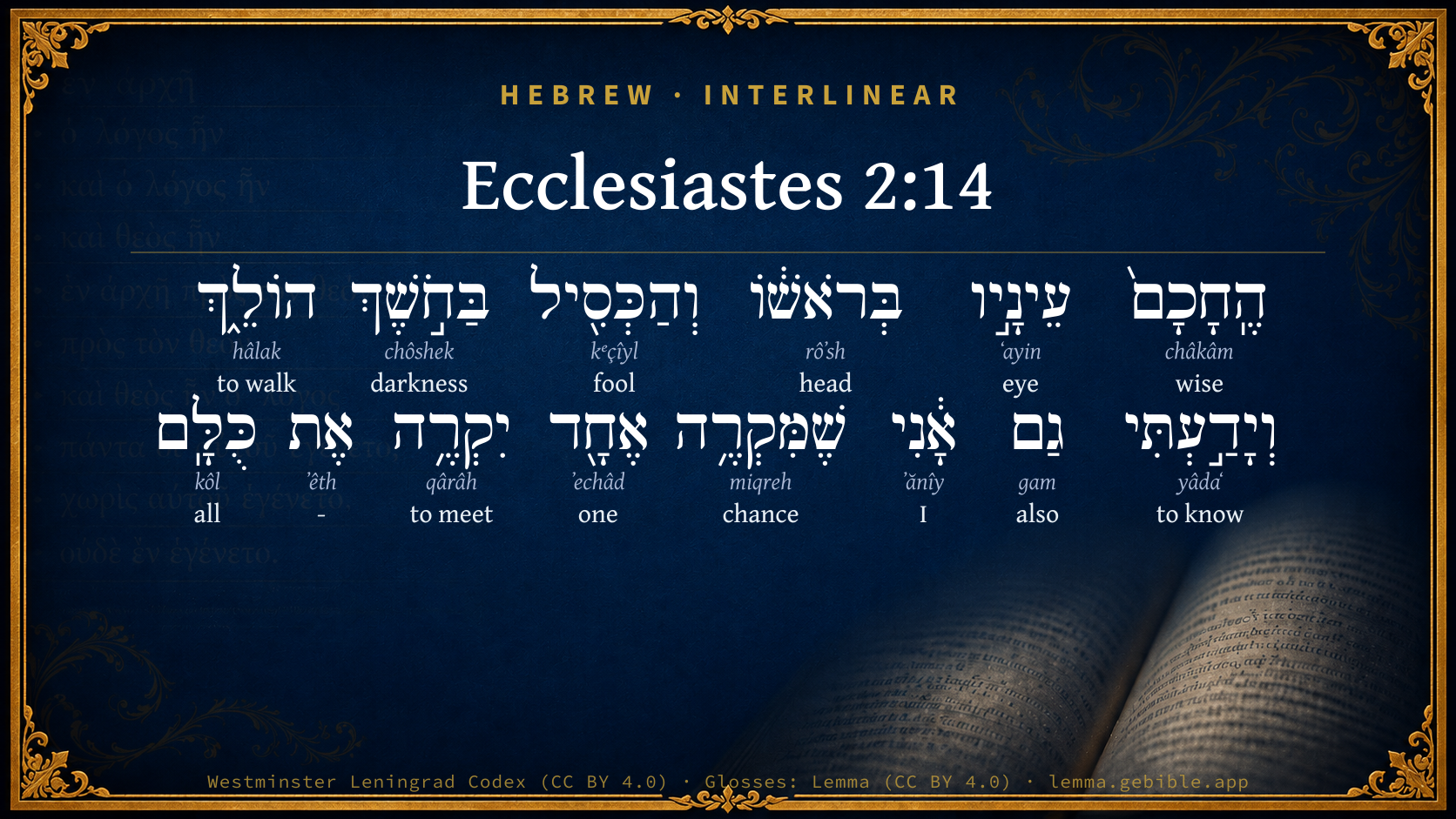
Hebrew (Westminster Leningrad Codex) Ecclesiastes 2:14 appears in the Hebrew Old Testament. The text above is from the Westminster Leningrad Codex. Each word links to its Strong’s number, a concise gloss, and parsing drawn from the Open Scriptures Hebrew Bible morphology. Click any word for its full Brown-Driver-Briggs (BDB) entry.
Download image
Cite this verse

Ecclesiastes 2:14 (World English Bible). Public Domain. Lemma interlinear Bible study tool, https://lemma.gebible.app/v/ecclesiastes/2/14.

Show BibTeX & RIS
BibTeX
RIS
English Translation
The wise man's eyes are in his head, and the fool walks in darkness--and yet I perceived that one event happens to them all.
World English Bible · Public Domain
Download a study sheet

One document with this verse’s original text, its word-by-word gloss line, the meaning frame, cross-references with their text, attributed commentary, and full source and license credits — printable, and it pastes into notes with its structure intact.

This verse Autodidact and up

Study sheet (.html) Plain text (.txt)

A passage Seminary Student

Up to 50 verses in one chapter. A passage sheet keeps up to 6 commentary sources and 12 cross-references per verse, in the order this page ranks them, and says so on the sheet whenever that leaves anything out. Ask for a single verse and you get the Autodidact verse sheet above.

Everything on this page stays free to read, with no account — the sheet is a download of what is already on screen, not access to it.

Want to remove ads? Support Godless Engineer
Compare translations 3

The same verse in 3 English versions, stacked beneath the original-language interlinear above. Click any original word for its lexicon entry.

Each is an independent rendering of the whole verse — the interlinear is not word-aligned to these translations.

Highlighted words mark where these versions differ — a whole-verse word diff, not a word-by-word alignment.

  • World English Bible Public Domain
    The wise man's eyes are in his head, and the fool walks in darkness--and yet I perceived that one event happens to them all.
  • King James Version Public Domain
    The wise man's eyes are in his head; but the fool walketh in darkness: and I myself perceived also that one event happeneth to them all.
  • unfoldingWord Literal Text CC BY-SA 4.0
    The wise, his eyes in his head, but the fool in the darkness is walking. But I know, even I, that one happening will happen to both of them.

unfoldingWord Literal Text — © unfoldingWord, licensed CC BY-SA 4.0. Word-aligned USFM3 via Door43 (git.door43.org/unfoldingWord/en_ult).

Versions to compare (up to 4)

3 of 4 selected

Show all 18 translations

Every available English version of this verse, each an independent rendering of the whole verse.

  • World English Bible Public Domain
    The wise man's eyes are in his head, and the fool walks in darkness--and yet I perceived that one event happens to them all.
  • Berean Standard Bible Public Domain
    The wise man has eyes in his head, but the fool walks in darkness. Yet I also came to realize that one fate overcomes them both.
  • Majority Standard Bible Public Domain
    The wise man has eyes in his head, but the fool walks in darkness. Yet I also came to realize that one fate overcomes them both.
  • King James Version Public Domain
    The wise man's eyes are in his head; but the fool walketh in darkness: and I myself perceived also that one event happeneth to them all.
  • American Standard Version (1901) Public Domain
    The wise man's eyes are in his head, and the fool walketh in darkness: and yet I perceived that one event happeneth to them all.
  • Revised Version (1885) Public Domain
    The wise man’s eyes are in his head, and the fool walketh in darkness: and yet I perceived that one event happeneth to them all.
  • Geneva Bible (1599) Public Domain
    For the wise mans eyes are in his head, but the foole walketh in darknes: yet I know also that the same condition falleth to them all.
  • Douay-Rheims (1899) Public Domain
    The eyes of a wise man are in his head: the fool walketh in darkness: and I learned that they were to die both alike.
  • Young's Literal Translation Public Domain
    The wise! -- his eyes `are' in his head, and the fool in darkness is walking, and I also knew that one event happeneth with them all;
  • Literal Standard Version CC BY-SA 4.0
    The wise—his eyes [are] in his head, and the fool is walking in darkness, and I also knew that one event happens with them all;
  • Unlocked Literal Bible CC BY-SA 4.0
    The wise man uses his eyes in his head to see where he is going, but the fool walks in darkness, although I know the same event happens to all of them.
  • unfoldingWord Literal Text CC BY-SA 4.0
    The wise, his eyes in his head, but the fool in the darkness is walking. But I know, even I, that one happening will happen to both of them.
  • Darby Bible Public Domain
    The wise man's eyes are in his head, and the fool walketh in darkness; but I myself also perceived that one event happeneth to them all.
  • World Messianic Bible Public Domain
    The wise man’s eyes are in his head, and the fool walks in darkness—and yet I perceived that one event happens to them all.
  • Webster's Bible Public Domain
    The wise man's eyes are in his head; but the fool walketh in darkness: and I myself perceived also that one event happeneth to them all.
  • Free Bible Version CC BY-SA 4.0
    The wise see where they're going, but fools walk in darkness. But I also realized that they all come to the same end.
  • Bible in Basic English Public Domain
    The wise man's eyes are in his head, but the foolish man goes walking in the dark; but still I saw that the same event comes to them all.
  • JPS Tanakh (1917) Public Domain
    The wise man, his eyes are in his head; but the fool walketh in darkness. And I also perceived that one event happeneth to them all.

Literal Standard Version (2020), Covenant Press — licensed CC BY-SA 4.0. Text via the HelloAO Bible API (eBible.org). Unlocked Literal Bible (unfoldingWord) — licensed CC BY-SA 4.0. Text via the HelloAO Bible API (eBible.org). unfoldingWord Literal Text — © unfoldingWord, licensed CC BY-SA 4.0. Word-aligned USFM3 via Door43 (git.door43.org/unfoldingWord/en_ult). Free Bible Version, Dr. Jonathan Gallagher — licensed CC BY-SA 4.0. Text via the HelloAO Bible API (eBible.org).

Word by word

More ways to search: Search by grammar → Find every occurrence → Compare this word →

Practice this passage: Drill this verse → Learn its vocabulary →

שֶׁמִּקְרֶ֥ה
miqreh
H4745
“who/which · chance”
Particle, Relative + Noun, Common, Masculine, Singular, Absolute
Part of Speech
Particle + Noun
Type
Common
Gender
Masculine
Number
Singular
State
Absolute
Full BDB Definition

Origin: from H7136

TWOT: 2068c

unforeseen meeting or event, accident, happening, chance, fortune - accident, chance - fortune, fate
  1. הֶֽחָכָם֙ châkâm H2450 “the · wise” Particle, Definite Article + Adjective, Adjective, Masculine, Singular, Absolute
  2. עֵינָ֣יו ʻayin H5869 “eyes · his” Noun, Common, Both, Dual, Construct + Suffix, Personal, 3rd Person, Masculine, Singular
  3. בְּרֹאשׁ֔וֹ rôʼsh H7218 “in/at · head · his” Preposition + Noun, Common, Masculine, Singular, Construct + Suffix, Personal, 3rd Person, Masculine, Singular
  4. וְהַכְּסִ֖יל kᵉçîyl H3684 “and · the · fool” Conjunction + Particle, Definite Article + Adjective, Adjective, Masculine, Singular, Absolute
  5. בַּחֹ֣שֶׁךְ chôshek H2822 “in/at the · darkness” Preposition, Determined + Noun, Common, Masculine, Singular, Absolute
  6. הוֹלֵ֑ךְ hâlak H1980 “walking” Verb, Qal, Participle Active, Masculine, Singular, Absolute
  7. וְיָדַ֣עְתִּי yâdaʻ H3045 “and · to know” Conjunction + Verb, Qal, Perfect, 1st Person, Common, Singular
  8. גַם gam H1571 “also” Adverb
  9. אָ֔נִי ʼănîy H589 “I” Pronoun, Personal, 1st Person, Common, Singular
  10. אֶחָ֖ד ʼechâd H259 “one” Adjective, Cardinal number, Masculine, Singular, Absolute
  11. יִקְרֶ֥ה qârâh H7136 “to meet” Verb, Qal, Imperfect, 3rd Person, Masculine, Singular
  12. אֶת ʼêth H853 “-” Particle, Direct Object
  13. כֻּלָּֽם kôl H3605 “all · their” Noun, Common, Masculine, Singular, Construct + Suffix, Personal, 3rd Person, Masculine, Plural

About this verse

These counts appear in no published source. They are computed here, from the morphology-tagged text and Lemma’s own curated glosses. What Lemma adds →

14
words
14
distinct lemmas
Wisdom
section

Notable vocabulary

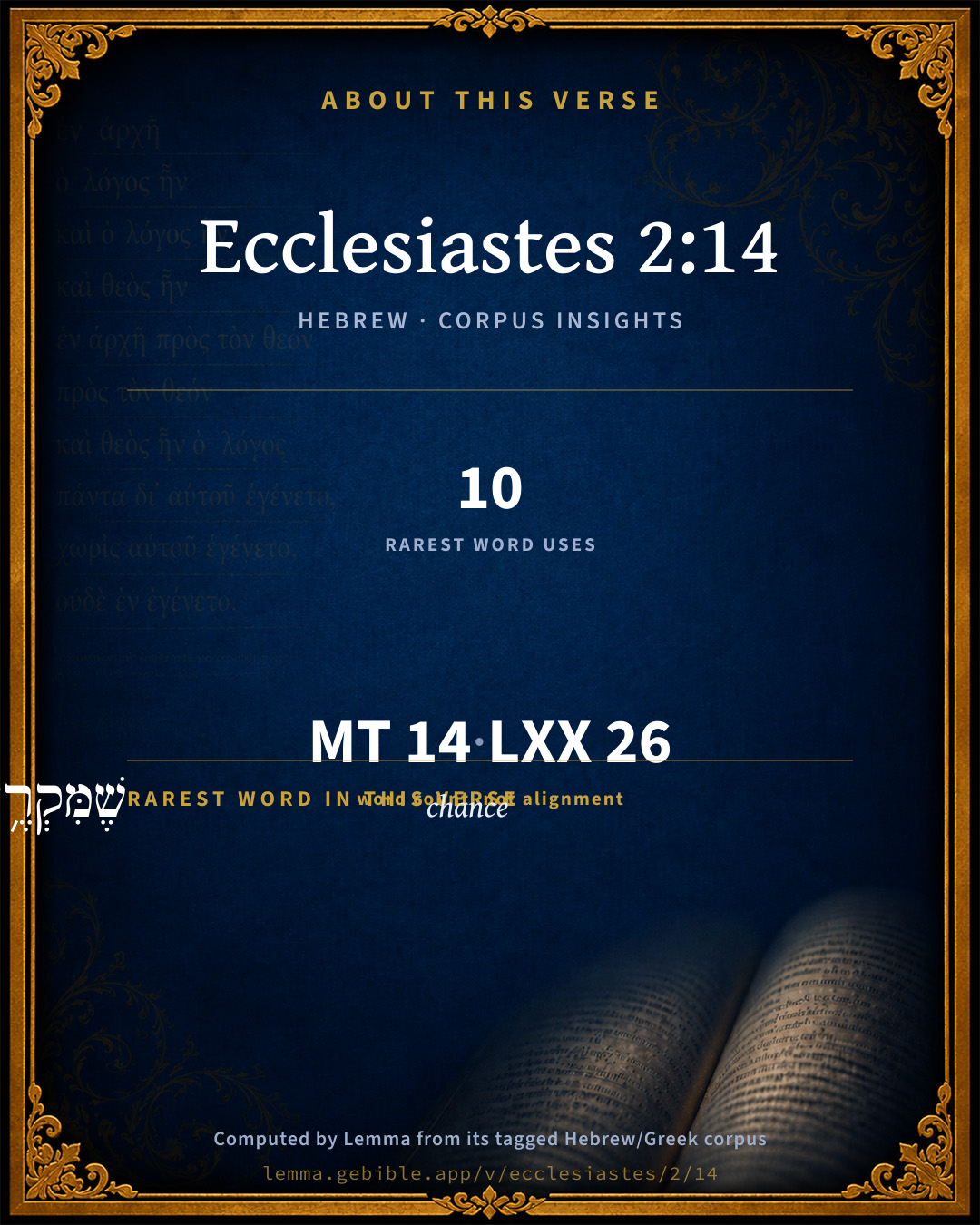
The rarest word here is שֶׁמִּקְרֶ֥ה chance H4745 — appearing just 10 times in the whole Hebrew Bible.

Shared distinctive vocabulary

שֶׁמִּקְרֶ֥ה chance H4745 occurs in 8 verses of the Hebrew Bible. Also found in:

Grammatical profile

  • 3 verbs
  • 5 nouns
  • 3 adjectives
  • 1 pronoun
  • 1 adverb
  • 1 particle

Verb forms

  • הוֹלֵ֑ךְ Qal · Participle Active
  • וְיָדַ֣עְתִּי Qal · Perfect
  • יִקְרֶ֥ה Qal · Imperfect

Hebrew & Septuagint length

In English translation the verse runs 24 words from the Hebrew and 27 from the Septuagint (LXX English) — closely comparable.

A rough comparison of the two English renderings, which tokenize alike — not a word-level alignment.

Word counts can differ between the Hebrew and the Greek without any difference in meaning — e.g. the Hebrew direct-object marker אֵת has no separate Greek word, and Greek often adds the article ὁ.

In the original languages it is 14 Hebrew tokens and 26 Greek tokens — but the two are counted differently (Hebrew bundles its prefixes and suffixes into one token; the Greek is in lemma form), so that isn’t a like-for-like length.

Cross-references

13

Topical passages linked to Ecclesiastes 2:14 in the Treasury of Scripture Knowledge — connected by theme and wording, ordered by reader-vote popularity; previews shown in the World English Bible.

  • Psalms 49:10 For he sees that wise men die; Likewise the fool and the senseless perish, And leave their wealth to others.
  • Proverbs 17:24 Wisdom is before the face of one who has understanding, But the eyes of a fool wander to the ends of the earth.
  • Ecclesiastes 9:11 I returned, and saw under the sun, that the race is not to the swift, nor the battle to the strong, neither yet bread to the wise, nor yet riches to men of understanding, nor yet favor to men of skill; but time and chance happen to them all.
  • Ecclesiastes 3:19 For that which happens to the sons of men happens to animals. Even one thing happens to them. As the one dies, so the other dies. Yes, they have all one breath; and man has no advantage over the animals: for all is vanity.
  • Ecclesiastes 9:1–3 For all this I laid to my heart, even to explore all this: that the righteous, and the wise, and their works, are in the hand of God; whether it is love or hatred, man doesn't know it; all is before them.
  • 1 John 2:11 But he who hates his brother is in the darkness, and walks in the darkness, and doesn't know where he is going, because the darkness has blinded his eyes.
  • Psalms 19:10 More to be desired are they than gold, yes, than much fine gold; Sweeter also than honey and the extract of the honeycomb.
  • Proverbs 14:8 The wisdom of the prudent is to think about his way, But the folly of fools is deceit.
  • Ecclesiastes 6:6 Yes, though he live a thousand years twice told, and yet fails to enjoy good, don't all go to one place?
  • Ecclesiastes 7:2 It is better to go to the house of mourning than to go to the house of feasting: for that is the end of all men, and the living should take this to heart.
  • Ecclesiastes 8:1 Who is like the wise man? And who knows the interpretation of a thing? A man's wisdom makes his face shine, and the hardness of his face is changed.
  • Ecclesiastes 9:16 Then said I, Wisdom is better than strength. Nevertheless the poor man's wisdom is despised, and his words are not heard.
  • Ecclesiastes 10:2–3 A wise man's heart is at his right hand, but a fool's heart at his left.

Cross-references courtesy of OpenBible.info (CC BY 4.0).

Hebrew and Greek witnesses Masoretic Hebrew ↔ Greek Septuagint

The same verse in the two great witnesses to the Old Testament, shown verse-for-verse.

These are two independent witnesses, not word-aligned to each other, and the Septuagint is shown in lemma (dictionary) form.

Hebrew Ecclesiastes 2:14 Masoretic · Westminster Leningrad Codex

הֶֽחָכָם֙ עֵינָ֣יו בְּרֹאשׁ֔וֹ וְהַכְּסִ֖יל בַּחֹ֣שֶׁךְ הוֹלֵ֑ךְ וְיָדַ֣עְתִּי גַם אָ֔נִי שֶׁמִּקְרֶ֥ה אֶחָ֖ד יִקְרֶ֥ה אֶת כֻּלָּֽם

The wise man's eyes are in his head, and the fool walks in darkness--and yet I perceived that one event happens to them all.

World English Bible · Public Domain

Greek LXX Ecclesiastes 2:14 Septuagint · lemma form

ὁ σοφός ὁ ὀφθαλμός αὐτός ἐν κεφαλή αὐτός καί ὁ ἄφρων ἐν σκότος πορεύομαι καί γιγνώσκω καί γέ ἐγώ ὅτι συνάντημα εἷς συνἀντάω ὁ πᾶς αὐτός

The wise man's eyes are in his head; but the fool walks in darkness: and I perceived, even I, that one event shall happen to them all.

LXX2012 (modern English Septuagint) · Public Domain

On this verse, The Pulpit Commentary discusses the Septuagint’s reading. Read the note in Commentary ↓

Hebrew: Westminster Leningrad Codex (CC BY 4.0). Greek: Septuagint (public domain); English from LXX2012 (modern English Septuagint) (Public Domain). How the Septuagint differs from the Hebrew →

Commentary

Notes on Ecclesiastes 2:14 from classic Christian and Jewish commentators (each source and its license shown beneath its notes). The classic Christian expositions comment on the surrounding passage and are grouped to its opening verse, so a note may address several verses; the Jewish commentaries on the Tanakh (Rashi and others) are per-verse, so they appear only where the commentator wrote on this verse.

Lemma curates 59 commentaries, every one of them public domain or Creative Commons licensed, each selected and text-cleaned for this edition rather than reprinted as found. About our sources →

Trapp's Complete Commentary

John Trapp

Ecc 2:14 The wise man’s eyes [are] in his head; but the fool walketh in darkness: and I myself perceived also that one event happeneth to them all.

Ver. 14. The wise man’s eyes are in his head.] He judiciously pondereth things past, and prudently ordereth things present, and providently foreseeth to prevent dangers likely to ensue. {a} The Chinese use to say of themselves, that all other nations of the world see but with one eye, they only with two. {b} Italians tell us, that, whereas Spaniards seem wise and are fools, Frenchmen seem fools and are wise, Portuguese neither are wise nor so much as seem to be so, they themselves both seem wise, and are so. {c} This I could sooner believe if from a better mouth than their own. Romani, sicut non acumina, ita non imposturas habent, saith Bellarmine; The Romans (those wittiest of the Italians) are neither very subtle nor very simple.

But the fool walketh in darkness.] He hath neither sight nor light, but is acted and agitated by the prince of darkness, who holds his black hand before the eye of such men’s minds and blinds their understandings - dealing with them as Pliny saith the eagle deals with the hart; she lights upon his horns, and there flutters up and down, filling his eyes with dust borne in her feathers, that at last he may cast himself from a rock, and so be made a prey unto her.

One event happeneth to them all.] As did to Josiah and Ahab in the manner of both their dying in battle. They may be all wrapped up together in a common calamity, and sapientes sapienter in gehennam descendant, {d} the world’s great wise men go very wisely down to hell; there, for want of saving grace, fools and wiser men meet at one and the same inn, though by several ways, at one and the same haven, though from several coasts.

{a} Pροσσω και οπισσω.

{b} Description of the World, Ec. Of China.

{c} Heyl., Geog.

{d} Augustine.

John Trapp, A Commentary or Exposition upon All the Books of the Old and New Testament (1647–1656) — public domain. Text from a community e-Sword module.

The Biblical Illustrator

Joseph S. Exell

Ecc_2:14

The wise mans eyes are in his head; but the fool walketh in darkness.

The advantage of wisdom over folly

Wisdom possesses the same advantage over folly that sight does over blindness. The man of wisdom, having all his wits about him, in the full possession and the appropriate exercise of all his faculties, guides his affairs with discretion, looks before him, thinks maturely of what he is doing, and by his knowledge of men and things, is directed to the adoption of plans which promise to be profitable, and to the prudent and successful prosecution of them. He foreseeth the evil, and hideth himself. He aims at worthy ends, and employs suitable means for their accomplishment. But the fool--the ignorant, and inconsiderate, and improvident man--is continually in danger of stumbling, or of going astray, like a person overtaken by darkness, who knoweth not whither he goeth. He is ever prone to run blindly and heedlessly into absurd and injurious projects, or to destroy such as are in themselves good, by blundering in the execution of them. The fools eyes, it is elsewhere said, are in the ends of the earth, roaming vainly and idly abroad, without serving his present and needful purposes; gazing, as the organs of a vacant mind, on far-off objects, and allowing him to stumble over what is immediately in his way. Without foresight to anticipate probable evils, without even sagacity to avoid such as are present, the fool is in perpetual hazard of iniuring and ruining both himself and all who are so unfortunate as to stand connected with him, or to be exposed to his influence. (R. Wardlaw, D. D.)

The wisdom of the eye

I. To understand this proverb, notice, first, the contrasts which it suggests. One of these is expressed in the context; the other is to be readily and clearly inferred.

1. First, there is a contrast between persons. We have before us the believer in God and the unbeliever, the child of light and the child of darkness, the converted and the unconverted, the spiritual and the natural. Whatever may be their relative state of knowledge or ignorance, of wealth or poverty, in the sense of the Bible of truth, and in the judgment of the God of truth, the one is wise and the other a fool.

2. Secondly, there is a contrast implied: The wise mans eyes are in his head, but the fool walketh in darkness. And why is his path in darkness? Because, unlike the wise man, his eyes are not in his head; if they had been there, he would have walked in light, surely, safely. But they are in his heart, and so he walks foolishly, erringly, darkly. The eye in the head--the wise mans eye, sees under the direction of reason, and faith, and of right understanding. The eye in the heart--the fools eye, sees under the direction of the affections, the disposition and the feelings. And so, while the one man walks in light, the other man walks in darkness.

II. But now let me more pointedly and practically set out the meaning of this verse. Let us take by itself each part of this proverb and consider it.

1. First, then, it is implied that the fools eyes are in his heart. He sees all things through the medium of his own wishes and inclinations; his reason and conscience do not control, but they are possessed by his inclinations.

(1) Hence I believe, because the eye of many is in the heart, the scepticism which obtains in our day, especially the scepticism which obtains in the minds of young men. No man, I believe, ever became an infidel against his will. Inclination, not evidence, has been deficient to the man. The evil heart of unbelief is at the root of scepticism.

(2) Hence I believe the prejudice with which many professed Christians turn away from the doctrines of evangelical religion. They do not question their reality, but they just dislike their practical consequences.

(3) A fools eyes are in his heart, because his bondage is to things present and temporal, and he is indifferent to thinks unseen and eternal. The Bible, though not a fable, is as another book to him, and nothing more. Truth, if not a fiction, is not a fact. Earth is a loved present, possessed; heaven is a forgotten, distant future.

2. But the wise mans eyes are in his head. The light of a holy knowledge shines upon them, and in this light the eye of reason and of faith, the eye, not of blind inclination, but of Christian consciousness and confidence, sees light.

(1) Hence a Christian man feels the right and the responsibility of private judgment on the truth and the service of God. The authority of Christ is supreme authority unto him. He will allow no interference with it; he will allow no usurper to take its place.

(2) Hence the Christian man prays for the light of Divine teaching, The possession of truth has taught him the possibility and the peril of error. He would be found never trusting in man, but he would always pray--That which I know not, Lord, teach Thou me!

(3) Hence the impression which he receives of the things around him and before him. The rule of duty, read by the eyes in his head, is just this--his Fathers will. The measure of goodness, admired by the eye in his head, is just this--his Saviours image.

(4) Lastly, when our eyes are in our head, under the government of an enlightened reason and a Christian faith, they will always be doing a holy and a godly service to our souls--never an injurious one. They will not, then, wander lustfully where they should not even steal a glance; they will be turned away from all vanities. Looking ever, will they be found, unto Jesus; ever, will they be found, setting the Lord before them; single will they ever be, full of light, turning the whole body into light also. (J. Eyre, M. A.)

One event happeneth to them all.--

Wisdom and folly compared

Looking simply at knowledge as such, and looking merely at the brief span of our existence under the sun, we must confess that the wise man is sometimes as powerless as the fool. Two men take their seats in a railway train. The one man is an accomplished scholar, or mathematician, or philosopher. He has disciplined his mental powers, and has amassed large stores of knowledge. He has even acquired, it may be a certain reputation as a man of learning, or as a leader of the thoughts of others. The man who is sitting beside him cares nothing for intellectual culture. Animal enjoyment is his ideal. Give him a good dinner, and you may keep your books to yourself! He could never see any good in racking his brains over hard problems. There sit these two men in the railway carriage, side by side: the one, perhaps, reading the latest book of science; the other, perhaps, glancing through some Sporting Gazette. Suddenly, in a moment, there comes the collision which it was utterly impossible for either of them to foresee: the train is a wreck; and these two lie together, crushed, mangled, and dead! One event, one chance, has happened to them both! Now, shut out the thought of God, and the thought of immortality, and what advantage has the one man over the other? The student has had his intellectual enjoyments: the votary of pleasure has had his enjoyments also. The scholar, along with his enjoyment, has had much fatiguing toil, and, it may be, painful thought; the pleasure-seeker also has doubtless, on his part experienced some of the penalties of self-indulgence. The lover of knowledge has, indeed, had this advantage, that his eyes have been in his head: he has had a wider and clearer vision; and he has lived a higher kind of life. But to what purpose? Where is the permanent advantage? These two men have lived their short span: and here has come Death, as the great leveller! For a few years, perhaps, the scholar may be spoken of; his name may even get into some biographical dictionary but, unless he is one of a very select few, it will be little more than a name, and, in the ages to come, he will be altogether forgotten. To what purpose, then, has he scorned delights, and lived laborious days? Can he be said to have made the best use of human life, if he has simply spent it in acquiring a wisdom which leaves him, in the end, indistinguishable from the fool? Thus, then, we seem to be driven to the same conclusion as Ecclesiastes. Whatever advantages earthly wisdom has, it cannot be regarded as the chief good for man. The amassing of knowledge as the one supreme object of human existence is a vain delusion: it is a feeding on wind: it fails to satisfy the deepest cravings of the human soul. (T. C. Finlayson.)

The Biblical Illustrator, edited by Joseph S. Exell (c. 1880s–1900s) — public domain. Text from a community e-Sword module.

The Pulpit Commentary

The wise man"s eyes are in his head; but the fool walketh "in darkness. This clause is closely connected with the preceding verse, showing how wisdom excelleth folly. The wise man has the eyes of his heart or understanding enlightened; (Eph_1:18) he looks into the nature of things, fixes his regard on what is most important, sees where to go; while the fool"s eyes are in the ends of the earth; (Pro_17:24) he walks on still in darkness, stumbling as he goes, knowing not whither his road shall take him. And I myself also (I even I) perceived that one event happeneth to them all. "Event" (mikreh); sunanthma (Septuagint); interitus (Vulgate); not chance, But death, the final event. The word is translated "hap" in Rth_2:3, and "chance" in 1Sa_6:9; but the connection here points to a definite termination; nor would it be consistent with Koheleth"s religion to refer this termination to fate or accident. With all his experience, he could only conclude that in one important aspect the observed superiority of wisdom to folly was illusory and vain. He saw with his own eyes, and needed no instructor to teach, that both wise and fool must succumb to death, the universal leveler. Horace, in many passages, sings of this: thus "Carm.," 2:3. 21

Divesne prisco natus ab Inacho, Nil interest, an pauper et infima De gente sub dive moreris, Victima nil miserantis Orci.

(Comp, ibid, 1:28. 15, etc.; 2:14. 9, etc.) Plato ("Phaedo," 57. p. 108, A) refers to a passage in "Telephus," a lost play of 2 Eschylus, which is restored thus

JAplh gantev eijv Aidou ferei.

A single path leads all unto the grave.

The Pulpit Commentary (1880–1919), ed. H.D.M. Spence-Jones & Joseph S. Exell — public domain. Text from a community e-Sword module.

Geneva Bible (1599)

Geneva Bible translators

He forseeth things, which the fool cannot for lack of wisdom.

For both die and are forgotten as verse 16, or they both alike have prosperity or adversity.

Geneva Bible (1599) marginal notes — public domain. Text via Bolls.life.

Adam Clarke's Commentary

Verse 14. The wise man's eyes, c.] Well expressed by Choheleth: -

"The wise are circumspect, maturely weigh

The consequence of what they undertake,

Good ends propose, and fittest means apply

To accomplish their designs."

But the fool walketh in darkness]

"But fools, deprived

Of reason's guidance, or in darkness grope,

Or, unreflecting like a frantic man,

Who on the brink of some steep precipice

Attempts to run a race with heedless steps,

Rush to their own perdition."

One event happeneth to them all.]

"Though wide the difference, what has human pride

To boast? Even I myself too plainly saw,

That one event to both alike befalls

To various accidents of life exposed,

Without distinction: nor can wisdom screen

From dangers, disappointments, grief, and pain."

Adam Clarke's Commentary on the Bible (1810–1826) — public domain. Text from a community e-Sword/MySword module.

Ellicott's Commentary for English Readers

(14) Event.—Translated “hap,” or “chance” (Rth_2:13; 1Sa_6:9; 1Sa_20:26).

A Bible Commentary for English Readers, edited by Charles John Ellicott (1878–1897) — public domain. Text from a community e-Sword module.

The Cambridge Bible for Schools and Colleges

gen. ed. J. J. S. Perowne

14. The wise man’s eyes are in his head] The figurative language is so much of the nature of an universal parable that we need hardly look to any special source for it, but we are at least reminded of those that “walk on still in darkness,” who have eyes and yet “see not” in any true sense of seeing (Isa_6:10). In Pro_17:24 we have the opposite form of the same thought: “The eyes of a fool are in the ends of the earth.” Comp. also Joh_11:10; Joh_12:33.

and I myself perceived also] Better, And yet I myself perceived. The thought of Ecc_2:13 which had given an apparent resting-place for the seeker, is traversed by another which sends him once more adrift. Wisdom is better than folly. True, but for how long? With an emphasized stress on his own personal reflections, he goes on, “Yes, I myself, learning it for myself, and not as a topic of the schools, saw that there is one event for the wise and for the fool.” In a few short years the difference in which the former exults will vanish, and both will be on the same level. So sang the Epicurean poet:

“Omnes una manet nox,

Et calcanda semel via lethi.”

“One dark black night awaits us all;

One path of death we all must tread.”

Hor. Od. i. 28. 15.

The Cambridge Bible for Schools and Colleges (gen. ed. J. J. S. Perowne; Cambridge University Press, 1878–1918) — public domain. Text from a community e-Sword module.

John Gill's Exposition

The wise man's eyes are in his head,.... And so are the eyes of every man; but the sense is, he makes use of them, he looks about him, and walks circumspectly; he takes heed to his goings, he foresees the evil, and avoids it; or the danger he is exposed unto, and guards against it. Some understand it, in a more spiritual and evangelical sense, of Christ, who is the head of the body the church, and of every true believer; of everyone that is wise unto salvation, whose eyes are on him alone for righteousness, salvation, and eternal life; or on whom Christ's eyes are; who is said to have seven eyes, with which he guides, guards, and protects his people;

but the fool walketh in darkness; his eyes are to the ends of the earth; he walks incautiously, without any circumspection or guard; he knows not where he is, nor where he is going, nor where he shall set his foot next, nor at what he may stumble; wherefore a wise man is to be preferred to a fool, as wisdom is to folly. The Midrash interprets the wise man of Abraham, and the fool of Nimrod;

and I myself perceived also that one event happeneth to them all; the wise man and the fool; or, "but I myself perceived" (w), &c. though it is allowed that a wise man is better than a fool; yet this also must be owned, which Solomon's experience proved, and every man's does, that the same things befall wise men and fools; they are liable to the same diseases of body, and disasters of life; to poverty and distress, to loss of estate, children, and friends, and to death itself.

(w) "sed agnovi", Junius & Tremellius, Piscator; "sed cognovi", Rambachius; "but I saw", Broughton.

John Gill's Exposition of the Whole Bible (1746–1763) — public domain (CC PDM 1.0). Text via the HelloAO Bible API.

Haydock's Catholic Bible Commentary

Darkness and ignorance. He knows not whither he is going, Proverbs iv. 19., and xvii. 24. Wisdom is to be preferred before wealth, &c. (Calmet) --- Consideration directs a person to do good. --- Alike. Thus worldlings speak, who reflect not on the life to come. (Worthington) --- In many respects all resemble one another, though their sentence be very different. (Menochius)

George Leo Haydock (1774–1849), Haydock's Catholic Family Bible and Commentary, 1859 edition — public domain. Excludes Psalms (Douay-Rheims chapter numbering differs from Protestant) and Deuterocanonical books (Catholic canon only).

Matthew Poole's English Annotations

Are in his head; in their proper place, and therefore they can see, which they could not do if they were out of his head. He hath the use of his eyes and reason, and sees his way, and orders all his affairs with discretion, and foresees, and so avoids, many dangers and mischiefs. Walketh in darkness; manageth his affairs ignorantly, rashly, and foolishly, whereby he showeth that his eyes are not in his head, but in his heels, or, as it is expressed, Pro 17:24, in the ends of the earth. And; or, yet; notwithstanding this excellency of wisdom above folly for our conduct in the matters of this life, yet at last they both come to one end.

One event happeneth to them all; both are subject to the same calamities, and to death itself, which utterly takes away all difference between them.

Matthew Poole's English Annotations on the Holy Bible (1683–1685) — public domain. Text from a community e-Sword/MySword module.

Whedon's Commentary on the Bible

Daniel D. Whedon

14. The wise man’s eyes are in his head — The Hebrew is more forcible: As for the wise man, his eyes, etc. The “wise man’s eyes” are where they belong, and can be used to some purpose. The reference is to the eyes of the understanding, the inward organ of spiritual knowledge.

Darkness — Better, blindness, as contrasted with the seeing eyes just named.

I myself — This declaration is of marked emphasis.

One event — The “event” here mentioned is evidently death, so often in the writer’s mind.

Daniel D. Whedon (gen. ed.), Commentary on the Old and New Testaments (1874–1909) — public domain. Text from a community e-Sword module.

John Wesley's Explanatory Notes

Head - In their proper place. He hath the use of his eyes and reason, and foresees, and so avoids many dangers and mischiefs. Yet - Notwithstanding this excellency of wisdom above folly, at last they both come to one end. Both are subject to the same calamities, and to death itself, which takes away all difference between them.

John Wesley, Explanatory Notes Upon the Whole Bible (1754–1765) — public domain. Text via the GEBible commentary corpus.

Rashi

Rabbi Shlomo Yitzchaki (Rashi)

The wise man has eyes in its beginning In the beginning of the matter, he observes what will be at its end.

and I too know Also, I, who praise the wise man over the fool, know that they both will die.

Rashi on the Tanakh — English translations: “The Judaica Press complete Tanach with Rashi, translated by A. J. Rosenberg” (CC BY 4.0); “Pentateuch with Rashi's commentary by M. Rosenbaum and A.M. Silbermann, 1929-1934” (public domain); “The Metsudah Tanach series, Lakewood, N.J” (CC BY 4.0); and “The Book of Joshua, Metsudah Publications, 1997” (CC BY 4.0). Text via Sefaria.

Lesson kit

Teaching starters — assembled from the data on this page, not authored interpretation. Every prompt links to the verse data it draws on. Edit before teaching.

Ecclesiastes, in the Wisdom, opens this verse with 14 words (14 distinct Hebrew lemmas). Its most distinctive word is miqreh (“chance”). A historical commentator’s framing appears above. Read the whole chapter for the surrounding context.

Discussion questions

  1. What does “chance” (miqreh) contribute to the verse as a whole?
  2. How does Ruth 2:3, which shares the word «chance», read alongside this verse?
  3. These translations render this verse differently; the difference is in the English rendering, not the original. What questions does that raise?
  4. «הוֹלֵ֑ךְ» is a Qal Participle Active verb. How does that grammatical form shape the action described?
  5. Compare how Trapp's Complete Commentary and The Biblical Illustrator read this verse. Where do they agree or differ?

Things to notice

Reading settings

Reading text

Shown beneath each verse's original-language words.

Old Testament
Old Testament edition

Read the OT as the Masoretic Hebrew (MT) or the Greek Septuagint (LXX).

English shown for the Greek Septuagint (in the Hebrew ↔ Greek comparison).

Comparing translations? Open the Compare panel on any verse page to stack up to four side by side.