
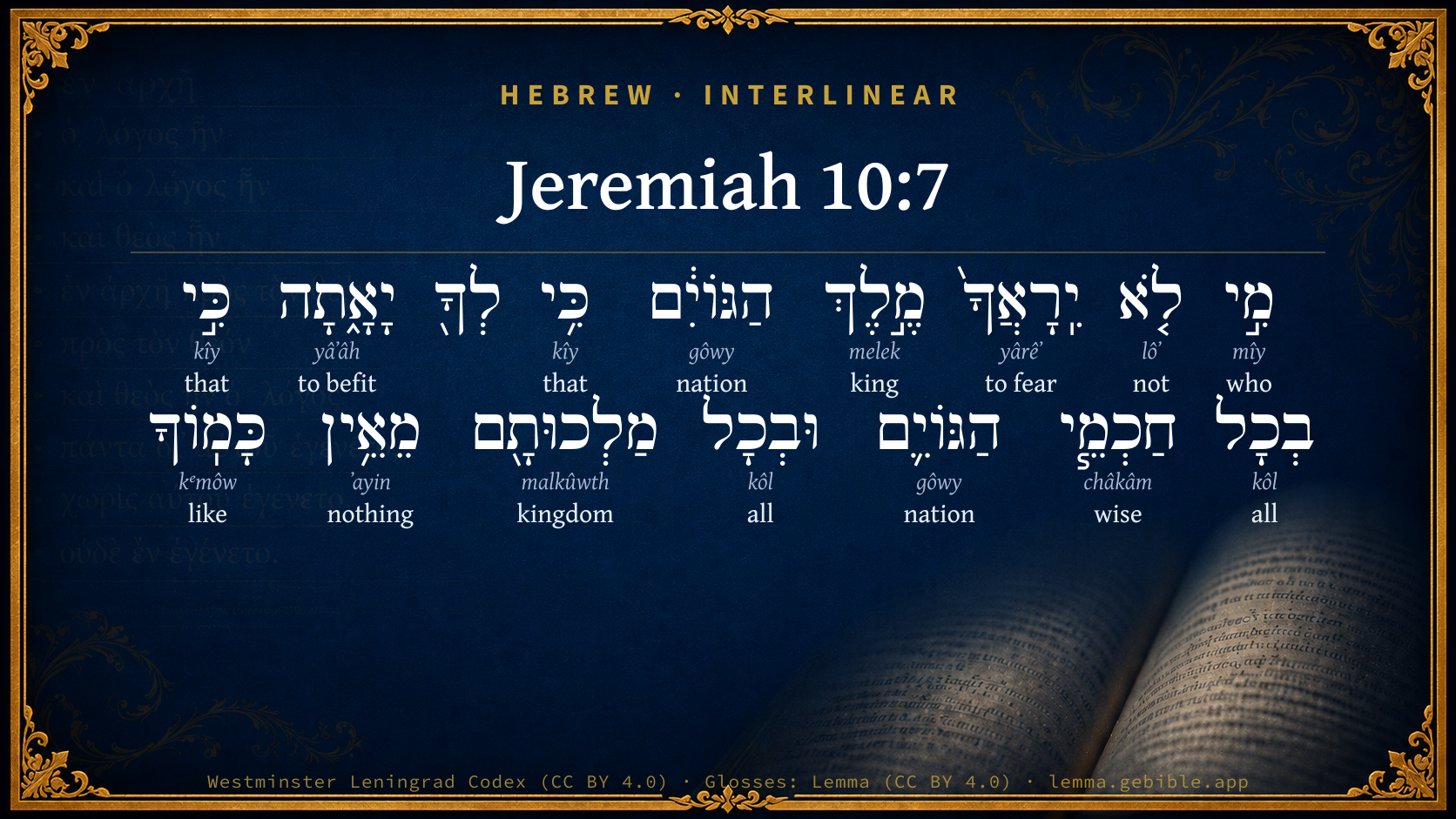
Jeremiah 10:7

Hebrew (Westminster Leningrad Codex) Jeremiah 10:7 appears in the Hebrew Old Testament. The text above is from the Westminster Leningrad Codex. Each word links to its Strong’s number, a concise gloss, and parsing drawn from the Open Scriptures Hebrew Bible morphology. Click any word for its full Brown-Driver-Briggs (BDB) entry.
Download image
Cite this verse

Jeremiah 10:7 (World English Bible). Public Domain. Lemma interlinear Bible study tool, https://lemma.gebible.app/v/jeremiah/10/7.

Show BibTeX & RIS
BibTeX
RIS
English Translation
Who should not fear you, King of the nations? for to you does it appertain; because among all the wise men of the nations, and in all their royal estate, there is none like you.
World English Bible · Public Domain
Highlights
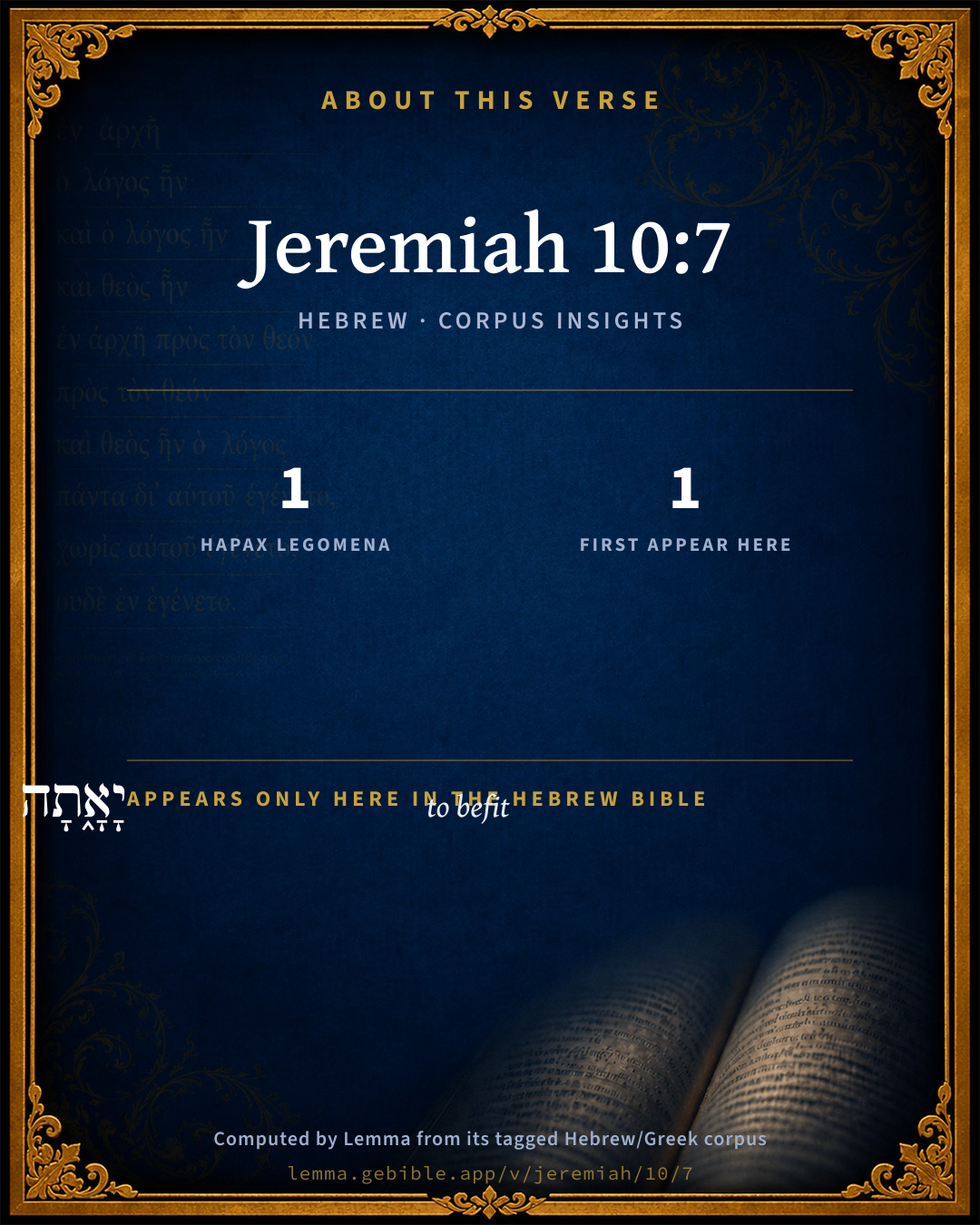
  • 1 hapax legomenon — only here in the Hebrew Bible
  • 1 first appearance in the Hebrew Bible
Full analysis ↓
Download a study sheet

One document with this verse’s original text, its word-by-word gloss line, the meaning frame, cross-references with their text, attributed commentary, and full source and license credits — printable, and it pastes into notes with its structure intact.

This verse Autodidact and up

Study sheet (.html) Plain text (.txt)

A passage Seminary Student

Up to 50 verses in one chapter. A passage sheet keeps up to 6 commentary sources and 12 cross-references per verse, in the order this page ranks them, and says so on the sheet whenever that leaves anything out. Ask for a single verse and you get the Autodidact verse sheet above.

Everything on this page stays free to read, with no account — the sheet is a download of what is already on screen, not access to it.

Want to remove ads? Support Godless Engineer
Compare translations 3

The same verse in 3 English versions, stacked beneath the original-language interlinear above. Click any original word for its lexicon entry.

Each is an independent rendering of the whole verse — the interlinear is not word-aligned to these translations.

Highlighted words mark where these versions differ — a whole-verse word diff, not a word-by-word alignment.

  • World English Bible Public Domain
    Who should not fear you, King of the nations? for to you does it appertain; because among all the wise men of the nations, and in all their royal estate, there is none like you.
  • King James Version Public Domain
    Who would not fear thee, O King of nations? for to thee doth it appertain: forasmuch as among all the wise men of the nations, and in all their kingdoms, there is none like unto thee.
  • unfoldingWord Literal Text CC BY-SA 4.0
    Who would not fear you, king of the nations? For it is fitting to you, for among all the wise of the nations and among all of their kingdoms there is no one like you.

unfoldingWord Literal Text — © unfoldingWord, licensed CC BY-SA 4.0. Word-aligned USFM3 via Door43 (git.door43.org/unfoldingWord/en_ult).

Versions to compare (up to 4)

3 of 4 selected

Show all 18 translations

Every available English version of this verse, each an independent rendering of the whole verse.

  • World English Bible Public Domain
    Who should not fear you, King of the nations? for to you does it appertain; because among all the wise men of the nations, and in all their royal estate, there is none like you.
  • Berean Standard Bible Public Domain
    Who would not fear You, O King of nations? This is Your due. For among all the wise men of the nations, and in all their kingdoms, there is none like You.
  • Majority Standard Bible Public Domain
    Who would not fear You, O King of nations? This is Your due. For among all the wise men of the nations, and in all their kingdoms, there is none like You.
  • King James Version Public Domain
    Who would not fear thee, O King of nations? for to thee doth it appertain: forasmuch as among all the wise men of the nations, and in all their kingdoms, there is none like unto thee.
  • American Standard Version (1901) Public Domain
    Who should not fear thee, O King of the nations? for to thee doth it appertain; forasmuch as among all the wise men of the nations, and in all their royal estate, there is none like unto thee.
  • Revised Version (1885) Public Domain
    Who would not fear thee, O King of the nations? for to thee doth it appertain: forasmuch as among all the wise men of the nations, and in all their royal estate, there is none like unto thee.
  • Geneva Bible (1599) Public Domain
    Who would not feare thee, O King of nations? for to thee appertaineth the dominion: for among all the wise men of the Gentiles, and in al their kingdomes there is none like thee.
  • Douay-Rheims (1899) Public Domain
    Who shall fear thee, O king of nations? for thine is the glory: among all the wise men of the nations, and in all their kingdoms there is none like unto thee.
  • Young's Literal Translation Public Domain
    Who doth not fear Thee, king of the nations? For to Thee it is becoming, For among all the wise of the nations, And in all their kingdom there is none like Thee.
  • Literal Standard Version CC BY-SA 4.0
    Who does not fear You, King of the nations? For it is befitting to You, || For among all the wise of the nations, || And in all their kingdom, there is none like You.
  • Unlocked Literal Bible CC BY-SA 4.0
    Who does not fear you, king of the nations? For this is what you deserve, for there is no one like you among all the wise men of the nations or all their royal kingdoms.
  • unfoldingWord Literal Text CC BY-SA 4.0
    Who would not fear you, king of the nations? For it is fitting to you, for among all the wise of the nations and among all of their kingdoms there is no one like you.
  • Darby Bible Public Domain
    Who would not fear thee, O King of nations? For to thee doth it appertain; for among all the wise men of the nations, and in all their kingdoms, there is none like unto thee.
  • World Messianic Bible Public Domain
    Who shouldn’t fear you, King of the nations? For it belongs to you. Because among all the wise men of the nations, and in all their royal estate, there is no one like you.
  • Webster's Bible Public Domain
    Who would not fear thee, O King of nations? for to thee doth it appertain: forasmuch as among all the wise men of the nations, and in all their kingdoms, there is none like to thee.
  • Free Bible Version CC BY-SA 4.0
    Everyone should respect you, King of the nations. This is how you should be treated. There's no one like you among all the wise men of every nation and kingdom.
  • Bible in Basic English Public Domain
    Who would not have fear of you, O King of the nations? for it is your right: for among all the wise men of the nations, and in all their kingdoms, there is no one like you.
  • JPS Tanakh (1917) Public Domain
    Who would not fear Thee, O king of the nations? For it befitteth Thee; forasmuch as among all the wise men of the nations, and in all their royalty, there is none like unto Thee.

Literal Standard Version (2020), Covenant Press — licensed CC BY-SA 4.0. Text via the HelloAO Bible API (eBible.org). Unlocked Literal Bible (unfoldingWord) — licensed CC BY-SA 4.0. Text via the HelloAO Bible API (eBible.org). unfoldingWord Literal Text — © unfoldingWord, licensed CC BY-SA 4.0. Word-aligned USFM3 via Door43 (git.door43.org/unfoldingWord/en_ult). Free Bible Version, Dr. Jonathan Gallagher — licensed CC BY-SA 4.0. Text via the HelloAO Bible API (eBible.org).

Word by word

More ways to search: Search by grammar → Find every occurrence → Compare this word →

Practice this passage: Drill this verse → Learn its vocabulary →

יָאָ֑תָה
yâʼâh
H2969
“to befit”
Verb, Qal, Perfect, 3rd Person, Feminine, Singular
Part of Speech
Verb
Stem
Qal
Form
Perfect
Person
3rd Person
Gender
Feminine
Number
Singular
Full BDB Definition

Origin: a primitive root

TWOT: 829

(Qal) to pertain to, befit, be befitting
  1. מִ֣י mîy H4310 “who” Particle, Interrogative
  2. לֹ֤א lôʼ H3808 “not” Particle, Negative
  3. יִֽרָאֲךָ֙ yârêʼ H3372 “to fear · you” Verb, Qal, Imperfect, 3rd Person, Masculine, Singular + Suffix, Personal, 2nd Person, Masculine, Singular
  4. מֶ֣לֶךְ melek H4428 “king of” Noun, Common, Masculine, Singular, Construct
  5. הַגּוֹיִ֔ם gôwy H1471 “the · nations” Particle, Definite Article + Noun, Common, Masculine, Plural, Absolute
  6. כִּ֥י kîy H3588 “that” Conjunction
  7. כִּ֣י kîy H3588 “that” Conjunction
  8. בְכָל kôl H3605 “in/at · all of” Preposition + Noun, Common, Masculine, Singular, Construct
  9. חַכְמֵ֧י châkâm H2450 “wise of” Adjective, Adjective, Masculine, Plural, Construct
  10. הַגּוֹיִ֛ם gôwy H1471 “the · nations” Particle, Definite Article + Noun, Common, Masculine, Plural, Absolute
  11. וּבְכָל kôl H3605 “and · in/at · all of” Conjunction + Preposition + Noun, Common, Masculine, Singular, Construct
  12. מַלְכוּתָ֖ם malkûwth H4438 “kingdom · their” Noun, Common, Feminine, Singular, Construct + Suffix, Personal, 3rd Person, Masculine, Plural
  13. מֵאֵ֥ין ʼayin H369 “from · nothing” Preposition + Particle, Negative
  14. כָּמֽוֹךָ kᵉmôw H3644 “like · you” Preposition + Suffix, Personal, 2nd Person, Masculine, Singular

About this verse

These counts appear in no published source. They are computed here, from the morphology-tagged text and Lemma’s own curated glosses. What Lemma adds →

16
words
12
distinct lemmas
Prophets
section

Notable vocabulary

1 hapax legomenon — a word that appears only here in the entire Hebrew Bible:

  • יָאָ֑תָה to befit H2969

First appearance in Scripture

This word makes its first canonical appearance in the Hebrew Bible here:

  • יָאָ֑תָה to befit H2969

Grammatical profile

  • 2 verbs
  • 6 nouns
  • 1 adjective
  • 2 prepositions
  • 2 conjunctions
  • 3 particles

Verb forms

  • יִֽרָאֲךָ֙ Qal · Imperfect
  • יָאָ֑תָה Qal · Perfect

Repetition

Words recur within this verse — often emphatic in Hebrew:

  • הַגּוֹיִ֔ם nation H1471 ×2
  • בְכָל all H3605 ×2
  • כִּ֥י that H3588 ×2

Cross-references

14

Topical passages linked to Jeremiah 10:7 in the Treasury of Scripture Knowledge — connected by theme and wording, ordered by reader-vote popularity; previews shown in the World English Bible.

  • Revelation 15:4 Who wouldn't fear you, Lord, And glorify your name? For you only are holy. For all the nations will come and worship before you. For your righteous acts have been revealed."
  • Psalms 22:28 For the kingdom is Yahweh's. He is the ruler over the nations.
  • Psalms 89:6 For who in the skies can be compared to Yahweh? Who among the sons of the heavenly beings is like Yahweh,
  • Jeremiah 5:22 Don't you fear me? says Yahweh: won't you tremble at my presence, who have placed the sand for the bound of the sea, by a perpetual decree, that it can't pass it? and though the waves of it toss themselves, yet they can't prevail; though they roar, yet they can't pass over it.
  • Jeremiah 10:6 There is none like you, Yahweh; you are great, and your name is great in might.
  • 1 Corinthians 1:19–20 For it is written, "I will destroy the wisdom of the wise, I will bring the discernment of the discerning to nothing."
  • Job 37:23–24 We can't reach the Almighty, He is exalted in power; In justice and great righteousness he will not oppress.
  • Psalms 72:11 Yes, all kings shall fall down before him. All nations shall serve him.
  • Psalms 76:7 You, even you, are to be feared. Who can stand in your sight when you are angry?
  • Psalms 86:9 All nations you have made will come and worship before you, Lord. They shall glorify your name.
  • Isaiah 2:4 He will judge between the nations, And will decide concerning many peoples; And they shall beat their swords into plowshares, And their spears into pruning-hooks. Nation shall not lift up sword against nation, Neither shall they learn war any more.
  • Zechariah 2:11 Many nations shall join themselves to Yahweh in that day, and shall be my people; and I will dwell in the midst of you, and you shall know that Yahweh of Hosts has sent me to you.
  • Luke 12:5 But I will warn you whom you should fear. Fear him, who after he has killed, has power to cast into Gehenna. Yes, I tell you, fear him.
  • Revelation 11:15 The seventh angel sounded, and great voices in heaven followed, saying, "The kingdom of the world has become the Kingdom of our Lord, and of his Christ. He will reign forever and ever!"

Cross-references courtesy of OpenBible.info (CC BY 4.0).

Hebrew and Greek witnesses Masoretic Hebrew ↔ Greek Septuagint

The same verse in the two great witnesses to the Old Testament, shown verse-for-verse.

These are two independent witnesses, not word-aligned to each other, and the Septuagint is shown in lemma (dictionary) form.

Hebrew Jeremiah 10:7 Masoretic · Westminster Leningrad Codex

מִ֣י לֹ֤א יִֽרָאֲךָ֙ מֶ֣לֶךְ הַגּוֹיִ֔ם כִּ֥י לְךָ֖ יָאָ֑תָה כִּ֣י בְכָל חַכְמֵ֧י הַגּוֹיִ֛ם וּבְכָל מַלְכוּתָ֖ם מֵאֵ֥ין כָּמֽוֹךָ

Who should not fear you, King of the nations? for to you does it appertain; because among all the wise men of the nations, and in all their royal estate, there is none like you.

World English Bible · Public Domain

Greek LXX Structure differs

In the Septuagint, Jeremiah is about an eighth shorter than the Hebrew and arranges its material differently — the Oracles Against the Nations (Hebrew chapters 46–51) appear in the middle of the Greek book, after 25:13. Because the chapter and verse boundaries do not line up, a verse-for-verse comparison with the Hebrew is not shown.

A verse-for-verse comparison isn’t shown here because the chapters and verses don’t line up. Switch to the LXX edition with the MT / LXX toggle above to read the Greek directly.

Hebrew: Westminster Leningrad Codex (CC BY 4.0). Greek: Septuagint (public domain); English from a public-domain English Septuagint. How the Septuagint differs from the Hebrew →

Targum (Aramaic paraphrase)

1

The Targum is the ancient Jewish Aramaic paraphrase of the Hebrew Scriptures — an interpretive translation, not the Hebrew text itself. Onkelos (literal) and Pseudo-Jonathan (expansive) render the Torah, and Jonathan the Prophets. Coverage is partial: where no permissively-licensed English translation exists for a verse, only the Aramaic is shown. This is verse-level text, not a word-by-word alignment to the Hebrew.

  1. Targum Jonathan Prophets (Joshua–Malachi)
    מַן לָא יִדְחַל מִן קֳדָמָךְ מֶלֶךְ עַל כָּל עַמְמַיָא אֲרֵי דִילָךְ הִיא מַלְכוּתָא אֲרֵי בְּכָל חַכִּימֵי עַמְמַיָא וּבְכָל מַלְכְּוָתְהוֹן לֵית בַּר מִנָךְ:

    (no public-domain English translation for this verse)

    Targum Jonathan — Aramaic: “Mikraot Gedolot” (public domain). English: “Sefaria Community Translation” (CC0 1.0 (public-domain dedication)); “London "Chaldee Paraphrase," 1871” (public domain). Text via Sefaria.

Commentary

Notes on Jeremiah 10:7 from classic Christian and Jewish commentators (each source and its license shown beneath its notes). The classic Christian expositions comment on the surrounding passage and are grouped to its opening verse, so a note may address several verses; the Jewish commentaries on the Tanakh (Rashi and others) are per-verse, so they appear only where the commentator wrote on this verse.

Lemma curates 59 commentaries, every one of them public domain or Creative Commons licensed, each selected and text-cleaned for this edition rather than reprinted as found. About our sources →

Trapp's Complete Commentary

John Trapp

Jer 10:7 Who would not fear thee, O King of nations? for to thee doth it appertain: forasmuch as among all the wise [men] of the nations, and in all their kingdoms, [there is] none like unto thee.

Ver. 7. Who would not fear thee, O King of nations?] Tremble at thy transcendent greatness, thy matchless majesty, power, and prowess? See Mal 1:14 Rev 15:4 Psa 103:19. {See Trapp on "Mal 1:14"} {See Trapp on "Rev 15:4"} {See Trapp on "Psa 103:19"}

Forasmuch as among all the wise men of the nations.] Who used to deify their wise men and their kings.

John Trapp, A Commentary or Exposition upon All the Books of the Old and New Testament (1647–1656) — public domain. Text from a community e-Sword module.

Tyndale Open Study Notes

Tyndale Open Resources

10:7 The fear of the Lord is not craven terror, but profound reverence and submission to his discipline (Job 28:28; Ps 34:11-14; Prov 1:7). It results in contentment (Prov 10:23). • King of nations: God is not limited to being the Lord of one small nation; his reign is worldwide. Jeremiah pointed out that no man-made deity could ever claim that title; not even wise people deserve such reverence.

Tyndale Open Study Notes — © Tyndale Open Resources, licensed CC BY-SA 4.0. Text via the HelloAO Bible API.

Jamieson, Fausset & Brown

Robert Jamieson, A. R. Fausset & David Brown

(Rev 15:4).

to thee doth it appertain--to Thee it properly belongs, namely, that Thou shouldest be "feared" (taken out of the previous "fear Thee") (compare Eze 21:27). He alone is the becoming object of worship. To worship any other is unseemly and an infringement of His inalienable prerogative.

none--nothing whatever (see on Jer 10:6; Psa 89:6).

Jamieson, Fausset & Brown — Commentary Critical and Explanatory on the Whole Bible (1871) — public domain (CC PDM 1.0). Text via the HelloAO Bible API.

Adam Clarke's Commentary

Verse 7. Who would not fear thee] Who would not worship thee as the Author and Giver of all good? The fear of God is often taken for the whole of true religion.

Among all the wise men of the nation] Not even the wisest and most cultivated of the nations have ever found out any one equal to thee; but so exalted and holy art thou, that in all their wisdom and research they have never been able to find out the true God.

Adam Clarke's Commentary on the Bible (1810–1826) — public domain. Text from a community e-Sword/MySword module.

John Calvin's Commentaries

The Prophet exclaims, Who will not fear thee? This question is very emphatical, as though he indignantly rebuked the stupidity of all those who acknowledged not the only true God, as if he had said, “Whence is it that thou art not feared throughout the whole world? Surely were there a spark of right knowledge in men, they would acknowledge thee as the only true God, and having found this truth, would submit to thy power. When, therefore, men invent for themselves various gods, and when every one is led here and there without any judgment, it is a monstrous thing; for when the subject is pressed on the attention of the rudest, they confess that there, is some supreme deity, and are at length constrained to allow that there is but one true God; whence then is it that there is such a multitude and variety of gods in the world? How is it that they who hold this principle — that God ought to be worshipped — fall away, and adopt many gods, and never can determine who the true God is, or how he is to be worshipped?” We now understand the object of the Prophet in exclaiming, as through astonishment, Who will not fear thee, the King of nations?

We know that the true God was then despised by the heathens; and we also know that his law was regarded with contempt, and even els an abomination: What then does this question mean? even what I have already stated: The Prophet indignantly says, that it was a monstrous thing, bordering on madness, that men paid no regard to the only true God, but went astray after their own foolish devices. And he calls him the King of the nations, not that the nations submitted to his authority, but because he manifested evidences of his power everywhere, which might have induced the rudest to shew him reverence, were they not extremely stupid. We then see that this is not said to the honor of the nations, but on the contrary, that their ingratitude might be exposed to shame in not honoring God, who manifested his power among them.

Then follows what confirms this: For to thee it belongs; for among all the wise of the nations, and in all their kingdoms, from no time has there been one like to thee He says that it belongs to God, that is, that all the world should fear him. Some render יאתה iate, as a noun, and take it as signifying “honor;” and others render it “government,” or authority; but this cannot be received. He then says, it belongs to God. What? Some say, “glory or dominion belongs to thee.” But it must be referred to the beginning of the verse: there is here a figure called Zeugma, and the meaning is, God deserves this, that is, to be feared by all. H.e then speaks of fear, and says that it belongs to God. What is meant is, that the glory of God shines so much as to be sufficient to arrest and engage all the thoughts of men, and that they are therefore extremely stupid when they pass by and forsake him, and turn to their own devices, and invent gods according to their own fancies.

The Prophet then confirms what we have already said — that all men who worship not nor fear the only true God are detestable beings, because so much of his glory shines forth, that renders all bound to acknowledge him. It then follows, that those who are carried away into various superstitions are to the last degree stupid and brutish; for God renders his glory conspicuous everywhere, so that it ought to engage and occupy the thoughts of all men; and it would do so were they not led away by their own vanity.

We hence also learn that the pretext of ignorance made by unbelievers is wholly vain. There are those who on the first view seem to be excusable for their error, as they have not been taught, and never understood who the true God is; but yet there is in them the blame of neglect as well as of wickedness, for they wilfully neglect and despise the only true God. As then the unbelieving take delight in their errors, they are to be held guilty. And this is what the Prophet means by saying that God was worthy of glory — the glory of being feared by all: and this he more fully confirms when he says, “Among all the wise, and in all kingdoms,” that is, among all the princes who seemed to excel in wisdom in governing the world, “no other God could be found throughout all the ages.”

He repeats again the word מאין main, of which we spoke yesterday. It is the same as though the Prophet had said, “Let all the wise men and philosophers come forth, let all those counsellors who assume great wisdom appear, and let them adduce whatever they can allege; doubtless God will ever defend his own glory against all their frivolous arguments, so that they must depart confounded; nor shall they be able, however willing they may be, to bring any solid objection against him.” By these words, then, the Prophet intimates that it is vain to boast of philosophic reasons, and that the counsels of princes, who esteem themselves very acute in civil affairs, will be adduced in vain; for all will be covered with shame, and be constrained to be silent, when God makes known his glory. Indeed the glory of God appears everywhere so conspicuously, that the rudest ought to perceive it, that the wise, who fly above the heavens as philosophers, who search all the secrets of nature, do not understand what is, as they say, abroad in the open air; for God manifests himself to the simple, and even to children. We now perceive the design of the Prophet, when he says, From no times has been found any like to God, not only among the vulgar or common men, but among the wise, and princes, and kings’ counsellors. He afterwards adds —

John Calvin's Commentaries (1540-1563) — public domain. Text from the Calvin Translation Society English edition (1840s-50s) via the Christian Classics Ethereal Library (ccel.org). Calvin's coverage is partial (roughly two-thirds of the Bible); uncommented books and verses are honest gaps, never fabricated. The 19th-century editor's footnotes and remarks are omitted so the notes are faithfully Calvin's own voice.

Ellicott's Commentary for English Readers

(7) King of nations.—Emphatically, “King of the heathen” expressing the universal sovereignty of Jehovah in contrast with the thought that He was the God of the Jews only. (Compare Rom_3:29.)

To thee doth it appertain.—Better, for it is thine, i.e., the kingdom over the heathen implied in the title just given.

The wise men.—The word “men” is better omitted. Jehovah is not compared with the sages of the heathen only, but with all to whom they looked as sources and givers of wisdom.

In all their kingdoms.—Better, in all their sovereignty.

A Bible Commentary for English Readers, edited by Charles John Ellicott (1878–1897) — public domain. Text from a community e-Sword module.

The Cambridge Bible for Schools and Colleges

gen. ed. J. J. S. Perowne

7. to thee doth it appertain] rather, as mg. it beseemeth thee.

The Cambridge Bible for Schools and Colleges (gen. ed. J. J. S. Perowne; Cambridge University Press, 1878–1918) — public domain. Text from a community e-Sword module.

John Gill's Exposition

Who would not fear thee, O King of nations?.... Not that the fear of him among the nations was general, or that he was owned by them as their King; but inasmuch as of right he was their King, so he ought to have been feared and reverenced by them; and it was an instance of great stupidity and ingratitude not to do it. The Targum renders it,

"King of all people;''

and the Syriac version, "King of all worlds"; some reference seems to be had to this passage in Rev 15:3, where, instead of "King of nations", the Lord is called "King of saints"; and there refers to a time when he will be feared, that is, worshipped and served by all nations, as he ought to be:

for to thee doth it appertain; that is, fear belongs to him, it is his due; and this, with keeping the commandments of God, is the whole duty of man. The Vulgate Latin version is, "thine is the glory"; honour or praise, as the Syriac version; and so Jarchi interprets it of beauty or glory; but the Targum,

"thine is the kingdom;''

and so Kimchi; and to which agrees the Arabic version.

Forasmuch as among all the wise men of the nations, and in all their kingdoms, there is none like unto thee; that is, among all the wise kings of the nations, and all their wise counsellors, there is none like unto God for wisdom, or for glory and majesty; there is none of them that has such a kingdom as he has, or that governs it as he does; and as all their power and government, so all that wisdom by which they manage their political affairs, are from him.

John Gill's Exposition of the Whole Bible (1746–1763) — public domain (CC PDM 1.0). Text via the HelloAO Bible API.

Albert Barnes' Notes on the Bible

O King of nations - i. e., pagan nations. Yahweh is not the national God of the Jews only, but He reigns over all mankind Psa 22:28.

It - i. e., everything.

In all their kingdoms - More correctly, “in all their royalty or kingship.”

Albert Barnes' Notes on the Bible (1834–1885) — public domain. Text from a community e-Sword/MySword module.

Haydock's Catholic Bible Commentary

Wise. Manuscript 2 has in the margin "kings," perhaps more correctly. (Kennicott)

George Leo Haydock (1774–1849), Haydock's Catholic Family Bible and Commentary, 1859 edition — public domain. Excludes Psalms (Douay-Rheims chapter numbering differs from Protestant) and Deuterocanonical books (Catholic canon only).

Matthew Poole's English Annotations

Who would not fear thee, O King of nations? he is called a great King, Mal 1:14; q.d. Thou, by whom all nations are governed, and all affairs in them disposed, and by none else, who would worship any but thee, or be afraid of any but thee, seeing it is fit for, and therefore can belong to, none besides? as in the next words; it is thy right and due. Or, Who can be so stupid as not to acknowledge one Supreme Being, and this to be but one? as, among the heathens, Socrates, Plato, Seneca, and divers others did; and therefore is it not a prodigious thing that any should so withhold the truth in unrighteousness, be so gross as to worship many gods?

Among all the wise men of the nations, and in all their kingdoms, there is none like unto thee: q.d. If you search among all their wise men and philosophers, all the great men and rulers, in their kingdoms; for these the heathens were wont to worship as gods after death, wise men for their wisdom, and kings for their power; you will find none to compare with God, either for wisdom or power; their wise men are but as so many fools.

Matthew Poole's English Annotations on the Holy Bible (1683–1685) — public domain. Text from a community e-Sword/MySword module.

Whedon's Commentary on the Bible

Daniel D. Whedon

7. O King of nations — Mark here, as in many other Old Testament passages, the conception of God as the universal ruler of mankind, and not merely the national God of the Jews.

Doth it appertain — The subject is indefinite, as though all dignity should be included.

Wise men — “Men,” inserted by the translators, is misleading, and should not be used.

Wise ones — Whether men or gods.

Daniel D. Whedon (gen. ed.), Commentary on the Old and New Testaments (1874–1909) — public domain. Text from a community e-Sword module.

The Pulpit Commentary

O King of nations. As time went on, the sacred writers became more and more distinct in their assertions of the truth that Jehovah, the Self-revealing God, is not Israel"s King only, but also of the world. (comp. Psa_22:28 Psa_47:7, 8 96:10) To thee doth it appertain; viz. that men should fear thee. Forasmuch as, etc. (see above, on Ver. 6). Among all the wise men. "Men" is supplied, but doubtless rightly. It is a contest how unequal a one! between Jehovah and the sages of the heathen. (comp. "Yet he also is wise," Isa_31:2)

Ver. 8. Brutish and foolish. In fact, the original meaning of the idolatrous religions had begun, probably, to fade, and the worship of Bel and Nebo had become (as the worship of the Egyptian gods became at a later period) increasingly formal and ritualistic. The stock is a doctrine of vanities; rather, an instruction of vanities; i.e. all that the idols can teach is vanities. Against this is the plural ("vanities," not vanity); it is more natural (and also more in accordance with usage; comp. Gen_41:26, Hebrew) to render, the instruction of the vanities is wooden. ("vanities" has the constant technical sense of "idols;" see Jer_8:19 Jer_14:22 Deu_32:21 Psa_31:6) The clause then furnishes a reason for the folly of the heathen; how should they attain to more than a "wooden" knowledge, when the idols themselves are but wood? A bitter truth in an ironical form.

The Pulpit Commentary (1880–1919), ed. H.D.M. Spence-Jones & Joseph S. Exell — public domain. Text from a community e-Sword module.

Scofield Reference Notes

C. I. Scofield

fear (See Scofield "Psa 19:9").

The Scofield Reference Bible (1917 edition), notes by C. I. Scofield — public domain. Text from a community e-Sword module.

Rashi

Rabbi Shlomo Yitzchaki (Rashi)

for it befits You It is proper for you.

Rashi on the Tanakh — English translations: “The Judaica Press complete Tanach with Rashi, translated by A. J. Rosenberg” (CC BY 4.0); “Pentateuch with Rashi's commentary by M. Rosenbaum and A.M. Silbermann, 1929-1934” (public domain); “The Metsudah Tanach series, Lakewood, N.J” (CC BY 4.0); and “The Book of Joshua, Metsudah Publications, 1997” (CC BY 4.0). Text via Sefaria.

Lesson kit

Teaching starters — assembled from the data on this page, not authored interpretation. Every prompt links to the verse data it draws on. Edit before teaching.

Jeremiah, in the Prophets, opens this verse with 16 words (12 distinct Hebrew lemmas). Its most distinctive word is yâʼâh (“to befit”). A historical commentator’s framing appears above. Read the whole chapter for the surrounding context.

Discussion questions

  1. What does “to befit” (yâʼâh) contribute to the verse as a whole?
  2. 1 word here appears nowhere else in the Hebrew Bible. Why might the author reach for such rare wording?
  3. This is the first place “to befit” appears in Scripture (first appears here). What does its debut here establish?
  4. How does Revelation 15:4, which shares this passage’s theme, read alongside this verse?
  5. What does the repetition of “nation” (2× in this one verse) do in this verse?
  6. These translations render this verse differently. What is at stake in choosing one wording over another?
  7. «יִֽרָאֲךָ֙» is a Qal Imperfect verb. How does that grammatical form shape the action described?
  8. Compare how Trapp's Complete Commentary and Tyndale Open Study Notes read this verse. Where do they agree or differ?

Things to notice

  • 1 word in this verse appears nowhere else in the Hebrew Bible.
  • 1 word makes its first canonical appearance in Scripture here.
  • These translations choose different wording for 15 words in this verse.
  • “nation” occurs 2× in this single verse.
  • 12 distinct Hebrew lemmas span 16 words in this verse.

Reading settings

Reading text

Shown beneath each verse's original-language words.

Old Testament
Old Testament edition

Read the OT as the Masoretic Hebrew (MT) or the Greek Septuagint (LXX).

English shown for the Greek Septuagint (in the Hebrew ↔ Greek comparison).

Comparing translations? Open the Compare panel on any verse page to stack up to four side by side.