
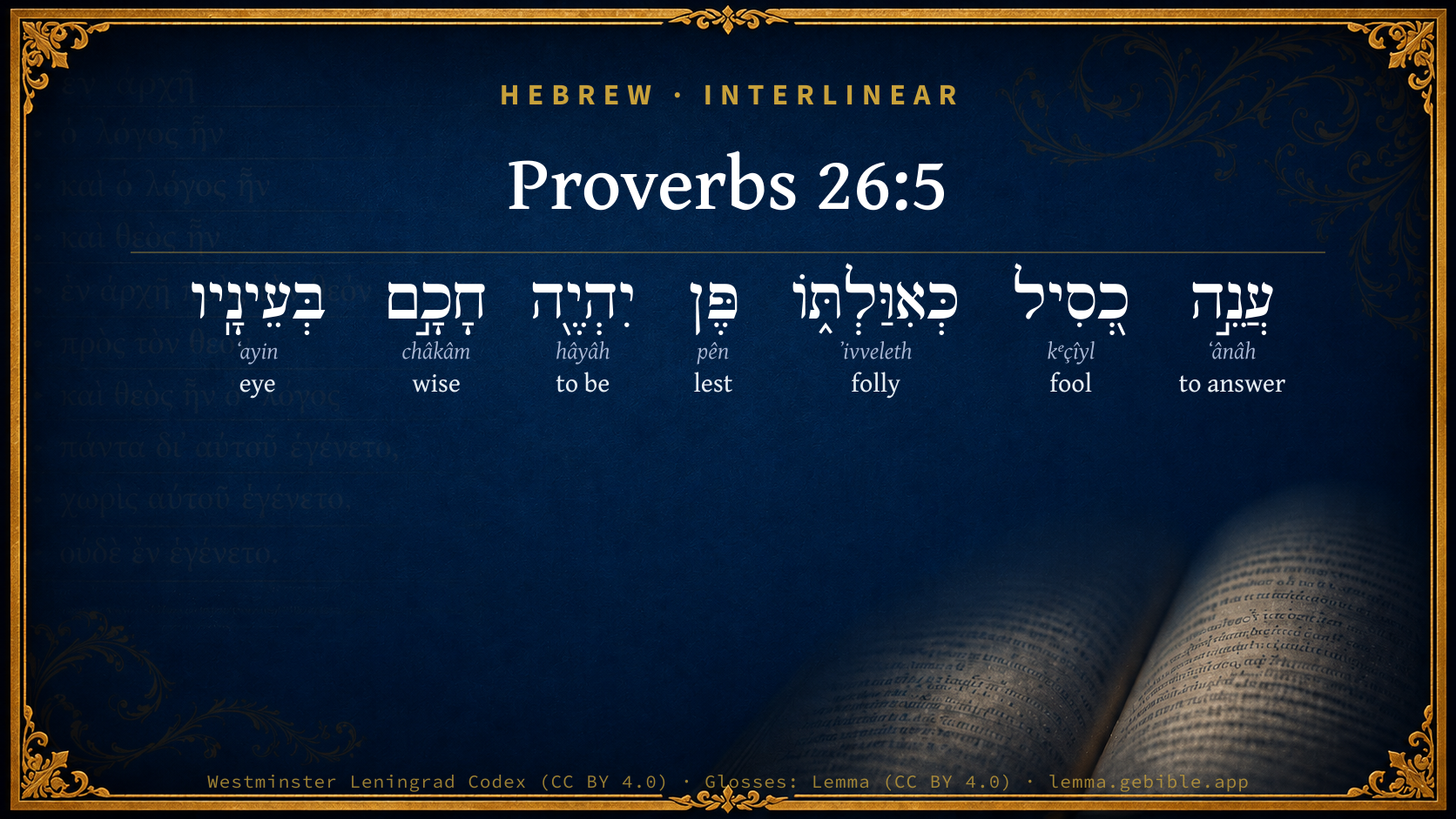
Proverbs 26:5

Hebrew (Westminster Leningrad Codex) Proverbs 26:5 appears in the Hebrew Old Testament. The text above is from the Westminster Leningrad Codex. Each word links to its Strong’s number, a concise gloss, and parsing drawn from the Open Scriptures Hebrew Bible morphology. Click any word for its full Brown-Driver-Briggs (BDB) entry.
Download image
Cite this verse

Proverbs 26:5 (World English Bible). Public Domain. Lemma interlinear Bible study tool, https://lemma.gebible.app/v/proverbs/26/5.

Show BibTeX & RIS
BibTeX
RIS
English Translation
Answer a fool according to his folly, Lest he be wise in his own eyes.
World English Bible · Public Domain
Download a study sheet

One document with this verse’s original text, its word-by-word gloss line, the meaning frame, cross-references with their text, attributed commentary, and full source and license credits — printable, and it pastes into notes with its structure intact.

This verse Autodidact and up

Study sheet (.html) Plain text (.txt)

A passage Seminary Student

Up to 50 verses in one chapter. A passage sheet keeps up to 6 commentary sources and 12 cross-references per verse, in the order this page ranks them, and says so on the sheet whenever that leaves anything out. Ask for a single verse and you get the Autodidact verse sheet above.

Everything on this page stays free to read, with no account — the sheet is a download of what is already on screen, not access to it.

Want to remove ads? Support Godless Engineer
Compare translations 3

The same verse in 3 English versions, stacked beneath the original-language interlinear above. Click any original word for its lexicon entry.

Each is an independent rendering of the whole verse — the interlinear is not word-aligned to these translations.

Highlighted words mark where these versions differ — a whole-verse word diff, not a word-by-word alignment.

  • World English Bible Public Domain
    Answer a fool according to his folly, Lest he be wise in his own eyes.
  • King James Version Public Domain
    Answer a fool according to his folly, lest he be wise in his own conceit.
  • unfoldingWord Literal Text CC BY-SA 4.0
    Answer a stupid one according to his folly, lest he become wise in his eyes.

unfoldingWord Literal Text — © unfoldingWord, licensed CC BY-SA 4.0. Word-aligned USFM3 via Door43 (git.door43.org/unfoldingWord/en_ult).

Versions to compare (up to 4)

3 of 4 selected

Show all 18 translations

Every available English version of this verse, each an independent rendering of the whole verse.

  • World English Bible Public Domain
    Answer a fool according to his folly, Lest he be wise in his own eyes.
  • Berean Standard Bible Public Domain
    Answer a fool according to his folly, lest he become wise in his own eyes.
  • Majority Standard Bible Public Domain
    Answer a fool according to his folly, lest he become wise in his own eyes.
  • King James Version Public Domain
    Answer a fool according to his folly, lest he be wise in his own conceit.
  • American Standard Version (1901) Public Domain
    Answer a fool according to his folly, Lest he be wise in his own conceit.
  • Revised Version (1885) Public Domain
    Answer a fool according to his folly, lest he be wise in his own conceit.
  • Geneva Bible (1599) Public Domain
    Answere a foole according to his foolishnes, least he be wise in his owne conceite.
  • Douay-Rheims (1899) Public Domain
    Answer a fool according to his folly, lest he imagine himself to be wise.
  • Young's Literal Translation Public Domain
    Answer a fool according to his folly, Lest he be wise in his own eyes.
  • Literal Standard Version CC BY-SA 4.0
    Answer a fool according to his folly, || Lest he is wise in his own eyes.
  • Unlocked Literal Bible CC BY-SA 4.0
    Answer a fool and join in on his folly, so he will not become wise in his own eyes.
  • unfoldingWord Literal Text CC BY-SA 4.0
    Answer a stupid one according to his folly, lest he become wise in his eyes.
  • Darby Bible Public Domain
    Answer a fool according to his folly, lest he be wise in his own eyes.
  • World Messianic Bible Public Domain
    Answer a fool according to his folly, lest he be wise in his own eyes.
  • Webster's Bible Public Domain
    Answer a fool according to his folly, lest he be wise in his own conceit.
  • Free Bible Version CC BY-SA 4.0
    Answer stupid people following their stupidity, otherwise they'll think they're wise.
  • Bible in Basic English Public Domain
    Give a foolish man a foolish answer, or he will seem wise to himself.
  • JPS Tanakh (1917) Public Domain
    Answer a fool according to his folly, lest he be wise in his own eyes.

Literal Standard Version (2020), Covenant Press — licensed CC BY-SA 4.0. Text via the HelloAO Bible API (eBible.org). Unlocked Literal Bible (unfoldingWord) — licensed CC BY-SA 4.0. Text via the HelloAO Bible API (eBible.org). unfoldingWord Literal Text — © unfoldingWord, licensed CC BY-SA 4.0. Word-aligned USFM3 via Door43 (git.door43.org/unfoldingWord/en_ult). Free Bible Version, Dr. Jonathan Gallagher — licensed CC BY-SA 4.0. Text via the HelloAO Bible API (eBible.org).

Word by word

More ways to search: Search by grammar → Find every occurrence → Compare this word →

Practice this passage: Drill this verse → Learn its vocabulary →

About this verse

These counts appear in no published source. They are computed here, from the morphology-tagged text and Lemma’s own curated glosses. What Lemma adds →

7
words
7
distinct lemmas
Wisdom
section

Notable vocabulary

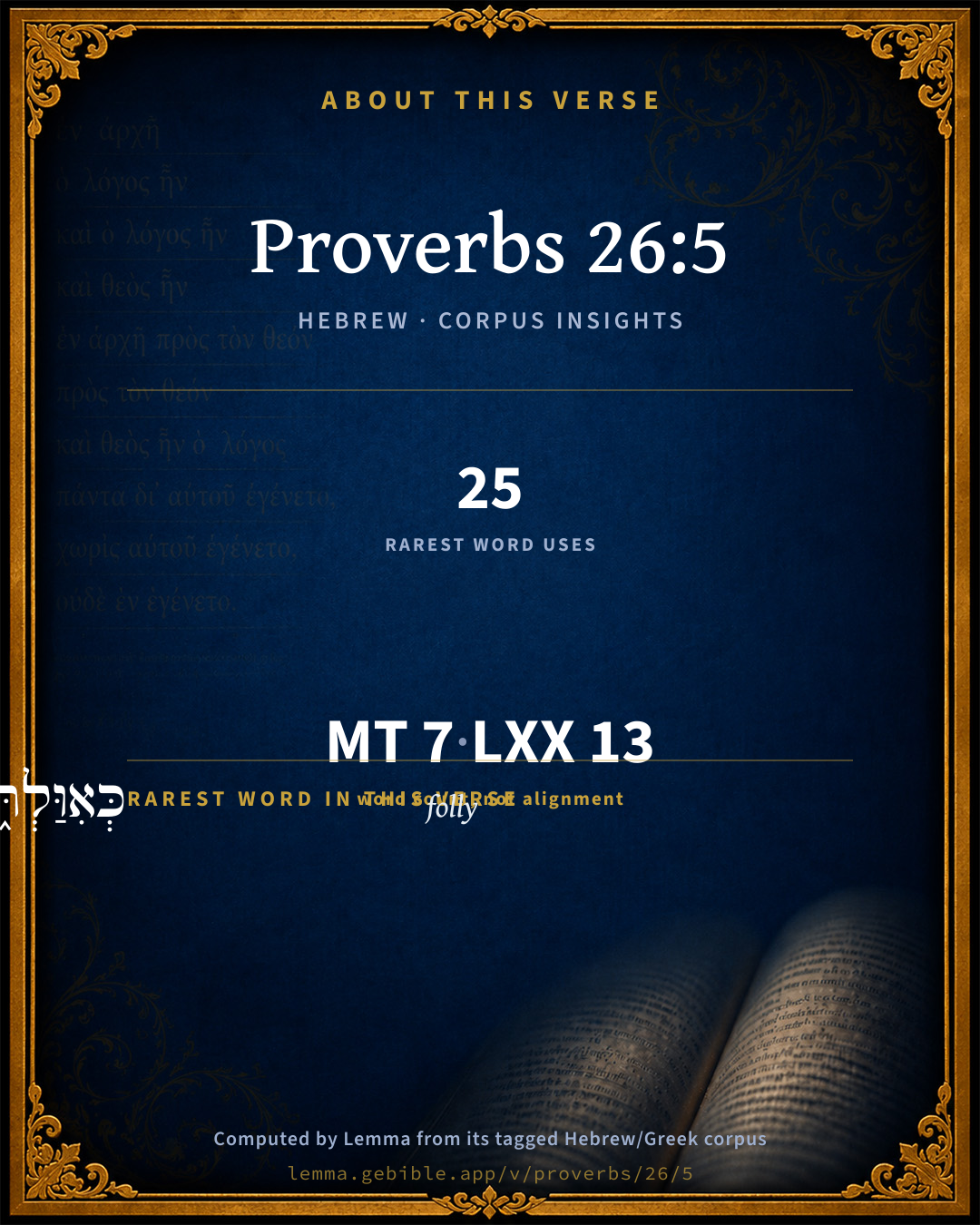
The rarest word here is כְּאִוַּלְתּ֑וֹ folly H200 — appearing just 25 times in the whole Hebrew Bible.

Shared distinctive vocabulary

כְּאִוַּלְתּ֑וֹ folly H200 occurs in 24 verses of the Hebrew Bible. Also found in:

Grammatical profile

  • 2 verbs
  • 2 nouns
  • 2 adjectives
  • 1 conjunction

Verb forms

  • עֲנֵ֣ה Qal · Imperative
  • יִהְיֶ֖ה Qal · Imperfect

Hebrew & Septuagint length

In English translation the verse runs 15 words from the Hebrew and 16 from the Septuagint (LXX English) — closely comparable.

A rough comparison of the two English renderings, which tokenize alike — not a word-level alignment.

Word counts can differ between the Hebrew and the Greek without any difference in meaning — e.g. the Hebrew direct-object marker אֵת has no separate Greek word, and Greek often adds the article ὁ.

In the original languages it is 7 Hebrew tokens and 13 Greek tokens — but the two are counted differently (Hebrew bundles its prefixes and suffixes into one token; the Greek is in lemma form), so that isn’t a like-for-like length.

Cross-references

18

Topical passages linked to Proverbs 26:5 in the Treasury of Scripture Knowledge — connected by theme and wording, ordered by reader-vote popularity; previews shown in the World English Bible.

  • Matthew 16:1–4 The Pharisees and Sadducees came, and testing him, asked him to show them a sign from heaven.
  • Romans 12:16 Be of the same mind one toward another. Don't set your mind on high things, but associate with the humble. Don't be wise in your own conceits.
  • Proverbs 3:7 Don't be wise in your own eyes. Fear Yahweh, and depart from evil.
  • Proverbs 28:11 The rich man is wise in his own eyes; But the poor who has understanding sees through him.
  • Titus 1:13 This testimony is true. For this cause, reprove them sharply, that they may be sound in the faith,
  • Proverbs 26:4 Don't answer a fool according to his folly, Lest you also be like him.
  • Proverbs 26:12 Do you see a man wise in his own eyes? There is more hope for a fool than for him.
  • Matthew 21:23–27 When he had come into the temple, the chief priests and the elders of the people came to him as he was teaching, and said, "By what authority do you do these things? Who gave you this authority?"
  • Luke 12:13–21 One of the multitude said to him, "Teacher, tell my brother to divide the inheritance with me."
  • John 8:7 But when they continued asking him, he looked up and said to them, "He who is without sin among you, let him throw the first stone at her."
  • John 9:26–33 They said to him again, "What did he do to you? How did he open your eyes?"
  • Romans 11:25 For I don't desire, brothers, to have you ignorant of this mystery, so that you won't be wise in your own conceits, that a partial hardening has happened to Israel, until the fullness of the Gentiles has come in,
  • 1 Kings 22:24–28 Then Zedekiah the son of Chenaanah came near, and struck Micaiah on the cheek, and said, Which way went the Spirit of Yahweh from me to speak to you?
  • Isaiah 5:21 Woe to those who are wise in their own eyes, And prudent in their own sight!
  • Jeremiah 36:17–18 They asked Baruch, saying, Tell us now, How did you write all these words at his mouth?
  • Matthew 15:1–3 Then Pharisees and scribes came to Jesus from Jerusalem, saying,
  • Luke 13:23–30 One said to him, "Lord, are they few who are saved?" He said to them,
  • Matthew 22:15–32 Then the Pharisees went and took counsel how they might entrap him in his talk.

Cross-references courtesy of OpenBible.info (CC BY 4.0).

Hebrew and Greek witnesses Masoretic Hebrew ↔ Greek Septuagint

The same verse in the two great witnesses to the Old Testament, shown verse-for-verse.

These are two independent witnesses, not word-aligned to each other, and the Septuagint is shown in lemma (dictionary) form.

Hebrew Proverbs 26:5 Masoretic · Westminster Leningrad Codex

עֲנֵ֣ה כְ֭סִיל כְּאִוַּלְתּ֑וֹ פֶּן יִהְיֶ֖ה חָכָ֣ם בְּעֵינָֽיו

Answer a fool according to his folly, Lest he be wise in his own eyes.

World English Bible · Public Domain

Greek LXX Proverbs 26:5 Septuagint · lemma form

ἀλλά ἀποκρίνω ἄφρων κατά ὁ ἀφροσύνη αὐτός ἵνα μή φαίνω σοφός παρά ἑαυτοῦ

Yet answer a fool according to his folly, lest he seem wise in his own conceit.

LXX2012 (modern English Septuagint) · Public Domain

Hebrew: Westminster Leningrad Codex (CC BY 4.0). Greek: Septuagint (public domain); English from LXX2012 (modern English Septuagint) (Public Domain). How the Septuagint differs from the Hebrew →

Commentary

Notes on Proverbs 26:5 from classic Christian and Jewish commentators (each source and its license shown beneath its notes). The classic Christian expositions comment on the surrounding passage and are grouped to its opening verse, so a note may address several verses; the Jewish commentaries on the Tanakh (Rashi and others) are per-verse, so they appear only where the commentator wrote on this verse.

Lemma curates 59 commentaries, every one of them public domain or Creative Commons licensed, each selected and text-cleaned for this edition rather than reprinted as found. About our sources →

Trapp's Complete Commentary

John Trapp

Pro 26:5 Answer a fool according to his folly, lest he be wise in his own conceit.

Ver. 5. Answer a fool according to his folly.] Cast in somewhat that may sting him, and stop his mouth. Stone him with soft words but hard arguments, as Christ dealt with Pilate, lest he lift up his crest, and look upon himself as a conqueror, and be held so by the hearers. In fine, when a fool is among such as himself, answer him, lest he seem wise. If he be among wise men, answer him not, and they will regard rather quid tu taceas, quam quod ille dicat, thy seasonable silence than his passionate prattle.

John Trapp, A Commentary or Exposition upon All the Books of the Old and New Testament (1647–1656) — public domain. Text from a community e-Sword module.

Keil & Delitzsch

C. F. Keil & F. Delitzsch

5 Answer the fool according to his folly,

Lest he regard himself as wise.

ענה־כסיל (with Makkeph, and Gaja, and Chatef)

(Note: Thus after Ben Asher; while, on the contrary, Ben Naphtali writes ענה כסיל with Munach, vid., Thorath Emeth, p. 41.)

here stands opposed to אל־תען כסיל. The Gospel of John, e.g., Joh 5:31, cf. Pro 8:31,

(Note: Vid., my dissertation on three little-observed passages in the Gospel of John, and their practical lessons, in the Evang. luth. Kirchenzeitung, 1869, Nos. 37, 38.)

is rich in such apparently contradictory sayings. The sic et non here lying before us is easily explained; after, or according to his folly, is this second time equivalent to, as is due to his folly: decidedly and firmly rejecting it, making short work with it (returning a sharp answer), and promptly replying in a way fitted, if possible, to make him ashamed. Thus one helps him, perhaps, to self-knowledge; while, in the contrary case, one gives assistance to his self-importance. The Talmud, Schabbath 30b, solves the contradiction by referring Pro 26:4 to worldly things, and Pro 26:5 to religious things; and it is true that, especially in the latter case, the answer is itself a duty toward the fool, and towards the truth. Otherwise the Midrash: one ought not to answer when one knows the fool as such, and to answer when he does not so know him; for in the first instance the wise man would dishonour himself by the answer, in the latter case he would give to him who asks the importance appertaining to a superior.

Keil & Delitzsch — Biblical Commentary on the Old Testament (1861–1891) — public domain (CC PDM 1.0). Text via the HelloAO Bible API. (Old Testament only.)

Geneva Bible (1599)

Geneva Bible translators

Hebrew, eyes.

Reprove him as the matter requireth.

Geneva Bible (1599) marginal notes — public domain. Text via Bolls.life.

Jamieson, Fausset & Brown

Robert Jamieson, A. R. Fausset & David Brown

Answer--by reproof.

Jamieson, Fausset & Brown — Commentary Critical and Explanatory on the Whole Bible (1871) — public domain (CC PDM 1.0). Text via the HelloAO Bible API.

Ellicott's Commentary for English Readers

(5) Answer a fool according to his folly.—As his folly deserves, sharply and decisively, and in language suited to his comprehension.

A Bible Commentary for English Readers, edited by Charles John Ellicott (1878–1897) — public domain. Text from a community e-Sword module.

John Gill's Exposition

Answer a fool according to his folly,.... The Targum is,

"but speak with a fool in thy wisdom;''

and the Syriac version,

"yea, speak with a fool according to thy wisdom;''

which would at once remove the seeming contradiction in these words to the former, but then they are not a true version; indeed it is right, and must be the sense, that when a fool is answered, as it is sometimes necessary he should, that it be done in wisdom, and so as to expose his folly; he is to be answered and not answered according to different times, places, and circumstances, and manner of answering; he is to be answered when there is any hope of doing him good, or of doing good to others; or of preventing ill impressions being made upon others by what he has said; when the glory of God, the good of the church, and the cause of truth, require it; and when he would otherwise glory and triumph, as if his words or works were unanswerable, as follow;

lest he be wise in his own conceit; which fools are apt to be, and the rather when no answer is given them; imagining it arises from the strength of their arguments, and their nervous way of reasoning, when it is rather from a neglect and contempt of them.

John Gill's Exposition of the Whole Bible (1746–1763) — public domain (CC PDM 1.0). Text via the HelloAO Bible API.

Matthew Poole's English Annotations

According to his folly; so as his folly needs and requires, convincing him strongly, reproving him sharply, exposing him to just shame, and correcting him with a rod, when he deserves it, and thou hast a just power to use it.

Lest he be wise in his own conceit; lest thy silence make him arrogant and presumptuous, as if his words were unanswerable.

Matthew Poole's English Annotations on the Holy Bible (1683–1685) — public domain. Text from a community e-Sword/MySword module.

The Pulpit Commentary

Answer a fool according to his folly. This maxim at first sight seems absolutely antagonistic to the purport of the preceding verse; but it is not so really. The words, "according to his folly," in this verse mean, as his folly deserves, in so plain a way as is expose it, and shame him, and bring him to a better mind. Lest he be wise in his own conceit; thinking, it may be, that he has said something worth hearing, or put you to silence by his superior intelligence.

The Pulpit Commentary (1880–1919), ed. H.D.M. Spence-Jones & Joseph S. Exell — public domain. Text from a community e-Sword module.

John Wesley's Explanatory Notes

According - So as his folly needs and requires, convincing him strongly, reproving him sharply, and exposing him to just shame.

John Wesley, Explanatory Notes Upon the Whole Bible (1754–1765) — public domain. Text via the GEBible commentary corpus.

unfoldingWord translationNotes

Door43 World Missions Community

Answer a fool and join in on his folly

Joining in on a fool's folly when answering him represents answering him in a foolish way. AT: "Answer a fool according to his folly" or "Answer a fool foolishly"

so he will not become wise in his own eyes

The eyes represent seeing, and seeing represents thoughts or judgment. AT: "so that he will not become wise according to his judgement" or "so that he does not consider himself to be wise" (See: Metaphor)

Whoever sends a message by the hand of a fool

Here the hand represents the fool's responsibility to deliver the message. AT: "Whoever sends a fool to deliver a message" (See: Metonymy)

cuts off his own feet

Cutting off one's own feet is an exaggeration for harming one's self. AT: "harms himself like a person who cuts off his own feet and drinks violence" (See: Metaphor and Hyperbole and Generalization)

drinks violence

Violence is spoken of as if it were a poisonous liquid that someone might drink. AT: "harms himself by being violent" (See: Metaphor)

translationWords

wise

unfoldingWord translationNotes — © Distant Shores Media and the Door43 World Missions Community, licensed CC BY-SA 4.0. Source: git.door43.org/Door43/en_tn.

Rashi

Rabbi Shlomo Yitzchaki (Rashi)

Answer a fool who comes to win you over to idolatry; let him know his folly.

lest he be wise in his sight The meaning of these two verses is explained in [the verses] themselves: Do not answer in a matter in which you will become like him if you answer him. Answer a fool in a matter in which he will be wise in his sight if you do not answer him.

Rashi on the Tanakh — English translations: “The Judaica Press complete Tanach with Rashi, translated by A. J. Rosenberg” (CC BY 4.0); “Pentateuch with Rashi's commentary by M. Rosenbaum and A.M. Silbermann, 1929-1934” (public domain); “The Metsudah Tanach series, Lakewood, N.J” (CC BY 4.0); and “The Book of Joshua, Metsudah Publications, 1997” (CC BY 4.0). Text via Sefaria.

Lesson kit

Teaching starters — assembled from the data on this page, not authored interpretation. Every prompt links to the verse data it draws on. Edit before teaching.

Proverbs, in the Wisdom, opens this verse with 7 words (7 distinct Hebrew lemmas). Its most distinctive word is ʼivveleth (“folly”). A historical commentator’s framing appears above. Read the whole chapter for the surrounding context.

Discussion questions

  1. How does “folly” (ʼivveleth) shape what this verse is saying?
  2. Psalms 38:5 shares the word «folly» with this verse. How do the two illuminate each other?
  3. These translations render this verse differently; the difference is in the English rendering, not the original. What questions does that raise?
  4. The verb «עֲנֵ֣ה» is Qal Imperative. How does its form color the action?
  5. Reading how Trapp's Complete Commentary and Keil & Delitzsch read this verse, where do the two commentators agree and where do they part?

Things to notice

Reading settings

Reading text

Shown beneath each verse's original-language words.

Old Testament
Old Testament edition

Read the OT as the Masoretic Hebrew (MT) or the Greek Septuagint (LXX).

English shown for the Greek Septuagint (in the Hebrew ↔ Greek comparison).

Comparing translations? Open the Compare panel on any verse page to stack up to four side by side.