
Jeremiah 51:57

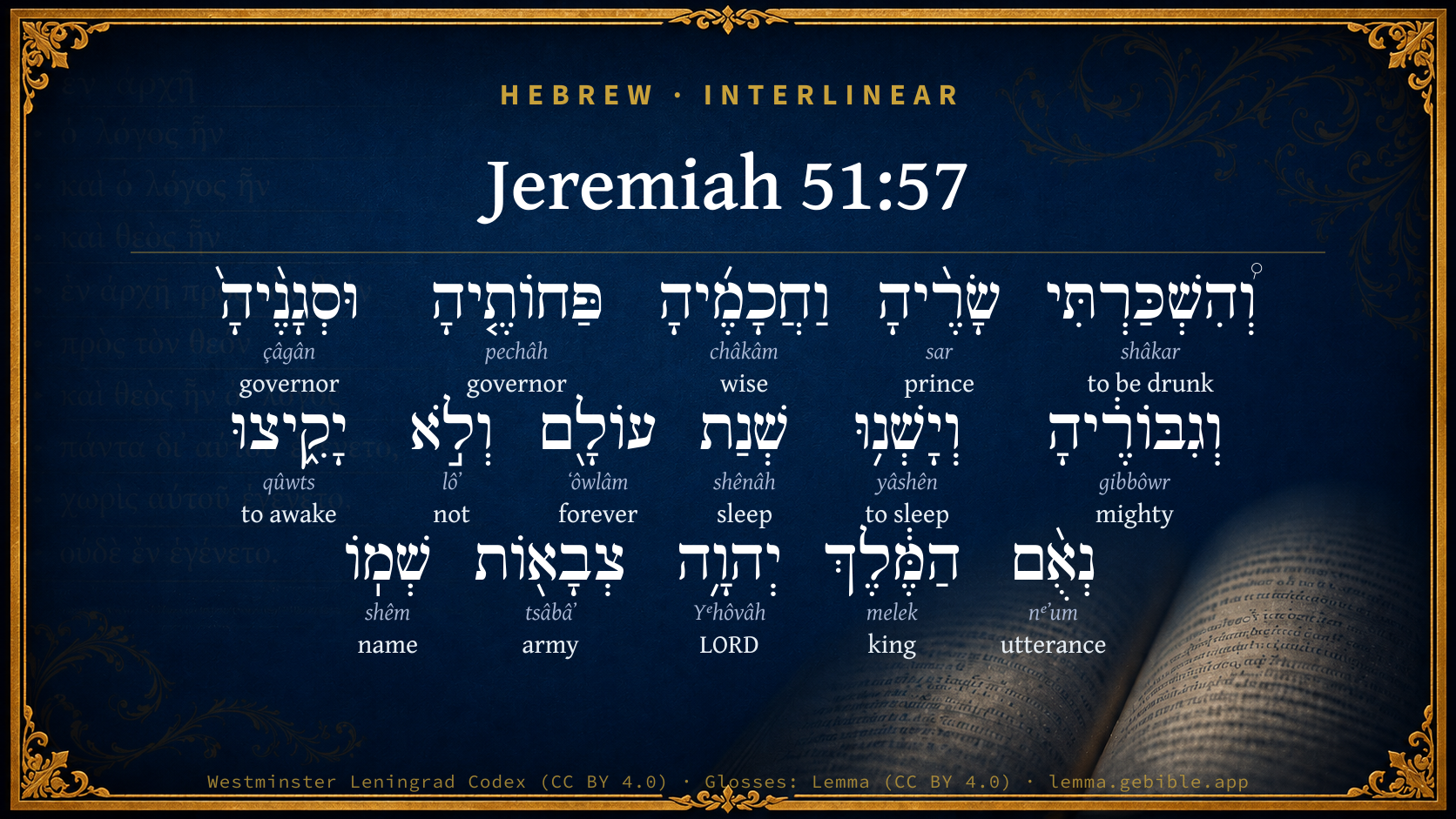
Hebrew (Westminster Leningrad Codex) Jeremiah 51:57 appears in the Hebrew Old Testament. The text above is from the Westminster Leningrad Codex. Each word links to its Strong’s number, a concise gloss, and parsing drawn from the Open Scriptures Hebrew Bible morphology. Click any word for its full Brown-Driver-Briggs (BDB) entry.
Download image
Cite this verse

Jeremiah 51:57 (World English Bible). Public Domain. Lemma interlinear Bible study tool, https://lemma.gebible.app/v/jeremiah/51/57.

Show BibTeX & RIS
BibTeX
RIS
English Translation
I will make drunk her princes and her wise men, her governors and her deputies, and her mighty men; and they shall sleep a perpetual sleep, and not wake up, says the King, whose name is Yahweh of Hosts.
World English Bible · Public Domain
Download a study sheet

One document with this verse’s original text, its word-by-word gloss line, the meaning frame, cross-references with their text, attributed commentary, and full source and license credits — printable, and it pastes into notes with its structure intact.

This verse Autodidact and up

Study sheet (.html) Plain text (.txt)

A passage Seminary Student

Up to 50 verses in one chapter. A passage sheet keeps up to 6 commentary sources and 12 cross-references per verse, in the order this page ranks them, and says so on the sheet whenever that leaves anything out. Ask for a single verse and you get the Autodidact verse sheet above.

Everything on this page stays free to read, with no account — the sheet is a download of what is already on screen, not access to it.

Want to remove ads? Support Godless Engineer
Compare translations 3

The same verse in 3 English versions, stacked beneath the original-language interlinear above. Click any original word for its lexicon entry.

Each is an independent rendering of the whole verse — the interlinear is not word-aligned to these translations.

Highlighted words mark where these versions differ — a whole-verse word diff, not a word-by-word alignment.

  • World English Bible Public Domain
    I will make drunk her princes and her wise men, her governors and her deputies, and her mighty men; and they shall sleep a perpetual sleep, and not wake up, says the King, whose name is Yahweh of Hosts.
  • King James Version Public Domain
    And I will make drunk her princes, and her wise men, her captains, and her rulers, and her mighty men: and they shall sleep a perpetual sleep, and not wake, saith the King, whose name is the LORD of hosts.
  • unfoldingWord Literal Text CC BY-SA 4.0
    For I will make her princes, her sages, her officials, and her soldiers drunk, and they will sleep in an unending sleep and never wake up— this is the King’s declaration: Yahweh of hosts is his name.

unfoldingWord Literal Text — © unfoldingWord, licensed CC BY-SA 4.0. Word-aligned USFM3 via Door43 (git.door43.org/unfoldingWord/en_ult).

Versions to compare (up to 4)

3 of 4 selected

Show all 18 translations

Every available English version of this verse, each an independent rendering of the whole verse.

  • World English Bible Public Domain
    I will make drunk her princes and her wise men, her governors and her deputies, and her mighty men; and they shall sleep a perpetual sleep, and not wake up, says the King, whose name is Yahweh of Hosts.
  • Berean Standard Bible Public Domain
    I will make her princes and wise men drunk, along with her governors, officials, and warriors. Then they will fall asleep forever and not wake up,” declares the King, whose name is the LORD of Hosts.
  • Majority Standard Bible Public Domain
    I will make her princes and wise men drunk, along with her governors, officials, and warriors. Then they will fall asleep forever and not wake up,” declares the King, whose name is the LORD of Hosts.
  • King James Version Public Domain
    And I will make drunk her princes, and her wise men, her captains, and her rulers, and her mighty men: and they shall sleep a perpetual sleep, and not wake, saith the King, whose name is the LORD of hosts.
  • American Standard Version (1901) Public Domain
    And I will make drunk her princes and her wise men, her governors and her deputies, and her mighty men; and they shall sleep a perpetual sleep, and not wake, saith the King, whose name is Jehovah of hosts.
  • Revised Version (1885) Public Domain
    And I will make drunk her princes and her wise men, her governors and her deputies, and her mighty men; and they shall sleep a perpetual sleep, and not wake, saith the King, whose name is the LORD of hosts.
  • Geneva Bible (1599) Public Domain
    And I will make drunke her princes, and her wise men, her dukes, and her nobles, and her strong men: and they shall sleepe a perpetuall sleepe, and not wake, sayth the King, whose Name is the Lord of hostes.
  • Douay-Rheims (1899) Public Domain
    And I will make her princes drunk. and her wise men, and her captains, and her rulers, and her valiant men: and they shall sleep an everlasting sleep, and shall awake no more, saith the whose name is Lord of hosts.
  • Young's Literal Translation Public Domain
    And I have caused its princes to drink, And its wise men, its governors, And its prefects, and its mighty ones, And they have slept a sleep age-during, And they awake not -- an affirmation of the king, Jehovah of Hosts `is' His name.
  • Literal Standard Version CC BY-SA 4.0
    And I have caused her princes to drink, || And her wise men, her governors, || And her prefects, and her mighty ones, || And they have slept a continuous sleep, || And they do not awaken—an affirmation of the King, || YHWH of Hosts [is] His Name.
  • Unlocked Literal Bible CC BY-SA 4.0
    For I will make her princes, her sages, her officials, and her soldiers drunk, and they will sleep in an unending sleep and never wake up —this is the King's declaration: Yahweh of hosts is his name.
  • unfoldingWord Literal Text CC BY-SA 4.0
    For I will make her princes, her sages, her officials, and her soldiers drunk, and they will sleep in an unending sleep and never wake up— this is the King’s declaration: Yahweh of hosts is his name.
  • Darby Bible Public Domain
    And I will make drunk her princes, and her wise men, her governors, and her rulers, and her mighty men; and they shall sleep a perpetual sleep, and not wake, saith the King, whose name is Jehovah of hosts.
  • World Messianic Bible Public Domain
    I will make her princes, her wise men, her governors, her deputies, and her mighty men drunk. They will sleep a perpetual sleep, and not wake up,” says the King, whose name is the LORD of Hosts.
  • Webster's Bible Public Domain
    And I will make drunk her princes, and her wise men, her captains, and her rulers, and her mighty men: and they shall sleep a perpetual sleep, and not wake, saith the king, whose name is the LORD of hosts.
  • Free Bible Version CC BY-SA 4.0
    I will make her leaders and wise men drunk, along with her commanders, officers, and soldiers. Then they will pass out, and won't ever wake up, declares the King, whose name is the Lord Almighty.
  • Bible in Basic English Public Domain
    And I will make her chiefs and her wise men, her rulers and her captains and her men of war, overcome with wine; their sleep will be an eternal sleep without awaking, says the King; the Lord of armies is his name.
  • JPS Tanakh (1917) Public Domain
    And I will make drunk her princes and her wise men, her governors and her deputies, and her mighty men; and they shall sleep a perpetual sleep, and not wake, saith the King, whose name is the LORD of hosts.

Literal Standard Version (2020), Covenant Press — licensed CC BY-SA 4.0. Text via the HelloAO Bible API (eBible.org). Unlocked Literal Bible (unfoldingWord) — licensed CC BY-SA 4.0. Text via the HelloAO Bible API (eBible.org). unfoldingWord Literal Text — © unfoldingWord, licensed CC BY-SA 4.0. Word-aligned USFM3 via Door43 (git.door43.org/unfoldingWord/en_ult). Free Bible Version, Dr. Jonathan Gallagher — licensed CC BY-SA 4.0. Text via the HelloAO Bible API (eBible.org).

Word by word

More ways to search: Search by grammar → Find every occurrence → Compare this word →

Practice this passage: Drill this verse → Learn its vocabulary →

וּסְגָנֶ֨יהָ֙
çâgân
H5461
“and · governors · her”
Conjunction + Noun, Common, Masculine, Plural, Construct + Suffix, Personal, 3rd Person, Feminine, Singular
Part of Speech
Conjunction + Noun
Type
Common
Gender
Masculine
Number
Plural
State
Construct
Full BDB Definition

Origin: from an unused root meaning to superintend

TWOT: 1461

ruler, prefect, governor, a subordinate ruler - prefects (of Assyria and Babylon) - petty rulers or officials
  1. וְ֠הִשְׁכַּרְתִּי shâkar H7937 “and · to be drunk” Conjunction + Verb, Hiphil, Sequential Perfect, 1st Person, Common, Singular
  2. שָׂרֶ֨יהָ sar H8269 “princes · her” Noun, Common, Masculine, Plural, Construct + Suffix, Personal, 3rd Person, Feminine, Singular
  3. וַחֲכָמֶ֜יהָ châkâm H2450 “and · wise · her” Conjunction + Adjective, Adjective, Masculine, Plural, Construct + Suffix, Personal, 3rd Person, Feminine, Singular
  4. פַּחוֹתֶ֤יהָ pechâh H6346 “governors · her” Noun, Common, Masculine, Plural, Construct + Suffix, Personal, 3rd Person, Feminine, Singular
  5. וְגִבּוֹרֶ֔יהָ gibbôwr H1368 “and · mighty · her” Conjunction + Adjective, Adjective, Masculine, Plural, Construct + Suffix, Personal, 3rd Person, Feminine, Singular
  6. וְיָשְׁנ֥וּ yâshên H3462 “and · to sleep” Conjunction + Verb, Qal, Sequential Perfect, 3rd Person, Common, Plural
  7. שְׁנַת shênâh H8142 “sleep of” Noun, Common, Feminine, Singular, Construct
  8. עוֹלָ֖ם ʻôwlâm H5769 “forever” Noun, Common, Masculine, Singular, Absolute
  9. וְלֹ֣א lôʼ H3808 “and · not” Conjunction + Particle, Negative
  10. יָקִ֑יצוּ qûwts H6974 “to awake” Verb, Hiphil, Imperfect, 3rd Person, Masculine, Plural
  11. נְאֻ֨ם nᵉʼum H5002 “utterance of” Noun, Common, Masculine, Singular, Construct
  12. הַמֶּ֔לֶךְ melek H4428 “the · king” Particle, Definite Article + Noun, Common, Masculine, Singular, Absolute
  13. יְהוָ֥ה Yᵉhôvâh H3068 “LORD” Noun, Proper
  14. צְבָא֖וֹת tsâbâʼ H6635 “armies” Noun, Common, Both, Plural, Absolute
  15. שְׁמֽוֹ shêm H8034 “name · his” Noun, Common, Masculine, Singular, Construct + Suffix, Personal, 3rd Person, Masculine, Singular

About this verse

These counts appear in no published source. They are computed here, from the morphology-tagged text and Lemma’s own curated glosses. What Lemma adds →

16
words
16
distinct lemmas
Prophets
section

Notable vocabulary

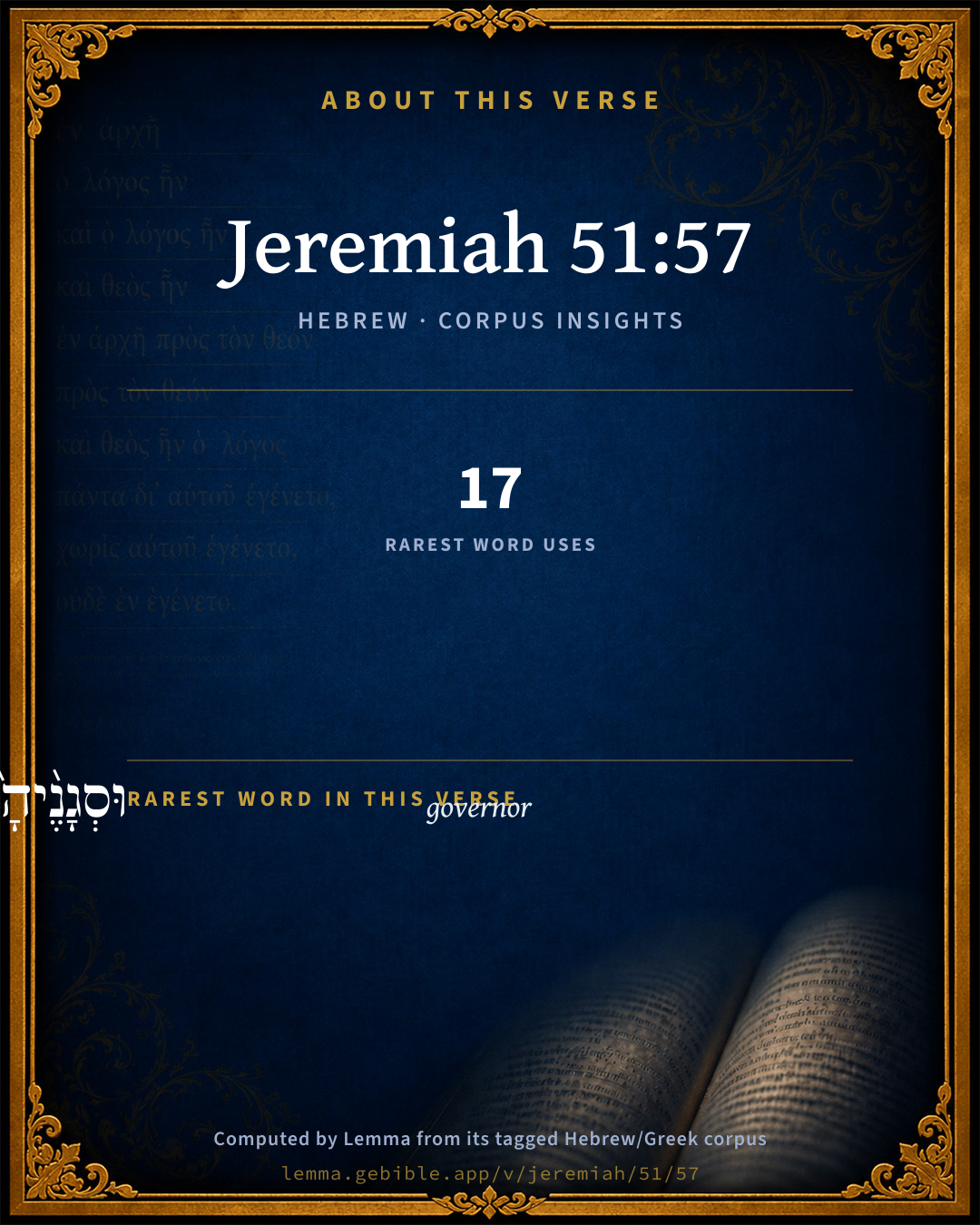
The rarest word here is וּסְגָנֶ֨יהָ֙ governor H5461 — appearing just 17 times in the whole Hebrew Bible.

Shared distinctive vocabulary

וּסְגָנֶ֨יהָ֙ governor H5461 occurs in 16 verses of the Hebrew Bible. Also found in:

Grammatical profile

  • 3 verbs
  • 10 nouns
  • 2 adjectives
  • 1 particle

Verb forms

  • וְ֠הִשְׁכַּרְתִּי Hiphil · Sequential Perfect
  • וְיָשְׁנ֥וּ Qal · Sequential Perfect
  • יָקִ֑יצוּ Hiphil · Imperfect

Cross-references

14

Topical passages linked to Jeremiah 51:57 in the Treasury of Scripture Knowledge — connected by theme and wording, ordered by reader-vote popularity; previews shown in the World English Bible.

  • Jeremiah 46:18 As I live, says the King, whose name is Yahweh of Hosts, surely like Tabor among the mountains, and like Carmel by the sea, so shall he come.
  • Jeremiah 25:27 You shall tell them, Thus says Yahweh of Hosts, the God of Israel: Drink you, and be drunken, and spew, and fall, and rise no more, because of the sword which I will send among you.
  • Jeremiah 48:15 Moab is laid waste, and they are gone up into his cities, and his chosen young men are gone down to the slaughter, says the King, whose name is Yahweh of Hosts.
  • Psalms 76:5–6 Valiant men lie plundered, They have slept their last sleep. None of the men of war can lift their hands.
  • Jeremiah 51:39 When they are heated, I will make their feast, and I will make them drunken, that they may rejoice, and sleep a perpetual sleep, and not wake, says Yahweh.
  • Isaiah 21:4–5 My heart flutters, horror has frightened me; the twilight that I desired has been turned into trembling to me.
  • Isaiah 37:36 The angel of Yahweh went forth, and struck in the camp of the Assyrians one hundred and eighty-five thousand; and when men arose early in the morning, behold, these were all dead bodies.
  • Daniel 5:1–4 Belshazzar the king made a great feast to a thousand of his lords, and drank wine before the thousand.
  • Daniel 5:30–31 In that night Belshazzar the Chaldean King was slain.
  • Nahum 1:10 For entangled like thorns, and drunken as with their drink, they are consumed utterly like dry stubble.
  • Habakkuk 2:15–17 "Woe to him who gives his neighbor drink, pouring your inflaming wine until they are drunk, so that you may gaze at their naked bodies!
  • Malachi 1:14 "But the deceiver is cursed, who has in his flock a male, and vows, and sacrifices to the Lord a blemished thing; for I am a great King," says Yahweh of hosts, "and my name is awesome among the nations."
  • Revelation 18:6–7 Return to her just as she returned, and repay her double as she did, and according to her works. In the cup which she mixed, mix to her double.
  • Revelation 18:9 The kings of the earth, who committed sexual immorality and lived wantonly with her, will weep and wail over her, when they look at the smoke of her burning,

Cross-references courtesy of OpenBible.info (CC BY 4.0).

Hebrew and Greek witnesses Masoretic Hebrew ↔ Greek Septuagint

The same verse in the two great witnesses to the Old Testament, shown verse-for-verse.

These are two independent witnesses, not word-aligned to each other, and the Septuagint is shown in lemma (dictionary) form.

Hebrew Jeremiah 51:57 Masoretic · Westminster Leningrad Codex

וְ֠הִשְׁכַּרְתִּי שָׂרֶ֨יהָ וַחֲכָמֶ֜יהָ פַּחוֹתֶ֤יהָ וּסְגָנֶ֨יהָ֙ וְגִבּוֹרֶ֔יהָ וְיָשְׁנ֥וּ שְׁנַת עוֹלָ֖ם וְלֹ֣א יָקִ֑יצוּ נְאֻ֨ם הַמֶּ֔לֶךְ יְהוָ֥ה צְבָא֖וֹת שְׁמֽוֹ

I will make drunk her princes and her wise men, her governors and her deputies, and her mighty men; and they shall sleep a perpetual sleep, and not wake up, says the King, whose name is Yahweh of Hosts.

World English Bible · Public Domain

Greek LXX Structure differs

In the Septuagint, Jeremiah is about an eighth shorter than the Hebrew and arranges its material differently — the Oracles Against the Nations (Hebrew chapters 46–51) appear in the middle of the Greek book, after 25:13. Because the chapter and verse boundaries do not line up, a verse-for-verse comparison with the Hebrew is not shown.

A verse-for-verse comparison isn’t shown here because the chapters and verses don’t line up. Switch to the LXX edition with the MT / LXX toggle above to read the Greek directly.

On this verse, John Gill's Exposition discusses the Septuagint’s reading. Read the note in Commentary ↓

Hebrew: Westminster Leningrad Codex (CC BY 4.0). Greek: Septuagint (public domain); English from a public-domain English Septuagint. How the Septuagint differs from the Hebrew →

Targum (Aramaic paraphrase)

1

The Targum is the ancient Jewish Aramaic paraphrase of the Hebrew Scriptures — an interpretive translation, not the Hebrew text itself. Onkelos (literal) and Pseudo-Jonathan (expansive) render the Torah, and Jonathan the Prophets. Coverage is partial: where no permissively-licensed English translation exists for a verse, only the Aramaic is shown. This is verse-level text, not a word-by-word alignment to the Hebrew.

  1. Targum Jonathan Prophets (Joshua–Malachi)
    וַאֲרַוֵי רַבְרְבָהָא וְחַכִּימָהָא שׁוּלְטָנָהָא וְטוּרְנָהָא וְגִבָּרָהָא וִימוּתוּן מוֹתָא תִנְיָנָא וְלָא יֵיתוּן לְעַלְמָא דְאָתֵי אֲמַר מַלְכָּא יְיָ צְבָאוֹת שְׁמֵיהּ:

    (no public-domain English translation for this verse)

    Targum Jonathan — Aramaic: “Mikraot Gedolot” (public domain). English: “Sefaria Community Translation” (CC0 1.0 (public-domain dedication)); “London "Chaldee Paraphrase," 1871” (public domain). Text via Sefaria.

Commentary

Notes on Jeremiah 51:57 from classic Christian and Jewish commentators (each source and its license shown beneath its notes). The classic Christian expositions comment on the surrounding passage and are grouped to its opening verse, so a note may address several verses; the Jewish commentaries on the Tanakh (Rashi and others) are per-verse, so they appear only where the commentator wrote on this verse.

Lemma curates 59 commentaries, every one of them public domain or Creative Commons licensed, each selected and text-cleaned for this edition rather than reprinted as found. About our sources →

Trapp's Complete Commentary

John Trapp

Jer 51:57 And I will make drunk her princes, and her wise [men], her captains, and her rulers, and her mighty men: and they shall sleep a perpetual sleep, and not wake, saith the King, whose name [is] the LORD of hosts.

Ver. 57. And I will make drunk.] See Jer 51:39.

John Trapp, A Commentary or Exposition upon All the Books of the Old and New Testament (1647–1656) — public domain. Text from a community e-Sword module.

Tyndale Open Study Notes

Tyndale Open Resources

51:57 Belshazzar, the ruler of the city, and his officers had a feast at which drunkenness was dominant; it ended in their death (Dan 5).

Tyndale Open Study Notes — © Tyndale Open Resources, licensed CC BY-SA 4.0. Text via the HelloAO Bible API.

Geneva Bible (1599)

Geneva Bible translators

I will so astonish them by afflictions that they shall not know which way to turn them.

Geneva Bible (1599) marginal notes — public domain. Text via Bolls.life.

Jamieson, Fausset & Brown

Robert Jamieson, A. R. Fausset & David Brown

(Jer 51:39; Dan 5:1, &c.).

Jamieson, Fausset & Brown — Commentary Critical and Explanatory on the Whole Bible (1871) — public domain (CC PDM 1.0). Text via the HelloAO Bible API.

Adam Clarke's Commentary

Verse 57. I will make drunk her princes] See Clarke on Jer 51:39.

Adam Clarke's Commentary on the Bible (1810–1826) — public domain. Text from a community e-Sword/MySword module.

John Calvin's Commentaries

Jeremiah pursues the same subject, he said yesterday that desolators would come to destroy Babylon. He now confirms this by a similitude; and God himself speaks, I will inebriate the princes and captains as well as the soldiers and all the counselors. He seems here to allude to that feast of which Daniel speaks, and of which heathen authors have written. (Daniel 5:1) For while the feast was celebrated by the Babylonians, the city was that night taken, not only through the contrivance and valor of Cyrus, but also through the treachery of those who had revolted from Belshazzar. As, then, they were taken while at the feast, and as the king was that night slain together with his satraps, God seems to refer to this event when he declares, that when he had inebriated them, they would be overtaken with perpetual sleep; for death immediately followed that feasting. They had prolonged their feast to the middle of the night; and while they were sitting at table, a tumult arose suddenly in the city, and the king heard that he was in the hand of his enemies. As, then, feasting and death followed in close succession, it is a striking allusion given by the Prophet, when God threatens the Babylonians with perpetual sleep, after having inebriated them.

But he mentions here the rulers and the captains, as well as the counsellors and the wise men. We, indeed, know that the Babylonians were inflated by a twofold confidence, — they thought themselves endued with consummate wisdom, and also that they possessed warlike valor. This is the reason why the Prophet expresses so distinctly, that all the captains and rulers in Babylon, however superior in acuteness and prudence, would yet be overtaken with perpetual sleep before they rose from their table. And we must observe that Jeremiah had many years thus prophesied of Babylon; and hence we conclude that his mind as well as his tongue was guided by the Spirit of God, for he could not have possibly conjectured what would be after eighty years: yet so long a time intervened between the prediction and its accomplishment, as we shall presently see.

Moreover, the Prophet uses here a mode of speaking which often occurs in Scripture, even that insensibility is a kind of drunkenness by which God dementates men through his hidden judgment. It ought, then, to be noticed, that whatever prudence and skill there is in the world, they are in such a way the gifts of God, that whenever he pleases the wisest are blinded, and, like the drunken, they either go astray or fall. But we must bear in mind what I have already said, that the Prophet alludes to that very history, for there was then an immediate transition from feasting to death. It now follows,

John Calvin's Commentaries (1540-1563) — public domain. Text from the Calvin Translation Society English edition (1840s-50s) via the Christian Classics Ethereal Library (ccel.org). Calvin's coverage is partial (roughly two-thirds of the Bible); uncommented books and verses are honest gaps, never fabricated. The 19th-century editor's footnotes and remarks are omitted so the notes are faithfully Calvin's own voice.

Ellicott's Commentary for English Readers

(57) I will make drunk her princes.—The imagery is repeated from Jer_51:39, and carries out the thought of Jer_25:15-16; Jer_25:27. On the list of officers see Note on Jer_51:23.

A Bible Commentary for English Readers, edited by Charles John Ellicott (1878–1897) — public domain. Text from a community e-Sword module.

The Cambridge Bible for Schools and Colleges

gen. ed. J. J. S. Perowne

57. her governors and her deputies] Cp. Jer_51:23; Jer_51:28, and for the latter part see on Jer_51:39.

The Cambridge Bible for Schools and Colleges (gen. ed. J. J. S. Perowne; Cambridge University Press, 1878–1918) — public domain. Text from a community e-Sword module.

John Gill's Exposition

The word which Jeremiah the prophet commanded Seraiah,.... This word is no other than the above prophecy concerning the destruction of Babylon, contained in this and the preceding chapter; or rather the order the prophet gave this prince to take a copy of it with him to Babylon, and there read it, and their cast it into the river Euphrates, with a stone bound it. Of this Seraiah we read nowhere else: he is further described as

the son of Neriah, the son of Maaseiah, when he went with Zedekiah the king of Judah into Babylon, in the fourth year of his reign; the Jews say (i) that Zedekiah, in the fourth year of his reign, went to Babylon, to reconcile himself to Nebuchadnezzar king of Babylon, and took Seraiah with him, and returned and came to his kingdom in Jerusalem; but we have no account in Scripture of any such journey he took. The Septuagint and Arabic versions render it, "when he went from Zedekiah"; as this particle is sometimes (k) elsewhere rendered, Gen 4:1; and so the Targum explains it,

"when he went on an embassy of Zedekiah;''

and Abarbinel, by the command of the king; it seems he was ambassador from the king of Judah to the king of Babylon upon some business or another; and Jeremiah took this opportunity of sending a copy of the above prophecy by him, for the ends before mentioned: this was in the fourth year of Zedekiah's reign, seven years before the destruction of Jerusalem, and sixty years before the taking of Babylon; so long before was it prophesied of. The Syriac version wrongly reads it "in the eleventh year"; the year of Jerusalem's destruction; supposing that Seraiah's going with Zedekiah to Babylon was his going with him into captivity:

and this Seraiah was a quiet prince; one of a peaceable disposition, that did not love war, or persecution of good men; and so a fit person for Zedekiah to send upon an embassy of peace; and for Jeremiah to employ in such service as he did; for, had he been a hot and haughty prince, he would have despised his orders and commands. Some render it, "prince of Menuchah" (l); taking it to be the proper name of a place of which he was governor; thought to be the same with Manahath, Ch1 8:6. The Targum and Septuagint version call him "the prince of gifts": one by whom such were introduced into the king's presence that brought treasure, gifts, or presents to him, as Jarchi interprets it; according to Kimchi, he was the king's familiar favourite, with whom he used to converse and delight himself when he was at rest and at leisure from business. Some take him to be the lord of the bedchamber, or lord chamberlain; and others lord chief justice of peace. The first sense seems most agreeable.

(i) Seder Olam Rabba, c. 25. p. 72, 73. (k) Vid. L'Empereur, Not. in Mosis Kimchii, p. 254, 255. & Noldii Concordant. Ebr, p. 114. No. 577. (l) "princeps Menuchae", Junius & Tremellius, Piscator.

John Gill's Exposition of the Whole Bible (1746–1763) — public domain (CC PDM 1.0). Text via the HelloAO Bible API.

Haydock's Catholic Bible Commentary

Drunk, with the wine of fury, ver. 39., and chap. xxv. 26.

George Leo Haydock (1774–1849), Haydock's Catholic Family Bible and Commentary, 1859 edition — public domain. Excludes Psalms (Douay-Rheims chapter numbering differs from Protestant) and Deuterocanonical books (Catholic canon only).

Matthew Poole's English Annotations

Drunken men use to fall asleep. The prophet speaks here metaphorically. His meaning is, that the Lord would fill them with the wine of his fury, mentioned Jer 30:15,16, and upon the drinking of it they should sleep their last sleep, the effects of it should be their utter ruin and destruction. Yet there seemeth to be an allusion to the posture the king of Babylon, and the thousand of his lords, mentioned Dan 5:1, were in, when their city was taken (which, as was before said, was in the time of the festival of their idol Shach,) when they were drinking wine in the bowls that were brought from the temple at Jerusalem, Jer 51:3; Jer 51:30, it is said, In that very night was Belshazzar the king of the Chaldeans slain.

Matthew Poole's English Annotations on the Holy Bible (1683–1685) — public domain. Text from a community e-Sword/MySword module.

The Pulpit Commentary

Her captains, and her rulers (see on ver. 23).

The Pulpit Commentary (1880–1919), ed. H.D.M. Spence-Jones & Joseph S. Exell — public domain. Text from a community e-Sword module.

John Wesley's Explanatory Notes

Drunk - A plain allusion to the posture the king of Babylon, and the thousand of his lords were in, when their city was taken while they were drinking wine in the bowls that were brought from the temple at Jerusalem.

John Wesley, Explanatory Notes Upon the Whole Bible (1754–1765) — public domain. Text via the GEBible commentary corpus.

unfoldingWord translationNotes

Door43 World Missions Community

her princes, her sages, her officials, and her soldiers ... her high gates ... her aid ... for her

The people of Babylon are spoken of as if they were the city itself, and the city is spoken of as if it were a woman. AT: "their princes, their sages, their officials, and their soldiers ... their high gates ... their aid ... for them" (See: Metonymy and Metaphor)

they will sleep in an unending sleep and never wake up

They will be dead. See how you translated this in Jeremiah 51:39. (See: Euphemism)

Yahweh of hosts says this

Jeremiah often uses these words to introduce an important message from Yahweh. See how you translated this in Jeremiah 6:6.

The thick walls of Babylon will be completely demolished

This can be translated in active form. AT: "The invaders willl completely demolish the thick walls of Babylon" (See: Active or Passive)

her high gates will be burned

This can be translated in active form. AT: "they will burn her high gates" (See: Active or Passive)

everything ... will be burned up

This can be translated in active form. AT: "they will burn up everything that the nations try to do for her" (See: Active or Passive)

translationWords

prince

drunk

asleep

king

Yahweh of hosts

name

gate

labor

nation

unfoldingWord translationNotes — © Distant Shores Media and the Door43 World Missions Community, licensed CC BY-SA 4.0. Source: git.door43.org/Door43/en_tn.

Lesson kit

Teaching starters — assembled from the data on this page, not authored interpretation. Every prompt links to the verse data it draws on. Edit before teaching.

Jeremiah, in the Prophets, opens this verse with 16 words (16 distinct Hebrew lemmas). Its most distinctive word is çâgân (“governor”). A historical commentator’s framing appears above. Read the whole chapter for the surrounding context.

Discussion questions

  1. The word çâgân carries the sense “governor.” How does it shape the verse?
  2. How does Ezra 9:2, which shares the word «governor», read alongside this verse?
  3. These translations render this verse differently. What is at stake in choosing one wording over another?
  4. «וְ֠הִשְׁכַּרְתִּי» is a Hiphil Sequential Perfect verb. How does that grammatical form shape the action described?
  5. Compare how Trapp's Complete Commentary and Tyndale Open Study Notes read this verse. Where do they agree or differ?

Things to notice

Reading settings

Reading text

Shown beneath each verse's original-language words.

Old Testament
Old Testament edition

Read the OT as the Masoretic Hebrew (MT) or the Greek Septuagint (LXX).

English shown for the Greek Septuagint (in the Hebrew ↔ Greek comparison).

Comparing translations? Open the Compare panel on any verse page to stack up to four side by side.