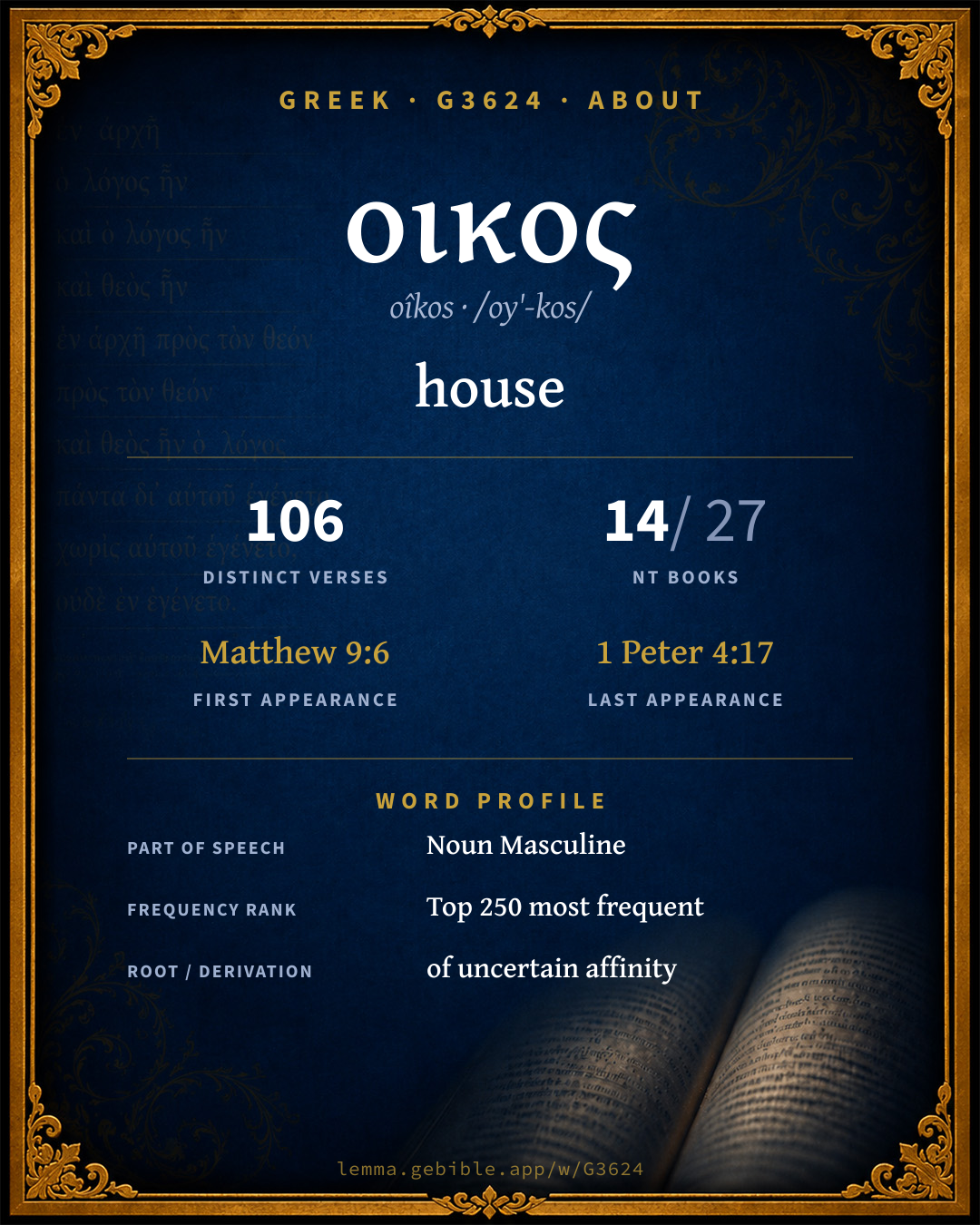
οἶκος
house
‘house’ is one of 5 main senses fuller range ↓
Full lexicon entry — Thayer's Greek Lexicon
From Thayer's Greek Lexicon
Where this word appears
See every Accusative-case word in the Greek New Testament →
Grammar key — what these labels mean
Part of speech
- Noun
- A naming word — a person, place, thing, or idea.
Case
- Accusative
- The case of the direct object and of extent.
- Dative
- The case of the indirect object, means, or location — “to / for / with / in.”
- Nominative
- The case of the subject (and the predicate nominative).
- Genitive
- The case of source, possession, or “of” — answers “whose / from what.”
Gender
- Masculine
- Grammatically masculine.
Number
- Singular
- One.
- Plural
- More than one.
Grammatical forms
- Noun, Accusative, Singular, Masculine 58 times (51%)
- Noun, Dative, Singular, Masculine 20 times (18%)
- Noun, Nominative, Singular, Masculine 18 times (16%)
- Noun, Genitive, Singular, Masculine 12 times (11%)
- Noun, Accusative, Plural, Masculine 4 times (4%)
- Noun, Dative, Plural, Masculine 1 time (1%)
- Noun, Genitive, Plural, Masculine 1 time (1%)
Parsed forms decoded from the imported morphology (Robinson–Tischendorf, public domain), counted across 114 parsed occurrences — not distinct verses.
Every verse where G3624 appears — 106 distinct verses across 14 books. Click any verse to open its interlinear word-by-word view. Verse text shown in the World English Bible for context — . Each verse’s Greek form is shown with its reference; the English is not keyword-highlighted, since the data carries no word-level English alignment. Use “Compare translations” on any verse to read it across multiple English versions. This concordance covers the Greek New Testament; Septuagint (Greek Old Testament) occurrences of this word are not indexed here.
Matthew 9 verses
- Matthew 9:6 οἶκόν n acc sg masc But that you may know that the Son of Man has authority on earth to forgive sins..." (then he said to the paralytic), "Get up, and take up your mat, and go up to your house."
- Matthew 9:7 οἶκον n acc sg masc He arose and departed to his house.
- Matthew 10:6 οἴκου n gen sg masc Rather, go to the lost sheep of the house of Israel.
- Matthew 11:8 οἴκοις n dat pl masc But what did you go out to see? A man in soft clothing? Behold, those who wear soft clothing are in king's houses.
- Matthew 12:4 οἶκον n acc sg masc how he entered into the house of God, and ate the show bread, which was not lawful for him to eat, neither for those who were with him, but only for the priests?
- Matthew 12:44 οἶκόν n acc sg masc Then he says, 'I will return into my house from which I came out,' and when he has come back, he finds it empty, swept, and put in order.
- Matthew 15:24 οἴκου n gen sg masc But he answered, "I wasn't sent to anyone but the lost sheep of the house of Israel."
- Matthew 21:13 οἶκός οἶκος n nom sg masc n nom sg masc He said to them, "It is written, 'My house shall be called a house of prayer,' but you have made it a den of robbers!"
- Matthew 23:38 οἶκος n nom sg masc Behold, your house is left to you desolate.
Mark 12 verses
- Mark 2:1 οἴκῳ n dat sg masc When he entered again into Capernaum after some days, it was heard that he was in the house.
- Mark 2:11 οἶκόν n acc sg masc "I tell you, arise, take up your mat, and go to your house."
- Mark 2:26 οἶκον n acc sg masc How he entered into the house of God when Abiathar was high priest, and ate the show bread, which it is not lawful to eat except for the priests, and gave also to those who were with him?"
- Mark 3:19 οἶκον n acc sg masc and Judas Iscariot, who also betrayed him. He came into a house.
- Mark 5:19 οἶκόν n acc sg masc He didn't allow him, but said to him, "Go to your house, to your friends, and tell them what great things the Lord has done for you, and how he had mercy on you."
- Mark 5:38 οἶκον n acc sg masc He came to the synagogue ruler's house, and he saw an uproar, weeping, and great wailing.
- Mark 7:17 οἶκον n acc sg masc When he had entered into a house away from the multitude, his disciples asked him about the parable.
- Mark 7:30 οἶκον n acc sg masc She went away to her house, and found the child having been laid on the bed, with the demon gone out.
- Mark 8:3 οἶκον n acc sg masc If I send them away fasting to their home, they will faint on the way, for some of them have come a long way."
- Mark 8:26 οἶκον n acc sg masc He sent him away to his house, saying, "Don't enter into the village, nor tell anyone in the village."
- Mark 9:28 οἶκον n acc sg masc When he had come into the house, his disciples asked him privately, "Why couldn't we cast it out?"
- Mark 11:17 οἶκός οἶκος n nom sg masc n nom sg masc He taught, saying to them, "Isn't it written, 'My house will be called a house of prayer for all the nations?' But you have made it a den of robbers!"
Luke 31 verses
- Luke 1:23 οἶκον n acc sg masc It happened, when the days of his service were fulfilled, he departed to his house.
- Luke 1:27 οἴκου n gen sg masc to a virgin pledged to be married to a man whose name was Joseph, of the house of David. The virgin's name was Mary.
- Luke 1:33 οἶκον n acc sg masc and he will reign over the house of Jacob forever. There will be no end to his Kingdom."
- Luke 1:40 οἶκον n acc sg masc and entered into the house of Zacharias and greeted Elizabeth.
- Luke 1:56 οἶκον n acc sg masc Mary stayed with her about three months, and then returned to her house.
- Luke 1:69 οἴκῳ n dat sg masc And has raised up a horn of salvation for us in the house of his servant David
- Luke 2:4 οἴκου n gen sg masc Joseph also went up from Galilee, out of the city of Nazareth, into Judea, to the city of David, which is called Bethlehem, because he was of the house and family of David;
- Luke 5:24 οἶκόν n acc sg masc But that you may know that the Son of Man has authority on earth to forgive sins" (he said to the paralyzed man), "I tell you, arise, and take up your cot, and go to your house."
- Luke 5:25 οἶκον n acc sg masc Immediately he rose up before them, and took up that which he was laying on, and departed to his house, glorifying God.
- Luke 6:4 οἶκον n acc sg masc how he entered into the house of God, and took and ate the show bread, and gave also to those who were with him, which is not lawful to eat except for the priests alone?"
- Luke 7:10 οἶκον n acc sg masc Those who were sent, returning to the house, found that the servant who had been sick was well.
- Luke 7:36 οἶκον n acc sg masc One of the Pharisees invited him to eat with him. He entered into the Pharisee's house, and sat at the table.
- Luke 8:39 οἶκόν n acc sg masc "Return to your house, and declare what great things God has done for you." He went his way, proclaiming throughout the whole city what great things Jesus had done for him.
- Luke 8:41 οἶκον n acc sg masc Behold, there came a man named Jairus, and he was a ruler of the synagogue. He fell down at Jesus' feet, and begged him to come into his house,
- Luke 9:61 οἶκόν n acc sg masc Another also said, "I want to follow you, Lord, but first allow me to bid farewell to those who are at my house."
- Luke 10:5 οἴκῳ n dat sg masc Into whatever house you enter, first say, 'Peace be to this house.'
- Luke 11:17 οἶκος οἶκον n nom sg masc n acc sg masc But he, knowing their thoughts, said to them, "Every kingdom divided against itself is brought to desolation. A house divided against itself falls.
- Luke 11:24 οἶκόν n acc sg masc The unclean spirit, when he has gone out of the man, passes through dry places, seeking rest, and finding none, he says, 'I will turn back to my house from which I came out.'
- Luke 11:51 οἴκου n gen sg masc from the blood of Abel to the blood of Zachariah, who perished between the altar and the sanctuary.' Yes, I tell you, it will be required of this generation.
- Luke 12:39 οἶκον n acc sg masc But know this, that if the master of the house had known in what hour the thief was coming, he would have watched, and not allowed his house to be broken into.
- Luke 12:52 οἴκῳ n dat sg masc For from now on, there will be five in one house divided, three against two, and two against three.
- Luke 13:35 οἶκος n nom sg masc Behold, your house is left to you desolate. I tell you, you will not see me, until you say, 'Blessed is he who comes in the name of the Lord!'"
- Luke 14:1 οἶκόν n acc sg masc It happened, when he went into the house of one of the rulers of the Pharisees on a Sabbath to eat bread, that they were watching him.
- Luke 14:23 οἶκος n nom sg masc "The lord said to the servant, 'Go out into the highways and hedges, and compel them to come in, that my house may be filled.
- Luke 15:6 οἶκον n acc sg masc When he comes home, he calls together his friends and his neighbors, saying to them, 'Rejoice with me, for I have found my sheep which was lost!'
- Luke 16:4 οἴκους n acc pl masc I know what I will do, so that when I am removed from management, they may receive me into their houses.'
- Luke 16:27 οἶκον n acc sg masc "He said, 'I ask you therefore, father, that you would send him to my father's house;
- Luke 18:14 οἶκον n acc sg masc I tell you, this man went down to his house justified rather than the other; for everyone who exalts himself will be humbled, but he who humbles himself will be exalted."
- Luke 19:5 οἴκῳ n dat sg masc When Jesus came to the place, he looked up and saw him, and said to him, "Zacchaeus, hurry and come down, for today I must stay at your house."
- Luke 19:9 οἴκῳ n dat sg masc Jesus said to him, "Today, salvation has come to this house, because he also is a son of Abraham.
- Luke 19:46 οἶκός οἶκος n nom sg masc n nom sg masc saying to them, "It is written, 'My house is a house of prayer,' but you have made it a 'den of robbers'!"
John 4 verses
- John 2:16 οἶκον οἶκον n acc sg masc n acc sg masc To those who sold the doves, he said, "Take these things out of here! Don't make my Father's house a marketplace!"
- John 2:17 οἴκου n gen sg masc His disciples remembered that it was written, "Zeal for your house will eat me up."
- John 7:53 οικον n acc sg masc Everyone went to his own house,
- John 11:20 οἴκῳ n dat sg masc Then when Martha heard that Jesus was coming, she went and met him, but Mary stayed in the house.
Acts 24 verses
- Acts 2:2 οἶκον n acc sg masc Suddenly there came from the sky a sound like the rushing of a mighty wind, and it filled all the house where they were sitting.
- Acts 2:36 οἶκος n nom sg masc "Let all the house of Israel therefore know assuredly that God has made him both Lord and Christ, this Jesus whom you crucified."
- Acts 2:46 οἶκον n acc sg masc Day by day, continuing steadfastly with one accord in the temple, and breaking bread at home, they took their food with gladness and singleness of heart,
- Acts 5:42 οἶκον n acc sg masc Every day, in the temple and at home, they never stopped teaching and preaching Jesus, the Christ.
- Acts 7:10 οἶκον n acc sg masc and delivered him out of all his afflictions, and gave him favor and wisdom before Pharaoh, king of Egypt. He made him governor over Egypt and all his house.
- Acts 7:20 οἴκῳ n dat sg masc At that time Moses was born, and was exceedingly handsome. He was nourished three months in his father's house.
- Acts 7:42 οἶκος n nom sg masc But God turned, and gave them up to serve the host of the sky, as it is written in the book of the prophets, 'Did you offer to me slain animals and sacrifices Forty years in the wilderness, O house of Israel?
- Acts 7:46 οἴκῳ n dat sg masc who found favor in the sight of God, and asked to find a habitation for the God of Jacob.
- Acts 7:47 οἶκον n acc sg masc But Solomon built him a house.
- Acts 7:49 οἶκον n acc sg masc 'heaven is my throne, And the earth a footstool for my feet. What kind of house will you build me?' says the Lord; 'Or what is the place of my rest?
- Acts 8:3 οἴκους n acc pl masc But Saul ravaged the assembly, entering into every house, and dragged both men and women off to prison.
- Acts 10:2 οἴκῳ n dat sg masc a devout man, and one who feared God with all his house, who gave gifts for the needy generously to the people, and always prayed to God.
- Acts 10:22 οἶκον n acc sg masc They said, "Cornelius, a centurion, a righteous man and one who fears God, and well spoken of by all the nation of the Jews, was directed by a holy angel to invite you to his house, and to listen to what you say."
- Acts 10:30 οἴκῳ n dat sg masc Cornelius said, "Four days ago, I was fasting until this hour, and at the ninth hour, I prayed in my house, and behold, a man stood before me in bright clothing,
- Acts 11:12 οἶκον n acc sg masc The Spirit told me to go with them, without discriminating. These six brothers also accompanied me, and we entered into the man's house.
- Acts 11:13 οἴκῳ n dat sg masc He told us how he had seen the angel standing in his house, and saying to him, 'Send to Joppa, and get Simon, whose surname is Peter,
- Acts 11:14 οἶκός n nom sg masc who will speak to you words by which you will be saved, you and all your house.'
- Acts 16:15 οἶκος οἶκόν n nom sg masc n acc sg masc When she and her household were baptized, she begged us, saying, "If you have judged me to be faithful to the Lord, come into my house, and stay." So she persuaded us.
- Acts 16:31 οἶκός n nom sg masc They said, "Believe in the Lord Jesus Christ, and you will be saved, you and your household."
- Acts 16:34 οἶκον n acc sg masc He brought them up into his house, and set food before them, and rejoiced greatly, with all his household, having believed in God.
- Acts 18:8 οἴκῳ n dat sg masc Crispus, the ruler of the synagogue, believed in the Lord with all his house. Many of the Corinthians, when they heard, believed and were baptized.
- Acts 19:16 οἴκου n gen sg masc The man in whom the evil spirit was leaped on them, and overpowered them, and prevailed against them, so that they fled out of that house naked and wounded.
- Acts 20:20 οἴκους n acc pl masc how I didn't shrink from declaring to you anything that was profitable, teaching you publicly and from house to house,
- Acts 21:8 οἶκον n acc sg masc On the next day, we, who were Paul's companions, departed, and came to Caesarea. We entered into the house of Philip the evangelist, who was one of the seven, and stayed with him.
Romans 1 verse
1 Corinthians 4 verses
- 1 Corinthians 1:16 οἶκον n acc sg masc (I also baptized the household of Stephanas; besides them, I don't know whether I baptized any other.)
- 1 Corinthians 11:34 οἴκῳ n dat sg masc But if anyone is hungry, let him eat at home, lest your coming together be for judgment. The rest I will set in order whenever I come.
- 1 Corinthians 14:35 οἴκῳ n dat sg masc If they desire to learn anything, let them ask their own husbands at home, for it is shameful for a woman to chatter in the assembly.
- 1 Corinthians 16:19 οἶκον n acc sg masc The assemblies of Asia greet you. Aquila and Priscilla greet you much in the Lord, together with the assembly that is in their house.
Colossians 1 verse
1 Timothy 5 verses
- 1 Timothy 3:4 οἴκου n gen sg masc one who rules his own house well, having children in subjection with all reverence;
- 1 Timothy 3:5 οἴκου n gen sg masc (but if a man doesn't know how to rule his own house, how will he take care of the assembly of God?)
- 1 Timothy 3:12 οἴκων n gen pl masc Let deacons be husbands of one wife, ruling their children and their own houses well.
- 1 Timothy 3:15 οἴκῳ n dat sg masc but if I wait long, that you may know how men ought to behave themselves in the house of God, which is the assembly of the living God, the pillar and ground of the truth.
- 1 Timothy 5:4 οἶκον n acc sg masc But if any widow has children or grandchildren, let them learn first to show piety towards their own family, and to repay their parents, for this is acceptable in the sight of God.
2 Timothy 2 verses
Titus 1 verse
Philemon 1 verse
Hebrews 9 verses
- Hebrews 3:2 οἴκῳ n dat sg masc who was faithful to him who appointed him, as also was Moses in all his house.
- Hebrews 3:3 οἴκου n gen sg masc For he has been counted worthy of more glory than Moses, inasmuch as he who built the house has more honor than the house.
- Hebrews 3:4 οἶκος n nom sg masc For every house is built by someone; but he who built all things is God.
- Hebrews 3:5 οἴκῳ n dat sg masc Moses indeed was faithful in all his house as a servant, for a testimony of those things which were afterward to be spoken,
- Hebrews 3:6 οἶκον οἶκός n acc sg masc n nom sg masc but Christ is faithful as a Son over his house; whose house we are, if we hold fast our confidence and the glorying of our hope firm to the end.
- Hebrews 8:8 οἶκον οἶκον n acc sg masc n acc sg masc For finding fault with them, he said, "Behold, the days come," says the Lord, "That I will make a new covenant with the house of Israel and with the house of Judah;
- Hebrews 8:10 οἴκῳ n dat sg masc "For this is the covenant that I will make with the house of Israel. After those days," says the Lord; "I will put my laws into their mind, I will also write them on their heart. I will be to them a God, And they will be to me a people.
- Hebrews 10:21 οἶκον n acc sg masc and having a great priest over the house of God,
- Hebrews 11:7 οἴκου n gen sg masc By faith, Noah, being warned about things not yet seen, moved with godly fear, prepared an ark for the saving of his house, through which he condemned the world, and became heir of the righteousness which is according to faith.
1 Peter 2 verses
- 1 Peter 2:5 οἶκος n nom sg masc You also, as living stones, are built up as a spiritual house, to be a holy priesthood, to offer up spiritual sacrifices, acceptable to God through Jesus Christ.
- 1 Peter 4:17 οἴκου n gen sg masc For the time has come for judgment to begin at the house of God. If it begins first with us, what will happen to those who don't obey the Gospel of God?
About this entry
At a glance — auto-summarized from this page’s data, not written by a person. Every figure links to its source below. This summary describes the numbers; it doesn’t interpret them.
“house” is the headline sense of the Greek noun οικος (oîkos). Catalogued under 5 senses, its meaning is not single-sense. With 106 verses in 14 books, it is a common word in the Greek New Testament. It concentrates in Luke, which alone accounts for 29% of its uses. Scripture first uses it in Matthew 9:6. See the sense tree, 106-verse concordance, and the renderings breakdown below.
Gloss history
Strong's 1890 vs modern scholarship

About this word
Strong's G3624 catalogs a Greek word from the Greek New Testament.
These counts are not copied from any lexicon or concordance. They are computed here, from the morphology-tagged Greek New Testament. What Lemma adds →
- 106
- distinct verses
- The word appears in 106 distinct verses.
- 14 / 27
- NT books
- The word appears in 14 of 27 New Testament books.
- #145
- by frequency
- Top 250 most frequent Greek words (rank 145 of 5,347 Greek words by occurrence).
View all 106 occurrences in the concordance →
By section of the New Testament
By traditional corpus
Conventional, traditional groupings — biblical authorship is debated, so this is a traditional corpus grouping, not an authorship claim. Some books belong to more than one corpus (Luke is in both the Gospels and the Lukan corpus, and so on), so these shares overlap and need not total 100%. Each figure is a share of the word’s 106 distinct verses.
- Gospels 56 verses · 53%
- Lukan (Luke–Acts) 55 verses · 52%
- Pauline corpus 15 verses · 14%
- Hebrews 9 verses · 8%
- Johannine 4 verses · 4%
- General (Catholic) Epistles 2 verses · 2%
How translations render this word
Counts come from each version’s own published word-to-Strong’s tagging or interlinear alignment — an approximate guide to how each version renders this word, not a word-level alignment the data otherwise carries. Because each total is that version’s own tagged count, the per-version totals vary from one another and need not match the appearance or distinct-verse counts above. These counts may also differ from a printed concordance because Lemma counts each distinctly tagged rendering and does not collapse phrase taggings into a single head-word total. This is a fixed set of word-tagged versions (KJV, ASV, BSB, ULT) and does not change with the reading translation you choose elsewhere. Each version’s license is shown beside its name below (and on Sources).
- King James Version: House 97×, Houses 5×, Home 3×
- American Standard Version: House 90×, 's house 5×, Home 5×
- Berean Standard Bible: House 59×, Home 25×, Household 14×
- unfoldingWord Literal Text: House 87×, Household 13×, Home 7×
King James Version Public Domain
Renders G3624 across 112 tagged occurrences — most commonly:
Plus 2 renderings that appear only once — usually multi-word phrases or single function words the recovered tagging swept in, not distinct renderings. Not rendered by a distinct English word in 2 further occurrences.
American Standard Version Public Domain
Renders G3624 across 117 tagged occurrences — most commonly:
Plus 10 renderings that appear only once — usually multi-word phrases or single function words the recovered tagging swept in, not distinct renderings.
Berean Standard Bible Public Domain
Renders G3624 across 109 tagged occurrences — most commonly:
Plus 7 renderings that appear only once — usually multi-word phrases or single function words the recovered tagging swept in, not distinct renderings. Not rendered by a distinct English word in 3 further occurrences.
unfoldingWord Literal Text CC BY-SA 4.0
Renders G3624 across 120 tagged occurrences — most commonly:
Plus 5 renderings that appear only once — usually multi-word phrases or single function words the recovered tagging swept in, not distinct renderings.
Senses in Thayer's
The 5 senses Thayer's distinguishes for this word, in lexicon order (not ranked by frequency or importance). The full entry — with sub-senses — is in the Lexicon Entry tab.
- an inhabited house, home
- any building whatever
- any dwelling place
- the inmates of a house, all the persons forming one family, a household
- stock, family, descendants of one
Word origin
Origin: of uncertain affinity
Of uncertain affinity; a dwelling (more or less extensive literally or figuratively); by implication a family (more or less related literally or figuratively): - home house (-hold) temple.
— Strong’s Exhaustive Concordance (1890), public domain.
Forms in the corpus
The 10 distinct written forms G3624 takes in the Greek New Testament, most frequent first — each parse links to that case’s occurrences in the concordance.
| Form | Parsing | Example | Uses |
|---|---|---|---|
| οἶκον oîkon | Noun, Accusative, Singular, Masculine | Matthew 9:7 | 46 |
| οἴκῳ oíkō | Noun, Dative, Singular, Masculine | Mark 2:1 | 20 |
| οἴκου oíkou | Noun, Genitive, Singular, Masculine | Matthew 10:6 | 12 |
| οἶκος oîkos | Noun, Nominative, Singular, Masculine | Matthew 21:13 | 12 |
| οἶκόν oîkón | Noun, Accusative, Singular, Masculine | Matthew 9:6 | 11 |
| οἶκός oîkós | Noun, Nominative, Singular, Masculine | Matthew 21:13 | 6 |
| οἴκους oíkous | Noun, Accusative, Plural, Masculine | Luke 16:4 | 4 |
| οικον oikon | Noun, Accusative, Singular, Masculine | John 7:53 | 1 |
| οἴκοις oíkois | Noun, Dative, Plural, Masculine | Matthew 11:8 | 1 |
| οἴκων oíkōn | Noun, Genitive, Plural, Masculine | 1 Timothy 3:12 | 1 |
Same root — word family
Other Thayer's entries built from the same root as G3624, grouped by Strong’s listed origin. These share a root / origin per the lexicon — not necessarily a shared meaning. Each links to that word’s own entry.
Derived from this word
- οικειος oikeîos G3609 domestic
- οικεω oikéō G3611 to dwell in
- οικια oikía G3614 house
- οικοδεσποτης oikodespótēs G3617 householder
- οικοδομη oikodomḗ G3619 building
- οικονομος oikonómos G3623 steward
- οικουρος oikourós G3626 domestic
Compare all same-root words → Showing 4 of 8 — not the complete family. They share a root, not necessarily a meaning.
Septuagint usage
The same Greek word οικος appears 1,820 times in the Greek Old Testament (Septuagint), across 1,515 verses in 37 books.
- 1,820
- LXX occurrences
- Tagged occurrences of this Greek word in the Septuagint.
- 1,515
- verses
- Distinct Septuagint verses containing this word.
- 37 / 39
- OT books
- The word appears in 37 of the 39 Old Testament books.
Sample Septuagint occurrences
- Genesis 7:1 οἶκος
- Exodus 6:14 οἶκος
- Leviticus 9:7 οἶκος
- Numbers 1:2 οἶκος
- Deuteronomy 3:29 οἶκος
- Joshua 2:12 οἶκος
- Judges 1:35 οἶκος
- Ruth 1:8 οἶκος
- 1 Samuel 1:7 οἶκος
- 2 Samuel 1:12 οἶκος
- 1 Kings 1:53 οἶκος
- 2 Kings 1:18 οἶκος
Septuagint occurrences (same lexeme)
Every verse where the same Strong’s number (G3624) appears in the Greek Septuagint — showing the first 50 of 1,515. Verse text shown in the World English Bible for context; the Greek form is the matched word — the English is not keyword-highlighted.
- Genesis 7:1 οἶκος Yahweh said to Noah, "Come with all of your household into the ark, for I have seen your righteousness before me in this generation.
- Genesis 9:21 οἶκος He drank of the wine, and got drunk. He was uncovered within his tent.
- Genesis 9:27 οἶκος God enlarge Japheth, Let him dwell in the tents of Shem; Let Canaan be his servant."
- Genesis 12:1 οἶκος Now Yahweh said to Abram, "Get out of your country, and from your relatives, and from your father's house, to the land that I will show you.
- Genesis 12:15 οἶκος The princes of Pharaoh saw her, and praised her to Pharaoh; and the woman was taken into Pharaoh's house.
- Genesis 12:17 οἶκος Yahweh plagued Pharaoh and his house with great plagues because of Sarai, Abram's wife.
- Genesis 17:23 οἶκος Abraham took Ishmael his son, all who were born in his house, and all who were bought with his money; every male among the men of Abraham's house, and circumcised the flesh of their foreskin in the same day, as God had said to him.
- Genesis 17:27 οἶκος All the men of his house, those born in the house, and those bought with money of a foreigner, were circumcised with him.
- Genesis 18:19 οἶκος For I have known him, to the end that he may command his children and his household after him, that they may keep the way of Yahweh, to do righteousness and justice; to the end that Yahweh may bring on Abraham that which he has spoken of him."
- Genesis 19:2 οἶκος and he said, "See now, my lords, please turn aside into your servant's house, stay all night, wash your feet, and you will rise up early, and go on your way." They said, "No, but we will stay in the street all night."
- Genesis 19:10 οἶκος But the men put forth their hand, and brought Lot into the house to them, and shut the door.
- Genesis 19:11 οἶκος They struck the men who were at the door of the house with blindness, both small and great, so that they wearied themselves to find the door.
- Genesis 20:13 οἶκος It happened, when God caused me to wander from my father's house, that I said to her, 'This is your kindness which you shall show to me. Everywhere that we go, say of me, "He is my brother."'"
- Genesis 20:18 οἶκος For Yahweh had closed up tight all the wombs of the house of Abimelech, because of Sarah, Abraham's wife.
- Genesis 24:7 οἶκος Yahweh, the God of heaven, who took me from my father's house, and from the land of my birth, who spoke to me, and who swore to me, saying, 'I will give this land to your seed.' He will send his angel before you, and you shall take a wife for my son from there.
- Genesis 24:27 οἶκος He said, "Blessed be Yahweh, the God of my master Abraham, who has not forsaken his loving kindness and his truth toward my master. As for me, Yahweh has led me in the way to the house of my master's relatives."
- Genesis 24:28 οἶκος The young lady ran, and told her mother's house about these words.
- Genesis 24:38 οἶκος but you shall go to my father's house, and to my relatives, and take a wife for my son.'
- Genesis 24:40 οἶκος He said to me, 'Yahweh, before whom I walk, will send his angel with you, and prosper your way. You shall take a wife for my son of my relatives, and of my father's house.
- Genesis 24:67 οἶκος Isaac brought her into his mother Sarah's tent, and took Rebekah, and she became his wife. He loved her. Isaac was comforted after his mother's death.
- Genesis 27:15 οἶκος Rebekah took the good clothes of Esau, her elder son, which were with her in the house, and put them on Jacob, her younger son.
- Genesis 28:2 οἶκος Arise, go to Paddan Aram, to the house of Bethuel your mother's father. Take a wife from there from the daughters of Laban, your mother's brother.
- Genesis 28:17 οἶκος He was afraid, and said, "How dreadful is this place! This is none other than God's house, and this is the gate of heaven."
- Genesis 28:19 οἶκος He called the name of that place Bethel, but the name of the city was Luz at the first.
- Genesis 28:21 οἶκος so that I come again to my father's house in peace, and Yahweh will be my God,
- Genesis 28:22 οἶκος then this stone, which I have set up for a pillar, will be God's house. Of all that you will give me I will surely give the tenth to you."
- Genesis 29:13 οἶκος It happened, when Laban heard the news of Jacob, his sister's son, that he ran to meet Jacob, and embraced him, and kissed him, and brought him to his house. Jacob told Laban all these things.
- Genesis 30:30 οἶκος For it was little which you had before I came, and it has increased to a multitude. Yahweh has blessed you wherever I turned. Now when will I provide for my own house also?"
- Genesis 31:14 οἶκος Rachel and Leah answered him, "Is there yet any portion or inheritance for us in our father's house?
- Genesis 31:30 οἶκος Now, you want to be gone, because you sore longed after your father's house, but why have you stolen my gods?"
- Genesis 31:33 οἶκος Laban went into Jacob's tent, into Leah's tent, and into the tent of the two maid-servants; but he didn't find them. He went out of Leah's tent, and entered into Rachel's tent.
- Genesis 31:35 οἶκος She said to her father, "Don't let my lord be angry that I can't rise up before you; for the manner of women is on me." He searched, but didn't find the teraphim.
- Genesis 31:37 οἶκος Now that you have felt around in all my stuff, what have you found of all your household stuff? Set it here before my relatives and your relatives, that they may judge between us two.
- Genesis 34:19 οἶκος The young man didn't wait to do this thing, because he had delight in Jacob's daughter, and he was honored above all the house of his father.
- Genesis 34:26 οἶκος They killed Hamor and Shechem, his son, with the edge of the sword, and took Dinah out of Shechem's house, and went away.
- Genesis 34:30 οἶκος Jacob said to Simeon and Levi, "You have troubled me, to make me odious to the inhabitants of the land, among the Canaanites and the Perizzites. I am few in number. They will gather themselves together against me and strike me, and I will be destroyed, I and my house."
- Genesis 35:2 οἶκος Then Jacob said to his household, and to all who were with him, "Put away the foreign gods that are among you, purify yourselves, change your garments.
- Genesis 36:6 οἶκος Esau took his wives, his sons, his daughters, and all the members of his household, with his cattle, all his animals, and all his possessions, which he had gathered in the land of Canaan, and went into a land away from his brother Jacob.
- Genesis 38:11 οἶκος Then Judah said to Tamar, his daughter-in-law, "Remain a widow in your father's house, until Shelah, my son, is grown up;" for he said, "Lest he also die, like his brothers." Tamar went and lived in her father's house.
- Genesis 39:2 οἶκος Yahweh was with Joseph, and he was a prosperous man. He was in the house of his master the Egyptian.
- Genesis 39:4 οἶκος Joseph found favor in his sight. He ministered to him, and he made him overseer over his house, and all that he had he put into his hand.
- Genesis 39:5 οἶκος It happened from the time that he made him overseer in his house, and over all that he had, that Yahweh blessed the Egyptian's house for Joseph's sake; and the blessing of Yahweh was on all that he had, in the house and in the field.
- Genesis 39:8 οἶκος But he refused, and said to his master's wife, "Behold, my master doesn't know what is with me in the house, and he has put all that he has into my hand.
- Genesis 39:16 οἶκος She laid up his garment by her, until his master came home.
- Genesis 41:10 οἶκος Pharaoh was angry with his servants, and put me in custody in the house of the captain of the guard, me and the chief baker.
- Genesis 41:40 οἶκος You shall be over my house, and according to your word will all my people be ruled. Only in the throne I will be greater than you."
- Genesis 42:33 οἶκος The man, the lord of the land, said to us, 'Hereby will I know that you are honest men. Leave one of your brothers with me, and take grain for the famine of your houses, and go your way.
- Genesis 43:17 οἶκος The man did as Joseph commanded, and the man brought the men to Joseph's house.
- Genesis 43:18 οἶκος The men were afraid, because they were brought to Joseph's house; and they said, "Because of the money that was returned in our sacks at the first time are we brought in; that he may seek occasion against us, and fall on us, and take us for bondservants, along with our donkeys."
- Genesis 43:19 οἶκος They came near to the steward of Joseph's house, and they spoke to him at the door of the house,
These are occurrences of the same Greek lexeme (G3624) in the Septuagint — not a translation of any one Hebrew word. The store carries no word-level Hebrew↔Greek alignment, so no Hebrew original is asserted here. Counts come from the recovered LXX Strong's tagging — high-frequency vocabulary is well covered, while rare or late forms may be untagged — so they reflect tagged occurrences and may slightly undercount.