1 Peter 4:17

Greek (Tischendorf 8th ed.) 1 Peter 4:17 appears in the Greek New Testament. The text above is from the Tischendorf 8th edition. Each word links to its Strong’s number and a concise gloss. Click any word for its full Thayer’s Greek Lexicon entry.
Download image
Cite this verse

1 Peter 4:17 (World English Bible). Public Domain. Lemma interlinear Bible study tool, https://lemma.gebible.app/v/1-peter/4/17.

Show BibTeX & RIS
BibTeX
RIS
English Translation
For the time has come for judgment to begin at the house of God. If it begins first with us, what will happen to those who don't obey the Gospel of God?
World English Bible · Public Domain
Download a study sheet

One document with this verse’s original text, its word-by-word gloss line, the meaning frame, cross-references with their text, attributed commentary, and full source and license credits — printable, and it pastes into notes with its structure intact.

This verse Autodidact and up

Study sheet (.html) Plain text (.txt)

A passage Seminary Student

Up to 50 verses in one chapter. A passage sheet keeps up to 6 commentary sources and 12 cross-references per verse, in the order this page ranks them, and says so on the sheet whenever that leaves anything out. Ask for a single verse and you get the Autodidact verse sheet above.

Everything on this page stays free to read, with no account — the sheet is a download of what is already on screen, not access to it.

Want to remove ads? Support Godless Engineer
Compare translations 3

The same verse in 3 English versions, stacked beneath the original-language interlinear above. Click any original word for its lexicon entry.

Each is an independent rendering of the whole verse — the interlinear is not word-aligned to these translations.

Highlighted words mark where these versions differ — a whole-verse word diff, not a word-by-word alignment.

  • World English Bible Public Domain
    For the time has come for judgment to begin at the house of God. If it begins first with us, what will happen to those who don't obey the Gospel of God?
  • King James Version Public Domain
    For the time is come that judgment must begin at the house of God: and if it first begin at us, what shall the end be of them that obey not the gospel of God?
  • unfoldingWord Literal Text CC BY-SA 4.0
    For the time to begin the judgment with the household of God; but if first with us, what the end of the ones disobeying the gospel of God?

unfoldingWord Literal Text — © unfoldingWord, licensed CC BY-SA 4.0. Word-aligned USFM3 via Door43 (git.door43.org/unfoldingWord/en_ult).

Versions to compare (up to 4)

3 of 4 selected

Show all 19 translations

Every available English version of this verse, each an independent rendering of the whole verse.

  • World English Bible Public Domain
    For the time has come for judgment to begin at the house of God. If it begins first with us, what will happen to those who don't obey the Gospel of God?
  • Berean Standard Bible Public Domain
    For it is time for judgment to begin with the family of God; and if it begins with us, what will the outcome be for those who disobey the gospel of God?
  • Majority Standard Bible Public Domain
    For it is time for judgment to begin with the family of God; and if it begins with us, what will the outcome be for those who disobey the gospel of God?
  • King James Version Public Domain
    For the time is come that judgment must begin at the house of God: and if it first begin at us, what shall the end be of them that obey not the gospel of God?
  • American Standard Version (1901) Public Domain
    For the time `is come' for judgment to begin at the house of God: and if `it begin' first at us, what `shall be' the end of them that obey not the gospel of God?
  • Revised Version (1885) Public Domain
    For the time is come for judgment to begin at the house of God: and if it begin first at us, what shall be the end of them that obey not the gospel of God?
  • Geneva Bible (1599) Public Domain
    For the time is come, that iudgement must beginne at the house of God. If it first beginne at vs, what shall the ende be of them which obey not the Gospel of God?
  • Douay-Rheims (1899) Public Domain
    For the time is, that judgment should begin at the house of God. And if first at us, what shall be the end of them that believe not the gospel of God?
  • Young's Literal Translation Public Domain
    because it is the time of the beginning of the judgment from the house of God, and if first from us, what the end of those disobedient to the good news of God?
  • Literal Standard Version CC BY-SA 4.0
    because it is the time of the judgment to have begun from the house of God, and if first from us, what [is] the end of those disobedient to the good news of God?
  • Unlocked Literal Bible CC BY-SA 4.0
    For it is time for judgment to begin with the household of God. If it begins with us, what will be the outcome for those who do not obey God's gospel?
  • unfoldingWord Literal Text CC BY-SA 4.0
    For the time to begin the judgment with the household of God; but if first with us, what the end of the ones disobeying the gospel of God?
  • Darby Bible Public Domain
    For the time of having the judgment begin from the house of God [is come]; but if first from us, what [shall be] the end of those who obey not the glad tidings of God?
  • World Messianic Bible Public Domain
    For the time has come for judgment to begin with the household of God. If it begins first with us, what will happen to those who don’t obey the Good News of God?
  • Webster's Bible Public Domain
    For the time is come that judgment must begin at the house of God: and if it first beginneth at us, what will be the end of them that obey not the gospel of God?
  • Free Bible Version CC BY-SA 4.0
    For the time of judgment has come—and it begins with the house of God. If it begins with us, what will be the end of those who reject God's good news?
  • Bible in Basic English Public Domain
    For the time has come for the judging, starting with the church of God; but if it makes a start with us, what will be the end of those who are not under the rule of God?
  • Text-Critical English NT CC BY 4.0
    For it is time for judgment to begin with the household of God, and if it begins first with us, what will be the outcome for those who are disobedient to the gospel of God?
  • Tyndale New Testament (1534) Public Domain
    For the tyme is come that iudgement must begynne at the housse of god. If it fyrst begynne at vs what shall the ende be of them which beleve not the gospell of god?

Literal Standard Version (2020), Covenant Press — licensed CC BY-SA 4.0. Text via the HelloAO Bible API (eBible.org). Unlocked Literal Bible (unfoldingWord) — licensed CC BY-SA 4.0. Text via the HelloAO Bible API (eBible.org). unfoldingWord Literal Text — © unfoldingWord, licensed CC BY-SA 4.0. Word-aligned USFM3 via Door43 (git.door43.org/unfoldingWord/en_ult). Free Bible Version, Dr. Jonathan Gallagher — licensed CC BY-SA 4.0. Text via the HelloAO Bible API (eBible.org).

Word by word

More ways to search: Search by grammar → Find every occurrence → Compare this word →

Practice this passage: Drill this verse → Learn its vocabulary →

ἀπειθούντων
apeithéō
G544
“to disobey”
Verb, Present, Active, Participle, Genitive, Plural, Masculine
Part of Speech
Verb
Tense
Present
Voice
Active
Mood
Participle
Case
Genitive
Number
Plural
Gender
Masculine
Full Thayer's Definition

Origin: from G545

TDNT: 06:10,8

1. not to allow one's self to be persuaded a. to refuse or withhold belief b. to refuse belief and obedience 2. not to comply with
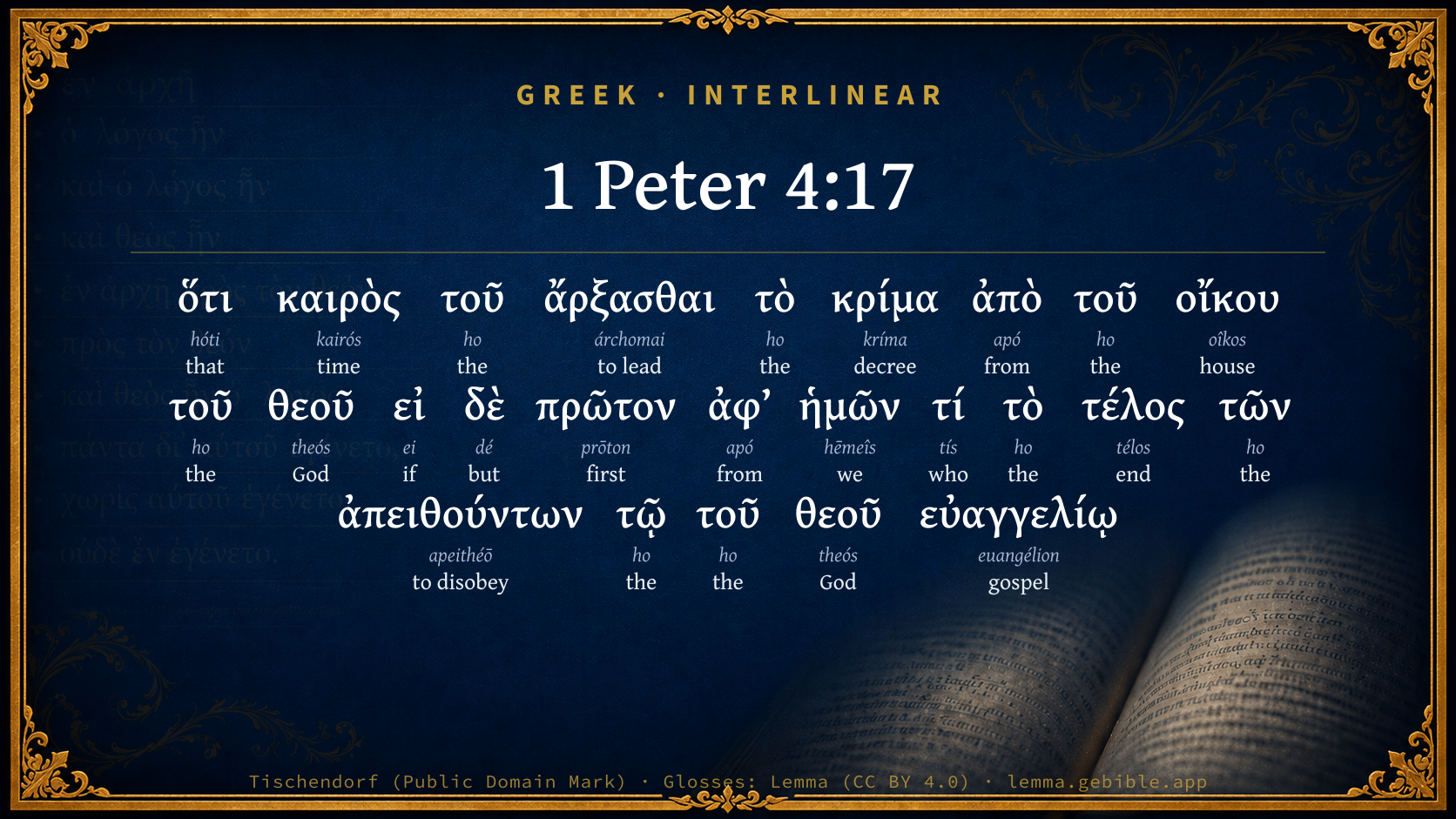
  1. ὅτι hóti G3754 “that” Conjunction
  2. καιρὸς kairós G2540 “time” Noun, Nominative, Singular, Masculine
  3. τοῦ ho G3588 “the” Article, Genitive, Singular, Neuter
  4. ἄρξασθαι árchomai G756 “to lead” Verb, Aorist, Middle, Infinitive
  5. τὸ ho G3588 “the” Article, Accusative, Singular, Neuter
  6. κρίμα kríma G2917 “decree” Noun, Accusative, Singular, Neuter
  7. ἀπὸ apó G575 “from” Preposition
  8. τοῦ ho G3588 “the” Article, Genitive, Singular, Masculine
  9. οἴκου oîkos G3624 “house” Noun, Genitive, Singular, Masculine
  10. τοῦ ho G3588 “the” Article, Genitive, Singular, Masculine
  11. θεοῦ theós G2316 “God” Noun, Genitive, Singular, Masculine
  12. εἰ ei G1487 “if” Conditional
  13. δὲ dé G1161 “but” Conjunction
  14. πρῶτον prōton G4412 “first” Adverb, Superlative
  15. ἀφ’ apó G575 “from” Preposition
  16. ἡμῶν hēmeîs G2249 “we” Personal pronoun, 1st person, Genitive, Plural
  17. τί tís G5101 “who” Interrogative pronoun, Nominative, Singular, Neuter
  18. τὸ ho G3588 “the” Article, Nominative, Singular, Neuter
  19. τέλος télos G5056 “end” Noun, Nominative, Singular, Neuter
  20. τῶν ho G3588 “the” Article, Genitive, Plural, Masculine
  21. τῷ ho G3588 “the” Article, Dative, Singular, Neuter
  22. τοῦ ho G3588 “the” Article, Genitive, Singular, Masculine
  23. θεοῦ theós G2316 “God” Noun, Genitive, Singular, Masculine
  24. εὐαγγελίῳ euangélion G2098 “gospel” Noun, Dative, Singular, Neuter

About this verse

These counts appear in no published source. They are computed here, from the morphology-tagged text and Lemma’s own curated glosses. What Lemma adds →

25
words
16
distinct lemmas
General Epistles
section

Notable vocabulary

The rarest word here is ἀπειθούντων to disobey G544 — appearing just 14 times in the whole Greek New Testament.

Shared distinctive vocabulary

ἀπειθούντων to disobey G544 occurs in 14 verses of the Greek New Testament. Also found in:

Repetition

Words recur within this verse:

  • θεοῦ God G2316 ×2
  • τοῦ the G3588 ×8
  • ἀπὸ from G575 ×2

Cross-references

21

Topical passages linked to 1 Peter 4:17 in the Treasury of Scripture Knowledge — connected by theme and wording, ordered by reader-vote popularity; previews shown in the World English Bible.

  • Jeremiah 25:29 For, behold, I begin to work evil at the city which is called by my name; and should you be utterly unpunished? You shall not be unpunished; for I will call for a sword on all the inhabitants of the earth, says Yahweh of Hosts.
  • Romans 2:9 oppression and anguish, on every soul of man who works evil, on the Jew first, and also on the Greek.
  • 2 Thessalonians 1:8 giving vengeance to those who don't know God, and to those who don't obey the Gospel of our Lord Jesus,
  • Ezekiel 9:6 kill utterly the old man, the young man and the virgin, and little children and women; but don't come near any man on whom is the mark: and begin at my sanctuary. Then they began at the old men that were before the house.
  • 1 Peter 2:8 and, "A stone of stumbling, and a rock of offense." For they stumble at the word, being disobedient, whereunto also they were appointed.
  • Luke 12:47–48 That servant, who knew his lord's will, and didn't prepare, nor do what he wanted, will be beaten with many stripes,
  • Malachi 3:5 I will come near to you to judgment; and I will be a swift witness against the sorcerers, and against the adulterers, and against the perjurers, and against those who oppress the hireling in his wages, the widow, and the fatherless, and who deprive the foreigner of justice, and don't fear me," says Yahweh of Hosts.
  • Luke 23:31 For if they do these things in the green tree, what will be done in the dry?"
  • Hebrews 12:24–25 to Jesus, the mediator of a new covenant, and to the blood of sprinkling that speaks better than that of Abel.
  • Matthew 3:9–10 Don't think to yourselves, 'We have Abraham for our father,' for I tell you that God is able to raise up children to Abraham from these stones.
  • Matthew 11:20–24 Then he began to denounce the cities in which most of his mighty works had been done, because they didn't repent.
  • Luke 10:12–14 I tell you, it will be more tolerable in that day for Sodom than for that city.
  • Amos 3:2 "You only have I chosen of all the families of the earth. Therefore I will punish you for all of your sins."
  • Isaiah 10:12 Therefore it shall happen that, when the Lord has performed his whole work on Mount Zion and on Jerusalem, I will punish the fruit of the stout heart of the king of Assyria, and the glory of his high looks.
  • Hebrews 2:2 For if the word spoken through angels proved steadfast, and every transgression and disobedience received a just recompense;
  • Galatians 3:1 Foolish Galatians, who has bewitched you not to obey the truth, before whose eyes Jesus Christ was openly set forth among you as crucified?
  • Galatians 5:7 You were running well! Who interfered with you that you should not obey the truth?
  • Hebrews 2:4 God also bearing witness with them, both by signs and wonders, and by various works of power, and by gifts of the Holy Spirit, according to his own will?
  • Hebrews 5:9 Having been made perfect, he became to all of those who obey him the author of eternal salvation,
  • Jeremiah 49:12 For thus says Yahweh: Behold, they to whom it didn't pertain to drink of the cup shall assuredly drink; and are you he who shall altogether go unpunished? you shall not go unpunished, but you shall surely drink.
  • Hebrews 11:8 By faith, Abraham, when he was called, obeyed to go out to the place which he was to receive for an inheritance. He went out, not knowing where he went.

Cross-references courtesy of OpenBible.info (CC BY 4.0).

Commentary

Notes on 1 Peter 4:17 from classic Christian and Jewish commentators (each source and its license shown beneath its notes). The classic Christian expositions comment on the surrounding passage and are grouped to its opening verse, so a note may address several verses; the Jewish commentaries on the Tanakh (Rashi and others) are per-verse, so they appear only where the commentator wrote on this verse.

Lemma curates 59 commentaries, every one of them public domain or Creative Commons licensed, each selected and text-cleaned for this edition rather than reprinted as found. About our sources →

The Biblical Illustrator

Joseph S. Exell

1Pe_4:17-19

Judgment must begin at the house of God.

The Churchs visitation

How we may know when some judgment approacheth. God usually, before any heavy judgment, visits a people with lesser judgments.

1. This, and this have I done, saith the Lord, and yet ye have not returned unto Me (Amo_4:6-7). There be droppings before the ruin of a house.

2. Again, usually before some great calamity, God takes away worthy men, the councillor, and the captain, and the man of war (Isa_3:2-3). This is a fearful presage that God threateneth some destruction, for they are the pillars of the church and the strength of the world; for they keep away evil and do good by their example and by their prayers many ways.

3. God usually visits a people when some horrible crying sins reign amongst them, as-

(1) Atheism.

(2) Idolatry.

(3) When divisions grow amongst a people. Union is a preserver.

4. Again, when sin goes with some evil circumstances and odious qualities, which aggravate the same in the sight of God, as when sin grows ripe, and abounds in a land or nation.

(1) When it is impudent; when men grow bold in sin, making it their whole course and trade of life.

(2) When sin grows common and spreads far. It is an ill plea to say, Others do so as well as I. Alas! the more sin the more danger.

(3) When there is a security in sinning, without fear of the Almighty, as if men would dare the God of heaven to do His worst.

5. Unfruitfulness threateneth a judgment upon a people. When God, the great husbandman in His Church, sees that upon so great and continual cost bestowed upon us, we remain yet unfruitful, He will not suffer us long to cumber the ground of His Church.

6. Decay in our first love is a sign of judgment approaching. (R. Sibbes.)

Difficulties in the pursuit, despair in the neglect, of salvation

I. That the conduct of God to His Church is such, that judgment may be said to begin at the house of God, and the righteous to be scarcely saved.

1. The Church is here often subject to persecution.

2. The Christian life is a painful course of exertion and warfare.

3. Many serious apprehensions and fears are felt by the people of God respecting their final salvation.

4. The righteous is scarcely saved, as, to be saved, he must endure to the end.

II. We proceed to the solemn inquiry, which the apostle infers from such a conduct of the Lord toward His servants; What shall be the end of those who obey not His gospel? where shall the ungodly and the sinner appear; if judgment begin at the house of God; if the righteous be scarcely saved?

1. Now if these require such a process of afflictive correction and purification, what shall be the doom of those who experience none; those who live without God? If His corrective dealings were so severe, what will be His severity, when justice alone, without mercy, shall preside?

2. The saints are prepared for glory by a course of privations and endurances; by learning to deny themselves: what then may be expected by those who never aimed at following the will of God as their rule? those that live at large after the desires of the flesh and the mind.

3. If the righteous had so many fears and anxieties regarding their state; what then shall be the portion of those who had no such fears, who lived in a reckless disregard of all that is most serious?

4. The followers of Christ, in the midst of all their difficulties, endure to the end: but if thus only are they saved, what shall be the doom of those who persevered in an opposite path? acquiring only, at every step, fresh degrees of obduration, a more fixed habit of resistance to the will of God! Where shall they appear? (R. Hall, M. A.)

The Churchs visitation

I. The Church of God is His own house.

1. God hath two houses, the heavens, which are called His house, because He manifests His glory there, and the Church here below, wherein He manifests His grace. Yea, the whole world, in a sort, is His house, because He manifests His power and wisdom in it; but heaven and His Church, in a more peculiar manner; and that in these respects-

1. Because God by His graze hath residence in His Church.

(2) Because by the means of salvation-the Word and sacraments there administered-He doth feed His Church, as in a house.

(3) A man rests and takes contentment in His house; so God takes His best contentment in His Church and people; they are the most beloved of all mankind.

(4) As in a house we use to lay up our jewels and precious things; so God lays up in His Church whatsoever is precious-His praises, His graces, yea, whatsoever is good and of high esteem, that He bestows upon His Church and people.

2. God provides for His Church as His own house. First, a man provides for his family; so doth God provide for His Church. And as a man protects his house from all enemies, so will God protect His Church and people, and be a wall of fire, and a defence round about them.

3. The heart of true Christians is Gods private closet. And as in every house or building, there are some open places, and some private closets, etc., so is it here. God hath His private chamber, and His retiring place, which is the heart of every true Christian.

II. The house of God needs visiting and purging.

1. Such is the weakness of mans nature, that evil things soon discourage us; and good things, except we wrestle with our spirits, prove a snare to the best. Even the Church of God, after a long time of peace, is apt to gather corruption, as water doth by standing, and as the air itself will do if it have not the wind to purge it.

2. Most certain it is that the Church of God cannot be long without some affliction, considering that it is now in a state of pilgrimage, absent from God, in another world as it were.

III. God will come to visit and purge His house when need is. He afflicts His own people before others, because-

1. They are of His own family, and are called by His name (Num_6:27). Now the disorders of the family tend to the disgrace of the governor of it.

2. The gospel suffers much through the sins of professors.

3. The sins of the godly are more heinous than others.

(1) Committed against more light.

(2) More benefits and favours.

(3) Sacrilege.

(4) Idolatry.

IV. God appoints a particular time for His visitation.

1. The time of visiting the Church of God is from Abel to the last man that shall be in the earth. The whole days of the Church are a time of persecution.

2. The Church is afflicted when the light of the gospel hath most clearly shined.

3. Now is the time of the Churchs affliction.

V. Judgment must begin at the house of God. God begins with His own Church and people-

1. Usually because He uses wicked men and the enemies of His Church for that base service, to correct and punish them.

2. To take away all excuse from wicked men.

3. That His children might be best at last.

4. That when He sends them good days afterwards, they might have the more taste and relish of His goodness. (R. Sibbes.)

Afflictions amongst the people of God

I. Afflictions must begin with Gods servants. Jacobs house first, afterwards the Egyptians, felt the famine; first the Israelites were oppressed, afterwards the Egyptians; the Jews were first carried into captivity, but afterwards the Assyrians were destroyed by the Medes and Persians.

1. In respect of their sins, they are full of terror ere they can get any comfort, and when they have obtained it, it is often eclipsed, and they go mourning.

2. They are subject to many sicknesses, grievous pains, diseases, losses, crosses, disgrace, persecution at the hand of the wicked, etc.

(1) To humble them for sin past.

(2) To fetch them into the way from wandering, and teach them obedience.

(3) To humble them.

(4) To mortify their lusts, wean them from the world, and quicken them to duty.

(5) Hereby also God showeth that He will not bear with sin in His dearest servants.

(6) To confute the devil, and show that Gods people serve Him not for wages.

(7) To show them their happiness is to come, and that if God thus school His servants, that then He will deal severely with the wicked, so that this may be a looking glass to them.

II. It is of necessity that Gods servants must here suffer troubles.

1. In respect of Gods will. He hath appointed us thereunto.

2. In respect of our necessity. Sin is so riveted into us, and in our very nature, as it must be no easy thing to pluck it out from us. (John Rogers.)

Gods judgment of the world

I. The human world morally is divided into two grand sections.

1. The house of God. All good men are members of one great family, They have one Father, one Elder Brother, one spiritual life, and one common home.

2. Those who obey not the gospel of God.

II. These two sections are alike subject to suffering.

1. The best men, in their greatest suffering, feel that their sufferings are deserved.

2. That they are disciplinary.

III. The suffering of the one is far more terrible than that of the other.

1. The one has resignation to the Divine will; the other has not.

2. The one has peace of conscience; the other has not.

3. The one has the hope of a better life; the other has not.

4. The one has fellowship with the Father; the other has not.

Learn:-

1. The transcendent importance of moral character.

2. The fallacy of judging from appearances.

3. The influence of the gospel upon mans destiny. (Homilist.)

Judgment beginning at the house of God

The stormy shower lighteth first on the high hills, and having washed them, settleth with all the filth in the valleys. (J. Trapp.)

Judgments of grace

It is necessary to distinguish the judgment of grace from the judgment of wrath, and temporal punishment from eternal. (J. P. Lange.)

What shall the end be of them that obey not.-

What is the doom of those who die impenitent

I. Not annihilation.

1. Future punishment of some kind seems essential to the moral government of God.

2. The fact of there being various degrees in punishment makes it impossible for that punishment to be annihilation.

3. All that is said about the sinners doom shuts out the idea of annihilation (Luk_12:4-5; Mat_13:41-42; Mar_9:43).

II. Not merely a temporary punishment. The most general argument brought against eternal punishment is that it is opposed to the perfect justice of God. The punishment, they say, being eternal must at last exceed the sin. In order to understand aright the nature of the sin, you must bear in mind the being against whom the sin is committed. It is against Jehovah, the Infinite One, and against one to whom we are under infinite obligations. But, say others, God is infinitely merciful, and the very idea of eternal suffering is opposed to that attribute. it may be according to your idea of that mercy, and yet not against that mercy itself. Remember God is as just as He is merciful. That mercy can permit eternal suffering is proved by the fact that it does in the case of Satan and the rebel angels. There will be nothing in hell to refine or alter the sinner. Hell fire is no refiners fire, to purge the dross away. (A. G. Brown.)

The ultimate destiny of the wicked

The question concerns those who obey not the gospel. Observe, the gospel is not to be treated as a mere subject for study; although a more noble subject comes not within the reach of man. Nor as a means of mere excitement. It is not a book for entertainment, such as a tale, a poem, a drama. The gospel is a statute, a law to be obeyed; it comes with the highest authority. Unless it is translated into our lives, and embodied in our actions, it is a curse.

I. The question in the text is one that it is impossible to determine with certitude. No less than three theories have been propounded, in order to render an answer to this tremendous problems utter extinction-eternal torment- ultimate restoration.

II. Certitude on such a subject is of no vital importance.

1. Genuine religion is the one thing essential for man.

2. Genuine religion is independent of any certitude of the future.

3. Whilst genuine religion is independent of any certitude of the future, it is dependent upon the knowledge of some things, and these things are clearly revealed.

(1) Our great moral obligations.

(2) Our means of spiritual improvement. (Homilist.)

The end of the ungodly

This is a verse of implication. It affirms nothing, but by its own species of argument causes us to gather some very striking lessons.

I. We have implied the meaning of religion. Obedience. This is Gods due as-

1. Creator.

2. Father.

3. King.

II. We have implied the law on which obedience is to be founded. The gospel of God. The gospel is the revelation of good-

1. On account of its Author.

2. Purport.

3. Practical influence.

III. We have implied that the punishment of the unbeliever will be severe. The answer, left here as a great hiatus, is fully given in other parts of Scripture-

1. In the threats which it utters.

2. In the examples it affords.

3. In the logical course of sequence.

IV. We have implied a warning to the sinful. They stand on the brink of an awful precipice, in which at any moment they may fall.

V. We have implied a consolation to the righteous. If their lot here is hard, it is nothing to that in store for the disobedient. Sin may be pleasant for a season, but it brings forth death. (Pryce Thomas.)

The end of the disobedient

I. That there is an end to the unconverted.

II. That this end is fraught with fearful contingencies.

III. That the nature of this end demands urgent and careful consideration.

IV. That this end is shrouded, even to the most earnest investigation, in obscurity. (Homilist.)

The sin and danger of not obeying the gospel

I. The great privilege of having the gospel.

1. It is good news, the best news that ever reached our fallen world-news sent from heaven, news of a reconciliation for a fallen world.

2. Though it was intended for universal man and suited to meet all his spiritual wants, yet through the supineness of the Church its universal proclamation has been withheld, and millions of our fellow creatures left without it. But we are blessed with it in all its purity, freeness, and fulness (Psa_16:6; Heb_4:2).

II. The great sin of not obeying the gospel. It is not enough to go and hear the gospel, to converse about it, to approve it, unless we obey it (Tit_2:11-14).

III. The awful consequences of not obeying the gospel.

1. It will be the end of their hope and happiness, but not of their existence.

2. It will be to die, not only under the curse of the law, but under the gospel. (Pulpit Studies.)

The ungodlys misery

I. The seeming prosperity of the wicked shall have an end. See what a fearful judgment follows the wicked! That which he sins for-his honour, riches, delights-all shall vanish and come to nothing.

II. The happiness of the wicked is momentary, their misery endless. When we are tempted to any sin or unlawful course, consider thus with ourselves: Shall I, for a pleasure that will end, have a judgment that shall never end? For the favour of men that will fail, shall I lose the perpetual favour of God? Shall I, for a little profit, lose my soul eternally? I beseech you therefore, whenever you are solicited to sin, for profit or pleasure, etc., set before your eyes the perishing condition of these things, and the everlastingness of that judgment which attends upon them.

III. Those that obey not the gospel.

1. Sins against the gospel are sins against those attributes wherein God will glorify Himself most, as His grace, mercy, loving kindness, etc.

2. Sins against the greatest light are most sinful.

3. Another aggravation of sins against the gospel is that they sin against the better covenant. (R. Sibbes.)

The criminality and the consequences of unbelief

I. The criminality of your disobedience. This will appear if you consider-

1. The excellency and importance of that gospel which you have hitherto disbelieved.

2. The source in which your unbelief has originated.

(1) Immoral conduct.

(2) Inattention and inconsideration.

(3) Worldly mindedness.

(4) Self-righteousness.

3. The motives and appeals which your unbelief has resisted.

(1) Birth in a Christian family

(2) Afflictive dispensations.

(3) Conversion of ungodly companions.

(4) Impressions and convictions.

4. The injurious influence which your unbelief may have produced on the minds and destiny of others.

II. The ruinous consequences of your disobedience.

1. You are now in a state of condemnation.

2. You are in the greatest danger of being suffered to continue in impenitence and unbelief. What will be your condition in the next world? (J. Alexander.)

If the righteous scarcely be saved.-

The righteous scarcely saved, and the misery of the wicked

To be saved is what the generality of persons in the world wish for. I am satisfied that the genuine sense of our text hath a particular reference to temporal salvation from calamity, for the copulative particle and makes a connection between it and the foregoing verses, where we have the apostle speaking unto Gods people about their suffering for the cause of Christ. He tells them of judgment beginning at the house of God, by which we are to understand affliction and calamity, wherewith God exercises His people. But the text need not be particularly confined to this sense, but may hold good with respect to eternal salvation.

1. That the people of God are a righteous people. They are called so in the text, not that they are so in themselves or by nature. They are righteous in the righteousness of Christ, who is called the Lord our Righteousness (Jer_23:6; 1Co_1:30). A principle of righteousness is planted in them at their conversion, from whence flows a righteousness of conversation (Luk_1:6).

2. That the people of God shall be saved. Our text plainly supposes it, though while in the world they are persecuted. Now what is it for them to be saved but to be delivered from sin and misery, and brought into the enjoyment of eternal glory by Jesus Christ. Israel shall be saved in the Lord with an everlasting salvation.

(1) They shall be delivered from sin and misery. From sin, both from the guilt, filth, power, and being of it.

(2) They shall be brought to the full enjoyment of eternal glory; and their bodies shall also be saved.

3. That though the righteous be saved, yet it is with abundance of difficulty. In temporal calamity the Lord may suffer things to run to the very last extremity before He appears for His peoples salvation. Now their being scarcely saved is not for want of power in God, for He is able to save to the uttermost, nor is it for want of will, for He win give grace and glory (Psa_84:11), nor is it for want of an appointment, for He hath not appointed them to wrath, but to obtain salvation by our Lord Jesus Christ (1Th_5:9); but the difficulty lies in the things they meet with in the way to salvation.

(1) At their entrance into the way to heaven they meet with abundance of difficulty. The gate of conversion is strait, and a crowd of oppositions meet them at their entrance. Many temptations does Satan lay before young converts, and such a mighty advantage has he against them, their corruptions being strong and grace weak, that they find it a very hard thing to escape. The world also, sometimes with its charms and sometimes with its frowns, bears hard upon the poor creature, so that if he escape being entangled it is with great difficulty.

(2) In their progress on the way to heaven they meet with so many oppositions that they are but scarcely saved. The way to heaven is but a narrow way. Gods people, like those in the shipwreck with Pard, escape all safe to land, yet it is with a scarcely, they get over the turbulent sea of this world. Oh, the snares that are laid for them!

(3) At their exit out of the world they meet with abundance of difficulty, so that though they be saved, yet it is with a scarcely; their enemies would not suffer it if they could hinder it. When their souls are ready to take their flight into another world, then is Satan most busy to hinder their salvation. Now though it be impossible for him to hinder their salvation, yet he may so molest them as to make it difficult to obtain salvation, so that they shall find they are but scarcely saved.

This further appears-

(1) From the frequent apprehensions they have of their being in danger of hell and destruction.

(2) This is further evident from the fears there are in the people of God about their salvation.

4. That as it is impossible for the ungodly and sinner to be saved as such, so their misery is unspeakable. Where shall the ungodly and sinner appear?

(1) Negatively, I shall show where they shall not appear. Not in heaven. Not in the presence of God, for the foolish shall not stand in His sight; He hateth all the workers of iniquity. Not among the righteous. Sinners shall not stand in the congregation of the righteous. Where, then, shall the wicked appear?

(2) Positively, they shall appear in hell. The wicked shall be turned into hell, and all the nations that forget God. They shall appear at the awful tribunal of God, before His judgment seat. And are the righteous scarcely saved? Hence learn-

1. That going to heaven is not so easy a thing as some imagine. It is not an empty profession of religion that will serve the turn.

2. Are the righteous scarcely saved? Hence we learn what a miserable disappointment many meet with, who, instead of getting to heaven, fall into hell.

3. If the righteous be scarcely saved, then we may from hence learn the miserable condition of the wicked in the other world, who are not saved.

(1) O ye sleepy, secure sinners! where will you appear?

(2) O ye drunkards! where will you appear-you that waste your time and estates, that spoil your constitution, and abuse the good creatures of God?

(3) O ye fornicators and adulterers! where will you appear?

(4) O ye sabbath breakers! where will you appear?

(5) O ye swearers! where will you appear?

(6) O ye scoffers at religion! where will you appear? (J. Sedgfield.)

If so-what then

Scarcely saved points out the difficulty of salvation. It is no light thing to be saved; omnipotent grace is needed. It is no trifling thing to be lost, but it can be done by neglect.

I. The fact. The righteous scarcely are saved.

1. From the connection we conclude that the righteous are saved with difficulty because of the strictness of Divine rule.

2. From the experience of saints we come to the same conclusion. They find many saving acts to be hard, as, for instance-

(1) To lay hold on Christ simply, and as sinners.

(2) To overcome the flesh from day to day.

(3) To resist the world, with its blandishments, threats, and customs.

(4) To vanquish Satan and his horrible temptations.

(5) To perform needful duties in a humble and holy spirit.

(6) To reach to gracious attainments and to continue in them.

(7) To pass the tribunal of their own awakened and purified conscience, and to receive a verdict of acquittal there.

3. From the testimony of those who are safely landed (Rev_7:14).

II. The influence from the fact. Where shall the ungodly and the sinner appear?

1. If even the true coin is so severely tested, what will become of the reprobate silver?

2. If saints scarcely reach heaven, what of the ungodly? What can they do who have no God? What can they do who have no Saviour? What can they do who are without the Spirit of God? What without prayer, the Word, the promise of God, etc.?

3. If saints are so sorely chastened, what will justice mete out to the openly defiant sinner?

III. Another inference. Where will the mere professor appear? If the truly godly have a hard fight for it-

1. The formalist will find ceremonies a poor solace.

2. The false professor will be ruined by his hypocrisy.

3. The presumptuous will find his daring pride a poor help.

4. He who trusted to mere orthodoxy of creed will come to a fall

5. Height of office will do no more than increase responsibility.

IV. Another inference. Then the tempted soul may be saved. It seems that even those who are truly saints are saved with difficulty; then we may be saved, though we have a hard struggle for it.

V. Another inference. How sweet will heaven be! There the difficulties will be ended forever. There the former trials will contribute to the eternal bliss. (C. H. Spurgeon.)

The salvation of the righteous difficult

I. The character of the persons here spoken of.

1. The righteous.

(1) None are such legally (Rom_3:10; Job_9:15).

(2) They are such as have believed in Christ, are pardoned and justified (Rom_3:25-26).

2. The ungodly sinner. They are such as remain in their native, unconverted state. Particularly they are such-

(1) Over whom Satan exercises an uncontrolled dominion (Eph_2:2).

(2) Alienated from the love of God (Eph_4:18).

(3) Rebellion against God (Rom_1:28-32).

(4) Neglecting, perhaps rejecting, the only way of salvation by Jesus Christ (Heb_2:3; Heb_10:28-29).

II. The difficulty of the salvation of the righteous.

1. The text admits that the righteous shall be saved; their salvation is certain upon their being found faithful unto death.

(1) The testimony of Scripture secures it (2Ti_1:12; 2Ti_4:17; 1Pe_1:3-5. This is the purpose of God concerning them (2Th_2:13).

(3) It was the ultimate end of Christs sufferings (Heb_2:10).

(4) Of His ascension into heaven (Heb_6:20).

(5) God hath promised it (Rev_2:10).

(6) The work of salvation in the righteous is already begun (Php_1:6).

2. Nevertheless, their salvation is here represented as being with difficulty obtained.

(1) This difficulty is not owing to any deficiency in the love of God, which is universal (Joh_3:16).

(2) Nor in the death and merit of Christ, which are infinite (Heb_2:9; 1Jn_2:2).

(3) Nor in the influence of the Spirit (Joh_14:16-17; Joh_16:7-8). But it is owing chiefly-

(4) To the difficulty of the work they have got to do (Tit_2:11-14).

(5) The opposition they meet with from the world.

(6) The influence of evil example which abounds in the world (Joh_15:19).

(7) The opposition they meet with from Satan (1Pe_5:8).

(8) The remains of corruption within.

(9) The instability of some Christians (Jam_1:8), and the apostasy of others (1Ti_1:19-20).

III. The certain and dreadful misery that awaits the ungodly sinner. The question in the text relating to such may refer-

1. To a time of popular calamity (Luk_21:25-26).

2. To death (Psa_9:17).

3. To the day of judgment. Let the wicked tremble for the consequences of their conduct. Should they live and die such, their destruction is inevitable. (T. Hannam.)

The difficulty of salvation

Let us consider the solemn truth assumed-If the righteous be scarcely saved. The meaning of this is that the righteous are saved with difficulty, or, as Steiger well expresses it, it costs believers much to remain steadfast in their endurance of trials and to glorify God. The radical cause of the difficulty is with the righteous-original sin. The external causes of the difficulty are around believers-the world, which is in league with their infected nature, and offers corresponding objects to all its evil propensities. It is readily admitted that they are surrounded also with the helps of the Church. Now to notice the particular causes of such difficulty. Observe, first, that the faith of the righteous, which is always imperfect, has, like a physical power, a constant tendency to decrease in strength and firmness through its exercise being neglected. The temptations to such neglect are many and great. The righteous, for the most part, are leading a busy life. Hence they are tempted not to find time for the exercise of faith. Besides, sensible things ever surround them, try to press into their souls by every avenue of their senses, and exclusively, fill their affections and engage their thoughts; hence their disinclination to exercise faith would be proportionately increased. True, if the righteous are exposed to temptation to neglect the exercise of faith, they have incentives to attend to the duty. One incentive is a sense of sin. Another incentive is special temptation, or trouble, or difficulty, which often besets them, and urges them to look to their Saviour for deliverance or support. A third incentive is the impulse of the Holy Spirit, inciting thoughts of Christ. Further, the faith of the righteous is liable to decrease in strength and stability, through their failure to properly seek its nourish meat. Thus may their faith decline and waver through defect in spiritual appetite or neglect of spiritual food. And their exposedness to this may hardly be obviated by the frequent calls they may have to the healthy and invigorating exercises of devotion. Again, the faith of the righteous is liable to decrease in strength and firmness, through being exposed to attacks from the unbelief of their fallen nature, called in Scripture the evil heart of unbelief. Natural unbelief, therefore, needs to be much watched and prayed against, and an increase of faith to be much encouraged and prayed for. But further, the danger which their faith is in does not only arise from the unbelief of their fallen nature, but from the encouragement which such unbelief meets with in the world-ah! and the professing Church. For infidelity in sonic degree, practical or avowed, is everywhere manifest. The manner of such injury to their faith will be different at separate times. Sometimes, to notice the two extremes, when it is violently assailed by doubts within and infidel expressions and actions without, its injury will be sudden and apparent, like that of a plant which in spring is smitten with the blast of the east wind, so that one hour its roots are firm and its leaves green, the next its roots are loose, and its leaves dried up and withered. At other times, when its exercise or its nourishment is neglected through a worldly spirit, its injury will be gradual and imperceptible, like that of a plant which, while it is left uncultivated, has a worm at its roots. The righteous are saved with difficulty, secondly, because, in consequence of the general causes mentioned, their holiness is exposed to some degree of failure. It is exposed to this through decrease of faith, like the fruit of a tree through injury of its root, and also, like faith, through its exercise and nourishment being neglected. The holiness of the righteous is exposed to failure in measure through temptations. Again, the holiness of the righteous is exposed to failure through trials. Further, the righteous are saved with difficulty, because they are exposed to failure, in measure, in holiness, through difficulty in certain parts of obedience. It is no easy matter for the righteous, depraved as they are in nature, to perform their various duties in their entirety. But even this is not all; some duties which the righteous have to perform are especially difficult, through their direct opposition to their natural tendencies. I mean such as are involved in the following sayings of the Master:-If ye forgive men their trespasses, your Heavenly Father will also forgive you. But if ye forgive not men their trespasses, neither will your Father forgive your trespasses (Mat_6:14). Now I have two inferences to draw from this solemn subject.

1. The first is, if the righteous are thus scarcely saved, must not many professors of religion be in a sad mistake?

2. The second inference is that the righteous have great cause for earnest striving that the evidences of their conversion may be clear to themselves and to others.

3. In a word, let them work out their own salvation with fear and trembling, and give all diligence to make their calling and election sure. (C. H. Coleman.)

The salvation of the sinner impossible

1. The faith in Christ of the righteous is maintained with difficulty. But the ungodly and sinners have no living faith in Christ at all. Thus they not only have not faith and seek not after it, but they yield themselves to be bound and fettered in infidelity. Yet without faith is it not impossible that the ungodly and sinners should be saved?

2. I observe, the holiness of the righteous is maintained with difficulty in resisting and overcoming the evil dispositions which are inherent in their fallen nature. But the ungodly and sinners are entirely destitute of holiness in principle and in practice. How, then, can the ungodly and sinners be meet for heaven?

3. The righteous often find it difficult to bear their trials with Christian consistency, being liable to impatience and irritability, through want of watchfulness in trials comparatively light and transient, and strongly urged to discontent and resistance of will, through distrust of God and failure in spiritual firmness, in trials severe and lasting. But the ungodly and sinners almost always, under any trials, allow themselves in discontent, bad temper, and resistance, whether the trials come the more evidently from God or from man. But the ungodly and sinners being thus refractory under trials, how is it possible that they can be finally saved?

4. The righteous frequently experience great difficulty in performing some of the harder duties of the Christian life. But the ungodly and sinners neglect them altogether. If they render bodily service, they render no spiritual service to God. How is it possible, then, that the ungodly and sinners can find favour before the judgment seat? (C. H. Coleman.)

Salvation difficult to the Christian-impossible to the sinner

I. Why the salvation of the righteous is difficult. The difficulty in the salvation of either the righteous or the wicked turns not on any want of mercy in the heart of God. It is not because God is implacable and hard to be appeased. Again, it is not in any lack of provision in the atonement to cover all the wants of sinners. But, positively, one difficulty is found in the nature of Gods government, and in the nature of free agency in this world. God has so constituted man as to limit Himself to one mode of government over him. This must be moral, and not physical. That physical omnipotence which sweeps the heavens and upholds the universe could find no difficulty in moving lumps of clay so small and insignificant as we. But mind cannot be moved as God moves the planets. Physical force can have no direct application to mind for the purpose of determining its moral action. Such being the case, the great difficulty is to persuade sinners to choose right. God is infinitely ready to forgive them if they will repent; but the great problem is to persuade them to do so. God may and does employ physical agencies to act morally, but never to act physically. There are a great many difficulties in the way of converting sinners, and saving them when once converted. One class of these difficulties is the result of an abused constitution. When Adam and Eve were created their appetites were doubtless mild and moderate. They did not live to please themselves and gratify their own appetites. Their deep and all engrossing desire and purpose to please God was the law of their entire activities. Sin introduced another law-the law of self-indulgence. Every one knows how terribly this law tends to perpetuate and strengthen itself. Their appetites lost their proper balance. No longer subordinate to reason and to God, they became inordinate, clamorous, despotic. Now in order to save men, they must be restored to a state in which God and reason control the free action of the mind, and appetite is held in due subjection. Here is the difficulty. Some have formed habits and have confirmed them until they have become immensely strong, and it becomes exceedingly difficult to induce them to break away. The rescue must be effected by moral, not by physical means, and the problem is to make the moral means powerful enough for the purpose. Again, we must notice, among the difficulties in question, the entanglements of a multitude of circumstances. I have often thought it well for Christians that they do not see all their difficulties at first. If they did, its discouraging effect might be disastrous. The great difficulty is living to please self rather than God. It is wonderful to see how much this difficulty is enhanced by the agency Satan and sin have had in the framework of society. It would seem that a bait is held before every man, whatever his position and circumstances may be. There is a man chained to a wife who is a constant source of temptation and trial to him. There is a wife who sees scarce a peaceful moment in all her life with her husband-all is vexation and sorrow of spirit. Many parents have children who are a constant trial to them. They are indolent, or they are reckless, or they are self-willed and obstinate. Their own tempers perhaps are chafed, and they become a sore temptation to a similar state of chafed and fretted temper in their parents. On the other hand, children may have equal trials in their parents. Who but God can save against the power of such temptations? Many children have been brought up in error. Their parents have held erroneous opinions, and they have had their moral constitution saturated with this influence from their cradle and upwards. How terrible such an influence must inevitably be! Or the business of their parents may have been such as to miseducate them. When the mind gives itself up to self-indulgence, and a host of appetites become clamorous and impetuous, what a labour it must be to bring the soul into harmony with God! How many impulses must be withstood and overcome l how great the change that must be wrought in both the physical and moral state of the man! No wonder that the devil flatters himself that he has got the race of depraved men into his snares and can lead them captive at his will. Many are not aware of the labour necessary to get rid of the influence of a bad education. Ofttimes the affections become unhappily attached, yet the attachment is exceedingly strong, and it shall seem like the sundering of the very heart strings to break it off. Sometimes we are quite inadequate to judge of the strength of this attachment, except as we may see what strange and terrible means God is compelled to use to sever it. Oh, what a work is this which Christ undertakes that He may save His people from their sins! How strange and how complicated are the difficulties 1 Who could overcome them but God? Again, the darkness of nature is so great and so gross that it must be an exceedingly great work to save them from its influence and pour the true light of God through their intelligence. Indeed, Christians never know themselves except as they see themselves in Gods own light. Finally, the greatness of the change requisite in passing from sin to real holiness-from Satans kingdom into full fitness for Christs, creates no small difficulty in the way of saving even the converted, Remarks: We see why the Scriptures are so full of exhortations to the Christians to run, run, and especially to run by rule. They must, however, give all diligence. A lazy man cannot Bet to heaven. To get there costs toil and labour. For his will must be sanctified. The entire voluntary department of his being must be renovated. The Christian is also commanded to watch-not to close his eyes for a little more sleep and a little more slumber. We see, also, why the Christian is to pray always. We may also see why Christians are exhorted to separate themselves from the world. Mark, also, why Christians are exhorted to spend the time of their sojourning here in fear, and to walk softly and carefully, as before God, through all the meanderings of their pilgrimage. When candid men come to consider all these things-the human constitution, the tendency to unbelief, the impulses towards self-indulgence, and the strength of temptation-they cannot but see that there is abundant occasion for all those faults in Christian character and conduct which they are wont to criticise so stringently. Yet often, perhaps commonly, wicked men make no allowance for the faults of Christians, but assume that every Christian ought to be spotless, while every sinner may make so much apology for his sin as quite to shield his conscience from conviction of guilt.

II. Show how and why the salvation of the wicked is impossible. Vitally important to be considered here is the fact that the governmental difficulty in the way of being saved, growing out of your having sinned, even greatly, is all removed by Christs atonement. The difficulty in the way of saving sinners is not simply that they have sinned, but that they will not now cease from sinning and believe on the Lord Jesus Christ. The salvation of sinners is therefore impossible.

1. Because it is impossible for God by any means He can wisely employ to persuade them to desist from sinning. It may not be wise for God to bring all the moral power of His universe to bear upon the sinner in this world. If this were wise and practicable, it might avail-for aught we can know; but since He does not do it, we infer that He refrains from some wise reason. Certain limitations are fixed in the divine wisdom to the amount of moral influence which God shall employ in the case of a sinner. It is in view of this fact that I say God finds it impossible to gain the sinners consent to the gospel by any means that He can wisely employ.

2. Again, the sinner cannot be saved, because salvation from sin is an indispensable condition of salvation from hell. The being saved from sin must come first in order. If salvation implies fitness for heaven, and if this implies ceasing from sin, then, of course, it is naturally and forever impossible that any sinner can be saved without holiness.

3. The peace of heaven forbids that you should go there in your sins. What sort of happiness, congenial to his heart, could the sinner hope to find there? And now will heaven let you in? No. Nothing that worketh abomination can by any means go in there.

4. Besides, it would not be for your own comfort to be there. You were never quite comfortable in spiritual society on earth.

5. The justice of God will not allow you to participate in the joys of the saints. His sense of propriety forbids that He should give you a place among His pure and trustful children.

III. If, then, the sinner cannot be saved and go to heaven, where shall he appear? The question is a strong negation. They shall not appear among the righteous and the saved. This is a common form of speaking. Nehemiah said, Shall such a man as I flee? No, indeed. Where, then, shall the ungodly and the sinner appear? In no desirable place or position-certainly. Not with the righteous in the judgment, for so Gods Word has often and most solemnly affirmed. It is asked, Where shall the ungodly appear? I answer, Certainly not in heaven, nor on the heavenly side. (C. G. Finney.)

Saved with difficulty

I. The people of God will be saved with difficulty.

1. Owing to their strong remaining corruptions.

2. To their long and inveterate habits of sin.

3. To the strong and numerous foes that oppose his march.

4. A great amount of labour will be requisite to push him forward in his heavenly pilgrimage.

5. There will await him many other dangers, of which he can have yet no conception.

II. But where shall the ungodly and sinner appear? All the difficulties, and more yet, that obstruct the way of the Christian heavenward, are surely before the man who has not commenced his route thither.

1. The man who is not a Christian has yet to enter upon the way.

2. He may have yet more corruptions. He may have taken a more wayward course.

3. But his iniquities must all be uprooted.

4. He has more foes, in addition to those planted in the way of the Christian.

5. He must do more labour than if he had set out earlier.

6. The same, and more yet dangers await him than await the Christian.

Remarks:

1. Would I have the sinner despair, lie down and die? Will not heaven be worth all the efforts he has yet to make?

2. Oh, then, how anxious should sinners be to commence the great work of their salvation!

3. How anxious, too, should the Church be that sinners might live! (D. A. Clark.)

The difficulties that are to be encountered in the way of salvation

That the righteous should scarcely be saved seems hardly reconcilable with the grace and deign and promises of the gospel. Did not Christ come to save sinners?

I. In what sense the righteous are said to be scarcely saved. That may be understood two ways.

(1) With respect to accidental difficulties arising from the particular circumstances of times and persons. For the difficulties of religion are not alike in all times, nor to all persons; for they are not like a geometrical measure, which is always exactly the same; but rather like a voyage at sea, which is to be managed by the same compass and to the same port; hut it sometimes proves calm and pleasant, and at other times stormy and tempestuous. Which chiefly happens when a religion appears new, or goes about to reform the old; for then it is sure to meet with all the opposition which the passions and interests and prejudices of partial men can raise against it. For the time is come that judgment must begin at the house of God; and if it first begin at us, what shall the end be of them that obey not the gospel of God? i.e., Christ hath foretold desolation and ruin to come upon the Jewish nation. Sincerity and constancy are the necessary conditions of salvation, which may be tried much more in some than it is in others. We must all have the same journeys end if we hope to get to heaven, but some may meet with a freer road, and a calmer season, and better company, in their journey than others. But herein mankind are apt to be deceived, as though all the difficulties lay in a suffering condition; whereas a soft and careless life is rather more dangerous to their souls, because persons are less apt to suspect their danger. The temptations of the suffering side are apt to awake the sleepy powers of the soul, whereas the gentle and easy condition of life often lays them asleep. But this is not all; for there are many things which make it more difficult to some than others, which are of another nature. Some tempers are more flexible and pliable than others; more capable of hearkening to reason, and more apt to reflect on their own actions; whereas others are naturally stiff and obstinate, who stick fast to an opinion or prejudice which they have once taken up. Some, again, are very easily convinced of a fault, but very hardly reclaimed. Again, some have had the advantage of a pious and religious education. For although the difficulties be not alike in all, yet, of one kind or other, they are such as cannot be overcome by ourselves without the power of Divine grace exciting, preventing, and assisting of us.

(2) Having thus showed what difficulties there are which arise from the different circumstances of times and persons, I am now to consider those which arise from the terms of salvation, which are common to all persons and times.

Here we must suppose salvation to be the thing aimed at as the chief end or happiness of such men, and here are two kinds of difficulties to be inquired into.

(1) Such as are implied in the general pursuit or happiness. For happiness is not a thing of chance or necessity, but a matter of choice and design.

(1) That happiness did consist in one uniform design of life, i.e., that a man must choose one proper and chief end to himself, and so order his thoughts and actions that he may attain it.

(2) That there must be a careful and attentive mind to pursue this design.

(3) That any man who desired to be happy must, above all things, take pains about himself.

(4) That those who consulted most the ease and pleasure of mankind were forced to put men upon some hard and unpleasant things to make anything like happiness to consist in pleasure. For they cast off all riot and excess, because the pain which followed exceeded the pleasure; and therefore they made temperance and chastity necessary to the true pleasure of life. So that all were agreed that it was impossible to attain to anything that looked like happiness without some real difficulty, which was necessary to be undergone, although the success Were uncertain.

(2) Let us now consider the difficulties relating to salvation, or that happiness which Christians expect. And here I shall show-

(1) It is more reasonable to expect difficulties in the way of salvation. For the more excellent and desirable the happiness is, the more it is worth the while for us to take pains about it; especially when there is a certainty of attaining it

(2) The difficulties in our way to salvation are not such but we may reasonably hope to overcome them; i.e., if we set ourselves about it; otherwise a very mean difficulty will appear too great for us.

And there are two things to show that we may hope to overcome them.

(1) That the most difficult duties are in themselves reasonable to be performed by us.

(2) That God offers His gracious assistance for the performance of them.

II. And this helps us to reconcile the difficulty of salvation with the easiness of the terms of the gospel. For that which is not only hard, but impossible to us, in our own strength, may, by the mighty power of Divine grace, become not only possible but easy to us.

III. And from hence we see what encouragement there is still for us to hope to be saved, if we be righteous. There is none for the ungodly and sinner. But what is it, some may say, to hear that the righteous are scarcely saved, when we are so conscious to ourselves of our own unrighteousness? (Bp. Stillingfleet.)

The difficulties of salvation

This imports not any uncertainty in the thing itself as to the end, in respect of the purpose and performance of God, but only the great difficulties and hard encounters in the way, fightings without, and fears within. All outward difficulties, however, would be us nothing, were it not for the incumbrance of lusts and corruptions within. Were a man to meet disgraces and sufferings for Christ, how easily would he go through them, yea, and rejoice in them, were he rid of the fretting impatience, the pride, and self-love, of his own carnal heart! And many times, after much wrestling, he scarcely finds that he hath gained any ground: yea, sometimes he is foiled and cast down by them. And so in all duties the flesh is dragging downwards! When he would mount up, he finds himself as a bird with a stone tied to its foot; he hath wings that flutter to be upwards, but is pressed down with the weight fastened to him. What struggling with wanderings and deadness in hearing, and reading, and prayer! And what is most grievous, is, that, by their unwary walking and the prevailing of some corruption, believers grieve the Spirit of God, and provoke Him to hide His face and withdraw His comforts. How much pain to attain anything, any particular grace of humility, or meekness, or self-denial! And if anything be attained, how hard to keep and maintain it against the contrary party! How often are they driven back to their old point! If they do but cease from striving a little, they are carried back by the stream. And what returns of doubtings and unbelief, after they thought they were got somewhat above them, insomuch that sometimes they are at the point of giving over, and thinking it will never be for them! And yet, through all these, they are brought safely home. There is another strength than theirs, which bears them up and brings them through. But these things, and many more of this nature, argue the difficulty of their course, and that it is not so easy a thing to come to heaven as most imagine it. (Abp. Leighton.)

A solemn appeal

I. Consider the appeal in its reference to temporal calamities.

1. The righteous are saved, when the existence of the Church is preserved.

2. The righteous are saved personally, when their lives are preserved.

3. The righteous are saved, while the life and welfare of their souls are secured, whatever may otherwise befall them.

II. Consider the appeal in its reference to spiritual and eternal salvation.

1. The righteous are scarcely saved-

(1) Because their salvation could not be purchased but at the greatest conceivable expense.

(2) Because the purchased redemption could not be applied but by supernatural power.

(3) Because even when salvation is thus attained, it is not persevered in without the same supernatural aid, and the utmost diligence.

(4) Because after death is the judgment. The righteous shall be saved, but it will be scarcely when the matter comes to a scrutiny of sterling evidence.

2. It remains now to ponder the inference which the apostle chiefly designs to impress on our minds, If the righteous scarcely be saved, where shall the ungodly and the sinner appear? It is as if he had said, How certain their doom!

(1) How certain! Where shall they appear? Not surely in a saved state. This is the simple answer to the question.

(2) How dreadful must it be! The abrupt and pungent form of expression suggests the horrors of their doom.

(3) How reasonable will be their doom! For this, too, the question strongly implies, not only as an appeal to reason, leaving themselves to decide, but as an allusion to the mode of procedure in courts among men. Where shall the ungodly and the sinner appear? On what ground shall they stand? What can they plead in their own behalf at the bar of the eternal Judge? Inferences:

1. What construction ought to be put on the little difference made between the righteous and the wicked in the dispensations of Providence. This has often been mistaken by the former (Psa_73:1-28), and abused by the latter, as if religion were of no value. A real distinction exists, and will eventually be manifested. The ungodly have no reason to glory, indulging atheistical thoughts because of the sufferings of the godly.

2. What views ought to be entertained of spiritual salvation? It is not that easy trifling matter which many take it to be. Who then can be saved?

3. Propose this question to yourselves in a less limited form, Who can be saved? Through the grace of God, all sinners, even the chief. But, who will be saved? Only those who live a life of faith, and make their calling and election sure. (The Christian Magazine.)

The difficulty of salvation

The way to come to salvation is full of difficulties-

1. Because there is much ado to get Lot out of Sodom, to get Israel out of Egypt.

2. Again, it is hard in regard of the sin that continually cleaves to them in this world, which doth, as it were, shackle them, and compass them about in all their performances.

3. Besides, it is a hard matter in regard of Satan; for he is a great enemy to the peace of Gods children. Pharaoh after the Israelites.

4. Then, by reason of great discouragements and ill-usage which they find in the world from wicked men.

5. Besides this, scandal makes it a hard matter to be saved; to see evil courses and evil persons flourish and countenanced in the world.

6. This, likewise, makes the way difficult; we are too apt to offend God daily, giving Him just cause to withdraw His Spirit of comfort from us, which makes us go mourning all the day long; wanting those sweet refreshments of spiritual joy and peace we had before. When Christ wanted the sweet solace of His Father upon the Cross, how did it trouble Him? (R. Sibbes.)

Why God will have the righteous with such difficulty saved

God will have it thus to sweeten heaven unto us. After a conflicting life peace is welcome; heaven is heaven indeed after trouble. We can relish it then. Because God will discard hypocrites in this life, who take up so much of religion as stands with their ease and credit in the world, avoiding every difficulty which accompanies godliness, but, so they may swim two ways at once, go on in their lusts still and be religious withal. This they approve of. Therefore, God will have it a hard matter to be saved, to frustrate the vain hopes of such wretches. Alas! it is an easy matter to be an hypocrite, but not to live godly. (R. Sibbes.)

The righteous scarcely saved

Peter means this, If Christians have such a hard tug to get into heaven, there is no chance at all for anybody else. The soul that has long been driving before the winds of pleasure cannot so easily turn round and cut the winds eye. If religion were something you could wear like a cane in your hand, or a band of crape on your hat, or if it were portable, in the shape of a Bible or Psalm book that you could carry under your arm, it would not seem so hard; but to have it as a principle in the soul, looking over your shoulder when you write out your ledgers, coming in to make suggestions when you are making a trade, breaking over the walls of Sunday, and running by your side from Monday morning to Saturday night, verily that seems a troublesome religion. How many postpone conversion because they think that it is so easy to become religious-they can begin at any time! They can shed sin as naturally as a bird his feathers, or a tree its bark. One crack of the whip of resolution will frighten out the drove of their iniquities. No! no! St. Peter himself was scarcely saved. It was not until every passion of his soul was in agony of earnestness that he fastened on to life. Oh, if in this instance it required the girding up of the soul in order to obtain the hope and joy of Christs salvation, what shall become of those who make no effort, reach forth no strong prayer, lay hold of no Bible promise, and sleep when peril stands at the helm? If the righteous be scarcely saved, where will the ungodly and sinner appear? But after pardon is obtained, there are batteries of strength which must be passed on our way into the heavenly harbour. All the Christians foes are marshalled under three sturdy generals-the World, the Flesh, and the Devil. Business, entrenched behind counters, and bales of goods, and safes, attempts the overthrow of our souls. Disappointments fret, and fraud exasperates us, and meddlesome curiosity makes our lip curl. Gains lift us up, so that losses can better hurl us down. The Christian has to contend against temptations which made Adam disobey, and Abraham lie, and Moses get angry, and Job swear, and David sin against chastity, and Peter deny his Master. Satan makes assault. Having gathered skill by six thousand years of chicanery in making devotion profane, and integrity lie, and honesty cheat, and humility proud, and generosity tight-fisted, he knows just where to strike the Christian. Bad spirits are ever on the wing, coming to us on steps of sunshine, and floating on the dark wave of midnight, seated on the wings of the morning, and dropping with the evening dew. Guns cannot shoot them, swords cannot pierce them, fire cannot burn them, cold cannot freeze them. They fly with wings tireless, eye dimless, swifter than arrows, deadlier than plagues, cutting like hail, drowning like surges, crushing like rocks. Who can resist them? Only that arm which clasps Gods arm, and that heart sustained by Gods heart. If, with heavenly shield and sword, the righteous are only scarcely saved, where, where shall the ungodly and the sinner appear? (T. De Witt Talmage.)

Scarcely saved

The victorious general in the hour of triumph has not unfrequently reason to remember how nearly, through oversight or miscalculation, he had lost the day: a little more pressure on this wing or that, a trifling prolongation of the struggle, a few minutes further delay in the arrival of reinforcements, and his proud banner had been dragged in the dust. The pilot guiding his barque safely into port sometimes knows how through lack of seaman ship he nearly made shipwreck. And the successful merchant remembers crises in his history when he found himself on the brink of ruin, when the last straw only was wanting to precipitate the catastrophe. Men who have won the prizes of life have cause to wear their honours meekly when they recall the errors of judgment, the lack of courage, the acts of rashness, the ignorance, the credulousness, the hesitation, which so nearly deprived them of fame and fortune. Our religious history furnishes parallels to these narrow escapes on the lower level. (W. L. Watkinson.)

Commit the keeping of their souls to Him.-

The saints hiding place in the evil day

Wherein consider-

1. That the state and condition of Gods children is to suffer.

2. The dispensation of that suffering, they suffer not at all adventures, but according to the will of God.

3. Their duty in this estate, namely, to commit the keeping of their souls to God.

In the duty we have these particulars comprehended-

1. An action, to commit.

2. An object, what we must commit, the soul.

3. The person to whom, to God.

4. The manner, in well-doing.

5. The reason which should move us hereunto, implied in these words, as unto a faithful Creator.

Observe-

1. That the state of Gods children is to suffer, yea, to suffer of God; for sometimes He seems to be an enemy to His dearest servants, as unto Job. But chiefly they are in a militant estate here.

(1) Why Gods children must suffer here. Because they live among those that they cannot but suffer from, wheresoever they live.

(2) They must suffer also in regard of themselves; for the best of us all have many lusts to be subdued, and a great deal of corruption to be purged out, before we can come to heaven, that holy place into which no unclean thing can enter. In the best estate there will be suffering one way or other. Then, suspect thyself to be in a bad estate, for every true Christian suffers in one kind or other, either from without or within. We must be conformable to our Head before we can come to heaven. But the dispensation of our suffering is according to the will of God. Gods will concerning our suffering is permissive in respect of those that do us harm; but in regard of our patient enduring injuries, it is His approving and commanding will. We are enjoined to suffer, and they are permitted to wrong us. It seems, then, there is some excuse for those that persecute the saints. They do but according to Gods will; and if it be so, who dares speak against them? It is not Gods commanding will, but His suffering will. He useth their malice for His own ends. But observe further, that we never suffer but when God will. And His will is not that we should always suffer, though generally our estate be so in one kind or other. God is not always chiding (Psa_103:9), but hath times of intermission, which He vouchsafes His children for their good. And this the Lord doth out of mercy to His poor creatures, that they might not sink before Him, but gather strength of grace, and be the better fitted to bear further crosses afterwards. And it is for matters better than life that God lets His children suffer here; for, alas! this life is but a shadow, as it were, nothing. I beseech you, therefore, considering all our sufferings are by the appointment and will of God, let us bring our souls to a holy resignation unto His Majesty, not looking so much to the grievance we are under as to the hand that sent it.

I. Now this well-doing must be distinguished into two times.

1. Before our suffering. We must not go out of our sphere, but serve God in our standings, that if trouble comes it may find us in a way of well-pleasing, either doing works of charity or else the works of our particular calling wherein God hath set us.

2. So likewise in suffering we must commit our souls to God in well-doing in a double regard.

1. We must carry ourselves generally well in all our sufferings.

2. In particular, we must do well to them that do us wrong. First, I say, in affliction our carriage must be generally good in respect of God, by a meek behaviour under His hand, without murmuring against Him.

3. In regard of the cause of God, that we betray it not through fear or cowardice, through base aims and intentions, etc., but endeavour to carry it with a good conscience in all things. When we make it clear by managing anything, that we are led with the cause and conscience of our duty, it works mightily upon them that wrong us.

(1) It wins those that are indifferent.

(2) Confounds the obstinate, and stops their mouths.

Therefore, let us carry ourselves well, not only before, but in suffering. We should have an eye to God, and an eye to ourselves, and an eye to others, and an eye to the cause in hand; so we shall do well. We must not commit our souls to God in idleness, doing nothing at all, nor yet in evil-doing, but in well-doing. But I cannot do well, but I shall suffer ill. Labour, therefore, to carry thyself well in suffering evil, not only in the general, but even in particular, towards those persons that do thee wrong; endeavour to requite their evil with good. There is a great measure of self-denial required to be a Christian, especially in matter of revenge, to pray for them that curse us, to do good to them that persecute us, etc., and so heap coals of fire upon our enemies heads (Pro_25:22; Rom_12:20). How is that?

1. Coals of conversion.

2. Coals of confusion.

Some will say, Christianity is a strange condition, that enforceth such things upon men, that are so contrary to nature. It is so, indeed, for we must be new moulded before ever we can come to heaven. But suppose a man carry himself ill in suffering. There is not the least promise of comfort in Scripture to such a man, unless he return, and seek the Lord by timely repentance; for all encouragement is to well-doing.

II. But what must we commit to God in well-doing? The keeping of our souls. The soul is the more excellent part, witness He that purchased the same with His dearest blood. Therefore, whatsoever estate thou art in, let thy first care be for thy soul, that it may go well with that. You know in the firing of an house, that which a man chiefly looks after is his jewels and precious things, I have some wealth in such a place, if I could but have that I care for no more, let the rest go; so it is with a Christian, whatsoever becomes of him in this world, he looks to his precious soul, that that may be laid up safely in the hands of God. But what should we desire our souls to be kept from in this world? From sin and the evil consequences thereof. But must we not commit our bodies and our estates to God, as well as our souls? Yes, all we have; for that is only well kept which God keeps; but yet in time of suffering we must be at a point with these things. If God will have our liberty, if He will have our life and all, we must hate all for Christs sake; but we must not be at such a point with our souls, we must keep them close to God, and desire Him to keep them in well-doing. Suppose it come to an exigent, that we must either sin and hurt our souls, or else lose all our outward good things? Our chief care must be over our souls. We must desire God to preserve our souls, whatsoever becomes of these; our principal care must be that that be not blemished in the least kind; for, alas! other things must be parted with first or last. The soul is the better part of a man, and if that miscarries, all miscarries. If the soul be not well, the body will not continue long in a good estate. Bernard saith sweetly, Oh, body, thou hast a noble guest dwelling in thee, a soul of such inestimable worth that it makes thee truly noble. Considering therefore that it is Satans aim to unloose our hold from God, by defiling our souls with sin, oh! let it be our chief care to see to that which Satan strikes at most!

III. But to whom must the soul be committed? To God. Indeed, He only can keep our souls.

IV. But why must we commit our souls to God? Because He is a faithful Creator. Whence observe-That the soul of man being an understanding essence, will not be satisfied and settled without sound reasons. Comfort is nothing else but reasons stronger than the evil which doth afflict us; when the reasons are more forcible to ease the mind than the grievance is to trouble it. It is no difficult matter to commit our souls to God when we are once persuaded that He is a faithful Creator. We must take God here as a Creator of our whole man, body and soul, and of the new creature in us. Yea, God became man to enrich us with all grace and goodness, to free us from the hands of Satan, and bring us to an eternal state of communion with Himself in heaven. (R. Sibbes.)

The Christians duty under trials

I. Christians must expect to suffer.

1. Sometimes by adversity. Poverty; Christ so suffered; so did His disciples; bodily affliction, etc.

2. In their reputation. Holiness of life and zeal in religion will provoke the ungodly (Mat_11:18; Luk_7:33; Heb_11:25-26).

3. In their property. Persecution in olden times; spoiling of their goods; loss of custom; piety a bar to temporal promotion.

4. In their liberty and life. Though the age of martyrdom has passed, let us cherish and honour the memory of those, etc.

II. Christians suffer according to the will of God.

1. These sufferings are for the trial of faith (verses 12, 13; 1Pe_1:7). It is the day of battle that tests the valour and fidelity of soldiers. Then the believer feels his own helplessness and trusts in God alone.

2. They promote spiritual prosperity and happiness. The graces of the Spirit generally languish under worldly prosperity (Mat_13:22). Under trials God gives more grace(2Co_12:9-10).

3. They promote the glory of God. Show what His grace can do in supporting the mind of the sufferers, and in filling their hearts with gratitude. He hath done all things well.

III. The conduct of Christians under sufferings.

1. They should be characterised by well-doing. Obedience a sign of resignation. The more we are tried the stronger must be our attachment to Christ (Job_5:19-22) Active usefulness a cure for trouble.

2. The soul is to be more valued than the body.

3. Enlarged views of the love and care of God.

4. The actual surrender of the soul to His keeping. What can separate us? etc.

Application:

1. See the dignity, wealth, and happiness of Gods people; He loves and protects them, and is their portion (Psa_44:16).

2. Learn the folly of trusting in human resources amid the trials of life.

3. Note the folly of those who persecute the Church of God (Isa_54:17). (The Lay Preacher.)

Tranquillity in suffering

These words contain the true principle of Christian patience and tranquillity of mind in the sufferings of this life, expressing both wherein it consists and what are the grounds of it.

1. It lies in this, committing the soul unto God in well-doing. If you would commit your soul to the keeping of God, know that He is a holy God, and an unholy soul that walks in any way of wickedness, whether known or secret, is no fit commodity to put into His pure hand to keep. Therefore beware of wilful pollutions and unholy ways. Loose ways will loosen your hold of Him and confidence in Him. If thou give thy soul to Him to keep upon the terms of liberty to sin, He will turn it out of His doors, and remit it back to thee to look to as thou wilt thyself. Yea, in the ways of sin thou dost indeed steal it back, and carriest it out from Him; thou puttest thyself out of the compass of His defence, goest without the trenches, and art, at thine own hazard, exposed to armies of mischiefs and miseries. So much sin as gets in, so much peace will go out. Afflictions cannot break in upon it to break it, but sin doth. All the winds which blow upon the earth from all points, stir it not; only that within the bowels of it makes the earthquake. I do not mean that for infirmities a Christian ought to be discouraged. But take heed of walking in any way of sin, for that will unsettle thy confidence. Commit the keeping of their souls. Their chief concern is, that whatsoever be lost, this may not; this is the jewel, and therefore the prime care is of this. If the soul be safe, all is well; it is riches enough. What shall it profit a man, though he gain the whole world, says our Saviour, and lose his own soul? And so, what shall it disprofit a man, though he lose the whole world, if he gain his soul? Nothing at all. Now the way is this, commit it to God: this many say, but few do. Give your souls into His hand, lay them up there, so the word is, and they are safe, and may be quiet and composed. Learn from hence what is the proper act of faith; it rolls the soul over on God, ventures it in His hand, and rests satisfied concerning it, being there. And there is no way but this to be quiet within, to be impregnable and immovable in all assaults, and fixed in all changes, believing in His free love. The ground of this confidence is in these two things, the ability and fidelity in Him in whom we trust. There is much in a persuasion of the power of God. If He was able to give them being, surely He is able to keep them from perishing. This relation of a Creator implies likewise a benign propension and goodwill to the works of His hands. And as He is powerful, He is no less faithful, a faithful Creator, truth itself. Those who believe on Him, He never deceives or disappoints. There is another ground of quietness contained in the first word, which looks back to the foregoing discourse, Wherefore-what? Seeing that your reproaches and sufferings are not endless, yea, that they are short, they shall quickly end in glory, be not troubled about them, overlook them. The eye of faith will do it. A moment gone, and what are they? (Abp. Leighton.)

The souls refuge

I. The sufferance of the saints. Let this teach us two duties. First, to prepare for evils before they come; next, to make them welcome when they are come. So they shall neither meet us with fear, nor leave us with sorrow.

II. The integrity of that sufferance. They only are said to suffer according to Gods will, who suffer first innocently, then patiently.

III. The comfort of this integrity. He that suffers for Christs testimony is confident of Gods mercy.

IV. The boldness of this comfort.

1. God loves us, as our Creator.

2. God is faithful to us, however unfaithful we have been to Him.

V. The caution of this boldness. In well doing.

1. The wicked man may commit his soul to Gods keeping, but how is he sure God will take the charge of it? What should God do with a foul and polluted soul? The soul must at last be committed to some; now He only is the receiver of it in death, that was keeper of it in life. If Satan have always ruled it, God will not embrace it.

2. A man may do good, yet come short of this comfort; it is given to them that do well. It is not doing good, but doing well that gets God to keep the soul. You have served Me, says God to Israel, but after your own lusts. To serve God is doing good, but after their own lusts, is not doing well. To build a church is a good work; yet if the foundations of it be laid in the ruins of the poor, their children come not to pray for, but curse the builder. (T. Adams.)

The support of good men under their sufferings for religion

I. When men do suffer really and truly for the cause of religion and Gods truth, they may with confidence commit themselves (their lives and all that is dear to them) to the more especial care of His providence. When men may be said to suffer truly for the cause of religion and Gods truth, and when not.

1. When men suffer for not renouncing the true religion, and because they will not openly declare against it, and apostatise from it.

2. When then they are persecuted only for making an open profession of the Christian religion, by joining in the assemblies of Christians for the worship of God.

3. When they suffer for not betraying it by any indirect and unworthy means.

4. When they suffer for the maintenance and defence of any necessary and fundamental article of it, though they be not required to renounce the whole Christian religion.

5. When they suffer for maintaining the purity of the Christian doctrine and worship; and for opposing and not complying with those gross errors and corruptions which superstition and ignorance had, in a long course of time, brought into the Christian religion.

6. When they suffer for not disclaiming and renouncing any clear and undoubted truth of God whatsoever; yea, though it be not a fundamental point and article of religion.

Cases wherein men may seem to suffer for the cause of religion, but cannot truly be said to do so.

1. When they rashly expose themselves to danger and run upon sufferings for the sake of religion.

2. When they suffer not for their faith, but their fancy, and for the wilful and affected error of a mistaken conscience.

3. When they suffer for the open profession and defence of truths not necessary.

II. How far they may rely upon the providence of God to bear them out in these sufferings. To which I answer: that provided we do what is our duty on our part, the providence of God, will not be wanting on His part to bear us out in all our sufferings for His cause, one of these three ways.

1. To secure us from that violent degree of temptation and suffering, which would be too strong for human strength and patience.

2. In case of such extraordinary temptation and trial, to give us the extraordinary supports and comforts of His Holy Spirit.

3. In case of a temporary fall and miscarriage, to raise us up by repentance, and a greater resolution and constancy under sufferings.

III. What ground and reason there is for good men to expect the more peculiar and especial care of Gods providence in case of such sufferings. The providence of God extends to all His creatures, according to that of the Psalmist: The Lord is good to all, and His tender mercies are over all His works. But He exerciseth a more peculiar providence towards mankind; and more peculiar yet towards those who study to please Him by obeying Him and doing His will (Psa_11:7; Psa_33:18). When, in all our sufferings for the cause of religion, we may, with confidence, commit ourselves to the more especial care of Gods providence.

1. Provided always that we neglect no lawful means of our preservation from sufferings, or our deliverance out of them.

2. Provided, likewise, that we do not attempt our own preservation or deliverance from suffering by evil and unlawful means.

3. Provided, also, that we do trust the providence of God, and do indeed commit ourselves to it; relying upon His wisdom and goodness, and entirely submitting ourselves to His will and disposal, both as to the degree and duration of our sufferings.

4. Provided yet further, that we pray earnestly to God for His gracious help, for His merciful comfort and support under sufferings; that He would be pleased to strengthen our faith, and lengthen out our patience, in proportion to the degree and duration of our sufferings.

5. Provided, moreover, that we be not confident of ourselves, and of the force and strength of our resolution.

6. Provided furthermore, that, according to our ability, we have been much in the exercise of alms and charity.

7. Provided, above all, that we be sincere in our religion, and endeavour to be universally good, and holy in all manner of conversation, and to abound in all the fruits of righteousness, which are by Jesus Christ, to the praise and glory of God. This is the largest sense of well-doing, and the most necessary, to prepare us for sufferings, and to give us courage and constancy under them; and likewise to engage the providence of God to a tender care of us, and concernment for us, if He shall see it fit to bring us into a state of suffering. (Abp. Tillotson.)

The keeping of the soul

I. Observe both the mystery and the mercy of the believers sufferings in this world.

1. It is a mystery that God should be pleased to subject His people to suffering.

2. Though we may sometimes deem it a mystery we may readily see that it is a mercy-it is according to the will of God-both as to the end to be answered by it, and as to the measure and degree.

II. There is one supreme subject which in all our sufferings should be our chief care-that is the soul.

1. It is infinitely more precious than the body.

2. Everlasting happiness depends upon committing the soul to God now.

III. The text shows us who alone is qualified to be the keeper of this invaluable treasure-our immortal soul.

1. The soul belongs to God.

2. This Divine and merciful Creator has provided for the keeping of our souls. Sent a Saviour for them-engaged to accept and keep them.

IV. Here is an act of sacred resignation and confidence to which all, and especially all sufferers for righteousness sake, are invited. Let them commit the keeping of their souls to Him, etc.

1. This is an act of faith resting on His promise of salvation through a Mediator.

2. This act must be accompanied with well-doing. It must be in the way of righteousness. (The Evangelist.)

A faithful Creator.-

Gods faithfulness

This is one of those Biblical phrases upon which in many a time of need the souls of men may fall back and rest, The phrase was intended originally for the support of some in the early Church who had been compelled to suffer for Christs sake. Commit your souls, the Apostle writes to such, in well-doing to God as a faithful Creator. The first truth involved in this simple, large phrase is that the Creator has character. A certain well known and fundamental character, that of faithfulness, we are warranted by this Scripture in ascribing to the Creator. It is one of the general characteristics of revelation throughout the Bible that it attributes to God certain distinct moral qualities; that it brings out by these the character of God, rather than the nature or mode in which God may be conceived to exist or to create. This is the grand peculiarity of the Old Testament. This one feature lifts it up above all the literature of the ancient times, as a clear mountain above a jungle; this feature renders it an inspiring Bible for the world, that it exalts the Lord God as having character-true, holy, righteous, merciful, supremely moral character. You have known some man who had this character of faithfulness. He may have accomplished little which men will remember; but he has kept on his way faithfully. He was always to be found where others had reason to expect to find him. Many a faithful womans life has been the one scarce noticed, continuous thread, slight, but not to be broken, on which has been bound and kept together all the happiness and success of sons and daughters. A faithful life resembles the sure, unceasing roadway, which runs on and on over the hills, and through the woods, and by the homes of men, into which we may always come back at evening time, no matter how far we may have wandered afield or how long we may have followed the winding brook, at our own sweet will during the day. Now this familiar, homelike, often unnoticed, but fundamental character is described by this Scripture directly to our God. He is the faithful One. Other Scriptures ascribe to Him characters more transcendent, and the very glory of them renders God to our thought unspeakable and high as the heavens above us. Carrying our thought of this character a step further, observe, secondly, that in this Biblical phrase is included the truth that God has some regular method in whatever He does. For regular habit, or methodical action, is a quality of faithfulness. The person who is here and there and everywhere, and whose belongings are never in their place; the person whose life follows no conceivable method may have some other attractive qualities, but would not be counted on as faithful. So that in speaking of the Creator as faithful we must mean that He has followed some method in creation. We say that our God has His regular habits of procedure: that He does not deal with His creation now on one plan and then on another; that He does not let His divine affairs run on of themselves from age to age without thought, system, or order. The faithful Creator is the God of regular habits, the God of system, the God who has His own time and place for everything. Now, think how very much it means for us to know that God is methodical, whether in the realm of nature or of redemption. Two helpful things in particular let me mention as of daily importance for us in the methodical habit of the Divine faithfulness; the one is that because God all through nature and history has been following His one chosen method, we can study what He has been doing, and find out to some extent at least what His method is, and as we find it out we can trust it and adjust our plans of life and our efforts and hopes to it. So we can live surely, as we live in accordance with Gods method. Consider thus Gods method in the natural creation. It is the business of all our sciences to find that out. And as our science discovers Gods method in nature, we may learn to use it in our acts. We propel our street cars, we light our houses, we run our machinery, we multiply our conveniences, because we have found out something about Gods regular habit or method of the light and the electricity and the admirable mechanics of the creation, to which from the beginning He has been faithful. As we learn what the laws of life are-the laws of development, survival, and fruitfulness-we discover still further truth concerning the methods of the faithful One from eternity; and we; must trust these laws of life, and adjust our free action to them, or we shall perish. It is so, likewise, in the kingdom of heaven. God has His providential methods of soul training, and soul enlarging, and soul ripening. Experience discloses to some extent these spiritual methods of the faithful One; and there is life, hope, and peace in submitting our souls to them. The other particular which I would bring out from this general truth of the methodicalness which the faithful Creator observes is this: a good method, as we know, is not to be set aside every now and then because it may seem not to meet exactly all cases and contingencies. So the fact that God has method, and must have it in order to be faithful, is reason enough why He does not vary the course of His providence to meet some of our desires, however much the good God might wish to gratify us. We indeed some times have to change our methods, because we find that they do not work. But Gods regular ways of doing things, whether in the evolution of the creation or in His redemptive work of making all things new-Gods methods have been formed in wisdom, and are on the whole the methods which can be trusted to work out the largest amount of possible creaturely good. There is no new reason, therefore, arising in any juncture of natural forces, or even from any emergency of human history, which should lead God to change the laws of life or to give to His Church some different method of redeeming love than that which has been followed, and is now pursued, by the Divine wisdom on this earth. If, then, Gods persistency in keeping straight on along His well known ways of nature and grace may seem at times to work incidental evil; if Gods steadfastness in letting fire burn, and lightnings blast, and devouring floods overwhelm, as well as the sweet sunshine restore and fructify, may at times destroy human homes or lay desolate for a season human hearts-nevertheless, it is His faithfulness which is involved, and that same faithfulness holds in its own persistent method the possibility of future good in place of present evil, and of even larger and eternal good in consequence of temporal hardship. A third element goes with those just mentioned. This text contains also the kindred truth that God has aim or object. Faithfulness is fidelity to ones aim or object. It requires that the goal be kept in sight. Faith fulness in the highest is for us to be true to our ideals. It is the same kind of loyalty in the Creator. This likewise is a grandly uplifting thought for us, that the Creator from the beginning, and through all the method of His working, has never lost sight of the goal; that He is faithful to the divine ideals; the divine ideal of a free life of the creature capable of sinning and suffering, because made also to achieve a righteousness and love which only along the way of spiritual freedom can ever be reached; the divine ideal also of embodied spirit, capable of being raised through death to celestial perfection. This likewise belongs to the faithfulness of God. One other characteristic might be added to these three elements of moral character, method, and aim, which are comprehended in the faithfulness of our God-viz., responsibility. This last, however, might be regarded rather as the resultant of all the others, or as a consequent of faithfulness. God is responsible. Think of that in relation to your own personal being and life, as well as in relation to the affairs of Gods world. Perhaps we are more ready to think of it in the latter relation, and to admit Gods responsibility for the world at large and its government, than we are to trust it in reference to our own individual lives. But it is equally true of both. We must assume the Divine responsibility on the large scale of history. When brave Martin Luther was once hard pressed, and inclined to be over anxious concerning the prospects of the Reformation, quiet Philip Melancthon by his side would say to him, Martin, let God be Governor of the world. The faithful Creator is the responsible One. There is not a verse of prophet or apostle, there is not a word spoken by Jesus Christ, to lead us to suppose for an instant that God on high would avoid His responsibility for His world; or that He would for a moment put off upon any man the least of His Divine responsibility for affairs. There would be indeed no use and no hope for anything we may do or say to make things human better were it not for this prior and this final responsibility of God, the faithful One from eternity to eternity. Let Martin Luther do and dare as the great reformer, because God is Governor of the world. Let us do with our might whatsoever our hands find to do, because we are but servants, and the responsibility is Gods. Finally, let us take this same truth into our daily thought of ourselves, and of those with whose lives ours are bound in this world and beyond. God gave you and them power to live together in common affections and pursuits. He will be faithful to His own gifts. He will not deny Himself in the being and the powers of life, of thought, of love, which He has given you and them. God made these human hearts capable of love immortal, and even in their mourning capable of proving and deepening their power of love; He is faithful; He cannot deny Himself in the human hearts which He has made. (Newman Smyth.)

A faithful Creator

Suppose, in the place of God as Creator, we substitute chance, or fate, or law, what a blank we have at once in the highest regions of thought and feeling! If you are only the offspring of a blind, unintelligent, unknown force; if you are the product of something that men call a tendency or law, are you not immediately let down from a conscious dignity, which has been one of the most ennobling factors and influences of your life? As a child of God you have a supreme motive to be Godlike; as a creature of force you are deprived of all such motives.

I. God the creator is faithful is His relations to us His creatures. It is surely not a presumptuous thing to assert that God has assumed, by the very act of creating us, something like responsibility for our well-being. We cannot conceive of a God calling sensitive creatures like ourselves into existence, and then leaving us to our own poor hapless devices. We reason from analogy-we say, in the common arrangements of society, that parentage involves the idea of obligation. But let us come to declarations and facts-the declarations of Scripture and the facts of human life. In the Book we read, from one end to the other, that God has the charge of our existence; that He acknowledges our claim, as His creatures, as His children, on His bounty and wisdom and love. We take the third step in the inquiry, and look at the facts of life. Just as a parent will seek to adapt the surroundings of a child to its powers and capacities, to place him in a position where he shall obtain all the enjoyment that is compatible with his growth and development; so God has provided the things that are. He has furnished the world as the fitting nursery and schoolhouse for the family of man that He is educating for an immortal and perfect life.

II. God the creator is faithful to the great purpose for which He made us His creatures. We here and now cannot see what the design in the creation of mall is-that is, not to the full of what God purposes to make of us; how He intends by and by in another state of being to use us. We are here only preparing for the sublime work of some future, preparing to fulfil what our Father has had in view for us from the beginning. It could have been for no insignificant position and service that He did actually make men in His own likeness, giving them the high honour of resembling Himself in those spiritual characteristics which constitute the essence of His being. Some time since I stood looking with melancholy interest on the magnificent desolations of Kenilworth Castle. It was a spectacle that filled the heart with regret, but beneath one part were some workmen busily engaged in introducing new layers of stone. On inquiring what they were doing, I was told they were supporting the ruin to prevent its getting any worse. That was all that the owner of that once famous place could do-support the ruin! With that he must be content; but it would not be surprising if he left it alone to the swift process of decay. Human nature is ruined, but not left to decay, not simply kept from getting worse. The will of God is complete recovery, restoration to even greater glory in all its parts, and to this end nothing the Divine Father could expend that would serve this purpose has been withheld. A faithful Creator! Who is like unto Him? He has never left and never forsaken us. And He will not until we again reflect His glory in the fullest measure, and are prepared to take that high place and do that grand service for which we were originally designed. Being faithful to us, can we not trust Him and commit our souls to Hint? (W. Braden.)

The faithful Creator

I. God is faithful in responding to the claims of His creatures. Even of the animal creation this is true. Gods tender mercies are over all His works. The springs of the valleys give drink to the beasts of the field. He causeth the grass to grow for the cattle. Not a sparrow falleth to the ground without your Father. And surely God is faithful also in responding to the claims of man. The appetites, desires, and affections with which man has been endowed, have theft correspondent means of satisfaction in the world around him. There is nourishment for his body-for his intellect-for his heart. If God is thus faithful in responding to the claims of His creatures, surely He is faithful also in the sense of being worthy of our trust.

II. God is faithful in adhering to His original purpose in creation. Humanity, in His idea, is a holy and blessed thing; and this idea must yet be realised. God has not created sin, but He will triumph over it. As man has chosen that he shall not be educated by standing firm, he must be educated by and through his very fall. And so the faithful Creator becomes the merciful Redeemer. How faithful is that love which will even send sorrow upon us-yes, and take sorrow upon itself-rather than permit us to come short of the destiny for which it created us. It is Gods purpose to make you holy and blessed. For this He created you. For this Christ died. For this God is educating you. And surely, if He is thus faithful in adhering to His own purpose concerning you, He is faithful also in the sense of being worthy of your trust. If He crosses your wishes and thwarts your projects, this may be simply because He is unwilling to let you ruin yourself. He would lead you into humility. He would subdue your selfishness and self-will. He would enrich your whole spiritual nature. He would lead you to Christ or into closer sympathy with Christ. (J. C. Finlayson.)

.

The Biblical Illustrator, edited by Joseph S. Exell (c. 1880s–1900s) — public domain. Text from a community e-Sword module.

Joseph Benson's Commentary

1Pe 4:17. For the time is come — Foretold by Christ, Mat 24:9; Joh 16:2; that judgment must begin at the house of God — In the Christian Church; God’s own family, which he first visits, both in justice and mercy. The judgment here spoken of is thought by many commentators to signify the particular distress which was to happen before Jerusalem should be utterly destroyed. the Christians were to expect to feel some of the first effects of that general calamity: it was to begin with them, as Christ had plainly foretold in the passages just referred to. It was God’s method of old to begin with sending calamities on his own people; and indeed a state of trial seems highly proper before a state of recompense. See 1Pe 1:6. There seems to be an allusion in this passage to Eze 9:6, and Jer 25:29. By us here, the apostle meant the Christians of that age, whether formerly Jews or Gentiles; for they appear to have been now persecuted generally everywhere. And if it first begin at us — Who have truly turned to God, and are taken into his favour through Christ, his beloved Son; what shall be the end of them that obey not the gospel of God? — Who, through unbelief and obstinacy, reject the counsel of God against themselves? how terribly will he visit them! The words, who obey not the gospel of God, properly describe the unbelieving Jews: they were not chargeable with idolatry; they acknowledged, and in a sense worshipped, the true God; but they rejected the gospel which God had revealed by his Son, and therefore the divine wrath was executed upon them in so dreadful a manner. See on 1Th 2:14-16. Whoever compares the accounts in the Scriptures, or ancient fathers, concerning the persecutions which befell the Christians about this time, with the sufferings of the Jews, as related by Josephus, will easily see that the distress only began with the Christians, and was light compared with what afterward fell upon the Jews: for when Jerusalem was destroyed, the Christians escaped with their lives, and enjoyed more peace and tranquillity than they had done before.

Joseph Benson's Commentary on the Old and New Testaments (1811–1818) — public domain. Text from a community e-Sword module.

Tyndale Open Study Notes

Tyndale Open Resources

4:17 God’s judgment is often pictured as beginning with God’s household—i.e., with his own people—as a means of purifying them (Jer 25:29; Ezek 9:5-6; Mal 3:1-6).

Tyndale Open Study Notes — © Tyndale Open Resources, licensed CC BY-SA 4.0. Text via the HelloAO Bible API.

Bengel's Gnomon

Johann Albrecht Bengel

1Pe 4:17. Ὁ καιρὸς, the time) that is, now is.—τοῦ ἄρξασθαι τὸ κρίμα, that judgment should begin) It is one and the same judgment from the time of the preaching of the Gospel by the apostles until the last judgment. Ἄρξασθαι, a middle verb.—ἀπὸ τοῦ οἴου τοῦ Θεοῦ, from the house of God) that is, the Church, ch. 1Pe 2:5. Judgment begins from this with a mild beginning: Jer 25:29; Jer 49:12; Eze 9:6.—τί τὸ τέλος, what shall be the end) The judgment, which is more tolerable at the beginning, gradually becomes more severe. The righteous, having gone through their part, behold with security the miseries of the wicked: the wicked, while they afflict the righteous, fill up their own measure, and learn what their own portion will be; but the righteous better know this, and therefore they are patient.

Bengel's Gnomon of the New Testament — English translation (T&T Clark, Edinburgh, 1860) — public domain. Text from a community e-Sword module.

Meyer's Critical & Exegetical Commentary

Heinrich August Wilhelm Meyer

1Pe_4:17. The apostles exhortation: μὴ αἰσχυνέσθω, δοξαζέτω δέ, is based on a reference to the judgment which threatens the unbelieving. The connection of thought is the same here as in 1Pe_4:4-5.

Calvin differently: Nam haec necessitas totam Dei ecclesiam manet, ut

Dei manu castigetur: tanto igitur aequiori animo ferendae sunt pro Christo persequutiones. But in this, as in the following verse, the chief stress is laid not so much on the first as on the second half. It is purely arbitrary for Pott to assert that ὅτι is superfluous.

ὅτι ὁ καιρὸς τοῦ ἄρξασθαι τὸ κρίμα] Luthers translation: it is time, is inexact. The article before καιρός must not be overlooked; thus: for it is the time of the beginning of the judgment, that is, in which the judgment is beginning; ἐστί is to be supplied; the genitive is directly dependent on ὁ καιρός (cf. Luk_1:57), and not on καιρός taken out of the subject, ὁ καιρός (Hofmann). By κρίμα is to be understood the definite judgment (τό), that is, the final judgment, which Peter, however, here thinks of, not in its last decisive act, but in its gradual development. It begins with the Christians (Mat_24:9 ff.) in the refining fire of affliction, 1Pe_4:12, and is completed in the sentence of condemnation pronounced on the unbelieving world at the advent of Christ. In opposition to the apostles manner of expressing himself, Hofmann maintains that reference is here made only to the judgment of the unbelieving world, the beginning of which Peter recognised in the fact that God permitted it to persecute the Christians, to do unto them that which makes itself ripe for judgment(!).

ἀπὸ τοῦ οἴκου τοῦ Θεοῦ] ἀπό is here pregnant: the judgment takes place first in the οἶκ. τοῦ Θεοῦ: thence it proceeds further on; with the construction ἄρχεσθαι ἀπό, cf. Act_1:22; Act_8:35; Act_10:37.[259]

οἶκος τοῦ Θεοῦ is the church of believers; 1Ti_3:15 (chap. 1Pe_2:5, οἶκος πνευματικός).

εἰ δὲ πρῶτον ἀφʼ ἡμῶν] By these words the apostle passes over to the chief thought of the verse. Either τὸ κρίμα ἄρχεται may be supplied, and πρῶτον regarded as a pleonasm intensifying the idea ἄρχεται; or it may be assumed, with de Wette, that the expression arose from a mingling of the two thoughts, εἰ δὲ ἀφʼ ἡμῶν τὸ κρίμα ἄρχεται and εἰ δὲ πρῶτον ἡμεῖς κρινόμεθα. The first is more probable; πρῶτον presented itself to the apostle, because he wished to lay stress on the fact that the Christians had to suffer only the beginning of the judgment, not its close.[260]

ἈΦʼ ἩΜῶΝ corresponds with the preceding ΟἾΚ. Τ. ΘΕΟῦ. The sense is: If God does not exempt us, the members of His house (His family), from judgment, but permits it to take its beginning at us, how should the unbelievers be exempted? (cf. Luk_23:31).

ΤΊ ΤῸ ΤΈΛΟς ΤῶΝ Κ.Τ.Λ.] sc. ἔσται.

τὸ τέλος, not: the reward, but: the final term, the end, to which the ἀπειθοῦντες τῷ εὐαγγ. (i.e. those who in hostility oppose the gospel of God) are going. Schott explains τὸ τέλος (antithetically to ΠΡῶΤΟΝ) as the final judgment itself, and the genitive ΤῶΝ ἈΠΕΙΘΟΎΝΤΩΝ as a concise, nearer definition (the part of the judgment which falls to the lot of the unbelievers). But as little as ΠΡῶΤΟΝ means initiatory judgment, so little does ΤῸ ΤΈΛΟς final judgment.

On the interrogative form of the clause, Gerhard rightly remarks: exaggeratio est in interrogatione; cf. Luk_23:31. The echo[261] in this verse of passages of the Old Testament, like Jer_25:29; Jer_49:12, Eze_9:6, can the less fail to be recognised, that the words which follow are borrowed from the Old Testament.

[259] Schott thinks that Peter really intended to write: for the time is come, that the judgment of the world must begin, but its beginning must be at the house of God. But why then did Peter not write as he intended? Schott introduces an idea into the second clause, which Peter has in no way expressed.

[260] Schotts interpretation, that πρῶτον should be taken as a substantive (equal to a first), and that a general verb, expressive of what takes place, should be supplied out of ἄρξασθαι (ἀπό being at the same time zeugmatically repeated), contradicts itself by its artificialness.

[261] Calvin: Hane sententiam ex trita et perpetua Scripturae doctrina sumpsit Petrus; idque mihi probabilius est. uam quod alii putant, certum aliquem locum notari.

Meyer — Critical and Exegetical Commentary on the New Testament — English translation by Peter Christie, edited by Frederick Crombie (T&T Clark, 1880) — public domain. Text from a community e-Sword module.

Expositor's Greek Testament

ed. W. Robertson Nicoll

1Pe 4:17 . That Judgment begins at the House of God is a deduction from the vision of Eze 9 . ( cf. Eze 7:4 , the καιρός has come ); the slaughter of Israelites who are not marked with Tau, is ordained by the Glory of the God of Israel; the Lord said, ἀπὸ τῶν ἁγίων μου ἄρξασθε and the men began at ( ἀπό ) the elders who were within in the house. The new Israel has precedence like the old even in condemnation; cf. Rom 2:8 f., τοῖς … ἀπειθοῦσι τῇ ἀληθεία … ὀργὴ ἐπὶ … ψυχὴν … Ἰουδαίου τε πρῶτον . τῷ … εὐαγγελίῳ , cf. Mar 1:14 . The Gospel or Word, which God spake in a Son , succeeds to the law as the expression of the will against which all but the remnant ( Ez. l.c. ) rebel.

The Expositor's Greek Testament, edited by W. Robertson Nicoll (1897–1910) — public domain. Text from a community e-Sword module.

Geneva Bible (1599)

Geneva Bible translators

The third reason because the Lord of all the world being especially careful for them of his household, doth therefore chastise them first of all, yet so that he keepeth a measure in his greatest severity: And as he hath always used to do heretofore, so doth he now specially when as he exhibited himself in person to his Church.

Lest the godly should be offended and stumble at that vain shadow of felicity of the wicked, as though God were not the governor of the world, for that the wicked are in good case, and the godly in evil, the Apostle teacheth by an argument of a comparison of them together, that God who spareth not his own, but nurtureth them under the cross, will at length in his time handle the rebellious and wicked far otherwise, whom he hath appointed to utter destruction.

Geneva Bible (1599) marginal notes — public domain. Text via Bolls.life.

Jamieson, Fausset & Brown

Robert Jamieson, A. R. Fausset & David Brown

Another ground of consolation to Christians. All must pass under the judgment of God; God's own household first, their chastisement being here, for which they should glorify Him as a proof of their membership in His family, and a pledge of their escape from the end of those whom the last judgment shall find disobedient to the Gospel.

the time--Greek, "season," "fit time."

judgment must begin at the house of God--the Church of living believers. Peter has in mind Eze 9:6; compare Amo 3:2; Jer 25:29. Judgment is already begun, the Gospel word, as a "two-edged sword," having the double effect of saving some and condemning others, and shall be consummated at the last judgment. "When power is given to the destroyer, he observes no distinction between the righteous and the wicked; not only so, but he begins first at the righteous" [WETSTEIN from Rabbins]. But God limits the destroyer's power over His people.

if . . . at us, what shall the end be of them, &c.--If even the godly have chastening judgments now, how much more shall the ungodly be doomed to damnatory judgments at last.

gospel of God--the very God who is to judge them.

Jamieson, Fausset & Brown — Commentary Critical and Explanatory on the Whole Bible (1871) — public domain (CC PDM 1.0). Text via the HelloAO Bible API.

Adam Clarke's Commentary

Verse 17. Judgment must begin at the house of God] Our Lord had predicted that, previously to the destruction of Jerusalem, his own followers would have to endure various calamities; see Mat 24:9; Mat 24:21; Mat 24:22; Mar 13:12; Mar 13:13; Joh 16:2, c. Here his true disciples are called the house or family of God. That the converted Jews suffered much from their own brethren, the zealots, or factions into which the Jews were at that time divided, needs little proof and some interpreters think that this was in conformity to the purpose of God, (Mt 23:35: That on you may come all the righteous blood shed from the foundation of the world,) "that the Jewish Christians were to be involved in the general punishment; and that it was proper to begin at them as a part of the devoted Jewish nation, notwithstanding they were now become the house of God, because the justice of God would thereby be more illustriously displayed." See Macknight. But probably the word κριμα, which we here translate judgment, may mean no more than affliction and distress; for it was a Jewish maxim that, when God was about to pour down some general judgment, he began with afflicting his own people in order to correct and amend them, that they might be prepared for the overflowing scourge. In Bava Kama, fol. 60, 1, we have the same sentiment, and in nearly the same words, as in Peter, viz.: "God never punishes the world but because of the wicked, but he always begins with the righteous first. The destroyer makes no difference between the just and the unjust, only he begins first with the righteous." See Eze 9:1-7, where God orders the destroyer to slay both old and young in the city: But, said he, begin at my sanctuary.

And if it first begin at us] Jews, who have repented, and believed on the Son of God; what shall the end be of them-the Jews who continue impenitent, and obey not the Gospel of God? Here is the plainest reference to the above Jewish maxim; and this, it appears, was founded upon the text which St. Peter immediately quotes.

Adam Clarke's Commentary on the Bible (1810–1826) — public domain. Text from a community e-Sword/MySword module.

John Calvin's Commentaries

17 For the time is come, or, Since also the time is come. He amplifies the consolation, which the goodness of the cause for which we suffer brings to us, while we are afflicted for the name of Christ. For this necessity, he says, awaits the whole Church of God, not only to be subject to the common miseries of men, but especially and mainly to be chastised by the hand of God. Then, with more submission, ought persecutions for Christ to be endured. For except we desire to be blotted out from the number of the faithful, we must submit our backs to the scourges of God. Now, it is a sweet consolation, that God does not execute his judgments on us as on others, but that he makes us the representatives of his own Son, when we do not suffer except for his cause and for his name.

Moreover, Peter took this sentence from the common and constant teaching of Scripture; and this seems more probable to me than that a certain passage, as some think, is referred to. It was formerly usual with the Lord, as all the prophets witness, to exhibit the first examples of his chastisements in his own people, as the head of a family corrects his own children rather than those of strangers. (Isaiah 10:12.) For though God is the judge of the whole world, yet he would have his providence to be especially acknowledged in the government of his own Church. Hence, when he declares that he would rise up to be the judge of the whole world, he adds that this would be after he had completed his work on Mount Sion. He indeed puts forth his hand indifferently against his own people and against strangers; for we see that both are in common subjected to adversities; and if a comparison be made, he seems in a manner to spare the reprobate, and to be severe towards the elect. Hence the complaints of the godly, that the wicked pass their life in continual pleasures, and delight themselves with wine and the harp, and at length descend without pains in an instant into the grave — that fatness covers their eyes — that they are exempt from troubles — that they securely and joyfully spend their life, looking down with contempt on others, so that they dare to set their mouth against heaven. (Job 21:13; Psalm 73:3-9.) In short, God so regulates his judgments in this world, that he fattens the wicked for the day of slaughter. He therefore passes by their many sins, and, as it were, connives at them. In the meantime, he restores by corrections his own children, for whom he has a care, to the right way, whenever they depart from it.

In this sense it is that Peter says that judgment begins at the house of God; for judgment includes all those punishments which the Lord inflicts on men for their sins, and whatever refers to the reformation of the world.

But why does he say that it was now the time? He means, as I think, what the prophets declare concerning his own time, that it especially belonged to Christ’s kingdom, that the beginning of the reformation should be in the Church. Hence Paul says that Christians, without the hope of a resurrection, would of all men be the most miserable, (1 Corinthians 15:19;) and justly so, because, while others indulge themselves without fear, the faithful continually sigh and groan; while God connives at the sins of others, and suffers them to continue torpid, he deals rigidly with his own people, and subjects them to the discipline of the cross.

John Calvin's Commentaries (1540-1563) — public domain. Text from the Calvin Translation Society English edition (1840s-50s) via the Christian Classics Ethereal Library (ccel.org). Calvin's coverage is partial (roughly two-thirds of the Bible); uncommented books and verses are honest gaps, never fabricated. The 19th-century editor's footnotes and remarks are omitted so the notes are faithfully Calvin's own voice.

Ellicott's Commentary for English Readers

(17) For the time is come.—The “for” (literally, because) seems to substantiate the whole of the former part of the section, from 1Pe_4:12 onwards, but with special reference to the injunction to glorify God on the ground of bearing the name of Christians, upon which it follows in much the same way as “for the spirit of glory” followed upon “if ye be reproached . . . happy are ye.” The judgment is just about to begin, and all those who bear the name of Christians may well be thankful that they do.

That judgment.—It should be, that the judgment—i.e., the great judgment which we all expect. The word “begin,” however, shows that in St. Peter’s mind it would be a long process; and he probably does not distinguish in his mind between the “burning which is befalling for a trial” and the final judgment, except that that “burning” is but the beginning. (Comp. 1Pe_4:5.)

Begin at the house of God.—The phrase contains an obvious reference to Eze_9:6 (comp. also Jer_25:29). Who are meant by the “house of God” is clear, not only from such passages as 1Pe_2:5; 1Co_3:16; 2Th_2:4, but also from the immediate addition, “and if first at us.” We who are Chrestiani, who bear the mark of the Christ’s shame upon our foreheads, and are not ashamed of it, are quite safe in this judgment: “come not near any man upon whom is the mark.” The sense is a little closely packed. It seems as if St. Peter meant at first only to say, “Thank God that you are ‘Christians,’ for the judgment is just about to begin,” as something which only concerns the unbelievers; then, as an afterthought, he adds, “and begin, too, at the house of God,” by way of making the believers also feel the need of care.

And if it first begin at us, what shall the end be . . .?—It is more expressive to omit, with St. Peter, the verb “begin “: and if first at us. The argument is: “If we, who are the very household of God, must undergo this searching investigation first, what will happen, as the judgment nears its climax, to those who,” &c.? When he says “the end of those that obey not,” he does not mean exactly “the final doom of those that obey not,” as contrasted with “the end” of those that obey, or as contrasted with their own earlier opportunities: rather, “the end” is the end of the great process of judgment, as contrasted with the “beginning first at us.” The judging of the house of God has now gone on for eighteen hundred years, but it has not yet touched those who are without.

That obey not the gospel of God?—Rather, that disobey the gospel of God?. The word is the same which we have noticed several times (see Note on 1Pe_3:1) as being peculiarly applied to the Jews. Now the object of this mysterious threat (which is made more terrible by being thrown into the form of a question) is not only to solace the persecuted by the thought of God being their avenger, but to warn them against slipping into the position of those thus threatened. The recipients of the Letter, we must recollect, were Jewish Christians, who were in a two-fold danger—either of relapsing sullenly into Judaism, or of plunging into heathen excesses, like the Nicolaitan school, under the notion that such things could not hurt the spiritually-minded. To meet these two forms of danger, the Apostle hints darkly at the punishment of the two classes in this phrase and in the verse following, precisely as St. Paul, in 2Th_1:8 (see Note there), divides the wicked to be punished into Jew and Gentile, or, in Rom_2:9, still more particularly. And that he is thinking specially of unbelieving Jews in this place appears from the context in Eze_9:6 (especially 1Pe_4:9), where the separation to be effected is not between Jew and Gentile, but between Jew and Jew—those “that sigh and that cry for all the abominations” committed by Israel, and those that commit the abominations. As Bengel remarks, “The persecution of Nero was but a few years before the catastrophe of the Jews.”

A Bible Commentary for English Readers, edited by Charles John Ellicott (1878–1897) — public domain. Text from a community e-Sword module.

The Cambridge Bible for Schools and Colleges

gen. ed. J. J. S. Perowne

17. For the time is come that judgment must begin] Literally, It is the season of the beginning of the judgment. The words of the Apostle stand in close connexion with his belief that he was living in the last age of the world, that “the end of all things was at hand.” (See note on 1Pe_4:7.) He saw in the persecutions and sufferings that fell on the Church, beginning “from the house of God,” the opening of that judgment. It was not necessarily a work of condemnation. Those on whom it fell might be judged in order that they might not be condemned (comp. 1Co_11:32). But it was a time which, like the final judgment, was one of separation. It was trying the reality of the faith of those who professed to believe in Christ, and dividing the true disciples from the hypocrites and half-hearted. The “house of God” is His family, His Ecclesia, as in 1Ti_3:15, and the “spiritual house” of chap. 1Pe_2:5.

what shall the end be of them that obey not] The à fortiori argument reminds us in some measure of that of St Paul, “If God spared not the natural branches, take heed lest He also spare not thee” (Rom_11:21). There, however, the contrast lay between Israel after the flesh that was rejected for its unfaithfulness and the new Israel after the spirit if it too should prove unfaithful. Here it lies between the true Israel of God and the outlying heathen world. With a question which is more awful than any assertion, he asks, as to those that obey not, What shall be their end? The thought was natural enough to have been quite spontaneous, but it may also have been the echo of like thoughts that had passed through the minds of the older prophets. “I begin to bring evil upon the city which is called by my Name, and shall ye”—the nations of the heathen—“be utterly unpunished?” Jer_25:29. Comp. also Jer_49:12; Eze_9:6.

The Cambridge Bible for Schools and Colleges (gen. ed. J. J. S. Perowne; Cambridge University Press, 1878–1918) — public domain. Text from a community e-Sword module.

John Gill's Exposition

For the time is come that judgment must begin at the house of God,.... By the house of God is either meant the temple at Jerusalem, which is often so called, because it was built for God, and where were the symbol of his presence, and his worship; and now the time was come, or at hand, that God would begin at his sanctuary, and leave this house desolate, and not one stone should be left upon another, as Christ had foretold: or else the church of God, which is frequently called the house of God, because it is of his building, where he dwells, and grants his gracious presence, and which he beautifies, fills, repairs, and defends; and so may design believers in Christ, those that are of the household and family of God: and by judgment is meant, not punishment for sin, strictly speaking, because Christ has endured this in the room and stead of his church and people, and therefore in justice cannot be inflicted on them; but afflictions and persecutions, and which are fatherly chastisements, and different from God's judgment on the world, and condemnation with it; see Co1 11:32 and these may be said to "begin" with them, because it is only in this life the saints have their afflictions; and which are in love to them, and therefore are early brought upon them to try them, and purge them, and make them partakers of his holiness: besides, wicked men are often made use of as instruments, by which God chastises his people; upon which account they are reserved till last, to be the objects of his vengeance, when they have filled up the measure of their sins; and then what is begun in love at the house of God, will end in wrath and severe punishment on them: and whereas it is said, "the time" is come, or at hand, it may be observed, that as God has his set time to favour his Zion, so likewise to chastise her; all his people's times are in his hand, as of comfort, so of temptation, affliction, and persecution. The first times of Christianity, or of the preaching of the Gospel, were times of trouble and distress; for as it was necessary the Gospel should be confirmed by signs and wonders, so that it should be tried and proved by the sufferings of the saints for it: and the phrase also suggests, that these sufferings and afflictions were but for a time, and even as it were for a moment, for a little while; and is a reason why the saints should glorify God, as these words imply, being introduced with the causal particle, "for"; that they have their sufferings now, and not with the wicked in the world to come, which will have no end:

and if it first begin at us; either us Jews, for Peter, and those he writes to, were such; or us Christians, who believe in Christ, have embraced his Gospel, and profess his name:

what shall the end be of them that obey not the Gospel of God? of which God is the author, and which contains things relating to him; as the grace of God, the righteousness of God, peace with him, pardon from him, justification before him, and acceptance with him; and which he commits to men, and qualifies them for preaching it, and succeeds the ministry of it; and it being his Gospel, as it makes it the more valuable in itself, so it is to be had in the greatest reverence and esteem; and the greater is the sin of such who despise and reject it, as did the unbelieving Jews, who seem chiefly designed, here; it was first preached to them, but they disbelieved the doctrines of it, and submitted not to its ordinances, and rejected Christ, the Saviour, the sum and substance of it; and put it away from them, judging themselves unworthy of everlasting life: and what shall the end of such be? in this world wrath came upon them to the uttermost, ruin upon their nation, city, and temple; and in the world to come everlasting destruction from the presence of the Lord, and eternal vengeance in flames of fire. The Jews have various phrases, and frequent expressions in their writings, which resemble these, and serve to illustrate them. When Noah told the old world of the flood, and called upon them to repent, they are represented as saying to him (o),

"where does punishment begin? , "at the house" of that man does it "begin?" when Methuselah died, they said unto him, does not punishment begin at the house of that man?''

and elsewhere (p), says R. Jonathan,

"punishment does not come into the world, but in the time that the wicked are in the world; and it does not begin (i.e. at them) , but it begins at the righteous;''

and again (q).

"when God executes judgment on the righteous, he is praised; for if he executes this on them, how much more on the ungodly?''

see Isa 10:11.

(o) Midrash Kohelet, fol. 79. 4. (p) T. Bab. Bava Kama, fol. 60. 1. Caphtor, fol. 70. 2. (q) Jarchi in Numb. 179. apud Grotium in loc.

John Gill's Exposition of the Whole Bible (1746–1763) — public domain (CC PDM 1.0). Text via the HelloAO Bible API.

Trapp's Complete Commentary

John Trapp

17 For the time is come that judgment must begin at the house of God: and if it first begin at us, what shall the end be of them that obey not the gospel of God?

Ver. 17. Judgment must begin] The mortality at Corinth began at the believers, 1Co 11:30. Infidels escaped scotfree. God’s cup is first sent to Jerusalem. There was bread in Moab, when there was none in Israel, Rth 1:1. The stormy shower lighteth first on the high hills, and having washed them, settleth with all the filth in the valleys.

John Trapp, A Commentary or Exposition upon All the Books of the Old and New Testament (1647–1656) — public domain. Text from a community e-Sword module.

Albert Barnes' Notes on the Bible

For the time is come - That is, this is now to be expected. There is reason to think that this trial will now occur, and there is a propriety that it should be made. Probably the apostle referred to some indications then apparent that this was about to take place.

That judgment must begin - The word “judgment” here (κρίμα krima) seems to mean “the severe trial which would determine character.” It refers to such calamities as would settle the question whether there was any religion, or would test the value of that which was professed. It was to “begin” at the house of God, or be applied to the church first, in order that the nature and worth of religion might be seen. The reference is, doubtless, to some fearful calamity which would primarily fall on the “house of God;” that is, to some form of persecution which was to be let loose upon the church.

At the house of God - Benson, Bloomfield, and many others, suppose that this refers to the Jews, and to the calamities that were to come around the temple and the holy city about to be destroyed. But the more obvious reference is to Christians, spoken of as the house or family of God. There is probably in the language here an allusion to Eze 9:6; “Slay utterly old and young, both maids, and little children, and women; and begin at my sanctuary.” Compare Jer 25:29. But the language used here by the apostle does not denote literally the temple, or the Jews, but those who were in his time regarded as the people of God - Christians - the church. So the phrase (בּית יהוה bēyt Yahweh) “house of Yahweh” is used to denote the family or people of God, Num 12:7; Hos 8:1. Compare also 1Ti 3:15 and the note on that verse. The sense here is, therefore, that the series of calamities referred to were to commence with the church, or were to come first upon the people of God. Schoettgen here aptly quotes a passage from the writings of the Rabbis: “Punishments never come into the world unless the wicked are in it; but they do not begin unless they commence first with the righteous.”

And if it first begin at us, what shall the end be of them that obey not the gospel of God? - If God brings such trials upon us who have obeyed his gospel, what have we not reason to suppose he will bring upon those who are yet in their sins? And if we are selected first as the objects of this visitation, if there is that in us which requires such a method of dealing, what are we to suppose will occur in the end with those who make no pretensions to religion, but are yet living in open transgression? The sentiment is, that if God deals thus strictly with his people; if there is that in them which makes the visitations of his judgment proper on them, there is a certainty that they who are not his people, but who live in iniquity, will in the end be overwhelmed with the tokens of severer wrath. Their punishment hereafter will be certain; and who can tell what will be the measure of its severity? Every wicked man, when he sees the trials which God brings upon his own people, should tremble under the apprehension of the deeper calamity which will hereafter come upon himself. We may remark:

(1) That the judgments which God brings upon his own people make it certain that the wicked will be punished. If he does not spare his own people, why should he spare others?

(2) The punishment of the wicked is merely delayed. It begins at the house of God. Christians are tried, and are recalled from their wanderings, and are prepared by discipline for the heavenly world. The punishment of the wicked is often delayed to a future world, and in this life they have almost uninterrupted prosperity, but in the end it will be certain. See Ps. 73:1-19. The punishment will come in the end. It cannot be evaded. Sooner or later justice requires that the wicked should be visited with the expressions of divine displeasure on account of sin, and in the future world there will be ample time for the infliction of all the punishment which they deserve.

Albert Barnes' Notes on the Bible (1834–1885) — public domain. Text from a community e-Sword/MySword module.

Haydock's Catholic Bible Commentary

The time is that judgment should begin at the house of God. By judgment seems to be here understood afflictions, persecutions, and trials in this world; and the sense is, that the time of this life is a time of suffering. --- And if first at us. That is, if the justice of God deal in this manner with his friends whom he loves, much greater will be hereafter the punishments of sinners, and of those who have refused to believe in Christ. (Witham)

George Leo Haydock (1774–1849), Haydock's Catholic Family Bible and Commentary, 1859 edition — public domain. Excludes Psalms (Douay-Rheims chapter numbering differs from Protestant) and Deuterocanonical books (Catholic canon only).

Matthew Poole's English Annotations

For the time is come; or season, viz. that which is fixed by God: the afflictions that befall God’s people come in the time appointed, and so are never unseasonable. Or this may imply, that what the prophets spoke in their time, Isa 10:12; Jer 25:29, doth especially agree to gospel times, viz. that judgment begins at the house of God.

Judgment; viz. temporary, and for good, in opposition to the destructive judgment he implies in the latter part of the verse; he means all those afflictions God brings upon his children for their correction, trial, instruction, mortification, 1Co 11:31,32.

Must begin at the house of God; the church of God, and the members of it, called here his house, as 1Ti 3:15; Heb 3:6, and typified by the material house or temple of God under the Old Testament.

What shall the end be of them that obey not the gospel of God? How miserable, how dreadful will be the end of all those that would not obey the gospel! Implying, that they shall be in a much worse condition if God take them in hand. If he spare not his children, much less will he his enemies. If the one sip of the cup of God’s wrath, the other shall wring out the dregs, and drink them, Psa 75:8.

Matthew Poole's English Annotations on the Holy Bible (1683–1685) — public domain. Text from a community e-Sword/MySword module.

Whedon's Commentary on the Bible

Daniel D. Whedon

17. The time—The season, the fit time, for God’s judicial dealings with a wicked and corrupt world. The apostle saw that the times were ripe for the stretching forth of the divine hand in terrible chastenings.

Judgment— That severe trial which determines character through afflictions and distresses, purifying, as in a furnace, those who endure the test, and overwhelming the wicked with destruction. The apostle says, It is now the season of the beginning of this work at the house of God. The divine rule is to always begin his work of discipline and punishment with his own people. Isa_10:12-13; Eze_9:6; Jer_25:29; Jer_49:12.

House of God—The us in the next verse, the “spiritual house” of 1Pe_2:5, the “Church of the living God” of 1Ti_3:15, and the “whose house are we” of Heb_3:6. There appears no special reference to the Jewish temple or to the destruction of Jerusalem.

If it first begin at us—The sufferings of the righteous proceed from God’s judgment, for the purpose of chastening, (Heb_12:6;) and they should, therefore, glorify God in them; but that judgment does not end with them, for it proceeds onward from them to the wicked. If he deal thus with his faithful people who obey his gospel, how terribly will he deal with them that obey it not, and scorn the Christ in whom it commands them to believe? It may be delayed; it may seem to be escaped; they may prosper and attain high honor and power by their iniquity, and die calmly in their beds; but the awful, overwhelming end will surely come.

Daniel D. Whedon (gen. ed.), Commentary on the Old and New Testaments (1874–1909) — public domain. Text from a community e-Sword module.

The Pulpit Commentary

For the time is come that judgment must begin at the house of God. The house of God is the Church. (see 1Ti_3:15; 1Co_3:16; and 1Pe_2:5) The judgment must begin at the sanctuary. (Eze_9:6; see also Jer_25:15-29) The beginning of judgment is the persecution of the Christians, as our Lord had taught; (Mat_24:8, Mat_24:9, and following verses) but that judgment is not unto condemnation: "When we are judged, we are chastened of the Lord, that we should not be condemned with the world"; (1Co_11:32) it is the fiery trial, "which is much more precious than of gold that perisheth," the refining fire of affliction. And if it first begin at us, what shall the end be of them that obey not the gospel of God? Compare the passage in Jeremiah already referred to: "Behold, I begin to bring evil on the city which is called by my Name, and should ye be utterly unpunished?" Compare also our Lord"s question, "If they do these things in a green tree, what shall be done in the dry?" Gerhard (quoted by Huther) rightly remarks," Exaggeratio est in interrogatione." The question suggests answers too awful for words.

The Pulpit Commentary (1880–1919), ed. H.D.M. Spence-Jones & Joseph S. Exell — public domain. Text from a community e-Sword module.

John Wesley's Explanatory Notes

The time is come for judgment to begin at the house of God - God first visits his church, and that both in justice and mercy. What shall the end be of them that obey not the gospel - How terribly will he visit them! The judgments which are milder at the beginning, grow more and more severe. But good men, having already sustained their part, are only spectators of the miseries of the wicked.

John Wesley, Explanatory Notes Upon the Whole Bible (1754–1765) — public domain. Text via the GEBible commentary corpus.

Burkitt's Expository Notes on the New Testament

William Burkitt

Observe here, 1. The apostle does not say, if judgment begin at the temple of idols, but, if it begin at the house of God: God will not spare his house, nor his own household: he will not spare his children or servants when they sin; he is no cockering father, to indulge his children to their ruin.

Nay, observe, 2. Judgment first begins at the house of God, God will not bear so long with his own people sinning as with strangers; they shall be corrected sooner and sorer than others; the Lord will first punish them who have been forgetful of him, and trifled with him, who have been formal in their profession, and vain in their conversation.

Observe, 3. That when we see with sorrow God contending with his own people for their sins, we may with astonishment expect what will be the end of them that obey not the gospel; when God brings such troubles upon his own house, what troubles may they expect from God, who are but a den of thieves, and a cage of unclean birds? O what appearance shall they have of God! and how shall they appear before God!

Observe then, What little cause wicked men have to rejoice at the church’s sufferings, when it presages a far more heavy judgment coming upon themselves: for if judgment begin at the house of God, what shall be the end of them that obey not the gospel?

William Burkitt's Expository Notes on the New Testament (1700–1703) — public domain. Text from a community e-Sword module.

The People's New Testament

B. W. Johnson

17. The time for judgment is come. it begins at the house of God, the church. In Matt., chapter 25, the righteous are judged first. If it begin first at us. If even the righteous are called to judgment, what shall be the fate of the disobedient?

B. W. Johnson's The People's New Testament with Notes (1889–1891) — public domain. Electronic text from the Christian Classics Ethereal Library (CCEL) ThML edition.

unfoldingWord translationNotes

Door43 World Missions Community

household of God

This phrase refers to believers, whom Peter speaks of as God's family. (See: Metaphor)

If it begins with us, what will be the outcome for those who do not obey God's gospel?

Peter use this question to emphasize that God's judgment will be more severe for people who reject the gospel than for believers. AT: "If it begins with us, the outcome for those who do not obey God's gospel will be much worse." (See: Rhetorical Question)

what will be the outcome for those

"what will happen to those"

those who do not obey God's gospel

"those who do not believe God's gospel." Here the word "obey" means to believe.

the righteous ... what will become of the ungodly and the sinner?

Peter use this question to emphasize that sinners will suffer much more than believers do. AT: "the righteous man ... the outcome will be much worse for the ungodly and the sinner." (See: Rhetorical Question)

what will become of the ungodly and the sinner

"what will happen to the ungodly and the sinner"

If it is difficult for the righteous to be saved

Here the word "saved" refers to final salvation when Christ returns. This can be stated in active form. AT: "If the righteous person experiences many difficulties before God saves him" (See: Active or Passive)

the ungodly and the sinner

The words "ungodly" and "sinner" mean basically the same thing and emphasize the wickedness of these people. AT: "ungodly sinners" (See: Doublet)

entrust their souls

Here the word "souls" refers to the whole person. AT: "entrust themselves" or "entrust their lives" (See: Synecdoche)

in well-doing

The abstract noun "well-doing" can be translated with a verbal phrase. AT: "while they do good" or "while they live rightly" (See: Abstract Nouns)

translationWords

judge

household

God

obey

good news

righteous

save

godly

sin

will of God

soul

faithful

create

unfoldingWord translationNotes — © Distant Shores Media and the Door43 World Missions Community, licensed CC BY-SA 4.0. Source: git.door43.org/Door43/en_tn.

Cambridge Greek Testament for Schools and Colleges

17. ὅτι [ὁ] καιρὸς τοῦ ἄρξασθαι τὸ κρίμα ἀπὸ τοῦ οἴκου τοῦ θεοῦ.

The sufferings of Christians are the initial stages in the judgment of the world. The process of judgment begins with God’s own house first. οἶκος might mean merely household (cf. Heb 12:7, where chastisement is regarded as a proof of sonship), but it may mean God’s temple—and the idea that judgment is to begin at God’s house may be borrowed from Eze 9:6, where God’s agents of punishment are instructed to “begin at my sanctuary” (LXX. ἀπὸ τῶν ἁγίων μου). Again in Mal 3:2-3, the coming of the Lord is compared to a refiner’s fire (cf. πύρωσις in 1Pe 4:12): He will come to His Temple and purify the sons of Levi and purge them as gold and silver that they may offer unto the Lord an offering in righteousness … pleasant unto the Lord. Then, when the purification of the priesthood is accomplished, sudden judgment will descend upon sinners and all who do not fear God. So St Peter (1Pe 2:5) has described his readers as a spiritual house or temple—a priesthood to offer sacrifices acceptable to God, and (1Pe 4:12) their sufferings are regarded as a refining or “trial by fire.” If the purging of God’s own house is thus painful how far more terrible will be the judgment of sinners which follows it. For the idea that the judgment of aliens will be more terrible than that of God’s own city cf. Jeremiah’s language about Jerusalem Jer 25:29, Jer 49:12[2].

[2] An entirely different interpretation of the passage is given by Selwyn (St Luke the Prophet, pp. 141 ff.). He connects it with the Book of Henoch (of which there are probably traces elsewhere in this Ep.), in which the history of the world is divided into “Weeks.” In the “Eighth Week” the House of the Great King (so Selwyn interprets βασίλειον in 1Pe 2:9 to mean Royal Palace) will be built in glory for evermore. After that in the “Ninth Week” the righteous judgment will be revealed to the whole world and all the works of the godless will vanish from the whole earth, &c.

So St Peter has described his readers as living stones built into God’s house, and here he means, if a man suffer as a Christian, a follower of the Messiah, let him not be ashamed, for though persecuted now unjustly by his fellow-men and so “saved with difficulty,” he will share the approaching victory of Messiah the Great King, whose spiritual house is now being built in glory with us first. The Seven Weeks are past and the Eighth is now at its close, and we of this generation are “the house of the Great King.” If the judgment begins with the building of us, what shall be the end of those who reject the Gospel which we preach?

This interpretation is very improbable. In this section St Peter is not referring to the “building up” of Christians as a Temple, but to the “trial by fire” which they have to undergo. The righteous as God’s Temple are the first to undergo judgment, whereas in Henoch during the eighth week sinners are delivered into the hands of the righteous.

τί τὸ τέλος. τέλος may mean: (a) What shall be the end or fate of? or (b) what shall be the final stage of the judgment? as contrasted with its initial stages (ἄρξασθαι—πρῶτον) as seen in the sufferings of Christians.

Cambridge Greek Testament for Schools and Colleges (Cambridge University Press, 1896; 21 vols, various authors incl. Carr, Maclear, Plummer, Farrar, Lumby, Moule, M. R. James, Simcox) — public domain. Text from a community e-Sword module.

Alford’s Greek Testament

Henry Alford

17-19.] See summary at ver. 12. The thought which lies at the root, is this: all men must come under the judgment of God. His own family He brings first under it, chastising them in this life: let then those who suffer for His sake glorify Him for it, as apprehending their part in His family, and as mindful of the terrible lot of those whom His judgment shall find impenitent and unchastised. It is this latter thought, the escape from the weight of God’s hand (ch. 5:6), and not (Gerh.) the thought of the terrible vengeance which God will take on their persecutors, which is adduced as the second ground of comfort to the persecuted Christians.

17.] Because (grounds the δοξαζέτω, and the whole behaviour implied in it) it is the season (now: “the time is come,” as E. V.) of the judgment (nouns in -μα and -σις became very much confounded in later Greek: witness καύχημα, sometimes hardly distinguishable from καύχησις, even in the passages where we have maintained the concrete meaning, 2Co 5:12, 2Co 9:3. And κρῖμα must very often be simply rendered “judgment,” “act of judging:” cf. reff.) beginning at (ἀπό, reff.: and proceeding onward from) the house of God (explained in the next clause (ἀφʼ ἡμῶν) to mean the church, the temple of living stones, the οἶκος πνευματικός of ch. 2:5. The reference is to prophecies like Jer 25:15 ff., especially ver. 29: 49:12: Eze 9:6: Amo 3:2. “Hanc sententiam ex trita et perpetua Scripturæ doctrina sumpsit Petrus: idque mihi probabilius est, quam quod alii putant, certum aliquem locum notari.” Calv. Wiesinger reminds us that it is hardly possible that the destruction of Jerusalem was past, when these words were written: if that had been so, it would hardly have been said, ὁ καιρὸς τοῦ ἄρξασθαι): but if first (it begin) at us (= τοῦ οἴκου τοῦ θεοῦ, cf. Heb 3:6. The argument, ‘a minori ad majus,’ see expanded above. Cf. our Lord’s question, Luk 23:31, εἰ ἐν τῷ ὑγρῷ ξύλῳ ταῦτα ποιοῦσιν, ἐν τῷ ξηρῷ τί γένηται;), what (will be) the end of them that disobey (reff.) the gospel of God (τοῦ θεοῦ prefixed to εὐαγγ. for emphasis: q. d. “the blessed tidings of the very God who is to judge them.” Bengel’s summary is excellent: “Judicium, initio tolerabilius, sensim ingravescit. Pii sua parte perfuncti cum immunitate spectant miserias impiorum: impii dum pios affligunt, suam mensuram implent et discunt quæ sua ipsorum portio futura sit: sed id melius sciunt pii, quare patientes sunt”)?

Henry Alford, The Greek Testament (1849–1861) — public domain. Text from a community e-Sword module.

Lesson kit

Teaching starters — assembled from the data on this page, not authored interpretation. Every prompt links to the verse data it draws on. Edit before teaching.

1 Peter, in the General Epistles, opens this verse with 25 words (16 distinct Greek lemmas). Its most distinctive word is apeithéō (“to disobey”). A historical commentator’s framing appears above. Read the whole chapter for the surrounding context.

Discussion questions

  1. What does “to disobey” (apeithéō) contribute to the verse as a whole?
  2. How does John 3:36, which shares the word «to disobey», read alongside this verse?
  3. What does the repetition of “God” (2× in this one verse) do in this verse?
  4. These translations render this verse differently. What is at stake in choosing one wording over another?
  5. Compare how The Biblical Illustrator and Joseph Benson's Commentary read this verse. Where do they agree or differ?

Things to notice

Reading settings

Reading text

Shown beneath each verse's original-language words.

Old Testament
Old Testament edition

Read the OT as the Masoretic Hebrew (MT) or the Greek Septuagint (LXX).

English shown for the Greek Septuagint (in the Hebrew ↔ Greek comparison).

Comparing translations? Open the Compare panel on any verse page to stack up to four side by side.