
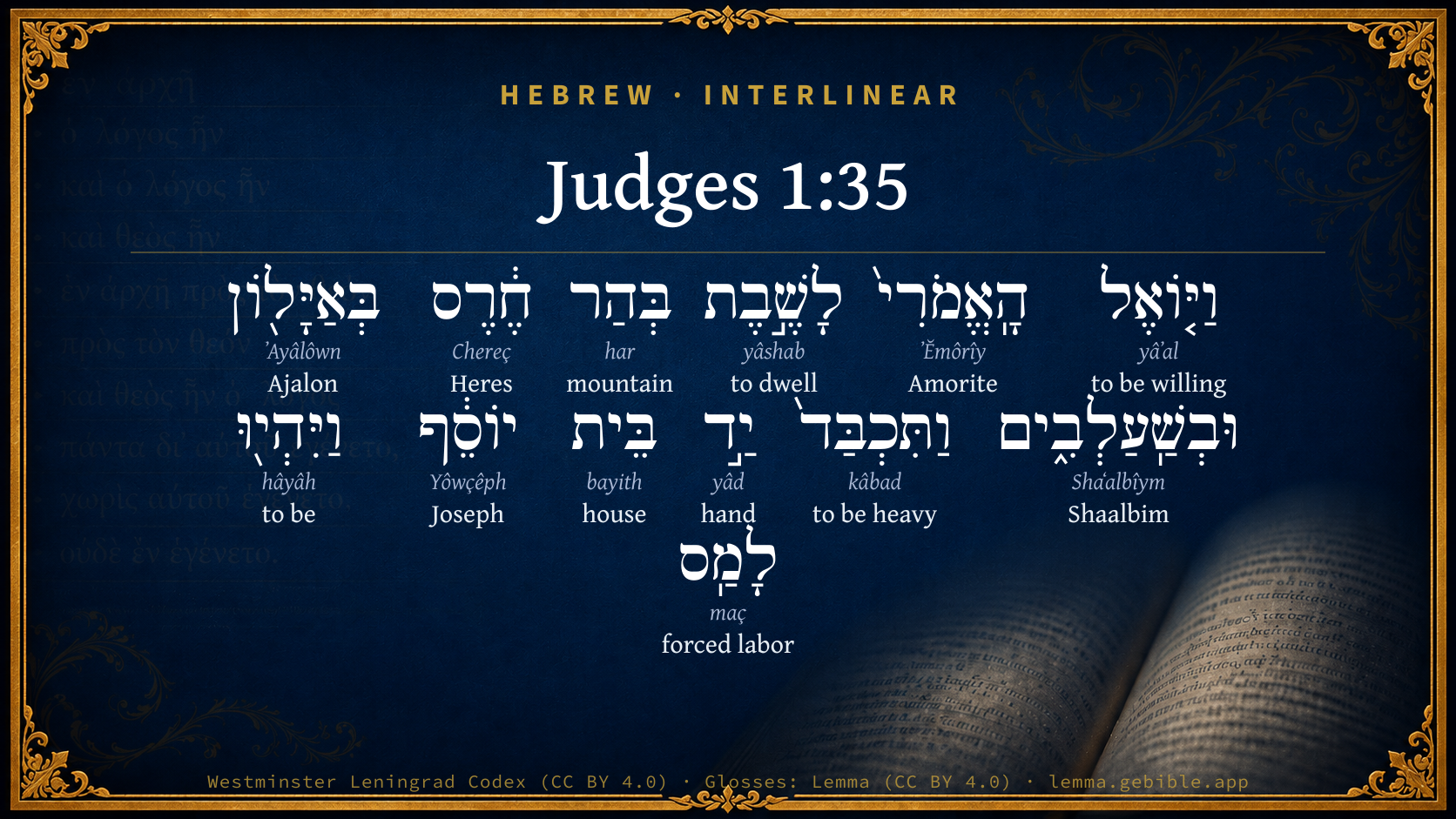
Judges 1:35

Hebrew (Westminster Leningrad Codex) Judges 1:35 appears in the Hebrew Old Testament. The text above is from the Westminster Leningrad Codex. Each word links to its Strong’s number, a concise gloss, and parsing drawn from the Open Scriptures Hebrew Bible morphology. Click any word for its full Brown-Driver-Briggs (BDB) entry.
Download image
Cite this verse

Judges 1:35 (World English Bible). Public Domain. Lemma interlinear Bible study tool, https://lemma.gebible.app/v/judges/1/35.

Show BibTeX & RIS
BibTeX
RIS
English Translation
but the Amorites would dwell in Mount Heres, in Aijalon, and in Shaalbim: yet the hand of the house of Joseph prevailed, so that they became subject to forced labor.
World English Bible · Public Domain
Highlights
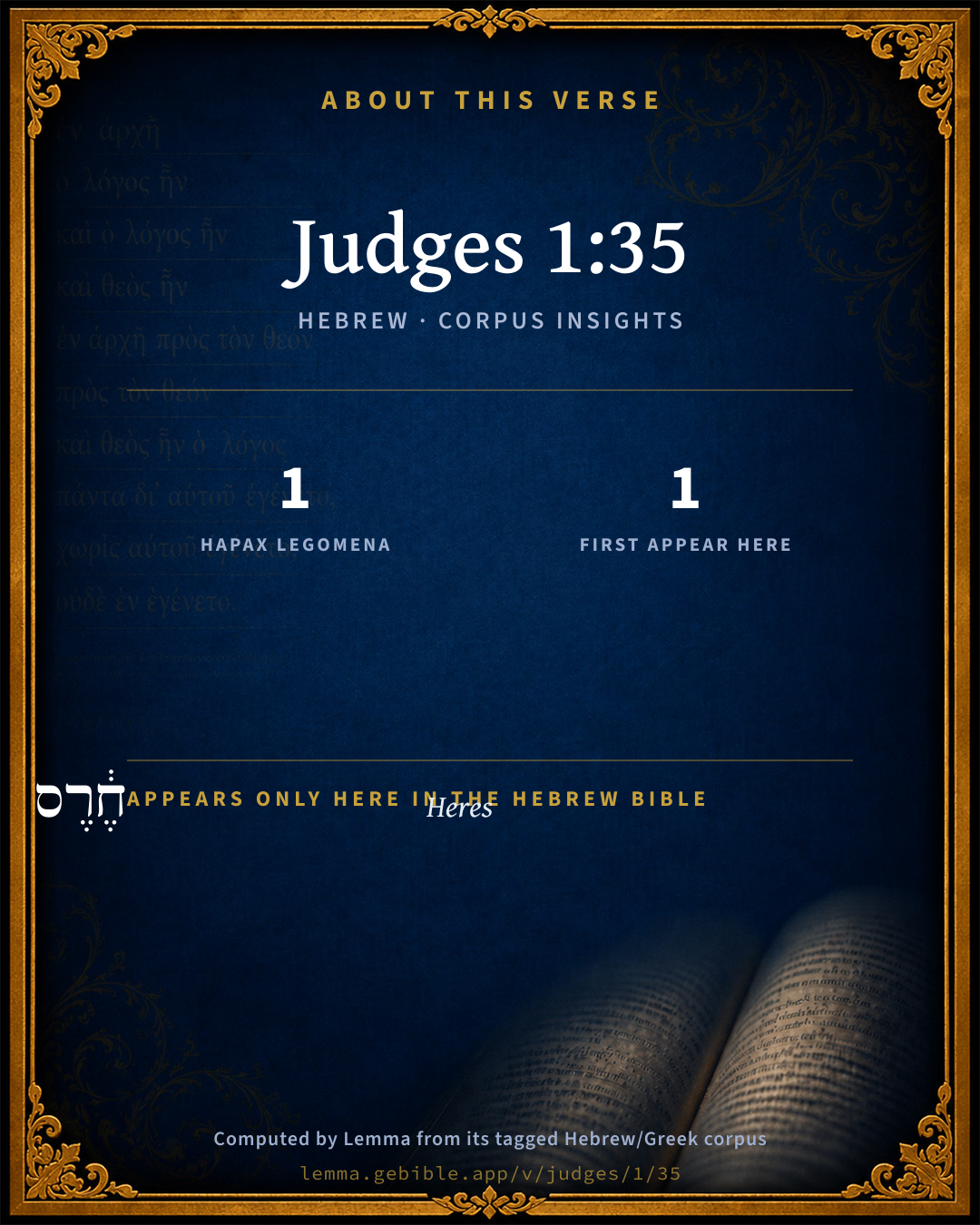
  • 1 hapax legomenon — only here in the Hebrew Bible
  • 1 first appearance in the Hebrew Bible
Full analysis ↓
Download a study sheet

One document with this verse’s original text, its word-by-word gloss line, the meaning frame, cross-references with their text, attributed commentary, and full source and license credits — printable, and it pastes into notes with its structure intact.

This verse Autodidact and up

Study sheet (.html) Plain text (.txt)

A passage Seminary Student

Up to 50 verses in one chapter. A passage sheet keeps up to 6 commentary sources and 12 cross-references per verse, in the order this page ranks them, and says so on the sheet whenever that leaves anything out. Ask for a single verse and you get the Autodidact verse sheet above.

Everything on this page stays free to read, with no account — the sheet is a download of what is already on screen, not access to it.

Want to remove ads? Support Godless Engineer
Compare translations 3

The same verse in 3 English versions, stacked beneath the original-language interlinear above. Click any original word for its lexicon entry.

Each is an independent rendering of the whole verse — the interlinear is not word-aligned to these translations.

Highlighted words mark where these versions differ — a whole-verse word diff, not a word-by-word alignment.

  • World English Bible Public Domain
    but the Amorites would dwell in Mount Heres, in Aijalon, and in Shaalbim: yet the hand of the house of Joseph prevailed, so that they became subject to forced labor.
  • King James Version Public Domain
    But the Amorites would dwell in mount Heres in Aijalon, and in Shaalbim: yet the hand of the house of Joseph prevailed, so that they became tributaries.
  • unfoldingWord Literal Text CC BY-SA 4.0
    And the Amorite resolved to dwell at Mount Heres, in Aijalon, and in Shaalbim, but the hand of the house of Joseph became heavy and they became forced labor.

unfoldingWord Literal Text — © unfoldingWord, licensed CC BY-SA 4.0. Word-aligned USFM3 via Door43 (git.door43.org/unfoldingWord/en_ult).

Versions to compare (up to 4)

3 of 4 selected

Show all 18 translations

Every available English version of this verse, each an independent rendering of the whole verse.

  • World English Bible Public Domain
    but the Amorites would dwell in Mount Heres, in Aijalon, and in Shaalbim: yet the hand of the house of Joseph prevailed, so that they became subject to forced labor.
  • Berean Standard Bible Public Domain
    And the Amorites were determined to dwell in Mount Heres, Aijalon, and Shaalbim. But when the house of Joseph grew in strength, they pressed the Amorites into forced labor.
  • Majority Standard Bible Public Domain
    And the Amorites were determined to dwell in Mount Heres, Aijalon, and Shaalbim. But when the house of Joseph grew in strength, they pressed the Amorites into forced labor.
  • King James Version Public Domain
    But the Amorites would dwell in mount Heres in Aijalon, and in Shaalbim: yet the hand of the house of Joseph prevailed, so that they became tributaries.
  • American Standard Version (1901) Public Domain
    but the Amorites would dwell in mount Heres, in Aijalon, and in Shaalbim: yet the hand of the house of Joseph prevailed, so that they became subject to taskwork.
  • Revised Version (1885) Public Domain
    but the Amorites would dwell in mount Heres, in Aijalon, and in Shaalbim: yet the hand of the house of Joseph prevailed, so that they became tributary.
  • Geneva Bible (1599) Public Domain
    And the Ammonites dwelt still in mount Heres in Aijalon, and in Shaalbim, and when the hand of Iosephs familie preuailed, they became tributaries:
  • Douay-Rheims (1899) Public Domain
    And he dwelt in the mountain Hares, that is, of potsherds, in Aialon and Salebim. And the hand of the house of Joseph was heavy upon him, and he became tributary to him.
  • Young's Literal Translation Public Domain
    and the Amorite is desirous to dwell in mount Heres, in Aijalon, and in Shaalbim, and the hand of the house of Joseph is heavy, and they become tributary;
  • Literal Standard Version CC BY-SA 4.0
    and the Amorite is desirous to dwell in Mount Heres, in Aijalon, and in Shaalbim, and the hand of the house of Joseph is heavy, and they are for forced labor;
  • Unlocked Literal Bible CC BY-SA 4.0
    So the Amorites lived at Mount Heres, in Aijalon, and in Shaalbim, but the military might of the house of Joseph conquered them, and they were forced to serve them with hard labor.
  • unfoldingWord Literal Text CC BY-SA 4.0
    And the Amorite resolved to dwell at Mount Heres, in Aijalon, and in Shaalbim, but the hand of the house of Joseph became heavy and they became forced labor.
  • Darby Bible Public Domain
    the Amorites persisted in dwelling in Har-heres, in Ai'jalon, and in Sha-al'bim, but the hand of the house of Joseph rested heavily upon them, and they became subject to forced labor.
  • World Messianic Bible Public Domain
    but the Amorites would dwell in Mount Heres, in Aijalon, and in Shaalbim. Yet the hand of the house of Joseph prevailed, so that they became subject to forced labor.
  • Webster's Bible Public Domain
    But the Amorites would dwell in mount Heres in Ajalon, and in Shaalbim: yet the hand of the house of Joseph prevailed, so that they became tributaries.
  • Free Bible Version CC BY-SA 4.0
    The Amorites insisted on remaining in Mount Heres, Aijalon, and Shaalbim, but when the tribes of Joseph grew stronger, the Amorites were made to do forced labor.
  • Bible in Basic English Public Domain
    For the Amorites would go on living in Mount Heres, in Aijalon, and in Shaalbim; but the children of Joseph became stronger than they, and put them to forced work.
  • JPS Tanakh (1917) Public Domain
    But the Amorites were resolved to dwell in Harheres, in Aijalon, and in Shaalbim; yet the hand of the house of Joseph prevailed, so that they became tributary.

Literal Standard Version (2020), Covenant Press — licensed CC BY-SA 4.0. Text via the HelloAO Bible API (eBible.org). Unlocked Literal Bible (unfoldingWord) — licensed CC BY-SA 4.0. Text via the HelloAO Bible API (eBible.org). unfoldingWord Literal Text — © unfoldingWord, licensed CC BY-SA 4.0. Word-aligned USFM3 via Door43 (git.door43.org/unfoldingWord/en_ult). Free Bible Version, Dr. Jonathan Gallagher — licensed CC BY-SA 4.0. Text via the HelloAO Bible API (eBible.org).

Word by word

More ways to search: Search by grammar → Find every occurrence → Compare this word →

Practice this passage: Drill this verse → Learn its vocabulary →

חֶ֔רֶס
Chereç
H2776
“Heres”
Noun, Proper
Part of Speech
Noun
Type
Proper
Full BDB Definition

Origin: the same as H2775

TWOT: None

Heres = "the sun" - a mountain inhabited by Amorites in Moab; the place where Gideon turned back from chasing the Midianites
  1. וַיּ֤וֹאֶל yâʼal H2974 “and · to be willing” Conjunction + Verb, Hiphil, Sequential Imperfect, 3rd Person, Masculine, Singular
  2. הָֽאֱמֹרִי֙ ʼĔmôrîy H567 “the · Amorite” Particle, Definite Article + Noun, Gentilic, Masculine, Singular, Absolute
  3. לָשֶׁ֣בֶת yâshab H3427 “to dwell” Preposition + Verb, Qal, Infinitive Construct
  4. בְּהַר har H2022 “in/at · mountain of” Preposition + Noun, Common, Masculine, Singular, Construct
  5. בְּאַיָּל֖וֹן ʼAyâlôwn H357 “in/at · Ajalon” Preposition + Noun, Proper
  6. וּבְשַֽׁעַלְבִ֑ים Shaʻalbîym H8169 “and · in/at · Shaalbim” Conjunction + Preposition + Noun, Proper
  7. וַתִּכְבַּד֙ kâbad H3513 “and · to be heavy” Conjunction + Verb, Qal, Sequential Imperfect, 3rd Person, Feminine, Singular
  8. יַ֣ד yâd H3027 “hand of” Noun, Common, Both, Singular, Construct
  9. בֵּית bayith H1004 “house of” Noun, Common, Masculine, Singular, Construct
  10. יוֹסֵ֔ף Yôwçêph H3130 “Joseph” Noun, Proper
  11. וַיִּהְי֖וּ hâyâh H1961 “and · to be” Conjunction + Verb, Qal, Sequential Imperfect, 3rd Person, Masculine, Plural
  12. לָמַֽס maç H4522 “to/for · forced labor” Preposition + Noun, Common, Masculine, Singular, Absolute

About this verse

These counts appear in no published source. They are computed here, from the morphology-tagged text and Lemma’s own curated glosses. What Lemma adds →

13
words
13
distinct lemmas
Historical
section

Notable vocabulary

1 hapax legomenon — a word that appears only here in the entire Hebrew Bible:

  • חֶ֔רֶס Heres H2776

First appearance in Scripture

This word makes its first canonical appearance in the Hebrew Bible here:

  • חֶ֔רֶס Heres H2776

Shared distinctive vocabulary

וּבְשַֽׁעַלְבִ֑ים Shaalbim H8169 occurs in 3 verses of the Hebrew Bible. Also found in:

Grammatical profile

  • 4 verbs
  • 9 nouns

Verb forms

  • וַיּ֤וֹאֶל Hiphil · Sequential Imperfect
  • לָשֶׁ֣בֶת Qal · Infinitive Construct
  • וַתִּכְבַּד֙ Qal · Sequential Imperfect
  • וַיִּהְי֖וּ Qal · Sequential Imperfect

Hebrew & Septuagint length

In English translation the verse runs 30 words from the Hebrew and 41 from the Septuagint (LXX English) — closely comparable.

A rough comparison of the two English renderings, which tokenize alike — not a word-level alignment.

Word counts can differ between the Hebrew and the Greek without any difference in meaning — e.g. the Hebrew direct-object marker אֵת has no separate Greek word, and Greek often adds the article ὁ.

Cross-references

4

Topical passages linked to Judges 1:35 in the Treasury of Scripture Knowledge — connected by theme and wording, ordered by reader-vote popularity; previews shown in the World English Bible.

  • Joshua 10:12 Then spoke Joshua to Yahweh in the day when Yahweh delivered up the Amorites before the children of Israel; and he said in the sight of Israel, Sun, stand you still on Gibeon; You, Moon, in the valley of Aijalon.
  • Joshua 19:42 and Shaalabbin, and Aijalon, and Ithlah,
  • Judges 12:12 Elon the Zebulunite died, and was buried in Aijalon in the land of Zebulun.
  • 1 Kings 4:9 Ben Deker, in Makaz, and in Shaalbim, and Beth-shemesh, and Elon Beth Hanan;

Cross-references courtesy of OpenBible.info (CC BY 4.0).

Hebrew and Greek witnesses Masoretic Hebrew ↔ Greek Septuagint

The same verse in the two great witnesses to the Old Testament, shown verse-for-verse.

These are two independent witnesses, not word-aligned to each other, and the Septuagint is shown in lemma (dictionary) form.

Hebrew Judges 1:35 Masoretic · Westminster Leningrad Codex

וַיּ֤וֹאֶל הָֽאֱמֹרִי֙ לָשֶׁ֣בֶת בְּהַר חֶ֔רֶס בְּאַיָּל֖וֹן וּבְשַֽׁעַלְבִ֑ים וַתִּכְבַּד֙ יַ֣ד בֵּית יוֹסֵ֔ף וַיִּהְי֖וּ לָמַֽס

but the Amorites would dwell in Mount Heres, in Aijalon, and in Shaalbim: yet the hand of the house of Joseph prevailed, so that they became subject to forced labor.

World English Bible · Public Domain

Greek LXX Judges 1:35 Septuagint · lemma form

καί ἄρχω ὁ ἀμορραῖος καταοἰκέω ἐν ὁ ὄρος ὁ ὀστρακώδης ἐν ὅς ὁ ἄρκος καί ἐν ὅς ὁ ἀλώπηξ ἐν ὁ μυρσινών καί ἐν θαλαβιν καί βαρύνω χείρ οἶκος ιωσηφ ἐπί ὁ ἀμορραῖος καί γίγνομαι αὐτός εἰς φόρος

And the Amorite began to dwell in the mountain of shells, in which are bears, and foxes, in Myrsinon, and in Thalabin; and the hand of the house of Joseph was heavy upon the Amorite, and he became tributary to them.

LXX2012 (modern English Septuagint) · Public Domain

On this verse, Adam Clarke's Commentary discusses the Septuagint’s reading. Read the note in Commentary ↓

Hebrew: Westminster Leningrad Codex (CC BY 4.0). Greek: Septuagint (public domain); English from LXX2012 (modern English Septuagint) (Public Domain). How the Septuagint differs from the Hebrew →

Targum (Aramaic paraphrase)

1

The Targum is the ancient Jewish Aramaic paraphrase of the Hebrew Scriptures — an interpretive translation, not the Hebrew text itself. Onkelos (literal) and Pseudo-Jonathan (expansive) render the Torah, and Jonathan the Prophets. Coverage is partial: where no permissively-licensed English translation exists for a verse, only the Aramaic is shown. This is verse-level text, not a word-by-word alignment to the Hebrew.

  1. Targum Jonathan Prophets (Joshua–Malachi)
    וּשְׁרִי אֱמוֹרָאָה לְמִתַּב בְּטוּר חֶרֶס בְּאַיָלוֹן וּבְשַׁעַלְבִים וּתְקֵיפַת יַד בֵּית יוֹסֵף וַהֲווֹ לְמַסְקֵי מִסִין:

    (no public-domain English translation for this verse)

    Targum Jonathan — Aramaic: “Mikraot Gedolot” (public domain). English: “Sefaria Community Translation” (CC0 1.0 (public-domain dedication)); “London "Chaldee Paraphrase," 1871” (public domain). Text via Sefaria.

Commentary

Notes on Judges 1:35 from classic Christian and Jewish commentators (each source and its license shown beneath its notes). The classic Christian expositions comment on the surrounding passage and are grouped to its opening verse, so a note may address several verses; the Jewish commentaries on the Tanakh (Rashi and others) are per-verse, so they appear only where the commentator wrote on this verse.

Lemma curates 59 commentaries, every one of them public domain or Creative Commons licensed, each selected and text-cleaned for this edition rather than reprinted as found. About our sources →

Geneva Bible (1599)

Geneva Bible translators

Or, would dwell.

Meaning, when he was stronger than they.

Geneva Bible (1599) marginal notes — public domain. Text via Bolls.life.

Adam Clarke's Commentary

Verse 35. The Amorites would dwell in Mount Heres] They perhaps agreed to dwell in the mountainous country, being unable to maintain themselves on the plain, and yet were so powerful that the Danites could not totally expel them; they were, however, laid under tribute, and thus the house of Joseph had the sovereignty. The Septuagint have sought out a literal meaning for the names of several of these places, and they render the verse thus: "And the Amorites began to dwell in the mount of Tiles, in which there are bears, and in which there are foxes." Thus they translate Heres, Aijalon, and Shaalbim.

Adam Clarke's Commentary on the Bible (1810–1826) — public domain. Text from a community e-Sword/MySword module.

Ellicott's Commentary for English Readers

(35) Mount Heres.—(See Jdg_1:33.) Cheres is used for the sun in Job_9:7. The Vatican Codex of the LXX. has the strange rendering, “in the mountains of potsherds” (comp. the Monte Testacclo at Rome), and Jerome follows them in reading תֶךֶש for תֶךֶס. The Alexandrian Codex renders it, “the mountain of the myrtle-grove,” reading Haras.

Aijalon.—The name means “gazelles,” and is still preserved in the name Yalo, a village on the south side of the beautiful valley, Merj Ibn Omeir. It is mentioned in the story of the battle of Beth-horon (Jos_10:12), and as a scene of the defeat of the Philistines by Saul (1Sa_14:31). It was a Levitical town (Jos_21:24).

Shaalbim.—The name means “jackals” (comp. Jdg_15:4; and Hazar-shual, Jos_15:28; and Shalim, 1Sa_9:4). The LXX. render this and Aijalon by “where the bears and foxes are.” Not far off is Zeboim, i.e. “Hyænas.”

Yet the hand of the house of Joseph prevailed.—This may imply that when Dan was unable to dislodge the Amorites they were effectually aided by the tribes of Ephraim and Manasseh. Hence the LXX. render it, “The hand of the house of Joseph was heavy on the Amorites.” (Comp. 1Sa_5:6; Psa_32:6.)

Tributaries.—Not to Dan, but to their conquerors, the Ephraimites; so that the assistance rendered by the house of Joseph to their weak brother was, at the best, somewhat selfish, although it enabled Dan to hold the sea-coast (Jdg_1:17).

A Bible Commentary for English Readers, edited by Charles John Ellicott (1878–1897) — public domain. Text from a community e-Sword module.

The Cambridge Bible for Schools and Colleges

gen. ed. J. J. S. Perowne

35. would dwell] See Jdg_1:27 note.

mount Heres] i.e. ‘mount of the sun,’ probably the same as Ir-shemesh, i.e. ‘city of the sun’ Jos_19:41, and Beth-shemesh, i.e. ‘temple of the sun’ 1Ki_4:9, both names occurring along with Ayyalon and Shaalbim in these passages. The site may be identified with the mod. ‘Ain-shems, in the W. eṣ-Ṣarâr, opposite Ṣar‘a (Zorah).

Aijalon] Jos_10:12; Jos_19:42 (in Dan), the mod. Yâlô, on the S. side of the broad ‘valley of Ayyalon,’ now called Merj (‘meadow of’) ibn ‘Umar, 14 m. W. of Jerusalem. According to the Chronicler the town was occupied by Benjamin 1Ch_8:13, fortified by Rehoboam 2Ch_11:10, and taken from Ahaz by the Philistines ib. 2Ch_28:18. The Amarna tablets mention it as Aialuna (nos. 173 and 180 ‘fields of A.’), and Shishak (1Ki_14:25) enumerates it among the conquered cities of Judah, Aiyurun = Ayyalon (Müller, As. u. Eur., p. 166).

Shaalbim] Cf. Jos_19:42, 1Ki_4:9. The situation of the mod. Selbît ̣ is suitable, but the names are dissimilar.

prevailed] lit. ‘was heavy,’ as 1Sa_5:6; 1Sa_5:11. The house of Joseph, i.e. the Northern Kingdom, whose boundaries reached these towns, reduced them to forced labour. They became Israelite possessions, however, before the division of the kingdoms, 1Ki_4:9; 1Sa_6:12 ff. (Beth-shemesh).

The Cambridge Bible for Schools and Colleges (gen. ed. J. J. S. Perowne; Cambridge University Press, 1878–1918) — public domain. Text from a community e-Sword module.

John Gill's Exposition

But the Amorites would dwell in Mount Heres in Aijalon, and in Shaalbim,.... And they would not suffer the Danites to dwell in the valley, a fruitful and delightful part of their country, terrifying them with their iron chariots, which in the vale they could make use of to great advantage; so neither would they let them dwell alone in the mountainous part of their tribe, but would dwell with them, particularly in three places mentioned: where Mount Heres was is not certain; it signifies the "sun"; very probably it had its name from the worship of the sun on it, or from the sun standing still near it; for Aijalon, where that miracle was wrought, is next mentioned. Perhaps it might be near to Timnathheres, which was in Mount Ephraim, Jdg 2:9; since Ephraim assisted in making these places tributaries; of the two cities, Aijalon and Shaalbim, see Jos 19:42,

yet the hand of the house of Joseph prevailed, so that they became tributaries; or "the hand of it became heavy" (x); by which it does not clearly appear whether the hand of Joseph was made heavy, and to hang down, by the Amorites; or whether it was heavy upon them, and so prevailed over them, as our version; but the Septuagint puts it out of doubt, reading the words,"and the hand of the house of Joseph was heavy upon the Amorites;''the Ephraimites being near to the tribe of Dan, and observing how they were pressed by the Amorites, took up arms in their favour, and obliged the Canaanites of the above places to become tributaries to the Danites.

(x) "et aggravata est manus", V. L. Paginus Montanus.

John Gill's Exposition of the Whole Bible (1746–1763) — public domain (CC PDM 1.0). Text via the HelloAO Bible API.

Haydock's Catholic Bible Commentary

He dwelt. That is, the Amorrhite. (Challoner) --- Hebrew, "But the Amorrhites would dwell in Mount Hares, in Aialon, and in Salebim." Some copies of the Septuagint seem to give the meaning of these proper names, though inaccurately. (Haydock) --- Solomon had one of his twelve officers at Salebim, in the tribe of Dan, 3 Kings iv. 9.

George Leo Haydock (1774–1849), Haydock's Catholic Family Bible and Commentary, 1859 edition — public domain. Excludes Psalms (Douay-Rheims chapter numbering differs from Protestant) and Deuterocanonical books (Catholic canon only).

Matthew Poole's English Annotations

Of the house of Joseph, i.e. of the Ephraimites, who helped their brethren the Danites against the Amorites, and that with good success.

Matthew Poole's English Annotations on the Holy Bible (1683–1685) — public domain. Text from a community e-Sword/MySword module.

Whedon's Commentary on the Bible

Daniel D. Whedon

35. Mount Heres (sun mountain) is supposed to be another name for Ir-shemesh, (the sun town,) identified in Ain Shems. Perhaps it was some eminence or range of hills in the vicinity of Ain Shems. See Jos_15:10.

Aijalon — See on Jos_10:12.

Shaalbim — No trace of any name resembling this is found in the vicinity of Yale or Ain Shems.

House of Joseph — See note on Jdg_1:22.

Daniel D. Whedon (gen. ed.), Commentary on the Old and New Testaments (1874–1909) — public domain. Text from a community e-Sword module.

John Wesley's Explanatory Notes

House of Joseph - That is, of the Ephraimites, who helped their brethren the Danites against the Amorites.

John Wesley, Explanatory Notes Upon the Whole Bible (1754–1765) — public domain. Text via the GEBible commentary corpus.

Lesson kit

Teaching starters — assembled from the data on this page, not authored interpretation. Every prompt links to the verse data it draws on. Edit before teaching.

Judges, in the Historical, opens this verse with 13 words (13 distinct Hebrew lemmas). Its most distinctive word is Chereç (“Heres”). A historical commentator’s framing appears above. Read the whole chapter for the surrounding context.

Discussion questions

  1. What does “Heres” (Chereç) contribute to the verse as a whole?
  2. 1 word here appears nowhere else in the Hebrew Bible. Why might the author reach for such rare wording?
  3. This is the first place “Heres” appears in Scripture (first appears here). What does its debut here establish?
  4. How does Joshua 19:42, which shares the word «Shaalbim», read alongside this verse?
  5. The translations on this page render this verse differently — a whole-verse word diff, not a word-by-word alignment. What might account for the different wordings?
  6. «וַיּ֤וֹאֶל» is a Hiphil Sequential Imperfect verb. How does that grammatical form shape the action described?
  7. Compare how Geneva Bible (1599) and Adam Clarke's Commentary read this verse. Where do they agree or differ?

Things to notice

  • 1 word in this verse appears nowhere else in the Hebrew Bible.
  • 1 word makes its first canonical appearance in Scripture here.
  • These translations choose different wording for 10 words in this verse.
  • 13 distinct Hebrew lemmas span 13 words in this verse.

Reading settings

Reading text

Shown beneath each verse's original-language words.

Old Testament
Old Testament edition

Read the OT as the Masoretic Hebrew (MT) or the Greek Septuagint (LXX).

English shown for the Greek Septuagint (in the Hebrew ↔ Greek comparison).

Comparing translations? Open the Compare panel on any verse page to stack up to four side by side.