
Philemon 1:2

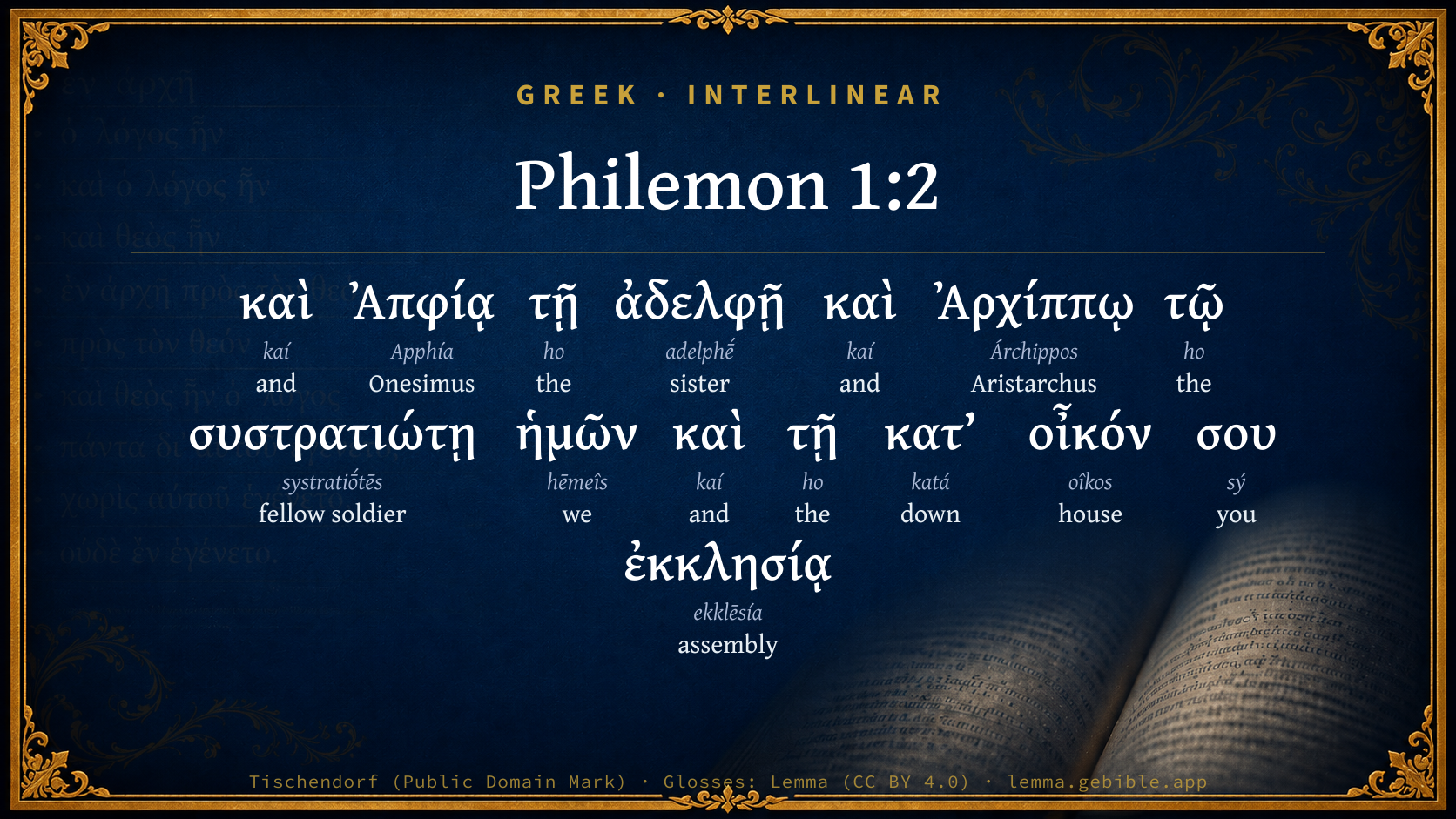
Greek (Tischendorf 8th ed.) Philemon 1:2 appears in the Greek New Testament. The text above is from the Tischendorf 8th edition. Each word links to its Strong’s number and a concise gloss. Click any word for its full Thayer’s Greek Lexicon entry.
Download image
Cite this verse

Philemon 1:2 (World English Bible). Public Domain. Lemma interlinear Bible study tool, https://lemma.gebible.app/v/philemon/1/2.

Show BibTeX & RIS
BibTeX
RIS
English Translation
to the beloved Apphia, to Archippus, our fellow soldier, and to the assembly in your house:
World English Bible · Public Domain
Highlights
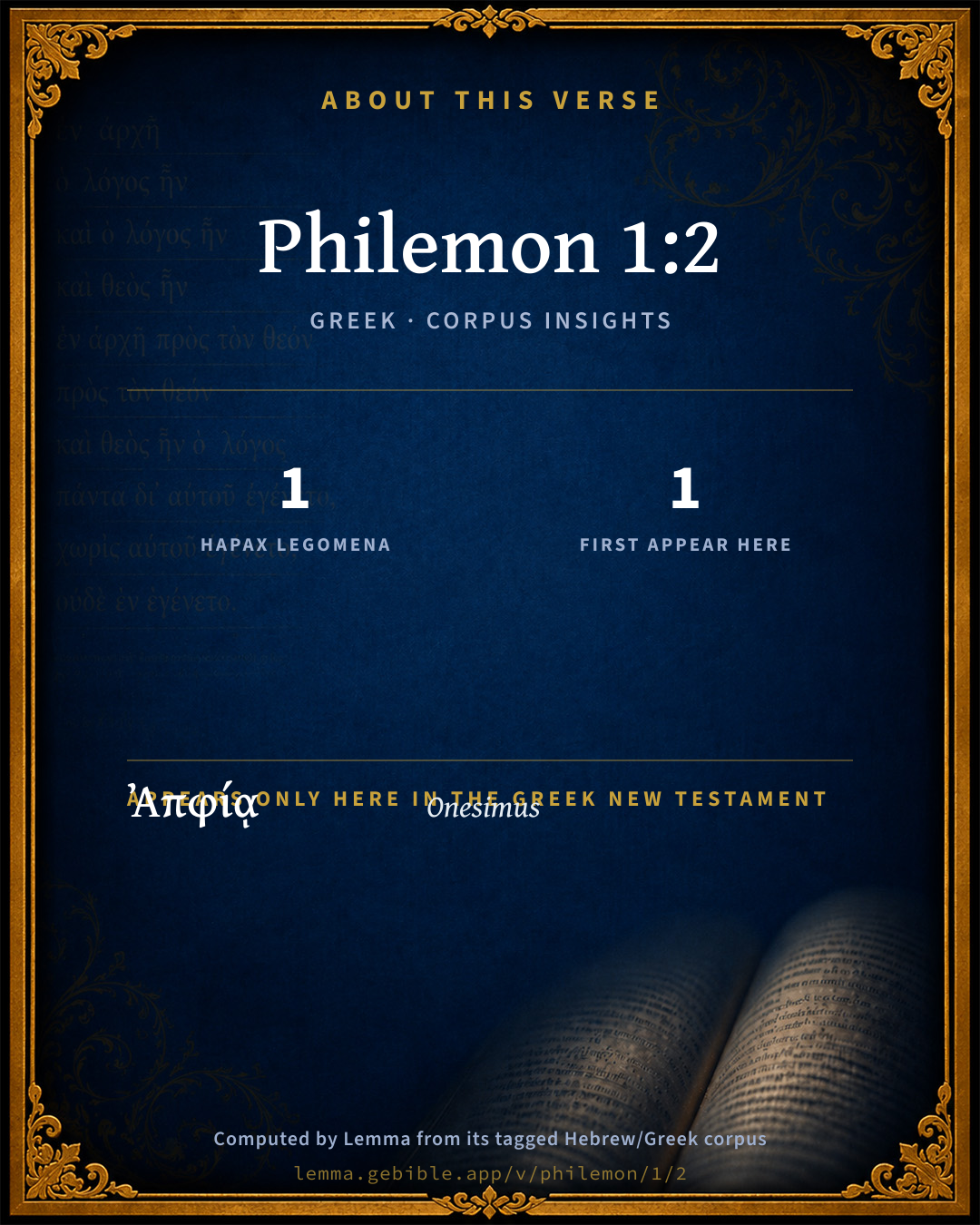
  • 1 hapax legomenon — only here in the Greek New Testament
  • 1 first appearance in the Greek New Testament
Full analysis ↓
Download a study sheet

One document with this verse’s original text, its word-by-word gloss line, the meaning frame, cross-references with their text, attributed commentary, and full source and license credits — printable, and it pastes into notes with its structure intact.

This verse Autodidact and up

Study sheet (.html) Plain text (.txt)

A passage Seminary Student

Up to 50 verses in one chapter. A passage sheet keeps up to 6 commentary sources and 12 cross-references per verse, in the order this page ranks them, and says so on the sheet whenever that leaves anything out. Ask for a single verse and you get the Autodidact verse sheet above.

Everything on this page stays free to read, with no account — the sheet is a download of what is already on screen, not access to it.

Want to remove ads? Support Godless Engineer
Compare translations 3

The same verse in 3 English versions, stacked beneath the original-language interlinear above. Click any original word for its lexicon entry.

Each is an independent rendering of the whole verse — the interlinear is not word-aligned to these translations.

Highlighted words mark where these versions differ — a whole-verse word diff, not a word-by-word alignment.

  • World English Bible Public Domain
    to the beloved Apphia, to Archippus, our fellow soldier, and to the assembly in your house:
  • King James Version Public Domain
    And to our beloved Apphia, and Archippus our fellowsoldier, and to the church in thy house:
  • unfoldingWord Literal Text CC BY-SA 4.0
    and to Apphia our sister, and to Archippus our fellow soldier, and to the church in your house.

unfoldingWord Literal Text — © unfoldingWord, licensed CC BY-SA 4.0. Word-aligned USFM3 via Door43 (git.door43.org/unfoldingWord/en_ult).

Versions to compare (up to 4)

3 of 4 selected

Show all 19 translations

Every available English version of this verse, each an independent rendering of the whole verse.

  • World English Bible Public Domain
    to the beloved Apphia, to Archippus, our fellow soldier, and to the assembly in your house:
  • Berean Standard Bible Public Domain
    to Apphia our sister, to Archippus our fellow soldier, and to the church that meets at your house:
  • Majority Standard Bible Public Domain
    to Apphia our beloved, to Archippus our fellow soldier, and to the church that meets at your house:
  • King James Version Public Domain
    And to our beloved Apphia, and Archippus our fellowsoldier, and to the church in thy house:
  • American Standard Version (1901) Public Domain
    and to Apphia our sister, and to Archippus our fellow-soldier, and to the church in thy house:
  • Revised Version (1885) Public Domain
    and to Apphia our sister, and to Archippus our fellow-soldier, and to the church in thy house:
  • Geneva Bible (1599) Public Domain
    And to our deare sister Apphia, and to Archippus our fellowe souldier, and to the Church that is in thine house:
  • Douay-Rheims (1899) Public Domain
    And to Appia, our dearest sister, and to Archippus, our fellow soldier, and to the church which is in thy house:
  • Young's Literal Translation Public Domain
    and Apphia the beloved, and Archippus our fellow-soldier, and the assembly in thy house:
  • Literal Standard Version CC BY-SA 4.0
    and Apphia the beloved, and Archippus our fellow-soldier, and the assembly in your house:
  • Unlocked Literal Bible CC BY-SA 4.0
    and to Apphia our sister, and to Archippus our fellow soldier, and to the church that meets in your home.
  • unfoldingWord Literal Text CC BY-SA 4.0
    and to Apphia our sister, and to Archippus our fellow soldier, and to the church in your house.
  • Darby Bible Public Domain
    and to the sister Apphia and to Archippus our fellow-soldier, and to the assembly which [is] in thine house.
  • World Messianic Bible Public Domain
    to the beloved Apphia, to Archippus our fellow soldier, and to the assembly in your house:
  • Webster's Bible Public Domain
    And to our beloved Apphia, and Archippus our fellow-soldier, and to the church in thy house:
  • Free Bible Version CC BY-SA 4.0
    to our sister Apphia, to Archippus who fights alongside us, and to your house church.
  • Bible in Basic English Public Domain
    And to Apphia, our sister, and to Archippus, our brother in God's army, and to the church in your house:
  • Text-Critical English NT CC BY 4.0
    and also to the beloved Apphia, to Archippus our fellow soldier, and to the church that meets in yoʋr house:
  • Tyndale New Testament (1534) Public Domain
    and to the beloved Appia and to Archippus oure felowe soudier and to the congregacion of thy housse.

Literal Standard Version (2020), Covenant Press — licensed CC BY-SA 4.0. Text via the HelloAO Bible API (eBible.org). Unlocked Literal Bible (unfoldingWord) — licensed CC BY-SA 4.0. Text via the HelloAO Bible API (eBible.org). unfoldingWord Literal Text — © unfoldingWord, licensed CC BY-SA 4.0. Word-aligned USFM3 via Door43 (git.door43.org/unfoldingWord/en_ult). Free Bible Version, Dr. Jonathan Gallagher — licensed CC BY-SA 4.0. Text via the HelloAO Bible API (eBible.org).

Word by word

More ways to search: Search by grammar → Find every occurrence → Compare this word →

Practice this passage: Drill this verse → Learn its vocabulary →

Ἀπφίᾳ
Apphía
G682
“Onesimus”
Noun, Dative, Singular, Feminine
Part of Speech
Noun
Case
Dative
Number
Singular
Gender
Feminine
Full Thayer's Definition

Origin: probably of foreign origin

TDNT: None

Apphia = "fruitful" 1. a Christian member of Philemon's household
  1. καὶ kaí G2532 “and” Conjunction
  2. τῇ ho G3588 “the” Article, Dative, Singular, Feminine
  3. ἀδελφῇ adelphḗ G79 “sister” Noun, Dative, Singular, Feminine
  4. καὶ kaí G2532 “and” Conjunction
  5. Ἀρχίππῳ Árchippos G751 “Aristarchus” Noun, Dative, Singular, Masculine
  6. τῷ ho G3588 “the” Article, Dative, Singular, Masculine
  7. συστρατιώτῃ systratiṓtēs G4961 “fellow soldier” Noun, Dative, Singular, Masculine
  8. ἡμῶν hēmeîs G2249 “we” Personal pronoun, 1st person, Genitive, Plural
  9. καὶ kaí G2532 “and” Conjunction
  10. τῇ ho G3588 “the” Article, Dative, Singular, Feminine
  11. κατ’ katá G2596 “down” Preposition
  12. οἶκόν oîkos G3624 “house” Noun, Accusative, Singular, Masculine
  13. σου sý G4771 “you” Personal pronoun, 2nd person, Genitive, Singular
  14. ἐκκλησίᾳ ekklēsía G1577 “assembly” Noun, Dative, Singular, Feminine

About this verse

These counts appear in no published source. They are computed here, from the morphology-tagged text and Lemma’s own curated glosses. What Lemma adds →

15
words
11
distinct lemmas
Pauline Epistles
section

Notable vocabulary

1 hapax legomenon — a word that appears only here in the entire Greek New Testament:

  • Ἀπφίᾳ Onesimus G682

First appearance in Scripture

This word makes its first canonical appearance in the Greek New Testament here:

  • Ἀπφίᾳ Onesimus G682

Shared distinctive vocabulary

Ἀρχίππῳ Aristarchus G751 occurs in 2 verses of the Greek New Testament. Also found in:
Repetition

Words recur within this verse:

Cross-references

6

Topical passages linked to Philemon 1:2 in the Treasury of Scripture Knowledge — connected by theme and wording, ordered by reader-vote popularity; previews shown in the World English Bible.

  • Philippians 2:25 But I counted it necessary to send to you Epaphroditus, my brother, fellow worker, fellow soldier, and your apostle and minister to my need;
  • Romans 16:5 Greet the assembly that is in their house. Greet Epaenetus, my beloved, who is the first fruits of Achaia to Christ.
  • Colossians 4:17 Tell Archippus, "Take heed to the ministry which you have received in the Lord, that you fulfill it."
  • Colossians 4:15 Greet the brothers who are in Laodicea, and Nymphas, and the assembly that is in his house.
  • 1 Corinthians 16:19 The assemblies of Asia greet you. Aquila and Priscilla greet you much in the Lord, together with the assembly that is in their house.
  • 2 Timothy 2:3–4 You therefore must endure hardship, as a good soldier of Christ Jesus.

Cross-references courtesy of OpenBible.info (CC BY 4.0).

Where the printed editions differ

1 variant

Places in this verse where the major printed Greek editions disagree on the wording in a way that affects the translation — a comparison of editions, not a manuscript-by-manuscript collation. The editions are the modern critical texts (Nestlé-Aland 28/27, SBL, Westcott-Hort, Tregelles, Tyndale House) and the traditional texts behind the KJV (the Textus Receptus and the Byzantine/Majority text). It is not a claim about which reading is original.

  1. Different wording
    ἀδελφῇ

    “our sister”

    In NA28NA27TynSBLWHTreg Not in TRByz

    ἀγαπητῇ (agapētēa) 'beloved' occurs in traditional manuscripts (TR+Byz) instead of ἀδελφῇ (adelphēa) 'our sister' in older manuscripts (NA28+NA27+Tyn+SBL+WH+Treg)

Textual data: Translators Amalgamated Greek New Testament (STEPBible TAGNT) · CC BY 4.0.

Commentary

Notes on Philemon 1:2 from classic Christian and Jewish commentators (each source and its license shown beneath its notes). The classic Christian expositions comment on the surrounding passage and are grouped to its opening verse, so a note may address several verses; the Jewish commentaries on the Tanakh (Rashi and others) are per-verse, so they appear only where the commentator wrote on this verse.

Lemma curates 59 commentaries, every one of them public domain or Creative Commons licensed, each selected and text-cleaned for this edition rather than reprinted as found. About our sources →

The Biblical Illustrator

Joseph S. Exell

Phm_1:2

Our beloved Apphia

Apphia

It seems in the highest degree probable that Apphia was Philemons wife; probable, but in a lower degree, that Archippus was their son.

The mention of a woman between two such men, one the apostles fellow labourer, the other his fellow soldier, is a noble example of the spirit of the gospel (Gal_3:28). It is an unobtrusive yet real hint of the elevation of woman, as the whole letter is of the release of the other victim of classical civilisation, the slave. Thus, supported on both sides, she seems to have the place not of her own sex, but of her worth. (Bp. Wm. Alexander.)

A new reading

The reading the sister seems preferable to the beloved. It is superior in uncial authority. It is of course conceivable that beloved might have been exchanged for sister from motives of false delicacy. (Bp. Lightfoot.)

Sister

On the other hand, the adjective applied to Philemon might readily have suggested the same prefix to Apphia. The reading beloved seems scarcely grave enough for the dignified reserve which St. Paul never forgets in his tenderest moments. Above all, the word sister distinctly adds to the meaning. For it shows that Apphia had embraced the gospel, and was a baptised member of the Church, and thus preserves the line of thought in the sentiments balancing the epithets fellow worker, fellow soldier, applied to Philemon and Archippus. (Bp. Lightfoot.)

Addressed to both

Her friendly reception of the runaway would be quite as important as Philemons, and it is therefore most natural that the letter bespeaking it should be addressed to both. (A. Maclaren, D. D.)

Archippus our fellow soldier--

Archippus

He was perhaps Philemons son; or a family friend; or the minister of the family; the former hypothesis being perhaps the most probable, as the letter concerns a family matter. (Dean Alford.)

Archippus

was a Christian pastor at Colosse (Col_4:7), and a fellow soldier of St. Paul, in fighting the good fight of faith against the enemies of the gospel. (Bp. Chris. Wordsworth.)

Fellow soldier

The notion of the spiritual life--more especially as connected with definite ministerial functions--being a warfare, a campaign, a soldiers life, passed into New Testament from Old Testament (cf. Num_4:23; Num_8:24; 1Sa_2:22; 1Co_9:7; 2Co_10:4; 1Ti_1:18; 2Ti_2:4)

. The gospel campaigns in which Archippus was St. Pauls comrade in arms may have been those during the apostles sojourn at Ephesus (A.D. 54-57). Those who hold that St. Paul had a personal connection with Colosse will also point to Act_18:23. (Bp. Wm. Alexander.)

Soldier instead of worker

The variation of soldier for worker probably is due to the fact of Archippus being the bishop of the Laodicean church. In any case, it is very beautiful that the grizzled veteran officer should thus, as it were, clasp the hand of this young recruit, and call him his comrade. How it would go to the heart of Archippus! (A. Maclaren, D. D.)

A stern message

A somewhat stern message is sent to Archippus in the Colossian letter. Why did not Paul send it quietly in this, instead of letting a whole church know of it? It seems at first sight as if he had chosen the harshest way; but perhaps further consideration may suggest that the reason was an instinctive unwillingness to introduce a jarring note into the joyous friendship and confidence which sounds through this Epistle, nor would he bring public matters into this private letter. The warning would come with more effect from the church, and this cordial message of goodwill and confidence would prepare Archippus to receive the other, as rain showers make the ground soft for the good seed. The private affection would mitigate the public exhortation, with whatever rebuke may have been in it. (A. Maclaren, D. D.)

Fellow soldier

He calleth him a fellow soldier because they of the ministry (if they be faithful) are in continual warfare, not only against the continual engines and assaults of Satan, who withstandeth their ministry, but against false teachers, and against many other unreasonable men, as also against the sins and corruptions that reign or arise in their several charges. We see how men destitute of faith make continual war against them one way or other. (W. Attersoll.)

Ministers are soldiers

I. In the field.

1. Conflict.

(1) With Satans temptations.

(2) With persecutions (Timothy 2:3).

(3) With the perverse understanding, will, and affections of sinful man (2Co_10:4).

2. In victory.

(1) Over the elect, who are taken captive and made willingly to submit themselves to Jesus Christ, against whom formerly they fought under Satans banner.

(2) Over the reprobate, who are quite killed with the spiritual sword, and because they will not bend, are broken to pieces.

II. In the garrison. Though returned home glorious in victory, yet he must not sit down and rest, as though all were now despatched, but on with his defensive weapons, that he may be able to maintain his own. And herein first of all consisteth the second part of the ministers soldiership at home, namely, in having a wakeful eye to discern even the clouds of danger even arising afar off, and thereupon to give warning. Secondly, having so done, which is the half-arming of his people, according to the proverb, Forewarned, forearmed, he must fortify and make them strong against the power of the adversaries. First, by instructing them how to carry themselves, how both to wear and how to use that complete harness of the Christian soldier. Thus like a good captain doth he train his soldiers, teaching their hands to fight and fitting their fingers for the battle. Secondly, by praying for them; wherein he playeth the valiant soldier indeed, combating and conflicting with the Lord God Himself. This is called standing in the gap, and making up of the hedge (Eze_22:30). Look as the wife and provident martiallist will see where the city is weakest when the walls are anything decayed, and will bend his forces most of all to fortify that place, knowing the enemy will be sure to take advantage of that place for his more easy entering upon them, so likewise doth the faithful minister consider with himself where the sins of the people have most weakened them, and made any breaches in their walls, any gaps in their fence for Gods judgments to run in upon them, and there doth he make up the breach and stand up in the gap by earnest praying and calling upon the name of the Lord, as Aaron (Num_16:47). (D. Dyke, B. D.)

The warfare of work

Paul, indeed, loves to think of himself as a soldier; for in all earnest work there is verily something of war. Real labour itself is but a war against sloth and self-indulgent idleness. Agricultural labour is war on the weeds and the stubbornness of the soil. And so shall all work that kindles into the white heat of earnestness burst often into a war flame. (A. H. Drysdale, M. A.)

Fulfilling the true soldiership

We look past the lounging mercenary at his wrist. Not he, but Paul, is fulfilling the true soldiership of the world. We see the apostles work, by its intensity, rising into warfare; and as we hear him in his prayers, the warfare rises into worship before the Lord. (A. H. Drysdale, M. A.)

Christians are fellow soldiers

Those who speak of the Christian warfare, as I have observed, almost always limit it to the narrow path in which one treads alone. That was the idea so grandly wrought out by Bunyan in his Pilgrims Progress. But that sort of warfare belonged to the days of knight errantry. The modern soldiers of the Cross, like other soldiers, are massed in armies. No doubt each Christian has many a fight single-handed with the adversary. But those thrilling appeals in the Epistle to the Ephesians, concerning taking the whole armour of God, were addressed to the Church collectively. Individualism has its perils. Christians are fellow soldiers. We need to build a common barrier against the common foe. Side by side we need to charge on the enemys works. And then, in the final day of triumph, we shall join with thousands of thousands, and ten times ten thousand, in shouting the glad chorus of victory. (J. Hovey.)

The church in thy house--

Early Christian churches

As vast buildings, publicly consecrated and set apart, were impossible from the nature of the case in the earliest years of Christianity, houses of considerable size were employed for worship--like those of Aquila at Rome, of Nymphas or Philemon at Colosse--and the name of church seems to have been transferred at an early period from the collection of living souls to the building in which they met. (Bp. Wm. Alexander.)

An act of zeal

This was one way in which Philemon might be said to have refreshed the bowels of the saints (Phm_1:7), and to have shown his Christian faith and love to his poorer brethren. Here probably it was that St. Paul preached when at Colosse. This concession of some apartment in their own houses for the purposes of the public worship of the Christian Church, a sect everywhere spoken against in those days, was an act of zeal and courage on the part of the wealthier members of the Christian community, and seems to have elicited special expressions of notice, approval, and affection from St. Paul and the other apostles (Rom_16:5; Rom_16:23; Col_4:15; cf. 2Ti_1:16; 2Ti_4:19; 3Jn_1:6-7). (Bp. Chris. Wordsworth.)

A comprehensive salutation

He did not omit the slaves here; for he knew that the words of slaves can often change a masters purpose, and especially when they plead for a fellow servant. Some of them perhaps had stirred up Philemon against Onesimus. He does not permit them there to have any feeling of grudge, as he addresses them with the family. Nor does he give the master just reason for anger. If he had addressed the slaves by name, Philemon probably would have been displeased. See, then, how prudently he deals. For the word Church does not permit masters to be angry, if they are numbered with slaves. For the Church knows not the distinction of master and slave (Gal_3:28). (Chrysostom.)

Tact

Meyer remarks the tact of the apostle in associating with Philemon those connected with his house, but not going beyond the limits of the house. (Dean Alford.)

The domestic church

1. A Christians household a church of Christ.

2. Means and influences suited to make it such.

3. Pleasures and secular habits which tend to prevent it;

(1) by quenching the religious spirit;

(2) by interfering with domestic worship and training;

(3) by placing godliness in a secondary position.

4. Motives which should urge the Christian to utmost effort to secure it.

(1) Salvation of children and servants greatly dependent on him;

(2) God holds him responsible;

(3) world needs well-trained workers. (A. D. Johnson.)

A Church in a house

1. In this pious household there had been one graceless member. Onesimus must often have witnessed the holy engagements of this Church! listened to reproofs and appeals of Gods Word; seen the joyfulness of Christian faith and life. This aggravated the wrong he had done, and his sin against God and conscience.

2. Yet the holy influence was not lost. It prepared his heart for the apostles doctrine.

3. Apphias share in this influence may be safely reckoned upon. There is no power in a home like that of a mother or mistress. Womens work may seem the slowest, but it is the surest. (A. D. Johnson.)

The family church

Christians families should be little churches. How may a family come to deserve this title? For this purpose many things are required, whereof some are common to all in the family, others proper to some. Common to all are these two points--

1. If we would have our families churches then we that are members in families must labour to become true members of the Church. For a company of profane men is not the house of God, but a den and dungeon of thieves, adulterers, atheists, conspiring together against God. The which yet is not so to be understood, as if the name of a church could not be attributed to a family in which there are some not members of the Church, for even in the Church itself there are some in it that are not of it. Let therefore everyone of a family be desirous the house he dwells in should be Bethel--Gods house--bring one stone to the making of this spiritual house that so he may be able to say, This house is a holy edifice and I am one of the living stones that help to the making of it so.

2. That a family may obtain the commendation of being a Church, this is another thing that we require generally of all in the family, namely, that look what kind of men they are, or at least would seem to be, in the Church and public congregation, the same they would show themselves to be in the family and private conversement one with another. These be things common to all; now follow those peculiar to some--first to the chief, secondly the inferior. Those things which respect the chief are specially these--first, as much as in them lies, let them entertain none into their family whom God hath not first entertained into His. The Church doth not indifferently receive all and admit into her society by the sacrament of baptism the children of Turks and cannibals, strangers from the covenant, but only such ordinarily as are of a holy seed, the offspring of religious parents. So likewise must our families, if we would have them like churches, be something dainty who they receive. Davids example is to be imitated (Psalm cf.), whose eyes were unto the faithful of the land, that he might pick even the choicest of them for his service, and that so much the rather because far more easily may we keep out than cast such guests out of our houses. Secondly, the chief in the family must resemble the chief in the Church, namely, the pastors, etc., thereof; and that not only in those things which concern Gods service, but outward discipline also. For the first. There are two special duties of the pastor respecting Gods service, preaching and praying. In both these, in some measure, should the governors of the family be like to the pastors of the Church. First, therefore, they must instruct the whole family in that doctrine which is according to godliness. This they must do, first, in words; which Paul commandeth (Eph_6:1-24), and which God Himself commendeth in Abraham (Gen_18:1-33). Here, then, is censured that government of the family which is only civil, not religious. Assuredly, if the Word of God found not in thy house as in the Church it is unworthy the name of a church? Secondly, they must teach likewise by example. With David, walking in the uprightness of their hearts in the midst of their house; for the eye of the whole family is upon the governors thereof, as is the eye of the Church upon their pastors. Secondly, as in preaching, so likewise in praying, must they imitate the pastors; for the house of God is called the house of prayer. If, therefore, this principal part of Gods service be wanting in any house, how can it be called Gods house? Thus must they be like the pastors in things concerning Gods service. Secondly, they must resemble them in their discipline, causing their household discipline to be answerable to the Church discipline. First, that which is the ground of all good discipline, they must have a very watchful and attentive eye over every soul in the family, so that they may know the several natures, conditions, and dispositions of all, and so proportion their government accordingly. This is rightly to play the bishop, who hath that name from his careful overseeing of the flock (Act_20:20). Secondly, after that the eye hath laid these foundations the hand must build thereon. First, as soon as it hath received warning from the eye of some evil that is in brewing, in stretching forth itself and arming itself to hinder it, and keep the authors thereof within their bounds. For this purpose both admonitions and threatenings must be used, but especially wholesome laws must be enacted for the prohibiting and preventing of things unlawful. Secondly, the same hand which made the sword of good laws for the prevention of evil to come must draw it out for the punishment of evil past, and not suffer it to lie rusting in the sheath. If, then, any shall break those good laws which the governors of the families have made, let the punishments threatened be inflicted, that so those who would not obey the precepts of the law may perforce be constrained to obey the threatenings thereof. Now herein must there be an imitation of Church discipline. Look, then, as in the Church the offender is first admonished divers times, and at length, not profiting by those admonitions, is excommunicated and dis-synagogued, so likewise in thy family, finding wicked and ungodly ones, first must thou deal with them by admonition, reprehension, castigation; and if, for all these means, they still remain incorrigible, then cast them out of thy house, and think their room better than their company. If the king were to come to thy house, and there were some in it he could not abide, wouldest thou not discharge them thine house, if so be thou wert desirous of the kings presence? And entertaining traitors in thy house, traitors against God, thinkest thou that He will come and pitch His tent and take up His lodging with thee? These be the things proper to the chief. Now follow those which belong to the inferiors, in the which, as in the former, their governors resembled the pastors of the Church, they must resembled the rest of the body of the Church. First, in matter of doctrine. As the Church acknowledgeth those that are over her, in the Lord, and obeyeth them (1Th_5:1-28; Heb_13:1-25), so must those that are under government carry themselves reverently and respectively towards their governors, cheerfully and conscionably obeying, as all other of their lawful commands, so especially those which concern Gods worship. And as by the example of the pastors, the rest of the Church are stirred up to godliness (Php_4:9), so must the inferiors in the family be encouraged and inflamed to virtue, when they shall see their superiors going before them. Secondly, they must resemble the Church in matters of discipline. First, enduring those chastisements, either verbal or real, which for their deserts are inflicted, and freely acknowledging the equity of them. Secondly, if at any time they see any of their fellows misbehaving himself, first let them try what they can do themselves by admonition; but if that way they prevail not, then according to the example of the ecclesiastical discipline (Mat_18:1-35), let them acquaint their governors therewithal. (D. Dyke, B. D.)

A Christian household

We have here shown to us, by one stray beam of twinkling light, for a moment, a very sweet picture of the domestic life of that Christian household in their remote valley. It shines still to us across the centuries which have swallowed up so much that seemed more permanent, and silenced so much that made far more noise in its day. The picture may well set us asking ourselves the question whether we, with all our boasted advancement, have been able to realise the true ideal of Christian family life as these three did. The husband and wife dwelling as heirs together of the grace of life, their child beside them, sharing their faith and service, their household ordered in the ways of the Lord, their friends Christs friends, and their social joys hallowed and serene--what nobler form of family life can be conceived than that? What a rebuke and satire on many a so-called Christian household! (A. Maclaren, D. D.)

Family worship

Robert Halls words on this subject are as beautiful as they are true. Family worship, he says, serves as edge or border to prevent the web of life from unravelling.

Influence of personal contact

Said General Havelock, in reply to a remark of a friend as to his influence over the men of his regiment, I keep close to them--have personal contact with each man and know each mans name. (Preachers Lantern.)

Refreshment in the Church

The bee cannot gather honey on the wing. No more can Christs disciples gain refreshment and sustenance in the midst of the worlds bustle, save by habitually alighting and drawing on the resources of Christs presence and grace afforded in the assemblies of the saints. Not as though the Church were only a convalescent home for recruiting spiritual energies--it is no less a field for their exercise and development. It is the seat and centre of witnessing for Christ and of working for Him. His disciples need not think to carry dark lanterns. Loyalty to Him will not be ashamed to confess His name before men. (A. H. Drysdale, M. A.)

The mission of the Church

For as the lowly bush receives the dew of heaven, not to absorb it on itself, but to distil a portion on the yet lowlier plant that may grow at its root, so must the Church in the house learn to do good and distribute, as a steward for Christ of that gospel which is committed to it in trust for others. Even the lordly mountain catches the first outpourings of the skies, not to treasure them up in its own bosom, but to send them down in limpid and refreshing streams along the valleys and meadows below. And so it is the mission of the Church of Christ at large to fulfil such offices of gospel mercy as shall make the wilderness and solitary place be glad for them, and the desert rejoice and blossom as the rose, and to be the instrument of Christian enterprise and effort to the ends of the earth. (A. H. Drysdale, M. A.)

The Biblical Illustrator, edited by Joseph S. Exell (c. 1880s–1900s) — public domain. Text from a community e-Sword module.

The Pulpit Commentary

Our beloved Apphia. Codices A, D, E, F, G, and a (Sinaiticus) read adelphe (sister) for agapete (beloved), and also Jerome, Griesbach, Meyer; which also has been adopted in the Revised Version. The name Appia, or Apphia, is either the Roman Appia Hellenized, which was the conjecture of Grotins (see Introduction), or more probably a native Phrygian name, from Appa or Appha, a term of endearment. The name does not occur elsewhere in Scripture. The word adelfh is not unlikely to have been added by way of explanation. St. Paul has used it in five other places, and always in the same sense, viz. Rom_16:1, 15 1Co_7:15 1Co_9:5 1Ti_5:2. Most commentators, and particularly Chrysostom, Theodoret, and Theophylact, among the ancients, infer that Apphia was the wife of Philemon. Otherwise, why mention her name here? Archippus; comp. Col_4:17, where he is said to have received a diakonia , i.e. a ministry or service, in the Church. This word, when used without a determining genitive, denotes service to others in a general and undefined sense. But more commonly with some limiting word; as diakonia logou , office of teaching; (Act_6:4) diakonia tou yanatou , office or function of death. (2Co_3:7) The general view is that Archippus was the presbyter who ministered to that congregation which assembled at the house of Philemon, though Ambrose and Jerome, with other commentators ancient and modern, think that he was the bishop. Grotius, however, takes him to have been a deacon. (It is a very precarious inference that he was a son of Philemon and Appia.) Probably he was fulfilling a temporary mission only in Colossae, and that would be the diakonia in the passage cited. Epaphras, a resident in Colossae, (Col_4:12) is spoken of as having been the founder of the Church there, (Col_1:7, Col_1:8) and as still being responsible for it. (Col_4:13) Primasius calls Epaphras bishop and Archippus deacon; and so Grotius. It may be that these theories err in ascribing too rigid and technical a meaning to the terms of ecclesiastical service at this early stage of their employment. Epaphras was, however, at this time in Rome with St. Paul, (Col_4:12, Col_4:13) and it is possible that Archippus was filling his place temporarily. It will be safer to call him (with Bishop Wordsworth) a presbyter. It is, as we have said, an unsupported idea of some writers ancient and modern (Theod. Mopsuest., Michaelis, Rosenmuller, Olshausen, Lightfoot) that he was the son of Philemon (but see below). Our fellow-soldier; i.e. of himself and St. Timothy, as engaged in the same warfare for Christ. (1Co_9:7 2Co_10:4 1Ti_1:18) The same term is applied in Php_2:25 to Epaphroditus, and also the sunergov of Ver. 1. And to the Church in thy house. Mede (so Chrysostom and Theodoret also) understands this as meaning "and to the whole of thy family" (which is a Christian one) a suggestion quite worth considering. For a separate letter "to the saints and faithful brethren in Christ which are at Colossae" (Col_1:2) was brought by the same messengers, and it would seem natural that, in a matter so personal to Philemon, salutations should be confined to his own family. The phrase is used more than once. (see Rom_16:5 1Co_16:19, which seems rather to point the other way; but especially Col_4:15, "Nymphas and the Church which is in his house," which, since it was in Colossae itself, seems almost conclusive for that meaning) The Ecclesia domestica was very familiar in the apostolic times. Theodoret states that the house of Philemon was still pointed out as late as the fifth century.

The Pulpit Commentary (1880–1919), ed. H.D.M. Spence-Jones & Joseph S. Exell — public domain. Text from a community e-Sword module.

Tyndale Open Study Notes

Tyndale Open Resources

1:2 This is not a private letter to Philemon alone but is addressed also to his family and church. • Apphia was probably Philemon’s wife. • soldier: The servant of Christ is involved in a war and must be prepared to stand firm in the face of opposition (Eph 6:10-17). • Archippus was probably Philemon’s son (also mentioned in Col 4:17). • the church that meets in your house: The early Christians met together in private homes (see also Rom 16:5; 1 Cor 16:19; Col 4:15).

Tyndale Open Study Notes — © Tyndale Open Resources, licensed CC BY-SA 4.0. Text via the HelloAO Bible API.

Bengel's Gnomon

Johann Albrecht Bengel

Phm 1:2. Ἀπφίᾳ, to Apphia) the wife of Philemon, who had something to do with the business of Onesimus.—οἶκόν σου, thy house) viz. Philemon’s.

Bengel's Gnomon of the New Testament — English translation (T&T Clark, Edinburgh, 1860) — public domain. Text from a community e-Sword module.

Meyer's Critical & Exegetical Commentary

Heinrich August Wilhelm Meyer

Phm_1:2. That Appia was the wife of Philemon (Chrysostom, Theodoret, Theophylact, and many) does not indeed admit of proof, but is the more probable, in proportion as the intercession for the slave was a matter of household concern, in which case the méstress of the house came into view. On the form of the name with πφ instead of ππ (Act_28:15), comp. Ἀπφιανός in Mionnet, Description des midailles, III. 179, IV. 65, 67, and the forms ἀπφύς and ἀπφά. See also Lobeck, Paral. p. 33.

τῇ ἀδελφῇ] in the sense of Christian sisterhood, like ἀδελφός, Phm_1:1.

Archippus, too (see on Col_4:17), must have belonged to the family circle of Philemon. But whether he was precisely son of Philemon (Michaelis, Eichhorn, Rosenmüller, Olshausen, Hofmann, and already Theodore of Mopsuestia) we cannot determine. Chrysostom and Theophylact take him to be a friend of the household; Theodoret, to be the teacher to the household.

τῷ συστρατ. ἡμ.] As in Php_2:25. The relation cannot be more precisely ascertained. He may have been deacon (according to Ambrosiaster and Jerome, he was even bishop), but must have endured conflict and trouble for the gospel. Comp. likewise 2Ti_2:3.

καὶ τ. κατʼ οἶκ. σ. ἐκκλ.] not to be understood of the family of Philemon (Chrysostom, Theodoret, Theophylact: πάντας τοὺς ἐν τῇ οἰκίᾳ πιστοὺς λέγει, συμπαραλαβὼν καὶ δούλους, comp. Calvin and Storr), but of the section of the Christians at Colossae, which met in his house.[65] See on Col_4:15. Wisely (see on Phm_1:1) does Paulalthough otherwise in Phm_1:4-24 he only speaks to Philemonenlist the interest not merely of Appia and Archippus, but also of the church in the house, and therewith embrace the whole circle, in which there was to be prepared for the converted fugitive a sanctuary of pardon and affection. But farther than this he does not go; not beyond the limits of the house, since the matter, as a household-affair, was not one suited to be laid before the Christian community collectively. To the latter, however, he at the same time (Col_4:9) commended his protégé, though without touching upon the particular circumstances of his case. Correct tact on the part of the apostle.

[65] Perhaps it is to this part of the address, which directed the letter to a congregational circle, that we are indebted for the preservation of the documentthe only one of the certainly very numerous private letters, which the apostle wrote in the prosecution of his many-sided labours.

Meyer — Critical and Exegetical Commentary on the New Testament — English translation by Peter Christie, edited by Frederick Crombie (T&T Clark, 1880) — public domain. Text from a community e-Sword module.

Expositor's Greek Testament

ed. W. Robertson Nicoll

Phm 1:2 . Ἀπφίᾳ τῇ ἀδελφῆ : A Phrygian name, often occurring on Phrygian inscriptions. It is most natural to suppose that she was the wife of Philemon: but she must have occupied also, most likely, a quasi-official position in the Church; τῆ ἀδελφῇ , coming between συνεργῷ and συνστρατιώτῃ , suggests this, especially when one remembers the important part the ministry of women played in the early Church, cf. the labours, e.g. , of Mary, Tryphaena and Tryphosa, Persis, in connexion with whom the semi-technical term κοπιᾶν is used (see 1Th 5:12 , 1Ti 5:17 , for the use of this word), and Prisca; on the whole subject see Harnack, The Mission and Expansion of Christianity , i., pp. 122 f., 161 f., 363 f. (1908). Ἀρχίππῳ : there is nothing to show that he was the son of Philemon, rather the contrary, for why should the son be addressed in a letter which dealt with one of his father’s slaves? The inclusion of his name must be due to the fact that he occupied an important position in the local church ( cf. the words which follow in the text), which was thus, in a certain sense, included in the responsibility with regard to Onesimus. Archippus occupied, apparently, a more important position than Philemon (see Col 4:17 , βλέπε τὴν διακονίαν ἤν παρέλαβες ἐν Κυρίῳ , ἵνα αὐτὴν πληροῖς , if Philemon had occupied any such official position mention would certainly have been made of it), but this would be most unlikely to have been the case if the latter had been the father of the former. It is more natural to regard him as the head of the local Church, who lived in the house where the members met for worship ( cf. Theodoret’s words, quoted by Lightfoot: ὁ δὲ Ἄρχιππος τὴν διδασκαλίαν αὐτῶν ἐπεπίστευτο ). συνστρατιώτῃ : only elsewhere in N.T., Phi 2:25 , but for the metaphor cf. 2Co 10:3-4 , 1Ti 1:18 , 2Ti 2:3-4 , καὶ τῇ κατʼ οἶκον …: Cf. Act 12:12 , Rom 16:5 , 1Co 16:19 , Col 4:15 . Up to the third century we have no certain evidence of the existence of church buildings for the purposes of worship; all references point to private houses for this. In Rome several of the oldest churches appear to have been built on the sites of houses used for Christian worship; see Sanday and Headlam, Romans , p. 421, who quote this interesting passage from the Acta Justini Martyris , § 2 (Ruinart): “Quaesivit Praefectus, quem in locum Christiani convenient. Cui respondit Justinus, eo unumquemque convenire quo vellet ac posset. An, inquit, existimas omnes nos in eundem locum convenire solitos? Minime res ita se habet … Tunc Praefectus: Age, inquit, dicas, quem in locum conveniatis, et discipulos tuos congreges. Respondit Justinus: Ego prope domum Martini cuiusdam, ad balneum cognomento Timiotinum, hactenus mansi.”

The Expositor's Greek Testament, edited by W. Robertson Nicoll (1897–1910) — public domain. Text from a community e-Sword module.

Jamieson, Fausset & Brown

Robert Jamieson, A. R. Fausset & David Brown

Apphia--the Latin, "Appia"; either the wife or some close relative of Philemon. She and Archippus, if they had not belonged to his family, would not have been included with Philemon in the address of a letter on a domestic matter.

Archippus--a minister of the Colossian Church (Col 4:17).

fellow soldier-- (Ti2 2:3).

church in thy house--In the absence of a regular church building, the houses of particular saints were used for that purpose. Observe Paul's tact in associating with Philemon those associated by kindred or Christian brotherhood with his house, and not going beyond it.

Jamieson, Fausset & Brown — Commentary Critical and Explanatory on the Whole Bible (1871) — public domain (CC PDM 1.0). Text via the HelloAO Bible API.

Adam Clarke's Commentary

Verse 2. APPHIA. απφια. Under the word απφα Suidas says: Αδελφης και αδελφου ὑπακορισμα· Appha is the affectionate address of a brother or sister; or the diminutive of a brother and sister, used to express kindness and affection. Hence the apostle, referring to the meaning of the word, says: Και Απφιᾳ τῃ αδελφῃ αγαπητῃ· And to Apphia the beloved sister. Though αδελοη sister, be not in our common text, it is found in AD*EFG, several others, the Itala, Vulgate, Slavonic, c. and is undoubtedly genuine.

ARCHIPPUS, αρχιπηος. The ruler or master of the horse; from αρχων, a chief, and ιππος, a horse. HEROES of old were, both among the Greeks and Trojans, celebrated for their skill in managing and taming the horse, and employing him in war; this frequently occurs in Homer. The import of the name of Archippus might suggest this idea to the apostle's mind, and lead him to say: Archippus our FELLOW SOLDIER.

Suidas mentions a person of this name, who was once victor at the games, in the ninety-first Olympiad.

There was one of the pupils of Pythagoras of this name; and I introduce him here for the sake of a quotation from St. Jerome, (Apol. adv. Ruffin.,) relative to the doctrines taught by him and his fellow disciple, Lysis: Φευκτεον πανταπασι και εκκοπτεον ασθενειαν μεν του σωματος, απαιδευσιαν δε της ψυχης, ακολασιαν δε της γαστρος, στασιν δε της πολεως, την δε διαφωνιαν απο της οικιας, και κοινῃ απο παντων το ακρατες· "By all means and methods these evils are to be shunned and cut off: effeminacy from the body; IGNORANCE from the soul; delicacies from the belly; sedition from the city; discord from the house; and, in general, intemperance from all things." Vid. FAB. Thes. Erud. Schol.

ONESIMUS, ονησιμος. Useful or profitable; from ονημι, to help. The import of this name led the apostle to play upon the word thus: I beseech thee for any son Onesimus - which in time past was to thee UNPROFITABLE, but now PROFITABLE to thee and me.

To the Church in thy house] The congregation of Christians frequently assembling in Philemon's house; for at this time the Christians had neither temples, churches, nor chapels. See Clarke on Ro 16:5, and the reference there.

It is very probable that Apphia was the wife of Philemon, and Archippus, their son, the pastor of the Church at Philemon's house.

Adam Clarke's Commentary on the Bible (1810–1826) — public domain. Text from a community e-Sword/MySword module.

John Calvin's Commentaries

2. And to Archippus our fellow-soldier. He next adds “Archippus,” who appears also to have been a minister of the Church; at least, if he be the same person who is mentioned towards the conclusion of the Epistle to the Colossians, (Colossians 4:17,) which is not at all improbable; for the designation — “fellow-soldier” — which he bestows on this latter individual, belongs peculiarly to ministers. Although the condition of a soldier belongs to all Christians universally, yet because teachers may be regarded as standardbearers in the warfare, they ought to be ready more than all others to fight, and Satan usually gives them greater annoyance. It is also possible, that Archippus attended and shared in some contests which Paul maintained; and, indeed, this is the very word that Paul makes use of, whenever he mentions persecutions.

And to the Church which is in thy house. By employing these terms, he bestows the highest praise on the family of Philemon. And certainly it is no small praise of a householder, that he regulates his family in such a manner as to be an image of the Church, and to discharge also the duty of a pastor within the walls of his dwelling. Nor must we forget to mention that this good man had a wife of the same character; for she, too, not without reason, is commended by Paul.

John Calvin's Commentaries (1540-1563) — public domain. Text from the Calvin Translation Society English edition (1840s-50s) via the Christian Classics Ethereal Library (ccel.org). Calvin's coverage is partial (roughly two-thirds of the Bible); uncommented books and verses are honest gaps, never fabricated. The 19th-century editor's footnotes and remarks are omitted so the notes are faithfully Calvin's own voice.

Ellicott's Commentary for English Readers

(2) Apphia.—The name is usually taken to be the Roman name Appia. But the occurrence of such a name in a Græco-Asiatic family, though of course possible, is perhaps improbable; and Dr. Lightfoot has shown that it occurs in the form Apphia in many Phrygian inscriptions, and may therefore be naturally supposed to be a native name. There seems little doubt that Apphia was Philemon’s wife, like himself “the beloved,” though not the “fellow-labourer” or “partner” of St. Paul.

Archippus our fellow soldier.—From this mention of Archippus we may certainly conclude that he was a member of Philemon’s family; the ordinary conjecture makes him his son. The name “fellow-soldier,” applied elsewhere only to Epaphroditus (Php_2:25), as the name “soldier of Jesus Christ” to Timothy (2Ti_2:3), appears to denote ministerial office in Archippus, which agrees with the charge to him in Col_4:18 to “take heed to his ministry and fulfil it.”

Church in thy house.—See Note on Col_4:15. The specially domestic and personal character of the Epistle need not induce any limitation of the phrase to Philemon’s own family. As the joining of Timothy’s name in giving the salutation did not prevent the Letter from being St. Paul’s only, so the joining the Church in the house in the receiving of the salutation does not prevent its being addressed only to Philemon and his family, who were, like himself, interested in Onesimus.

A Bible Commentary for English Readers, edited by Charles John Ellicott (1878–1897) — public domain. Text from a community e-Sword module.

The Cambridge Bible for Schools and Colleges

gen. ed. J. J. S. Perowne

2. our beloved Apphia] Read, probably, our (lit., the) sister Apphia. The Vulgate combines the two readings, Appiæ sorori caris-simæ.—We may be sure that Apphia was Philemon’s wife. Her name was a frequent Phrygian name (written otherwise Aphphia; other forms found are Apphê, Aphphê), and had no connexion with the Latin Appia. See Lightfoot’s abundant evidence, pp. 372–4.—We know Apphia from this passage only. Legend says that she was martyred with Philemon at Colossæ.—See further above, p. 152.

Archippus] Probably Philemon’s son and (Col_4:17) a missionary-pastor of Colossæ and its neighbourhood. Of him too we know nothing outside these allusions; his martyrdom, when he suffered with his parents, is a legend only.—Lightfoot (p. 375) inclines to think that his pastorate lay at Laodicea, reasoning from the passage Col_4:15-17. But would he not have lived at Laodicea, if so? And if so, would he have been saluted thus, in this letter referring wholly to the home, in closest connexion with his (assumed) parents, and just before a mention of “the church in their house”? On the other hand, Archippus may have had to do with the mission at Laodicea, perhaps as superintending pastor, while resident at Colossæ. Possibly he had lately undertaken such an extension of charge, and this might be referred to Col_4:17. But (see note there) we incline to think that that verse refers to Archippus and to a recent appointment to ministry at Colossæ.—See further above, p. 152.

See note on the Subscription to the Epistle, for a (late) mention of Archippus as “the deacon” of the Colossian Church.

our fellowsoldier] In Christ’s great missionary campaign. Cp. Php_2:25, and our note. For the imagery, cp. 2Co_10:3-5; 1Ti_1:18; 2Ti_2:3-4.—Wyclif, “archip oure euene knyet.”

the church in thy house] Cp. Col_4:15, and note. Philemon’s house was the Christian rendezvous of Colossæ, and his great room the worship-place.

The Cambridge Bible for Schools and Colleges (gen. ed. J. J. S. Perowne; Cambridge University Press, 1878–1918) — public domain. Text from a community e-Sword module.

John Gill's Exposition

And to our beloved Apphia,.... The Alexandrian copy reads, "to sister Apphia"; and the Vulgate Latin version, "to the beloved sister Apphia"; for this is a woman's name; and it is thought that she was the wife of Philemon, since she is placed next to him, and before Archippus, a minister of the word; and very prudently is she wrote to, and justly commended, in order to engage her to use her interest with her husband to receive his servant again, who otherwise might have stood against it, and been a very great hinderance to a reconciliation: this clause is wanting in the Ethiopic version:

and Archippus our fellow soldier; that this Archippus was a preacher of the Gospel at Colosse is manifest from Col 4:17 wherefore the apostle styles him a fellow soldier; for though this character belongs to private Christians, who are enlisted as volunteers under Christ, the Captain of salvation, and fight under his banners, against sin, Satan, and the world, being accoutred with the whole armour of God, and are more than conquerors through Christ that has loved them; yet it very eminently belongs to the ministers of the Gospel, who are more especially called upon, to endure hardness, as good soldiers of Christ; to war a good warfare, to fight the good fight of faith; and besides the above enemies common to all believers, to engage with false teachers, and earnestly contend for the faith of the Gospel, that so it may continue with the saints. Now this man was in the same company, and in the same service, engaged in the same common cause, against the same enemies, and under the same Captain, and was expecting the same crown of immortality and glory, and therefore he calls him his fellow soldier; and he wisely inscribes his epistle to him, that he might make use of the interest he had in Philemon, and his wife, to bring this matter to bear, the apostle writes about:

and to the church in thy house: not in the house of Archippus, but in the house of Philemon; and designs not the church at Colosse, as though it met at his house; but his own family, which for the great piety and religion which were among them, and for the good order and decorum in which they were kept, were like a church of themselves; and here again the apostle acts the wise part, in order to gain his point, by taking notice of them, who might some of them have been injured or affronted by Onesimus, when with them; and so entertained some resentment against him, and might put a bar in the way of his reception into the family again.

John Gill's Exposition of the Whole Bible (1746–1763) — public domain (CC PDM 1.0). Text via the HelloAO Bible API.

Trapp's Complete Commentary

John Trapp

2 And to our beloved Apphia, and Archippus our fellowsoldier, and to the church in thy house:

Ver. 2. And to our beloved Apphia] For Appia, but this was the manner of pronunciation at Tarsus, St Paul’s country. This Apphia was (saith Theodoret) Philemon’s wife; whose goodwill might make much to the furtherance of St Paul’s suit.

And Archippus our fellowsoldier] Who seems to have sojourned with Philemon. {See Trapp on "Col 4:17"}

And to the church in thy house] Every Christian family is a church. But Philemon’s house was (belike) a public meeting house, and so continued for many years after, as Theodorct witnesseth.

John Trapp, A Commentary or Exposition upon All the Books of the Old and New Testament (1647–1656) — public domain. Text from a community e-Sword module.

Albert Barnes' Notes on the Bible

And to our beloved Apphia - This was a female (Greek ἀγαπητῇ agapētē), and was probably the wife of Philemon.

And Archippus our fellow-soldier - See the notes at Col 4:17. It has been supposed that he was a son of Philemon, and this would appear not to be improbable, as he was one of his family. On the term “fellow-soldier,” see the notes at Phi 2:25. It is applied here to one who was a minister of the gospel, and who is spoken of in con nection with Paul as enlisted under the banners of the Captain of salvation, and waging a warfare with the wickedness of the world; compare the notes at 2Ti 2:3-4. That Archippus was a minister of the gospel, is clear from Col 4:17.

And to the church in thy house - Either the church that commonly met in his house, or more probably that was composed of his own family; compare the notes at Rom 16:5.

Albert Barnes' Notes on the Bible (1834–1885) — public domain. Text from a community e-Sword/MySword module.

Haydock's Catholic Bible Commentary

And to the Church, or congregation of the faithful which is in thy house. (Witham)

George Leo Haydock (1774–1849), Haydock's Catholic Family Bible and Commentary, 1859 edition — public domain. Excludes Psalms (Douay-Rheims chapter numbering differs from Protestant) and Deuterocanonical books (Catholic canon only).

Matthew Poole's English Annotations

Apphia was the Roman name of a woman; the naming of her before Archippus, a minister, makes it probable she was Philemon’s wife. It appears this

Archippus was a minister, from Col 4:17. He calleth him his fellow soldier, because he was engaged in some of those many dangers Paul encountered, but we are not told in Scripture which.

And to the church in thy house; all those Christians that live in thy family: we have the like expression, Rom 16:5; 1Co 16:19; Col 4:15. The apostle doth not always by the term church signify a body under ecclesiastical discipline, but sometimes calleth a company of Christians ordinarily conversing together by that name. Those who think the body of the church were wont constantly to meet in Philemon’s house, seem not to consider how the dangers of those times made such a thing hardly practicable.

Matthew Poole's English Annotations on the Holy Bible (1683–1685) — public domain. Text from a community e-Sword/MySword module.

Whedon's Commentary on the Bible

Daniel D. Whedon

2. Apphia—The Roman name Appia; doubtless designating Philemon’s wife. Tradition honours her as a martyr with her husband.

Archippus— Signifying “master of horse,” and so Paul’s fellow soldier. This heroic title confirms the belief that Col_4:17 (where see note) was a word of cheer to him, and not of reproof.

Church in thy house—Notes on Rom_16:5; 1Co_16:19; and Col_4:15. From the last passage it is certain that there were at least two house-churches in Colosse. Probably there were several, each with its own churchly organization, and collectively forming the Church of Colosse addressed by St. Paul’s epistle. A number of house-congregations would require several sets of elders and deacons; which would naturally require a president-presbyter or bishop for the city, including suburbs. A wealthier member supplied a room, or, perhaps, the court of his house; and his home became a “meeting-house,” a “church.” The Greek commentator, Theodoret, fifth century, says: “Philemon was a citizen of Colossae, and his house still remains in that city.” Its double character as church and residence might render it memorable and traditional. Though the matter of Onesimus was personal between St. Paul and Philemon alone, yet it would possess an interest for the entire coterie that met for worship in Philemon’s court. An epistle from the great apostle, and glad news from the fugitive Onesimus, would raise a stir in the hearts of the little band, and form rich topic for listening ears and praying lips.

Daniel D. Whedon (gen. ed.), Commentary on the Old and New Testaments (1874–1909) — public domain. Text from a community e-Sword module.

John Wesley's Explanatory Notes

To Apphia - His wife, to whom also the business in part belonged. And the church in thy house - The Christians who meet there.

John Wesley, Explanatory Notes Upon the Whole Bible (1754–1765) — public domain. Text via the GEBible commentary corpus.

The People's New Testament

B. W. Johnson

2. Our beloved Apphia. Supposed to have been Philemon's wife. And Archippus. The connection has suggested that he was Philemon's son. He was no doubt a minister. See Col. 4:17. The church in thy house. As the early church had no houses of worship, it met in private houses.

B. W. Johnson's The People's New Testament with Notes (1889–1891) — public domain. Electronic text from the Christian Classics Ethereal Library (CCEL) ThML edition.

Cambridge Greek Testament for Schools and Colleges

2. καὶ Ἀπφίᾳ. Lightfoot (p. 372 sqq.) shows convincingly from the inscriptions that this is not the Latin Appia, for it and its congeners always have the aspirate, but a native Phrygian name, of which the root is apparently a term of endearment or relationship. It may be assumed that she was the wife of Philemon, and would therefore take interest in the return of Onesimus. St Paul wisely includes her name when about to plead for him.

τῇ ἀδελφῇ, “Therefore under Christian obligations” (Beet).

καὶ Ἀρχίππῳ. Evidently standing in some special relation to both Onesimus and Philemon, probably the son of the latter. Whether he lived at Colossae and had spiritual work either in that town or in Laodicea (see Col 4:17, note), or resided ordinarily at Laodicea, would make little difference in a personal question of the kind before us. There is little probability in the suggestion that he was only the leader of the body of Christians that met at Philemon’s house and that this gave him such a position there that St Paul would think it well to include his name; cf. Theodoret, ὁ δὲ” Αρχιππος τὴν διδασκαλίαν αὐτῶν ἐπεπίστευτο. Chrysostom thinks him a friend and also a clergyman, but does not definitely connect his clerical office with Philemon’s household.

τῷ συνστρατιώτῃ ἡμῶν, “our fellow-soldier.” So of Epaphroditus, Php 2:25†; cf. 2Ti 2:3.

Observe that Philemon shares the title of συνεργός with Epaphroditus, but Archippus that of συνστρατ. Perhaps the work of the latter as the younger man was more aggressive. That it was also more official is implied in Col 4:17.

καὶ τῇ κατʼ οἶκόν σου ἐκκλησίᾳ, Col 4:15, note. Observe (1) the Christians in Colossae did not necessarily, and probably did not in fact, all meet for worship at one house. For it is improbable that they would have found any one room sufficiently large. (2) The apostle when writing to the Colossian Church as a whole commended indeed Onesimus to them (Col 4:9) but did not touch upon the peculiar circumstances of the case. (3) Yet seeing that some of them met for worship in Philemon’s house he includes these in his salutation, partly, we may suppose, in order to enlist their sympathy with his request, and, still more, because it was in that congregation that Onesimus would have to be recognised as a Christian. Further, some at least of the worshippers there would be his fellow-servants, with whom he must be properly reinstated.

σοῦ is of course employed because the house belonged to Philemon. It is hard to see why it is a stumbling-block to van Manen (Encycl. Bibl. col. 3695).

Cambridge Greek Testament for Schools and Colleges (Cambridge University Press, 1896; 21 vols, various authors incl. Carr, Maclear, Plummer, Farrar, Lumby, Moule, M. R. James, Simcox) — public domain. Text from a community e-Sword module.

International Critical Commentary

2. καὶ Ἀπφίᾳ τῇ ἀδελφῇ: ‘and to Apphia our sister.’

DKL, Syr.sch, Syr.P, add αγαπητῃ.

Ἀπφία is a Phrygian name. Not the same as Ἀππίου (Act 28:15). She is commonly supposed to have been Philemon’s wife, which is the more probable because the case of the slave was a household matter. “Uxori ad quam nonnihil pertinebat negotium Onesimi” (Beng.). Unless especially related to Philemon, her name would naturally have stood after the one which follows.

ἀδελφῇ: In the Christian sense.

Ἀρχίππῳ: Possibly a son of Philemon. He is mentioned Col 4:17 with a special admonition to fulfil the ministry (διακονίαν) which he received in the Lord; from which it may be inferred that he was an office-bearer in the church. A reason for addressing him in this letter, even if he was not a member of Philemon’s household, might lie in the fact that Onesimus was to be received into the church in which Archippus exercised his ministry.

Different speculations have made him a bishop, a deacon, a presbyter, and an evangelist. Opinions differ as to whether his ministry was at Colossæ or at the neighboring city of Laodicæa, since his name occurs in the epistle to Colossæ, immediately, it is said, after the salutations to the Laodicæans. On the other hand, Wieseler (Chronol. des Apost. Zeital.) argues that if Archippus had been a Colossian it is not easy to see why Paul in vs. 17 makes him to be admonished by others. We do not know the motive of the exhortation. It does not immediately follow the salutations to the Laodicæans. If Archippus had not resided at Colossæ, Paul would probably have caused a salutation to be sent to him as well as to Nymphas. It is very strange that Paul should have conveyed this admonition to Archippus through a strange church, more especially when he had written at the same time to Archippus in this letter, addressing him jointly with Philemon. That the admonition to Archippus in Col. implies a rebuke (Lightf.) is not certain. (Comp. Act 12:25.)

συστρατιώτῃ: ‘fellow-soldier.’ Only here and Php 2:25; but comp. 2Ti 2:3. The veteran apostle salutes his younger friend as a fellow-campaigner in the gospel warfare. It is unnecessary to search for any particular crisis or contest in church affairs in which they were associated. The figure may have been suggested by Paul’s military associations in Rome.

τῇ κατʼ οἶκον σου ἐκκλησίᾳ: ‘to the church in thy house.’ The assembly of believers which met at Philemon’s house. In large cities there would be several such assemblies, since no one house could accommodate the whole body, and besides, a large assembly of the whole church would have awakened the suspicion of the Roman authorities. (Comp. Act 12:12; Rom 16:5; 1Co 16:19; Col 4:15, and see note at the end of the chapter.) Ἐκκλησία was originally a secular word: ‘an assembly of citizens called out.’ So Act 19:39; LXX; 1Ki 8:65. Used of the congregation of Israel (Act 7:38). The Jewish assembly is more commonly styled συναγωγή, as Act 13:43. Ἐκκλησία denotes the Christian community in the midst of Israel (Act 5:11, Act 5:8:1, Act 5:12:1, Act 5:14:23, Act 5:27). Συναγωγή, however, is used of a Christian assembly (Jas 2:2). Both in the Old and New Testament ἐκκλησία implies a community based upon a special religious idea, and established in a special way. The word is also used in N.T. of a single church or assembly, or of a church confined to a particular place, as the church in the house of Prisca and Aquila (Rom 16:5), or of Philemon as here; the church at Corinth, Jerusalem, etc. In these assemblies in private houses messages and letters from the apostles were announced or read. It is perhaps to the address of this letter to a congregational circle, as well as to an individual correspondent, that we are indebted for its preservation. Paul must have written many such private letters. The character of the address emphasises the importance of the subject of the letter as one affecting both the household circle and the church.

International Critical Commentary — older volumes (1896–1929), various authors — public domain. Text from a community e-Sword module.

Vincent's Word Studies in the New Testament

Marvin R. Vincent

Our beloved Apphia [απφια τη αγαπητη] . Read th aJudelfh the [ουρ] sister. Commonly supposed to have been Philemon's wife. The word is not the common Roman name Appia, but is a Phrygian name, occurring frequently in Phrygian inscriptions. It is also written Aphphia, and sometimes Aphia.

Archippus. Possibly the son of Philemon and Apphia. From Col 4:17 he would appear to have held some important office in the church, either at Colossae or at Laodicaea, which lay very near. In Colossians his name occurs immediately after the salutation to the Laodicaeans.

Fellow - soldier. In christian warfare. Perhaps at Ephesus. Applied also to Epaphroditus, Phi 2:25.

The church in thy house. See on Rom 16:5.

Marvin R. Vincent, Word Studies in the New Testament (1887–1900) — public domain. Text from a community e-Sword/MySword module.

Lightfoot's Colossians and Philemon

J. B. Lightfoot

2. τῇ ἀδελφῇ] For this the received text has τῇ ἀγαπητῇ. Internal probabilities can be urged in favour of both readings. On the one hand ἀγαπητῇ might have been introduced for the sake of conformity to the preceding ἀγαπητῷ; on the other ἀδελφῇ might have been substituted for ἀγαπητῇ on grounds of false delicacy. Theodore of Mopsuestia (Spicil. Solesm. I. p. 154), who had the reading ἀγαπητῇ, feels an apology necessary: ‘Istius temporis (i.e. of the present time) homines propemodum omnes in crimine vocandos esse existimant, modo si audierint nomen charitatis. Apostolus vero non sic sentiebat; sed contrario etc.’ I have preferred τῇ ἀδελφῇ, because the preponderance of ancient authority is very decidedly in its favour.

συνστρατιώτῃ] These spiritual campaigns, in which Archippus was his comrade, probably took place while St Paul was at Ephesus (A.D. 54–57). For the word συνστρατιώτης see Phil. ii. 25. The metaphor of στρατεία, στρατεύεσθαι, is common in St Paul.

τῇ κατ’ οἶκον κ.τ.λ.] probably at Colossæ; see above p. 370 sq. For the meaning of the expression see the note on Col. iv. 15.

J. B. Lightfoot, St Paul's Epistles to the Colossians and Philemon: a revised text with introductions, notes and dissertations (London: Macmillan, 1875) — public domain. Electronic text from Project Gutenberg (ebook #50857). Covers Colossians and Philemon only (the verse-by-verse notes; introductions and dissertations are omitted); Lightfoot's companion Galatians and Philippians volumes are not included, as the available public-domain scans carry garbled Greek that cannot be faithfully reproduced.

Lesson kit

Teaching starters — assembled from the data on this page, not authored interpretation. Every prompt links to the verse data it draws on. Edit before teaching.

Philemon, in the Pauline Epistles, opens this verse with 15 words (11 distinct Greek lemmas). Its most distinctive word is Apphía (“Onesimus”). A historical commentator’s framing appears above. Read the whole chapter for the surrounding context.

Discussion questions

  1. The word Apphía carries the sense “Onesimus.” How does it shape the verse?
  2. 1 word here appears nowhere else in the Greek New Testament. Why might the author reach for such rare wording?
  3. This is the first place “Onesimus” appears in Scripture (first appears here). What does its debut here establish?
  4. How does Colossians 4:17, which shares the word «Aristarchus», read alongside this verse?
  5. What does the repetition of “and” (3× in this one verse) do in this verse?
  6. These translations render this verse differently. What is at stake in choosing one wording over another?
  7. Compare how The Biblical Illustrator and The Pulpit Commentary read this verse. Where do they agree or differ?

Things to notice

  • 1 word in this verse appears nowhere else in the Greek New Testament.
  • 1 word makes its first canonical appearance in Scripture here.
  • These translations choose different wording for 7 words in this verse.
  • “and” occurs 3× in this single verse.
  • 11 distinct Greek lemmas span 15 words in this verse.

Reading settings

Reading text

Shown beneath each verse's original-language words.

Old Testament
Old Testament edition

Read the OT as the Masoretic Hebrew (MT) or the Greek Septuagint (LXX).

English shown for the Greek Septuagint (in the Hebrew ↔ Greek comparison).

Comparing translations? Open the Compare panel on any verse page to stack up to four side by side.