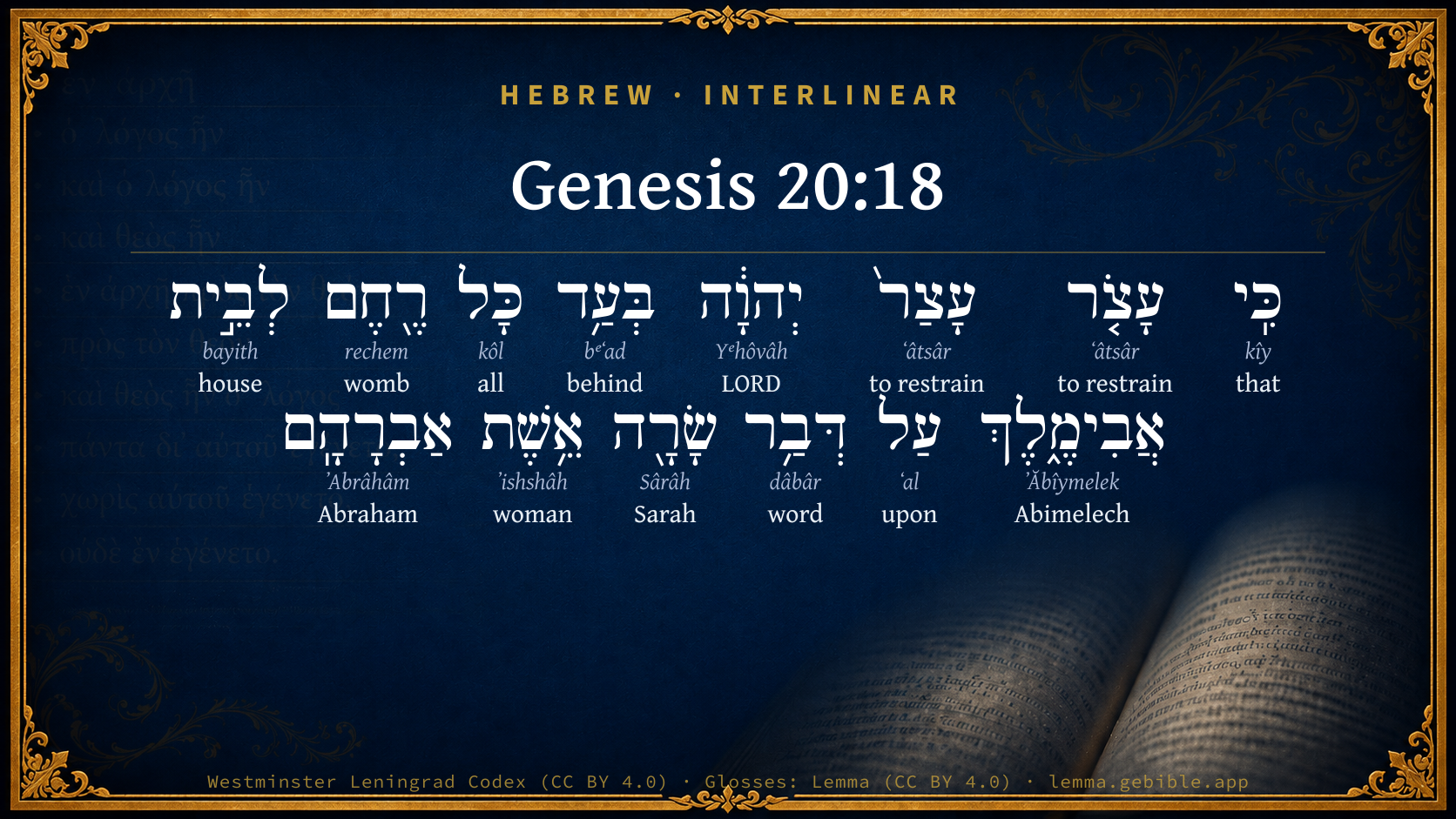
Genesis 20:18

Hebrew (Westminster Leningrad Codex) Genesis 20:18 appears in the Hebrew Old Testament. The text above is from the Westminster Leningrad Codex. Each word links to its Strong’s number, a concise gloss, and parsing drawn from the Open Scriptures Hebrew Bible morphology. Click any word for its full Brown-Driver-Briggs (BDB) entry.
Download image
Cite this verse

Genesis 20:18 (World English Bible). Public Domain. Lemma interlinear Bible study tool, https://lemma.gebible.app/v/genesis/20/18.

Show BibTeX & RIS
BibTeX
RIS
English Translation
For Yahweh had closed up tight all the wombs of the house of Abimelech, because of Sarah, Abraham's wife.
World English Bible · Public Domain
Highlights
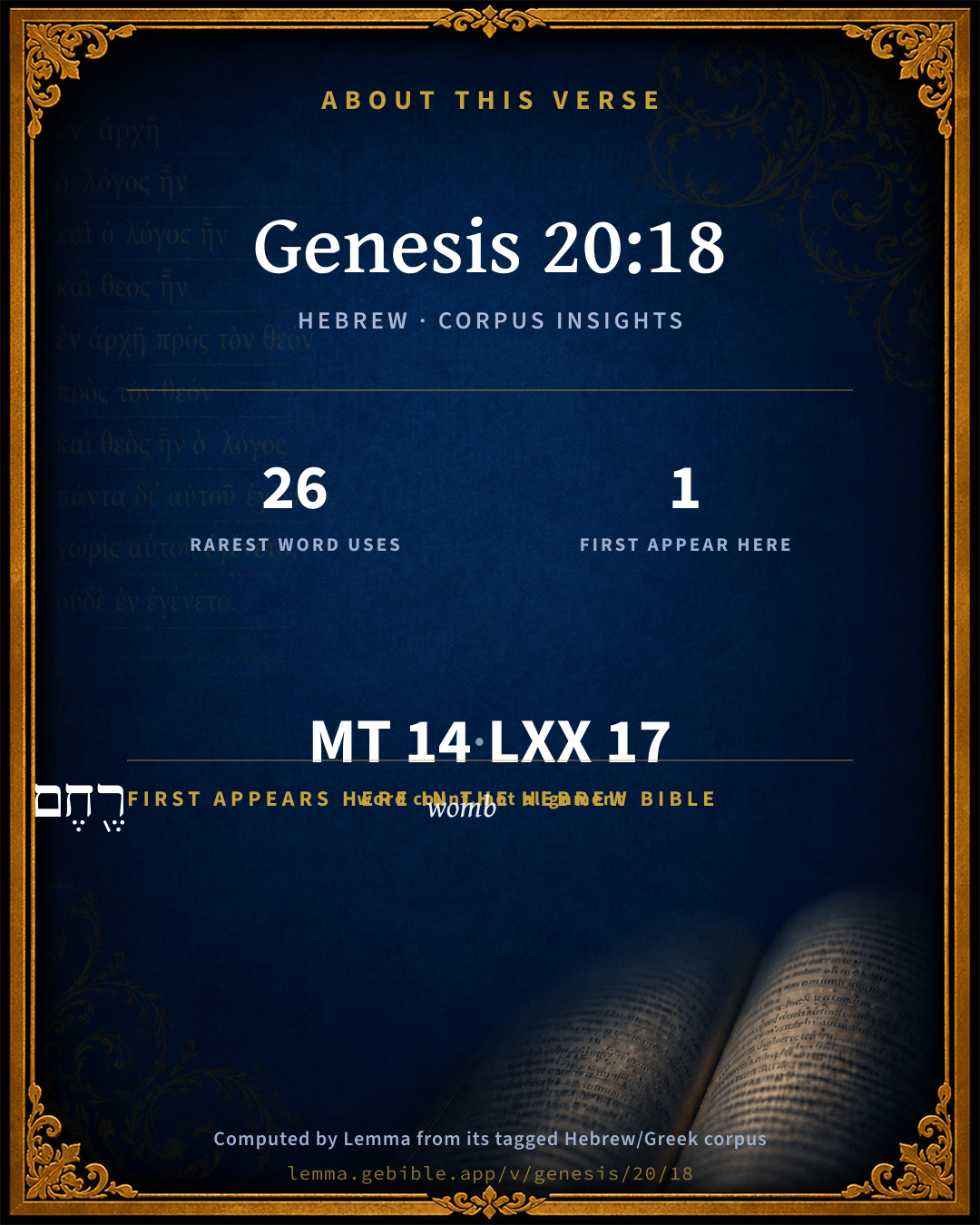
  • 1 first appearance in the Hebrew Bible
Full analysis ↓
Download a study sheet

One document with this verse’s original text, its word-by-word gloss line, the meaning frame, cross-references with their text, attributed commentary, and full source and license credits — printable, and it pastes into notes with its structure intact.

This verse Autodidact and up

Study sheet (.html) Plain text (.txt)

A passage Seminary Student

Up to 50 verses in one chapter. A passage sheet keeps up to 6 commentary sources and 12 cross-references per verse, in the order this page ranks them, and says so on the sheet whenever that leaves anything out. Ask for a single verse and you get the Autodidact verse sheet above.

Everything on this page stays free to read, with no account — the sheet is a download of what is already on screen, not access to it.

Want to remove ads? Support Godless Engineer
Compare translations 3

The same verse in 3 English versions, stacked beneath the original-language interlinear above. Click any original word for its lexicon entry.

Each is an independent rendering of the whole verse — the interlinear is not word-aligned to these translations.

Highlighted words mark where these versions differ — a whole-verse word diff, not a word-by-word alignment.

  • World English Bible Public Domain
    For Yahweh had closed up tight all the wombs of the house of Abimelech, because of Sarah, Abraham's wife.
  • King James Version Public Domain
    For the LORD had fast closed up all the wombs of the house of Abimelech, because of Sarah Abraham's wife.
  • unfoldingWord Literal Text CC BY-SA 4.0
    because Yahweh had completely closed up every womb in the house of Abimelech because of Sarah, the wife of Abraham.

unfoldingWord Literal Text — © unfoldingWord, licensed CC BY-SA 4.0. Word-aligned USFM3 via Door43 (git.door43.org/unfoldingWord/en_ult).

Versions to compare (up to 4)

3 of 4 selected

Show all 17 translations

Every available English version of this verse, each an independent rendering of the whole verse.

  • World English Bible Public Domain
    For Yahweh had closed up tight all the wombs of the house of Abimelech, because of Sarah, Abraham's wife.
  • Berean Standard Bible Public Domain
    for on account of Abraham’s wife Sarah, the LORD had completely closed all the wombs in Abimelech’s household.
  • Majority Standard Bible Public Domain
    for on account of Abraham’s wife Sarah, the LORD had completely closed all the wombs in Abimelech’s household.
  • King James Version Public Domain
    For the LORD had fast closed up all the wombs of the house of Abimelech, because of Sarah Abraham's wife.
  • American Standard Version (1901) Public Domain
    For Jehovah had fast closed up all the wombs of the house of Abimelech, because of Sarah, Abraham's wife.
  • Revised Version (1885) Public Domain
    For the LORD had fast closed up all the wombs of the house of Abimelech, because of Sarah Abraham’s wife.
  • Geneva Bible (1599) Public Domain
    For the Lord had shut vp euery wombe of the house of Abimelech, because of Sarah Abrahams wife.
  • Young's Literal Translation Public Domain
    for Jehovah restraining had restrained every womb of the house of Abimelech, because of Sarah, Abraham's wife.
  • Literal Standard Version CC BY-SA 4.0
    for YHWH restraining had restrained every womb of the house of Abimelech, because of Sarah, Abraham’s wife.
  • Unlocked Literal Bible CC BY-SA 4.0
    For Yahweh had caused all the women of the household of Abimelech to be completely infertile, because of Sarah, Abraham's wife.
  • unfoldingWord Literal Text CC BY-SA 4.0
    because Yahweh had completely closed up every womb in the house of Abimelech because of Sarah, the wife of Abraham.
  • Darby Bible Public Domain
    For Jehovah had fast closed up all the wombs of the house of Abimelech because of Sarah Abraham's wife.
  • World Messianic Bible Public Domain
    For the LORD had closed up tight all the wombs of the house of Abimelech, because of Sarah, Abraham’s wife.
  • Webster's Bible Public Domain
    For the LORD had made barren all the females of the house of Abimelech, because of Sarah, Abraham's wife.
  • Free Bible Version CC BY-SA 4.0
    For the Lord had made all the women unable to have children because Abraham's wife, Sarah, had been taken.
  • Bible in Basic English Public Domain
    For the Lord had kept all the women of the house of Abimelech from having children, because of Sarah, Abraham's wife.
  • JPS Tanakh (1917) Public Domain
    For the LORD had fast closed up all the wombs of the house of Abimelech, because of Sarah Abraham's wife.

Literal Standard Version (2020), Covenant Press — licensed CC BY-SA 4.0. Text via the HelloAO Bible API (eBible.org). Unlocked Literal Bible (unfoldingWord) — licensed CC BY-SA 4.0. Text via the HelloAO Bible API (eBible.org). unfoldingWord Literal Text — © unfoldingWord, licensed CC BY-SA 4.0. Word-aligned USFM3 via Door43 (git.door43.org/unfoldingWord/en_ult). Free Bible Version, Dr. Jonathan Gallagher — licensed CC BY-SA 4.0. Text via the HelloAO Bible API (eBible.org).

Word by word

More ways to search: Search by grammar → Find every occurrence → Compare this word →

Practice this passage: Drill this verse → Learn its vocabulary →

About this verse

These counts appear in no published source. They are computed here, from the morphology-tagged text and Lemma’s own curated glosses. What Lemma adds →

14
words
13
distinct lemmas
Pentateuch
section

First appearance in Scripture

This word makes its first canonical appearance in the Hebrew Bible here:

  • רֶ֖חֶם womb H7358

Shared distinctive vocabulary

רֶ֖חֶם womb H7358 occurs in 25 verses of the Hebrew Bible. Also found in:

Grammatical profile

  • 2 verbs
  • 9 nouns
  • 2 prepositions
  • 1 conjunction

Verb forms

  • עָצֹ֤ר Qal · Infinitive Absolute
  • עָצַר֙ Qal · Perfect

Repetition

A word recurs within this verse — often emphatic in Hebrew:

  • עָצֹ֤ר to restrain H6113 ×2

Hebrew & Septuagint length

In English translation the verse runs 19 words from the Hebrew and 20 from the Septuagint (LXX English) — closely comparable.

A rough comparison of the two English renderings, which tokenize alike — not a word-level alignment.

Word counts can differ between the Hebrew and the Greek without any difference in meaning — e.g. the Hebrew direct-object marker אֵת has no separate Greek word, and Greek often adds the article ὁ.

In the original languages it is 14 Hebrew tokens and 17 Greek tokens — but the two are counted differently (Hebrew bundles its prefixes and suffixes into one token; the Greek is in lemma form), so that isn’t a like-for-like length.

Cross-references

6

Topical passages linked to Genesis 20:18 in the Treasury of Scripture Knowledge — connected by theme and wording, ordered by reader-vote popularity; previews shown in the World English Bible.

  • Genesis 12:17 Yahweh plagued Pharaoh and his house with great plagues because of Sarai, Abram's wife.
  • Genesis 30:2 Jacob's anger was kindled against Rachel, and he said, "Am I in God's place, who has withheld from you the fruit of the womb?"
  • Genesis 16:2 Sarai said to Abram," See now, Yahweh has restrained me from bearing. Please go in to my handmaid. It may be that I will obtain children by her." Abram listened to the voice of Sarai.
  • Genesis 20:7 Now therefore, restore the man's wife. For he is a prophet, and he will pray for you, and you will live. If you don't restore her, know for sure that you will die, you, and all who are yours."
  • 1 Samuel 1:6 Her rival provoked her sore, to make her fret, because Yahweh had shut up her womb.
  • 1 Samuel 5:10 So they sent the ark of God to Ekron. It happened, as the ark of God came to Ekron, that the Ekronites cried out, saying, They have brought about the ark of the God of Israel to us, to kill us and our people.

Cross-references courtesy of OpenBible.info (CC BY 4.0).

Hebrew and Greek witnesses Masoretic Hebrew ↔ Greek Septuagint

The same verse in the two great witnesses to the Old Testament, shown verse-for-verse.

These are two independent witnesses, not word-aligned to each other, and the Septuagint is shown in lemma (dictionary) form.

Hebrew Genesis 20:18 Masoretic · Westminster Leningrad Codex

כִּֽי עָצֹ֤ר עָצַר֙ יְהוָ֔ה בְּעַ֥ד כָּל רֶ֖חֶם לְבֵ֣ית אֲבִימֶ֑לֶךְ עַל דְּבַ֥ר שָׂרָ֖ה אֵ֥שֶׁת אַבְרָהָֽם

For Yahweh had closed up tight all the wombs of the house of Abimelech, because of Sarah, Abraham's wife.

World English Bible · Public Domain

Greek LXX Genesis 20:18 Septuagint · lemma form

ὅτι συνκλείω συνκλείω κύριος ἔξωθεν πᾶς μήτρα ἐν ὁ οἶκος ὁ αβιμελεχ ἕνεκεν σαρρα ὁ γυνή αβρααμ

Because the Lord had fast closed from without every womb in the house of Abimelech, because of Sarrha Abraam's wife.

LXX2012 (modern English Septuagint) · Public Domain

Hebrew: Westminster Leningrad Codex (CC BY 4.0). Greek: Septuagint (public domain); English from LXX2012 (modern English Septuagint) (Public Domain). How the Septuagint differs from the Hebrew →

Targum (Aramaic paraphrase)

1

The Targum is the ancient Jewish Aramaic paraphrase of the Hebrew Scriptures — an interpretive translation, not the Hebrew text itself. Onkelos (literal) and Pseudo-Jonathan (expansive) render the Torah, and Jonathan the Prophets. Coverage is partial: where no permissively-licensed English translation exists for a verse, only the Aramaic is shown. This is verse-level text, not a word-by-word alignment to the Hebrew.

  1. Targum Onkelos Torah (Genesis–Deuteronomy)
    אֲרֵי מֵיחַד אֲחַד יְיָ בְּאַפֵּי כָל פָּתַח וַלְדָא לְבֵית אֲבִימֶלֶךְ עַל עֵיסַק שָׂרָה אִתַּת אַבְרָהָם

    (no public-domain English translation for this verse)

    Targum Onkelos — Aramaic: “Onkelos Genesis” (public domain); “Onkelos Exodus” (public domain); “Onkelos Leviticus” (public domain); “Onkelos Numbers” (public domain); “Onkelos Deuteronomy” (public domain). English: “Sefaria Community Translation” (CC0 1.0 (public-domain dedication)); “J.W. Etheridge. The Targums of Onkelos and Jonathan Ben Uzziel on the Pentateuch. London: Longmans, Green, 1862” (public domain). Text via Sefaria.

Commentary

Notes on Genesis 20:18 from classic Christian and Jewish commentators (each source and its license shown beneath its notes). The classic Christian expositions comment on the surrounding passage and are grouped to its opening verse, so a note may address several verses; the Jewish commentaries on the Tanakh (Rashi and others) are per-verse, so they appear only where the commentator wrote on this verse.

Lemma curates 59 commentaries, every one of them public domain or Creative Commons licensed, each selected and text-cleaned for this edition rather than reprinted as found. About our sources →

Trapp's Complete Commentary

John Trapp

Gen 20:18 For the LORD had fast closed up all the wombs of the house of Abimelech, because of Sarah Abraham’s wife.

Ver. 18. For the Lord had fast closed up all, &c.] In quibus peccamus, in iisdem plectimur . God oft takes notice of the offending member. Dives was tormented most in his tongue, quia lingua plus peccaverat , saith Cyprian. {a} Nestorii lingua vermibus exesa . Archbishop Arundel was so smitten in his tongue, that he could neither swallow nor speak, for serveral days before his death. Atque id multi tum fieri putabant, quod verbum Dei alligasset, ne suo tempore praedicaretur , saith the historian. {b} The like is reported of Stephen Gardiner, Fertur Heraclius Imp. inguine sursum converso faciem suam perminxisse, nisi urina (tabella imo ventri appossita) averteretur. Id ei accidisse creditum, ob incestum cum fratris filia coitum. {c}

{a} Evag., lib. i.

{b} Theo. Gascon. in Diction. Theolog.

{c} Act. and Mon. 1622.

John Trapp, A Commentary or Exposition upon All the Books of the Old and New Testament (1647–1656) — public domain. Text from a community e-Sword module.

Geneva Bible (1599)

Geneva Bible translators

Had taken away from them the gift of conceiving.

Geneva Bible (1599) marginal notes — public domain. Text via Bolls.life.

Adam Clarke's Commentary

Verse 18. For the Lord had fast closed up all the wombs] Probably by means of some disease with which he had smitten them, hence it is said they were healed at Abraham's intercession; and this seems necessarily to imply that they had been afflicted by some disease that rendered it impossible for them to have children till it was removed. And possibly this disease, as Dr. Dodd conjectures, had afflicted Abimelech, and by this he was withheld, Ge 20:6, from defiling Abraham's bed.

1. ON the prevarication of Abraham and Sarah, see the notes and concluding observations on chap. xii.; See Clarke on Ge 12:20; and while we pity this weakness, let us take it as a warning.

2. The cause why the patriarch did not acknowledge Sarah as his wife, was a fear lest he should lose his life on her account, for he said, Surely the fear, i.e., the true worship, of the true God is not in this place. Such is the natural bigotry and narrowness of the human heart, that we can scarcely allow that any besides ourselves possess the true religion. To indulge a disposition of this kind is highly blamable. The true religion is neither confined to one spot nor to one people; it is spread in various forms over the whole earth. He who fills immensity has left a record of himself in every nation and among every people under heaven. Beware of the spirit of intolerance! for bigotry produces uncharitableness; and uncharitableness, harsh judging; and in such a spirit a man may think he does God service when he tortures, or makes a burnt-offering of the person whom his narrow mind and hard heart have dishonoured with the name of heretic. Such a spirit is not confined to any one community, though it has predominated in some more than in others. But these things are highly displeasing in the sight of God. HE, as the Father of the spirits of all flesh, loves every branch of his vastly extended family; and as far as we love one another, no matter of what sect of party, so far we resemble HIM. Had Abraham possessed more charity for man and confidence in God at this time, he had not fallen into that snare from which he barely escaped. A hasty judgment is generally both erroneous and harsh; and those who are the most apt to form it are generally the most difficult to be convinced of the truth.

Adam Clarke's Commentary on the Bible (1810–1826) — public domain. Text from a community e-Sword/MySword module.

The Cambridge Bible for Schools and Colleges

gen. ed. J. J. S. Perowne

18. For the Lord] An editorial addition, explanatory of Gen_20:17. “Jehovah” is here used for the only time in this narrative.

The Cambridge Bible for Schools and Colleges (gen. ed. J. J. S. Perowne; Cambridge University Press, 1878–1918) — public domain. Text from a community e-Sword module.

John Gill's Exposition

For the Lord had fast closed up all the wombs of the house of Abimelech,.... With large tumours probably, so that they could not cohabit with their husbands and conceive; nor could those that had conceived bring forth: and this disorder they were smitten with:

because of Sarah Abraham's wife; who was taken into the house of Abimelech, in order to be his; to rebuke and punish for which, and to convince of the evil of it, and cause to abstain from it, this disorder was inflicted on them.

Next: Genesis Chapter 21

John Gill's Exposition of the Whole Bible (1746–1763) — public domain (CC PDM 1.0). Text via the HelloAO Bible API.

Matthew Poole's English Annotations

This phrase elsewhere notes barrenness, as 1Sa 1:5,6, and so many understand it here. Against which some learned men object that that could not so soon be discovered, for all this happened between the conception and birth of Isaac. Which objection may seem not valid, because the evidences of women’s being with child go so long before the birth of the child, and those evidences not appearing in any of their women, who before that time were generally fruitful and child bearing, they might discern God’s hand in it, especially upon God’s admonition to their king. But because this history seems to have been done in a far less space of time, it not being probable either that God would suffer Sarah to be long with Abimelech ere he warned him, or that he being warned, and so severely threatened, and actually punished, would delay the execution of God’s command, or that upon his obedience to God the mercy and deliverence promised would be delayed by God; that seems more probable which others think, that this was an indisposition, or plague, or sore in the secret parts, by which they were hindered from cohabitation and mutual converse, and consequently from hopes of conception and child-bering; upon the removal whereof, it is said that

they bare children, where, as ofttimes in Scripture, the last and consummating act is put for all the preceding acts: q.d. and they were restored to the conjugal use, and conception, and, in due time, to child-bearing.

Matthew Poole's English Annotations on the Holy Bible (1683–1685) — public domain. Text from a community e-Sword/MySword module.

Whedon's Commentary on the Bible

Daniel D. Whedon

18. The Lord — It was JEHOVAH, the covenant God, who had thus interposed.

Fast closed up all the wombs — So as to prevent conception. Compare 1Sa_1:5-6.

Because of Sarah — The malady, which is said to have been healed, Gen_20:17, was sent for Sarah’s sake, and, therefore, we naturally suppose that Sarah was kept apart from Abraham some months at least. Compare Gen_20:3-4, notes.

Daniel D. Whedon (gen. ed.), Commentary on the Old and New Testaments (1874–1909) — public domain. Text from a community e-Sword module.

The Pulpit Commentary

For the Lord (Jehovah; vide supra on Ver. 3) had fast closed up all the wombs i.e. prevented conception, or produced barrenness (Gen_16:2; Isa_66:9; 1Sa_1:5, 1Sa_1:6; for the opposite; Gen_29:31 Gen_30:22) "poena convenientissima; quid enim convenientius esse poterat, quam ut amittat, qui ad se rapit aliena" (Musculus). Vide Havernick, of the house of Abimelech, because of Sarah Abraham"s wife the motive obviously being to protect the purity of the promised seed.

The Pulpit Commentary (1880–1919), ed. H.D.M. Spence-Jones & Joseph S. Exell — public domain. Text from a community e-Sword module.

Rashi

Rabbi Shlomo Yitzchaki (Rashi)

בעד כל רחם GOD HAD CLOSED UP EVERY רחם — means had closed up every opening (of the body)

'על דבר שרה וגו BECAUSE OF (literally, by the word of) SARAH — at Sarah’s bidding (Genesis Rabbah 52:13).

Rashi on the Tanakh — English translations: “The Judaica Press complete Tanach with Rashi, translated by A. J. Rosenberg” (CC BY 4.0); “Pentateuch with Rashi's commentary by M. Rosenbaum and A.M. Silbermann, 1929-1934” (public domain); “The Metsudah Tanach series, Lakewood, N.J” (CC BY 4.0); and “The Book of Joshua, Metsudah Publications, 1997” (CC BY 4.0). Text via Sefaria.

Radak

Rabbi David Kimhi (Radak)

כי עצר עצר בעד כל רחם, among the women, and possibly also among the animals which were meant to give birth at that time. (as we quoted our sages as saying). In fact the Talmud says that even hens which lay eggs instead of producing live chicks from their bodies were equally affected.

Radak on the Tanakh — English translations: “Sefaria Community Translation” (CC0 1.0 (public-domain dedication)); “Eliyahu Munk, HaChut Hameshulash” (CC BY 4.0); “Rabbi Mike Feuer, Jerusalem Anthology” (CC BY 4.0); and “R. David Kimhi on the first book of Psalms, Translated by R.G. Finch, London, 1919” (public domain). Text via Sefaria.

Lesson kit

Teaching starters — assembled from the data on this page, not authored interpretation. Every prompt links to the verse data it draws on. Edit before teaching.

Genesis, in the Pentateuch, opens this verse with 14 words (13 distinct Hebrew lemmas). Its most distinctive word is rechem (“womb”). A historical commentator’s framing appears above. Read the whole chapter for the surrounding context.

Discussion questions

  1. What does “womb” (rechem) contribute to the verse as a whole?
  2. This is the first place “womb” appears in Scripture (first appears here). What does its debut here establish?
  3. How does Genesis 29:31, which shares the word «womb», read alongside this verse?
  4. What does the repetition of “to restrain” (2× in this one verse) do in this verse?
  5. The translations on this page render this verse differently — a whole-verse word diff, not a word-by-word alignment. What might account for the different wordings?
  6. «עָצֹ֤ר» is a Qal Infinitive Absolute verb. How does that grammatical form shape the action described?
  7. Compare how Trapp's Complete Commentary and Geneva Bible (1599) read this verse. Where do they agree or differ?

Things to notice

Reading settings

Reading text

Shown beneath each verse's original-language words.

Old Testament
Old Testament edition

Read the OT as the Masoretic Hebrew (MT) or the Greek Septuagint (LXX).

English shown for the Greek Septuagint (in the Hebrew ↔ Greek comparison).

Comparing translations? Open the Compare panel on any verse page to stack up to four side by side.