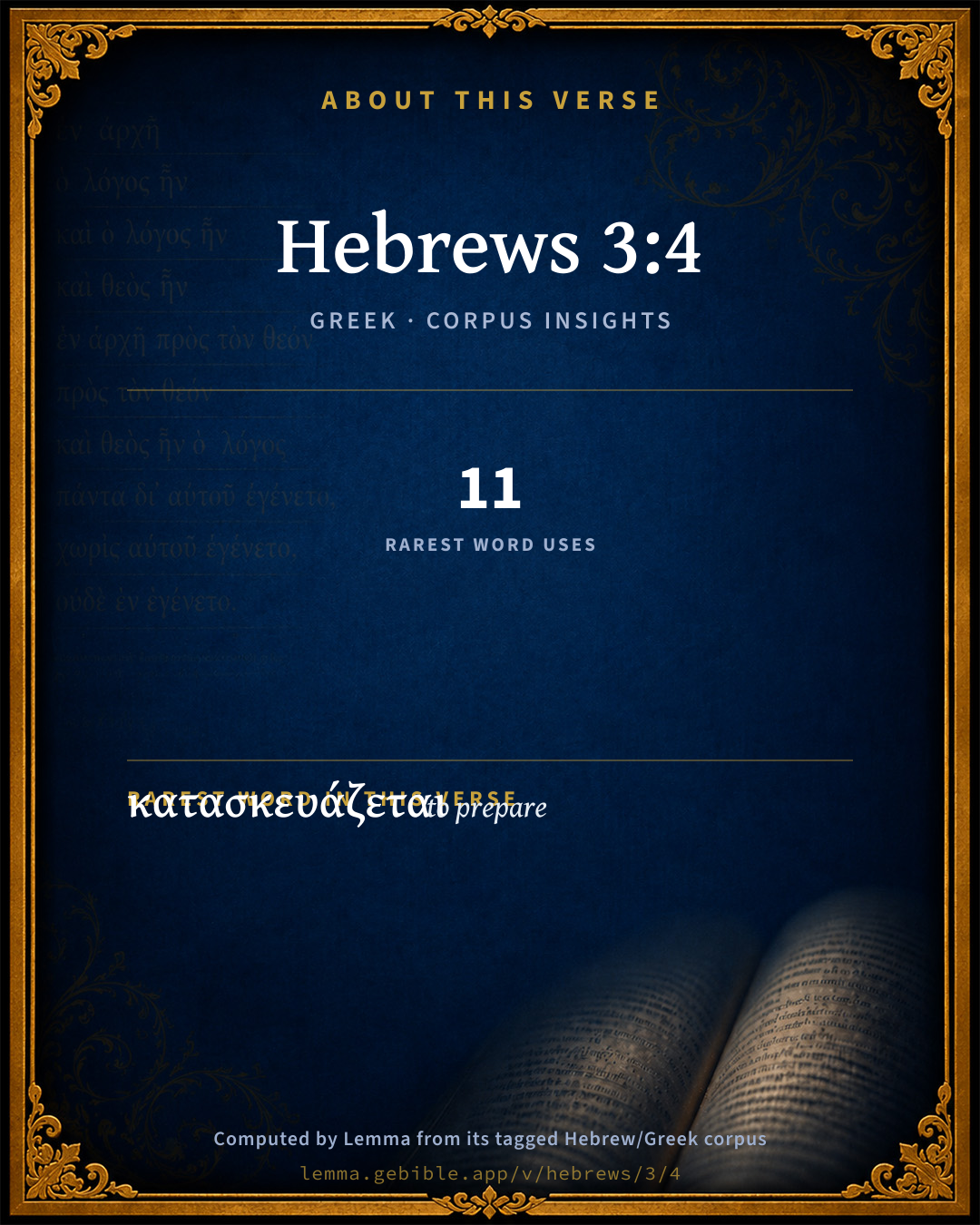
Hebrews 3:4

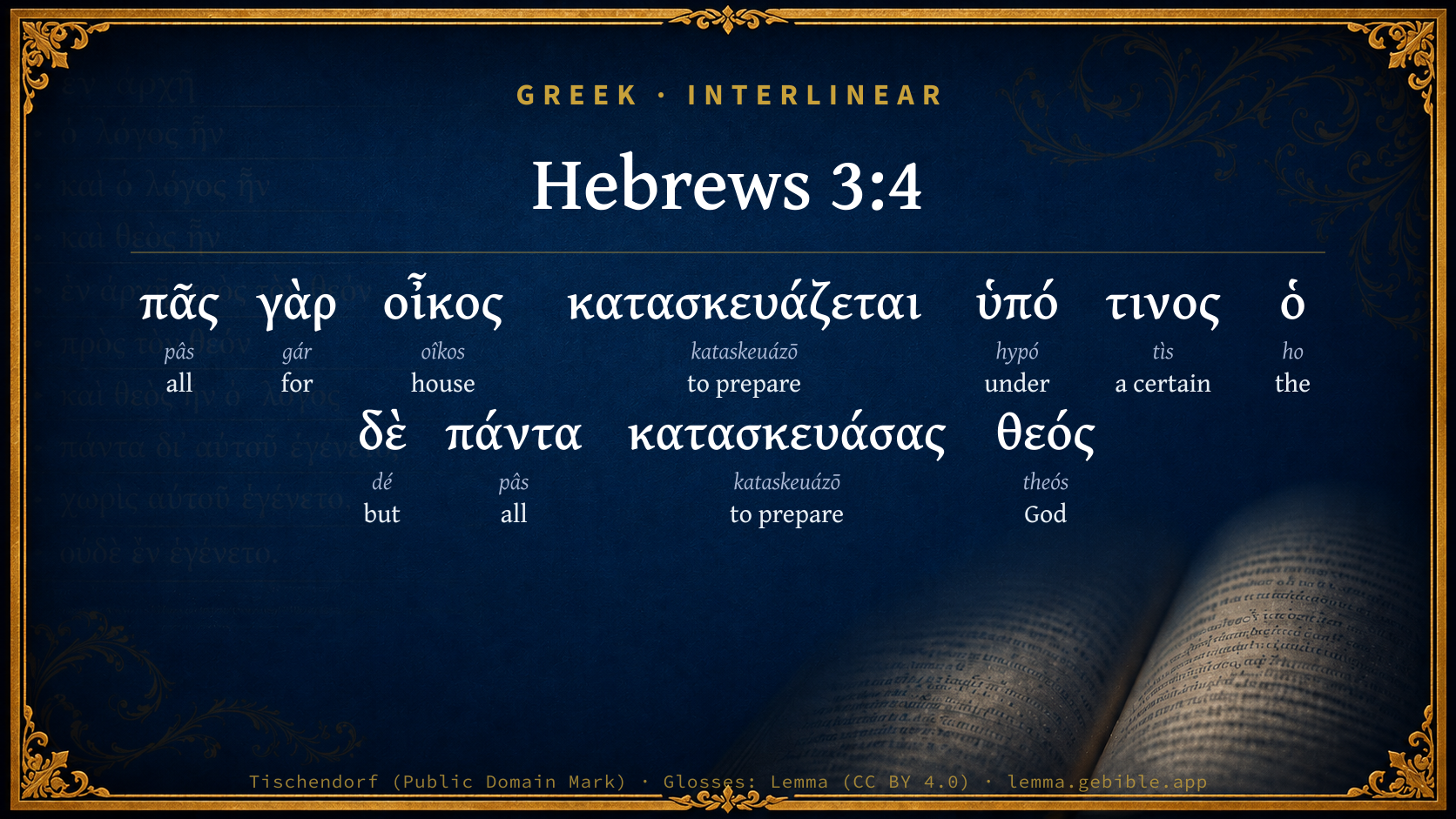
Greek (Tischendorf 8th ed.) Hebrews 3:4 appears in the Greek New Testament. The text above is from the Tischendorf 8th edition. Each word links to its Strong’s number and a concise gloss. Click any word for its full Thayer’s Greek Lexicon entry.
Download image
Cite this verse

Hebrews 3:4 (World English Bible). Public Domain. Lemma interlinear Bible study tool, https://lemma.gebible.app/v/hebrews/3/4.

Show BibTeX & RIS
BibTeX
RIS
English Translation
For every house is built by someone; but he who built all things is God.
World English Bible · Public Domain
Download a study sheet

One document with this verse’s original text, its word-by-word gloss line, the meaning frame, cross-references with their text, attributed commentary, and full source and license credits — printable, and it pastes into notes with its structure intact.

This verse Autodidact and up

Study sheet (.html) Plain text (.txt)

A passage Seminary Student

Up to 50 verses in one chapter. A passage sheet keeps up to 6 commentary sources and 12 cross-references per verse, in the order this page ranks them, and says so on the sheet whenever that leaves anything out. Ask for a single verse and you get the Autodidact verse sheet above.

Everything on this page stays free to read, with no account — the sheet is a download of what is already on screen, not access to it.

Want to remove ads? Support Godless Engineer
Compare translations 3

The same verse in 3 English versions, stacked beneath the original-language interlinear above. Click any original word for its lexicon entry.

Each is an independent rendering of the whole verse — the interlinear is not word-aligned to these translations.

Highlighted words mark where these versions differ — a whole-verse word diff, not a word-by-word alignment.

  • World English Bible Public Domain
    For every house is built by someone; but he who built all things is God.
  • King James Version Public Domain
    For every house is builded by some man; but he that built all things is God.
  • unfoldingWord Literal Text CC BY-SA 4.0
    For every house is built by someone, but God the one having built all things.

unfoldingWord Literal Text — © unfoldingWord, licensed CC BY-SA 4.0. Word-aligned USFM3 via Door43 (git.door43.org/unfoldingWord/en_ult).

Versions to compare (up to 4)

3 of 4 selected

Show all 19 translations

Every available English version of this verse, each an independent rendering of the whole verse.

  • World English Bible Public Domain
    For every house is built by someone; but he who built all things is God.
  • Berean Standard Bible Public Domain
    And every house is built by someone, but God is the builder of everything.
  • Majority Standard Bible Public Domain
    And every house is built by someone, but God is the builder of everything.
  • King James Version Public Domain
    For every house is builded by some man; but he that built all things is God.
  • American Standard Version (1901) Public Domain
    For every house is builded by some one; but he that built all things is God.
  • Revised Version (1885) Public Domain
    For every house is builded by some one; but he that built all things is God.
  • Geneva Bible (1599) Public Domain
    For euery house is builded of some man, and he that hath built all things, is God.
  • Douay-Rheims (1899) Public Domain
    For every house is built by some man: but he that created all things, is God.
  • Young's Literal Translation Public Domain
    for every house is builded by some one, and He who the all things did build `is' God,
  • Literal Standard Version CC BY-SA 4.0
    For every house is built by someone, and He who built all things [is] God,
  • Unlocked Literal Bible CC BY-SA 4.0
    For every house is built by someone, but the one who built everything is God.
  • unfoldingWord Literal Text CC BY-SA 4.0
    For every house is built by someone, but God the one having built all things.
  • Darby Bible Public Domain
    For every house is built by some one; but he who has built all things [is] God.
  • World Messianic Bible Public Domain
    For every house is built by someone; but he who built all things is God.
  • Webster's Bible Public Domain
    For every house is built by some man; but he that built all things is God.
  • Free Bible Version CC BY-SA 4.0
    Every house has its builder; God is the builder of everything.
  • Bible in Basic English Public Domain
    For every house has a builder; but the builder of all things is God.
  • Text-Critical English NT CC BY 4.0
    For every house is built by someone, but the builder of all things is God.
  • Tyndale New Testament (1534) Public Domain
    Every housse is prepared of some man. But he that ordeyned all thinges is god.

Literal Standard Version (2020), Covenant Press — licensed CC BY-SA 4.0. Text via the HelloAO Bible API (eBible.org). Unlocked Literal Bible (unfoldingWord) — licensed CC BY-SA 4.0. Text via the HelloAO Bible API (eBible.org). unfoldingWord Literal Text — © unfoldingWord, licensed CC BY-SA 4.0. Word-aligned USFM3 via Door43 (git.door43.org/unfoldingWord/en_ult). Free Bible Version, Dr. Jonathan Gallagher — licensed CC BY-SA 4.0. Text via the HelloAO Bible API (eBible.org).

Word by word

More ways to search: Search by grammar → Find every occurrence → Compare this word →

Practice this passage: Drill this verse → Learn its vocabulary →

κατασκευάζεται
kataskeuázō
G2680
“to prepare”
Verb, Present, Passive, Indicative, 3rd person, Singular
Part of Speech
Verb
Tense
Present
Voice
Passive
Mood
Indicative
Person
3rd person
Number
Singular
Full Thayer's Definition

Origin: from G2596 and a derivative of G4632

TDNT: None

1. to furnish, equip, prepare, make ready a. of one who makes anything ready for a person or thing b. of builders, to construct, erect, with the included idea of adorning and equipping with all things necessary
  1. πᾶς pâs G3956 “all” Adjective, Nominative, Singular, Masculine
  2. γὰρ gár G1063 “for” Conjunction
  3. οἶκος oîkos G3624 “house” Noun, Nominative, Singular, Masculine
  4. ὑπό hypó G5259 “under” Preposition
  5. τινος tìs G5100 “a certain” Indefinite pronoun, Genitive, Singular, Masculine
  6. ὁ ho G3588 “the” Article, Nominative, Singular, Masculine
  7. δὲ dé G1161 “but” Conjunction
  8. πάντα pâs G3956 “all” Adjective, Accusative, Plural, Neuter
  9. κατασκευάσας kataskeuázō G2680 “to prepare” Verb, Aorist, Active, Participle, Nominative, Singular, Masculine
  10. θεός theós G2316 “God” Noun, Nominative, Singular, Masculine

About this verse

These counts appear in no published source. They are computed here, from the morphology-tagged text and Lemma’s own curated glosses. What Lemma adds →

11
words
9
distinct lemmas
General Epistles
section

Notable vocabulary

The rarest word here is κατασκευάζεται to prepare G2680 — appearing just 11 times in the whole Greek New Testament.

Shared distinctive vocabulary

κατασκευάζεται to prepare G2680 occurs in 10 verses of the Greek New Testament. Also found in:

Repetition

Words recur within this verse:

  • πᾶς all G3956 ×2
  • κατασκευάζεται to prepare G2680 ×2

Cross-references

2

Topical passages linked to Hebrews 3:4 in the Treasury of Scripture Knowledge — connected by theme and wording, ordered by reader-vote popularity; previews shown in the World English Bible.

  • Hebrews 1:2 has at the end of these days spoken to us by his Son, whom he appointed heir of all things, through whom also he made the worlds.
  • Hebrews 3:3 For he has been counted worthy of more glory than Moses, inasmuch as he who built the house has more honor than the house.

Cross-references courtesy of OpenBible.info (CC BY 4.0).

Commentary

Notes on Hebrews 3:4 from classic Christian and Jewish commentators (each source and its license shown beneath its notes). The classic Christian expositions comment on the surrounding passage and are grouped to its opening verse, so a note may address several verses; the Jewish commentaries on the Tanakh (Rashi and others) are per-verse, so they appear only where the commentator wrote on this verse.

Lemma curates 59 commentaries, every one of them public domain or Creative Commons licensed, each selected and text-cleaned for this edition rather than reprinted as found. About our sources →

Bengel's Gnomon

Johann Albrecht Bengel

Heb 3:4. Ὁ δὲ, but He) Christ. The article points out the subject, and also possesses in this passage a relative meaning, as in ch. Heb 7:6. Θεὸς, GOD, is the predicate.—Θεὸς, GOD) absolutely. Moses was a ‘god’ to Aaron, but he was not GOD absolutely.

Bengel's Gnomon of the New Testament — English translation (T&T Clark, Edinburgh, 1860) — public domain. Text from a community e-Sword module.

Meyer's Critical & Exegetical Commentary

Heinrich August Wilhelm Meyer

Heb_3:4. The author has spoken, Heb_3:2, of the house of God, and yet, Heb_3:3, has ascribed the founding and preparing of the same to Christ. For the justification of this apparent contradiction does the remark, Heb_3:4, serve. Although every house has its special preparer, yet this notwithstanding, it is God who has prepared all things. That special foundership of Christ does not exclude the universal higher foundership of God. The proposition Heb_3:4 is incidental to the main argument. It is not, however, to be enclosed in a parenthesis, because αὐτοῦ, Heb_3:5, refers back to θεός, Heb_3:4.

In the second clause, θεός is subject, and ὁ δὲ πάντα κατασκευάσας predicate. Wrongly has θεός been ordinarily taken by others as predicate, and as subject either ὁ δὲ πάντα κατασκευάσας or merely ὁ δέ, since πάντα κατασκευάσας was taken as a defining adjunct. The second member of the proposition was then referred to Christ, and the statement found therein that Christ is God. So Theodoret, Oecumenius, Theophylact, Clarius, Beza, Estius, Jac. Cappellus, Cornelius a Lapide, Cameron, Piscator, Owen, Seb. Schmidt, Wittich, Braun, Akersloot, Calmet, Bengel, Cramer, Whitby, Stuart, Baumgarten, and many others; also still Woerner. But with this thought the sequel is not in keeping. For not of Christs being God, but of His exalted relation to the house of God as the υἱός, while Moses was only a θεράπων, does the author speak, Heb_3:5-6.

πάντα] denotes not the universality of all created things, thought of as a unity, but in general: each and all, that exists.

Meyer — Critical and Exegetical Commentary on the New Testament — English translation by Peter Christie, edited by Frederick Crombie (T&T Clark, 1880) — public domain. Text from a community e-Sword module.

Expositor's Greek Testament

ed. W. Robertson Nicoll

Heb 3:4 . πᾶς γὰρ οἶκος … θεός . “For every house is built by someone, but he that built all is God.” Over and above the right conduct of the house there is a builder. No house, no religious system, grows of itself; it has a cause in the will of one who is greater than it. There is a “someone” at the root of all that appears in history. And He who planned and brought into being πάντα , “all,” whether old or new, is God. The present development of this divine house as well as its past condition and equipment is of God. And Christ, the Son, naturally and perfectly representing God or the builder, and by whose agency God created all things (Heb 1:2 ) is therefore worthy of more honour than Moses. The argument is not so much elliptical as incomplete, waiting to be supplemented by the following verses in which the relation of Jesus to God and the relation of Moses to the house are exhibited. “It is argued that a household must be established by a householder; now God established the universe, and therefore he is the supreme householder of the universal household or Church of God, and in that household Jesus, as His perfect representative, is entitled to receive glory corresponding” (Rendall).

The Expositor's Greek Testament, edited by W. Robertson Nicoll (1897–1910) — public domain. Text from a community e-Sword module.

Jamieson, Fausset & Brown

Robert Jamieson, A. R. Fausset & David Brown

Someone must be the establisher of every house; Moses was not the establisher of the house, but a portion of it (but He who established all things, and therefore the spiritual house in question, is God). Christ, as being instrumentally the Establisher of all things, must be the Establisher of the house, and so greater than Moses.

Jamieson, Fausset & Brown — Commentary Critical and Explanatory on the Whole Bible (1871) — public domain (CC PDM 1.0). Text via the HelloAO Bible API.

Adam Clarke's Commentary

Verse 4. For every house is builded by some man] The literal sense is plain enough: "Every structure plainly implies an, architect, and an end for which it was formed. The architect may be employed by him for whose use the house is intended; but the efficient cause of the erection is that which is here to he regarded." The word house, here, is still taken in a metaphorical sense as above, it signifies family or Church. Now the general meaning of the words, taken in this sense, is: "Every family has an author, and a head or governor. Man may found families, civil and religious communities, and be the head of these; but God alone is the Head, Author, and Governor, of all the families of the earth; he is the Governor of the universe. But the apostle has a more restricted meaning in the words τα παντα, all these things; and as he has been treating of the Jewish and Christian Churches, so he appears to have them in view here. Who could found the Jewish and Christian Church but God? Who could support, govern, influence, and defend them, but himself? Communities or societies, whether religious or civil, may be founded by man; but God alone can build his own Church. Now as all these things could be builded only by God, so he must be God who has built all these things. But as Jesus is the Founder of the Church, and the Head of it, the word GOD seems here to be applied to him; and several eminent scholars and critics bring this very text as a proof of the supreme Deity of Christ: and the apostle's argument seems to require this; for, as he is proving that Christ is preferred before Moses because he built this house, which Moses could not do, where he to be understood as intimating that this house was built by another, viz. the Father, his whole argument would fall to the ground; and for all this, Moses might be equal, yea, superior to Christ. On this ground Dr. Owen properly concludes: "This then is that which the apostle intends to declare; namely, the ground and reason whence it is that the house was or could be, in that glorious manner, built by Christ, even because he is GOD, and so able to effect it; and by this effect of his power, he is manifested so to be."

Adam Clarke's Commentary on the Bible (1810–1826) — public domain. Text from a community e-Sword/MySword module.

John Calvin's Commentaries

4. He that built, etc. Though these words may be extended to the creation of the whole world, yet I confine them to the present subject. We are then to understand that nothing is done in the Church which ought not to he ascribed to Gods power; for he alone has founded it by his own hand, (Psalm 87:5;) and Paul says of Christ that he is the head, from whom the whole body, joined together and connected by every subservient juncture, makes an increase according to what is done proportionally by every member. (Ephesians 4:16.) Hence he often declares that the success of his ministry was God’s work. In a word, if we take a right view of things, it will appear that how much soever God may use the labors of men in building his Church, yet he himself performs everything — the instrument derogates nothing from the workman.

John Calvin's Commentaries (1540-1563) — public domain. Text from the Calvin Translation Society English edition (1840s-50s) via the Christian Classics Ethereal Library (ccel.org). Calvin's coverage is partial (roughly two-thirds of the Bible); uncommented books and verses are honest gaps, never fabricated. The 19th-century editor's footnotes and remarks are omitted so the notes are faithfully Calvin's own voice.

Ellicott's Commentary for English Readers

(4) For every house is builded by some man.—Rather, by some one: the thought of the house leads at once to the thought of the builder of it. The meaning of the several parts of this verse is very simple; but it is not easy to follow the reasoning with certainty. The second clause seems to be a condensed expression of this thought: “But He that built this house is He that built all things, God.” “Moses is possessed of lesser glory than the Apostle of our confession, as the house stands below its maker in honour. For this house, like every other, has its maker:—it is He who made all things, even God.

A Bible Commentary for English Readers, edited by Charles John Ellicott (1878–1897) — public domain. Text from a community e-Sword module.

The Cambridge Bible for Schools and Colleges

gen. ed. J. J. S. Perowne

4. For every house is builded by some man] The real meaning would perhaps be better expressed by “Every household is established by some one.” The establisher of the Old Dispensation as well as of the New was Christ, but yet, in some sense (as an instrument and minister) Moses might be regarded as the founder of the Old Covenant (Act_7:38), as Jesus of the New. The verb (kataskeuazo) is rendered “prepare” in Heb_9:6, Heb_11:7; Luk_1:17.

he that built all things is God] In His humanity Jesus was but “the Apostle” of God in building His house, the Church. “He (the man whose name is the Branch) shall build the temple of the Lord,” Zec_6:12. God is the supreme, ultimate, and universal Founder.

The Cambridge Bible for Schools and Colleges (gen. ed. J. J. S. Perowne; Cambridge University Press, 1878–1918) — public domain. Text from a community e-Sword module.

John Gill's Exposition

For every house is built by some man,.... Or by some one; for a house does not build itself: this is true of houses properly taken, or improperly, as nations, tribes, families, and kindred, of the whole church in general, of particular congregations, and of individual believers; the greatest saints, even apostles and prophets, such an one as Moses, are built by and upon Christ; their persons are built on him; they receive all their gifts for edification from him, and their success is owing to him; though they are to be esteemed of in their proper places: the apostle's design is to bring down the high esteem the Jews had of Moses, that they might rightly value Christ.

But he that built all things is God; Christ has built all things, and therefore he is God, and must be infinitely above Moses; for this is not to be understood of God and of the creation of the world, and of all things in it by him; but of Christ, and of his building the church, and of his ordering and managing of that, and all affairs relating to it; such as the constitution of it, settling the worship of God, and the ordinances in it, the redemption and salvation of the members of it, and its rule and government; all which prove him to be God, and above Moses.

John Gill's Exposition of the Whole Bible (1746–1763) — public domain (CC PDM 1.0). Text via the HelloAO Bible API.

Trapp's Complete Commentary

John Trapp

4 For every house is builded by some man; but he that built all things is God.

Ver. 4. He that built all things] Moses and all.

Is God] That is, Christ, whom he had proved to be God by many arguments, Heb 1:1-14. Messiah therefore is to be preferred before Moses.

John Trapp, A Commentary or Exposition upon All the Books of the Old and New Testament (1647–1656) — public domain. Text from a community e-Sword module.

Albert Barnes' Notes on the Bible

For every house is builded by some man - The words in this verse are plain, and the sentiment in it clear. The only difficulty is in seeing the connection, and in understanding how it is intended to bear on what precedes, or on what follows. It is clear that every house must have a builder, and equally clear that God is the Creator of all things. But what is the meaning of this passage in this connection? What is its bearing on the argument? If the verse was entirely omitted, and the fifth verse read in connection with the third, there would be apparently nothing wanting to complete the sense of the writer, or to finish the comparison which he had commenced. Various ways have been adopted to explain the difficulty. Perhaps the following observations may remove it, and express the true sense:

(1) Every family must have a founder; every dispensation an author; every house a builder. There must be someone, therefore, over all dispensations - the old and the new - the Jewish and the Christian.

(2) Paul “assumes” that the Lord Jesus was divine. He had demonstrated this in Heb 1:1-14; and he argues as if this were so, without now stopping to prove it, or even to affirm it expressly.

(3) God must be over “all things.” He is Creator of all, and he must, therefore, be over all. As the Lord Jesus, therefore, is divine, he must be over the Jewish dispensation as well as the Christian - or he must, as God, have been at the head of that - or over his own family or household.

(4) As such, he must have a glory and honor which could not belong to Moses. He, in his divine character, was the Author of both the Jewish and the Christian dispensations, and he must, therefore, have a rank far superior to that of Moses - which was the point which the apostle designed to illustrate. The meaning of the whole may be thus expressed. “The Lord Jesus is worthy of more honor than Moses. He is so, as the maker of a house deserves more honor than the house. He is divine. In the beginning he laid the foundation of the earth, and was the agent in the creation of all things; Heb 1:2, Heb 1:10. He presides, therefore, over everything; and was over the Jewish and the Christian dispensations - for there must have been someone over them, or the author of them, as really as it must be true that every house is built by some person. Being, therefore, over all things, and at the head of all dispensations, he must be more exalted than Moses.” This seems to me to be the argument - an argument which is based on the supposition that he is at the head of all things, and that he was the agent in the creation of all worlds. This view will make all consistent. The Lord Jesus will be seen to have a claim to a far higher honor than Moses, and Moses will be seen to have derived his honor, as a servant of the Mediator, in the economy which he had appointed.

Albert Barnes' Notes on the Bible (1834–1885) — public domain. Text from a community e-Sword/MySword module.

Matthew Poole's English Annotations

The excellency of this builder is evinced by his nature and preference beyond his building, as any man is beyond his.

For every house is builded by some man; for every earthly artificial building, a material house built for habitation, though it may metaphorically and analogically be understood of a commonwealth, or political one, which is contrived, framed, and raised by some man; yet an effect cannot produce itself, nor a house raise itself; both must have a cause, both the house wherein Moses was faithful, and Christ’s house.

But he that built all things is God; but he who built his church in all ages, whether the Israelitish or Christian, and all things about it of which we speak, and all things else, Mat 16:18; Joh 1:1,3; Col 1:20; he is God essentially; and Christ, doing God’s work and building all things, is not by name only, but by nature, God. The whole world is his workmanship, but the church is the most rare, curious, and excellent piece of it. Christ is not part of the house, as Moses is, but the builder of it; he is the Creator and builder both of the church and him, and so infinitely above him.

Matthew Poole's English Annotations on the Holy Bible (1683–1685) — public domain. Text from a community e-Sword/MySword module.

Whedon's Commentary on the Bible

Daniel D. Whedon

4. Every house—And, therefore, this house—has its special builder. And this divine house-building of the two dispensations is like all others, and pre-eminently so, under the divine all-builder, God. As apostles, neither is independent, both being under, as well as from, a divine Founder, by whom both are appointed. The whole structure is established by God supreme. This attribution of all to God, which perplexes Delitzsch, is in Paul’s style. See 2Co_1:21, with our note.

Daniel D. Whedon (gen. ed.), Commentary on the Old and New Testaments (1874–1909) — public domain. Text from a community e-Sword module.

The Pulpit Commentary

For every house is builded (or, established) by some one; but he that built (or, established) all things is God. Of the second clause of this verse "God" is rightly taken by modern commentators as the subject, not the predicate, though the Fathers generally take it otherwise. Thus Theodoret, regarding as a o panta kataskeuasav designation of Christ, views this clause as an assertion of his Deity on the ground of his being the Founder of all things. But this view introduces an idea out of keeping with the argument, and especially with the preceding expression, "faithful to him who appointed him," in which Christ, in his office as the Christ, is distinguished from the Creator of all who appointed him to that office. The verse seems to be interposed in elucidation of the preceding o kataskeuasav auton , to make it clear that the Founder of the house spoken of is God himself, and thus to give full effect to the proportionate glory of Christ in comparison with that of Moses. Thus: the glory of Christ is greater than that of Moses by so much as the honor of the founder of a house is greater than that of the house; of the founder, we say; for every house has some founder: but God is the original Founder of all things, and therefore of necessity the Founder of this house of his own in which Moses was a servant. The verse, thus interpreted, seems (as intimated there) to fall in with the train of thought mere naturally than it can be shown to do if Christ is "regarded as the Builder. Possibly "all things" may be purposely used to denote the house itself over which Christ, as Son, is Lord. For, though the expression seems too wide for the limited house in which Moses was a servant, it is net so for the expanded and consummated house over which Christ in glory reigns; of. Heb_1:2, "Whom he appointed Heir of all things; " and Heb_2:8, "Thou hast put all things in subjection under his feet;" the last being said in especial connection with the "glory and honor" wherewith Christ "has been counted worthy" to be crowned. It is not necessary to confine the meaning of "God"s house" to the Mosaic dispensation, or to assign to it (as some have done) two separate meanings in the eases of Moses and of Christ. It may be regarded as a comprehensive term, including in its general meaning the Law, the gospel, and the final consummation the whole dispensation of redemption, beginning with the Law, and completed at the second advent. Moses held office in its early stage, and there only as a servant; in its ultimate development it comprises "all things," and over "all things," thus comprised, Christ, as SON, has been shown to be by inheritance absolute Lord.

The Pulpit Commentary (1880–1919), ed. H.D.M. Spence-Jones & Joseph S. Exell — public domain. Text from a community e-Sword module.

John Wesley's Explanatory Notes

Now Christ, he that built not only this house, but all things, is God - And so infinitely greater than Moses or any creature.

John Wesley, Explanatory Notes Upon the Whole Bible (1754–1765) — public domain. Text via the GEBible commentary corpus.

The People's New Testament

B. W. Johnson

4. Every house is builded by some one. The word man does not occur in the Greek. The meaning is “every house has a builder, but the Builder of all things is God.” He built the house of Israel, but Christ is God manifest to us, the Divine personality at work in human redemption; hence, the builder of the typical church, as well as of the antitype.

B. W. Johnson's The People's New Testament with Notes (1889–1891) — public domain. Electronic text from the Christian Classics Ethereal Library (CCEL) ThML edition.

Cambridge Greek Testament for Schools and Colleges

4. πάντα אABC1D1E &c. The reading τὰ πάντα (= “the Universe”) would be less suitable to the context.

4. πᾶς γὰρ οἶκος κατασκευάζεται ὑπό τινος. “Every household is established by some one.” The establisher of the Old Dispensation as well as of the New was Christ, but yet, in some sense (as an instrument and minister), Moses might be regarded as the founder of the Old Covenant (Act 7:38), as Jesus of the New. The verb κατασκευάζω is rendered “prepare” in Heb 9:6, Heb 11:7; Luk 1:17.

ὁ δὲ πάντα κατασκευάσας θεός. In His humanity Jesus was but “the Apostle” of God in building His house, the Church. “He (the man whose name is the Branch) shall build the temple of the Lord,” Zec 6:12. God is the supreme, ultimate, and universal Founder.

Cambridge Greek Testament for Schools and Colleges (Cambridge University Press, 1896; 21 vols, various authors incl. Carr, Maclear, Plummer, Farrar, Lumby, Moule, M. R. James, Simcox) — public domain. Text from a community e-Sword module.

Alford’s Greek Testament

Henry Alford

4.] For (expansion and justification of ὁ κατασκευάσας) every house is established by some one (i. e. it belongs to the idea of a house that some one should have built and fitted it up: arrangement implies an arranger, design a designer): but (contrast as passing from the individual to the general) He which established all things is, God (= God is he which established all things; θεός being the subject, and ὁ τὰ πάντα κατασκ., the predicate. Before treating of the misunderstanding of this verse by the Fathers, and by many of the moderns, let us endeavour to grasp its true meaning. The last verse brings before us Christ as the κατασκευαστής of the house of God. And this He is, in whatever sense οἶκος be taken: whether on the narrower sense which best suits this present comparison, or in the wider sense implied by the faithful centurion in Mat 8:9, in which all natural powers are His οἰκέται. But He is this not by independent will or agency. διʼ οὗ καὶ ἐποίησεν τοὺς αἰῶνας, is our Writer’s own language of the creation by Christ: and it is in accord with that of St. John, where he says πάντα διʼ αὐτοῦ ἐγένετο. He, as the Son, is ὁ κατασκευάσας the house of God—the Church, or the world, or the universe; but, apparently (cf. ver. 6), the former of these: but it is as one with,—by virtue of his Sonship,—Him who is ὁ πάντα κατασκευάσας, viz. God. And thus the αὐτοῦ, twice repeated in vv. 5, 6, falls into its own place as belonging both times to God: Moses is His servant, part and portion of His household: Christ is His Son, over His household. And by this reference to God as the πρωτοκατασκευαστής, is the expression above, τῷ ποιήσαντι αὐτόν, illustrated and justified. So that this verse is not quasiparenthetic, as almost all the recent expositors make it—e. g. Tholuck, Bleek, Ebrard, Lünemann,—but distinctly part of the argument.

The ancient expositors, almost without exception, take θεός as predicate, and ὁ (τὰ) πάντα κατασκευάσας as a designation of Christ—“now He that founded all things, is (must be) God:” thus making the passage a proof of the deity of Christ. The short-hand writer has apparently here blundered over Chrysostom’s exposition, for it is meagre and confused to the last degree; but Thdrt., Œc., and Thl., so explain it, regarding ver. 2 as an assertion of Christ’s superiority to Moses quoad His human nature, and this verse as regards His divinity. ὅρα πῶς ἤρξατο μὲν τῆς συγκρίσεως ἀπὸ τῆς σαρκός, ἀνέβη δὲ εἰς τὴν θεότητα, καὶ ἀσυγκρίτως ὑπερέχειν τὸν ποιητὴν τοῦ ποιήματος ἔδειξε. And so also Beza, Estius, Cappellus, a-Lapide, Cameron, Seb. Schmidt, Calmet, Bengel (who however as well as Cappellus, takes ὁ as the personal pronoun referring to Christ, and (τὰ) πάντα κατασκευάσας as in apposition; but He, who &c., is God), al. But, apart from the extreme harshness and forcing of the construction to bring out this meaning, the sentiment itself is entirely irrelevant here. If the Writer was proving Christ to be greater than Moses inasmuch as He is God, the founder of all things, then clearly the mere assertion of this fact would have sufficed for the proof, without entering on another consideration: nay, after such an assertion, all minor considerations would have been not only superfluous, but preposterous. He does however, after this, distinctly go into the consideration of Christ being faithful not as a servant but as a son: so that he cannot be here speaking of His Deity as a ground of superiority).

Henry Alford, The Greek Testament (1849–1861) — public domain. Text from a community e-Sword module.

Vincent's Word Studies in the New Testament

Marvin R. Vincent

He that built all things is God [ο παντα κατασκευασας θεος] . The verb includes not only erection, but furnishing with the entire equipment. See ch. Heb 9:2; 1Pe 2:10. The verb o P. The application of built or established to Christ (ver. 3) is guarded against possible misapprehension. Christ is the establisher, but not by any independent will or agency. As the Son he is he that built, but it is as one with God who built all things. The special foundership of Christ does not contradict or exclude the general foundership of God.

Marvin R. Vincent, Word Studies in the New Testament (1887–1900) — public domain. Text from a community e-Sword/MySword module.

Westcott on Hebrews & the Epistles of John

Brooke Foss Westcott

4. was ydp...] Tho general principle, that the framer is superior to the thing framod, admits of application in the caso of the Law. Evon hore we must not rest on the system; for every system, and this highest of all, has ite framor; and finally every system is carried up to God as its Author, and ‘Jesus’ our ‘Apostle and High-priest’ is the Son of God.

Nothing is said hore oxpreesly of the unique relation in which Christ, an tho Son, stands to God. That is assumol, as having boon already laid down in the opening of the Epistle.

πάντα] all things taken severally, and not the sum of all things (ra πάντα). Comp. ii. Io.

Geos} For the difforence of θεός and ὃ θεός see Additional Noto on 1 John iv. 12. The anarthrous form (θεός) wherovor it is usod in the Epistle suggests the thought of the character of God as God: i. 6; ii. 9 (note); 10; xi. 3, 16; xii. 23. The force of it will be felt by comparing vi. 1, 5 with vi. 3; vi. 17 with vi. 18; xi 3 with xi. 4.

5,6. Thosuporiority of Christ ovor Moses is shewn also by another argument. Moses and Christ are not only distinguished as standing to one another in the relation of an economy to its author; but also in regard to the

tive economies which they administored. The position of Mosos was,

by a necessary consequence, that of a servant acting in a certain sphere, tho position of Christ that of a Son over a certain sphore. And yet again, the Mosaic order pointed forward as preparatory to that which should come after: the Christian order includes the blessings which it proclaims.

Brooke Foss Westcott (1825–1901), The Epistle to the Hebrews (1889) and The Epistles of St John (1883) — public domain (pre-1929). Text recovered from Internet Archive / Google Books OCR scans. Westcott’s Gospel of John commentary is not included (its OCR lost the chapter running-heads required for reliable verse-keying). Some Greek quoted in the Hebrews volume is imperfectly rendered by the OCR.

Lesson kit

Teaching starters — assembled from the data on this page, not authored interpretation. Every prompt links to the verse data it draws on. Edit before teaching.

Hebrews, in the General Epistles, opens this verse with 11 words (9 distinct Greek lemmas). Its most distinctive word is kataskeuázō (“to prepare”). A historical commentator’s framing appears above. Read the whole chapter for the surrounding context.

Discussion questions

  1. The word kataskeuázō carries the sense “to prepare.” How does it shape the verse?
  2. How does Matthew 11:10, which shares the word «to prepare», read alongside this verse?
  3. What does the repetition of “all” (2× in this one verse) do in this verse?
  4. These translations render this verse differently. What is at stake in choosing one wording over another?
  5. Compare how Bengel's Gnomon and Meyer's Critical & Exegetical Commentary read this verse. Where do they agree or differ?

Things to notice

  • These translations choose different wording for 7 words in this verse.
  • “all” occurs 2× in this single verse.
  • 9 distinct Greek lemmas span 11 words in this verse.

Reading settings

Reading text

Shown beneath each verse's original-language words.

Old Testament
Old Testament edition

Read the OT as the Masoretic Hebrew (MT) or the Greek Septuagint (LXX).

English shown for the Greek Septuagint (in the Hebrew ↔ Greek comparison).

Comparing translations? Open the Compare panel on any verse page to stack up to four side by side.