2 Timothy 4:19

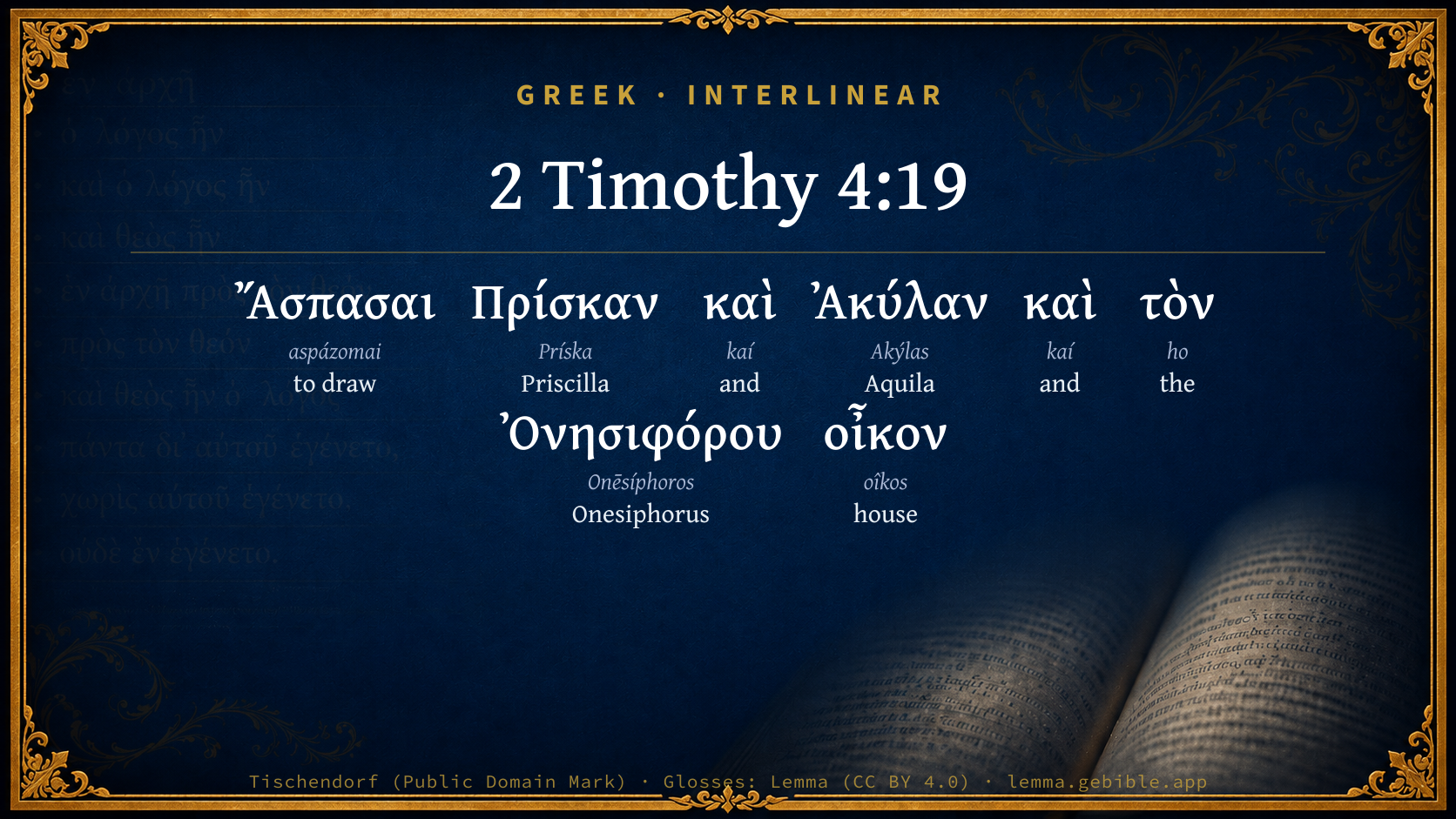
Greek (Tischendorf 8th ed.) 2 Timothy 4:19 appears in the Greek New Testament. The text above is from the Tischendorf 8th edition. Each word links to its Strong’s number and a concise gloss. Click any word for its full Thayer’s Greek Lexicon entry.
Download image
Cite this verse

2 Timothy 4:19 (World English Bible). Public Domain. Lemma interlinear Bible study tool, https://lemma.gebible.app/v/2-timothy/4/19.

Show BibTeX & RIS
BibTeX
RIS
English Translation
Greet Prisca and Aquila, and the house of Onesiphorus.
World English Bible · Public Domain
Download a study sheet

One document with this verse’s original text, its word-by-word gloss line, the meaning frame, cross-references with their text, attributed commentary, and full source and license credits — printable, and it pastes into notes with its structure intact.

This verse Autodidact and up

Study sheet (.html) Plain text (.txt)

A passage Seminary Student

Up to 50 verses in one chapter. A passage sheet keeps up to 6 commentary sources and 12 cross-references per verse, in the order this page ranks them, and says so on the sheet whenever that leaves anything out. Ask for a single verse and you get the Autodidact verse sheet above.

Everything on this page stays free to read, with no account — the sheet is a download of what is already on screen, not access to it.

Want to remove ads? Support Godless Engineer
Compare translations 3

The same verse in 3 English versions, stacked beneath the original-language interlinear above. Click any original word for its lexicon entry.

Each is an independent rendering of the whole verse — the interlinear is not word-aligned to these translations.

Highlighted words mark where these versions differ — a whole-verse word diff, not a word-by-word alignment.

  • World English Bible Public Domain
    Greet Prisca and Aquila, and the house of Onesiphorus.
  • King James Version Public Domain
    Salute Prisca and Aquila, and the household of Onesiphorus.
  • unfoldingWord Literal Text CC BY-SA 4.0
    Greet Prisca and Aquila, and the household of Onesiphorus.

unfoldingWord Literal Text — © unfoldingWord, licensed CC BY-SA 4.0. Word-aligned USFM3 via Door43 (git.door43.org/unfoldingWord/en_ult).

Versions to compare (up to 4)

3 of 4 selected

Show all 19 translations

Every available English version of this verse, each an independent rendering of the whole verse.

  • World English Bible Public Domain
    Greet Prisca and Aquila, and the house of Onesiphorus.
  • Berean Standard Bible Public Domain
    Greet Prisca and Aquila, as well as the household of Onesiphorus.
  • Majority Standard Bible Public Domain
    Greet Prisca and Aquila, as well as the household of Onesiphorus.
  • King James Version Public Domain
    Salute Prisca and Aquila, and the household of Onesiphorus.
  • American Standard Version (1901) Public Domain
    Salute Prisca and Aquila, and the house of Onesiphorus.
  • Revised Version (1885) Public Domain
    Salute Prisca and Aquila, and the house of Onesiphorus.
  • Geneva Bible (1599) Public Domain
    Salute Prisca and Aquila, and the householde of Onesiphorus.
  • Douay-Rheims (1899) Public Domain
    Salute Prisca and Aquila, and the household of Onesiphorus.
  • Young's Literal Translation Public Domain
    Salute Prisca and Aquilas, and Onesiphorus' household;
  • Literal Standard Version CC BY-SA 4.0
    Greet Prisca and Aquilas, and Onesiphorus’ household;
  • Unlocked Literal Bible CC BY-SA 4.0
    Greet Priscilla, Aquila, and the house of Onesiphorus.
  • unfoldingWord Literal Text CC BY-SA 4.0
    Greet Prisca and Aquila, and the household of Onesiphorus.
  • Darby Bible Public Domain
    Salute Prisca and Aquila, and the house of Onesiphorus.
  • World Messianic Bible Public Domain
    Greet Prisca and Aquila, and the house of Onesiphorus.
  • Webster's Bible Public Domain
    Salute Prisca and Aquila, and the household of Onesiphorus.
  • Free Bible Version CC BY-SA 4.0
    My greetings to Prisca and Aquila, and to Onesiphorus's family.
  • Bible in Basic English Public Domain
    Give my love to Prisca and Aquila and those of the house of Onesiphorus.
  • Text-Critical English NT CC BY 4.0
    Greet Prisca and Aquila and the household of Onesiphorus.
  • Tyndale New Testament (1534) Public Domain
    Salute Prisca and Aquila and the housholde of Onesiphorus.

Literal Standard Version (2020), Covenant Press — licensed CC BY-SA 4.0. Text via the HelloAO Bible API (eBible.org). Unlocked Literal Bible (unfoldingWord) — licensed CC BY-SA 4.0. Text via the HelloAO Bible API (eBible.org). unfoldingWord Literal Text — © unfoldingWord, licensed CC BY-SA 4.0. Word-aligned USFM3 via Door43 (git.door43.org/unfoldingWord/en_ult). Free Bible Version, Dr. Jonathan Gallagher — licensed CC BY-SA 4.0. Text via the HelloAO Bible API (eBible.org).

Word by word

More ways to search: Search by grammar → Find every occurrence → Compare this word →

Practice this passage: Drill this verse → Learn its vocabulary →

About this verse

These counts appear in no published source. They are computed here, from the morphology-tagged text and Lemma’s own curated glosses. What Lemma adds →

8
words
7
distinct lemmas
Pauline Epistles
section

Notable vocabulary

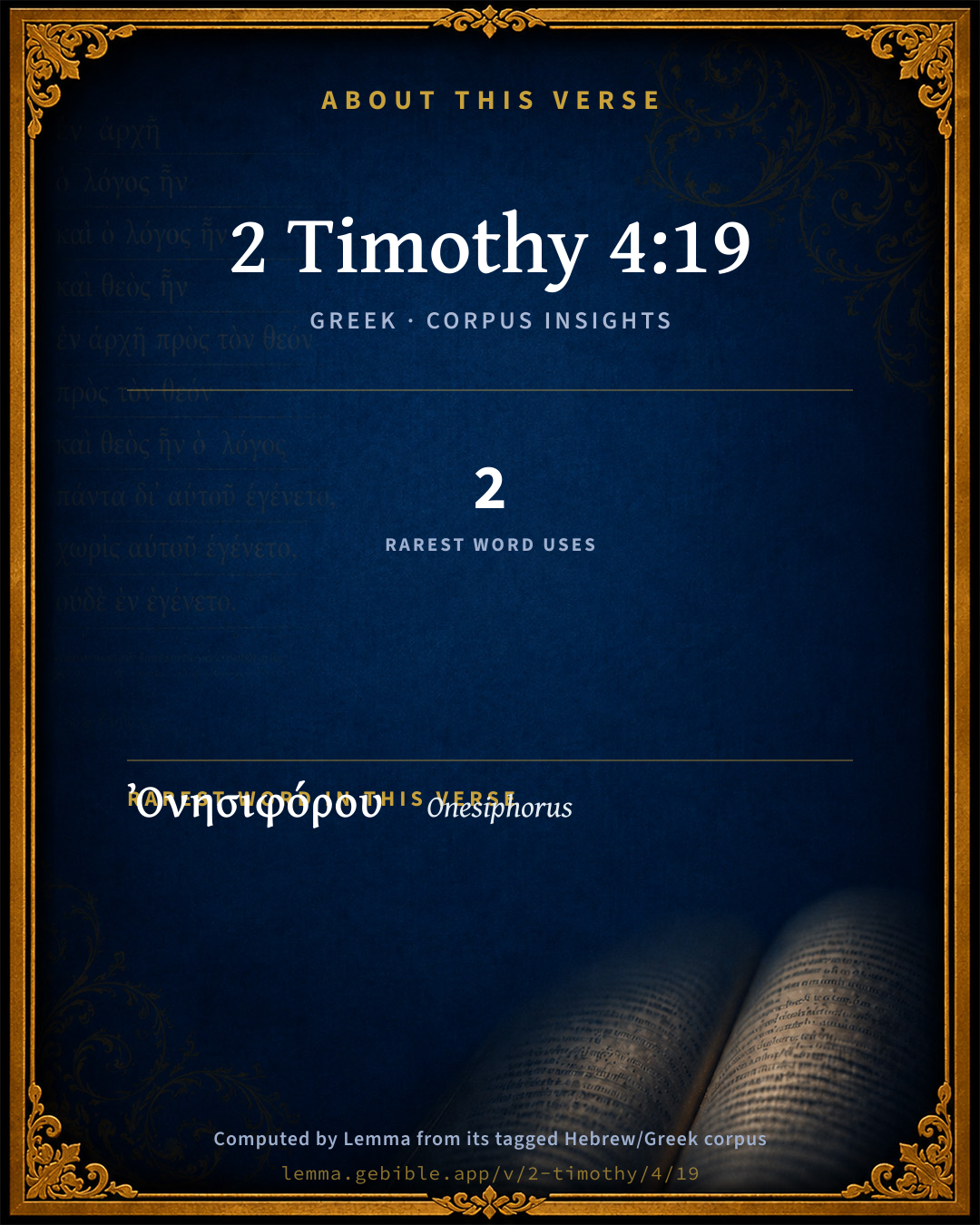
The rarest word here is Ὀνησιφόρου Onesiphorus G3683 — appearing just 2 times in the whole Greek New Testament.

Shared distinctive vocabulary

Ὀνησιφόρου Onesiphorus G3683 occurs in 2 verses of the Greek New Testament. Also found in:

Repetition

A word recurs within this verse:

Cross-references

6

Topical passages linked to 2 Timothy 4:19 in the Treasury of Scripture Knowledge — connected by theme and wording, ordered by reader-vote popularity; previews shown in the World English Bible.

  • Acts 18:2 He found a certain Jew named Aquila, a man of Pontus by race, who had recently come from Italy, with his wife Priscilla, because Claudius had commanded all the Jews to depart from Rome. He came to them,
  • 1 Corinthians 16:19 The assemblies of Asia greet you. Aquila and Priscilla greet you much in the Lord, together with the assembly that is in their house.
  • Romans 16:3–4 Greet Prisca and Aquila, my fellow workers in Christ Jesus,
  • 2 Timothy 1:16–18 May the Lord grant mercy to the house of Onesiphorus, for he often refreshed me, and was not ashamed of my chain,
  • Acts 18:26 He began to speak boldly in the synagogue. But when Priscilla and Aquila heard him, they took him aside, and explained to him the way of God more accurately.
  • Acts 18:18 Paul, having stayed after this many more days, took his leave of the brothers, and sailed from there for Syria, together with Priscilla and Aquila. He shaved his head in Cenchreae, for he had a vow.

Cross-references courtesy of OpenBible.info (CC BY 4.0).

Commentary

Notes on 2 Timothy 4:19 from classic Christian and Jewish commentators (each source and its license shown beneath its notes). The classic Christian expositions comment on the surrounding passage and are grouped to its opening verse, so a note may address several verses; the Jewish commentaries on the Tanakh (Rashi and others) are per-verse, so they appear only where the commentator wrote on this verse.

Lemma curates 59 commentaries, every one of them public domain or Creative Commons licensed, each selected and text-cleaned for this edition rather than reprinted as found. About our sources →

The Biblical Illustrator

Joseph S. Exell

2Ti_4:19

The household of Onesipherus.

An extensive blessing

As the dew that falleth on the mountains runs down to the valleys, and the precious ointment that was poured upon the head of Aaron ran down to the skirts of his clothing (Psa_133:1-3.), so the blessing which God pours on governors extendeth itself to such as are under them. (T. Hall, B. D.)

The Biblical Illustrator, edited by Joseph S. Exell (c. 1880s–1900s) — public domain. Text from a community e-Sword module.

Joseph Benson's Commentary

2Ti 4:19-22. Salute Prisca — This word is a contraction of the name Priscilla; or, as Estius supposes, Priscilla may be the diminutive of Prisca. Erastus abode at Corinth — When I came from thence, being chamberlain of the city, Rom 16:23. He is likewise mentioned, Act 19:22, as one who administered to Paul. But Trophimus have I left at Miletum sick — It has been very justly argued from this text, that a power of working miracles did not always reside in the apostles; and indeed if it had, one can hardly imagine that any good and useful man would have been sick and died under their notice; which would have been quite inconsistent with the scheme of Providence. Timothy’s frequent infirmities afford a further argument to the same purpose. Do thy diligence to come before winter — Sailing being then dangerous. Some, comparing Heb 13:23 with this text, have concluded that Timothy did come, and was seized at Rome, and confined longer than Paul himself. But it seems much more probable that the epistle to the Hebrews was written during Paul’s first imprisonment, and consequently several years before this. Eubulus greeteth thee, and Pudens — Though these persons, like the other Roman brethren, did not appear with the apostle at his first answer, they did not flee from the city, nor desert him altogether; but visited him in his prison, and desired him to send their salutation to Timothy. Linus is said, by some of the ancients, to have been the first bishop of Rome, after the apostles Paul and Peter. But Theodoret speaks of this only as a tradition. Claudia is said to have been a British lady, whom Paul was the instrument of converting, and that she first carried the gospel into Britain. But of this there is no evidence. According to tradition, the Apostle Peter was now in Rome, and suffered martyrdom at the same time with St. Paul. But seeing Paul says, 2Ti 4:11, Only Luke is with me, and 2Ti 4:16, At my first answer no one appeared with me; also, seeing Peter’s salutation was not sent to Timothy, his being in Rome at the time this letter was written may justly be doubted. If he suffered martyrdom along with Paul, as the ancients affirm, he must have come to Rome after Paul wrote his second letter to Timothy. Grace be with you — This being a benediction distinct from the one bestowed on Timothy in the preceding clause, it must have been designed for such of the brethren where Timothy was, as maintained the truth of the gospel in purity.

Joseph Benson's Commentary on the Old and New Testaments (1811–1818) — public domain. Text from a community e-Sword module.

Whedon's Commentary on the Bible

Daniel D. Whedon

5. Salutations and benedictions, 2Ti_4:19-22.

19. Prisca—Notes, Act_18:2; and Rom_16:4.

Household— Note, 2Ti_1:16.

Daniel D. Whedon (gen. ed.), Commentary on the Old and New Testaments (1874–1909) — public domain. Text from a community e-Sword module.

The Preacher's Complete Homiletical Commentary

Joseph S. Exell (gen. ed.)

MAIN HOMILETICS OF THE PARAGRAPH.—2Ti_4:19-22

A Martyr’s Last Words—

I. Breathe the spirit of love towards tried and faithful friends.—“Salute Prisca and Aquila, and the household of Onesiphorus” (2Ti_4:19). How tenderly this salutation would be prized when the friends received intelligence of the apostle’s fate! Love is precious the more it is tested and tried. The heart is impoverished indeed that cannot find room for its best friends. Love reveals itself in words and deeds.

II. Indicate unabated interest in the movements and condition of former fellow-labourers.—“Erastus abode at Corinth: but Trophimus have I left at Miletum sick” (2Ti_4:20). Erastus was a frequent companion of Paul (Act_19:22), possibly the same as referred to in Rom_16:23, and was the chamberlain or city steward and treasurer of Corinth. As he left Trophimus in sickness at Miletus, we learn that his power of healing the sick was limited and exercised only on special occasions and for a special purpose. To the last Paul kept in touch with his fellow-workers, and retained his anxious concern for the spread of the gospel.

III. Reveal a yearning for sympathetic companionship in the prospect of approaching doom.—“Do thy diligence to come before winter” (2Ti_4:21). Before the winter storms begin, when navigation would be impossible, or it may be too late. And Paul would need his cloak to protect him from winter cold. A companion like Timothy was what the apostle especially desired; but we have no record that the longed-for interview ever took place. How many of our yearnings are never satisfied! And yet they are not altogether useless. The highest cravings of the soul are gratified only in Christ.

IV. Do not neglect the grace of Christian courtesy.—“Eubulus greeteth thee, and Pudens, and Linus, and Claudia, and all the brethren” (2Ti_4:21). Pudens and Claudia afterwards married—she a Roman knight, he a Briton surnamed Rufina. Linus afterwards became a bishop. Eubulus is identified with Aristobulus, who, with his converts, is said to have been among the first evangelists of Britain. Paul himself, says Clement, “visited the farthest West—perhaps Britain, certainly Spain—and was martyred under the rulers of Rome, who were Nero’s vicegerents in his absence from the city.” Paul was not so absorbed with his own troubles as to neglect to send the joint commendations of the saints in Rome. Christianity is the essence of true courtesy.

V. Concludes with the invocation of Divine blessing.—“The Lord Jesus Christ be with thy spirit. Grace be with you. Amen” (2Ti_4:22). Grace is invoked for Timothy and the members of the Ephesian and neighbouring Churches to whom this epistle would be read. We need no more to make us happy and inspire us to Christian work than the presence of Christ and the enriching favour of God.

Lessons.—

1. The uncertainty of life should intensify our interest in God’s work.

2. Courtesy is a grace of the Christian spirit.

3. We cannot die better than with a prayer for others on our lips.

The Preacher's Complete Homiletical Commentary (gen. ed. Joseph S. Exell; Funk & Wagnalls, c. 1892) — public domain (pre-1929). A full-Bible homiletical/sermon-outline anthology covering 65 of 66 books (2 John is absent from the source module). Text from a community e-Sword module.

Tyndale Open Study Notes

Tyndale Open Resources

4:19-21 As in several of Paul’s epistles, the letter closes with greetings and final instructions (e.g., Rom 16:1-23; 1 Cor 16:19-21; 2 Cor 13:12).

4:19 Priscilla and Aquila had been in Ephesus (Acts 18:26; 1 Cor 16:19) and were probably there at this time. They had also lived in Rome (Acts 18:2; Rom 16:3), where Paul currently was. This might imply that Timothy was still in Ephesus (see 1 Tim 1:3). • Paul appreciatively mentions Onesiphorus in 2 Tim 1:16 as having ministered to him in prison.

Tyndale Open Study Notes — © Tyndale Open Resources, licensed CC BY-SA 4.0. Text via the HelloAO Bible API.

Meyer's Critical & Exegetical Commentary

Heinrich August Wilhelm Meyer

2Ti_4:19. Paul sends greetings to Prisca and Aquila.

Paul had become acquainted with them in Corinth (Act_18:2), from which they accompanied him to Syria (2Ti_4:18). When Paul wrote the Epistle to the Romans they were in Rome (Rom_16:13), but they were in Corinth at the time of his writing the First Epistle to the Corinthians (1Co_16:19).

καὶ τὸν Ὀνησιφόρου οἶκον, see on 2Ti_1:16.

Meyer — Critical and Exegetical Commentary on the New Testament — English translation by Peter Christie, edited by Frederick Crombie (T&T Clark, 1880) — public domain. Text from a community e-Sword module.

Expositor's Greek Testament

ed. W. Robertson Nicoll

2Ti 4:19-22 . Final salutations.

2Ti 4:19 . Πρῖσκαν καὶ Ἀκύλαν : The same unusual order, the wife before the husband, is found in Rom 16:3 , Act 18:18 ; Act 18:26 , but not in Act 18:2 , 1Co 16:19 . “Probably Prisca was of higher rank than her husband, for her name is that of a good old Roman family [the Acilian gens]. Aquila was probably a freedman. The name does indeed occur as cognomen in some Roman families; but it was also a slave name, for a freedman of Maecenas was called (C. Cilnius) Aquila” (Ramsay, St. Paul the Traveller , pp. 268, 269; see also Sanday and Headlam, Romans , p. 118 sqq .).

τὸν Ὀνησιφόρου οἶκον : Their names are inserted after Ἀκύλαν from the Acts of Paul and Thecla , by the cursives 46 and 109: Λέκτραν τὴν γυναῖκα αὐτοῦ καὶ Σιμαίαν καὶ Ζήνωνα τοὺς υἱοὺς αὐτοῦ .

The Expositor's Greek Testament, edited by W. Robertson Nicoll (1897–1910) — public domain. Text from a community e-Sword module.

Jamieson, Fausset & Brown

Robert Jamieson, A. R. Fausset & David Brown

Prisca and Aquila-- (Act 18:2-3; Rom 16:3-4; Co1 16:19, written from Ephesus, where therefore Aquila and Priscilla must then have been).

household of Onesiphorus--If he were dead at the time, the "household" would not have been called "the household of Onesiphorus." He was probably absent (see on Ti2 1:16).

Jamieson, Fausset & Brown — Commentary Critical and Explanatory on the Whole Bible (1871) — public domain (CC PDM 1.0). Text via the HelloAO Bible API.

Adam Clarke's Commentary

Verse 19. Salute Prisca and Aquila] Several MSS., versions, and fathers have Priscilla instead of Prisca: they are probably the same as those mentioned Ac 18:18; Ac 18:26.

The household of Onesiphorus.] See 2Ti 1:16. Onesiphorus was probably at this time dead: his family still remained at Ephesus.

Adam Clarke's Commentary on the Bible (1810–1826) — public domain. Text from a community e-Sword/MySword module.

Ellicott's Commentary for English Readers

(19) Salute Prisca and Aquila.—These were two of St. Paul’s earliest friends after he had begun his great work for his Master. Originally of Pontus, they had taken up their abode at Rome, where Aquila exercised his trade of a tent-maker.

Driven out of Rome by the decree of Claudius, which banished the Jews from the capital, they came to Corinth, where St. Paul became acquainted with them. But they were evidently Christians when St. Paul first met them, about A.D. 51-2. We hear of them in company with St. Paul at Corinth, about A.D. 52-3 (Act_18:2); at Ephesus, about A.D. 55 (1Co_16:19); and in the year A.D. 58 St. Paul sends greetings to them at Rome (Rom_16:3).

They were, evidently, among the many active and zealous teachers of the first days of the faith. That they possessed great ability as well as zeal is evident from the fact that it was from them that the eloquent and trained Alexandrian master, Apollos, learnt to be a Christian (Act_18:26). In this place, and in several other passages, Prisca (or Priscilla) is named before her husband, Aquila. This would seem to hint that in this case the woman was the principal worker of the two in the cause of Christ. She, in fact, was one of that band of devoted holy women which the preaching of Christ and His disciples had called into existence: a representative of the great class of noble female workers which had no existence before Christ told the world what was the true position of women—until the same divine Master taught them that they, too, as well as men, had a work to work for Him here.

And the household of Onesiphorus.—St. Paul may have been aware that Onesiphorus was absent then from Ephesus; but this peculiar greeting, taken together with the words of 2Ti_1:16, leads us irresistibly to the conclusion that this friend of St. Paul’s was dead when the Epistle was written. (See Notes on 2Ti_1:16.)

A Bible Commentary for English Readers, edited by Charles John Ellicott (1878–1897) — public domain. Text from a community e-Sword module.

The Cambridge Bible for Schools and Colleges

gen. ed. J. J. S. Perowne

19. Salute Prisca and Aquila] Prisca, or Priscilla, and her husband Aquila of Pontus had been driven from Rome with the Jews by the edict of the Emperor Claudius (Act_18:2); they were staying at Corinth with St Paul ‘because they were of the same trade’ (acts 18:3); they accompanied him 18 months later to Ephesus (acts 18:18) where they ‘further instructed Apollos’ (acts 18:24); were still there when St Paul wrote his first letter to Corinth (1Co_16:19); afterwards were again at Rome ‘cessante edicti saevitia,’ perhaps on business; their house became a place of assembly for the Christians, and they endangered their lives for St Paul (Rom_16:3). Now they seem settled at Ephesus. Dr Howson quotes Priscilla as the example of what the married woman may do for the general service of the Church, in conjunction with home duties, as Phœbe is the type of the unmarried servant of the Church or deaconess; and cites Archdeacon Evans as to her usefulness to Timothy at Ephesus. ‘In his dealings with the female part of his flock which in that time and country required peculiar delicacy and discretion, the counsel of the experienced Priscilla would be invaluable. Where for instance could he obtain more prudent and faithful advice than hers in the selection of widows to be placed upon the eleemosynary list of the church and of deaconesses for the ministry?’ Dict. Bib. Priscilla.

the household of Onesiphorus] See 2Ti_1:16-18 and notes.

19–22. Last words of salutation, entreaty, benediction

He takes up the thought of 2Ti_4:9-12, weaving in with it the new thought of his last greetings.

The Cambridge Bible for Schools and Colleges (gen. ed. J. J. S. Perowne; Cambridge University Press, 1878–1918) — public domain. Text from a community e-Sword module.

John Gill's Exposition

Do thy diligence to come before winter,.... When travelling would not be so safe and comfortable: the apostle consults Timothy's good, as well as his own advantage.

Eubulus greeteth thee. Eusebius (k) makes mention of one of this name of Manganaea, who suffered martyrdom with one Adrian at Caesarea; but he cannot be thought to be the same with this, since he suffered in the times of Dioclesian.

And Pudens, and Linus, and Claudia; the first of these is said to be a person of note at Rome, and of the senatorial order, and the father of two pious virgins, Praxis and Pudentiana. He is put among the seventy disciples; See Gill on Luk 10:1. Mention is made by Pliny the younger (l), of Servilius Pudens, a Roman; and Martial, a poet of those times, speaks (m) of the marriage of Pudens and Claudia, and of Aulus Pudens. Linus is said to be the first bishop of Rome after the martyrdom of Peter and Paul (n). Though some will have it, that he was bishop of Rome in the time of Peter, and that he and one Cletus were co-pastors with Peter; and Platina, who wrote the "Lives of the Popes", first makes Peter to consecrate Clement his successor, and to commend the chair, and the church of God, to him, and yet afterwards places Linus, and not Clement, as his immediate successor; yea, puts Cletus also before Clement; so much are the Papists at a loss about, and so little account can they give of the boasted succession of their popes from Peter, that they are not agreed about his immediate successor. This Linus is said to be born at Volterra in Tuscany, and to be of the family of the Moors, whose father was one Herculaneus, who sent him at twenty two years of age to Rome, for the sake of his studies; at which time, as is pretended, Peter came thither, by whom he was converted, and with whom he continued as a fellow helper in the Gospel. He is moreover said to be bishop of Rome ten years, (Platina says eleven,) three months, and twelve days, and to have suffered martyrdom under Saturninus the consul, whose daughter he had delivered from a diabolical possession, and was buried in the Vatican. He is reckoned among the seventy disciples of Christ, but very wrongly; See Gill on Luk 10:1. The name is a Latin one, and is often mentioned by Martial the poet. And Claudia is the name of a woman, very likely of considerable note. Some think she was the wife of Pudens, the same Martial speaks of, and is said to be a Briton.

And all the brethren: that is, of the church of Rome, these all sent greeting to Timothy.

(k) Eccl. Hist. l. 8. de Martyr. Palestin. c. 11. (l) L. 10. ep. 10. (m) Epigram. l. 4. ep. 10. 23. 1. 6. ep. 45. l. 7. ep. 10. (n) Iren. adv. Haeres. l. 3. c. 3. Euseb. Ec. Hist. l. 3. c. 2, 4. & l. 5. c. 6.

John Gill's Exposition of the Whole Bible (1746–1763) — public domain (CC PDM 1.0). Text via the HelloAO Bible API.

Trapp's Complete Commentary

John Trapp

19 Salute Prisca and Aquila, and the household of Onesiphorus.

Ver. 19. Salute Prisca, &c.] {See Trapp on "Rom 16:3"}

John Trapp, A Commentary or Exposition upon All the Books of the Old and New Testament (1647–1656) — public domain. Text from a community e-Sword module.

Albert Barnes' Notes on the Bible

Salute Prisca and Aquila - Prisca, or Priscilla, was the wife of Aquila, though her name is sometimes mentioned first. In regard to their history, see the notes at Rom 16:3. They were at Rome when Paul wrote his Epistle to the Romans, but afterward went into Asia Minor, which was the native place of Aquila Act 18:2, and where they probably died.

And the household of Onesiphorus; - see the notes on 2Ti 1:16.

Albert Barnes' Notes on the Bible (1834–1885) — public domain. Text from a community e-Sword/MySword module.

Matthew Poole's English Annotations

Salute Prisca and Aquila; by this Prisca and Aquila it is mor than probable he means that Priscilla and Aquila mentioned 1Co 16:19.

And the household of Onesiphorus; it cannot be concluded from hence that Onesiphorus was now dead, but probably he was. It is the same man mentioned 2Ti 1:16.

Matthew Poole's English Annotations on the Holy Bible (1683–1685) — public domain. Text from a community e-Sword/MySword module.

The Pulpit Commentary

House for household, A.V Prisca and Aquila. Prisca is elsewhere always called Priscilla (Act_18:2, Act_18:18, Act_18:26; Rom_16:3; 1Co_16:19) A similar variation of names is seen in Drusa and Drusilla, Livia and Livella, etc. She is named before her husband, as here Act_18:18; Rom_16:3. The mention of them here is in favour of Timothy being at Ephesus at this time, as Ephesus is one of the places where they were wont to sojourn. (Act_18:19, Act_18:26) The house (as in A.V 2Ti_1:16) of Onesiphorus (see ch. 1:16, 18, note). This repetition of the "house of Onesiphorus" is almost conclusive as to the recent death of Onesiphorus himself.

Vers. 19-22.

Salutations and personal notices.

I SALUTATIONS. "Salute Prisca and Aquila, and the house of Onesiphorus.

1. The apostle remembers his absent friends in his solitude, but especially those who gave him such hearty cooperation at Corinth or Ephesus.

2. He likewise transmits to Timothy the Christian salutations of Eubulus, Pudens, Linus, and Claudia, Roman saints, of eminence and grace in the Church, yet who failed to stand by him on his memorable trial.

II NOTICES. "Erastus abode at Corinth." Probably the chamberlain of that city, (Rom_16:22) who once showed much kindness to the apostle, and afterwards accompanied Timothy on a journey into Macedonia. (Act_19:22) "Trophimus I left at Miletus sick." This was a Gentile Christian of Ephesus, whose presence with the apostle at Jerusalem caused such an uproar. (Act_21:29) Miletus was a seaport of Caria, thirty miles from Ephesus. Trophimus would have been with the apostle at Rome, probably, but for his sickness. The apostle left him at Miletus, probably, shortly before his present imprisonment.

III FINAL WORDS FOR TIMOTHY. "Do thy diligence to come before winter." We see here the tender anxiety of the apostle to see his young friend before death. If he did not come at once, the severities of the winter might prevent his journey altogether. "The Lord Jesus Christ be with thy spirit. Grace be with you." We have here a double benediction one addressed singly to Timothy, the other to Timothy and the Ephesian Church. The presence of Christ would be his comfort and stay in every difficulty, and strengthen him forevery duty. T.C.

The Pulpit Commentary (1880–1919), ed. H.D.M. Spence-Jones & Joseph S. Exell — public domain. Text from a community e-Sword module.

Fairbairn on Ezekiel, Jonah & the Pastoral Epistles

Patrick Fairbairn

Ver. 19. Salute Prisca and Aquila—with whom the apostle maintained a long, very endearing, and intimate fellowship (Act 18:1; Rom 16:3-4, etc.)—and the household of Onesiphorus. See at 2Ti 1:16.

Patrick Fairbairn — An Exposition of Ezekiel (1851), Jonah (1849), and The Pastoral Epistles (1874) — public domain. Text from a community e-Sword module.

Kretzmann's Popular Commentary

Paul E. Kretzmann

Concluding Remarks and Greeting.

v. 19. Salute Prisca and Aquila, and the household of Onesiphorus.

v. 20. Erastus abode at Corinth; but Trophimus have I left at Miletum sick.

v. 21. Do thy diligence to come before winter. Eubulus greeteth thee, and Pudens, and Linus, and Claudia, and all the brethren.

v. 22. The Lord Jesus Christ be with thy spirit. Grace be with you. Amen.

According to his custom Paul closes his letter with greetings. Prisca, or Priscilla, and Aquila, his hosts at Corinth and later his coworkers in Ephesus, were among his most faithful friends. Act 18:2-18. Both of them were always deeply interested in the spread of the Gospel and were leading members of the congregations, but the woman, who elsewhere also is named first (Rom 16:3; Act 18:18), seems to have been the more aggressive and energetic of the two. Women are by no means excluded from the work of the Lord; under circumstances they may do very much for the message of salvation. For the family and household of Onesiphorus Paul has a special greeting on account of the kindness which he had experienced at the hands of the head of this family, 2Ti 1:16-18.

Of a certain Erastus, who may be identical with the city treasurer of Corinth, Rom 16:23, or with the assistant mentioned Act 19:22, Paul reports that he stayed at Corinth, that there had been no reason for his leaving the city. Trophimus had been a traveling companion of the apostle for some time, Act 20:4; Act 21:29, the innocent cause of the riot at Jerusalem. He had accompanied Paul on his missionary trip at the end of the first Roman imprisonment and had been taken severely ill at Miletus in Caria, and Paul had finally been obliged to leave him there to rejoin him after his recovery. Note: Paul did not heal this young coworker of his; his power to perform miracles was not his to use as he pleased, but only as the Lord wished.

Since Timothy himself was not too robust physically, the apostle adds the urgent entreaty: Do thy best to come before winter. It was not only his pupil’s state of health that caused him to write thus, however, but the fear that the first storms of winter might interrupt shipping for a matter of five months and deprive him for that much longer time of Timothy’s company and comfort.

There were several Christians in Rome that sent their greetings personally: Linus, of whom tradition says that he was the first bishop of the congregation; Claudia, either his mother or his wife. But the entire congregation joined them in sending their greetings to the distant, but highly esteemed brother. The apostle’s wish for his pupil is that the Lord Jesus Christ may be with his spirit, fill him with His gifts and keep him in His grace. The second blessing is that of the apostle to all the brethren in the Ephesian congregation, that the grace of the Father, as revealed through the Son, might be with them all, for with this blessing in their possession they would be safe against all dangers forever.

Summary.The apostle admonishes Timothy to faithfulness in his ministry, also with a reference to his own fight and victory; he gives him a short account of various mutual acquaintances and a report of his first hearing; he concludes with several personal remarks and a greeting.

Paul E. Kretzmann, Popular Commentary of the Bible (1921–1924) — public domain. Text from a community e-Sword module.

Burkitt's Expository Notes on the New Testament

William Burkitt

Observe here, How mindful the apostle is of his absent friends; though he was now in prison, and they a great way from him, yet he sends pious salutations to them. This Prisca or Priscilla, and Aquilla, are often remembered by St. Paul, he lodged in their house at Corinth: The saints and servants of God forget not one another, when at the ends of the earth. - He salutes also Onesiphorus and his household, wife and children, and servants. Thus do pious governors procure a blessing upon their families as well as upon their persons. Onesiphorus is not only prayed for himself, and saluted singly, but likewise his household also; Salute Prisca and Aquilla, and the household of Onesiphorus.

William Burkitt's Expository Notes on the New Testament (1700–1703) — public domain. Text from a community e-Sword module.

The People's New Testament

B. W. Johnson

19–22. Salute Prisca and Aquila. These tried friends, whom he first met in Corinth, afterwards in Ephesus, who returned also to Rome, were now again in Ephesus. The house of Onesiphorus. See 2 Tim. 1:16. Some have thought that this form implies that Onesiphorus was dead, but that does not follow necessarily.

B. W. Johnson's The People's New Testament with Notes (1889–1891) — public domain. Electronic text from the Christian Classics Ethereal Library (CCEL) ThML edition.

unfoldingWord translationNotes

Door43 World Missions Community

house of Onesiphorus

Here "house" stands for the people who live there. AT: "family of Onesiphorus" (See: Metonymy)

Onesiphorus

This is the name of a man. See how you translated this name in 2 Timothy 1:16.

Erastus ... Trophimus ... Eubulus ... Pudens, Linus

These are all names of men. (See: How to Translate Names)

Miletus

This is the name of a city to the south of Ephesus. (See: How to Translate Names)

Do your best to come

"Make a way to come"

before winter

"before the cold season"

greets you, also Pudens, Linus, Claudia, and all the brothers

This can be translated as a new sentence. AT: "greets you. Pudens, Linus, Claudia, and all the brothers also greet you"

Claudia

This is a female name. (See: How to Translate Names)

all the brothers

Here "brothers" means all believers whether male or female. AT: "all the believers here" (See: When Masculine Words Include Women)

May the Lord be with your spirit

"I pray that the Lord makes your spirit strong." Here "you" is singular and refers to Timothy. (See: Forms of You)

May grace be with you

"I pray that the Lord shows his grace to all of you there." Here "you" is plural and refers to all the believers there with Timothy. (See: Forms of You)

translationWords

Priscilla

Aquila

Corinth

lord

spirit

grace

unfoldingWord translationNotes — © Distant Shores Media and the Door43 World Missions Community, licensed CC BY-SA 4.0. Source: git.door43.org/Door43/en_tn.

Cambridge Greek Testament for Schools and Colleges

19–21. SALUTATIONS

19. Ἀκύλαν. The cursives 46 and 109 are reported to add here: Λέκτραν τὴν γυναῖκα αὐτοῦ καὶ Σιμαίαν καὶ Ζήνωνα τοὺς υἱοὺς αὐτοῦ. These are the names of the wife and sons of Onesiphorus according to the Acts of Paul and Thecla; the clause is evidently a gloss on τὸν Ὀνησιφόρου οἶκον which has got into the text.

19. Ἄσπασαι Πρίσκαν καὶ Ἀκύλαν. Aquila, a Jew of Pontus, and his wife Prisca or Priscilla, are first mentioned in the N.T. at Act 18:2. They had left Rome, in consequence of an edict of Claudius, and had come to Corinth, where St Paul met them and lodged with them, as they were, like him, tent-makers. If they were Christians at this time, as would seem probable, they must have been among the earliest members of the Roman Church. St Paul brought them with him to Ephesus, where he left them (Act 18:19), and where (Act 4:26) they gave instruction to Apollos. Along with ‘the Church in their house’ they send salutations to the Corinthian Christians from Ephesus in 1Co 16:19; and we find them again at Rome when St Paul wrote his Epistle to the Romans (Rom 16:3). We gather from the verse before us that they returned to Ephesus. Like many Jews of the time, Aquila evidently travelled a great deal, probably for the purposes of his trade. From the fact that Prisca’s name precedes that of Aquila in four out of the six places where they are mentioned, it suggests itself that she was a more important person than her husband. It may be that she was a member of a good Roman family, but it seems more probable that both Aquila and Prisca were freed members of some great household. It has been pointed out, e.g., that Priscilla was a name of the women of the Acilian gens. But such identifications hardly admit of proof[527].

[527] A full and interesting note on Aquila and Priscilla will be found in Sanday and Headlam’s Romans, p. 420 ff.

καὶ τὸν Ὀνησιφόρου οἶκον. See the critical note, where the traditional names of the wife and sons of Onesiphorus are given. Cp. also the note on 2Ti 1:16-17 above.

Cambridge Greek Testament for Schools and Colleges (Cambridge University Press, 1896; 21 vols, various authors incl. Carr, Maclear, Plummer, Farrar, Lumby, Moule, M. R. James, Simcox) — public domain. Text from a community e-Sword module.

Alford’s Greek Testament

Henry Alford

19-21.] Salutations and notices. Salute Prisca and Aquila (see notes, Act 18:2: Rom 16:3) and the house of Onesiphorus (himself probably deceased. See on ch. 1:16). Erastus (Act 19:22, an Erastus was sent forward into Macedonia by the Apostle from Ephesus,—and Rom 16:23, an Erastus sends greeting, who is described as the οἰκονόμος τῆς πόλεως (Corinth). This latter would seem to be the person here mentioned) abode in Corinth (on the inferences to be drawn from this, see Prolegg to Past. Epp. § ii. 30 f.), but Trophimus (he accompanied the Apostle from Greece into Asia, Act 20:4. He was an Ephesian, id. 21:29, and was with the Apostle in Jerusalem on his last visit there) I left (not ‘they (the Asian brethren who came to Rome) left,’ as Hug) in Miletus (see again this discussed in Prolegg. to this Epistle, § i. 5. Various conjectures have been made to escape the difficulty here presented: ἐν Μελίτῃ (Baronius, Beza, Grot., Est., &c.)—a Miletus in Crete (Michaelis, Schrader)) sick. Endeavour to come before winter (when the voyage would be impossible, and so the visit thrown over to another year. See also on ver. 13). Eubulus (otherwise unknown) greets thee, and Pudens (see excursus at the end of the Prolegg. to this Epistle on Pudens and Claudia), and Linus (Iren. iii. 3. 3, p. 176, οἱ ἀπόστολοι … Λίνῳ τὴν τῆς ἐπισκοπῆς (at Rome) λειτουργίαν ἐνεχείρισαν. τούτου τοῦ Λίνου Παῦλος ἐν ταῖς πρὸς Τιμόθεον ἐπιστολαῖς μέμνηται. So also Euseb. H. E. iii. 4), and Claudia (see excursus as before), and all the brethren.

Henry Alford, The Greek Testament (1849–1861) — public domain. Text from a community e-Sword module.

International Critical Commentary

19. Πρίσκαν καὶ Ἀκύλαν] Act 18:2, Act 18:18, Rom 16:3, 1Co 16:19: very probably freed members of the gens Acilia at Rome; v. S.-H. on Rom 16:3.

τὸν Ὀνησιφ. οἶκον] cf. 1:16-18.

International Critical Commentary — older volumes (1896–1929), various authors — public domain. Text from a community e-Sword module.

Vincent's Word Studies in the New Testament

Marvin R. Vincent

Salute [ασπασαι] . Very often in Paul. The singular only here and Tit 3:15.

Prisca and Aquila. They appear in Corinth, Act 18:2, 3; in Ephesus, Act 18:18, 26; 1Co 16:19.

Onesiphorus. Profit - bringer. Comp. chapter 2Ti 1:16. One of the punning names so common among slaves. Comp. Chresimus, Chrestus, Onesimus, Symphorus, all of which signify useful or helpful.

Marvin R. Vincent, Word Studies in the New Testament (1887–1900) — public domain. Text from a community e-Sword/MySword module.

Lesson kit

Teaching starters — assembled from the data on this page, not authored interpretation. Every prompt links to the verse data it draws on. Edit before teaching.

2 Timothy, in the Pauline Epistles, opens this verse with 8 words (7 distinct Greek lemmas). Its most distinctive word is Onēsíphoros (“Onesiphorus”). A historical commentator’s framing appears above. Read the whole chapter for the surrounding context.

Discussion questions

  1. What does “Onesiphorus” (Onēsíphoros) contribute to the verse as a whole?
  2. 2 Timothy 1:16 shares the word «Onesiphorus» with this verse. How do the two illuminate each other?
  3. “and” occurs 2× in this one verse. What is the effect of the repetition?
  4. These translations render this verse differently; the difference is in the English rendering, not the original. What questions does that raise?
  5. Reading how The Biblical Illustrator and Joseph Benson's Commentary read this verse, where do the two commentators agree and where do they part?

Things to notice

  • These translations choose different wording for 4 words in this verse.
  • “and” occurs 2× in this single verse.
  • 7 distinct Greek lemmas span 8 words in this verse.

Reading settings

Reading text

Shown beneath each verse's original-language words.

Old Testament
Old Testament edition

Read the OT as the Masoretic Hebrew (MT) or the Greek Septuagint (LXX).

English shown for the Greek Septuagint (in the Hebrew ↔ Greek comparison).

Comparing translations? Open the Compare panel on any verse page to stack up to four side by side.