
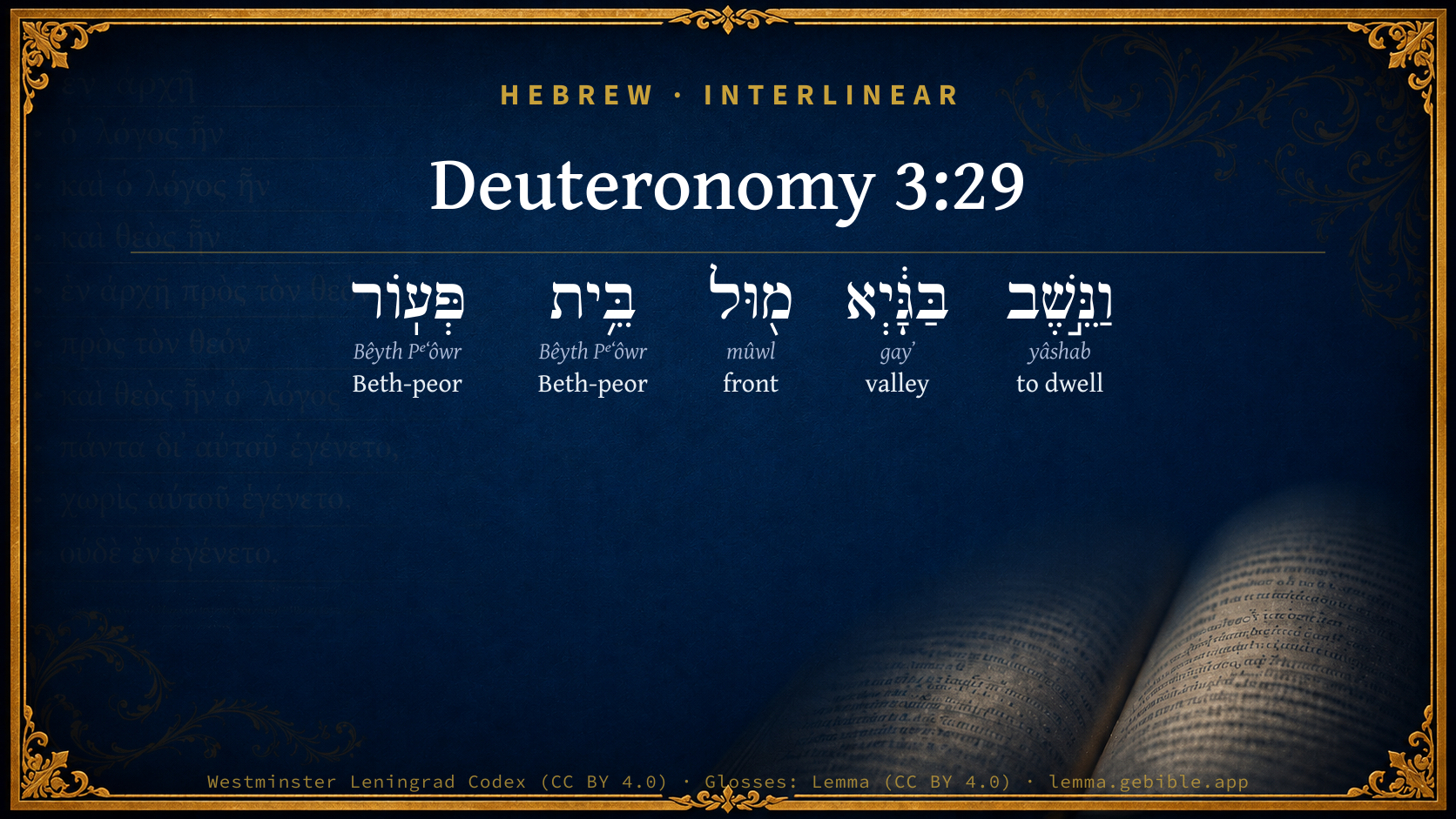
Deuteronomy 3:29

Hebrew (Westminster Leningrad Codex) Deuteronomy 3:29 appears in the Hebrew Old Testament. The text above is from the Westminster Leningrad Codex. Each word links to its Strong’s number, a concise gloss, and parsing drawn from the Open Scriptures Hebrew Bible morphology. Click any word for its full Brown-Driver-Briggs (BDB) entry.
Download image
Cite this verse

Deuteronomy 3:29 (World English Bible). Public Domain. Lemma interlinear Bible study tool, https://lemma.gebible.app/v/deuteronomy/3/29.

Show BibTeX & RIS
BibTeX
RIS
English Translation
So we abode in the valley over against Beth Peor.
World English Bible · Public Domain
Highlights
  • 1 first appearance in the Hebrew Bible
Full analysis ↓
Download a study sheet

One document with this verse’s original text, its word-by-word gloss line, the meaning frame, cross-references with their text, attributed commentary, and full source and license credits — printable, and it pastes into notes with its structure intact.

This verse Autodidact and up

Study sheet (.html) Plain text (.txt)

A passage Seminary Student

Up to 50 verses in one chapter. A passage sheet keeps up to 6 commentary sources and 12 cross-references per verse, in the order this page ranks them, and says so on the sheet whenever that leaves anything out. Ask for a single verse and you get the Autodidact verse sheet above.

Everything on this page stays free to read, with no account — the sheet is a download of what is already on screen, not access to it.

Want to remove ads? Support Godless Engineer
Compare translations 3

The same verse in 3 English versions, stacked beneath the original-language interlinear above. Click any original word for its lexicon entry.

Each is an independent rendering of the whole verse — the interlinear is not word-aligned to these translations.

Highlighted words mark where these versions differ — a whole-verse word diff, not a word-by-word alignment.

  • World English Bible Public Domain
    So we abode in the valley over against Beth Peor.
  • King James Version Public Domain
    So we abode in the valley over against Bethpeor.
  • unfoldingWord Literal Text CC BY-SA 4.0
    And we stayed in the valley opposite Beth Peor.

unfoldingWord Literal Text — © unfoldingWord, licensed CC BY-SA 4.0. Word-aligned USFM3 via Door43 (git.door43.org/unfoldingWord/en_ult).

Versions to compare (up to 4)

3 of 4 selected

Show all 18 translations

Every available English version of this verse, each an independent rendering of the whole verse.

  • World English Bible Public Domain
    So we abode in the valley over against Beth Peor.
  • Berean Standard Bible Public Domain
    So we stayed in the valley opposite Beth-peor.
  • Majority Standard Bible Public Domain
    So we stayed in the valley opposite Beth-peor.
  • King James Version Public Domain
    So we abode in the valley over against Bethpeor.
  • American Standard Version (1901) Public Domain
    So we abode in the valley over against Beth-peor.
  • Revised Version (1885) Public Domain
    So we abode in the valley over against Beth-peor.
  • Geneva Bible (1599) Public Domain
    So wee abode in the valley ouer against Beth-Peor.
  • Douay-Rheims (1899) Public Domain
    And we abode in the valley over against the temple of Phogor.
  • Young's Literal Translation Public Domain
    `And we dwell in a valley over-against Beth-Peor.
  • Literal Standard Version CC BY-SA 4.0
    And we dwell in a valley opposite Beth-Peor.”
  • Unlocked Literal Bible CC BY-SA 4.0
    So we stayed in the valley opposite Beth Peor.
  • unfoldingWord Literal Text CC BY-SA 4.0
    And we stayed in the valley opposite Beth Peor.
  • Darby Bible Public Domain
    And we abode in the valley opposite to Beth-Peor.
  • World Messianic Bible Public Domain
    So we stayed in the valley near Beth Peor.
  • Webster's Bible Public Domain
    So we abode in the valley over against Beth-peor.
  • Free Bible Version CC BY-SA 4.0
    So we remained there in the valley near Beth-peor.
  • Bible in Basic English Public Domain
    So we were waiting in the valley facing Beth-peor.
  • JPS Tanakh (1917) Public Domain
    So we abode in the valley over against Beth-peor.

Literal Standard Version (2020), Covenant Press — licensed CC BY-SA 4.0. Text via the HelloAO Bible API (eBible.org). Unlocked Literal Bible (unfoldingWord) — licensed CC BY-SA 4.0. Text via the HelloAO Bible API (eBible.org). unfoldingWord Literal Text — © unfoldingWord, licensed CC BY-SA 4.0. Word-aligned USFM3 via Door43 (git.door43.org/unfoldingWord/en_ult). Free Bible Version, Dr. Jonathan Gallagher — licensed CC BY-SA 4.0. Text via the HelloAO Bible API (eBible.org).

Word by word

More ways to search: Search by grammar → Find every occurrence → Compare this word →

Practice this passage: Drill this verse → Learn its vocabulary →

About this verse

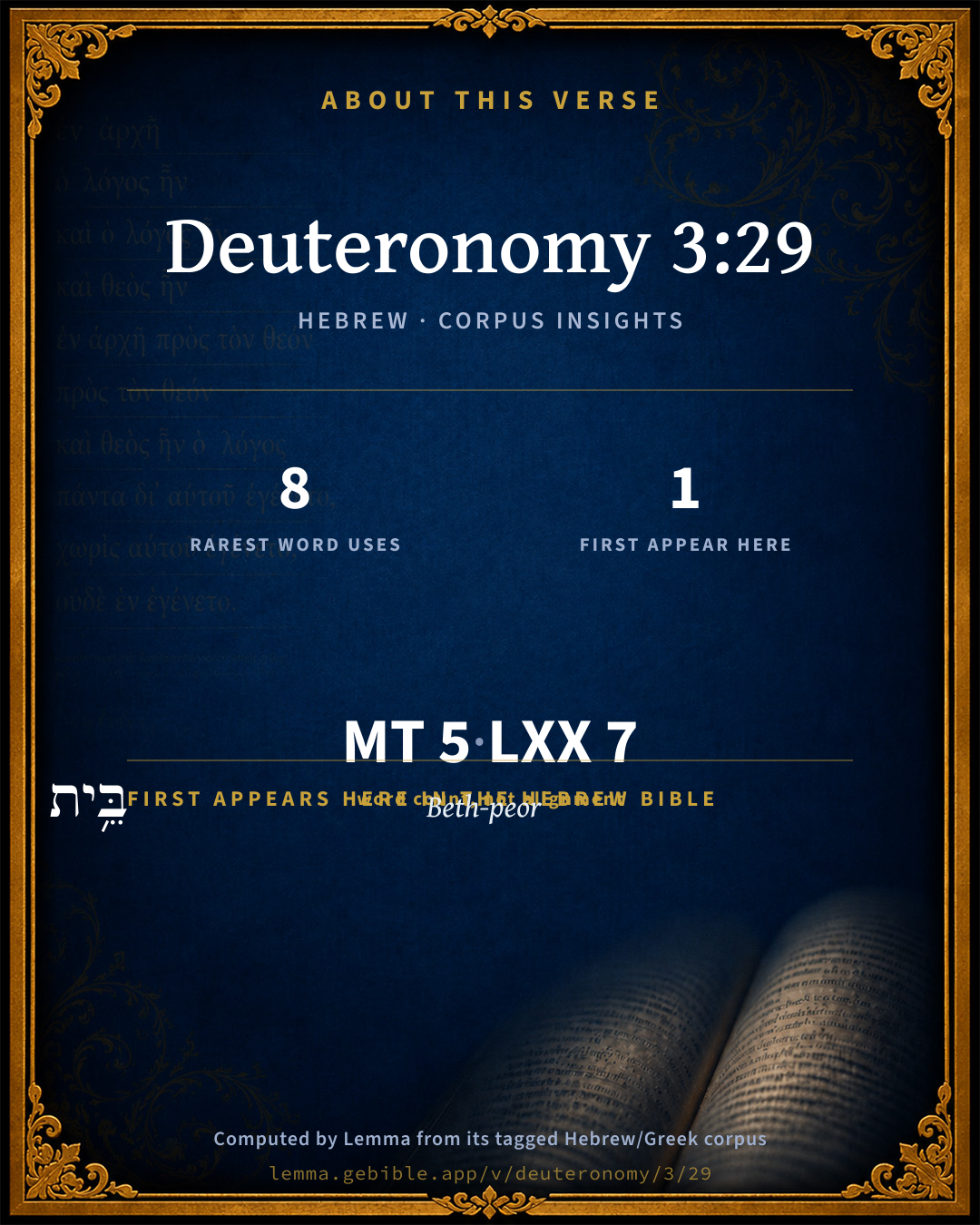
These counts appear in no published source. They are computed here, from the morphology-tagged text and Lemma’s own curated glosses. What Lemma adds →

5
words
4
distinct lemmas
Pentateuch
section

Notable vocabulary

The rarest word here is בֵּ֥ית Beth-peor H1047 — appearing just 8 times in the whole Hebrew Bible.

First appearance in Scripture

This word makes its first canonical appearance in the Hebrew Bible here:

  • בֵּ֥ית Beth-peor H1047

Shared distinctive vocabulary

בֵּ֥ית Beth-peor H1047 occurs in 4 verses of the Hebrew Bible. Also found in:

Grammatical profile

  • 1 verb
  • 3 nouns
  • 1 preposition

Verb forms

  • וַנֵּ֣שֶׁב Qal · Sequential Imperfect

Repetition

A word recurs within this verse — often emphatic in Hebrew:

  • בֵּ֥ית Beth-peor H1047 ×2

Hebrew & Septuagint length

In English translation the verse runs 10 words from the Hebrew and 11 from the Septuagint (LXX English) — closely comparable.

A rough comparison of the two English renderings, which tokenize alike — not a word-level alignment.

Word counts can differ between the Hebrew and the Greek without any difference in meaning — e.g. the Hebrew direct-object marker אֵת has no separate Greek word, and Greek often adds the article ὁ.

In the original languages it is 5 Hebrew tokens and 7 Greek tokens — but the two are counted differently (Hebrew bundles its prefixes and suffixes into one token; the Greek is in lemma form), so that isn’t a like-for-like length.

Cross-references

5

Topical passages linked to Deuteronomy 3:29 in the Treasury of Scripture Knowledge — connected by theme and wording, ordered by reader-vote popularity; previews shown in the World English Bible.

  • Deuteronomy 4:46 beyond the Jordan, in the valley over against Beth Peor, in the land of Sihon king of the Amorites, who lived at Heshbon, whom Moses and the children of Israel struck, when they came forth out of Egypt.
  • Deuteronomy 34:6 He buried him in the valley in the land of Moab over against Beth Peor: but no man knows of his tomb to this day.
  • Numbers 25:3 Israel joined himself to Baal Peor: and the anger of Yahweh was kindled against Israel.
  • Numbers 33:48–49 They traveled from the mountains of Abarim, and encamped in the plains of Moab by the Jordan at Jericho.
  • Deuteronomy 4:3 Your eyes have seen what Yahweh did because of Baal Peor; for all the men who followed Baal Peor, Yahweh your God has destroyed them from the midst of you.

Cross-references courtesy of OpenBible.info (CC BY 4.0).

Hebrew and Greek witnesses Masoretic Hebrew ↔ Greek Septuagint

The same verse in the two great witnesses to the Old Testament, shown verse-for-verse.

These are two independent witnesses, not word-aligned to each other, and the Septuagint is shown in lemma (dictionary) form.

Hebrew Deuteronomy 3:29 Masoretic · Westminster Leningrad Codex

וַנֵּ֣שֶׁב בַּגָּ֔יְא מ֖וּל בֵּ֥ית פְּעֽוֹר

So we abode in the valley over against Beth Peor.

World English Bible · Public Domain

Greek LXX Deuteronomy 3:29 Septuagint · lemma form

καί ἐνκαθήμαι ἐν νάπη σύνεγγυς οἶκος φογωρ

And we abode in the valley near the house of Phogor.

LXX2012 (modern English Septuagint) · Public Domain

Hebrew: Westminster Leningrad Codex (CC BY 4.0). Greek: Septuagint (public domain); English from LXX2012 (modern English Septuagint) (Public Domain). How the Septuagint differs from the Hebrew →

Targum (Aramaic paraphrase)

2

The Targum is the ancient Jewish Aramaic paraphrase of the Hebrew Scriptures — an interpretive translation, not the Hebrew text itself. Onkelos (literal) and Pseudo-Jonathan (expansive) render the Torah, and Jonathan the Prophets. Coverage is partial: where no permissively-licensed English translation exists for a verse, only the Aramaic is shown. This is verse-level text, not a word-by-word alignment to the Hebrew.

  1. Targum Onkelos Torah (Genesis–Deuteronomy)
    וִיתֵבְנָא בְחֵילָתָא לָקֳבֵל בֵּית פְּעוֹר

    (no public-domain English translation for this verse)

    Targum Onkelos — Aramaic: “Onkelos Genesis” (public domain); “Onkelos Exodus” (public domain); “Onkelos Leviticus” (public domain); “Onkelos Numbers” (public domain); “Onkelos Deuteronomy” (public domain). English: “Sefaria Community Translation” (CC0 1.0 (public-domain dedication)); “J.W. Etheridge. The Targums of Onkelos and Jonathan Ben Uzziel on the Pentateuch. London: Longmans, Green, 1862” (public domain). Text via Sefaria.

  2. Targum Pseudo-Jonathan Torah (Genesis–Deuteronomy)
    וְשָׁרִינָן בְּחֵילְתָא בַּכְיָין עַל חוֹבֵינָן דְּאִיזְדַוֵיגָן לְפַלְחֵי טַעֲוַת פְּעוֹר

    And we dwelt in the valley, weeping for our sins, because we had been joined with the worshippers of the idol of Peor.

    Targum Pseudo-Jonathan — Aramaic: “Targum Jonathan on Genesis” (public domain); “Targum Jonathan on Exodus” (public domain); “Targum Jonathan on Leviticus” (public domain); “Targum Jonathan on Numbers” (public domain); “Targum Jonathan on Deuteronomy” (public domain). English: “The Targum of Jonathan ben Uzziel, trans. J. W. Etheridge, London, 1862” (public domain). Text via Sefaria.

Commentary

Notes on Deuteronomy 3:29 from classic Christian and Jewish commentators (each source and its license shown beneath its notes). The classic Christian expositions comment on the surrounding passage and are grouped to its opening verse, so a note may address several verses; the Jewish commentaries on the Tanakh (Rashi and others) are per-verse, so they appear only where the commentator wrote on this verse.

Lemma curates 59 commentaries, every one of them public domain or Creative Commons licensed, each selected and text-cleaned for this edition rather than reprinted as found. About our sources →

Tyndale Open Study Notes

Tyndale Open Resources

3:29 Beth-peor, otherwise known as Baal-peor (see 4:3) or simply Peor (Num 23:28; Josh 22:17), became Moses’ burial place (Deut 34:6). At that place the false prophet Balaam had earlier attempted to curse Israel on behalf of Balak, king of Moab (Num 23:27–24:25).

Tyndale Open Study Notes — © Tyndale Open Resources, licensed CC BY-SA 4.0. Text via the HelloAO Bible API.

Adam Clarke's Commentary

Verse 29. Beth-peor.] This was a city in the kingdom of Sihon king of the Amorites; and as בית beth signifies a house, the place probably had its name from a temple of the god Peor, who was worshipped there. Peor was nearly the same among the Moabites that Priapus was among the Romans - the obscene god of an obscene people. This we have already seen.

IT is very likely that what God speaks here, both concerning Moses and Joshua, was designed to be typical of the procedure of his justice and grace in the salvation of man.

1. The land of Canaan was a type of the kingdom of heaven.

2. The law, which shows the holiness of God and the exceeding sinfulness of sin, could not bring the people to the possession of that kingdom.

3. Moses may probably be considered here as the emblem of that law by which is the knowledge of sin, but not redemption from it.

4. Joshua, the same as Jesus, the name signifying a Saviour, is appointed to bring the people into the rest which God had provided for them; thus it is by Jesus Christ alone that the soul is saved - fitted for and brought into the possession of the heavenly inheritance, (see Joh 1:17; Ga 2:16; Ga 3:12-13; Ga 3:24); for he is the end of the law - the great scope and design of the law, for righteousness - for justification, to them that believe; Ro 10:4. Such a use as this every pious reader may make of the circumstances recorded here, without the danger of pushing analogy or metaphor beyond their reasonable limits.

Adam Clarke's Commentary on the Bible (1810–1826) — public domain. Text from a community e-Sword/MySword module.

Ellicott's Commentary for English Readers

(29) So we abode in the valley over against Beth-peor.—Moses’ burial-place, as appears by Deu_34:6. It is a significant finishing touch to the scene described above. This verse also concludes the recapitulation of Israel’s journey from Horeb (Deu_1:6) to the banks of Jordan, with which this first discourse of Moses begins. The remainder, contained in Deut. Iv., is the practical part of the discourse, which now begins.

A Bible Commentary for English Readers, edited by Charles John Ellicott (1878–1897) — public domain. Text from a community e-Sword module.

The Cambridge Bible for Schools and Colleges

gen. ed. J. J. S. Perowne

29. the valley over against Beth-peor] Heb. the gai = hollow, glen, ravine, inapplicable to the Jordan plain; rather one of the glens descending to this from the Moab-plateau. That suits the probable meaning of Pe‘or, gap or cleft (Ar. fughrah, ‘a river-mouth’; cp. the ‘other Phogor’ of Euseb. and Jer. near Bethlehem, the modern Kh. Fâghûr, PEF Map Sh. xvii.). Beth-Pe‘or abbrev. from Beth-Ba‘al-Pe‘or, shrine of the B. of P. (cp. Deu_4:3). This gai of Israel’s encampment, where also Moses was buried (Deu_34:6), unnamed, but defined as over against Beth-pe‘or (so too Deu_4:46), is also nameless in E, Num_21:20, defined as in the region of Moab, and these words are added, headland of the Pisgah that looks upon the Yeshîmon; and Num_23:28 gives a headland of Pe‘or that looks out upon the Yeshîmon; while Beth-Pe‘or is placed by P, Jos_13:20, with the slopes of the Pisgah and Beth-Yeshimôth. Again Euseb. and Jer. describe Beth-phogor as near Mt Phogor opposite Jericho 6 Roman miles above Livias, the mod. Tell er-Rameh, on the Jordan plain. These data suit the identification of the gai with the W. ‘Uyûn Musa, on the N. of the Nebo or Pisgah headland (see on Deu_3:17). So Dillm., G. A. Smith (HGHL, 564) and G. B. Gray (Num_21:20). Further, Musil (Moab, 344 f., 348) suggests for the headland of Pe‘or the headland to the N. of W. ‘Uyûn Musa, and for Beth-Pe‘or the ruins and shrine esh-Sheikh Jâyel on one of the steps of that headland, ‘thence one gets the best view of the lower slopes and of the Jordan valley.’ The stream of the wady between these two headlands, before it reaches the Dead Sea, passes the ruins es-Sueimeh, in which there is a possible echo of Yeshimon, and Yeshimôth; and the bare district about this lies in full view of both headlands. There is, therefore, no need to read Pisgah for Pe‘or in Num_23:28 on the basis of Num_21:20. On the whole the above identification of the Gai with the W. ‘Uyun Musa is preferable to that with the next wâdy to the N., the W. Hesbân (Driver). Conder’s proposal for Beth-Pe‘or (Heth and Moab, 146), the headland by ‘Ain el Minyeh, would remove the Gai too far south.

The Cambridge Bible for Schools and Colleges (gen. ed. J. J. S. Perowne; Cambridge University Press, 1878–1918) — public domain. Text from a community e-Sword module.

Albert Barnes' Notes on the Bible

Beth-peor, i. e., the house of Peor, no doubt derived its name from a temple of the Moabite god Peor which was there situated. It was no doubt near to Mount Peor Num 23:28, and also to the valley of the Jordan perhaps in the Wady Heshban.

Albert Barnes' Notes on the Bible (1834–1885) — public domain. Text from a community e-Sword/MySword module.

Haydock's Catholic Bible Commentary

Phogor. Hebrew Beth pehor, "the house, temple, or city of Phogor," where that idol was the object of adoration. The city was probably at the foot of Mount Phasga, and fell to the share of Ruben, Josue xiii. 20. (Calmet) --- The Hebrews dwelt in the valley when Moses made the aforesaid supplication to God, and was ordered to desist; and, after taking a view of the promised land, to give the necessary instructions to his successor, ver. 23. (Haydock) --- Perhaps this might take place before the defeat of the two kings. (Calmet)

George Leo Haydock (1774–1849), Haydock's Catholic Family Bible and Commentary, 1859 edition — public domain. Excludes Psalms (Douay-Rheims chapter numbering differs from Protestant) and Deuterocanonical books (Catholic canon only).

Matthew Poole's English Annotations

The house or temple of Peor, or of Baal-Peor, of which see Num 25:3, whence this place or city had its name.

Matthew Poole's English Annotations on the Holy Bible (1683–1685) — public domain. Text from a community e-Sword/MySword module.

Whedon's Commentary on the Bible

Daniel D. Whedon

29. So we abode in the valley — Here the people were encamped a long time. The transactions related in Numbers 28-34 took place here. Here these discourses of Moses were spoken. Near this spot he was buried.

Beth-peor — See on Num_23:28.

Daniel D. Whedon (gen. ed.), Commentary on the Old and New Testaments (1874–1909) — public domain. Text from a community e-Sword module.

The Pulpit Commentary

In the valley over against Beth-peor; i.e. in the plains of Moab. (Arboth Moab, Num_22:1; cf. Deu_4:46 Deu_34:6) Beth-pe"or, i.e the house or temple of Pe"or, the Moabitish Baah There was a hill Pe"or, in the Abarim range, near to which this town was; it was opposite to Jericho, six Roman miles north of Libias (Eusebius); it was given to the tribe of Reuben. (Jos_13:20) In passing from the historical recapitulation, Moses indicates precisely the locality in which they were when this address was delivered.

The Pulpit Commentary (1880–1919), ed. H.D.M. Spence-Jones & Joseph S. Exell — public domain. Text from a community e-Sword module.

Rashi

Rabbi Shlomo Yitzchaki (Rashi)

ונשב בגיא וגו׳ SO WE ABODE IN THE VALLEY [OVER AGAINST BETH PEOR], — and ye associated yourselves with idol-worship, yet, however, ועתה ישראל שמע אל החקים NOW, O ISRAEL, HEARKEN TO THE STATUTES and everything will be forgiven thee. But I — I was not privileged that it was forgiven me (Sifrei Devarim 30:2).

Rashi on the Tanakh — English translations: “The Judaica Press complete Tanach with Rashi, translated by A. J. Rosenberg” (CC BY 4.0); “Pentateuch with Rashi's commentary by M. Rosenbaum and A.M. Silbermann, 1929-1934” (public domain); “The Metsudah Tanach series, Lakewood, N.J” (CC BY 4.0); and “The Book of Joshua, Metsudah Publications, 1997” (CC BY 4.0). Text via Sefaria.

Lesson kit

Teaching starters — assembled from the data on this page, not authored interpretation. Every prompt links to the verse data it draws on. Edit before teaching.

Deuteronomy, in the Pentateuch, opens this verse with 5 words (4 distinct Hebrew lemmas). Its most distinctive word is Bêyth Pᵉʻôwr (“Beth-peor”). A historical commentator’s framing appears above. Read the whole chapter for the surrounding context.

Discussion questions

  1. How does “Beth-peor” (Bêyth Pᵉʻôwr) shape what this verse is saying?
  2. This is the first place “Beth-peor” appears in Scripture (first appears here). What does its debut here establish?
  3. How does Deuteronomy 4:46, which shares the word «Beth-peor», read alongside this verse?
  4. What does the repetition of “Beth-peor” (2× in this one verse) do in this verse?
  5. The translations on this page render this verse differently — a whole-verse word diff, not a word-by-word alignment. What might account for the different wordings?
  6. «וַנֵּ֣שֶׁב» is a Qal Sequential Imperfect verb. How does that grammatical form shape the action described?
  7. Compare how Tyndale Open Study Notes and Adam Clarke's Commentary read this verse. Where do they agree or differ?

Things to notice

Reading settings

Reading text

Shown beneath each verse's original-language words.

Old Testament
Old Testament edition

Read the OT as the Masoretic Hebrew (MT) or the Greek Septuagint (LXX).

English shown for the Greek Septuagint (in the Hebrew ↔ Greek comparison).

Comparing translations? Open the Compare panel on any verse page to stack up to four side by side.