
Joshua 2:12

Hebrew (Westminster Leningrad Codex) Joshua 2:12 appears in the Hebrew Old Testament. The text above is from the Westminster Leningrad Codex. Each word links to its Strong’s number, a concise gloss, and parsing drawn from the Open Scriptures Hebrew Bible morphology. Click any word for its full Brown-Driver-Briggs (BDB) entry.
Download image
Cite this verse

Joshua 2:12 (World English Bible). Public Domain. Lemma interlinear Bible study tool, https://lemma.gebible.app/v/joshua/2/12.

Show BibTeX & RIS
BibTeX
RIS
English Translation
Now therefore, please swear to me by Yahweh, since I have dealt kindly with you, that you also will deal kindly with my father's house, and give me a true token;
World English Bible · Public Domain
Download a study sheet

One document with this verse’s original text, its word-by-word gloss line, the meaning frame, cross-references with their text, attributed commentary, and full source and license credits — printable, and it pastes into notes with its structure intact.

This verse Autodidact and up

Study sheet (.html) Plain text (.txt)

A passage Seminary Student

Up to 50 verses in one chapter. A passage sheet keeps up to 6 commentary sources and 12 cross-references per verse, in the order this page ranks them, and says so on the sheet whenever that leaves anything out. Ask for a single verse and you get the Autodidact verse sheet above.

Everything on this page stays free to read, with no account — the sheet is a download of what is already on screen, not access to it.

Want to remove ads? Support Godless Engineer
Compare translations 3

The same verse in 3 English versions, stacked beneath the original-language interlinear above. Click any original word for its lexicon entry.

Each is an independent rendering of the whole verse — the interlinear is not word-aligned to these translations.

Highlighted words mark where these versions differ — a whole-verse word diff, not a word-by-word alignment.

  • World English Bible Public Domain
    Now therefore, please swear to me by Yahweh, since I have dealt kindly with you, that you also will deal kindly with my father's house, and give me a true token;
  • King James Version Public Domain
    Now therefore, I pray you, swear unto me by the LORD, since I have showed you kindness, that ye will also show kindness unto my father's house, and give me a true token:
  • unfoldingWord Literal Text CC BY-SA 4.0
    And now, please swear to me by Yahweh, since I am doing kindness with you, that you yourselves will also do kindness with the house of my father, and give to me a sign of truth,

unfoldingWord Literal Text — © unfoldingWord, licensed CC BY-SA 4.0. Word-aligned USFM3 via Door43 (git.door43.org/unfoldingWord/en_ult).

Versions to compare (up to 4)

3 of 4 selected

Show all 18 translations

Every available English version of this verse, each an independent rendering of the whole verse.

  • World English Bible Public Domain
    Now therefore, please swear to me by Yahweh, since I have dealt kindly with you, that you also will deal kindly with my father's house, and give me a true token;
  • Berean Standard Bible Public Domain
    Now therefore, please swear to me by the LORD that you will indeed show kindness to my family, because I showed kindness to you. Give me a sure sign
  • Majority Standard Bible Public Domain
    Now therefore, please swear to me by the LORD that you will indeed show kindness to my family, because I showed kindness to you. Give me a sure sign
  • King James Version Public Domain
    Now therefore, I pray you, swear unto me by the LORD, since I have showed you kindness, that ye will also show kindness unto my father's house, and give me a true token:
  • American Standard Version (1901) Public Domain
    Now therefore, I pray you, swear unto me by Jehovah, since I have dealt kindly with you, that ye also will deal kindly with my father's house, and give me a true token;
  • Revised Version (1885) Public Domain
    Now therefore, I pray you, swear unto me by the LORD, since I have dealt kindly with you, that ye also will deal kindly with my father’s house, and give me a true token:
  • Geneva Bible (1599) Public Domain
    Now therefore, I pray you, sweare vnto me by the Lord; that as I haue shewed you mercie, ye will also shewe mercie vnto my fathers house, and giue me a true token,
  • Douay-Rheims (1899) Public Domain
    We have heard that
  • Young's Literal Translation Public Domain
    `And now, swear ye, I pray you, to me by Jehovah -- because I have done with you kindness -- that ye have done, even ye, kindness with the house of my father, and have given to me a true token,
  • Literal Standard Version CC BY-SA 4.0
    And now, please swear to me by YHWH—because I have done kindness with you—that you have done, even you, kindness with the house of my father, and have given a true token to me,
  • Unlocked Literal Bible CC BY-SA 4.0
    Now then, please swear to me by Yahweh that, just as I have been kind to you, you will also deal kindly with my father's house. Give me a sure sign
  • unfoldingWord Literal Text CC BY-SA 4.0
    And now, please swear to me by Yahweh, since I am doing kindness with you, that you yourselves will also do kindness with the house of my father, and give to me a sign of truth,
  • Darby Bible Public Domain
    And now, I pray you, swear to me by Jehovah, since I have dealt kindly with you, that ye will also deal kindly with my father's house, and give me a certain sign,
  • World Messianic Bible Public Domain
    Now therefore, please swear to me by the LORD, since I have dealt kindly with you, that you also will deal kindly with my father’s house, and give me a true sign;
  • Webster's Bible Public Domain
    Now therefore, I pray you, swear to me by the LORD, since I have showed you kindness, that ye will also show kindness to my father's house, and give me a true token:
  • Free Bible Version CC BY-SA 4.0
    So now promise me in the name of the Lord that because I have acted in good faith to you, then you will do the same for my family. Give me some sign that I can trust you,
  • Bible in Basic English Public Domain
    So now, will you give me your oath by the Lord, that, because I have been kind to you, you will be kind to my father's house,
  • JPS Tanakh (1917) Public Domain
    Now therefore, I pray you, swear unto me by the LORD, since I have dealt kindly with you, that ye also will deal kindly with my father's house — and give me a true token —

Literal Standard Version (2020), Covenant Press — licensed CC BY-SA 4.0. Text via the HelloAO Bible API (eBible.org). Unlocked Literal Bible (unfoldingWord) — licensed CC BY-SA 4.0. Text via the HelloAO Bible API (eBible.org). unfoldingWord Literal Text — © unfoldingWord, licensed CC BY-SA 4.0. Word-aligned USFM3 via Door43 (git.door43.org/unfoldingWord/en_ult). Free Bible Version, Dr. Jonathan Gallagher — licensed CC BY-SA 4.0. Text via the HelloAO Bible API (eBible.org).

Word by word

More ways to search: Search by grammar → Find every occurrence → Compare this word →

Practice this passage: Drill this verse → Learn its vocabulary →

א֥וֹת
ʼôwth
H226
“sign of”
Noun, Common, Both, Singular, Construct
Part of Speech
Noun
Type
Common
Gender
Both
Number
Singular
State
Construct
Full BDB Definition

Origin: probably from H225 (in the sense of appearing)

TWOT: 41a

sign, signal - a distinguishing mark - banner - remembrance - miraculous sign - omen - warning - token, ensign, standard, miracle, proof
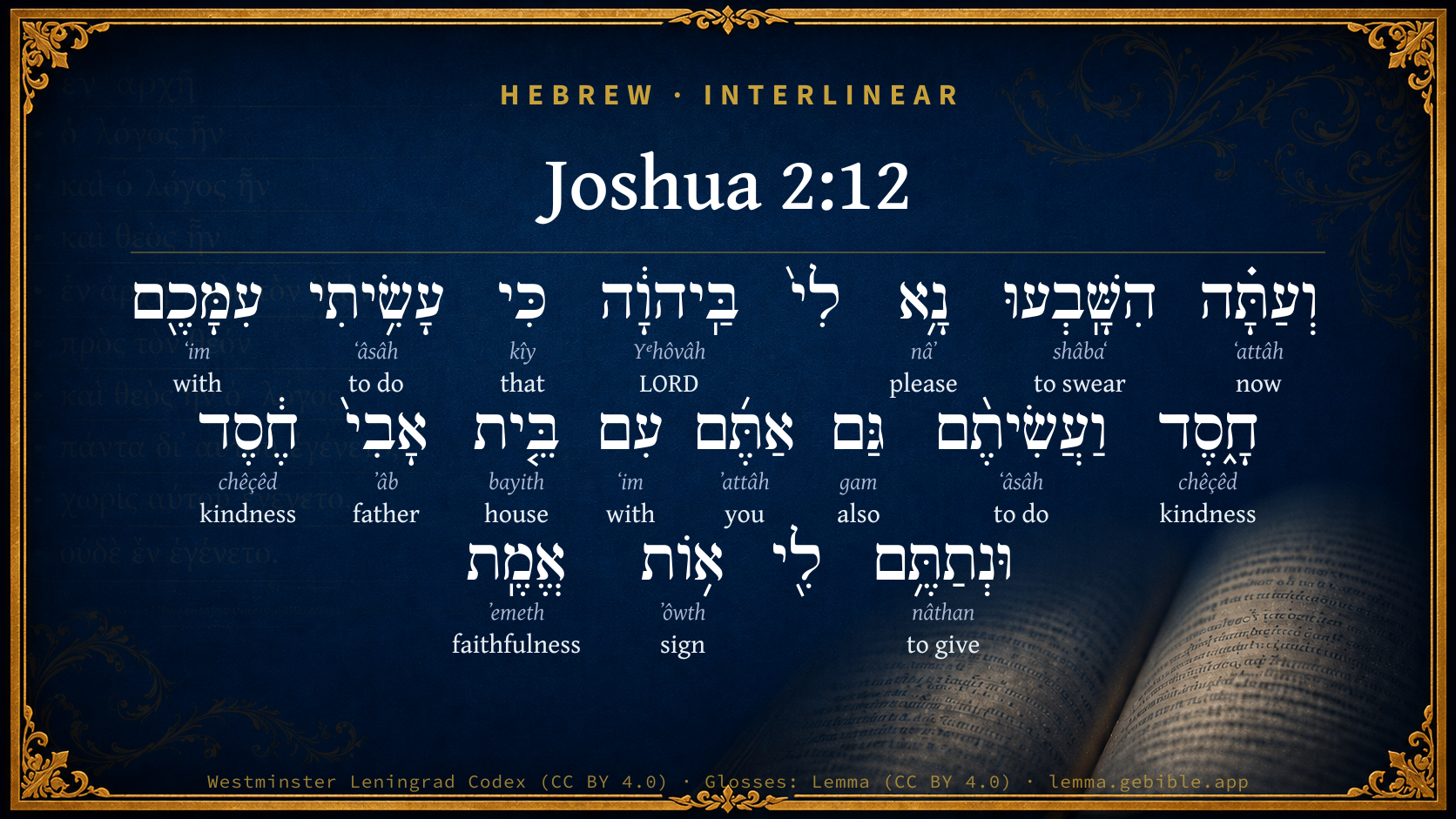
  1. וְעַתָּ֗ה ʻattâh H6258 “and · now” Conjunction + Adverb
  2. הִשָּֽׁבְעוּ shâbaʻ H7650 “swear” Verb, Niphal, Imperative, 2nd Person, Masculine, Plural
  3. נָ֥א nâʼ H4994 “please” Particle, Exhortation
  4. בַּֽיהוָ֔ה Yᵉhôvâh H3068 “in/at · LORD” Preposition + Noun, Proper
  5. כִּי kîy H3588 “that” Conjunction
  6. עָשִׂ֥יתִי ʻâsâh H6213 “to do” Verb, Qal, Perfect, 1st Person, Common, Singular
  7. עִמָּכֶ֖ם ʻim H5973 “with · you” Preposition + Suffix, Personal, 2nd Person, Masculine, Plural
  8. חָ֑סֶד chêçêd H2617 “kindness” Noun, Common, Masculine, Singular, Absolute
  9. וַעֲשִׂיתֶ֨ם ʻâsâh H6213 “and · to do” Conjunction + Verb, Qal, Sequential Perfect, 2nd Person, Masculine, Plural
  10. גַּם gam H1571 “also” Particle, Accusative
  11. אַתֶּ֜ם ʼattâh H859 “you” Pronoun, Personal, 2nd Person, Masculine, Plural
  12. עִם ʻim H5973 “with” Preposition
  13. בֵּ֤ית bayith H1004 “house of” Noun, Common, Masculine, Singular, Construct
  14. אָבִי֙ ʼâb H1 “father · my” Noun, Common, Masculine, Singular, Construct + Suffix, Personal, 1st Person, Common, Singular
  15. חֶ֔סֶד chêçêd H2617 “kindness” Noun, Common, Masculine, Singular, Absolute
  16. וּנְתַתֶּ֥ם nâthan H5414 “and · to give” Conjunction + Verb, Qal, Sequential Perfect, 2nd Person, Masculine, Plural
  17. אֱמֶֽת ʼemeth H571 “faithfulness” Noun, Common, Feminine, Singular, Absolute

About this verse

These counts appear in no published source. They are computed here, from the morphology-tagged text and Lemma’s own curated glosses. What Lemma adds →

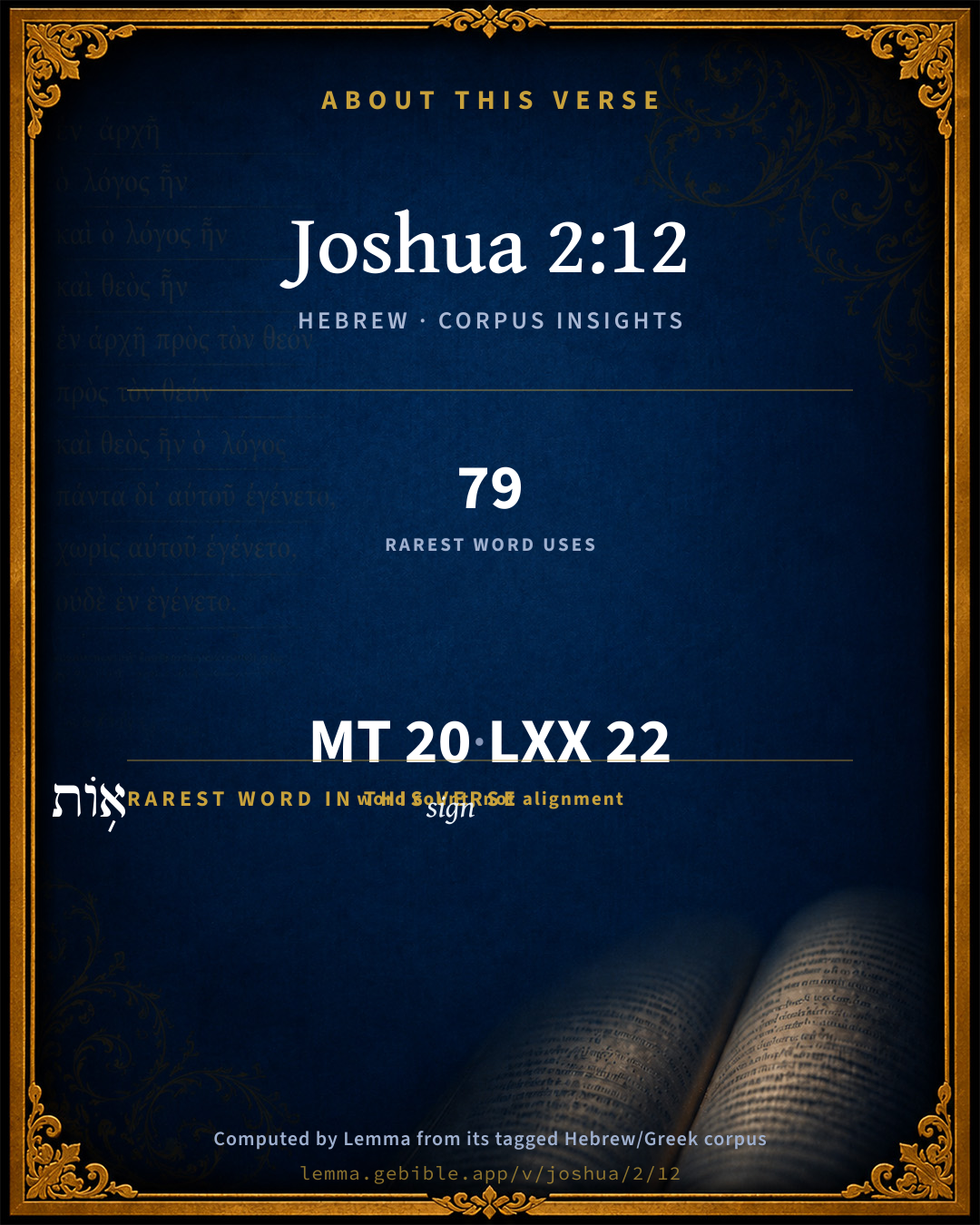
20
words
15
distinct lemmas
Historical
section

Grammatical profile

  • 4 verbs
  • 7 nouns
  • 1 pronoun
  • 4 prepositions
  • 1 conjunction
  • 1 adverb
  • 2 particles

Verb forms

  • הִשָּֽׁבְעוּ Niphal · Imperative
  • עָשִׂ֥יתִי Qal · Perfect
  • וַעֲשִׂיתֶ֨ם Qal · Sequential Perfect
  • וּנְתַתֶּ֥ם Qal · Sequential Perfect

Repetition

Words recur within this verse — often emphatic in Hebrew:

  • עָשִׂ֥יתִי to do H6213 ×2
  • חָ֑סֶד kindness H2617 ×2
  • עִמָּכֶ֖ם with H5973 ×2

Hebrew & Septuagint length

In English translation the verse runs 31 words from the Hebrew and 27 from the Septuagint (LXX English) — closely comparable.

A rough comparison of the two English renderings, which tokenize alike — not a word-level alignment.

Word counts can differ between the Hebrew and the Greek without any difference in meaning — e.g. the Hebrew direct-object marker אֵת has no separate Greek word, and Greek often adds the article ὁ.

In the original languages it is 20 Hebrew tokens and 22 Greek tokens — but the two are counted differently (Hebrew bundles its prefixes and suffixes into one token; the Greek is in lemma form), so that isn’t a like-for-like length.

Cross-references

19

Topical passages linked to Joshua 2:12 in the Treasury of Scripture Knowledge — connected by theme and wording, ordered by reader-vote popularity; previews shown in the World English Bible.

  • Joshua 2:18 Behold, when we come into the land, you shall bind this line of scarlet thread in the window which you did let us down by: and you shall gather to you into the house your father, and your mother, and your brothers, and all your father's household.
  • Genesis 24:3 I will make you swear by Yahweh, the God of heaven and the God of the earth, that you shall not take a wife for my son of the daughters of the Canaanites, among whom I live.
  • Genesis 24:9 The servant put his hand under the thigh of Abraham his master, and swore to him concerning this matter.
  • Exodus 12:13 The blood shall be to you for a token on the houses where you are: and when I see the blood, I will pass over you, and there shall no plague be on you to destroy you, when I strike the land of Egypt.
  • Joshua 2:13 and that you will save alive my father, and my mother, and my brothers, and my sisters, and all that they have, and will deliver our lives from death.
  • Joshua 9:15 Joshua made peace with them, and made a covenant with them, to let them live: and the princes of the congregation swore to them.
  • Joshua 9:18–20 The children of Israel didn't strike them, because the princes of the congregation had sworn to them by Yahweh, the God of Israel. All the congregation murmured against the princes.
  • 1 Samuel 20:14–17 You shall not only while yet I live show me the loving kindness of Yahweh, that I not die;
  • 1 Samuel 24:21–22 Swear now therefore to me by Yahweh, that you will not cut off my seed after me, and that you will not destroy my name out of my father's house.
  • 1 Samuel 30:15 David said to him, Will you bring me down to this troop? He said, Swear to me by God, that you will neither kill me, nor deliver me up into the hands of my master, and I will bring you down to this troop.
  • 2 Chronicles 36:13 He also rebelled against king Nebuchadnezzar, who had made him swear by God: but he stiffened his neck, and hardened his heart against turning to Yahweh, the God of Israel.
  • Esther 8:6 for how can I endure to see the evil that shall come to my people? or how can I endure to see the destruction of my relatives?
  • Jeremiah 12:16 It shall happen, if they will diligently learn the ways of my people, to swear by my name, As Yahweh lives; even as they taught my people to swear by Baal; then shall they be built up in the midst of my people.
  • Ezekiel 9:4–6 Yahweh said to him, Go through the midst of the city, through the midst of Jerusalem, and set a mark on the foreheads of the men that sigh and that cry over all the abominations that are done in the midst of it.
  • Mark 14:44 Now he who betrayed him had given them a sign, saying, "Whoever I will kiss, that is he. Seize him, and lead him away safely."
  • 1 Timothy 5:8 But if anyone doesn't provide for his own, and especially his own household, he has denied the faith, and is worse than an unbeliever.
  • 2 Timothy 1:16–18 May the Lord grant mercy to the house of Onesiphorus, for he often refreshed me, and was not ashamed of my chain,
  • James 2:13 For judgment is without mercy to him who has shown no mercy. Mercy triumphs over judgment.
  • Romans 1:31 without understanding, covenant-breakers, without natural affection, unforgiving, unmerciful;

Cross-references courtesy of OpenBible.info (CC BY 4.0).

Hebrew and Greek witnesses Masoretic Hebrew ↔ Greek Septuagint

The same verse in the two great witnesses to the Old Testament, shown verse-for-verse.

These are two independent witnesses, not word-aligned to each other, and the Septuagint is shown in lemma (dictionary) form.

Hebrew Joshua 2:12 Masoretic · Westminster Leningrad Codex

וְעַתָּ֗ה הִשָּֽׁבְעוּ נָ֥א לִי֙ בַּֽיהוָ֔ה כִּי עָשִׂ֥יתִי עִמָּכֶ֖ם חָ֑סֶד וַעֲשִׂיתֶ֨ם גַּם אַתֶּ֜ם עִם בֵּ֤ית אָבִי֙ חֶ֔סֶד וּנְתַתֶּ֥ם לִ֖י א֥וֹת אֱמֶֽת

Now therefore, please swear to me by Yahweh, since I have dealt kindly with you, that you also will deal kindly with my father's house, and give me a true token;

World English Bible · Public Domain

Greek LXX Joshua 2:12 Septuagint · lemma form

καί νῦν ὄμνυμι ἐγώ κύριος ὁ θεός ὅτι ποιέω σύ ἔλεος καί ποιέω καί σύ ἔλεος ἐν ὁ οἶκος ὁ πατήρ ἐγώ

And now swear to me by the Lord God; since I deal mercifully with you, so do you⌃ also deal mercifully with the house of my father:

LXX2012 (modern English Septuagint) · Public Domain

Hebrew: Westminster Leningrad Codex (CC BY 4.0). Greek: Septuagint (public domain); English from LXX2012 (modern English Septuagint) (Public Domain). How the Septuagint differs from the Hebrew →

Targum (Aramaic paraphrase)

1

The Targum is the ancient Jewish Aramaic paraphrase of the Hebrew Scriptures — an interpretive translation, not the Hebrew text itself. Onkelos (literal) and Pseudo-Jonathan (expansive) render the Torah, and Jonathan the Prophets. Coverage is partial: where no permissively-licensed English translation exists for a verse, only the Aramaic is shown. This is verse-level text, not a word-by-word alignment to the Hebrew.

  1. Targum Jonathan Prophets (Joshua–Malachi)
    וּכְעַן קַיְימוּ כְעַן לִי בְּמֵימְרָא דַייָ אֲרֵי עֲבָדִית עִמְכוֹן טִיבוּ וְתַעְבְּדוּן אַף אַתּוּן עִם בֵּית אַבָּא טִיבוּ וְתִתְּנוּן לִי אָת דִקְשׁוֹט:

    (no public-domain English translation for this verse)

    Targum Jonathan — Aramaic: “Mikraot Gedolot” (public domain). English: “Sefaria Community Translation” (CC0 1.0 (public-domain dedication)); “London "Chaldee Paraphrase," 1871” (public domain). Text via Sefaria.

Commentary

Notes on Joshua 2:12 from classic Christian and Jewish commentators (each source and its license shown beneath its notes). The classic Christian expositions comment on the surrounding passage and are grouped to its opening verse, so a note may address several verses; the Jewish commentaries on the Tanakh (Rashi and others) are per-verse, so they appear only where the commentator wrote on this verse.

Lemma curates 59 commentaries, every one of them public domain or Creative Commons licensed, each selected and text-cleaned for this edition rather than reprinted as found. About our sources →

The Cambridge Bible for Schools and Colleges

gen. ed. J. J. S. Perowne

12. a true token] “a verrey tokne,” Wyclif; i.e. a token of truth, a sign; comp. Exo_3:12, “And this shall be a token unto thee, that I have sent thee;” 1Sa_2:34; Isa_7:11; Luk_2:12.

The Cambridge Bible for Schools and Colleges (gen. ed. J. J. S. Perowne; Cambridge University Press, 1878–1918) — public domain. Text from a community e-Sword module.

Trapp's Complete Commentary

John Trapp

Jos 2:12 Now therefore, I pray you, swear unto me by the LORD, since I have shewed you kindness, that ye will also shew kindness unto my father’s house, and give me a true token:

Ver. 12. And give me a true token.] Sυσσημον, as Mar 14:44. Signum consignans, de composito datum. As for the familiar conference that here passed betwixt these spies and Rahab, we need not question how they could so easily understand one another, being of two several nations. For, first, the language of the Canaanites, Phoenicians, Philistines, differed not much from the Hebrew, which Jerome {a} rightly calleth Omnium linguarum matricem, the mother tongue. See Plautus in "Paenulo," act v. And then, it is not unlikely that these spies had learned the language of Canaan, by conversing with those conquered Amorites on this side Jordan.

{a} In cap. iii. Sophoniae.

John Trapp, A Commentary or Exposition upon All the Books of the Old and New Testament (1647–1656) — public domain. Text from a community e-Sword module.

Joseph Benson's Commentary

Jos 2:12-13. Swear unto me by the Lord — Hebrew, by Jehovah, your God, who is the only true God: so she owns his worship, one eminent act whereof is, swearing by his name. My father’s house — My near kindred, which she particularly names, (Jos 2:13,) husband and children, it seems, she had none. And for herself it was needless to speak, it being a plain and undeniable duty to save their preserver. True tokens — Either an assurance that you will preserve me and mine from the common ruin, or a token which I may produce as a witness of this agreement, and a means of my security. This is all that she asks. But God did for her more than she could ask or think. She was afterward advanced to be a princess in Israel, the wife of Salmon, and one of the ancestors of Christ. All that they have — That is, their children, as appears from Jos 6:23.

Joseph Benson's Commentary on the Old and New Testaments (1811–1818) — public domain. Text from a community e-Sword module.

Tyndale Open Study Notes

Tyndale Open Resources

2:12-13 Rahab’s request demonstrated her faith in Israel and Israel’s God.

Tyndale Open Study Notes — © Tyndale Open Resources, licensed CC BY-SA 4.0. Text via the HelloAO Bible API.

Adam Clarke's Commentary

Verse 12. Swear unto me by the Lord] This is a farther proof that this woman had received considerable instruction in the Jewish faith; she acknowledged the true God by his essential character Jehovah; and knew that an oath in his name was the deepest and most solemn obligation under which a Jew could possibly come. Does not this also refer to the command of God, Thou shalt fear the Lord, and shalt swear by his name? See Clarke on De 6:13.

Adam Clarke's Commentary on the Bible (1810–1826) — public domain. Text from a community e-Sword/MySword module.

John Calvin's Commentaries

12. Now, therefore, I pray you, swear, etc. It is another manifestation of faith that she places the sons of Abraham in sure possession of the land of Canaan, founding on no other argument than her having heard that it was divinely promised to them. For she did not suppose that God was favoring lawless intruders who were forcing their way into the territories of others with unjust violence and uncurbed licentiousness, but rather concluded that they were coming into the land of Canaan, because God had assigned them the dominion of it. It cannot be believed that when they sought a passage from the Edomites and others, they said nothing as to whither they were going. Nay, those nations were acquainted with the promise which was made to Abraham, and the memory of which had been again renewed by the rejection of Esau.

Moreover, in the language of Rahab, we behold that characteristic property of faith described by the author of the Epistle to the Hebrews, when he calls it a vision, or sight of things not appearing. (Hebrews 11:1) Rahab is dwelling with her people in a fortified city: and yet she commits her life to her terrified guests, just as if they had already gained possession of the land, and had full power to save or destroy as they pleased. This voluntary surrender was, in fact, the very same as embracing the promise of God, and casting herself on his protection. She, moreover, exacts an oath, because often, in the storming of cities, the heat and tumult of the struggle shook off the remembrance of duty. In the same way she mentions the kindness she had shown to them, that gratitude might stimulate them the more to perform their promise. For although the obligation of the oath ought of itself to have been effectual, it would have been doubly base and inhumane not to show gratitude to a hostess to whom they owed deliverance. Rahab shows the kindliness of her disposition, in her anxiety about her parents and kindred. This is, indeed, natural; but many are so devoted to themselves, that children hesitate not to ransom their own lives by the death of their parents, instead of exerting courage and zeal to save them.

John Calvin's Commentaries (1540-1563) — public domain. Text from the Calvin Translation Society English edition (1840s-50s) via the Christian Classics Ethereal Library (ccel.org). Calvin's coverage is partial (roughly two-thirds of the Bible); uncommented books and verses are honest gaps, never fabricated. The 19th-century editor's footnotes and remarks are omitted so the notes are faithfully Calvin's own voice.

John Gill's Exposition

Now therefore, I pray you, swear unto me by the Lord,.... Which being a religious action, and done by men that feared the Lord, she knew it would be binding upon them: the Targum is,"swear to me by the Word of the Lord:"

since I have showed you kindness; by receiving them with peace into her house, and hiding them when inquired for and demanded of her; in doing which she risked her own, life, had this treachery to her country, as it would have been deemed, been discovered;

that you will also show kindness unto my father's house; she mentions not herself and household, for if this was granted that would be implied and included; and this she presses for by the law of retaliation and friendship, for since she had shown kindness to them, it was but reasonable it should be returned:

and give me a true token; that she and her father's house would be saved by them when the city should be taken and the inhabitants destroyed; a token that would not deceive her, on which she might depend, and would be firm and sure.

John Gill's Exposition of the Whole Bible (1746–1763) — public domain (CC PDM 1.0). Text via the HelloAO Bible API.

Albert Barnes' Notes on the Bible

A true token - literally, “a sign” or “pledge of truth; “something to bind them to keep their promise faithfully. The “token” was the oath which the spies take Jos 2:14.

Albert Barnes' Notes on the Bible (1834–1885) — public domain. Text from a community e-Sword/MySword module.

Haydock's Catholic Bible Commentary

True token, such a one as, when I shew it to the Israelites, they may preserve me and mine. She is not content with a verbal promise, she requires something permanent and sensible, as a mark of their mutual engagements, (Calmet) a token of their sincerity. They afterwards appointed a piece of scarlet to be hung out of the house, where those were to be collected who should be entitled to protection. Rahab was bound not to divulge their secret, nor to betray them. If she had instructed others of her fellow-citizens to hand out the same mark, she would have forfeited all her privileges, ver. 20. (Haydock)

George Leo Haydock (1774–1849), Haydock's Catholic Family Bible and Commentary, 1859 edition — public domain. Excludes Psalms (Douay-Rheims chapter numbering differs from Protestant) and Deuterocanonical books (Catholic canon only).

Matthew Poole's English Annotations

By the Lord; by your God, who is the only true God: so she shows her conversion to God, and owns his worship, one eminent act whereof is swearing by his name.

My father’s house; my near kindred, which she particularly names, Jos 2:13. Husband and children it seems she had none. And for herself; it was needless to speak, it being a plain and undeniable duty to save their preserver.

A true token; either an assurance that you will preserve me and mine from the common ruin; or a token which I may produce as a witness of this-agreement, and a mean of my security.

Matthew Poole's English Annotations on the Holy Bible (1683–1685) — public domain. Text from a community e-Sword/MySword module.

Whedon's Commentary on the Bible

Daniel D. Whedon

12. Swear unto me — She gives still stronger proof of her confidence in the success of the Israelites by wishing to enter into covenant with the spies for the salvation of herself and her father’s family. She feels that if they swear by Israel’s mighty God they will not dare prove false. Her faith assumes a practical character, and shows itself by works. It impels her to bargain for her deliverance from the destruction which she sees impending over the city.

Since I have showed you kindness — Rahab here makes a good application of the Golden Rule.

Give me a true token — Some visible, material proof of the oath; some object which she may keep and produce as evidence that such a solemn compact has been entered into by the parties. This token was a substitute for a written covenant bearing their signatures.

Daniel D. Whedon (gen. ed.), Commentary on the Old and New Testaments (1874–1909) — public domain. Text from a community e-Sword module.

The Pulpit Commentary

THE OATH OF THE SPIES.

Kindness. The original is perhaps a little stronger, and involves usually the idea of mercy and pity. This, however, is not always the ease. (see Gen_21:23 2Sa_10:2) "It had been an ill nature in Rahab if she had been content to be saved alone: that her love might be a match to her faith, she covenants for all her family, and so returns life to those of whom she received it," (Bp. Hall). A true token. Literally, a token of truth. The construction is that in which the latter noun often stands in Hebrew for an adjective. Here, however, it would seem to be a little more, a token of truth a pledge, that is, of sincerity. Rahab wanted some guarantee that her life and the lives of her kindred would be saved. The bare word of the spies would not suffice, for how could she and her kindred be identified in the confusion attending the sack of the city? But if the spies would agree upon some sign by which she could be recognised, it would at once be a pledge that they intended to keep their word, and a means of protection in the approaching downfall of the city.

Vers. 12-24. The oath of the spies, and their return to Joshua.

This passage suggests considerations of various kinds, historical, practical, and allegorical.

I THE TRUSTWORTHINESS OF THE SPIES. They had, no doubt, been specially selected by Joshua for this purpose, and they show themselves worthy of his choice.

(1) They are scrupulously honest. They enter into an engagement with Rahab, and that engagement is faithfully kept. They are anxious that the tenor of their engagement should be thoroughly understood on both sides, so that there may be no reproach cast upon them for not observing conditions which it would be impossible to fulfill. And they are also

(2) men of foresight. They do not give their word rashly, without having considered to what they are pledging themselves. They see beforehand how impossible it would be, in the confusion attending the sack of the city, to ensure the safety of those in whose welfare Rahab is interested. Thus they suggest the twofold precaution that Rahab"s relatives should be collected together in Rahab"s house, and that Rahab"s house should be plainly indicated by the scarlet cord. And

(3) they are grateful. They might have left matters as they were, and taken no trouble to point out to Rahab the risk she was running, in the absence of some definite agreement as to the way in which the promise should be carried out. They might have excused themselves afterwards by saying that it was not their business, but Rahab"s, to secure the identification of herself and her kindred. But they took every care and trouble possible to show their Sense of the obligation they were under to a stranger who had thus generously interested herself in their safety. Such are the men who ought to be singled out for special work in God"s Church, scrupulous, thoughtful, frank, generous, grateful men, who make it their first care to deal with others as they would desire to be dealt with themselves.

II THE SCARLET CORD A TOKEN OF SALVATION THROUGH CHRIST. For scarlet, or rather crimson (see note), is the colour of blood. The scarlet cord had been the salvation of the messengers. It was now to be the means of salvation to her who had received from them the assurance of deliverance from the wrath to come. Like the blood upon the door post, it was to be the sign which the destroying messengers of God"s vengeance were to respect and pass by. That scarlet cord alone could ensure safety. And it could ensure the safety only of those who trusted in it alone. It must be taken, therefore, as the type of salvation through the blood of Christ alone.

III EXTRA ECCLESIAM NULLA SALUS. Like St. Paul"s "Except these abide in the ship, ye cannot be saved", (Act_27:31) so the spies here declare that to abide in Rahab"s house is a necessary condition of safety. The house here is a type of the Church of Christ, not necessarily of external communion with any particular branch of it, but of actual internal membership in the mystical body of Christ, of which, ordinarily speaking, Baptism and the reception of the Sacrament of the Lord"s Supper are the outward tokens. "Holy Scripture," says the 18th Article of the Church of England, "doth set out to us only the name of Christ, whereby men must be saved." And we must unite ourselves with Him by faith and obedience. We must enter into the "House of God, which is the Church of the Living God, the pillar and ground of the truth". (1Ti_3:15) We must keep up a "continual remembrance of the sacrifice of the death of Christ." Our scarlet cord must be bound prominently in the window. Those who wander recklessly from the fold, who are carried about to "erroneous and strange doctrines," who follow their own wills instead of abiding by the covenant of salvation in Christ, cannot expect the deliverance which comes only to those who confess Christ openly before men, and declare plainly their union with those who fight under His banner.

IV THE SPIES WHO FAITHFULLY DISCHARGE THEIR DUTY HAVE THEIR REWARD IN BRINGING GOOD TIDINGS. We have seen what the conduct of the spies has been. And now they return to reanimate their brethren. Their report is, that already their enemies are disheartened and dispirited at the thought of the Great Name under the protection of which the Israelites fight. So does the faithful soldier of Christ ever become a source of encouragement to his brethren. He who trusts in the Lord, and goes steadfastly about His work, never fails to find the enemies of the Lord "fainting because of" His soldiers. It is only the cowardly and distrustful who find the "children of Anak," and "cities walled up to heaven that is, insuperable difficulties and tasks beyond their powers. They who set themselves in earnest to combat the enemies of God, and will neither make a compact with them, nor be "afraid of their faces," are sure of victory. Sometimes the walls of some fortress of sin will fall as if by miracle. Sometimes the enemy will only be discomfited after the prolonged and exhausting efforts of a battle of Beth-horon. But the servants of God on the eve of a new conflict with the powers of evil may safely address their fellow warriors in the words, "Truly the Lord hath delivered into our hands all the land."

The Pulpit Commentary (1880–1919), ed. H.D.M. Spence-Jones & Joseph S. Exell — public domain. Text from a community e-Sword module.

John Wesley's Explanatory Notes

By the Lord - By your God who is the only true God: so she owns his worship, one eminent act whereof is swearing by his name. My father's house - My near kindred, which she particularly names, ver. 13, husband and children it seems she had none. And for herself, it was needless to speak, it being a plain and undeniable duty to save their preserver. True token - Either an assurance that you will preserve me and mine from the common ruin: or a token which I may produce as a witness of this agreement, and a means of my security. This is all that she asks. But God did for her more than she could ask or think. She was afterwards advanced to be a princess in Israel, the wife of Salmon and one of the ancestors of Christ.

John Wesley, Explanatory Notes Upon the Whole Bible (1754–1765) — public domain. Text via the GEBible commentary corpus.

unfoldingWord translationNotes

Door43 World Missions Community

General Information:

Rahab continues to talk to the Israelite spies.

please swear to me ... Give me a sure sign

These are similar statements of Rahab seeking assurance from the spies. (See: Parallelism)

I have been kind to you

The word "you" refers to the two spies. (See: Forms of You)

spare the lives ... save us from death

a polite way of saying "do not to kill us" (See: Euphemism)

translationWords

oath

Yahweh

ancestor

sign

brother

sister

family

save

die

unfoldingWord translationNotes — © Distant Shores Media and the Door43 World Missions Community, licensed CC BY-SA 4.0. Source: git.door43.org/Door43/en_tn.

Rashi

Rabbi Shlomo Yitzchaki (Rashi)

A true sign. You create the sign, so that when you come and capture the city, you will recognize the sign and keep me alive.

Rashi on the Tanakh — English translations: “The Judaica Press complete Tanach with Rashi, translated by A. J. Rosenberg” (CC BY 4.0); “Pentateuch with Rashi's commentary by M. Rosenbaum and A.M. Silbermann, 1929-1934” (public domain); “The Metsudah Tanach series, Lakewood, N.J” (CC BY 4.0); and “The Book of Joshua, Metsudah Publications, 1997” (CC BY 4.0). Text via Sefaria.

Lesson kit

Teaching starters — assembled from the data on this page, not authored interpretation. Every prompt links to the verse data it draws on. Edit before teaching.

Joshua, in the Historical, opens this verse with 20 words (15 distinct Hebrew lemmas). Its most distinctive word is ʼôwth (“sign”). A historical commentator’s framing appears above. Read the whole chapter for the surrounding context.

Discussion questions

  1. What does “sign” (ʼôwth) contribute to the verse as a whole?
  2. How does Joshua 2:18, which shares this passage’s theme, read alongside this verse?
  3. What does the repetition of “to do” (2× in this one verse) do in this verse?
  4. These translations render this verse differently; the difference is in the English rendering, not the original. What questions does that raise?
  5. «הִשָּֽׁבְעוּ» is a Niphal Imperative verb. How does that grammatical form shape the action described?
  6. Compare how The Cambridge Bible for Schools and Colleges and Trapp's Complete Commentary read this verse. Where do they agree or differ?

Things to notice

Reading settings

Reading text

Shown beneath each verse's original-language words.

Old Testament
Old Testament edition

Read the OT as the Masoretic Hebrew (MT) or the Greek Septuagint (LXX).

English shown for the Greek Septuagint (in the Hebrew ↔ Greek comparison).

Comparing translations? Open the Compare panel on any verse page to stack up to four side by side.