1 Timothy 5:4

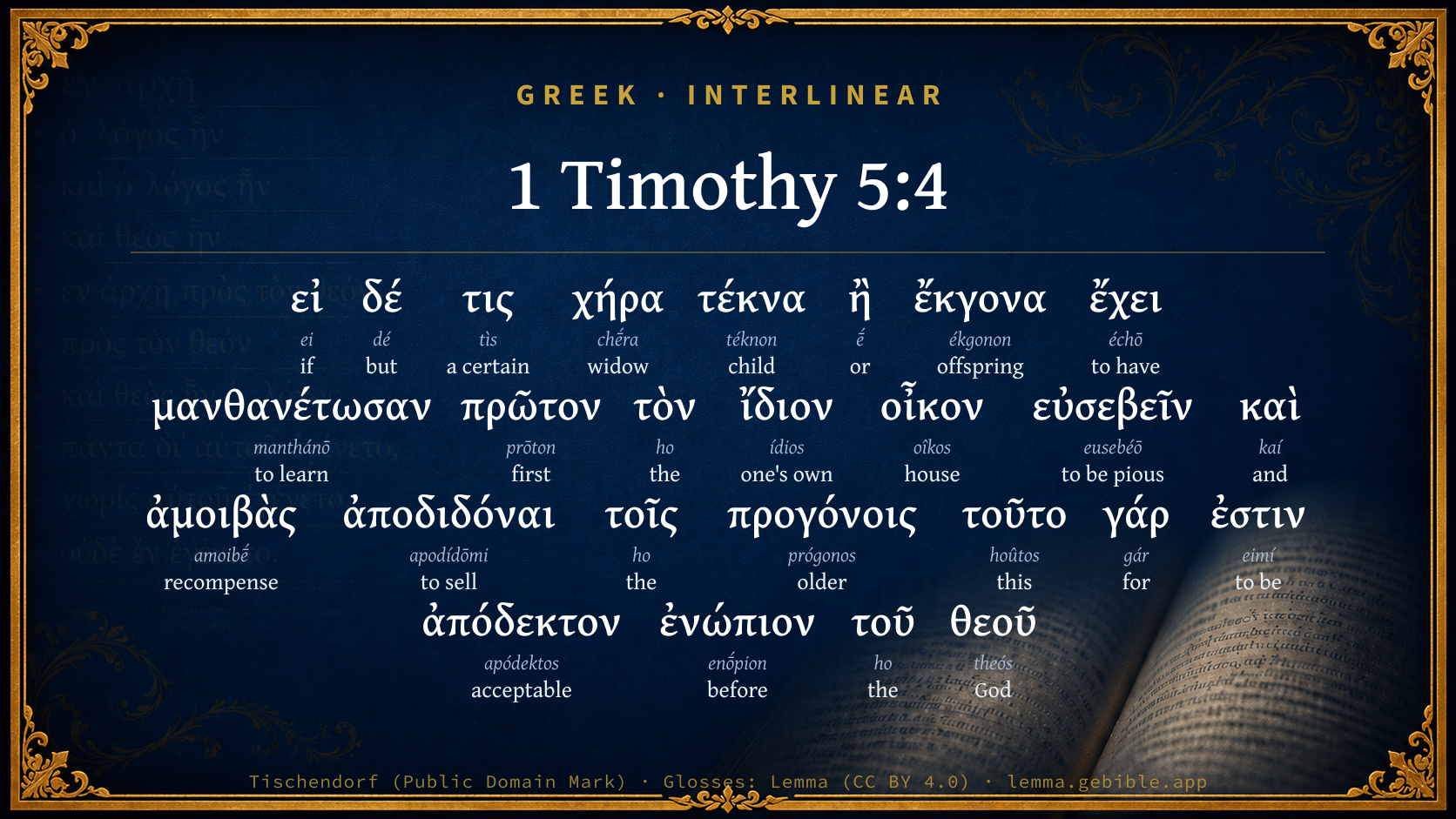
Greek (Tischendorf 8th ed.) 1 Timothy 5:4 appears in the Greek New Testament. The text above is from the Tischendorf 8th edition. Each word links to its Strong’s number and a concise gloss. Click any word for its full Thayer’s Greek Lexicon entry.
Download image
Cite this verse

1 Timothy 5:4 (World English Bible). Public Domain. Lemma interlinear Bible study tool, https://lemma.gebible.app/v/1-timothy/5/4.

Show BibTeX & RIS
BibTeX
RIS
English Translation
But if any widow has children or grandchildren, let them learn first to show piety towards their own family, and to repay their parents, for this is acceptable in the sight of God.
World English Bible · Public Domain
Highlights
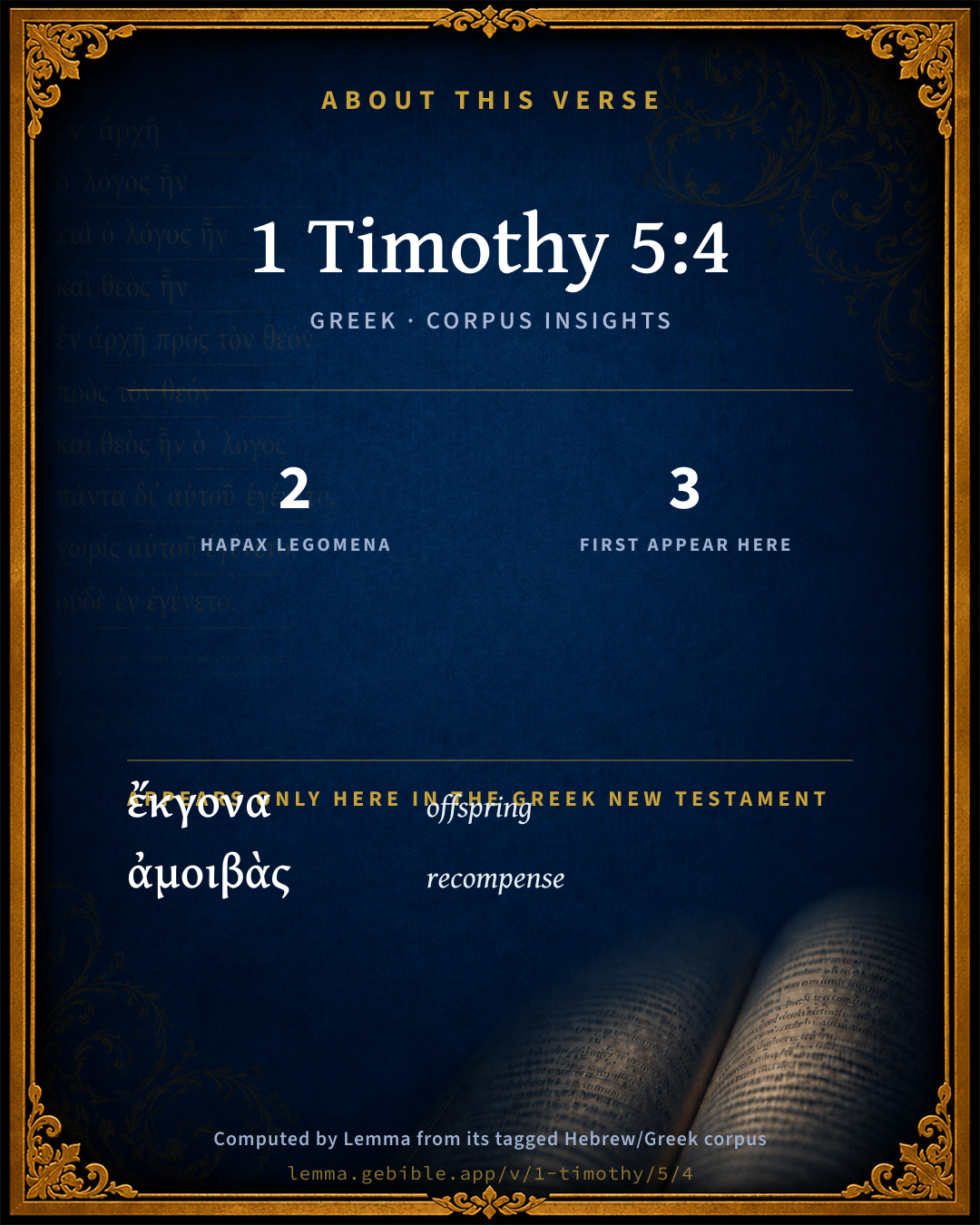
  • 2 hapax legomena — only here in the Greek New Testament
  • 3 first appearances in the Greek New Testament
Full analysis ↓
Download a study sheet

One document with this verse’s original text, its word-by-word gloss line, the meaning frame, cross-references with their text, attributed commentary, and full source and license credits — printable, and it pastes into notes with its structure intact.

This verse Autodidact and up

Study sheet (.html) Plain text (.txt)

A passage Seminary Student

Up to 50 verses in one chapter. A passage sheet keeps up to 6 commentary sources and 12 cross-references per verse, in the order this page ranks them, and says so on the sheet whenever that leaves anything out. Ask for a single verse and you get the Autodidact verse sheet above.

Everything on this page stays free to read, with no account — the sheet is a download of what is already on screen, not access to it.

Want to remove ads? Support Godless Engineer
Compare translations 3

The same verse in 3 English versions, stacked beneath the original-language interlinear above. Click any original word for its lexicon entry.

Each is an independent rendering of the whole verse — the interlinear is not word-aligned to these translations.

Highlighted words mark where these versions differ — a whole-verse word diff, not a word-by-word alignment.

  • World English Bible Public Domain
    But if any widow has children or grandchildren, let them learn first to show piety towards their own family, and to repay their parents, for this is acceptable in the sight of God.
  • King James Version Public Domain
    But if any widow have children or nephews, let them learn first to shew piety at home, and to requite their parents: for that is good and acceptable before God.
  • unfoldingWord Literal Text CC BY-SA 4.0
    But if any widow has children or grandchildren, first let them learn to treat their own household in a godly way and to make repayment to their forebears, for this is acceptable before God.

unfoldingWord Literal Text — © unfoldingWord, licensed CC BY-SA 4.0. Word-aligned USFM3 via Door43 (git.door43.org/unfoldingWord/en_ult).

Versions to compare (up to 4)

3 of 4 selected

Show all 19 translations

Every available English version of this verse, each an independent rendering of the whole verse.

  • World English Bible Public Domain
    But if any widow has children or grandchildren, let them learn first to show piety towards their own family, and to repay their parents, for this is acceptable in the sight of God.
  • Berean Standard Bible Public Domain
    But if a widow has children or grandchildren, they must first learn to show godliness to their own family and repay their parents, for this is pleasing in the sight of God.
  • Majority Standard Bible Public Domain
    But if a widow has children or grandchildren, they must first learn to show godliness to their own family and repay their parents, for this is pleasing in the sight of God.
  • King James Version Public Domain
    But if any widow have children or nephews, let them learn first to shew piety at home, and to requite their parents: for that is good and acceptable before God.
  • American Standard Version (1901) Public Domain
    But if any widow hath children or grandchildren, let them learn first to show piety towards their own family, and to requite their parents: for this is acceptable in the sight of God.
  • Revised Version (1885) Public Domain
    But if any widow hath children or grandchildren, let them learn first to shew piety towards their own family, and to requite their parents: for this is acceptable in the sight of God.
  • Geneva Bible (1599) Public Domain
    But if any widowe haue children or nephewes, let them learne first to shewe godlinesse towarde their owne house, and to recompense their kinred: for that is an honest thing and acceptable before God.
  • Douay-Rheims (1899) Public Domain
    But if any widow have children, or grandchildren, let her learn first to govern her own house, and to make a return of duty to her parents: for this is acceptable before God.
  • Young's Literal Translation Public Domain
    and if any widow have children or grandchildren, let them learn first to their own house to show piety, and to give back a recompense to the parents, for this is right and acceptable before God.
  • Literal Standard Version CC BY-SA 4.0
    and if any widow has children or grandchildren, let them first learn to show piety to their own house, and to give back a repayment to the parents, for this is right and acceptable before God.
  • Unlocked Literal Bible CC BY-SA 4.0
    But if a widow has children or grandchildren, let them first learn to show honor in their own household. Let them repay their parents, because this is pleasing to God.
  • unfoldingWord Literal Text CC BY-SA 4.0
    But if any widow has children or grandchildren, first let them learn to treat their own household in a godly way and to make repayment to their forebears, for this is acceptable before God.
  • Darby Bible Public Domain
    but if any widow have children or descendants, let them learn first to be pious as regards their own house, and to render a return on their side to [their] parents; for this is acceptable in the sight of God.
  • World Messianic Bible Public Domain
    But if any widow has children or grandchildren, let them learn first to show piety toward their own family and to repay their parents, for this is acceptable in the sight of God.
  • Webster's Bible Public Domain
    But if any widow hath children or nephews, let them learn first to show piety at home, and to requite their parents: for that is good and acceptable before God.
  • Free Bible Version CC BY-SA 4.0
    For the Christian responsibility of a widow's children or grandchildren is to do their duty for their own family, and repay their parents by helping them out. This is what pleases God.
  • Bible in Basic English Public Domain
    But if any widow has children or children's children, let these see that it is right to take care of their family and their fathers and mothers: for this is pleasing in the eyes of God.
  • Text-Critical English NT CC BY 4.0
    But if any widow has children or grandchildren, they should first learn to show godliness toward their own household and to make some repayment to their parents, for this is acceptable in the sight of God.
  • Tyndale New Testament (1534) Public Domain
    Yf eny wyddowe have chyldren or neves let them learne fyrst to rule their awne houses godly and to recompence their elders. For that is good and acceptable before God.

Literal Standard Version (2020), Covenant Press — licensed CC BY-SA 4.0. Text via the HelloAO Bible API (eBible.org). Unlocked Literal Bible (unfoldingWord) — licensed CC BY-SA 4.0. Text via the HelloAO Bible API (eBible.org). unfoldingWord Literal Text — © unfoldingWord, licensed CC BY-SA 4.0. Word-aligned USFM3 via Door43 (git.door43.org/unfoldingWord/en_ult). Free Bible Version, Dr. Jonathan Gallagher — licensed CC BY-SA 4.0. Text via the HelloAO Bible API (eBible.org).

Word by word

More ways to search: Search by grammar → Find every occurrence → Compare this word →

Practice this passage: Drill this verse → Learn its vocabulary →

ἔκγονα
ékgonon
G1549
“offspring”
Adjective, Accusative, Plural, Neuter
Part of Speech
Adjective
Case
Accusative
Number
Plural
Gender
Neuter
Full Thayer's Definition

Origin: neuter of a derivative of a compound of G1537 and G1096

TDNT: None

1. sprung from one, born, begotten 2. a son, daughter, offspring, children, descendants 3. grandchildren
  1. εἰ ei G1487 “if” Conditional
  2. δέ dé G1161 “but” Conjunction
  3. τις tìs G5100 “a certain” Indefinite pronoun, Nominative, Singular, Masculine
  4. χήρα chḗra G5503 “widow” Noun, Nominative, Singular, Feminine
  5. τέκνα téknon G5043 “child” Noun, Accusative, Plural, Neuter
  6. ἢ ḗ G2228 “or” Particle
  7. ἔχει échō G2192 “to have” Verb, Present, Active, Indicative, 3rd person, Singular
  8. μανθανέτωσαν manthánō G3129 “to learn” Verb, Present, Active, Imperative, 3rd person, Plural
  9. πρῶτον prōton G4412 “first” Adverb, Superlative
  10. τὸν ho G3588 “the” Article, Accusative, Singular, Masculine
  11. ἴδιον ídios G2398 “one's own” Adjective, Accusative, Singular, Masculine
  12. οἶκον oîkos G3624 “house” Noun, Accusative, Singular, Masculine
  13. εὐσεβεῖν eusebéō G2151 “to be pious” Verb, Present, Active, Infinitive
  14. καὶ kaí G2532 “and” Conjunction
  15. ἀμοιβὰς amoibḗ G287 “recompense” Noun, Accusative, Plural, Feminine
  16. ἀποδιδόναι apodídōmi G591 “to sell” Verb, Present, Active, Infinitive
  17. τοῖς ho G3588 “the” Article, Dative, Plural, Masculine
  18. προγόνοις prógonos G4269 “older” Noun, Dative, Plural, Masculine
  19. τοῦτο hoûtos G3778 “this” Demonstrative pronoun, Nominative, Singular, Neuter
  20. γάρ gár G1063 “for” Conjunction
  21. ἐστιν eimí G1510 “to be” Verb, Present, Active, Indicative, 3rd person, Singular
  22. ἀπόδεκτον apódektos G587 “acceptable” Adjective, Nominative, Singular, Neuter
  23. ἐνώπιον enṓpion G1799 “before” Adverb
  24. τοῦ ho G3588 “the” Article, Genitive, Singular, Masculine
  25. θεοῦ theós G2316 “God” Noun, Genitive, Singular, Masculine

About this verse

These counts appear in no published source. They are computed here, from the morphology-tagged text and Lemma’s own curated glosses. What Lemma adds →

26
words
24
distinct lemmas
Pauline Epistles
section

Notable vocabulary

2 hapax legomena — words that appear only here in the entire Greek New Testament:

  • ἔκγονα offspring G1549
  • ἀμοιβὰς recompense G287

First appearance in Scripture

These words make their first canonical appearance in the Greek New Testament here:

  • ἔκγονα offspring G1549
  • ἀμοιβὰς recompense G287
  • προγόνοις older G4269

Shared distinctive vocabulary

εὐσεβεῖν to be pious G2151 occurs in 2 verses of the Greek New Testament. Also found in:

Repetition

A word recurs within this verse:

Cross-references

16

Topical passages linked to 1 Timothy 5:4 in the Treasury of Scripture Knowledge — connected by theme and wording, ordered by reader-vote popularity; previews shown in the World English Bible.

  • Ephesians 6:1–3 Children, obey your parents in the Lord, for this is right.
  • Matthew 15:4–6 For God commanded, 'Honor your father and your mother,' and, 'He who speaks evil of father or mother, let him be put to death.'
  • John 19:26–27 Therefore when Jesus saw his mother, and the disciple whom he loved standing there, he said to his mother, "Woman, behold your son!"
  • Genesis 47:12 Joseph nourished his father, his brothers, and all of his father's household, with bread, according to their families.
  • Genesis 45:10–11 You shall dwell in the land of Goshen, and you will be near to me, you, your children, your children's children, your flocks, your herds, and all that you have.
  • Mark 7:11–13 But you say, 'If a man tells his father or his mother, "Whatever profit you might have received from me is Corban, that is to say, given to God;"'
  • 1 Timothy 2:3 For this is good and acceptable in the sight of God our Savior;
  • Ruth 2:2 Ruth the Moabitess said to Naomi, Let me now go to the field, and glean among the ears of grain after him in whose sight I shall find favor. She said to her, Go, my daughter.
  • Ruth 2:18 She took it up, and went into the city; and her mother-in-law saw what she had gleaned: and she brought forth and gave to her that which she had left after she was sufficed.
  • 1 Samuel 22:3–4 David went there to Mizpeh of Moab: and he said to the king of Moab, Please let my father and my mother come forth, [and be] with you, until I know what God will do for me.
  • Proverbs 31:28 Her children rise up and call her blessed. Her husband also praises her:
  • Luke 2:51 And he went down with them, and came to Nazareth. He was subject to them, and his mother kept all these sayings in her heart.
  • Genesis 47:28 Jacob lived in the land of Egypt seventeen years. So the days of Jacob, the years of his life, were one hundred forty-seven years.
  • Judges 12:14 He had forty sons and thirty sons' sons, who rode on seventy donkey colts: and he judged Israel eight years.
  • Job 18:19 He shall have neither son nor grandson among his people, Nor any remaining where he sojourned.
  • Isaiah 14:22 I will rise up against them, says Yahweh of Hosts, and cut off from Babylon name and remnant, and son and son's son, says Yahweh.

Cross-references courtesy of OpenBible.info (CC BY 4.0).

Where the printed editions differ

1 variant

Places in this verse where the major printed Greek editions disagree on the wording in a way that affects the translation — a comparison of editions, not a manuscript-by-manuscript collation. The editions are the modern critical texts (Nestlé-Aland 28/27, SBL, Westcott-Hort, Tregelles, Tyndale House) and the traditional texts behind the KJV (the Textus Receptus and the Byzantine/Majority text). It is not a claim about which reading is original.

  1. Extra text
    καλὸν καὶ

    “good and”

    In TR Not in NA28NA27TynSBLWHTregByz

    καλὸν καὶ (kalon kai) 'good and' is only in traditional manuscripts (TR)

Textual data: Translators Amalgamated Greek New Testament (STEPBible TAGNT) · CC BY 4.0.

Commentary

Notes on 1 Timothy 5:4 from classic Christian and Jewish commentators (each source and its license shown beneath its notes). The classic Christian expositions comment on the surrounding passage and are grouped to its opening verse, so a note may address several verses; the Jewish commentaries on the Tanakh (Rashi and others) are per-verse, so they appear only where the commentator wrote on this verse.

Lemma curates 59 commentaries, every one of them public domain or Creative Commons licensed, each selected and text-cleaned for this edition rather than reprinted as found. About our sources →

The Biblical Illustrator

Joseph S. Exell

1Ti_5:4; 1Ti_5:8; 1Ti_5:16

But if any widow have children or nephews.

--

Home responsibilities

We are reminded here--

I. That home responsibilities are to be accepted as the appointment of God. The sacredness of family relationship is constantly insisted upon both in the Old Testament and the New. All transgressions against it were severely punished under the Mosaic economy, and were condemned still more solemnly by our Lord. A word of exposition on the first clause in the fourth verse is desirable, If any widows have children or nephews, let them (i.e., not the widows, but the children or nephews)

learn first to show piety (filial love) at home. The word nephews is used by our translators in its old English sense, and is rendered in the Revised Version by its nearest modern equivalent, grand children, for in the writings of Chaucer, Sir Thomas More, and John Locke, nephews is used to denote grandchildren. And similarly, when it is said they are to requite their parents, more is included than fathers or mothers, for the apostles word is equivalent to the Scotch forbears, for which the English language has no exact synonym. The idea is that we owe a debt of gratitude to those from whom we have derived existence, and to whom we owe the support, care, and education we have received. We are bound to see that to the utmost of our ability their wants in old age are met.

II. That among our God-given responsibilities is the duty of labouring for the support of the weak. Among the blessings of our human relationships is this: that honest work is necessitated. We have seen instances in which a young fellow who has spent all his salary on cigars, dress, and amusements, has after his marriage buckled to work, and displayed an energy and ability for which none had given him credit before. Many a brave young wife and self-sacrificing mother has been ennobled through her home duties, having completely abandoned the foolish and trivial pursuits to which she was once addicted. And what numberless instances there are of men, whose diligence and self-abnegation are beyond praise, who have become what they are by first feeling the responsibility of caring and working for a widowed mother!

III. Paul emphatically declares that those who fail in these responsibilities have denied the faith and are worse than infidels. Stern as the words are, they are true! Even the heathen, certainly the better class of them, were wont to acknowledge filial duties, and would have condemned cynical disregard of parents and refusal to fulfil natural duties towards them. This is an offence against humanity, and therefore, in the deepest sense, an offence against Christ. But a Christian professes to have higher motives in duty than others. Let us never for get that the test of character is to be found in family relationships rather than in those which are ecclesiastical; and that it is in the home first and chiefest of all that Christs disciples are to adorn the doctrine of God their Saviour. (A. Rowland, LL. B.)

Piety at home.--

Life at home

A church within a church, a republic within a republic, a world within a world, is spelled by four letters--Hornet If things go right there, they go right everywhere; if things go wrong there, they go wrong everywhere. The door-sill of the dwelling-house is the foundation of Church and State. A man never gets higher than his own garret or lower than his own cellar. In other words, domestic life overarches and underguides all other life. George Washington commanded the forces of the United States, but Mary Washington commanded George. Chrysostoms mother made his pen for him. As individuals, we are fragments. God makes the races in parts, and then He gradually puts us together. What I lack, you make up; what you lack, I make up; our deficits and surpluses of character being the wheels in the great social mechanism. One person has the patience, another has the courage, another has the placidity, another has the enthusiasm; that which is lacking in one is made up by another, or made up by all. Buffaloes in herds; grouse in broods; quails in flocks; the human race in circles. Our usefulness, and the welfare of society, depend upon our staying in just the place that God has put us, or intended we should occupy. For more compactness, and that we may be more useful, we are gathered in still smaller circles in the home group. And there you have the same varieties again; brothers, sisters, husband, and wife; all different in temperaments and tastes. It is fortunate that it should be so. If the husband be all impulse, the wife must be all prudence. If one sister be sanguine in her temperament, the other must be lymphatic. Mary and Martha are necessities. Then there are those who will, after awhile, set up for themselves a home, and it is right that I should speak out upon these themes.

1. My first counsel to you is, have Jesus in your new home, if it is a new home; and let Him who was a guest at Bethany be in your new household; let the Divine blessing drop upon your every hope, and plan, and expectation. Those young people who begin with God end with heaven.

2. My second advice to you in your home is, to exercise to the very last possibility of your nature the law of forbearance. Prayers in the household will not make up for everything. Some of the best people in the world are the hardest to get along with. Sometimes it will be the duty of the husband and sometimes of the wife to yield; but both stand punctiliously on your rights, and you will have a Waterloo with no Blucher coming up at nightfall to decide the conflict. The best thing I ever heard of my grandfather, whom I never saw, was this: that once, having unrighteously rebuked one of his children, he himself--having lost his patience, and, perhaps, having been misinformed of the childs doings--found out his mistake, and in the evening of the same day gathered all his family together, and said: Now, I have one explanation to make, and one thing to say. Thomas, this morning I rebuked you very unfairly. I am very sorry for it. I rebuked you in the presence of the whole family, and now I ask your forgiveness in their presence. It must have taken some courage to do that.

3. I advise, also, that you make your chief pleasure circle around about that home. It is unfortunate when it is otherwise. If the husband spend the most of his nights away from home, of choice and not of necessity, he is not the head of the household; he is only the cashier. If the wife throw the cares of the household into the servants lap, and then spend five nights of the week at the opera or theatre, she may clothe her children with satins, and laces, and ribbons that would confound a French milliner, but they are orphans.

4. I advise you also to cultivate sympathy of occupation. Sir James McIntosh, one of the most eminent and elegant men that ever lived, while standing at the very height of his eminence, said to a great company of scholars: My wife made me. The wife ought to be the advising partner in every firm. She ought to be interested in all the losses and gains of shop and store. She ought to have a right--she has a right--to know everything. Your gains are one, your interests are one, your losses are one; lay hold of the work of life with both hands. Four hands to fight the battles. Four eyes to watch for the danger. Four shoulders on which to carry the trials. It is a very sad thing when the painter has a wife who does not like pictures. It is a very sad thing for a pianist when she has a husband who does not like music.

5. I have one more word of advice to give to those who would have a happy home, and that is: let love preside in it. (T. De Witt Talmage.)

Home, sweet home

How many are longing for grand spheres in which to serve God. They admire Luther at the Diet of Worms, and wish they had some such daring opportunity in which to exhibit Christian character. Now, the apostle comes to such persons, in my text, and says: I will show you a place where you can exhibit all that is grand, and beautiful, and glorious in the Christian character, and that place is the domestic circle. Let them learn first to show piety at home. Indeed, if a man does not serve God on a small scale, he never will serve Him on a large scale. I propose to speak to you of home as a test, of home as a refuge, of home as a political safeguard, of home as a school, of home as a type of heaven.

I. The home, in the first place, is the most powerful test of ones character. A mans disposition in public may be in gay costume, while in private it is in deshabille. The play actor does differently on the platform from the way he does behind the scenes; and public life is often a very different thing from private life. A man will receive you in his parlour with so much gracefulness that he seems to be the distillation of smiles, while in his heart there is a swamp of nettles. Private life is often public life turned wrong side out. The lips that drop with myrrh and cassia--the disposition that seems to be warm and bright as a sheaf of sunbeams, may only be a magnificent show-window to a wretched stock of goods. The harp that all day sang like an angel, may at night grate like a saw. There are those who are philanthropists in public life, who in home life are the Nero with respect to their slippers and their gown. The great Newton, after he had spent half of his life on one manuscript, came into his study one day and found that his dog had torn the manuscript to pieces. All he said was: Little Diamond, you know not how much trouble you have given your master. Audubon, the great ornithologist, with gun and pencil, went all through the forests of this country for the purpose of bringing down and sketching the birds of the land; then went home, put the valuable documents in a trunk, and, after an absence, found that the rats had completely devoured the manuscripts, so that again he took gun and pencil, and again went through the forests of the land, reproducing that which was destroyed; while there are many in private life who, at the loss of a pencil or an article of clothing, will act as though they had met with a severe and irreparable loss, and will blow sharp, and loud, and long as a north-east storm. Let us learn to show piety at home.

II. Again: I remark that home is a refuge. The home is the tent we pitch to rest in, our bayonets stacked, our war caps hung up, our heads resting on the knapsack until the morning bugle sounds, warning us to strike tent and prepare for marching and action. Oh, what a pleasant place it is to talk over the days victories, and surprises, and attacks, seated by the still camp-fires of the domestic circle. Life is a stormy sea. With shivered mast, and torn sail, and hulk aleak, we put into the harbour of home. Into this dry-dock we come for repair. Blessed harbour! The candle in the window is to the labouring man the lighthouse guiding him into port. May God pity the poor miserable wretch who has not any home.

III. Again: I remark that the home is a political safeguard. The safety of the State depends upon the character of the home. The Christian hearthstone is the only foundation for a Republic. In the family virtues are cultured which are a necessity for the State; and if there be not enough moral principle to make the family adhere, there cannot be enough political principle to make the State adhere. No home, no free institution. No home makes a nation of Goths and Vandals; makes the Nomads of Central Asia; makes the Numidians of Africa, changing from month to month, and from place to place, as the pasture happens to change.

IV. I go further, and speak of home as a school. Old ground must be upturned by a subsoil plough, and harrowed and re-harrowed, and then it will not yield as good a crop as new ground with less culture. Now, infancy and childhood are new ground, and all that is scattered over that ground will yield luxuriantly. Make your home the brightest place on earth if you would charm your children into the high path of rectitude and religion. Do not always have the blinds turned the wrong way. Let Gods light, that puts gold on the gentian and spots the pansy, stream into your windows. Do not expect your children to keep step to a dead march. A dark home makes bad boys and bad girls to be bad men and bad women. Above all, take into your homes thorough Christian principle. (T. De Witt Talmage.)

Home piety

I. Our first endeavour will be to show what piety is. This is all the more needful, as mistakes, numerous and fatal, exist on this vital subject, not only in the world, but also in the Church. It is the mind that was in Christ, leading us to walk as He also walked.

1. Piety has its principles. It is not like a tree without a root; or a stream without a spring. It is originated, sustained, and cherished by an experimental acquaintance with God in Christ; for this is life eternal, to know Thee, the true God, and Jesus Christ whom Thou has sent. Here, then, we have the principles of piety--knowledge, faith, love, submission, and holy fear. A cluster of good things; the soul and spirit of true religion; the gift of the Divine hand; the fruit of the Spirit; the purchase of Messiahs blood; and the earnest of everlasting life.

2. Piety has its enjoyments. Her ways are ways of pleasantness, and all her paths are peace. She is a tree of life to them that lay hold upon her. The forgiveness of sins, access to God as a Father, the communion of Saints, the hope of everlasting life, the possession of a new nature, constitute a well-spring of blessedness to the humble, believing, obedient soul.

3. Piety has its duties. If ye love Me, said the Saviour, keep My commandments; not every one that saith unto Me, Lord, Lord, shall enter into the kingdom of heaven, but he that doeth the will of My Father which is in heaven. With what frequency and earnestness has practical piety been enforced in the law and the prophets, as also by our Lord and His apostles!

II. We proceed to show where piety is to be made manifest. If the principles and rootlets of piety be out of sight, their existence and power may easily be made apparent. Vegetable life in this sweet jessamine, or in yonder blushing rose, is far beyond our ken; but the effects of life are plain enough to be seen--the rind, the bud, the leaf, the flower, tell us that life is there. As to animal life--the sparkling eye, the ruddy countenance, the cheerful voice, the active limb, show us that life is there; but it is as much a mystery as ever; as far out of sight as ever. Steam, as it lies in the bosom of the boiler, is invisible; but the stroke of the piston, the sweep of the u heel, and the speed of the train, as well as the condensing power of the atmosphere, tell us that it is there. So of piety: much of it is hidden from the public gaze--its depths are not seen. Christian life is hid with Christ in God. Yet if spiritual life exists, it will give proof of its existence and power. Hence at Antioch, when Barnabas had seen the grace of God, he was glad. And exhorted them all that with purpose of heart they would cleave unto the Lord. Fire must burn, a fountain must flow, a good tree cannot bring forth bad fruit--Therefore show piety.

1. In general, wherever the providence of God may place you. The shop, the ship, the market, the farm, the factory, the counting-house, will afford you opportunities for confessing your Lord.

2. In particular, let your piety appear at home. Show to those around you, that the fear and love of God control your desires, purposes, words, and deeds; whatever your relation to the family circle--in whatever department your duty lies, act your part with cheerfulness, fidelity, and to the extent of your ability. See, that your piety is such as never can be reasonably questioned.

(1) Shows its reality; let the root of the matter spring up and bring forth good fruit.

(2) Maintain its spirit, humble, gentle, kind, forgiving: Let this mind be in you, which was also in Christ Jesus.

(3) Manifest its power, to restrain you from evil, to sustain and comfort and bless you, amid the ills of life; and to enable you by a patient continuance in well-doing, to seek for glory, honour, immortality, and eternal life. Mind that your piety be uniform; let no child be forgotten, no aged parent neglected, no poor widowed relative forsaken, no duty omitted. One word more: let your home religion be steady and growing; and as a general rule, rather seen, and felt, than heard.

3. The considerations by which this important duty may be enforced are numerous and weighty. Would to God we could rightly see and feel them. God, our Saviour, has made Christian believers a chosen generation, a royal priesthood, a holy nation, a peculiar people, to show forth the praises of Him who has called them out of darkness into His marvellous light. And shall they not do His pleasure? Shall not Christian people acknowledge their Owner--and the claims of Him who hath made, redeemed, and saved them--by giving up themselves to His service, by glorifying Him, both at home and abroad, in their body and spirit, which are His? Besides, as members of the family circle, are we not bound to promote its comfort, safety, and welfare to the extent of our ability? If you feel any interest in the prosperity of the Church, the conversion of poor sinners, the general good of society, show piety at home. Be followers of them who through faith and patience inherit the promises. Tread in the steps of faithful Abraham, the pattern of believers, and the friend of God, who commanded his children and household after him to keep the way of the Lord. Drink into the spirit of Joshua, who served the Lord himself, and put forth all his strength to lead his family to do likewise. (J. J. Topham.)

The Christian at home

Some characteristics of home piety.

1. A careful respect for the rights of each member of the family. It is our first duty to be just towards each other, and a duty which is obligatory all round, as between husband and wife, parents and children, brothers and sisters, families and their relatives, employers and servants. It is not always easy to be just. It requires thoughtful consideration and some power of imaginative sympathy even on the part of those who desire to do as they would be done by. A great deal of the wrong that is suffered in the world arises out of unwitting injustice. Some persons are grossly and habitually unjust to those about them, misrepresenting their opinions, and imposing upon them sacrifices of feeling and trouble, while in other respects they are singularly generous. Another frequent cause of unhappiness in families is the partiality shown to a favourite child. This also justice forbids.

2. Next to careful respect for the rights of others I may mention great forbearance in asserting our own. A small thing in family life, but most significant as an index to character, is the self-pleasing with which some persons secure their own preferences at table. Even if they make a show of giving up what others like, they do it so ostentatiously that their generosity is generally declined. But real self-denial, that can find pleasure in the gratification of others, will conceal its preferences so that they may enjoy what they like without knowing that it is at the expense of any one else.

3. A third characteristic of home piety is the endeavour to please those about us for their good. A cheerful manner, a flow of wise and genial conversation, sparkling here and there with some bright coruscation of wit, flavoured always with the salt of cultured taste, and sometimes suggestive of serious thoughts, is a fine means of pleasing and benefiting others. Show piety at home by learning to talk well and wisely.

4. Lastly, piety should be shown at home in a devout regard for the honour of God. At the principal meals of the day, and morning or evening, if not both morning and evening, reverence should find suitable expression in acts of worship. You must be guided by your own sense of fitness as to what arrangements you shall make for this purpose. Let us systematically choose the good part, seek first the kingdom of God and His righteousness, endeavour to catch the spirit of our Master, and let its influence be diffused throughout our whole life. (E. W. Shalders, B. A.)

Piety at home

The radiance of a Christian character is to shine around the family hearth. In most minds the word home awakens emotions both sweet and solemn. Our tenderest relations, our strongest affections, our highest joys, our deepest sorrows, all are touched by the thought of home. The great duty which our text enjoins is the cultivation of piety at home.

I. Home is the place where character is most tested; and if piety be not shown there, it cannot be shown anywhere. Our real character is not so much shown in what we do intentionally and with a purpose, as in what we do impulsively and without reflection. Abroad in the world men may wear a cloak--they may deceive others, they may deceive themselves as to their true character; but at home the cloak generally slips aside, the true character comes out, and those who see them in their unguarded hours know them as they really are. Often a word, a look, or even a gesture in the family will give more insight into a mans heart than years of observation of his public life. The close intercourse of home life tries as well as reveals the real character. That which tries character also helps to form it. Home not only shows what we are, it helps to make us what we shall be for ever. The education which is deepest and most enduring is that of the home school.

II. Home is sometimes the scene of our deepest sorrows: and piety is the best help to enable us to bear these. The causes which disturb the happiness of home are manifold. Unwise marriage unions are the cause of much family misery. Bad habits are a frequent occasion of home sorrow, Evil tempers sometimes ruin the happiness of home. A practical carrying out of our text would speedily correct the evils to which we have referred, and change the character of the home-life where they have been endured. Were all the members of a family to learn to show piety at home, what a scene of blessedness that would be! But there are other trials which sometimes convert the home into a house of mourning, and which piety alone can enable us to meet. There are homes in which the pinching of poverty has to be endured. There are homes where disease presses with his heavy hand; and homes over which death spreads his black and chilly wing. But if there be only one pious member of the family, how the others will look to him and lean upon him in their hour of bereavement and sorrow! The influence acquired by consistency of character now operates for the good of his afflicted friends.

III. Home ought to be the scene of our highest joy; and piety is the only means to make it so, The mutual love and confidence so essential to family happiness, can be produced and secured by nothing so certainly as by a common affection for the Saviour. How blessed are the ties of nature when they are sanctified and strengthened by grace! (G. D. Macgregor.)

Selfish children

An old Virginia minister said lately, Men of my profession see much of the tragic side of life. I have seen men die in battle, have seen children die, but no death ever seemed so pathetic to me as the death of an aged mother in my church. I knew her first as a young girl, beautiful, gay, full of joy and hope. She married and had four children. Her husband died and left her penniless. She sewed, she made drawings, she taught, she gave herself scarcely time to eat or sleep. Every thought was for her children, to educate them, to give them the advantages their father would have given them had he lived. She succeeded. She sent her boys to college and her girls to school. When all came home they gave themselves up to their own selfish pursuits. She lingered among them some three years, and then was stricken with mortal illness brought on by overwork. The children gathered around her bedside. The oldest son took her in his arms. He said, You have been a good mother to us. That was not much to say, was it? It was much to her, who had never heard anything like it. A flush came over her pallid face, and with faint voice she whispered, My son, you never said so before! (Dr. Hoge.)

John Gough and his mother

I remember, when my father was away in the Peninsular war, my mother, who used to work lace very nicely (and she grew very nearly blind by it), went one day from Sandgate to Dover, eight and a half miles, to sell it. I went out to play, having the whole day to myself till she came back. I was a famous reader when I was a little bit of a thing, and I never remember the time when I learned to read, and I cant remember when I could not read with the book the wrong side up. As I was playing, a boy came up to me and said, Johnny Gough, Mr. Purday wants you in the library. Well, I ran into the library, and I remember being taken into a little room, and a girl dipped her hands in water and rubbed my face, and brushed my hair back, to make me look decent, and then took me into the reading-room, where there was a venerable looking gentleman, whom I distinctly remember they called my lord. Mr. Purday said, This is the boy I was speaking of; and he then put a newspaper into my hands, and asked me to read a certain column to him, which I did. He gave me a five-shilling piece; another gentleman gave me sixpence; and the proprietor of the library gave me two pennies. Oh I how rich I was! I went out to play with the boys; I put my hands in my pockets now and then, and jingled my money, and then went on playing again. After a while a boy came to me and said, Johnny, your mother has got home. I ran into the house, and there sat my poor mother upon a stool, faint and weary, with her basket of lace at her side. Her face was buried in her hands; I heard her sob, and I never could bear to hear my mother cry. Mother, mother, said I, what is the matter? My poor child, she said, I have not sold a farthings-worth to-day, and what we shall do God only knows! Said I, Mother, just look at this! and she did look at it; and she said, Why John, where did you get that? I have been into the library; one gentleman gave me that, another gave me that, and Mr. Purday gave me these two pennies. My mother went upon her knees, clasped me around the neck, lifted up her eyes, thanked God, and then gave me a halfpenny all to myself! And what do you suppose I did with it? I went out and changed it into two farthings, and I never enjoyed money as much as that all the days of my life. (J. B. Gough.)

A widows trust in God

M. Poinsot, the devoted Protestant Scripture-reader at Charleroi, has been much blessed in his arduous and heroic work for Christ. He says in his journal--I visited a poor woman of seventy-six years of age, alone, poor, and ill. I said to her, The nights must seem very long to you, being always alone? If I were alone, she replied, I should have been dead long ago, but I have a Friend who never leaves me day nor night; I commune always with Him, and His Word comforts me. But, I said, if you became worse in the night? He would take care of me, was the reply; He is the best Doctor in Belgium.

The Biblical Illustrator, edited by Joseph S. Exell (c. 1880s–1900s) — public domain. Text from a community e-Sword module.

Bengel's Gnomon

Johann Albrecht Bengel

1Ti 5:4. Μανθανέτωσαν, let them learn) i.e. let the sons learn; and rather the grandsons, for in the correlative progenitors (τοῖς προγόνοις) alone are mentioned. There is an elegant Metonymy of the antecedent for the consequent; the consequent is, that the widows should remain with their relations (viz. their sons or grandchildren).—πρῶτον τὸν ἴδιον, first their own) before they are put into any public office (duty).—οἷκου εὐσεβεῖν, to treat their family with dutiful affection) We have the same word with the accusative, Act 17:23. The reason (ground) for the dutiful conduct enjoined, is evident from the end of the verse.—ἀμοιβὰς ἀποδιδόναι τοῖς προγόνοις, to requite their progenitors [parents, Engl. Vers.]) Some think that the duty of widows who have families, is here intended; and Pricæus compares with this passage that of Augustine regarding his mother Monica, She had requited her parents, she had treated her family with pious affection, 1Ti 1:9, Confess, 100:9. That saying of the Roman censors in reference to old bachelors is quite in accordance with this: Nature writes in you the law, as of being born, so also of begetting; and your parents, by supporting you, have bound you, if you have any shame, to pay the debt of bringing up grandchildren (for them).—Val. Max., l. 2, c. 4. But the word μανθανέτωσαν, let them learn, and its plural number, shows that the matter under discussion, is the duty of children and grandchildren. Therefore the widow in 1Ti 5:5, who has no children, is opposed to the widow who has children, because the former has no one from whom she can receive requital, and she therefore has her hopes placed solely in God.

Bengel's Gnomon of the New Testament — English translation (T&T Clark, Edinburgh, 1860) — public domain. Text from a community e-Sword module.

Meyer's Critical & Exegetical Commentary

Heinrich August Wilhelm Meyer

1Ti_5:4-8. There are two opposing views regarding the explanation of this section. (1) The view upheld by the majority of recent commentators, de Wette, Wiesinger, van Oosterzee, Plitt, which is as follows. Paul is giving Timothy instructions to support the real widows. From these he distinguishes (1Ti_5:4 being in contrast with 1Ti_5:3) the widow who has children or grandchildren, because they are able and ought to care for her. With μανθανέτωσαν we should supply as subject τέκνα ἢ ἔκγονα, and we should understand by τὸν ἴδιον οἶκον and τοῖς προγόνοις the widowed mother or grandmother. 1Ti_5:5 contrasts again with 1Ti_5:4; καὶ μεμονωμένη explains the signification of ἡ ὄντως χήρα. The predicate ἤλπικε κ.τ.λ. denotes the life-work which the right, i.e. the forsaken, widow has to fulfil, her fulfilment of it being a necessary condition of receiving support. 1Ti_5:6 declares negatively what conduct the apostle expects from an ὄντως χήρα, and to such conduct Timothy (1Ti_5:7) is to exhort them. At 1Ti_5:8, Paul returns to 1Ti_5:4, τις referring to the widows relations, and τῶν ἰδίων καὶ μάλιστα [τῶν] οἰκείων to the widows themselves.(2) The view upheld by most older and some recent commentators, especially Matthies and Hofmann, which is as follows. After enjoining on Timothy to honour the real widows, Paul first directs the widows who have children or grandchildren (still uncared for), to show these all loving care, and thereby recompense the love shown to themselves by their parents. The subject of μανθανέτωσαν is τις χήρα (as a collective idea); τὸν ἴδιον οἶκον are the children or grandchildren, and οἱ πρόγονοι the dead parents of the widow. 1Ti_5:5 describes the real widow as one who in her loneliness leads a life pious and consecrated to God; and as a contrast to this we have the picture of a wanton widow in 1Ti_5:6. In 1Ti_5:8, again (1Ti_5:4), widows who have relations needing their care are again reminded of the duty of this care.[172]

Each of these views has its difficulties. Against the second view, the supporters of the first maintain the following points:(1) that as 1Ti_5:4 is in contrast with 1Ti_5:3, and 1Ti_5:5 in contrast again with 1Ti_5:4 (δέ), the χήρα spoken of in 1Ti_5:4 cannot be regarded as belonging to the ὄντως χήραις; and (2) that as εὐσεβεῖν (1Ti_5:4) applies more naturally to the conduct of children towards their mother (or grandmother) than vice versâ, and as the thought: the widow is by her care for her children to make recompense for the care shown to herself by her parents, is somewhat far-fetched (de Wette), the ὄντως χήρα can only mean the widow with no relations for whom it is her duty to care.

But the first view has also its difficulties. If we adopt it, we find it strange that the apostle should not have written simply αὐτήν for τὸν ἴδιον οἶκον, and αὐτῇ for τοῖς προγόνοις, all the more that οἱ πρόγονοι is a name for progenitors. Further, πρῶτον, which Wiesinger translates inaccurately by before all, does not get its full force. It is arbitrary to understand by τέκνα ἢ ἔκγονα, grown-up children, especially as the expression τέκνα ἔχειν makes the children appear dependent on the mother (comp. 1Ti_3:4; Tit_1:6). De Wette says regarding 1Ti_5:5 : The author would have more clearly said: Remind a true and forsaken widow to whom thou dost give support, that it falls upon her to show an example of confidence in God and of continual prayer; but we can hardly think that the apostle would have expressed this thought in such an uncertain way. Even the three repetitions of the same thought in 1Ti_5:4; 1Ti_5:8; 1Ti_5:16, is at least very strange. Finally, the idea of money-support, on which this view lays all stress, is purely imported. These difficulties are too considerable for us to regard the first view as right in spite of them.[173]

De Wette and Wiesinger are certainly right in regarding 1Ti_5:4 as contrasted with 1Ti_5:3, and 1Ti_5:5 with 1Ti_5:4, as well as in thinking that the word μεμονωμένη sets forth the apostles mark of the ὄντως χήρα; but they are not justified in inferring that in 1Ti_5:4 he is speaking of a widow with relations who can take care of her. Why, in that case, should the apostle in 1Ti_5:5 have said regarding the ὄντως χήρα, that she was to προσμένειν ταῖς δεήσεσι καὶ ταῖς προσευχαῖς, and to do so νυκτὸς καὶ ἡμέρας, for all this is in no way opposed to what is said in 1Ti_5:4? The προσμένειν leads us to suppose that the apostle was thinking of a widow who had not to care for relations.

The right view will accordingly be this. After exhorting Timothy to honour the real widows (see on 1Ti_5:3), Paul distinguishes from these ὄντως χήραις, in the first place, the one who is not forsaken, but has children or grandchildren (not grown up); and he lays it on her as a duty not to neglect them. Then he describes the conduct of the real or forsaken widow, who has therefore no ἴδιον οἶκον, showing what beseems her in her position in life as a Christian widow; so that he is contrasting the widow who works diligently for her own, and the lone widow who continues day and night in prayer. As opposed to the latter (or even to both), he mentions in 1Ti_5:6 the χήρα σπαταλῶσα, who is, however, to be considered as dead, because her conduct is in entire contradiction with her widowed state. Then there is a natural transition to the exhortation in 1Ti_5:7, which gives the apostle an opportunity for uttering, in 1Ti_5:8, a general maxim in order to impress once more on the widow with relations to care for, the exhortation in 1Ti_5:4.1Ti_5:4. τέκνα ἢ ἔκγονα] ἔκγονα here (in connection with τέκνα) means the grandchildren (τέκνα τέκνων, Hesychius).[174] In classical usage, ὁ ἔκγονος is usually the son (ἡ ἔκγονος, the daughter), but also the grandson; τὰ ἔκγονα denotes properly posterity (comp. Wisd. 40:15, 44:11, 45:13, 47:22; synonymous with τὸ σπέρμα).

μανθανέτωσαν] The subject for this verb might be taken from the object in the protasis; but the formation of the sentence is more correct, if we take the subject of the protasis (τις χήρα) to be the subject here also. Τις χήρα is then a collective idea, and takes the plural. Winer, too (p. 586 [E. T. p. 787]), supports this opinion.

πρῶτον] viz., before they give themselves up to the care of the church for them, with special reference to what follows: χήρα καταλεγέσθω, 1Ti_5:9, or better perhaps: before she makes work for herself outside the house (Hofmann).

τὸν ἴδιον οἶκον εὐσεβεῖν] The term οἶκον likewise shows that he is speaking not of the things which the children are to do for their widowed mother (or grandmother), but of the things which the widows as mothers are to do for the children; because the mother or grandmother does not necessarily belong to the οἶκος of a grown-up son or grandson, whereas the children not grown up necessarily belong to the οἶκος of the widowed mother. The meaning therefore is: they are not to forsake their house, i.e. their children or grandchildren. The term εὐσεβεῖν is used to show that the house is a temple to whose service they are to devote themselves. Matthies inaccurately translates: practise piety in regard to ones own house. Οἶκον is not the accusative of reference, but purely an objective accusative; comp. Act_17:23, and Meyer on the passage. To honour ones house is therefore equivalent to serving it with pious heart;[175] Luthers translation: rule divinely, is not to the point.

καὶ ἀμοιβὰς ἀποδιδόναι τοῖς προγόνοις] According to the context, the meaning is this: the widows by the εὐσεβεῖν of their house, i.e. by their pious care for their children and grandchildren, are to recompense the love shown to themselves by their parents. Chrysostom: ἀπῆλθον ἐκεῖνοι (οἱ πρόγονοι)· οὐκ ἠδυνήθῃς αὐτοῖς ἀποδοῦναι τὴν ἀμοιβὴν· ἐν τοῖς ἐκγόνοις ἀμειβοῦ· ἀποδίδου τὸ ὀφείλημα διὰ τῶν παίδων. Though this thought is peculiar, it is neither ingenious (de Wette) nor far-fetched (Wiesinger).

ἀμοιβή, in the N. T. ἅπαξ λεγόμ.; ἀμοιβ. ἀποδιδόναι, Euripides, Orestes, 467.

οἱ πρόγονοι, in contrast with the previous τὰ ἔκγονα: the progenitors; in the N. T. only here and 2Ti_1:3. It would be against usage to understand by it the (widowed) mother or grandmother who is still alive.

τοῦτο γάρ ἐστι ἀπόδεκτον κ.τ.λ.] comp. 1Ti_2:3.

[172] Hofmann, however, takes these verses (58) in a different way from that in which they are here interpreted by most expositors; see farther on.

[173] Van Oosterzee, in agreeing with the first view, thinks it puzzling that this commentary gives the preference to the second. But he does not by this furnish anything towards the solution of the question, all the less that he has neglected to enter in any way upon the difficulties surrounding the view he adopts.

[174] Luther translates it Neffen (nephew), which in Old German usage has the meaning descendant, grandchild; comp. Gen_21:23; Job_18:19; Isa_14:22.

[175] It is certainly correct that εὐσεβεῖν is used properly of conduct towards God, and then of conduct towards parents and persons of higher position; but it is not restricted to such use. In Euripides, Alcestis, 1151, it is used, e.g., of ξένοι. Hofmann well says: If a widow turns her hack on the house of her dead husband and of her relations, she neglects her nearest duty, and sins against the holiness of family ties.

Meyer — Critical and Exegetical Commentary on the New Testament — English translation by Peter Christie, edited by Frederick Crombie (T&T Clark, 1880) — public domain. Text from a community e-Sword module.

Expositor's Greek Testament

ed. W. Robertson Nicoll

1Ti 5:4 . ἔκγονα : offspring ought to be the best rendering of this. It has a wider connotation than children and narrower than descendants .

μανθανέτωσαν : It ought not to be necessary to say that the subject of this verb is τέκνα ἢ ἔκγονα , only that Chrys. Theod. Vulg. and [268] agree in referring it to the class χῆραι . (“Requite them in their descendants, repay the debt through the children,” Chrys.; “ Discat primum domum suam regere .” See critical note.) Similarly Augustine says of his mother Monica, “Fuerat enim unius viri uxor, mutuam vicem parentibus reddiderat, domum suam pie tractaverat” ( Confessiones , ix. 9). This can only be regarded as a curiosity in exegesis.

[268] The Latin text of Codex Claromontanus (sæc. vi.), a Græco-Latin MS. at Paris, edited by Tischendorf in 1852.

πρῶτον : The first duty of children is filial piety. οἶκον , which is usually correlative to parents rather than children, is used here “to mark the duty as an act of family feeling and family honour” (De Wette, quoted by Ell.).

εὐσεβεῖν ( domum pie tractare , [269] 82 ) with a direct accusative is also found in reff. Ellicott supplies an appropriate illustration from Philo, de Decalogo , § 23, “where storks are similarly said εὐσεβεῖν and γηροτροφεῖν ”.

[269] Speculum

προγόνοις : When the term occurs again, 2Ti 1:3 , it has its usual meaning forefather . It is usually applied to forbears that are dead. Here it means parents, grandparents, or great-grandparents that are living; and this use of it was probably suggested by ̓́κγονα , a term of equally vague reference. Plato, Laws , xi. p. 932, is quoted for a similar application of the word to the living.

τοῦτο γάρ , κ . τ . λ .: Besides being enjoined in the O.T., our Lord taught the same duty, Mar 7:16-23 = Mat 15:4-6 . See also Eph 6:1-2 .

The Expositor's Greek Testament, edited by W. Robertson Nicoll (1897–1910) — public domain. Text from a community e-Sword module.

Geneva Bible (1599)

Geneva Bible translators

Another, because nature itself teacheth us to recompense our parents.

The third: because this dutifulness pleaseth God.

Widows’ children and nephews must take care for their parents, according to their ability.

The first reason, because that, that which they bestow upon theirs, they bestow it upon themselves.

Geneva Bible (1599) marginal notes — public domain. Text via Bolls.life.

Jamieson, Fausset & Brown

Robert Jamieson, A. R. Fausset & David Brown

if any widow have children--not "a widow indeed," as having children who ought to support her.

nephews--rather, as Greek, "descendants," or "grandchildren" [HESYCHIUS]. "Nephews" in old English meant "grandchildren" [HOOKER, Ecclesiastical Polity, 5.20].

let them--the children and descendants.

learn first--ere it falls to the Church to support them.

to show piety at home--filial piety towards their widowed mother or grandmother, by giving her sustenance. Literally, "to show piety towards their own house." "Piety is applied to the reverential discharge of filial duties; as the parental relation is the earthly representation of God our heavenly Father's relation to us. "Their own" stands in opposition to the Church, in relation to which the widow is comparatively a stranger. She has a claim on her own children, prior to her claim on the Church; let them fulfil this prior claim which she has on them, by sustaining her and not burdening the Church.

parents--Greek, (living) "progenitors," that is, their mother or grandmother, as the case may be. "Let them learn," implies that abuses of this kind had crept into the Church, widows claiming Church support though they had children or grandchildren able to support them.

good and--The oldest manuscripts omit. The words are probably inserted by a transcriber from Ti1 2:3.

Jamieson, Fausset & Brown — Commentary Critical and Explanatory on the Whole Bible (1871) — public domain (CC PDM 1.0). Text via the HelloAO Bible API.

Adam Clarke's Commentary

Verse 4. But if any widow have children or nephews] This shows that widows indeed are those that have neither children nor nephews, i.e. no relatives that either will or can help them, or no near relatives alive.

Let them learn first to show piety at home] Let these children and nephews provide for their aged or helpless parents or relatives, and not burden the Church with them while they are able to support them.

And to requite their parents] Και αμοιβας αποδιδοναι τοις προγονοις· Let them learn to give benefit for benefit. Your parents supported and nourished you when you were young and helpless; you ought therefore to support them when they are old and destitute. This is called showing piety; and there is doubtless an allusion to the fifth commandment: Honour thy father and thy mother-provide for them in their old age and afflictions; God commands this.

Adam Clarke's Commentary on the Bible (1810–1826) — public domain. Text from a community e-Sword/MySword module.

John Calvin's Commentaries

4 If any widow There are various ways of explaining this passage; and the ambiguity arises from this circumstance, that the latter clause may refer either to widows or to their children. Nor is this consistent with the verb (let them learn) being plural, while Paul spoke of a widow in the singular number; for a change of number is very customary in a general discourse, that is, when the writer speaks of a whole class, and not of an individual. They who think that it relates to widows, are of the opinion that the meaning is, “let them learn, by the pious government of their family, to repay to their successors the education that they received from their ancestors.” This is the explanation given by Chrysostom and some others. But others think that it is more natural to interpret it as relating to children and grandchildren. Accordingly, in their opinion, the Apostle teaches that the mother or grandmother is the person towards whom they should exercise their piety; for nothing is more natural than (ἀντιπελαργία) the return of filial for parental affection; and it is very unreasonable that it should be excluded from the Church. Before the Church is burdened with them, let them do their duty.

Hereto I have related the opinion of others. But I wish my readers to consider if it would not agree better with the context in this manner: “Let them learn to conduct themselves in a godly manner at home.” As if he had said, that it would be valuable as a preparatory instruction, that they should train themselves to the worship of God, by performing godly offices at home towards their relatives; for nature commands us to love our parents next to God; that this secondary piety leads to the highest piety. And as Paul saw that the very rights of nature were violated under the pretense of religion, in order to correct this fault, he commanded that widows should be trained by domestic apprenticeship to the worship of God.

To shew piety towards their own house Almost all the commentators take the verb εὐσεβεῖν in an active sense, because it is followed by an accusative; but that is not a conclusive argument, for it is customary with the Greek authors to have a preposition understood. And this exposition agrees well with the context, that, by cultivating human piety, they should train themselves in the worship of God; lest a foolish and silly devotion should divest them of human feelings. Again, let widows learn to repay what they owe to their ancestors by educating their own offspring.

For this is good and acceptable before God Not to shew gratitude to our ancestors is universally acknowledged to be monstrous; for that is a lesson taught us by natural reason. And not only is this conviction natural to all, that affection towards our parents is the second degree of piety; but the very storks teach us gratitude by their example; and that is the etymology of the word ἀνιπελαργία But Paul, not satisfied with this, declares that God hath sanctioned it; as if he had said, “There is no reason why any one should think that it has its origin in the opinion of men; but God hath so ordained.”

John Calvin's Commentaries (1540-1563) — public domain. Text from the Calvin Translation Society English edition (1840s-50s) via the Christian Classics Ethereal Library (ccel.org). Calvin's coverage is partial (roughly two-thirds of the Bible); uncommented books and verses are honest gaps, never fabricated. The 19th-century editor's footnotes and remarks are omitted so the notes are faithfully Calvin's own voice.

Ellicott's Commentary for English Readers

(4) But if any widow have children or nephews, let them learn first to shew piety at home, and to requite their parents (or, nephews).—The Greek word here should be rendered grandchildren; the original meaning of “nephew” (nepotes) has disappeared. Here a warning against allowing the Church to be burdened with a burden which others ought to bear is given, in the form of a pressing reminder to the children or grandchildren of the destitute and desolate widow. It is a solemn and imperative duty for the children to afford all needful succour—a duty not to be evaded by any bearing the Christian name.

For that is good and acceptable before God.—An especial blessing is promised to those who really carry out this too often forgotten duty. (See Eph_6:2-3; and also comp. Mar_7:10-11.)

A Bible Commentary for English Readers, edited by Charles John Ellicott (1878–1897) — public domain. Text from a community e-Sword module.

The Cambridge Bible for Schools and Colleges

gen. ed. J. J. S. Perowne

4. children or nephews] Rather, grandchildren, ‘nephews’ no longer having this meaning as in the time of Jeremy Taylor, who says, ‘If naturalists say true, that nephews are often liker to their grandfathers than to their fathers.’

to shew piety] The deeper meaning given to this word above, 1Ti_2:2, 1Ti_3:8, &c., is not lost here, though it be practical godliness. Our Lord’s own teaching on this very subject, Mat_15:3-6, is just this word, ‘writ large.’

to shew piety at home] More accurately towards their own house. If it is a little strained to speak of the children learning to shew piety towards their own house when the care of parents or grandparents is meant, it is much more strained to speak of aged widows requiting their parents by the care of their own children or grandchildren. ‘Let the children learn,’ then it should run. In answer to Bp Wordsworth’s objections to this, notice (1) that the Apostle’s whole subject is Christian duty towards widows, (2) that the repetition in 1Ti_5:16 is only in keeping with other repetitions of the passage, (3) that the word ‘learn’ here has a clause dependent upon it and so differs in sense from 1Ti_5:13, 1Ti_2:11, and 2Ti_3:7, where it is absolute. The plural verb is used, although the subject to be supplied is in the neuter, according to the common N.T. use in the case of persons: e.g. Mat_10:21, ‘children shall rise up.’ So the plural verb should be read, 2Ti_4:17, ‘that all the Gentiles might hear.’ Winer, § 58, 3.

to requite their parents] Lit., ‘to give due returns to their forbears,’ using the old Scotch word, which, as Fairbairn says, exactly corresponds in its including parents and grandparents.

For the phrase ‘to give due returns’ which only occurs in N. T. here but is thoroughly classical, cf. Eur. Or. 467, where Orestes speaks of Tyndareus ‘who reared me, kissed me, carried me about,’ and then of ‘the base returns that I requited him’ in slaying his reputed daughter Clytemnestra.

good and acceptable] With R.V. following ms. authority, we should read acceptable alone; the addition has been made from 1Ti_2:3.

The Cambridge Bible for Schools and Colleges (gen. ed. J. J. S. Perowne; Cambridge University Press, 1878–1918) — public domain. Text from a community e-Sword module.

John Gill's Exposition

But if any widow have children or nephews,.... Such are not widows indeed; they are not desolate, or alone, or without persons to take care of them; their children or nephews should, and not suffer the church to be burdened with them. Wherefore it follows,

let them learn first to show piety at home; which some understand of the widows, who, instead of casting themselves upon the church for a maintenance, or taking upon them the office of a deaconess, to take care of others, should continue in their own families, and bring up their children and nephews in like manner as they have been brought up by their parents, which will be more pleasing and acceptable unto God; but it is better to interpret it of their children; and so the Ethiopic version expresses it, "let the children first learn to do well to their own house", or family. It is the duty of children to take care of their parents in old age, and provide for them, when they cannot for themselves: this is a lesson they ought to learn in the first place, and a duty which they ought principally to observe; they should not suffer them to come to a church for relief, but first take care of them themselves, as long as they are in any capacity to do it; and these should be their first care before any others; so to do is an act of piety, a religious action, a pious one; it is doing according to the will and law of God, and is well pleasing to him:

and to requite their parents; for all the sorrow, pain, trouble, care, and expenses they have been at in bearing and bringing them forth into the world, in taking care of them in their infancy, in bringing them up, giving them an education, providing food and raiment for them, and settling them in the world; wherefore to neglect them in old age, when incapable of providing for themselves, would be base ingratitude; whereas to take care of them is but a requital of them, or a repaying them for former benefits had of them:

for that is good and acceptable before God; it is good in itself, and grateful, and well pleasing in his sight; it is part of the good, and perfect, and acceptable will of God; and which, as other actions done in faith, is acceptable to God through Jesus Christ.

John Gill's Exposition of the Whole Bible (1746–1763) — public domain (CC PDM 1.0). Text via the HelloAO Bible API.

Trapp's Complete Commentary

John Trapp

4 But if any widow have children or nephews, let them learn first to shew piety at home, and to requite their parents: for that is good and acceptable before God.

Ver. 4. Let them learn first to show] Such any one is in truth, as he is at home, Psa 101:2. The hypocrite’s virtues (as that of the Sarmatians) run all outward. Something he seems abroad, but follow him home, and you shall soon see what he is: follow stage players into their attiring house where they disrobe themselves, and then it will appear they are vile varlets. {a} Like unto this apostolic precept, was that of Chile, one of the wise men of Greece, της αυτου οικιας καλως προστατειν to govern honestly a man’s own family. (Laert. in Vita.)

And to requite their parents] {See Trapp on "Mat 15:4"} The storks feed their dams when old; though the young kites expel their dams, and with their bills and wings beat them out of their nest. Boughs bend toward their root, &c.

{a} A man or lad acting as an attendant or servant; a menial, a groom. Now arch. ŒD

John Trapp, A Commentary or Exposition upon All the Books of the Old and New Testament (1647–1656) — public domain. Text from a community e-Sword module.

Albert Barnes' Notes on the Bible

But if any widow have children - Who would be dependent on her care, and who might themselves contribute to her support.

Or nephews - The word nephew now commonly means the son of a brother or sister. Formerly the English word also meant grandchildren, or descendants of any description. Webster. The Greek word here - ἔκγονα ekgona - has the latter meaning. It denotes those “sprung from or born of;” and then descendants of any kind - sons, daughters, grandchildren. The Greek word would not, in fact, properly include nephews and nieces. It embraces only those in a direct line.

Let them learn first to show piety at home - Margin, “or kindness.” That is, let the children and grandchildren learn to do this. Let them have an opportunity of performing their duty toward their aged parent or grandparent. Do not receive such a widow among the poor and dependent females of the church, to be maintained at public expense, but let her children support her. Thus they will have an opportunity of evincing Christian kindness, and of requiting her for her care. This the apostle calls “showing piety” - εὐσεβεῖν eusebein - that is, “filial piety;” piety toward a parent by providing for the needs of that parent in advanced age. The word is commonly used to denote piety toward God, but it is also used to denote proper reverence and respect for a parent. Robinson.

And to requite their parents - To repay them, as far as possible, for all their kindness. This debt can never be wholly repaid, but still a child should feel it a matter of sacred obligation to do as much toward it as possible.

For that is good and acceptable before God - It is a duty everywhere enjoined; compare Mat 15:5-7 notes; Eph 6:1-2 notes.

Albert Barnes' Notes on the Bible (1834–1885) — public domain. Text from a community e-Sword/MySword module.

Haydock's Catholic Bible Commentary

Let her [2] learn first, &c. He gives this as a mark to know if widows deserve to be maintained out of the common stock; if they have been careful of their own family, and to assist their parents, if yet alive. In most Greek copies, and in the Syriac, is read, let them learn; i.e. let the children and grandchildren learn to govern their family, and to assist their parents, whey they are widows; that, as it is said ver. 16. the Church may not be burthened with maintaining them. (Witham) --- Let her render to her children the same good services she has received from her parents, that she may also expect from them what is her due as mother. (Theodoret)

===============================

[BIBLIOGRAPHY]

Discat, in moat Greek copies, discant, Greek: manthanetosan. Yet St. John Chrysostom in his commentary, (Greek: log. ig.) expounds it of the widow.

George Leo Haydock (1774–1849), Haydock's Catholic Family Bible and Commentary, 1859 edition — public domain. Excludes Psalms (Douay-Rheims chapter numbering differs from Protestant) and Deuterocanonical books (Catholic canon only).

Matthew Poole's English Annotations

But if any widow have children or nephews: by the widows indeed, mentioned by the apostle, 1Ti 5:3, he here showeth that he meant women that not only wanted husbands, but children, or grandchildren or any near kindred that were Christians, and in a capacity to relieve them; but if any widows had any such near relations, the apostle willeth that they should be taught

to shew piety at home; τον ιδιον οικον ευσεβειν, word for word, to worship their own house, or to be religious or godly toward their own house; that is, to show a respect or pagan homage to their own house. For worship is nothing but a respect, honour, or homage paid to another in consideration of his or her excellency and superiority; only the use of this word, which is the Greek word generally used to express religion and godliness by, lets us know that religion and godliness is vainly pretended to any that have of this world’s goods, and relieve not those from whom they are descended, (for the word εκγονα signifies persons descended from another, whether in the first generation or not), if they be in want, and stand in need of their assistance.

And to requite their parents: nor is this an act of charity, but justice, a just requital of our parents for their care of us, and pains with us in our education.

For that is good and acceptable before God; and this is good, just, decent, and commanded by God, and acceptable in the sight of God, for the precept:

Honour thy father and mother, is the first commandment with promise, Eph 6:2. By the way, that precept is excellently expounded by this text, both as to the act commanded, which this text teacheth is to be extended to maintenance as well as compliments; and as to the object, viz. all those as to whom we are εκγονα, descended from, whether immediate parents, yea or no.

Matthew Poole's English Annotations on the Holy Bible (1683–1685) — public domain. Text from a community e-Sword/MySword module.

Whedon's Commentary on the Bible

Daniel D. Whedon

4. Children or nephews—Who are able, should show piety enough at home to keep them from burdening the Church.

Nephews—Rather, grandchildren. The apostle’s let them learn, implies that these relatives are members of the Church, and may be by the Church required to do their duty under pain of the penalty implied in 1Ti_5:8.

Requite—Recompense returns; so expressed to show that the care for feeble parentage is not a mere benevolence, but a repayment, and so a binding duty.

Their parents—Or, progenitors; including grandparents, or any higher living progenitors in direct line. In countries where women marry in extreme youth, great-grandchildren at sixty are no rare occurrence.

Daniel D. Whedon (gen. ed.), Commentary on the Old and New Testaments (1874–1909) — public domain. Text from a community e-Sword module.

The Pulpit Commentary

Hath for have, A.V; grandchildren for nephews, A.V; towards their own family for at home, A.V; this for that, A.V; acceptable in the sight of for good and acceptable before, A.V and T.R. Grandchildren (ekgona; only here in the New Testament, but common in the LXX and in classical Greek); descendants, children or grandchildren (as on the other hand, progonoi in this verse includes grandparents as well as parents). In Latin nepotes, "descendants;" nos neveux (in French), "our descendants;" and so the English word "nephews" (derived from nepos, through the French neveu) properly means, and is commonly so used in all old English writers, as e.g. in Holinshed (Richardson"s Dictionary), "their nephews, or sons" sons, which reigned in the third place." Locke"s phrase, "a nephew by a brother," seems to show the transition to the modern use of "nephew." But as the old meaning of "nephews" is now obsolete, it is better to substitute "grandchildren," as in the R.V Let them learn. Clearly "the children or grandchildren" is the subject. To show piety towards (eujsebein). In the only other passage in the New Testament where this word occurs, Act_17:23, it has also an accusative of the person ye worship." In classical Greek also eujsebein tina is used as well as eijv, or peri, or prov tina.. Their own family, of which the widowed mother or grandmother formed a part. The force of ton idon oi=kon, their own family," lies in the implied contrast with the Church. As long as a widow has members of her own house who are able to support her, the Church ought net to be burdened (see ver. 16). To requite (ajmoibadonai); literally, to give back the return or exchange due. jAmoibh is only found here in the New Testament, but is not uncommon in the LXX, and is much used in the best classical authors. The progonoi had nourished and cared for them in their childhood; they must requite that care by honoring and supporting them in their old age. This is acceptable (ajpodekton); only here in the New Testament or LXX, and rarely if ever in classical Greek. The same idea is expressed inshv 1Ti_1:15, by pa ajpodochv axiov, and inriv 1Pe_2:19, 1Pe_2:20, by ca Touto cariv para Qew, "This is acceptable with God.

What pleases God.

that is good and acceptable before God." He looks not merely on the great heroisms of confessors and martyrs, but on the sublime simplicities even of a child"s character.

I AVOID MISTAKES IN CHILD TRAINING AND TEACHING. I am one of those who think that it is a monstrous mistake to fill their hymns with rich rhapsodies about heaven, about wanting to be angels, and about superior emotions, when the very things next to them are seldom referred to at all. To the father the son must always be a boy, and the daughter to the mother a girl; so that all manner, even which is high-flown and independent, or brusque and irreverent, is painful, and brings tears to the hearts of parents.

II REMEMBER THE RELIGIOUSNESS OF HOME-LIFE. "Piety at home," by which is not meant precocity of religious opinion, or plentifulness of religious phraseology, but the piety of respect, attention, obedience, requital, and reverence. This is "good and acceptable before God. W.M.S.

The Pulpit Commentary (1880–1919), ed. H.D.M. Spence-Jones & Joseph S. Exell — public domain. Text from a community e-Sword module.

John Wesley's Explanatory Notes

Let these learn to requite their parents - For all their former care, trouble, and expense.

John Wesley, Explanatory Notes Upon the Whole Bible (1754–1765) — public domain. Text via the GEBible commentary corpus.

Fairbairn on Ezekiel, Jonah & the Pastoral Epistles

Patrick Fairbairn

Ver. 4. If, however, any widow has children or grandchildren (ἔκγονα, offspring; but remoter than children, τέκνα, τέκνων, Hesych.—grandchildren, which was once also the meaning of our nephews), let them first learn to show piety at home (or toward their own house), and requite their parents: προγόνοις, forbears, a Scottish term, exactly corresponds; and so formally does progenitors in English, only this is now commonly used of relatives in the direct line further off than those meant by the apostle. Is is best, therefore, to retain parents, but understanding by it grandparents as well. A widow in the circumstances here supposed occupies a position considerably different from the widow indeed of the preceding verse, having persons residing with her to whom, as her own children, or her children’s children, she is entitled to look for every becoming mark of honour and affection. It primarily belonged to these to do what in them lay to relieve the wants and cheer the loneliness of her widowhood; and for the most part, if that were properly done, no special oversight of the matter would need to be taken by the authorities of the church. Such appears to be by much the most natural interpretation of the passage; so that the children and grandchildren are regarded as the subjects of the learning: “let them learn,” not the any widow (as most of the ancient, and some also of the modern commentators take it, considering the τις χήρα as equivalent to χήραι. Were this latter construction adopted, the showing piety and rendering requitals (ἀμοιβὰς ἀποδιδόναι) would necessarily lose their proper force. Filial piety and filial requitals are perfectly natural; for they correspond to the honour due from children to parents, are but different modes of expressing this; but understood of parents with reference to the conduct they should exhibit toward their children, if they can be made at all to bear such a sense, they are certainly not the forms of expression one would have looked for. What chiefly, perhaps, led to the interpretation in question, is a feeling that if widows were not the subject of the verb, there would fail to what goes before the proper apodosis; since there it is what pertains to the widows that is made prominent, while here it is what pertains to the children. In reality, however, there is no ground for such a feeling; for the instruction given is not directly addressed to the parties mentioned, but to Timothy. It is he who is charged to see to it, that matters were rightly ordered in the households of believing widows, and especially that the young should be taught to manifest respect and gratitude toward the mother that bore them, and watched over their infant years. The expression, to show piety (εὐσεβεῖν) to such, points back to the fifth commandment, in which the honouring of parents is placed in immediate connection with the reverence and homage due to God, and the things which most nearly concern His glory: that in youthful bosoms is the germ of fealty to God, and so its becoming exercise is reckoned a department of piety. To do this first, therefore, toward their own house, as having a prior claim even in comparison of what is due to the church or house of God, and to do it in the way of substantial ministrations of relief, which in such a case are but returns for similar ministrations formerly received (Mat 15:4-6), is acceptable before God; He regards it in a manner as done to Himself, and sees in it the earnest of future worth. The homes in which such reverential feelings are cherished, and such acts of lovingkindness are reciprocated, are the best nurseries of the church—churches themselves, indeed, in embryo, because the homes of Christian tenderness, holy affection, self-denying love, and fruitfulness in well-doing.

Patrick Fairbairn — An Exposition of Ezekiel (1851), Jonah (1849), and The Pastoral Epistles (1874) — public domain. Text from a community e-Sword module.

The People's New Testament

B. W. Johnson

4. But if any widow hath children or nephews. These must support them, and thus “show piety at home.” Nephews is better rendered “grandchildren.”

B. W. Johnson's The People's New Testament with Notes (1889–1891) — public domain. Electronic text from the Christian Classics Ethereal Library (CCEL) ThML edition.

Cambridge Greek Testament for Schools and Colleges

4. Rec. text inserts καλὸν καὶ (from ch. 1Ti 2:3) before ἀπόδεκτον with some cursives and versions; om. אACD2GKLP.

4. This verse is parenthetical. If a widow has children or grandchildren, pious care for her needs is their duty.

The nominative to μανθανέτωσαν has been understood variously by commentators; e.g. the Vulgate has discat and Chrysostom makes χῆραι the subject, ‘If any widows have offspring, their first duty is to their own households.’ But this introduces an idea foreign to the context and does not afford a good sense for ἀμοιβὰς ἀποδιδόναι τοῖς προγόνοις; also εὐσεβεῖν is more appropriate of children than of parents. We therefore take τέκνα ἢ ἔκγονα as the subject of μανθανέτωσαν.

ἔκγονα is not found elsewhere in the N.T., nor is ἀμοιβή; but ἔκγονος occurs often in the LXX. (cp. Sir 40:15) and ἀμοιβή is a common word (though not in LXX. yet in Aq.). πρόγονοι is only found in N.T. here and at 2Ti 1:3, but we have it in Sir 8:5; 2Ma 8:19; 2Ma 11:25, in its usual sense of dead ancestors. Plato, however (Laws XI. 931 E), applies it, as here, to living parents: it is perhaps used by the writer in this verse to balance ἔκγονα. The A.V. nephews now conveys a wrong meaning for ἔκγονα, but in 1611 the word nephew signified grandchild.

πρῶτον. Respect to parents is the first duty of children; if it is in their power they are bound further to requite them (ἀμοιβὰς ἀποδ.) for their care.

τὸν ἵδιον οἶκον εὐσεβεῖν, to shew piety towards their own household. The peculiar obligation of the duty is marked by the use of ἴδιον; the support of widowed parents should not be left to the charity of the Church where the children are old enough to undertake the responsibility. see on 2Ti 1:5.

For ἀπόδεκτος see on 1Ti 2:3.

Cambridge Greek Testament for Schools and Colleges (Cambridge University Press, 1896; 21 vols, various authors incl. Carr, Maclear, Plummer, Farrar, Lumby, Moule, M. R. James, Simcox) — public domain. Text from a community e-Sword module.

Alford’s Greek Testament

Henry Alford

4.] The case of the χήρα who is not ὄντως χήρα, having earthly relations answerable for her support.

ἔκγονα] τέκνα τέκνων, Hesych.; grandchildren: not as E. V. ‘nephews;’ at least, not in its present sense.

μανθανέτωσαν] What is the subject? (1) The ancient Commentators mostly understand αἱ χῆραι, implied in τίς χήρα: so vulg. (discat: also D-lat, 2 cursives have μανθανέτω), Chr. (see below), Thdrt., Œc., Jer., Pel., Ambr., Luth., Calv., Grot., Calov., Huther, al. (2) But some of the ancients took τὰ τέκνα ἢ ἔκγονα as the subject: e.g. Œc. 2, Thl., and so Beza, Wolf, Mosh, Wegscheid: Heydenr., Flatt, Mack, De W., Wiesinger, Ellicott. There is much to be said for both views; and as we advance, we shall give the interpretations on both hypotheses, (1) and (2).

πρῶτον] Either, ‘first of all duties,’ which seems supported by ver. 8 below; or first, before applying to the church for sustenance. These meanings will apply to both the above alternatives: whether we understand the subject to be the widows, or the children and grandchildren.

τὸν ἴδιον οἶκον εὐσεβεῖν] On hypothesis (1),—to behave piously towards, i.e. to rule religiously (Luth.; so vulg.), their own household. This seems somewhat to force εὐσεβεῖν, see below; while the sense of τὸν ἴδιον οἶκον is thus the simple and usual one, as the widow in question would be the head of the household. On hypothesis (2), to behave piously towards, i.e. to honour with the honour which God commands, their own family, i.e. the widowed mother or grandmother who is one of their own family. This sense of εὐσεβής, εὐσέβεια, and εὐσεβέω, is common enough (see especially Palm and Rost’s Lex.): the reference being generally (not always, it is true) to superiors,—those who demand σέβας,—those who stand in the place of God. This sense of τὸν ἴδιον οἶκον is not so usual, but not therefore to be rejected. To dishonour their widowed mother or grandmother, would be to dishonour their own family, in that one of its members who most required respect.

καὶ ἀμοιβὰς ἀποδιδόναι τοῖς προγόνοις] On hypothesis (1), as Chrys., ἀπῆλθον ἐκεῖνοι· οὐκ ἠδυνήθης αὐτοῖς ἀποδοῦναι τὴν ἀμοιβήν· οὐ γὰρ δὴ καὶ αὐτὴ ἐγέννησας ἐκείνους, οὐδὲ ἀνέθρεψας. ἐν τοῖς ἐκγόνοις αὐτοῦ ἀμείβου· ἀποδίδου τὸ ὀφείλημα διὰ τῶν παιδῶν. But surely it is a very strange way of requiting one’s progenitors for their care of us, to be kind towards our own children: and besides, what would this have to do with the question, whether or not the widow was to be put on the charity roll of the church? But on hypothesis (2), this sentence certainly becomes more clear and natural. Let them, the children or grandchildren, learn first to be piously grateful to (these members of) their own families, and to give back returns (a return in each case) to their progenitors (so called, although living, because, the mother and grandmother having been both mentioned, πρόγονοι was the only word which would include them in one category).

τοῦτο γὰρ …] see ch. 2:3.

Henry Alford, The Greek Testament (1849–1861) — public domain. Text from a community e-Sword module.

International Critical Commentary

4. εὐσεβεῖν] “pie tractare” (Ambros.) rarely applied to human beings, though εὐσέβεια was used of loyalty to the Emperor (cf. 2:2 note, and vid. M.M. s.v.): here πρῶτον suggests deeper lessons to be learnt afterwards. Let them learn their first lessons in εὐσεβεία in their treatment of their own parents: then they will know how to reverence God’s family (cf. 3:15, supra1, 2) and God Himself; cf. note on 8.

μανθανέτωσαν] what is the nominative? Possibly “such widows” making return to their forbears by due treatment of their own children or grandchildren (Chrys. Thdt. Pelag. Holtzmann, Wohlenberg), but more probably “such children and grandchildren” as τέκνα ἢ ἔκγονα lead up more naturally to τοῖς προγόνοις, and this gives a better antithesis to v. 5, and is more in accordance with the whole drift of the paragraph which is about the support of widows rather than their duties (so Theod.-Mops. Bengel, Liddon, von Soden). For the sense of this filial duty in the pagan world, cf. Eur. Or. 462-69, Iph. in Aul. 1228; Demosth. c. Aristog. 1, ἐγὼ γὰρ ἄπιστον καὶ θεοῖς ἐχθρόν, οὐ μόνον ἀνθρώποις, ὑπολαμβάνω τὸν τῶν γονέων ἀμελοῦντα, and other illustrations in Wetstein.

ἀμοιβάς] The plural is common (even when speaking of one person; cf. Eur. Or. l.c. ἀπέδωκʼ ἀμοιβὰς οὐ καλάς); cf. Inscr. Cagnat. iv. 293, ii. 39, κομιζόμενος τῶν εὐεργεσιῶν ἀξίας τὰς ἀμοιβάς (M.M. s.v.).

International Critical Commentary — older volumes (1896–1929), various authors — public domain. Text from a community e-Sword module.

Vincent's Word Studies in the New Testament

Marvin R. Vincent

Nephews [εκγονα] . N. T. o. Often in LXX Nephews, in the now obsolete sense of grandsons or other lineal deseendants. Derived from Lat. nepos. Trench (Select Glossary) remarks that nephew was undergone exactly the same change of meaning that nepos underwent, which, in the Augustan age, meaning grandson, in the post - Augustan age acquired the signification of nephew in our present acceptation of that word. Chaucer :

"How that my nephew shall my bane be." Legend of Good Women, 2659.

'His (Jove's) blind nevew Cupido. " House of Fame, 67.

Jeremy Taylor :

"Nephews are very often liken to their grandfathers than to their fathers." Let them learn. The subject is the children and grandchildren. Holtzmann thinks the subject is any widow, used collectively. But the writer is treating of what should be done to the widow, not of what she is to do. The admonition is connected with widows indeed. They, as being utterly bereft, and without natural supporters, are to be cared for by the church; but if they have children or grandchildren, these should assume their maintenance.

First [πρωτον] . In the first place : as their first and natural obligation. To show piety at home [τον ιδιον οικον ευσεβειν] . More correctly, to show piety toward their own family. Piety in the sense of filial respect, though not to the exclusion of the religious sense. The Lat. pietas includes alike love and duty to the gods and to parents. Thus Virgil's familiar designation of Aeneas, "pius Aeneas," as describing at once his reverence for the gods and his filial devotion. The verb eujsebein (only here and Act 17:23) represents filial respect as an element of godliness [ευσεβεια] . For ton idion their own, see on Act 1:7. It emphasises their private, personal belonging, and contrasts the assistance given by them with that furnished by the church. It has been suggested that oikon household or family may mark the duty as an act of family feeling and honor.

To requite [αμοιβας αποδιδοναι] . An entirely unique expression. Amoibh requital, recompense is a familiar classical word, used with didonai to give, ajpotiqenai to lay down, tinein to pay, poieisqai to make. N. T. o. Paul uses instead ajntimisqia (Rom 1:27; 2Co 6:13), or ajntapodoma, (Rom 11:9), or ajntapodosiv (Col 3:24). The last two are LXX words.

Their parents [τοις προγονοις] . N. T. o. Parents is too limited. The word comprehends mothers and grandmothers and living ancestors generally. The word for parents is goneiv, see 2Ti 3:2; Rom 1:30; 2Co 12:14; Eph 6:1; Col 3:20. Progonoi for living ancestors is contrary to usage. One instance is cited from Plato, Laws, 11 932. The word is probably selected to correspond in form with ekgona children.

Good and acceptable [καλον και αποδεκτον] . Omit kalon kai good and. Apodektov acceptable only here and 1Ti 2:3. See note. Before [ενωπιον] . Frequent in N. T., especially Luke and Revelation. It occurs 31 times in the phrases ejnwpion tou Qeou in the sight of God, and ejnwpion kuriou in the sight of the Lord. o LXX Comp. emprosqen tou Qeou before God. Act 10:4; 1Th 1:3; 1Th 2:19; 1Th 3:9, 13. Not in Pastorals, and by Paul only 1 Thessalonians the difference is trifling. Comp. 1Jo 3:19 and 22.

Marvin R. Vincent, Word Studies in the New Testament (1887–1900) — public domain. Text from a community e-Sword/MySword module.

Lesson kit

Teaching starters — assembled from the data on this page, not authored interpretation. Every prompt links to the verse data it draws on. Edit before teaching.

1 Timothy, in the Pauline Epistles, opens this verse with 26 words (24 distinct Greek lemmas). Its most distinctive word is ékgonon (“offspring”). A historical commentator’s framing appears above. Read the whole chapter for the surrounding context.

Discussion questions

  1. What does “offspring” (ékgonon) contribute to the verse as a whole?
  2. This verse holds 2 words here found nowhere else in the Greek New Testament. What might the rare words draw attention to?
  3. 3 words here appear for the first time in Scripture. What is being introduced at this debut?
  4. Acts 17:23 shares the word «to be pious» with this verse. How do the two illuminate each other?
  5. “the” occurs 3× in this one verse. What is the effect of the repetition?
  6. These translations render this verse differently; the difference is in the English rendering, not the original. What questions does that raise?
  7. Reading how The Biblical Illustrator and Bengel's Gnomon read this verse, where do the two commentators agree and where do they part?

Things to notice

  • 2 words in this verse appear nowhere else in the Greek New Testament.
  • 3 words make their first canonical appearance in Scripture here.
  • These translations choose different wording for 24 words in this verse.
  • “the” occurs 3× in this single verse.
  • 24 distinct Greek lemmas span 26 words in this verse.

Reading settings

Reading text

Shown beneath each verse's original-language words.

Old Testament
Old Testament edition

Read the OT as the Masoretic Hebrew (MT) or the Greek Septuagint (LXX).

English shown for the Greek Septuagint (in the Hebrew ↔ Greek comparison).

Comparing translations? Open the Compare panel on any verse page to stack up to four side by side.