1 Timothy 3:4

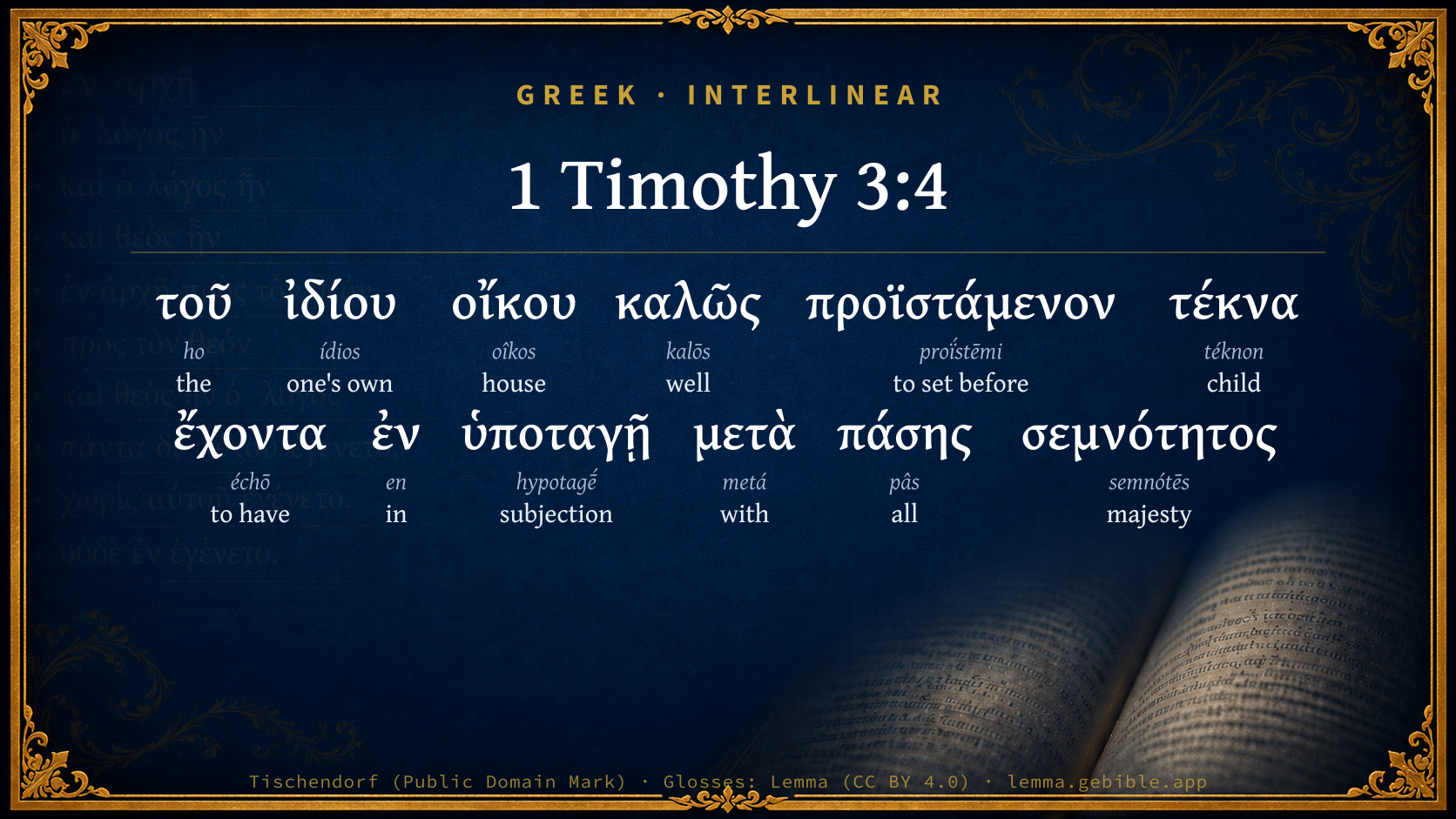
Greek (Tischendorf 8th ed.) 1 Timothy 3:4 appears in the Greek New Testament. The text above is from the Tischendorf 8th edition. Each word links to its Strong’s number and a concise gloss. Click any word for its full Thayer’s Greek Lexicon entry.
Download image
Cite this verse

1 Timothy 3:4 (World English Bible). Public Domain. Lemma interlinear Bible study tool, https://lemma.gebible.app/v/1-timothy/3/4.

Show BibTeX & RIS
BibTeX
RIS
English Translation
one who rules his own house well, having children in subjection with all reverence;
World English Bible · Public Domain
Download a study sheet

One document with this verse’s original text, its word-by-word gloss line, the meaning frame, cross-references with their text, attributed commentary, and full source and license credits — printable, and it pastes into notes with its structure intact.

This verse Autodidact and up

Study sheet (.html) Plain text (.txt)

A passage Seminary Student

Up to 50 verses in one chapter. A passage sheet keeps up to 6 commentary sources and 12 cross-references per verse, in the order this page ranks them, and says so on the sheet whenever that leaves anything out. Ask for a single verse and you get the Autodidact verse sheet above.

Everything on this page stays free to read, with no account — the sheet is a download of what is already on screen, not access to it.

Want to remove ads? Support Godless Engineer
Compare translations 3

The same verse in 3 English versions, stacked beneath the original-language interlinear above. Click any original word for its lexicon entry.

Each is an independent rendering of the whole verse — the interlinear is not word-aligned to these translations.

Highlighted words mark where these versions differ — a whole-verse word diff, not a word-by-word alignment.

  • World English Bible Public Domain
    one who rules his own house well, having children in subjection with all reverence;
  • King James Version Public Domain
    One that ruleth well his own house, having his children in subjection with all gravity;
  • unfoldingWord Literal Text CC BY-SA 4.0
    leading his own household well, having children in submission with all dignity,

unfoldingWord Literal Text — © unfoldingWord, licensed CC BY-SA 4.0. Word-aligned USFM3 via Door43 (git.door43.org/unfoldingWord/en_ult).

Versions to compare (up to 4)

3 of 4 selected

Show all 19 translations

Every available English version of this verse, each an independent rendering of the whole verse.

  • World English Bible Public Domain
    one who rules his own house well, having children in subjection with all reverence;
  • Berean Standard Bible Public Domain
    An overseer must manage his own household well and keep his children under control, with complete dignity.
  • Majority Standard Bible Public Domain
    An overseer must manage his own household well and keep his children under control, with complete dignity.
  • King James Version Public Domain
    One that ruleth well his own house, having his children in subjection with all gravity;
  • American Standard Version (1901) Public Domain
    one that ruleth well his own house, having `his' children in subjection with all gravity;
  • Revised Version (1885) Public Domain
    one that ruleth well his own house, having his children in subjection with all gravity;
  • Geneva Bible (1599) Public Domain
    One that can rule his owne house honestly, hauing children vnder obedience with all honestie.
  • Douay-Rheims (1899) Public Domain
    One that ruleth well his own house, having his children in subjection with all chastity.
  • Young's Literal Translation Public Domain
    his own house leading well, having children in subjection with all gravity,
  • Literal Standard Version CC BY-SA 4.0
    leading his own house well, having children in subjection with all dignity,
  • Unlocked Literal Bible CC BY-SA 4.0
    He should manage his own household well, and his children should obey him with all respect.
  • unfoldingWord Literal Text CC BY-SA 4.0
    leading his own household well, having children in submission with all dignity,
  • Darby Bible Public Domain
    conducting his own house well, having [his] children in subjection with all gravity;
  • World Messianic Bible Public Domain
    one who rules his own house well, having children in subjection with all reverence;
  • Webster's Bible Public Domain
    One that ruleth well his own house, having his children in subjection with all gravity;
  • Free Bible Version CC BY-SA 4.0
    He must handle his own family well. His children must respect what he tells them to do.
  • Bible in Basic English Public Domain
    Ruling his house well, having his children under control with all serious behaviour;
  • Text-Critical English NT CC BY 4.0
    He must lead his own household well, keeping his children in submission with all dignity.
  • Tyndale New Testament (1534) Public Domain
    and one that rueleth his awne housse honestly havynge chyldren vnder obedience with all honeste.

Literal Standard Version (2020), Covenant Press — licensed CC BY-SA 4.0. Text via the HelloAO Bible API (eBible.org). Unlocked Literal Bible (unfoldingWord) — licensed CC BY-SA 4.0. Text via the HelloAO Bible API (eBible.org). unfoldingWord Literal Text — © unfoldingWord, licensed CC BY-SA 4.0. Word-aligned USFM3 via Door43 (git.door43.org/unfoldingWord/en_ult). Free Bible Version, Dr. Jonathan Gallagher — licensed CC BY-SA 4.0. Text via the HelloAO Bible API (eBible.org).

Word by word

More ways to search: Search by grammar → Find every occurrence → Compare this word →

Practice this passage: Drill this verse → Learn its vocabulary →

About this verse

These counts appear in no published source. They are computed here, from the morphology-tagged text and Lemma’s own curated glosses. What Lemma adds →

12
words
12
distinct lemmas
Pauline Epistles
section

Notable vocabulary

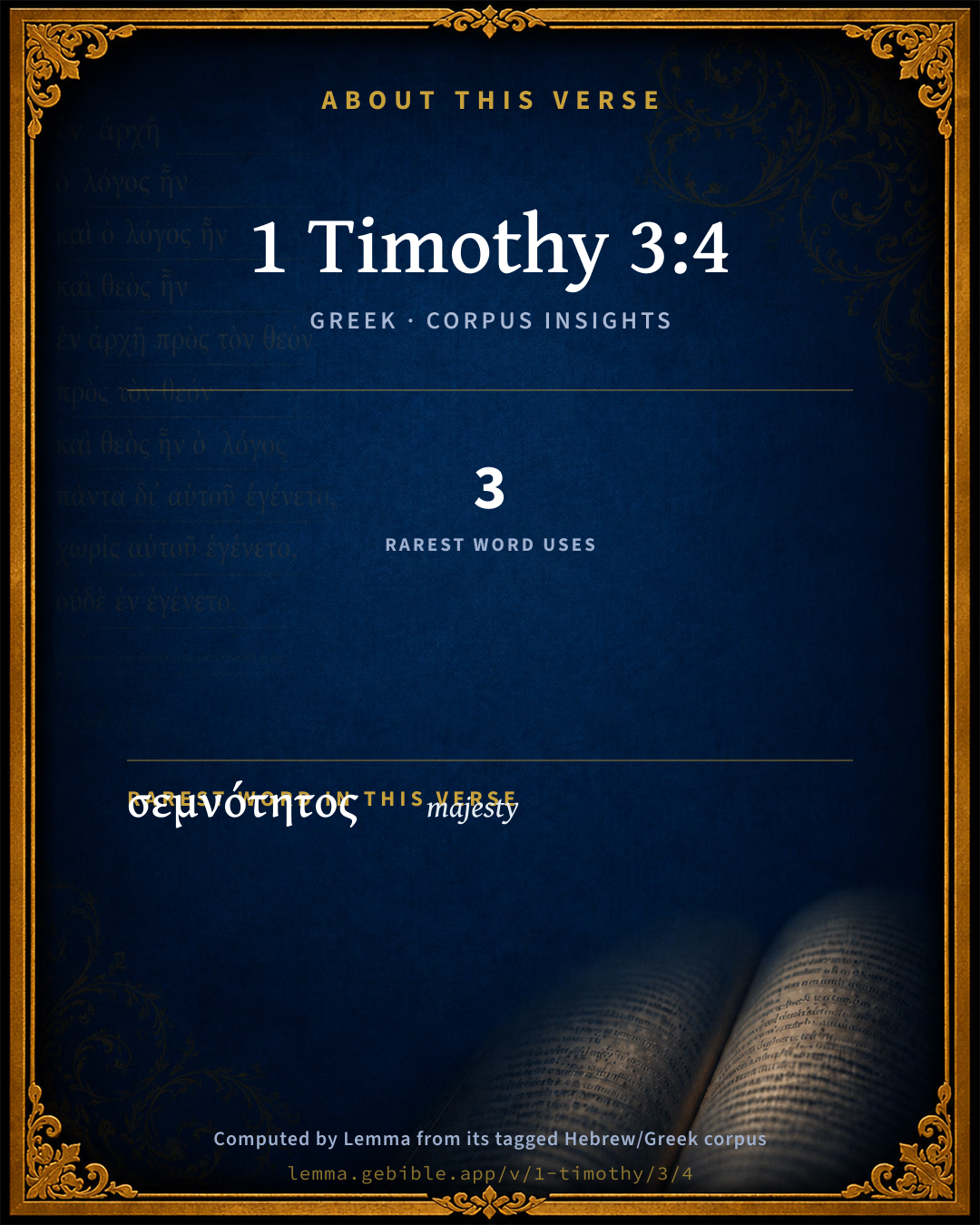
The rarest word here is σεμνότητος majesty G4587 — appearing just 3 times in the whole Greek New Testament.

Shared distinctive vocabulary

σεμνότητος majesty G4587 occurs in 3 verses of the Greek New Testament. Also found in:

Cross-references

9

Topical passages linked to 1 Timothy 3:4 in the Treasury of Scripture Knowledge — connected by theme and wording, ordered by reader-vote popularity; previews shown in the World English Bible.

  • Titus 1:6 if anyone is blameless, the husband of one wife, having children who believe, who are not accused of loose or unruly behavior.
  • Genesis 18:19 For I have known him, to the end that he may command his children and his household after him, that they may keep the way of Yahweh, to do righteousness and justice; to the end that Yahweh may bring on Abraham that which he has spoken of him."
  • 1 Timothy 3:12 Let deacons be husbands of one wife, ruling their children and their own houses well.
  • Titus 2:2 that older men should be temperate, sensible, sober-minded, sound in faith, in love, and in patience:
  • Joshua 24:15 If it seem evil to you to serve Yahweh, choose you this day whom you will serve; whether the gods which your fathers served that were beyond the River, or the gods of the Amorites, in whose land you dwell: but as for me and my house, we will serve Yahweh.
  • Acts 10:2 a devout man, and one who feared God with all his house, who gave gifts for the needy generously to the people, and always prayed to God.
  • Psalms 101:2–8 I will be careful to live a blameless life. When will you come to me? I will walk within my house with a blameless heart.
  • Titus 2:7 in all things showing yourself an example of good works; in your teaching showing integrity, seriousness, incorruptibility,
  • Philippians 4:8 Finally, brothers, whatever things are true, whatever things are honorable, whatever things are just, whatever things are pure, whatever things are lovely, whatever things are of good report; if there is any virtue, and if there is any praise, think about these things.

Cross-references courtesy of OpenBible.info (CC BY 4.0).

Commentary

Notes on 1 Timothy 3:4 from classic Christian and Jewish commentators (each source and its license shown beneath its notes). The classic Christian expositions comment on the surrounding passage and are grouped to its opening verse, so a note may address several verses; the Jewish commentaries on the Tanakh (Rashi and others) are per-verse, so they appear only where the commentator wrote on this verse.

Lemma curates 59 commentaries, every one of them public domain or Creative Commons licensed, each selected and text-cleaned for this edition rather than reprinted as found. About our sources →

Joseph Benson's Commentary

1Ti 3:4-6. One that ruleth well his own house — That not only rules it, but rules it well, and keeps his family in good order: that rules it so as to promote religion and virtue in all its members; rules it calmly, but firmly; never using harshness where gentleness and love will produce the desired effect; having his children — If he be a father; in subjection, with all gravity — Or seriousness; for levity undermines all domestic authority: and he must thus rule his house both that he may set a good example to other masters of families, and that he may thereby give proof of his ability to preside over the church of God. For if a man know not how to rule his own house — So as to preserve a due decorum in the family where he has such a natural authority; how should he be able to take care of — Or to govern, in a proper manner, that greater and more important society, the church of God — In which there will be such a diversity of characters and dispositions, and over which it will be impossible for him to maintain an equal inspection and influence? Not a novice — νεοφυτον, literally, one newly ingrafted, namely, into the body of Christ, or newly planted, namely, in the garden of his church; that is, one newly converted. Such were not to be made bishops, or presbyters; because, being yet but imperfectly instructed in the Christian doctrine, they were not fit to teach it to others. Besides, as their zeal, constancy, fidelity, and other graces, had not been sufficiently tried, they could have had but little authority, especially with the brethren of longer standing and greater experience. Lest being lifted up with pride — Greek, τυφωθεις, puffed up, with this new honour conferred upon him, or the applause which frequently follows it; he fell into the condemnation of the devil — The same into which the devil fell, or be guilty of the sin of self-conceit and high-mindedness, for which the devil was condemned.

Joseph Benson's Commentary on the Old and New Testaments (1811–1818) — public domain. Text from a community e-Sword module.

Tyndale Open Study Notes

Tyndale Open Resources

3:4-5 The church as a household (3:15) overlapped with the family household. An overseer’s capacity to manage in one sphere reflected his capability in the other (see also 3:12; 5:17; Rom 12:8; 1 Thes 5:12). • The Greco-Roman household was united by familial bonds characterized by mutual responsibilities, roles, and stewardship. The household included the blood relatives living together along with other dependents, such as household servants.

Tyndale Open Study Notes — © Tyndale Open Resources, licensed CC BY-SA 4.0. Text via the HelloAO Bible API.

Bengel's Gnomon

Johann Albrecht Bengel

1Ti 3:4. Τοῦ ἰδίου οἴκου, his own house) Many men, for instance, are mild abroad, but are the less disposed to restrain their passion at home, which they direct against their wives, etc.—καλῶς προιστάμενον, one who ruleth well) To this ἀφιλαργυρία chiefly refers.—μετὰ πάσης σεμνότητος, with all gravity [propriety]) so that there may be no luxury [ἀσωτία, riotous living]: Tit 1:6.

Bengel's Gnomon of the New Testament — English translation (T&T Clark, Edinburgh, 1860) — public domain. Text from a community e-Sword module.

Meyer's Critical & Exegetical Commentary

Heinrich August Wilhelm Meyer

1Ti_3:4. In the second verse, the apostle touched on the subject of marriage-life; here, he directs how the bishop is to conduct himself in his own house.

τοῦ ἰδίου οἴκου καλῶς προϊστάμενον] Though ἴδιος is used at times in the N. T. instead of the simple possessive pronoun, it is here emphatic, in contrast with ἐκκλησία Θεοῦ, 1Ti_3:5.

οἶκος here, as elsewhere, denotes the entire household, including slaves. It is above all important that he should act properly in regard to the children; hence the apostle adds: τέκνα ἔχοντα ἐν ὑποταγῇ μετὰ πάσης σεμνότητος] From a comparison with the corresponding passage in Tit_1:6, it is clear that he is speaking here, not of the fathers disposition, but of that of the children (in opposition to Hofmann). The ἔχοντα ἐν ὑποταγῇ corresponds in sense with μὴ … ἀνυπότακτα in the other passage, and in construction with ἔχοντα … μὴ ἐν κατηγορίᾳ ἀσωτίας. The bishop is to preside over his house in such a way that the children shall not be wanting in submissiveness. The words μετὰ πάσης σεμνότητος are to be connected with what immediately precedes, and not with προϊστάμενον (Hofmann). If it be right to refer them to the fathers (Heydenrich, Matthies, van Oosterzee), ἔχειν must be explained as equivalent either to tenere (Matthies: holding the children in obedience) or to κατέχειν (van Oosterzee). That, however, is arbitrary; besides, the parallel passage in Tit_1:6, where ἀσωτία is the opposite of σεμνότης, is against it. Leo, Mack, de Wette, Wiesinger, are right therefore in referring the words to the children. The idea of σεμνότης does not forbid this reference, if only we avoid thinking of little children; comp., by way of contrast, the conduct of the children of the high priest Eli, in the O. T.

Meyer — Critical and Exegetical Commentary on the New Testament — English translation by Peter Christie, edited by Frederick Crombie (T&T Clark, 1880) — public domain. Text from a community e-Sword module.

Expositor's Greek Testament

ed. W. Robertson Nicoll

1Ti 3:4 . τοῦ ἰδίου οἴκου : Although ἴδιος commonly retains in the N.T. the emphatic sense own , yet there can be no doubt that examples occur of the later weakened sense in which it means simply αὐτοῦ , e.g. , 1Co 7:2 . We are not therefore justified in insisting on the emphatic sense, own , here or in 1Ti 3:12 , 1Ti 6:1 , Tit 2:5 ; Tit 2:9 . See J. H. Moulton Grammar , vol. i. p. 87 sqq ., and Expositor , vi., iii. 277, and Deissmann, Bible Studies , trans. p. 123 sq . οἶκος also means household , 1Co 1:16 and in the Pastorals.

προϊστάμενον : προΐστασθαι is perhaps used, here and in 1Ti 3:12 , because it would naturally suggest church government. See reff., and Hermas, Vis . ii. 4; Justin Martyr, Apol . i. 65. A different use is found in Tit 3:8 ; Tit 3:14 , καλῶν ἔργων προΐστασθαι , where see note. The domestic qualification, as we may call it, of the episcopus, also applies to deacons (1Ti 3:12 ) and to the Cretan episcopus (Tit 1:6 ).

τέκνα ἔχοντα : Alford cannot be right in supposing that τέκνα is emphatic. It would be absurd to suppose that a man otherwise suited to the office of an episcopus would be disqualified because of childlessness. The clause is parallel to μιᾶς γυναικὸς ἄνδρα : if the episcopus be a married man, he must not be a digamist; if he have children, they must be ἐν ὑποταγῇ .

ἐν ὑποταγῇ σεμνότητος : with the strictest regard to propriety , see note on chap. 1Ti 2:2 . Most commentators join these words closely together. The σεμνότης of the children in their extra-family relations being the outward and visible expression of the ὑποταγή to which they are subject in domestic life. This is a more natural reference of σεμνότ . than to the general household arrangements, “ ut absit luxuria ” (Bengel). On the other hand there is much force in Dean Bernard’s remark that “ σεμνότης is hardly a grace of childhood.” He connects ἔχοντα μετὰ πασ . σεμν . This seems to be supported by 1Ti 3:8 , διακόνους ὡσαύτως σεμνούς and 1Ti 3:11 . Von Soden takes a similar view.

The Expositor's Greek Testament, edited by W. Robertson Nicoll (1897–1910) — public domain. Text from a community e-Sword module.

Jamieson, Fausset & Brown

Robert Jamieson, A. R. Fausset & David Brown

ruleth--Greek, "presiding over."

his own house--children and servants, as contrasted with "the church" (house) of God (Ti1 3:5, Ti1 3:15) which he may be called on to preside over.

having his children--rather as Greek, "having children (who are) in subjection" (Tit 1:6).

gravity--propriety: reverent modesty on the part of the children [ALFORD]. The fact that he has children who are in subjection to him in all gravity, is the recommendation in his favor as one likely to rule well the Church.

Jamieson, Fausset & Brown — Commentary Critical and Explanatory on the Whole Bible (1871) — public domain (CC PDM 1.0). Text via the HelloAO Bible API.

Adam Clarke's Commentary

Verse 4. The fourteenth qualification of a Christian bishop is, that he ruleth well his own house; του ιδιου οικου καλως προΐσταμενον, one who properly presides over and governs his own family. One who has the command, of his own house, not by sternness, severity, and tyranny, but with all gravity; governing his household by rule, every one knowing his own place, and each doing his own work, and each work having the proper time assigned for its beginning and end. This is a maxim of common sense; no family can be prosperous that is not under subjection, and no person can govern a family but the head of it, the husband, who is, both by nature and the appointment of God, the head or governor of his own house. See Clarke on Eph 5:22.

Adam Clarke's Commentary on the Bible (1810–1826) — public domain. Text from a community e-Sword/MySword module.

John Calvin's Commentaries

4 Who ruleth well his own house Hence it is evident, that Paul does not demand that a bishop shall be unacquainted within human life, but that he shall be a good and praiseworthy master of a household; for, whatever may be the admiration commonly entertained for celibacy and a philosophical life altogether removed from ordinary custom, yet wise and thoughtful men are convinced by experience, that they who are not ignorant of ordinary life, but are practiced in the duties of human intercourse, are better trained and adapted for governing the Church. And, therefore, we ought to observe the reason which is added, (1 Timothy 3:5,) that he who does not know how to rule his family, Will not be qualified for governing the Church. Now, this is the case with very many persons, and indeed with almost all who have been drawn out of an idle and solitary life, as out of dens and caverns; for they are a sort of savages and destitute of humanity.

Who hath his children in subjection with, all reverence The apostle does not recommend a clever man, and deeply skilled in domestic matters, but one who has learned to govern a family by wholesome discipline. He speaks chiefly of children, who may be expected to possess the natural disposition of their father; and therefore it will be a great disgrace to a bishop, if he has children who lead a wicked and scandalous life. As to wives, he will speak of them afterwards; but at present, as I have said, he glances at the most important part of a house.

In the Epistle to Titus, (Titus 1:6,) he shows what is here meant by the word reverence; for, after having said that the children of a bishop must not be unruly and disobedient, he likewise adds,

“nor liable to the reproach of profligacy or of intemperance.”

He therefore means, in a word, that their morals shall be regulated by all chastity, modesty, and gravity.

John Calvin's Commentaries (1540-1563) — public domain. Text from the Calvin Translation Society English edition (1840s-50s) via the Christian Classics Ethereal Library (ccel.org). Calvin's coverage is partial (roughly two-thirds of the Bible); uncommented books and verses are honest gaps, never fabricated. The 19th-century editor's footnotes and remarks are omitted so the notes are faithfully Calvin's own voice.

Ellicott's Commentary for English Readers

(4) One that ruleth well his own house.—Paul here again turns to the vein of thought first struck in 1Ti_3:2 : The life of the officer in the Church of God must be a pattern life for those without, as well as for those within the Church’s fold, to copy and imitate. He must be pre-eminent in nobility of life and aims; but the life and the aims must belong to ordinary every day life. His high standard must be no inimitable one; the example must be one that all honest men may follow and copy, if they will. So, first of all (1Ti_3:2), the Apostle places among the qualities necessary for a governing elder in the Church, the pure home life of the husband; then, after enumerating other points to be sought for in the character of one chosen to rule in the congregation, Paul comes back to this central idea, the home life of the Church official; that home life must present the spectacle of a well-ordered household. This will be at least a good test of a man’s fitness to rule the large family gathered together in the form of a congregation, if his own home is gently yet firmly ruled; the wife, a pattern Christian lady; the children growing up in the nurture and admonition of the Lord.

Having his children in subjection with all gravity.—The Greek word rendered “gravity” occurs in 1Ti_2:2, where it is translated in the authorised version, not very happily, by “honesty.” The word employed in the original Greek denotes that decorum, that propriety of demeanour, which belongs especially to the pure and chaste, and seems to urge that a peculiar reverence and an especial decorum shall be aimed at in all relations with the young. Maxima debetur pueris reverentia. The child life in the families of these ministers of Christ’s religion must, too, be an example to countless other homes.

A Bible Commentary for English Readers, edited by Charles John Ellicott (1878–1897) — public domain. Text from a community e-Sword module.

The Cambridge Bible for Schools and Colleges

gen. ed. J. J. S. Perowne

4. that ruleth well his own house] In distinction to ‘God’s household’ the Church, 1Ti_3:5; 1Ti_3:15.

his children] Rather, from the emphatic position of ‘children,’ and the absence of the article, the sense is ‘with a household of his own rightly under his rule, with children held in subjection.’

with all gravity] There should be, that is, all propriety of conduct on his part, according to the line ‘maxima debetur pueris reverentia’; so Titus in order to commend his exhortations to the young men to be pure is himself ‘to set an example of propriety,’ Tit_2:7. There should be the same propriety on the children’s part, according to the similar passage in Tit_1:6, that they be ‘not accused of riot.’

Compare St Paul’s eloquent appeal to the Philippians to ‘think thoughts true and seemly, righteous and pure,’ thoughts of truth, morality, righteousness and purity, Php_4:8.

The Cambridge Bible for Schools and Colleges (gen. ed. J. J. S. Perowne; Cambridge University Press, 1878–1918) — public domain. Text from a community e-Sword module.

John Gill's Exposition

One that ruleth well his own house,.... His family, wife, children, and servants; and is not to be understood of his body, and of keeping of that under, and of preserving it chaste and temperate, as appears from what follows:

having his children in subjection with all gravity; keeping a good decorum in his family; obliging his children to observe his orders, and especially the rules of God's word; and not as Eli, who did not use his authority, or lay his commands upon his sons, nor restrain them from evil, or severely reprove them for their sins, but neglected them, and was too mild and gentle with them;

1Sa 2:23 3:13 but like Abraham, who not only taught, but commanded his children and his household, to keep the way of the Lord; Gen 18:19 and so should those act who are in such an office as is here treated of; and should not only rule well in their families, preside over them, go before them, and set an example to them, and keep their children in obedience and subjection; but this should be "with all gravity": not only in the master of the family, but in the children; who as their father is, or should be, should be brought up in, and used to gravity in words and in dress; and in the whole of their deportment and conversation. This may he observed against the Papists, who forbid marriage to the ministers of the Gospel.

John Gill's Exposition of the Whole Bible (1746–1763) — public domain (CC PDM 1.0). Text via the HelloAO Bible API.

Trapp's Complete Commentary

John Trapp

4 One that ruleth well his own house, having his children in subjection with all gravity;

Ver. 4. One that ruleth well] προισταμενον. A good priest in his own family, which he daily perfumes with evangelical sacrifices, till his house, as the house of David, be as God, as the angel of the Lord before them, Zec 12:8.

Having his children in subjection] Yet Pope Pelagius forbids a bishop to have either wife or children; whereof this wise reason is given, because children are argumentum ambulans super terram, A walking argument of their father’s incontinence. Os durum! Hard saying! His successor Paul III had no wife indeed, but children he had. One of whom, named Petro Alvigi Farnesis, having first forced and then poisoned Cosmus Chaerius, bishop of Fanum, received no other check or chastisement of his father the pope but this, Haec vitia me non commonstratore didicit, He never learned those vices from his father.

John Trapp, A Commentary or Exposition upon All the Books of the Old and New Testament (1647–1656) — public domain. Text from a community e-Sword module.

Albert Barnes' Notes on the Bible

One that ruleth well his own house - This implies that a minister of the gospel would be, and ought to be, a married man. It is everywhere in the New Testament supposed that he would be a man who could be an example in all the relations of life. The position which he occupies in the church has a strong resemblance to the relation which a father sustains to his household; and a qualification to govern a family well, would be an evidence of a qualification to preside properly in the church. It is probable that, in the early Christian church, ministers were not unfrequently taken from those of mature life, and who were, at the time, at the head of families; and, of course, such would be men who had had an opportunity of showing that they had this qualification for the office. Though, however, this cannot be insisted on now as a “previous” qualification for the office, yet it is still true that, if he has a family, it is a necessary qualification, and that a man in the ministry “should be” one who governs his own house well. A want of this will always be a hindrance to extensive usefulness.

Having his children in subjection with all gravity - This does not mean that his “children” should evince gravity, whatever may be true on that point; but it refers “to the father.” He should be a grave or serious man in his family; a man free from levity of character, and from frivolity and fickleness, in his conversation with his children. It does not mean that he should be severe, stern, morose - which are traits that are often mistaken for gravity, and which are as inconsistent with the proper spirit of a father as frivolity of manner - but that he should be a serious and sober-minded man. He should maintain proper “dignity” (σεμνότης semnotēs); he should maintain self-respect, and his deportment should be such as to inspire others with respect for him.

Albert Barnes' Notes on the Bible (1834–1885) — public domain. Text from a community e-Sword/MySword module.

Haydock's Catholic Bible Commentary

Ruleth well his own house, &c. Before he is set over the Church, let him have given proofs of his talents for governing within his own house, by the regularity he has made all his dependants observe. In the infancy of the Church, it was frequently necessary to ordain the most regular fathers of families bishops, for want of others of a sufficient age who had observed perpetual continency. --- With all chastity. The Greek implies, grave, sober, temperate; but as this seems to answer what is said Titus i. 6. it seems to be properly understood of chastity. (Witham)

George Leo Haydock (1774–1849), Haydock's Catholic Family Bible and Commentary, 1859 edition — public domain. Excludes Psalms (Douay-Rheims chapter numbering differs from Protestant) and Deuterocanonical books (Catholic canon only).

Matthew Poole's English Annotations

One that ruleth well his own house; if he he one to whom God hath given a family, one who hath given an experiment of his conversation and ability to take care of a church, by the care that he hath taken of his family, and his ruling in that lesser society.

Having his children in subjection with all gravity; one that hath not let his children behave themselves rudely, and indecently, and rebelliously, but kept them in order by a grave demeanour towards them.

Matthew Poole's English Annotations on the Holy Bible (1683–1685) — public domain. Text from a community e-Sword/MySword module.

Whedon's Commentary on the Bible

Daniel D. Whedon

4. House… children—How entirely adverse to Scripture is the requirement of clerical celibacy is transparent from this passage, where the elder’s care of his family is token of his ability to care for his Church. Indeed, Vigilantius, the great opponent of Jerome, had some reason for maintaining that St. Paul required marriage in the clergy.

Daniel D. Whedon (gen. ed.), Commentary on the Old and New Testaments (1874–1909) — public domain. Text from a community e-Sword module.

The Pulpit Commentary

One that ruleth well his own house. The ejpiskopov is one who has to preside over and rule (proistasqai) the house of God (1Ti_5:17; Rom_12:8; 1Th_5:12) as the high priest was called "ruler of the house of God". (1Ch_9:11; Neh_11:11) So in Justin Martyr the bishop is called oJ proestwv twn ajdelfwn ("Apology," 11) and simply oJ proestwv, and similarly inmenoi Heb_13:7 the clergy are oiJ hJgou uJmwn, they which have the rule over you." How needful, then, is it that he should rule well his own house, and have his own children in subjection! The testimony given in this passage to a married clergy is too clear to need any comment. In subjection (ejn uJpotagh); as above, 1Ti_2:11, where see note. For the sense, comp.thtov), Tit_1:6, which leads us to apply the words, with all gravity (semno) the contrary to "riot," ajswtia), to the children. The children of the ejpiskopov are to exhibit that seriousness and sobriety of conduct which is in accordance with their father"s office, meta, together with, as in 1Ti_1:14.

Vers. 4, 5.

The Christian pastor in his home life.

The apostle here turns to the family life of the pastor as an important element affecting the public examination of his character.

I THE IMPORTANCE OF A WELL-ORDERED HOUSEHOLD. "One that ruleth well his own house, having his children in subjection with all gravity.

1. The pastor is no ascetic recluse, but shares in the everyday life of the world.

2. He must have firmness and authority to rule his family wife, children, and servants; not slack in his rule like old Eli, but faithful as Abraham, who not only taught but commanded his children and household to keep the way of the Lord.

3. He is to rule gently yet firmly, so as, while securing subjection in his household, he creates that gravity of deportment which is the accompanying grace of obedience in children reared under wise and loving mastery.

II THE WELL-ORDERED HOUSEHOLD THE TEST OF FITNESS FOR THE RULE OF THE HOUSE OF GOD. "For if a man know not how to rule his own house, how shall he take care of the Church of God?

1. The argument is from the less to the greater. The family is the lesser sphere, the Church the larger family. The family needs much prudence, care, forethought, affection. But while it is the narrowest sphere, it is governed with peculiar advantages, arising from the feelings of love and dependence on the part of the children. If there is failure here, there is a self-evident unfitness for the wider and more complex administration of the Church.

2. The Church of God is to be a subject of anxious care to the pastor. The Greek word implies this thought. The apostle himself had the care of all the Churches upon him. But the pastor has a care for the individual members of his flock, to seek the conversion of sinners, to instruct the ignorant, to guide the perplexed, to comfort the doubting, to check the wayward, and to defend the flock against errorists. "Who is sufficient for these things? T.C.

The Pulpit Commentary (1880–1919), ed. H.D.M. Spence-Jones & Joseph S. Exell — public domain. Text from a community e-Sword module.

John Wesley's Explanatory Notes

Having his children in subjection with all seriousness - For levity undermines all domestic authority; and this direction, by a parity of reason, belongs to all parents.

John Wesley, Explanatory Notes Upon the Whole Bible (1754–1765) — public domain. Text via the GEBible commentary corpus.

Fairbairn on Ezekiel, Jonah & the Pastoral Epistles

Patrick Fairbairn

Ver. 4. The proper pastor is further described as ruling well his own house—his own (ἰδίου) as contradistinguished from God’s, the relatively little, and more easily managed; having children in subjection with all gravity, or decency of deportment; having, in short, a well-ordered and properly trained household. And the special reason follows, introduced by the adversative particle δέ, which no more in such a connection than any other can be strictly rendered for (Winer, Gr. § 53, 2, b), since it introduces parenthetically a statement which forms an antithesis to the one immediately preceding, yet an antithesis which at the same time constitutes a reason: But if one knows not how to rule his own house, how shall he take charge of the church of God?—if within the narrower sphere, and with all the advantage which a parent’s position and influence naturally secure for him, he should prove deficient in the proper governing authority, how certainly may he be expected to fail in the efficient management and control of things pertaining to the church of God! The future here (ἐπιμελήσεται), as frequently elsewhere, especially in interrogative sentences, involves the idea of possibility (Winer, Gr. xl. 6); and so Chrysostom expressly puts it: “He, then, who does not rightly administer these [smaller] things, how shall he be able (πῶς δυνήσεται) to administer the affairs of the church?”

Patrick Fairbairn — An Exposition of Ezekiel (1851), Jonah (1849), and The Pastoral Epistles (1874) — public domain. Text from a community e-Sword module.

Burkitt's Expository Notes on the New Testament

William Burkitt

A bishop being a ruler in the church of God, Timothy is advised to choose such a one to rule in the church that well and wisely governs his own family, having his children in due subjection, and both he and they behaving themselves with becoming gravity; and St. Paul subjoins a reason for this apostolical injunction, arguing from the less to the greater, thus: "The church is a large family, the bishop’s house a less; the former requires a greater skill in governing of it than the latter: if then a man cannot rule a less province, how shall he manage a greater? If he cannot keep up his authority with decency and becoming gravity in his own family, how shall such a one be thought fit to be entrusted with the care of the church of God?"

Great are the obligations which lie upon the ministers of God, above all men, to guide and govern their own families, to keep their children in due subjection, and their servants in great order; because their family miscarriages reflect greatly upon their authority and prudence, and the world will pronounce them unfit for rule in the church of God, who cannot govern their own house. If a man know not how to rule his own house, how shall he take care of the church of God?

Learn hence, That he who knows now to rule his own house well, is in a good posture of spirit for public rule; the same wisdom, justice, and holiness for kind, but more extensive, acts in either sphere, and will regularly move in both.

William Burkitt's Expository Notes on the New Testament (1700–1703) — public domain. Text from a community e-Sword module.

The People's New Testament

B. W. Johnson

4. One that ruleth well his own house. This implies that he must be a man of family. Having his children. He must be a father with obedient children.

B. W. Johnson's The People's New Testament with Notes (1889–1891) — public domain. Electronic text from the Christian Classics Ethereal Library (CCEL) ThML edition.

unfoldingWord translationNotes

Door43 World Missions Community

He should manage

"He should lead" or "He should take care of"

with all respect

Possible meanings are 1) the overseer's children should obey and show respect to their father or 2) the overseer's children should show respect to everyone or 3) the overseer should show respect to those in his household as he leads them.

all respect

"complete respect" or "respect at all times"

For if a man does not know how to manage

"For when a man cannot manage"

how will he care for a church of God?

Paul uses a question to teach Timothy. AT: "he cannot take care of a church of God." or "he will not be able to lead a church of God." (See: Rhetorical Question)

a church of God

Here "church" refers to a local group of God's people. AT: "a group of God's people" or "the believers over whom he is in charge" (See: Metonymy)

translationWords

manager

household

obey

church

unfoldingWord translationNotes — © Distant Shores Media and the Door43 World Missions Community, licensed CC BY-SA 4.0. Source: git.door43.org/Door43/en_tn.

Cambridge Greek Testament for Schools and Colleges

4. ἰδίου. Repeated again in 1Ti 3:5, in contrast to θεοῦ.

καλῶς. A characteristic word of the Pastorals (see on 1Ti 1:8, 1Ti 2:10 above).

προϊστάμενον. We find this verb applied to the officers of the Church also in Rom 12:8; 1Th 5:12, and to πρεσβύτεροι in ch. 1Ti 5:17 (see Introd. p. lxix.).

τέκνα κ.τ.λ. The parallel clause in Tit 1:6 is: τέκνα ἔχων πιστά, μὴ ἐν κατηγορίᾳ ἀσωτίας ἢ ἀνυπότακτα.

ἔχοντα. This is to be taken in subordination to προϊστάμενον: having his children in subjection. For ἐν ὑποταγῇ see 1Ti 2:11. This verse, like 1Ti 3:2, certainly seems to contemplate as the normal, and not merely a permissible, state of things that the ἐπίσκοπος should be a married man whose wife has borne him children.

μετὰ πάσης σεμνότητος. For the form of the phrase see note on 1Ti 2:11. Both the order of the words and the natural sense lead us to connect this clause with ἔχοντα, rather than with τὰ τέκνα. σεμνότης (see note on 1Ti 2:2) is hardly a grace of childhood; we approve it in the προϊστάμενος, but its presence in those over whom his rule is exercised does not afford any convincing proof of his fitness for rule; see on Tit 1:7.

Cambridge Greek Testament for Schools and Colleges (Cambridge University Press, 1896; 21 vols, various authors incl. Carr, Maclear, Plummer, Farrar, Lumby, Moule, M. R. James, Simcox) — public domain. Text from a community e-Sword module.

Alford’s Greek Testament

Henry Alford

4.] (This positive requisite again seems to spring out of the negative ones which have preceded, and especially out of ἀφιλάργυρον. The negatives are again resumed below with μὴ νεόφυτον) presiding well over his own house (ἰδίου, as contrasted with the church of God below, οἴκου, in its wide acceptation, ‘household,’ including all its members), having children (not ‘keeping (or having) his children’ (ἔχοντα τὰ τέκνα), as E. V. and Conyb. The emphatic position of τέκνα, besides its anarthrousness, should have prevented this mistake: cf. also Tit 1:6,—μιᾶς γυναικὸς ἀνήρ, τέκνα ἔχων πιστά, κ.τ.λ.) in subjection (i.e. who are in subjection) with all gravity (‘reverent modesty,’ see ch. 2:2. These words are best applied to the children, not to the head of the house, which acceptance of them rather belongs to the rendering impugned above. It is the σεμνότης of the children, the result of his προστῆναι, which is to prove that he knows how to preside over his own house,—not his own σεμνότης in governing them: the matter of fact, that he has children who are in subjection to him in all gravity,—not his own keeping or endeavouring to keep them so. Want of success in ruling at home, not want of will to rule, would disqualify him for ruling the church. So that the distinction is an important one): but (contrast, as in ch. 2:12, to the suppressed but imagined opposite case) if any man knows not (the use of εἰ οὐ here is perfectly regular: see Ellicott’s note) how to preside over his own house (shews, by his children being insubordinate, that he has no skill in domestic government), how shall he (this future includes ‘how can he,’ but goes beyond it—appealing, not to the man’s power, which conditions his success, but to the resulting matter of fact, which will be sure to substantiate his failure) take charge of (so Plato, Gorg. p. 520 a: οἱ φάσκοντες προεστάναι τῆς πόλεως καὶ ἐπιμελεῖσθαι) the church of God (ὁ τὰ σμικρὰ οἰκονομεῖν οὐκ εἰδώς, πῶς δύναται τῶν κρειττόνων καὶ θείων πιστευθῆναι τὴν ἐπιμέλειαν; Thdrt. See the idea followed out popularly in Chrys.)?

Henry Alford, The Greek Testament (1849–1861) — public domain. Text from a community e-Sword module.

International Critical Commentary

4. Cf. Tit 1:6; μετὰ πάσης σεμνότητος: cf. 2:2 of all Christians: here the reference is specially to the father (cf. 8, 11), though it might include the effect on the whole household (πάσης).

International Critical Commentary — older volumes (1896–1929), various authors — public domain. Text from a community e-Sword module.

Vincent's Word Studies in the New Testament

Marvin R. Vincent

That ruleth [προισταμενον] . Mostly in the Pastorals, but also in Rom 12:8; 1Th 5:12. The participle means placed in front. Here in a general sense, but in 1Th 1:5 of church authorities, but only functionally, not as a title of specially appointed officers. It is characteristic of the loose and unsettled ecclesiastical nomenclature of the apostolic age.

Having in subjection [εχοντα εν υποταγη] . The phrase is unique in N. T. Upotagh subjection is a Pauline word : see 2Co 9:13; Gal 2:5. o LXX

Marvin R. Vincent, Word Studies in the New Testament (1887–1900) — public domain. Text from a community e-Sword/MySword module.

Lesson kit

Teaching starters — assembled from the data on this page, not authored interpretation. Every prompt links to the verse data it draws on. Edit before teaching.

1 Timothy, in the Pauline Epistles, opens this verse with 12 words (12 distinct Greek lemmas). Its most distinctive word is semnótēs (“majesty”). A historical commentator’s framing appears above. Read the whole chapter for the surrounding context.

Discussion questions

  1. How does “majesty” (semnótēs) shape what this verse is saying?
  2. 1 Timothy 2:2 shares the word «majesty» with this verse. How do the two illuminate each other?
  3. These translations render this verse differently; the difference is in the English rendering, not the original. What questions does that raise?
  4. Reading how Joseph Benson's Commentary and Tyndale Open Study Notes read this verse, where do the two commentators agree and where do they part?

Things to notice

Reading settings

Reading text

Shown beneath each verse's original-language words.

Old Testament
Old Testament edition

Read the OT as the Masoretic Hebrew (MT) or the Greek Septuagint (LXX).

English shown for the Greek Septuagint (in the Hebrew ↔ Greek comparison).

Comparing translations? Open the Compare panel on any verse page to stack up to four side by side.