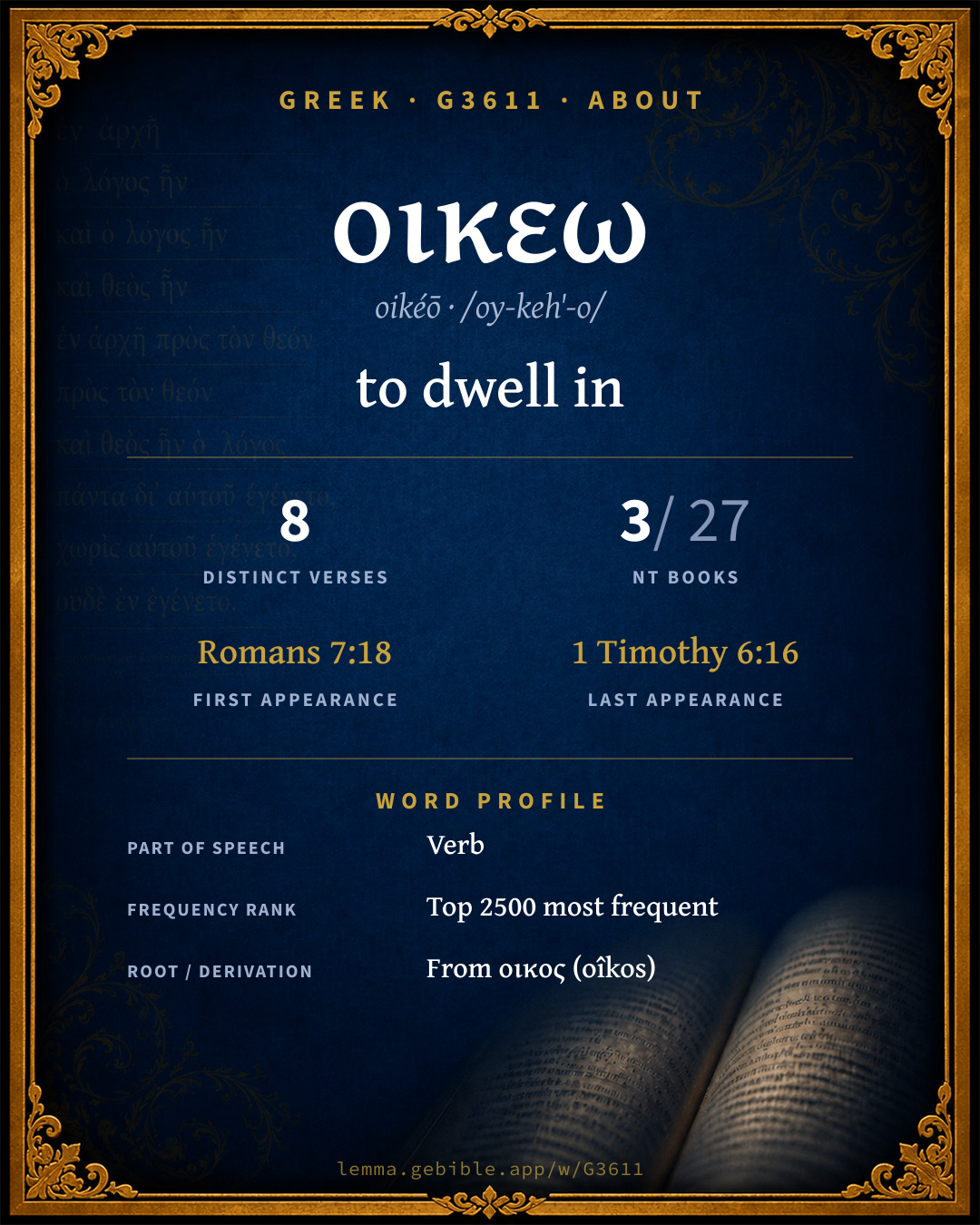
οἰκέω
to dwell in
Full lexicon entry — Thayer's Greek Lexicon
From Thayer's Greek Lexicon
Where this word appears
Grammar key — what these labels mean
Part of speech
- Verb
- An action or state-of-being word.
Tense
- Present
- Ongoing or general action in present time (imperfective aspect).
Voice
- Active
- The subject performs the action.
Mood
- Indicative
- States a fact or asks a factual question (the mood of reality).
- Infinitive
- A verbal noun (“to write”), unmarked for person or number.
- Participle
- A verbal adjective (“writing,” “having written”).
Case
- Nominative
- The case of the subject (and the predicate nominative).
Person
- 3rd person
- The one spoken about (“he / she / it / they”).
Gender
- Feminine
- Grammatically feminine.
- Masculine
- Grammatically masculine.
Number
- Singular
- One.
Grammatical forms
- Verb, Present, Active, Indicative, 3rd person, Singular 4 times (50%)
- Verb, Present, Active, Infinitive 2 times (25%)
- Verb, Present, Active, Participle, Nominative, Singular, Feminine 1 time (13%)
- Verb, Present, Active, Participle, Nominative, Singular, Masculine 1 time (13%)
Parsed forms decoded from the imported morphology (Robinson–Tischendorf, public domain), counted across 8 parsed occurrences — not distinct verses.
Every verse where G3611 appears — 8 distinct verses across 3 books. Click any verse to open its interlinear word-by-word view. Verse text shown in the World English Bible for context — . Each verse’s Greek form is shown with its reference; the English is not keyword-highlighted, since the data carries no word-level English alignment. Use “Compare translations” on any verse to read it across multiple English versions. This concordance covers the Greek New Testament; Septuagint (Greek Old Testament) occurrences of this word are not indexed here.
Romans 4 verses
- Romans 7:18 οἰκεῖ pres act ind 3sg For I know that in me, that is, in my flesh, dwells no good thing. For desire is present with me, but I don't find it doing that which is good.
- Romans 7:20 οἰκοῦσα pres act ptcp nom sg fem But if what I don't desire, that I do, it is no more I that do it, but sin which dwells in me.
- Romans 8:9 οἰκεῖ pres act ind 3sg But you are not in the flesh but in the Spirit, if it is so that the Spirit of God dwells in you. But if any man doesn't have the Spirit of Christ, he is not his.
- Romans 8:11 οἰκεῖ pres act ind 3sg But if the Spirit of him who raised up Jesus from the dead dwells in you, he who raised up Christ Jesus from the dead will also give life to your mortal bodies through his Spirit who dwells in you.
1 Corinthians 3 verses
- 1 Corinthians 3:16 οἰκεῖ pres act ind 3sg Don't you know that you are a temple of God, and that God's Spirit lives in you?
- 1 Corinthians 7:12 οἰκεῖν pres act inf But to the rest I--not the Lord--say, if any brother has an unbelieving wife, and she is content to live with him, let him not leave her.
- 1 Corinthians 7:13 οἰκεῖν pres act inf The woman who has an unbelieving husband, and he is content to live with her, let her not leave her husband.
1 Timothy 1 verse
About this entry
At a glance — auto-summarized from this page’s data, not written by a person. Every figure links to its source below. This summary describes the numbers; it doesn’t interpret them.
At its core, οικεω (oikéō) means “to dwell in.” Its uses cluster heavily in Romans (50% of all occurrences). Spanning 8 verses in 3 books, it ranks among the uncommon words of the Greek New Testament. It first appears in Romans 7:18. Sharing its root, it stands alongside οικος, οικειος and οικια. Dig into 8-verse concordance and the renderings breakdown below.
Gloss history
Strong's 1890 vs modern scholarship
About this word
Strong's G3611 catalogs a Greek word from the Greek New Testament.
These counts are not copied from any lexicon or concordance. They are computed here, from the morphology-tagged Greek New Testament. What Lemma adds →
- 8
- distinct verses
- The word appears in 8 distinct verses.
- 3 / 27
- NT books
- The word appears in 3 of 27 New Testament books.
- #1,240
- by frequency
- Top 2500 most frequent Greek words (rank 1,240 of 5,347 Greek words by occurrence).
View all 8 occurrences in the concordance →
Most concentrated in
- Romans 4 verses 50%
- 1 Corinthians 3 verses 38%
- 1 Timothy 1 verse 13%
By section of the New Testament
By traditional corpus
Conventional, traditional groupings — biblical authorship is debated, so this is a traditional corpus grouping, not an authorship claim. Some books belong to more than one corpus (Luke is in both the Gospels and the Lukan corpus, and so on), so these shares overlap and need not total 100%. Each figure is a share of the word’s 8 distinct verses.
- Pauline corpus 8 verses · 100%
How translations render this word
Counts come from each version’s own published word-to-Strong’s tagging or interlinear alignment — an approximate guide to how each version renders this word, not a word-level alignment the data otherwise carries. Because each total is that version’s own tagged count, the per-version totals vary from one another and need not match the appearance or distinct-verse counts above. These counts may also differ from a printed concordance because Lemma counts each distinctly tagged rendering and does not collapse phrase taggings into a single head-word total. This is a fixed set of word-tagged versions (KJV, ASV, BSB, ULT) and does not change with the reading translation you choose elsewhere. Each version’s license is shown beside its name below (and on Sources).
- King James Version: Dwell 4×, Dwelleth 4×
- American Standard Version: Dwelleth 6×, Dwell 2×
- Berean Standard Bible: Dwells 2×, Live 2×, Lives 2×
- unfoldingWord Literal Text: Live 3×, Lives 3×
King James Version Public Domain
Renders G3611 across 9 tagged occurrences — most commonly:
Plus 1 rendering that appears only once — usually multi-word phrases or single function words the recovered tagging swept in, not distinct renderings.
American Standard Version Public Domain
Renders G3611 across 9 tagged occurrences — most commonly:
Plus 1 rendering that appears only once — usually multi-word phrases or single function words the recovered tagging swept in, not distinct renderings.
Berean Standard Bible Public Domain
Renders G3611 across 9 tagged occurrences — most commonly:
Plus 1 rendering that appears only once — usually multi-word phrases or single function words the recovered tagging swept in, not distinct renderings.
unfoldingWord Literal Text CC BY-SA 4.0
Renders G3611 across 9 tagged occurrences — most commonly:
Plus 3 renderings that appear only once — usually multi-word phrases or single function words the recovered tagging swept in, not distinct renderings.
Senses in Thayer's
The 1 sense Thayer's distinguishes for this word, in lexicon order (not ranked by frequency or importance). The full entry — with sub-senses — is in the Lexicon Entry tab.
- to dwell in
Word origin
Derived from οικος (oîkos) (G3624) — house.
Forms in the corpus
The 4 distinct written forms G3611 takes in the Greek New Testament, most frequent first — each parse links to that tense’s occurrences in the concordance.
| Form | Parsing | Example | Uses |
|---|---|---|---|
| οἰκεῖ oikeî | Verb, Present, Active, Indicative, 3rd person, Singular | Romans 7:18 | 4 |
| οἰκεῖν oikeîn | Verb, Present, Active, Infinitive | 1 Corinthians 7:12 | 2 |
| οἰκοῦσα oikoûsa | Verb, Present, Active, Participle, Nominative, Singular, Feminine | Romans 7:20 | 1 |
| οἰκῶν oikō̂n | Verb, Present, Active, Participle, Nominative, Singular, Masculine | 1 Timothy 6:16 | 1 |
Same root — word family
Other Thayer's entries built from the same root as G3611, grouped by Strong’s listed origin. These share a root / origin per the lexicon — not necessarily a shared meaning. Each links to that word’s own entry.
Derives from
Shares the same root
- οικειος oikeîos G3609 domestic
- οικια oikía G3614 house
- οικοδεσποτης oikodespótēs G3617 householder
- οικοδομη oikodomḗ G3619 building
- οικονομος oikonómos G3623 steward
- οικουρος oikourós G3626 domestic
Derived from this word
- οικετης oikétēs G3610 household member
- οικημα oíkēma G3612 dwelling
- οικητηριον oikētḗrion G3613 habitation
- οικουμενη oikouménē G3625 world
Compare all same-root words → Showing 4 of 12 — not the complete family. They share a root, not necessarily a meaning.
Septuagint usage
The same Greek word οικεω appears 117 times in the Greek Old Testament (Septuagint), across 114 verses in 19 books.
- 117
- LXX occurrences
- Tagged occurrences of this Greek word in the Septuagint.
- 114
- verses
- Distinct Septuagint verses containing this word.
- 19 / 39
- OT books
- The word appears in 19 of the 39 Old Testament books.
Sample Septuagint occurrences
- Genesis 4:16 οἰκέω
- Exodus 2:15 οἰκέω
- Deuteronomy 28:30 οἰκέω
- Joshua 21:42 οἰκέω
- Judges 9:21 οἰκέω
- 2 Samuel 15:8 οἰκέω
- 1 Kings 3:17 οἰκέω
- 2 Kings 4:13 οἰκέω
- 1 Chronicles 4:41 οἰκέω
- 2 Chronicles 34:9 οἰκέω
- Ezra 4:6 οἰκέω
- Psalms 9:9 οἰκέω
Septuagint occurrences (same lexeme)
Every verse where the same Strong’s number (G3611) appears in the Greek Septuagint — showing the first 50 of 114. Verse text shown in the World English Bible for context; the Greek form is the matched word — the English is not keyword-highlighted.
- Genesis 4:16 οἰκέω Cain went out from Yahweh's presence, and dwelt in the land of Nod, on the east of Eden.
- Genesis 4:20 οἰκέω Adah gave birth to Jabal, who was the father of those who dwell in tents and have cattle.
- Genesis 16:3 οἰκέω Sarai, Abram's wife, took Hagar the Egyptian, her handmaid, after Abram had lived ten years in the land of Canaan, and gave her to Abram her husband to be his wife.
- Genesis 19:30 οἰκέω Lot went up out of Zoar, and lived in the mountain, and his two daughters with him; for he was afraid to live in Zoar. He lived in a cave with his two daughters.
- Genesis 20:1 οἰκέω Abraham traveled from there toward the land of the South, and lived between Kadesh and Shur. He lived as a foriegner in Gerar.
- Genesis 24:3 οἰκέω I will make you swear by Yahweh, the God of heaven and the God of the earth, that you shall not take a wife for my son of the daughters of the Canaanites, among whom I live.
- Genesis 24:13 οἰκέω Behold, I am standing by the spring of water. The daughters of the men of the city are coming out to draw water.
- Genesis 25:27 οἰκέω The boys grew. Esau was a skillful hunter, a man of the field. Jacob was a quiet man, living in tents.
- Genesis 27:44 οἰκέω Stay with him a few days, until your brother's fury turns away;
- Genesis 29:19 οἰκέω Laban said, "It is better that I give her to you, than that I should give her to another man. Stay with me."
- Genesis 34:16 οἰκέω then will we give our daughters to you, and we will take your daughters to us, and we will dwell with you, and we will become one people.
- Genesis 34:21 οἰκέω "These men are peaceful with us. Therefore let them live in the land and trade in it. For, behold, the land is large enough for them. Let us take their daughters to us for wives, and let us give them our daughters.
- Genesis 34:23 οἰκέω Won't their cattle and their substance and all their animals be ours? Only let us give our consent to them, and they will dwell with us."
- Genesis 35:1 οἰκέω God said to Jacob, "Arise, go up to Bethel, and live there. Make there an altar to God, who appeared to you when you fled from the face of Esau your brother."
- Genesis 36:7 οἰκέω For their substance was too great for them to dwell together, and the land of their travels couldn't bear them because of their cattle.
- Genesis 36:8 οἰκέω Esau lived in the hill country of Seir. Esau is Edom.
- Exodus 2:15 οἰκέω Now when Pharaoh heard this thing, he sought to kill Moses. But Moses fled from the face of Pharaoh, and lived in the land of Midian, and he sat down by a well.
- Exodus 16:35 οἰκέω The children of Israel ate the manna forty years, until they came to an inhabited land. They ate the manna until they came to the borders of the land of Canaan.
- Deuteronomy 28:30 οἰκέω You shall betroth a wife, and another man shall lie with her: you shall build a house, and you shall not dwell therein: you shall plant a vineyard, and shall not use the fruit of it.
- Joshua 21:42 οἰκέω These cities were every one with their suburbs round about them: thus it was with all these cities.
- Judges 9:21 οἰκέω Jotham ran away, and fled, and went to Beer, and lived there, for fear of Abimelech his brother.
- Judges 9:41 οἰκέω Abimelech lived at Arumah: and Zebul drove out Gaal and his brothers, that they should not dwell in Shechem.
- Judges 10:1 οἰκέω After Abimelech there arose to save Israel Tola the son of Puah, the son of Dodo, a man of Issachar; and he lived in Shamir in the hill-country of Ephraim.
- Judges 11:3 οἰκέω Then Jephthah fled from his brothers, and lived in the land of Tob: and there were gathered vain fellows to Jephthah, and they went out with him.
- Judges 11:8 οἰκέω The elders of Gilead said to Jephthah, Therefore are we turned again to you now, that you may go with us, and fight with the children of Ammon; and you shall be our head over all the inhabitants of Gilead.
- Judges 11:26 οἰκέω While Israel lived in Heshbon and its towns, and in Aroer and its towns, and in all the cities that are along by the side of the Arnon, three hundred years; why didn't you recover them within that time?
- Judges 20:15 οἰκέω The children of Benjamin were numbered on that day out of the cities twenty-six thousand men who drew the sword, besides the inhabitants of Gibeah, who were numbered seven hundred chosen men.
- Judges 21:9 οἰκέω For when the people were numbered, behold, there were none of the inhabitants of Jabesh Gilead there.
- Judges 21:10 οἰκέω The congregation sent there twelve thousand men of the most valiant, and commanded them, saying, Go and strike the inhabitants of Jabesh Gilead with the edge of the sword, with the women and the little ones.
- Judges 21:12 οἰκέω They found among the inhabitants of Jabesh Gilead four hundred young virgins, who had not known man by lying with him; and they brought them to the camp to Shiloh, which is in the land of Canaan.
- Judges 21:21 οἰκέω and see, and, behold, if the daughters of Shiloh come out to dance in the dances, then come you out of the vineyards, and catch you every man his wife of the daughters of Shiloh, and go to the land of Benjamin.
- 2 Samuel 15:8 οἰκέω For your servant vowed a vow while I abode at Geshur in Syria, saying, If Yahweh shall indeed bring me again to Jerusalem, then I will serve Yahweh.
- 2 Samuel 15:19 οἰκέω Then said the king to Ittai the Gittite, Why go you also with us? return, and abide with the king: for you are a foreigner, and also an exile; [return] to your own place.
- 2 Samuel 19:33 οἰκέω The king said to Barzillai, Come you over with me, and I will sustain you with me in Jerusalem.
- 2 Samuel 22:16 οἰκέω Then the channels of the sea appeared, The foundations of the world were laid bare, By the rebuke of Yahweh, At the blast of the breath of his nostrils.
- 1 Kings 3:17 οἰκέω The one woman said, Oh, my lord, I and this woman dwell in one house; and I was delivered of a child with her in the house.
- 2 Kings 4:13 οἰκέω He said to him, Say now to her, Behold, you have been careful for us with all this care; what is to be done for you? would you be spoken for to the king, or to the captain of the host? She answered, I dwell among my own people.
- 2 Kings 6:1 οἰκέω The sons of the prophets said to Elisha, See now, the place where we dwell before you is too strait for us.
- 2 Kings 6:2 οἰκέω Let us go, we pray you, to the Jordan, and take there every man a beam, and let us make us a place there, where we may dwell. He answered, Go you.
- 2 Kings 19:36 οἰκέω So Sennacherib king of Assyria departed, and went and returned, and lived at Nineveh.
- 1 Chronicles 4:41 οἰκέω These written by name came in the days of Hezekiah king of Judah, and struck their tents, and the Meunim who were found there, and destroyed them utterly to this day, and lived in their place; because there was pasture there for their flocks.
- 2 Chronicles 34:9 οἰκέω They came to Hilkiah the high priest, and delivered the money that was brought into the house of God, which the Levites, the keepers of the threshold, had gathered of the hand of Manasseh and Ephraim, and of all the remnant of Israel, and of all Judah and Benjamin, and of the inhabitants of Jerusalem.
- Ezra 4:6 οἰκέω In the reign of Ahasuerus, in the beginning of his reign, wrote they an accusation against the inhabitants of Judah and Jerusalem.
- Ezra 4:17 οἰκέω [Then] sent the king an answer to Rehum the chancellor, and to Shimshai the scribe, and to the rest of their companions who dwell in Samaria, and in the rest [of the country] beyond the River: Peace, and so forth.
- Ezra 13:26 οἰκέω
- Ezra 14:6 οἰκέω
- Ezra 17:3 οἰκέω
- Ezra 23:4 οἰκέω
- Psalms 9:9 οἰκέω Yahweh will also be a high tower for the oppressed; A high tower in times of trouble.
- Psalms 17:16 οἰκέω
These are occurrences of the same Greek lexeme (G3611) in the Septuagint — not a translation of any one Hebrew word. The store carries no word-level Hebrew↔Greek alignment, so no Hebrew original is asserted here. Counts come from the recovered LXX Strong's tagging — high-frequency vocabulary is well covered, while rare or late forms may be untagged — so they reflect tagged occurrences and may slightly undercount.