
James 5:2

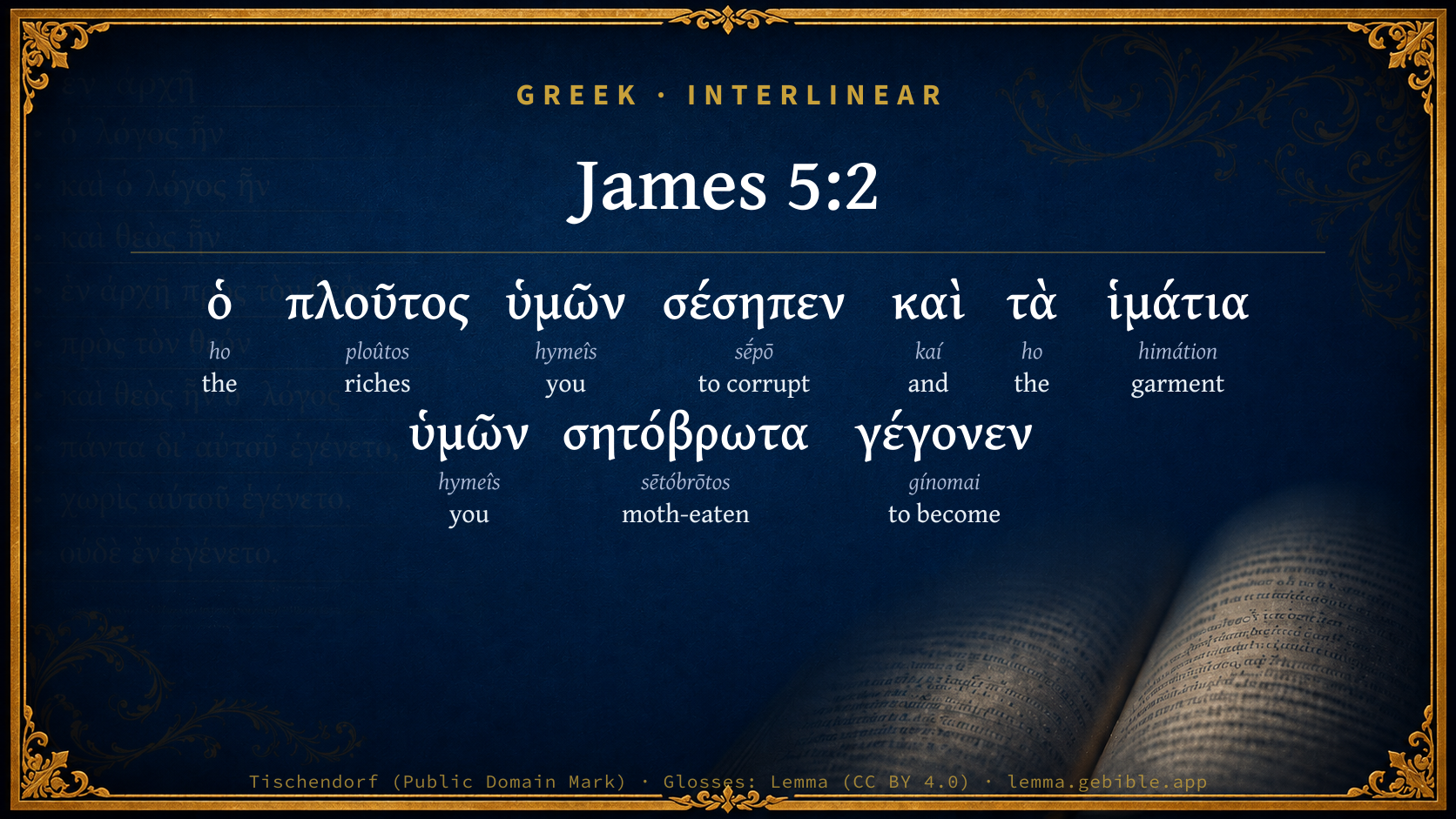
Greek (Tischendorf 8th ed.) James 5:2 appears in the Greek New Testament. The text above is from the Tischendorf 8th edition. Each word links to its Strong’s number and a concise gloss. Click any word for its full Thayer’s Greek Lexicon entry.
Download image
Cite this verse

James 5:2 (World English Bible). Public Domain. Lemma interlinear Bible study tool, https://lemma.gebible.app/v/james/5/2.

Show BibTeX & RIS
BibTeX
RIS
English Translation
Your riches are corrupted and your garments are moth-eaten.
World English Bible · Public Domain
Highlights
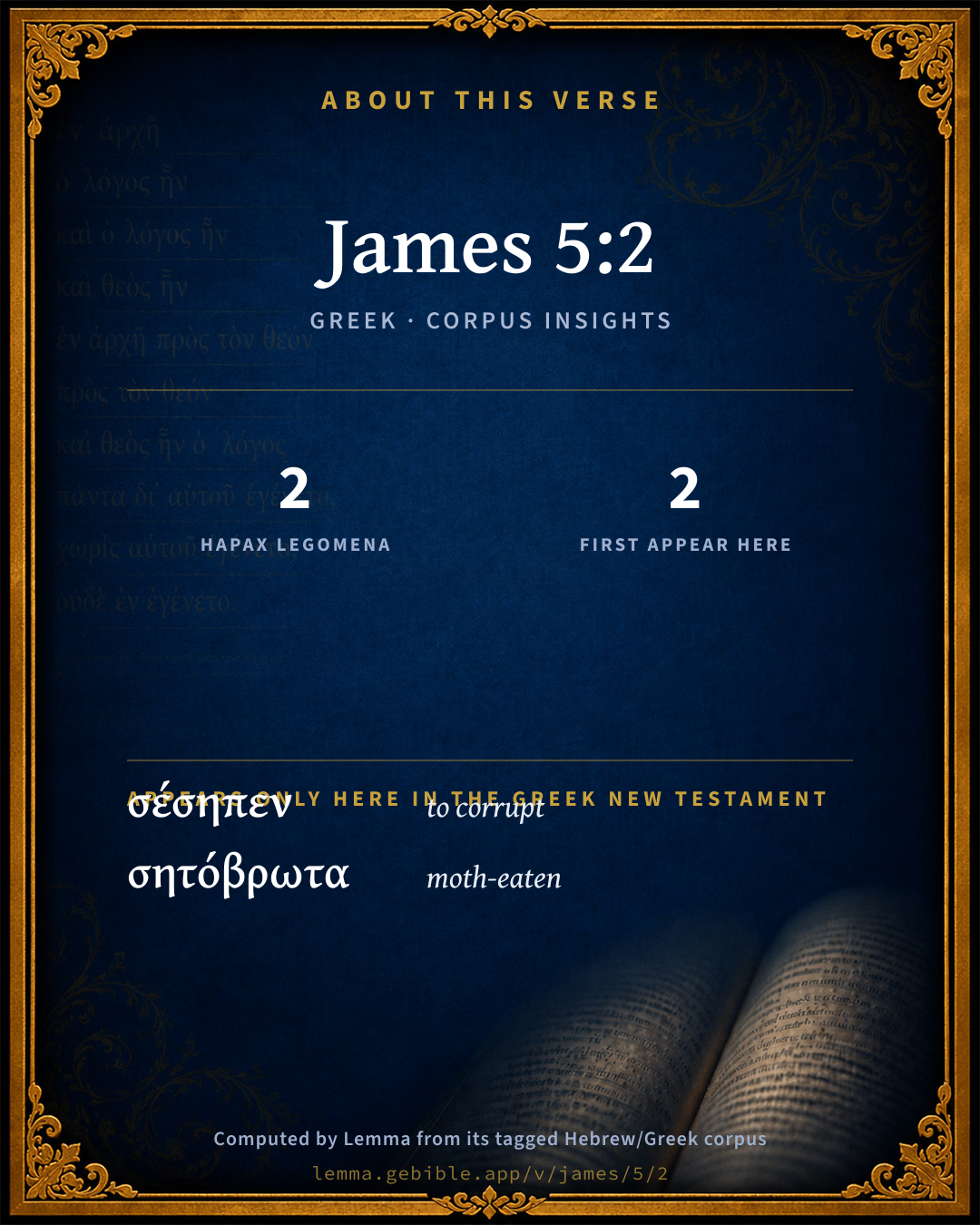
  • 2 hapax legomena — only here in the Greek New Testament
  • 2 first appearances in the Greek New Testament
Full analysis ↓
Download a study sheet

One document with this verse’s original text, its word-by-word gloss line, the meaning frame, cross-references with their text, attributed commentary, and full source and license credits — printable, and it pastes into notes with its structure intact.

This verse Autodidact and up

Study sheet (.html) Plain text (.txt)

A passage Seminary Student

Up to 50 verses in one chapter. A passage sheet keeps up to 6 commentary sources and 12 cross-references per verse, in the order this page ranks them, and says so on the sheet whenever that leaves anything out. Ask for a single verse and you get the Autodidact verse sheet above.

Everything on this page stays free to read, with no account — the sheet is a download of what is already on screen, not access to it.

Want to remove ads? Support Godless Engineer
Compare translations 3

The same verse in 3 English versions, stacked beneath the original-language interlinear above. Click any original word for its lexicon entry.

Each is an independent rendering of the whole verse — the interlinear is not word-aligned to these translations.

Highlighted words mark where these versions differ — a whole-verse word diff, not a word-by-word alignment.

  • World English Bible Public Domain
    Your riches are corrupted and your garments are moth-eaten.
  • King James Version Public Domain
    Your riches are corrupted, and your garments are motheaten.
  • unfoldingWord Literal Text CC BY-SA 4.0
    Your wealth has rotted and your clothes have become moth-eaten.

unfoldingWord Literal Text — © unfoldingWord, licensed CC BY-SA 4.0. Word-aligned USFM3 via Door43 (git.door43.org/unfoldingWord/en_ult).

Versions to compare (up to 4)

3 of 4 selected

Show all 19 translations

Every available English version of this verse, each an independent rendering of the whole verse.

  • World English Bible Public Domain
    Your riches are corrupted and your garments are moth-eaten.
  • Berean Standard Bible Public Domain
    Your riches have rotted and moths have eaten your clothes.
  • Majority Standard Bible Public Domain
    Your riches have rotted and moths have eaten your clothes.
  • King James Version Public Domain
    Your riches are corrupted, and your garments are motheaten.
  • American Standard Version (1901) Public Domain
    Your riches are corrupted, and your garments are moth-eaten.
  • Revised Version (1885) Public Domain
    Your riches are corrupted, and your garments are moth-eaten.
  • Geneva Bible (1599) Public Domain
    Your riches are corrupt, and your garments are moth eaten.
  • Douay-Rheims (1899) Public Domain
    Your riches are corrupted: and your garments are motheaten.
  • Young's Literal Translation Public Domain
    your riches have rotted, and your garments have become moth-eaten;
  • Literal Standard Version CC BY-SA 4.0
    your riches have rotted, and your garments have become moth-eaten;
  • Unlocked Literal Bible CC BY-SA 4.0
    Your riches have rotted, and your clothes have become moth-eaten.
  • unfoldingWord Literal Text CC BY-SA 4.0
    Your wealth has rotted and your clothes have become moth-eaten.
  • Darby Bible Public Domain
    Your wealth is become rotten, and your garments moth-eaten.
  • World Messianic Bible Public Domain
    Your riches are corrupted and your garments are moth-eaten.
  • Webster's Bible Public Domain
    Your riches are corrupted, and your garments are moth-eaten.
  • Free Bible Version CC BY-SA 4.0
    Your wealth is ruined, and your clothes have been eaten by moths.
  • Bible in Basic English Public Domain
    Your wealth is unclean and insects have made holes in your clothing.
  • Text-Critical English NT CC BY 4.0
    Your riches have rotted, and your garments are moth-eaten.
  • Tyndale New Testament (1534) Public Domain
    Youre ryches is corrupte youre garmentes are motheaten.

Literal Standard Version (2020), Covenant Press — licensed CC BY-SA 4.0. Text via the HelloAO Bible API (eBible.org). Unlocked Literal Bible (unfoldingWord) — licensed CC BY-SA 4.0. Text via the HelloAO Bible API (eBible.org). unfoldingWord Literal Text — © unfoldingWord, licensed CC BY-SA 4.0. Word-aligned USFM3 via Door43 (git.door43.org/unfoldingWord/en_ult). Free Bible Version, Dr. Jonathan Gallagher — licensed CC BY-SA 4.0. Text via the HelloAO Bible API (eBible.org).

Word by word

More ways to search: Search by grammar → Find every occurrence → Compare this word →

Practice this passage: Drill this verse → Learn its vocabulary →

About this verse

These counts appear in no published source. They are computed here, from the morphology-tagged text and Lemma’s own curated glosses. What Lemma adds →

10
words
8
distinct lemmas
General Epistles
section

Notable vocabulary

2 hapax legomena — words that appear only here in the entire Greek New Testament:

  • σέσηπεν to corrupt G4595
  • σητόβρωτα moth-eaten G4598

First appearance in Scripture

These words make their first canonical appearance in the Greek New Testament here:

  • σέσηπεν to corrupt G4595
  • σητόβρωτα moth-eaten G4598

Shared distinctive vocabulary

πλοῦτος riches G4149 occurs in 21 verses of the Greek New Testament. Also found in:
Repetition

Words recur within this verse:

Cross-references

9

Topical passages linked to James 5:2 in the Treasury of Scripture Knowledge — connected by theme and wording, ordered by reader-vote popularity; previews shown in the World English Bible.

  • Matthew 6:19–20 "Don't lay up treasures for yourselves on the earth, where moth and rust consume, and where thieves break through and steal;
  • Job 13:28 Though I am decaying like a rotten thing, Like a garment that is moth-eaten.
  • Luke 12:33 Sell that which you have, and give gifts to the needy. Make for yourselves purses which don't grow old, a treasure in the heavens that doesn't fail, where no thief approaches, neither moth destroys.
  • Isaiah 50:9 Behold, the Lord Yahweh will help me; who is he who shall condemn me? Behold, all they shall wax old as a garment, the moth shall eat them up.
  • Isaiah 51:8 For the moth shall eat them up like a garment, and the worm shall eat them like wool; but my righteousness shall be forever, and my salvation to all generations.
  • 1 Peter 1:4 to an incorruptible and undefiled inheritance that doesn't fade away, reserved in heaven for you,
  • Psalms 39:11 When you rebuke and correct man for iniquity, You consume his wealth like a moth. Surely every man is but a breath." Selah.
  • Jeremiah 17:11 As the partridge that sits on [eggs] which she has not laid, so is he who gets riches, and not by right; in the midst of his days they shall leave him, and at his end he shall be a fool.
  • Hosea 5:12 Therefore I am to Ephraim like a moth, And to the house of Judah like rottenness.

Cross-references courtesy of OpenBible.info (CC BY 4.0).

Commentary

Notes on James 5:2 from classic Christian and Jewish commentators (each source and its license shown beneath its notes). The classic Christian expositions comment on the surrounding passage and are grouped to its opening verse, so a note may address several verses; the Jewish commentaries on the Tanakh (Rashi and others) are per-verse, so they appear only where the commentator wrote on this verse.

Lemma curates 59 commentaries, every one of them public domain or Creative Commons licensed, each selected and text-cleaned for this edition rather than reprinted as found. About our sources →

Joseph Benson's Commentary

Jas 5:2-3. Your riches are corrupted — Greek, σεσηπε, are putrefied, or are as things putrefied by being kept too long. The riches of the ancients consisted much in large stores of corn, wine, oil, and costly apparel. These things the rich men in Judea had amassed, like the foolish rich man mentioned Luk 12:18, little imagining that they would soon be robbed of them by the Roman soldiers, and the destructive events of the war. Your garments — In your wardrobes; are moth-eaten — The fashion of clothes not changing in the eastern countries as with us, persons of fortune used to have many garments made of different costly stuffs, which they laid up as a part of their wealth. Thus, according to Q. Curtius, (lib. 5. c. 6,) when Alexander took Persepolis, he found the riches of all Asia gathered together there, which consisted not only of gold and silver, but vestis ingens modus, a vast quantity of garments. Your gold and silver is cankered — Or eaten out with rust; and the rust of them — Your perishing stores and moth-eaten garments; shall be, εις μαρτυριον, for a testimony against you — Of your covetousness and worldly mind; and of your having foolishly and wickedly buried those talents in the earth, which you ought to have employed, according to your Lord’s will, in relieving the wants of your fellow-creatures. And shall eat your flesh as it were fire — Will occasion you as great a torment as if fire were consuming your flesh. Or, as the rust eats into the gold and silver, so shall your flesh and wealth be eaten up as if you had treasured up fire in the midst of it. This was punctually fulfilled in the destruction of that nation by their own seditions, and their wars with the Romans. For, among the Sicarii and the Zealots, the ringleaders of all their seditions, it was crime enough to be rich; and their insatiable avarice induced them continually to search into the houses of the rich, and, by false accusation, to slay them as deserters, for the sake of their property. Yea, both their substance and their bodies were devoured by the flames which burned up the city and the temple: and if any thing remained, it became a prey to the Roman soldiers. Ye have heaped treasure for the last days — The days which are now coming, when your enemies shall seize or destroy all, to your infinite vexation and distress: or, you have heaped them up when it is too late; when you have no time or opportunity to enjoy them. This phrase, the last days, does not merely signify for the time to come, but for that period when the whole Jewish economy was to close, and when those awful judgments, threatened in the prophets to be poured out upon wicked men in the last days, were just coming.

Joseph Benson's Commentary on the Old and New Testaments (1811–1818) — public domain. Text from a community e-Sword module.

Tyndale Open Study Notes

Tyndale Open Resources

5:2 The wealth and fine clothes are so excessive that they deteriorate from lack of use; their destruction is a sign of the anticipated judgment.

Tyndale Open Study Notes — © Tyndale Open Resources, licensed CC BY-SA 4.0. Text via the HelloAO Bible API.

Bengel's Gnomon

Johann Albrecht Bengel

Jas 5:2. Σέσηπε, are corrupted) The grasping avarice of the rich is set forth.—σητόβρωτα, moth-eaten) Job 13:28, ἱμάτιον σητόβρωτον, a garment that is moth-eaten.

Bengel's Gnomon of the New Testament — English translation (T&T Clark, Edinburgh, 1860) — public domain. Text from a community e-Sword module.

Meyer's Critical & Exegetical Commentary

Heinrich August Wilhelm Meyer

Jam_5:2. Description of the judgment destroying all riches: ὁ πλοῦτος ὑμῶν σέσηπεν] In a prophetical manner the future is described as having already taken place (Hottinger, Schneckenburger, de Wette, Wiesinger, Bouman, and others). By πλοῦτος is not hereas Estius, Raphelius, Wolf, Semler, Gebser, Bouman on account of σέσηπεν thinkto be understood such things (fruit, etc.) as undergo literal rottenness, but is to be understood generally; and σέσηπε as a figurative expression denotes generally the destruction to which riches is abandoned. The explanation of Calvin is incorrect: hic immensa divitum rapacitas perstringitur, dum supprimunt, quicquid undecunque possunt ad se trahere, ut inutiliter in area computrescat (similarly Hornejus, Laurentius, Grotius, Bengel, Theile[218]); James does not here intend to give the natural result of covetousness, and thus the reason of the judgment, but the effect of the judgment breaking forth (Wiesinger).[219] James describes the reason from Jam_5:4 and onwards.

The verb σήπω, to cause to rot, in the passive and second perfect to corrupt, is in the N. T. ἅπ. λεγ., but often occurs in the LXX.; comp. Job_33:21; Job_40:7; as here in a general sense (= φθείρεσθαι) it is found in Sir_14:19.

καὶ τὰ ἱμάτια ὑμῶν κ.τ.λ.] The general idea πλοῦτος is here and in what follows specialized.

σητόβρωτος] moth-eaten, in the N. T. ἅπ. λεγ., does not occur in the classics, but in Job_13:20, LXX.: ὥσπερ ἱμάτιον σητόβρωτον; comp. Isa_51:8. σκωληκόβρωτος in Act_12:23 is similarly formed.

[218] Theile, who takes the preterite in its literal sense, thus explains the passage: divitiae a vobis coacervatae perierunt nulla vestra aliorumque utilitate … atque ideo vos coram judice perdent. Ita causa additur istarum calamitatum perferendi, gravi oppositione eorum quae per absurda et impia ipsorum avaritia jam facta sunt eorumque, quae pro justa Dei retributione adhuc fient.

[219] In agreement with his explanation of πλούσιοι, Lange understands also τλοῦτος in a symbolical sense, namely, the externalized Judaistic righteousnessconnected, of course, with worldly prosperity. His assertion is also incorrect, that here not the last judgment, but the natural immanent judgments of sinners are meant.

Meyer — Critical and Exegetical Commentary on the New Testament — English translation by Peter Christie, edited by Frederick Crombie (T&T Clark, 1880) — public domain. Text from a community e-Sword module.

Expositor's Greek Testament

ed. W. Robertson Nicoll

Jas 5:2 . The use of the Hebraic prophetic perfects in this passage is another mark of Jewish authorship. ὁ πλοῦτος ὑμῶν : this cannot refer to wealth in the abstract because this would be out of harmony with the rest of the verse which speaks of literal destruction; we have here precisely the same idea, as to actual destruction, as that which occurs in the eschatological passage Enoch , xcviii. 1 ff., where in reference to foolish men “in royalty, and in grandeur, and in power, and in silver and in gold, and in purple …,” it says that “they will perish thereby together with their possessions and with all their glory and their splendour”. σέσηπεν : ἅπ . λεγ . in N.T., cf. Sir 14:19 , πᾶν ἔργον σηπόμε . νον ἐκλείπει . σητόβρωτα : ἅπ . λεγ · in N.T., cf. Job 13:28 , παλαιοῦται ὥσπερ ἱμάτιον σητόβρωτον ; Sir 42:13 , ἀπὸ γὰρ ἱματίων ἐκπορεύεται σής . For the form of the word cf. σκωληκόβρωτος in Act 12:23 .

The Expositor's Greek Testament, edited by W. Robertson Nicoll (1897–1910) — public domain. Text from a community e-Sword module.

Jamieson, Fausset & Brown

Robert Jamieson, A. R. Fausset & David Brown

corrupted--about to be destroyed through God's curse on your oppression, whereby your riches are accumulated (Jam 5:4). CALVIN thinks the sense is, Your riches perish without being of any use either to others or even to yourselves, for instance, your garments which are moth-eaten in your chests.

garments . . . moth-eaten--referring to Mat 6:19-20.

Jamieson, Fausset & Brown — Commentary Critical and Explanatory on the Whole Bible (1871) — public domain (CC PDM 1.0). Text via the HelloAO Bible API.

Adam Clarke's Commentary

Verse 2. Your riches are corrupted] σεσηπε. Are putrefied. The term πλουτος, riches, is to be taken here, not for gold, silver, or precious stones, (for these could not putrefy,) but for the produce of the fields and flocks, the different stores of grain, wine, and oil, which they had laid up in their granaries, and the various changes of raiment which they had amassed in their wardrobes.

Adam Clarke's Commentary on the Bible (1810–1826) — public domain. Text from a community e-Sword/MySword module.

John Calvin's Commentaries

2 Your riches. The meaning may be twofold: — that he ridicules their foolish confidence, because the riches in which they placed their happiness, were wholly fading, yea, that they could be reduced to nothing by one blast from God — or that he condemns as their insatiable avarice, because they heaped together wealth only for this, that they might perish without any benefit. This latter meaning is the most suitable. It is, indeed, true that those rich men are insane who glory in things so fading as garments, gold, silver, and such things, since it is nothing else than to make their glory subject to rust and moths; and well known is that saying “What is ill got is soon lost;” because the curse of God consumes it all, for it is not right that the ungodly or their heirs should enjoy riches which they have snatched, as it were, by violence from the hand of God.

But as James enumerates the vices of which the rich brought on themselves the calamity which he mentions, the context requires, as I think, that we should say, that what he condemns here is the extreme rapacity of the rich, in retaining everything they could lay hold on, that it might rot uselessly in their chests. For thus it was, that what God had created for the use of men, they destroyed, as though they were the enemies of mankind.

But it must be observed, that the vices which he mentions here do not belong to all the rich; for some of them indulge themselves in luxury, some spend much in show and display, and some pinch themselves, and live miserably in their own filth. Let us, then, know that he here reproves some vices in some, and some vices in others. However, all those are generally condemned who unjustly accumulate riches, or who foolishly abuse them. But what James now says, is not only suitable to the rich of extreme tenacity, (such as Euclio of Plautus,) but to those also who delight in pomp and luxury, and yet prefer to heap up riches rather than to employ them for necessary purposes. For such is the malignity of some, that they grudge to others the common sun and air.

John Calvin's Commentaries (1540-1563) — public domain. Text from the Calvin Translation Society English edition (1840s-50s) via the Christian Classics Ethereal Library (ccel.org). Calvin's coverage is partial (roughly two-thirds of the Bible); uncommented books and verses are honest gaps, never fabricated. The 19th-century editor's footnotes and remarks are omitted so the notes are faithfully Calvin's own voice.

Ellicott's Commentary for English Readers

(2) Your riches are corrupted . . .—As expanded in the eloquent gloss of Bishop Wordsworth, “Your wealth is mouldering in corruption, and your garments, stored up in vain superfluity, are become moth-eaten: although they may still glitter brightly in your eyes, and may dazzle men by their brilliance, yet they are in fact already cankered; they are loathsome in God’s sight; the Divine anger has breathed upon them and blighted them; they are already withered and blasted.” (Comp. Mat_6:19.)

A Bible Commentary for English Readers, edited by Charles John Ellicott (1878–1897) — public domain. Text from a community e-Sword module.

The Cambridge Bible for Schools and Colleges

gen. ed. J. J. S. Perowne

2. Your riches are corrupted, and your garments are motheaten] The union of the two chief forms of Eastern wealth in this and the following verse, reminds us of the like combination in Mat_6:19, “where moth and rust doth corrupt.” Comp. St Paul’s “I have coveted no man’s silver, or gold, or apparel” (Act_20:33).

The Cambridge Bible for Schools and Colleges (gen. ed. J. J. S. Perowne; Cambridge University Press, 1878–1918) — public domain. Text from a community e-Sword module.

John Gill's Exposition

Your riches are corrupted,.... Either through disuse of them; and so the phrase is expressive of their tenaciousness, withholding that from themselves and others which is meet, and which is keeping riches for the owners thereof, to their hurt; or these are corrupted, and are corruptible things, fading and perishing, and will stand in no stead in the day of wrath, and therefore it is great weakness to put any trust and confidence in them:

and your garments are moth eaten; being neither wore by themselves, nor put upon the backs of others, as they should, but laid up in wardrobes, or in chests and coffers, and so became the repast of moths, and now good for nothing.

John Gill's Exposition of the Whole Bible (1746–1763) — public domain (CC PDM 1.0). Text via the HelloAO Bible API.

Trapp's Complete Commentary

John Trapp

2 Your riches are corrupted, and your garments are motheaten.

Ver. 2. Your riches are corrupted] Being subject to vanity and violence, Mat 6:19. See the note there. Provide yourselves therefore bags that wax not old; treasure that faileth not, &c., Luk 12:33.

John Trapp, A Commentary or Exposition upon All the Books of the Old and New Testament (1647–1656) — public domain. Text from a community e-Sword module.

Albert Barnes' Notes on the Bible

Your riches are corrupted - The word here rendered “corrupted” (σήπω sēpō) does not occur elsewhere in the New Testament. It means, to cause to rot, to corrupt, to destroy. The reference here is to their hoarded treasures; and the idea is, that they had accumulated more than they needed for their own use; and that, instead of distributing them to do good to others, or employing them in any useful way, they kept them until they rotted or spoiled. It is to be remembered, that a considerable part of the treasures which a man in the East would lay up, consisted of perishable materials, as garments, grain, oil, etc. Such articles of property were often stored up, expecting that they would furnish a supply for many years, in case of the prevalence of famine or wars. Compare Luk 12:18-19. A suitable provision for the time to come cannot be forbidden; but the reference here is to cases in which great quantities had been laid up, perhaps while the poor were suffering, and which were kept until they became worthless.

Your garments are moth-eaten - The same idea substantially is expressed here in another form. As the fashions in the East did not change as they do with us, wealth consisted much in the garments that were laid up for show or for future use. See the notes at Mat 6:19. Q. Curtius says that when Alexander the Great was going to take Persepolis, the riches of all Asia were gathered there together, which consisted not only of a great abundance of gold and silver, but also of garments, Lib. vi. c. 5. Horace tells us that when Lucullus the Roman was asked if he could lend a hundred garments for the theater, he replied that he had five thousand in his house, of which they were welcome to take part or all. Of course, such property would be liable to be moth-eaten; and the idea here is, that they had amassed a great amount of this kind of property which was useless to them, and which they kept until it became destroyed.

Albert Barnes' Notes on the Bible (1834–1885) — public domain. Text from a community e-Sword/MySword module.

Matthew Poole's English Annotations

Your riches are corrupted: either by riches he means the general, and by

garments, gold and silver, the particulars in which their riches consisted; and then being corrupted, is to be taken generally, as comprehending the several ways whereby the several kinds of their riches were spoiled: or else, by riches he understands such things as were liable to corruption, or putrefaction, as corn, wine, oil, which were a great part of their riches.

And your garments are moth-eaten; costly garments, in which rich men are wont to pride themselves; and under them may be comprehended all such clothes as may be eaten by worms or moths.

Matthew Poole's English Annotations on the Holy Bible (1683–1685) — public domain. Text from a community e-Sword/MySword module.

Whedon's Commentary on the Bible

Daniel D. Whedon

2. Riches are corrupted—Under a series of physical images the great truth is proclaimed that ill-gotten and oppressive wealth brings upon the possessor the divine malediction, fulfilled in this or a coming world. The various forms of wealth are either to be themselves destroyed, or to become the destroyers of their holders. As it is rich men of the twelve tribes who are here more specifically addressed—as the epistle was written from Jerusalem, and as the magnates of the tribes were even now on the brink of destruction in the coming overthrow of the Jewish State, it is a plausible interpretation which applies this passage as a prophecy, in accordance with our Lord’s memorable predictions of that downfall.

Nor is it supposable that a man so deeply imbued with so national and patriotic a sympathy for his kindred would overlook that coming catastrophe so fully predicted by Jesus, and so well understood by Jewish Christians as that they thereby effected their own escape. Indeed, this predicting the day of slaughter, and then the parousia of Jas_5:7, is remarkably parallel to our Lord’s discourse distinguishing and contrasting these two great events. The specifications of their treasures with their destruction embraces a triad, namely, riches, or hoarded goods; garments; and gold and silver. The first has been (for the three verbs are in the perfect tense, and should have been strictly so rendered) rotted; the second, motheaten; the third, not only rusted, but so rusted as that the rust shall corrode like fire, and consume their flesh. Like the old prophets, our apostle takes his standpoint in the future, and contemplates the destruction he predicts as already completed.

Corrupted—Literally, putrified, rotted.

Daniel D. Whedon (gen. ed.), Commentary on the Old and New Testaments (1874–1909) — public domain. Text from a community e-Sword module.

The Pulpit Commentary

Description of the miseries that are coming upon them. The perfects (seshpe gegonen) are probably to be explained as "prophetic," in accordance with a common Hebrew idiom (see Driver on the "Tenses of the Hebrew Verb," and cf. Winer, "Grammar of New Testament Greek," p. 342: "The perfect does not stand for a present or future, but the case indicated by the apostle in talaipwriaiv uJmwn taiv ehpercomenaiv is viewed as already present, and consequently the shpein of the riches as already completed"). For an instance of the prophetic perfect, used as here after ojlouzein, seeshpen: Isa_23:1, Isa_23:14," Howl.... for your stronghold has been wasted. " The miseries coming upon the rich are thus announced to be the destruction of everything in virtue of which they were styled rich. Their costly garments, in a great store of which the wealth of an Eastern largely consists, should become moth-eaten. Their gold and silver should be rusted. Bengel notes on this passage: "Scripta haec suut paucis annis ante obsidionem Hierosolymorum;" and certainly the best commentary upon it is to be found in the terrible account given by Josephus of the sufferings and miseries which came upon the Jews during the war and siege of Jerusalem. The Jewish historian has become the unconscious witness to the fulfillment of the prophecies of our Lord and his apostle. Se only here in the New Testament; in the LXX, brwta. (Job_16:7) Shto is also an apax legomenon in the New Testament; in LXX used also of garments in Job_13:28.

The Pulpit Commentary (1880–1919), ed. H.D.M. Spence-Jones & Joseph S. Exell — public domain. Text from a community e-Sword module.

John Wesley's Explanatory Notes

The riches of the ancients consisted much in large stores of corn, and of costly apparel.

John Wesley, Explanatory Notes Upon the Whole Bible (1754–1765) — public domain. Text via the GEBible commentary corpus.

The People's New Testament

B. W. Johnson

2. Your riches are corrupted. Even their riches in which they trusted are “corrupted,” or spoiled. Much of the wealth of that period was in stores of various kinds which time or improper care would destroy. Your garments are moth-eaten. The rich gathered great stores of garments, carpets, etc. See Matt. 22:11, 12. These would be liable to be eaten by moths if not used.

B. W. Johnson's The People's New Testament with Notes (1889–1891) — public domain. Electronic text from the Christian Classics Ethereal Library (CCEL) ThML edition.

Cambridge Greek Testament for Schools and Colleges

2. σέσηπεν … γέγονεν … κατίωται. The tense implies that the case indicated by ταλαιπωρίαις is already present. The tarnishing of the gold and silver is an accomplished fact. The words bring out the thought that the wealth wrung from the poor by injustice and cruelty is of no service to the rich man himself: ‘putrescit in arca.’

ὁ πλοῦτος, corresponding in poetical parallelism to τὰ ἱμάτια, wealth in Oriental countries consisting largely of garments: comp. Act 20:33 ἀργυρίου ἢ χρυσίου ἢ ἱματισμοῦ οὐδενὸς ἐπεθύμησα.

σητοβρωτα here only in N.T. Comp. Job 13:28 ὥσπερ ἱμάτιον σητόβρωτον. The word is not elsewhere found. For the thought see Mat 6:19-20 μὴ θησαυρίζετε ὑμῖν θησαυροὺς ἐπὶ τῆς γῆς, ὅπου σὴς καὶ βρῶσις ἀφανίζει, κ.τ.λ. and comp. Hor. Sat. II. 3. 119 cui stragula vestis │ blattarum ac tinearum epulae putrescat in arca. The word is formed like σκωληκόβρωτος, Act 12:23.

Cambridge Greek Testament for Schools and Colleges (Cambridge University Press, 1896; 21 vols, various authors incl. Carr, Maclear, Plummer, Farrar, Lumby, Moule, M. R. James, Simcox) — public domain. Text from a community e-Sword module.

Alford’s Greek Testament

Henry Alford

2.] The effect of the coming judgment is depicted as already present, and its material as already stored up against them. What is meant by the figure used, we learn in ver. 4. Your riches are corrupted (see besides reff., Job 33:21; Job 40:7. σήπω is transitive—σῆψον δὲ ἀσεβεῖς παραχρῆμα, Job 40:7 (12),—but σέσηπα the perf. middle. The expression is figurative, and πλοῦτος to be understood of all riches: ‘your possessions’) and your garments (the general term πλοῦτος is now split into its component parts. clothing and treasure) are become motheaten (ref.: see also Isa 51:8: Act 12:23. The reference to Mat 6:19, Mat 6:20 is obvious):

Henry Alford, The Greek Testament (1849–1861) — public domain. Text from a community e-Sword module.

International Critical Commentary

2-3. Your wealth is already, to any eye that can see realities, rotten, moth-eaten, and rusted. The rust of it will testify to you in the Day of Judgment how valueless it and your confidence in it are. And the worthlessness of your wealth will then be your ruin, for you have been storing up for yourselves only the fire of hell.

2. σέσηπεν, “has rotted,” “is rotten,” i. e. of no value. The word is here used to apply (literally or figuratively) to every kind of wealth.

On the general idea, cf. Mat 6:19. In James it is not the perishability but the worthlessness of wealth that is referred to. The property—no matter what its earthly value, or even its earthly chance of permanence—is worthless if measured by true standards.

This and the following verbs in the perfect tense (γέγονεν, κατίωται) are picturesque, figurative statements of the real worthlessness of this wealth to the view of one who knows how to estimate permanent, eternal values. The perfect tense is appropriately used of the present state of worthlessness.

Others take the perfect tense in these verbs as describing by prophetic anticipation (cf. Isa 60:1) what will inevitably happen with the lapse of time. But this is unnecessary, and the change to the future in ἔσται makes it unlikely. Notice also that the mention of the “rusting” of gold and silver points to a figurative meaning.

The view taken of these perfects carries the decision for a series of exegetical problems in vv. 2, 3 which are discussed in detail in the notes. A different view can be made clear by the following paraphrase, based on Huther’s interpretation:

“Your wealth will all perish in the Day of Judgment. The rust of it will testify to you beforehand of your own coming destruction, and the Judgment, when it has destroyed your possessions, will afterwards fall on you. You have been amassing treasure in the very days of the Judgment itself!”

The idea that σέσηπεν κτλ. gives the first specification of the actual sin of the rich, who show their rapacity by treasuring up wealth and letting it rot instead of using it to give to the poor or as capital to promote useful industries (“Œcumenius,” Calvin, Hornejus, Laurentius, Grotius, Bengel, Theile), is needless and far-fetched.

τὰ ἱμάτια. On garments as a chief form of wealth, cf. Mat 6:19, Mat 6:1 Macc. 11:24, Act 20:33, also Hor. Ep. i, 6, lines 40-44, Quint. Curt. v, 63.

σητόβρωτα, cf. HDB, “Moth,” and EB, “Moth.”

The word is found elsewhere in the Bible only in Job 13:28 ὡς ἰμάτιον σητόβρωτον. In secular Greek it has been observed only Orac. Sib. ap. Theoph. Ad Autol. ii, 36 (fragm. 3, 1. 26), σητόβρωτα δέδορκε (of idol-images). Cf. Isa 51:8, Isa 50:9, Mic 7:4 (LXX), Job 32:22 (LXX).

International Critical Commentary — older volumes (1896–1929), various authors — public domain. Text from a community e-Sword module.

Vincent's Word Studies in the New Testament

Marvin R. Vincent

Are corrupted [σεσηπεν] . Only here in New Testament.

Are moth - eaten [σητοβρωτα γεγονεν] . Lit., have become moth - eaten. Only here in New Testament, but compare skwlhkobrwtov, eaten of worms, Act 12:23; and see Mt 6:19, 20.

Marvin R. Vincent, Word Studies in the New Testament (1887–1900) — public domain. Text from a community e-Sword/MySword module.

Lesson kit

Teaching starters — assembled from the data on this page, not authored interpretation. Every prompt links to the verse data it draws on. Edit before teaching.

James, in the General Epistles, opens this verse with 10 words (8 distinct Greek lemmas). Its most distinctive word is sḗpō (“to corrupt”). A historical commentator’s framing appears above. Read the whole chapter for the surrounding context.

Discussion questions

  1. What does “to corrupt” (sḗpō) contribute to the verse as a whole?
  2. 2 words here appear nowhere else in the Greek New Testament. Why might the author reach for such rare wording?
  3. 2 words make their first appearance in Scripture here. What does this debut establish?
  4. How does Matthew 13:22, which shares the word «riches», read alongside this verse?
  5. What does the repetition of “the” (2× in this one verse) do in this verse?
  6. These translations render this verse differently. What is at stake in choosing one wording over another?
  7. Compare how Joseph Benson's Commentary and Tyndale Open Study Notes read this verse. Where do they agree or differ?

Things to notice

  • 2 words in this verse appear nowhere else in the Greek New Testament.
  • 2 words make their first canonical appearance in Scripture here.
  • These translations choose different wording for 11 words in this verse.
  • “the” occurs 2× in this single verse.
  • 8 distinct Greek lemmas span 10 words in this verse.

Reading settings

Reading text

Shown beneath each verse's original-language words.

Old Testament
Old Testament edition

Read the OT as the Masoretic Hebrew (MT) or the Greek Septuagint (LXX).

English shown for the Greek Septuagint (in the Hebrew ↔ Greek comparison).

Comparing translations? Open the Compare panel on any verse page to stack up to four side by side.