James 1:23

Greek (Tischendorf 8th ed.) James 1:23 appears in the Greek New Testament. The text above is from the Tischendorf 8th edition. Each word links to its Strong’s number and a concise gloss. Click any word for its full Thayer’s Greek Lexicon entry.
Download image
Cite this verse

James 1:23 (World English Bible). Public Domain. Lemma interlinear Bible study tool, https://lemma.gebible.app/v/james/1/23.

Show BibTeX & RIS
BibTeX
RIS
English Translation
For if anyone is a hearer of the word and not a doer, he is like a man beholding his natural face in a mirror;
World English Bible · Public Domain
Download a study sheet

One document with this verse’s original text, its word-by-word gloss line, the meaning frame, cross-references with their text, attributed commentary, and full source and license credits — printable, and it pastes into notes with its structure intact.

This verse Autodidact and up

Study sheet (.html) Plain text (.txt)

A passage Seminary Student

Up to 50 verses in one chapter. A passage sheet keeps up to 6 commentary sources and 12 cross-references per verse, in the order this page ranks them, and says so on the sheet whenever that leaves anything out. Ask for a single verse and you get the Autodidact verse sheet above.

Everything on this page stays free to read, with no account — the sheet is a download of what is already on screen, not access to it.

Want to remove ads? Support Godless Engineer
Compare translations 3

The same verse in 3 English versions, stacked beneath the original-language interlinear above. Click any original word for its lexicon entry.

Each is an independent rendering of the whole verse — the interlinear is not word-aligned to these translations.

Highlighted words mark where these versions differ — a whole-verse word diff, not a word-by-word alignment.

  • World English Bible Public Domain
    For if anyone is a hearer of the word and not a doer, he is like a man beholding his natural face in a mirror;
  • King James Version Public Domain
    For if any be a hearer of the word, and not a doer, he is like unto a man beholding his natural face in a glass:
  • unfoldingWord Literal Text CC BY-SA 4.0
    For if anyone is a hearer of the word and not a doer, he is like a man beholding the face of his birth in a mirror.

unfoldingWord Literal Text — © unfoldingWord, licensed CC BY-SA 4.0. Word-aligned USFM3 via Door43 (git.door43.org/unfoldingWord/en_ult).

Versions to compare (up to 4)

3 of 4 selected

Show all 19 translations

Every available English version of this verse, each an independent rendering of the whole verse.

  • World English Bible Public Domain
    For if anyone is a hearer of the word and not a doer, he is like a man beholding his natural face in a mirror;
  • Berean Standard Bible Public Domain
    For anyone who hears the word but does not carry it out is like a man who looks at his face in a mirror,
  • Majority Standard Bible Public Domain
    For anyone who hears the word but does not carry it out is like a man who looks at his face in a mirror,
  • King James Version Public Domain
    For if any be a hearer of the word, and not a doer, he is like unto a man beholding his natural face in a glass:
  • American Standard Version (1901) Public Domain
    For if any one is a hearer of the word and not a doer, he is like unto a man beholding his natural face in a mirror:
  • Revised Version (1885) Public Domain
    For if any one is a hearer of the word, and not a doer, he is like unto a man beholding his natural face in a mirror:
  • Geneva Bible (1599) Public Domain
    For if any heare the woorde, and doe it not, he is like vnto a man, that beholdeth his naturall face in a glasse.
  • Douay-Rheims (1899) Public Domain
    For if a man be a hearer of the word, and not a doer, he shall be compared to a man beholding his own countenance in a glass.
  • Young's Literal Translation Public Domain
    because, if any one is a hearer of the word and not a doer, this one hath been like to a man viewing his natural face in a mirror,
  • Literal Standard Version CC BY-SA 4.0
    because, if anyone is a hearer of the word and not a doer, this one has been like to a man viewing his natural face in a mirror,
  • Unlocked Literal Bible CC BY-SA 4.0
    For if anyone is a hearer of the word but not a doer, he is like a man who examines his natural face in a mirror.
  • unfoldingWord Literal Text CC BY-SA 4.0
    For if anyone is a hearer of the word and not a doer, he is like a man beholding the face of his birth in a mirror.
  • Darby Bible Public Domain
    For if any man be a hearer of [the] word and not a doer, *he* is like to a man considering his natural face in a mirror:
  • World Messianic Bible Public Domain
    For if anyone is a hearer of the word and not a doer, he is like a man looking at his natural face in a mirror;
  • Webster's Bible Public Domain
    For if any is a hearer of the word, and not a doer, he is like a man beholding his natural face in a glass:
  • Free Bible Version CC BY-SA 4.0
    If you just listen to the word, and don't act on it, it's like staring at your own face in a mirror.
  • Bible in Basic English Public Domain
    Because if any man is a hearer of the word and not a doer, he is like a man looking at his natural face in a glass;
  • Text-Critical English NT CC BY 4.0
    For if anyone is a hearer of the word and not a doer, he is like a man who looks at his face in a mirror.
  • Tyndale New Testament (1534) Public Domain
    For yf eny heare the worde and do it not he is lyke vnto a man that beholdeth his bodyly face in a glasse.

Literal Standard Version (2020), Covenant Press — licensed CC BY-SA 4.0. Text via the HelloAO Bible API (eBible.org). Unlocked Literal Bible (unfoldingWord) — licensed CC BY-SA 4.0. Text via the HelloAO Bible API (eBible.org). unfoldingWord Literal Text — © unfoldingWord, licensed CC BY-SA 4.0. Word-aligned USFM3 via Door43 (git.door43.org/unfoldingWord/en_ult). Free Bible Version, Dr. Jonathan Gallagher — licensed CC BY-SA 4.0. Text via the HelloAO Bible API (eBible.org).

Word by word

More ways to search: Search by grammar → Find every occurrence → Compare this word →

Practice this passage: Drill this verse → Learn its vocabulary →

ἔοικεν
eíkō
G1503
“to be like”
Verb, Perfect, Active, Indicative, 3rd person, Singular
Part of Speech
Verb
Tense
Perfect
Voice
Active
Mood
Indicative
Person
3rd person
Number
Singular
Full Thayer's Definition

Origin: apparently a root word [perhaps akin to G1502 through the idea of faintness as a copy]

TDNT: None

1. to be like
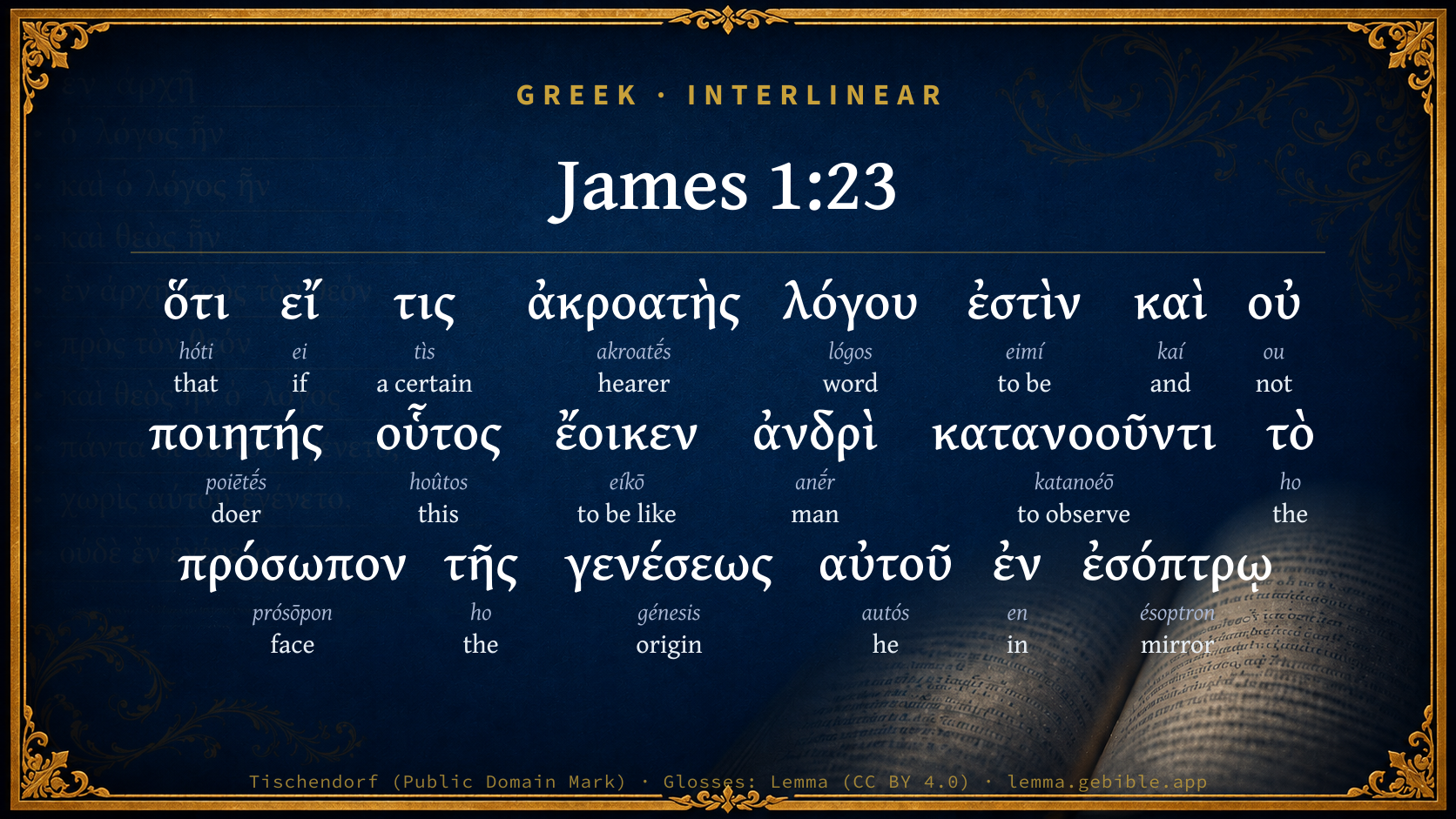
  1. ὅτι hóti G3754 “that” Conjunction
  2. εἴ ei G1487 “if” Conditional
  3. τις tìs G5100 “a certain” Indefinite pronoun, Nominative, Singular, Masculine
  4. ἀκροατὴς akroatḗs G202 “hearer” Noun, Nominative, Singular, Masculine
  5. λόγου lógos G3056 “word” Noun, Genitive, Singular, Masculine
  6. ἐστὶν eimí G1510 “to be” Verb, Present, Active, Indicative, 3rd person, Singular
  7. καὶ kaí G2532 “and” Conjunction
  8. οὐ ou G3756 “not” Particle, Negative
  9. ποιητής poiētḗs G4163 “doer” Noun, Nominative, Singular, Masculine
  10. οὗτος hoûtos G3778 “this” Demonstrative pronoun, Nominative, Singular, Masculine
  11. ἀνδρὶ anḗr G435 “man” Noun, Dative, Singular, Masculine
  12. κατανοοῦντι katanoéō G2657 “to observe” Verb, Present, Active, Participle, Dative, Singular, Masculine
  13. τὸ ho G3588 “the” Article, Accusative, Singular, Neuter
  14. πρόσωπον prósōpon G4383 “face” Noun, Accusative, Singular, Neuter
  15. τῆς ho G3588 “the” Article, Genitive, Singular, Feminine
  16. γενέσεως génesis G1078 “origin” Noun, Genitive, Singular, Feminine
  17. αὐτοῦ autós G846 “he” Personal pronoun, Genitive, Singular, Masculine
  18. ἐν en G1722 “in” Preposition
  19. ἐσόπτρῳ ésoptron G2072 “mirror” Noun, Dative, Singular, Neuter

About this verse

These counts appear in no published source. They are computed here, from the morphology-tagged text and Lemma’s own curated glosses. What Lemma adds →

20
words
19
distinct lemmas
General Epistles
section

Notable vocabulary

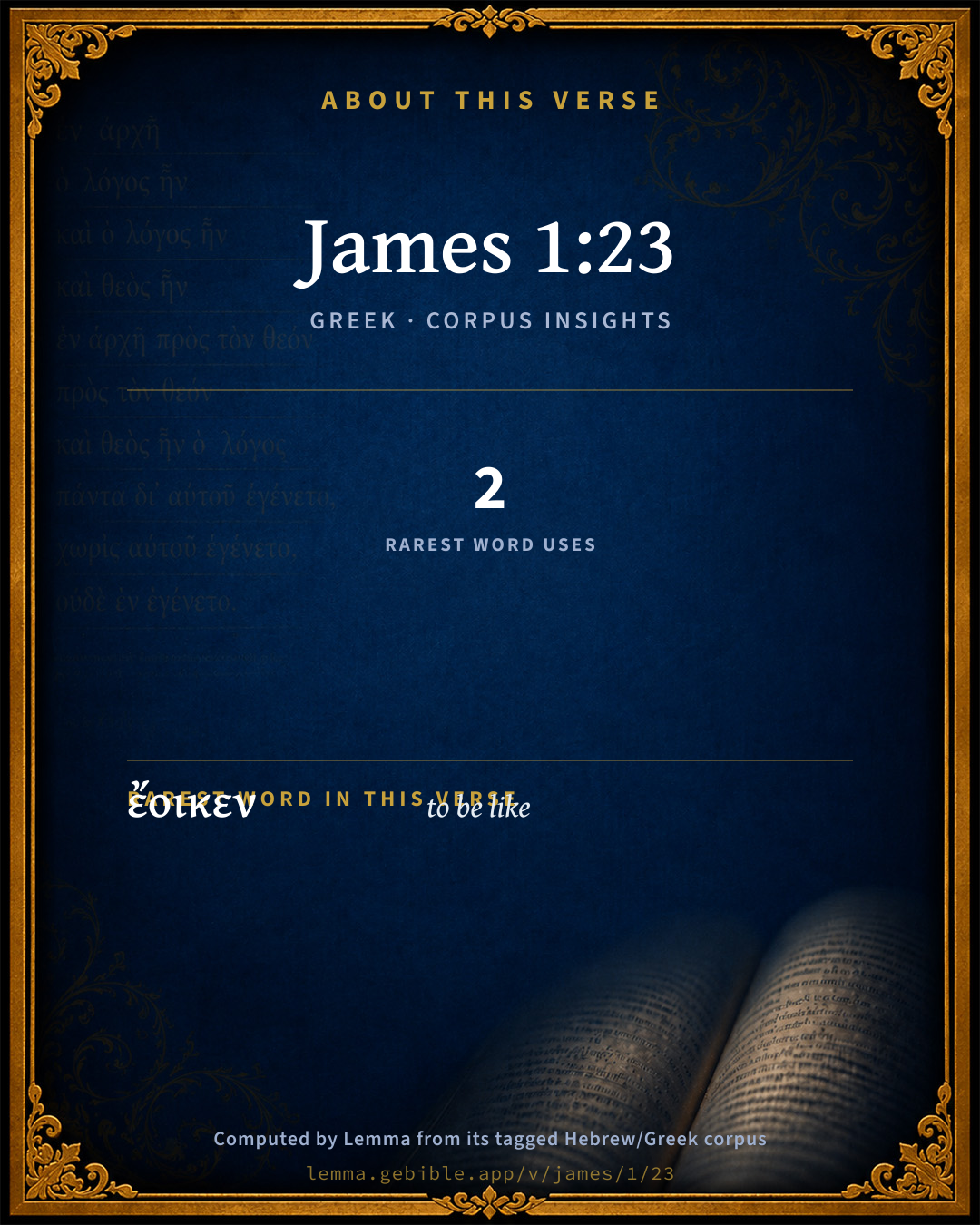
The rarest word here is ἔοικεν to be like G1503 — appearing just 2 times in the whole Greek New Testament.

Shared distinctive vocabulary

ἔοικεν to be like G1503 occurs in 2 verses of the Greek New Testament. Also found in:

Repetition

A word recurs within this verse:

Cross-references

5

Topical passages linked to James 1:23 in the Treasury of Scripture Knowledge — connected by theme and wording, ordered by reader-vote popularity; previews shown in the World English Bible.

  • Matthew 7:26–27 Everyone who hears these words of mine, and doesn't do them will be like a foolish man, who built his house on the sand.
  • James 2:14–26 What good is it, my brothers, if a man says he has faith, but has no works? Can faith save him?
  • Ezekiel 33:31–32 They come to you as the people comes, and they sit before you as my people, and they hear your words, but don't do them; for with their mouth they show much love, but their heart goes after their gain.
  • Luke 6:47 Everyone who comes to me, and hears my words, and does them, I will show you who he is like.
  • Jeremiah 44:16 As for the word that you have spoken to us in the name of Yahweh, we will not listen to you.

Cross-references courtesy of OpenBible.info (CC BY 4.0).

Commentary

Notes on James 1:23 from classic Christian and Jewish commentators (each source and its license shown beneath its notes). The classic Christian expositions comment on the surrounding passage and are grouped to its opening verse, so a note may address several verses; the Jewish commentaries on the Tanakh (Rashi and others) are per-verse, so they appear only where the commentator wrote on this verse.

Lemma curates 59 commentaries, every one of them public domain or Creative Commons licensed, each selected and text-cleaned for this edition rather than reprinted as found. About our sources →

Joseph Benson's Commentary

Jas 1:23-24. If any be a hearer of the word merely, and not a doer — If he do not comply with its design, do not so consider and believe it as to lay it to heart, and be influenced by its doctrines, obey its precepts, embrace and rely on its promises, revere and stand in awe of its threatenings, guarding against what would expose him to them; he is like a man beholding — From custom or by accident; his natural face in a glass — Without any intention to discover, and wash or wipe off, the spots that may be on it. For he beholdeth himself — Without taking particular notice of what renders his visage disagreeable; and goeth his way — To other business; and straightway forgetteth what manner of man he was — What renders his countenance uncomely, and requires to be removed. Here the word of God is represented as a mirror, in which, if a man will look with attention and care, he will see the face of his soul, and discover in what state he is, and what character he bears in the sight of God. It will manifest to him those principles and practices, those thoughts and imaginations, those affections, intentions, dispositions, words, and actions, which are contrary to truth and grace, to wisdom, piety, and virtue. But frequently those who discover all this through the word heard or read, go away, and so occupy themselves in secular affairs, as immediately to forget what manner of persons they were, and continue the same in their temper and conduct as before. Reader, is this thy case?

Joseph Benson's Commentary on the Old and New Testaments (1811–1818) — public domain. Text from a community e-Sword module.

Bengel's Gnomon

Johann Albrecht Bengel

Jas 1:23. Ὅτι, because) The false reasoning, self-deceit, of careless hearers is explained.—γενέσεως, of nature) Comp. ch. Jas 3:6.—ἐν ἐσόπτρῳ, in a mirror) The truth of Scripture is proved from this, that it presents to a man a most accurate portrait of his soul.

Bengel's Gnomon of the New Testament — English translation (T&T Clark, Edinburgh, 1860) — public domain. Text from a community e-Sword module.

Meyer's Critical & Exegetical Commentary

Heinrich August Wilhelm Meyer

Jam_1:23. This exhortation is confirmed by a comparison. Therefore: ὅτι, which is not superfluous (Pott). This verse expresses the similitude; Jam_1:24 the tertium comparationis. A hearer, who is not a doer, is to be compared to a man who contemplates his bodily form in a glass. Hornejus, Rosenmüller, Semler, Pott, and others, attach to the word κατανοεῖν the additional meaning of a transitory observation, against the etymology and the linguistic use of the word (comp. Luk_12:24; Luk_12:37; Act_7:31-32; Act_11:6). The point of transitoriness, or, more correctly, of transitory contemplation, is contained not in the verb, but in the situation, which in Jam_1:24 is prominently brought forward by καὶ ἀπελήλυθεν. On the rhetorical usage of again resuming the foregoing subject (which is here expressed by εἴ τις κ.τ.λ.) by οὗτος, see Winer, p. 144 [E. T. 199]; A. Buttmann, p. 262 [E. T. 347]; on ἔοικε, see Jam_1:6; ἀνδρί, as in Jam_1:8, and frequently with James.[99]

τὸ πρόσωπον τῆς γενέσεως αὐτοῦ] By πόρσωπον is here meant not the whole form (Baumgarten, Hensler, Pott, Schneckenburger), but the face. By τῆς γενέσεως is more plainly indicated the sphere of mere material perception, from which the comparison is taken, as distinguished from the ethical sphere of ἀκροᾶσθαι (Wiesinger). γένεσις denotes not so much the natural life as the natural birth, so that the phrase is to be interpreted: the countenance which one possesses by his natural birth. See Eustathius in Od. ix. p. 663, 25.[100]

Whether ΑὐΤΟῦ belongs to the whole idea, or only to the genitive, is uncertain. Winer, p. 212, leaves it undecided; Wiesinger is for the first rendering; but the union here (as well as in Col_1:13) with the genitive appears to be more natural.

[99] The remark of Paes, approved of by Lange, is curious: viri obiter tantum solent specula intueri, muliebre autem est, curiose se ad speculum componere.

[100] Lange argues against this explanation, whilst, mingling in a most confused manner the image employed with the thing itself, he explains πρόσωπον as the image of the inner mans appearance according to his sinful condition.

Meyer — Critical and Exegetical Commentary on the New Testament — English translation by Peter Christie, edited by Frederick Crombie (T&T Clark, 1880) — public domain. Text from a community e-Sword module.

Expositor's Greek Testament

ed. W. Robertson Nicoll

Jas 1:23 . οὗτος ἔοικεν ἀνδρὶ . ἐν ἐσόπτρῳ : With the thought here contained, cf. Pseudo-Cyprian in De duobus mont. , chap. 13: “Ita me in vobis videte, quomodo quis vestrum se videt in aquam aut in speculum” (Resch., op. cit. , P. 35), cf. 1Co 13:12 ; 2Co 3:18 . τὸ πρόσωπον τῆς γενέσεως αὐτοῦ : Cf. Jud 1:12 :18, πάσας τὰς ἡμέρας τῆς γενέσεως , “all the days of the natural life,” γεν . being used of unenduring existence; if this is the meaning here, it is used “to contrast the reflexion in the mirror of the face which belongs to this transitory life, with the reflexion, as seen in the Word, of the character which is being here moulded for eternity” (Mayor). In Jas 1:24 , “forgetteth what manner of man he was” makes it improbable that the reference is to the “natural face,” because a man would probably have some idea as to what his features were like. If πρόσωπον is here used in the sense of “personality” (as in Sir 4:22 ; Sir 4:27 ; Sir 7:6 ; Sir 10:5 ; Sir 42:1 , etc.) then the reference would perhaps be to a man looking into his conscience, i.e. , “the personality at its birth,” before he had become sin-stained; this being what he was originally meant to be. The Peshiṭtâ simplifies the matter by omitting τῆς γενέσεως , and is followed in this by some minor authorities. ἐσόπτρῳ : Cf. Sir 12:11 … καὶ ἔσῃ αὐτῷ ὡς ἐκμεμαχὼς ἔσοπτρον ; and Wis 7:26 .

The Expositor's Greek Testament, edited by W. Robertson Nicoll (1897–1910) — public domain. Text from a community e-Sword module.

Geneva Bible (1599)

Geneva Bible translators

He alludeth to that natural spot, to which is contrary that purity whereunto we are born again, the lively image whereof we behold in the Law.

Secondly, because they lose the chiefest use of God’s word, which correct not by it the faults that they know.

Geneva Bible (1599) marginal notes — public domain. Text via Bolls.life.

Jamieson, Fausset & Brown

Robert Jamieson, A. R. Fausset & David Brown

For--the logical self-deceit (Jam 1:22) illustrated.

not a doer--more literally, "a notdoer" [ALFORD]. The true disciple, say the rabbis, learns in order that he may do, not in order that he may merely know or teach.

his natural face--literally, "the countenance of his birth": the face he was born with. As a man may behold his natural face in a mirror, so the hearer may perceive his moral visage in God's Word. This faithful portraiture of man's soul in Scripture, is the strongest proof of the truth of the latter. In it, too, we see mirrored God's glory, as well as our natural vileness.

Jamieson, Fausset & Brown — Commentary Critical and Explanatory on the Whole Bible (1871) — public domain (CC PDM 1.0). Text via the HelloAO Bible API.

Adam Clarke's Commentary

Verse 23. Beholding his natural face in a glass] This metaphor is very simple, but very expressive. A man wishes to see his own face, and how, in its natural state, it appears; for this purpose he looks into a mirror, by which his real face, with all its blemishes and imperfections, is exhibited. He is affected with his own appearance; he sees deformities that might be remedied; spots, superfluities, and impurities, that might be removed. While he continues to look into the mirror he is affected, and wishes himself different to what he appears, and forms purposes of doing what he can to render his countenance agreeable. On going away he soon forgets what manner of person he was, because the mirror is now removed, and his face is no longer reflected to himself; and he no longer recollects how disagreeable he appeared, and his own resolutions of improving his countenance. The doctrines of God, faithfully preached, are such a mirror; he who hears cannot help discovering his own character, and being affected with his own deformity; he sorrows, and purposes amendment; but when the preaching is over, the mirror is removed, and not being careful to examine the records of his salvation, the perfect law of liberty, Jas 1:25, or not continuing to look therein, he soon forgets what manner of man he was; or, reposing some unscriptural trust in God's mercy, he reasons himself out of the necessity of repentance and amendment of life, and thus deceives his soul.

Adam Clarke's Commentary on the Bible (1810–1826) — public domain. Text from a community e-Sword/MySword module.

John Calvin's Commentaries

23 He is like to a man. Heavenly doctrine is indeed a mirror in which God presents himself to our view; but so that we may be transformed unto his image, as Paul says in 2 Corinthians 3:18. But here he speaks of the external glance of the eye, not of the vivid and efficacious meditation which penetrates into the heart. It is a striking comparison, by which he briefly intimates, that a doctrine merely heard and not received inwardly into the heart avails nothing, because it soon vanishes away.

John Calvin's Commentaries (1540-1563) — public domain. Text from the Calvin Translation Society English edition (1840s-50s) via the Christian Classics Ethereal Library (ccel.org). Calvin's coverage is partial (roughly two-thirds of the Bible); uncommented books and verses are honest gaps, never fabricated. The 19th-century editor's footnotes and remarks are omitted so the notes are faithfully Calvin's own voice.

Ellicott's Commentary for English Readers

(23) He is like unto a man beholding his natural face in a glass.—The Apostle points grimly to an example of this self-deception. He (literally, this) is like unto a man beholding his natural face in a mirror. Not a “glass,” but a mirror of polished steel, such as are still used in the East. “His natural face,” or the face of his birth—the real appearance, that is, which the reflection of the Word of God, properly looked into, will afford the inquirer.

A Bible Commentary for English Readers, edited by Charles John Ellicott (1878–1897) — public domain. Text from a community e-Sword module.

The Cambridge Bible for Schools and Colleges

gen. ed. J. J. S. Perowne

23. he is like unto a man …] The instance is chosen to illustrate the nature of the paralogism or fallacy by which the man deceived himself. It lies, as said above, in forgetting the self-knowledge which should form a premiss in his argument, and reasoning as if it did not exist.

beholding his natural face] Literally, the face of his birth, that which he was born with. The latter word might seem at first almost superfluous, but it serves to point the spiritual interpretation. That which the man sees in the mirror of the Divine Word, is the revelation of himself, as he is by nature (comp. 1Co_14:24-25), weak, sinful, “double-minded.” That revelation is meant to lead him to seek for supernatural strength to rise to the higher life. The word for “beholding” implies more than a passing glance, the man contemplates the reflection of his face (see Mat_7:3; Luk_12:24).

in a glass] Better, in a mirror. The word is the same as in 1Co_13:12. The mirrors in use among the Jews, Greeks, and Romans were of polished metal, and as these presented a less perfect image than our modern mirrors, to see through, i. e. by means of, a mirror had become among the later Rabbis, as well as with St Paul, a proverbial phrase for man’s imperfect knowledge of divine things. Here, however, stress is laid on the fact that the mirror does supply, in some measure, the self-knowledge which the man could not attain without it. The sapiential books of the Apocrypha present two interesting illustrations drawn from the same source (Wis_7:26; Sir_12:11). It is possible, though it can hardly be insisted on, that there is an emphasis on a man’s casual way of looking at a mirror, and the more careful gaze supposed to be characteristic of a woman.

The Cambridge Bible for Schools and Colleges (gen. ed. J. J. S. Perowne; Cambridge University Press, 1878–1918) — public domain. Text from a community e-Sword module.

John Gill's Exposition

But if any man be a hearer of the word, and not a doer,.... The Arabic version here again reads, "a hearer of the law", and so some copies; not hearing, but practice, is the main thing; not theory, but action: hence, says R. Simeon, not the word, or the searching into it, and the explanation of it, is the root, or principal thing, , "but the work" (p): and if a man is only a preacher, or a hearer, and not a doer,

he is like unto a man beholding his natural face in a glass; or, "the face of his generation"; the face with which he was born; his true, genuine, native face; in distinction from any counterfeit one, or from the face of his mind: it means his own corporeal face. The Ethiopic version renders it, "the lineaments of his face".

(p) Pirke Abot, c. 1. sect. 17.

John Gill's Exposition of the Whole Bible (1746–1763) — public domain (CC PDM 1.0). Text via the HelloAO Bible API.

Trapp's Complete Commentary

John Trapp

23 For if any be a hearer of the word, and not a doer, he is like unto a man beholding his natural face in a glass:

Ver. 23. His natural face] Gr. the face of his nativity, that wherewith he was born into the world. Pythagoras wished his scholars often to view themselves in a glass, that if they were well-favoured, they might likewise be well-conditioned; as if otherwise, they might make it up in virtue.

" Si mihi difficilis formam natura negavit,

Ingenio formae damna rependo meae."

Ovid. Epist.

The law is a crystal glass, wherein a man may soon see his spiritual deformities, and be advertised of his duty. {See Trapp on "Jas 1:25"}

John Trapp, A Commentary or Exposition upon All the Books of the Old and New Testament (1647–1656) — public domain. Text from a community e-Sword module.

Albert Barnes' Notes on the Bible

For if any be ... - The ground of the comparison in these verses is obvious. The apostle refers to what all persons experience, the fact that we do not retain a distinct impression of ourselves after we have looked in a mirror. While actually looking in the mirror, we see all our features, and can trace them distinctly; when we turn away, the image and the impression both vanish. When looking in the mirror, we can see all the defects and blemishes of our person; if there is a scar, a deformity, a feature of ugliness, it is distinctly before the mind; but when we turn away, that is “out of sight and out of mind.” When unseen it gives no uneasiness, and, even if capable of correction, we take no pains to remove it. So when we hear the word of God. It is like a mirror held up before us. In the perfect precepts of the law, and the perfect requirements of the gospel, we see our own short-comings and defects, and perhaps think that we will correct them. But we turn away immediately, and forget it all. If, however, we were doers of the word,” we should endeavor to remove all those defects and blemishes in our moral character, and to bring our whole souls into conformity with what the law and the gospel require. The phrase “natural face” (Greek: face of birth), means, the face or appearance which we have in virtue of our natural birth. The word glass here means mirror. Glass was not commonly used for mirrors among the ancients, but they were made of polished plates of metal. See the Isa 3:24 note, and Job 37:18 note.

Jam 1:24

For he beholdeth himself - While he looks in the mirror he sees his true appearance.

And goeth his way, and straightway forgetteth - As soon as he goes away, he forgets it. The apostle does not refer to any intention on his part, but to what is known to occur as a matter of fact.

What manner of than he was - How he looked; and especially if there was anything in his appearance that required correction.

Albert Barnes' Notes on the Bible (1834–1885) — public domain. Text from a community e-Sword/MySword module.

Haydock's Catholic Bible Commentary

He shall be compared to a man, &c. The sense is, that it is not enough for a man to examine and look into his interior, and the state of his conscience in a negligent and superficial manner, no more than one that goes to a looking-glass, but does not take care to take away the dirt or spots which he might discover. (Witham)

George Leo Haydock (1774–1849), Haydock's Catholic Family Bible and Commentary, 1859 edition — public domain. Excludes Psalms (Douay-Rheims chapter numbering differs from Protestant) and Deuterocanonical books (Catholic canon only).

Matthew Poole's English Annotations

He is like unto a man: the Greek word here used, properly signifies the sex, not the species, but is indifferently used by this apostle with the other, as Jam 1:12,20, so that by a man looking at his face in a glass, is meant any man or woman.

Beholding his natural face; or, the face of his nativity, by a Hebraism, for natural face, as we translate it; i.e. his own face, that which nature gave him, or he was born with.

In a glass; the word is here compared to a looking-glass: as the glass represents to us the features and complexions of our faces, whether beautiful or deformed; so the word shows us the true face of our souls, the beauty of God’s image when restored to them, and the spots of sin which so greatly disfigure them.

Matthew Poole's English Annotations on the Holy Bible (1683–1685) — public domain. Text from a community e-Sword/MySword module.

Whedon's Commentary on the Bible

Daniel D. Whedon

23. Natural face—Literally, the face of his birth; the face he was born with, and which he had been in the habit of seeing all his life; and so the stranger that he should forget it the moment he ceases looking at it.

Glass—Mirror. See note, 1Co_13:12.

Daniel D. Whedon (gen. ed.), Commentary on the Old and New Testaments (1874–1909) — public domain. Text from a community e-Sword module.

The Pulpit Commentary

Vers. 23, 24. Illustration from life, showing the folly of being led astray. His natural face (toswpon thv genesewv aujtou); literally, the face of his birth. The expression is an unusual one, but there is no doubt of its meaning. In a glass; rather, in a mirror, ejn ejsoptrw: cf. ptrou. (1Co_13:12, Dij ejso) The mirror of burnished brass.

The Pulpit Commentary (1880–1919), ed. H.D.M. Spence-Jones & Joseph S. Exell — public domain. Text from a community e-Sword module.

John Wesley's Explanatory Notes

Beholding his face in a glass - How exactly does the scripture glass show a man the face of his soul!

John Wesley, Explanatory Notes Upon the Whole Bible (1754–1765) — public domain. Text via the GEBible commentary corpus.

Burkitt's Expository Notes on the New Testament

William Burkitt

In these words our apostle declares the vanity and unprofitableness of a bare hearing of the word, by a similitude taken from a man looking in a glass; though he sees in a glass his own natural face, which he was born with, whilst he is looking in it, yet no sooner is he gone from it, but he forgets the figure and fashion of his own countenance, having had only a slight and transient view of it; so, in like manner, the preaching of the word has not an awakening influence, and leaves not an abiding impression upon most hearers, who are willing to be deceived, and to deceive themselves, by a bare and naked hearing of divine truths.

Learn hence, that the word of God is a glass, or as a glass, in which the soul’s complexion may be seen: in this glass we may see both God and ourselves. Christ’s beauty, and our own deformity, both our disease, and our remedy.

Learn, 2. That the glass of the word must not be carelessly and cursorily looked into, with a slight and superficial glance, but if we desire to have all the spots and blemishes of our souls thoroughly discovered, we must keep it before our eyes continually, and daily dress our souls by it.

William Burkitt's Expository Notes on the New Testament (1700–1703) — public domain. Text from a community e-Sword module.

The People's New Testament

B. W. Johnson

23, 24. If any be a hearer … not a doer. The point of the comparison is this: Like a man who looks in the glass and soon forgets the impression, so the impression of the word on such a man is soon forgotten. The word must be impressed by the doing of it.

B. W. Johnson's The People's New Testament with Notes (1889–1891) — public domain. Electronic text from the Christian Classics Ethereal Library (CCEL) ThML edition.

Cambridge Greek Testament for Schools and Colleges

23. ἀκροατὴς λόγου, ‘he who only hears the word,’ is compared to a man who by looking into a mirror observes (κατανοεῖ) the face of his γένεσις—his true individuality—the real meaning of himself (κατενόησεν γὰρ ἑαυτόν), but who instantly departing forgets what manner of man he was. That is, if a man listens for a time only to divine teaching and is made to understand himself, to see himself in God’s word, and then abandons it, the impression made by reading or instruction is momentary. He is like the seed that fell in stony places or among thorns. On the other hand the ποιητὴς λόγου, he who does the word, looks into the perfect law, the law of liberty, i.e. the word of God, and there sees reflected as in a mirror his own personality as it was created in the likeness of God (comp. ch. Jas 3:9); he abides in it, continues that earnest gaze, never losing sight of his ideal, of that which he was intended to be according to the purpose of his γένεσις or creation. “Is it not remarkable that St James dwells not on what the man learns about God in the Scripture, but on what he sees of God’s design, or delineation of what he, the beholder, was meant and made to be?” Archbp Benson, Communings of a Day, p. 8.

κατανοοῦντι, closely observing, attentively considering. Comp. Mat 7:3 δοκὸν οὐ κατανοεῖς; Luk 12:24; Luk 12:27 κατανοήσατε τοὺς κόρακας … τὰ κρίνα, Luk 20:23 κατανοήσας δὲ αὐτῶν τὴν πανουργίαν; Act 7:31-32; Act 11:6 εἰς ἣν ἀτενίσας κατενόουν καὶ εἶδον: Rom 4:19; Heb 3:1 κατανοήσατε τὸν ἀπόστολον κ.τ.λ.; Heb 10:24 κατανοῶμεν ἀλλήλους, ‘take careful note of.’

τὸ πρόσωπον τῆς γενέσεως αὐτοῦ. Vultum nativitatis suae, V. The countenance (vultum as expressive of character) of his birth or creation in the image of God (see ch. Jas 3:9 and above, Jas 1:18); that is to say, as the next clause shews, his real self or personality (κατενόησεν γὰρ ἑαυτόν). Comp. ἐπὶ τῆς ἐν τῷ κατόπτρῳ μορφῆς ἡ εἰκὼν πρὸς τὸ ἀρχέτυπον σχηματίζεται, Greg. Nyssen, quoted in Suicer. Comp. the later use of πρόσωπον to signify the Persons or ὑποστάσεις of the blessed Trinity.

For the thought comp.

“As when a painter poring on a face

Divinely, through all hindrance finds the man

Behind it, and so paints him that his face,

The shape and colour of a mind and life,

Lives for his children ever at its best

And fullest.” (Tennyson.)

ἐν ἐσόπτρῳ. A mirror of polished metal.

Cambridge Greek Testament for Schools and Colleges (Cambridge University Press, 1896; 21 vols, various authors incl. Carr, Maclear, Plummer, Farrar, Lumby, Moule, M. R. James, Simcox) — public domain. Text from a community e-Sword module.

Alford’s Greek Testament

Henry Alford

23-25.] Justification of παραλογιζόμενοι, and of the foregoing exhortation.

23.] Because, if any is a hearer of the word and not (the hypothesis being one of fact, that he ἀκούει καὶ οὐ ποιεῖ, οὐ is used, where we should rather expect μή, and where in the exhortation, μή has been used. Strictly, it is ‘if any one is a hearer, and a not-doer’) a doer, this man (the demonstrative pronoun points more markedly at the individual in whom the hearing and not-doing are united: see reff.) is like to a man (ἀνδρί general again: see vv. 8, 12, &c. Huther quotes a curious comment from Paes: “Viri obiter tantum solent specula intueri, muliebre autem est curiose se ad speculum componere”) contemplating (reff. Probably the example was meant to have a general reference: for though it may be true, as De Wette says, that many men remember well their appearance in the mirror, the common rule is that men forget it. Had a particular case of one who looks and forgets been intended, the next sentence would not surely have been introduced with the aor. and γάρ, but with καί and participles) the countenance of his birth (i. e. as E. V., “his natural face:” the face he was born with. The expression is to be explained apparently as Wiesinger: “Not that he can see in the glass any other than his natural face, but the addition τῆς γενέσεως αὐτοῦ serves more plainly to point out the sphere of mere material perception from which the comparison is taken, as distinguished from the ethical sphere of ἀκροᾶσθαι, and at the same time hints at the easy translation of the remark from the one department to the other, in which ‘the word of God is a mirror in which we may and ought to see our moral visage,’ as De Wette.” Various other explanations have been given: by Pott, “Formam vultus nativam transeundo animadvertit: supple, non item maculas vultui haud ἐκ γενέσεως insitas, sed propria culpa adspersas:” Luther, Michaelis, Benson, Knapp imagine a contrast to be intended between his natural face and τὸ τοῦ πνεύματος πρόσωπον: Schulthess, between the natural face and a mask: &c. Whether the gen. αὐτοῦ (not αὑτοῦ) belongs to πρόσωπον or to τῆς γενέσεως, is uncertain as the words stand: more probably however to the latter: cf. τοῦ υἱοῦ τῆς ἀγάπης αὐτοῦ, Col 1:13) in a mirror (see reff.: and Pind. Neh 7:20):

Henry Alford, The Greek Testament (1849–1861) — public domain. Text from a community e-Sword module.

International Critical Commentary

23. ὅτι, “because,” introduces, as a kind of argument, a brief illustrative parable.

οὐ is the appropriate negative, because οὐ ποιητής, as a single idea, is opposed to ἀκροατής.

οὗτος, cf. vv. 25, 26 (τούτου), 3:2.

ἔοικεν. Only here and 1:6 in O. T. or N. T.

ἀνδρί, cf. v. 8.

κατανοοῦντι, “look at,” with no thought of a hasty or any other special kind of glance; so κατενόησεν, v. 24.

τὸ πρόσωπον τῆς γενέσεως αὐτοῦ, “the face that nature gave him,” seen in a mirror, is here used as a comparison for the ideal face, or character, which a man sees set forth in the law. As one may forget the former and have no lasting benefit from seeing it, so the mere ἀκροατής has no profit from the latter. τῆς γενέσεως is emphatic, to mark the distinction of the two kinds of “faces.”

γενέσεως, gen. of attribute, or perhaps of source.

γένεσις is here used, as in 3:6, in the sense of “Nature,” much as in modern usage, to mean the created world (including man) as distinguished from God, and with a suggestion of its character as seen and temporal. So Plato, Resp. viii, p. 525 B; Plut. De gen. Socr. 24, p. 593 D; Philolaus ap. Stob. Ecl. i, c. 22 (ed. Wachsmuth, p. 197); and especially Philo in many passages, e. g. De post. Cain. 9 θεοῦ μὲν ἴδιον ἠρεμία καὶ στάσις, γενέσεως δὲ μετάβασίς τε καὶ μεταβατικὴ πᾶσα κίνησις. For abundant references to Philo, see Mayor3, pp. 117 f. The Romans translated by rerum natura.

More congenial to the Jewish point of view, and hence more common in the O. T., is κτίσις, “creation,” which is often used collectively in the later books (e. g. Psa 104:24, Judith 16:14, Wisd. 16:24, Ecclus. 49:16, 3 Macc. 2:2, 7), in much the same sense as γένεσις in Philo.

Beyschlag states strongly certain difficulties of the usual interpretation of τὸ πρόσωπον τῆς γενέσεως, but fails to discover an acceptable substitute for the meaning given above. The meaning “birth” (cf. e. g. Gen 32:9 εἰς τὴν γῆν τῆς γενέσεώς σου) is hardly adequate, since a man sees in the glass not merely the gift of birth but also the acquisitions of experience.

ἐσόπτρῳ. The ancients, like the modern Japanese, had polished metal mirrors of silver, copper, or tin. Cf. EB, “Mirrors,” HDB, “Mirror.”

The figure of a mirror is frequently used by Greek ethical writers (see references in Mayor, pp. 71 f.), but otherwise than here, with reference to the reflection of the actual, not of the ideal, man. Philo, De vita contempl. 10, compares the law (ἡ νομοθεσία) to a mirror for the rational soul (ἡ λογικὴ ψυχή), in a manner which recalls James’s figure.

International Critical Commentary — older volumes (1896–1929), various authors — public domain. Text from a community e-Sword module.

Vincent's Word Studies in the New Testament

Marvin R. Vincent

Beholding [κατανοουντι] . With the notion of attentively considering (kata, down into, or through; compare eijv, into, ver. 25). Compare Luk 12:24, 27; Heb 3:1. So that the contrast is not between a hasty look and a careful contemplation (ver. 25, looketh). It is not mere careless hearing of the word which James rebukes, but the neglect to carry into practice what is heard. One may be an attentive and critical hearer of the word, yet not a doer.

His natural face [το προσωπον της γενεσεως] . Lit., the countenance of his birth; the face he was born with.

In a glass [εν εσοπτρω] . Better, Rev., a mirror; a metallic mirror. The word occurs only here and 1Co 13:12.

Marvin R. Vincent, Word Studies in the New Testament (1887–1900) — public domain. Text from a community e-Sword/MySword module.

Lesson kit

Teaching starters — assembled from the data on this page, not authored interpretation. Every prompt links to the verse data it draws on. Edit before teaching.

James, in the General Epistles, opens this verse with 20 words (19 distinct Greek lemmas). Its most distinctive word is eíkō (“to be like”). A historical commentator’s framing appears above. Read the whole chapter for the surrounding context.

Discussion questions

  1. The word eíkō carries the sense “to be like.” How does it shape the verse?
  2. James 1:6 shares the word «to be like» with this verse. How do the two illuminate each other?
  3. “the” occurs 2× in this one verse. What is the effect of the repetition?
  4. These translations render this verse differently; the difference is in the English rendering, not the original. What questions does that raise?
  5. Reading how Joseph Benson's Commentary and Bengel's Gnomon read this verse, where do the two commentators agree and where do they part?

Things to notice

Reading settings

Reading text

Shown beneath each verse's original-language words.

Old Testament
Old Testament edition

Read the OT as the Masoretic Hebrew (MT) or the Greek Septuagint (LXX).

English shown for the Greek Septuagint (in the Hebrew ↔ Greek comparison).

Comparing translations? Open the Compare panel on any verse page to stack up to four side by side.