James 2:11

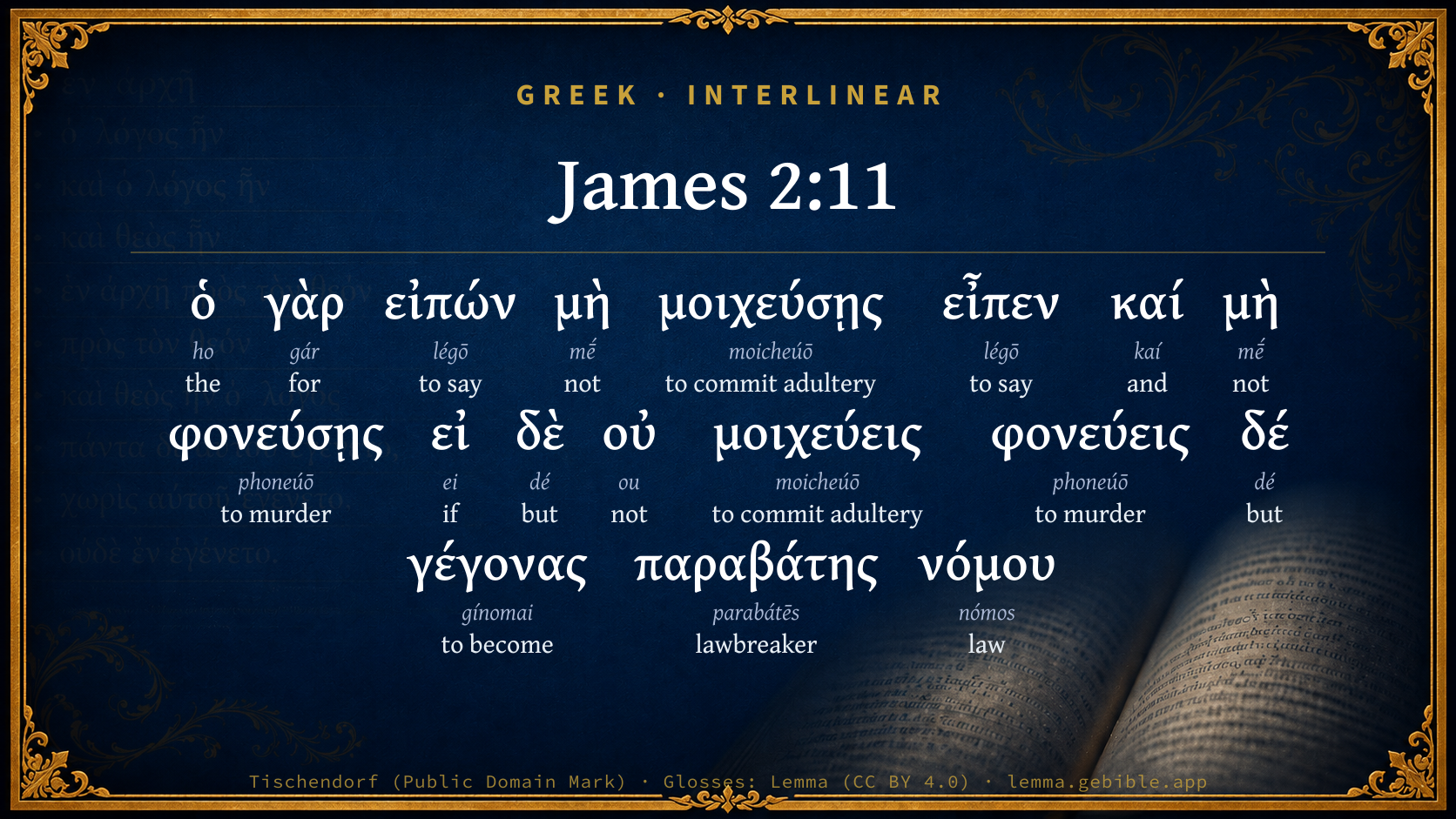
Greek (Tischendorf 8th ed.) James 2:11 appears in the Greek New Testament. The text above is from the Tischendorf 8th edition. Each word links to its Strong’s number and a concise gloss. Click any word for its full Thayer’s Greek Lexicon entry.
Download image
Cite this verse

James 2:11 (World English Bible). Public Domain. Lemma interlinear Bible study tool, https://lemma.gebible.app/v/james/2/11.

Show BibTeX & RIS
BibTeX
RIS
English Translation
For he who said, "Do not commit adultery," said also, "Do not commit murder." Now if you do not commit adultery, but murder, you have become a transgressor of the law.
World English Bible · Public Domain
Download a study sheet

One document with this verse’s original text, its word-by-word gloss line, the meaning frame, cross-references with their text, attributed commentary, and full source and license credits — printable, and it pastes into notes with its structure intact.

This verse Autodidact and up

Study sheet (.html) Plain text (.txt)

A passage Seminary Student

Up to 50 verses in one chapter. A passage sheet keeps up to 6 commentary sources and 12 cross-references per verse, in the order this page ranks them, and says so on the sheet whenever that leaves anything out. Ask for a single verse and you get the Autodidact verse sheet above.

Everything on this page stays free to read, with no account — the sheet is a download of what is already on screen, not access to it.

Want to remove ads? Support Godless Engineer
Compare translations 3

The same verse in 3 English versions, stacked beneath the original-language interlinear above. Click any original word for its lexicon entry.

Each is an independent rendering of the whole verse — the interlinear is not word-aligned to these translations.

Highlighted words mark where these versions differ — a whole-verse word diff, not a word-by-word alignment.

  • World English Bible Public Domain
    For he who said, "Do not commit adultery," said also, "Do not commit murder." Now if you do not commit adultery, but murder, you have become a transgressor of the law.
  • King James Version Public Domain
    For he that said, Do not commit adultery, said also, Do not kill. Now if thou commit no adultery, yet if thou kill, thou art become a transgressor of the law.
  • unfoldingWord Literal Text CC BY-SA 4.0
    For the one having said, “Do not commit adultery,” also said, “Do not murder.” If, then, you do not commit adultery but you do murder, you have become a transgressor of the law.

unfoldingWord Literal Text — © unfoldingWord, licensed CC BY-SA 4.0. Word-aligned USFM3 via Door43 (git.door43.org/unfoldingWord/en_ult).

Versions to compare (up to 4)

3 of 4 selected

Show all 19 translations

Every available English version of this verse, each an independent rendering of the whole verse.

  • World English Bible Public Domain
    For he who said, "Do not commit adultery," said also, "Do not commit murder." Now if you do not commit adultery, but murder, you have become a transgressor of the law.
  • Berean Standard Bible Public Domain
    For He who said, “Do not commit adultery,” also said, “Do not murder.” If you do not commit adultery, but do commit murder, you have become a lawbreaker.
  • Majority Standard Bible Public Domain
    For He who said, “Do not commit adultery,” also said, “Do not murder.” If you do not commit adultery, but do commit murder, you have become a lawbreaker.
  • King James Version Public Domain
    For he that said, Do not commit adultery, said also, Do not kill. Now if thou commit no adultery, yet if thou kill, thou art become a transgressor of the law.
  • American Standard Version (1901) Public Domain
    For he that said, Do not commit adultery, said also, Do not kill. Now if thou dost not commit adultery, but killest, thou art become a transgressor of the law.
  • Revised Version (1885) Public Domain
    For he that said, Do not commit adultery, said also, Do not kill. Now if thou dost not commit adultery, but killest, thou art become a transgressor of the law.
  • Geneva Bible (1599) Public Domain
    For he that saide, Thou shalt not commit adulterie, saide also, Thou shalt not kill. Nowe though thou doest none adulterie, yet if thou killest, thou art a transgressour of the Lawe.
  • Douay-Rheims (1899) Public Domain
    For he that said, Thou shalt not commit adultery, said also, Thou shalt not kill. Now if thou do not commit adultery, but shalt kill, thou art become a transgressor of the law.
  • Young's Literal Translation Public Domain
    for He who is saying, `Thou mayest not commit adultery,' said also, `Thou mayest do no murder;' and if thou shalt not commit adultery, and shalt commit murder, thou hast become a transgressor of law;
  • Literal Standard Version CC BY-SA 4.0
    for He who is saying, “You may not commit adultery,” also said, “You may not murder”; but if you will not commit adultery, but will commit murder, you have become a transgressor of law;
  • Unlocked Literal Bible CC BY-SA 4.0
    For the one who said, “Do not commit adultery,” also said, “Do not murder.” If you do not commit adultery, but if you do commit murder, you have become a lawbreaker.
  • unfoldingWord Literal Text CC BY-SA 4.0
    For the one having said, “Do not commit adultery,” also said, “Do not murder.” If, then, you do not commit adultery but you do murder, you have become a transgressor of the law.
  • Darby Bible Public Domain
    For he who said, Thou shalt not commit adultery, said also, Thou shalt not kill. Now if thou dost not commit adultery, but killest, thou art become transgressor of [the] law.
  • World Messianic Bible Public Domain
    For he who said, “Do not commit adultery,” also said, “Do not commit murder.” Now if you do not commit adultery but do murder, you have become a transgressor of the law.
  • Webster's Bible Public Domain
    For he that said, Do not commit adultery; said also, Do not kill. Now if thou committest no adultery, yet if thou killest, thou art become a transgressor of the law.
  • Free Bible Version CC BY-SA 4.0
    God told you not to commit adultery, and he also told you not to kill. So if you don't commit adultery, but you do kill, you've become a law-breaker.
  • Bible in Basic English Public Domain
    For he who said, Do not be untrue in married life, is the same who said, Put no man to death. Now if you are not untrue in married life, but you put a man to death, the law is broken.
  • Text-Critical English NT CC BY 4.0
    For he who said, “ Yoʋ shall not commit adultery,” also said, “ Yoʋ shall not murder.” Now if yoʋ do not commit adultery but do commit murder, yoʋ have become a transgressor of the law.
  • Tyndale New Testament (1534) Public Domain
    For he that sayd. Thou shallt not commit adulterie sayed also: thou shallt not kyll. Though thou do none adulterie yet yf thou kill thou arte a transgresser of the lawe.

Literal Standard Version (2020), Covenant Press — licensed CC BY-SA 4.0. Text via the HelloAO Bible API (eBible.org). Unlocked Literal Bible (unfoldingWord) — licensed CC BY-SA 4.0. Text via the HelloAO Bible API (eBible.org). unfoldingWord Literal Text — © unfoldingWord, licensed CC BY-SA 4.0. Word-aligned USFM3 via Door43 (git.door43.org/unfoldingWord/en_ult). Free Bible Version, Dr. Jonathan Gallagher — licensed CC BY-SA 4.0. Text via the HelloAO Bible API (eBible.org).

Word by word

More ways to search: Search by grammar → Find every occurrence → Compare this word →

Practice this passage: Drill this verse → Learn its vocabulary →

παραβάτης
parabátēs
G3848
“lawbreaker”
Noun, Nominative, Singular, Masculine
Part of Speech
Noun
Case
Nominative
Number
Singular
Gender
Masculine
Full Thayer's Definition

Origin: from G3845

TDNT: 17:20,8

1. a transgressor 2. a lawbreaker
  1. ὁ ho G3588 “the” Article, Nominative, Singular, Masculine
  2. γὰρ gár G1063 “for” Conjunction
  3. εἰπών légō G3004 “to say” Verb, Aorist, Active, Participle, Nominative, Singular, Masculine
  4. μὴ mḗ G3361 “not” Particle, Negative
  5. μοιχεύσῃς moicheúō G3431 “to commit adultery” Verb, Aorist, Active, Subjunctive, 2nd person, Singular
  6. εἶπεν légō G3004 “to say” Verb, Aorist, Active, Indicative, 3rd person, Singular
  7. καί kaí G2532 “and” Conjunction
  8. μὴ mḗ G3361 “not” Particle, Negative
  9. φονεύσῃς phoneúō G5407 “to murder” Verb, Aorist, Active, Subjunctive, 2nd person, Singular
  10. εἰ ei G1487 “if” Conditional
  11. δὲ dé G1161 “but” Conjunction
  12. οὐ ou G3756 “not” Particle, Negative
  13. μοιχεύεις moicheúō G3431 “to commit adultery” Verb, Present, Active, Indicative, 2nd person, Singular
  14. φονεύεις phoneúō G5407 “to murder” Verb, Present, Active, Indicative, 2nd person, Singular
  15. δέ dé G1161 “but” Conjunction
  16. γέγονας gínomai G1096 “to become” Verb, Perfect, Active, Indicative, 2nd person, Singular
  17. νόμου nómos G3551 “law” Noun, Genitive, Singular, Masculine

About this verse

These counts appear in no published source. They are computed here, from the morphology-tagged text and Lemma’s own curated glosses. What Lemma adds →

18
words
13
distinct lemmas
General Epistles
section

Notable vocabulary

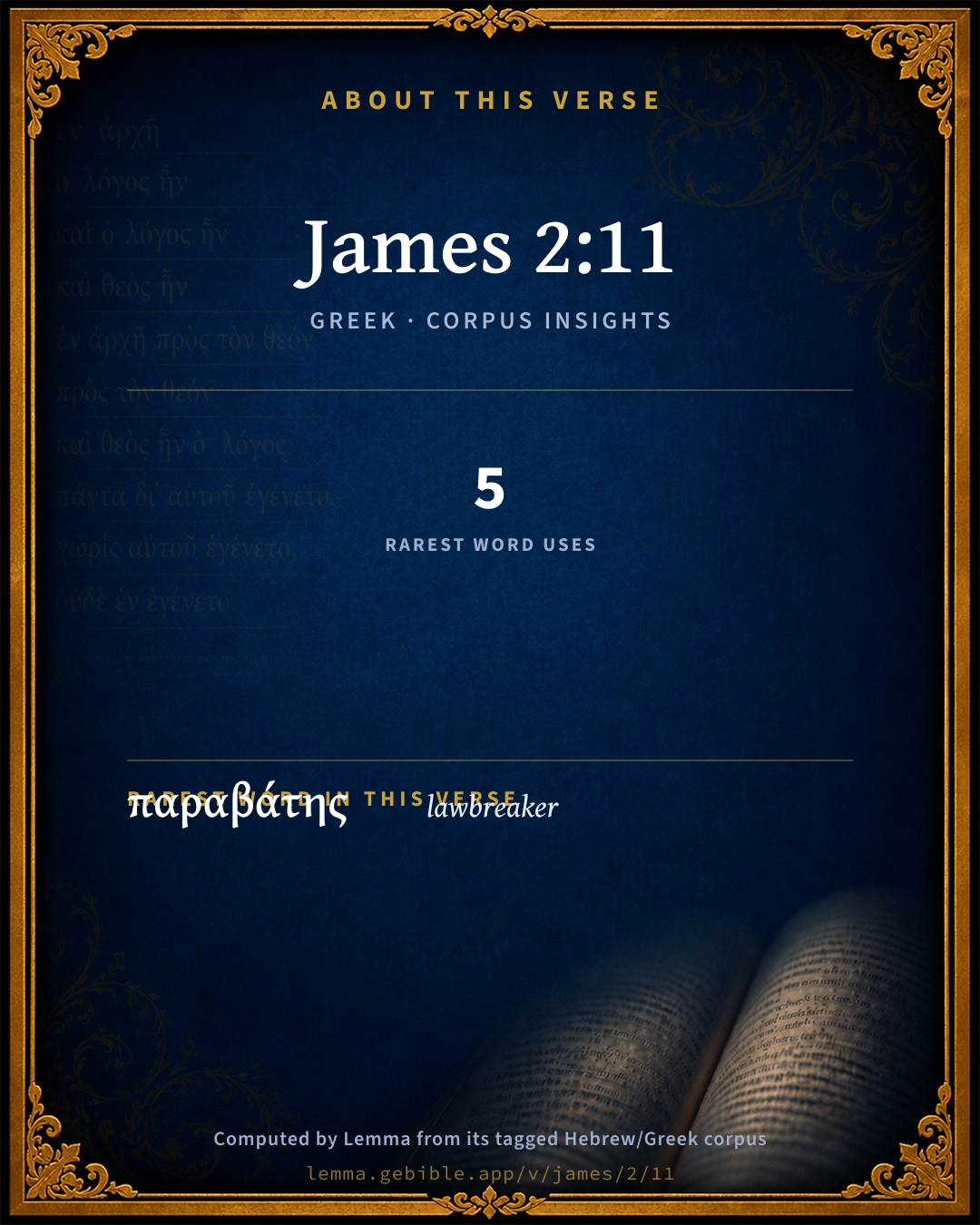
The rarest word here is παραβάτης lawbreaker G3848 — appearing just 5 times in the whole Greek New Testament.

Shared distinctive vocabulary

παραβάτης lawbreaker G3848 occurs in 5 verses of the Greek New Testament. Also found in:

Repetition

Words recur within this verse:

  • εἰπών to say G3004 ×2
  • μοιχεύσῃς to commit adultery G3431 ×2
  • φονεύσῃς to murder G5407 ×2
  • μὴ not G3361 ×2
  • δὲ but G1161 ×2

Cross-references

9

Topical passages linked to James 2:11 in the Treasury of Scripture Knowledge — connected by theme and wording, ordered by reader-vote popularity; previews shown in the World English Bible.

  • Exodus 20:13–14 "You shall not murder.
  • Matthew 5:21–28 "You have heard that it was said to the ancient ones, 'You shall not murder;' and 'Whoever shall murder shall be in danger of the judgment.'
  • Deuteronomy 5:17–18 "You shall not murder.
  • Romans 13:9 For the commandments, "You shall not commit adultery," "You shall not murder," "You shall not steal," "You shall not give false testimony," "You shall not covet," and whatever other commandments there are, are all summed up in this saying, namely, "You shall love your neighbor as yourself."
  • Psalms 130:3–4 If you, Yah, kept a record of sins, Lord, who could stand?
  • Matthew 19:18 He said to him, "Which ones?" Jesus said, "'You shall not murder.' 'You shall not commit adultery.' 'You shall not steal.' 'You shall not offer false testimony.'
  • Mark 10:19 You know the commandments: 'Do not murder,' 'Do not commit adultery,' 'Do not steal,' 'Do not give false testimony,' 'Do not defraud,' 'Honor your father and mother.'"
  • Luke 18:20 You know the commandments: 'Don't commit adultery,' 'Don't murder,' 'Don't steal,' 'Don't give false testimony,' 'Honor your father and your mother.'"
  • Leviticus 4:13 "'If the whole congregation of Israel sins, and the thing is hidden from the eyes of the assembly, and they have done any of the things which Yahweh has commanded not to be done, and are guilty;

Cross-references courtesy of OpenBible.info (CC BY 4.0).

Commentary

Notes on James 2:11 from classic Christian and Jewish commentators (each source and its license shown beneath its notes). The classic Christian expositions comment on the surrounding passage and are grouped to its opening verse, so a note may address several verses; the Jewish commentaries on the Tanakh (Rashi and others) are per-verse, so they appear only where the commentator wrote on this verse.

Lemma curates 59 commentaries, every one of them public domain or Creative Commons licensed, each selected and text-cleaned for this edition rather than reprinted as found. About our sources →

Adam Clarke's Commentary

Verse 11. For he that said] That is, the authority that gave one commandment gave also the rest; and he who breaks one resists this authority; so that the breach of any one commandment may be justly considered a breach of the whole law. It was a maxim also among the Jewish doctors that, if a man kept any one commandment carefully, though he broke all the rest, he might assure himself of the favour of God; for while they taught that "He who transgresses all the precepts of the law has broken the yoke, dissolved the covenant, and exposed the law to contempt, and so has he done who has broken even one precept," (Mechilta, fol. 5, Yalcut Simeoni, part 1, fol. 59,) they also taught, "that he who observed any principal command was equal to him who kept the whole law;" (Kiddushin, fol. 39;) and they give for example, "If a man abandon idolatry, it is the same as if he had fulfilled the whole law," (Ibid., fol. 40.) To correct this false doctrine James lays down that in the 11th verse. Jas 2:11 Thus they did and undid.

Adam Clarke's Commentary on the Bible (1810–1826) — public domain. Text from a community e-Sword/MySword module.

Bengel's Gnomon

Johann Albrecht Bengel

Jas 2:11. Ὁ γὰρ εἰπὼν, for He who said) It is one and the same Being who gave the whole law; and they who violate His will in one point, violate it altogether.

Bengel's Gnomon of the New Testament — English translation (T&T Clark, Edinburgh, 1860) — public domain. Text from a community e-Sword module.

Meyer's Critical & Exegetical Commentary

Heinrich August Wilhelm Meyer

Jam_2:11. The truth of the above thought is founded on the fact that all commandments proceed from one lawgiver.

ὁ γὰρ εἰπών· μὴ μοιχεύσῃς, εἶπεν καί· μὴ φονεύσῃς] Baumgarten finds the reason why James adduces these two commandments, μὴ μοιχεύσῃς and μὴ φονεύσῃς, in this, because the transgression of these two was punished with death; Wiesinger, on the other hand, because μοιχεύειν was never laid to the charge of the readers, whereas μὴ φονεύσῃς had the command of love as its essence; and Lange, because to the Israelite the prohibition of adultery was likewise the prohibition of apostasy to heathenism, and the prohibition of murder was likewise that of uncharitableness towards our neighbour. But the reason is rather because these two commandments are the first of those which refer to our duties to our neighbour (thus Brückner). That μὴ μοιχεύσῃς precedes the other has its reason in ancient tradition: see on both points Mar_10:19; Luk_18:20; Rom_13:9 (see Meyer in loc.); Philo, de decal. xii. 24, 32. With the words that follow: εἰ δὲ οὐ μοιχεύεις κ.τ.λ., James draws the inference from the preceding. The negative οὐ after εἰ with the indicative is not surprising in the N. T. usage, the less so as here only a part of the conditional sentence is denied; see Winer, p. 423 ff. [E. T. 601]; Al. Buttmann, p. 296 ff. [E. T. 346 f.[127]]. With the apodosis γέγονας παραβάτης νόμου James refers to Jam_2:9; consequently not ἔνοχος, as in Jam_2:10, but παραβάτης is put.

The reason of the judgment here expressed is contained in ὁ εἰπών … εἶπε καί. Since the law is the expression of the will of Him who gave it, the transgression of a single portion is disobedience to the one will, and consequently a transgression of the whole law. Bengel: unus est, qui totam legem tulit; cujus voluntatem qui una in re violant, totam violant. James might indeed have confirmed the idea by the internal connection of all commands, and by pointing out that the transgression of one commandment reveals a want which makes the fulfilment of the other commandments impossible;[128] but as he does not do so, these considerations are not to be arbitrarily introduced into his words.

[127] According to Buttmann, the negative οὐ here, even according to classic usage, is the more necessary, when to the negative predicate another, still in the protasis, is immediately so appended with an adversative particle that the entire emphasis falls upon this second part [E. T. 346]. It is indeed said in Thuc. i. 32: εἰ μὴ μετἀ κακίας, δόξης δὲ μᾶλλον ἁμαρτίᾳ … ἐναντία τολμῶμεν; but here the relation is different, as the contrast δόξης κ.τ.λ. could be left out without injury to the thought, which is evidently not the case with James.

[128] Augustine, in his Epistle to Jerome on this passage (Opera Hieronym., Francf. iv. p. 154 ff.), says: Unde fiet omnium reus, si in uno offendat, qui totam legem servaverit? An forte quia plenitudo legis charitas est, qua Deus proximusque diligitur, in quibus praeceptis charitatis tota lex pendet et prophetae, merito fit reus omnium, qui contra illam fecit, in qua pendent omnia? Nemo autem peccat, nisi adversus illam faciendo.Ticinus thus well expresses the unity of the law: lex tota est quasi una vestis, quae tota violatur, si vel unam ex ea partem demus; quasi harmonia, quae tota corrumpitur, si vel unica vox dissonet; and Gataker: quasi catena aurea, quae tota rupta est, si unicum nexum abrumpas. What Gunkel says is indeed correct: The solidarity consists in this, that God has given with the equal obligation the one as well as the other commandment; but the point of equal obligation is not here brought forward by James.

Meyer — Critical and Exegetical Commentary on the New Testament — English translation by Peter Christie, edited by Frederick Crombie (T&T Clark, 1880) — public domain. Text from a community e-Sword module.

Expositor's Greek Testament

ed. W. Robertson Nicoll

Jas 2:11 . μὴ μοιχεύσῃς , etc.: for the order of the seventh commandment preceding the sixth, cf. the Septuagint (Exo 20:13-14 ), and Luk 18:20 ; Rom 13:9 . With this mention of adultery and murder together should be compared §§ 9, 10 of the Apoc. of Peter ; in the former section the punishment of adulterers is described, in the latter that of murderers, while in § 11 mention is made of the children who were the victims of murder. Possibly it is nothing more than a coincidence, but the fact is worth drawing attention to that in the Apoc. of Peter (or, more strictly, in the extant remains of this) the punishment is described only of those who had been guilty of evil speaking (blasphemy), adultery, murder, and the wealthy who had not had pity upon widows and orphans. These are the sins upon which special stress is laid in our Epistle; other sins receive only incidental mention.

The Expositor's Greek Testament, edited by W. Robertson Nicoll (1897–1910) — public domain. Text from a community e-Sword module.

Geneva Bible (1599)

Geneva Bible translators

A proof: because the Lawmaker is always one and the selfsame, and the body of the Law cannot be divided.

Geneva Bible (1599) marginal notes — public domain. Text via Bolls.life.

Jamieson, Fausset & Brown

Robert Jamieson, A. R. Fausset & David Brown

He is One who gave the whole law; therefore, they who violate His will in one point, violate it all [BENGEL]. The law and its Author alike have a complete unity.

adultery . . . kill--selected as being the most glaring cases of violation of duty towards one's neighbor.

Jamieson, Fausset & Brown — Commentary Critical and Explanatory on the Whole Bible (1871) — public domain (CC PDM 1.0). Text via the HelloAO Bible API.

John Calvin's Commentaries

11 For he that said, or he who hath said. This is a proof of the former verse; because the Lawgiver is to be considered rather than each particular precept apart. The righteousness of God, as an indivisible body, is contained in the law. Whosoever, then, transgresses one article of the Law, destroys, as far as he can, the righteousness of God. Besides, as in one part, so in every part, God’s will is to try our obedience. Hence a transgressor of the law is every one who offends as to any one of its commandments according to this saying,

“Cursed is he who fulfills not all things.” (Deuteronomy 27:26.)

We further see, that the transgressor of the law, and the guilty of all, mean the same according to James.

John Calvin's Commentaries (1540-1563) — public domain. Text from the Calvin Translation Society English edition (1840s-50s) via the Christian Classics Ethereal Library (ccel.org). Calvin's coverage is partial (roughly two-thirds of the Bible); uncommented books and verses are honest gaps, never fabricated. The 19th-century editor's footnotes and remarks are omitted so the notes are faithfully Calvin's own voice.

Ellicott's Commentary for English Readers

(11) For he that said . . .—All men have favourite vices and indulgences; and most

“Compound for sins they have a mind to

By damning those they’re not inclined to;”

forgetful that the same Lawgiver has laid His restrictions upon every sort and kind. Not that we can believe all sins are the same in their deadening effect upon the soul, or, further, in their punishment. The point which St. James urges is that sin, as sin, involves the curse of the law; and that “respect of persons,” with its unloving and unlovely results, must bring its deceived possessor into condemnation before God. Just as our Lord referred the Sixth and Seventh Commandments (Mat_5:21-32) to the first issues of the angry or lustful heart, and by no means confined them as did the Rabbinical teachers to the very act, so now in like manner the Apostle takes his stand upon the guiltiness of any breach whatever of the Law. Love is its complete fulfilment, we are well informed (Rom_13:10), but in that startling briefness lies comprehended all the decalogue, with its utmost ramifications; and men of the world would find a rule of the most minute and rigid ceremony easier to be followed than this simple all-embracing one. “The fulfilling of the Law” is very different from the substitution of a single plain command for a difficult code; this would seem to be the mistake of many, noisily asserting their freedom from the older obligations, who do not so evidently live under the mild bondage of the new.

A curious question may be raised upon the inverted order of the Sixth and Seventh Commandments in this passage, as well as in Mar_10:19; Luk_18:20; Rom_13:9. (Not so however, observe, in the sermon on the Mount, Mat_5:21-27.) Professor Plumptre says they are thus placed because “standing first in the second table, the Fifth being classed by most Jewish writers as belonging to the first,” and “there was, probably, a traditional order of the Tenth, varying from that at present found in the Hebrew Pentateuch.” The Greek version, known as the Septuagint, supports this theory, placing “Thou shalt not commit adultery” in Jas_2:13 of Exodus 20, and “Thou shalt not kill” in Jas_2:15.

A Bible Commentary for English Readers, edited by Charles John Ellicott (1878–1897) — public domain. Text from a community e-Sword module.

The Cambridge Bible for Schools and Colleges

gen. ed. J. J. S. Perowne

11. For he that said, Do not commit adultery …] The two commandments are chosen as standing first in the Second Table, the fifth being classed by most Jewish writers as belonging to the First, just as in Greek and Roman ethics, duty to parents came under the head of Εὐσεβεία and Pietas, rather than under that of Justice (comp. 1Ti_5:4). This division is recognised by Josephus (Ant. iii. 6. § 6) and Philo (De Decal. i.), and falls in better than the common one with the pentad and duad grouping that pervades the Law. It is singular that in all New Testament quotations from the Second Table “Thou shalt not commit adultery” precedes “Thou shalt not kill,” Mar_10:19; Luk_18:20; Rom_13:9; and the order is made the subject of direct comment by Philo (De Decal. xii. 24). It may be inferred from this that there was, probably, a traditional order varying from that at present found in the Hebrew Pentateuch.

The Cambridge Bible for Schools and Colleges (gen. ed. J. J. S. Perowne; Cambridge University Press, 1878–1918) — public domain. Text from a community e-Sword module.

John Gill's Exposition

For he that said, Do not commit adultery,.... That same lawgiver, who is but one, and is God, that gave out the seventh command, and forbids adultery,

said also, Do not kill; delivered the sixth command, which forbids murder.

Now if thou commit no adultery; do not break the seventh command;

yet if thou kill, break the sixth command,

thou art become a transgressor of the law; not of that particular precept of the law, the seventh command, for the contrary is supposed before, but of the sixth only; and yet by so doing, a man becomes a violator of the whole law; for the law is but one, though it consists of various precepts; and the breach of one precept, as well as of another, is the breach of the law: and besides, there is but one lawgiver, who has enjoined one command, as well as another, and whose legislative power and authority is despised and trampled upon by the violation of one command, as of another. This is the apostle's argument, and way of reasoning, proving the above assertion, that he that breaks the law in one particular instance, is guilty of the breach of the whole law.

John Gill's Exposition of the Whole Bible (1746–1763) — public domain (CC PDM 1.0). Text via the HelloAO Bible API.

Trapp's Complete Commentary

John Trapp

11 For he that said, Do not commit adultery, said also, Do not kill. Now if thou commit no adultery, yet if thou kill, thou art become a transgressor of the law.

Ver. 11. For he that said] "God spake all those words, and said;" there is the same divine authority for one commandment as another, Exo 20:1. The Pharisees had their minutula legis, insignificant laws, but Christ cries them down, Mat 5:20. The Jews to this day senselessly argue, "Cursed is he that abides not in all things," therefore he is not cursed that abides in some things only.

Thou art become a transgressor of the law] Now every transgression and disobedience receiveth a just recompence of reward, Heb 2:2.

John Trapp, A Commentary or Exposition upon All the Books of the Old and New Testament (1647–1656) — public domain. Text from a community e-Sword module.

Albert Barnes' Notes on the Bible

For he that said, Do not commit adultery, said also, Do not kill - That is, these are parts of the same law of God, and one is as obligatory as the other. If, therefore, you violate either of these precepts, you transgress the law of God as such, and must be held to be guilty of violating it as a whole. The penalty of the law will be incurred, whatever precept you violate.

Albert Barnes' Notes on the Bible (1834–1885) — public domain. Text from a community e-Sword/MySword module.

Matthew Poole's English Annotations

All proof of what he laid down in the former verse, by instancing in these two commands, there being the same reason of all the rest, the same sovereignty and righteousness of God appearing in them, and it being the will of God to try our obedience in one as well as another.

Thou art become a transgressor of the law; viz. by contemning the authority and holiness of God, which appears in the whole law, and every command of it.

Matthew Poole's English Annotations on the Holy Bible (1683–1685) — public domain. Text from a community e-Sword/MySword module.

Whedon's Commentary on the Bible

Daniel D. Whedon

11. For—It is not meant that you have committed each and every mentionable act of transgression. The ten commandments are but so many specifications under the one law of love; they are but specifications of various ways in which that one whole law can be violated. Every specific violation is a violation of that one whole law. He—The same one undivided divine Authority is promulgator of the one law, which so branches into ten specifications. Violating any one specification impinges against that entire authority. It denies the supremacy of God. It is treason against the government of the universe.

No adultery—You may be as chaste as “the icicle in Dian’s temple,” yet, if you murder, your virtue will not save you. There is to be no balancing of account with heaven between your vices and your virtues. Every vice breaks the whole law.

A modern American poem described a western steamboat pilot who closed a life of profligacy with being blown up in order to save the lives of the passengers on board his boat. It assumes that his self-sacrifice in death would atone for his profligate life, and concludes by declaring that Christ would not severely judge “the man who died for men.” But the death was scarcely less profligate than the life. It was simply that same desperate recklessness of life, acting under an impulse of professional pride, as he would show in a fray for supremacy or advantage in any other matter. No such act could atone for the crimes against temperance, chastity, the rights of his fellow men, and the laws of God, which, as described in the poem itself, formed the staple of this bad hero’s existence. The writing of such poetry is as profligate and demoralizing as the life it heroizes.

Daniel D. Whedon (gen. ed.), Commentary on the Old and New Testaments (1874–1909) — public domain. Text from a community e-Sword module.

The Pulpit Commentary

Do not commit adultery do not kill. The order of the commandments is remarkable; what is now the seventh is placed bolero the sixth. This appears to have been the usual order at that time. In this order our Lord quotes them in Luk_18:20, and St. Paul in Rom_13:9. Philo also has the same order, and expressly comments on it, drawingfrom it an argument for the heinousness of adultery ("Dec.," 12:24). In the Vatican Manuscript of the LXX in Exo_20:13-15 the order is, Thou shalt not commit adultery. Thou shalt not steal. Thou shalt not kill." But the Alexandrian Manuscript has the usual order, which is also found in Mat_19:18 and Mar_10:19 (according to the correct reading).

The Pulpit Commentary (1880–1919), ed. H.D.M. Spence-Jones & Joseph S. Exell — public domain. Text from a community e-Sword module.

John Wesley's Explanatory Notes

For it is the same authority which establishes every commandment.

John Wesley, Explanatory Notes Upon the Whole Bible (1754–1765) — public domain. Text via the GEBible commentary corpus.

Scofield Reference Notes

C. I. Scofield

transgressor

Sin. (See Scofield "Rom 3:23").

The Scofield Reference Bible (1917 edition), notes by C. I. Scofield — public domain. Text from a community e-Sword module.

Burkitt's Expository Notes on the New Testament

William Burkitt

As if the apostle had said, "He that threatened adultery with death, threatened also murder with death; it is the same lawgiver that forbids both, and his authority is as truly contemned in transgressing one as both these laws. Disobedience to God, in any one law, is a virtual denying of his authority to prescribe any law to us, and lays a foundation for universal disobedience; for if Almighty God’s sovereignty be disowned in any one instance, it may as well be so in all other; the same reason that leads to the observation or violation of one law, doth oblige us to keep or break all the rest, and that is the authority of the lawgiver. The whole law hath an equal obligation upon the conscience." From hence the apostle draws this inference, that persons should so speak and so do, so order their speeches and their actions, as they that shall be judged by the law of liberty.

Note here, 1. That all we say and do, all our actions and expressions, do fall under the judgment and sentence of the law of God.

2. That the law of God, in the hand of Christ, is the law of liberty; we are freed from it as a covenant, freed from its condemnatory curse, freed from its rigorous exactions, bondage, and terrors. The law to a believer is a law of liberty, and to others a law of bondage and death.

3. That it will be a great help to us in our Christian course, to think often that all our words and actions must come into judgment; it is agreeable to the liberty of the gospel to believe and remember, that all we say and do must be judged by the law of liberty.

William Burkitt's Expository Notes on the New Testament (1700–1703) — public domain. Text from a community e-Sword module.

The People's New Testament

B. W. Johnson

11. He that said, etc. He that gave one command, gave the other commands. If you break any one of them, you sin against the Divine Lawgiver.

B. W. Johnson's The People's New Testament with Notes (1889–1891) — public domain. Electronic text from the Christian Classics Ethereal Library (CCEL) ThML edition.

Cambridge Greek Testament for Schools and Colleges

11. εἰ δὲ οὐ μοιχεύεις. This use of οὐ for μή in the protasis of a conditional sentence is not infrequent in the N.T., especially when there is an antithesis between a negative and affirmative sentence as here. As Dr Moulton notes on Winer, p. 601, the expression is equivalent to εἰ οὐ μοιχεύων ἔσῃ, φονεύων δέ. εἰ οὐ μοιχεύεις = ‘if thou art guiltless of adultery.’ Comp. εἰ τοὺς θανόντας οὐκ ἐᾷς θάπτειν, Soph. Aj. 1131; εἰ ἀποστῆναι Ἀθηναίων οὐκ ἠθελήσαμεν, Thuc. III. 55; εἰ ἄλλοις οὐκ εἰμὶ ἀπόστολος ἀλλά γε ὑμῖν εἰμί, 1Co 9:2.

In Modern Greek ἐὰν δέν (the modern equivalent to οὐ) is the regular idiom.

Cambridge Greek Testament for Schools and Colleges (Cambridge University Press, 1896; 21 vols, various authors incl. Carr, Maclear, Plummer, Farrar, Lumby, Moule, M. R. James, Simcox) — public domain. Text from a community e-Sword module.

Alford’s Greek Testament

Henry Alford

11.] Reason for this assertion: the unity of the divine Author of the whole law, and of that law, as the exponent of His will: “Unus est, qui totam legem tulit: cujus voluntatem qui una in re violant, totam violant,” Bengel. Cf. also Ep. ad Hieronym. on this passage. For He who said, Commit not adultery, said also, Commit not murder; now if thou committest no adultery (οὐ, and not μή, because the attention is fixed on the fact of no committal of adultery having taken place. It corresponds, in fact, to μὴ μοιχεύσῃς above in prohibition. See Winer, § 55. 2, c. d: and cf. ch. 1:23; 3:2: 1Co 16:22), but committest murder, thou hast become a transgressor of the law. (Various fanciful reasons have been given for the selection of these two commandments: “because these two were punished with death,” Baumgarten: “because no one had laid a charge of adultery against the readers, but the other they violated by violating the law of love,” Wiesinger. But it is far more likely that they are alleged as the two first which regard our duty to our neighbour generally: μὴ μοιχεύσῃς being put first, as in Mar 10:19: Luk 18:20: Rom 13:9: Philo de Decalog. § 10, 12, 24, 82, vol. ii. pp. 186, 189, 201, 207, who lays a stress on this order as shewing that adultery is μέγιστον ἀδικημάτων: see also De Spec. Leg. ad 6 Est_7 Dec. Cap. § 2, p. 300. So that this order must have been one preserved in ancient tradition: or perhaps found anciently in the LXX. The Rabbis have the same sentiment as this: Wolf quotes from the Talm. Sabbath, fol. lxx. 2, where R. Jochanan says of the 39 precepts of Moses, “Quod si faciat omnia, unum vero omittat, omnium et singulorum reus est.”)

12,

Henry Alford, The Greek Testament (1849–1861) — public domain. Text from a community e-Sword module.

International Critical Commentary

11. μὴ μοιχεύσῃς … μὴ φονεύσῃς. Exo 20:13, Exo 20:15, Deu 5:17 f.. This order, in which the seventh commandment is mentioned before the sixth, is perhaps due to the order found in the LXX (Cod. B, not AF) of Exo_20. So Luk 18:20, Rom 13:9, Philo, De decal. 12, 24, 32, De spec. leg. iii, 2; but not so Mat 5:21, Mat 5:27.

C minnpauci syrhcl arm have conformed the text to the usual order by putting murder first. In the following sentence this is done by minnpauci arm.

οὐ μοιχεύεις. οὐ follows the regular N. T. usage in present simple conditions. Cf. Buttmann, § 148; Burton, § 469; J. H. Moulton, Prolegomena, pp. 170 f.; Winer, § 55, 2, c (where it is said that εἰ οὐ makes the negative emphatic). Here, since the negative belongs only to a part of the protasis (μοιχεύεις) and not to the rest (φονεύεις), οὐ is in any case necessary.

International Critical Commentary — older volumes (1896–1929), various authors — public domain. Text from a community e-Sword module.

Vincent's Word Studies in the New Testament

Marvin R. Vincent

A transgressor [παραβατης] . From para, beyond, and bainw, to go. A transgressor, therefore, is one who goes beyond the line. So, also, trespass, which is trespass, from the Latin trans, across, and passus, a step. A similar word occurs in Homer, uJperbasia, a transgression or trespass, from uJper, over, and bainw, to go.

Marvin R. Vincent, Word Studies in the New Testament (1887–1900) — public domain. Text from a community e-Sword/MySword module.

Lesson kit

Teaching starters — assembled from the data on this page, not authored interpretation. Every prompt links to the verse data it draws on. Edit before teaching.

James, in the General Epistles, opens this verse with 18 words (13 distinct Greek lemmas). Its most distinctive word is parabátēs (“lawbreaker”). A historical commentator’s framing appears above. Read the whole chapter for the surrounding context.

Discussion questions

  1. How does “lawbreaker” (parabátēs) shape what this verse is saying?
  2. Romans 2:25 shares the word «lawbreaker» with this verse. How do the two illuminate each other?
  3. “to say” occurs 2× in this one verse. What is the effect of the repetition?
  4. These translations render this verse differently; the difference is in the English rendering, not the original. What questions does that raise?
  5. Reading how Adam Clarke's Commentary and Bengel's Gnomon read this verse, where do the two commentators agree and where do they part?

Things to notice

  • These translations choose different wording for 8 words in this verse.
  • “to say” occurs 2× in this single verse.
  • 13 distinct Greek lemmas span 18 words in this verse.

Reading settings

Reading text

Shown beneath each verse's original-language words.

Old Testament
Old Testament edition

Read the OT as the Masoretic Hebrew (MT) or the Greek Septuagint (LXX).

English shown for the Greek Septuagint (in the Hebrew ↔ Greek comparison).

Comparing translations? Open the Compare panel on any verse page to stack up to four side by side.